HAL Id: tel-01336757
https://hal.inria.fr/tel-01336757
Submitted on 27 Jun 2016
HAL is a multi-disciplinary open access archive for the deposit and dissemination of sci-entific research documents, whether they are
pub-L’archive ouverte pluridisciplinaire HAL, est destinée au dépôt et à la diffusion de documents scientifiques de niveau recherche, publiés ou non,
To cite this version:
Saverio Giallorenzo. Real-World Choreographies. Distributed, Parallel, and Cluster Computing [cs.DC]. Università degli studi di Bologna, 2016. English. �tel-01336757�
Alma Mater Studiorum — Universit`a di Bologna
DOTTORATO DI RICERCA IN INFORMATICA
Ciclo: XXVIII
Settore Concorsuale di Afferenza: 01/B1 Settore Scientifico Disciplinare: INF/01
Real-World Choreographies
Presentata da: Saverio Giallorenzo Coordinatore Dottorato: Paolo Ciaccia Relatore: Maurizio Gabbrielli Correlatore: Fabrizio Montesi
Abstract
Since the early days of the Internet, distributed software applications have become one of the leading forces behind the development and economic growth of our society. Nonethe-less, the practice of programming distributed systems is one of the most error-prone. De-velopers strive to correctly implement separate components that, put together, enact an agreed protocol. If one component fails to follow such protocol, it could lead to sys-tem blocks or misbehaviours. Ensuring that all components correctly follow the intended protocol is very difficult due to the inherent non-determinism of distributed programs.
This led practitioners and theoretical researchers to explore new tools to assist the de-velopment of distributed systems. Choreographies are one of these tools. They have been introduced to describe from a global viewpoint the exchange of messages among the com-ponents of a distributed system. Moreover, since they describe atomic communications (not split into I/Os), they are free from deadlocks and race conditions by design. Recent theoretical results proved that it is possible to define proper Endpoint Projection (EPP) functions to compile choreographic specifications into their single components. Since EPPs are behaviour preserving, projected systems also enjoy freedom from deadlocks and races by construction. Some of these results have been implemented, however much work has to be done to make choreographies a suitable tool for real-world programming.
Aim of this PhD is to formalise non-trivial features of distributed systems with chore-ographies and to translate our theoretical results into the practice of implemented systems. To this purpose, we provide two main contributions.
The first contribution tackles one of the most challenging features of distributed de-velopment: programming correct and consistent runtime updates of distributed systems. There is no affirmed technology for structuring runtime updates of distributed applica-tions. Moreover, the non-determinism of distributed systems easily leads to partial ap-plications of updates and to inconsistent systems. Our solution is a theoretical model of dynamic choreographies, called DIOC. DIOC provides a clear definition of which com-ponents and behaviours can be updated. We prove that systems compiled from a DIOC definition are correct and consistent after any update. Finally, we refine our theoretical model with constructs for a finer control over updates. On this refinement, we develop a framework for programming adaptable distributed systems, called AIOCJ.
The second contribution covers one of the main issues of implementing theoretical re-sults on choreographies: formalising the compilation from choreographies to executable programs. There is a sensible departure between choreographic frameworks like Chor (the first on this paradigm) and AIOCJ and their theoretical models: their theories abstract communications with synchronisation on names (`a la CCS/π-calculus) yet they compile to Jolie programs, an executable language that uses correlation — a renowned technol-ogy of Service-Oriented Computing — for message routing. This discontinuity breaks the chain of proven correctness from choreographies to implemented systems. Our solution is a theory of Applied Choreographies (AC) that models correlation-based message passing. With AC, we formalise the key theoretical problems and the guiding principles that de-velopers should follow to obtain correct implementations. Finally, we prove our approach by defining a correct compiler from AC to the calculus behind the Jolie language.
III
Acknowledgements
If I have seen further, it is by standing on the shoulders of giants.
Sir Isaac Newton
A PhD is a formidable endeavour, not only academically speaking but also at the per-sonal level. It gave to me the opportunity to face my limits, to experiment failure, and, in many senses, to grow up. Thankfully, I was very lucky to have the best people around me. These are my acknowledgements to them all.
I thank my parents, Patrizia and Vito, for supporting all my (mostly eccentric) projects and for giving me the freedom to be wrong. I owe to them my creativity and love for Science. They taught me patience and perseverance, principles that “saved” me countless times and that I like to think constitute some of my best qualities.
In these years, I also contracted an infinite debt of gratitude with my girlfriend Daniela. She has been my most passionate supporter and best friend. Times and times she encour-aged me while I lingered in self-doubt and comforted me when I complained about broken formalisations, buggy programs, and rejected papers. I owe to her all the sacrifices she made for me: the days and nights passed alone while I was working for a deadline, the missed vacations, and the long trips to Denmark. I deeply thank her for all the love she gave to me and for accepting a simple “Ti amo” (“I love you”) in exchange for all of that.
I dedicate this work to Daniela, Ma, and Pa, for their unbreakable belief in me. Thanks also to Roberta and Andrea for having accepted this chaotic guy in their family and to Giorgia for all the joyful games and talks about dinosaurs (!).
In my PhD I had the good fortune to have many teachers, whom I thank. Thanks to my two co-advisors: Maurizio Gabbrielli and Fabrizio Montesi.
I thank Maurizio for having believed in me and that a poor “Scienziato di Internet” (graduate in IT and Management) could pull off some basic research. I owe to Maurizio many thanks: for having set up a nice research team at the beginning of my PhD, for the freedom he has always given to me, for having pushed me beyond my limits, and for cheering me up during my saddest moments.
I owe a lot also to Fabrizio. He is the crazy guy who coded the most part of the Jolie language, which brought me in 2012 to work with him in Copenhagen (again, thanks to Maurizio) while he was working on his PhD on “Choreographic Programming” — of which this thesis can be considered a continuation. Fabrizio dedicated a lot of his time to teach me academic rigour and to seek clarity in the definition of problems before venturing in their resolution. I really enjoyed all the time we spent together trying to bring elegance and balance to our formalisations, Jolie, and choreographies1.
Thanks to Ivan Lanese for the many times he proved me (and, above all, calmly ex-plained why I was) wrong. I hope I have been able to steal a little of Ivan’s mathematical genius and cleverness during our restless sessions on our theoretical model and its proofs.
Thanks to Jacopo — O Captain, My Captain! — Mauro. I had the good fortune to have a big brother like him in the Underground Laboratory in Bologna. Thanks for having given to me stability when I desperately needed some, for all the advices and chats, and for begin a very good friend to me.
Thanks to Claudio Guidi for having introduced me into the academic world, “Galeotto fu il linguaggio (Jolie) e chi lo scrisse2” and for all the inspiring conversations we had on
languages, abstractions, and “visions”.
Thanks to Marco Carbone, my (now) academic grandfather who (back then) hosted me for my first stay-abroad in Copenhagen. It was a pleasure to know him as a person and I thank him for contributing in making all this possible.
Thanks to Davide Sangiorgi for all the inestimable support he gave to me before and during my PhD, both academically and personally. I am also really grateful to Davide for having let me teach Jolie in his course on Operating Systems (yay!).
Thanks to Gianluigi Zavattaro for the interesting discussions and alternative visions on choreographies and for having given to me the opportunity to present Jolie at the Bertinoro International Spring School, that was really great!
I also want to thank my reviewers, Ilaria Castellani and Thomas Hildebrandt, who not only took the duty of refereeing this thesis but provided encouraging and stimulating comments to improve its contents.
I thank all the members of the INRIA Focus team in Bologna for all the inspiring talks. Thanks to the people in the research group of Programming, Logic and, Semantics at the IT University of Copenhagen and in the department of Mathematics and Computer Science (IMADA) at the Southern Denmark University. I also thank Maja, Borna, Marco, and Luís for the joyful time in Odense.
Finally I owe a great deal of gratitude to all my fellow colleagues and PhD students for having shared with me the joys, the grumbles, the aperitivi, and the awesome discussions in and out of the (Hardcore) Underground Laboratory.
Many thanks to Valeria Vignudelli for the endless hours spent to teach me proof tech-niques, for all the laughs, and the cheerful pats on the shoulder that I needed.
Thanks to Jean-Marie Madiot for sharing with me many serious (and definitely not seri-ous) talks, many pat-pats on the shoulder, and for that “You don’t know Hacker News?!”. Thanks to Francesco Gavazzo, for the desperate mission to explain to me Category Theory and for all the fruitful chats on the philosophy of dark knights and the super men. Thanks also to Mila, Ornela, Paolo, Gustavo, Giulio, Roberto, Abel and Yiyi (¡gracias por el ron!), Stefano, Vincenzo, Giacomo, (the other) Vincenzo, Federico, and Luca for all the nice time spent together.
V
List of Publications
• Dalla Preda, Mila, Maurizio Gabbrielli, Saverio Giallorenzo, Ivan Lanese, and Jacopo Mauro.Dynamic Choreographies: From Theory to Practice. Submitted.
• Maurizio Gabbrielli, Saverio Giallorenzo, Claudio Guidi, Fabrizio Montesi, Jacopo Mauro. Self-configuring Microservices. In Theory and Practice of Formal Methods, pp. 194–210. Springer International Publishing, 2016. • Maurizio Gabbrielli, Saverio Giallorenzo, and Fabrizio Montesi. Applied
Choreographies. Submitted.
• Dalla Preda, Mila, Maurizio Gabbrielli, Saverio Giallorenzo, Ivan Lanese, and Jacopo Mauro. Dynamic Choreographies — Safe Runtime Update of Distributed Applications. In Coordination Models and Languages, pp. 67–82. Springer International Publishing, 2015.
• Dalla Preda, Mila, Maurizio Gabbrielli, Saverio Giallorenzo, Ivan Lanese, and Jacopo Mauro. Developing correct, distributed, adaptive software. Sci-ence of Computer Programming 97, pp. 1–46. Elsevier, 2015.
• Dalla Preda, Mila, Saverio Giallorenzo, Ivan Lanese, Jacopo Mauro, and Maurizio Gabbrielli.AIOCJ: A choreographic framework for safe adap-tive distributed applications. In Software Language Engineering, pp. 161-170. Springer International Publishing, 2014.
• Maurizio Gabbrielli, Saverio Giallorenzo, and Fabrizio Montesi. Service-Oriented Architectures: from design to production exploiting workflow pat-terns. In Distributed Computing and Artificial Intelligence, 11th Interna-tional Conference, pp. 131–139. Springer InternaInterna-tional Publishing, 2014. • Claudio Guidi, Saverio Giallorenzo, and Maurizio Gabbrielli. Towards a
Composition-based APIaaS Layer, In CLOSER 2014 - Proceedings of the 4th International Conference on Cloud Computing and Services Science, pp. 425–432. SciTePress, 2014.
Contents
Abstract I Acknowledgements III List of Publications V Table of Contents VI List of Figures XI1 Introduction to the dissertation 1
1.1 Problem Description . . . 1
1.2 Aim and Thesis Statement . . . 1
1.3 Contributions . . . 3
1.4 Structure of the Dissertation . . . 3
I Introduction and Background
7
2 Introduction to Choreographies 9 2.1 Distributed Programming, in brief . . . 92.1.1 Problems of Distributed Programming . . . 10
2.2 The Service-Oriented Approach . . . 12
2.2.1 Breaking down complexity . . . 14
2.3 Orchestration . . . 15
2.5 Programming with Choreographies . . . 18
2.6 Contributions . . . 20
II Adaptable Choreographies
23
3 Runtime Software Update and Adaptation 25 3.1 Linguistic Constructs for Adaptation . . . 253.1.1 Reflection and Metaprogramming . . . 27
3.1.2 Aspect- and Context-Oriented Programming . . . 28
3.1.3 Adaptation in Process-Aware Information Systems . . . . 29
3.2 Safe Update of Distributed Systems . . . 32
4 Dynamic Choreographies 33 4.1 Introduction . . . 33
4.2 Dynamic Interaction-Oriented Choreographies . . . 36
4.2.1 DIOC Syntax . . . 36
4.2.2 Annotated DIOCs and their Semantics . . . 37
4.3 Dynamic Process-Oriented Choreographies . . . 42
4.3.1 DPOC syntax . . . 42
4.3.2 DPOC semantics . . . 44
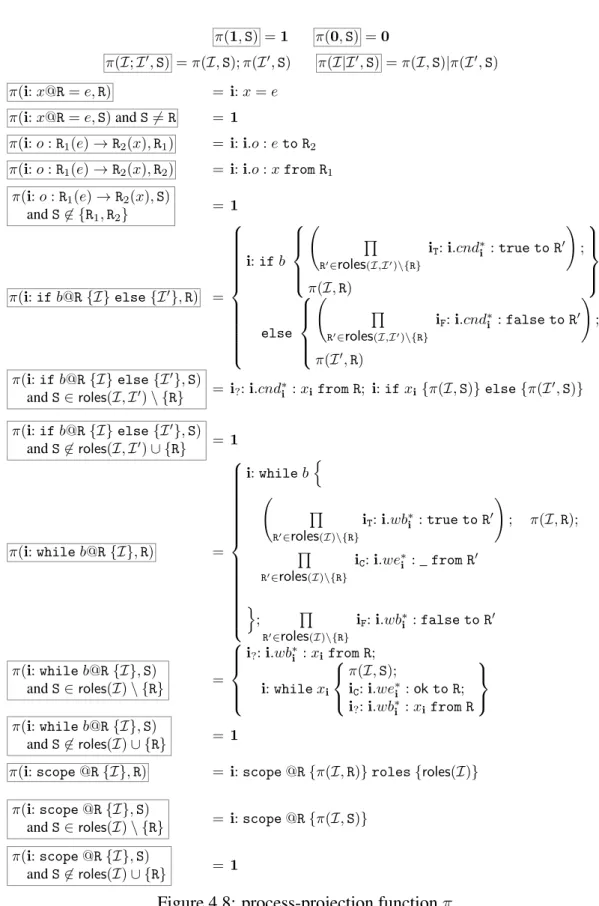
4.4 Projection Function . . . 49
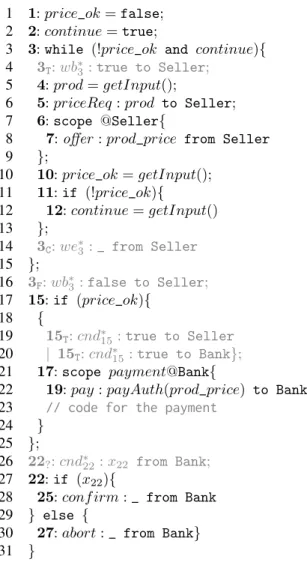
4.5 Running Example: Projection and Execution . . . 53
4.5.1 Projection . . . 53
4.5.2 Runtime Execution . . . 53
4.6 Connected DIOCs . . . 57
4.7 Correctness . . . 60
5 Adaptable Interaction-Oriented Choreographies in Jolie 65 5.1 Introduction . . . 65
5.1.1 DIOC Language Extensions in AIOCJ . . . 66
5.2 AIOCJ Practice . . . 69
5.3 Implementation . . . 70
5.4 Validation . . . 72
III Applied Choreographies
77
6 Applied Choreographies 79 6.1 Introduction . . . 79CONTENTS IX
6.2.1 Syntax . . . 82
6.2.2 Semantics . . . 84
6.2.3 An example . . . 90
6.3 Typing . . . 92
6.3.1 Types and Type Projection . . . 92
6.3.2 Type checking . . . 93 6.3.3 Runtime Typing . . . 96 6.3.4 Properties . . . 101 6.4 Endpoint Projection . . . 102 6.4.1 Projection Example . . . 104 6.4.2 Properties . . . 105
6.5 Dynamic Correlation Calculus Language . . . 106
6.6 Compiler from AC to DCC and Properties . . . 107
6.6.1 Compiler . . . 107 6.6.2 Example of Compilation . . . 111 6.6.3 Properties . . . 113
IV Conclusion
115
7 Conclusion 117 7.1 Adaptable Choreographies . . . 1177.1.1 Adaptable Choreographies and their degree of flexibility . 119 7.2 Applied Choreographies . . . 119
V Appendix
135
A Adaptable Choreographies: Proofs 137 A.1 Proof of Theorem 1 . . . 137A.2 Proof of Theorem 2 . . . 138
B Adaptable Choreographies: Test Code 161 B.1 Code used for validation . . . 161
B.1.1 Pipe and fork-join code . . . 161
B.1.2 AIOCJ programs used for benchmarking primitives . . . . 164
C Adaptable Choreographies: Models of Adaptation 167 C.1 A distributed adaptive document system . . . 167
C.1.1 Pointcuts . . . 170
C.2 ContextChat . . . 172
C.2.1 Online/Offline switch . . . 177
D Applied Choreographies: Additional Material 179 D.1 Applied Choreographies . . . 179
D.2 Typing . . . 180
D.3 Endpoint Projection . . . 182
D.4 Dynamic Correlation Calculus . . . 185
E Applied Choreographies: Proofs 187 E.1 Proofs of Subject Reduction and Session Fidelity . . . 187
E.1.1 Local and Typing Environment Subtyping . . . 189
E.2 Proof of Deadlock Freedom . . . 203
E.3 Proof of Endpoint Projection . . . 204
E.3.1 Minimal Typing . . . 205
E.3.2 Typing Projection . . . 205
E.3.3 Proof of Theorem 6 . . . 207
E.3.4 EPP Theorem . . . 214
E.3.5 Proof of Theorem 7 . . . 217
E.4 Proof of Compilation . . . 228
List of Figures
2.1 Sequence chart of the ATM withdrawal example. . . 11
2.2 Example of orchestration. . . 15
2.3 Upper part: example of interaction-oriented choreography. Lower part: from left to right, the process-oriented choreographies of the ATM, the Bank, and the Card Issuer. . . 18
4.1 Fidelity Card Update. . . 34
4.2 DIOC process for Purchase Scenario. . . 38
4.3 Annotated DIOC system semantics. . . 40
4.4 Auxiliary function roles. . . 41
4.5 DPOC role semantics. Computation rules. (Update rules in Fig-ure 4.6) . . . 45
4.6 DPOC role semantics. Update rules. (Computation rules in Fig-ure 4.5) . . . 46
4.7 DPOC system semantics. . . 48
4.8 process-projection function π. . . 51
4.9 Seller DPOC Process. . . 54
4.10 Bank DPOC Process. . . 54
4.11 Buyer DPOC Process. . . 54
4.12 Auxiliary functions transI and transF. . . 59
5.1 An AIOC program (upper part) and an applicable adaptation rule (lower part). . . 70
5.2 Representation of the AIOCJ framework — Projection and exe-cution of the example in Figure 5.1. . . 71
5.4 Times of execution of the pipe (left) and the fork-join (right)
sce-narios . . . 74
6.1 Overall methodology of Applied Choreographies. . . 81
6.2 Choreography Calculus - Syntax . . . 84
6.3 Choreography calculus, semantics. . . 87
6.4 Semantics of effects on D . . . 88
6.5 Choreography Example . . . 90
6.6 Example of structure of Session Descriptor . . . 92
6.7 Choreography Calculus - Global Type Projection . . . 94
6.8 Choreography Calculus - Typing Rules (selected) . . . 95
6.9 Protocols example . . . 100
6.10 EPPs of Cc| Cs. Projection on a, dm (excepts), and l. . . 104
6.11 Dynamic Correlation Calculus, syntax . . . 106
6.12 Correlation Calculus, semantics . . . 108
6.13 Compiler from AC to DCC. . . 110
6.14 Compilation of C = Cc| Cs, behaviours of c (excepts), a, and l. . 112
D.1 Choreography Calculus, swap relation 'C . . . 179
D.2 Choreography Calculus - Typing Rules . . . 180
D.3 Global types, Swap Relation 'G. . . 181
D.4 Choreography Calculus - Buffer Type Projection . . . 181
D.5 Choreography Calculus — Annotation operator . . . 182
D.6 Choreography Calculus, process projection . . . 183
D.7 Merging Function . . . 184
D.8 Service Grouping . . . 184
D.9 Correlation Calculus, structural congruence . . . 185
E.1 Choreography calculus, annotated semantics. . . 188
E.2 Choreography Calculus — Minimal typing rules . . . 206
CHAPTER
1
Introduction to the dissertation
Here we present the scientific context of our research and the problems that we want to address in this dissertation. The purpose of this chapter is to provide an overview of the structure of this dissertation. We give a brief introduction of the concepts that are extensively presented in the next chapters.
1.1 Problem Description
Since the early days of the Internet [1], distributed software applications have become one of the leading forces behind the development and economic growth of our society. A distributed system is a software application whose behaviour emerges from the interaction of several components (programs) that run in paral-lel and rely on message passing to communicate and coordinate their actions [2]. News systems, messaging, governance, healthcare, and transportation are just some of the contexts recently revolutionised by distributed applications.
Nonetheless, the practice of programming distributed systems is one of the most error-prone. Developers strive to correctly implement separate components that, put together, enact an agreed global behaviour (protocol). If one or more of said components fail to follow their common protocol, the distributed system can block or misbehave [3, 4]. Unfortunately, ensuring that all components correctly play their part in the interaction — i.e., that they follow their intended protocol — is very difficult due to the inherent non-determinism of several distributed programs running in parallel.
1.2 Aim and Thesis Statement
Here, we consider “safe” a distributed system in which its components correctly enact the intended global behaviour of the system, i.e., a safe distributed system is one free from defective behaviours due to faulty communications between its
components. On this definition, we state that the aim of this dissertation is to advance the scientific knowledge on programming safe distributed systems. Having proper language abstractions to express and analyse concurrent and dis-tributed software has proven to be one of the most effective techniques to harness their complexity and to provide guarantees of their safety [5, 6]. Hence, we pursue our aim investigating the linguistic abstractions that can support the development of safe distributed applications.
Choreographies [7] are one of such linguistic abstractions. Introduced for the definition of protocols of interactions [8, 9], they describe the communications be-tween the components of a distributed system from a global point of view. Distin-guishing feature of choreographic languages is that they describe communications as atomic entities, i.e., not split into inputs and outputs. Since it is impossible to write mismatched I/Os, distributed systems described in a choreographic language are free from deadlocks and race conditions by design. However, a choreographic description of a distributed system is not directly executable. Recent theoretical results proved [10, 11, 12, 13, 14] that, given a proper choreographic descrip-tion of a distributed system, it is possible to correctly compile it into its single components, which are also deadlock- and race-free by construction. This makes choreographies a very interesting linguistic abstraction for the development of real-world safe distributed systems. Although promising, the present choreogra-phy theories and their implementation prototypes still cover a very limited set of properties of distributed systems. Making choreographies a suitable tool for real-world programming [15] still requires a lot of work. Extensions of the theoretical models are needed to capture desirable requirements of distributed applications, like safety-preserving integrations with existing executable languages (e.g., the possibility to write Java or Scala code directly in the choreography), exception handling [16], and runtime updates [17]. Finally, also the correct implementation of the theoretical models is extremely important to the aim of bringing into the real-world the desirable properties of choreographies. Indeed, providing a for-mal treatment of such compilation is of paramount importance to guarantee the preservation of the properties of correctness and safety of choreographies down to compiled executable programs.
The thesis of this dissertation affirms that choreographies are a suitable linguis-tic abstraction that can be successfully extended to support the development of real-world safe distributed systems.
Thesis Statement
1.3. Contributions
1.3 Contributions
We prove our thesis presenting two main contributions.
The first contribution tackles one of the most challenging features of distributed programming: guaranteeing the correct update of the behaviour of distributed sys-tems at runtime. Indeed, beside the lack of proper abstractions to structure dis-tributed updates, the non-determinism of disdis-tributed systems easily lead to partial applications of updates, leaving systems in an inconsistent state. Our solution is a theory of Dynamic Choreographies, called DIOCs. DIOCs can update at run-time in a coherent way and provide a clear definition of which components and behaviours can be changed. We prove that systems compiled from a DIOC defi-nition are correct and consistent after any update. Our theory of dynamic chore-ographies is deliberately general and can be refined to model specific policies of updates. We extend the DIOC language with constructs for providing a fine con-trol on the updates and we implement AIOCJ, a framework for the development of correct, adaptable distributed systems.
The second contribution covers one of the main issues of implementing theo-retical results on choreographies: providing a formal compilation from a choreo-graphic language to an executable language. Our solution is to develop a theory of Applied Choreographies (AC) that models correlation-based message passing. We pinpoint the key theoretical problems and formalise the guiding principles that developers should follow to obtain correct implementations. Finally, we prove our approach by defining a correct compiler from AC to the foundational calculus of the executable language Jolie.
1.4 Structure of the Dissertation
The reminder of this dissertation is structured in three main parts in which we introduce the reasons and issues that motivate our investigations and report our results. All presented results have been produced during the course of the PhD studies and are here presented in an extended form.
• Part I — Introduction to the Dissertation and Background
It comprises this Chapter about the aim, thesis, and structure of this disser-tation. In the next Chapter of this Part we present the features and issues of concurrent, distributed programming, the scientific context of our research, and the state of the art, on which we build our results. This introduction is intended to provide the reader with the basic knowledge to interpret the results presented in the next Parts.
• Part II — Adaptable Choreographies
We tackle the problem of programming distributed applications that update their behaviour at runtime, adopting some new, external behaviours that were unforeseen at the time of their development. The Part is divided intro three Chapters.
In the first Chapter we provide a general overview on runtime software up-date and adaptation. In particular we focus on the renowned technologies and abstractions introduced to enable and structure runtime software up-dates.
In the second Chapter we show how choreographies can be modelled into a language, called DIOC, that provides suitable abstractions for programming distributed systems that update at runtime. We prove that DIOCs can be compiled (projected) to sets of processes that correctly enact the indented behaviour of their specification. We also prove that correctness is preserved after any step of update.
DIOCs provide a general support for software update and do not specify a particular policy for the application of updates (indeed such choice is or-thogonal wrt the guarantees of correctness). In the third Chapter of this Part we present a refinement of our theoretical model of DIOCs aimed at mod-elling adaptation of distributed systems. We report how we implemented such model into a framework, called AIOCJ, for programming safe and adaptable distributed programs.
• Part III — Applied Choreographies
We address the issue of formalising the implementation of choreography models presenting our choreography theory of Applied Choreographies (AC). In particular, we model message passing based on correlation in the seman-tics of AC. We provide AC with a typing discipline that ensures the correct use of the low-level mechanism of message correlation, thus avoiding com-munication errors. We also define a two-step compilation from AC to a low-level Correlation Calculus, which is the basis of the executable language Jolie. Finally, we prove an operational correspondence theorem, ensuring that compiled programs behave as the original choreography.
• Part IV — Conclusion
We summarise the contributions of this dissertation and relate them to sim-ilar existing work. We also discuss some interesting directions of future investigation.
1.4. Structure of the Dissertation • Part V — Appendices
– Chapter A — Adaptable Choreographies: Proofs. – Chapter B — Adaptable Choreographies: Test Code.
– Chapter C — Adaptable Choreographies: Models of Adaptation. – Chapter D — Applied Choreographies: Additional Material. – Chapter E — Applied Choreographies: Proofs.
Part I
CHAPTER
2
Introduction to Choreographies
Clara pacta, boni amici.
Latin proverb
2.1 Distributed Programming, in brief
A distributed system is a software application whose behaviour emerges from the interaction of several components (programs) that run in parallel and rely on mes-sage passing to communicate and coordinate their actions [2]. Although simple, this definition covers all kinds of distributed systems, ranging from networks of computers to communicating threads of the same program. The practice of writing distributed applications is called distributed programming.
Distributed programming born with the introduction of the first wide [18] and local [19] area networks of computers between the late 1970s and the early 1980s. Since that time, distributed programs evolved along the networks that supported their communications. During the 1990s the Internet [1] widely spread to consti-tute an heterogeneous collection of networks — a network of networks — includ-ing wired and wireless sub-networks connected by different technologies (e.g., Ethernet, Bluetooth, WiFi, etc.). Lately, Pervasive Computing [20] and Cloud Computing [21] are major threads of research, ranging from room-scale to global-scale networks of interacting component.
Distributed software constitutes the backbone of our society: it enables people to carry out tasks otherwise unmanageable, automating and ensuring the correct execution of complex social systems. Healthcare, transportation, commerce, and manufacturing are some of the industries that are currently experiencing strong benefits from the integration of software.
The reasons for writing distributed programs can be either compulsory or delib-erate. In some cases the nature of the application requires to be distributed, e.g.,
when production and consumption of data happens in different places. In other cases, distributed programming fits a particular choice of the designer of the sys-tem, e.g., a distributed system that uses replicated and (geographically) distributed components to ensure reliability.
More in general, distributed programs benefit from two main features:
• modularity as message passing imposes no bonds on the components of a system. Any resource that behaves according to the specification of a component of the system can be employed as such. If said resource fails or becomes busy, the system might replace it with a new, compliant one by simply redirecting its messages.
• scalability, both in functions and size. Once deployed, a distributed pro-gram can become itself a component employed by another propro-gram, en-hancing its functionalities with minimal effort. In the same way, since com-ponents are modular, if the workload on a component can be shared, it is possible to add a new instance of the same component in the system and separate the workload between the two.
Although distributed programming contributed to shape the present, the prac-tice of correctly developing and debugging distributed systems remains one of the most challenging.
2.1.1 Problems of Distributed Programming
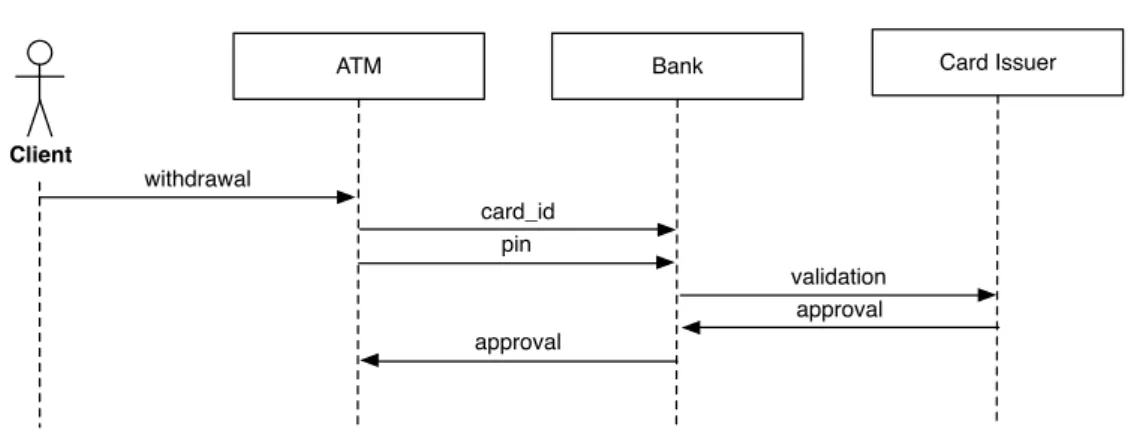
Distributed systems are developed to implement some protocol of interaction. Let us take as an example the sequence of messages exchanged between an ATM terminal, the bank accounting system, and the issuer of the credit card to approve a withdrawal. When a client requires a withdrawal, the ATM forwards to the bank the card ID and the inserted PIN. Next the bank asks the card issuer to validate the request. Finally, the card issuer approves or denies the withdrawal and the bank forwards the outcome to the ATM. We depict in Figure 2.1 the sequence
2.1. Distributed Programming, in brief
ATM Bank Card Issuer
validation approval approval pin Client withdrawal card_id
Figure 2.1: Sequence chart of the ATM withdrawal example.
Since the early days of distributed computing, developers introduced and used several tools to precisely describe the order of interactions between the compo-nents of a system, like message sequence charts [22] and sequence diagrams [23]. Baseline of all these tools is to avoid or at least minimise the ambiguity of the de-scription of the sequence of messages in the system. However, developers struggle to make sure that the final interplay between the components of a distributed sys-tem correctly implement the global description of that syssys-tem. The problem here is that they have to infer the logic of each component from a global protocol where interactions are considered as a whole and not broken down to sequences of send and receive actions.
Failing to correctly implement the global protocol of interaction of a system is the main source of system freezes and misbehaviours. Such errors are classified in literature as deadlocks [3] and race conditions [4].
Deadlocks. Deadlocks are one of the main causes of blocks of distributed sys-tems. A system is in a deadlock state when one or more components hang, waiting for another component to release a resource (e.g., a message). The components cannot proceed with their computation and the whole system blocks.
Deadlocks usually occur when one of the components of a distributed applica-tion does not implement the global protocol of the system.
As an example, assume that the developer of the ATM mistakenly reversed the first two interactions with the bank. As a result, the system ends up in a deadlock state because i) the ATM hangs waiting for the bank to receive the message car-rying the PIN whilst ii) the bank waits indefinitely for the message carcar-rying the card ID.
Race Conditions. Race conditions are even subtler errors than deadlocks. When a system has a race condition, the runtime behaviour of an application depends on the timing or the sequencing of communications among its components. Due to their non-deterministic nature, race conditions are one of the most difficult bugs to spot and may potentially lead to worst scenarios than the block of the system; among these are data inconsistency and information leakage.
On the example in Figure 2.1, let us assume that the ATM sends the two mes-sages for the card ID and PIN in parallel to the bank. Contrarily, the implementa-tion of the bank is sequential: it waits to first receive the card ID and then the PIN. In this case we have two scenarios, depending on the order in which the bank re-ceives the messages sent from the ATM. If the bank rere-ceives the card ID first then the interaction proceeds as intended. Otherwise the system ends up in a deadlock state where the bank waits to receive a message carrying the card ID whilst the first consumable message is the one carrying the PIN.
To avoid these faulty executions, programmers must make sure that all compo-nents of a distributed system correctly follow its designed protocol, however such strong guarantee is very difficult to assess.
On one hand, the static analysis of the non-deterministic interaction of many programs, executing in parallel, easily leads to the computation of exponentially many traces of execution, which makes such analysis computationally impractical. On the other hand, non-determinism makes also the practice of testing and de-bugging the system unreliable. Plus, corner cases may be hard to predict and reproduce in all their possible combinations.
In the following sections we provide a brief introduction to the theoretical and practical solutions that have recently been proposed and adopted to ease the de-velopment of safe distributed systems. We introduce Service Oriented-Computing (SOC) and how SOC can be implemented following two opposite approaches, namely the Orchestration or the Choreographic approach. Finally, we present some seminal theoretical works that paved the way for the employment of chore-ographies as language abstraction for the development of safe distributed systems.
2.2 The Service-Oriented Approach
The World Wide Web [24] (WWW or Web for short) is an established technol-ogy that, although invented to provide human-readable content to users, has gone acquiring importance also for distributed programming.
Technologies like Uniform Resource Locators (URLs) [25], HyperText Trans-fer Protocol [26] (HTTP), and the eXtensible Markup Language [27] (XML) pro-vided a common platform to make distributed programs communicate. In the
2.2. The Service-Oriented Approach
specific interface of interaction. The World Wide Web Consortium (W3C) defines a Web Service [28] as:
[. . . ] a software system designed to support interoperable machi-ne-to-machine interaction over a network. It has an interface de-scribed in a machine-processable format (specifically WSDL [29]). Other systems interact with the Web service in a manner pre-scribed by its description using SOAP [30] messages, typically conveyed using HTTP with an XML serialization in conjunction with other Web-related standards.
Paraphrasing the above definition, Web services pose no restriction on the in-ternal technologies that implement their functionalities. Provided that a service describes its interface of interaction in a machine-processable format (WSDL) and interacts through SOAP messages, it will be able to interoperate with other Web services by receiving and sending requests through messages.
Notably, the computing paradigm described by Web services is not bound to Web standards but can be further abstracted to the so called Service-Oriented [31] paradigm.
Service orientation is platform-agnostic, it abstracts from the underlying tech-nologies that enable components to interact in a network, and dictates that any resource (i.e., any program) of the network shall self-describe its functionalities through a standard interface. Services offer their functionalities following the client-server principle. In particular service orientation hinges on two principles:
• Neutrality: clients must be able to require functions of services through open, standardised, and wide-adopted technologies. Therefore all the layers that support the invocation of a request should comply with widely accepted standards.
• Loose Coupling: clients and services must agree only on the terms of the invocation of a function. Their internal implementations remain unknown to each other and the interaction does not rely on any knowledge of the internal structures that enact the execution of that functionality.
The service-oriented paradigm applies to any context that i) provides a common channel of communication for programs which ii) comply with some shared spec-ification regarding protocols of communication and serialisation of data. Other than the Web stack, some renowned technologies that apply the service-oriented approach are D-Bus [32] and DCOM [33], which are respectively an open-source and a proprietary message bus that provide a context for one-to-one message pass-ing for applications of the same system. Enterprise Service Bus [34] (ESB)
tech-nologies offer an analogous support for communication between distributed pro-grams. In particular ESBs usually offer built-in transparent protocol conversion (e.g., HTTP, SOAP, DCOM, SAP RFC [35], etc.).
2.2.1 Breaking down complexity
The main novelty introduced by service orientation regards a new architectural perspective for organising distributed systems. Since the construction blocks of SOC are services, a service-oriented distributed system results from the compo-sition of interacting services that form a Service-Oriented Architecture (SOA). The purpose of developing a distributed system as an SOA is to break down its complexity into simple services and build up the system in a hierarchical way.
This has several benefits, among which:
• Parallel and compartmentalised development. Since services communicate only through their standardised interfaces, an SOA can be quickly build up by different teams of developers working in parallel on a distinct subset of such services.
• Reuse. Usually projects share a common set of functionalities like logging, monitoring or security. Since services are compositional, it is easy to in-clude an existing service that provides one of the required functionalities into a new project. Beside fostering re-usability of code, it also naturally lends itself to a market of specialised third-party services.
• Simpler debugging. Services that accomplish one simple task are easier to test and check for compliance (wrt specifics) that more complex ones. • Systems of systems. SOAs can be built on top of other SOAs. The guiding
principle remains that of ease of testability. Given a set of “simple” services, a first level of “simple” (to test) SOAs can accomplish more elaborate tasks as composition of such services. Iteratively, the most complex behaviours of a distributed system result from high-level SOAs that compose other ar-chitectures.
These general ideas gave birth to two opposite ways of composing services [7]: Orchestration where the logic and order of the interactions in an SOA are
de-fined and controlled by a single party, called the orchestrator.
Choreography which defines the sequence of messages each participant exchanges. Each party implements its own part and the intended interaction emerges from
2.3. Orchestration
In the next section we present a brief introduction to the concept of orchestrated services and discuss the relationship between the former and choreography.
2.3 Orchestration
Nowadays, orchestration is the most adopted solution for service composition and the main reasons behind its wide adoption are i) that exposing and composing legacy programs (already developed and owned by businesses) requires little to no adjustments and ii) orchestrators become themselves new services that other orchestrators can use in their compositions.
Whilst the industrial standard for orchestration is WS-BPEL [36] (BPEL for short) all orchestration languages share a common base of functionalities to com-pose services at message level:
• asynchronous or synchronous delivery and reception of messages;
• sequential composition — an interaction can occur only after the one that precedes it;
• parallel composition — two or more interactions can occur in parallel; • guarded composition — only one of a set of interactions can occur while
the others are discarded.
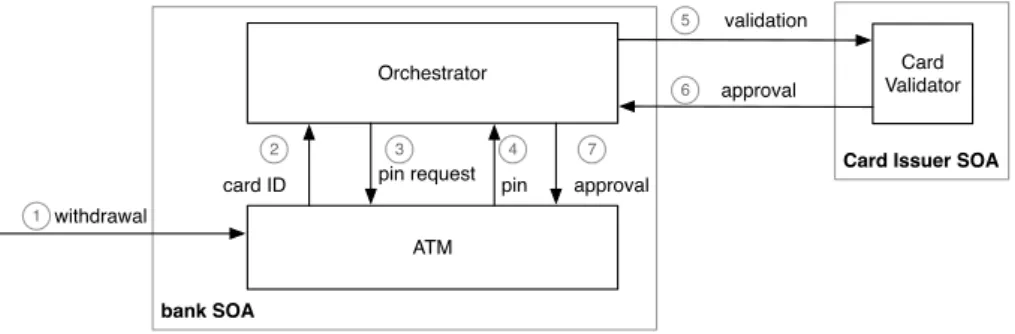
As an example, we report in Figure 2.2 the orchestrated implementation of the protocol presented in Figure 2.1.
bank SOA
Card Issuer SOA
Card Validator ATM Orchestrator withdrawal 1 2 card ID 4 approval 5 validation approval 6 pin request 3 pin 7
Figure 2.2: Example of orchestration.
In the example, since the bank is the owner of the SOA to which also the ATM belongs, we do not have a “bank” service but rather we introduce the Orchestrator service that implements the withdrawal protocol.
Following the orchestrative approach, the Orchestrator coordinates all interac-tions among the services in the systems. When the ATM receives a withdrawal request
, it sends the card ID to the orchestrator. Then
12 the Orchestrator
asks the ATM for the PIN. After having received the PIN
, the Orchestrator
3asks to validate the request to the Card Validator service (offered and owned by the card issuer). Finally, the Orchestrator receives the outcome of the validation (approval)
6 and
7 forwards it to the ATM.
In orchestration the logic of a distributed system is mostly implemented and enclosed in the orchestrator and therefore it becomes easier to check and test com-pliance between protocols and implementations.
However, orchestration poses a strong limitation in the development of dis-tributed systems because it requires a central entity that manages the whole in-teraction whilst in many distributed contexts that assumption might not hold. For example, OpenID [37] is a widely adopted protocol that provides authentication in a decentralised way. In OpenID a service (e.g., a web site) delegates a rely-ing party to authenticate users. The benefits are twofold: services do not have to manage users and users avoid to give their credentials to possibly untrusted ser-vices. In these cases, it is not possible to orchestrate the interaction and the only available solution is to develop each component separately.
2.4 Choreography
Unlike orchestration, choreography has no central point of coordination and de-scribes SOAs in terms of interactions between the participant services. In a chore-ography all services are peers and the logic of the composition is spread among them. Choreographic composition is an unexplored topic wrt orchestration. In fact, the paradigm has been mostly used for protocol specification [8, 9].
W3C proposed a candidate recommendation, called WS-CDL [8]. In WS-CDL the developer specifies the protocol of observable interactions between services from a global point of view. As already remarked, the main reason behind the need for a choreographic composition is that the orchestration paradigm requires a full control on outputs and inputs toward and from the invoked services. On the contrary, there exist various systems that are composed by several services that communicate to each other but cannot be coordinated from a centralised position. However, WS-CDL is not a language for programming composition of services, it is rather a formal language for specifying protocols, i.e., the correct sequences of interactions in the composition. Quoting the definition of the purpose of WS-CDL given by the W3C:
2.4. Choreography
The WS-CDL specification is aimed at being able to precisely describe collaborations between any type of participant regard-less of the supporting platform or programming model used by the implementation of the hosting environment.
Using the WS-CDL specification, a contract containing a “glo-bal” definition of the common ordering conditions and constraints under which messages are exchanged, is produced that describes, from a global viewpoint, the common and complementary ob-servable behaviour of all the participants involved. Each partici-pant can then use the global definition to build and test solutions that conform to it. The global specification is in turn realized by combination of the resulting local systems, on the basis of appro-priate infrastructure support.
Following to the above declaration of purposes, a choreography describes the interactions between several participants but it does not provide an implementa-tion of such interacimplementa-tion. It is up to each participant to correctly implement its individual part in the choreography.
Beside the interpretation of choreographies given by the W3C, several works investigated the possibility to use choreographies as abstractions to implement distributed systems.
For example, OASIS proposed a different perspective to choreographic compo-sition with BPEL4Chor [38]. Whilst WS-CDL sees choreographies as a top-down tool that can be used to specify protocols, OASIS considers choreographies from bottom-up, as an abstraction to define interoperability.
In particular, BPEL4Chor introduces a layer over BPEL where the developer defines only the activities of sending and reception of messages. Then, given an abstract specification in BPEL4Chor, the developer can implement the compo-nents that interact in the choreography as BPEL services. Once a BPEL4Chor choreography has been “grounded” into several BPEL orchestrators (one for each participant) the choreography is enacted by the parallel execution of the imple-mented orchestrators.
The two approaches have interests at odds (analysed in detail in [12]):
• top-down choreographies, à la WS-CDL, benefit from the maximum degree of abstraction, focussing only on the protocol of interaction. Communica-tions are atomic and therefore they inherently exclude deadlocks and races (as seen in § 2.1.1). However, these kind of interaction-oriented choreogra-phies are meant as design tools and cannot be used to implement distributed systems.
implemen-table, allowing developers to follow a common schema of interaction. How-ever, since these process-oriented choreographies maintain such close re-lation to the processes that implement the distributed system, they model communications as sequences of send and receive actions, possibly leading to deadlocks and races.
To exemplify the difference between the interaction-oriented and the process-oriented approach, we report in Figure 2.3 how the two approaches would model the scenario presented in Figure 2.1.
In the example we use the “Alice and Bob” notation [39] for interaction-oriented choreographies, where A → B : action represents a communication between two endpoints (components) of the system, specifically A sending a message through an action to B, and ; is the sequential composition of interactions. For process-oriented choreographies we use the notations from A : action and to A : action to respectively represent the receiving from and the sending to the endpoint A through action, ; still means sequential composition.
Client → ATM :withdrawal; ATM → Bank :card_id; ATM → Bank :pin;
Bank → Card Issuer :validation; Card Issuer → Bank :approval; Bank → ATM :approval
ATM process
from Client :withdrawal; to Bank :card_id;
to Bank :pin; from Bank :approval
Bank process from ATM :card_id; from ATM :pin;
to Card Issuer :validation; from Card Issuer :approval; to ATM :approval
Card Issuer process
from Card Issuer :validation; to Bank :approval
Figure 2.3: Upper part: example of interaction-oriented choreography. Lower part: from left to right, the process-oriented choreographies of the ATM, the Bank, and the Card Issuer.
2.5 Programming with Choreographies
Recent theoretical investigations explored how the interaction- and process-oriented aspects of choreographies could be merged into one language, namely one that
en-2.5. Programming with Choreographies
ographies but able to express process-level interactions, needed to implement dis-tributed systems.
Seminal work in such endeavour are [10, 40, 11].
In [10] Qiu et al. give a first theoretical account of the fundamental issues be-tween interaction-oriented choreographies and implementations. In that work, the authors introduce the concept of projection to map the global behaviour of a distributed system, described as a choreography, into a set of processes that im-plement it.
In [40], Bravetti and Zavattaro build on the concept of service contracts [41] — i.e., descriptions of the behaviour of services in terms of their inputs and out-puts — and define a projection that, given an interaction-oriented choreography, generates a set of contracts, one for each of its participants. Then, it is possible to implement the original choreography by executing those services whose contracts match the generated ones.
Finally, in [11] Carbone at al. formalise a core WS-CDL language and relate interaction-oriented choreographies and implementations by means of an End-point Projection (EPP) function. The EPP is a mapping from a choreography specification to a set of processes which, run in parallel, enact the behaviour de-scribed by the choreography. The target of the EPP is an applied π-calculus [5] and not an actual executable language. However in [11] the authors prove that interaction-oriented choreographies can be made expressive enough to define the implementation of safe distributed systems. Essentially, the projected processes enact all and only the behaviours described in the choreography (protocol) and since choreographies cannot express deadlocks and races also the projected sys-tem is deadlock- and race-free.
The most notable results of [11] are that i) it paved the way for the concept of choreographic programming [42] — i.e., to use choreographies as abstraction to implement distributed systems —, ii) it inspired the introduction of multiparty session types [43] as evolution of binary session types [44], and iii) it provided a methodology for the development of distributed software, based on a correctness-by-construction approach, which we can depict as:
Choreography (Correct by design)
EPP
−−−−−−−−→ Endpoint Projection (Correct by construction)
Subsequent theoretical works [12, 13, 14] followed a similar approach, extend-ing the choreography model to support multiparty sessions, channel mobility, and modularity.
On the other side of the spectrum, some early works [45, 46, 47] explored how choreographies could be used to support the implementation of distributed pro-grams, however none of these proposals uses choreographies as a programming
abstraction and rather employs them to check endpoint programs.
Chor [48] is the first work that brought the theoretical results on choreographies into the world of implementation languages. Based on the theoretical framework presented in [13], Chor supports the definition of global descriptions (protocols), the programming of compliant choreographies, and the safe projection of said choreographies into a collection of distributable and executable orchestrators.
Chor gives a tangible proof that choreographic programming is a suitable para-digm for the implementation of real-world distributed systems because: i) it lets developers focus on the description of the interactions between the components in the system and ii) it generates deadlock- and race-free distributed applications that are guaranteed to follow the designed protocol.
Nonetheless, Chor is just the first attempt at bringing into the real world the promising theoretical results on choreographies. The language lacks some stan-dard features of programming languages like modularity1, dynamic updates or
error handling. Beside the expressiveness of the language, the major limitation of Chor is that its EPP is not formally proven. The theoretical treatment on which Chor is based uses as target language a process calculus that models communica-tions through synchronisacommunica-tions on names (as in CCS [49] and the π-calculus [5]). Contrarily, the EPP equipped with Chor targets Jolie [50], which is an orches-tration language that uses correlation (à la BPEL) to route messages. Hence, to ensure that programs projected from Chor correctly implement their originating choreography, it is necessary to formalise and prove an Endpoint Projection pro-cedure for the targeted executable language.
2.6 Contributions
In Chapters 4–5 we give a positive answer to the question:
Can we model safe and dynamic updates of distributed systems with choreographies?
In Chapter 4 we present our theoretical model of Dynamic Choreographies and our results of correctness of projection and runtime update. In Chapter 5 we re-fine our theoretical model of Dynamic Choreographies to provide a re-fine control over updates. As a result we develop a programming framework for developing adaptive [51] (cf. Chapter 3) distributed systems. Like Chor, AIOCJ proves that choreographic programming can be used to deal with different and real-world ap-plication domains, preserving the desirable properties of correctness and safety of interaction-oriented choreographies.
pro-2.6. Contributions
In Chapter 6 we progress our venture by tackling one of the most important problems of bringing choreographies to the real world. As discussed in § 2.5, Chor — but also AIOCJ — is based on a theoretical model that abstracts the mechanics of communication with synchronisation on names. Although such abstraction allows for an elegant theoretical treatment, it sensibly departs from the reality of distributed systems, where some underlying technology must be set and used to support the routing of messages between processes.
As a result, the implementations of Chor and AIOCJ loosely follow the EPP de-fined in their foundational models. This breaks the chain of guarantee of correct-ness from choreographies to the implemented systems. For instance, to establish the communication channels between the processes in the system, the programs projected by Chor and AIOCJ make some preliminary communications, unex-pected by their theoretical models. Whether those communications are deadlock or race-free and that they do not interfere with the behaviour defined at the chore-ography level is not investigated nor theoretically proven. Moreover, these addi-tional interactions weaken one of the main advantages of choreographic program-ming: the clear specification of the communications carried out during execution. The leading research question that we pose in Chapter 6 is therefore:
Can we formalise the implementation of communications in choreographies? Interestingly, this question easily overcomes the boundaries of choreographies. The problem of bringing the results on name-based theoretical models for dis-tributed systems into the real world of implemented languages has been faced in various works, following different custom practices [52, 53, 54]. Therefore, solv-ing the problem of formalissolv-ing the implementation of communications in chore-ographies would be a useful reference to formalise the implementation of name-based languages in general.
Our answer, presented in Chapter 6, is to develop a theoretical model for Ap-plied Choreographies (AC). ACs support the most advanced features of recent choreography models like modularity [14], asynchrony, parallelism, and the dy-namic creation of multiparty sessions and processes, yet it models message-passing based on correlation, one of the main technologies used in Service-Oriented Com-puting (BPEL, Java/JMS/ C#/.NET, etc.) to support message routing.
On the definition of AC, we pinpoint the key theoretical problems and formalise the guiding principles that developers should follow to obtain correct implemen-tations. Finally, to prove our approach, we define a correct compiler from AC choreographies to the theoretical model of the Jolie language.
Part II
CHAPTER
3
Runtime Software Update and Adaptation
In Chapter 2 we discussed how distributed software has become a commodity used on a daily basis like phone lines, electricity, and water.
As our society becomes more and more dependent on software, it also demands for solutions that quickly and continuously update and adapt to the changes in objectives and the surrounding environment. Software systems that respond to change by self-adapting while running — and providing services — reflect the vision of autonomic computing [55]. Along with this requirement of flexibil-ity, software must remain reliable and predictable, in particular when adapting business- or safety-critical applications.
This requirements gave birth to an important branch of research interested in providing solutions like design patterns, language abstractions, and frameworks for the reliable development of systems that are able to adapt, preserving some desirable properties of correctness and coherence after the adaptation.
In the next sections we present some of the renowned technologies that enable runtime software update and to structure adaptation, focussing on the constructs introduced by these technologies to:
• harness the inherent complexity of updating different parts of a software system, from a software engineering viewpoint;
• guarantee coherence between all the updated components and the correct-ness of the system after any update.
3.1 Linguistic Constructs for Adaptation
The practice of adapting software at runtime spans various levels of abstraction, ranging over parameters, methods, aspects, components, applications, architec-tures, systems, and data-centres [56].
In [57] the authors clarify that there exist two main approaches to software adaptation:
This research has been addressing both the theoretical founda-tions of adaptation and, more pragmatically, how adaptation tech-niques can be applied to solve the problems at hand. [...] To achieve these goals, solutions to engineer self-adaptive behaviours are often sought at the software architecture level, including mid-dleware and component-based design. Accordingly, architec-tural approaches to dynamic adaptation have been extensively studied by researchers [58, 59, 60]. As a complementary ap-proach, researchers also adopted specialized programming para-digms to implement adaptive systems, such as metaprogramming and Aspect-Oriented Programming.
Essentially, the first approach is an architectural one and structures adaptation at the level of software components. The other approach is at language-level, which aims at providing language constructs for structuring which parts of a programs shall change at runtime. In their analysis, the authors of [57] remark that:
Supporting behavioural variations at the language level is appeal-ing with respect to dealappeal-ing with adaptation at a higher architec-tural level. First, language-level approaches provide means to adapt at a very fine-grain detail. Second, many language con-cepts (e.g., polymorphism and late binding) are well known to programmers and can be easily specialized to support adapta-tion [61].
Hence, language-level solutions provide a finer control over the adaptation ac-tions wrt architectural ones. In particular, constructs for adaptation embedded in programming languages provide a fine-grained granularity on adaptation whilst architectures for software adaptation usually rely on a component-based design that allows adaptation only at a coarser level.
Moreover, adaptation at language level brings several benefits:
• research on constructs for adaptation at language level tends to elicit general concepts that can be integrated, mixed, and evolved within new languages; • languages take advantage of various techniques like syntactic and type
check-ers, compilcheck-ers, etc. that enforce correctness of software;
• adaptation at architectural level introduces strong dependencies on the frame-works that enable adaptation.
3.1. Linguistic Constructs for Adaptation
The first is an enabling aspect, i.e., the possibility of a language to control and change its own programming at runtime. The second is a structuring aspect, i.e., the abstractions offered by the language to program updates in a structured way.
In the following sections we briefly overview some of the main linguistic con-structs that enable software updates and provide structure to their application.
3.1.1 Reflection and Metaprogramming
In [62], Pattie defines computation reflection as:
[...] the behaviour exhibited by a reflective system, where a re-flective system is a computational system which is about itself in a causally connected way.
In the context of the definition, a software system is said to be causally connected if there is a bond between its internal structures and the domain they represent. In particular, a reflective system is a computational system endowed with struc-tures that represent aspects of itself. Having access to its self-representation, the system can respond to queries about its structural state and change it. Since a self-representing system is causally connected to the domain of the aspects it rep-resents, i) the system has always an accurate representation of itself and ii) its computational status is always compliant with its representation, i.e., it can mod-ify itself by means of its own computation.
Metaprogramming is the practice of using computational reflection, i.e., the use of a reflective interface on the program to change its behaviour. As exposed above, meta (domain) and base levels are causally connected, therefore changes at meta-level “reflect” in behavioural variations at base level.
Reflection is the most general and powerful mechanism to obtain runtime be-havioural variation in programs. Examples of its usage span from higher-order languages like Lisp [63], which uses reflection to handle its own programming structures as first-class data types, to language APIs, which enable for runtime structure definitions (e.g., classes).
In general, the main two features of any metaprogramming facility are inspec-tion and modificainspec-tion. Inspecinspec-tion supports queries on the state of execuinspec-tion of a program, whilst modification supports the change of the behaviour of a pro-gram, e.g., intercepting calls, modifying dispatching policies, augmenting data with new structures, and injecting new functions or modifying the body of existing ones. [64, 65, 66] are some established examples of usage of metaprogramming. In [64] Ledoux explains how it is possible to modify dynamically the behaviour of objects through dynamic classes. In [65] Dowling et al. employ reflection to enable a program to change the binding between its methods and their
implemen-tations. In [66] Xu et al. propose a method that exploits call interception and code injection for implementing fault tolerance.
All cited works prove that metaprogramming is the staple linguistic element that enables developers to pursue any kind of runtime adaptation on programs. However, due to its unstructured nature, the direct use of metaprogramming tends to generate code that is difficult to read and debug because programmers have to figure out which variations affected the behaviour of the program at runtime. More in general, metaprogramming does not guarantee any property on the state of the system after adaptation.
This led to the creation of a new set of language constructs i) to precisely define the boundaries of the effects of metaprogramming and to ii) to clearly specify the conditions that fire the application of each variation.
3.1.2 Aspect- and Context-Oriented Programming
Aspect-Oriented programming [67] (AOP) is one of the most renowned paradigms for managing runtime software update. The main reason behind the development of the aspect-oriented paradigm is to be able to separate the essential functional-ities of a program from orthogonal modules like logging, persistence, synchroni-sation, and fault handling. The practice of uncoupling orthogonal modules from the main functionalities of a software is called separation of concerns and it is achieved by two specific constructs of AOP, namely point-cuts and join-points.
A point-cut corresponds to a set of join-points. When the execution of the main code of a program reaches one of the join-points of a point-cut, the control is transferred from the main code to the code that implements a separate concern of that point-cut. The code corresponding to a join-point of a point-cut is called advice. The aspect weaver is the metaprogramming utility that “weaves” (merges) together the main code of an application, its point-cuts, and a set of advices to generate the final implementation of an aspect-oriented application.
Aspect-oriented programming has been successfully employed in many works on dynamic adaptation. Some examples are [68], [69], whilst [70] employed it to adapt distributed systems.
Although AOP provides a powerful yet easy abstraction to manage separation of concerns, its scope of application remains that of single programs and lacks mechanisms that ensure coherence among the adapted parts of a distributed sys-tem. Moreover, it is possible that various conditions coexist in the environment of execution and that several variations apply on the same system. Hence, beside making sure that adaptation is coherent over the system, it should be possible to express conflicts between variations. Adding such conflicting conditions in plain AOP quickly clutters the code, tangles the present point-cuts, and makes the
in-3.1. Linguistic Constructs for Adaptation
This motivations paved the way for the development of an evolution of the aspect-oriented paradigm for context-aware software: Context-Oriented program-ming [71] (COP).
The abstractions introduced by COP regard the modularisation of software up-dates to support the coherent activation of behavioural variations, based on con-texts [71], that Hirschfeld et al. define as:
Any information which is computationally accessible may form part of the context upon which behavioural variations depend.
Given its recent introduction, one major direction of research on COP is in-volved in defining the essential features a context-oriented language should sup-port. The context-oriented paradigm relies on i) proper abstractions for represent-ing variations and ii) explicit mechanisms for triggerrepresent-ing variations. Usually, COP extensions for mainstream languages [72], like ContextJ [71], provide abstrac-tions for representing variaabstrac-tions as first-class structures, which can be referenced and returned. The language provides ad-hoc mechanisms to dynamically activate and deactivate variations. When a variation is enabled, the set of behaviours it models activate and modify the runtime behaviour of the application. Vice versa, if the variation is deactivated the control returns to the main code.
Variations can also be activated simultaneously. In that case, the final behaviour of the application derives from the combination of the active variations. Since the applicability of variations is specified wrt both environmental conditions and the state of other variations, context-oriented languages ensure two properties: i) all the advices related to a variation are coherently active or inactive ii) conflicting advices cannot occur.
ContextErlang [73] is an interesting example of context-orientation brought in the (possibly) distributed world, by enabling the coherent application of variations on a per-thread basis. Variations can be both expressed internally and be included at runtime from an external source via message passing.
Although AOP and COP give a sensible contribution to ease the programming of runtime software updates, their scope remains that of single programs. Indeed, to the best of our knowledge, there are no formal results on the employment of such programming abstractions to preserve the coherency of updated distributed programs nor on the correctness of the programs after the application of updates.
3.1.3 Adaptation in Process-Aware Information Systems
In § 3.1, we underlined that in this work we do not consider architectural-level solutions wrt to language-level ones because the latter give a finer control over the adaptation actions.