Dielectric Response and Interactions in
Low-dimensional Carbon Materials from First
Principles Calculations.
by
Boris Kozinsky
Submitted to the Department of Physics
in partial fulfillment of the requirements for the degree of
Doctor of Philosophy
at the
MASSACHUSETTS INSTITUTE OF TECHNOLOGY
June 2007
@
Massachusetts Institute of Technology 2007. All rights reserved.
t . I o I
A uthor ...
D
p
. .
. . ...
Department if Physics
A/ /L1
fV..
111,
2007
Certified by.
Certified by.
Nicola Marzari
Associate Professor of Materials Science and Engineering
/,
,/Tbesix Supervisor
.
.
.
.
.
.
.
.
.
.
.
.
.
.
.
.
.
.
.
.
.
.
.
.
.
.
.
.
.
...
.
.. ...
..
Johr9 Joannopoulos
Francis Wright Davis Professor of Physics
Thesil Supervisor
Accepted by...
Associate
...
o
.
.y.
.
"
Thoas
faoJ.
ytak
Department Head for Eucation
MASSACHLUSETTS INSTITUTE
OF TECHNOLOGY
OCT 0 9 2008
LIBRARIES
Dielectric Response and Interactions in Low-dimensional
Carbon Materials from First Principles Calculations
by
Bo()is K()ziisky
Sulliittled to t(lhe Departmellllt of Physics on May 11, 2007, in partia1 fulfillinmeit of tihe
req(luirellIelmts for
thie (legree of
Doctor of PhilosophyAbstract
This work examiiiinles tie (dielectric respo))nse of nal()Ios(ale o1ne- and two-dlilnelsiolnal systems using first-prinlciples calculations. In the first, part we discuss itihe peculiari-ties of the long-wavelength inl-llaile dielectric response of graplellne and1( loron-ilitlri(ld sheets. Graiphlene is shown to possess fealtures thllat classify it a as ni interllmedi(hate b
e-tween a two-dinlensional metal anld an insula.tor. unlike the simp)le insulating c ase of boron-nitride. Carbon 11anotu1ib)s inherit the
u•hnusual
scale-invarianlce of graplhne's response, whicih manifests itself as a. high t lansverse polarizab)ilitv antd a radius-insensitive screening. Boron initride Inalnotullles )behave nlore like hollow tielectriccylinders. For a single-wall lnanotllube of (each tvype, we fillnd
t
hat tile longitlldinl
re-spionse is conitrolled by t he 1)and galp, while t he tIralIsverse response is Sensitive ()1ily to thlie effective radilus. To stud(lvy the stal ic resl)onse' of nulltliwall'lanlotull)es, we conlstru(ct a simple yet, accurat(e clectrostatic
•d(m(el;
ti hat predicts qualitat ive (lifferell(ces b)tw(eenthe transverse respol•ise of carl])on nan otlulbes and tha.t of boron-ll-it ri(le inanotid)es. The
seconld p)art of this work is conlcerlln(d withlithhe Lultinger liqutil (lescrip)tioon of
interac-tions in nian(oscale one-dinlensionial conlductors, that is believed to expI)laill the power laws observed in experilments in the Iphotoenllissioll sp)ectra andn he dependence of the. conduhctanlce on voltage and temperlature. \Ve (lescril)e a mnetllho for al)-initio calcula-tions of the paralieters of the Luttinger liquid miodel and apply it to mluetallic (carblon
n18an0otubl)es, filnding good agreemenit withi expleri]ments.
The tihiri1
part is
(levoted
to
an anialvsis of issues that arise in ab1-illitio calculations of low-dliniesioinlal systems using filly periodic boundary conditions. \We presenlt a coilprehelsive review of tlie
difficulties arising for (liff(erent.
(dinlllisioliali ties
an1d(1 discuss efficiellf waysof
using electrostatics to (raInatically improve hic 'peed11d accuracy
of colilpl tios.Thesis Supervisor: Nicola Marza ri
Title: Associate Professor of M\Iat erials Scien"ce aind Engineering
Thesis Supervisor: Johln D. ,JoannopIolos Title: Francis Wright Davis Professor of' P1lysics
Acknowledgments
I am very grateful to my thesis
advisor
Prof. Nicola Marzari for his inspiring
cre-ative suggestions, llunwavering support anld inllfectious enthusiasmn for cool new
pIr(-)l)-lemis. I greatly enjoyed the wari and
aid I
lt
tmostphere of the Quasiamiore
group, where I worked for the pasl three years, and I would like t1( thank all of
the iimembers with wholn
I
Il
had thle pleasure to interact
1andcollal•orate: Mayeul
D'Avezac, Francesca Baletto. Nicola Bonini, M\atteo C(ococioni, Ismaila Dal)o,
Os-waldo Dieguez, Jivtesh Garg, Heather Kulik, Ymoung-Su Lee, Elise Li, Arash
nI\ostofi,
Nicolas Mounet, Nicholas Singh-Miller. Nic(hlas Poilvert, Damian Seherlis, Kathryn
Siilons, Patrick Sit , Timiio Tllnhaliser, Paolo Umari, and Brandon Wo)od.
I eannot thank enough Prof. Leonid Levitov, whomi I had(1 the fortuine to learn
fromi an(1 colla,borate with since my uindergra.duate days. His help and sage advice
were essenltial during lily years at MIT, a.nd his profound insights have inspired imuch
of the work presented this thesis. I am thalkful to Prof. Mild]red Dresselhalls for
inlilortaInt comnllenlts on the thesis draft and woind(erfull discussions 01on the history of nanot ubes.I owe a great deal to my parIents
fortheir love and encolluragemenit of Illy early
scientific pursuits an1ld to lily sister
11111na
for being lmy role
iimodel
throlghllout miuch
of
my
life. Finally, ily wonterfll wife Katya has lilmy inexl)ressilble grat itude for her
devotionll, patiencle and persistenit (cll'roura, gemll ; that
llmalde this work pIossiblel. SheContents
1 Introduction
1.1
I
Nanotubes ...1.2 Graphene ...
1.3 Outline . . . . . ...
2 Basics of ab-initio calculations
2.1
Manliy-electro problem . . . ...
2.2
Holenl erg-Kohn tlheores . . . .
2.3 Kohn-Shamn equationis
. . ...
2.4 Exchange-correla tion functionals ...
2.5 Planewave
,iasis
calculaios . . . .
2.6 Density functional Iertlurlation theory
3 Structure of graphene and carbon nanotubes
3.1 Electronic stiiictiure of grai)hene ...
3.2 Geometric nd(l electronic st1ructure of cari rb linaotull)es . . . ...
4 Static dielectric response of sheets and tubes
4.1 Dielectric linear respoitse forialisi . .. ... 4.1.1 Definitions ind i(ientities . .. ... 4.1.2 Randonm-Ihase aplwroxinmtion . ... ... 4.1.3 Polarizabilities in low (dimlensions .. ... ... 4.2 2D: Grajphene and boron-nilri(de ... .. ...
17 18 20 21
23
.. . . . 23 . . .. . . . . . . . . 2 5.
.
. .
.
27
.. . . 29 . . . . . 30 . . . . .. . . . . . . 3 337
37 4451
52
52
59 62 634.2.1
Wannier function analysis
.. . . .
4.3
1D: Nanotubes ...
...
4.3.1
Longituidinal Iolarizabilitis . . . .
4.3.2
Tiransverse polarizablilities and screening factors
4.3.3
Electrostatic imiodels of nanotubes . . . .
4.3.4
-
Nanotube bundles ...4.3.5 Linearity of tllh response . . . . .
4.4 Separation and ailignment of nanotubles . . . .
5 Calculation of Luttinger liquid parameters in
5.1
Introdluctioi...
...
5.2 The Luttinger liquid . . . ...
5.3
DFT app,)roach to p)aramlleter calculation
. . .
carbon nanotubes
6 Electrostatic corrections in periodic boundary conditions
6.1 Charged Systemi s ... .. .. ...6.1.1
Point countercharge method . . . .
6.2 Polarized Systenms... ... . .. . ...
6.2.1
Polarizability corrections . . . .
6.2.2
Depolarization shal)e effects in finite samples . . . .
6.3
Inhomogeneous Systemsns ...
...
6.4
Density countrcharge method .
. . . . .
. . . .
...
6.5 Defects in bulk mediuu ... ...
7 Summary and future directions
A Electrostatics of dielectric cylinders
B Matlab code for MWNT models
C Polarizability tensor of a metallic ellipsoid
. . . .
.
70
.
. . .. .
72
. . . .
.
72
. . . .
.
75
. . . .
.
82
. . . .
89
. . . .
90
. . . .
.
91
95
95
.
99
102
113
..
115
..
115
120
123
..
127
128
133
135
141
145149
153
List of Figures
3-1 Honeycombl laIttice consists of two sulblattices A(*) and B(o) .... 38 3-2 Bands of graphllene as ob)tained fromi the tight binding c(alculat;ioln.
Courtesy of Joiias Ial)tmainll. ... .. 42 3-3 Brilloilln zone of grapI)hC.ne. . ... . ... .
.
43 3-4 Chiral and translational vectors of single-wall nanlotull•s. Structul 'neson the right are exalmples of zigzag, general chiral, and armnchair nan-otubl)es. Reproduce(l from iht p:// www.nanoelec. ronics.jp ... 46 3-5 (a),(1)) The t;ransverse k-vect(or comil)oncint k] is (luantized( wheln
peri-odic boundary conditdions are a.pplied. (c) The values of kA allowed )by
(lulalntization slice tQhr(oughl tih(le 1alds of graphllnc . Pictlures co(urt- sy of Paul McEnen's group. ... ... 47 3-6 Quantlization of thlie
k-vect-ors
inl tlhie Brillouill z(one and thIli resifltingb1anis. ... ... .... 48
3-7 Band st ructure of armchair and zigzag carbon() SWNTs ot1)ained from DFT calculatiions. Courtesy of Youing-Su Lee.. . ... . 48
4-1 Charge (lenlsit.y oscillations in a gral)h(ncie slhet induced by a p)ertu'lrbl)ing sinumlsoidal potIentiial witlh a waveleigih e((ulal Io()
(60)
ulnit cells. R•apidoscillations are caused canse char4ge tIransfer )between the( two carblon sub-lattices. . ... .. ... . . . . . . 65
4-2 Scaling of the self-consistent response matrix element yo,o(q) of a graphene
and a BN sheet as a function of the wavelength of the perturbing
sinu-soidal potential. The doping
level
for graphene is 0.005 electrons per
unit cell (cF=0.01 Ha). At lower doping levels the curve exhibits a
shlarlper variation at smaller q. . ...
...
67
4-3 Scaling of the full response matrix element ,ko,o(q) of the BN sheet.
Extrapolation to q
=
0 is used to compute the in-plane polarizability.
68
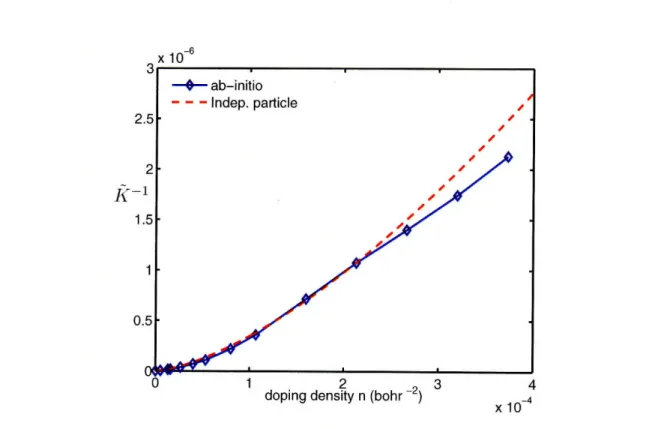
4-4 Inverse screened compressibility of al doped graphene sheet versus the
doping density. The dashed curve is computed from the
independent-particle linear band model via (4.53). . ...
69
4-5 Maximally localized Wannier functions of the occupied states in graphene.
(a) a-bonding MLWF; (b) w-bonding MLWF. Courtesy of Young-Su
Lee. ... ... .. 70 4-6 Percent relative contribution of' r-electrons to the in-plane response
function of the undop)ed graphene sheet. ... . . . 71 4-7 Log scale plot of a(l of zigzag nanotubes as a function of band gap.
The dashed line has slope -2. The inset shows the values for large-gap SWNTs as a function of Ro/A. .. . .. ..
..
...
. . ... 73 4-8 Longitudinal polarizability of boron-nitride nanotubes as a function ofradius ... .. . ... 73
4-9 Transverse polarizabilities v(1 of armchair and zigzag nanotubes as a
function of 1". The
tdashed
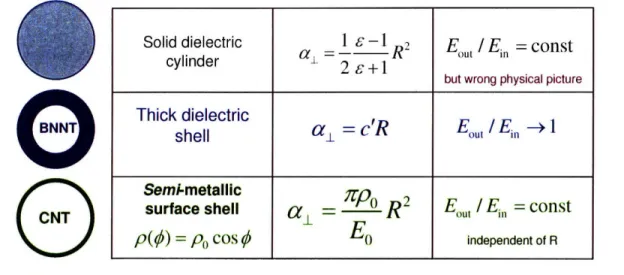
line is the best-fit result of our semi-metallic shell model; the solid line (atL = It corresponds to an idealmetallic cylinder.. ...
...
.
76
4-10 Transverse i)olarizibilities of boron-nitride nanotubes as a function of
the radius. The dashed line is the best-fit result of our thick dielectric
shell m odel.. .. .. . .. .. . .. .. .... . . . . . ... 76 4-11 Electrostatic potential for a (10,10) SWNT in an applied homogeneous
transverse field Eout. The electric field through the center slice is shown in the inset. ... ... .. . . ... ... 77
4-12 Screening factors of carl)bon1 a lnd b oron-llitride nanlotu)bes versus tlihe
radius .. . . .. . . . .
.. . . . .
8
4-13 Transverse response of a tul)e to a uniform field can 1)e viewed as the
in-p)lane response of a sheet to a sinusoi(lal potential. . ...
..
82
4-14 Electrostatic models for transverse response of single-wall
nanllotubllcs.The first line has the correct radlius dependlence for CNTs bullt is
olbvi-ously wrong. ...
...
...
..
82
4-15 Transverse polarizal)ilit.y of a clarlon \IMWNT of radius 100A versus tlhe
illl)ber of iler layers, asl)re(iced
by ourelectrostatic
model. Thouter few layers stronigly o(hminate the tranisverse rcsl)lse . ... .
87
4-16 Transverse polarizability of a, loron-nitride MWNT of radius 100)A
versus the munlber of inner layers, as predicted
1)y
)v
our electrostatic
model ...
...
...
.
87
4-17 Screening factors in a carb)on MWNT of outer radius 100oA versus the
numnber of nanotulbe layers, a's p1re(licted
lby
our electrostatic model.
The vertical axis is oil the log scale, so screening is expoll lltia.l ill the
num|lll)er of lavyers. ...
...
.
88
4-18 Screening factors of a boron-nitride MWNT of outer randius 10()A versus
the number of inner layers, as predicted by our electrost at ic model. The
inllerimost layers colntril)lte more to the transverse reslponse . ....
.
88
4-19 Electrostatic Ipotential for a (10,10) SWNT in an aapplied homogeneous
transverse field Eo,,t. The electric field through the center slice is shown
in lihe inset. ...
...
91
5-1 Momentuml distribution finiction. Dotted line rep)resents free electron
gas. Red line rep•resellts the Fernli liquid, essentially simnilar to the free
gas: the distrilbution still has a( discontinuity at
k,:
bult
Witlh
a reduced
ampllitudle
Z
< 1. Blue line represents
ihe Lutt
linger liquid, wllcIre
quasiparticles are unstable excitatioiis. . ...
96
5-2 Single particle excitation in 1D induced by a photon (a) splits into an excitation containing only a charge degree of freedom and another one
with spin (b). ...
.... ...
.
100
5-3 Typical experimental.1 setup with a nanotube of radius R suspended above an infinite metallic gate distance
Ih
away . ... 106 5-4 The inverse capacitance of a periodic array of (10,10) nanotubes as afunction of the lattice spacing L on a1. log scale. The trend deviates slightly froml logarithmic at small separations ldue to proximity effects. 108 5-5 Microscopic length scale A as deterinined from our calculations for
nanotubes of different sizes. ... ... 110
5-6 Luttinger liquid interaction parameter g as a function of the dilmen-sionless ratio of two length scales. Here we set vF= 0.36 a.u= 8 x 10⁵
im/s. ... ... 111
6-1 Left: potential of a single 2D charge in OBC. Right: potential of a 5x5 square array of 2D charges in OBC. Note the overall parabolic shape of the potential... ... ... 115
6-2 Left:Ipotential of a 5x5 square array of 2D charges plotted together with the paralbolic potential due to a. uniform jellium of the same average density. Right: subtracting the jelliumn potential from the systeml yields precisely the same potential as the PBC system of point charge. .... 116
6-3 Left: Potential of images "`t~ in an OBC array (i.e. one charge re-moved). Right: PBC potential with an isolated charge potential re-moved to show the parabolic correction. ... . . 117
6-4 Change in the force between ions of a
1f4I
molecule due to periodic images a~s a function of lattice spacing.... ... . . 120 6-5 Left: because potentials of point charges are linear in 1D, thecontribu-tion of images vanishes. Lower curve shows i'5""9 = 0. Right: Potentials of PBC and OBC 1D systems differ by exactly the parabolic potential
6-6 Left.: Potential of a square array of 2D dipoles in OBC with one di)ole remioved(. The average slop)e corresp)ondls to thle macroscopic elct.ric field. Right: Zoonl-ini on the origin shows tlhat, the fiehl chere due to all other images vanishes. ... ... 122 6-7 Convergence of (o) and (ajb with resplect to L for a. (5,5) SWNT. The
point at L=10.6A corresI)oni(ls to a tylpical tubl)e-tulbe scparation iin a. umndle. ... ... . . . ... 125
6-8
Convergence of Ihe screenilig factor with resi)ect to L for a (10(),10)SWNT ...
....
...
...
125
6-9 Response filnction versus the periodic inter-p)lanle
(list
anI'ce before aInd after the inhomiogeneous electrostatic correction1.. .... . . .... . 1326-10 Schematic represent at;ion of the energy conltrilbution from, an isolated
defect, in bulk. Left: E" c f. Right: E. . . . . ... . . . . . 136 6-
The syft etry duality tat, alows. Right: .E... aWlul... 137
(i-11
Thiesynmnmetry hiality
that.allowvs
11us o oal •flat1 e i ... ...137
List of Tables
3.1 Structural parameters for (n•,n) armchair and (n,0O) zigzag an1notubl)es: translational period, diamliter, an-d the nulnl)er of carbon at1OlllS in a
unit cell... ... ... 46 4.1 Suninary of q - () scaling of liclect;ric resIpoiseo qiiantities of icetafls
and insulaltors of differelnt dlinmensionalit.is, as derived within I PA. i
is the (density of states at. the Fermi ncergy. ... (i2
4.2 Radius, hand gap, screlling ratio, longitu;ldina.l and transverse polar-izabilities (per unit length) of carbon nlliontubes as a function of the chiral1 vector (n,
in).
R• is the radius of the carblon backi)one. The nun-hers in parent;heses have l)beeli obtained with hlie electrostatic modlcel for nmulti-wallCNTs...
...
...
78
4.3 Screening ratios, transverse polarizabilities (per unit length). longitlu-dinal polarizab)ilit ics alnd ratii of t)oron-llitridee n•unot ul•es as a function of the chiral vector (',' in). RIo is the radius of the B-N hlacklonc a]1nd (1i
is the full static polariza.bilit.y inhat includems ionic resI)onse. Thl
lnulm-bers in parentheses have 1)een o).aind with the clectrostatic model for multi-wall BNNTs .. ... . 79
Chapter 1
Introduction
Recent sweeping advalnces in nlalnotchmloh)gy have elevated the imp)ortance of low-(timelnsional nanoscale structures, a8ndt a g()ol un(lcerst a lllillg of their physical prop-erties became essential. It is well-known that the di.censioinality of a. systemr has pro-noinc1ed efflcts on the electron-electr on interactiolns. In convenltional three-diirensional metals elementary excitations form a weakly interacting Ferini liqlui(l of quasiparticles, reminliscent of the independent electroll l1icX t llre. I11 two di illmesiolns, clcti'roin-elct-tron interactions in metals calt p)ro(luce (xoti(c behaviors, suc('h as the fracti(onial (llualntumll1 Hall effect, where excitations are very dlifferenlt from the al:re clectrollns and (can evel carry fractional charge. Finally, ill olne-dilmenllsiolal metals the conventional quasipar-ticles are not stal)le excitatio(,s at all even fol weak interactions, anld• arising collective excitations determine thelrmn lodynanmii an(1 tra(nslpt l) prop)rties. as descri)e(d withlin the Luttinger liquid p)ara(diglln. In scilliconlnductors, static screening prop)ertics and the scaling of excitonic. energies also depelld critically o11 the dim(ensionality.
Even in the cases where th tbli asic tlheory of electlronic interact ionls is believed to
)be well understood, it is still a clhallenge to inlterpret results of ex)perillcInt s within
the theoretical friamework because lIanloscale devices are extredelyv sensitive to their miucroscopic envir)onminlelt. Various envirominentlal factors that can i•flu(ence the out-collie of mileasuremients oftenl cannlot
1be
incor)porated(l into simplemnodels
alnd are still not. well understood at the nano-scale. This inlmportalnt niche is filled by first Iprin-cip)les calclulaItions thatl)i(lge,
the galp betweell explcrimlletl a1nd 1b)asi theoryv il thatthey offer much more control over the realistic details of the system of interest and at the same time provide access to measurable quantities with close to experimental accuracy. Quantuml-mechanical modeling is particularly valuable in situations where experimental control is difficult. Low-dinmensional nanoscale structures, particularly nanotubes, are good exampIles of this situation even though luch is known about their properties, there is neither a way to grow a nanotube of a specified size and chirality, nor to fully characterize an already grown multi-wall nanotube.
The goal of this thesis is to combine ab-initio and analytical methods to develop a. detailed understanding of the effects of electron-electron interactions on the prop-erties of low-dimensional structures. Our stjudy spans dielectric response propprop-erties of one- and two- (linlensional insulators, metals, and zero-gap semiconductors, con-centrating on carbon-based structures and comparing them to similar ones based on boron nitri(le. We study primarily nanotubes and single-layer sheets, materials that possess many fascinating and potentially useftul properties, and whose theoret-ical and experimental characterization is far from complete. A complementary goal is to present apiplications of established and recently developed alb-initio methods to low-dinmensional structures and highlight issues that arise in studying these materials from first principles.
1.1
Nanotubes
Carbon nalnotulbes have been first observed and reported in 1952 by Radushkevich and Lukyanovich [1] and have been rediscovered several times over the years, culmi-nating in the famous papeIrs by Iijima on single-wall carbon nanotubes in the early 1990's [2] that brought theni to the awareness of the wi(le scientific community and generated a lot of excitement. Subsequently, the physics of c:arbon nanotubes has raplidly evolved into a research field of its own and significanit progress has been made in understanding and charactterizing their physical properties [3, 4]. They have at-tracted mlluch attention for their exceptional I)roperties, such as extremely high tensile strength, elasticity, excellent thermnal conductivity, and ballistic conductance. One of
the rnost unusual properties of carboln nanotll)es is their clectroniic st ruct.ure which depenlds only on their geometry, i.e. chirality and diamneter, and is unique in solid statie physics. This property steils from the clectronic prolerties of lhe graph'llne sheet, and the constraints of the geometrical slape of a inailoltIll)e. result ing iln ei-ther seinicondlucting or mct
allic
uiiles. Metallic carl)xo na1n1otll)bes are ahll)ost ideal (luasi-onle-dirnensiona.l (uallntuml wires that c(all sustaini extrecicly high c'urrent. den-sitics. Apart from the obvious ailpplications as transistors and int.erconnects in elec-tronics, carbon nanlotubes have beeln clnvisiolled to penetra.te into various other area.s of tecihnology. The high surface-to-vohnlle ratio. c(mll)ined with struclture-sen siltive electronic properties, makes thell a(. goo(1 canIllolidlate for chel•mlical sensor alI)ppliclations.
The high aspect-ratio anid itechanlical stab.ility qualifies th-emii for electron emiitter a.l.l super-cal acitor appl]ications.
Unfort.unately, synthesis a ndl separa.tion( of specific nanotiubl)es remains a central challenge that imlpedes furtlher progress in scientific study and connmercial appl)lica-tions. O()ne approach may b e to separalte a randlo(m1 miixt ure of nanotuibes after growth,
bas(ed oni their dtistinct characteristics. Variations ill chirality aln(d size influence
di(cc-tric p)roperties, which in turn 1 calln
)e
exploite(d for sel)aratiio; e.g. clectric( fields have been used to align naniotubes during CVD synthesis [5. 6] and to se)parate differeinttubes in solttCions
[7,
8]. Another moltivation for vunderstalnding of their dielectric re-sponse is the need to characterize op)tical excitatioils, screenling a"t contacts, p)lasillnons in inaniotube arrays, and the (degree of conitrol achfievable in en(ldohlle(dral fillings. In recent years the respoinse of carbon single-wall inanotulix )s (SWNTs) has been stludiedwithll tight-binding [9, 10, 11] and first-principles a,1pproach•es [12, 13], while nmulti-wall
mnainotubes (MWNTs) a more colnllon lprolluct of syvnllhesis have received u111h(11 less attention due to their complexity. In this work we will examine thil st atic di-electric p)roperties of different types of lnanotubles with the goals of enllgineering better ways of controlling their structiurll
explericlmentallly
amnml, in general, ofadlva.ncing
the understandt(ing of the electronlic respionse of these ulilliqlue oile-dlilllllsioinal systems.By alna.logy with carbon nanotlubes. boroll-nitride nainotul es (BNNTs) were pre-dict('d to exist using ab-initio imethlods in 1993 [14], amdnl were discovered shortly
afterwards [15]. They share good mechanical and thermal qualities with carbon nan-otubes, while due to the insulating nature of the boron-nitride sheet, the electronic properties of these nanotul)es are much more uniform and do not depend so strongly on the structure.
1.2
Graphene
Graphene is a relative newcomer in carbon physics, attracting a rIapidly growing research interest, despite the fact that it has been known and studied for decades as an integral pI)art of graphite and graphite-intercalated compounds. In the last decade, graphene has been viewed as a. hyplothetical building block whose understanding was a I)rerequisite to the study of fullerenes and nanotubes. By itself, the free standing single-layer grap)hene was thought not to e(ven exist in a stable form, after Landau a.nd Peierls argued that strictly two-dimensional crystals were thermodynamically unstable due to divergences of thermal fluctuations [16, 17]. The argument was later extended( by Mermin [18] and is strongly suppIortedl by expelrimental observations that the melting temperature of many thin fihns raplidly decreases with decreasing thickness, and they become unstable. Atomic monolayers have so far been known only as an integral part of larger three-(tinlelsional structures, usually grown epitaxially on topl of substrates. Without being embedded in a 3D structure, 2D materials were presumed not to exist until the experimentacl discovery in 2004 of the grap)hene mono-layer and other free-standing 2D a.tomic' crystals, inc'luding boron-nitride [19, 20].
Among the remarkable proplerties of free-standing graphene are the extremely high carrier mobility, which only weakly depends on temperature, and the presence of the anomalous (Iuantum Hall effect, ob)served even at room tempnIerature. One indicator of the high crystal quality of graphene is that charge carriers can travel thousands of interatomic distainces without sca ttering. Graphoene is also excepItional from a theoretical point of view: its charge carriers mimic relativistic particles and are natu-rally descrihbed by the Dirac equation rather than the Schrodinger equation, although there is nothing particularly relativistic about electrons moving around c.arl)on atoms.
This
iunusual
electronic stru1(ct tire is respon)(sille for a n111:11)er of unique featuires ill tlihe static dielectric response of graphenle, also inherit.ed b)y (carbotn inanotubes, and we will describ)e them in the following chapters.1.3
Outline
The thesis is organized a.s follows. In Chapter 2 we review the l)basic theory ul(erlying the met hods of first prilicip)les c(alculhationls that we use in this work, in part'iculilar dell-sity functional
Itheory
and denllsit, -flllct ionlal perturbl)ation theory. Chapter 3 cotntains a )brief description of the inti:lla.te coiinnection b)etween of thli geomnetric: anld ele('lronic structures of grapheine, boron-nitlride and the corresponding nanoltubles. Chapter 4 deals with calculations of dielectric: licar resipnse of thoese 2D imaterials, highlight.-ing the uniusual response of graphenle. These result s are t.hli( used tlo puani itlat ivelyund(erstand the response of nlanotll)bes to electric: fields and to construct. all accur'ate classical electrostatic Ilod(el thllat cap])t;ures the response of nuilti-wall 11a.nll)otubes. In Chapter 5 we d(escribe the efl'cts of very strong corrclation)ms in 11(metallic silngle-wall car:)on nlanotubes within lthe Luttinger liquid pictulre anld present a 1let(hod( of cal-culating from first-prin(c iples the paramieters of this m(od)(el. Finally, in Chalpter 6 we
pIresent
niet1ho(ds. that, we dcvelolj)(1 a8nd used throulghotiii this work, for increasing efficiency of ab-initio calhulau1tions of dielectrici respo)nse of low-dimensio)nal structures.Chapter 2
Basics of ab-initio calculations
Quantum
mechanics is extreimely
successful
in describing
mnicroscopic
proIperties of
matter and has provided fundamental understanding of a.n enormous range of
Ilphe-nomena in physics, chemistry and bIiology. Despite the ambiguities in logical
inter-pretation of the underlying equations, the incredible accuracy of quantitative
predic-tions on the microscopic level make it such a. powerful tool that lhardly alny bra.nch of
physical science today remains unaffected by quantum methods and concepts.
Nan-otechnology in particular owes its very existence to the possibility of calculating with
high precision material quantities like the equilibrium lattice constants, vibrational
spectra, dielectric tensors and even phase diagrams. The tota.l energy of the ground
state is a central quantity in quantum theory, and a vast majority of material
prop-erties are related to the total energy of the electron-ion system and its variation with
various parameters or external perturbations. This explains the amount of work tha~t
has been done in developing efficient methods of total-energy calculations in recent
years [21]. We present here briefly the fundamentals of density flnctional. theory
-the most widely studied and used method of first-principles calculations.
2.1
Many-electron problem
At the heart of non-relativistic quantum mechanics lies the many-body time-independent
Schrodinger equation, which describes the system of ions a.t positions {R} and
elec-trons at {r}
H!fi(r, R) = E, (r, R) . (2.1)
Solutions of this equation provide complete information about an ensemble of particles interacting with each other and with external fields. In practice we are only interested in the ground state solution; however, even this problem is impossible to treat ill an exact way, and only a few cases are solvable analytically. Numerical solutions are also linlited to very few plarticles, primarily due to the fact that there is no general way to decouple the equation for the 3N degrees of freedom into a set of independent equations. One is forced to resort to approximations, of which the adiabatic (Born-Oppenheimer) apl)proximnation is the most comnnniionly used. It amounts to assuming that the motions of ions andl electrons occur oin such drastically different time scales that they can be decoupled. This means that in studying the electronic degrees of freedom the ions can be considered at rest, so that the total wavefunction can be written as a product of two fiinctions: one describing the ions and another describing electrons while treating ionic positions as paramimeters
P(r, R) = ()(R) T (r). 1(2.2)
We are now left with a, slightly easier problem corresponding to the electronic system with the nuclei fixed in the configuration
{R).
Electrons are fermions, and the electronic waveftunction is antisymmnuetric with respect to exchange of two electrons. The Hamiltonian for the electrons is given byN N N
H
=Te+
e
+
Vee
(-V
+
S
(r)
+E
r
r
(2.3)
Si i<j
(r =
(2.4)
where E is tile electroinic grounld state energy, ri lthe coor(dinalte of
elect•rolln
i, R the coordinate of nucleus I, and ZI the charge of nuclmhs I.' The total enlergy It, including the ion-ion interactions I,,,, is tlihei givel )byI1= E
+
,,,
- E +
Z
(2.:5)
Nearly all physical properties of a syst;en cal be calculat.ed(' once the groullnd sta.te wavefuinction is known. This is the fuildamlllental idea behinll(l ir.st-princ(:ipls or
ab-initio a )pproanches: rna.terial )propIerties are ol)tailled from the solutionl of the Schrodlinger equation without, any exp)erimelnta.l inpilt. But we still have an interact ing llany-body quia.ntum I)roblem which is far too comiplicataedt to be solved1 exactly in a I)ractical way. Further approximations are requllire d to pIerform ab-initio cahlculations for real nmateri-a1s, and Density Functional theory (DFT) provides a framework for making I)rogress.
2.2
Hohenberg-Kohn theorems
The first p)rescrip)tion for construltctinlg the total niergy ill terms of ouly the electronic density was given by Thonmas and Ferini [22].
lThey
use(d t~he explression for the kinetiic, exchange anld correlation 'energies of the lholnmogeneolls electroll gas to con(struct the samie quailtities for the inholllogencol()us systeri ill the local (lensity a pprl)oxilniation. I 1964 HIohenberg and Kohn formulated a.ndproved
two theorems thatpunt
those early ideas oni solid Ilmathematical grounil. The first theorem states that no two different pIotentials acting on the electroins of a given systeml can give rise to the samle grounld-state electronic charge density, i.e. the externlal potential v(r) is uniquely determinnedby the electronic density n (r), up) to a coistant, [23]. The external )(otent ial v(r) then fixes thlie Haamiltonian and thus the ground sta.te wavefuinction i 1 ; the grollind state of a many-body syste n is a uniqile fimictional of uiherefore
u(r).
Their second theo rem introduces a formal variati(o)nall principle on the charge dlensityv itself. SinceThis equation and all others in tI his work, u1nless ot(lherwise niote(l, are written in atolmic units:
in
4() is determined by n(r), one can define the functional
F[n(r)]
('IoITe + Vee
)
(2.6)
It is worth noting that F[n(r)] is a universal functional independent of v(r) since the kinetic energy T, anid the electron-electron interaction energy ,e are functionals only of n(r). Then the ground state energy functional is (lefined as
E
,[n(r)]
,F[n(r)] +
J
(r)n(r) dr .
(2.7)
The theorem states that for a. given external potential v(r), ground state density rno(r) and any trial electron density hf(r), the energy functional is minimized by the electron charge density of the ground state
E0
=
E,Jno]
•
E,[ji] .
(2.8)
Furthermore, the value of the mininmum coincides with the ground-state energy E0.
Therefore, the ground state density must satisfy tihe equation
6F[n. (r)] =
v(r)
(2.9)
These theorems
provide
the foundation of what is currently known as density-fulctional
theor'y [24]. The Hohenberg-Kohn approach rel)resents a great conceptual simplifica-tion of the quantuin-mechanica.l problem of the search of the ground-state properties of a system of interacting electrons, for it replaces the traditional description based on wave-functionis with a much more tractable description in terms of the charge density. If the explicit forum of the universal functional F[n(r)] were known, the problem of deterlmining the ground state would reduce to' the problem of the minimization of a, functional of the 3-dintensional electron density, i.e., a function of 3 coordinates, instead of 3N (N being the numlber of electrons). The lohenlberg and Kohn theorem
determincld by its grolund-sta.te( clharge"--de(llsity (list ribution . The Il•ajor 1)rolem that ha
mpers
a straight forward aIppljlicatioll of this remnarkal)le result is that the formt of thec universal F[rn(r)] fulnctional is of coursel unknowln. This problemll can) l)e ap)pro(ached lby mappIing the systemi onto an auxiliary systeill of 11(io ilitertac(ting electr(onis [25] and by making aIppropriate app)roxinmat.ions along the lines des(ribed in the next section.2.3
Kohn-Sham equations
The Hollhenblerg-Kohn theorems h10oll inlldependently of the precisc form of the clectro(n-electron int.eraction. In particullar, ill a noll-int-era.cting system. F[n (r)] is simply the kinetic energy as a. functiona.] of the ground-state charge-denlsity (istributioln, T,[n(r)]. This fact ha.s b)eenll sed(l
1by
Kolhn allnd Shmi to map the problem of a system of interacting electrons onto an c(qllivalelt fion-interacting probler m [25]. The key is to be able to reprod(uce the exact( resltl for tihe non-interac(ting case, regar(dless ofany
app)roximationIs introllucled to
trca.t
interactions. In t;his regard, Kohun and Sham
argued( tihat tihe ground( state density of t he inuter(acting system caln l be represente(d a.s the ground state de nsity of a, non-int(,ractifn( svst,
cll
in so()lae local ext ler'llal pote)entialVIc
(r).
Then according to the general (l•lsity-fulctional forlnalisni, the groun(d state density canbe
ol)tailnedby
miniilllnizing the non-intelra.cting energy flun(ltiolialE(,k, [n(r)] - T7[n(r)]
+
V/,-s(r)n(r) dr .
(2.10)
The unknown functional F[n (r)] is written( as
F[n(r)] =
71[n(r)] +
drdr' +
E,,[,,(r)],
(2.11)
(2.11)
2
r
- r'
where the second terni is the classic(al (lectrostatic( self-interaction of the electlron charge-denlsity distrilultion, and thlie unknown last termil is the so-called
cxrchangc-corrclat/ion enericyj is actually dlefincd 1b Eq. (2.11). E:,[
[n]
captlures all renaining contrilbutions including the coIiiple)x nmany-)bod(y eff•ects of exchange alld correlatio011 beyond the Hartree lealn-field. Variation of thie energy filuctiomal with resp)ect tan(r)
with the constraint that the numbl)er of electrons is kept fixed leads formally tothe saine equation that would hold for a, system of non-interacting electrons subject
to an effective self-consistent Kohni-Shami potential:
Ti
.(r')
Vc-s(r) = v(r)+
Ir- r)dr'
+v,,,,(r),
(2.12)
where v.,.(r) - (2.13) ii(r)is the functional derivative of the correlation energy, also called the
exchange-correlation potential. Although v,,
(r)
is a local potential, its functional dependence on the density is noulocal. The resulting effective Hamiltonian for the system is the one ldescribing a non-interacting gas feeling the effective potential Vl/s in which all the interparticle interactions of the real system are contained,cs'C(r1)
= -( +Vis(r) '&(r)
= e•,1(r). (2.14) The ground-state charge-density dlistributiol and non-interacting kinetic energy flnc-tional would then b1e given in terms of the auxiliary Kohn-Sha.m (KS) orbitals,yji(r):
n(r) =
t )d(r)1
2(2.15)
i=J
To[n(r)]
=
-5
J'I(r)V
(r)dr.
(2.16)
i= l
where N is the number of electrons. The grounid-state energy given by Eqs. (2.11) can be equivalently expressed in terms of the
KS
eigenvalues:N f21 f .(rr- r' f
E[n(r)J = E
--
drdr' + E[n(r)]-
n(r)v,,,(r)dr. (2.17)
Eq. (2.14) has the form of a non-linear Schrodinger equation whose potential depends onil its owin eigenfunlctions through the electron clharge-density distribution. Once
an explicit form for the excha.nge-correlation energy is available, this equation can be solved in an iterative self-consistent way using a variety of methods. It should be noted that the wavefunctions y,3 and eigenvalues ci appearing in the Kohn-Shami equa.tions have no direct physical meaning: they are the eigensta.tes and eigevalues of the auxil-iary ion-interacting system tha.t are used in an intermediate step of the mnethod, but cannot be considered the wave functions and energy levels for the electrons of the real system. Nevertheless, for lack of better a.nd equally genera.l methods, KS eigenvalues are often used to estimate excitation energies. One importalnt excelption is the highest occupied KS eigenvalue. which caln be shown to correspond exactly to the true Fermi energy of an extended ga.pless system, through a theorem by Ja.nak [26]. The general features of the low-lying energy bands in solids are generally considered to be at least qualitatively correct, in spite of the fact tha.t oftentimes optical gaps in insula.tors are substa.ntially underestimated. Though the Kolhn-Sha.m a.pproa.ch involves solving for
N one-electron wavefumctions instead of the charge density, the explicit treatment of
wavefunctions allows very accurate approximations of the exact kinetic energy. This, combined with reasonable approximations for the exchange-correlation functiona.l has led to remarkalble predictive accuracy and has made first-p)rinciples calculations very successful. It is expected that this approach is very efficient in situations where the energy is dominated by the kinetic and electrostatic terms.
2.4
Exchange-correlation functionals
The Kohn-Shalm scheme constitutes a, practical way to implement DFT, provided
an accurate and reasonably easy-to-use approximation is ava.ilable for the exchange-correlation energy, Ec[n(r)]. In their original pa.per [25], they used the idea. tha.t each small volume of the system can be considered locally uniform so tha.t one ca.n use the same exchalnge-correlation energy as an equalll volume of a honlogeneous electron gas at the same dlensity. With this a.ssumption, the exchange-correlation energy functional
and potential are:
EL
[r
(n(r))n(r)dr,
(2.18)
.A (n(r)) -
E
(r)]
( ) + (2.19)X.,
&()n(r)
+-
)
dn
(9())
where eZX,:() is the exchange-correlation energy per particle in a homogeneous elec-tron gas at density n. This approximation is known as the local density approximation
(LDA). It is designed to work with systemls in which the electronic charge density is smlooth, like in simpnle metals and semniconductors, but in practice it gives suprisingly good results for non-homogeneous systems, like covalently bonded materials. LDA typically gives good agreement with experiment for equilibrium structures a.nd vi-brational prol)erties but tends to uniderestimnate bond lengths. To improve on LDA, soime extensions of the mneth.od were introduced, of which the Generalized Gradient AppIroximation (GGA) is one of the most popular [27]:
:"[n(r)]
=
/f(u(r),
Vn(r))dr .
(2.20)
GGA gives more accurate results than LDA in many cases, but it is nonetheless not a systematic improvemlent. That can be improved by further powers of the gradient expanisions.
2.5
Planewave basis calculations
For periodic solids, one needs to deal with infinitely many electrons and ions, and thus all infinite basis set to represent each particle's wavefunctions. This formidable prob-lemnn ai
1)e
surmounted by perforning calculations on periodic systems and applying Bloch's theorem to the electronic wave functions [21]. According to this theorem, when the Hamiltonian operator H dlisplays translational symmetry,(= +V v(r)] '(r) = (r) (2.21)
where
v(r)
=
'v(r
+ R)
(for all R in a Bravais lattice) ,
(2.22)
the eigenfunction )' caln be chosen of the following form:
n,,k(r + R) = eikR¾/l,,k(R) (2.23)
or equivalently,
',,k(r) = ikrunk(r)
(2.24)
(2.24)
u,,k(r
+ R)
= ,,k(r)which essentially expresses an eigenfunction as a la.ttice-periodic part multiplied by
a. plane-wave envelope. Each wavefunction
4'
is thus labeled by a wa~ve vector k, the
crystal momentunm, and a, discrete band index n which classifies states corresponding
to the same k. Due to translational invariance, different k-points can be treated
independently and the Schrodinger equation becomlmes decoupled:
(V
+
ik)
2+'v(r)'
uk(r)
=
Enk'.,,.k(r)(2.25)
where
{',,k} are ortholnormnal wavefunlctions, i.e. (t?',,k
',n'k')=
6.nnAkk'. Eq. 2.25
must be solved for all k inside the Brillouin zone (BZ) of the reciprocal space, and
physical quantities are integrals overthe BZ, e.g. the charge density is given by
,.(r)
=
|Y
unk(r)
2(2.26)
k vn
where the n-sum runs over the occupied bainds at k. While, in principle, an infinite
number of k vectors must be sampled to obtain the exact result (equivalent to
sim-ulating a. crystal of infinite dimensions), in practice, the number of k-vectors can 1)e
systematically increased until the physical quantities of interest converge within the
desired accuracy. The required number of k-points can be significamntly reduced by
using symmetries of the crystal of interest, via, the so-called special point techniqllue
[28]. A practical way of solving the KS equation (2.25) is achieved by expanding the
electronic wavefunctions in a finite basis of plane waves. This is a natural choice of lbasis functions for studying periodic crystalline systems, and it allows to take advan-tage of efficient algoritluns, such as the Fast Fourier Transform (FFT), to go between
the real and recil)rocal spaces. A wavefunction in a planie-wave basis is expressed as
L,,k()=
nk(G)
iGr
(2.27)
G
or
.,kr)
Cnk(G)
ci(k+G)-r
,
(2.28)
where
G
is a reciprocal lattice vector. The sumn is customarily taken over the set of
G vectors satisfying -Ik + G12 < Eeut, where Ec,,t is the plane-wave cutoff energy. Using this expansion, the KS equation (can be written as an algebraic equation in reciprocal space:
G
[ijk
+
G1
2+ '
v(G
- G')
+ ,ti:,(G
- G') +
.',,(G- G')] ~.(k + G')
=k,,,, (k + G)
(2.29)
The tlanmiltonian in this representation is block-diagonal with respect to k-vectors
and diagonalization can be performed separately on each block. A great advantage
of this basis set is that it treats all parts of a general inhomogeneous system on an equal footing, unlike a basis of localized orbitals. The accuracy of the calculation is directly controlled by the parameter Ecut, which determines the size of the basis set to represent all wavefunctions. Once the atonmic coordinates, ionic potentials and total inumber of electrons are supplied, the Fourier comIponents of the wavefunctions areconlputed iteratively without any further assulmptions regarding the system structure.
Thus all the symmnetries and degeneracies of the electronic states (such as the K-point
of graphene) are correctly ca.l)turel. A disadvantage of the planewave basis is that the
nulmber of basis flnctions is usually large compared to a localized basis, especially for
the case of isolated
systems.
We will further addllress this concern in Chapter 6( and
in-t roduce an efficienin-t in-technique in-to deal wiin-th such scaling issues. Anoin-ther disadvanin-tage
of the plaine-wave basis is the fact that all regions of space are resolved oni the saime
uniform grid, whereas it is clear that close to ioniic cores the chalge dlensity varies vawry
rapidly and in princip)le requlires a. very large number of G vectors to be accuraltely described. One way arolunl this difficulty is the psicudopolth' , tia miethod, which is
lbased
oni the assumption that the miost relevanit physica.1 and chemiical p)rop)erties ofa system are due to its valence elect rons only, while the iollnic cores withii thle inner
electrons can be considered frozen. The vawlence electrons thuls feel aln effective field
produced by these inert iollic cores and a pseudopoenl) tial tries to reprodluce this field on the outer valence electrons without explicit calcullation of
I
lie core states. The total nuiiimber of electroins is tillhus re(duced t( the mlni!1)er of valenie• electromis, and a .n11ch smallermin)ber
of1basis
funlctions is requlired when only the sumloother valence( elect(tron wavefunctions are involved. A typlical norm-cons)ll(rving p)seudlo()ote(lntial, where tihe valence pseudo-wavefunictions satisfy the orth(olo)rlnality conditionl(0K?/fi)
i.)is constructed following the i)rescrii)tiions of Ref. [29]. Norin-conservilig p)seul(hdopo-tentials require a relatively highl Et,,, aind since the computational cost grows s as the I)la.newave cutoff increases, a smlootlher pseudo wavefiunction wouhll
1
be desiral)le. Mostof our calculations are dolie usinig ultrasoft pseudl(c)ot ent ials, that geinerate opltiiimally smooth pseu(do wavefunctions 1by rela.xin g the norm-ceonserving cond(•lition [30()].
2.6
Density functional perturbation theory
Once the apI)roximlate ground state charge density is known, it is plossile• to conve-niently calculate linear response qualntities within t
lie
fraiimework of density-ftlmtionail pert urbation theory (DFPT), which we now )riefly (liscuss. Let us ad(l a )(prt.url)ation to the original external pIotenlltial vA(r) = v(r) + AAo(r) pIarnanct rized1t
A. Theln, accordling to the Hellnaun-Feyinmiian theorem. the first. aI'nd seco(()d derivatives oflihe
grollnd-state energy are: ' E Ov(r) ,
=
(,,
OA I/) =Av(r)nx(r) dr,
(2.30)
OA
OA
82E/
(ix(r)
(
-
=
_-
Av(r) dr
(2.31)
The electron-density response,
V0Il
(r)/VA, appearing ill (2.31) can be evaluated by linearizing E(qs. (2.15), (2.14), and (2.12) with respect; to wave-function, density, and potential variations. A general feature of linear response is that only the first-order delnsity resplonse is needed to compute the second derivative of the total energy with respect to the p)erturbaition (e.g. p1)onon frequency or dielectric susceptibility). Linearization of the density vawriation yieldsN
An(r) = 2
>
'e,(r)A.,,(r).
(2.32)
The variation of the KS orbitals, Api,,(r), is obtained by standard first-order pertur-bation theory:
(H;;s
-
cFj,,)A',)
- s =
=
-(AV,<
8-
-
AnE.)[v'n),
(2.33)
(2.33)
where
1
HS =
-2Vr
+ V,,cs(r)
(2.34)
is the unperturbed Kohn-Shani IIainiltonian, andj A,(r') dr,,.(n)
An(r),
(2.35)
AVs(r)
=AV(r) +
d r '(r),
(235)
Ir
- r'I d n=n(r)is the first-order correction to the self-consistent potential, and Ac,, =
(iAVKs/n)
is the first order variation of the KS eigenvialue, ,,. Equations (2.32)--(2.35) form a set of self-consistent equations for the I)erturl)ed systemn completely analogous to the KS equations ill the unperturbed case ---Eqs. (2.12), (2.14), and (2.15) with the KS cigelvahlue equation, Eq. (2.14), being replaced by the solution of a linear system, Eq. (2.33). A great benelit of this method is t.hat, once reformulated in Fourier
spa•)c, all p)rturbin")ig frequei(icies decollple to lillM ear(l order, Yand reSp)o1[S(i' to a )perioidic
perturbation of a givel wave-vCtor q(/ call b)e solved ill a sepal-at.-e calculationl (see (4.12) below). For a detailed review of DPFT afnd its
appl)licialions
seeHe. [31].
Chapter 3
Structure of graphene and carbon
nanotubes
3.1
Electronic structure of graphene
Graphene is a single sheet of carbon atoins forming a hexagonal grid. Every aItoll ha1s
four valence electrons
-
one 2s and three 2p, and electronic wave functions of
neigh-boring atoms overlap. While the s, py, and p1, orbitals are symmetric with respect to
reflections across the gra~phene planle, the pz orbital changes sign. Therefore, the
over-laps of p, aIlnd py with Pz orbitals vanish a.nd p, orbitals caan be treated independently
of the other valence electrons. The hybridization of the in-pla.ne orbitals p)roduces
a hexagonal network of a bonds, while pz orbitals form Ir honds that point
perpeln-dicular to the plane. The energies of a bands lie far away from the Fermi level, so
tha.t they contribute very little to the electronic and chemical properties of graphene
and nanotubes (apart from curvature effects in narrow tubes). As we will see shortly,
the bonding and anti-bonding 7 bands actually cross at the Fermi level and they are
responsible for the unique semi-lnetallic nature of gra)phene. In the description of the
electronic excitations we will rely on a tight-binding formulation, which translates the
problem into that of finding the spectrum of the hopping Hamiltonian for the fermion
Figure 3-1: Honeycomb lattice consists of two sublattices A(*) and B(o).
operators ai, a
+H =
a
3
aj
(3.1)
<i,j>
with the sum running over nearest neighbors i, j in the lattice and ai , aJ are the
canonically anticommuting operators
{ai, aj} = {a, a} = 0 {a, a} = (3.2)
When the single hopping parameter
y
is appropriately adjusted based on
experimen-tal data, the tight-binding model works exceptionally well in reproducing the features
of the conduction and valence r bands. It is also important to stress that, in spite
of neglecting the coulombic interaction between electrons, the tight-binding
approx-imation predicts energy levels which are in good quantitive agreement with existing
experimental results. The set of discrete translations under which the lattice potential
V(r) is invariant can be generated by 2D vectors Ti and T2 so tllhat
V(r
+
pT,+
qT2) =V(r)
Vp, qE
Z (3.3)According to Bloch theorem 2.24 the eiiergy eigen:functions of the qluantuln l)robllem caln be expressed as
Ak(r) = (cik-rlt,k(r) (3.4)
with lUlk(r) obeying
ll,,k(r + pT + qT2) = U,,k(r)
Vp,q C Z
(3.5)
In the above exp)ressiolln stands for the b)and label, while k lalbels differelnt states inl
a ban(l within the Brillouin zone. WeC caii writ'e t, lie energy eigenfuinictions (3.4) as a linl(ac r com)ilnation of the normalized atollic( orblitals /),,
'k(r)
=
ik-rib,,(
-
ri)
(3.6)
where N is the mllunler of unit cells in tile cryst al and the sumn runs over all the lattice
pointfs
ri = piT + T q,T2 p, q C Z (3.7)
It can be shown that (3.6) is a Bloclh wavefnlct ion and, vice versa. tlhat alln
igenfulllc-tion with the pIrolpcity (3.4) cani always be cast ill the formn (3.6). One caln then insert
the linear colmbination (3.6) in the (compI)utation of the energy eigenvalles. When tilhe orbitals 6 a.re loc:alized arolund each lattice site, we can appr)loxinminte the I1Illner-ator lby integrals involving only licalrest neighll)or orbit als, which is thellc essence of the tight-lbinding method. This gives for the energy levels:
Ek =
r *(r)H(/)(r)
+ ik-rd
(/)(r) (- ri) (3.8) n1ighbors1l(c (11 (s~ 1u lq·bbos
where the sum runs over all nearest neighbors i of the origin. We can generalize the
above procedure to two atoms per unit cell, labeled A and B, and take as generators
of the lattice the vectors
T
=
4e:
T
2= --
2
e
+
2
e,
(3.9)
One atom is placed at the origin of the primitive cell and another is at d = e., so that the hloneycomb lattice is ob)tained by repeated application of the generators. The wavefunctions 4 may be thought of being comnposed of two orbitals .'A and BR
localized respectively around each of the two atoms in the unit cell. We make here our
first approxima.t.ion
by
writing a convenient linear combination of these two orbitals
asc/(r)
= cAqfA(r) + cne/ik-dOn(r -d)
(3.10)
By introducing this exp)ression into the energy functional we get, in the tight-)inding
app)l)roxilimatioll,
Ek
=(
ACA
]
d
2r ij(r)HEA(r) + (cc
1 3d'
2r
4(r
- d)H'kB(r - d)
+c(3
e>
ik u,'d2/r
(r)HII(,(r -
uj)
J±($3CA