https://doi.org/10.5194/tc-13-2439-2019
© Author(s) 2019. This work is distributed under the Creative Commons Attribution 4.0 License.
Two-dimensional inversion of wideband spectral data from the
capacitively coupled resistivity method – first applications
in periglacial environments
Jan Mudler1, Andreas Hördt1, Anita Przyklenk1, Gianluca Fiandaca2, Pradip Kumar Maurya2, and Christian Hauck3
1Institut für Geophysik und extraterrestrische Physik, Technische Universität Braunschweig, Braunschweig, Germany 2Department of Geoscience, Hydrogeophysics Group, Aarhus University, Aarhus, Denmark
3Department of Geosciences, University of Fribourg, Fribourg, Switzerland
Correspondence: Jan Mudler ([email protected])
Received: 20 December 2018 – Discussion started: 30 January 2019
Revised: 25 July 2019 – Accepted: 6 August 2019 – Published: 20 September 2019
Abstract. The DC resistivity method is a common tool in periglacial research because it can delineate zones of large resistivities, which are often associated with frozen wa-ter. The interpretation can be ambiguous, however, because large resistivities may also have other causes, like solid dry rock. One possibility to reduce the ambiguity is to mea-sure the frequency-dependent resistivity. At low frequencies (< 100 Hz) the corresponding method is called induced po-larization, which has also been used in periglacial environ-ments. For the detection and possibly quantification of water ice, a higher frequency range, between 100 Hz and 100 kHz, may be particularly interesting because in that range, the electrical properties of water ice exhibit a characteristic be-haviour. In addition, the large frequencies allow a capacitive coupling of the electrodes, which may have logistical ad-vantages. The capacitively coupled resistivity (CCR) method tries to combine these logistical advantages with the potential scientific benefit of reduced ambiguity.
In this paper, we discuss CCR data obtained at two field sites with cryospheric influence: the Schilthorn massif in the Swiss Alps and the frozen Lake Prestvannet in the north-ern part of Norway. One objective is to add examples to the literature where the method is assessed in different condi-tions. Our results agree reasonably well with known subsur-face structure: at the Prestvannet site, the transition from a frozen lake to the land is clearly visible in the inversion re-sults, whereas at the Schilthorn site, the boundary between a snow cover and the bedrock below can be nicely delineated.
In both cases, the electrical parameters are consistent with those expected from literature.
The second objective is to discuss useful methodological advancements: first, we investigate the effect of capacitive sensor height above the surface and corroborate the assump-tion that it is negligible for highly resistive condiassump-tions. For the inversion of the data, we modified an existing 2-D in-version code originally developed for low-frequency induced polarization data by including a parametrization of electrical permittivity. The new inversion code allows the extraction of electrical parameters that may be directly compared with lit-erature values, which was previously not possible.
1 Introduction
Electrical resistivity measurements determine electrical properties of the subsurface. They can support the investi-gation in periglacial environments because they provide in-formation on regions below the surface, otherwise only ac-cessible by drilling. The DC resistivity method, called elec-trical resistivity tomography (ERT) if used to create vertical sections, is most useful to “detect, localize and characterize structures containing frozen material” (Hauck and Kneisel, 2008). The reason is that electrical resistivity dramatically increases when temperature falls below the freezing point of water. Therefore, ERT is “maybe the most universally
appli-range. The method has traditionally been used for a variety of applications, such as mineral exploration and the assessment of hydraulic properties of sediments, amongst others (Kemna et al., 2012). Applications in periglacial environments are sparse; a recent example of the investigation of a rock glacier is described in Duvillard et al. (2018).
At the field scale, SIP measurements are typically made at relatively low frequencies (say < 100 Hz). At higher fre-quencies (roughly > 100 Hz), field data are less frequently measured, one reason being that electromagnetic induc-tion (EMI) may inhibit the determinainduc-tion of frequency-dependent electrical properties. In periglacial environments, where large resistivities are typically encountered, EMI is much less important, and the determination of electrical properties at the field scale might be feasible, as will be dis-cussed further below.
Whereas at low frequencies, electrical properties are nor-mally expressed by the imaginary conductivity (Kemna et al., 2012), electrical permittivity is often used at higher frequen-cies (e.g. Stillman et al., 2010). When using complex num-bers, the use of conductivity or permittivity is mathematically equivalent, but since the frequency dependence is caused by different physical processes in different frequency ranges, it is common to use permittivity for higher frequencies.
The frequency range > 100 Hz up to several hundred kilo-hertz is particularly interesting for periglacial processes be-cause the permittivity of water ice exhibits a characteris-tic frequency dependence in that range (Petrenko and Whit-worth, 2002). A number of laboratory studies exists that in-vestigate permittivity of natural material including ice (Ol-hoeft, 1977; Seshadri et al., 2008; Grimm et al., 2015; Mur-ton et al., 2016; Zorin and Ageev, 2017), suggesting the idea that ice content might even be determined quantitatively (Bit-telli et al., 2004). Therefore, if permittivity could be mea-sured at the field scale, a unique piece of information would be contributed that can help to reduce the ambiguity that ex-ists when only DC resistivity is measured.
The usage of relatively high frequencies can help to over-come another major problem associated with electrical mea-surements in periglacial environments: the coupling between the electrodes and the often hard and very resistive surface
roads (Dashevsky et al., 2005; Flageul et al., 2013), as well as archeological sites (Tabbagh et al., 1993) and environmen-tal problems (Kuras et al., 2007).
The first high-frequency SIP measurements at the field scale in periglacial environments were carried out by Grimm and Stillman (2015), who used the method for a characteri-zation of subsurface ice. Przyklenk et al. (2016) discuss data from CCR measurements using data acquired on an ice layer at the Zugspitze, and develop an inversion scheme based on a homogeneous half-space assumption.
Although the concept of obtaining high-frequency SIP data using CCR may be considered proven, there is still lit-tle experience with field data, and several open questions on the applicability remain. One aspect is the sensor height ef-fect: a distortion of the data arising from electrodes being a finite distance from the ground. The effect has been inves-tigated both theoretically and experimentally (Kuras et al., 2006; Wang et al., 2016), and there are indications that it can be neglected in periglacial applications characterized by large resistivities (Przyklenk et al., 2016). However, the ef-fect depends on the specific conditions in each survey area, and there is little practical experience.
A second aspect not fully solved is the inversion. Przyk-lenk et al. (2016) used a so-called single site inversion that treats each four-point measurement individually assuming a homogeneous half-space, and inverts only the spectral be-haviour. This was justified by the homogeneous subsurface and the small spatial coverage of that data set. Grimm and Stillman (2015) investigated several methods of 2-D inver-sion in order to produce a vertical cross section. The chal-lenge was that existing IP inversion codes, such as developed by Routh et al. (1998) and Kemna et al. (2000) were only able to invert single-frequency data, and postprocessing is required to integrate all spectral and spatial data. Grimm and Stillman (2015) discuss some difficulties they encountered, which they finally circumvented using the time-lapse feature of RES2DINV, a widely used 2-D inversion code for DC re-sistivity and IP data (Loke and Barker, 1996). Recently, 2-D inversion codes have become available which are able to in-vert all frequencies and spatial data points at the same time (Günther and Martin, 2016; Maurya et al., 2018).
Here, we discuss two case histories of CCR applications in periglacial environments, one from the Schilthorn massif in the Swiss Alps and the other one from the frozen Lake Prestvannet in the northern part of Norway. In addition to the general usefulness of gaining experience with CCR field applications and extending the sparse data set existing in the literature, we focus on two aspects. For the 2-D inversion, we modified the SIP inversion code AarhusInv (Auken et al., 2014), an inversion tool for various geophysical methods, to consider the frequency dependence and apply the code to the data of our two test sites. We also investigate the potential effect of electrode height and show that it is negligible in both cases.
The results of the 2-D inversion will be compared with existing knowledge about the subsurface stratifications and materials. Although a quantitative assessment of the parame-ters is difficult because of the sparse availability of additional information, we show that the results are at least not implau-sible. The new inversion code is suitable for field data and constitutes one step forward towards the ultimate goal: re-ducing the ambiguity in the interpretation of resistivity data and maybe providing quantitative information, such as ice content.
2 Measurements and test sites
For the application of CCR, we focus on the cryosphere (i.e. ice, snow, permafrost), where the logistic advantages of the capacitive coupling are given in terms of highly resistive ground and in some cases hard surfaces (e.g. ice or frozen ground). The method enables us to measure directly on snow and ice. The measurements were carried out using the Chameleon equipment from Radic Research, which is specif-ically designed for the application of broadband measure-ments of the electrical impedance (Radi´c, 2013; Przyklenk et al., 2016). The prototype device uses a four-electrode ar-ray. Therefore, two-dimensional measurements along a pro-file and in depth are achieved by gradually shifting and en-larging the array. It is possible to measure in a range from 1 Hz up to 240 kHz at 19 discrete frequencies. The results are the spectral values of the magnitude |Z(f )| and the phase shift ϕ(f ) of the impedance. Wenner and dipole–dipole con-figurations were used.
2.1 Schilthorn
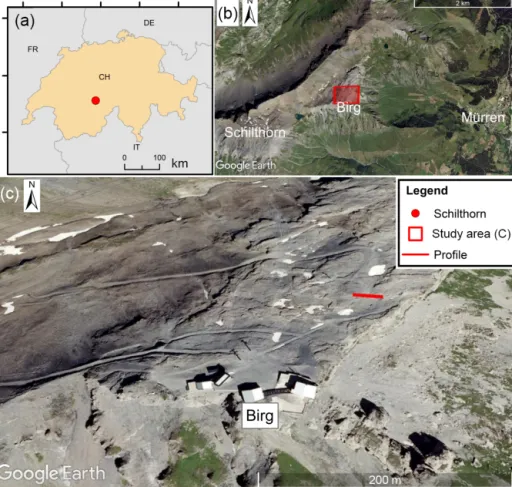
The survey was carried out in July 2016 on the Schilthorn massif, in the Bernese Alps, Switzerland. There is occurrence of alpine permafrost in the area (e.g. Hilbich et al., 2008; Scherler et al., 2010). Figure 1 illustrates the geographical location. Panel (b) shows the area from the village Mürren up to the summit of Schilthorn. The mountain station Birg is in between and can be reached by a cable car. The position of the selected profile B-SCH, north of Birg, at an altitude
of about 2700 m a.s.l. and with a length of 27 m, is shown in Fig. 1c. The surface in this area mostly consists of rock, which is covered with snow most of the year (i.e. October– July). On the summit area, the ground material is described as weathered. The occurrence of an ice layer under the snow is possible, as modelled by Scherler et al. (2010).
The photograph in Fig. 2 shows an example of the equip-ment layout in the field. The plate electrodes, which are cov-ered with Kapton foil for galvanic decoupling, were arranged in a profile line. They are connected by cables through a probe and a remote unit to the base unit (Przyklenk et al., 2016), which controls the measurements. The surface at the time of the measurements was covered by a layer of snow, which was frozen on the top. The depth of this snow layer was separately measured every 2 m using a dipstick for later validation of the results. Measurements were made along the profile in a dipole–dipole configuration (a = 1 m) for sev-eral electrode spacings (n = 1 − 6). They were not carried out with the same electrode spacing throughout the profile. Measurements with wider electrode spacing and correspond-ing larger penetration depth were carried out only on the first half of the profile.
2.2 Tromsø
The measurements in Norway were made in 2015 on the frozen Lake Prestvannet near the town of Tromsø. Figure 3 shows the geographical position of the area and the test site. In Fig. 3b, a part of the peninsula Tromsøya with the city Tromsø and the lake is visible. Lake Prestvannet covers an area of about 10 ha, has a maximum depth of 4 m and is cov-ered by ice most of the year (Stabbel, 1985). Although no quantitative statement is made, investigations of the lake wa-ter qualitatively indicate a high salinity (https://memim.com/ prestvannet.html, last access: 29 August 2019). The part of the lake where the test site is located is shown in panel (c), including the profile, which has an extension 33 m long and crosses the shore of the lake. The shore was covered with a layer of snow, the lake itself was frozen and measurements took place directly on the lake ice. Starting the profile on the lake and ending at the shore, the transition to the lake surface is at about profile coordinate 20.5 m.
The measurements were taken with a fixed electrode spac-ing in Wenner configuration (a = 1.5 m) to investigate differ-ences in the measured data due to the sub-vertical lake–shore boundary. The penetration depth of the measurements there-fore has a maximum of 1.5 m (Militzer and Weber, 1985). Additional measurements indicated that the boundary to the liquid water was at a minimum of 4 m depth, below the pen-etration depth of the data.
Figure 1. Geographical maps of the Schilthorn area. Panel (a) shows the location in Switzerland. In panel (b) the Schilthorn area with the village Mürren, the mountain station Birg and the summit is shown (© Google Earth). The area around Birg where the measurements took place is shown in panel (c), including the location of profile B-SCH (© Google Earth).
3 Basics of the capacitively coupled resistivity method When a time-varying current is injected into the ground, two different physical mechanisms are stimulated: the conduc-tion current associated with the electrical resistivity and the displacement current controlled by the electrical permittivity. The response of the material contains a combination of these two mechanisms, which can be measured as the impedance. Consequently, it is possible to define a complex value named the effective conductivity, or the effective permittivity ε∗, which combines the conduction and polarization properties, as
ε∗(ρ, εr, ω) = ε0εr+
1
iωρ, (1)
where i is the imaginary unit, ε0the permittivity of the
vac-uum and ω the angular frequency. In the most general form, both the electrical resistivity ρ and the relative electrical permittivity εr may be considered complex and
frequency-dependent (Loewer et al., 2017). However, since this general description is redundant, it is a matter of choice or convention whether frequency dependence is expressed by resistivity,
conductivity or permittivity. In the low-frequency range used by conventional SIP, frequency dependence is commonly ex-pressed by an imaginary conductivity (e.g. Maurya et al., 2018), whereas at higher frequencies permittivity is normally used (e.g. Stillman et al., 2010). Here, we choose to express our results in terms of frequency-dependent permittivity, as-suming resistivity to be a real, constant value, as will be de-tailed below.
The three variable quantities, i.e. ω, ρ and εr, determine in
mutual dependence the weighting of the two current compo-nents. The injected current and the measured voltage are in phase for the proportion of conduction current and shifted by −90◦for the displacement current component.
Most geophysical methods working with time-varying electric fields focus on one of the two mechanisms by defin-ing a chosen frequency range and neglect the other part. The ratio of the proportions of both current mechanisms gives an estimation for the physical regime of the measurements. Geophysical methods such as induced polarization (IP) or magnetotellurics (MT) (Telford et al., 1990) work in a rather low frequency range where the conduction current dominates the signal of the impedance. The ground-penetrating radar
Figure 2. Photograph of the measurements at profile B-SCH (Schilthorn area) in July 2016 with the Chameleon measurement device. The four plate electrodes are lying in line on the snow sur-face. The larger yellow box is the base unit which is connected by cables to the electrodes with the cubic grey remote units in between.
(GPR), on the other hand, works at very high frequencies and focuses on the displacement current, determining the permit-tivity (Zorin and Ageev, 2017). Our aim is to measure in an intermediate frequency range where both current mech-anisms are relevant in order to determine both electrical pa-rameters (see Eq. 1). In order to ensure this in our given fre-quency range, the subsurface materials have to exhibit rela-tively high resistivities and permittivities. The condition may be calculated based on the loss tangent (Przyklenk et al., 2016). Typically, for our frequency range the resistivity has to be greater than 1000 m. The needed conditions are par-ticularly prevalent in periglacial areas, with the occurrence of ground ice (Arenson et al., 2015; Hauck and Kneisel, 2006). The description of the complex impedance by Kuras et al. (2006), modified by Przyklenk et al. (2016) in order to use the unmodified geometry factor K, known from DC resistiv-ity, is
Z(ω, ρ, εr, h) =
1 2iωε0K
[1 − α(ρ, εr)H (h)], (2)
where the reflection factor α contains both electrical param-eters of the subsurface.
Special attention is given to the height factor H (h). It de-pends on the geometry factor K and a vertical geometry fac-tor, which describes the height of the capacitively coupled sensors. In the case of an ideal contact of the electrodes to the ground, the height h becomes zero and the resulting height factor H becomes 1. Thus, the electrical parameters for each frequency can be determined directly from the real and
imag-inary parts of the impedance (Przyklenk et al., 2016):
ρ = K Re(Z−1), (3) εr = I m(Z−1) Kωε0 −1. (4)
The challenge is that the electrodes, especially in the case of plates or discs, usually do not rest over their entire sur-face on the ground. Rather, with a slight unevenness of the ground, a contact of the electrodes to the ground is ensured only at a few points. This results in a mean non-zero height h of the electrode surface over the ground, which however can hardly be measured directly. The height dependence has al-ready been discussed by a few authors (Kuras et al., 2006; Przyklenk et al., 2016). Even small heights in the range of micrometres can cause large differences in the measured impedance, but this dependence becomes weaker as resistiv-ity and permittivresistiv-ity increase.
3.1 Cole–Cole model
The electrical permittivity and the resistivity are not con-stant values in most cases but vary with frequency. Polariz-able materials, e.g. water-saturated sediments or mineralized rocks, exhibit a strong frequency dependence of electrical pa-rameters (Zorin and Ageev, 2017). This is especially true in periglacial areas, for materials with pure ice or large ice con-tents (Petrenko and Whitworth, 2002; Bittelli et al., 2004; Stillman et al., 2010). Przyklenk et al. (2016) investigated several parametrizations of the frequency dependence of re-sistivity and permittivity. They suggest the use of the Cole– Cole model (CCM) (Cole and Cole, 1941), which provides reasonable results when fitting the spectral data of CCR mea-surements. For variable data with more spectral shape, a dual CCM, corresponding to a model of a two-component mix-ture, might be necessary for the evaluation of the impedance spectrum. For our studies, we decided to use the single CCM, which includes just one material, because it can fit our data with a minimum number of parameters. For the relative com-plex permittivity, the single Cole–Cole model is expressed by εr∗=εHF+ εDC−εHF 1 + (iωτ )c + 1 iωε0ρDC . (5)
The description of the frequency dependence of the electrical parameters is based on five Cole–Cole parameters: the DC resistivity ρDC, a low-frequency limit εDC, a high-frequency
limit εHF, which is referred to in the literature as the dielectric
constant, the relaxation time τ and the relaxation exponent c. The positive relaxation exponent can range up to a maximum value of 1, for which the model simplifies to the Debye model (Petrenko and Whitworth, 2002). The parameters are directly related to a physical context. Thus, they are material-specific parameters for which ranges of literature values are known and can be used for a discussion of the inversion results.
Figure 3. Geographical maps of Lake Prestvannet. The location in the northern part of Norway is shown in part (a) by the red dot. The lake is located on the peninsula Tromsøya, presented in panel (b), close to the city Tromsø (© Google Earth). A detailed view of the test site is given in panel (c), showing the profile crossing the boundary from the lake to the shore (© Google Earth).
3.2 Operating range
There is a parameter range in which the CCR method is fea-sible in the sense that the underlying assumptions are ful-filled and the physical process that is used to determine the spectral behaviour of permittivity and conductivity actually dominates. The term “parameter range” refers to the fre-quency, spatial scale (i.e. distance between transmitter and receiver), and electrical conductivity and permittivity. The CCR method operates in the “geometric sounding” range, where the investigated volume and in particular the pene-tration depth depend only on the location and the distance between transmitter and receiver. This is the same condition that applies to the ERT method.
The two processes that need to be investigated because they may limit the operating range of CCR are electromag-netic induction (EMI) and wave propagation. Electronetic induction currents are caused by the time-varying mag-netic fields which always co-exist with electric fields. Several methods are based on EMI, which is particularly important if the conductivity is large. Wave propagation is the basis of
ground-penetrating radar (GPR) methods, and is particularly important for very large frequencies.
For an assessment of the relative importance of the pro-cesses, we use the consideration by Weidelt, 1997, who com-pares the wavelengths (or their inverse, the wavenumbers) of the three processes with each other. The wavelength of EMI is equal to the skin depth, given by
δ = s
2ρ
ωµ, (6)
where µ is the magnetic permeability, where in this context it is sufficient to use the vacuum value, which is µ0=4π ×
10−7 V sAm.
The wavelength of wave propagation is given by λ = 2π
ω√εµ. (7)
For geometric sounding, the signal is composed of many dif-ferent wavelengths, but for an estimate of the relative im-portance of the processes, it is feasible to use an
appropri-ate measure of the spatial scale of the electrode configura-tion (i.e. the electrode distance a for Wenner configuraconfigura-tion) as the dominant wavelength. The equation that allows us to compare the three processes is (Weidelt, 1997)
γ2=4π 2 a2 + 2i δ2− 4π2 λ2 =G +EMI − WP, (8)
where γ is the complex wavenumber including all three pro-cesses, and the symbols G, EMI and WP stand for the geo-metrical sounding, electromagnetic induction and wave prop-agation term, respectively. The process corresponding to the largest term will dominate, and the other terms may be neg-ligible, depending on their magnitude.
Since there are four parameters controlling Eqs. (6)–(8), which also depend on each other (i.e. permittivity depends on frequency), it is difficult to give an operating range of general validity. It seems more feasible to evaluate the terms in Eq. (8) for specific conditions. For the measurements dis-cussed in this paper, we can carry out the following estimates. The maximum frequency of our system is 240 kHz. Assum-ing a minimum relative permittivity of 3, the minimum wave-length of wave propagation given by Eq. (7) is 722 m. The minimum wavelength of EMI given by Eq. (6) depends on electrical resistivity. Assuming ρ = 100 m as the minimum resistivity, which is a little smaller than the minimum val-ues actually encountered, we obtain approximately 10 m for the minimum EMI wavelength. From Eq. (8), it is clear that the geometrical sounding term will be the minimum for the largest electrode spacing, and therefore we use our largest spacing a = 1.5 m in Eq. (8) to obtain a worst-case estimate. With these numbers for the wavelengths, we obtain for the magnitudes G = 17.5, EMI = 0.02 and WP = 7.6×10⁻⁵. Therefore, the wave propagation term is by far the smallest and can safely be neglected; the EMI term is still significantly smaller than the geometrical sounding term. We therefore as-sume that for the data discussed here, EMI is also negligible, in case of high resistive environments and small electrode distances (Fiandaca, 2018). Nevertheless, we are also aware that a comprehensive assessment requires precise modelling of the equations, which will be the subject of future work. If we chose a larger electrode spacing, a = 30 m, then EMI = 8, and this would be of the same order of magnitude as G, and we would have to carry out a more thorough analysis.
In addition to these purely physical considerations, we also have to take technical issues into account, such as coupling of the capacitive electrodes, and electromagnetic coupling be-tween cables and the ground, which are less simple to esti-mate or to correct for. Therefore, we consider it necessary to gain experience and to test the entire system under a variety of conditions.
3.3 Single site inversion
The single site inversion was the primary method used in Przyklenk et al. (2016). In this spectral approach, the data of
each measured four-point array are inverted separately, i.e. without influence of other measurements. Under the condi-tions of geometrical sounding, the penetration depth of the measurement is only controlled by the geometric size of the configuration, i.e. the geometry factor K, in contrast to the frequency sounding where the frequency-dependent skin depth describes the penetration depth (McNeill, 1980).
The fit of the measured spectral data of the magnitude |Z(f )|and phase shift ϕ(f ) is obtained under parametriza-tion of the complex impedance (Eq. 2) by the single Cole– Cole equation (Eq. 5). The inversion is based on the model of a homogeneous half-space. From the result of the inversion, the five Cole–Cole model parameters can be extracted. More-over, the single site inversion has the possibility to take the sensor height effects into account. By using the mean elec-trode height h as an additional free inversion parameter, it is possible to include the effect of electrode height and at the same time determine its value. Thereby, capacitively coupled measurements taken under conditions of strong height influ-ence, in particular on low resistive subsurfaces, can also be evaluated. If the height is neglected during inversion, this can in principle lead to a distortion of the data and erroneous re-sults. Since in the next step we use a conventional 2-D in-version code for spectral IP data, where the height effect is not included in the forward modelling, it is essential to test whether it is justified to neglect it. For this purpose, we carry out the single site inversion twice: first including the height effect by setting the height as a free parameter and once un-der the assumption of no sensor height, i.e. by fixing it to zero.
Figure 4 shows a representative example of the spectra for magnitude (a) and phase shift (b) from a measurement at pro-file B-SCH. The points indicate the measured data, and the lines are the calculated spectra for the best-fit model. Inver-sion is done with (CCM hinv) and without (CCM h0)
deter-mination of height. The calculated height for CCM hinv is
7 × 10⁻⁷m. This is so close to zero that the results exhibit no visible difference in the measured frequency range. The pa-rameters of the Cole–Cole model, given in the caption of the figure, have no difference if rounded to a maximum of two decimal places.
The magnitude adopts a value of around 2 × 10⁵for low frequencies, where the curves converge to a constant value. The phase shift covers almost the entire range that is theoret-ically possible (0 to −90◦). The values close to zero for low frequencies indicate a domination of conduction currents, whereas the deviation from zero for increasing frequencies indicates the increasing relevance of displacement currents. It is expected that for higher frequencies out of the measured range, the phase shift approaches the limit of −90◦ where displacement currents dominate. The aim of measuring the intermediate range with the transition between both current mechanisms has been achieved in this case. The measured spectral signals in Fig. 4 are typical of the whole measure-ments on the profile. The values of magnitude are decreasing
Figure 4. Spectra for the magnitude (a) and the phase shift (b) of the impedance for measured data (dots) and inversion results by using the Cole–Cole model (CCM, lines). The inversion was carried out twice, with the assumption of zero electrode height (h0) and by calculating the height as an additional inversion parameter (hinv). The simulated curves of the two inversions can not be distinguished from each other. Data were measured at profile B-SCH, Schilthorn area, Switzerland, in a dipole-dipole configuration (a = 1m, n = 1). The CCM parameters are (h0and hinv): ρDC=3.8 × 10⁶m, εDC=53, εHF=2.8, τ = 3.6 × 10⁻⁵s, c = 0.82.
for larger configurations because of the increasing geome-try factor. The phase shift shows the characteristic wavelike shape with a local minimum and maximum. The data fit of the single site inversion is reasonable, justifying the usage of the single Cole–Cole model.
In the case of Lake Prestvannet we assume a sub-vertical separation through the measurements over the lake shore. Two representative signals are shown in Fig. 5 to illustrate the difference between the characteristic curve shapes. The magnitude exhibits a stronger frequency dependence in the case of the land measurements and a higher value for low frequencies of about 1 order compared to the lake measure-ments. For the phase shift, the shape of the curve measured on the lake is flatter and the local minimum is at higher fre-quencies. The phase shift shows smaller dynamics for the lake than for the land measurements. The figure illustrates that the different ground materials provide significant differ-ences in their response.
The inversion was performed with and without the deter-mination of sensor height. For the onshore measurement the estimated height is 2.5 × 10⁻⁵m, which results in no visible difference between the simulated curves. For the lake mea-surement the fitted height of 1.2 × 10⁻³m leads to a visi-ble difference for the phase shift (panel b). The two calcu-lated spectra vary for the lowest frequencies. While the in-version with zero height (continuous line) converges towards zero, the version including height (dashed line) shows a de-viation from zero consistent with the data. The data fit also shows a difference in terms of the root mean square (RMS), which is better for CCM hinv. It is known from theory that the
height dependence has stronger effects for lower frequencies and is stronger for the phase than for the magnitude of the impedance (Przyklenk et al., 2016). Our data, with a visible
effect in the phase shift and negligible effect in the magni-tude for the data set with the smaller impedance (panels a, b), are consistent with these theoretical results.
3.4 Influence of electrode height on Cole–Cole parameters
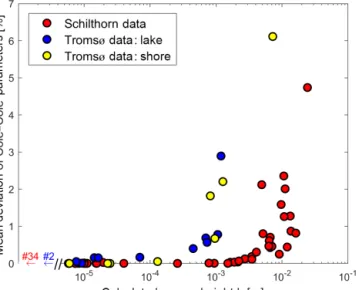
In the following, we analyse the dependence of the Cole– Cole parameters on the electrode height in some more detail. The reason why we perform this analysis is that the 2-D in-version used later is not able to consider non-zero electrode height. Therefore, the single site inversion was performed for every measured array of both field areas in both versions, with and without determining h. For every array, the five re-sulting Cole–Cole parameters were put into relation for both inversions, and the mean deviation in percent was calculated. This deviation is shown as a function of the estimated sensor height in Fig. 6.
For larger sensor height, the Cole–Cole results are more affected. The Schilthorn data (red dots) show a strong in-crease in deviations from approximately 5 × 10⁻³m height on. For the Tromsø data, which are shown separately for the measurements on the lake (blue dots) and on the shore (yel-low dots), this increase occurs for sensor heights about 1 or-der of magnitude lower. The different behaviour can be ex-plained by the condition of lower electrical resistivities for the Tromsø measurements. As mentioned earlier, the height effect is stronger for lower ground parameters of resistivity and permittivity. Furthermore, for the Schilthorn data higher values of sensor height were determined. This could indi-cate that in case of the solid ice surface, as on the lake, the contact of electrodes to the ground is very smooth, resulting in a more homogeneous sensor height. On the other hand, the snow surface at Schilthorn builds a more porous ground.
Figure 5. Spectra of two measurements from the Tromsø site. Panels (a) and (b) show data from the lake and (c, d) data from a mea-surement on shore. The figure shows the measured data and the inversion results using the Cole–Cole model. The simulated curves with zero electrode height (h0) and inverted height (hinv) can not be distinguished, except for the phase shift of the lake measurement (b). Both measurements were taken in a Wenner configuration with a = 1.5 m. The CCM parameters for the lake measurement are (h0/hinv) ρDC=1.82 × 10⁴/1.81 × 104m, εDC=374/370, εHF=8.80/8.83, τ = 4.2 × 10⁻⁵/4.1 × 10−5s and c = 0.93/0.93. The CCM parame-ters for the onshore measurement are (h0and hinv) ρDC=1.2 × 10⁵m, εDC=670, εHF=12.8, τ = 7.1 × 10⁻⁵s and c = 0.84.
The loose material might cause a poorly defined contact and lead to an artificially increased apparent electrode height. The Schilthorn data show scattered sensor heights, which indicates the uncertainty in the electrode contact surface. It should be noted that the calculated sensor heights in Fig. 6 are shown only down to the lowest values of 5 × 10⁻⁶m, but lower values were also determined. Investigations from Przyklenk et al. (2016) and Kuras et al. (2006) indicate that electrode heights lower than around 10−4m do not effect the measured signal, especially under high resistive conditions. Smaller heights determined by the inversion are mainly due to numerical reasons and do not represent physical condi-tions. They can be seen as equal to zero. The determined values of the Schilthorn measurements range from less than 10−9m up to centimetres. On the other hand the Tromsø re-sults only vary from 10−7m to the millimetre range.
Additional investigations, which will not be further elabo-rated here, have indicated that the parameters ρ, εDCand τ
are generally more affected than εHFand c. That is
consis-tent with the fact that the electrode height mainly affects the lower frequencies. All in all, the deviations of the Cole–Cole results are relatively small. Except for the two highest val-ues in Fig. 6, their effect is smaller 3 %. These deviations are considered to be acceptable, compared to the typical Cole– Cole parameter resolution for inversions (Yuval and Olden-burg, 1997; Madsen et al., 2017). The results therefore jus-tify the use of inversions without considering effective sensor height, as in the case of the 2-D inversion (see next section). It should be noted that under less favourable conditions, de-pending on the electrical parameters of the soil and the tex-ture of the surface, neglecting the height can lead to larger errors. Neglecting height is therefore not a general
recom-Figure 6. Mean deviation of Cole–Cole parameters vs. sensor height. The deviation was calculated by performing the single site inversion with and without the determination of sensor height and calculating the ratio for all the five Cole–Cole parameters. The data are separately shown for all measurements at profile B-SCH (Schilthorn, red) and for Lake Prestvannet (Tromsø) on the lake (blue) and on shore (yellow). Values for sensor heights lower than 5 × 10⁻⁶m are not displayed but their number of measurements is shown.
mendation, but has to be investigated separately for each ap-plication with different subsurface conditions. In the case of snow or icy ground, one additional benefit is that these are rather smooth surfaces, where the electrode height is small. On uneven surfaces, such as gravel and rock fields, an instal-lation of the plate electrodes without height variations may be difficult to achieve.
4 2-D inversion with AarhusInv
The full spectral inversion of complex resistivity data, where all frequencies are being inverted simultaneously, has been a challenge for some time. For example, Grimm and Stillman (2015) used a workaround based on the time-lapse feature of RES2DINV (Loke and Barker, 1996) to invert their broad-band SIP data from a periglacial environment. Recently, a few codes for full spectral inversion have become available (Günther and Martin, 2016; Maurya et al., 2018). Here, we use the program AarhusInv (as in Maurya et al., 2018), which is a tool for the inversion and modelling of geophysical data for several measurement methods (Auken et al., 2014). The software is freely available for non-commercial purposes. In AarhusInv the complex impedance is modelled in 2-D solv-ing the Poisson’s equation and Fourier transformed in the strike direction, without considering electromagnetic effects (Fiandaca et al., 2013). All the inversion parameters are in-verted simultaneously using all the measured frequencies in
parameters. As discussed previously, the height of the elec-trodes is not included in AarhusInv and is assumed to be zero. Through this approximation the application for CCR data is usually just suitable under highly resistive conditions. Of course, this inversion method could generally be used for high-frequency spectral resistivity measurements, including galvanically coupled electrodes.
In the following, we will show the results of the 2-D in-version for both field sites. The resulting distribution of all Cole–Cole parameters will be discussed and compared with the expected properties of the subsurface.
4.1 Schilthorn
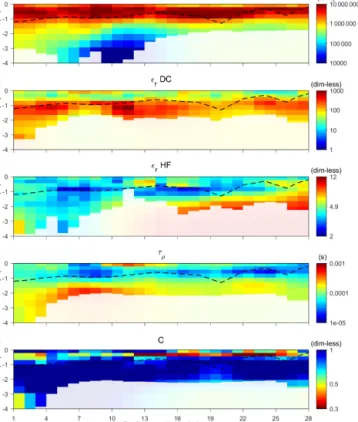
The measured data from profile B-SCH were evaluated with the 2-D inversion. The result is shown in Fig. 7, where sev-eral 2-D models for the five Cole–Cole parameters ρ, εDC,
εHF, τ and c are shown colour-coded vs. the depth and
hor-izontal coordinate. The dashed black line corresponds to the manually measured depth of the top snow layer.
In this context, it is important to discuss the resolution of the Cole–Cole parameters because it is known from previ-ous studies that it can be difficult to reliably estimate relax-ation time and frequency exponent (e.g. Madsen et al., 2017). Problems usually arise if the frequency where the phase peak occurs, which is related to the relaxation time, is outside the measured acquisition range. Weigand and Kemna (2016) discuss similar observations when average parameters are de-rived from spectral decomposition techniques. The particu-lar benefit of our acquisition system is the wide frequency range compared to a conventional SIP system. As a result, all phase peaks corresponding to the relaxation times are in fact being measured. Therefore, we are confident that the Cole–Cole parameters of the inversion results are well deter-mined. Nevertheless, we carried out additional experiments where we fixed the frequency exponent c, as suggested by Weigand and Kemna (2016). In that case, the data fit deteri-orates, in the sense that the curve shape vs. frequency cannot be matched that well any more. We consider this as evidence that even c is not poorly constrained. The strong variability of c observed in the inversion results may be justified by the
Figure 7. Result of the AarhusInv 2-D inversion for the data from the Schilthorn area along the profile B-SCH denoted in Fig. 1. The figure shows the sections of the five Cole–Cole parameters (a–e) de-fined by Eq. (5). The dashed line shows the separately measured depth of the snow layer, and the brighter parts represent the area where the depth of investigation is exceeded.
actual change in materials. Finally, we rely on the depth of investigation (DOI) as an objective measure in which region parameters are well constrained. The calculation of the DOI was described in Fiandaca et al. (2015). The brighter areas in Fig. 7 are those below the DOI, areas where the parameters can no longer be reliably estimated. This boundary differs for each parameter, having in most cases the deepest extent for the resistivity model. We are aware that other tools to assess parameter resolution may exist, but a comprehensive treat-ment of this subject is beyond the scope of this paper.
First, we focus on the structural aspects of the results. The structure is a little different for each of the five sections, but in general a structure of two layers can be recognized, repre-senting the top snow layer and the underlying surface layer. Because of the additional snow depth measurements, the re-sults of the inversion can be validated. Especially for εDC, the
boundary of the snow layer agrees well with the correspond-ing parameter contrasts. Around profile metre 20, where the boundary indicates a ditch, it becomes particularly clear how precisely the layer structure is reflected by the low-frequency permittivity value (panel b). The layer boundary can also be seen from the result of the resistivity (panel a), where a
highly resistive surface layer is followed by a more conduc-tive material. Unlike in the εDCsection, there is a
continu-ous decrease in the value with the depth, which makes the layer transition appear more smoothly. The layer boundary is also apparent in the section of parameter τ (panel d). The relaxation exponent c (panel e) also indicates the boundary. In the lower layer, c is close to 1, corresponding to a De-bye relaxation. Compared to the other parameters, less liter-ature is available for the relaxation exponent and the values are close to each other. Therefore, c seems less suitable for an interpretation in terms of material properties. The high-frequency value εHF (panel c) is the only one which does
not show a clear distribution. The range in this case is sig-nificantly smaller compared to the other parameters, which could make it more difficult to identify differences in mate-rials based on εHF. This is the case in this example but could
be different for other test sites or under different conditions. The region of slightly higher values at about 2 m depth on the second half of the profile could indicate a systematic change in the permittivity.
The two layers could be identified as the snow layer and the underlying bedrock, expected to be the limestone layer described by Rowan (1993), which could also be seen at some spots on the surface near the profile area. The resis-tivity and the relaxation time on the first half of the profile show some more variation underneath the snow. This could be caused by a third layer of weathered material on top of the bedrock or a possible ice cover underneath the snow, as described by Scherler et al. (2010).
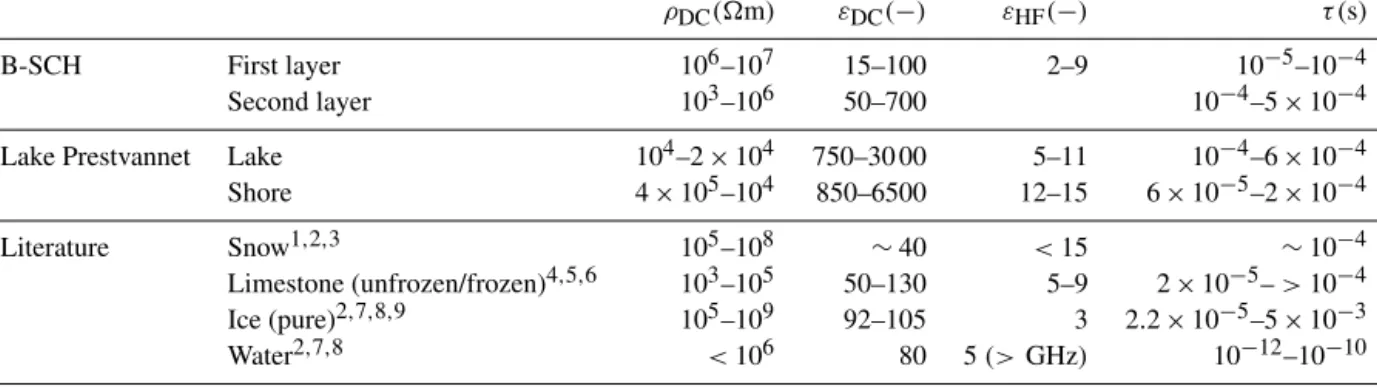
The determined values in their dominating range for the two horizontal regions of profile B-SCH are compared to the literature in Table 1. The literature values of the differ-ent materials can vary over large ranges, which is mainly caused by the differences in physical conditions. For ice and snow the purity, density, salinity and temperature can strongly influence the electrical parameters (Auty and Cole, 1952; Arenson et al., 2015; Evans, 1965). New and soft snow, as was present in the case of the profile B-SCH, has a rela-tively low density, meaning an increase in resistivity towards more dense snow. For the literature values of ice the attribute “pure” means that there is no impurity caused by other ma-terials in the ice/water, but there are still variations based on the physical conditions like temperature. If ground material is frozen, like on permafrost or seasonal frost, the measured signal is expected to react as a composition of the basic ma-terial and ice (Zorin and Ageev, 2017). The parameters for frozen ground are strongly dependent on the ice content and temperature (Arenson et al., 2015; Grimm et al., 2015). In the case of limestone, laboratory investigations of CCR by Mur-ton et al. (2016) showed that the resistivity of a frozen lime-stone sample (105m) can be 1 order of magnitude higher than for the same sample in an unfrozen state.
The electrical behaviour of water needs particular atten-tion because the typical relaxaatten-tion frequency of water is in the range of gigahertz (e.g. Artemov and Volkov, 2014).
Con-Water <10 80 5 (> GHz) 10 –10
Literature values were taken from Arenson et al. (2015)1, Evans (1965)2, Achammer and Denoth (1994)3, Palacky (1988)4, Murton et al. (2016)5, Olatinsu et al.
(2013)6, Seshadri et al. (2008)7, Artemov and Volkov (2014)8, and Auty and Cole (1952)9.
sequently, the high frequency value εHFof about 5 will not
be reached within our frequency range. Instead, the real di-electric permittivity exhibits a constant behaviour, denoted as the low-frequency value, which is commonly known as 80. However, a study by Seshadri et al. (2008) shows that even in water without solids another relaxation process takes place at lower frequencies in the range of hertz, associated with in-terfacial polarization due to ions. The dielectric permittivity therefore can reach values of more than 1000 at the lower boundary of our frequency range, especially if the water has a high electrolyte concentration.
In Table 1 (top row) the information of the inversion re-sults (Fig. 7) is extracted and attributed to different layers. For the first layer, the estimated values agree for all Cole– Cole parameters with those of snow. For the area under the horizontal boundary, indicated by the clear change in param-eters ρDC, εDCand τ , the estimated values are in agreement
with the expected limestone layer. As the resistivity indicates a further separation, the area directly underneath the snow could either belong to an ice layer or be caused by a frozen state, followed by a less resistive part of the limestone. The observation that all other parameters except resistivity show no significant change in this area can be explained by the sim-ilarity of the parameters for ice and limestone, indicated by the literature values. The similarity and small range of high-frequency permittivity εHFof all corresponding literature
val-ues can explain the low variability and missing distinctness in this parameter section. In summary, the determined Cole– Cole parameters from the 2-D inversion are consistent with the literature values for the expected materials.
A comparison with the results of the single site inversion illustrates the differences of the inversion methods. Figure 8 shows the results for the same measurements as in Fig. 7 but evaluated by the single site inversion. The parameters are determined individually for each quadrupolar measure-ment. In order to represent the results in a two-dimensional
Figure 8. Pseudo-sections of the five Cole–Cole parameters (a–e) calculated by the single site inversion for profile B-SCH. Measure-ments were performed for larger configurations on the left half of the profile.
structure, the parameters are assigned to a certain location according to the midpoint position and extent of the array. Thus, a two-dimensional pseudo-section is finally created for each parameter, which can provide a rough overview of the subsurface structure. The difference between Figs. 7 and 8 is that Fig. 8 represents an inversion result only with re-spect to frequency, but a pseudo-section with rere-spect to the spatial distribution, whereas Fig. 7 is a full inversion result with respect to both frequency and space. As expected when comparing pseudo-sections with 2-D inversion results, over-all structures are similar, but there are differences in detail. The low-frequency permittivity (panel b) and the relaxation time (panel d) systematically increase with depth, while the resistivity (panel a) shows a decrease with depth, all indi-cating a horizontally layered structure. As seen before in the 2-D results, the high permittivity value εHFexhibits a small
range of values and does not show a systematic distribution, but fits in the range of the literature. Since the results of the deeper pseudo-layers always represent an integral value over the entire depth range, it has to be expected that clear bound-aries between the layers can not be identified by this method. Therefore the measurements have to be analysed as functions of each other, as carried out by the 2-D inversion. However, since the inversion with respect to the frequency dependence is independent for the two methods, we take the qualitative consistency as evidence that our 2-D inversion is a feasible tool to invert spatial and frequency dependence at the same time.
4.2 Tromsø
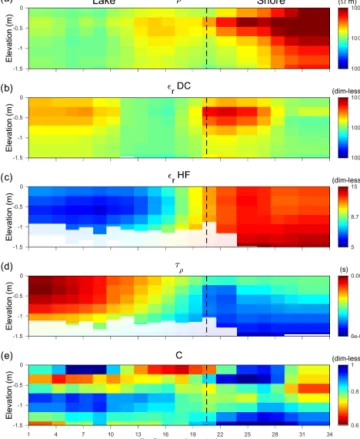
The investigations at Lake Prestvannet focus on the vertical transition from the lake to the shore rather than on the dis-tribution with depth. In Fig. 9, the result of the AarhusInv 2-D inversion is shown for all Cole–Cole parameters. Mea-surements were carried out for just a small spacing (Wenner a =1.5 m), so the penetration depth is not more than approx-imately 1.5 m. Brighter areas are again below the DOI and the vertical black line indicates the surface position of the transition from the lake to the shore at profile metre 20.5. Except for the relaxation exponent c (panel e), in all models the transition is defined by a parameter change. The ranges of the estimated Cole–Cole parameters for lake and shore are given in Table 1 and can be compared to the literature values of snow, ice and water.
The high-frequency permittivity εHF(panel c) shows lower
values for the lake than onshore. This parameter is some-what specific because the variation from lake to shore is the only prominent variation, whereas the other parameters also show some structure within both sides. Compared to pro-file B-SCH (Fig. 7), where εHF has a small dynamic range
with little spatial coherence, for the data of Lake Prestvan-net both permittivity values εDCand εHFseem to be useful
to distinguish different materials or the state of freezing. The low-frequency permittivity εDC (panel b) shows the
transi-Figure 9. Two-dimensional inversion result of the five Cole–Cole parameters (a–e) for the measurements at Lake Prestvannet denoted in Fig. 3. The surface boundary between lake and shore is at profile metre 20.5, indicated by the dashed line, where a change in most parameters can be recognized. The whitened areas are those where the value of DOI is exceeded.
tion from lake to shore, but exhibits additional variation on either side of the transition. The land side shows an anomaly close to the transition. The cause is not exactly known, but we hypothesize that it indicates a change in sediments. A de-tailed analysis, where the two properties of permittivity may be combined with resistivity in a multi-parameter analysis, may be a subject of future research. The relaxation time τ shows relatively homogeneous values for each of the sides. The fact that the relaxation times of snow are shorter than those of ice (Evans, 1965) is consistent with our results. The resistivity ρDC decreases from higher values on the
snow-covered land side by about 1 order of magnitude on the lake. The relaxation exponent c shows small variations and poor spatial coherence, and is difficult to interpret in terms of ma-terial variations.
Onshore, the measurements were taken on the snow and the known values of snow are consistent for some param-eters. Higher density of the snow could explain the much lower resistivity than obtained for the snow at B-SCH. How-ever, in combination with the values of εDC, which are higher
than expected for snow, this could indicate that the measure-ments are under the influence of the ground material beneath.
mated value is larger than that expected for pure ice. Lower values of resistivity could also be explained by this compo-sition because water has a lower intrinsic resistivity than ice. A similar observation was made by Przyklenk et al. (2016) during their discussion of measurements on mountain ice. 4.3 Data fit
For the assessment of the inversion results, we consider their quality in terms of the data fit. Because of being a spectral inversion, the inversion includes the fit of all measured data over frequency, corresponding to a spectral pair of magnitude and phase shift for every four-point array. In the following, the data misfit is expressed in terms of the weighted mean square error, where each difference is weighted by the in-verse of the data error. This value is denoted by the symbol χ, and is a well-established measure of the misfit. Together with an additive regularization term, it is minimized during the inversion (Fiandaca et al., 2013).
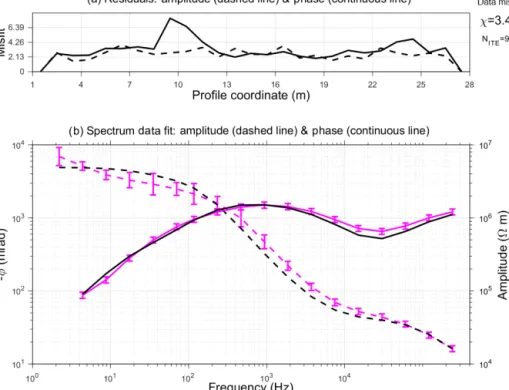
Figure 10 shows the data fit for the 2-D inversion of the Schilthorn measurements. The top panel (a) shows the mis-fit of amplitude and phase shift over the profile length. The residuals are averaged over all measurements with all con-figurations with the same midpoint. The total inversion mis-fit is χ = 3.4, based on the average relative standard devia-tion of amplitude (0.16) and phase measurements (0.10). The inversion converged after nine iterations. The misfits of am-plitude and phase are homogeneous over the profile, except around profile metre 10, where the phase misfit is signifi-cantly higher. As can be seen from Fig. 7, this is the area where ρ and τ show another change for the deeper region. The higher misfit corresponds to the data of larger config-urations (dipole–dipole with n = 5, 6), where the measured signals show slightly different curves than for the shallower measurements. The large misfit indicates that the deep struc-ture should be treated with caution because it could be caused by difficulties in matching data.
Panel (b) of Fig. 10 shows the data fit of the spectrum, which was previously shown during the discussion of the single site inversion (Fig. 4). Data and inversion results are shown for the amplitude (dashed lines) and the phase
(con-to define the dispersion of permittivity.
Another example of data spectra is shown in Fig. 11 for the measurements taken at Lake Prestvannet. The data are the same as discussed in Fig. 5, with one lake measurement (blue) and one onshore measurement (red) corresponding to profile coordinates 11.5 and 28 m from Fig. 9. The total data misfit of the inversion is χ = 1.8. The onshore spectra show some similarity to the Schilthorn spectra (Fig. 10). The am-plitude and the phase shift are both matched very well. As mentioned before for the single site inversion, the spectra of lake and land show a different frequency-dependent be-haviour. A slight difference between the measured and cal-culated data is visible for the phase of the lake measurement in the intermediate frequency range. This could indicate lim-itations of the single Cole–Cole model.
The sensor height effect is not negligible in this case. The lowest two frequencies seem to be affected and can not be matched by the inversion. This is the same effect as discussed previously during the single site inversion.
5 Conclusions
Wide-band complex resistivity measurements based on ca-pacitively coupled electrodes were carried out on two cryospheric field sites, on a frozen lake in Norway and in an alpine region in Switzerland. By recording the spectral data in an intermediate frequency range, where conduction currents and displacement mechanisms are relevant, the de-termination of the frequency-dependent electrical resistivity and permittivity is investigated. The data analysis is per-formed by a novel 2-D inversion for broadband electrical measurements based on the inversion tool AarhusInv, where the permittivity is parameterized with a Cole–Cole model.
The first applications of the 2-D inversion give encourag-ing results in the sense of consistence with known materials and structure. For our shallow field measurements, the single Cole–Cole model seems sufficient and there is no evidence of fundamental difficulties in fitting spectral data. The observed misfits are acceptable in a sense that χ is close to 1, in the range typical for conventional 2-D resistivity inversions, and
Figure 10. Data fit of the 2-D inversion of profile B-SCH. Panel (a) shows the misfit of amplitude (dashed line) and phase shift (solid line) over the profile. Panel (b) shows an example of measured (red) and inverted (black) spectra of amplitude (dashed lines) and phase (continuous lines), which belong to the dipole–dipole measurement starting from profile metre 16 (a = 1 m, n = 1) along the profile direction (see Fig. 7). The measured data are the same as in Fig. 4, with resistivity instead of impedance, and phase shift on a logarithmic scale. The total data misfit is χ = 3.4 after nine iterations. For each profile coordinate, the misfit of all data corresponding to this point was averaged to obtain the top panel (a).
Figure 11. Data fit of the 2-D inversion for two stations of the Lake Prestvannet profile. The blue lines correspond to a measurement at 11.5 m, which is on the lake, the red lines to an onshore measure-ment at 28 m, with the corresponding inverted spectra (black). Both were measured with a Wenner configuration (a = 1.5 m). The mea-sured data are the same as in Fig. 5. The amplitude is indicated by the dashed lines and the phase shift by the solid lines.
should have similar causes, such as 3-D effects. In principle, it is possible to implement a double Cole–Cole model, which could fit more complex spectra, but has more inversion pa-rameters. The assumption of zero sensor height seems to be uncritical in our chosen field applications. In some cases, it
could be helpful to discard some low-frequency data, which are most strongly affected by electrode height above the ob-served surface.
The determination of the electrical parameters for both in-vestigations was successful. They show reasonable consis-tence with literature values within a maximum deviation of 1 order of magnitude. The inversion for the five Cole–Cole parameters works as well as conventional 2-D resistivity in-version, except for the frequency exponent, which tends to show spatially incoherent images. The complementary in-formation provided by the high- and low-frequency limits of permittivity can be significant. Some structures are more clearly defined than in the corresponding resistivity image. We conclude that using different parameter sections for the interpretation can lead to a more differentiated analysis of the subsurface.
The full spectral information can be used for the determi-nation of ground ice content at the field scale, as suggested by Grimm and Stillman (2015). This is an objective of re-search in periglacial environments, and will be the subject of future work.
Schilthorn massif and discussed the interpretation of electrical prop-erties.
Competing interests. C. Hauck is a member of the editorial board of the journal.
Acknowledgements. We are grateful to Katharina Bairlein (PTB, Braunschweig) and Christian Kulüke (TU Braunschweig) for the support of our measurements in Norway and Switzerland. We thank Wim Weber (City of Tromsø) for the permission to measure the data on the Lake Prestvannet.
Financial support. The work was sponsored by the German Re-search Foundation (projects HO 1506/22-1 and HO 1506/22-2), and by the University of Aarhus.
Review statement. This paper was edited by Tobias Sauter and re-viewed by two anonymous referees.
References
Achammer, T. and Denoth, A.: Snow dielectric properties: from DC to microwave X-band, Ann Glaciol, 19, 92–96, https://doi.org/10.3189/S0260305500011034, 1994.
Arenson, L., Colgan, W., and Marshall, H.: Physical, Ther-mal, and Mechanical Properties of Snow, Ice, and Per-mafrost, in: Snow and Ice-Related Hazards, Risks and Disasters, https://doi.org/10.1016/B978-0-12-394849-6.00002-0, 2015.
Artemov, V. and Volkov, A.: Water and Ice Dielectric
Spectra Scaling at 0◦C, Ferroelectrics, 466, 158–165, https://doi.org/10.1080/00150193.2014.895216, 2014.
Auken, E., Christiansen, A., Kirkegaard, C., Fiandaca, G., Scham-per, C., Behroozmand, A., Binley, A., Nielsen, E., Effersø, F., Christensen, N., Sørensen, K., Foged, N., and Vignoli, G.: An overview of a highly versatile forward and stable in-verse algorithm for airborne, ground-based and borehole elec-tromagnetic and electric data, Explor. Geophys., 46, 223–235, https://doi.org/10.1071/EG13097, 2014.
Rock Glacier, J. Geophys. Res.-Sol. Ea., 123, 9528–9554, https://doi.org/10.1029/2018JB015965, 2018.
Evans, S.: Dielectric Properties of Ice and
Snow – a Review, J. Glaciol., 5, 773–792,
https://doi.org/10.3189/S0022143000018840, 1965.
Fiandaca, G.: Induction-free acquisition range in spectral time- and frequency-domain induced polarization at field scale, Geophys. J. Int., https://doi.org/10.1093/gji/ggy409, in press, 2018. Fiandaca, G., Ramm, J., Binley, A., Gazoty, A., Christiansen, A.,
and Auken, E.: Resolving spectral information from time do-main induced polarization data through 2-D inversion, Geophys. J. Int., 192, 631–646, https://doi.org/10.1093/gji/ggs060, 2013. Fiandaca, G., Christiansen, A., and Auken, E.: Depth of
Inves-tigation for Multi-parameters Inversions, European Associa-tion of Geoscientists and Engineers, Near Surface Geoscience 2015, Conference Paper, 631–646, https://doi.org/10.3997/2214-4609.201413797, 2015.
Flageul, S., Dabas, M., Thiesson, J., Reijiba, F., and Tabbagh, A.: First in situ test of a new electrostatic resistivity meter, Near Surf. Geophys., 11, 265–273, https://doi.org/10.3997/1873-0604.2012063, 2013.
Grard, R.: A quadrupolar array for measuring the complex permit-tivity of the ground: application to Earth prospection and plane-tary exploration, Meas. Sci. Technol., 1, 295–301, 1990. Grard, R. and Tabbagh, A.: A mobile four-electrode array
and its application to the electrical survey of planetary grounds at shallow depth, J. Geophys. Res., 96, 4117–4123, https://doi.org/10.1029/90JB02329, 1991.
Grimm, R. and Stillman, D.: Field Test of Detection and Char-acterisation of Subsurface Ice using Broadband Spectral-Induced Polarisation, Permafrost Periglac., 26, 28–38, https://doi.org/10.1002/ppp.1833, 2015.
Grimm, R., Stillman, D., and MacGregor, J.: Dielectric signa-tures and evolution of glacier ice, J. Glaciol., 61, 1159–1170, https://doi.org/10.3189/2015JoG15J113, 2015.
Günther, T. and Martin, T.: Spectral two-dimensional inver-sion of frequency-domain induced polarization data from a mining slag heap, J. Appl. Geophys., 135, 436–448, https://doi.org/10.1016/j.jappgeo.2016.01.008, 2016.
Hauck, C. and Kneisel, C.: Application of Capacitively-coupled and DC Electrical Resistivity Imaging for Moun-tain Permafrost Studies, Permafrost Periglac., 17, 169–177, https://doi.org/10.1002/ppp.555, 2006.
Hauck, C. and Kneisel, C.: Applied Geophysics in
Periglacial Environments, Cambridge Univ. Press,
https://doi.org/10.1017/CBO9780511535628, 2008.
Hauck, C., Böttcher, M., and Maurer, H.: A new model for estimating subsurface ice content based on combined electrical and seismic data sets, Cryosphere, 5, 453–468, https://doi.org/10.5194/tc-5-453-2011, 2011.
Hilbich, C., Hauck, C., Hoelzle, M., Scherler, M., Schudel, L., Völksch, I., Vonder Mühll, D., and Mäusbacher, R.: Monitoring mountain permafrost evolution using electrical resistivity tomog-raphy: A 7-year study of seasonal, annual, and long-term varia-tions at Schilthorn, Swiss Alps, J. Geophys. Res., 113, F01S90, https://doi.org/10.1029/2007JF000799, 2008.
Hördt, A., Weidelt, P., and Przyklenk, A.: Contact impedance of grounded and capacitive electrodes, Geophys. J. Int., 193, 187– 196, https://doi.org/10.1093/gji/ggs091, 2013.
Kemna, A., Binley, A., Ramirez, A., and Daily, W.: Complex resis-tivity tomography for environmental applications, Chem. Eng. J., 77, 11–18, https://doi.org/10.1016/S1385-8947(99)00135-7, 2000.
Kemna, A., Binley, A., Cassiani, G., Niederleithinger, E., Revil, A., Slater, L., Williams, K., Flores Orozco, A., Haegel, F.-H., Hördt, A., Kruschwitz, S., Leroux, V., Titov, K., and Zimmermann, E.: An overview of the spectral induced polarization method for near-surface applications, Near Surf. Geophys., 10, 453–468, 2012.
Kuras, O., Beamish, D., Meldrum, P., and Ogilvy, R.: Fundamentals of the capacitive resistivity technique, Geophysics, 71, 135–152, https://doi.org/10.1190/1.2194892, 2006.
Kuras, O., Beamish, D., Meldrum, P., Ogilvy, R., and Lala, D.: Ca-pacitive Resistivity Imaging with Towed Arrays, J. Environ. Eng. Geoph., 12, 267–279, https://doi.org/10.2113/JEEG12.3.267, 2007.
Loewer, M., Günther, T., Igel, J., Kruschwitz, S., Martin, T., and Wagner, N.: Ultra-broad-band electrical spectroscopy of soils and sediments – a combined permittivity and conductivity model, Geophys. J. Int., 210, 1360–1373, 2017.
Loke, M. and Barker, R.: Rapid least-squares inversion of apparent resistivity pseudosections by a quasi-Newton method, Geophys. Prospect, 44, 131–152, 1996.
Madsen, L., Fiandaca, G., Auken, E., and Christiansen, A.: Time-domain induced polarization – an analysis of Cole-Cole parameter resolution and correlation using Markov Chain Monte Carlo inversion, Geophys. J. Int., 211, 1341–1353, https://doi.org/10.1093/gji/ggx355, 2017.
Maurya, P., Fiandaca, G., Christiansen, A., and Auken, E.: Field-scale comparison of frequency- and time-domain spec-tral induced polarization, Geophys. J. Int., 214, 1441–1466, https://doi.org/10.1093/gji/ggy218, 2018.
McNeill, J.: Electromagnetic terrain conductivity measurement at low induction numbers, Technical note TN-6, Geonics Ltd., 1980.
Militzer, H. and Weber, F.: Angewandte Geophysik, 2, Geoelektrik-Geothermik-Radiometrie-Aerogeophysik, Springer Wien, Akademie-Verlag Berlin, 1985.
Murton, J. B., Kuras, O., Krautblatter, M., Cane, T., Tschofen, D., Uhlemann, S., Schober, S., and Watson, P.: Monitor-ing rock frezMonitor-ing and thawMonitor-ing by novel geoelectrical and
acoustic techniques, J. Geophys. Res.-Earth, 121, 2309–2332, https://doi.org/10.1002/2016JF003948, 2016.
Olatinsu, O. B., Olorode, D. O., and Oyedele, K. F.: Radio fre-quency dielectric properties of limestone and sandstone from Ewekoro, Earstern Dahomey Basin, Advances in Applied Sci-ence Research, 4, 150–158, 2013.
Olhoeft, G. R.: Electrical properties of natural clay permafrost, Can. J. Earth Sci., 14, 16–24, https://doi.org/10.1139/e77-002, 1977. Palacky, G. J.: Resistivity characteristics of geologic targets,
in: Electromagnetic methods in applied geophysics, 52–129, https://doi.org/10.1190/1.9781560802631.ch3, 1988.
Pelton, W., Ward, S., Hallof, P., Sill, W., and Nelson, P.: Mineral discrimination and removal of inductive cou-pling with multifrequency IP, Geophysics, 43, 588–609, https://doi.org/10.1190/1.1440839, 1978.
Petrenko, V. and Whitworth, R.: Physics of Ice, Oxford University Press, New York, 2002.
Przyklenk, A., Hördt, A., and Radi´c, T.: Capacitively-Coupled Re-sistivity measurements to determine frequency-dependent elec-trical parameters in periglacial environments – theoretical con-siderations and first field tests, Geophys. J. Int., 206, 1352–1365, https://doi.org/10.1093/gji/ggw178, 2016.
Radi´c, T.: First Results from the New Multi-purpose Instrument CapGeo, 19th European Meeting of Environmental and Enge-neering Geophysics, Near Surface Geoscience 2013, Extended abstract, https://doi.org/10.3997/2214-4609.20131364, 2013. Routh, P., Oldenburg, D., and Li, Y.: Regularized inversion of
spec-tral IP parameters from complex resistivity data, Expanded Ab-stracts of the 68th Annual International Meeting, Society of Ex-ploration Geophysicists, 810–813, 1998.
Rowan, M.: Structural geometry of the Wildhorn Nappe between the Aar massif and the Brienzer See, Eclogae Geol. Helv., 86, 87–119, 1993.
Scherler, M., Hauck, C., Hoelzle, M., Stähli, M., and Völksch, I.: Meltwater infiltration into the frozen active layer at an alpine permafrost site, Permafrost Periglac., 21, 325–334, https://doi.org/10.1002/ppp.694, 2010.
Seidensticker, K., Möhlmann, D., Apathy, I., Schmidt, W., Thiel, K., Arnold, W., Fischer, H., Kretschmer, M., Madlener, D., Pe-ter, A., Trautner, R., and Schieke, S.: Sesame – An Experiment of the Rosetta Lander Philae: Objectives and General Design, Space Sci. Rev., 128, 301–337, https://doi.org/10.1007/s11214-006-9118-6, 2007.
Seshadri, S., Chin, K., Buehler, M., and Anderson, R.:
Us-ing Electrical Impedance Spectroscopy to Detect
Wa-ter in Planetary Regoliths, Astrobiology, 8, 781–792, https://doi.org/10.1089/ast.2007.0180, 2008.
Souffaché, B., Cosenza, P., Flageul, S., Pencolé, J.-P., Seladji, S., and Tabbagh, A.: Electrostatic multipole for electrical resistivity measurements at the decimetric scale, J. Appl. Geophys., 71, 6– 12, https://doi.org/10.1016/j.jappgeo.2010.01.009, 2010. Stabbel, B.: Development of the diatom flora in Prestvannet,
Tromsø, northern Norway, Norsk Geol Tidsskr, 65, 179–186, 1985.
Stillman, D., Grimm, R., and Dec, F.: Low-Frequency Electrical Properties of Ice-Silicate Mixtures Regoliths, J. Phys. Chem.-US, 114, 6065–6073, https://doi.org/10.1021/jp9070778, 2010. Tabbagh, A., Hesse, A., and Grard, R.: Determination of