HAL Id: lirmm-02180361
https://hal-lirmm.ccsd.cnrs.fr/lirmm-02180361
Submitted on 11 Jul 2019
HAL is a multi-disciplinary open access
archive for the deposit and dissemination of
sci-entific research documents, whether they are
pub-lished or not. The documents may come from
teaching and research institutions in France or
L’archive ouverte pluridisciplinaire HAL, est
destinée au dépôt et à la diffusion de documents
scientifiques de niveau recherche, publiés ou non,
émanant des établissements d’enseignement et de
recherche français ou étrangers, des laboratoires
PAPOW: Papow Aggregates Preferences and Orderings
to select Winners
Martin Jedwabny, Pierre Bisquert, Madalina Croitoru
To cite this version:
Martin Jedwabny, Pierre Bisquert, Madalina Croitoru. PAPOW: Papow Aggregates Preferences and
Orderings to select Winners. 18th International Conference on Autonomous Agents and MultiAgent
Systems (AAMAS), May 2019, Montréal, Canada. pp.2363-2365. �lirmm-02180361�
PAPOW: Papow Aggregates Preferences and
Orderings to select Winners
Martin Jedwabny
∗1, Pierre Bisquert
†1and Madalina Croitoru
‡21
IATE INRA, Montpellier, France
2INRIA Graphik
July 11, 2019
Abstract
In this demonstration paper, we introduce PAPOW: Papow Aggre-gates Preferences and Orderings to select Winners. The tool allows for demographic filtering of voters depending on their characteristics. We show its application on a use-case from the NoAW H2020 project.
Keywords: Voting Theory; Demographic Filtering; Preference Ag-gregation.
1
Introduction
In this demonstration paper we place ourselves in the setting of multi-agent collective decision making via voting techniques. This problem has ubiquitous applications stemming from political elections, to industrial decision support systems and, more recently, to management techniques popularized by the ar-rival of Internet such as Doodle. In this setting, the introduction of massive scale vote manipulation techniques (see for instance the Cambridge Analytica scandal) called for the need of demographic vote analysis and user profiling. The application was also developed as a decision support system in the context of the NoAW H2020 project that aims for approaches to turn agricultural waste into ecological and economic assets.
There are several software packages that provide solutions [1, 2, 5] for multi-agent preference aggregation. Let us mention here the most well known: Whale4 (WHich ALternative is Elected) [1] and Pnyx [2]. These tools provide numerous aggregation methods, the possibility for the agents to input partial rankings, visualize and/or hide agent preferences amongst each other and visualization
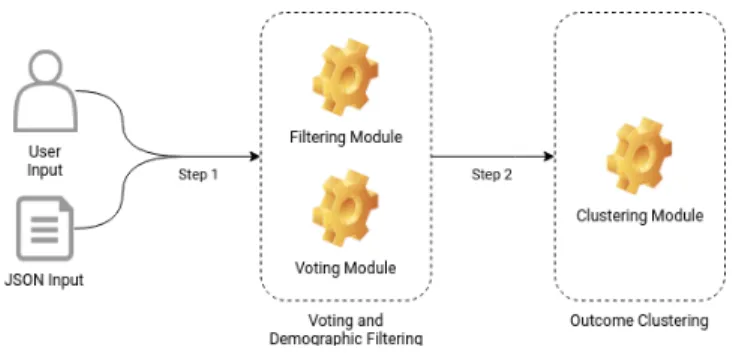
Figure 1: A schematic presentation of the tool’s architecture.
tools such as weighted majority graph generation. Unfortunately, none of the mentioned preference aggregation software packages provide demographic anal-ysis through vote filtering mechanisms and user profiling, nor multi-axis result clustering through demographic filters and preference aggregation techniques.
To address this gap in the literature, in this demonstration paper we intro-duce PAPOW: Papow Aggregates Preferences and Orderings to select Winners. The research question we address is “How to identify critical voter profiles that might be subject to manipulation in order to change the results? ”.
Indeed, the tool we propose allows the user to “play around” with the various filters and clustering methods in order to identify such “danger zones”. To this respect we try to counter balance manipulation effects (such as those seen in Cambridge Analytica, for instance). Of course such profiles could also be identified from a theoretical point of view but such endeavor is outside the scope of the current tool demonstration paper.
To this end, in this paper we show how PAPOW implements various prefer-ence aggregation mechanisms well known in the literature (see in the following section), allows for agent profiling through parametrizable categorization, has multi-criteria agent selection mechanisms through logical formulas that facil-itate demographic-dependent outcome comparison and provide flexible result clustering visualization.
This tool is available in Github1 and use case examples can be found in
Youtube2.
2
PAPOW Features
2.1
Workflow and architecture
The main three phases of our software are: (1) data input, (2) voting and demographic filtering and (3) outcome visualization.
1https://github.com/martinjedwabny/PAPOW 2https://youtu.be/c9PCPYunce4
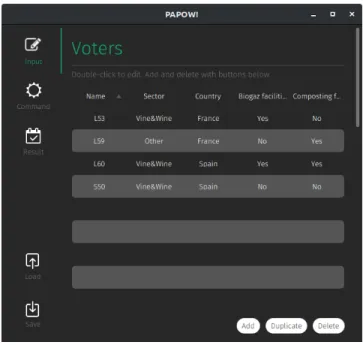
Figure 2: Snapshot of the input phase.
Let us consider a classic workflow (see Figure 1) that necessity the creation of users and voting alternatives from scratch. Please note that our tool admits .JSON file input and export format for saving and later loading of existing projects. In the input phase, the user can create, edit or delete voters along with their characteristics. Once the voting alternatives are created the user can specify the various voting questions over these alternatives.
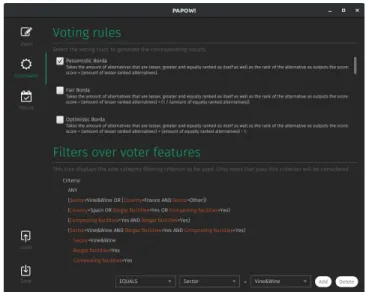
Voting and demographic filtering. After the input data is specified (see Figure 2), the user must precise the voting mechanisms desired to aggregate the individual preferences. Our software lets voters express their votes in the form of total preorders. The voting rules provided by our software are Plurality, k-Approval, Copeland’s method, Instant runoff, Borda count [3, 6]. Then the user can create demographic filtering criteria which generate different results according to the voters selected profile (see Figure 3).
Outcome clustering. Finally, users can analyze the results for each ques-tion, voting rule and criterion with various clustering options (see Figure 4). Through the clustering options, they can visualize the results for a particular demographic filtering criterion or compare the filters under a particular question and/or voting rule.
Figure 3: Snapshot of the command phase.
3
Discussion
As far as we know, PAPOW is the first voting tool that allows for user profiling and demographic analysis through filtering criteria as well as outcome cluster-ing. Having implemented the main modules of the voting software, various ideas present themselves for future work. We plan to formalize the clustering capa-bilities we introduced. Also, we are interested in the development of further research in the topic of demographic analysis and the prevention of vote manip-ulation through user profile targeting and think of this tool as a solid basis to experiment over such ideas.
This tool was developed with related European H2020 NoAW [5] and GloPACK [7] projects. It will be used both as a standalone solution as well as part of a larger scale project that combines the power of argumentation and defeasible reasoning [4].
4
Acknowledgments
The authors acknowledge the support of the European H2020 NoAW project (project ID 688338) and the European H2020 GLOPACK project (project ID 773375).
References
[1] Sylvain Bouveret. Trends in Computational Social Choice. Social Choice on the Web, Chapter 20:387–402, 2017.
[2] Felix Brandt, Guillaume Chabin, and Christian Geist. Pnyx:: A Powerful and User-friendly Tool for Preference Aggregation. In Proceedings of the 2015 International Conference on Autonomous Agents and Multiagent Sys-tems, pages 1915–1916. International Foundation for Autonomous Agents and Multiagent Systems, 2015.
[3] Felix Brandt, Vincent Conitzer, Ulle Endriss, Jrme Lang, and Ariel D Pro-caccia. Handbook of computational social choice. Cambridge University Press, 2016.
[4] Abdelraouf Hecham, Pierre Bisquert, and Madalina Croitoru. On a Flexible Representation for Defeasible Reasoning Variants. In Proceedings of the 17th International Conference on Autonomous Agents and MultiAgent Systems, AAMAS ’18, pages 1123–1131, Richland, SC, 2018. International Foundation for Autonomous Agents and Multiagent Systems.
[5] Nikos Karanikolas, Pierre Bisquert, Patrice Buche, Christos Kaklamanis, and Rallou Thomopoulos. A Decision Support Tool for Agricultural Ap-plications Based on Computational Social Choice and Argumentation. In-ternational Journal of Agricultural and Environmental Information Systems (IJAEIS), 9(3):54–73, 2018.
[6] Hervi Moulin. Axioms of cooperative decision making. Number 15. Cam-bridge university press, 1991.
[7] Bruno Yun, Pierre Bisquert, Patrice Buche, Madalina Croitoru, Valrie Guil-lard, and Rallou Thomopoulos. Choice of environment-friendly food packag-ings through argumentation systems and preferences. Ecological Informatics, 48:24–36, 2018.