HAL Id: cirad-00780849
http://hal.cirad.fr/cirad-00780849
Submitted on 24 Jan 2013HAL is a multi-disciplinary open access archive for the deposit and dissemination of sci-entific research documents, whether they are pub-lished or not. The documents may come from teaching and research institutions in France or abroad, or from public or private research centers.
L’archive ouverte pluridisciplinaire HAL, est destinée au dépôt et à la diffusion de documents scientifiques de niveau recherche, publiés ou non, émanant des établissements d’enseignement et de recherche français ou étrangers, des laboratoires publics ou privés.
Olympe, a multiscale tool to explore management
options in Agroforestry Systems.
O. Deheuvels, E. Penot
To cite this version:
O. Deheuvels, E. Penot. Olympe, a multiscale tool to explore management options in Agroforestry Systems.. Modelling agroforestry systems with perennial crops: connecting agroforestry researchers with modellers. CATIE, Turrialba, 25-28 Feb 2008., B. Rapidel, O. Roupsard and M. Navarro, 10p., 2008. �cirad-00780849�
Title :
Olympe, a multiscale tool to explore management options in
Agroforestry Systems.
Authors : Olivier Deheuvels, Eric Penot, CIRAD
Summary : Olympe is a software developed by INRA, IAMM and CIRAD to model
and simulate cropping and farming systems functioning. As it is based on economic analysis that considers contextual components, it enables to identify and model one or several farmers‟ strategies and trajectories. Prospective analysis is also possible, including prices volatility or climatic events and their impacts. This tool was first developed in close cooperation with research institutions involved in tropical agriculture and tested in different case studies, including agroforestry systems, in North and West Africa, Southeast Asia and Latin America, leading to a wide variety of applications. Such variety displays the richness that can be expected from reliable and representative farming systems studies at various levels. These levels go from the simple comparison between two cropping systems, through farming system modelling and further monitoring or counselling, to study of entire irrigated schemes at regional level, prospective analysis and elaboration of potential scenarios and role games. Such diversity in uses can be addressed to an equal diversity of actors : farmers, project or community leaders, extension institutions, researchers and policy makers.
Key words : Farming System Modelling, Olympe, Agroforestery, scenario, prospective analysis.
Citation:
Deheuvels O. & Penot E., 2008. Olympe, a multiscale tool to explore
management options in Agroforestry Systems. In: B. Rapidel, O. Roupsard and M. Navarro (Editors), Modelling agroforestry systems with perennial crops: connecting agroforestry researchers with modellers. CATIE, Turrialba, 25-28 Feb 2008.
Introduction
As agriculture sustainability is becoming a major concern, the main questions concerning "ecological sustainability" are linked to the problem of degraded environment and fragile soils and thus fertility, biodiversity, and protection of watersheds. Several cropping systems offer potential solutions to these problems: agroforestry systems, permanent cover cropping systems, etc. Crop diversification and rapid technical change characterise the evolution of existing farming systems. The history of these innovations and innovation processes are key elements to analyse and understand and thus be in a position to make viable recommendations for development.
The notion of “economic sustainability”, places emphasis on the profitability of specific technical choices: (margins analysis, income generation, return on labour and capital as a function of a specific activity, analysis of constraints-opportunities, etc.) from the point of view of farming systems, at the regional level, and the “community level” where there are serious constraints with respect to land availability, and to access to capital and information. Analysis of farming systems and knowledge about smallholders‟ strategies in the different contexts are thus key elements that should also be taken into account.
As sustainable development is on the way to becoming the new “priority objective”, the rehabilitation of previously intensively managed agricultural or degraded land also deserves consideration
Perennial crops in particular are subject to very marked and sometimes very rapid changes in plantation/replantation strategies in pioneer and post-pioneer areas, and these changes currently characterise farmers„ strategies in the mid tropical areas of the world.
The impact these strategies have on land control, land-use dynamics (agreement on the definition of new types of “territories” (land-uses) between stakeholders) and relations between stakeholders including those not directly involved in agricultural production, should be major topics of research if we are to gain a better understanding of farmers‟ strategies in the present context of multiple crises. A constant factor that underlies such strategies is innovation: both the process of technical innovation (technical pathways) and of organisational innovation (farmers‟ organisation, access to credit, etc.) are key elements to understanding and qualifying change.
Most perennial crops (cocoa, rubber, coffee …) are now facing a post-boom crisis. Political changes have resulted in new decentralisation policies (indirectly linked with democratisation in some countries) that can/may introduces new ways of local governance. The major economic trend is towards globalisation accompanied by a general decrease in prices for most agricultural commodities. Concurrently, most farmers enjoyed direct links to markets over a relatively long period of time, in particular in the case of cocoa, coffee, rubber, oil palm and coconut.
Therefore emphasis should also be placed on the history of innovation processes in the context of the change from pioneer fronts to increasingly stable post-pioneer areas.
To ensure that the adoption and appropriation of technology by smallholders is efficient, further research is required on innovation processes and technical change in general, using socio-economic tools. Negotiations between stakeholders and a better knowledge of the relations between the State and farmers is essential to improve the effectiveness of future projects and development actions.
The main objective of topic-oriented research centred on the analysis of decision-making processes at different levels (farms, community, projects, regional or national policies makers) would thus be to provide socio-economic information to policy makers to improve the decision-making process in agricultural development. The process of innovation (farmers) and of decision-making (both farmers and developers) are key research topics in sustainable development. And the analysis of farming systems, the characterisation of agrarian systems and the identification of stakeholders‟ strategies are key components to a better understanding of these issues.
This type of approach is applicable at different scales, going from small areas to watershed or agrarian region, by taking into account the different levels of intervention (production systems, experimentation of farming systems and commodity systems,…). One expected output would be the clear identification of the conditions required to ensure that future projects are more viable at the decision-making level. A further output would be to ensure the scientific valorisation of this collaborative work by :
1. anticipating problems (e.g. recurring negative phases of booms, drops in fertility /productivity due to over-exploitation, negative externalities, etc.);
2. offering alternatives (technical pathways or organisational innovations,…); 3. providing better support for technical choices made by decision makers
regarding agricultural policy.
The purpose of this paper is to show how the Olympe software could be a modelling tool for a possible global approach, including the identification of gaps and opportunities to promote actions and projects or the implementation of policies that answer the needs of sustainable development, as well as those of local stakeholders, developers and researchers.
Agronomists and economists working on cropping and farming systems always have to collect information in order to characterise them and identify typologies and potentially recommendations domains. CIRAD, INRA and IAMM have developped a software called « Olympe » that enable the modelling of cropping and farming systems at different scales, including modules for farms groups analysis, externalities, trends and scenarios integration fro prospective analysis.
This software, associated with classical cropping or farming systems surveys, allows a wide range of opportunities that go from:
- testing the economic impact of a technical choice on a cropping or a farming system or between different systems,
- or identifying farmers possibilities and potential strategies according to technical alternatives
- or calculating environmental positive or negative externalities,
- or testing the robustness of a technical choice according to climatic or economical uncertainties (effect of a drought, an “el nino » year , or price volatility…)
- to assessing risks and helping farmers and donors to make decisions.
Data analysis can be discussed with farmers using a participatory approach or partnership with farmers through on-farm trials in order to validate scenarios and guarantee a high level of representativity. A network of representative farms can be monitored for several years with two main objectives: first, to diagnose constraints and opportunities and, second, to measure impacts due to technical change (with or without project activities).
One of the main output of such approach is to assess impact of technical alternatives or choices at the farming systems level, on the economic point of view as well as on the environmental point of view. Olympe is fed with data from adapted farming systems surveys and will provide key information in terms of diagnosis and, further on, in term of prospective analysis.
Methodological context for the use of « Olympe »
Tools for the comprehension of farming systems based on simulation and modelling such as the "Olympe" software allow a comprehensive understanding of how a given cropping or farming system functions, as well as provide a tool to model prospective technical choices, price scenarios, and even ecological scenarios.
Such tools are based on the use of primary data (Figure 1) collected during surveys for the characterisation of farming systems, and are essential to provide decision-making tools to key stakeholders in terms of development, adaptive research, project orientations and so on, all projects which require serious negotiations between partners. They can be used at different levels: local community, regional, national or international, depending on the stakeholders and on the commodities involved. Emphasis would be on the farmer and on the other people directly involved in the farmers‟ environments, including the government (development policies at the national level).
Figure 1 : Olympe‟s first window (top) and corresponding conceptual model (bottom). Database -Units -Taxes
+
Database -Names and prices /unit for allvariables classified by types of incomes and costs - Annual calendar of available working periods+
Database -amounts/ha -Necessary working periods Hazards (Climate/ Prices) Simulator + Calculation procedures Simulator RESULTS Procedures to edit , classify and Compare Database -Units -Taxes+
Database -Names and prices /unit for allvariables classified by types of incomes and costs - Annual calendar of available working periods+
Database -amounts/ha -Necessary working periods Hazards (ClimateHazards/ Prices) (Climate/ Prices) Simulator + Calculation procedures Simulator Simulator + Calculation procedures Simulator RESULTS RESULTS Procedures to edit , classify and Compare Procedures to edit , classify and CompareThe Participatory and Action–Research approaches are a basic methodology commonly employed by Olympe users to collect data. In addition to the Participatory approach and on-farm experimentation, links with SIG and Multi-Agent System Modelling (SMA) allow possible answers to be identified to important agricultural questions.
As contexts are important in the evolution of processes, the impact of globalisation on smallholders and commodity systems as well as on their internal growth (logical internal development within a specific context) and the effects of decentralisation policies can also be included in this analysis.
Knowledge on the local farming context (pioneer zones, rehabilitation areas or traditional rubber belts), capabilities and strategies will contribute to build alternatives, solutions and proposals to help farmers to make the right decision at the right time. The use of “Olympe” is aimed to improve farmers‟ understanding and provide orientations or policies for development institutions or donors.
The objectives of using the Olympe modelling tool can be the following:
- to identify smallholders‟ constraints and opportunities in a rapidly changing environment for the adoption of new cropping or farming systems;
- to understand farmers‟ strategies and their capacity for innovation;
- to assess their ability to adapt to changing economy, prices crisis and technological change;
- to provide tools to understand the farmers‟ decision making;
- to replace cropping or farming systems information in its social and economical context, through a regional approach;
- to undertake prospective analysis.
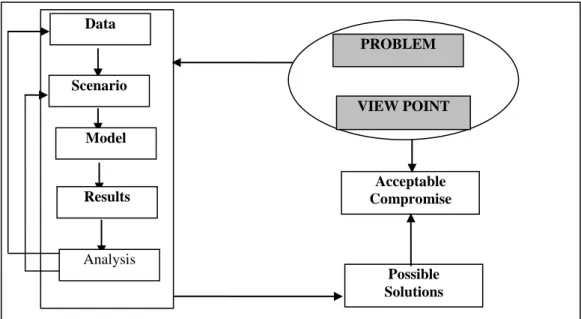
Olympe is based on the systemic approach and is generally used in the form of an iterative analysis of a question (Fig. 2). It has been validated by experiments and activities in the field led by a network of researchers that exists since 2001. All researchers, teachers and consultants involved in this network are also playing the role of β-testers for this free software in permanent evolution.
Figure 2 : Iterative analysis using the Olympe software (From Penot & al., 2004)
Acceptable Compromise Possible Solutions Data Scenario Model Results Analysis PROBLEM VIEW POINT
Data required for cropping and farming systems modelling using Olympe
Information that qualifies the structure and components of production factors of the crop or the farm are required (Operational costs, inputs and outputs, yields, externalities, labour requirements). They are obtained through traditional survey. Beside that, as Olympe is focused on the origin of the different sources of incomes and costs, all information should be collected in four domains in the case of farming system analysis :
1. the different cropping systems : crops are divided into annual crops, perennial crops (minimum 5 years) and multi-annual crops (Banana, pineapple or casava, between 1 and 5 years cycle),
2. livestock raising systems,
3. activities systems, not directly linked with agricultural or livestock production and including transformation of primary products,
4. farming systems : the “farm level” with a decision maker (the producer) and a strategy for the combination of production factors. All non operational costs (incomes, including off farm, credits , loans, and expenses) are integrated at that level. Family account and enterprise account can be separated but should be recorded.
Finally, commodity prices should be collected, in particular taking into account the local variations as well as international historical series of prices that will enable to build potential scenarios.
Olympe : methodological systemic approach for farming systems modelling
As an example, the methodology used in Olympe can be based on the following stagesthat create a framework for its implementation:
1. Diagnosis : a preliminary diagnosis based on the collection of all available
information (bibliography, data collections, key-informants), and an exploratory survey of the characteristics of the farming system to understand the constraints, opportunities, income and labour productivity of each cropping system and farm activities. The data analysis should provide an operational typology and a clear identification of constraints and opportunities.
2. Identification of an on-farm experimentation programme
The identification of a potential on-farm experimentation programme aimed at overcoming technical constraints (technical innovations) or social constraints (organisational innovations). On–farm trial protocols should be identified as a function of the typology. Experiments should be listed in order of priority.
3. Implementation of on-farm experimentation
Implementation of on-farm experimentation using a participatory approach in an “on-farm trials network”.
4. Monitoring farming systems
Implementation of a “farming systems monitoring reference network” in order to monitor technical changes and the adoption of innovations, and to assess their impact and externalities at the farming system and regional scales.
5. Analysis and re-assessment of the research programme
Feedback analysis with farmers, extension agents and research institutions and the re-assessment of the on-farm trial in a constantly ongoing process of R&D.
An agronomic approach including on-farm experimentations linked with a socio-economic approach (farming systems analysis, typology, etc.) provides suitable technical pathways or improved cropping systems for farmers. It also ensures adequate conditions for the adoption and appropriation of innovations by farmers.
6. The results and outputs are :
- Annual and perennial cropping patterns and technologies (technical pathways for monoculture, intercropping, agro-forestry systems, etc.),
- An operational typology of situations and farmers leading to the identification of “topics of recommendations”,
- A global overview of the possible adoption of technologies as a function of farmers‟ strategies and local conditions,
- An ongoing and dynamic data base on farming systems using Olympe software.
Conclusion
Whether the Olympe user is a researcher, a developers, a producer or a decision maker, its flexibility and the diversity of uses already known and shared in the network makes it very attractive. After 7 years of improvements, Olympe software shows an excellent ability to adapt to various questions and contexts (temperate / tropical; technical / multifunctional studies; Diagnosis / Prospective analysis; …) in the study of farmers‟ behaviours, activity impact, farm evolution and decision-making process.
As Olympe provides three potential levels of analysis : crop, farm and groups of farms, his great flexibility allows it to adapt its level of detail and analysis according to studied case's requirement. Simulations of farming possibilities, risks factors and decisions on production factors‟ assignment (capital, work, land) in the mid and long term are a net advantage compared to other tools more focused initially on annual results.
Forecasting of incomes, monthly treasury, labour availability per activity allows a fine evaluation of viability of technical and organisational choices. This function helps to define technical thresholds and possible scenarios of evolution.
Good quality data and all information on origin and use of sources of income remain the determining elements to identify properly the evolution of farmers‟ strategies. When properly validated by actors, Olympe is an operational representation of decision-making process and its components. As farmers are in permanent interaction with rapidly changing climatic and economical risks, modelling and
forecasting these risk is of high interest for them, especially if we can include all non economic factors inherent to the rural world and agricultural production. A large variety of goods and services such as biodiversity conservation, land sustainability, etc., that covers the multifunctional aspects of agricultural activities, have to be integrated into farmers management and strategies.
The use of Olympe, coupled to a true contextual socio-economic analysis shows operationality in both research and development activities. It remains however an approach requiring rigour, a constant effort of validation and a clear definition of the initial problematic in order to avoid “instrumentalisation” disconnected from reality.
REFERENCES
Antle, J.M. and Stoorvogel, J. (2001) „Integrating site-specific biophysical and economic models to assess trade-offs in sustainable land use and soil quality‟,
Economic Policy and Sustainable Land Use, pp.169–184.
Attonaty, J.M. and Le Grusse, P. (1994) „Helping farmers in strategic decision-making. Training of executives from different Mediterranean countries: an
experiment‟, in B. Jacobsen, D. Pedersen, J. Christensen and S. Rasmussen (Eds.)
Farmers’ Decision Making, A Descriptive Approach, Copenhagen: Institute of
Agricultural Economics, 38th EAAE Semi-ton, 3–5 October, pp.235–245.
Attonaty, J.M. and Soler, L.G. (1992) „Aide à la décision et gestion stratégique: un modèle pour l‟entreprise agricole‟, Revue Française de Gestion, No. 8, pp.45–54. Attonaty, J.M., Chatelin, M.H. and Garcia, F. (1999) „Interactive simulation modelling in farm decision-making‟, Computers and Electronics in Agriculture, Vol. 22, pp.157– 170.
Barbier, B. and Bergeron, G. (1999) „Impact of policy interventions on land
management in Honduras: results of a bioeconomic model‟, Agricultural Systems, Vol. 60, pp.1–16.
Falconer, K. and Hodge, I. (2001) „Pesticide taxation and multi-objective policy-making: farm modelling to evaluate profit/environment trade-offs‟, Ecological
Economics, Vol. 36, pp.263–279.
Flichman, G. (1997) „Bio-economic models integrating agronomic, environmental and economic issues with agricultural use of water [on line]‟, in B. Dupuy (Ed.) Aspects
économiques de la gestion de l’eau dans le bassin méditerranéen: actes de l’atelier de Marrakech, Bari (Italie): CIHEAM-IAM, Options Méditerranéennes: série A.
Flichman, G. and Jacquet, F. (2003) „Le couplage des modèles agronomiques et économiques: intérêt pour l‟analyse des politiques [en ligne]‟, Cahiers d’Economie et
Sociologie Rurales, Communication présentée au Séminaire en économie de la
production, 28–29 November, 2001 à Paris, Avril–Juin, No. 67, pp.51–69. Le Bars, M. & Le Grusse, P. (2008) „Use of a decision support system and a simulation game to help collective decision-making in water management‟. Computers and electronics in agriculture 6-2(2008) : 182–189.
Le Bars, M., Allaya, M., Le Grusse, P. and Attonaty, J.M. (2005) OLYMPE, Manuel
d’utilisation, IHEAM-IAMM editions, ISBN: 2–85352–305–5, p.120.
Le Bars, M., Le Grusse, P., Allaya, M., Attonaty, J.M. and Mahjoubi, R. (2004) „NECC: a simulation game to help collective decision-making‟, WADEMED (Water
Demand Management Knowledge Base in the Mediterranean), Rabat, Maroc, 19–21
April.
Le Grusse, P., Belhouchette, H., Le Bars, M., Carmona, G. and Attonaty, J.M. (2006) „Participative modelling to help collective decision-making in water allocation and nitrogen pollution: application to the case of the Aveyron-Lère Basin‟, Int. J.
Agricultural Resources, Governance and Ecology, Vol. 5, Nos. 2/3, pp.247–271
Mendoza, G.A. and Prabhu, R. (2005) „Combining participatory modeling and multi-criteria analysis for community-based forest management‟, Forest Ecology and Management, Vol. 207, pp.145–156.
Pacini, C.A., Wossink, G., Giesen, G., Vazzana, C. and Huirne, R. (2003) „Evaluation of sustainability of organic, integrated and conventional farming systems: a farm and field-scale analysis‟, Agriculture, Ecosystems and Environment, Vol. 95, pp.273–288. Penot, E. & Deheuvels, O. (Scientific Editors) ( 2007) „Modélisation économique des exploitations agricoles : modélisation, simulation et aide à la décision avec le logiciel Olympe‟. Ed. L‟Harmattan, 182 p.
Penot, E., Le Bars, M., Deheuvels, O., Le Grusse, P., Attonaty, J.M. (2004) „Farming systems modelling in tropical agriculture using the sofware “Olympe”‟. Ecomod Seminar, Paris, June 2004.
Penot E. (2001), Stratégies paysannes et évolution des savoirs : l‟hévéaculture agro-forestière indonésienne. Thèse présentée pour obtenir le grade de Docteur de l‟Université Montpellier I, 364 p.
Rauschmayer, F. and Risse, N. (2005) „A framework for the selection of participatory approaches for SEA‟, Environmental Impact Assessment Review, Vol. 25, pp.650– 666.
Siebenhüner, B. and Volker, B. (2005) „The role of computer modelling in
participatory integrated assessments‟, Environmental Impact Assessment Review, Vol. 25, pp.367–389.