Animated Props for Responsive Playspaces
by
Susanne Seitinger
Master in City Planning
Massachusetts Institute of Technology, 2004 Bachelor of Arts in Architecture
Princeton University, 2001
Submitted to the Program in Media Arts and Sciences, School of Architecture and Planning in partial fulfillment of the
requirements of the degree of Master of Science at the
Massachusetts Institute of Technology, June 2006. 8 2006 Massachusetts Institute of Technology.
All rights reserved.
MASSACHUSETTS I N S ~ E . ~ OF TECHNOLOGY
LIBRARIES
-
IARCHIVES
-
I \ Y wAuthor Program in Media A& and Sciences, May 7, 2006
/.
.
1Certified by William J. Mitchell, Professor of Architecture and Media Arts and Sciences Thesis Supervisor
/ I 1
- -- - -- - Accepted-by Andrew 6. ~ i ~ ~ r n a h - - -
Animated Props for Responsive Playspaces
by Susanne Seitinger
Master in City Planning
Massachusetts Institute of Technology, 2004 Bachelor of Arts in Architecture
Princeton University, 2001
Abstract
Playgrounds are special places within the urban landscape specially designed for children. Here, they encounter the outdoors and the physical properties of large spaces through play, which allows children to develop their physical skills, explore the natural and built environment as well as interact with their peers. Even more importantly, children direct their own play activities in
playgrounds in an open-ended way. As digital technologies become increasingly present in children's lives an important question arises regarding their role in playgrounds.
This thesis contributes to playground design in a meaningful way by exploring how digital technologies can enhance children's open-ended and physically active play in outdoor settings. Can animated playground props support and possibly enhance open-ended and physically active play in playgrounds? This thesis expands the repertoire of objects conceived specifically for children's outdoor play environments through a review of existing technologies and designs followed by a design exploration with a new category of animated playground prop.
I develop an ecological approach to children's digital playground props which takes into account the links among children t,props t,play settings. In playing with objects, children gather information about the physical characteristics and embedded meanings of their three-dimensional surroundings. In other words, children's interactions with play props are one lens for experiencing the world. This theoretical framework leads me to a new category of animated prop called "space explorer".
The thesis describes a design process for one prop, an autonomous, pneumatic playground ball which is part of the "space explorers" category. The method combines design development with input from children in two workshops about their playground and specific objects. The design and research exploration concludes with reflections and recommendations for future attempts to design more autonomous and responsive objects which can enrich children's outdoor play experiences.
William J. Mitchell, Professor of Architecture and Media Arts and Sciences Thesis Supen/isor
Animated Props for Responsive Playspaces
by Susanne Seitinger
Master in City Planning
Massachusetts lnstitute of Technology, 2004 Bachelor of Arts in Architecture
Princeton University, 2001
Submitted to the Program in Media Arts & Sciences, School of Architecture and Planning in partial fulfillment of the
requirements of the degree of Master of Science at the
Massachusetts lnstitute of Technology, June 2006. O 2006 Massachusetts lnstitute of Technology.
All rights reserved.
\ Advisor William J. Mitchell
Professor of Architecture and Media Arts and Sciences
--
-
v v
-
& . - - Reader Edith K. AckermannProfessor of Developmental Psychology
Visiting Scientist, MIT Center for Advanced Visual Studies
I
-4Reader Mitchel Resnick
LEG0 Professor of Learning Research MIT Media Lab
Acknowledgements
I would like to thank my advisors for all their constructive criticism and help throughout the thesis process:
William J. Mitchell, thesis supervisor Edith K. Ackermann, reader
Mitchel Resnick, reader
In addition, I would like to thank many people and the following list is by no means exhaustive; but it shows that this thesis is not a solo accomplishment (the list is an alphabetical order):
Marcel Botha, Dept. of Architecture, MIT Constance Fleuriot, HP Mobile Bristol Axel Kilian, Dept. of Architecture, MIT Marianthi Liapi, Dept. of Architecture, MIT Lira Nikolovska, Dept. of Architecture, MIT
Marko Popovic, Reactive Playground Project, MIT Media Lab Biomechatronics
William Porter, Dept. of Architecture, MIT Peter Schmitt, MIT Media Lab Smart Cities Karin and Heinz Seitinger
Serenella Sferza, MIT Italy Program (Thanks for supporting my trip to Reggio Emilia, Italy!)
Smart Cities Group at the MIT Media Lab Pat Solakoff, Media Arts and Sciences
Elisabeth Sylvan, Reactive Playground Project, MIT Media Lab Lifelong Kindergarten
Technology Children's Center at the MIT Stata Center Franco Vairani, Dept. of Architecture, MIT
Cynthia Wilkes, Design Laboratory, MIT Media Lab Smart Cities Morris Williams, UWE, HP Mobile Bristol
Oren Zuckermann, Reactive Playground Project, MIT Media Lab Lifelong Kindergarten
Oriz Zuckermann, Reactive Playground Project, MIT Media Lab Ambient Intelligence
Reader Biographies
William J. Mitchell is Director of the MIT Design Laboratory. He is the Alexander W. Dreyfoos Professor of Architecture and Media Arts and Sciences at MIT, and former Dean of the School of Architecture and Planning. During the recent period of extensive construction of major projects on the MIT campus, he served as Architectural Advisor to the President of MIT. His books include City of Bits, E-topia, Me++, and most recently Placing Words: Symbols, Space, and the City (MIT Press, 2005). He writes a monthly column for the RlBA Journal in London.
Before coming to MIT, he was the G. Ware and Edythe M. Travelstead Professor of Architecture and Director of the Master in Design Studies Program at the Harvard Graduate School of Design. He previously served as Head of the ArchitectureIUrban Design Program at UCLA's Graduate School of Architecture and Urban Planning, and he has also taught at Yale, Carnegie-Mellon, and Cambridge Universities. In Spring 1999 he was the visiting Thomas Jefferson Professor at the University of Virginia. He holds a BArch from the University of Melbourne, MED from Yale University, and MA from Cambridge. He is a Fellow of the Royal Australian lnstitute of Architects, a Fellow of the American Academy of Arts and Sciences, and a recipient of honorary doctorates from the University of Melbourne and the New Jersey lnstitute of Technology. In 1997 he was awarded the annual Appreciation Prize of the Architectural lnstitute of Japan for his "achievements in the development of architectural design theory in the information age as well as worldwide promotion of CAD education."
Edith K. Ackermann is a Professor of Developmental Psychology, University of Aix-Marseille, France. Currently a Visiting Scientist at the Massachusetts lnstitute of Technology School of Architecture, Center for Advanced Visual Studies, and Visiting Professor at the University of Siena, Department of Communication, she teaches graduate students, conducts research and consults for companies, institutions, and organizations interested in the intersections between learning, teaching, design, and digital technologies. Previously, Ackermann was a Senior Research
Scientist at MERL, Cambridge, MA; an Associate Professor of Media Arts and Sciences at the MIT Media laboratory, Cambridge, MA; and
a Scientific Collaborator at the Centre International dlEpistemologie Genetique, under the direction of Jean Piaget, Geneva. Edith K. Ackermann received a Doctor of Developmental Psychology [Com Laude] ( I 981); two Master's degrees in Developmental Psychology and Clinical Psychology (1970); and a Bachelor of Experimental Psychology degree (1969), all from the University of Geneva, Switzerland.
Mitchel Resnick explores how new technologies both
I
/
necessitate and facilitate deep changes in the ways people think II and learn. Resnick's Lifelong Kindergarten group, at the MIT Media
1
Lab, has developed a variety of educational tools, including the"programmable bricks" that were the basis for LEGO's award- f winning Mindstorms robotics construction kit. Resnick also led I
:
the development of StarLogo, a software toolkit for modelingdecentralized systems. He also co-founded the Computer Clubhouse : project, a network of after-school learning centers for youth from i underserved communities, and co-developed The Virtual Fishtank,
:
a million-dollar museum exhibit that helps children of all agesunderstand the working of complex systems. Resnick earned a B.S. in physics from Princeton University in 1978, and an M.S. and Ph.D. in computer science from MIT. Before pursuing his graduate degrees, he worked for five years as a science/technology journalist
i
for Business Week magazine.i i
Table
of
Contents
1
Page Acknowledgements 7 Reader Biographies9
Introduction 15Chapter 1: An Environmental Approach to 19
Children's Play
Chapter 2: Comparing the Child's Conception 27 of Space to the Designer's
Chapter 3: Adding New Technologies 43
to the Playground
Chapter 4: A Design Process 51
I I
I
/
Chapter 5: Conclusions/
EpilogueI
I
Bibliography ! 1 IFig. 1 Reactive Playground Project, interactive pathway project (Summer 2005).
See footnote 2 for the detailed references. Unless otherwise noted photographs by author.
Introduction
Playgrounds are special places within the urban landscape specially designed for children. Here, they encounter the outdoors and the physical properties of large spaces through play, which allows young children in cities to explore the natural and built environment. In addition, teachers, parents or sports coaches do not set the agenda at the playground. In other words, playgrounds are spaces where children can engage in open-ended play patterns1 of their choice. The type of equipment such as swings and slides available on the playground provides a framework within which children establish their play patterns.
As digital technologies become increasingly present in children's lives an important question arises regarding their role in playgrounds. This thesis contributes to playground design in a meaningful way by exploring how digital technologies
-
if at all-
can enhance children's open-ended and physically active play in outdoor settings. Can animated playground props support and possiblyenhance open-ended and physically active play in playgrounds?
This thesis expands the repertoire of objects conceived specifically for children's playgrounds through a review of some existing approaches to outdoor technologies for children and playground designs as well as design explorations with a new category of animated playground prop.
Reactive Playground Project
From June through August 2005, a group of colleagues and I initiated the Reactive Playground Project2 at the MIT Media Lab. In an attempt to capture the strength of existing, successful playground installations and emerging, popular interactive exhibits, an
interdisciplinary group of researchers designed a simple prototype for exploring the problem space of outdoor playgrounds in the digital - --
1 Play patterns refers to the sequence of choices and decisions a child makes in creating a game, challenge, or scenario. For example, trying to climb up a slide is one characteristic play pattern, sliding down is another pattern.
2 The Reactive Playground Project is a joint initiative among four research groups at the MIT Media Lab. I am grateful to Marko Popovic, Lis Sylvan, Oren Zuckerman and Orit Zuckerman for a summer of fun. See also, S. Seitinger, E. Sylvan, 0. Zuckerman, M. Popovic, 0. Zuckerman. ,,A New Playground Experience: Going Digital?' Extended Abstracts Proc. CH1'06, (Montreal, 2006).
I era. We designed an interactive pathway in two sections that consist of a wooden frame with five pressure-sensitive mats. The latter are attached at a distance corresponding approximately to the length of a 4 year-old's gait. Each mat has a motor with a spinner attached to the wood next to it which turns as the child steps on the adjacent mat.
The simple design with one responsive element enabled many play patterns. We observed all types of running, jumping and walking, fantasy play and more in-depth exploration of the spinners. Just like children use slides as imaginary waterfalls or hiding spots, they used the pathway for everything from simple running to playing choo-choo trains. This diversity of responses seeded further explorations of digitally enhanced outdoor play experiences.
Two Key Principles
Following the Reactive Playground Project, I identified two key principles of successful outdoor play experiences: open-ended- ness and full-body engagement. My working definitions for these principles are:
Full-body Engagement: In playgrounds, children learn to engage the outdoors through active play which entails running, jumping, swinging, sliding and every other form of physical activity. Both playground installations, traditionally mechanical elements such as swings and slides, and the availability of open space encourage children to move around as much as possible and develop their motor skills.
Open-ended Play: The term open-ended is used to describe a play activity that encourages a child's development by promoting his or her own ability to
experiment with many different kinds of play patterns. These patterns may include goal-driven scenarios, individual and group play, and all types of designed (e.g. tricycle) and ad- hoc (e.g. a cardboard box) play props.3
Using the two principles of play derived from the interactive pathway project, I aim to explore how digital props can be developed that
1
I 3 In the education literature, a growing movement has been advocating for more play in educational and non-educational settings because of the many I
encourage full-body engagement and open-ended play in outdoor play settings.
Architects, planners and artists have spent significant energy on designing the physical, fixed-in-place installations in playgrounds while props remain less e~plored.~ Children bring objects to the playground and use found props to enhance their play. For example in the sandbox, buckets and more irregular molds allow children to build imaginary worlds. Some of the most commonplace toys are balls, pull-along toys, cars, and tricycles while found objects include rocks, leaves and sticks. This thesis specifically focuses on the "rollers and crawlers" (referring to balls, pull-along toys, etc.) children use in playgrounds because they mediate between the child and larger play installations such as swings and slides. Enhancing these intermediary program elements through digital means reveals new dimensions for playground props.
Thesis Outline
In the first three chapters, I develop an ecological approach to designing animated props. Drawing on the lessons from architecture, urban planning and developmental psychology,
I suggest a framework for implementing a prototype. Chapter 4 describes the design process for developing one prototype of an animated prop which is part of a category named space explorers. In Chapter 5, 1 review the prototype and suggest directions for future research on animated playground props as well as meta-reflections on the design process itself as a less rigid and still rigorous
approach to designing new technologies for children.
I
I
I
I
4 Significant research has been conducted by designers, architects and urban planners about the best approaches to playground design. Devices, layout, natural features and other elements have been considered extensively and evolved over different time periods and cultures, but the props remain unexplored. Hendricks (2001). Hurtwood (1968). Heseltine and Holborn (1987). Alamo (2005).I
IFig. 2 Calvin and Hobbes comic strip.
SUDDEMLV. A SEkWNG EXT QF DEADLY FRAP RAY SUGS brcFmSS W E W K N E S S !
I
I
Chapter I
An Ecological Approach to Children's Outdoor Play
Play presents a key means of "learning about the world" available to children. The child psychologist Piaget was very interested in these dynamic aspects of children's play which he saw "as a biological model of interaction between child and envir~nment."~ In other words, children are able to learn about themselves and subsequently the world through hands-on interactions which researchers, educators and grown-ups call play. This environmental dimension of children's play is highlighted by Catherine Garvey and more generally the Vygotskian socio- constructivist approach.
w v
children
I
During play, objects act as mediating elements between children and their surroundings because they connect the two. Garvey's work specifically mentions the importance of objects asmediating elements b e t y e a . ...-.
.-
cll\/ldlekfign?
.!heir
environment. because 8. - . .they connect the two: . - - . . . bm = . . . . ' . . - - ' . , . . . .
. . .
. . . . . * . . . . . .
- They provide a means by which a child can represent or express his '
.
: feelings, concerns, or preoccupying , I!..
.
, interests. (..
.) Further, for the child , - . . . ; an unfamiliar object tends to set up a- , , -:.- . .. chain of exploration, familiarization, , . -
. ' - 3 b '1 and eventual understanding: an ofien- . . . -. ). ;; repeated sequence that will eventually -
.
. . .. . lead to more mature conceptions of the ,,A ;>-< I '
.: ;: I, ,. p.mperties (shape, texture, size) of the
' " ' .
.
- '19j
:
. physical world.' ~ < ~ ; ~ ~ ~ ; ~ : . i.
- .. - -..
. 6. > % '.wJt~..,+d,, .,. (;$, .. ,. . .props for play, objects
The adjacent figure introduces the three essential elements
of the play scenario Garvey describes, children t,props t,play setting. Though Gawey does not limit herself to outdoor spaces, they
are the setting studied in this thesis. I use the words environment, 'I : playground space, space"'-:.'
for outdoor fully-body ,, play, includes natural and built spaces such as
urban environments
surroundings and space in different contexts, but the reader should
keep the outdoor play setting
-
the playground-
in mind throughout., , . 4 :.,':$pi,,r, ,: .,?..~iiy$~[--..-,'.:, ,;. ' . - .
.
. . . ,,?,&.;;;<-L: , - -
;
, < , . _.
. . , . . ,,, .. , ' . ; , a A & & * ' - . b , - * . "y-<;,;;.e,-.: ,,, * -,: .' - '" - 7 , . ,, . . - . 1 . , . . - , ... - + . .
# .
. . . ' J
-.
5 Quoted in Heseltine and Holborn (1987).:
.
.-<
.
- . , I .6 C. Garvey and K. Rubin, Play: The Cnrcible of Learning. (Cambridge,
I
1
MA: Harvard University Press, 1977), 4 1. . . .Developmental Stages of Play
Play patterns can be categorized in many ways in relation to a child's developmental stage, age or exhibited preferences. Differentiating among cognitive, physical, and social styles of play are three often-cited categories. The general phases of physical play are "rhythmic stereotypes peaking in infancy, exercise play peaking during the preschool years, and rough-and-tumble play peaking in middle childhood" according to Pellegrini and Smith.'A group of Spanish architects has distilled the psychological data into the following helpful categories:
Play Stages
0-3 : children experimenting with their bodies, moving alone, playing, experiment touch, sound sight. 3-6: lots of fantasy play, they use "abstract elements, tables, benches,
. . ."
6-8: more physical activities, training themselves8- 10: less adult supervision needed, also physical dexterity, balance, coordination, structured games, rules, social
One of the important themes in this chart is the increased independence of children and the importance of physical skill- building. As children mature, they develop the gross and fine motor skills which allow adults to navigate their environments. Typical play equipment such as swings, slides and monkey bars are all geared towards this type of development. During the preschool years, certain types of exercise play peak, according to Pellegrini and Smith making it especially important to promote continued physical activity during this phase.g
7 A.D. Pellegrini and P.K. Smith, "Physical Activity Play: The Nature and Function of a Neglected Aspect of Play.'' Child Development 69,3 (June 1998): 577- 598.
8 M. R. del Alamo. Design for Fun: Playgrounds (Barcelona, Spain: Linksbooks, Structure, 2004), 268.
9 The other stages are: "rhythmic stereotypes peaking in infancy, exercise play peaking during the preschool years, and rough-and-tumble play peaking in middle childhood." Pellegrini and Smith (1998).
Physically Active Play
Physically active play can benefit children's development in significant ways. Pellegrini and Smith's explain that: "Exercise play could be beneficial (. . .) both because it is nonacademic and also because it is self-motivated, playful, and associated with enjoyment, self-efficacy, and mastery."1° Physical play can be an important part of the "active engagement" children show in an activity:"
(.
.
.) physical activities abound in our children's world and are crucial to their development because they are taking pleasure in testing their budding abilities, learning how well they work, and practicing their various uses.'*These physical activities have general health benefits, but they also , enhance the overall experience of self-directed play. Being engaged
with the whole body goes hand in hand with so-called cognitive play. In Jerome Bruner's research, quality play time at a young age is shown to increase a child's aptitude later in life.I3 Quality play time means access to different types of play including open- ended situations. So, while organized sports can be very healthy for children they do not replace open-ended and physically active play situations without codified rules. The playground presents the ideal setting for providing this type of self-directed experience.
Open-Ended Play
The term open-ended is used to describe an activity that is not constrained by explicit limits. In this case, open-ended play encourages child development by relying more upon the child than the toylprescribed activity for learning. Constructivist theory posits that "children have an inner drive to build an understanding of their
---- 10 Pellegrini and Smith (1998).
11 Catherine Garvey introduces five elements of play: ( I ) "Play must be pleasurable and enjoyable." (2) "Play must have no extrinsic goals." (3) "Play is spontaneous and voluntary." (4) "Play involves some active engagement on the part of the player." (5) "Play contains a certain element of make-believe." Garvey and Rubin (1 977).
12 Garvey and Rubin (1 977), 2 1 Off.
13 J.S. Bruner, A. Jolly, and K. Sylvia, eds. Play: Its Role in Development and Evolution (New York, Basic Books, 1977).
:
world as they explore and interact with materials. Concepts about!
how the world works are built gradually and become increasingly , complex as the child enters a rich learning environment and i exercises his or her freedom to play." During open-ended playI
children are free to use their imagination to define a play scenarioj
and apply their own unique play patterns, actions and details.14 ISome researchers in education have been lamenting the reduction of play time in kindergartens, the removal of dress-up spaces and the exclusive focus on cognitive development with no regard for other forms of activity. A similar wave of focus on cognitive functions took place in the 50s and 60s cold war era to ensure a strong American future. Zigler et al. argue for a whole-child approach to learning rather than just focusing on certain aspects by referring back to Piaget who said that "children actively acquire knowledge through interacting with the physical environment." l5 This type of interaction with the world is an inherent part of playgrounds.
Props or Not? i
i
The question of whether children need props to play also1
requires some attention. Some educators-
like the Alliance for1
ChildhoocP6-
criticize that children don't need specially designed j objects for play and especially not digital or computational ones. I/
Walter Benjamin thought that specially designed toys were a signI
of the increasing disconnect between children and their parents. : Specialized-
or as he called them "emancipated"-
toys are a:
caretaker-replacement rather than a prop for learning or teaching."14 Several definitions for the word "open-ended": http://dictionary.reference. com/search?q=open-ended, http://www.earlychiIdhood.com/Articles/index.cfm?A=6 2&FuseAction=Article, http://www.parentpages.net/arasmarttoys.shtml
15 Zigler et al. (2004).
16 Alliance for Childhood, www.allianceforchildhood.net; Playing for Keeps, www.playingforkeeps.org; American Association for the Child's Right to Play, www.ipausa.org; and Play Matters, www.playrnaatters.net.
17 Translation by author. W. Benjamin. Gesammelte Schrijien (Frankfurt am Main: Suhrkamp, 199 I), 1 15.
In the second half of the 19th century, on observes how the toys become larger, and they lose their subtle, small and playful characteristics. Is it at this moment that the child lives in a separate play room, a closet where she can store, for example, her books separately from the parents' books? There is no doubt that the older, smaller books required the constant attention of the mother, the new large-format books with their boring codling are better designed to replace her while she is away. The toy becomes emancipated; and so it removes itself further and further from the family's control as industrialization takes its course and becomes strange to the children, but also the parents?
Benjamin understood that children need an external
assistant at certain times. Vygotsky "argued that development 1 occurs within the "zone of proximal development" when tasks that
I are difficult for the child to learn alone can be mastered if the child ' is guided by someone who is skilled at the task."15 In play, the ! right balance of structure and freedom can be crucial to ensuring a ' ! positive experience.
Smart play props cannot replace teachers and parents, but they might be able to provide a helpful nudge at the right moment
'
through their autonomous and potentially interactive behavior. In!
general, manipulating objects allows children to experiment with theories about themselves and the world that they could not test with people or pets. For example, a child destroys a tower after painstakingly building it. This situation could be a re-enactment of , the child's own propensity to fall previously. Making the tower topple gives a sense of power and superiority as well as the possibility of reliving the previous experience in an active manner." If the objects'
were animated in addition to being manipulable, the child could enact even more complex scenarios.Manipulating objects is one of the outwardly visible signs that play is necessarily a full-body experience. Winnicott explains
'
that playing involves the body through the "manipulation of objects"-
18 R. W. Rieber and A. S. Carton, eds. The Collected Works of L.S. @gotsky i (New York, NY Plenum Press, 1987), 2 19-220.
and the intense interest "certain aspects of bodily excitement" entail.lg Froebel developed a series of "gifts" which were designed as objects that young children could manipulate in order to learn. These "manipulatives" have evolved into a mainstay of the preschool environment." In the playground, physical play and the manipulation of objects can be brought together in an especially engaging way.
A manipulative setting can incorporate different types of fixed and movable parts that range from smaller objects to larger movable parts through manipulable, but fixed parts. These components allow children "to learn the properties of the physical environment and develop skills in manipulating it." In their guidelines for playgrounds, Moore et al. describe six different types of manipulative setting^:^'
( 1 ) found objects in fied settings: small objects and natural materials; small toys (cars, trucks, sand box toys); heavy loose parts (wooden logs)
( 2 ) purpose-made props: idlatables, dress-up materials
(3) modular systems: large-scale construction blocks
(4) large wheeled vehicles ( 5 ) adventure playgrounds: open
setting where children design and build the entire infrastructure (6) natural settings
This list categorizes custom-made props, found props, large-scale and hand-scale props demonstrating the breadth of manipulative settings which are conceivable for outdoor play situations. Every
19 For a summary of Winnicott's principle conclusions about the nature of play, see D. Winnicott, Playing and Reality (London, U K : Tavistock, 1971), 5 1-52.
20 For more information on Froebel gifts and the origins of the kindergarten concept, see N. Brosterman, Inventing Kindergarten (New York, NY H.N. Abrams.,
1997).
21 R. Moore, S. Goltsman and D. Iacofano, Play for All Guidelines: Planning, Design and Management of Outdoor Play Settings for All Children (2"d Edition. Berkeley, CA: MIG Communications, 1992), Chapter 18, "Play Props and Manipulative Settings," 166- 175, 168.
prop enhances different play patterns and accommodate different play styles so that designers can target very specific play values through their choice of props.22 In adding digital features to the props further play patterns can be encouraged that still need to be developed by researchers and designers.
In any of outdoor play setting, children's ability to engage in the types of concentrated, open-ended play determines the quality of the play. This zone should be a protected area because "(t)he playing child inhabits an area that cannot be easily left, nor can it easily admit intrusions."lg Thus, any additions through new play equipment or props to these spaces must be derived from a deep understanding of the benefits of open-ended and physically active play in early childhood until adulthood.
Fig. 3 Santa Maria Maggiore in Rome, www.colossusblog.com/mt/archives/ images/maggiorel-thumb. JPG
;
Chapter 2
1j
Comparing the Child's Conception of Space to the
1
Designer's
. ,j !
i i
The understanding children develop of their play spaces is j strongly linked to their play patterns. In Experiencing Architecture,
i
i
1
Rasmussen illustrates this spatial understanding through an II i
] example:
The enormous church of S. Maria Maggiore stands on one of Rome's seven famous hills. Originally the site was very unkempt, as can be seen in an old fresco painting in the Vatican. Later, the slopes were smoothed and articulated with a flight of steps up to the apse of the basilica. The many tourists who are brought to the church on sight-seeing tours hardly notice the unique character of the surroundings. They simply check off one of the starred numbers in their guide-books and hasten on to the next one. But they do not experience the place in the way some boys I saw there a few years ago did. I imagine they were pupils from a nearby monastery school. They had a recess at eleven o'clock and employed the time playing a very special kind of ball game on the broad terrace at the top of the stairs. It was apparently a kind of football but they also utilized the wall in the game, as in squash - a curved wall, which they played against with great virtuosity. When the ball was out, it was most decidedly out, bouncing down all the steps and rolling several hundred feet further on with an eager boy rushing aRer it, in and out among motor cars and Vespas down near the great obelisk.
He goes on to explain what the value of the experience is for the children from his perspective as a designer:
I do not claim that these Italian youngsters learned more about architecture than the tourists did. But quite unconsciously they experienced certain basic elements of architecture: the horizontal planes and the vertical walls above the slopes. And they learned to play on these elements. As I sat in the shade watching them, I sensed the whole three-dimensional composition as never before. At a quarter past eleven the boys dashed off, shouting and laughing. The great basilica stood once more in silent grandeur. In similar fashion the child familiarizes himself with all sorts of playthings which increase his opportunities to experience his surroundings. 23
Through the "playful" use of the space these children learn to read the spatial qualities of the plaza behind the Basilica. They can estimate distances, materials, and ultimately more abstract qualities of the space.
I I I 23 S. E. Rasmussen, Translation from Danish by Eve Wendt, Experiencing I '
Children's Conception of Space
Children have a different relationship to their surroundings than adults because of their physical size and cognitive
development. In addition, their bodies are still changing causing a constant recalibration in relation to the surrounding Our bodies relate in scale to the objects around us for very pragmatic reasons such as usability and access. It would not make sense to place a cupboard two meters in the air in a regular kitchen an children experience most of their surroundings in this disorien way. So children perceive objects as unusually large or small while their bodies catch up to the world around them and their senses become perfectly calibrated to their surroundings. Before
/
HOW TOI
CHILDPROOF
I
F r
HOME
input.
they reach this point, their perception of the world is skewed. Pope's Essay on Man warns us about the dangers of inappropriate sensory
From Essay on Man25
Fig. American Express advertisement (2005).
The bliss of Man (could Pride that blessing find)
Is not to act or think beyond mankind; No pow'rs of body or of soul to share, But what his nature and his state can bear.
Why has not Man a microscopic eye? For this plain reason, Man is not a Fly. Say what the use, were finer optics g iv ' n,
T' inspect a mite, not comprehend the heav'n?
Or touch, if tremblingly alive all o'er, To smart and agonize at ev'ry pore? Or quick effluvia darting thro' the brain, Die of a rose in aromatic pain?
24 Wgotsky describes this phenomenon as well: "(.
.
.) children at different stages of their development do not yet possess a system of communication with adults which is sufficiently compatible. This means that a child at different stages of his development does not generalize to the same extent, and consequently, he interprets and imagines the surrounding reality and environment in a different way." In R. Veer and J. Valsiner, The Vygotsky Reader. (Cambridge, MA and Oxford, UK: Blackwell, 1994), 345.Most urban spaces cannot be interpreted at child-scale. This fact is powerfully conveyed by city maps where the smallest elements shown are usually buildings.26 Playgrounds have an intermediate scale that does not necessarily predetermine the users'
If nature thunder 'd in his op'ning ears, And stunn'd him with the music of the spheres,
How would he wish that Heav'n had left him still
The whisp'ring Zephyr, and the purling rill?
Who finds not Providence all good and wise,
Alike in what it gives, and what denies?
/
age or physical characteristics. While certain zones like the sandbox usually become a playing field for younger children,older children occasionally play there and parents also lend a helping hand.
playground space, space for outdoor fully-body play, includes natural and built spaces such as urban
environments
props for play, objects
Metaphorically and literally, the playground acts as a stage-setting for children's play in an
outdoor context. In this context the connection between stage set, i.e. the
sandbox, and props, i.e. the shovels and molds, lends meaning to the space which the children interpret and reinterpret throughout their play. Further, the spatial relationships among the objects and the children assume meaning based on the types of play patterns taking place.
mise-en-scene for play
These relationships resemble the technique with which filmmakers26 "The map's scale (.
.
.) has a way of determining - all by itself - what can be seen and what can't. For instance, at small scales kids just.. .disappear. They get swallowed up in the worlds of their parents." Wood, "The Power of Maps" in S. Aitken, Geographies of Young People (London, New York: Routledge, 2001), 22.1
bestow meaning, the "mise-en-scene." Modifying spaces by 'putting1
things in the scene" provides the basis for meaning interpreted byobservers. Monaco in Understanding Film thereby differentiates film from other media because "it is not composed of units as such, but is rather a continuum of meaning."*'
Urban spaces at various scales have been interpreted as providing a similar ongoing visual experience and narrative. Mitchell reinterprets mise-en-scene for the city:
(.
.
.) the interconnected spaces of a city construct a rnise-en-sche through both the synchronic effect of simultaneously visible elements and relationships and the diachronic effect of elements and relationships presenting themselves sequentially to moving observers.**Objects further enhance the meaning of spaces through there appearance and position in the environment.
In addition to bestowing semantic meaning, objects can also intermediate the sensory experience directly. As the character in the film or the observer in life moves through the city, she collects a mountain of sensory data which in turn is processed in the mind. In the case of a blind man, a cane literally transfers the information about the environment to the body and becomes an extension of the latter's sensory tools. In Bateson's words, "Suppose I am a blind man, and I use a stick. I go tap, tap, tap. Where do I start? Is my mental system bounded at the handle of the stick? Is it bounded by my skin? Does it start halfway up the stick? Does it start at the tip of the He unlocks this conundrum by explaining that the context of the inquiry should determine the definition of the unit under discussion:
27 J. Monaco, Understanding Film (3'* edition, New York: Oxford
1
University Press, 2000), 160.1
! II 28 W. J. Mitchell, Placing Words (Cambridge, MA: MIT Press, 2005), 5. i
1
1 29 G . Bateson, "Form, Substance and Difference," Steps to an Ecology of
/
Mind (1 972), 459.sensory experiences of space with and
without the intermediation of objects:
(1) direct experience of spaces through
senses
(2)
indirect
experience
of
space
will1
inter-
mediating
objects
(3) interconnected relationships leading to
entirety of the sensory landscape of play
The stick is a pathway along which transforms of difference are being transmitted. The way to delineate the system is to draw the limiting line in such a way that you do not cut any of these pathways in ways which leave things inexplicable. If what you are trying to explain is a given piece of behavior, such as the locomotion of a blind man, then, for this purpose, you will need the street, the stick, the man; the street, the stick, and so on, round and round.29
In designing for children's play, the unit of inquiry encompasses the child, the objects and the play space and not the relationship between the child and the space or the relationship between the child and the object separately.
An illustrative example makes the argument clearer: If one imagines a child pulling a duck on rollers behind itself she can feel the ground through the string. Her own speed of walking and the nature of the ground co-determine the state of the string. The relationship between the child, the string and the ground is analogous to the blind man, his cane and the world. The world becomes knowable with the assistance of the prop and enhances the experience of the environment. At each linkage point
-
hand to rope, rope to object, object to ground-
sensory information is passed on to the next stage until it finally reaches the child who begins to perceive attributes of the surrounding spaces. The attributes can be related to the topography (flat, hilly), the tactile characteristics (muddy, sticky, rocky), or the arrangement of objects in space (obstructions). Passed through the rope, these features add another dimension to the child's experience of the space and can then be added to the child's own ongoing narrative of the encounter with the outdoors.34 8 I I
I The Architect's Perspective
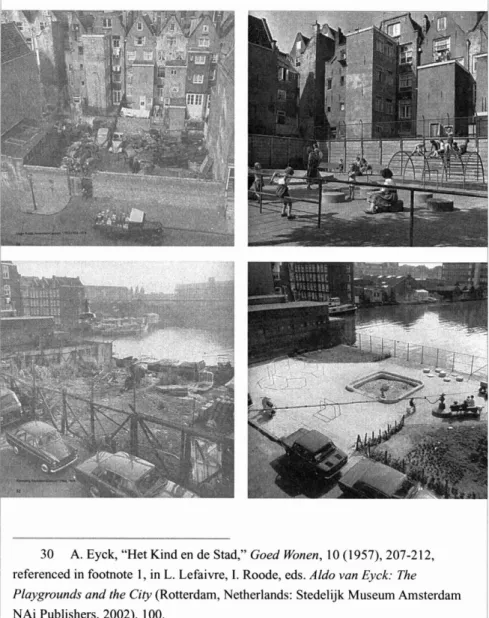
Architects and designers have often attempted to design special places for children's play. The architect Aldo Van Eyck describes vividly how heavy snow fall transforms the whole city into a playground for children: "But what the city needs for its children has to be more durable than snow."30 The spatial transformation achieved through the snow should be captured in our playground designs and the props found therein.
Infrastructure for playgrounds and outdoor games has a long history that differs among cultures. The most familiar play installations we find in playgrounds today, such as swings and seesaws, originated for the amusement and physical training of the wealthy. Play was an adult activity among the upper classes with ample leisure time. In the 19th century, the public play yard was
Fig. 5 Aldo van Eyck play- grounds before and after. From L. Lefaivre, I. Roode, eds. Aldo van Eyck: The Playgrounds and the City (Rotterdam, Nether- lands: Stedelijk Museum Amster- dam NAi Publishers, 2002).
I I !
I 30 A. Eyck, "Het Kind en de Stad," Goed Wonen, 10 (1 957), 207-2 12,
1
referenced in footnote 1, in L. Lefaivre, I. Roode, eds. Aldo van Eyck: The I I Playgrounds and the City (Rotterdam, Netherlands: Stedelijk Museum AmsterdamNAi Publishers, 2002), 100. I
designed in response to a lack of open space in urban settings depriving city children of physical activity outdoors.31 Urban planners now consider playground spaces generic utilities which should be available to all city residents.
Various design approaches have determined playground forms. For example, the 1970s gave rise to adventure playgrounds where children design and build their own play environments. Today, we see many examples of designers and artists developing playful and stimulating outdoor spaces.32 These designers have also regained an appreciation for the development of stimulating environments that consist of more than mechanical equipment:
The trade off imbalance which has been going on all this century between natural environments converted to urban development and their substitution by standard type playgrounds has been
totally in conflict with the best interests of children. This - - tide of - change cannot
be
s t o a but much can be done to re- establish a balance on the playground...
there isa
need to departfrom
the stereotype acquisition and placement of 'play structures' in flat open spaces?This critique suggests that designers should better integrate the play structures into the spatial concept of the playground because they are linked in how
they impact
children's play.And many sensitive designers have focused on equipment that increases motor
and
cognitive abilities in children. Guidelines developed byHe@ting
and
Holbom
focus
especially on the value of play achieved bya
specific design. Their measures for the quality of play are?33 Landscape Australia (1 990), 194, in Hildman Thomas Frank Cram Landscape Architecture and Planning. Innovative Pla)3gnoundr Research Pmject Report. Manitoba Re* ( M a n i w CA: August 2001). www.gov.mb.cdia/
programs/nei~bo~~h~gdfdinnovativeqlay&rotMd~research~report.pdf 34 Heseltine and Holborn (1 987), 18- 19.
Fig. 6 Felix Road Adventure Playground, Bristol, UK.
(1) time: "the more time a non- repetitive play activity lasts and holds the child's attention, the greater the play value"
(2) change: modularity, adaptability..
.
(3) relevance: make it individuallyrelevant
(4) challenges: the potential to increase the level of challenge..
.
(5) suitability: use for different ages (6) co-operation: group playMany of the most popular installations like large swings, merry-go-rounds, and slides mostly challenge children's gross motor skills. Increasingly, cognitive games have found their way into the playground though from observation and anecdotal evidence these installations fall behind the typical playground equipment when it comes to children's interest.35
Bodily activity and exploration with materials is important in all playgrounds and differs depending on the types of equipment available. A study on the impact of play equipment on children's activities found that the type of playground provided to children does impact play patterns. When there are more sophisticated installations children play more on the equipment. However, they also engage in less social play.36
Some architects observe that highly physical play activities often require less infrastructure because a good open space can fulfill the children's needs. However, "it is always advisable to ensure some form of modular play equipment, structures and varied terrain, all of which provides a range of possibilities for interaction and dynamic games."37 These dynamic games should be zoned for different areas throughout the playground so as not to interfere with the other types of more quiet and reflective play. Alamo advocates separating group play zones from individual play zones; noisy and
35 M. Wilker-Johnson, "The Effect on Behavior of Variation in the Amount of Play Equipment." Child Development 6, 1 (March 1935): 56-68.
36 M. Wilker-Johnson, "The Effect on Behavior of Variation in the Amount of Play Equipment," Child Development 6, 1 (March 1935): 56-68.
!
physical games from quiets ones. This type of separation is not just functional, but also increases the legibility of the space: "Ensuring a certain degree of organization in a playground is a necessary aspect so that children learn to find themselves within a space and get their bearings among different play areas? To achieve this legibility, designers need to think back to their roots as organizing human activity
-
in this case play activity - when conceiving of successful outdoor playgrounds.I
Alamo's book Design for Fun includes many truly inspired examples from around the world which successfully address these design goals. However, in some cases the design aesthetic is clearly adultist in nature in its emphasis of sculptural qualities, for example. How children's design aesthetics differ from those of adults goes beyond the discussion here, but it should be stated the two do not always overlap:A rich and plentiful world is not necessarily a good environment for children; on the contrary; it shows
mtB.er how much
adults strive tobe
thecentre
sf attention.
A child-orientedenvironment allows children the
- . -- f;wi6m &dspjp to qeate, shape ~ ~ ~ ~ - h
-
it iallows n gchange and s-
~~
W . w e _might consider - -desmdve;ii@y
ur
kitsch. A child-oriented world has its own aesthetics.
Fig. 7 Flaemingsstrasse, Berlin, Germany, playground. The
markings indicate parking spaces and hopscotch areas and other tpes of games. See Alamo (2005).
- - - - -..
_
l - i 6 -- - - - - . -- -- - -- - --
i -3-_ _ & - - -
Even for the most talented grownup designer it may not be easy to
judge what would be appropriate which muld be the essence of the
I
challenge-ts W -- e- appropriateplay props
and
spaces
for children.I=--
38 Alarno (2005), 274.
Fig. 8 Takino Suzuran National Hillside National Government Park, Sapporo, Japan. See Alamo
39 G. Beltzig, "Child-like, Childish, Child-friendly: is there such a thing as children's aesthetics?" in A. Vegewk, J. Oldiges, and L. Bullivant, eds. kid size: The Matm'al World of Childhood (Vitra Design Museum Exhibition Catalogue. Milan: Skira Editore, 1997), 87-95
Fig. 9 Atelier at the Diana School in Reggio Emilia. See Ceppi and
Zini (1998).
Bringing it All Together: Convivial Spaces for Open- Ended Play and Fully-Body and Mind Engagement
The Reggio Emilia school system combines the desire to build child-centered spaces with high-quality design in a unique way that emphasizes creative expression and supports children's natural exuberance. Since the 1970s, the medium-sized town of Reggio Emilia in Northern Italy (population approx. 150,000) has been building and designing very special school buildings and connected educational programs for young children up to the age of six. The spaces support a learning environment "where knowledge is seen
as constituted in a context through a process of meaning making in continuous encounters with others and the world, and the child and the teacher are understood as co-constructers of knowledge and culture."40 In Reggio's practice, the spaces of learning are
interlocutors for the children and teachers and are designed to "allow
for maximum movement, interdependence, and intera~tion."~' One of the original examples the Diana School is located in the heart of the downtown on the edge of the public gardens. Some of the early photographs documenting Reggio's successful approach depict the unique spaces within this school. Each classroom
includes an "atelier" and the school houses a larger public "atelier"
which is the center of creative activity.
Diana's contemporary counterpart, the Nilde Lotti infant-
toddler center was designed by Tullio Zini and completed in
2003. In contrast to the older Diana School, this building includes
many architecturally unprogrammed spaces that can be adapted
40 C. Rinaldi, In Dialogue with Reggio Emilia: Listening, Researching and Learning (New York, NY Routledge, 2006), 6.
41 "Transgressing the decontextualised idea of Piaget meant that Reggio, in the 1970s, started to experiment with what it would mean to work from another
idea: that children's learning is situated in a socio-cultural context and takes place
in interrelationships, requiring the construction of an environment that 'allows for
maximum movement, interdependence, and interaction' (L. Malaguzzi, "History, Ideas and Basic Philosophy")." In C. Edwards, L. Gandini, G. Forman, eds. The Hundred Languages of Children: The Reggio Approach to Early Childhood Education (Norwood, NJ: Ablex Publishing, 1994), 56. See also, E. K. Ackermann,
"Perspective-Taking and Object Construction: Two Keys to Learning," in Y
Kafai and M. Resnick, Eds. Constructionism in Practice: Designing, Thinking and Learning in a Digital World (Mahwah, NJ: Lawrence Erlbaum Associates, 1996).
to whatever activities are taking place empowering children and teachers to shape their environment, which is directly linked and
customized to the activity at hand. As a result, it feels like the whole
room can be incorporated into a creative activity in addition to the
ever-present "atelier" spaces. The indoor and outdoor zones are visually and physically connected through large glass elements and a central winter garden.
/
Fig. 10 Nilde Lotti School and plan, Reggio Emilia. Information
gathered during site-visit, June
2005.
At all the schools, several elements recur across age groups, schools, and classrooms. For example, the use of light tables and
overhead projectors to transform objects and create shadow plays
has been incorporated into every stage of teaching. Using a very simple technology such as light, children can transform everyday
objects into magical creatures. Fig. 11 Reggio Emilia light table.
Fig. 12 Wind chimes exhibited at the Remida center in Reggio Emilia.
Through the design of specific play spaces and the provision
,
of rich materials the infant-toddler centers of Reggio Emilia inspire atactile approach to designing tools and spaces for play and learning. All of Reggio's tools enhance the sensory richness of the creative and open-ended experience. Materials affording diverse tactile experiences allow the children to express their artistic and analytic capacity to study the world around them and visualize their ideas.
This attention to diverse encounters with materials relates to from Reggio's philosophy of the "Hundred Languages of Children" which acknowledges children's unique play and learning styles and the subsequent need for multi-faceted environments. The spaces of learning and playing at Reggio reflect this philosophy. Even though most children play with a variety of materials on a daily basis, their experiences, as those of grown-ups, are mediated by increasingly uniform and standardized materials. Research conducted by the Reggio Emilia Schools in conjunction with Domus Academy in Milan criticizes the relative homogeneity of the surrounding environment: "the coldness of metal, the linear cleanness of plastics and wood smoothed by machine precision, creating a material landscape in which contrasts are generally reduced or, at most, handled with difficulty.''42 Children, more than adults, use their hands to gather tactile information through sensory stimuli: "Children touch, caress, rub, and play; with one hand or two, with their fingertips, palm, the back of their hand, the knuckles, the edge."43
Many of the materials used in the classroom are collected by Remida (founded in 1996), which organizes and reuses clean waste materials from companies in the region. All materials are donated and range from fabrics to metals, electronics to paper. The exhibit shown to the left was prepared by an artist to demonstrate the breadth of materials available at the center.
42 The Reggio Emilia Schools in Italy are internationally acclaimed infant-toddler centers and preschools dedicated to building successful learning environments for children. Their research is specifically aimed at developing better physical spaces which they call "relational space" for children to flourish. G. Ceppi and M. Zini, eds., Children, Spaces, Relations. Metaproject for an Environment for
Young Children. (Milan: Reggio Children, 1998), 72.
Teachers and educators can "shop" for free at the Remida Centers for their school activities. Today the network of recycling
centers consists of locations in Italy, Australia and Denmark. Since
2000, Remida has been organizing a set of activities around a particular theme, for example, totems. The annual Remida Days are usually coupled with public installations in the downtown area which bring the schools closer to community life?
Capturing the spirit of Reggio in the design of props and spaces for play shows how theories of play (and education) can be interlaced with a designers' work. It closes the gap between theory and practice in a unique way. Incorporating new technologies into these designs adds another layer of complexity to the mix, which is described in the next chapter.
44 Remida Series, Remida Day muta
...
menti (Reggio Emilia, Italy: Reggio Children, 2005).Fig. 13 "Shopping" at the Remida
Fig. 14 Water games created for the 2004 Barcelona Forum of Culture. www.iua.upf. esleicljocsdaigua/, www.barcelona2004. orglcatl Photograph provided by N. Pares.
Chapter
3
Adding New Technologies to the Mix
Impact of Digital Technologies on Children's Play For today's children, so-called "millennials", digital devices and computation-based toys are taken for granted.45 In some cases
-
like the Sony Aibo-
the objects can be highly complex while others are simpler. Defining technology is not the goal here, but I am using it to mean computational elements that surpass traditional, analog toys.Very little interaction with these objects takes place outdoors or involves full-body engagement. In fact, most digital devices such as computers, handhelds or robotic toys like Sony's Aibo or Robosapiens do not encourage full-body motion or open-ended play. The Toy Robots Project at Carnegie M e l l ~ n , ~ ~ for example, has set the following goals:
( 1 ) Excite and inspire public interest in robotics and in science and engineering in general (2) Educate users in robotics,
engineering and the natural sciences
(3) Utilize commercial sources of funding for robotics R&D (4) Provide a challenging and
rewarding work environment for roboticists
(5) Exploit high-volume
manufacturing in the commercial sector to mitigate robotics costs
45 The Pew Internet and American Life Project discovered that more than half the teenagers online develop or reconstitute online content for their specific needs. The physical context for creating this content remains a computer lab, a children's room or some other enclosed space.
46 Toy Robots Initiative, Carnegie Mellon University, www.cs.cmu.edu/ -illah/EDUTOY/, Personal Exploration Rover, www.cs.cmu.edu/-personalroverl PER/index.htrnl
!
These goals are very focused on the field of robotics, which is the researchers1 domain of interest. This approach does not I; acknowledge the environmental aspects of children's play. I
Many "emancipated toys" - whether digital or otherwise
-
are designed for children to fulfill specific goals ranging from marketing goals to educational ones.47 As a result, designing digitalI
devices for children often implies making the adult world smaller. I' cuter, more colorful or simpler and less functional; that is, they lack I a certain open-ended nature which accommodates different styles I of play and what Resnick and Silverman call "low floors and wide
I
walls.1148
We see our construction kits as defining a space to explore, not a collection of specific activities. And our hope is that kids will continually surprise themselves (and surprise us too) as they explore the space of possibilities. When we created Programmable Bricks, we didn't imagine that kids would use them to measure their speed on rollerblades, or to create a machine for polishing and buffing their fingernail^.^'
In this description, the authors are referring to various tangible and software-based construction kits. Low floors allow beginners to immediately make creations. And wide walls make it possible to invent and reinvent new activities with the available features.
47 Note, that this thesis is not a techno-skeptical piece, as researchers have repeated technological determinism does not lead to useful findings. And, children and young people are increasingly found to have sophisticated an differentiated uses of technology that do not have negative impacts on them in the broad-brush way some popular claims imply. S.L. Holloway and G. Valentine, Cyberkids: Children in the Information Age (RoutledgeFalmer: London, 2003), Conclusion. J. Suoranta and H. Lehtimaki, Children in the Information Society, l3e Case of Finland (New York, N Y Peter Lang Publishing ,2004).
48 Resnick and Silverman develop ten guidelines for designing children's construction kits. Most of the guidelines are pertinent to this project, but especially "low floors and wide walls", "support many paths, many styles" and "give people what they want - not what they ask for". M. Resnick and B. Silverman, "Some Reflections on Designing Construction Kits for Kids," Proceedings of IDC'OS (Boulder, CO, June 2005).
Technologies Expanding the Scope of Outdoor Play Experiences
!
Some examples from different disciplinary angles show what
/
1
potential new technologies have for enhancing open-ended and1
/
physically active play:I
I
Ambient Spaces
Y. Rogers, Ambient Wood, Equator Project: The Equator
Project comprises many different research efforts among them the Ambient Wood outdoor field trip for school children. In order to enhance the field trip, tools were built which would provide digital information to the children while they were exploring the outdoor
environment. Rather than separating field research from other resources the goal was to enhance the experience through written
and audio information or through tools like magnifying or framing
certain elements in the forest. In some sense, these tools function
as digital props in the off-thegrid outdoor environment and become
meaningful through the potential they have to unlock the secrets of those spaces. Outside of that context these tools would not be
beneficial to the children. The technologists tried to take children's needs into account and enhance their outdoor experience in a
meaningful way. The end-result is an augmented outdoor installation accessible to children as they wander through the forest.
Full Body Engagement
Fig. 15 Periscope, Ambient Wood. See Rogers (2004).
H. Lund and Playware: A Danish group of computer
1
scientists and roboticists developed Playware as a system of'
'intelligent hard- and software that aims at producing play andplayful experiences among users." Inspired by hopscotch and
other floor games this digital iteration opens many possibilities for
reconfiguration. These elements could also be added to existing playgrounds to enhance that outdoor environment.
Fig. 16 Playware system from
Interactions in Spaces
I Interactive Water Installation: In Spain a group of computer I
i scientists and interaction designers created an interactive, outdoor I water play installation for the "Universal Forum of Cultures" held in
I
;
Barcelona. 2004. Users could activate the fountains by forming ringsi
, and spinning around them. This natural interaction was facilitatedby an artificial vision system. These designers developed a full I
I I 1 environment instead of individual augmented elements to be added
,
to the space. They selected the rather universal game of holding
I hands and running in a circle. From this interaction they derived the
I
technology and the spatial arrangement of the installation and truly ii
1
captured the essence of the Forum. None of the digital infrastructure II
I
interfered with the naturalness of the interaction and the intuitivei
nature of the design was confirmed by the popularity of the exhibiVg1
Fig. 17 Water Games, interaction patterns, the water fountain is activated when the children hold hands and start to move in a circle requiring them to coordinate and agree on a direction and pace. Photographs courtesy of N. Pares. See also Pares et al. (2005).
Several lessons can be drawn from these examples. First, simple interactions such as holding hands around a fountain can support very creative and imaginative games. Second, digital interventions can enhance the spatial experience without detracting from feeling grounded in a three-dimensional outdoor space. Third, digital props can support and encourage physical interaction that resembles the physical activity children enjoy in playgrounds.