HAL Id: hal-00012405
https://hal.archives-ouvertes.fr/hal-00012405
Preprint submitted on 24 Oct 2005HAL is a multi-disciplinary open access
archive for the deposit and dissemination of sci-entific research documents, whether they are pub-lished or not. The documents may come from teaching and research institutions in France or abroad, or from public or private research centers.
L’archive ouverte pluridisciplinaire HAL, est destinée au dépôt et à la diffusion de documents scientifiques de niveau recherche, publiés ou non, émanant des établissements d’enseignement et de recherche français ou étrangers, des laboratoires publics ou privés.
High spatial resolution study of the inner environment
around two young planetary nebulae
Olivier Chesneau
To cite this version:
Olivier Chesneau. High spatial resolution study of the inner environment around two young planetary nebulae. 2005. �hal-00012405�
ccsd-00012405, version 1 - 24 Oct 2005
Michaela Kraus & Anatoly S. Miroshnichenko
High spatial resolution study of the inner environment around two young planetary nebulae
O. Chesneau
Observatoire de la Cte d’Azur, Dpt. Gemini-CNRS-UMR 6203, Avenue Copernic, F-06130 Grasse
Abstract. We present observations of the dusty emission from the young
planetary nebulae Hen 2-113 and CPD-56 obtained with VLT/NACO, VLTI/MIDI. The central stars of these two objects are Wolf-Rayet stars of the same spectral type [WC10]. They share an impressive number of characteristics and are lo-cated at similar distance, making the detection of any differences in their close environment of great interest. Hen 2-113 exhibits a clear ring-like structure of about 0.4 arcsec in diameter, superimposed to a more diffuse environment visible in L’, M’ and 8.7µm bands. No clear core could be detected for this object with
MIDI through the N band. The dusty environment of CPD-56◦8032 is much
more compact, dominated by a bright, barely resolved, core whereas the visible nebula exhibits an amazing complexity. From MIDI 8.7µm acquisition images (dominated by PAHs emission), the extension and geometry of the core have been estimated and compared to the STIS/HST observations (De Marco et al., 1997 and 2002). Moreover, high SNR fringes at low level have been detected with projected baselines between 40 and 45 meters. This clear signal is inter-preted in terms of the bright inner rim of a dusty disk exposed to the flux from the Wolf-Rayet star. The geometrical parameters of the N band flux distribu-tion are well constrained by means of simple geometrical models and a simple radiative transfer model has been developed to extract the physical parameters of the disk.
1. Young PNs and B[e] stars
The optical spectrum of many compact Planetary Nebulae (PNe) shows strong Balmer emission lines and forbidden emission lines but we will concentrate our discussion on the strong IR excess exhibited by these sources. First of all, it is important to note that the targets discussed in this paper, CPD-56◦
8032 (He 3-1333, hereafter CPD) and Hen 2-113 (He 3-1044, hereafter HEN), are not PNe which could be confused with B[e] star and classified as cPNB[e] stars or SymB[e] stars (Lamers et al. 1998). Nevertheless, their study is highly relevant on the subject of this workshop since the environment of these young PNe share many characteristics encountered on B[e] stars ones. Among them, the most striking one is the presence of an equatorial overdensity of dust material exhibited by a growing number of PNs thanks to the improvement of high spatial resolution instruments operating in the mid-IR domain.
One of the most debated question regarding the post-AGB (asymptotic giant branch) evolution of low and intermediate mass stars is the departure from spherical symmetry observed in circumstellar envelopes of Pre-Planetary Nebulae (PPNe) and PNe. Indeed, whereas AGB stars have envelopes roughly
2
spherical, many PNe exhibit axisymmetric structures or even more complex morphologies. Most of PNe shaping theories rely on the velocity field of cir-cumstellar material distributed either in an expanding toroidal structure, or in an equatorial disk. The formation of such structures requires the presence of a binary companion, rotation and/or magnetic fields.
We would like to mention the difficulty to classify some B[e] sources in cPNB[e] stars or SymB[e] stars which reflects simply the difficulty to detect binary companion around post-AGBs and young PNe (see a recent example in S´anchez Contreras et al. 2004). For instance, the PNe M 2-9 and Mz 3, classified as cPNB[e] in Lamers et al. (1998) show indirect evidence suggesting that they indeed harbor symbiotic systems (Smith et al. 2005, Smith & Gehrz 2005). This question of binarity is the core of the debate for the shaping of PNe since it is the most natural physical process able to explain the angular momentum stored in the nebulae (see Soker 1997, Soker & Rappaport 2000, De Marco et al. 2004 and the recent provocative discussion in Soker 2005).
Wolf-Rayet CSs of PNe , which represent about 10% of all PNe, are H-deficient stars (mostly [WC] type) that exhibit a dense stellar wind which shares many characteristics with is counterpart from higher mass population I WR. Among the coolest CSs in this group are the [WC10] (Crowther, De Marco, & Barlow 1998) CPD and HEN.
The ISO spectrum of these objects is rich. The Red Rectangle, CPD and HEN are archetypal PAH-band sources and have amongst the highest ratios of PAH-band fluxes to total IR flux known. ISO spectroscopy also found a chemical dichotomy with evidence of crystalline silicate at longer wavelengths (Waters et al. 1998). The initial interpretation of the cold crystalline silicates was that they probably were located at large distances from the star, in order to be cool enough. However, the rate of occurrence of dual dust chemistry objects is now too high to be consistent with objects that happened to be caught during the brief transition from O-rich to C-rich chemistry. Binarity and the presence of circumstellar disks or tori in which O-rich grains from a previous evolutionary phase are increasingly believed to be responsible for the dual dust chemistry (Cohen et al. 1999, 2002).
De Marco & Soker (2002) proposed that the correlation between Wolf-Rayet characteristics and dual-dust chemistry points to a common mechanism within a binary evolution framework. In their first scenario a low-mass main-sequence star, brown dwarf, or planet spirals into the asymptotic giant branch star, in-ducing extra mixing, hence a chemistry change, and terminating the asymptotic giant branch evolution. In the second scenario a close binary companion is re-sponsible for the formation of a disk around either the binary or the companion. This long-lived disk harbors the O-rich dust. These models are mostly specula-tive owing to the rarity of spatial information on the dust environment at the center of these systems and the scarcity of of binary companion detection.
A careful study of the fundamental parameters of the CSs and nebulae of HEN and CPD was conducted by De Marco et al. (1997, hereafter DBS97) and De Marco & Crowther (1998). HEN and CPD offer a unique opportunity to compare two different nebulae ejected from central stars presenting striking similarities, especially in terms of estimated distance (D=1.3-1.5 kpc). This implies that the two stars and their nebulae have been observed generally with
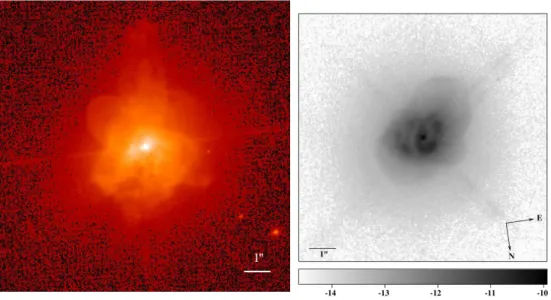
Figure 1. F435 HST image of the young planetary nebula CPD-568032
with the Planetary Camera (resolution 0.0456′′pixel1) of WFPC2/HST . A
logarithmic stretch has been used and North is up, East is left.
the same instruments involving similar spectral and spatial resolving power but the lack of spatial resolution prevented De Marco and collaborator to perform an in-depth study of the nebulae whereas their central stars study has been exhaustive.
In the present work we report new observations of HEN and CPD per-formed with high spatial resolution techniques, namely adaptive optics with NACO/VLT and long baseline interferometry with MIDI/VLTI which allow us to observe with great detail the bulk of the dust emission in the very central region of the object.
2. Hen 2-113
Hen 2-113 is a young planetary nebula with a [WC10] central star. Its ISO spectra shows simultaneously the presence of C-rich (PAHs) and O-rich dust grains. The distance to the star is in the range 1.5-3.1 kpc, Its central star has Teff ∼ 25000K and a mass-loss rate of ∼ 10−7M⊙yr−1.
Despite the careful study of the fundamental parameters of the CSs by De Marco and collaborators, the morphology of the nebula of HEN was poorly known until the HST observations by Sahai et al. (2000). These authors showed that HEN exhibits a complex geometry, roughly bipolar with two bright, knotty, compact ringlike structures around the central star. This compact structure is embedded in a larger and fainter spherically symmetric structure. HEN was thought not to exhibit a disk geometry due to unfavorable inclination (DBS97) but beside exhibiting the dual-dust chemistry like CPD, its complex, multi-lobal geometry also suggests binarity.
4
Infrared observations of HEN were obtained with VLT/NACO, VLTI/MIDI, VLT/ISAAC and TIMMI at the ESO 3.6m. We attempted to detect and study small scales structures in the Mid-IR with the long baseline interferometer MIDI/VLTI. The object was over-resolved with 46m baselines and no interfero-metric data could be recorded, but the acquisition images were very instructive. Hen 2-113 exhibits a clear 1” torus-like structure superimposed to a more dif-fuse environment visible in the L’ (3.8µm), M’ (4.78µm) and 8.7µm bands. Our ISAAC and TIMMI observations indicates that the PAHs are mostly concen-trated towards the bipolar lobes of the nebula.
Photometry of the central star in L’ and M’ band indicates that it is ∼300 and ∼800 times brighter than predicted by stellar models (from De Marco et al. 1997) in L′
and M′
band respectively. Moreover, the central object appears resolved in L’ band with measured FWHM of about 155 mas. Simple calculations indicate that this infrared excess can be explained by emission from hot dust grains. A mass of ∼ 10−9
M⊙ with T∼900K can account for this infrared excess.
By a totally independent way (fitting of the SED), Sahai et al. (2000) indicated the possible presence of hot dust (T∼900K and M ∼ 10−9
M⊙) inside the nebula,
dust that we have apparently detected. This is a clear evidence that dust is still continuously created in the present wind of the [WC] star.
3. CPD-56◦
8032
De Marco, Barlow & Cohen (2002), presented the first direct evidence for an edge-on disk/torus around CPD -568032, as revealed by recent HST/STIS spec-troscopy. Their HST spectra show a spatially resolved continuum split into two bright peaks separated by 0”.10 and interpreted to be stellar light reflected above and below an obscuring dust disk. From these observations, the disk thickness of CPD is deduced to be 134 au, at 1.35 kpc (De Marco et al. 1997).
We observed CPD with VLTI/MIDI in imaging providing a typical 300 mas resolution and in interferometric mode using UT2-UT3 47m baseline provid-ing a typical spatial resolution of 20 mas. We made also use of unpublished HST/WPC2 images in F435 and F606 filters. The visible HST images exhibit a complex multilobal geometry dominated by a few faint lobes for which a counter-part is not always found. The farthest structures are located more than 6′′
from the star. The mid-IR environment of CPD-568032 is dominated by a compact source, barely resolved by a single UT telescope in a 8.7µm filter (∆λ=1.6µm, contaminated by PAHs emission).
The infrared core is almost fully resolved with the three 40-45m projected baselines, ranging from -5◦
to 51◦
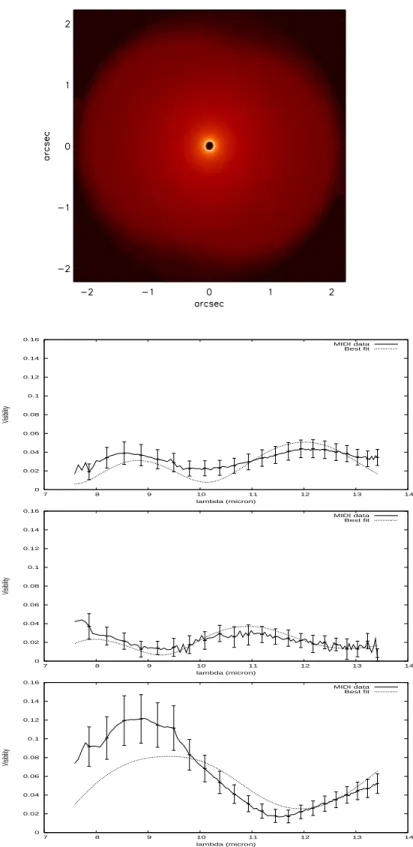
, but smooth oscillating fringes at low level have been detected in dispersed visibilities. This clear signal is interpreted in terms of a ring structure which would define the bright inner rim of the equatorial disk. Geometric models allowed us to retrieve the main geometrical parameters of the disk.
The object is proposed to be a central star (not visible in N band), that illuminates and heats a surrounding dusty disk, heavily resolved by the interfer-ometer. The disk geometry consists in a circular bright inner rim and a rapidly decreasing, although important, flux in the outer regions, which appears to pro-vide good results. The first minimizations were done using a truncated circular
Gaussian profile and a fixed inner gap radius equal to the FWHM of the Gaus-sian (real disk coupled). The residuals are surprisingly good but there are still important deviations from the measurements. The model has been refined with the incorporation of free inner gap radius and ellipticity, which matches the ob-served oscillations quite well. For instance, a reasonably good fit is reached with an achromatic and elliptical truncated Gaussian with a radius of 97±11AU, an inclination of 28±7◦
and a PA angle for the major axis at -15◦
±7◦
.
We performed radiative transfer simulations using the continuum radiative transfer code MC3D (Wolf et al. 1999), restricted to carbon-rich dust (i.e. to the close vicinity of the star). The goal is to get a good estimate of the physical parameters of the inner rim based on the simultaneous constraints of the visibilities, MIDI spectra and the SED.
4. A short comparison of these two environments
HEN and CPD offer a unique opportunity to compare two different nebulae ejected from central stars presenting striking similarities. The central stars are both of [WC10] types, with very similar temperature, luminosity putting them into tracks of stars at 0.62M⊙ (DBS97). At large scale, their environments
ob-served by the HST are quite different. The nebula around HEN is more compact and perhaps simpler than the one seen around CPD although both exhibit a com-plex multi-lobal geometry. Despite of its compactness, HEN presents a ring-like structure which is resolved by a single 8m telescopes from L’ to N band, whereas CPD is definitely only barely resolved at 8.7µm (probably due to the presence of PAHs) and harbor a compact disk in the vicinity of the central disk. Shortly speaking, it is tempting to propose that HEN exhibits a ’typical’ torus formed in the post-AGB phase whereas the disk around CPD is more suggestive of a nebula evolution involving a binary companion.
In this context, the question of the dynamical age of the nebulae is of importance. The development of a compact and complex planetary nebula is a fast event compared to the life-time of their parent stars and it is possible that the differences reported for HEN and CPD nebulae are solely due to the age of the ejection, the nebula of CPD being younger in this case than HEN since the dusty core is more compact. In an other hand, it does not explain why some lobes seen in the HST images of CPD are so extended, reaching 6” from the central star, whereas the lobes from HEN are at most at 3” from the star.
Our high spatial resolution observations have considerably enlarged our knowledge of the dust geometry of these nebula but the key of the problem remain unanswered: is their geometry a consequence of binary interaction? In the case of CPD we could answer that the probability is large but in the case of HEN the evidence is less direct. There is a correlated issue: we have shown that the core of HEN’s nebula is not a naked star, but that an optically thin shell of newly formed dust surrounds the star. The question is to know how this dust is formed at the vicinity of a [WR] star. Again, our view of this phenomenon would be clarified if we knew whether or not HEN harbors a binary system and of which kind. Understanding how dust can be formed in the hostile environment of hot winds is a challenging problem and a comparison with the massive WR stars case is instructive.
6 0 0.02 0.04 0.06 0.08 0.1 0.12 0.14 0.16 7 8 9 10 11 12 13 14 Visibility lambda (micron) MIDI data Best fit 0 0.02 0.04 0.06 0.08 0.1 0.12 0.14 0.16 7 8 9 10 11 12 13 14 Visibility lambda (micron) MIDI data Best fit 0 0.02 0.04 0.06 0.08 0.1 0.12 0.14 0.16 7 8 9 10 11 12 13 14 Visibility lambda (micron) MIDI data Best fit
Figure 2. Up: the 10µm flux distribution of the radiative transfer model.
Bottom: the three MIDI visibility measurements (solid lines) and the model signal (dotted lines). Most of the flux is over-resolved by the interferometer but the low level sinusoidal variation is the signature of the brigth inner rim of the disk. The two first visibility spectra have been obtained with almost identical projected baselines and a small variation of PA angle. The third one has been obtained with a smaller projected baseline with a clear change of PA angle allowing a good constraint of the aspect ratio of the disk.
Tuthill, Monnier, Danchi and collaborators have discovered that two sup-posed isolated massive WR known as persistent dust producers, WR 104 and WR 98a stars were in fact close-binary systems whose dust distribution was fol-lowing the orbital motion of the stars (Tuthill et al, 1999; Monnier et al, 1999, 2002). The dust production is probably triggered by the wind-wind collision and these discoveries raised interesting questions and propositions (see Monnier et al. 1999): is binarity mandatory to produce the dust? Furthermore, are alla the WC8-9 spectral stars a consequence of binary interaction? These questions have strong resonances in the case of [WR] at the center of planetary nebulae for which the evolutionary status remains unclear and could also be the result of binary interaction. We note that in the frame of the scenario of De Marco & Soker, the companion is no longer orbiting around the newly born [WR] star and that the dust production must in this context be formed from the wind alone.
In the case of HEN, we did not detect any asymmetry which would suggest that the dust production occurs in a preferred plane but the spatial resolution provided by NACO in L’ is probably too low. Moreover, the central object is no longer visible in MIDI N band observations and probably much below the sensi-tivity limit for interferometric detection. The observations of the central core of HEN and CPD by AMBER in K band could be useful, but their magnitudes in this band (7.5 and 6.8 respectively) are demanding in regards to the instrument sensitivity. The observations of the core of such objects remains challenging.
Acknowledgments. This work is the result of a fruitful collaborations in-volving Eric Lagadec, Arnaud Collioud, Orsola De Marco, Jos´e de Freitas de Pacheco, Sebastian Wolf, Albert Zijlstra, Mikako Matsuura, Agn`es Acker, Geof Clayton, Bruno Lopez and Alexander Rothkopf.
References
Cohen, M., Barlow, M.J., Sylvester, R.J. et al. 1999, ApJ, 513, L135
Cohen, M., Barlow, M.J., Liu, X.-W. and Jones, A. F. 2002, MNRAS, 332, 879 De Marco, O., Barlow, M.J. and Storey, P.J., 1997, MNRAS, 292, 86
De Marco, O. & Crowther, P. 1998 MNRAS, 296, 367 De Marco, O. & Soker, N 2002, PASP, 114, 602
De Marco, O., Barlow, M.J. & Cohen 2002, ApJ, 574, L83
De Marco, O., Bond, H.E., Harmer, D. and Fleming, A.J. 2004, ApJ, 602, L93 Lagadec, E., Chesneau, O., Matsuura, M., et al., 2005, A&A, accepted
Lamers, H.J.G.L.M., Zickgraf, F-J., de Winter, D. et al. 1998, A&A, 340, 117 Monnier, J.D., Greenhill, L.J., Tuthill, P.G. and Danchi, W.C., 2002, ApJ, 566, 399 Monnier, J.D., Tuthill, P.G. and Danchi, W.C., 1999, ApJ L., 525, 97
Sahai, R., Nyman, L-A. and Wootten, A. 2000, ApJ, 543, 880
S´anchez Contreras, C., Gil de Paz, A. and Sahai, R., 2004, ApJ, 616, 519
Smith, N., Balick, B., & Gehrz, R.D., 2005, AJ, 130, 853 Smith, N. & Gehrz, R.D., 2005, AJ, 129, 969
Soker, N., 1997, ApJ Sup. Ser., 112, 487 Soker, N. & Rappaport, S., 2000, ApJ, 538, 241 Soker, N., 2005, astro-ph, 8525
Tuthill, P.G., Monnier, J. and Danchi, W.C., 1999, Nature, 398, 487