HAL Id: hal-00461741
https://hal.archives-ouvertes.fr/hal-00461741
Preprint submitted on 5 Mar 2010HAL is a multi-disciplinary open access
archive for the deposit and dissemination of sci-entific research documents, whether they are pub-lished or not. The documents may come from teaching and research institutions in France or abroad, or from public or private research centers.
L’archive ouverte pluridisciplinaire HAL, est destinée au dépôt et à la diffusion de documents scientifiques de niveau recherche, publiés ou non, émanant des établissements d’enseignement et de recherche français ou étrangers, des laboratoires publics ou privés.
To cite this version:
Bernard Borderie, E. Bonnet, F. Gulminelli, N. Le Neindre, D. Mercier, et al.. Multifragmentation and phase transition for hot nuclei. 2009. �hal-00461741�
Multifragmentation and phase transition for hot nuclei: recent progress
INDRA and ALADIN Collaborations
B. Borderiea, E. Bonneta ∗, F. Gulminellib, N. Le Neindrea †, D. Mercierb c, S. Piantellia ‡, Ad. R. Radutaa d, M. F. Riveta, B. Tamainb, R. Bougaultb, A. Chbihie, R. Dayrasf,
J. D. Franklande, E. Galicheta, F. Gagnon-Moisana g, D. Guinetc, P. Lautessec,
J. Lukasikh, M. Pˆarlogb d, E. Rosatoi, R. Royg, M. Vigilantei and J. P. Wieleczkoe aInstitut de Physique Nucl´eaire, CNRS/IN2P3, Univ. Paris-Sud 11, Orsay, France bLPC Caen, CNRS/IN2P3, ENSICAEN, Univ. de Caen, Caen, France
cInstitut de Physique Nucl´eaire, IN2P3-CNRS et Universit´e, Villeurbanne, France
d National Institute for Physics and Nuclear Engineering, Bucharest-M˘agurele, Romania eGANIL, DSM-CEA/CNRS-IN2P3, Caen cedex, France
fIRFU/SPhN, CEA Saclay, Gif sur Yvette, France
gLaboratoire de Physique Nucl´eaire, Universit´e Laval, Qu´ebec, Canada hInstitute of Nuclear Physics IFJ-PAN, Krak´ow, Poland
iDipartimento di Scienze Fisiche e Sezione INFN, Universit´a di Napoli, Napoli, Italy
Recent important progress on the knowledge of multifragmentation and phase transition for hot nuclei, thanks to the high detection quality of the INDRA array, is reported. It concerns i) the radial collective energies involved in hot fragmenting nuclei/sources produced in central and semi-peripheral collisions and their influence on the observed fragment partitions, ii) a better knowledge of freeze-out properties obtained by means of a simulation based on all the available experimental information and iii) the quantitative study of the bimodal behaviour of the heaviest fragment distribution for fragmenting hot heavy quasi-projectiles which allows the extraction, for the first time, of an estimate of the latent heat of the phase transition.
1. Introduction
Nucleus-nucleus collisions at intermediate energies offer various possibilities to produce hot nuclei which undergo a break-up into smaller pieces, which is called multifragmen-tation. The measured fragment properties are expected to reveal and bring information
∗Present address: GANIL, DSM-CEA/CNRS-IN2P3, Caen, France
†Present address: LPC Caen, CNRS/IN2P3, ENSICAEN, Univ. de Caen, Caen, France ‡Present address: Sezione INFN, Sesto Fiorentino (Fi), Italy
energy on partitions is emphasized and the relative importance of the different collective energies is extracted [ 4] (section 2). Then, in section 3, freeze-out properties of multi-fragmentation events produced in central collisions (129Xe+natSn) are estimated [ 5] and
confirm the existence of a limiting excitation energy for fragments around 3.0-3.5 MeV per nucleon. The deduced freeze-out volumes are used as a calibration to calculate freeze-out volumes for QP sources; thus one can locate where the different sources break in the phase diagram. Finally, in section 4, the charge distribution of the heaviest fragment detected in the decay of QP sources is observed to be bimodal. This feature is expected as a generic signal of phase transition in nonextensive systems as finite systems. For the first time an estimate of the latent heat of the transition is also extracted [ 6].
2. Fragment partitions and radial collective energy
To make a meaningful comparison of fragment properties which can be related to the phase diagram, hot nuclei showing, to a certain extent, statistical emission features must be selected. For central collisions (QF events) one selects complete and compact events in velocity space (constraint of flow angle ≥ 60◦). For peripheral collisions (QP subevents)
the selection method applied to quasi-projectiles minimizes the contribution of dynamical emissions by imposing a compacity of fragments in velocity space. Excitation energies of the different hot nuclei produced are calculated using the calorimetry procedure (see [ 4] for details). By comparing the properties of selected sources on the same excitation energy domain significant differences are observed above 5 AMeV on both mean fragment multiplicities, < Mf rag >, even normalized to the sizes of the sources which differ by about
20% for QF and QP sources, and generalized asymmetry: AZ = σZ/(hZi
q
Mf rag − 1).
QF sources have larger normalized mean fragment multiplicities and lower values for generalized asymmetry. An explanation of those experimental results concerning fragment partitions is possibly related to the different dynamical constraints applied to the hot nuclei produced: a compression-expansion cycle for central collisions and a more gentle friction-abrasion process for peripheral ones.
Radial collective energy following a compression phase is predicted to be present in semi-classical simulations of central collisions in the Fermi energy domain [ 7, 8]. In experiments it was obtained, in most of the cases, from comparisons of kinetic properties of fragments with models. The mean relative velocity between fragments, βrel, independent
of the reference frame, allows to compare radial collective energy for both types of sources (QF or QP). The effect of the source size (Coulomb contribution on fragment velocities) can be removed by using a simple normalization which takes into account, event by event, the Coulomb influence, in velocity space, of the mean fragment charge, hZi, on the complement of the source charge (Zs − hZi): βrel(N ) = βrel/
q
hZi(Zs− hZi). At an
excitation energy of about 5 AMeV, the βrel(N ) values corresponding to QF and QP sources are similar. Above that excitation energy, the values for QF sources exhibit a strong linear
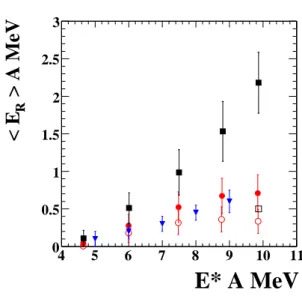
increase. For QP sources βrel(N ) slightly increases up to 9-10 AMeV excitation energy. That fast divergence between the values of βrel(N ) for the two types of sources signals the well known onset of radial collective expansion for central collisions. In [ 9], estimates of radial collective energy (from 0.5 to 2.2 AMeV) for QF sources produced by Xe+Sn collisions are reported for four incident energies: 32, 39, 45 and 50 AMeV. Those estimates which were extracted from comparisons with the statistical model SMM assuming a self similar expansion energy can be used to calibrate the βrel(N ) observable (see [ 4] for details). All
the quantitative information concerning the evolution of radial energy with excitation energy for both types of sources is presented in fig. 1. We have also added the ER values
published by the ISIS collaboration [ 10] corresponding to the π−+Au reactions which
provide sources equivalent to the QP ones in terms of excitation energy range and size. The observed evolution of ER for such sources is almost the same as for QP sources. For
hadron-induced reactions the thermal pressure is the only origin of radial expansion, which indicates that it is the same for QP sources. To be fully convincing, an estimate of the part of the radial collective energy due to thermal pressure calculated with the EES model [ 11] for an excited nucleus identical to QF sources produced at 50 A MeV incident energy is also reported (open square) in the figure [ 12]. To conclude we have shown that radial collective energy is essentially produced by thermal pressure in semi-peripheral heavy-ion collisions as it is in hadron-induced reactions. For QF sources produced in central heavy-ion collisheavy-ions the contributheavy-ion from the compressheavy-ion-expansheavy-ion cycle becomes more and more important as the incident energy increases. Those observations show that the radial collective energy does influence the fragment partitions.
E* A MeV
4 5 6 7 8 9 10 11> A MeV
R< E
0 0.5 1 1.5 2 2.5 3Figure 1. Evolution of the radial collec-tive energy with the excitation energy per nucleon for different sources. Full squares stand for QF sources. Open (full) circles correspond to QP sources produced in 80 (100) AMeV collisions. Full triangles correspond to π−+ Au
re-actions [ 10] and the open square to an estimate of the thermal part of the ra-dial collective energy for Xe+Sn sources produced at 50 AMeV incident energy. From [ 4]
3. Freeze-out properties
Starting from all the available experimental information of selected QF sources pro-duced in central 129Xe+natSn collisions which undergo multifragmentation, we developed
all incident energies. This naturally leads to a limitation of their excitation energy around 3.0-3.5 AMeV as observed in [ 13]. The major properties of the freeze-out configurations thus derived are the following: an important increase, from ∼20% to ∼60%, of the per-centage of particles present at freeze-out between 32 and 45-50 AMeV incident energies accompanied by a weak increase of the freeze-out volume which tends to saturate at high excitation energy. Finally, to check the overall physical coherence of the developed ap-proach, a detailed comparison with a microcanonical statistical model (MMM) was done. The degree of agreement, which was found acceptable, confirms the main results and gives confidence in using those reconstructed freeze-out events for further studies as it is done in [ 4]. Estimates of freeze-out volumes for QF sources evolve, between 32 and 50 AMeV, from 3.9 to 5.7 V /V0, where V0 would correspond to the volume of the source at normal
density; those volumes were used to calibrate the freeze-out volumes for QP sources (see [ 4] for details).
The deduced volumes of QP sources are found smaller than those of QF sources (by about 20% on the E∗range 5-10 AMeV), which supports the observations made previously
on radial collective energies: the larger the radial collective energy, the lower the density (the larger the F.O. volume) where multifragmentation takes place.
4. Bimodality of the heaviest fragment and latent heat of the transition At a first-order phase transition, the distribution of the order parameter in a finite system presents a characteristic bimodal behaviour in the canonical or grandcanonical ensemble [ 14]. The bimodality comes from an anomalous convexity of the underlying microcanonical entropy [ 15]. It physically corresponds to the simultaneous presence of two different classes of physical states for the same value of the control parameter, and can survive at the thermodynamic limit in a large class of physical systems subject to long-range interactions [ 16]. In the case of hot nuclei which undergo multifragmentation, the size/charge of the heaviest fragment was early recognized as an order parameter [ 17, 18] using the universal fluctuation theory. A quantitative analysis for QP sources is done and the robustness of the signal of bimodality is tested against two different QP selection methods [ 6]. A weighting procedure [ 19] is used to test the independence of the decay from the dynamics of the entrance channel and to allow a comparison with canoni-cal expectations. Finally, a double saddle-point approximation is applied to extract from the measured data an equivalent-canonical distribution. To take into account the small variations of the source size, the charge of the heaviest fragment Z1 has been normalized
to the source size. After the weighting procedure, a bimodal behaviour of the largest fragment charge distribution is observed for both selection methods. Those weighted ex-perimental distributions can be fitted with an analytic function (see [ 6] for more details). From the obtained parameter values one can estimate the latent heat of the transition of the hot heavy nuclei studied (Z∼70) as ∆E = 8.1(±0.4)stat(+1.2 − 0.9)syst AMeV.
Figure 2. Size of the heaviest frag-ment versus total excitation energy in AMeV. That picture is constructed us-ing the fit parameters extracted from the equivalent-canonical distribution. The distance between the two maxima, liq-uid and gas peaks, projected on the ex-citation energy axis corresponds to the latent heat of the transition.
Statistical error was derived from experimental statistics and systematic errors from the comparison between the different QP selections. The results (for one QP source selection) are illustrated in fig. 2.
REFERENCES
1. B. Borderie, J. Phys. G: Nucl. Part. Phys. 28 (2002) R217.
2. P. Chomaz et al. (eds.) vol. 30 of Eur. Phys. J. A, Springer, 2006. 3. B. Borderie, M. F. Rivet, Prog. Part. Nucl. Phys. 61 (2008) 551.
4. E. Bonnet et al. (INDRA and ALADIN Collaborations), Nucl. Phys. A 816 (2009) 1. 5. S. Piantelli et al. (INDRA Collaboration), Nucl. Phys. A 809 (2008) 111.
6. E.Bonnet et al. (INDRA Collaboration), Phys. Rev. Lett. 103 (2009) 072701. 7. J. J. Molitoris et al., Phys. Rev. C 37 (1988) 1020.
8. E. Suraud et al., Phys. Lett. B 229 (1989) 359. 9. G. T˘ab˘acaru et al., Eur. Phys. J. A 18 (2003) 103. 10. L. Beaulieu et al., Phys. Rev. C 64 (2001) 064604. 11. W. A. Friedman, Phys. Rev. C 42 (1990) 667.
12. B. Borderie, G. Giardina et al. (eds.) Proc. Int. Symposium on large-scale collective motions of atomic nuclei, Brolo, Italy, World scientific, 1997, 1.
13. S. Hudan et al. (INDRA Collaboration), Phys. Rev. C 67 (2003) 064613. 14. F. Gulminelli, Ann. Phys. Fr. 29 (2004) No 6.
15. D. H. E. Gross, Microcanonical thermodynamics, World Scientific, 2002, vol. 66 of World scientific Lecture Notes in Physics.
16. T. Dauxois et al. (eds.) vol. 602 of Lecture Notes in Physics, Springer-Verlag, Heidel-berg, 2002.
17. R. Botet et al., Phys. Rev. Lett. 86 (2001) 3514.
18. J. D. Frankland et al. (INDRA and ALADIN collaborations), Phys. Rev. C 71 (2005) 034607.