Computational Aspects of Communication Amid
Uncertainty
by
Badih Ghazi
B.Eng., American University of Beirut (2012)
S.M., Massachusetts Institute of Technology (2015)
Submitted to the Department of Electrical Engineering and Computer Science
in partial fulfillment of the requirements for the degree of
Doctor of Philosophy in Electrical Engineering and Computer Science
at the
MASSACHUSETTS INSTITUTE OF TECHNOLOGY
February 2018
c
○ Massachusetts Institute of Technology 2018. All rights reserved.
Author . . . .
Department of Electrical Engineering and Computer Science
January 31, 2018
Certified by . . . .
Ronitt Rubinfeld
Professor of Computer Science, MIT
Thesis Supervisor
Certified by . . . .
Madhu Sudan
Professor of Computer Science, Harvard
Thesis Supervisor
Accepted by . . . .
Leslie A. Kolodziejski
Professor of Electrical Engineering and Computer Science
Computational Aspects of Communication Amid Uncertainty
by
Badih Ghazi
Submitted to the Department of Electrical Engineering and Computer Science on January 31, 2018, in partial fulfillment of the
requirements for the degree of
Doctor of Philosophy in Electrical Engineering and Computer Science
Abstract
This thesis focuses on the role of uncertainty in communication and effective (computational) methods to overcome uncertainty. A classical form of uncertainty arises from errors intro-duced by the communication channel but uncertainty can arise in many other ways if the communicating players do not completely know (or understand) each other. For example, it can occur as mismatches in the shared randomness used by the distributed agents, or as ambiguity in the shared context or goal of the communication. We study many modern models of uncertainty, some of which have been considered in the literature but are not well-understood, while others are introduced in this thesis:
Uncertainty in Shared Randomness
∙ We study common randomness and secret key generation. In common randomness generation, two players are given access to correlated randomness and are required to agree on pure random bits while minimizing communication and maximizing agree-ment probability. Secret key generation refers to the setup where, in addition, the generated random key is required to be secure against any eavesdropper. These setups are of significant importance in information theory and cryptography. We obtain the first explicit and sample-efficient schemes with the optimal trade-offs between commu-nication, agreement probability and entropy of generated common random bits, in the one-way communication setting.
∙ We obtain the first decidability result for the computational problem of the non-interactive simulation of joint distributions, which asks whether two parties can convert independent identically distributed samples from a given source of correlation into an-other desired form of correlation. This class of problems has been well-studied in information theory and its computational complexity has been wide open.
Uncertainty in Goal of Communication
∙ We introduce a model for communication with functional uncertainty. In this setup, we consider the classical model of communication complexity of Yao, and study how
this complexity changes if the function being computed is not completely known to both players. This forms a mathematical analogue of a natural situation in human communication: Communicating players do not a priori know what the goal of com-munication is. We design efficient protocols for dealing with uncertainty in this model in a broad setting. Our solution relies on public random coins being shared by the communicating players. We also study the question of relaxing this requirement and present several results answering different aspects of this question.
Uncertainty in Prior Distribution
∙ We study data compression in a distributed setting where several players observe mes-sages from an unknown distribution, which they wish to encode, communicate and decode. In this setup, we design and analyze a simple, decentralized and efficient protocol.
In this thesis, we study these various forms of uncertainty, and provide novel solutions using tools from various areas of theoretical computer science, information theory and mathemat-ics.
Thesis Supervisor: Ronitt Rubinfeld
Title: Professor of Computer Science, MIT Thesis Supervisor: Madhu Sudan
Acknowledgments
I have been very fortunate to have great mentors, collaborators, friends and family without whom this work would not have been possible.
I am extremely thankful to Madhu who has been a fantastic advisor throughout my PhD. Madhu’s warm intelligence, encyclopedic knowledge, humility and creativity make it impossible to work with him without admiring him. Not once did I leave a meeting with Madhu without having a new idea or a fresh take on a problem. Among the things that I will miss the most about graduate school are my meetings with him.
I am very grateful to Ronitt who was incredibly helpful on every occasion long before she became my official advisor. I first got the chance to work with Ronitt in my second year at MIT when I TA’ed her wonderful course on Randomness and Computation. Ever since, her support has been phenomenal. I am very fortunate to have been advised by her.
Many thanks to Vinod Vaikuntanathan and T.S. Jayram for agreeing to be on my thesis committee. Vinod’s sharp-sightedness and ability to instantly detect connections between almost any theory question and cryptography are spectacular. I have learned a lot from Jayram’s expertise in communication and information complexity, and I am amazed by his eclectic knowledge that spans so many areas within the theory and applications of computer science.
This thesis has benefitted from discussions and exchanges with several researchers in-cluding: Boaz Barak, Mohammad Bavarian, Clément Canonne, Mohsen Ghaffari, Oded Goldreich, Mika Göös, Venkat Guruswami, Brendan Juba, Sudeep Kamath, Swastik Kop-party, Jingbo Liu, Elchanan Mossel and Ilya Razenshteyn.
I would also like to thank Vitaly Feldman for his supervision, along with Jayram, during my internship at IBM Almaden in the summer of 2016 and for his help and advice since then.
Also, many thanks to Venkat Guruswami who hosted me for a great week at CMU during which I started thinking about Common Randomness Generation. I hope to get to collaborate with Venkat in the future!
I would also like to thank Dina Katabi for hosting me during two summers at MIT. Dina’s work ethic and dedication were truly inspiring. I would also like to thank Piotr Indyk for the collaboration during that period and his help since then.
I was fortunate to have other great collaborators including: Haitham Hassanieh, Eric Price, Lixin Shi, Eric Blais, Joshua Brody, Elena Grigorescu, Venkata Gandikota, Pritish Kamath, Elad Haramaty, Prasad Raghavendra, Mohammad Bavarian, Ronald L. Rivest, Ilan Komargodski, Pravesh Kothari, Euiwoong Lee, and Rudiger Urbanke.
In particular, I would like to thank Pritish with whom I have had frequent and fruitful collaborations. Besides being a fantastic person, Pritish’s diligence, mathematical rigor and clarity of thought are truly remarkable.
I had the chance to get to know many friends in the Theory of Computation group at MIT with whom I had numerous interesting conversations: Mohsen Ghaffari, Pritish Kamath, Elad Haramaty, Alan Guo, Ilya Razenshteyn, Jerry Li, Gautam G Kamath , Arturs Backurs, Adam Sealfon, Cameron Musco, Katerina Sotiraki, Maryam Aliakbarpour, Nishanth Dikkala,
Akshay Degwekar, Prashant Vasudevan, Elena Mădălina Persu.. Apologies to those whom I am forgetting!
Also, thanks to the other researchers that I have had the chance to interact with during graduate school (including Guy Kindler, David Woodruff and Ilias Diakonikolas).
I would like to thank the administrative assistants in the Theory of Computation Group at MIT, especially Joanne Hanley, whose help and kindness has shielded us from all the bureaucratic requirements.
Back as an undergraduate student at the American University of Beirut, I was extremely lucky to work with Louay Bazzi. It was Louay’s outstanding courses and his mentorship during my first research project that sparked my interest in theoretical computer science. Also, many thanks to AUB professors Ibrahim Abou-Faycal, Fadi Karameh and Kamal Khuri-Makdisi from whom I learned a lot.
It would be hard for me to express how grateful I am to Christelle, the love of my life, for her unwavering support throughout this adventure. I am constantly dazzled by her brilliance, and I will never forget her heroic feats when we were separated for two long years by 5400 miles and 7 time zones.
I have been blessed with a great family whose size makes it impossible to properly ac-knowledge here. Let me just mention a few highly distinguished members. My grandparents Saadallah and Marie, who were particularly close to me as I was growing up, are an example of hard work and wisdom. My (so-called) uncle Charbel has been a constant source of help and support despite the fact that we have not lived in the same country for the past 15 years. I have missed a lot the intelligence and sharp sense of humor of my sisters Maria and Elena and my brother Rabih. Their loving support has been very precious. My biggest regret is not having spent enough time with them during the last years.
I owe a lot to my parents, Bassam and Hilda. My father’s limitless generosity and support has made my life much easier. My mother instilled in me an appetite for knowledge from an early age and her unmatched dedication and love inspire me every day.
A Note on The Content
This thesis contains a subset of the author’s work during his Ph.D. [GJ18, GKR17, GS17,
GHKS17, FG17, BGH+16, GKS16b, GGG16, GKKS16, GKS16a, GGG15, GL15, BBG14,
SAH+13, GHI+13].
Chapter 2 and Chapter4 are based on the following previous publication:
∙ [GJ18] Badih Ghazi and TS Jayram. Resource-efficient common randomness and secret-key schemes. In Proceedings of the Twenty-Ninth Annual ACM-SIAM Sym-posium on Discrete Algorithms (SODA), pages 1834–1853. SIAM, 2018
Chapter 3 is based on the following previous publication:
∙ [GKS16b] Badih Ghazi, Pritish Kamath, and Madhu Sudan. Decidability of non-interactive simulation of joint distributions. In Foundations of Computer Science (FOCS), 2016 IEEE 57th Annual Symposium on, pages 545–554. IEEE, 2016
Chapter 5 is based on the following two previous publications:
∙ [GKKS16] Badih Ghazi, Ilan Komargodski, Pravesh Kothari, and Madhu Sudan. Com-munication with contextual uncertainty. In Proceedings of the Twenty-Seventh Annual ACM-SIAM Symposium on Discrete Algorithms (SODA), pages 2072–2085. SIAM, 2016
∙ [GS17] Badih Ghazi and Madhu Sudan. The power of shared randomness in uncertain communication. In International Colloquium on Automata, Languages and Program-ming (ICALP), pages 49:1–49:14, 2017
Chapter 6 is based on the following previous publication:
∙ [GHKS17] Badih Ghazi, Elad Haramaty, Pritish Kamath, and Madhu Sudan. Com-pression in a distributed setting. Innovations in Theoretical Computer Science (ITCS), 2017
Chapter 7 is based on the following manuscript:
∙ [BGH+16] Mohammad Bavarian, Badih Ghazi, Elad Haramaty, Pritish Kamath, Ronald L
Rivest, and Madhu Sudan. The optimality of correlated sampling. arXiv preprint arXiv:1612.01041, 2016
This research was supported in part by an NSF STC Award CCF 0939370, NSF award numbers CCF-1217423, CCF-1650733 and CCF-1420692, an Irwin and Joan Jacobs Presi-dential Fellowship and an IBM Ph.D. Fellowship.
Contents
1 Introduction: Uncertainty in Communication 15
1.1 Uncertainty in Shared Randomness . . . 16
1.1.1 Common Randomness & Secret Key Generation . . . 16
1.1.2 Non-Interactive Simulation of Joint Distributions . . . 18
1.1.3 Communication with Imperfectly Shared Randomness . . . 19
1.2 Uncertainty in Goal of Communication . . . 20
1.3 Uncertainty in Prior Distribution . . . 20
1.3.1 Uncertain Distributed Compression . . . 20
1.3.2 Correlated Sampling . . . 21
1.4 Thesis Roadmap . . . 22
2 Common Randomness and Secret Key Generation 23 2.1 Introduction & Related Work . . . 23
2.1.1 Preliminaries . . . 28
2.2 Template One-Way Scheme and its Analysis . . . 29
2.3 Efficient Scheme for BGS(𝜌) . . . 31
2.4 Efficient Scheme for DSBS(𝜌) . . . 33
2.5 Information Complexity and Common Randomness . . . 37
2.6 Properties of Bivariate Gaussian Distribution . . . 42
2.6.1 Tail Bounds for Gaussians . . . 42
2.7 Non-Asymptotic Bounds on Correlated Binomials . . . 44
2.8 Correlated Randomness Generation . . . 50
2.9 LSH and Common Randomness . . . 56
2.10 Min-Entropy Properties . . . 56
2.10.1 DSBS(𝜌) ([BM11], rephrased). . . 57
2.10.2 BGS(𝜌). . . 57
2.11 Conclusion and Open Questions . . . 58
3 Non-Interactive Simulation of Joint Distributions 61 3.1 Introduction & Related Work . . . 61
3.1.1 Proof Overview . . . 64
3.1.2 Organization . . . 65
3.2.1 Notation . . . 66
3.2.2 The Non-Interactive Simulation Problem . . . 66
3.2.3 Reformulation of Gap-Non-Int-Sim . . . 68
3.2.4 Fourier Analysis and Multi-Linear Polynomials. . . 70
3.2.5 Hypercontractivity and Moment Bounds . . . 73
3.2.6 Maximal Correlation and Witsenhausen’s Rounding . . . 74
3.2.7 Two-Dimensional Berry-Esseen Theorem . . . 75
3.3 Main Technical Lemma and Overview. . . 77
3.3.1 Proof Overview . . . 77
3.3.2 Decidability of Gap-Non-Int-Sim . . . 78
3.4 Smoothing of Strategies . . . 79
3.5 Joint Regularity Lemma for Fourier Concentrated Functions . . . 80
3.5.1 Regularity Lemma for Constant-Degree Polynomials . . . 81
3.5.2 Joint Regularity Lemma . . . 84
3.6 Applying Correlation Bounds for Low-Influence Functions . . . 85
3.7 Simulating Correlated Gaussians. . . 88
3.8 Putting it All Together! . . . 90
3.8.1 Generalizing to Arbitrary Binary Targets . . . 92
3.9 Open Questions . . . 93
4 Communication with Imperfectly Shared Randomness 95 4.1 Introduction & Related Work . . . 95
4.2 Proof of Theorem 4.1.1 . . . 96
5 Communication with Functional Uncertainty 101 5.1 Introduction & Related Work . . . 101
5.1.1 Uncertain-Communication Complexity . . . 103
5.1.2 Results. . . 105
5.1.3 Prior Work . . . 111
5.2 The Uncertain-Communication Complexity Model . . . 112
5.2.1 Communication Complexity . . . 112
5.2.2 Uncertain-Communication Complexity . . . 113
5.3 Hardness of Contextual Agreement . . . 115
5.4 One-Way Uncertain Communication: Public-Coin Protocol . . . 120
5.4.1 Overview of Protocol . . . 120
5.4.2 Rejection Sampling . . . 122
5.4.3 Proof of Theorem 5.1.6 . . . 123
5.5 One-Way Uncertain Communication: Imperfectly Shared Randomness Protocol126 5.6 Lower Bound on Public-Coin Protocols . . . 128
5.6.1 Proof of Lemma 5.6.2. . . 129
5.6.2 Proof of Lemma 5.6.3. . . 130
5.7 Improved Lower Bound on One-Way Public-Coin Uncertain Protocols . . . . 135
5.7.2 Proof of Theorem 5.1.4 . . . 138
5.7.3 Proof Preliminaries for Sections 5.7.4 and 5.7.5 . . . 140
5.7.4 Simulation Protocol. . . 142
5.7.5 Proof of Lemma 5.7.3. . . 147
5.8 Lower Bound on Private-Coin Uncertain Protocols. . . 148
5.8.1 Overview of Proof of Theorem 5.1.11 . . . 148
5.8.2 Proof of Theorem 5.1.11 . . . 150
5.8.3 Proof of Lemma 5.8.4. . . 152
5.8.4 Proof of Part (iii) of Theorem 5.1.11 . . . 153
5.9 Two-Dimensional Berry-Esseen Theorem for Independent Random Variables 158 5.10 The Need to Work with Positive-Error Uncertain Protocols . . . 159
5.11 Discussion and Future Directions . . . 160
6 Uncertain Distributed Compression 163 6.1 Introduction & Related Work . . . 163
6.1.1 Model . . . 163
6.1.2 A Motivation: Language Formation and Development . . . 164
6.1.3 Context and Main Benchmarks . . . 165
6.1.4 Results. . . 167
6.1.5 Previous Work on Language Evolution . . . 168
6.2 Formal Definitions . . . 168
6.3 A Distributed Compression Protocol . . . 169
6.3.1 Overview of the Protocol . . . 170
6.3.2 The Static Protocol . . . 170
6.3.3 The Uncertain Protocol . . . 170
6.3.4 Final Protocol . . . 174
6.3.5 Efficient Implementation . . . 179
6.4 A Computationally Inefficient Protocol with Smaller Communication . . . . 181
6.4.1 Analysis of Computationally Inefficient Protocol . . . 183
6.5 Conclusion & Future Directions . . . 186
7 Correlated Sampling 189 7.1 Introduction & Related Work . . . 189
7.1.1 Special Cases . . . 191
7.1.2 Open Questions and Future Work . . . 192
7.2 Lower Bounds on Correlated Sampling . . . 193
7.2.1 Lower Bound in a Special Case . . . 196
7.3 Correlated Sampling Strategies . . . 197
7.3.1 Strategy in a Special Case . . . 198
List of Figures
1-1 Uncertainty in Communication . . . 16
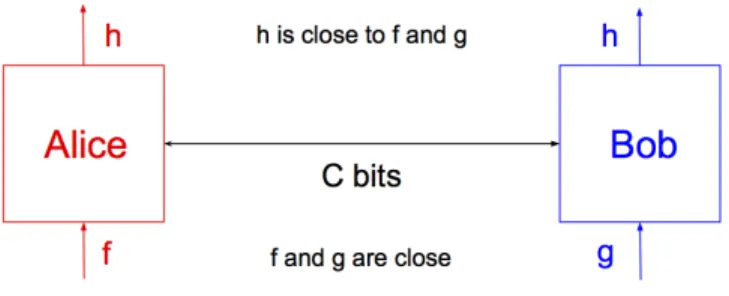
2-1 Common Randomness Generation. Here, 𝐾𝐴 denotes Alice’s output, 𝐾𝐵 denotes Bob’s output, and 𝐶 denotes then number of bits of communication. 24 3-1 Example Source Distribution for Which Many Samples Are Needed. . . 65
3-2 Non-Interactive Simulation of Joint Distributions [KA12, KA15] . . . 67
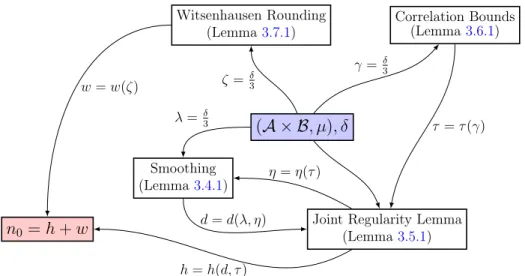
3-3 Dependency of Parameters in the Proof of Theorem 3.3.1 . . . 91
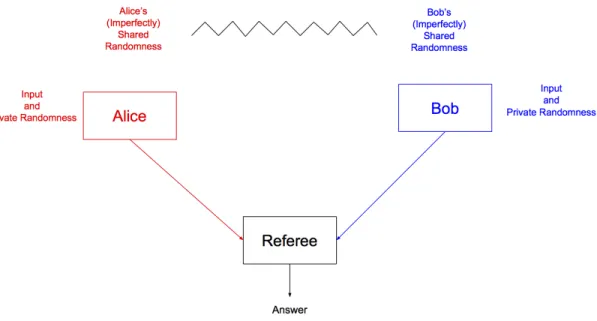
4-1 Simultaneous Message Passing Communication Model . . . 96
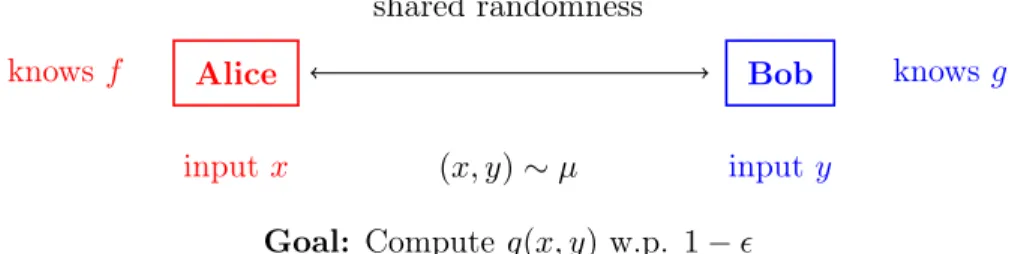
5-1 Communication with Functional Uncertainty . . . 105
5-2 Contextual Agreement Problem . . . 116
Chapter 1
Introduction: Uncertainty in
Communication
In many forms of communication, two or more agents interact with each other in order to achieve a certain goal such as transmitting and receiving information, computing a function of their input datasets or agreeing on an desirable object (such as a random ID or a secret key). A fundamental challenge in communication is raised by various forms of uncertainty, which can arise as noise in the inputs or in the exchanged messages, as mismatches in the shared randomness used by the distributed agents to speed up communication, or as ambiguity in the shared context or goal of the communication.
This thesis studies these diverse forms of uncertainty, building on work done on the topic in several disciplines, including information theory, computational complexity and distributed computing. In some cases, we answer open questions raised by previous work in the field; in other cases, we study novel generalized models of communication capturing forms of uncertainty that had eluded previous widely studied models.
Figure 1-1 illustrates the various components of uncertain communication that we elab-orate on in the next sections and study throughout this thesis.
While error correction is a classical paradigm for coping with the uncertainty introduced by a noisy channel, uncertainty can also occur in several other forms if the communicating players do not completely know (or understand) each other. We refer to this as contextual uncertainty. Specifically, in many forms of communication, the interacting parties share a context that is i) huge and ii) imperfectly shared. Examples of this phenomenon range from human communication where people with extremely different backgrounds and experiences are still able to communicate very efficiently, to the emerging area of “conversational artificial intelligence” which underlies intelligent virtual assistants, and to mathematical proofs that are not written in any formal system of logic but are yet considered correct. What makes such efficient forms of communication possible? How can we mathematically model uncertainty in context and approach such problems?
Figure 1-1: Uncertainty in Communication
1.1
Uncertainty in Shared Randomness
Randomness typically plays an important role in speeding up centralized algorithms as well as in decreasing the communication cost and time complexity of distributed protocols. Ideally, the different players in a distributed protocol would have joint access to an infinitely long string of random bits. Although it leads to significant speed-ups in numerous setups, such a perfect sharing of randomness might be practically infeasible. Realistically, it is more likely for the players to have access to weaker forms of correlation (such as correlated binary sequences or correlated Gaussian signals) than to random bits in perfect agreement. Can imperfect correlations be used to agree on a random id or on a secret key? Can they allow significant gains in communication as does perfectly shared randomness? We obtain several improvements on the state-of-the-art for these questions (answering some open problems from previous work) which we describe next in more detail.
1.1.1
Common Randomness & Secret Key Generation
In the setup of common randomness generation, two players are given independent identically distributed samples from a known distribution, and are required to agree on a given number of random bits while minimizing the communication and maximizing the agreement probability. This question has been studied in information theory, theoretical computer science and cryptography where it is equivalent to the secret key generation problem in which case the generated random sequence of bits has to be unknown to any eavesdropper (e.g., [AC93,
AC98]). This setup has several important applications. For instance, the generated random key can be used as shared randomness by distributed protocols, and the generated secret key can be used for encryption. This setting is in fact closely related to the identification capacity [AD89] and to hardware-based procedures for extracting a unique random ID from
process variations [LLG+05,SHO08,YLH+09] that can be used in authentication [LLG+05,
SD07].
Previous Work on Common Randomness & Secret Key Generation In informa-tion theory, common randomness and secret key generainforma-tion have been extensively studied in since the seminal work of Ahlswede and Csiszaŕ [AC93,AC98] who defined (an amortized ver-sion of) the setup and obtained several results on special cases of the problem. In particular, in the case of one-way communication, they characterized (amortized) common randomness generation for an arbitrary source of correlation in terms of its strong data processing con-stant, a beautiful mathematical measure that turns out to have important applications in information theory, and more recently in theoretical computer science.
Since the works of Ahlswede and Csiszaŕ, numerous follow-up works studied common randomness and secret key generation including the recent work of Liu, Cuff and Verdu [LCV15, LCV16] who in particular gave a characterization of 𝑟-round common randomness generation in terms of generalization of the strong data processing constant.
In theoretical computer science, Bogdanov and Mossel [BM11] studied common random-ness generation in the zero-communication case and when the source consists of 𝜌-correlated bits, and they gave a protocol with the optimal trade-off between agreement probability, the number of generated random bits and the correlation parameter 𝜌. Guruswami and Radhakr-ishnan [GR16] generalized the results of Bogdanov and Mossel to one-way communication, in which case they obtained the tight trade-off between communication, agreement proba-bility, number of generated random bits and 𝜌. While the protocols of [BM11] and [GR16] achieve the optimal trade-offs, they are non-explicit, sample-inefficient and computationally inefficient. Obtaining more efficient protocols is an open question that was explicitly asked by [BM11].
Our Results on Common Randomness & Secret Key Generation In the two-party zero-communication and one-way communication setups, we show in [GJ18] that certain explicit families of error-correcting codes (dual-BCH codes and their variants in Euclidean space) can be used to significantly improve the sample efficiency of common randomness generation, answering an open question of [BM11]. Specifically, we consider arguably the two most natural sources of correlation: 𝜌-correlated bits and 𝜌-correlated Gaussians. For each of these two sources, we give schemes for generating 𝑘 random bits using 𝑛 = poly(𝑘) samples and achieving the optimal dependence of agreement probability on 𝑘 and 𝜌 in the zero-communication case, and the optimal trade-off between communication and agreement probability in terms of 𝑘 and 𝜌 in the one-way communication case. We point out that while our schemes are explicit and sample-efficient, there are not computationally efficient. Obtaining computationally efficient schemes remains a fascinating open question.
We also reveal a surprising novel connection between interactive (amortized) common randomness generation and information complexity [CSWY01, BYJKS02, Bra15]. To de-scribe this connection, recall that the external information cost of a protocol is the amount of information it reveals about the inputs to an external observer, while its internal
informa-tion cost is the amount of informainforma-tion it reveals to each of the two players about the other player’s input. Surprisingly, we show for any source of correlation and for any number of rounds, the largest achievable ratio of generated entropy to communication is equal to the largest achievable ratio of external to internal information costs.
The full details can be found in Chapter 2.
1.1.2
Non-Interactive Simulation of Joint Distributions
A common assumption in the design of distributed algorithms is to allow the different parties access to a string of shared randomness in the form of independent random bits. However, many natural sources of correlation do not come in the form of bits that are perfectly (i.e., identically) shared by the different parties. Instead, the parties can often have access to correlated but non-identical random variables. Is it possible to convert one form of correlation to a more useful one? More generally, if Alice and Bob are given independent and identically distributed samples from a distribution 𝑃 , can they generate a sample from another distribution 𝑄 without interaction? This question – which dates back to classical work in information theory [GK73,Wyn75] and which has been studied by several subsequent works (see, e.g., [KA15] and the references within) – belongs to the class of problems on tensor powers on graphs [Alo02]. Understanding the computational aspects of such questions are notorious open problems: they are not known to be decidable while not even known to be NP-hard!
Our Result on Non-Interactive Simulation We prove [GKS16b] that the above non-interactive simulation problem is decidable for binary output alphabets. To do so, we signif-icantly leveraged recent developments in theoretical computer science, and in particular, the invariance principle from the analysis of Boolean functions [MOO05]. Our work allows differ-ent parties to convert very messy sources of correlation to a very structured one: correlated marginally-uniform random bits.
Future Developments In a follow-up work, De, Mossel and Neeman showed the decid-ability of the non-interactive simulation problem for arbitrary discrete output alphabets (in-cluding the particular case of computing the noise stability of a function) [DMN17,DMN18]. In a recent work (that is not included in this thesis) [GKR17], we give a dimension reduction for polynomials over the Gaussian space which we use to significantly improve the bound on the running time of the decidability procedure of [DMN17, DMN18] for non-interactive simulation (and for the particular case of computing the noise stability). Our dimension re-duction can be seen as a generalization of the Johnson-Lindenstrauss lemma (which has been extremely influential in computer science with numerous applications including unsupervised learning, compressed sensing, manifold learning, and graph embedding).
1.1.3
Communication with Imperfectly Shared Randomness
Communication complexity (first introduced by Yao [Yao79]) studies the amount of commu-nication needed by two or more parties in order to compute a joint function of their inputs. For many important functions, such as testing equality or closeness of two input datasets, there are well-known powerful protocols that are able to compute the function with very little communication assuming the players have access to perfectly shared randomness (i.e., identical sequences of random bits). What if the parties share the randomness imperfectly (i.e., they are given correlated random strings that are not necessarily equal)? The parties can choose to ignore their imperfectly shared randomness and only use their private random-ness; this however can lead to significant overhead in communication. The main question is whether the parties can use the imperfectly shared randomness in order to obtain much more efficient protocols.
Previous Work on Communication with Imperfectly Shared Randomness This setup was first independently studied by Bavarian, Gavinsky and Ito [BGI14] in the simul-taneous message passing model (where two players can each send a single message to a referee who should then output the answer), and by Canonne, Guruswami, Meka and Sudan [CGMS14] in the case of one-way and interactive communication. In both of these frame-works, Alice and Bob wish to compute a joint function of their inputs and have access to i.i.d samples from a known source. For the sake of exposition, we here consider the most natural source of correlation: correlated bits (although our result holds for more general sources).
In the one-way and interactive settings, [CGMS14] showed that any function having a two-way protocol using perfectly shared randomness and with communication 𝑘 bits, has a one-way protocol with imperfectly shared randomness and with communication at most 2𝑂(𝑘) bits. On the negative side, they showed the existence of a function for which the one-way communication with perfectly shared randomness is equal to 𝑘 bits whereas the two-way communication with imperfectly shared randomness is at least 2Ω(𝑘) bits.
In the simultaneous message passing setting, [BGI14] showed that there exists a function whose communication with perfectly shared randomness is equal to 𝑘 bits, but for which any protocol with imperfectly shared randomness has communication at least 2Ω(𝑘) bits.
Our Result on Communication with Imperfectly Shared Randomness The pre-vious work of [CGMS14] and [BGI14] left the following piece missing from the picture: does any function having a simultaneous message passing protocol with perfectly shared random-ness and communication 𝑘 bits, necessarily have a simultaneous message passing protocol with imperfectly shared randomness and communication 2𝑂(𝑘) bits? In [GJ18], we show that
this is indeed the case. Building on the approach of [CGMS14], our solution gives a sim-ple optimal protocol for estimating ℓ2-distances using imperfectly shared randomness in the
simultaneous message passing model.
1.2
Uncertainty in Goal of Communication
Functional Uncertainty One type of contextual uncertainty is the one pertaining to the goal of the communication. Namely, how can we capture the setup where two communicat-ing parties have somewhat similar views regardcommunicat-ing the goal of the communication without requiring these views to be perfectly aligned?
Quite often, the goal of the communication is to compute a function of the parties’ inputs. In this case, the uncertainty in the goal of the communication takes the form of functional uncertainty, which we study.
Our Results on Communication with Functional Uncertainty In [GKKS16], we suggest a framework for studying functional uncertainty by building on the model of com-munication complexity introduced by Yao [Yao79]. In this framework, Alice thinks that the goal of the communication is to compute function 𝑓 , Bob thinks that the goal is to compute function 𝑔, where 𝑓 and 𝑔 are close but not necessarily identical. The particular case where 𝑓 = 𝑔 corresponds to the widely studied communication complexity model. On the other hand, when 𝑓 ̸= 𝑔, Alice and Bob can choose to ignore part of their context by exchanging their entire inputs; this would allow Alice to compute 𝑓 and Bob to compute 𝑔 albeit with an enormous communication cost. The main question is therefore whether Alice and Bob can use their (imperfectly) shared context in order to solve the problem much more efficiently.
We answer this question by designing a (randomized) protocol that allows a sender and a receiver to overcome their uncertainty about the goal of the communication with a relatively small overhead (i.e., with a small blow-up in communication compared to the case where 𝑓 = 𝑔). In [GKKS16] and in a follow-up work [GS17], we study the power of public and private-coin protocols as well as protocols with imperfectly shared randomness, and we show how results from communication complexity and graph theory can be leveraged in order to better understand the randomness requirements of efficient protocols for communication with functional uncertainty.
The full details can be found in Chapter 5.
1.3
Uncertainty in Prior Distribution
1.3.1
Uncertain Distributed Compression
We now turn to a different type of contextual uncertainty, where the parties are unsure about the inputs’ prior distribution. In the special case where the players know the prior distribution, the problem is an instance of classical data compression where known solutions (such as Huffman codes) apply. On the other hand, when the players are uncertain about the prior distribution, they can choose to ignore any information they have about it and use a canonical encoding of the universe elements into bits (regardless of their probabilities); this trivial scheme would solve the problem but with huge communication. Thus, the main
question is whether one can use the players’ uncertain knowledge of the prior distribution in order to come up with much more efficient compression algorithms.
Our Results: Model and Protocol
Uncertain Distributed Compression: The Model Namely, we study the setup where 𝐾 players are trying to learn an unknown distribution based on individual samples and have to agree on a compression/decompression scheme that should compress this unknown distribution well despite disparities in their samples. In our model, a sequence of pairs of players from a set of 𝐾 players are chosen and tasked to communicate messages drawn from an unknown distribution 𝑄. The only knowledge that the players have about 𝑄 is from previously drawn samples. Since these samples differ from player to player, at any point of time different players will have different priors about the message distribution (and these priors are all likely to be different from the true distribution). The only common knowledge between the players is restricted to a common prior distribution 𝑃 (which can be quite far from the true distribution 𝑄) and some constant number of bits of information (such as a learning algorithm).
Classical solutions require all players to agree on the “same” approximation 𝑄′ to 𝑄 and then achieve an expected compression length of 𝐻(𝑄) + 𝐷(𝑄||𝑄′) bits, where 𝐷(·||·) denotes the KL-divergence between distributions. Players can settle for 𝑄′ = 𝑃 (so not learn at all) and achieve weak compression or try for something better by communicating a 𝑄′ that someone has learned. However, communicating any reasonably accurate distribution 𝑄′ leads to enormous communication.
Uncertain Distributed Compression: Efficient Protocol In [GHKS17], we present a novel decentralized solution with significantly better performance: We give a natural, uni-form and efficient algorithm that compresses the communication down to an average cost per message of 𝑂(𝐻(𝑄) + log(𝐷(𝑄||𝑃 )) bits in Θ(𝐾) iterations. Our algorithm builds on recent work on uncertain compression in the two-party setup by [JKKS11] and [HS14a].
The full details can be found in Chapter 6.
1.3.2
Correlated Sampling
Whenever two parties have knowledge of two distributions that are not necessarily equal (as in the compression setup described in the previous section), one basic question is for the parties to estimate the distance between these two distributions. One of the most widely used notion of distance between distributions is the total variation distance. Correlated Sampling is an algorithmic question that can be used to estimate the total variation distance between two distributions held by two parties.
Formally, a correlated sampling protocol is one where Alice is given a distribution 𝑃 , Bob is given a distribution 𝑄 over the same universe and their goal is to non-interactively
sample from their respective distributions while minimizing the disagreement probability. This very basic algorithmic procedure is used in several areas including sketching algorithms, approximation algorithms based on rounding linear programming relaxations, the study of parallel repetition and very recently cryptography. A well-known protocol – variants of which are due to Broder [Bro97], Kleinberg and Tardos [KT02], and Holenstein [Hol07] – solves this question while achieving disagreement probability at most 2𝛿/(1 + 𝛿) where 𝛿 is the total variation distance between 𝑃 and 𝑄. This protocol has been rediscovered numerous times across different communities.
Our Result on Correlated Sampling In [BGH+16], we give a surprisingly simple proof
that this protocol is in fact tight! Namely, we show that any protocol solving the correlated sampling problem on distributions at total variation distance 𝛿 cannot have disagreement probability smaller than 2𝛿/(1 + 𝛿).
The full details can be found in Chapter 7.
1.4
Thesis Roadmap
In Chapter 2, we give our results on common randomness generation. Our results on the non-interactive simulation of joint distributions appear in Chapter 3. Our result on corre-lated sampling are given in Chapter 7. Our protocol for communication with imperfectly shared randomness in the simultaneous message passing model is given in Chapter 4. The description of our communication with functional uncertainty model and our correspond-ing protocols and lower bounds appear in Chapter 5. Our results on uncertain distributed compression are given in Chapter 6. Finally, we conclude with some future directions in Chapter 8.
Chapter 2
Common Randomness and Secret Key
Generation
2.1
Introduction & Related Work
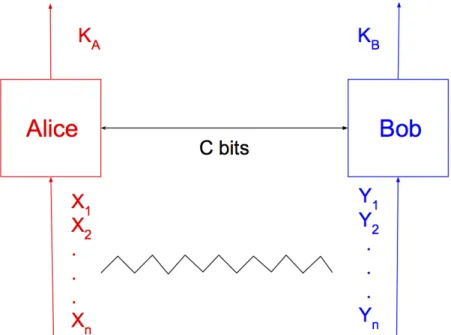
In this chapter, we present our results on common randomness and secret key generation. Common randomness plays a fundamental role in various problems within cryptography and information theory. We study this problem (depicted in Figure 2-1) in the basic two-party communication setting in which Alice and Bob wish to agree on a (random) key by drawing i.i.d. samples from a known source such as correlated bits or correlated Gaussians. If we further require that an eavesdropper, upon seeing the communication only, gains no information about the shared key, then this defines a secret key scheme. This information-theoretic approach to security was introduced in the seminal works of Mauer [Mau93] and Ahlswede and Csiszár [AC93]. Both common randomness and secret-key generation have been extensively studied in information theory [AC98, CN00, GK73, Wyn75, CN04, ZC11,
Tya13, LCV15, LCV16]. Common randomness has applications to identification capac-ity [AD89] and hardware-based procedures for extracting a unique random ID from process variations [LLG+05, SHO08, YLH+09] that can be used in authentication [LLG+05, SD07]. Randomness is a powerful tool as well in the algorithm designer’s arsenal. Shared keys (aka public randomness) are used crucially in the design of efficient communication protocols with immediate applications to diverse problems in streaming, sketching, data structures and property testing. Common randomness is thus a natural model for studying how shared keys can be generated in settings where it is not available directly [MO04,MOR+06,BM11,
CMN14, CGMS14, GR16]. In this chapter, we take the approach of treating correlated sources as a critical algorithmic resource, and ask whether common randomness can be generated efficiently.1
For −1 ≤ 𝜌 ≤ 1, we say that (𝑋, 𝑌 ) ∼ DSBS(𝜌) (doubly symmetric binary source with correlation parameter 𝜌) if 𝑋, 𝑌 are both uniform over {±1} and their correlation (and 1Notably, the schemes that we design can also be easily transformed into secret key schemes, as shown
Figure 2-1: Common Randomness Generation. Here, 𝐾𝐴denotes Alice’s output, 𝐾𝐵denotes
Bob’s output, and 𝐶 denotes then number of bits of communication.
covariance) is E[𝑋𝑌 ] = 𝜌 (i.e., a binary symmetric channel with uniform input). We say that (𝑋, 𝑌 ) ∼ BGS(𝜌) (bivariate Gaussian source with correlation parameter 𝜌) if 𝑋, 𝑌 ∼ 𝒩 (0, 1), the standard normal distribution, and their correlation is again equal to 𝜌.2
Bogdanov and Mossel [BM11] gave a common randomness scheme for DSBS(𝜌) with zero-communication to generate 𝑘-bit keys that agree with probability 2−1−𝜌1+𝜌·𝑘, up to lower order
inverse poly(𝑘, 1 − 𝜌) factors (which we suppress henceforth). Using the hypercontractive properties of the noise operator [Bon70, Bec75], they also proved the “converse” result, i.e., that this bound on the agreement (probability) is essentially the best possible. In a follow-up work, Guruswami and Radhakrishnan [GR16] recently gave a one-way scheme that achieves an optimal trade-off between communication and agreement probability. 3 Note that a
simple scheme in which Alice just sends her input requires 𝑘 − 𝑂𝜌(1) bits of communication
for constant agreement. In contrast, their scheme can guarantee the same agreement using only (1 − 𝜌2) · 𝑘 bits of communication. This is a non-trivial bound since for 𝜌 > 0, the ratio of entropy to communication (= 1/(1 − 𝜌2)) is strictly bounded away from 1 as 𝑘 → ∞. On
the other hand, the above schemes are non-explicit (they are proved using the probabilistic method) and use an exponential number of samples in 𝑘. Bogdanov and Mossel [BM11] asked whether an explicit and efficient scheme can be designed, motivating the definition below.
2Note that BGS(𝜌) is uniquely defined. To see this, note that any linear combination of 𝑋 and 𝑌 is also
Gaussian; thus, (𝑋, 𝑌 ) has a multivariate Gaussian distribution and is hence characterized by its first and second moments.
We say that a common randomness scheme to generate 𝑘-bit keys (with 𝑘 as input) is resource-efficient, if it (i) is explicitly4 defined, (ii) uses poly(𝑘) samples, (iii) has constant
agreement probability, and (iv) achieves an amortized ratio of entropy to communication bounded away from 1. We give the first efficient scheme for correlated bits and Gaussians, answering the question of [BM11]:
Theorem 2.1.1. There exist resource-efficient one-way common randomness schemes for DSBS(𝜌) and BGS(𝜌) using (1 − 𝜌2) · 𝑘 bits of communication. For zero-communication,
there exist explicit schemes for DSBS(𝜌) and BGS(𝜌) using poly(𝑘) samples with agreement probability 2−1−𝜌1+𝜌·𝑘, up to polynomial factors.
More generally, we obtain explicit one-way schemes with optimal trade-off between com-munication and agreement probability, matching [GR16], while using only poly(𝑘) samples. Below is the formal statement.
Theorem 2.1.2. Let 0 < 𝜌 < 1 and 0 ≤ 𝛿 ≤ √︁1−𝜌1+𝜌 be arbitrary. Set 𝜙 = 𝜌 + 𝛿√︀1 − 𝜌2.
Then, there exist explicit one-way common randomness schemes for DSBS(𝜌) and BGS(𝜌) using poly(𝑘) samples such that:
1. the entropy of the key is at least 𝑘 − 𝑜(𝑘);5
2. the agreement probability is at least 2−𝛿2𝑘, up to polynomial factors; and
3. the communication is 𝑂((1 − 𝜙2) · 𝑘) bits.
We point out that our schemes are resource efficient but computationally inefficient. One representative challenge that arises here is in decoding dual-BCH codes, which are an explicit algebraic family of error-correcting codes, from a very large number of errors.
The above schemes follow a template that generalizes the approach taken by [BM11,
GR16]. It relies on a carefully constructed codebook 𝒞 ⊆ R𝑛 of size 2𝑘, where 𝑛 is the
number of samples. Alice outputs the codeword in 𝒞 with the largest projection while Bob does the same on a subcode of 𝒞 based on Alice’s message. The analysis of the template reduces it to the problem of obtaining good tail bounds on the joint distribution induced by these projections. For BGS(𝜌), we use a codebook consisting of an explicitly defined large family of nearly-orthogonal vectors in R𝑛 due to Tao [Tao13], who showed their near-orthogonality property using the Weil bound for curves. The novel part of the analysis involves getting precise conditional probability tail bounds on trivariate Gaussians induced by the projections, whose covariance matrix has a special structure. Standard methods only give asymptotic bounds on such tails which are inadequate in the low-communication regime. Here, the best possible agreement is exponentially small in 𝑘. Our analysis determines the exact constant in the exponent by carefully evaluating the underlying triple integrals.
4By an explicit scheme, we mean that its existence is not proved using the probabilistic method, and that
the scheme can be constructed in time poly(𝑘, 𝑛) where 𝑘 is the number of generated common random bits and 𝑛 is the number of samples drawn from the source.
5We follow [GR16] who actually consider the min-entropy of Alice’s output, which is justifiable on
The resource-efficient scheme for DSBS(𝜌) is based on dual-BCH codes that can be seen as an F2-analogue of Tao’s construction. The Weil bound for curves implies that dual-BCH
codes are “unbiased”, in the sense that any two distinct codewords are at distance ≈ 𝑛/2 (with 𝑛 being the block length).6 Analogous to the Gaussian case, the analysis involves getting precise bounds on the (conditional) tail probabilities of various correlated binomial sums. Since 𝑛 = poly(𝑘), we cannot handle these binomial sums using the (two-dimensional) Berry-Esseen theorem, since the incurred additive error of 1/√𝑛 would overwhelm the target agreement probability. Moreover, crude concentration and anti-concentration bounds cannot be used since they do not determine the exact constant in the exponent. We directly handle these correlated binomial sums, which turns out to involve some tedious calculations related to the binary entropy function.
Interactive Common Randomness and Information Complexity. Ahlswede and Csiszár [AC93,AC98] studied common randomness in their seminal work using an amortized communication model. They defined it as the maximum achievable ratio 𝑎/𝑐, such that for every large enough number of samples 𝑛, Alice and Bob can agree on a key of 𝑎 · 𝑛 bits using 𝑐·𝑛 bits of communication, where the agreement probability tends to 1 (as 𝑛 tends to infinity). This more stringent linear relationship between the quantities is not obeyed by our explicit schemes. For one-way communication, they characterized this ratio in terms of the Strong Data Processing Constant of the source, which is intimately related to its hypercontractive properties [AG76, AGKN13]. More recently, Liu, Cuff and Verdu [LCV15, LCV16, Liu16] extended this beyond one-way communication. In particular, [Liu16] derives the “rate region” for 𝑟-round amortized common randomness.
In this chapter, we show that 𝑟-round amortized common randomness can be alterna-tively characterized in terms of two well-studied notions in theoretical computer science: the internal and external information costs of communication protocols. Recall that the internal information cost [BJKS04, BBCR13] of a two-party randomized communication protocol is the total amount of information that each of the two players learns about the other player’s input, whereas its external information cost [CSWY01] is the amount of information that an external observer learns about the inputs (see section2.5for formal definitions). These mea-sures have been extensively studied within the context of communication complexity. While being interesting measures in their own rights, they have also been the central tool in tack-ling direct-sum problems, with numerous applications, e.g., in data streams and distributed computation.
Theorem 2.1.3 (Informal Statement). Given an arbitrary distribution 𝜇, let Γ𝑟 denote the
supremum over all 𝑟-round randomized communication protocols 𝑃 of the ratio of the external information cost to the internal information cost of 𝑃 with respect to 𝜇. Then, for 𝑟-round amortized common randomness, Γ𝑟 equals the largest achievable ratio 𝐻/𝑅 such that using
𝜇 as the source, for every large enough 𝑛, Alice and Bob can agree on a key of 𝐻 · 𝑛 − 𝑂(1) bits with probability 1 − 𝑜𝑛(1) using 𝑟 rounds and 𝑅 · 𝑛 + 𝑂(1) bits of communication.
For the proof, we use a direct-sum approach, a classical staple of information complexity arguments. Our setup is slightly different from the known direct-sum results because we need to lower bound the internal information cost of the 𝑛-input protocol as well as upper bound its external information cost (which is non-standard) simultaneously. The essential ingredient is the same: embed the input on a judiciously chosen coordinate, but the argument works on a round-by-round basis so as to keep the mutual information expressions intact. To prove the other direction, we use the rate region of [LCV16, Liu16] to get a lower bound on Γ𝑟.
We now outline our results in various settings where common randomness plays an im-portant role.
Secret Key Generation: While secret key generation requires common randomness, in the amortized setting they are known to imply each other [LCV16, Liu16]: the rate pair (𝐻, 𝑅), using the notation of theorem 2.1.3, is achievable for common randomness if and only if (𝐻 − 𝑅, 𝑅) is achievable for secret key generation. In particular, using the Strong Data Processing Constant for DSBS(𝜌), the rate ratio 𝐻/𝑅 = 1/(1 − 𝜌2) is achievable for
common randomness and the rate ratio 𝜌2/(1 − 𝜌2) for secret key generation, but using
non-explicit schemes. Our resource-efficient but non-amortized schemes given in theorem 2.1.1
can be easily transformed into secret key schemes. See remark 2.3.2.
General Sources: Theorem 2.1.2 also implies an explicit scheme for an arbitrary source 𝜇 in terms of its maximal correlation 𝜌(𝜇) [Hir35, Geb41, Rén59]. For (𝑋, 𝑌 ) ∼ 𝜇, recall that 𝜌(𝜇) := sup E𝐹 (𝑋)𝐺(𝑌 ) over all real-valued functions 𝐹 and 𝐺 with E𝐹 (𝑋) = E𝐺(𝑌 ) = 0 and Var 𝐹 (𝑋) = Var 𝐺(𝑌 ) = 1. This uses the idea (implicit in [Wit75]) that given i.i.d. samples from any source of maximal correlation 𝜌, there is an explicit strategy (using the bivariate Central Limit Theorem) that allows Alice and Bob to use these samples in order to generate standard 𝜌-correlated Gaussians. The resulting scheme however is not resource-efficient.
Correlated Randomness Generation: In this relaxation proposed by [CGMS14], Alice and Bob are given access to DSBS(𝜌) and wish to generate 𝑘 bits that are jointly distributed i.i.d. according to DSBS(𝜌′) where 𝜌′ > 𝜌. Note that the 𝜌′ = 1 corresponds to the the common randomness setup studied above. We partially answer a question of [CGMS14] by showing that even a modest improvement in the correlation requires substantial communi-cation. Let 𝜖′log(1/𝜖′) ≪ 𝜖 < 1
2 be fixed. We show that for Alice and Bob to produce 𝑘
samples according to DSBS(1 − 2𝜖′) using DSBS(1 − 2𝜖) as the source requires Ω(𝜖 · 𝑘) bits of communication (even for interactive protocols and even when the agreement probability is as small as 2−𝑜(𝑘)). See section 2.8 for a detailed description.
Locality Sensitive Hashing (LSH): A surprising “universality” feature of our schemes (as well as previous ones) for DSBS(𝜌) and BGS(𝜌) using zero communication is that their definition is oblivious to 𝜌; only the analysis for every fixed 𝜌 shows that they have near-optimal agreement. This has a close resemblance to schemes used in LSH. Indeed, we show that our common randomness scheme leads to an improvement in the “ ¯𝜌-parameter” [IM98]
that governs one aspect of the performance of an LSH scheme. While this is mathematically interesting, we caution the reader that this does not lead to better nearest-neighbor data structures since the improvement is only qualitatively better and our scheme is computa-tionally inefficient. See section 2.9 for more details. As discussed in that section and in Section 2.11, there seem to be a strong intuitive connection between common-randomness generation and LHS, and a very interesting question is whether one can formalize this con-nection.
Organization. Section2.2 describes the template used for the one-way schemes and sets up the structure of the analysis. Section 2.3 and Section 2.4 describe the schemes for BGS(𝜌) and DSBS(𝜌) and their analysis. In Section 2.5, we show the connection between amortized common randomness and information complexity. In Section 2.6, we derive some properties of bivariate Gaussians that are used in Section 2.3. In Section 2.7, we derive some bounds on correlated binomial sums that are used in Section 2.4. In Section 2.8, we present our results on correlated randomness generation. In Section 2.9, we elaborate more on the intuitive connection between common randomness generation and locality sensitive hashing. In Section 2.10, we prove the min-entropy lower bounds for the schemes presented in Section 2.3 and Section2.4. In Section2.11, we conclude with some very intriguing open questions.
2.1.1
Preliminaries
Notation. For a tuple 𝑈 = (𝑈1, 𝑈2, . . . , 𝑈𝑛), let 𝑈𝑖𝑗 := (𝑈𝑖, 𝑈𝑖+1, . . . , 𝑈𝑗), when 1 ≤ 𝑖 ≤ 𝑗 ≤
𝑛, and empty otherwise; we may drop the subscript when 𝑖 = 1. For a distribution 𝜇, let 𝜇⊗𝑛 be obtained by taking i.i.d. samples (𝑋1, 𝑌1), . . . , (𝑋𝑛, 𝑌𝑛) from 𝜇. Abusing notation, we
say that (𝑋𝑛, 𝑌𝑛) ∼ 𝜇⊗𝑛. Let ⟨, ⟩ denote the standard inner product and let || · || denote the
Euclidean norm over R. For any positive integer 𝑛, let [𝑛] := {1, . . . , 𝑛}. Let 𝑎 . 𝑏 denote 𝑎 ≤ 𝐶𝑏 for some positive global constant 𝐶.
Bivariate Gaussians. Let (𝑋, 𝑌 ) ∼ BGS(𝜌). Let 𝑄(𝑡) := Pr[𝑋 > 𝑡] denote the Gaussian tail probability and 𝐿(𝑡, 𝜙; 𝜌) := Pr[︀𝑋 > 𝑡, 𝑌 > 𝜙𝑡] denote the (asymmetric) orthant prob-ability. In section 2.6, we prove the following proposition, which also uses some seemingly new properties of 𝑄(𝑡).
Proposition 2.1.4. Let 𝑡, 𝛿 ≥ 0. Set 𝜙 := 𝜌 + 𝛿√︀1 − 𝜌2 and 𝜆 0 := √︁ 2 𝜋. Then: (𝑎) 𝑒 −𝑡2/2 𝑡 + 𝜆0 . 𝑄(𝑡) . 𝑒−𝑡2/2 𝑡 + 1/𝜆0 ≤ 𝑒−𝑡2/2; (𝑏) 𝑄(𝑡) 𝛿2 𝛿𝑡 + 𝜆0 . 𝑄(𝛿𝑡) . 𝑄(𝑡) 𝛿2(𝑡 + 𝜆 0)𝑐 2 ; (𝑐) 𝐿(𝑡, 𝜙; 𝜌) ≥ 𝑄(𝑡)𝑄(𝛿𝑡); and (𝑑) 𝑄(𝑡) ≤ 𝑄(𝛿𝑡) ≤ 𝑄(𝑡)𝛿2, if 𝛿 ≤ 1 Proposition 2.1.5 (Elliptical symmetry). Let (𝑋, 𝑌 ) ∼ BGS(𝜌)⊗𝑛 and 𝑣, 𝑤 ∈ R𝑛 have unit
2.2
Template One-Way Scheme and its Analysis
The one-way schemes (including zero-communication as a special case) have the following template. Let 𝜇 denote the source on R × R. Alice and Bob will generate 𝑛 i.i.d. samples from 𝜇 and use them to output 𝑘-bit keys. This is achieved by the players using a special codebook 𝒞 of 2𝑘 points in R𝑛 where each codeword 𝑣 ∈ 𝒞 corresponds to a 𝑘-bit message
𝐷(𝑣), where 𝐷 : 𝒞 → {0, 1}𝑘. For 𝑐 ≥ 1, the players also agree on a coloring 𝜒 of 𝒞 using 2𝑐 colors such that each color class has size at most |𝒞| · 2−𝑐+ 1. In addition, let ◇ denote
an auxiliary color. Thus, each color can be specified using 𝑐 + 1 bits. For the special case of zero communication, we assume without loss of generality that all codewords are colored ◇ and we set 𝑐 = 0.
Let 𝑡 and 𝑠 be parameters that govern the achievable min-entropy and agreement prob-ability. Let 𝜅𝐴 and 𝜅𝐵 be any explicit mappings such that 𝜅𝐴(𝑋) and 𝜅𝐵(𝑌 ) are each
uniformly distributed over {0, 1}𝑘.
Protocol 1 One-way scheme for source 𝜇
CR(𝑘, 𝜇)(𝑘, 𝜇)(𝑘, 𝜇): (Goal is to generate 𝑘-bit common random key using source 𝜇.) 1. Let (𝑋, 𝑌 ) ∼ 𝜇⊗𝑛. (Alice gets 𝑋 and Bob gets 𝑌 .)
2. If ∃ unique 𝑣 ∈ 𝒞 such that ⟨𝑣, 𝑋⟩ > 𝑡, Alice outputs 𝐷(𝑣) and sends 𝜒(𝑣). Else, Alice outputs 𝜅𝐴(𝑋) and sends ◇.
3. Bob receives the color 𝜏 .
4. If ∃ unique 𝑤 ∈ 𝒞 such that 𝜒(𝑤) = 𝜏 and ⟨𝑤, 𝑌 ⟩ > 𝑠, then Bob outputs 𝐷(𝑤). Else, Bob outputs 𝜅𝐵(𝑌 ).
The pseudocode is given in Protocol 1. For the analysis, define the following quantities: 1. Univariate tail: 𝒰 := max
𝑣∈𝒞 Pr[⟨𝑣, 𝑋⟩ > 𝑡]; 2. Bivariate tail: ℬ := min𝑣∈𝒞 Pr[⟨𝑣, 𝑋⟩ >
𝑡, ⟨𝑣, 𝑌 ⟩ > 𝑠]
3. Conditional trivariate tails: (a) 𝒯𝐴 := max
𝑣̸=𝑤∈𝒞Pr[⟨𝑤, 𝑋⟩ > 𝑡 | ⟨𝑣, 𝑋⟩ > 𝑡, ⟨𝑣, 𝑌 ⟩ > 𝑠] and (b) 𝒯𝐵 := max𝑣̸=𝑤∈𝒞Pr[⟨𝑤, 𝑌 ⟩ > 𝑠 |
⟨𝑣, 𝑋⟩ > 𝑡, ⟨𝑣, 𝑌 ⟩ > 𝑠]
Theorem 2.2.1. The min-entropy of the basic scheme is at least − log(𝒰 + 2−𝑘). Assume that |𝒞| · 𝒯𝐴≤ 14 and |𝒞| · 𝒯𝐵≤ 14 · 2𝑐. Then, the probability of agreement is at least 12|𝒞| · ℬ.
Proof. If Alice outputs 𝑎 ∈ {0, 1}𝑘then either there exists a unique 𝑣 ∈ 𝒞 such that 𝐷(𝑣) = 𝑎
and ⟨𝑣, 𝑋⟩ > 𝑡, which happens with probability at most Pr[⟨𝑣, 𝑋⟩ > 𝑡] ≤ 𝒰 , or 𝜅𝐴(𝑋) = 𝑎,
which happens with probability 2−𝑘. The min-entropy guarantee follows.
For the agreement, fix 𝑣 ∈ 𝒞. Define the event 𝐸𝑣 := 𝐴𝑣∧ 𝐵𝑣∧ 𝐶𝑣 where 𝐴𝑣 := {⟨𝑣, 𝑋⟩ >
Note that the event 𝐸𝑣 ensures that both players output 𝐷(𝑣). By the union bound: Pr[𝐸𝑣] ≥ Pr[𝐴𝑣] ·(︀1 − Pr[𝐵𝑣∨ 𝐶𝑣 | 𝐴𝑣] )︀ ≥ Pr[𝐴𝑣] · (︁ 1 −∑︁ 𝑤̸=𝑣 Pr[⟨𝑤, 𝑋⟩ > 𝑡 | 𝐴𝑣] − ∑︁ 𝑤̸=𝑣 1{𝜒(𝑤) = 𝜒(𝑣)} · Pr[⟨𝑤, 𝑌 ⟩ > 𝑠 | 𝐴𝑣] )︁ ≥ ℬ(︀1 − |𝒞| · 𝒯𝐴− |𝒞| · 2−𝑐· 𝒯𝐵 )︀ ≥ 1 2ℬ,
where the last two inequalities follow from the definition of ℬ and 𝒯 and then invoking the premise of the lemma. Thus, the agreement probability is at least∑︀
𝑣Pr[𝐸𝑣] ≥ 12|𝒞| · ℬ.
As an illustration, we present an explicit one-way scheme for the BGS(𝜌) using an expo-nential number of samples. Let 𝑘 be a large enough constant and let 𝑛 = 2𝑘. Let 𝒞 consist
of the 𝑛 standard basis vectors {︀𝑒𝑖 : 𝑖 ∈ [𝑛]}︀ in R𝑛. Choose 𝑡 > 0 so that the Gaussian tail
probability 𝑄(𝑡) = 14 · 2−𝑘. Let 𝜌 ≤ 𝜙 ≤ 1 be arbitrary and set 𝑠 = 𝜙𝑡. (Choose 𝜙 = 1 for
zero communication.)
For the analysis, note that for each 𝑖, we have ⟨𝑒𝑖, 𝑋⟩ = 𝑋𝑖 and ⟨𝑒𝑖, 𝑌 ⟩ = 𝑌𝑖. Therefore,
Pr[𝑋𝑖 > 𝑡] = 𝑄(𝑡) and so by Theorem 2.2.1, the min-entropy of Alice’s output is at least
− log(𝑄(𝑡) + 2−𝑘) ≥ 𝑘 − 1.
We now analyze the agreement probability. To bound the bivariate tail, first by Proposi-tion 2.1.4(a), we have 𝑡 = Θ(√𝑘). Let 𝛿 satisfy 𝜙 = 𝜌 + 𝛿√︀1 − 𝜌2. Observe that 0 ≤ 𝛿 ≤ 1.
Applying Proposition 2.1.4(b,c), we obtain:
ℬ = min 𝑖∈[𝑛]Pr[𝑋𝑖 > 𝑡, 𝑌𝑖 > 𝜙𝑡] = 𝐿(𝑡, 𝜙; 𝜌) & 𝑄(𝑡)1+𝛿2 𝛿𝑡 + Θ(1) & 𝑄(𝑡)1+𝛿2 𝛿√𝑘 + Θ(1) (2.1) For 𝑖 ̸= 𝑗, the trivariate tail probability Pr[𝑋𝑗 > 𝑡 | 𝑋𝑖 > 𝑡, 𝑌𝑖 > 𝜙𝑡] = Pr[𝑋𝑗 > 𝑡] = 𝑄(𝑡),
by independence of components of (𝑋, 𝑌 ). Similarly, Pr[𝑌𝑗 > 𝜙𝑡 | 𝑋𝑖 > 𝑡, 𝑌𝑖 > 𝜙𝑡] = 𝑄(𝜙𝑡).
Therefore: 𝒯𝐴≤ 𝑄(𝑡) and 𝒯𝐵≤ 𝑄(𝜙𝑡). (2.2) Now 𝑄(𝑡) = 14 · 2−𝑘, so |𝒞| · 𝒯 𝐴 ≤ 14. Next, 𝑄(𝜙𝑡) ≤ 𝑄(𝑡)𝜙 2 , using Proposition 2.1.4(d). Therefore, 𝒯𝐵 ≤ 𝑄(𝑡)𝜙 2
. If we choose 𝑐 ≥ (1 − 𝜙2)(𝑘 + 2), then it can be verified that
|𝒞| · 𝒯𝐵 ≤ 14 · 2𝑐. This ensures that the conditions of Theorem 2.2.1 for agreement are
satisfied.
By Theorem 2.2.1, the agreement probability is 12|𝒞| · ℬ & 2−𝛿2𝑘/(𝛿√𝑘 + Θ(1)) and the scheme uses 𝑂((1 − 𝜙2)𝑘) bits of communication. In particular, set 𝜙 = 𝜌 and 𝛿 = 0;
we obtain an explicit one-way scheme with constant probability and 𝑂((1 − 𝜌2)𝑘) bits of
2.3
Efficient Scheme for
BGS(𝜌)
In this section, we give a resource-efficient one-way scheme for BGS(𝜌) with the optimal communication of (1−𝜌2)𝑘 bits. More generally, the tradeoff between the communication and
agreement probability is similar to the one achieved by the scheme presented in Section 2.2. The analysis of the template given previously suggests the following scheme to reduce the sample complexity to 𝑛 = poly(𝑘): use a codebook such that the projections are only 3-wise independent. Unfortunately, this does not work since a multivariate Gaussian distribution is completely characterized by its first and second moments, so even pairwise independence would imply full independence! Instead, we use a codebook consisting of the following explicitly defined large family of nearly-orthogonal vectors in R𝑛 due to Tao [Tao13], who
showed their near-orthogonality property using the Weil bound for curves.
Let 𝑝 be a prime number and 𝑛 = 2 · 𝑝. We identify R𝑛 with the complex vector space 𝒱 of functions from F𝑝 to C, where C denotes the complex plane. Thus, 𝑣 ∈ 𝒱 will also
denote an element of R𝑛. With this identification, we have ⟨𝑣, 𝑤⟩ = Re(︀∑︀𝑥∈F
𝑝𝑣(𝑥)𝑤(𝑥)
)︀
for 𝑣, 𝑤 ∈ 𝒱.
Let 𝑑 be a positive integer. Let 𝜔 := 𝑒2𝜋𝑖/𝑝 denote the 𝑝-th root of unity. For every
𝑎 ∈ F𝑑
𝑝, let 𝑣𝑎 ∈ 𝒱 be defined as 𝑣𝑎(𝑥) = √1𝑝 · 𝜔𝑎𝑑𝑥
𝑑+···+𝑎
1𝑥. We set 𝒞 := {𝑣
𝑎: 𝑎 ∈ F𝑑𝑝}. Note
that all the elements of 𝒞 have unit norm. The Weil bound for curves then implies that for every 𝑎 ̸= 𝑏 ∈ F𝑑𝑝, we have that |⟨𝑣𝑎, 𝑣𝑏⟩| ≤ (𝑑 − 1)/
√
𝑝 [Wei48] (for a recent exposition see [KL11]).
Choose 𝑑 = 𝑜(𝑛1/4/√log 𝑛) and 𝑘 = 𝑑 · log(𝑛/2) in Tao’s construction. We use the same
parameters 𝑡, 𝑠, 𝜙 and 𝛿 for Protocol1 as in the previous scheme described in Section 2.2. By elliptical symmetry (Proposition 2.1.5), (⟨𝑣, 𝑋⟩, ⟨𝑣, 𝑌 ⟩) ∼ BGS(𝜌), for every 𝑣 ∈ 𝒞. Therefore, the bounds in Section2.2for the univariate and bivariate tails (see Equation (2.1)) also hold here. The key difference is in the analysis of the trivariate probabilities because we no longer have independence amongst the various pairs (⟨𝑣, 𝑋⟩, ⟨𝑣, 𝑌 ⟩). This requires a new analysis of the conditional tails involving trivariate Gaussians whose covariances have a special structure. Below, we show that a slightly weaker bound than Equation (2.2): 𝒯𝐴 ≤ 𝑄(𝑡) · (1 + 𝑜𝑛(1)) and 𝒯𝐵 ≤ 𝑄(𝜙𝑡) · (1 + 𝑜𝑛(1)). Nevertheless, we can apply the same
argument following Equation (2.2) in Section2.2(along with the min-entropy lower bound in Section2.10.2) to get that: (a) the min-entropy at least 𝑘 − 1; (b) the agreement probability is & 2−𝛿2𝑘/(𝛿√𝑘 + Θ(1)); and (c) the communication is 𝑂((1 − 𝜙2)𝑘) bits. In particular,
with 𝜙 = 𝜌 and 𝛿 = 0; we obtain the main result of this section, namely a resource-efficient one-way scheme using 𝑂((1 − 𝜌2) · 𝑘) bits of communication.
It remains to prove that 𝒯𝐴≤ 𝑄(𝑡)·(1+𝑜𝑛(1)) and 𝒯𝐵 ≤ 𝑄(𝜙𝑡)·(1+𝑜𝑛(1)). Fix 𝑣 ̸= 𝑤 ∈ 𝒞.
The construction ensures that |⟨𝑣, 𝑤⟩| ≤ 𝜃 with 𝜃 = (𝑑 − 1)/√𝑝 = 𝑂(𝑘/(√𝑛 · log 𝑛)). For 𝑘 = 𝑜(𝑛1/4·√log 𝑛), we have 𝜃 = 𝑜
𝑛(1).
Now observe that (⟨𝑤, 𝑋⟩, ⟨𝑣, 𝑋⟩, ⟨𝑣, 𝑌 ⟩) can be written as a linear transform on (𝑋, 𝑌 ), so jointly they have the trivariate Gaussian distribution. Thus, their joint distribution is fully given by the first two moments. By stability, the marginals are standard normal and by elliptical symmetry, the covariances can be calculated as (i) E[(⟨𝑤, 𝑋⟩)(⟨𝑣, 𝑋⟩)] = ⟨𝑤, 𝑣⟩ ≤ 𝜃,
(ii) E[(⟨𝑣, 𝑋⟩)(⟨𝑣, 𝑌 ⟩)] = 𝜌, and (iii) E[(⟨𝑤, 𝑋⟩)(⟨𝑣, 𝑌 ⟩)] = 𝜌(⟨𝑤, 𝑣⟩) ≤ 𝜌𝜃. Observe that (⟨𝑤, 𝑌 ⟩, ⟨𝑣, 𝑌 ⟩, ⟨𝑣, 𝑋⟩) is also trivariate with an identical mean and covariance matrix. Lemma 2.3.1. Let (𝑈, 𝑉, 𝑊 ) be a trivariate Gaussian with standard normal marginals and covariances E[𝑈 𝑉 ] = 𝜎, E[𝑉 𝑊 ] = 𝜌, and E[𝑈 𝑊 ] = 𝜎𝜌. Let 𝑟, 𝑟′ ≥ 0. Then, for all 𝑏 ≥ 1:
Pr[𝑈 > 𝑟 | 𝑉 > 𝑟, 𝑊 > 𝑟′] ≤ 𝑄 (︂ 1 − 𝑏𝜎 √ 1 − 𝜎2𝑟 )︂ + 𝑄(𝑏𝑟) Pr[𝑉 > 𝑟, 𝑊 > 𝑟′]. Proof. We have: Pr[𝑈 > 𝑟 | 𝑉 > 𝑟, 𝑊 > 𝑟′] = Pr[𝑈 > 𝑟, 𝑉 > 𝑟, 𝑊 > 𝑟 ′] Pr[𝑉 > 𝑟, 𝑊 > 𝑟′] . (2.3)
For the numerator, we split the range of 𝑉 into two intervals:
Pr[𝑈 > 𝑟, 𝑉 > 𝑟, 𝑊 > 𝑟′] = Pr[𝑈 > 𝑟, 𝑟 < 𝑉 ≤ 𝑏𝑟, 𝑊 > 𝑟′] + Pr[𝑈 > 𝑟, 𝑉 > 𝑏𝑟, 𝑊 > 𝑟′] The second term is at most Pr[𝑉 > 𝑏𝑟] = 𝑄(𝑏𝑟). For the first term, note that the covariance structure implies that 𝑈 and 𝑊 are independent conditioned on 𝑉 , so we can write 𝑈 = 𝜎𝑉 +√1 − 𝜎2𝑍. where 𝑍 ∼ 𝒩 (0, 1) is independent of (𝑉, 𝑊 ). The event {𝑈 > 𝑟} can be
rewritten as {︀𝑍 > √𝑟−𝜎𝑉
1−𝜎2}︀ which under the assumption {𝑉 ≤ 𝑏𝑟} implies that {𝑍 > 𝑎𝑟}
where 𝑎 := √1−𝑏𝜎
1−𝜎2. By independence:
Pr[𝑈 > 𝑟, 𝑟 < 𝑉 ≤ 𝑏𝑟, 𝑊 > 𝑟′] ≤ Pr[𝑍 > 𝑎𝑟] Pr[𝑟 < 𝑉 ≤ 𝑏𝑟, 𝑊 > 𝑟′] ≤ 𝑄(𝑎𝑟) Pr[𝑉 > 𝑟, 𝑊 > 𝑟′] . Substituting these bounds in Equation (2.3) finishes the proof.
Apply Lemma 2.3.1 to the triples (⟨𝑤, 𝑋⟩, ⟨𝑣, 𝑋⟩, ⟨𝑣, 𝑌 ⟩) with 𝑟 := 𝑡, 𝑟′ := 𝜙𝑡 and (⟨𝑤, 𝑌 ⟩, ⟨𝑣, 𝑌 ⟩, ⟨𝑣, 𝑋⟩) with 𝑟 := 𝜙𝑡, 𝑟′ := 𝑡. In both cases, 𝜎 := ⟨𝑣, 𝑤⟩ ≤ 𝜃. Since 𝑄(·) is decreasing: Pr[⟨𝑤, 𝑋⟩ > 𝑡 | ⟨𝑣, 𝑋⟩ > 𝑡, ⟨𝑣, 𝑌 ⟩ > 𝜙𝑡] ≤ 𝑄 (︂ 1 − 𝑏𝜃 √ 1 − 𝜃2𝑡 )︂ + 𝑄(𝑏𝑡) 𝐿(𝑡, 𝜙; 𝜌), ∀𝑏 ≥ 1. (2.4) Pr[⟨𝑤, 𝑌 ⟩ > 𝜙𝑡 | ⟨𝑣, 𝑌 ⟩ > 𝜙𝑡, ⟨𝑣, 𝑋⟩ > 𝑡] ≤ 𝑄 (︂ 1 − 𝑏𝜃 √ 1 − 𝜃2𝜙𝑡 )︂ + 𝑄(𝑏𝜙𝑡) 𝐿(𝑡, 𝜙; 𝜌), ∀𝑏 ≥ 1. (2.5) Set 𝑏 := 2/𝜑. By Proposition 2.1.4(a), 𝑄(𝑏𝜙𝑡) . 𝑒−𝑏2𝜙2𝑡2/2
= 𝑒−2𝑡2 and 𝑄(𝑡) & 𝑒−𝑡2/2/(𝑡 +
𝜆0). Because 𝑡 = Θ(
√
𝑘), for large enough 𝑘, we have 𝑄(𝑏𝜙𝑡) . 𝑄(𝑡)3𝑒−𝑡2/2(𝑡 + 𝜆0)3 =
𝑄(𝑡)3𝑜 𝑛(1).
Using this bound and Proposition 2.1.4(c,d), we obtain:
𝑄(𝑏𝑡) ≤ 𝑄(𝑏𝜙𝑡) ≤ 𝑄(𝑡)3· 𝑜𝑛(1) ≤ 𝐿(𝑡, 𝜙; 𝜌)𝑄(𝑡) · 𝑜𝑛(1) ≤ 𝐿(𝑡, 𝜙; 𝜌)𝑄(𝜙𝑡) · 𝑜𝑛(1)

![Figure 3-2: Non-Interactive Simulation of Joint Distributions [KA12, KA15]](https://thumb-eu.123doks.com/thumbv2/123doknet/14433265.515564/67.918.198.656.102.457/figure-non-interactive-simulation-joint-distributions-ka-ka.webp)