II
THE CRYSTAL STRUCTURE OF DARAPSKITE
by
Martha Jane Redden
SB*, Massachusetts Institute of Technology (1967)
SUBMITTED IN PARTIAL FULFILLMENT'OF THE REQUIREMENTS FOR THE DEGREE OF
MASTER OF SCIENCE at the
MASSACHUSETTS INSTITUTE OF TECHNOLOGY
June, 1968
Signature of Author
Certified by
Accepted by
Department of Geology and Geophysics May 17, 1968
Thesis Supervisor
Chairman, Departmental Commite on Graduate Students
Lindgren
THE CRYSTAL STRUCTURE OF DARAPSKITE
Martha. J. Redden
Submitted to the Department of Geology and Geo-physics on May 17, 1968, in partial fulfillment of the requirements
for the degree of Master of Science
Abstract
The space group of darapskite was determined to be P2,/m, with the cell constants a, = 10.56 A, b = 6.92A
C = 5.19 A, and
(3
= 102.80 (monoclinic, 2nd setting). Each cell contains 2-(Na NO3S04*4O).Integrated-intensity measurements were taken using a single-crystal diffractometer with Ni-filtered CuKa radiation. These data-were corrected for absorption and-Lorentz-polarization, and the resultant Fhk values were used to compute a three-dimensional -- atterson synthesis. The sulfur inversion peak on the Harker section was identified using a superposition method and further confirmed by its occurrence with satellite peaks. Based on sulfur as a heavy atom, images in the Patterson
synthesis revealed the locations of all other atoms except
H 0. A Fourier synthesis, computed with the known
infor-mation, indicated the location of the H20 molecule. The structure so determined was refined by the method of least-squares to R = 8.8%.
The structure of darapskite is essentially an arrangement of atoms on two symmetry planes which are related to each other by the operation of a 21 screw axis. Located in the interstices between the planes and linking
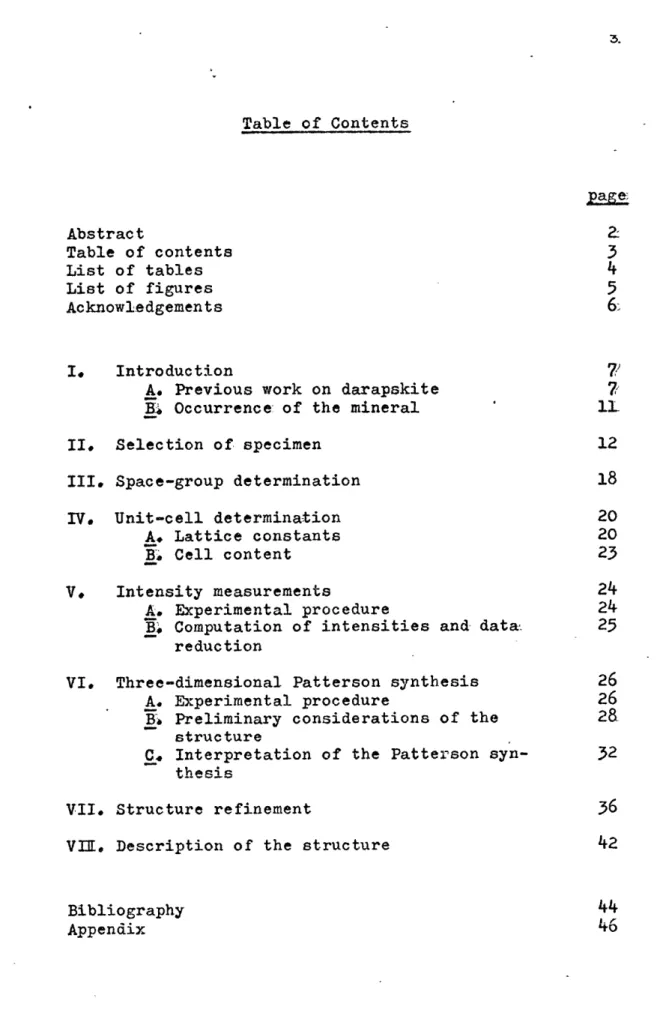
Table of Contents
page,
Abstract
2-Table of contents
3
List of tables
4
List of figures5
Acknowledgements
6
I.
Introduction
7
A. Previous work on darapskite 7
I Occurrence: of the mineral 11
II. Selection of specimen 12
III. Space-group determination 18
IV. Unit-cell determination 20
A. Lattice constants 20
B. Cell content 23
V. Intensity measurements 24
A. Experimental procedure 24
_.R Computation of intensities and data 25 reduction
VI. Three-dimensional Patterson synthesis 26
A. Experimental procedure 26
Ba Preliminary considerations of the 2& structure
C. Interpretation of the Patterson syn-
32
VII. Structure refinement
36
VI. Description of the structure 42
Bibliography 44
List of Tables
page Table 1 Chemical analyses of darapskite 10
Table 2L Lattice constants of darapskite
22-Table 3 Space group P21/m 31
Table 4 Calibration of expected peak heights 34 Table
5
Dispersion corrections for atomic38
scattering factors
Table 6 Atomic positional parameters of darap- 39
skite
Table
7
Structure factors 46List of Figures
page
Fig.1 Typical darapskite habit
9
Fig.2. Two- adjacent twin lamellae in cross-
9
section perpendicular to composition
plane
Fig.3 Symmetry of twin composite
13
Fig.4 Monoclinic unit cell twinned on (100)
16
Fig.5 Darapskite: b axis zero-level precession
17
photographs
A. Single crystal
B. Twinned crystal
Fig.6 Possible arrangements of NO,, S04, and
29
H
20 with respect to mirror
Fig.7 Patterson section P(x .25 z)
35
Fig.8
Electron density
'(xY.z)
40
Acknowledgements
The author is especially grateful to Professor Mo.J.Buerger, who suggested the thesis topic and super-vised the entire work. The specimens used for exper-imentation were kindly provided by Richard M. Beger, who grew them artificially. In addition, the assistance offered by Dr.Herbert Thurn, Dr.Peter Suesse, and the other graduate students in crystallography is greatly appreciated.
With special thanks, the author would.also like to acknowledge her entire family, who helped her during vacation with the task of transferring numbers onto Patterson maps.
This thesis was supported financially by a grant from the National Science Foundation. All major compu-tations were performed using the facilities of the M.I.T. Computation Center.
I. INTRODUCTION
A. Previous work on darapskite
The mineral darapskite was discovered and first described by Dr. August Dietze, a chemist in Taltal, Chile. His chemical analysis, performed on material from
the original locality in the Atacama Desert, showed that it is a hydrated double salt with the formula NaNO03S 4 *H20.
From that time to the present, darapskite is the only known, naturally-occurring combination of a sulfate with a nitrate.
Several years after Dietze's discovery, the new mineral was described in detail by A. Osann, a mineral-ogist in Minchen, Germany. His investigation led to the conclusion that darapskite is monoclinic, belonging to cryspal class 2/M. In physical appearance the crystals are colorless and transparent and have a habit which is
usually tabular with the pinacoidal form (100) dominating. Because of the nearly square shape of this form, the
crystals tend to be pseudo-tetragonal in appearance. A typical darapskite crystal showing these properties can be seen in Fig.l.
Perhaps the most interesting contribution to the understanding of this mineral which Osann made back in 1894 was his description of its twinning. According to him, "very often" crystals of darapskite are twinned, with
(100) as the composition plane. Furthermore, the twinning
repeats itself polysynthetically with the individual. lamellae tending to paper-thinness. As can be expected, the crystals exhibit parting parallel to
(100).
Fig.2shows the twinning arrangement of two adjacent lamellae of darapskite in a cross-section perpendicular to the twin plane.
During the years that followed these preliminary investigations, relatively little work was done on naturally-occurring darapskite. A French chemist by the name of deSchulten discovered, however, that the sponta-neous evaporation of a solution of sodium nitrate and sodium sulfate produces salt crystals which are identical with the mineral found in Chile. The chemical analysis of these crystals is shown in Table 1. Like the'natural
mineral, artificial darapskite crystallizes in tiny mono-clinic tablets with
(1001
as the dominant form.Later, additional work done on the system Na3NO3
-NaISO4 - H20 at Yale University further established the
equivalence of the double-salt crystals with darapskite-as well darapskite-as showing that an alleged mineral, nitroglauberite, does not exist but is a mixture of sodium nitrate and
FiG. 1.'
TypicA4L JDct~p-csWKITF- KABI
bib-di
m~
Fi. &'1
Two ALPTOCENT TWIN LPJm(.ELLVtE.
TABLE 1
Chemical analyses of darapskite
Predicted for NaN05 SO4 -H10
37.94 V.
22.0432.67
7*35 100.00 Material from Oficina Lautaro, Chile Artificial-materialanalyst: Dietze analy st: de Schulten 38.27 22.26 32,88 7*30 100.71
37.96 7
22.23 32.45 7o3499.98
I1 1 i Nai 0 N2 0,So,
14 0 Total Specific gravity2.203
2.197
B. Occurrence
Although darapbkite forms under a wide range of solubility conditions, its occurrence must obviously be greatly restricted by natural environment since it is a water-soluble mineral. The only place where darapskite can be found in considerable quantities is in the Atacama Desert in northern Chile, where it occurs in association with the famous Chilean nitrate deposits. The deposits
are situated in interior dry valleys between the Coast Range and the Andes, at elevations ranging from 1,000
to 3,000 feet. Massive nitrate rock and superficial beds of caliche generally comprise the gentle slopes of the valleys, and the darapskite often occurs in cavities or crevices or as a surficial concentration here. Asso-ciated with darapskite are soda-niter, bloedite, halite,
anhydrite, and kroehnkite.
In addition, darapskite associated with soda-niter and soda-niter has been reported from Death Valley,
II. SELECTION OF SPECIMEN
The structure determination of darapskite began with the selection of a specimen suitable for analysis
by x-ray techniques. For this purpose literally hundreds
of crystals, both natural and artificial, were examined under the microscope, but all were proven to be unsatis-factory. The reason for this is that each little
darapskite tablet, instead of being a single crystal, is in reality a composite of numerous twin individuals
arranged in lamellar fashion. Thus a typical crystal, which is tabular parallel to (100) and also twinned on
(100) resembles a little book with its pages
anal-ogous to polysynthetic twin lamellae.
That a twinned crystal is unsatisfactory for crystal-structure analysis is a well-established fact. The basic difficulty with twins is that their recip-rocal lattices interpenetrate each other, and thus the
symmetry and diffraction intensity information contained in an individual reciprocal lattice is likely to be masked. In the case of darapskite, which has point-group symmetry 2/ and is twinned on (100), the two-fold axes of each twin have a common direction and their mirrors are parallel. However, the operation of the twin law augments the simple 2/S symmetry of a twin individual
by effectively introducing an extra mirror parallel to the two-fold axes. (See Fig.3) Thus, the twin composite of darapskite has orthorhombic symmetry 2/m2/n2/m.
vI Yl a, m.Cr aa a rmE O rrT FIG. 5
(2-fold) axes and (100) planes in common orientation, the b* and a* axes of the individual interpenetrating reciprocal lattices will lie in common directions.
(See Fig.4.) Thus, the reciprocal-lattice points lying along these axes represent planes from both twins and the
diffracted intensities corresponding to these points arise from simultaneous diffraction in both twins. The
collection of
IFhkl
Is
obtained from the x-ray
invest-igation of a twinned crystal obviously conveys ficti-tious information about the structure of the single
crystal, and therefore can not be tolerated for structure determination.
In consideration of these drawbacks and the lack of success in finding a single crystal of darapskite, it became necessary to use a non-conventional method to obtain an acceptable specimen. During the course of routine optical examinations, a fragment of an artifi-cially-grown darapskite crystal was found which had several fairly wide twin lamellae. It seemed worthwhile to make use of the unusual width of these twins by
endeavoring to separate them with a razor blade. Several smaller fragments were thus obtained, and one of them in particular was singled out as being a possible twin individual. After this fragment was mounted on a pyrex fiber with VYHH (polyvinyl chloride) glue and a preces-sion orientation photograph was taken with b as the precessing axis, it seemed apparent that this crystal was indeed single.
Tn Fig. are shown two different mero-level
fragment and the other of a darapskite twin. For each, the unique axis (b). was the axis of precession, and thus the hOl reflections of the reciprocal lattice were recorded on the film. It is evident that for the single crystal, the pattern of these reflections shows typical monoclinic 2-fold symmetry; whereas for the twinned crystal the symmetry is 2mm, indicating orthorhombic. Therefore, by the straightforward comparison of these two zero-level reciprocal-lattice photographs, the authenticity of the single crystal was established.
The particular darapskite fragment which was selected for x-ray analysis was a rectangular prism with dimensions
.09mm X .015mm X .0075mm
Its longest dimension was parellel to the c axis, and this was the direction along which the crystal was mounted to the goniometer head.
C*
FG. A
rnONOCLlWtLC UNIT CELL TW11NNEV ON (100')
DARRPSKiTE- b cxiS ZERO - LEVEL PRECESSION PMOTOGRAPHS A. SINGLE CRYSrAL - £
I
LI
a a & B. TWINNED CRYSTALIII. SPACE - GROUP DETERMINATION
The initial steps of space-group interpretation necessarily include the determination of Friedel sym-metry and lattice type, as well as the detection of glide planes and screw axes isogonal with the symmetry
elements in the Friedel symmetry. To- this end, the
goniometer head holding the single crystal of darapskite was attached to a precession camera and x-ray photo-graphs were taken using MoK radiation. With the crystal in orientation such that its c axis was parallel to the dial axis of the camera and its b axis precessing
around the direct x-ray beam, a, series of photographs were taken representing the various reciprocal-lattice levels perpendicular to b. All of these photographs displayed 2-fold symmetry characteristic of the unique axis of monoclinic crystals. Furthermore, since x-ray diffrac-tion effects are centrosymmetrical according to Friedel-s. Law, the Friedel symmetry of darapskite was derived by combining the 2-fold axis with an inversion center. Thus the Friedel symmetry was determined to be 2/.
When the photographs of the different levels
were superimposed with their origins and reciprocal axes (a* and coinciding, the reflections for the levels
4)
fell right on top of one another. In this way it was shown that the reciprocal lattice of darapskite is prim-itive, and therefore the direct lattice is also primitive.
The remaining information which could be obtained from precession photographs, concerning the space group
of darapskite, had to do with the detection of sym-metry elements containing translation components. Since the zero-level b-axis photograph displayed no system-atic extinctions in its 2-fold arrangement of reflections, it was inferred that there is no glide plane present
which is isogonal with the mirror of the Friedel symmetry.
However, when the crystal was turned such that its a axis was the axis of precession, the resultant zero-level photograph exhibited a pattern of missing points along the b* axis. Only the (OkO) reflectioAs with
k = 2h were non-extinct. Therefore it was shown that there is definitely a.21 screw axis isogonal with the
2-fold axis of the Friedel symmetry.
In summarizing these results, it can be said that the diffraction symbol of darapskite is 2/P2,/-. The possible space groups with which this is consistent are P21 and P21 /m. However, dissolution experiments with etching solvents, which were performed by earlier investigators'7, have indicated that the point group is 2/M. Thus it can be concluded that there is a mirror perpendicular to the screw axis, and the space group of darapskite is P21/m.
IV& UNIT-CELL DETERMINATION
A, Lattice constants
For the purpose of lattice constant refinement, two back-reflection Weissenberg photographs were taken using twinned darapskite crystals in b axis and c axis rotation. (.The fact that the crystals were twinned would have no effect on the lattice constants.) CuKa
radiation was used and the resolved ,-e. doublets for
some of the hkl reflections on each film were indexed. The vertical component of the distance between each indexed reflection and its equivalent on the other side of the center line of the photograph was then meas-ured using a millimeter scale and vernier. From this film distance, F, the spacing between the planes in the crystal which gave rise to the reflection .,as easily calculated according to the following relationship6 :
d (n/2)x()
hkl c os(F hkl/4
In addition, for a monoclinic crystal the interplanar spacing is expressed by
= h2at2 + k2 b42 + 12C*2 + 2hla*c*cosp* (2) hkl
where a , b, c*, and@* are the lattice constants of the reciprocal cell. Thus, for each measured reflection an observational equation like (2) was set up in which the reciprocal-lattice constants were unknown quantities. The complete set of resultant simultaneous equations
ai.
computer program LCLSQ, written by Charles W. Burnham, which minimized the sums of the squares of the errors in the observable quantity dhkl'
After several refinement cycles, the reciprocal and direct lattice constants of darapskite were deter-mined to be the values shown in Table 2.
TABLE 2'
Lattice constants of darapskite
Reciprocal *
.09708
- .00003 AI .b.14451.00007 A
c.19767
.00004 A qa 77.19 ± .020 Direct 010.564
±
.oo4
A
6.920
±
.003A
5 . 0 5.188 .001- k - 0 102.81 .02 03B4 Cell content
The mass contained in one unit cell of a crystal
is given by
V
P , where V is the cell volume and e
is-the density of is-the substance. The mass can also be
expressed by (jM/N)Z where
M
is the gram atomic weight
of one formula unit, N is Avogadro a.
number, and Z is
the number of formula units in one cell. Thus,
z
VEIN
VN
(3),
Z = MFor darapskite,
V
=
369.8 x
10
cm
0= 2 20 gm/cm3
N
=
6.023 x
10"
M (Na NO3SO4.H 0).
= 3(22.997) +14.008
+8-(16,0)
+ 32.066 + 2(1.0081=
245.081 gm.
If these values are substituted into
(3),
the result
is Z =
14999
~
2. Therefore, there are two formula units
of NaN0,SO
4*Hj0 per unit cell of darapskite.
V. INTENSITY MEASUREMENTS
It is known that the intensity of the diffracted x-ray beam arising from a particular reciprocal lattice
point hkl is proportional to the square of the
struc-ture factor,
tFI2,
and that the structure factor is
in turn a function of the various kinds of atoms and their positions in the unit cell. Because of this
relationship, the collection of all diffracted intensities arising from a spherical region of the reciprocal
lat-tice conveys valuable information pertaining to the structure of the crystal.
A. Experimental procedure
The intensities from darapskite were measured using an equi-inclination diffractometer with
nickel-filtered, CuKm radiation. For each hkl reflection, the crystal setting
4
and the scintillation counter setting T were computed by the program DFSET 4, written by Charles T. Prewitt. With the c axis of the darapskite single crystal as rotation axis, the intensity of eachreflec-tion with -1 2 0 lying within the CuKa sphere was
meas-ured. Thus, one hemisphere or two asymmetric Friedel units of reflection intensities were measured.
Throughout the data collection, the voltage on the x-ray tube was set at 35 KV and the current at 15 mA. The detector voltage and the pulse-height analyzer
were adjusted to appropriate settings as described in the "Norelco Electronic Circuit Panel Instruction Manual" published by Philips.Electronic Instruments.
B. Computation of intensities and data reduction
The integrated intensities were computed from the raw diffractometer measurements by means of the program FINTE 2 14, which subtracted the average background reading for each peak and corrected for the counting interval used.
The integrated intensity I (which is the total diffracted energy received by the counter while the
crystal is rotated through the Bragg position) is related to the structure factor FC1 by
I
l
KIF hkI(Lp)hkl
(T)
h.
(4)
In this relationship Ig is the Lorentz-polarization factor, T is a transmission-correction term, and K is a constant for all reflections. The absolute value of each individual structure factor F was thus
com-puted by the program GAMP 15 and its subroutine GNABS 7,
which essentially corrected the integrated intensity data for absorption and Lorentz-polarization.
The linear absorption coefficient u.. for darap-skite, used by GNABS to correct for absorption, was
~1
calculated to.be 58.46 cm from the known density of 2.20 gm/cm3 1I and from data tabulated in the Inter-national Tables for X-ry Crystallography.
VI. THREE-DIMENSIONAL PATTERSON SYNTHESIS
The next step in determining the crystal struc-ture of darapskite was to compute a three-dimensional Patterson function P(xyz) from the experimental diffrac-tion data. The general form of this funcdiffrac-tion is:
P(xyz)
=
L
F
12,2Fhkl
egi(hx+ky+lz)
(5)
and it gives the average value of the electron-density product at points at each end of a vector whose compo-nents are xyz as it ranges over a cell of volume V. The resulting three-dimensional Patterson synthesis has peaks at the ends of vectors which are interatomic vectors in the crystal structure.
A. Experimental procedure
The experimentally observed structure factors for one asymmetric unit of reciprocal space were used
by the program GINFUT-GENFOR 21 to compute the Patterson function of darapskite in sections normal to the unique axis b (2nd setting, monoclinic). These sections were separated by intervals of 1/100 along b. Since the space group of darapskite is L21 /m, the space group of its vector set is 2/i. There are four operations in
this space group so that its asymmetric unit is I cell. Consequently, a block a/2 X b/2 X c is an asymmetric unit in vector space for darapskite; and the Patterson
function was computed at each grid point xyz for which* O-. x : .5, O s .5, 0: z i 1.0. The result was 51
Patter-art.
son sections normal to the b axis, from P(x0.z) to
B. Preliminary considerations of the structure As was previously determined, (p.a3), the unit cell of darapskite contains two formula; weights of composition Na3 NO3 SO4 * H2 0. The equipoints of space group P2 /m are:
2a1
2:b
: on inversion centers 2e : on mirrors
4f: in the general position
Since each cell has 2N, 2S, and 2240, these must all occupy special positions. Furthermore, in consideration of the symmetry requirements of the polyhedra formed
by these atoms and their surrounding atoms (i.e. trian-gular NO3 , tetrahedral SO4, angular H20), it is obvious
that none of these could be situated on inversion centers. All, however, are consistent with mirror symmetry:.
(i) The NO, equilateral triangle can either lie flat in the plane of a mirror (Fig.6a) or stand perpendicular to it with one 0 above the plane and another below (Fig.6b).
(ii) The SO4 tetrahedron must be situated such that S and io 0 lie onamirror, with the third
and fourth oxygens above and below the plane respectively (Fig.6c).
(Xii) The H20 molecule can either lie flat in the plane of a mirror (Fig.6d) or stand perpen-dicular to it with one H above the plane and
another below (Fig.6e).
mr
c~Z
,, Y~(00,
%0<
RIG.(o. P05511LE ARRANEMENTS OF NO3 50 FtNr, H, 0 IT wRE'F-T TO MIRFZ.
occupy three of the special positions (2a, 2b,
2c, 2d,
or2e) or (2) be situated such that four of them are in the
general position (4f) and two are in one of the special
positions. It seemed reasonable to assume at the outset
that at least some of the Na must lie between the mirrors
which are at 1/4 and
3/4
b, in order to utilize some of
the otherwise empty space in the structure and to
co-ord-inate the two planes containing the H
20, S0
4, and NO,
groups.
In Table
3
are shown some characteristics of space
group P2,/m.
TABLE 3
Space group P2, /m
/
/
2nd setting ::
unique axis b, origin at
1
Number of
positions
Wyckoff
notation
Point
symmetry
1
m
Co:-ordinates of
equiv-alent positions
xy4z, x x )+y ;, x 3-y z
xyz, ;1;
oo,
0*%
3a.
C. Interpretation of the three-dimensional Patterson
synthesis
The interpretation of the Patterson synthesis of darapskite began with a calibration of the expected peak heights for all pairs of atoms in the structure. The general basis for this calibration is that the height of a Patterson peak is proportional to the prod-uct of the number of electrons of the two atoms in the
pair. "Half-ionizedo states were assumed for the atoms involved. The results of this computation are shown in Table
4.
The most prominent peaks to be expected are due to atom pairs S-S, S-Na, and S-0.The general approach to solving the structure was to first determine. the co-ordinates of the two. symmet-rically-equivalent sulfer atoms occurring on the mirrors. This required finding the location of the S-S inversion peak on the Harker section P(xYz) of the Patterson synthesis. Since sulfer is a moderately heavy atom, it was expected that there would be an image of the com-plete structure from each of the sulfer atoms. In
parti-cular, the P(xOz) hould show an image of the light atom arrangement within one mirror plane due to vectors
originating from the sulfer atom in that plane; likewise, the P(x&z) section should also show an image of the atom arrangement within the mirror due to vectors originating from the sulfer atom in the adjacent symmetry plane.
A superposition of P(xOz) and P(xkz should therefore
indicate a coincidence of peaks when the corresponding
images of the light atoms in the mirror plane are lined
up.This method, described elsewhere as the 'vector-convergence method"*, was thus utilized to identify the.
S-S inversion peak. When the origin of the P(xOz) map
was displaced over the P(xtz) map to a position such that exact coincidence of several peaks in both maps occurred, the Patterson peak in the Harker section coin-ciding with the origin of the zero-level section was
accepted as the S-S inversion peak. This peak had co-ordi-nates typified by 2x,2r,2z , where _x,L,z are the co-ordi-nates of a sulfer atom in the actual crystal structure.
The identity of the S-S peak was further estab-lished by noting that it was accompanied by smaller peaks of the correct magnitude and at the proper tetra-hedral distance and angular orientation to be the S-0 satellite peaks.
With the co-ordinates of the SO4 tetrahedra known,
the co-ordinates of all the other lighter atoms on the mirror planes, except H20, were easily deduced. Further-more, due to relatively heavy Na atoms located between, the mirrors, section P(x
.25
z) of the Patterson synthesis showed an image, uncluttered by background peaks, of the atomic arrangement on the symmetry planes (Fig.7). There-fore this section verified the positions of the atoms on equipoint 2e, as well as providing the co-ordinates of four Na atoms in the general position.TABLE 4
Calibration of expected peak
heights-(height of origin peak = 1302)
Atom
so
H, Atom pairsS-S
S-Nai S-N S-NaO Na--Na Na&-N Na-0 N-N N-0 0-0z
16
10
6*
b/,z.z.
256
16o
1041-36
100
65
85
42,25
55.2572.25
256
1007425
4-
2-Z2
* (no, atoms/cell) = 512000 = 160.00 = 84.50 = 1156,oo = 2.25SZ
= 2354.75
,zi j
14288.5
57.5
75
55
36
47
2331
40
256 *a
100 * 642.25
*
L-72.25 * 16 Y16 * 4 originFIG'. 7
VII. STRUCTURE REFINEMENT
Using atomic scattering factors obtained from the International Tables for X-ray Crystallography e"d and the atomic co-ordinates which were deduced from the Patterson synthesis, a preliminary set of structure factors hkl for darapskite were computed by the pro-gram MIRA2 3 . The phases of these calculated structure factors were then assigned.to the absolute values of the corresponding observed structure factors. From the
resultant set of F , the program GINPUT-GENFOR21 com--obs
puted a three-dimensional Fourier synthesis for one asymmetric unit of the crystal cell according to the
formula:,
(Y
)
=WE
Eh
-2ix
+
(6)
The contoured electron-density maps not only showed peaks at the previously determined atom locations, but also: revealed the position of the water molecule on the symmetry plane.
Using the newly found co-ordinates of H20 and the
improved co-ordinates of the other atoms, which were suggested from the Fourier synthesis, a least-squares refinement of the structure was begun with computer program SFLSQ32 0 . At the start of this procedure, the residual factor R was 24%, where
R
=
II
obsl
._calci
7
-
Zi.obsI
After several refinement cycles in which the atom co-ordinates and isotropic thermal coefficients were
allowed to vary, aweighting scheme was introduced which was based on a statistical comparison of the
discrep-ancies between F and F c* . In addition, corrections
-obs -'calc
for anomalous scattering of the sulfur, sodium, and oxygen atoms were made (Table
5)o
With these changes, the least-squares refinement was continued until anunweighted R of 8.8% and &weighted R of 6.3% were reached. The final positional parameters for the various atoms
in the unit cell are listed in Table.6. Final temper-ature factors are omitted because their values are not completely refined to date. An electron-density differ-ence synthesis suggests, however, that 05 (one of the nitrate group oxygens) has considerable anisotropic thermal motion and that perhaps an attempt should be made to represent it as two "half-atoms". 2* Table 7 in the Appendix shows the agreement between the observed and computed structure factors.
Finally, a Fourier synthesis was computed using the observed structure factors and refined atom co-ord-inates. A section through this synthesis, P(xz),
showing the electron density on the symmetry plane at 14b can be seen in Fig.8. An interpretation of this electron density is shown in Fig.9.
TABLE 5
Dispersion corrections for atomic scattering factors
CuKa radiation at (sine)/A =0
TABLE
6
Atomic positional parameters of darapskite
Equipoint
in
P2
1/m
2e:
2e-4!
2e
2e
4f.
2e
2e
2e
2e
Representative
co-ordinates
(2nd setting)
x
z
X-Y
4z
x Y4 z x Y4 z x Y4z x Y4z_ x Y4 zParameters
*922
*096
.226
*380
.065
.897
.865
* 331
.502
.314
*612
.506
.422
Atom
S
Nal(1)Nma (2)
K,
0(1)
0(2)
0(3)0(4)
0(5)0(6)
O(7)=to
,176
.767
.365
.928
.278
.884
* 265
* 687
*997
.095*541
D
0
Os
I~r1~P5TRIOI 07FIGS;LL VkTOM1 ATr Y a IL XCZPT MN%- AW
VIII. DESCRIPTION OF THE STRUCTURE
The structure of darapskite consists essentially of an arrangement of atoms on mirror planes which are related to each other by the operation of a 2, screw axis. Sandwiched between the planes and linking them together are octahedrally co-ordinated Na atoms, each of which is bonded to three oxygen atoms from the plane above and three from the plane below.
Within the mirror planes themselves, the atomic arrangement is such that the 120 molecules and Na atoms provide linkages between the SO4 and NO3 groups. Each Na in the plane of the mirror is co-ordinated by seven oxygen atoms in all. Five of these oxygens belong to
NO3 and SO4 groups in the same plane as the Na, while two oxygens belong to S04 groups in the adjacent planes. On the other hand, each tetrahedrally ca-ordinated H20
molecule is bonded (by hydrogen bonds) to two oxygen atoms of two different NO, groups in the same plane and to two Na. atoms in the general position above and below the mirror, These relationships concerning the locations of atoms on the symmetry planes are shown in
Fig.9.
In summation, the truc ture of darapki te can be regarded as consisting of alternating layers of atoms perpendicular to the b axis. These layers are of two types:: the first (at 0, /2b, Y2b, ... ) is composed
exclusively of
Na,
atoms, while the second (atY1Ib,
4b,/4b, ...) is composed of SO., N0, H20, and Na atoms.
43.
Na and 0 such that Na in the general position is in
6-fold
co-ordination and Na on the mirrors is in 7-fold. co-ordination. Perfect cleavage on {010} arises from the rupture of Na-O bonds between the layers.Bibliography
1. Berghuis, Haanappel, Potters. New Calculations of
Atomic Scattering Factors. Acta Cryst. (1955).
8, -pp.#478-483.
2. Buerger, M.J., Crystal-Structure Analysis. John Wiley
& Sons, Inc., New York (1960).
3.
Buerger, M.J., Elementary Crystallography, John Wiley& Sons, Inc., New York (1956).
4. Btuerger, M.J., Precession Method. John Wiley & Sons, Inc., New York (1964).
5.
Buerger, N.J. Vector Space. John Wiley & Sons, Inc., New York (1959).6.
Buerger, M.J. X-ray Crystallography,. John Wiley & Sons, Inc., New York (1942)..7.
Brnham, Charles W. GNABS : program for computing transmission factors for crystals of arbitrary shape.8.
Burnham, Charles W. LCLSQ3 : program for computing lattice constants.9.
Dietze, August. Einige neue chilenische Mineralien. Z. Krist. 19 (1891), . pp. 445-447.10. Foote, H.W. The System Sodium Nitrate - Sodium Sulphate - Water, and the Minerals Darapskite and Nitro-glauberite. Am. Jour. Sci. (1925).. 54~ p.441. IX,
11. International Tables for X-ray Crystallography* vol.
I, II, III. The Kynoch Press, Oxford (1955).
12. Kartha G. and Ahmed, F.R. Structure Factor Calculations with Anisotropic Thermal Parameters. Acta Cryst.(1960). 13, pp. 532-534.
13. Lindgren, Waldemar. Mineral Deposits. McGraw-Hill
T~
~
~
'W T, Vc)dO (,O077NBook1- C^ompany, Inc1., L";w Yor (L93)
14. Onken, R.H. FINTE 2 : program for computing integ-rated intensities.
15. Onken, H.H. GAMP : program for computing absorption corrections.
16. Onken, H.H. Manual for some com2uter programs for x-ray analysis. M.I.T., Cambridge, Massachusetts
(1964).
17. Osann, A. Krystallographische Untersuchung einiger neuer chilenischer Mineralien. Z. Krist. 23
(894)pp
584-586.
18. Palache, C., Berman, H., Frondel, C. Dana's System
of Mineralogy. vol I. John Wiley & Sons, Inc. New York (1951). p.309.
19. Prewitt, C.T. DFSET program for computing diffract-ometer settings.
20. Prewitt, C.T. SFLSQg : program for refining struc-ture factors by least-squares methods.
21. Roof, R.B., Cromer,D.T., Larson, A.C. GINPUT
-GENFOR (M.I.T. version of Los Alamos Fourier
Program). Los Alamos Scientific Laboratory Report No. LA-3198.
22. deSchulten, A. Sur la reproduction artificielle de la darapskite. Bull. soc. franc. d. min. (1896).
19, pp, 161-164.
23. Suesse, P. MIRA : program for computing structure
Appendix
TABLE 7
1 0 G 54.31 55.47 T -~ 0
o-
U - --- 5 -. 55 - - 5 . 47 2 C C- 3.22 3.73 -2 0 ~~397 ~3273-3 C 0 18.25 15.63 -3 C CL 1U.T 15.63 4 0 0 46.92 45.93 4 0 0 --47.93 45.93 -3 5 0 0 47.33 45.10 -5 0 0 4322- 5 TC 6 0 0 43.53 42.28-o
U U0 43Y.52 42.28 7 C C 52.73 46.96 8 0 0 11.36 6.05 -8 - 0 t -- .71 b .05 -9 0 0 13.30 15.99 -~9-C
- 0 T33B 15-.99 -10 0 C 15.65 12.34 10 0 - -- S 25 -12.~34 11 0 0 7.91 6.32 -1 0 0 --. 3--- 532-12 0 0 3.90 - 2- -C-~. - 9.3 .8. 8 1 -1 0 8.35 7.67 1~~~ 7.39 - -7.67 2 -1 C 47.33 47.39 -2 1 C - 45-04 -7.39 3 -1 C 26.64 25.42 - - I - - 25 U 25.42 4 -1 0 26.60 24.16 4 -I~~--- 25.98 124.1 5 -1 0 6.91 7.40 -5 -1 6 - - - -7 40 6 -1 0 3.04 .67 7 -1 G 20.00 19.12 8 -1 C 0. 2.31 9 -1 c 5.42 .51 10 -1 0 2 .27 in -1 C 9.14 - 3.7 11 -1 C 5.52 3.58 1% K L F CA&CH. K LF 12 -1 C 0 -2' C 1 -2 0--1 -2 G 2 -2 C0 -2 -2 C -3 -2 C 4 -- 2 C -4 -2 C 5 _- 2 _ --5 -2 0 6 -2 0 -6 -2 C S.:7 =2 --7 -2 0 -86 ---z - --8 -2 C -9 -2 C 10 -2 -C--10 -2 C 1 2 C--11 -2 0 I2 i -12 -1 -2 -3---3 -4 -4 -5 -2 -2 -3 -3 -3 -3 -3 6 C C- *-0 C 0 - C G -- 6 -3 0 -T -3 0 -7' -3 0 8-3 C --8 -3 C -~~9 3 C ~ -9 -3 0 ~-T -3 - -U -10 -3 C I 3 C -16.73 38.34 ---- 654 2 .16 0 --- ) 7eca 24 .47 14.50 0. 5 .24 11.21 16 .93 ~ - .T 58 4.97 7.12 - ~ 2 2_-84 __~~ 22.84 14.24 6U24 8.24 3.01 11 .8C 17.04 ~44V0 2 c,21
~2.62
96.3 5
3.65 3 .5u 76.32-7 o.* 2]. ~ 52.5U ~ 52. 7 60.21 -c3 .26 - 63.06 6 .94 10.:02 17 . 25 .3o 19.77 21.56 - T9.74 -19.64 27 1 ;G -2 1.*19 3.13 - 3.3 -95.2t, 5 .5f 5 .56 74.1C 74.1-0 49.24 6 C.6E£ 65093 16.181b.
18 24 .38 ----ZTr4;
- -21.48~7TT~~2
17.62 1 6 - 7 6b I13 .70 2? .*6 7T~-19-17.19 35.40 2.40 ~ ~FraL.C-K L Fa,5 FC~LC. -11 -3 0 1 -4 0 2 -4 C 3 -4 C
3.92
25).3r 5.99 ~ ~ TIN9~T ~ 9.67 4.40 ~TT2 ;4-3 20.57 2.85 7.21 -3 - 1* U 10 .23 7.21 4 -4 0 9.28 7.56 - 5 ~ ~ ~ ~ ~ -9 ~~ 7 - ~ ~7 55 5 -4 C 16.14 19.95 6 -4 0 40.36 36.91 -4 0 79.43 36.9 7 -4 C 4 .1i 45.34 8 -4 0 8.42 6.92 - 8~-~ W ~-~~V-~-~~~-~3~.cT2-~.- 6 27 9 --4 0 9.01 8.79 10 -4 C 13.34 13.07 11 -4 0 .94 2.70--
I T 4 C~ ~~~0.o 2- --- - 7n-1 -5 C 0. 2.92 2 -5 C 21.51 21.00 2 5 C20.66Z1 OC 3 -5 C 11.47 9.97 4 -5 c 8.23 7.;7 -4 -5 C 5.28 7.97 5 -5 C 7.38 6.32 5 -S C- -6---~~-~2 6 -5 C 0. .93 - 6 - 5G0
- .6 - -5 7 -5 C 9.27 11.36 8 -5 c 2.32 1.93 8~5
C~ -37 -- -~~T93 9 -5 C 5.69 1.53~9
-5
-C --
I.5~
-T353~
10 -5 C 6.76 5.63 0 5 -G -5T -~53 0 -6 0 41.50 44.44 1 -6 U k3.b9 ZU. 40 -1 -6 C 24.O 20.4C 2 - C - Z364 28T17 Foes Feoc. h K LI T -; T1 L6'I 0 3 9 P, Q L69 + 9L 9L 9'1L -- 001l~ 0 R£ " 690 79 SE -5-a *O I 17 L *L'F -17 9L L 06*9 96*9 *6 &7 E 16'
1SE
L1 1 0973; 0 C T 47__ 17 * 47 L7 440 f7 47 4, 9L E 2 T 0 91 z I 11 0? 00 -7 L ---L 1 7 SE , * Q 4-E 1 0 70 4E9 47S SE 9G 6~'.
47 -E 000 1 '7 6L'Z 66 ±9'6 9 0 ---~ ~
IF_ f -1 0 z T 0T-0
0 '7 0 0 9- 1 D L-/ - 47 D L 9-D L 3 a-9- 6-0 9- 6-0 9- 9-9 9- 9 3 9- L--- 9 !R~L 00 0 9- 9 0 9-0 9-MA 660 , 'A %4 4- iK V L 0 6 0 1 -7 0 1 7 0 1 8 0 1 9 0 1 10 0 1 11 0 1 - 2 0 1> 0 -1 1 1 -1 1
2-
-ri--2 -1 1~3
-1 -I -3 -1 1 4' -1 1 -5 - 1 5 -1 1 6~ -1 1 1 .01 8.97 9.23 6.90 19.29 0 1 --- 4 9 Sdo .67 .93 47.02 33.41 3.23 8.88 4t.31 793-18 .d 3.22 23.08 8.36 5.44 9.37 16035 6.22 1989-4.43 1C.87 45 24 31.85 -- - ~264~~ 11.59 263-4.68 18.99 ~ -- U 02 1.36 -/ - 1 2.: 2.0 7 -1 1 8.55 5.95 -- 8 E-rT- 5Z.-ZT~3099
8 -1 1 3.17 3.79 --9~~- T T~ -~ LZ.8G~ ~ 23.09 9 -1 1 8.59 7.97 10 -1 1 7.13 5.61 -T- r - ~- -ZT8U---rZ 3T~~ 11 -1 1 6.67 5.68 -=r - -- - - 8-.- -- ~~~~T----0 -2 1 b2.21 64.18 1 -2 1 43 .b 4 46 .20 - - 2 -- ~ ~T97.2 T.~36 2 -2 1 3.47 1.75 3 -2 1 2o.35 25.4S - 4 -2F1 10U 9.25 4 -2 1 23.17 22.95 -572-- -42.60 42 . 30 5 -2 1 9.48 9.77 -6 - ~ ~I~
357 E4~---~~~~~~~~5 .~0T ~ -~~ ~~ ~ -CM.c. Foes6 -2 1 5.73 5.81 -Z 1 4.t'6 5 7 - 1 35.97 34.52 8 -2 1 26.75 29.40 9 -2 1 4.25 a.58 10 -2 1 3.44 1.55 - -Z -~ ~ ~ ~ - ~~---~ ~--~3.--11 -2 1 8.09 7.73 T2 2- ~~ --- -- ~~-6 T -~~ -- ^-- 1--0 -3 1 22.63 21.02 1 -3
1
2 -3 1 3 -3 1 -4 -3 1 4' -3 1 3 -3 1 - -3 1 4 -3 1 5 3 -- 1-~ 5 6 -3 -3 17 1 --7 -3 1 9 -3 1 8- 3 T -I 81 -3 1 913 T3-91 -3 1 10 -4 1 -1 -4 1 - -4 1 0 -4 1 --3 -4 1 32 -4' 1 -3 -4 1 -5 -4 1 5 4 i -6 -4 1 6 ~ 4 ~1 --I a b 2 313 13 b7 44.81 20.24 4.43 ~--~i7. 75~~~~ 24.50 11. 50 43.08 20.52 .2a I 5.55 ZI.9 1 8.19 20.53 --- 38 5 9' 1 1.92 18 .73 8.C8 U~~. -0. - - 3.35~-10.74 ---~0
.--20.93 20 .01 * -17 Z--Z 4 .19-30.171 -'37 . 3-45 .96' ~~-- -G-.- 2B-22.79 11.67 -- ~~-7C;3 --- 21;32 7.89 18.59 - -~38~;01 8.26 - 4.42 1.*57 10.75 16 .68 - 6T43~ 22.96 - -25-.06' 31015 S33.31 41.08 23.*92 11 .5C ~~~~~---5.12' K K LS. L Fo 5 __._FOSS -7 -4 1 -7 ---8 -4 1 8 -4 --9 -4 1 9 - T9 -10 -4 -11 -4 0~ - ;5-I 1 ~1~~~ --1 -5 1 -2 -5 1 z -!: I. -3 -5 1 -4 -5 1 -5 -5 1 -6 6 --7 7 -8 -9 - 5l -5 -5 -5 -5 -5 9 -5--10 -5 0 -6 -1 -6 -2 -6 2 -6 -3 -6 i 1
~1
1 1 1 -- l~1 1 *1 1 71 1 1--4 -6 1 4 -b 1 -5 -o 1 -6 -6 1 -7 -6 1 -8 8 0 -6 -7 -1 -7 1 I I ~~~~1 7.19 2.49 1T2.2~3 - -10.72 23 .3Ui ts . '19 117 .59 8 2 7.68 I .v 6.37 10.34 1007 0. 1 3335- - -11 .C8 2.02 7.583-17 .02 15.35 3 .60 9.19 21 .49 20.92 32.13 18 .34 --L4 .37 5.17 10.97 6.36 12 .35 1.80---
m--70i98
~
14.ol 14 .4 10 .u7 -~~T709 -3.21 2.44 1234C 9.42 ~ -20.01-24 . 06 1 .9 15.81 9.75 26.11 6 .04 ---~- B2 . 10.23 .26 - -- T3-.25-9.95 - .90--2.12 4.-32~ 19.07 16.97 4 .93 9 . 97 22.83 19.48 - 33.8 -26.98 1~.92 14 .65 .99 9.72 10. 31 10 .4t .09~~
2
r-.96
~
15. 26 -- 15 .03 7.33 11. 18 i -- ---h. K L Fc~ 1 2 - -3 4 5 -6 6 7 0 -7 - T -7 -7 -7 -- 7 -7 -7--7 -7 -7 -7--8 1 --1
~1
1 1 -1 -1 -1 ---1 8.38 14 .11 9 .2i -- - 0 . - -1 .83 -- 9.36 --1.73 9.64 7.01 0. f. 20 ~6.32 --8.82 -2.90 2.81 1.22 9.19 - -8&.5 3-6 .26 3.13 t-~8~~~1 8.uo 6 1 -8 1 0. 2.03 ---~6-~~T
-- - 6.87---~~~~-~~-~5 1 T -2 -8 1 10.56 10.53 -- 3~~-Z6~~T---T2-9T -~~~~~~ 2 45 0 0 2 50.77 50.42 1 240 .8 45. /6~7 -2 0 2 20.11 21.24 -3 0 2 16.12 1t.70 -73-~~~ 2 ~ - 2 5 --4 0 2 51.87 50.26 4 ... .. 212 .02--IT .89 -5 G 2 d.04 6.24 5^--0 2 SK-T-~---.--6 0 2 19.77 20.47 6 ~-u 2 5374 --- 5Z247 ~ -7 0 2 31.01 33.51 /T0G2 T0.00~TG
9 -8 0 2 32.19 31.65 -9 0 2 11.05 7.72 9 0 ~~-~~ - - .~Tr 34 -10 0 2 14.5: 12.55 T0 u 2 .5 ~ --11 0 2u.
2.94 -2 0~~---Z~~52 -4.6-0 -1 2 15.58 16.76 T - --- ---. 95--~---~-T~0Z 1 -1 2 15.08 12.33 -Z - 1) 1.5:>.5 2 -1 2 4.ob8 2.86 -3 -l 2 3/.u6-3 -1 2 8.5b 7.04 FeCme. 1. K Lh. K L FC*Lc~ 4 -1 2 5 -1 2 6 -l 2 - 7 ~ T ~~ -7 -8 8 9 1C 10 1 2 1 2 1 2 1 2 1 2 5.61 9.01 4.66 4.33 25.50 9.b7 0. 0. 4.67 5- 75 IC.64 3.08 5.18 25.22 9.69 .49 1.79 -11 - l 2 4-- .0 .- E -12 -1 2 12.84 14.95 -1 -2 2 8.33 10.81 -2 -2 2 21.04t 19.47 -28.Y f -3 -2 2 72.25 71.77 3 2-2 3~5 .55~---35 .7 I -4 -2 2 10.02 8.82 4 2 Z- Z23.24~- 2239 -5 -2 2 26.95 31.19 5 Z Z~ IO~. Z~35--6 -2 2 25.72 26.49 6-2- 2 - 20.53~ - 19.5--7 -2 2 22.62 23.50 7- -2 2 - 1.91 3772 -8 -2 2 12.U7 9.49 2~8 2 -9 -2 2 5.M8 4.46 9 2~ li.~66 10 83 -10 -2 2 29.31 28.57 10 2 Z ~- 2Z 5 25 B ~ -11 -2 2 8.19 c.57 12 -72 2 714 4 16 .7/ 0 -3 2 14.78 13.74 - -3- 2 Z229 --- 22.728-1 -3 2 22.32 22.27 -2 -32-- 19.~37 T3 2 -3 2 13.08 19.18
~3
-3T2~
34.803~-3 3 -3 2 4.7d 6.19 -4 -l 2.5 it -3 2 5.d5 4.b1 5 3 Z22 - 249451 FM Vh. K L -Z. K L _Fer.. 5 -3 2 0. 2 -8.29 6 -3 7 -3 2 7 -3 2 -8 -3 2 8 -3 2 9- 2 9 -3 2 -10 -3
~2
-11 -3 2 0 -4 --1 -4 2 --T-- 4 -2 ---2 -4 2 5- -~ - 2 -3 -4 2~3
-4 2 --4 -4 2 -4 -~4 2 ---_ -5 -4 2 5 -4 -2---6 -45
6
4
-7 -4 2 2 7 -4 2 8 . 84 12.23 0. 13 01-I 1 50 7.76 0.56 5.56 19 .69 54 -4 28 11 2 3 .31 .98 .64---.09 .67 1C.98 6.92 40.36 3.60 3T 25 7 .3u 0. -8 -4 2 29.81 -9 -4 2 -9 -42-2.62 ~T.-i3 -10 -4 2 3.52 T~-4 2 T.~720
-5
2
1 -5 2 -2 5- 2-2 -5 2 3 -5 4 -4 S----13.97 ~0.~910
--3 .--34 6.933-6.19 zT 6W21 2 2 2 6 -5 7 -5 -8 5 3.93 - - 2.40~ 5.12 6.37 11.36 7.91 2~ ~--E3;ffU .55 10.10 1.87 - 34.26 12.17 8.83 T.7T~ 3.91 -15~.8,92--5 5 62-55.66 24 .12 11.32 . 6.00 2.67 12.24 6 .8 4. 2' 36.13 1.80 30.86 2.45 4.88 ---- 3- 19-12.38 .68 1.07 4.67 --- 7 5 .23 6 .05 .72 5.48 10. f9 7.1qK___ 8 -5 2 -9 - 5 -2 ~--10 -5 2 0 -- 6 ~~~~ --1 ~6 2 -2 -6 2 -3 -6 2 -4 -6 2 4-~ -6 -Z -5 -6 2 6.69 -0. -~2 .34~ 11.41 12.75 2i.49 0. 1-7.98 7.47 ~~ ~~Z .5 E 1.37 ~~197T7 13 54 13 7 .90 10 * 90 -4.30 21.61 1.98 17.76 -6 i19.9 - 19.35 -6 -6 2 9.42 9.13 -7 -o 2 5.06 6.94 0 -7 2 6.2o 4.97 3 .17 3.61 1 -7 2 2.75 .69 2 -7 2 5.5 4.57 ~ ~~2 -~2~~ 8~IZ---T--- T 3 -7 2 3.37 4.98 4 -7 2 0, 2.20 -6 -7 2 3.1 1.21 1 0 3 65.85 63.85 2 U3 30.V 54ot2 -12 0 3 10.83 12.94 T~---~ --- 5- - -- ~-~5 T 3 0 3 15.t0 17.~f9 -z:4 ~~G~- 3~- ~~~4~ 50 ~ 3 .36q 4 0 3 21.31 21.99 5 0 3 19- .53 22.90
6--
-~-U ~ - ~rz-~
6 G 3 26.9' 27.05 7 0 3 11.40 13.89 -8 0 3 6.25 5.43 8 0 3 21.69 22.C8 9 0 3 8.74 11.54 10 - - ~3 - - --- - ~- .2C ~~~ SEetM. h. K. Lh. K L -11 0 3 -0 -1 -- ~3 -1 -1 3 -2 -1 3 2--3 -1 3 -4 -1 3 -4 - -3 -5 -1 3 5 -3 -6 -1 3 ~ 6 ~-= . -7 -1 3 -8 -1 3 -9 -1 3 9 -1 3 10i -1~ 3 --12 -1 3
0
2
3
-1 -2 3 --1 2 3 -2 -2 3 2 - 2 3 -3 -2 3 -4 -2 3 -5 -2 3 5 --6 -2 3 6 -2 3 -7 -2 37
-2
3
-8 -2 3 - 8 2-- 3 -9 -2 3 9 -2~3
-10 -2 3 1 23 3 0 -3 3 -2 - 3 3-1 -3 3 -2 -3~3
3.eT 17 .b0 9.29 37.0 :1 30.16 7.82 29.97 8 .85 T4 -;T4L -9 . 7 1 8.1'2 19.69 8 : 2) 4 8.24 -6.23 25 . 19 -4.11 12.40 T.~ ;J9 7 96 -13.72- -26.50 - 24630 --I 18 5.84 TTV32 1 C *4 1 31.25~25~.~7
9.38 31.19 28.34 9.56~6
73 -19.40 19.05 T1B72T 6.95 25.70 13.05 27f 27.26 -24.14 vx K L 16.27 23. 10 172.03-16.47 18 .62 11.45 - 2 ;3 -21.3d6 - Z 7 3-2.40 7.09 3 .09 2--T3
7 2et.89 17.03 -~- -- 2 75 -22 .67 16.71 21.60 12 . 16 20 .49 1.82 ~~T2T9--7.67 2.5E 26.26 'Foamh. K. L 009 2 -3 3 3 3 3 3 -3 3 -4 -3 3 4 -3 3 -5 -3 5 -3 3 6 -3 3 7 -3 3 7 -3 3 8 -3 3 -9 -3 3 -10 -3 3 0 -4 3 -- - 4 -3 1 -4 3 -2 4 -- 3 2 -4 3 3-- -44 -3 3 -4 3 --4 -4 3-4 -4 3 - 5- 4 -- 5- -5 -4 3 -- 6 43 -6 -4 3 -7 -4 -3-7 -4 3 -9 -4 3 -0
~-4
-3-0 -5 3a 1 -5 -3----2 -5 3 -- 3 -3 3 -5 3 4 -5 3 ! -5 n 5 -5 3 6 -5 3 --- 7~;- -5 - 5--3 1 .63 32.4 - --13 .63 22.17 13.90 20.36-11.69 18.682 4.61 6.65 21.41 8.71 3.39 S35.80 --- 6~-.-4-1- -28.oC) 0. 15.47 - ~- 26~.~2 ---12.60 TrO 3 - -13.09 9.14 -T -03 5---3.49 8.54-- 3- C-3
2 .24 20.43 19 .05 1.*15 d.23 Foss - -- ~~~ --K K 'L FALc 1.20 33.78 12 . 65 22.73 11.59 20.67 5.80 ----~
4-0 4 ---12.37 4.16 6.28 23.05 9.46 1.37 35.51 27.05 3.41 15.*19 11.37 ~IZ. 35 13.20 9.87 8.16 .20 -1 0 3 9.03 4.97 2.15 2C9 15:2 7-3 20 .74 19.73 .74 8.16-8 -5 3 1.12 2.14 - 9