HAL Id: hal-02939369
https://hal-utt.archives-ouvertes.fr/hal-02939369
Submitted on 15 Dec 2020
HAL is a multi-disciplinary open access archive for the deposit and dissemination of sci-entific research documents, whether they are pub-lished or not. The documents may come from teaching and research institutions in France or abroad, or from public or private research centers.
L’archive ouverte pluridisciplinaire HAL, est destinée au dépôt et à la diffusion de documents scientifiques de niveau recherche, publiés ou non, émanant des établissements d’enseignement et de recherche français ou étrangers, des laboratoires publics ou privés.
Systematic community of Practice activities evaluation
through Natural Language Processing: application to
research projects
Virginie Goepp, Nada Matta, Emmanuel Caillaud, Françoise Feugeas
To cite this version:
Virginie Goepp, Nada Matta, Emmanuel Caillaud, Françoise Feugeas. Systematic community of Prac-tice activities evaluation through Natural Language Processing: application to research projects. AI EDAM, Cambridge University Press (CUP), 2019, 33 (02), pp.160-171. �10.1017/S0890060419000076�. �hal-02939369�
Systematic community of Practice activities evaluation through Natural Language Processing: application to research projects
Virginie Goepp1, Nada Matta2, Emmanuel Caillaud3, Françoise Feugeas1 1INSA de Strasbourg - ICube
24, Bld de la Victoire - 67084 Strasbourg Cedex France 2UTT – TechCICO
12 Rue Marie Curie CS.42060 - 10004 Troyes Cedex France 3Unistra, ICube
3, rue de l’université - 67084 Strasbourg Cedex France
e-mails: {virginie.goepp , francoise.feugeas} @insa-strasbourg.fr ; [email protected]; [email protected]
Phone numbers 1 (0033) (0)3 88 14 47 00, 2(0033) (0)6 07 34 03 89, 3(0033) (0)3 68 85 49 66
Underlined : corresponding author
Short Title: NLP for CoP activity evaluation
Manuscript 39 pages with Title Page, Tables and Figures
7 figures
Systematic community of Practice activities evaluation through Natural Language Processing: application to research projects
Abstract
Community of Practice (CoP) efficiency evaluation is a great deal in research. Indeed, having the possibility to know if a given CoP is successful or not is essential to better manage it over time. The existing approaches for efficiency evaluation are difficult and time-consuming to put into action on real CoPs. They require either to evaluate subjective constructs making the analysis unreliable, either to work out a knowledge interaction matrix that is difficult to set up. However, these approaches build their evaluation on the fact that a CoP is successful if knowledge is exchanged between the members. It is the case if there is some interactions between the actors involved in the CoP. Therefore, we propose to analyse these interactions through the exchanges of emails thanks to Natural Language Processing. Our approach is systematic and semi-automated. It requires the e-mails exchanged and the definition of the speech-acts that will be retrieved. We apply it on a real project based CoP: the SEPOLBE research project that involves different expertise fields. It allows us to identify the CoP core group and to emphasize learning processes between members with different backgrounds (Microbiology, Electrochemistry and Civil engineering).
Highlights:
• We define the concept of Community of Practice (CoP) and its efficiency evaluation. • We make a state of the art of the existing CoP diagnosis approaches
• We propose an approach to evaluate CoPs based on the e-mails exchanged. • We apply the approach proposed to a real study case
Keywords: Community of practice, Performance Evaluation, Pragmatics, Natural Language Processing, Research Project
1. Introduction
Knowledge is one of the most valuable resources for modern organizations (Zack,
1999). The efficiency of organizations is strongly linked to the way the knowledge is
created, shared and managed (Chu & Khosla, 2009; Nonaka & Takeuchi, 1995). After
(Guptill, 2005) and (Kim, Hong, & Suh, 2012), Communities of Practice (CoPs) are
particularly effective to consider the whole knowledge lifecycle. CoPs are “groups of
people who share a concern, a set of problems, or a passion about a topic, and who deepen
their knowledge and expertise in this area by interacting on an ongoing basis.” (Wenger,
McDermott, & Snyder, 2002).
In this boarder, the efficiency evaluation of these groups becomes crucial. Several
propositions are worked out in the literature generally focused on the knowledge created
and exchanged between the CoPs members. These approaches, as stated in (Kim, et al.,
2012), can be grouped into: (i) subjective methods; (ii) objective methods. Generally, these
are difficult and time consuming to apply on real CoPs. For example, the interaction matrix
required for SNA (Social Network Analysis) as proposed in (Kim, et al., 2012) takes a lot
of time to be built. In this paper, we exploit the analysis of electronic messages exchanged
between the members of a CoP to refine the CoPs activities performance evaluation by
going beyond the classical evaluation of knowledge sharing level largely studied in
knowledge management (Zack, 1999). More precisely, we look for speech acts (Austin,
1975) in the message content to identify, among other, the role of the people involved in
the CoP, the knowledge shared and the learning processes that take place between the CoP
members. Pragma-linguistics techniques are then applied for this purpose (Levinson,
1983). Another advantage of our approach is that it is systematic and semi-automated.
The paper is structured as follows. The second section deals with the state of the art,
describing the current approaches for CoPs performance evaluation. The third section
four the approach we propose is applied on a project based CoP the SEPOLBE scientific
project dedicated to develop bioadmixtures for concrete. Section five concludes and gives
further research directions.
2. State of the Art
In this state of the art, we will analyse the different definitions of the CoPs and how the
efficiency of CoPs is evaluated.
2.1.CoPs definition
In (Wenger, 1998) CoPs are treated as the informal relations and understandings
developed in mutual engagement on an appropriated joint enterprise. In other words, a
community of practice is defined as a group that coheres through “mutual engagement” on
an “appropriated enterprise”, and creates a common “repertoire”.
In (Wenger, et al., 2002) the concept is redefined towards a more managerial stance,
making the concept more popular and simple. Here CoPs are “groups of people who share
a concern, a set of problems, or a passion about a topic, and who deepen their knowledge
and expertise in this area by interacting on an ongoing basis.” According to (Cox, 2005),
this definition is much vaguer than the previous one. The definition is of a group that is
somehow interested in the same thing, not closely tied together in accomplishing a
common enterprise. The purpose is specifically to learn and share knowledge, not to get
the job done. From this point of view a CoP has three structural features:
(i) Domain: it “… creates common ground and a sense of common identity. A well-defined
domain legitimises the community by affirming its purpose and value to members and other stakeholders. The domain inspires members to contribute and participate, guides their learning, and gives meaning to their actions” (Wenger, et al., 2002).
(ii) Community: it “…creates the social fabric of learning. A strong community fosters
interactions and relationships based on mutual respect and trust. It encourages a willingness to share ideas, expose one’s ignorance, ask difficult questions, and listen carefully. Community is an important element because learning is a matter of belonging as well as an intellectual process.” (Wenger, et al., 2002).
(iii) Practice: it “…is the specific knowledge the community develops, shares and
maintains’’ (Wenger, et al., 2002).
Considering our objective of a systematic approach based on the e-mail exchanged, we
are interested in the practice feature of a CoP that is to say the way knowledge is created,
shared and managed.
Different types of CoPs are identified in the literature. McDermott (2000) indicates four
types of community:
(i) Communities which are linked to a strategic objective;
(ii) Communities which focus on tactical processes, process optimisation and sharing of
best practice;
(iii)Project-based communities
(iv) Communities developing a particular body of knowledge.
We are interested in project based communities. This kind of CoP has several
interesting features. First of all, it is confined in time with fix start and end, enabling to
study all its lifecycle phases as detailed in (Lee, Suh, & Hong, 2010) from the building
stage corresponding to the initial state of a CoP, where people come together and develop a
detailed plan of structure of community to the close stage, during which a CoP declines or
transforms into several other communities.
Secondly the people involved in the CoP are project members and therefore act actively
(2002), is as core group. A core group is the group of people that carries out the work in
the community. It actively participates in discussions and identifies the topics to be
addressed within the community. The coordinator takes place in this group. He is the one
who organises events, connects communities and generally keeps the community alive.
Moreover, project members are known at the outset enabling to study their mutual
interactions easily.
2.2.CoP performance evaluation
A CoP is defined as successful when its members exchange specific knowledge,
practices and/or experiences that contribute to developing a practice (know-how) in a
specific field (McDermott, 2004). The research around the performance evaluation and
management of CoPs gains gradually importance. Indeed, in the nineties CoPs were
presented as spontaneous, self-organizing, and fluid processes that management cannot
intentionally establish (Brown & Duguid, 1991; Lave & Wenger, 1991). In other words, at
that time it was considered that the performance of a CoP cannot be measured and
managed to improve its efficiency. Later some works suggest that CoPs are amenable to
manipulation and can be managed (Lesser & Everest, 2001; Wenger, 2000; Wenger &
Snyder, 2000). In turn as a result of these works diagnosis frameworks for CoP efficiency
management were proposed. These aim at assessing the knowledge creation or sharing
level inside a given CoP. To do so, as stated in (Kim, et al., 2012), these frameworks are
either based on subjective methods or on objective one. Subjective methods are methods
that use qualitative constructs to assess the performance level whereas objective one assess
this performance level through a quantitiative indicators. In the next sub-sections we detail
two diagnosis frameworks one based on a subjective method (Borzillo & Kaminska-Labbe,
2011) and the second on an objective one (Kim, et al., 2012). For each category we analyze
2.2.1 CoP diagnosis framework based on subjective methods
In (Borzillo & Kaminska-Labbe, 2011) the underlying hypothesis of diagnosis is that
organizations need to guide CoPs to generate usable knowledge sustainability. As a result,
the authors aim to elucidate the related knowledge creation dymanics. Therefore, they go
beyond the mere evaluation of the four factors – knowledge objectives, leadership,
collaboration and boundary spanning – that are generally associated with knowledge
creation in CoPs. Contrary to this “fragmented” approach, they propose an “integrated”
one enabling to understand how the interactions between these factors lead to dynamic
knowledge creation processes. To do so, they exploit the complex adaptative system (CAS)
theory that provides an integrative and dynamic framework to understand the interaction
patterns in networks of interdependent agents who interact and are bound by their common
needs or objectives.As a consequence, the four factors of knowledge creation are translated
according to the CAS theory lenses into four constructs.
First, the knowledge objectives factor becomes adaptative tension that drives
self-organization and emergence. It emerges from external constraints and corresponds to the
energy diffrential between the system and its environment. The focus is therefore on the
definition of the upper and lower bounds of adaptative tension that will define the “region
of complexity” inside which a system is able to create new order (self-organization) and
producing new knowledge (emergence). Second, the leadership factor becomes enabling
leadership. In this perspective, the managers’ role is to design systems in which distributed
intelligence can easily emerge. For CoPs, enabling leadership means enhancing the
socialization between individuals. Third, collaboration becomes enhanced cooperation.
Indeed, CAS theory emphasizes that knowledge creation depends on the nature of the
interactions or connections between agents implying for CoPs regular meetings, workshops
factor remains unchanged. It highlights cognitive diversity for knowledge creation by
interacting with actors external to a given CoP.
Then, during 4 years, 5 CoPs from an international-operating industrial group were
studied via a longitudinal exploratory study (six series of interviews) in order to uncover if
the four constructs of CAS theory impact positively or negatively the dynamics of
knowledge creation. The data gathered was analysed qualitatively (preliminary analysis for
data categorization, within-in community analyses to search linkages between first order
concepts, croos-community analysis to reveal consistencies and contradictions between the
CoPs) and quantitatively (average ranking caculation of each constructs). As a result, two
modes of CoPs are proposed. Each mode couples two of the four studied constructs (see
Figure 1). When adaptive tension and enabling leadership are prevalent, the CoP is in a
“guided” mode. When enhancing cooperation with boundary spanning are prevalent the
CoP is in a “self-directed” mode.
---Insert the Figure 1 here---
These modes are then coupled with knowledge creation processes. The authors argue
that a “guided-mode” supports knowledge expansion, while a “self-directed mode”
simulates knowledge probing. The guided mode is used to improve the existing product
offerings, which requires creating improved knowledge. During the “self-directed” mode,
communities explore radically new knowledge.
This study is interesting as it exploits complexity theory to focus on the interaction of
the factors leading to knowledge creation in CoP. Even if this link is not formally
described, there is generally acknowledged that there is a positive correlation between
performance and knowledge creation. However, it seems difficult, on a given CoP, to
evaluate the four constructs: adaptive tension, enabling leadership, enhanced cooperation
different informants (community sponsors, leaders and members); attending to CoP
workshops) and data exploitation. Moreover, only two modes are described in this paper
the other possible configurations of the constructs are not considered. That is why another
research stream explores the use of objective methods.
2.2.2 CoP diagnosis framework based on objective methods
In (Kim, et al., 2012) a framework diagnosis for CoPs is proposed based on SNA
(Social Network Analysis). SNA is a scientific method to analyze a social network by
focusing on patterns of relationships between actors and examining the availability of
resources and their exchange between actors. Here, performance evaluation of CoPs
focuses on knowledge sharing activity by providing a view of the relationship network
between the members o f the CoP that is to say of the knowledge receivers and the
knowledge knowledge propagators and the related amount of knowledge exchanged as
shown in the conceptual framework of Figure 2.
---Insert the Figure 2 here---
The diagnosis methodology proposed by Kim, et al. (2012) is the following (see Figure
3):
1. Pre-process: this step enables to understand the methodology of knowledge sharing
and to build the knowledge sharing matrix. This matrix records the knowledge
propagators in columns, and knowledge receivers in rows. It will be the input for
the SNA;
2. Analysis: SNA and development of new indexes for CoP diagnosis;
3. Strategy: suggestion of a strategy for future knowledge sharing activities.
---Insert the Figure 3 here---
The SNA is based on the knowledge sharing matrix set up during the pre-process step.
input data are generally retrieved from questionnaires, interviews and data log, even if
other transaction data could be used (online messenger tools, e-mails, etc.). The data
processed have to define if two members exchange data or not. For e-mails it requires to
identify the sender and the recipients of a given message. It is stated that the working out
of this matrix spends tremendous time. Moreover, the kind of questionnaires to use is not
detailed.
By using a knowledge sharing matrix for input data, basic indexes can be generated by
SNA. Some of the basic indexes are:
• Node type (transmitter or out-flow only node, receiver or in-flow only node, carrier or node with only one connected in-flow and only one out-flow except from the in-flow
node, ordinary or node with a mixed in- and out-flow, isolate or node that is not
connected to others);
• Network density that is an indicator for the general level of connectedness of the graph; • Betweeness centrality: it is the share of times that a node i needs a node k (whose
centrality is being measured) in order to reach a node j via the shortest path;
• In and out degree of centrality: it is the proportion of a connected edge to the maximum possible connections.
Based on these indexes the analysis step can be carried out. To do so, the authors
provide a member and a CoPs typology. Both typologies are based on knowledge
propagating and receiving abilities. There are four kinds of members (see Figure 4):
• Balanced player: a member who propagates knowledge to and receives knowledge from other members. This kind of member corresponds to the ordinary or carrier nodes; • Egoistic propagator: a member who propagates knowledge to other members, but does not receive knowledge from other members. Such a member corresponds to the
• Egoistic receiver: a member who receives knowledge from other members, but does not propagate knowledge to other members. Such a member corresponds to the egoistic
receiver nodes;
• Knowledge isolator: a member who does not propagate knowledge to or receive knowledge from other members. These members are the isolator nodes.
---Insert the Figure 4 here---
Based on the member typology the CoP typology is set up (see Figure 5). It is based on
the knowledge receiving and knowledge propagating core group ratio that is to say the
ratio between the propagators or the receivers and the total number of member in the core
group. The core group is identified thank to in- and out-degree centrality. Four
communities’ types are proposed:
• Active community: the core group has a high ratio of knowledge propagation and receiving;
• Spreading community: the core group has a high ratio of knowledge propagation but a low ratio of knowledge receiving;
• Learning community: the core group has a low ratio of knowledge propagation but a high ratio of knowledge receiving;
• Inactive community: this community has low ratios of knowledge propagation and receiving within the core group.
---Insert the Figure 5 here---
Then, diagnosis of the CoP under study (thrid step of the framework) is made according
the CoP typology. For each community type improving strategies like, for example, “create
more practical knowledge” or “redefine the knowledge domain” are proposed.
This diagnosis framework is complete as it observes a CoP according knowledge
approach has two main drawbacks. First, the setting up of the knowledge sharing matrix is
complex and time consuming, even if e-mails could be exploited to retrieve the required
data automatically. Secondly the diagnosis focuses only on the knowledge exchanges on a
binary mode (knowledge receiving yes/no and knowledge propagating yes/no). There is no
in-deep analysis of the quality and the type of exchanges that would be interesting to better
highlight the CoP performance.
2.2.3 Synthesis
Existing diagnosis methods for CoPs rely efficiency evaluation on the ability of a CoP
to exchange and sustain knowledge over time. However, these are difficult and
time-consuming to put into action on real CoPs. They require either to assess subjective
constructs, either to work out a matrix of knowledge interaction. In both cases the input
data required for evaluation stem from questionnaires and interviews of the members of the
CoP.
In (Borzillo & Kaminska-Labbe, 2011) four subjective constructs (adaptative tension,
enabling leadership, enhanced cooperation and boundary spanning) are evaluated and their
interactions studied. This enables to reflect the way knowledge is created inside a given
CoP in a “guided” or “self-directed” mode.
In (Kim, et al., 2012) the members who propagate knowledge and these who receive
knowledge are identified and their interactions are analysed. This enables to evaluate the
level of knowledge sharing in a binary manner “Is knowledge exchanged or not between
two members ?”, then to characterize the CoP members and the CoPs according their role
in knowledge sharing (propagator and receiver) and to last to provide improving strategies
for each kind of CoP identified.
The main advantage of the approach of (Kim, et al., 2012) is to evaluate the CoP
reflect as it is the case for (Borzillo & Kaminska-Labbe, 2011) the complexity of
knowledge sustainability. In our view, the objective method option such as proposed in
(Kim, et al., 2012) is the most promising because it ensures the reliability of the evaluation.
However, it could be improved and completed with a semi-automated analysis of the
content of the knowledge shared as well as the related intentions of the actors. In this way,
the nature of the knowledge shared can be identified so as the contribution of this sharing
to organizational learning by indentification of the leraning processes involved and the role
of the actors in the CoP. For this purpose, our approach looks for the impacts of
interactions on the CoP users and their organization by analysing communication.
There are different kinds of techniques to analyse communication (as TextMining,
Natural Language Processing (NLP), etc.). On the one hand, TextMining groups a set of
techniques enabling to extract information from documents. On the other hand, NLP is the
field of study that focuses on the interactions between human language and computers.
Both approaches do not enable to emphasize the interactions between actors that is the
main feature of knowledge sharing and learning evaluation in CoPs. Therefore, we use
Pragmatics approach because that helps to analyse the content of communication and to
identify intention of interactions between participants. We present in the next section this
type of analysis.
3. Text analysis for CoP performance evaluation
3.1.Communication analysis
Several approaches study how to analyze communication as a specific discourse. We
note for instance, tagging work in (Yelati & Sangal, 2011), in which the authors present
techniques that help to identify topics in e-mails. We also note NLP (Natural Language
Processing) community on automated speech act identification in emails (Baron, 1998;
Kalia, Motahari Nezhad, Bartolini, and Singh (2013) use NLP in order to identify
messages concerning tasks and commitment. They parse verbs and sentences in order to
identify tasks and track messages between senders and receivers. Pragmatics, the study of
language in use, is concerned with the intended meaning of speakers beyond what is
explicitly stated. It is a branch of linguistics concerned with the use of language in social
contexts and the ways in which participants produce and comprehend meanings through
language. Pragmatics focuses on aspects of signification that are not only predicted by
linguistics knowledge. It is concerned with the analysis of the speaker’s meaning rather
than on the meaning of words and utterances (semantic or linguistic meaning). Thus
Pragmatics takes into account the role of physical and social context (Austin, 1975).
Pragmatics analysis of communication using e-mails uses only some of these methods like
ngrams analysis by (Carvalho & Cohen, 2006), Verbal Response Mode scheme by
Lampert in (Lampert, Dale, & Paris, 2010) or a custom coding scheme like in (Felice &
Deane, 2012).
As cited above, we use Pragmatics in order to study communication in community of
practices and topic identification. Our aim is first to identify if contributors learns from
each other’s and on which topics. So, we apply the CaMCa “Context aware Mediated
Communication analysis” approach (Rauscher, Matta, & Atifi, 2016), we develop for this
aim. CaMCa is based on Pragmatics analysis and context awareness. So, it helps to
identify, from one side, intention of communications and from another side, links
interactions to the activity context. CoPs activity evaluation needs these dimensions
because participants activities and roles are important. As the analysis is context
dependent, it makes no sense to study big volume of interactions such as in SNA. The
objective differs from SNA for e-mails and that could be used to improve the CoP
SNA for e-mails is generally used for contact identification focusing on the structure of the
network built from the email corpus and paying less attention to email contents.
3.2.CaMCa approach
Pragmatics puts on the fact that a dialogue is context and time dependent. Identifying
the sense of interaction is related to the conditions, environment and situation of
communication. We develop the Context aware Mediated Communication analysis
(CaMca) approach that considers from one side the context and the domain of the activity
and from the other side the speech acts in mediated communication.
The different phases of this approach are (Rauscher, et al., 2016) (see Figure 5): • Context identification:
o Skill and role of actors;
o Phases of collaboration among time;
o Goal of collaboration. • Domain identification
o Domain topics and subjects. • Communication analysis
o Sender/receivers/CC;
o Date/Hour;
o Subject;
o Thread of communication: Reply, comments;
o Main Speech Acts.
---Insert the Figure 6 here---
Each phase of CaMCa will bring a piece of information about CoP activity. Indeed, the
context identification is useful to underline the actors’ skills and collaboration roles
Thisenables to identify the core group and the coordinator of the CoP under study. The
domain identification will be used to identify the topics on which the CoP exchanges,
enabling to define the nature of knowledge shared. That is the “Domain” feature of a CoP.
Last but not least the Mediated Communication Analysis focuses on the e-mail exchanged
enabling to assess the degree of knowledge sharing and interactions between CoP
participants (“Practice” feature) and the related knowledge processes that take place.
In fact, in context we try to identify the organization of the communication. It mainly
concerns actors and their collaboration goals. The domain analysis puts on, the nature of
the activity subject of interactions, on which practices participants discuss. Finally, the
analysis of communication helps to emphasis the real effects of interactions: what is
happened when actors received and post messages? Is there any learning, coordination,
conflict, alliances, etc? and how it is done? CaMCa is used in order to identify the nature
of interactions in CoPs. Then the results obtained can be compared to the CoP typology
depicted in Figure 4. In this way, performance and diagnosis of studied CoPs can be put on
in a systematic way.
So, we propose to apply CaMCa to a project based CoP. Interaction around a project is
analysed and first principles of systematic CoPs diagnosis approach is determined. These
principles are identified by analysing the communication of the real SEPOLBE project,
presented in the next section.
4. Case study
In this section, we will illustrate the use of CaMCa on a project-based CoP. We will
analyse the exchanges between the members of the Cop. The roles of the actors,
particularly the coordination, will be analysed. The knowledge exchanged and created will
4.1.Study context: the SEPOLBE Project
We apply the CaMca approach to the SEPOLBE research project in order to identify the
knowledge shared and the learning processes that take place between the members and to
analyse how the CoP is coordinated (Who is the coordinator?; Level of coordination). The
SEPOLBE project is dedicated to develop bioadmixtures for concrete (Goepp, Munzer, &
Feugeas, 2014). These substances are conscientious of the environment and should limit
the bio contamination of the concrete surface and improve the resistance to corrosion of its
metallic reinforcement. This project implies four research teams and a company. The
research teams have different complementary areas of competency: concrete surface
analysis, physical chemistry analysis of films on steel and concrete, electro chemistry for
steel corrosion inhibition, petro physics for concrete physical chemistry characterization.
Competences in micro biology, chemistry and microscopy are also required to develop the
substances and to analyse the surface bio contamination. The industrial partner
manufactures and markets concrete products such as admixtures. Its product mix already
includes protection products but none of them is dedicated to biological contamination.
The duration of this project is about four years. Actors are coming from three main
domains: Microbiology, Electrochemistry and Civil engineering. To show the applicability
of our approach, we focus on two tasks of the project: (i) Project coordination and (ii)
Assessment of the cleaning ability of the mortar base surfaces. Here, objective is to
evaluate the ability of the bioadmixtures to limit the development of biofilms on the
concrete surface and its impact on the cleaning concrete surface (biofilm dropping out).
The ICube and B2HM teams are in charge of this task. The ICube team has to provide to
the B2HM team “adequate” concrete samples. The B2HM is in charge of the
contamination and cleaning tests.
For these tasks we analyze the e-mail exchanges between the people involved in the
given task (coordination or cleaning ability evaluation). So, we had access to the e-mails as
a whole (sender, recipients, date, content, etc.)
4.2.Learning evaluation using E-mail analysis
The main topics of the task dealing with the assessment of the cleaning ability of the
mortar base surfaces concern: Concrete, Mortar, Sample, Bioadmixtures (or BA),
Molecular, Bacteria, Essay, Experiment, Polishing, Sample, Ultrasonic, …
Actors communicate together using mainly e-mails but if the content of message is
available other sources of electronic messages could be exploited such as forums could be
exploited. So, we analyze their communication in order to understand if there was any
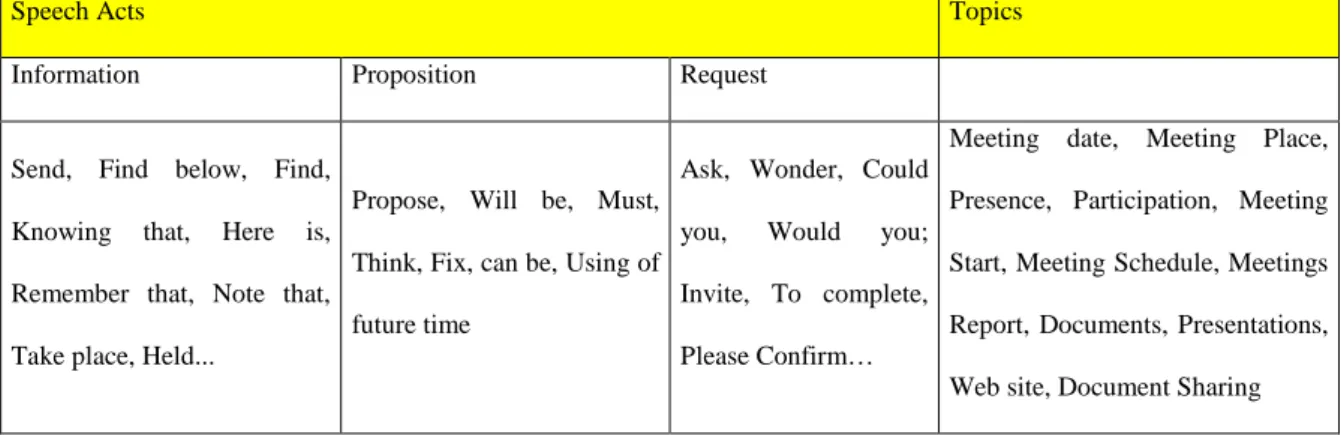
learning of procedures or concepts. First of all, our expert on Pragmatics identifies a grid
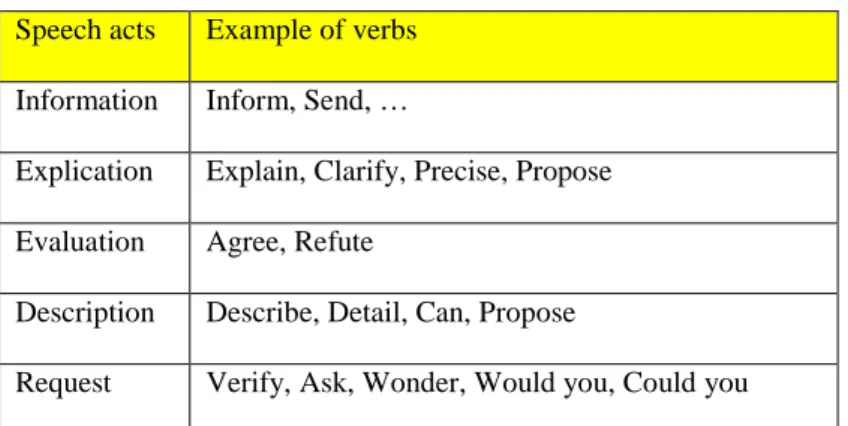
of main speech act types concerning learning (see Table 1).
---Insert here the Table 1---
Then, based on different synonyms and sentence forms given by the pragmatics expert
and the list of project topics, the NLP algorithm (Lucen) has been used in order to retrieve
the corresponding messages. Figure 7 illustrates the global results obtained. The inside
wheel shows the topics identified and the outside wheel the corresponding speech acts.
---Insert the Figure 7 here---
In our analysis, we try to identify if there is learning of concepts or procedures. So, we
look for some specific speech acts like proposition, explanation, request, verification and
information. Then we study this type of interaction among time: at the beginning, on the
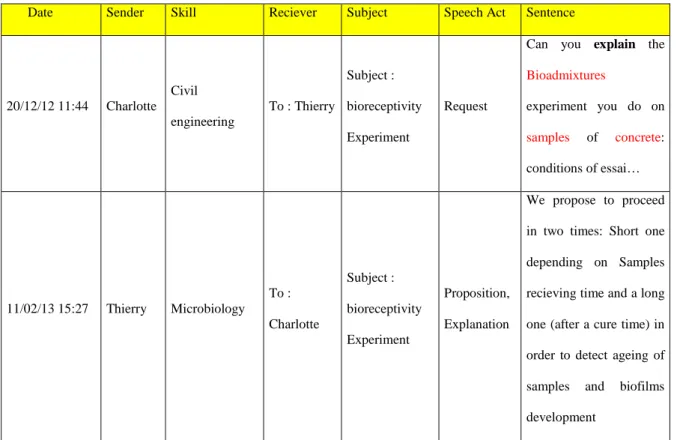
middle and at the end of task and project. For instance, at 20/12/12 Charlotte “civil
engineer” asks about the Bioadmixtures experiment conditions needed. Thierry
“Microbiologist” answers her by explaining a procedure (see Table 2).
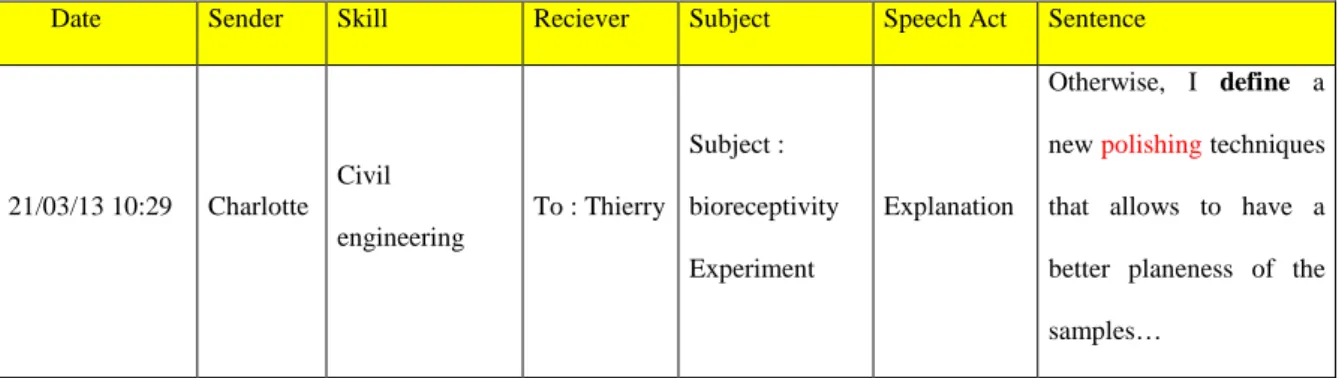
At 21/03/13, some months after this interaction, Charlotte “civil engineer” presents
some modification on the procedure (see Table 3).
---Insert here the Table 3 ---
We suppose then that Charlotte learns the procedure, uses it and tries to adapt it to
specific conditions.
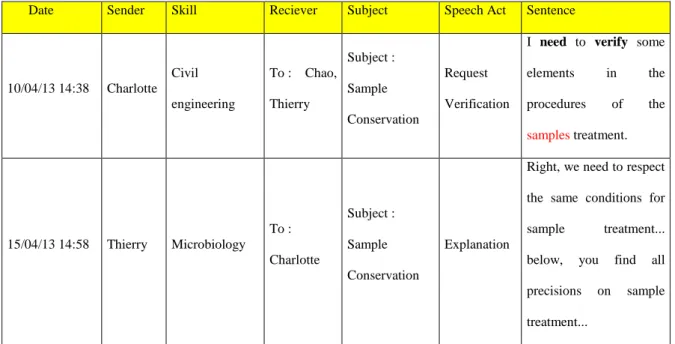
At 10/04/13, Charlotte asks for more verification about the samples conservation and
Bioadmixtures test conditions of sample treatment. Chao and Thierry define more
specifications about these conditions (see Table 4).
---Insert here the Table 4---
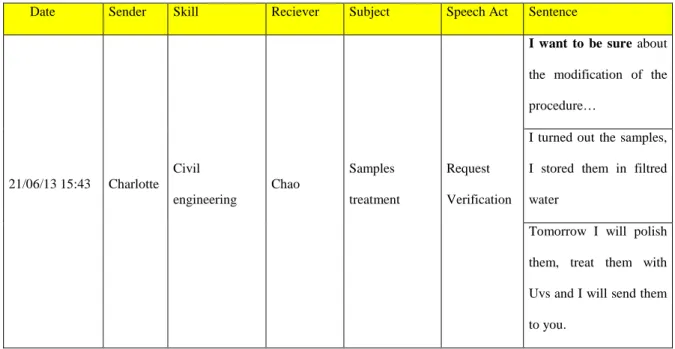
Charlotte asks then more verification about the procedure she applies (see Table 5).
---Insert here the Table 5---
We suppose that among these interactions, actors learned from each other about
bioreceptivity mixture experiment and sample treatment and conservation. Other analysis
of messages show also interactions about samples’ name coding and sending modes.
The chronology of interactions proves their dynamicity especially if actors have a
timeline to respect, they communicate about the project phases.
4.3.Coordination analysis
Using CaMca approach, e-mails are also analysed in order to analyse how the CoP is
coordinated. For this purpose, our analysis is based on coordination intentions (Matta,
Atifi, Sediri, & Sadgal, 2011). A specific grid was defined containing speech acts related to
coordination and topics concerning the coordination (see Table 6). The main coordination
speech acts are about information, proposition and request. Topics are around: meetings,
documents and reports. A statistical analysis is also done in order to identify the
engagement of actors in interactions. This type of analysis can complete those done by
statistical studies of exchanges, the identification of the interaction roles as used in our
study help to emphasis the dynamic organization movements.
---Insert here the Table 6---
42 messages have been analysed using this grid and based on the CaMCa approach.
These messages correspond to four milestones of the projects: Kick off, 12th, 18th and
30th month. Message date, Senders, Receivers, speech acts, topics are identified. 101
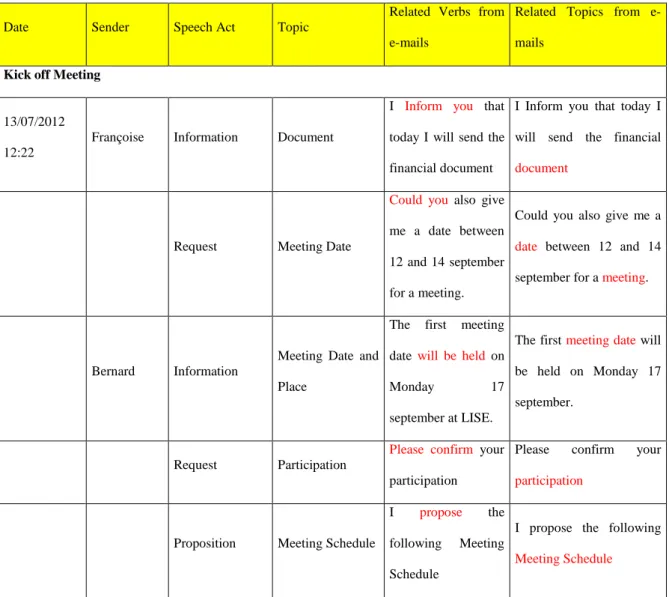
important sentences are identified from these messages. Table 7 illustrates a part of the
analysis for the Kick off milestone.
---Insert here the Table 7 ---
First statistics analysis syntheseized in Table 8 shows that Francoise is the main
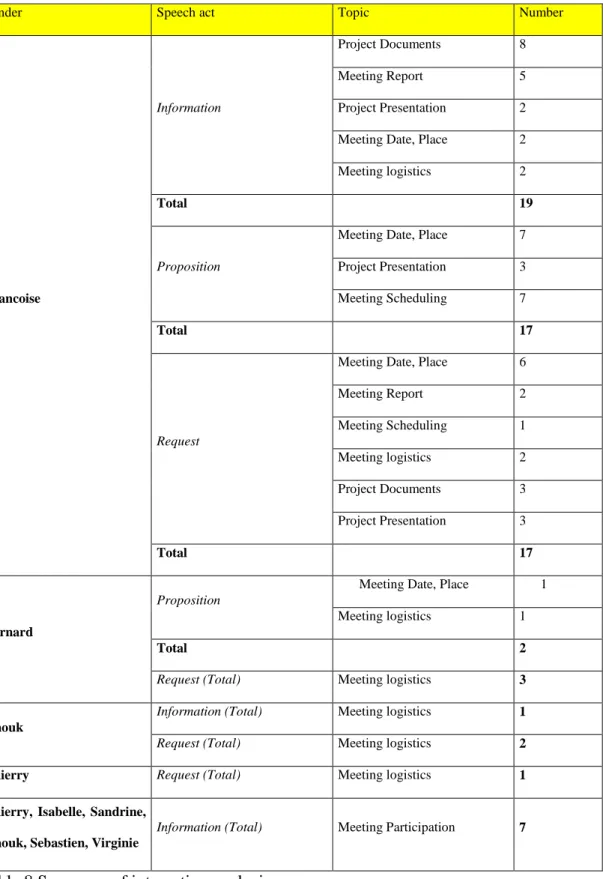
animator of the group. She takes the role of animator of coordination. She is the author of
22 messages. In these messages, Françoise informs about project documents, meeting
reports and meetings logistics (19 speech acts), proposes meetings schedules and project
presentations (17 speech acts) and asks for modification on Meetings Reports, logistics and
project documents. We observe also the dynamic participation of other actors like Bernard
(2 speech acts on Information and 1 on Request about Meeting logistics) and Anouk (1
speech act on Information and 1 Request about Meeting logistics) in the organization of
meetings.
---Insert here the Table 8 ---
Finally, even messages are addressed to all participants of projects (16 participants),
only 7 participate in the discussions. Time interaction analysis shows that messages are
close to meetings dates.
As showed in this analysis, CaMca can be used to identify the nature of animation of
CoPs and the core group. In SEPOLBE, we can see that some actors are engaged in the
animation is dynamic around meetings and tasks deadline. Beside that, interactions
concern explanations of procedures and precision of techniques.
4.4.Discussion
We focus on this paper on a systematic and semi-automated analysis of CoPs that goes
beyong knowledge sharing level assessment. Our analysis technique is based from one side
on interaction content analysis and from other side on participants’ competencies. This
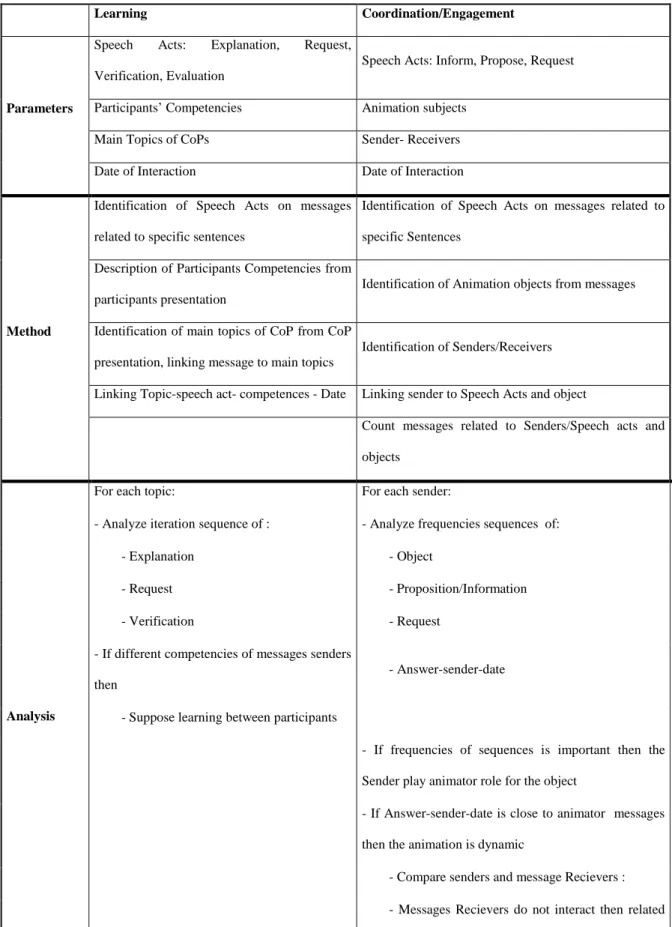
technique is summarized in Table 9.
---Insert here the Table 9---
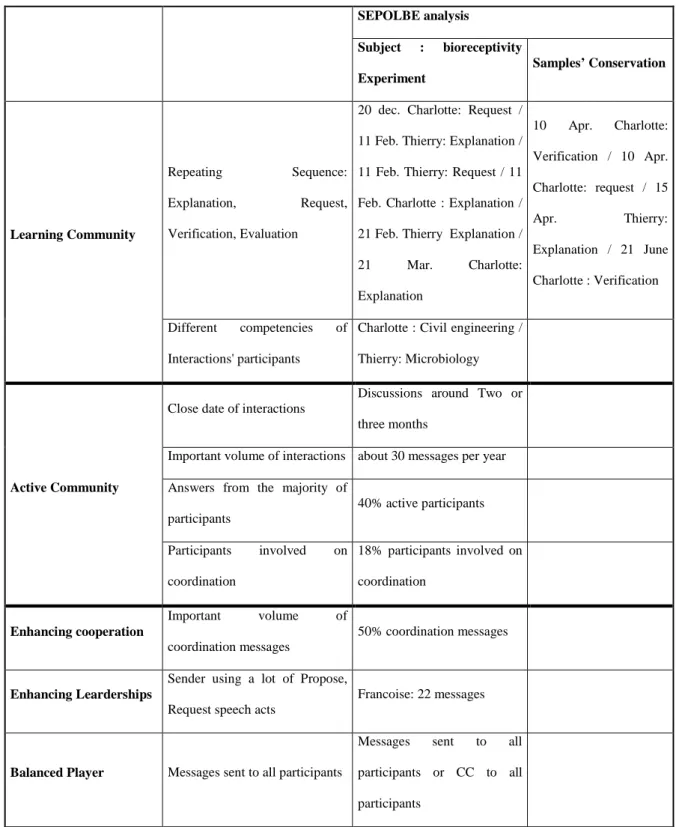
The analysis of the SEPOLBE project interactions shows that we can answer to some
characteristics of CoPs using CaMCa approach especially (see Table 10). So, in the
SEPOLBE project there are two interaction sequences about Bioreceptivity Experiment
and Samples Conservation that show learning between Charlotte and Thierry. The close
dates of interactions can emphasize an active community but only 40% of participants send
messages and only 18% are involved on coordination. So, we can note that only 40% of the
community are active. The 50% of coordination messages emphasize the cooperation
dimension of the CoPs.
Francoise can be identified as the coordinator because she is implied in 22 messages
using propose and request speech acts. Finally, we can note that the effective participants
are balanced player; all participants are in copy of messages or as receivers, even when
there is some dialogue between Charlotte and Thierry (see Table 10).
---Insert here the Table 10 ---
As showed in this paper, combining messages analysis and context awareness can give
a technique to go beyong the classical knowledge sharing level assessment of CoPs. We
tend in our analysis to identify a systematic methodology that help to diagnosis CoPs. This
that a sense interpretation is linked to an action and environment. We used an approach
mixing statistics and content analysis. We succeeded in identifying the real coordinator of
the CoP and how the actors learn from each other thanks to the emails exchanges.
5. Conclusion
CoP efficiency evaluation is a great deal in research. Indeed, having the possibility to
know if a given CoP is successful or not is essential to better manage it over time. The
existing approaches for efficiency evaluation are difficult and time-consuming to put into
action on real CoPs. They require either to evaluate subjective constructs making the
analysis unreliable, either to work out a knowledge interaction matrix that is
time-consuming to set up.
These approaches build their evaluation on the fact that a CoP is successful if
knowledge is exchanged between the members but they focus evaluation on the level of
knowledge shared and created. This is a useful but partial. Indeed, when knowledge is
shared there is some interactions between the actors involved in the CoP. Therefore, we
propose to analyse in detail these interactions through the exchanges of emails thanks to
NLP. Our approach is easy to put in action as it is systematic and semi-automated. It
requires the e-mails exchanged and the definition of the speech-acts that will be retrieved.
Our approach allowed us to identify one of the key role of a project-based CoP: the leader
of the core group. We also succeeded in identifying the learning process during the project
between stakeholders from different domains: civil engineering and biochemistry. These
first promising results must be confirmed on other project-based CoPs but also on other
types of CoPs for instance to study problem solving exchanges, experts identification, etc.
Last but not least it would be interesting to couple the proposed approach general
guidelines of CoP management as they are proposed in (Probst & Borzillo, 2008) or (Jeon,
success and failure of CoPs are worked out. An investigation on 57 CoPs from major
European and US companies led to the discovery of 10 “commandments” that lead to the
successful development of CoP. These ten “commandments” describe CoP governance
practices and could be linked with CoP diagnosis in order to apply the “commandments”
that the best fit to a given CoP context. Jeon, et al. (2011) identify and validate a set of
organizational factors that was anticipated to have effects on knowledge sharing by CoP
members such as perceived consequences, affect, social factors and facilitating conditions.
According to a given CoP diagnosis the corresponding organizational factors could be put
into action.
6. References
Austin, J.L. 1975. How to do things with words Vol. 367. Oxford university press.
Baron, N.S. 1998. Letters by phone or speech by other means: The linguistics of email.
Language & Communication, 18, 133-170.
Borzillo, S., & Kaminska-Labbe, R. 2011. Unravelling the dynamics of knowledge
creation in communities of practice though complexity theory lenses. Knowledge
Management Research & Practice, 9, 353-366.
Brown, J.S., & Duguid, P. 1991. Organizational leraning and communities of practice:
Toward a unified view of working. Organization Science, 2, 40-57.
Carvalho, V.R., & Cohen, W.W., 2006. Improving email speech acts analysis via
n-gram selection, HLT-NAACL 2006 Workshop on Analyzing Conversations in Text and
Speech, Association for Computational Linguistics. Publishing, Stroudsburg, PA, USA,
pp. 35-41.
Chu, M.-T., & Khosla, R. 2009. Index evaluations and business strategies on
Corney, M., De Vel, O., Anderson, A., & Mohay, G., 2002. Gender preferential text
mining of e-mail discourse, 18th Computer Security Applications Conference. Publishing,
Las Vegas, NV, USA.
Cox, A. 2005. What are communities of practice? A comparative review of four seminal
works. Journal of Information Science, 31, 527-540.
Felice, R.D., & Deane, P., 2012. Identifying speech acts in emails: Toward automated
scoring of the TOEIC® Email task. Publishing.
Goepp, V., Munzer, C., & Feugeas, F., 2014. Community of Practice Theory and
Process Modelling: Two Tools for Better Collaboration in Research Projects, Advances in
Production management systems : Innovative and knowledge-based production
management in a global-local world, APMS 2014. Publishing, Ajaccio, France.
Guptill, J. 2005. Knowledge management in health care. Journal of Health Care
Finance, 31, 10-15.
Jeon, S.-H., Kim, Y.-G., & Koh, J. 2011. Individual, social, and organizational contexts
for active knowledge sharing in communities of practice. Expert Systems with
Applications, 38, 12423-12431.
Kalia, A., Motahari Nezhad, H.R., Bartolini, C., & Singh, M., 2013. Identifying
business tasks and commitments from email and chat conversations. Publishing.
Kim, S.J., Hong, J.Y., & Suh, E.H. 2012. A diagnosis framework for identifying the
current knowledge sharing activity status in a community of practice. Expert Systems with
Applications, 39, 13093-13107.
Lampert, A., Dale, R., & Paris, C., 2010. Detecting emails containing requests for
action, Human Language Technologies: The 11th Annual Conference of the North
American Chapter of the Association for Computational Linguistics. Publishing, Los
Lave, J., & Wenger, E. 1991. Situated learning. Legitimate Peripheral Participation.
University Press, Cambridge.
Lee, J., Suh, E., & Hong, J. 2010. A maturity model based CoP evaluation framework:
A case study of strategic CoPs in a Korean company. Expert Systems with Applications,
37, 2670-2681.
Lesser, E., & Everest, K. 2001. Using communities of parctice to manage intellectual
capital. Ivey Business Journal, 65, 37-41.
Levinson, S.C. 1983. Pragmatics. Cambrigde University Press, Cambridge.
Matta, N., Atifi, H., Sediri, M., & Sadgal, M. 2011. Coordination interactions analysis
in design projects. International Journal of Communication and Information Sciences,
AICIT, HumanPub, 1, 22-29.
McDermott, R. 2000. Critical success factors in building communities of practice.
Knowledge Management Review, 3.
McDermott, R. 2004. How to avoid a mid-life crisis in your COPs: Uncovering six keys
to sustaining communities. Knowledge Management Review, 42, 10-13.
Nonaka, I., & Takeuchi, H. 1995. The Knowledge-Creating Company: How Japanese
Companies Create the Dynamics of Innovation. Oxford University Press, New-York.
Probst, G., & Borzillo, S. 2008. Why communities of practice succeed and why they
fail. European Management Journal, 26, 335-347.
Rauscher, F., Matta, N., & Atifi, F., 2016. KTR: an approach that supports Knowledge
extraction from design interactions, 8th IFAC Conference on Manufacturing Modelling,
Management & Control (MIM). Publishing, Troyes, France.
Richard, J.F. 1990. Mental activities, Understand, Reason, Find solutions (in French)
Tang, G.T., Pei, J., & Luk, W.S. 2014. Email mining: tasks, common techniques, and
tools. Knowledge and Information Systems, 41, 1-31.
Wenger, E. 1998. Communities of Practice: Learning, Meaning and Identity.
Cambridge University Press, Cambridge.
Wenger, E. 2000. Communities of practice and social leraning systems. Organization,
7, 225-246.
Wenger, E., McDermott, R., & Snyder, W.M. 2002. Cultivating Communities of
Practice. Harvard Business School Press, Boston.
Wenger, E., & Snyder, W.M. 2000. Communities of practice: The organizational
frontier. Harvard Business Review, 78, 139-145.
Yelati, S., & Sangal, R., 2011. Novel Approach for Tagging of Discourse Segments in
Help-Desk E-Mails, IEEE/WIC/ACM International Conference on Web Intelligence and
Intelligent Agent Technology (WI-IAT). Publishing, Lyon, France, pp. 369-372.
Zack, M.H. 1999. Developing a knowledge strategy. California Management Review,
41, 125-145.
7. Tables
Speech acts Example of verbs Information Inform, Send, …
Explication Explain, Clarify, Precise, Propose Evaluation Agree, Refute
Description Describe, Detail, Can, Propose
Request Verify, Ask, Wonder, Would you, Could you
Date Sender Skill Reciever Subject Speech Act Sentence 20/12/12 11:44 Charlotte Civil engineering To : Thierry Subject : bioreceptivity Experiment Request
Can you explain the
Bioadmixtures experiment you do on samples of concrete: conditions of essai… 11/02/13 15:27 Thierry Microbiology To : Charlotte Subject : bioreceptivity Experiment Proposition, Explanation We propose to proceed in two times: Short one depending on Samples recieving time and a long one (after a cure time) in order to detect ageing of samples and biofilms development
Date Sender Skill Reciever Subject Speech Act Sentence 21/03/13 10:29 Charlotte Civil engineering To : Thierry Subject : bioreceptivity Experiment Explanation Otherwise, I define a new polishing techniques that allows to have a better planeness of the samples…
Date Sender Skill Reciever Subject Speech Act Sentence 10/04/13 14:38 Charlotte Civil engineering To : Chao, Thierry Subject : Sample Conservation Request Verification
I need to verify some elements in the procedures of the samples treatment. 15/04/13 14:58 Thierry Microbiology To : Charlotte Subject : Sample Conservation Explanation
Right, we need to respect the same conditions for sample treatment... below, you find all precisions on sample treatment...
Date Sender Skill Reciever Subject Speech Act Sentence 21/06/13 15:43 Charlotte Civil engineering Chao Samples treatment Request Verification
I want to be sure about
the modification of the procedure…
I turned out the samples, I stored them in filtred water
Tomorrow I will polish them, treat them with Uvs and I will send them to you.
Speech Acts Topics Information Proposition Request
Send, Find below, Find, Knowing that, Here is, Remember that, Note that, Take place, Held...
Propose, Will be, Must, Think, Fix, can be, Using of future time
Ask, Wonder, Could you, Would you; Invite, To complete, Please Confirm…
Meeting date, Meeting Place, Presence, Participation, Meeting Start, Meeting Schedule, Meetings Report, Documents, Presentations, Web site, Document Sharing
Date Sender Speech Act Topic
Related Verbs from e-mails
Related Topics from e-mails
Kick off Meeting
13/07/2012 12:22
Françoise Information Document
I Inform you that today I will send the financial document
I Inform you that today I will send the financial
document
Request Meeting Date
Could you also give me a date between 12 and 14 september for a meeting.
Could you also give me a
date between 12 and 14 september for a meeting.
Bernard Information
Meeting Date and Place
The first meeting date will be held on
Monday 17 september at LISE.
The first meeting date will be held on Monday 17 september.
Request Participation
Please confirm your
participation
Please confirm your
participation
Proposition Meeting Schedule
I propose the following Meeting Schedule
I propose the following
Meeting Schedule
Sender Speech act Topic Number Francoise Information Project Documents 8 Meeting Report 5 Project Presentation 2 Meeting Date, Place 2 Meeting logistics 2
Total 19
Proposition
Meeting Date, Place 7 Project Presentation 3 Meeting Scheduling 7
Total 17
Request
Meeting Date, Place 6 Meeting Report 2 Meeting Scheduling 1 Meeting logistics 2 Project Documents 3 Project Presentation 3 Total 17 Bernard Proposition
Meeting Date, Place 1 Meeting logistics 1
Total 2
Request (Total) Meeting logistics 3
Anouk
Information (Total) Meeting logistics 1
Request (Total) Meeting logistics 2
Thierry Request (Total) Meeting logistics 1
Thierry, Isabelle, Sandrine,
Anouk, Sebastien, Virginie
Information (Total) Meeting Participation 7
Learning Coordination/Engagement
Parameters
Speech Acts: Explanation, Request, Verification, Evaluation
Speech Acts: Inform, Propose, Request
Participants’ Competencies Animation subjects Main Topics of CoPs Sender- Receivers Date of Interaction Date of Interaction
Method
Identification of Speech Acts on messages related to specific sentences
Identification of Speech Acts on messages related to specific Sentences
Description of Participants Competencies from participants presentation
Identification of Animation objects from messages
Identification of main topics of CoP from CoP presentation, linking message to main topics
Identification of Senders/Receivers
Linking Topic-speech act- competences - Date Linking sender to Speech Acts and object
Count messages related to Senders/Speech acts and objects
Analysis
For each topic: For each sender:
- Analyze iteration sequence of : - Analyze frequencies sequences of: - Explanation - Object
- Request - Proposition/Information - Verification - Request
- If different competencies of messages senders then
- Answer-sender-date
- Suppose learning between participants
- If frequencies of sequences is important then the Sender play animator role for the object
- If Answer-sender-date is close to animator messages then the animation is dynamic
- Compare senders and message Recievers : - Messages Recievers do not interact then related CoPs participants are not engaged
SEPOLBE analysis Subject : bioreceptivity Experiment Samples’ Conservation Learning Community Repeating Sequence: Explanation, Request, Verification, Evaluation
20 dec. Charlotte: Request / 11 Feb. Thierry: Explanation / 11 Feb. Thierry: Request / 11 Feb. Charlotte : Explanation / 21 Feb. Thierry Explanation / 21 Mar. Charlotte: Explanation 10 Apr. Charlotte: Verification / 10 Apr. Charlotte: request / 15 Apr. Thierry: Explanation / 21 June Charlotte : Verification Different competencies of Interactions' participants
Charlotte : Civil engineering / Thierry: Microbiology
Active Community
Close date of interactions
Discussions around Two or three months
Important volume of interactions about 30 messages per year Answers from the majority of
participants 40% active participants Participants involved on coordination 18% participants involved on coordination Enhancing cooperation Important volume of coordination messages 50% coordination messages Enhancing Learderships
Sender using a lot of Propose, Request speech acts
Francoise: 22 messages
Balanced Player Messages sent to all participants
Messages sent to all participants or CC to all participants
Table 10 Characterization of CoPs using CaMCa approach
8. Figure captions
Figure 1: Guided and self-directed modes of CoPs (Borzillo & Kaminska-Labbe, 2011)
Figure 3: Diagnosis process of CoPs based on Social Network Analysis (SNA) (Kim, et al.,
2012)
Figure 4: CoP member typology according to (Kim, et al., 2012)
Figure 5: CoP typology according to (Kim, et al., 2012)
Figure 6: CaMCa basic approach
Figure 7: Results of NLP analysis
9. Figures
Figure 1: Guided and self-directed modes of CoPs (Borzillo & Kaminska-Labbe, 2011)
Figure 3: Diagnosis process of CoPs based on Social Network Analysis (SNA) (Kim, et al., 2012)
Figure 4: CoP member typology according to (Kim, et al., 2012)
Figure 6: CaMCa basic approach