Publisher’s version / Version de l'éditeur:
Vous avez des questions? Nous pouvons vous aider. Pour communiquer directement avec un auteur, consultez la première page de la revue dans laquelle son article a été publié afin de trouver ses coordonnées. Si vous n’arrivez pas à les repérer, communiquez avec nous à [email protected].
Questions? Contact the NRC Publications Archive team at
[email protected]. If you wish to email the authors directly, please see the first page of the publication for their contact information.
https://publications-cnrc.canada.ca/fra/droits
L’accès à ce site Web et l’utilisation de son contenu sont assujettis aux conditions présentées dans le site LISEZ CES CONDITIONS ATTENTIVEMENT AVANT D’UTILISER CE SITE WEB.
Research Paper (National Research Council of Canada. Division of Building
Research), 1963-08
READ THESE TERMS AND CONDITIONS CAREFULLY BEFORE USING THIS WEBSITE. https://nrc-publications.canada.ca/eng/copyright
NRC Publications Archive Record / Notice des Archives des publications du CNRC :
https://nrc-publications.canada.ca/eng/view/object/?id=9d3984d2-a1e0-486b-8dc7-045b41060495 https://publications-cnrc.canada.ca/fra/voir/objet/?id=9d3984d2-a1e0-486b-8dc7-045b41060495
NRC Publications Archive
Archives des publications du CNRC
This publication could be one of several versions: author’s original, accepted manuscript or the publisher’s version. / La version de cette publication peut être l’une des suivantes : la version prépublication de l’auteur, la version acceptée du manuscrit ou la version de l’éditeur.
For the publisher’s version, please access the DOI link below./ Pour consulter la version de l’éditeur, utilisez le lien DOI ci-dessous.
https://doi.org/10.4224/40001229
Access and use of this website and the material on it are subject to the Terms and Conditions set forth at
Cohesion in an undisturbed sensitive clay
Ser TH1 N21r2
no.
195
c. 2 BLDGNATIONAL
RESEARCH
COUNCIL
CANADA
DIVISION OF BUILDING R E S E A R C H
COHESION
IN A N UNDISTURBED SENSITIVE CLAY
BY
CAEL
B.
CRAWFORDR E P R I N T E D F R O M
GEOTECHNIQUE, VOL. 13, NO. 2, JUNE 1963, P.132 - 146.
R E S E A R C H P A P E R N O . 195 O F T H E DIVISION OF BUILDING R E S E A R C H P R I C E 25 C E N T S BU'LLDINC RESEARCH
-
L!BQ$,RY
-
I
1
0" , " I 4 O T T A W A A U G U S T 1963 N R C 7420BY PERMISSION OF THE COUNCIL
EXCERPT FROM GZ?OTECH~VIQUE, JUNE 1963
.""'%-
COHESION IN AN UNDISTURBED SENSITIVE CLAY
The true cohesion of an undisturbed, sensitive clay was measured by compression testing of labora- tory specimens a t very low effective stresses. On the basis of modem ideas, the measured cohesion may be visualized as a frictional resistance mobilized by the arrangement of, and the intrinsic stresses between, individual soil particles. This concept, supported by observed fracture patterns in the laboratory and in the field, is considered to lead to a better fundamental understanding of the strength of undisturbed clay. Extrapolation of strength theories developed for remoulded clays to thc assess- ment of undisturbed, sensitive clays is refuted.
La cohlision vraie d'une argile intacte e t sensible
fut mesurCe au moyen d'essais de compression, &
tension efficace trks basse, sur des Cchantillons de laboratoire. Selon les idlies contemporaines, la
coh6sion lllesurCe peut 6tre comparCe & une friction
mobilislie par l'arrangement des particules indivi- duelles et les tensions intrinskques entre elles. Ce concept sontenu par le genre de ruptures observkes in
situ et en laboratoire, conduit L: une meilleure com-
prlihension fondanlentale de la rCsistance d'une arnile intacte. L'extrapolation des thCoiies de rkzstance pour les argiles remaniCes clans le domaine des argiles intactes et sensibles est rCfutCe. INTRODUCTION
The tests described in this Paper were made on undisturbed samples of a late-glacial marine clay of Eastern Canada, called ~ e d a clay. This strong, brittle clay is noted for its compres- sibility and extreme sensitivity. Laboratory studies of its stress-deformation properties have illustrated the inadequacy of the classical strength theories in interpreting its behaviour, especially its angle of shearing resistance in terms of effective stresses (where effective stress is computed by subtracting the pressure in the pore-water from the total applied stress).
I t has been shown (Crawford, 1960)' that because of the dependency of induced pore-water pressure on strain the magnitude of the computed effective stresses at failure is partly deter- - - mined by the strain at failure. The angle of shearing resistance, therefore, when computed in the usual way, is a function of strain at failure and because the strain at failure is related t o sample disturbances this further complicates the interpretation of the effective stress para- meters. This angle has also been shown to depend upon the rate of strain and this rate is considered to have even more influence on the cohesion intercept in terms of effective stresses (Crawford, 1959).
Observations on some sensitive Scandinavian clays, which, in a number of ways correspond to Leda clay, have indicated similar problems of interpretation (Osterman, 1960; Bjerrum, 1961). This uncertainty in interpretation of test results introduces a corresponding difficulty into field analyses. For the majority of effective stress stability analyses the co~nputed safety factor is especially sensitive to the value chosen for the cohesion intercept and a more complete understanding of this factor is necessary.
A comprehensive stability investigatioil of a natural slope in Norway is reported to have been satisfactorily treated using ordinary effective stress methods (Kjaernsli and Simons, 1962). This investigation involved a nornlally consolidated clay of relatively low sensitivity whereas Leda clay is usually extra-sensitive (or quick) and moderately overconsolidated (Crawford, 196l(a)). The cohesion of the Canadian clay, when compared with that of the Norwegian clay, may be substantially affected by these two features.
CLASSICAL THEORIES O F SHEARING RESISTANCE
Ever since Coulomb proposed the classical equation for shear strength, engineers have searched for fundamental definitions and evaluatioil of the two components, friction and cohesion. The historical development leading to Terzaghi's appreciation of the influence of
1 The references are given on p. 145.
132
C O H E S I O N I N A N U N D I S T U R B E D S E N S I T I V E C L A Y 133
effective stresses on shear strength has been admirably documented b y Skempton (19GO). Suffice to say here that so long as engineers treated clay soils in bulk without regard to pres- sures in the pore water it was impossible to develop any satisfactory physical meaning to the Coulomb components.
I t was the laboratory experiments of Rendulic (1937) and Hvorslev (1937) that paved the way for the present understanding of Coulomb's equation in terms of effective stresses, true friction, and true cohesion of renzoz~lded soils. Skempton and Bishop (1954) showed the practical relationship between Hvorslev's true friction and cohesion and the equivalent empirical parameters in terms of effective stresses. A comprehensive confirmation and extension of Hvorslev's work has been published by Roscoe, Schofield, and Wroth (1958) and several additional Papers in recent years have dealt with a variety of energy corrections in an attempt to improve the interpretation of laboratory test results.
All of these studies have had a great influence on the fundamental understanding of the shear strength of soils. They have, however, one serious limitation: practically all of the development work has been done on remoulded soils and the extent to which it can be applied to natural undisturbed soils is unknown. One potential source of difficulty in measuring the natural properties of Leda clay is its unusual reaction to distortion or remoulding. Lilre many natural soils Leda clay has developed a "structure" due to its geological environment which, once destroyed, cannot be re-made artificially. Casagrande (1932) drew attention t o the importance of clay structure and since then it has been a subject of intensive study.
SENSITIVITY
Some soils display greater "structural" influences than others. The magnitude of struc- tural effects in an undisturbed clay is reflected by its "sensitivity ", the ratio of undisturbed to remoulded strength a t constant water content. Possible reasons for clay sensitivity have been discussed by Skempton and Northey (1952), Rosenqvist (1953), Newland and Allely (1956), and Pusch (1962). An attempt is made in Fig. 1 to demonstrate the significance of sensitivity in strength considerations. This photograph shows an undisturbed sample carrying a vertical stress of more than 1 kglsq. cm, but when the same soil is completely remoulded at its natural water content it is of liquid consistency. The measurement of the remoulded strength of very sensitive soils is so difficult that absolute values of sensitivity depend to a large extent on the method used (Eden and Icubota, 1961).
Penner (1963) conducted some experiments on samples from the same undisturbed block of Leda clay used for demonstration in Fig. 1 (facing p. 134). Using the falling cone device he obtained an undisturbed strength value of about 2,100 lb/sq. ft (1 kglsq. cm) and aremoulded
strength of about 70 lb/sq. ft. By adding 1 % b y weight of sodium metaphosphate the remoulded
strength was decreased to about 1 lb/sq. ft thereby demonstrating the tremendous influence of inter-particle forces on strength and sensitivity.
Slope failures in Leda clay, because of its sensitivity, are often catastrophic. They occasionally involve several square miles of land in earth flows in which solid chunks of soil
flow away on liquefied clay. Describing the classical earthflow at St Thuribe, Quebec, G. M.
Da\vson (1899), a geologist, wrote: " I t appears probable that in this particular instance the silty-clay, surcharged with water, stood in a condition of unstable equilibrium, retaining its solidity merely by virtue of its unbroken molecular texture, and that at the moment in which it became subject to internal movement this texture gave way and i t lapsed into a nearly liquid mass, the particles re-arranging themselves with some freedom in the water previously locked up in its pores".
I t is apparent from these laboratory and field observations that the results of research on remoulded soils may not only have limited applicatioil to sensitive, undisturbed soils but may be even misleading. I t is not possible, for example, to extrapolate to this type of soil the
134 C A R L B . C R A W F O R D
observation made by Hvorslev on remoulded soil that the true cohesion is a function only of its voids ratio. The two specimens of the same soil shown in Fig. 1 have the same voids ratio but have greatly different values of cohesion.
SOIL STRUCTURE
I n view of the obvious importance of geologically developed soil structure to sensitivity and strength, it is worth reviewing this aspect of clay technology in an effort to understand the characteristics of Leda clay. The works of Lambe (1953, 1958) and Rosenqvist (1959) are particularly useful in interpreting for engineers the complex physical-chemistry of clay structure. Lambe (1958) defined "structure" as "the arrangement of soil particles and the electrical forces acting between adjacent particles
".
He explained the nature of the electrical forces and inferred the relative arrangement of particles in salt- and fresh-water clays which Rosenqvist (1959), using electron microscopy, proved to be generally ti-ue. On the basis of these concepts the structure of Leda clay is visualized in the following way.As the fine-grained soil elements are deposited and subsequently loaded by further de- position the individual particles are forced into intimate contact, the relative orientation of particles being primarily dependent on the characteristics of the liquid medium during de- position. I n Leda clay a flocculated structure is visualized with particles ranging from the finest colloids up to 30% or 40% silt sizes by weight. Dimensions range therefore from about 50 millimicrons up to about 50 microns or by a factor of about 1,000. The particles may vary from rather inert,-approximately spherical shapes, to thin plate-shaped particles surrounded by electrically attracted water molecules which, together with the mineral component, make up a
"mushy" particle (Lambe, 1958).
When the particles have been pushed together by externally applied effective stresses, additional electrical forces of attraction and repulsion between particles are introduced. The resultant force depends on many factors but especially on the distance between particles, their orientation, and the nature of the diffuse double layer. For the orientation and stresses visualized it is thought to be a net attractive force. In time a further strengthening of the mass may occur due to natural cementation.
I t is reasoned that because of the original card-house type of open structure in the natural soil deposit, the addition of further geological loading simply pushes particle edges closer to other particle faces and bends particles in the natural space frame, introducing more points of particle interaction. This process, together with a gradual cementation, would allow the slowly increasing load to be carried without substantial reduction in voids ratio or water content.
Unlike Lambe and Rosenqvist, Pusch (1962) suggests that particles may be attracted edge to edge during flocculation so that the exact arrangement must be considered in doubt. I n any event the solid particles are visualized as components of a complex space frame in which
both intrinsic forces and particle arrangement play a part in the undisturbed strength. When the external load is removed from Leda clay by sampling it may be partly replaced by capillary stresses but an intrinsic stress network due to electrical attraction and other bonds must exist. I t is possible that when the external stress is released and the particles tend to move apart, the net electrical attraction will increase and prevent expansion. This appears to be approximately the case in Leda clay because, as is shown later, an undisturbed specimen maintains most of its shearing resistance even though the externally applied stresses and the capillary stresses are removed.
MECHANISM O F S H E A R I N G RESISTANCE
In spite of the advancement in knowledge of colloid chemistry, it is virtually impossible to visualize satisfactorily the physical mechanisms that resist the shear in an undisturbed speci-
C O H E S I O N I N A N U N D I S T U R B E D S E N S I T I V E C L A Y 135 men of clay. Millions of contact points are involved. Some particle edges may slide along flat surfaces; some may bend or break; particles that have a rolling motion may force other particles apart or allow them to come closer together with consequent changes in inter-particle forces; particles may be pulled apart by shear or tension; and rigid bonds may be permanently broken. The speed with which the shear occurs will probably have a considerable effect on the mechanism.
Lambe (1960) attempted to list all of the possible mechanisms that may resist shear in clay but could not arrive at an "operational" equation. From a variety of evidence, Rosenqvist (1959) visualized a complex clay-water system in which the water films around the particles will yield plastically when pressed together with little or no elastic deformation of the particles themselves. With subsequent release of pressure the particles will not move apart completely but will stick together by adhesion. Michaels (1959) disagreed to some extent with the precise mechanism attributed to Rosenqvist thus illustrating the uncertainties that still exist in the matter.
Approaching the problem in another way, Goldstein and Ter-Stepanian (1957) observed the deformation of clay specimens and found it convenient to divide interparticle bonds into two types: brittle bonds formed over periods of time which permit elastic deformation and then fail, and viscous bonds which form, break under stress, and re-form fairly quickly. Brittle bonds would probably result from chemical change (cementation) and viscous bonds from net electrical attraction. In a similar way, Denisov and Reltov (1957) divided cohesion into two components: that due to electrical attraction and that due t o cementation and thixotropic strengthening.
Lo (1961) described clay as a non-linear, elastic, plastic material and on this basis explained the observed pore-water pressure changes under load. Borowicka (1961) observed that even in the elastic state, soil behaves differently in loading and unloading because of porosity
changes and he carried out some very interesting ring shear tests in which constant volume
was maintained by varying the vertical load while shearing first in one direction and then in the opposite direction.
~ e c a u s e of the complexity of the soil-water system, it is probable that strength parameters for natural soils will continue to be obtained by physical testing such as that already described but with an increasing appreciation of the fundamental intrinsic forces present. Based on observations of the physical performance of test specimens an attempt is made in the follow- ing paragraphs to develop, for a clay having a highly developed structure, a more satisfactory concept of shearing resistance.
First, it is necessary to agree on the concept of cohesion. Engineers have taken some liberties with the use
df
the term cohesion which, by definition, is t h e molecular attraction uniting the particles of a body throughout the mass. In most applications to soils, the term adhesion is more appropriate in that it refers to the molecular attraction eserted between the surfaces of bodies in contact. Soil engineers go a step further and consider "true" cohesion to be a shearing resistance due to one or other of these attractive forces. Coulomb implied such a definition (Golder, 1948); Collin (1846) referred to "the destructive power of time acting on molecular cohesion "; Bell (1881) wrote of "clay and other soils possessed of great tenacity"; Terzaghi (1941) emphasized the importance of the bond between particles (representing "true cohesion") of undisturbed clays; and Taylor (1948) was deeply engaged with the idea that true cohesive strength is caused by intrinsic pressure. This concept of cohesion originated with shear strength theories for soil but in recent years the term has been confused by a multitude of new definitions.In spite of this long-standing concept of cohesive strength, it is generally agreed that all shearing resistance in soil is of a frictional nature (Rosenqvist, 1955; Parry, 1959; Lambe, 1960; Trollope, 1961; Borowicka, 1962) and there appears to be no serious disagreement. If this is true, then true cohesion will be equal to:
136 C A R L B . C R A W F O R D
C, = oil tan
4,
and shear strength will be equal to:where:
T = ail tan 4,+uel tan
4,
= (uiI+uel) tan4,
ail = intrinsic effective normal stress.u,l = externally applied effective normal stress.
4e
= true angle of internal friction.I t follows that even a sensitive soil, such as Leda clay, should have a fundamental angle of internal friction so long as the structure, i.e. the bonds and the particle arrangement, is not altered. At stresses below the preconsolidation pressure in undisturbed clays, this angle cannot be measured because of the unknown influence of intrinsic stresses. This influence becomes relatively greater as applied effective stresses decrease more and more from the preconsolidation pressure until finally the intrinsic stresses control the shearing strength.
A study of the variation in effective stresses during consolidated-undrained triaxial com- pression tests of specimens of Leda clay at stress levels above and below the preconsolidation pressure resulted in a technique for computing a friction angle that is claimed to be of a fundamental nature (Crawford, 1961(b)). This angle, of approximately 17", was based on the following reasoning. I t was noted that while the soil was loaded to about one-half of its ultimate compressive strength it behaved like an elastic solid; stress and pore-water pressure each increased in proportion to strain. Further loading appeared to break down the structure of the soil and the significance of the computed effective stress parameters in this range was questioned.
I t was shown that when, in a typical test, 90% of the maximum compressive stress had been applied, the computed angle of shearing resistance, +', was about 20". During applica- tion of the remaining 10% of axial stress, accompanied by considerable strain, the computed
4'
increased to 26". Further strain increased the computed4'
to 35". It is essential to Itnow whether these high values, computed when the specimen is deforming rapidly and on the point of failure, have any practical significance. I n field observations it has been noted that shear failures of this soil are usually sudden and catastrophic with little or no warning. This would not be the case if the soil actually deformed as it does in a triasial compression test specimen during the late stages of loading.Because of these observations it was considered most reasonable to compute shear para- meters at stresses lower than at failure. To do this it is assumed that all resistance is frictional, that at high applied effective stresses (greater than preconsolidation pressure) the intrinsic stresses on the plane of shear have a relatively minor effect, and that when one-half of the maximum shear stress has been applied, 50% of the true frictional resistance is mobilized. The true angle of friction can be obtained therefore by doubling the ratio of shear stress to normal stress at this stage of loading. Repeating this procedure at other loading stages permits the plotting of a computed, friction angle for any degree of strain. This proves to be approximately a straight line intersecting the zero strain condition at angles ranging from about 15" to 18" for Leda clay and averaging about 17". The angle appears to be relatively independent of rate of strain and of stress level provided the stress level is not less than the preconsolidation pressure. If it is argued that a finite strain is required to mobilize friction the true angle of friction will be a little greater than at zero strain. If intrinsic stresses are contributing to the normal effective stress on the shear plane even at stress levels above the preconsolidation pressure, the true angle will be somewhat smaller. I t is unfortunate that so little is known of intrinsic stresses and of their effect on stress-deformation properties of clays but for this reason it is not possible to assess accurately the influence of intrinsic stresses even
C O H E S I O N I N A N U N D I S T U R B E D S E N S I T I V E C L A Y 137
when the applied stress level is high. I n an effort to improve understanding of the influence of intrinsic stresses on shearing resistance, the following research programme was developed at the Division of Building Research.
TESTING PROGRAMME
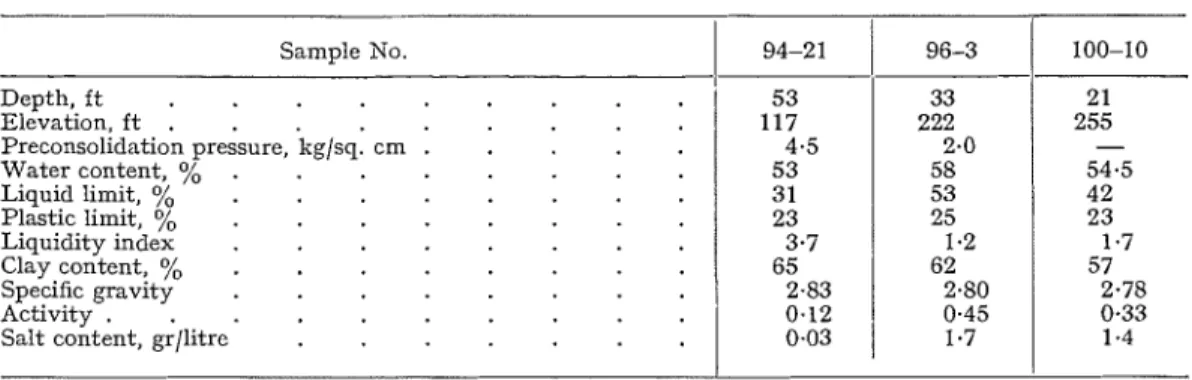
Tests were made on specimens cut from undisturbed block samples of Leda clay which had been obtained from deep excavations in the Ottawa area at three widely separated locations and elevations. The sensitivity of all samples is estimated to be greater than 50. Descriptive properties of the three materials are listed in Table 1. The programme was planned to measure the magnitude of cohesion in the accepted soil mechanics sense or, more precisely, to evaluate the influence of intrinsic stresses on shear strength.
One way to estimate the true cohesion of a saturated soil (assuming cohesion to be the shearing resistance due to intrinsic stresses as opposed to resistance due to externally applied effective stresses) is to shear it under effective stresses that are so low that the development of friction is limited by the low normal stress. Owing to the difficulties of measuring small pore-water pressures it is easier to immerse the specimen in water and shear it slowly on the assumption that significant pore pressures cannot develop.
Table 1 Properties of soils tested
If the soil is partly or wholly composed of swelling clay minerals, the specimen will take up water and in so doing it wiU change its properties, especially its shear strength. This is what happened when tests were made on immersed specimens of a swelling clay. If, however, it has little, if any, swelling clay minerals and has a significant resistance to shear even when immersed, this resistance can be largely attributed to cohesion as defined above. The clay fraction of Leda clay is predominantly composed of illite and chlorite with occasional traces
of montmorillonite but much of the soil is inert material (Forman and Brydon, 1961). It
eshibits little swelling unless previously dried (Warkentin and Bozozuk, 1961). Consequently, it was possible to study the strength of Leda clay at low effective stresses by immersing speci- mens in water before loading in unconfined compression. Soaking time varied up to 67 hours
and then specimens were strained at rates varying from
4%
t o 60% per hour.TEST RESULTS 100-10 2 1 255 - 54.5 42 23 1.7 57 2.78 0.33 1.4 Sample No. Depth, ft
.
Elevation, f t.
Preconsolidation pressure, kglsq. cm.
Water content, %.
Liquid limit, %.
Plastic limit, %.
Liquidity index.
Clay content, %.
Specific gravity.
Activity.
Salt content, grllitre
.
The most comprehensive set of tests was made on block sample 94-21. Results are given
in Table 2 and averages of compressive strength in relation to time to failure are plotted in
Fig. 2. The upper plot shows the relationship between con~pressive strength and time-to- failure for specimens of sample 94-21 tested in air. Below this is shown the strength of soaked
94-21
1
96-3 53 117 4.5 53 3 1 23 3.7 65 2.83 0.12 0.03 33 222 2.0 58 53 25 1-2 62 2.80 0.45 1.7138 C A R L B . C R A W F O R D
specimens which seemed to be related more to rate of strain than to time of soaking so values
were averaged for plotting in Fig. 2.
Another series of tests, referred to as creep tests in Table 2 and Fig. 2, was carried out. Three specimens (31, 32, and 29) were allowed to consolidate under a triaxial stress of 3 kglsq. cm but because of the natural overconsolidation of the clay very little water was squeezed out.
Table 2
Test results (sample 9&21)
I I I I I
Specimen Water content, %
1
Soaking Strain TI* :time:
1
rate: min.Initial
I
Final hour/
%/hourAverage Average 94-21-32 54.9 53.9 0 96 2.0 94-21-31 55.3 54.5 0 150
/
1-8 94-21-29 52.8 94-21-34 53.8 80,000* T f = Time t o failure. t ~f = Strain a t failure.
!
I 4 I I 1 I10 102 10 10' 10'
TIME TO FAILURE : Tf - MINUTCS
C O H E S I O N I N A N U N D I S T U R B E D S E N S I T I V E C L A Y 139 They were then loaded axially in one increment to about 75% or 50% of the estimated instantaneous compressive strength, and strain and pore pressures were measured until failure occurred. A fourth specimen (34) was not allowed to consolidate and was axially loaded t o only 50% of the estimated compressive strength. After 50 days and about 0.8% axial strain, the load was increased to 60% and after an additional 4 days, complete failure occurred. These tests yielded compressive strengths lower than unconfined compression tests in air but higher than those on immersed specimens (Fig. 2).
Unconfined compression tests on soaked and unsoaked specimens cut from the two addi- tional block samples (96-3 and 100-10) are given in Table 3 and plotted in Fig. 2. These were preliminary tests and are not so extensive as those carried out on sample 94-21.
A series of triaxial compression tests was made on specimens cut from sample 94-21. They
Table 3
Test results (samples 96-3 and 100-10)
Specimen Water content, %
Initial 57.2 Average Average 54.5 54.3 Average Soaking time : hour 0 0 0 Strain rate : %/hour T j : min.
were consolidated and sheared with a back pressure of 1 kg/sq. cm on the pore water, using a
method described by Eden (1960). This series included five ordinary consolidated-undrained tests and two drained tests at constant volume. The constant volume condition was achieved by reducing the cell pressure to prevent change in the pore-water pressure measured during shear. This resulted in the drained tests follolving the same effective stress paths as t h e corresponding undrained tests and they appeared to indicate similar performance.
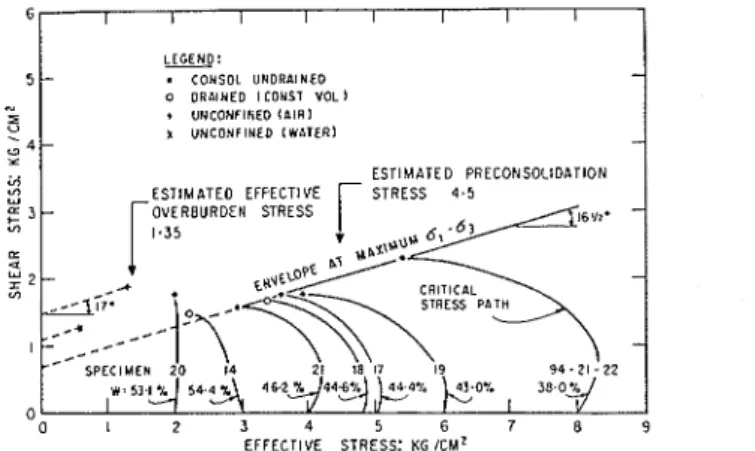
Details concerning these test specimens are given in Table 4 and the "critical stress paths"
(Crawford, 1961 (b)) are plotted in Fig. 3, terminating a t the maximum deviator stress. Also
shown in Fig. 3 are the best estimate of preconsolidation pressure, the present overburden effective stress a t the location from which the sample was taken, and the average unconfined
compression strength for soaked and unsoalted specimeils strained a t about the same rate as
the triaxial compression tests.
DISCUSSION O F TEST RESULTS
The Mohr envelope of stress paths, terminated a t maximum deviator stress, for specimens consolidated under pressure of 4 kg/sq. cm or more describes a soil with c1=0.7 kg/sq. cm and #'=16&" (Fig. 3). The undrained tests and the drained test (94-21-18) were in agreement.
140 C A R L B . C R A W F O R D
Under hydrostatic stresses of 4-8 kg/sq. cm each of the specimens was consolidated substan- tially (7-16
%
decrease in water content).At hydrostatic stresses of less than 4 kg/sq. cm the specimens consolidated very little (less than 1
%
decrease in water content) and the shear strength at failure was greater, in some cases ~nuch greater, than that described by the Mohr envelope. The constant volume drained test (94-21-14), consolidated under 3 lig/sq. cm, ended slightly above the envelope and a n ordinary compression test (94-21-20), consolidated under 2 lig/sq. cm, ended much above the envelope. The unconfined compression tests in air, in which pore pressures are unknown, failed a t stresses even further from the envelope. I t is most unlikely that these discrepancies can be explained b y errors in pore-pressure measurements.I t appears from these test results that the increase in strength due to consolidation does not compensate for loss of strength due to distortion of the soil structure b y the test. The significance of the slope of the envelope a t 164" is not clear. I t is the smallest angle
(4')
measured on Leda clay at the Division of Building Research and the low value may be due to the excellence of the undisturbed block sample. If t h e water contents at failure of specinlens 21 and 22 were the same, their differences in strength could be attributed to friction only butTable 4
Triaxial compression test results (sample 9 4 2 1 )
Specimen Water content, % ocl* :
lip, sq. cm n t e :
Initial Final %/hour
1
* ocl = effective consolidation stress. t A U j = change in pore pressure at failure.
-0:
.
CONSOL U H D R A I H E D 0 D R A I N E D I C O H S T VOL I 4 UHCOHFIHED I A l R l 1 U H C O H F I H E O I W A T E R ) x Y) ESTIMATED PRECONSOLIDATION OVERBURDEN STRESS 1.35 LT Q Y 2 - ..+ 0 0 1 2 3 4 5 6 7 8 9EFFECTIVE STRESS: KG ICM'
C O H E S I O N I N A N U N D I S T U R B E D S E N S I T I V E C L A Y 141
such is not the case. Probably the intrinsic stresses are eserting unequal influence and t h e true friction angle is something less than 166". Extrapolating back from the assumed effec- tive stresses a t failure in unconfined compression suggests that the soil has a cohesive strength of almost 1.5 kglsq. cm of which approximately one-half is due to rigid bonds that break when the soil structure is distorted.
The influence of rate of strain on unconfined compression strength was found to be about the same as shown previously for consolidated-undrained tests on similar soil (Crawford, 1959). The time of soaking appears to have only a secondary effect on the strength and there was no significant trend whether the specimens were soaked for 10 min. or for 3 days. In order t o compare strengths but to eliminate the influence of strain rate, the average compressive strengths for failure in 30 min. are indicated by a vertical line on Fig. 2. I t is seen t h a t although the strength of the strongest, most heavily overconsolidatedsoil(94-21) is most affected by soaking, it is reduced by only an average of 30%. The medium strength soil is affected about half as much. The weakest soil is apparently unaffected by soaking but the test information is not very extensive.
F A I L U R E PLANES
The types of failure that occur in this soil are illustrated in Fig. 4. When good undisturbed samples are tested they never fail by bulging. At about tlie time that the stresslstrain curve reaches a peal: the first evidence of a failure plane occurs. This is almost always at one end of the specimen indicating an influence of end restraint. If the specimen has been consolidated before shear the failure plane will be a t an angle, usually between 50" and GO0 to the horizontal. If the specimen has not been consolidated before shear, the failure plane (or planes) is usually vertical, indicating a splitting or tension failure. I n the soaked specimens the failure is invariably associated with vertical splitting.
To obtain more extensive general information on fracture patterns a review was made of about 200 recent laboratory strength tests on Leda clay for which the type of failure had been sketched. Although the significance of the fracture patterns had not been appreciated at the time, the review revealed some interesting facts. About 80% of the unconfined or un- consolidated triaxial compression tests on tube samples resulted in shear planes at an angle t o the horizontal similar to Fig. 4(a). I n unconfined compression tests on specimens cut from block samples, less than 50% of the failure planes were at an angle, the majority being vertical splitting failures (Fig. 4(b)). All of the water-immersed unconfined compression tests were on block samples and all failed by splitting (Fig. 4(c)). All of the consolidated-undrained triaxial compression tests were made on specimens cut from block samples and more than 80% of these had angle-type failures. The remainder had complex failure patterns due to large axial strains. In a preliminary way these observations and the photographs in Fig. 4 suggest t h a t sample disturbance, end restraint, and laboratory coilsolidation each have an important influence on the failure mechanism. Specimens cut from tube samples generally fail at a n angle. Specimens cut from block samples, on the other hand, generally fail by vertical splitting unless they are consolidated in the triaxial cell before shear. I t appears therefore that the disturbance to the sensitive soil structure caused by tube sampling or by laboratory consolidation may influence the mechanism of failure. Conditions of end restraint appear t o be equally important although the exact influence is not known. Unpublished observations suggest that end restraint may induce local pore pressures which initiate failure.
F A I L U R E MECHANISM
The mode of failure of test specimens may give a clue to the fundamental mechanism. It
is noted that in the consolidated-undrained test where failure is controlled by externally applied effective stresses, the failure plane is oriented as anticipated by Mohr-Coulomb. I n
142 C A R L B . C R A W F O R D .I
the other specimens which appear to fail in tension, i t is reasoned t h a t strength is controlled by intrinsic stresses and the applicability of Mohr-Coulomb is in doubt. This would be an unfortunate predicament because it is most desirable, for engineering application, t o have a satisfactory theory for the determination of shearing resistance from compression tests. I t may not be so serious in practice because effective stresses approach zero only in special cases. Vertical splitting would probably not occur even in the test specimen if there was a n y lateral effective stress on the specimen, but it may easily result from a small lateral tension if the specimen is on the point of failure under vertical compression. The lateral tension, in terms
of effective stress, could be caused b y a small pore pressure induced by structural
breakdown in the specimen just before failure. As noted previously, the end restraint may be instrumental in this pore-pressure development. The Mohr circle of stress, in such a case, would move to the left of ;he orilrin.
.,
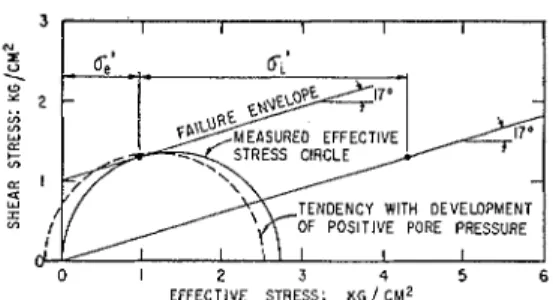
I n Fig. 5 is plotted the average effective stress circle a t failure for soaked specimens of
sample 9 4 2 1 when brought to failure in 30 min. The broken circle represents the tendency
for the circle to shift due to the developlnent of small positive pore pressures. The failure envelope, drawn a t 17" on the basis of previous discussion, strikes off a cohesion intercept equal to 1 kg/sq. cm. On the other hand, if the shearing resistance is considered to be entirely frictional, there must be an intrinsic stress (or an intrinsic stress effect) amounting to about
3.3 kg/sq. cm or more than three-quarters of the total. This observation helps to explain the
lack of agreement between triaxial tests and c/$ values measured in the field such as described
EFFECTIVE STRESS: K G / C M ~
Fig. 5. Interpretation of stresses at failure
by Bjerrum (1961). Unlike field tests, the effective stress on laboratory specimens decreases
in an undrained test, introducing intrinsic stress effects of unknown magnitude. If the inter-
granular stress is not equal to the computed effective stress in the triaxial test then agreement between the test and field values is not possible.
The intrinsic stress shown in Fig. 5 is obtained from the average stress circle a t failure for
soaked specimens. If the average stress circle for normal compression tests had been used, an
additional intrinsic stress of nearly 2 kg/sq. cm would be required to explain the shearing
resistance. If the general principle of a fundamental friction angle is accepted some explana-
tion for this sudden loss of intrinsic stress effect due to immersion must be found. One pos- sibility is that the relaxation of even small capillary stresses on immersion is sufficient to destroy some of the cemented bonds. Denisov and Reltov (1961) presented evidence that decrease in strength due to immersion is not related to capillary forces, but there is some
indication that the moderately overconsolidated Leda clay will react drastically to small
strains. Note, for instance, the predominance of angle failures on tube samples a n d the de- crease in strength of triaxially compressed creep tests (Fig. 2). Also, the carefully trimmed specimens cut from undisturbed block samples (94-21) had about twice the undrained strength of field vane tests or unconfined tests on samples obtained with the best thin-walled piston
Fig. 4. Failure planes (a) Consolidated-undrained (b) Unconfined compression (c) Soaked unconfined compression
I
C O H E S I O N I N A N U N D I S T U R B E D S E N S I T I V E C L A Y 143 sampler. I t seems reasonable therefore that the small strain, resulting from the loss of capillarity, may have a magnified effect on the relatively strong, rigid soil structure.
F U N D A M E N T A L S H E A R P A R A M E T E R S
By an ingenious analysis of a comprehensive series of direct shear tests, Hvorslev (1937) developed fundamental cohesion and friction parameters for remoulded clays whose natural structure had been destroyed. He found a simple coefficient of friction, constant for a particular soil, and attributed the cohesion to internal forces created by the complex soil-water system, its magnitude depending on void ratio.
The properties demonstrated in Fig. 1 show that for certain soils the cohesion component is not simply a function of voids ratio but is probably a complex function of soil structure, i.e. particle arrangement and interparticle forces. I t follows that the Hvorslev analysis cannot be applied to undisturbed soils of this type. On the other hand, if remoulded clays can be con- sidered to be frictional material there seems to be no reason why undisturbed clays should not have a similar quality but the determination of the true friction angle of many undisturbed soils may be very difficult because of more influential intrinsic stress effects.
Two observations draw attention to possible Limitations in applying computed effective stresses and classical friction concepts when dealing with Leda clay or similar soils. First, the laboratory failure conditions a t low stresses (Fig. 4) do not suggest a frictional slippage. Secondly, an unusual field observation (Fig. 6) showed distinct cleavage planes occurring at a slope of 45" to the horizontal as a result of excavating 30 ft of moderately overconsolidated
soil a few yards from the natural location of sample 94-21. I t appeared that the stress release
of this brittle soil caused a fracture pattern related to a fundamental cohesion failure. These examples do not mean that the soil is frictionless but they do suggest that in both cases the intrinsic stresses are controlling the fracture pattern. This phenomenon is probably limited to cases where the stress level a t failure is somewhat lower than the preconsolidation pressure of the clay.
Any development of fundamental shear parameters for undisturbed soils cannot ignore structure. I t is suggested that the concept of external (a,l) and intrinsic (ail) stresses acting
through a single true angle of friction
(4,)
is a step in the right direction. The intrinsic stress concept cannot be taken too literally, however, because the actual magnitude of stress may bemuch smaller than that indicated by ail. The measured shear strength attributed to intrinsic
stresses may be derived largely from the space frame of particles with relatively small intrinsic stresses merely holding the contact points in position. The inability of the specimens t o resist small lateral tensile stresses suggests that intrinsic stresses are small. They might preferably be termed "equivalent intrinsic stresses".
P R A C T I C A L S H E A R P A R A M E T E R S
A strong argument can be advanced for a much more critical examination of the cohesion intercept in terms of effective stresses than has been given in the past. Because of the influence of intrinsic stresses it is difficult to justify the arbitrary application of ordinary effective stress
methods to undisturbed clays. Moreover, the cohesion intercept, c', for Leda clay seems to be
a function of the test procedure rather than a property of the material (Crawford, 1959). In view of this it appears necessary to use effective stresses only in conjunction with a fundamental friction parameter such as that suggested previously (Crawford, 1961(b)). Further study of the cohesion intercept (or intrinsic stress effect) is required because it con- tributes most of the shearing resistance in the working stress range. This leads to the view that total stress analyses of stability problems in this soil may be satisfactory provided proper allowance is made for strain rate and sampling effects.
This suggestion must not preclude the need to visualize every problem in terms of effective stresses. Not only must effective stress concepts be retained, they must be improved. I t is
, /
144 C A R L B . C R A W F O R D
necessary to consider the intrinsic stress effects which cannot be evaluated by simply subtracting measured pore-water pressure from total stress. As long as measured effective stresses are high the shearing resistance can be explained by classical friction concepts but when applied effective stresses are reduced and shear resistance is still maintained, clearly the accepted effective stress concepts are inadequate and cannot be used with confidence. I t is un- important whether "cohesion " or "friction " (in the empirical sense) is mobilized first if it is
ag~eed that all shearing resistance is frictional. I t is important to understand the source of the true intergranular stresses in order to anticipate and understand time effects. If the actual magnitude of intrinsic stresses is small, the "dilatant " friction component visualized by Rosenqvist (1959) and Lambe (1960) may be extremely important.
CONCLUSIONS
From the analyses of these test results, the following specific conclusions are suggested:
(1) Strength theories developed using remoulded soils cannot be applied directly to undisturbed sensitive clays.
(2) Rate of strain or time to failure has a great influence on measured compressive strength.
(3) A non-swelling undisturbed clay may have a substantial shearing resistance under very small applied effective stresses.
(4) Most of this shearing resistance is attributed to cohesion or to friction caused by intrinsic stresses.
(5) The development of intrinsic stresses and bonds between soil particles appears to depend a great deal on the geologically applied effective stresses.
(6) Their influence on shear strength is considered to be more important during stress release than at maximum preconsolidation pressure.
(7) At stresses substantially below the preconsolidation pressure the mode of failure appears to be controlled by intrinsic stresses and the applicability of Mohr- Coulomb theory is in doubt.
(8) Disturbance due to sampling and to laboratory consolidation greatly affects the shearing resistance due to partial destruction of the geologically developed soil structure.
(9) I t does not appear that the intrinsic stresses applied to a coefficient of friction com- pletely describes the mechanism. The arrangement of the soil particles is thought to be an important factor.
(10) Failure to account for intrinsic stresses during a triaxial test will tend to result in too high friction angles in terms of measured effective stresses and this may partly explain the lack of agreement between laboratory tests and field evidence.
(11) For certain clays it is not satisfactory to compute effective stress by subtracting pore-water pressure from applied stress and using this value in an equation for frictional resistance.
Many questions are yet unanswered. These tests have merely demoilstrated the prominent role of intrinsic stresses in controlling the stress-deformation properties of a particular un- disturbed clay soil. This suggests a need for caution in applying the usual effective stress analysis to the solution of engineering problems involving this type of soil. I t would be a mistake to discount the value of effective stress analysis for other soils, especially compacted clays. At the same time the need for more research on the influence of intrinsic stress on true intergranular stress is evident.
A major point for discussion is the concept that in an undisturbed highly structured clay a cohesive-type resistance takes over from the frictional resistance as the effective stress level
1
C O H E S I O N I N A N U N D I S T U R B E D S E N S I T I V E C L A Y 145
decreases either naturally or during a test. This concept is most important to the inter- pretation and application of laboratory test results to field problems involving a geological or construction time scale.
ACKNOWLEDGEMENTS
The assistance of D. C. MacMillan and B. J. Bordeleau in carrying out the laboratory testing
with extraordinary care and interest is gratefully acltnowledged. The Author benefited greatly from the constructive criticism of his associates in the Division of Building Research, particu-
larly W. J. Eden, E . Penner, and R. F. Legget, Director of the Division, with whose approval
this Paper is published.
REFERENCES
BELL, A. L., 1881. "The lateral pressure and resistance of clay and the supporting power of clay founda-
tions." M i n . Proc. Instn civ. Engrs, 199 : 233-336.
BJERRUM, L.. 1961. "The effective shear strength parameters of sensitive clays." Proc. 5th I n t . Conf.
Soil Mech., Paris. 1 ::3-28.
BOROWICKA, H., 1961. The mechanical properties of soil." Proc. Fiftlz I n t . Conf. Soil ilfech., Paris,
1 : 39-42.
B o ~ o w l c l c ~ , H., 1962. "Soil mechanics-rock mechanics." Mitteilungen des Institutes fzlr Grundbaz~ u n d
Bodenmeclzanik, Technische Hochschule W i e n , Heft 4.
CASAGRANDE, A., 1932. "The structure of clay and its importance in foundation engineering." Boston
Soc. civ. Engrs, Contributions to Soil Mechanics, 1925-1940, pp. 72-113.
COLLIN, A., 1846. "Landslides in clays." U n i v . Toronto Prcss, 1956, 160 pp. (Translated by W. R.
Schriever.)
CRAWFORD, C. B., 1959. "The influence of rate of strain on effective stresses in sensitive clay." Amer. Soc.
Test. Materials, Special Tech. Publ. NO. 254, pp. 36-61.
CRAWFORD, C. B., 1960. Discussion in Proc. Amer. Soc. civ. Engrs, Research Conf. Shear Strength of Cohesive
Soils, Boulder, Colorado, pp. 1080-1086.
CRAWFORD, C. B.. 1961(a). "Engineering studies of Leda clay." I n "Soils in Canada". Royal Soc. Can.. - <
~ $ e c i a l Pzcbl; No. 3,
bp.
200T217.-
CRAWFORD, C. B., 1961 (b). "The influence of strain on shearing resistance of sensitive clay." Proc. A m e r .
Soc. Test. Materials, 61 : 1250-1276.
DAWSON, G. M., 1899. "Remarkable landslip in Portneuf County, Quebec." B u l l . Geol. Soc. Amer.,
10 : 484490.
DENISOV, N. J., and B. F. RELTOV, 1957. "Elastic and structural deformations of clayey soils." Pvoc.
Fourth I n t . Co~zf. Soil Mech., Lolzdon, 1 : 17-21.
DENISOV, N. J., and B. I?. RELTOV, 1961. "The influence of certain processes on the strength of soils."
Proc. F i f t h I n t . C o n f . Soil Meclz.. Paris. 1 :75-78.
EDEN, W. J.: 1960. ~ k c u s s i o n in
roc.
~ i z e r . Soc. civ. Engrs, Research Conf. Shear Strength of CohesiveSoils, Boztlder, Colorado, pp. 1021-1025.
EDEN, W. J., and J . I<. ICUBOTA, 1961. "Some observations on the measurement of sensitivity of clays."
Proc. Anzer. Soc. Test. Materials, 61 : 12??-1249.
FORMAN. S. A.. and T. E. BRYDON, 1961. Clay mineralogy of Canadian soils." I n "Soils in Canada",
--
Royal S O ~ . - ~ a n . , ~ ~ $ e c i a l Publ. N o . 3, pp. 140-146.
GOLDER, H. Q., 1948. "Coulomb and earth pressure." Giotechniqzre, 1 : 1 : 66-71.
GOLDSTEIN, M., and G. TER-STEPANIAN, 1957. "The long-term strength of clays and depth creep of slopes."
Proc. Fourth Int. Conf. Soil Mech., London, 2 : 31 1-314.
HVORSLEV, M. J., 1937. " Uber die Festiglteitseigenschaften Gestorter Bindiger Boden" ("On the physical
properties of disturbed cohesive soils"). Ingeniorvidenskabelige, Skrifter A , No. 45.
I~JAERNSLI. B., and N. SIMONS, 1962. "Stability investigations of the north bank of the Drammen River."
Gdotechnique, 12 : 2 : 147-167.
LAMBE. T. W.. 1953. "Structure of inoreanic soils." Amer. Soc. civ. EPLWS. S e ~ a r a t e 315.
LAMBE; T. w.,' 1958. "The structure of pompacted clay." J. Soil Mech. h i . , @roc. Amer. Soc. civ. Emgrs,
Paper 1654, pp. 1-34. May 1958, SM2.
LAMBE, T. W., 1960. "A mechanistic picture of shear strength in clay." Proc. A m e r . Soc. civ. Engrs,
Research Conf. :hear Strength of Cohesive Soils, Boulder, Colorado, pp. 555-580.
LO, I<. Y., 1961. Stress-strain relationship and pore-water pressure characteristics of a normally con-
solidated clay." Proc. Fifth Int. Cogzf. Soil M ~ z . , Paris, i :219-224.
MICHAELS, A. S., 1959. Discussion in Proc. A m e r . Soc. civ. Engrs-J. Soil Mech. and Found. Div., 85:2:
91-102.
NEWLAND, P. L., and B. H . ALLELY, 1956. "Results of some investigations on two sensitive clays." PYOG.
C A R L B . C R A W F O R D
OSTERMAN, J., 1960. "Notes on the shearing resistance of soft clays." A c t a Polytechnics Scatzdiiznuica,
26311959, Stockholm, 22 pp.
PARRY, R. H. G., 1959. "Latent interparticle forces in clays." Nntztre, 183: 538-539.
PENNER, E., 1963. " Sensitivity in Leda clay." iVatzrre, 197 : 4865 : 347.
P u s c ~ , ROLAND, 1962. "Clay particles, their size, shape, and arrangement in relation to some important
physical properties of clays." Handlingnr, N o . 40, T m n s . , Utgivare: Statens Rad for Bygg~zadsforskni~zg,
Stockkol~?z, 150 pp.
RENDULIC, L., 1937. " Ein Grundgesetz der Tonmechanik und sein experimenteller Beweis" ("The funda-
mental law of clay mechanics and the experimental proof "). Baz~ingenieur, 18 : 459467.
ROSCOE. I<. H.. A. N. SCHOFIELD, n~zd C. P. WROTH. 1958. "On the vieldina of soils." GE'otecligziaz~e.
ROSENQVIST, I. TH., 1953. "Considerations on t h e sensitivity of Norwegian quick-clays." Ge'otech~ziqzte
3 : 5 : 195-200.
ROSENQVIST, I. TH., 1955. "Investigations in t h e clay-electrolyte-water system." Norwe,yi.atz Ge'otech.
Inst., Publ. No. 9, Oslo.
ROSENQVIST, I. TH., 1959. " Physico-chemical properties of soils: soil-\\rater sj-stems." Pvoc. Awzer. SOG.
ciu. Engrs, J . Soil MEGIL. Diu., 85:31-53.
SKEMPTON. A. W.. and R. D. NORTHEY. 1952. "The sensitivitv of clavs." Ge'otecknioz~e. 3 . 1 : 30-53.
SICEMPTON; A.
and
A. W. BISHOP, 1954. "Soils." Chap. 16 of " 13&ilding material;, their elasticity andinelasticity". North Holland Publishing Co., Anzsterdain, pp. 417482.
SKEMPTON, A. W., 1960. "Significance of Terzaghi's concept of effective stress." 112 "From Theory t o
Practice in Soil Mechanics". S e l e c t i o ~ ~ s from the Writitrgs of Karl Terzaglzi, Toh~z W i l e y , N e w Y o r k , - -
pp. 42-53.
TAYLOR, D. W., 1948. "Fundainentals of soil mechanics." John W i l e s , Nezu I'ovk, 700 pp.
TERZAGHI, I<., 1941. "Undisturbcd clay samples and undisturbed clays." Boston Soc. civ. Ewgrs, Con-
tribz~tions lo Soil iWechanics, 1941-1953, pp. 45-65.
TROLLOPE, D. H., 1961. "Effective contact stresses and friction." Nalzrve, 191:376-377.
W A R I ~ N T I N , B. P., and M. Rozozu~c, 1961. "Shrinking and sxvelling properties of two Canadian clays."