Publisher’s version / Version de l'éditeur:
Engineering Journal, 49, 9, pp. 15-19, 1966-10-01
READ THESE TERMS AND CONDITIONS CAREFULLY BEFORE USING THIS WEBSITE. https://nrc-publications.canada.ca/eng/copyright
Vous avez des questions? Nous pouvons vous aider. Pour communiquer directement avec un auteur, consultez la
première page de la revue dans laquelle son article a été publié afin de trouver ses coordonnées. Si vous n’arrivez pas à les repérer, communiquez avec nous à [email protected].
Questions? Contact the NRC Publications Archive team at
[email protected]. If you wish to email the authors directly, please see the first page of the publication for their contact information.
NRC Publications Archive
Archives des publications du CNRC
This publication could be one of several versions: author’s original, accepted manuscript or the publisher’s version. / La version de cette publication peut être l’une des suivantes : la version prépublication de l’auteur, la version acceptée du manuscrit ou la version de l’éditeur.
Access and use of this website and the material on it are subject to the Terms and Conditions set forth at
Vibration measurements on a modern steel bridge
Ward, H. S.
https://publications-cnrc.canada.ca/fra/droits
L’accès à ce site Web et l’utilisation de son contenu sont assujettis aux conditions présentées dans le site LISEZ CES CONDITIONS ATTENTIVEMENT AVANT D’UTILISER CE SITE WEB.
NRC Publications Record / Notice d'Archives des publications de CNRC:
https://nrc-publications.canada.ca/eng/view/object/?id=8ab64ac7-e54f-41a1-9d8c-67ad3a2dc1b4
https://publications-cnrc.canada.ca/fra/voir/objet/?id=8ab64ac7-e54f-41a1-9d8c-67ad3a2dc1b4
by
H.
S.
WARD
Reprinted from
THE ENGINEERING JOURNAL
Vol. 49, No. 9, September 1966,
p. 15-19
Research Paper No. 294
of the
Division of Building Research
OTTAWA
October 1966
MESURE DES VIBRATIONS D'UN PONT MODERNE EN AClER
SOM MAlRE
Le prCsent expose dCcrit les mCthodes de mesure des vibrations d'un pont d'acier h travtes multiples, h poutres-maPtresses latCrales, dont la longileur dCpasse 2,000 pieds. Les mesures ont CtC rCalisCes h la travCe centrale du pont, soumise h des charges dynarniques relativement ClevCes dues
B
l'impact des roues de camions roulant sur le tablier inachevt. Bien que les oi~vriers travaillant sur le pont aient nettement ressenti les vibrations, les rtsultats des mesures montrent que les tensions induites dans les ClCments du pont Ctaient faibles. Une mCthode simple a t t t utiiisCe pour obliger la travCe centrale a entrer en vibration sur ses frCquences propres, et on a obtenu une estimation de ses caracttristiques d'amortissement.n Measurement
ing approximately 10 tons moving at about 10 mph in the direction of Ottawa. This meant that the bridge was receiving National Research Council
a series of impacts due to the truck falling through 1 % in. every 3 seconds.
EIC-66-BR STR 16 Each series of impacts would be made
up of the different sets of wheels going proximately 9 tons, was parked at the over the expansion joints, and t The ratio of live to dead load is gener- centre of the central span of the bridge dividual impacts would re ally higher for bridges than for most SO that it would not create an unsym- proximately 2 tons falling
other structures. The major live load, metrical loading condition. The vertical In. because there were that imposed by is dynamic in vibrations of the bridge were recorded wheels. If it is assumed tha
this is generally accounted ign by applying an impact he static load. Because aes- ons~derations are leading t o more structures, however, the time e approaching when a more structural dynamic analysis equired in bridge design. ingly the author was glad to self of the opportunity to make ration measurements during the tages of construction of the Mac- Id-Cartier Bridge Fig. 1. This bridge, ch connects Ottawa t o Hull, is of 1 girder construction, with five spans and a total length of approximately
Procedure
Vibration measurements were taken on two separate days, August 29 and Octo- ber 13, 1965. On August 29, the con- crete deck of the bridge was complete, but the final 1 % in. of bituminous ma- terial was not in place. This meant that the steel sections which act as part of the expansion joints in the deck were raised 1% in. above the concrete deck; the expansion joints are at 45-ft. centres along the length of the bridge. At this time there was still much constructional activity, in particular with regard to the placing of the sidewalk safety fence. On October 13 the bridge deck was com- pleted, and there was very little activity on the bridge.
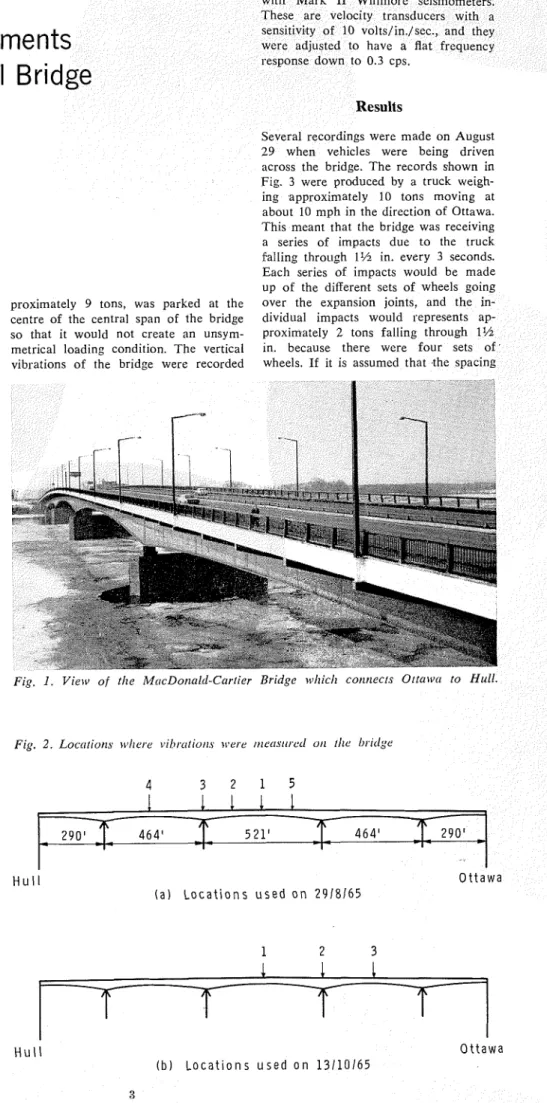
The locations at which the measure- lnents were taken on the two dates are shown in Figs. 2a and 2b. In each case the measurements were taken on the eastern side of the bridge, on the traffic lane nearest to the central median. The mobile laboratory of the Division of B ~ ~ i l d i n g Research, which weighs ap-
Fig. I . View of tlze Mc~cDonulcl-Currier Bridge which cotltzects Ottu\vci t o Hull.
I
H u l l ( a ) L o c a t i o n s u s e d o n 2 9 / 8 / 6 5I
O t t a w a H u l l O t t a w a ( b ) L o c a t i o n s u s e d o n 13110165'
t
Fig. 3. Vrhrntioris carrscd b y 10 toil trcr~li drivir~g o v e r rcri.ted e.~prrrz~ior~ joirlts rrt approxirnntely 10 M.P.H.
L L o c a t i o n 3
(I-
I
I I I I I-
0 1 2 3 4 5
T I M E F R O M T H E S T A R T OF T H E F O R C E D O S C I L L A T I O N O F T H E T R U C K ( S E C I .
Fig. 4 . Vi/~rrrtiorzs c n ~ t s e d b y tlre forced verticcrl oscillntior~s o f n strrtiorlnry trtrcA.
.
F o r c e d O s c i l l a t ~ o n s o f t h e t r u c k f l n i s h e d.
F o r c e d O s c i l l a t ~ o n s o f t h e t r u c k f l n i s h e d--I
1 3 1 4 I M E F R O M T H E S T A R T OF T H F F O R C E D O S C I L L A T I O N OF T H E TRUCI: ( S F C I . Fig. 5 . V i l proximately twice th vibrations at the nortions 1 and 2 were as the truck passed
centre of the bridge the tion level obtained dur was recorded; this level w peak to peak and the approximately 2 cps whic
way between the levels which, accordin to Reiher and Meister (I), humans find to be "perceptible" and "disturbing".
Another set of recordings was made of the response of the bridge due to the forced vertical oscillations of the stationary laboratory truck parked at the centre of the bridge. A visual dis- play of the bridge vibrations was used to enable the people in the truck to force the vehicle to vibrate so that one of the natural frequencies of the central span was excited. F ~ g u r e s 4 and 5 show how the vibrations were built LIP and Fig. 6
shows how they decayed when the forced vibration of the truck was discontinued. The mode of vibration of the bridge that was excited had a frequency of 2 cps. T h e reason it was possible to excite this particular mode can be ex- plained by considering the vibration characteristics of the truck and its sus- pension. For the case of vertically ap- plied loads the vehicle can be considered equivalent to a heavily damped single- degree-of-freedom system. This was demonstrated by recording the vibrations of the vehicle caused by a person jump- ing up and down at different rates. I t was shown in this manner that the truck could bc forced to vibrate through a frcqucncy range from 2 cps to 5 cps.
vibrations of the
amplitude of vibration 0.166
he quarter points of the interesting thing to notice
%
one point moves down the 0. 166
Fig. 7. Vibrcrtiot~~ rrt five locntiorrs otl the bridge caused b y the forcecl vertical oscillcrtiot~s of cr strrtiotrrrry trlrck.
Theoretical Analysis
rmation obtained to this point Area method to calculated the deflec- shapes are also shown in Fi
tral span of the MacDonald-Cartier quency vibration. The records a1
Bridge was therefore performed. T h e that the vibration was not tra
assumptions that were made are shown to the central span. Finally,
In Fig. 8a. I t was assumed that the span was fixed at each end and that the central two thirds of the span had a second moment of area equal 1/4 whereas the rest of the span had a
value equal to I. The numerical values 0.01 in./second peak to peak.
of I were obtained by taking average On October 13 the bridge
6000 kips.
The flexibility r n a t ~ i x of the girder (117) lcd to values O C 0.87 cps and 2.16 was parked at the ce
Fig. 9.
( b ) F u n d a m e n t a l mode s h a p e d ( f r e q u e n c y = 0.87 c p s )
/*A.
S e c o n d mode s h a p e ( f r e q u e n c y = 2.16 c p s )
Simplified nnalysis of tile c m l r n l spoil of t l ~ e Mric- -CarIier Bridge.
and a 1%-ton panel truck was driven across the bridge. Figures 11 and 12 show the vibration records obtained at three locations when the panel truck was being driven northwards at a speed of 30 mph. The records show that the amplitude of vibration was a maximum at each location as the truck passed tht location, and this level was around 0.02 in./second, peak to peak. The fre- cies of the vibrations were quite between 10 to 15 cps, although does appear to be a low frequency omponent for location 1 in Fig. 12
hown by the dotted line).
a frequency of 10 cps is used, the maximum displacements caused panel truck were in the region 0003 in. peak to peak. If the low ency vibration is as sketched in
.
12 it would represent a displace- ment at the centre of the central span equal t o 0.003 in. peak to peak. When this level is increased by a factor of six, to make it equivalent to the effect say a 10-ton truck, it is still less nearly a factor of 4 than those shown Fig. 3. Table I shows the vibration evels that were caused by the panel truck being driven at four different speeds. T h e amplitudes and frequencies of vibration were essentially the same in each case.Fig. 10. Bnckgrotir~d vibrotioris oil tlie bridge.
Table I
Vibration Levels Meas~ired on the MacDonald-Cartier
Bridge d~ae to the Passage of a 1%-Ton Truck
Truck Speed, m.p.1~.
Trctclc Inslr~imenl 5 15 20 30
Jocalion Locnlion (peak-lo-peal; uelocil~i, ~ n . / s e c )
I 0.020 0.030 0.016 0.020
I 2 0 0.012 0 0
3 0.001 0.010 0.008 0.004
Discussion of Results
The results obtained on the two days show the important influence of the type of exciting force o n the response of a structure. When there was a definite pronounced impact on the bridge, caused by vehicles moving across the raised expansion joints, relatively high vibra- tion levels were created in what ap- peared to be the first two modes of vibration of the central span. When the bituminous coating was in place there was no longer a pronounced impact causcd by vehicles; the a ~ n p l i t ~ ~ d e s of
vibration were much smaller and a mode of vibration higher than the second was excited (perhaps the fourth mode).
The results obtained for the response of the central span to the forced oscil- lations of a stationary truck indicate that there was only 2% of critical damp- ing for the second mode of vibration, when there was no bituminous material in place. It would have been of great interest to see if the addition of bitumin- ous material had increased the damping. but unfortunately this was overlooked at the time.
,
Truck passing TrucK p assingI
' O c a t l O n!L-..---
Location 1 0 ur
0.0;{
[
[
Location 2 W n V1 WI
1 second rI
, >-
z Location 3 0.04{
[
[
Fig. 11. Sample of vibrntion records crrlrsed b y I?/z tori trrrck trcrvellir~g nt 3 0 M.P.H.
T r u c k p a s s i n g
L o c a t i o n
1
0 . 0 4
{[
I
l o c a t i o n
n Z 0u
W V,-
rn[
0.04
{
[
L o c a t i o n
2
a m - Z-
&--
L o c a t i o n
3
Fig. 12. Snrnple of vibration records cirrrserl by 1% toll truck travellir~g rrt 3 0 M.P.H.
designer's viewpoint will be the stresses .I
fd
d 2 y caused by the dynamic loads. Since the (T = -- =Ed
-I
d.cZ ( 2 )simple model shown in Fig. 8 gives
results which are in agreement with the where d is the distance from the neutral measured values, it is possible to make axis to the top of the flange of the an estimate of the stresses induced by girders.
the vibrations that are described here. If E is taken to equal 30 x 106 Ib./sq. F o r example, the 10-ton truck moving in., the maximum stress, caused by the across the central span caused a maxi- highest vibration level measured during mum vibration of 0.08 in. peak to peak
at the quarter point of the span at a frequency of 2 cps. This frequency represented the second mode shape which is shown in Fig. 8c. A crude estimate has been made of the second differential of the curve in Fig. 8c when the deflection at the quarter point is 0.04 in. I n this case the maximum stress,
U , occurs at L / 3 from the supports and
its value is given by,
the two days, is found to be 250 lb./sq. in. This value is based o n the assump- tion that the deck and the girder act in an integral manner.
Even though the vibration levels recorded when a single vehicle moved across the completed bridge were low, there is a good possibility that under full traffic loading the vibration levels could become con~par;~tively large. It would therefore be of interest to try
and measure the vibrations under these conditions since it might be of signifi- cant interest to designers. F a r more in- formation could have been obtained if there had been a controlled method of exciting the bridge. Some thought was given to different ways of doing this, but the great difficulty with large struc- t ~ ~ r e s like the MacDonald-Cartier Bridge is the fact that a large force is required at a low frequency. If any more work is to be done in this field, it would be worthwhile to give serious thought to this factor.
Conclusions
The levels of vibration measured before the final road surface was in place were very noticeable to people o n the bridge, but the instrumental records showed that, beyond the point of impact itself, vibrational stresses induced in the bridge were probably n o greater than 250 psi. When the final bituminous sur- face was in place the cause of the im- pacts was eliminated, and the vibration levels created by road traffic were significantly reduced.
The vibration measurements indicated that the bridge was lightly damped and acted as if the separate spans were fixed at the supports. The close agreement between the measured frequencies of vibration and those obtained from a simple theoretical model indicates thrat this twofold approach to a study of the dynamic response characteristics of modern bridges could be a fruitful field of research.
Acknowledgenients
The author is grateful to two mem- bers of the Dominion Bridge Company, Ramsey Murray who first suggested the project and Dr. Ross Chamberlain whose comments o n an early draft of the paper were helpful in determining its final form. Thanks are due also to the struc- tural engineering staff of the Department of Public Works, Canada, who reviewed the paper and concur in its publication. This paper is a contribution from the Division of Building Research, National Research Council, Canada, and is pub- lished with the approval of the Director of the Division.
References
1. Die Ernpfindlichkeit des Menschen
gegen Erschutterungen. H. Reiher and
F. J. Meister, Forschung auf dem Gebiete des Ingenieurwescns, 193 1,
This publication is being distributed by the Division of Building Research of the National Research Council. It should not be reproduced in whole or in part, without permission of the original publisher. The Division would be glad to be of assistance in obtaining such
Publications of the Division of Building Research may be obtained by mailing t appropriate remittance, (a Bank, Express, or Post Office Money Order or a cheque ma payable at par in Ottawa, to the Receiver General of Canada, credit National R-search Council) to the National Research Council, Ottawa. Stamps are not acceptable.
A coupon system has been introduced to make payments for publications relatively simple. Coupons are available in denominations of 5, 25 and 50 cents, and may be obtained by making a remittance as indicated above. These coupons may be used for the purchase of all National Research Council publications.
available Building