Communicative Efficiency in the Lexicon
byPeter Nepomuk Herwig Maria Graff
M.A. with First Class Honours in English Language and Linguistics, University of Edinburgh, 2007
Submitted to the Department of Linguistics and Philosophy in partial fulfillment of the requirements for the degree of
Doctor of Philosophy in Linguistics at the
Massachusetts Institute of Technology
ARCHIVES
2012
© 2012 Peter Graff. All rights reserved.
The author hereby grants to MIT permission to reproduce and distribute publicly paper and electronic copies of this thesis document in whole or in part in any medium now known or hereafter created.
S ignature of A uthor... ..
Peter Graff Department of Linguistics and Philosophy
C e rtifie d b y ...
Edward Flemmi Associate Professor of Linguistics
Thesis Supervisor
Certified by...
Donca Steriade Class of 1941 Professor of Linguistics Thesis Supervisor
/7
Accepted by...
David Pesetsky Ferrari P. Ward Professor of Modern Languages and Linguistics Chair of the Linguistics Program
Communicative Efficiency in the Lexicon by
Peter Nepomuk Herwig Maria Graff
Submitted to the Department of Linguistics and Philosophy on August 31, 2012 in Partial Fulfillment of the
Requirements for the Degree of Doctor of Philosophy in Linguistics.
In this dissertation, I argue that a variety of probabilistic patterns in natural language phonology derive from communicative efficiency. I present evidence from phonetically transcribed dictionaries of 60 languages from 25 major language families showing that both probability distributions over phonological structures licensed by the categorical grammar, and the global organization of the phonological lexicon as a whole facilitate the efficient communication of intended messages from speaker to listener.
Specifically, I show that the occurrence probabilities of different grammatical structures render natural language phonology an efficient code for communication given the effort involved in producing different categories and the specific kinds of noise introduced by the human language channel. I also present evidence that co-occurrence restrictions on consonants sharing place features serve a communicative purpose in that they facilitate the identification of words with respect to each other. Furthermore, I show that the organization of the phonological lexicon as a whole is subject to communicative efficiency. Concretely, I show that words in human language preferentially rely on highly perceptible contrasts for distinctness, beyond what is expected from the probabilistic patterning of the individual sounds that distinguish them. This shows that redundancy in the phonological code is not randomly distributed, but exists to supplement imperceptibile distinctions between larger units as needed.
I argue that cross-linguistic biases in the distributions of individual sounds arise from humans
using their language in ways that accommodate anticipated mistransmission (Jurafsky et al. 2001, van Son and Pols 2003, Aylett and Turk 2004) thus presenting a serious challenge to theories relegating the emergence of communicative efficiency in phonology to properties of the human language channel only (Ohala 1981, Blevins 2004, 2006). Furthermore, I present preliminary computational and experimental evidence that the optimization of the lexicon as a whole could have arisen from the aggregate effects of speakers' biases to use globally distinct word forms over the course of a language's history (cf Martin, 2007).
Thesis supervisor: Edward Flemming Title: Associate Professor of Linguistics Thesis supervisor: Donca Steriade
Thesis Errata Sheet
Author __ Peter Gr~:ff _ _ . _ . ____ . _____ .. ___________ . ______ _ Primary Dept. . ... ~J~.g~.i§!.i.~~_
..
~DsJe.hU_9.~gQt!Y_... _._._._ ... _
Degree _P~D._. ____ .. Graduation date ._._§~p_.~_Q!L
Thesis title
Communicative Efficiency in the Lexicon
Brief description of errata sheet
Number of pages_._~_ ... _ (J.J. maximum, including this page)
~ Author: I request that the attache<1£:~~ltfeeti,-e;K1CJed to my thesis. I have attached two
copies prepared as prescribe aration.
Date 7/24/2013
~ Thesis Supervisor or Dept. Chair: I approve the attached errata sheet and recommend its addition to the student's thesis.
Signature __________ _
Name
._._._._J?_.1?_.~
..
~_1
___ . __
2_Tf'
f-t
ff
J)~
[Z]
Thesis supervisor Dept. Chair~ Dean for Graduate Education: I approve the attached errata sheet and direct the Institute Archives to insert it in.to aJ.1\copie~the student's thesis held by the MIT Libraries, both print and electronic. / "
I)
( I
n
p. 18, lines 6 - 8
I show that this holds for oppositions between English phonemes in particular, but also more generally for broad classes of phonological contrasts in context across a variety of different languages .
... should read ...
I show that this holds for broad classes of phonological contrasts in context across a variety of different languages.
p. 24, lines 14 -19
Chapter 5 elaborates on the notion of word-distinctness and presents a study of the minimal pairs of English. The results show that English words preferentially rely on perceptible contrasts for distinctness. Chapter 6 generalizes these findings to languages other than English and shows that the extent to which the words of other languages rely on different place contrasts for distinctness follows from the perceptibility of those contrasts in context.
... should read ...
Chapter 5 elaborates on the notion of word-distinctness and presents a study of the minimal pairs of English. The results show no effect of perceptibility on the number of minimal pairs for 120 word-initial contrasts in English. In Chapter 6, however, I show that the extent to which the words of other languages rely on different place contrasts for distinctness does indeed follow from the perceptibility of those contrasts in context. These results hold across 60 different languages.
p. 84, lines 6 -13
Building on the results for strictly identity presented in Section 4.4, which show that the probabilistic attestation of a particular class of words (Le., words with identical consonants) is dependent on the underattestation of a class of globally similar words (Le., words with consonants sharing place features), I show that communicative efficiency in natural language phonology goes further: not only the distributions of individual sounds in local and non-local context are subject to communicative efficiency, but also the particular contrasts distinguishing among words. I present evidence for this hypothesis from the probabilistic patterning of the minimal pairs of English .
.. . should read ...
Building on the results for strictly identity presented in Section 4.4, which show that the probabilistic attestation of a particular class of words (Le., words with identical consonants) is dependent on the underattestation of a class of globally similar words (Le., words with consonants sharing place features), I hypothesize that communicative efficiency in natural language phonology goes further: not only the distributions of individual sounds in local and non-local context are subject to communicative efficiency, but also the particular contrasts distinguishing among words. I present evidence bearing on this hypothesis from the probabilistic patterning of the minimal pairs of English.
p. 91, lines 14 - 20
As expected, the number of minimal pairs for each contrast increases significantly with the number of lemmas featuring the less frequent sound (J3=0.61 , z=36.7, p<.00001, X2(1 )=1885.23, p<.00001) as well as with the number of lemmas featuring the more frequent sound (J3=0.25, z=7.43, p<.00001, X2(1 )=56.36, p<.00001). Critically, we observe the predicted effect of perceptual distinctness, such that the number of minimal pairs for each contrast increases significantly with their perceptual distinctness beyond what is expected from the individual frequencies of sounds (J3=0.06, z=3.58, p<.0005, X2(1 )=13.09, p<.0005) .
... should read ...
As expected, the number of minimal pairs for each contrast increases significantly with the number of lemmas featuring the less frequent sound (J3=0.67, z=41.37, p<.00001, X2(1 )=2896.9, p<.00001) as well as with the number of lemmas featuring the more frequent sound «(3=0.33, z=8.03, p<.00001, X2(1 )=68.42, p<.00001). However, we find no effect of perceptual distinctness on the number of minimal pairs beyond what is expected from the individual frequencies of sounds «(3=0.02, z=0.99, p=.32, X2(1 )=0.98, p=.32).
p. 92, line 2 - p. 93, line 9
These results establish a direct link between the distinctness of words in the lexicon and the perceptual distinctness of the sounds that compose them, as indicated by the significant effect of perceptibility on the number of attested minimal pairs, after controlling for base frequencies of the relevant sounds. This finding provides support for the hypothesis that the global organization of the lexicon of English is optimized for the recoverability of individual words, beyond what is expected from the distributional properties of individual sounds. These results add to the growing body of recent evidence suggesting that the lexicon is globally optimized to allow language to fulfill its communicative function (e.g., Piantadosi et al. 2009, 2011). The result presented above is subject to four important qualifications. First, the current study only assesses the effect of perceptibility on lexical contrast in a single phonological environment and for a single language. In Chapter 6, I show that the observed effect also generalizes to phonological environments other than word-initial pre-vocalic context and languages other than English .
... should read ...
These results fail to establish a direct link between the distinctness of words in the lexicon and the perceptual distinctness of the sounds that compose them. This is because the number of attested minimal pairs in English follows directly from the base frequencies of the relevant sounds. The null-result presented above is subject to four important qualifications. First, the current study only assesses the effect of perceptibility on lexical contrast in a single phonological environment and for a single language. In Chapter 6, I show that the cross-linguistic patterning of minimal pairs differs crucially from what we observed in the current study. The number of minimal pairs for a given contrast in 60 different languages does indeed go beyond what is expected from the frequencies of the contrasting sounds: perceptually distinct contrasts distinguish more
words than expected from the relative occurrence of the contrasting categories.
p. 126, lines 3 - 7
Minimal pairs for If I and ITI, however, occur less often than implied by the occurrence frequencies of those two sounds .
... should read ...
While minimal pairs for If I and ITI occur exactly as often as implied by the frequencies of those two sounds in English, this is not the case for the cross-linguistic studies of minimal pairs presented in Chapter 6.
Communicative Efficiency in the Lexicon
2012
Acknowledgements
I would like to thank my committee, Gillian Gallagher, Ted Gibson, Edward Flemming, and
Donca Steriade for their invaluable comments and suggestions. The work presented here has benefitted from their input in so many ways, and I'm deeply indepted to them for their help throughout this process.
I would also like to thank my teachers at the University of Edinburgh and at UCLA. Specifically, I
would like to thank Ellen Bard, Heinz Giegerich, Caroline Heycock, and Bob Ladd, as well as Bruce Hayes, Sun-Ah Jun, Hilda Koopman, and Kie Zuraw for sparking my love for linguistics. Furthermore, I would like to thank T. Florian Jaeger for introducing me to cognitive science and the wonders of statistical analysis. I have greatly benefited from interacting with him.
Next, I would like to thank the dedicated and exceptionally talented undergraduates I have had the pleasure to work with during my time at MIT. Each and every one of them will go on to do great things and I am very thankful to have had the pleasure of sharing the excitement of linguistic research with them.
I would further like to thank my dear friends within and outside of the department, including but
not limited to Jeremy Hartman, Greg Scontras, Paul Marty, Marie-Christine Meyer, Jessica Coon, Maria Giavazzi, Omer Preminger, Ev Fedorenko, Steve Piantadosi, Tim O'Donnell, Maureen Gillespie, Judith Degen, Alex Fine, Masha Fedzechkina, Dan Pontillo, Jacopo Romoli, Rory Turnbull, Morgan Sonderegger, Michael Becker, Andrew Nevins, Hal Tily, Rob Kennedy, and Josh Reyes for making my five years in gradschool so enjoyable.
Finally, I would like to thank the three Moirai of my life, my grandmother Margareta, my mother Maria, and my sister Maria Antonia. None of this would have been possible without their continued support throughout the years.
Contents
1 Introduction 8
1.1 Communicative efficiency in categorical phonology 9
1.2 Communicative efficiency beyond categorical phonology 14
1.3 General methods 18
1.4 Organization of the dissertation 24
2 Efficient codes for voicing 25
2.1 Introduction 25
2.1.1 Articulatory asymmetries for voicing in stops 25
2.2 Methods 28
2.3 Results 29
2.4 Discussion 30
3 Efficient codes for place 32
3.1 Introduction 32
3.1.1 Channel-induced asymmetries for place 32
3.1.2 Shannon's example of a discrete channel with noise 34
3.2 Methods 37
3.3 Results 37
3.4 Discussion 39
4 A communicative account of consonant co-occurrence restrictions 42
4.1 Introduction 42
4.1.1 Previous work on consonant co-occurrence 43
4.2 Place, manner and voicing feature matches 48
4.2.1 Woods et al.'s (2010) study of CVC-identification 48
4.2.2 Methods 50
4.2.3 Results 53
4.2.4 Discussion 58
4.3 Labial, coronal, and dorsal place matches 59
4.3.1 Reanalyzing Woods et al. (2010) 60
4.3.2 Methods 61
4.3.3 Results 61
4.3.4 Discussion 65
4.4 Strict identity 72
4.4.1 Average featural distance between word classes in English 74
4.4.2 Methods 77
4.4.3 Results 78
4.4.4 Discussion 80
4.5 General Discussion 81
5 Minimal pairs in English 84
5.1 Introduction 84
5.2 Methods 87
5.2.1 Estimating Symmetrical Confusability from Miller and Nicely's Data 87
5.2.2 Computing Minimal Pairs and Controls 89
5.3 Results 91
6 Word contrast across languages 95
6.1 Introduction 95
6.1.1 Computing word-loss and controls 97
6.2 Stops and fricatives at the words edge 102
6.2.1 Methods 104
6.2.2 Results 105
6.2.3 Discussion 106
6.3 Stops in word medial context 107
6.3.1 Methods 109
6.3.2 Results 110
6.3.3 Discussion 111
6.4 Effects of vocalic context 112
6.4.1 Methods 113
6.4.2 Results 113
6.4.3 Discussion 114
6.5 Effects of consonantal context 116
6.5.1 Methods 117
6.5.2 Results 117
6.5.3 Discussion 118
6.6 General discussion 119
7 Causes of Efficiency 123
7.1 Summary of the dissertation 123
7.2 Causes of Efficiency 125
7.2.1 Lexicon evolution 125
7.2.2 Preliminary evidence for similarity-driven word-choice 135
7.2.3 Discussion 139
7.3 Perspectives for future work 146
Chapter 1
Introduction
In this dissertation, I argue that a variety of probabilistic patterns in natural language phonology derive from communicative efficiency. I present a series of studies showing that both probability distributions over phonological structures licensed by the categorical grammar, and the global organization of the phonological lexicon facilitate the efficient communication of intended messages from speaker to listener.
Communicative efficiency in general, and perceptual distinctiveness in particular have been shown to constitute fundamental driving forces in categorical grammar (Lijencrants and Lindblom 1972, Lindblom 1986, 1990, Flemming 1995, Steriade 1997, 1999, 2001, Flemming 2004). Here, I present data from the probabilistic phonologies of 60 languages from 25 major language families (Graff et al. 2011) evidencing that the effects of communicative efficiency go further. First, I show that the occurrence probabilities of different grammatical structures render natural language phonology an efficient code for communication given the effort involved in producing different categories and the specific kinds of noise introduced by the human language channel. Furthermore, building on perceptual accounts of the categorical typology of co-occurrence restrictions on marked laryngeal features (Gallagher, 2010), I show that gradient restrictions on multiple occurrences of phonological features within words facilitate the identification of those words by the listener: controlling for the occurrence probability of individual sounds, the features that are least likely to occur are also the features whose co-occurrence is most likely to cause words to be misperceived (Woods et al. 2010). Next, I show that the cross-linguistic preference for the co-occurrence of strictly identical consonants is probabilistically dependent on the dispreference for similar consonants to co-occur. I hypothesize that this pattern may be understood as maximizing the featural distance between words in the lexicon, thus facilitating their identification with respect to each other. Building on the notion of contrast among words, I next show that the organization of the phonological lexicon as a whole is also subject to communicative efficiency. That is, communicative
optimization in natural language phonology does not only affect individual phones, but also phonological units of greater complexity, namely, words. Concretely, I show that words in human language preferentially rely on highly perceptible contrasts for distinctness, beyond what is expected from the probabilistic patterning of the individual sounds that distinguish them. This shows that redundancy in the phonological code is not randomly distributed, but exists to supplement imperceptibile distinctions between larger units as needed.
I argue that cross-linguistic biases in the distributions of individual sounds arise from
humans using their language in ways that accommodate anticipated mistransmission (Jurafsky et al. 2001, van Son and Pols 2003, Aylett and Turk 2004) thus presenting a serious challenge to theories relegating the emergence of communicative efficiency in phonology to properties of the human language channel only (Ohala 1981, Blevins 2004, 2006). Furthermore, I present preliminary computational and experimental evidence that the optimization of the lexicon as a whole could have arisen from the aggregate effects of speakers' biases to use globally distinct word forms over the course of a language's history (cf Martin, 2007).
The idea that phonology is subject to communicative pressures is by no means new. A large body of research has already identified such effects within and across categorical grammars. 1, therefore, begin by introducing previous work on the effects of communicative efficiency on categorical phonology.
1.1 Communicative efficiency in categorical phonology
A variety of studies have shown that the categorical attestation of phonological structures is
subject to communicative pressures. One such pressure, which is also the focus of this dissertation, is perceptual distinctness. Efficient communication requires, among other things, that the symbols or categories produced by the speaker are sufficiently distinct to be accurately perceived as distinct by the listener. Indeed, both inventories of sounds (Hockett 1955, Martinet
1955, Lijencrants and Lindblom 1972, Lindblom and Maddieson 1988, Flemming 2002) and
2002, Padgett 2003, Jun 2004) have been shown to be biased in favor of perceptual
distinctness.
A well-known example of the context-dependent effects of perceptibility on the typology
of contrast is the categorical distribution of obstruent voicing contrasts in context (e.g., [pa] vs. [ba], [sa] vs. [za]). Steriade (1997) shows that the cross-linguistic attestation of these contrasts follows an implicational hierarchy according to perceptibility: if a language features a voicing contrast in context A then it will necessarily also feature that contrast in all contexts B where voicing distinctions are more perceptible than in A. The relative perceptibility of voicing in context is derived from the availability of perceptual cues to voicing in those contexts. Consider, for example, the following three phonological contexts: [+son]_[+son] (inter-sonorant), #_[+son]
(pre-sonorant), and [+son]_# (post-sonorant; where "#" is the word-boundary).1 In inter-sonorant position the voicing feature of an obstruent is cued in a wealth of ways. Perceptual studies have shown that listeners' perception of voicing in obstruents is sensitive to the duration of the preceding (Chen 1970, Raphael 1972, Raphael et al. 1980) and the following (Summerfield and Haggard, 1974) sonorant, the value of the first formant of both preceding and following sonorants (Stevens and Klatt 1974, Summerfield and Haggard 1977), Voice Onset Time (VOT; Lisker and Abramson 1970, Lisker et al. 1977, Keating 1984), F at the onset of voicing of the following sonorant (Haggard et al., 1970), and for stops in particular, burst duration and amplitude (Malecot 1958, Dorman et al. 1977, Repp 1979, Kewley-Port et al. 1983).
The absence of sonorous material on either side of an obstruent necessarily implies the absence of cues to voicing otherwise apparent in said sonorant. From this, Steriade (1997) generalizes that voicing contrasts in inter-sonorant context should be more perceptible than in word-initial pre-sonorant or word-final post-sonorant contexts. Additional evidence from studies comparing the perceptibility of voicing in pre-sonorant and post-sonorant context finding that
1 Steriade (1997) identifies two more contexts, {#,[-son]}_{#,[-son]} and [+son]_[-son], in which the
categorical attestation of voicing contrasts patterns in accordance with the implicational universal described above. However, since none of the 60 languages studied in this dissertation allow obstruents to contrast for voicing in those contexts, they are omitted from the discussion here.
voicing contrasts are more perceptible in the former (e.g., Raphael, 1981), lead Steriade to hypothesize a hierarchy of perceptibility for voicing contrasts in context such that inter-sonorant > pre-sonorant > post-sonorant. Steriade then goes on to show that the categorical typology of voicing contrasts obeys an implicational hierarchy according to the hypothesized hierarchy of perceptibility.
For example, Totontepec Mixe (Mixe-Zoque; Crawford, 1963) permits voicing contrasts in inter-sonorant context only, but not in pre- or post-sonorant context. Lithuanian (Indo-European; Senn, 1966) allows for voicing contrast only in inter- and pre-sonorant context, thus exhibiting word-final devoicing, a pattern common to a variety of languages. Finally, English permits voicing contrasts in all three contexts listed above. To date, no language has been found that violates this implicational universal.
Several researchers studying the effects of perceptibility on phonological contrast have proposed that generalizations like Steriade's universal derive from communicative efficiency (Liljencrants and Lindblom 1972, Lindblom 1986, 1990, Flemming 1995, 2004). Flemming
(1995) hypothesizes that categorical phonology presents a compromise between the conflicting
communicative pressures in (1).
(1) Communicative goals instantiated in the categorical typology of contrast (Flemming, 1995)
a. Maximize the distinctiveness of contrasts
b. Minimize articulatory effort
c. Maximize the number of contrasts
The pressures in (1) derive from a need to on increase the rate of information transmission between speaker and listener over time (Shannon, 1948). A communicative code, or language, that distinguishes a large number of symbols will allow for more information to be transmitted given the same amount of time, than a code constituted by a smaller number of
symbols. However, a larger number of symbols also entails greater mistransmission among the individual symbols used. In natural language, this increase in mistransmission results from the fact that the acoustic space in which phonological categories are distributed is finite. The more categories populate this space, the more likely it is that individual instances of different categories will be mistransmitted due to misperception by the listener. However, if speakers were to produce every single category with exceptional care misperception may nonetheless be unlikely. Such hyperarticulation is, however, in turn selected against by the communicative pressure of effort, which Flemming (2004) hypothesizes to derive from "a general principle of human motor behavior not specific to language."
Flemming's Dispersion Theory of Contrast (1995) proposes that the organization of natural language phoneme inventories as well as the categorical attestation of phonological contrasts in context follow from different prioritizations of these three pressures for categories contrasting along a given acoustic dimension. Consider, for example all logically possible high-vowel inventories constituted by subsets of the high-vowels {/i/, //, /u/} (Flemming 1995, 2002, 2004). In terms of perceptual distinctness, the categories li/ and /u/ are most distinct along the F2 acoustic dimension, which constitutes a major cue for the perception of the backness contrast distinguishing among those vowels. Minimization of articulatory effort is achieved in case high vowels do not contrast for backness, but simply instantiate a smooth articulatory transition between the places of articulation of the consonants that flank them. Regarding the number of contrasts, the subset containing all three categories clearly instantiates the most contrasting categories.
Depending on the varying prioritizations of these pressures, different high vowel inventories are predicted to occur, while others are not. In case the maximization of contrasting categories is prioritized, systems like Amharic and Romanian are generated, instantiating all three high vowel categories. In cases where articulatory effort is prioritized over number and distinctness, languages like Marshallese and Kabardian result, where short vowels do not contrast for backness. Such systems exhibit peripheral vowels only as a result of co-articulation
with neighboring consonants. That is, vowels like [i] and [u] only surface in cases where they constitute the least effortful articulatory target. Consequently vowel backness never independently distiguishes among words, but only behaves as a function of consonantal distinctions. Crucially, single-member high vowel inventories with vowels such as /i/, // or /u/ surfacing faithfully independent of phonological context are unattested in typology.
In cases where perceptual distinctness and number of contrasts are prioritized over effort, systems like Italian and Arabic are generated, which contrast only two categories along the F2 dimension. Importantly, these languages feature an opposition between the two most distinct categories /i/ and /u/, rather than other logically possible oppositions like /i/:/i/ or /u/:/i/,
which would be less acoustically distinct. Table 1 summarizes how different inventories fare according to the three pressures identified by Flemming (1995) and which languages instantiate them.
i}N/A ( nattested
{u} N/A ( KUnattested
{} N/A ( K Jnattested
No contrast N/A / K.g., Marshallese, Kabardian
i, i} ( K U nattested
i, u} ( K
Unattested
i, u} / _( K e.g., Arabic, Italian
i, i, u} K .g., Amharic, Romanian
Table 1: Typology of logically possible high-vowel inventories composed of {/i/, /I/ /u/}, and
languages that instantiate them. A checkmark indicates that a given inventory satisfies a given communicative pressure, while an "X" indicates that it does not.
Given the three pressures described above (maximize distinctness, minimize effort, maximize number of contrasting categories; Flemming, 1995), we may characterize the typological patterning of voicing contrast in obstruents discussed above in the following way: systems like
Totontepec Mixe, which only allow obstruents in inter-sonorant context to contrast for voicing, are optimized for communication because perceptually indistinct contrasts that would be hard for the listener to accurately recover, are categorically avoided (maximizing distinctness). Lithuanian, which allows both pre- and inter-sonorant obstruents to contrast, presents a compromise between the pressure to allow for a high number of contrasts, and the pressure to maintain a degree perceptual distinctness for obstruent voicing greater than it would be in word-final context. Finally, systems like English permit voicing contrasts in all three contexts (inter-, pre- and post-sonorant) regardless of differences in perceptibility and in turn exhibit the largest number of contrasts licensed by the categorical grammar.
In the next section, I show that the predictions of communicative efficiency are not limited to the categorical grammar and that different probabilistic grammars, just like different categorical grammars, may also allow for more or less efficient communication.
1.2 Communicative efficiency beyond categorical phonology
The categorical grammar places bounds on rate of information transmission that can be achieved given the perceptual confusability of different categories and the articulatory effort made by the speaker. For example, a categorical grammar allowing two contrasting categories in a given context will on average allow for more information to be transmitted in a given amount of time than a grammar permitting only one category in that context. However, whether this greater potential of information transmission is actually achieved depends on how possible symbols are deployed in constructing messages. It could, for example, be the case that one of two categories licensed by the grammar only occurs in a single word in the lexicon. Such a severely skewed frequency distribution over possible symbols would cause the average amount of information transmitted by the categorically licensed contrast to be low. The question is therefore whether the relative attestation of different phonological catgories in natural language is such that the bounds induced by the categorical grammar are maximally exploited.
In 1948, Claude Shannon introduced his "Mathematical Theory of Communication," which presents ways to assess the efficiency of different frequency distributions in communicating intended messages given the channel through which communication takes place. One of the major contributions of his work is the finding that, for any specific channel, there exists a distribution over symbols in the input to the channel that maximizes the average amount of information transmitted over time (i.e., achieves "channel capacity").2 In a noiseless channel (i.e., a channel where every symbol is accurately transmitted from speaker to listener), Shannon (1948) shows that capacity is reached when all input symbols are equally likely. This is because information presents a trade-off between probability of a symbol (p) and its surprisal (-log(p)). A highly likely symbol is unsurprising and thus communicates little information. For example, if all but one stop in a given language were voiced, then knowing that a given word contains a voiced stop does not help much in determining which word was uttered (i.e. it only ever eliminates one possibility). The exact inverse holds for low probability symbols. Extremely unlikely symbols are highly surprising. If only one word in a given language contains a voiced stop, then knowing that a given word contains such a stop is highly informative, in fact, it uniquely identifies the word in question. However, the overall infrequency of voiced stops still results in the average amount of information communicated to be low. This is because voiced stops are so infrequent, that knowing about their presence will only rarely help identify words. The optimal trade-off between these competing pressures is for voiced stops to occur exactly
50% of the time. This way, knowing about their presence helps eliminate the maximal amount of
possibilities on average. However, this is only the case if communication takes place through a noiseless channel. That is, if every symbol communicated through the channel is always accurately transmitted.
2 The reason the average amount of information must be maximized is provided by Shannon (1948): "The significant aspect is that the actual message is one selected from a set of possible messages. The system must be designed to operate for each possible selection, not just the one which will actually be chosen since this is unknown at the time of design."
This, however, is clearly not the case in human language. The phonological categories communicated from speaker to listener are often subject to mistransmission, due to misperception by the listener or lack of articulatory effort on the part of the speaker. In this dissertation, I show that the specific type frequencies of phonological categories in context follow from the specific kinds of noise introduced by the human language channel through which linguistic communication takes place, assuming throughout that these type frequencies present a reasonable approximation of the occurrence frequencies of different categories in language usage.
Shannon's theory of communication has been shown to predict a variety of linguistic behaviors (see Jaeger 2010 for discussion). In phonology in particular, Cohen Priva (Submitted) hypothesizes that the segments that undergo deletion processes in different languages (e.g., t/d in English, /q/ in Arabic) are on average more predictable from their phonological context than other sounds of comparable cross-linguistic markedness. Hume et al. (To appear) propose that the cross-linguistic markedness of French epenthetic vowels may be explained by information theoretic considerations: French does not epenthesize phonetically unmarked vowels, but rather vowels that are of little importance in distinguishing words in the lexicon. However, no studies have shown effects of communicative efficiency on the synchronic state of the probabilistic phonological grammar itself. Here, I show that the synchronic probability distributions over different sounds in context licensed by the categorical grammar, exhibit properties of efficient codes. That is, the particular probabilistic patterning of different categories such as voiced and voiceless obstruents in systems like English and Lithuanian (i.e., systems in which the categorical grammar licenses perceptually suboptimal contrasts) are also geared towards achieving communicative efficiency.
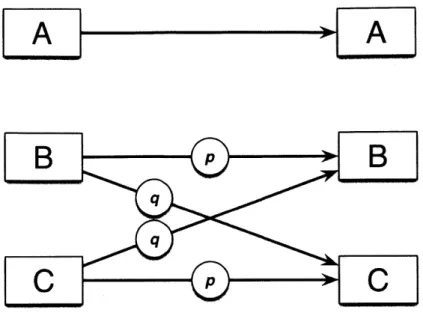
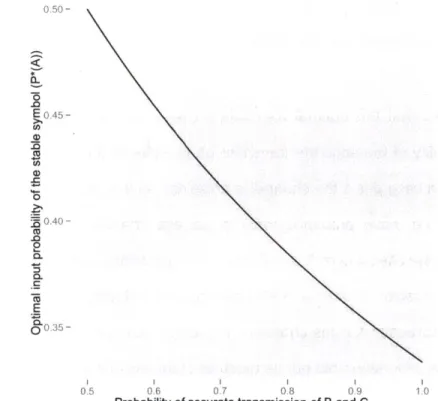
Given the fact that acoustic similarity induces very specific kinds of noise that asymmetrically affects different groups of categories in context in their transmission from speaker to listener, information theory leads us to expect specific trade-offs in the relative attestation of categories: if a set of categories is subject to mutual misperception to a greater
extent than another set of categories, then the relative attestation of the two sets of categories should be a direct function of within-set mistransmission (Shannon, 1948). That is, if categories
A and B have a high probability of being mistransmitted as each other, while category C is much
less likely to be mistransmitted as either A or B, then the probability of C should be much greater than the probability of A or B to achieve channel capacity.3 In this dissertation, I show that
information theoretic predictions for groups of categories subject to different rates of within-group mistransmission are borne out in the probabilistic phonologies of natural language. The relative probabilities of attested structures render human phonology an efficient code for communication in a channel with noise due to the ways in which humans perceive speech.
Furthermore, I show that probabilistic phonology is also subject to the communicative pressure of effort. The relative attestation of effortful categories mirrors the expected rate of information transmission in a given phonological context. In contexts where symbols are expected to be transmitted faithfully, effortful categories occur as frequently as needed to achieve channel capacity. In contexts where effortful categories would be subject to frequent mistransmission, however, these categories are probabilistically underattested. That is, human languages only feature effortful categories to the extent that their attestation is expected to achieve greater rates of information transmission.
Finally, this dissertation also presents new results evidencing communicative optimization of the phonological lexicon as a whole. Human language does not only rely on individual sounds to convey messages, but also phonological units of greater complexity. Here I show that the effects of communicative efficiency also generalize to the level of the word. Past research on the effects of communicative efficiency in the lexicon has focused on the global patterning of word length (Zipf 1939, 1949, Piantadosi et al. 2011). In this dissertation I show that the probabilistic patterning of the lexicon as a whole according to communicative efficiency
3 Shannon (1948) only shows this to hold for cases where there is no across-set mistransmission (i.e.
where the symbol C is never mistransmitted as A or B and vice-versa). This is of course not the case in natural language where any phonological category may in principle be mistransmitted as any other. However, in this dissertation, I assume that what holds for the complete absence of mistransmission also holds for cases where mistransmission is extremely unlikely, albeit to a lesser extent. This is certainly true in cases where two symbols are subject to mutual mistransmission to different extents (Silverman, 1955).
goes further. Natural language lexica are probabilistically composed such that the number of words relying on a given contrast follows from that contrasts perceptual distinctness beyond what is expected from the distributions of individual sounds. That is, perceptually confusable contrasts are likely to be disambiguated by additional phonological material, as expected if the lexicon as a whole is optimized for the accurate transmission of intended meanings under noise.
I show that this holds for oppositions between English phonemes in particular, but also more
generally for broad classes of phonological contrasts in context across a variety of different languages.
1.3 General methods
The studies presented in this dissertation are based on the World Lexicon Corpus (Graff et al. 2011), encompassing phonetically transcribed dictionaries of 60 languages from 25 major language families. The languages in the WOLEX corpus, the major language families they belong to, and the number of words in each sub-corpus are given in Table 2. Corpora range between 846 (Benabena) and 142,474 (French) words in size. Throughout this dissertation
"word" means primary non-bound dictionary entry (i.e., a phonological form listed independently
-anguage ~ od Le' anguage #aMy wrds
choli ilo-Saharan 43uKewa frans-New Guinea 4806
lekano rans-New Guinea 224 Khmer
ustro-Asiatic 17162
Amharic Afro-Asiatic 4245 Lake Miwok Penutian 1989
Arabic (Moroccan) Afro-Asiatic 12671 thuanian Indo-European 4118 Armenian (Eastern) Indo-European 4409 Maisin Austronesian 2597 Arrernte ustralian 3144 nauwake Trans-New Guinea 3693
Ata ustronesian 3020 Sepik uende 3551
Bargam T rans-New Guinea 2342 iengen Austronesian 1475
Benabena frans-New Guinea 846 Mianmin Trans-New Guinea 2319
Bunama Austronesian 2228 Mountain Koiali Trans-New Guinea 1477
Chickasaw iluskogean 13947 Muna Austronesian 5734
hinese (Mandarin) ino-Tibetian 30156 uyuw Austronesian 4603
Dadibi eberan-Pawaian 1442 Polish Indo-European 15192
Daga Dagan 4840 Quechua (Ayacucho) Quechuan 4894
Delaware Agic 3915 Romanian Indo-European 7216
Dobu ustronesian 3307 Rotokas West Bougainville 5547
Dutch Indo-European 102045 Siroi Trans-New Guinea 1365
English (Southern British) Indo-European 52370 Sudest Austronesian 1520
French Indo-European 142474 Suena Trans-New Guinea 3887
Georgian Kartvelian 4581 Tatar Altaic 5561
erman Indo-European 51473 Thompson Salish Salishan 4721
reek Indo-European 35304 Turkish Altaic 29412
uarani Tupian 4332 ffa Trans-New Guinea 2721
Haitian Creole Haitian Creole 38641 ntoat Trans-New Guinea 2239
Hausa Afro-Asiatic 9621 ris Border 1640
Hebrew Afro-Asiatic 48312 Wskia Trans-New Guinea 2028
Hindi Indo-European 32932 leaian Austronesian 5919
lamalele Austronesian 2980 ana Hokan 1764
Iduna ustronesian 3662 u'pik Eskimo-Aleut 240
Javanese ustronesian 14050 ulu Niger-Congo 3505
Table 2: Languages in the WOLEX corpus.
Every dictionary in the corpus included a broad phonetic transcription in the International Phonetic Alphabet (IPA) or a comparable system. If the transcription was not in IPA, dictionaries contained a detailed guide to the pronunciation of all phonemes. In rare cases of ambiguity the exact nature of each category was decided with the help of the electronic version of the UPSID database (Maddieson, 1984) hosted by the University of Frankfurt4 or other resources on the language in question.
Every category was translated into an alphanumeric IPA-based transcription system, which I call ANIPA (alphanumeric IPA). In ANIPA, any sound is represented by a phonetic
feature vector of length 8. Feature 1 (syllabic) specified whether the sound in question was a consonant or a vowel. Features 2-5 were differed for consonants and vowels. For consonants, those features were primary place, secondary place, manner, and lateral. For vowels they were height, backness, rounding and suprasegmental (stress, tone). Both consonants and vowels were also specified for their laryngeal articulation, nasality and length. All values for these features were inferred from the IPA. The full ANIPA system is given in Table 3.
1 oth Sllabic nonant
1 Oth Syllabic roe
Consonant PrimaryPlace B___labial
2 onsonant PrimaryPlace Labiodental _______
Consonant PrimaryPlace De___nta
onsonant PrmaryPlace Alvolar T
onsonant nmaryPlace ostalveolar
onsonant PnimaryPlace RetlR
onsonant rimaryPlace PaltalJ
onsonant rimaryPlace velarK
onsonant rimaryPlace U _ _ __vlar_
onsonant rimaryPlace haryngeal P
onsonant rimaryPlace PlotalH onsonant econdaryPlace one onsonant SecaryPlace abialized onsonant econdaryPlace Paatalized
onsonant cndaryPlace Velaized
3 onsonant econdaryPlace Pharyngealized A
4 onsonant Manner So
onsonant annerasa
4 onsonant MannerFrctv3 4 onsonant MannerAfrct
4 onsonant Manner Approximant _______
4 onsonant Mannerril 4 onsonant Mannerra 4 onsonant Manner lc 5 Consonant Lateral e onsonant ateralte osoelt eh Nasd 3 owe____ ackness __ _ __ _ 3__ ___we ___ Backness n___ ____ _ __ ___ aness 3 Vowel B~acknessBalRhti
Table 3: Alphanumeric IPA (ANIPA) transcription system of the WOLEX corpus.
In this system IPA /t/ would thus be represented as "CTXtNfo1" (alveolar central oral voiceless stop consonant of regular length) and IPA /u/ would be represented as "VEUrNvo1" (high back round stressless voiced oral vowel of regular length). Depending on the phenomenon studied, these features were further aggregated into higher level categories as necessary.
All frequencies and probabilities reported in this dissertation were computed over
phonological types only (i.e., every form in the dictionary is assumed to have frequency 1). The reasons for this is that token frequency estimates for different words were only available for a fraction of the languages in WOLEX. To ensure methodological uniformity and to be able to generalize across languages I use type frequency as a proxy for the occurrence frequency of different categories in running speech throughout this dissertation. I leave the question of whether the observed results generalize to actual usage frequencies of different phonological categories for future research.
owel Rounding Round
owel Rounding Jnround
owel Suprasegmental PrimaryStress
__ owel uprasegmental SecondaryStress
5__ owet uprasegmental ermaryStress T
owel uprasegmental NoStressTone/Neutral 5 owel Suprasegmental NighTone
5 owel Suprasegmental towTone 5 owel Suprasegmental MidTonie 5 owel Suprasegmnental iallTone
5 owel Suprasegmental RiseTone R
5 owel S~uprasegmental SuperHighI 5 owel Suprasegmnental SuperL-ow0
3 oth Larynx oiced
3 oth Larynx Voiceless/Neutral
3 Both Larynx Ejective
3 Both Larynx Implosive
oth Larynx Aspirated h
oth Larynx reathy
oth Larynx reaky
oth Nasal asal
7 Both Nasal ral
8 oth ength Superlong 3
8 Both ength Long 2
One additional important methodological decision was that all dependent measures reported in this dissertation were computed over attested structures only. That is, for example if the frequency of word-final voiced stops (Chapter 2) was calculated, data points from languages where voiced stops do not occur word-finally were completely omitted from the data set. It is thus unlikely for any of the results reported to be driven by the categorical absence of any structure in a given language, which is important given the fact that past research has already identified effects of communicative pressures on the absence of categories and categories in context. However, it should also be noted that some of the results reported (specifically, the results presented in Chapters 2, 4, and 6) rely on aggregate measures inferred over groups of individual contrasts in contexts (e.g., all place contrasts between stops in word-initial pre-sonorant context). In these cases, it possible that partial neutralization in any specific context
(e.g., */tl/ in English) could have contributed to the results.
It should also be explicitly noted here that some of the studies reported in this dissertation (specifically studies reported in Chapters 2, 3, and 6) investigate the extent to which probabilistic generalizations hold across, rather than within different languages. The hypothesis tested in those studies is that human languages in general tend to exhibit communicatively efficient sound patterns. What the statistical analyses reported as part of those studies assess is the chance of the observed patterns generalizing to previously unseen languages. The
statistical significance of the probabilistic patterning of different phonological structures observed implies that communicative efficiency is a sufficiently strong pressure on the sound patterns of the observed languages for us to expect that many more languages for which we do not have primary linguistic data will also pattern in accordance with communicative efficiency.
Another methodological question relates to differences in the phonetic implementation of different contrasts among the languages studied. Since a substantial number of the studies reported in this dissertation rely on the notion of perceptibility and since this notion depends on the particular phonetic instantiation of different categories in any given language, we may ask whether the results reported here could be influenced by biases in the sample of languages
modeled. While this is certainly possible (mainly because the specific phonetic implementation of different phonological categories is not known for the majority of the languages studied), it is nonetheless extremely unlikely to affect the results reported here for two reasons.
The first reason is that the particular contrasts compared in this dissertation have been chosen based on the fact that they are expected to affect different phonological structures in the same way for a variety of language-specific phonetic implementations. For example, asymmetries in the similarity of VC-transitions perceptually cueing /p/, /t/, and /k/ in the context of /i/ and /u/ (Chapter 3) apply regardless of whether stops are audibly released in word-final context or not. While the fact that stop bursts are generally present in the signal in some languages (e.g., French), and sometimes absent in other languages (e.g, English) is expected to modulate the extent to which transitional similarity affects the chance of the listener to recover a given place feature from the signal, stop-burst presence does not interact with transitional similarity in any way (Marty, To appear). This means, that no relative ordering of transitional cue similarity is expected to be reversed by the presence of a stop burst. It is therefore possible to generalize across languages with different burst cues when studying the effects of transitional similarity on the relative attestation of different structures relying on them for distinctness (Chapter 3). In cases where the particular perceptual properties of the categories compared was indeed expected to cause reversals the relevant languages have been omitted from the results reported.
Second, phonetically conditioned differences in the extent to which universal effects of perceptibility apply in any given language are at least partially accounted for by the fact that all analyses reported are based on generalized linear mixed effects models with the maximal random effects structure grouped by both language and language family. This methodology controls for language specific differences in effect size, while also controlling for the non-independence arising from the relatedness of different languages in the sample (Jaeger et al. 2011).
1.4 Organization of the dissertation
The dissertation is organized as follows. Chapter 2 presents a study of the relative distributions of modal voicing features in labial and velar stops in context. The results show that the probability of observing the effortful feature [+voice] in stops follows from the extent to which that feature value may be mistransmitted, as predicted by the communicative efficiency hypothesis (see Section 1.1). Chapter 3 shows that the relative distributions of labial, coronal and dorsal stops in word-final postvocalic context follows from the relative confusability of the three categories given the preceding vowel in ways predicted by information theory. Chapter 4 presents a communicative account of co-occurrence restrictions on consonants. The results show that both similarity avoidance and identity preference conspire to make words more recoverable. Feature matches which reduce the chance of the listener accurately perceiving a particular word are shown to be most reliably avoided cross-linguistically. Additionally, the identity preference is shown to be probabilistically dependent on similarity avoidance. This pattern is argued to increase distinctness of words in terms of overall featural distance. Chapter
5 elaborates on the notion of word-distinctness and presents a study of the minimal pairs of
English. The results show that English words preferentially rely on perceptible contrasts for distinctness. Chapter 6 generalizes these findings to languages other than English and shows that the extent to which the words of other languages rely on different place contrasts for distinctness follows from the perceptibility of those contrasts in context. Chapter 7 discusses possible causes for communicative efficiency in probabilistic phonology and concludes.
Chapter 2
Efficient codes for voicing
2.1 Introduction
In this Chapter, I present a study of the occurrence probabilities of voiced and voiceless labial (e.g., /b/, /p/) and dorsal (e.g., /k/, /g/) stops in context. These four categories differ in terms of the effort involved in their articulation. Voiced stops (i.e., /b/, /g/) are generally harder to produce than voiceless stops. Furthermore, labial stops are easier to voice than dorsal stops (Ohala and Riordan, 1979). Communicative efficiency predicts that the occurrence of effortful symbols should be a function of the information they transmit (Flemming 1995, 2004). That is, in contexts where voicing features are faithfully transmitted, the articulatory effort involved in their articulation is justified and they should occur frequently. However in contexts where voicing contrasts are imperceptible, it is more efficient to dispense of such categories as the additional effort invested would not necessarily result in a greater rate of information transmission. Here, I present a study of the languages in the WOLEX corpus showing that not just the categorical typology of voicing contrasts (Steriade, 1997), but also the relative frequencies of voiced and voiceless stops in in languages that feature both categories indeed conform to this desideratum.
2.1.1 Articulatory asymmetries for voicing in stops
Voiced stops are more difficult to articulate than voiceless stops (Garrett and Johnson To appear, a.o.). This asymmetry is due to the way in which voicing of speech sounds is achieved articulatorily. The voicing of any speech sound requires subglottal pressure to exceed oral pressure throughout the articulation of said sound (Ohala, 1983). To maintain voicing throughout the articulation of a stop, is particularly effortful. This is because the articulation of stops involves complete closure of the oral cavity. This closure of the vocal tract causes a build up of oral pressure, making the pressure asymmetry required for voicing more difficult to maintain.
Crucially, the effort involved in articulating voiced stops is further modulated by the size of the oral cavity behind the place of constriction (Ohala and Riordan, 1979). For stops with labial place of articulation, this constriction is between the lower and the upper lip, resulting in a relatively large oral cavity behind the constriction. This larger oral cavity causes oral pressure to build more slowly making it easier to maintain the pressure asymmetry necessary for voicing. It is therefore relatively easy to articulate voiced stops with a labial constriction. However, if the constriction is at the back of the mouth, as is the case for dorsal stops, the situation changes. The oral cavity behind a constriction articulated with the tongue dorsum and the roof of the mouth behind the hard palate is particularly small, causing oral pressure to build up quickly. Voiced dorsal stops are therefore particularly effortful to produce. Pape et al., (2006) present a production study substantiating this asymmetry for word-initial labial and dorsal stops in German. German speakers are much more likely to devoice word-initial dorsals (46.3% devoiced) than labials (26.4% devoiced). Furthermore, Hayes and Steriade (2004) show that this asymmetry in articulatory effort is reflected as an implicational universal in the categorical attestation of voiced and voiceless stops at different places of articulation. If a language has a voiced dorsal stop (e.g., /g/) then it will necessarily also feature all less articulatorily difficult voiced stops (e.g., /b/) as part of its phoneme inventory.5
Given the articulatory asymmetry described above the communicative pressure to minimize effort alone would predict that voiced stops should simply not occur in natural language. On the other hand, the existence of voiced stops in a language's inventory increases the number of symbols available to encode intended messages, which in turn means that more information can be transmitted per unit of time. However, the extent to which the existence of voiced stops actually results in a greater rate of information transmission also depends on whether the listener will be able to recover them accurately from the signal. As outlined in
Chapter 1, the perceptibility of voicing distinctions largely depends on the local phonological
5 Coronal stops fall in between labial and dorsal stops in terms of this asymmetry. In this study I focus on
context in which the obstruent hosting the voicing feature in question occurs. In particular, the perceptibility of intended voicing values is dependent on the presence of stop-adjacent sonorous material (vowels, sonorants). Cues to recover the intended voicing value of a stop are most available when said stop is between sonorous material (inter-sonorant). Next, voicing is less perceptible when stops are only followed and not preceded by sonorous material (pre-sonorant). Finally, voicing in stops is least recoverable in post-sonorant context (i.e., when the stop is only preceded but not followed by sonorous material; Steriade, 1997).
Crucially, these differences in the perceptibility of voicing contrasts in context imply differences in the information transmitted by the contrasting categories. In contexts where voicing contrasts are perceptible, any effort involved in producing voiced categories will more directly translate into a greater rate of information transmission than in contexts where voicing distinctions are less perceptible. For example, in inter-sonorant context where a wealth of cues is available to the listener to recover the intended voicing value of a stop, the articulatory effort involved in producing voiced stops translates almost directly into an increased rate of information transmission per unit of time. This is because intended voicing values occurring in this context have a high probability of being accurately perceived by the listener. However, in word final context where important cues to voicing are generally not present in the signal, the increase in information rate due to the occurrence of voiced stops is offset by greater rates of misperception. Consequently, the effort involved in producing them translates into a relatively smaller increase in information rate.
If the probability distributions over voiced and voiceless features in stops are optimized
for communication, we therefore expect that the occurrence frequency of effortful voiced stops will correlate with the expected increase in rate of information transmission their occurrence achieves in a given context. This is because efficient languages should only require increased effort when it results in a greater rate of information transmission (cf Flemming, 1995, 2002, 2004). Crucially, the context dependent effects of perceptibility on the attestation of effortful categories should affect dorsal stops more strongly than labial stops. This is because labial
voiced stops are much more easily articulated than dorsal voiced stops (Ohala and Riordan,
1979).
We thus derive the following specific predictions for the relative probabilities of voiced and voiceless stops in languages where the categorical grammar-licenses both categories: if the occurrence of effortful categories is dependent on the amount of information they convey, the probability of observing a voiced stop should decrease according to the availability of perceptual cues to voicing such that [+son]_[+son] > #_[+son] > [+son]_#. The steepness of this decrease should be much greater for dorsal stops than for labial stops, because the articulatory effort involved in voicing dorsals is greater than the effort involved in voicing labials, due to differences in the size of the oral cavity behind the constriction. I show next that these predictions are borne out for the languages in the WOLEX corpus.
2.2 Methods
The logit probability of observing a voiceless feature in a dorsal or labial stop in context (log(P (T)/1-P(T))) was calculated for all languages in the WOLEX corpus, that i) have a modal voicing distinction for at least one place of articulation in at least 2 of the three compared contexts, and ii) have no more than 2 possible values for laryngeal features in stops (i.e. only voiced and voiceless). For the purposes of this investigation I considered bilabial stops (active articulator is the lower lip) as labial and palatals, velars and uvulars (active articulator is the tongue dorsum) as dorsal. This left data from Acholi, Ayacucho Quechua, Bargam, Bunama, Chickasaw, Dadibi, Daga, Delaware, Dobu, Dutch, French, German, Greek, Haitian Creole, Hausa, Hebrew, Iduna, Javanese, Kewa, Khmer, Lithuanian, Maisin, Mauwake, Mengen, Mianmin, Moroccan Arabic, Mountain Koiali, Muna, Muyuw, Polish, Romanian, Rotokas, Siroi, Southern British English,6 Sudest, Suena, Tatar, Turkish, and Waskia for analysis. Data from contexts with categorical neutralization (i.e., P(T)=1) were excluded from the analysis.
6 Word-initially, voiced and voiceless stops in English contrast for aspiration rather than modal voicing.
The results reported below, however, still hold if data from word-initial pre-sonorant context in English is omitted from the analysis.
2.3 Results
Data were analyzed in terms of a linear mixed effects model predicting logit(P(T)) from place (sum-coded) and context (forward-difference-coded; Venables and Ripley, 2002). The model included random intercepts for language and language family as well as random slopes for context (grouped by language and language family) and place (grouped by language). We find no main effect of place feature (X2(1)=0, p>.99), evidencing that voiceless dorsals are overall no
more likely that voiceless labials. Further, we find the predicted main effect of context, such that the overall probability of observing a voiceless feature increases as the availability of cues to voicing contrasts decreases (X2(1)=7.75, p<.05). Finally, we observe the predicted interaction of
context and place such that the probability of observing a voiceless dorsal increases more dramatically, compared to voiceless labials, as the availability of perceptual cues to voicing decreases. Table 4 summarizes the results of the analysis.
Place 1 >.99
Context 7.75 2 <0.05
,1ace:Context 19.57 2 0.01 Table 4: Results (model comparison)
Figure 1 depicts the logit probability of voiceless dorsal and labial stops depending on the phonological context in which they occur.