HAL Id: hal-01077735
https://hal.inria.fr/hal-01077735
Submitted on 12 Nov 2014
HAL is a multi-disciplinary open access
archive for the deposit and dissemination of
sci-entific research documents, whether they are
pub-lished or not. The documents may come from
teaching and research institutions in France or
abroad, or from public or private research centers.
L’archive ouverte pluridisciplinaire HAL, est
destinée au dépôt et à la diffusion de documents
scientifiques de niveau recherche, publiés ou non,
émanant des établissements d’enseignement et de
recherche français ou étrangers, des laboratoires
publics ou privés.
Spatial distributions at equilibrium under heterogeneous
transient subdiffusion
Hugues Berry, Hédi Soula
To cite this version:
Hugues Berry, Hédi Soula. Spatial distributions at equilibrium under heterogeneous transient
sub-diffusion. Frontiers in Physiology, Frontiers, 2014, 5, 437 (8 p.). �10.3389/fphys.2014.00437�.
�hal-01077735�
Spatial distributions at equilibrium under heterogeneous
transient subdiffusion
Hugues Berry1,2* and Hédi A. Soula1,3* 1
Beagle, Institut National de Recherche en Informatique et en Automatique, Villeurbanne, France
2Laboratoire d’InfoRmatique en Image et Systèmes d’information, UMR 5205 CNRS-INSA, Université de Lyon, Villeurbanne, France 3Institut Multidisciplinaire de Biochimie des Lipides, Inserm UMR1060, Université de Lyon, Villeurbanne, France
Edited by:
Noriko Hiroi, Keio Univerity, Japan
Reviewed by:
Ralf Metzler, Technical University of Munich, Germany
Sergei Fedotov, The University of Manchester, UK
Yuichi Togashi, Hiroshima University, Japan
*Correspondence:
Hugues Berry, Beagle, Institut National de Recherche en Informatique et en Automatique, 56 Blvd Niels Bohr, CS 52132, Villeurbanne Cedex 69603, France e-mail: [email protected]; Hédi A. Soula, Institut
Multidisciplinaire de Biochimie des Lipides, Inserm UMR1060, Université de Lyon, 11 Avenue Jean Capelle, Villeurbanne 69621, France e-mail: [email protected]
Experimental measurements of the mobility of macromolecules, especially proteins, in cells and their membranes consistently report transient subdiffusion with possibly position-dependent—non-homogeneous—properties. However, the spatiotemporal dynamics of protein mobility when transient subdiffusion is restricted to a subregion of space is still unclear. Here, we investigated the spatial distribution at equilibrium of proteins undergoing transient subdiffusion due to continuous-time random walks (CTRW) in a restricted subregion of a two-dimensional space. Our Monte-Carlo simulations suggest that this process leads to a non-homogeneous spatial distribution of the proteins at equilibrium, where proteins increasingly accumulate in the CTRW subregion as its anomalous properties are increasingly marked. In the case of transient CTRW, we show that this accumulation is dictated by the asymptotic Brownian regime and not by the initial anomalous transient dynamics. Moreover, our results also show that this dominance of the asymptotic Brownian regime cannot be simply generalized to other scenarios of transient subdiffusion. In particular, non-homogeneous transient subdiffusion due to hindrance by randomly-located immobile obstacles does not lead to such a strong local accumulation. These results suggest that, even though they exhibit the same time-dependence of the mean-squared displacement, the different scenarios proposed to account for subdiffusion in the cell lead to different protein distribution in space, even at equilibrium and without coupling with reaction.
Keywords: brownian diffusion, subdiffusion, spatial protein distribution, nonhomogeneous cellular media, continuous-time random walks
1. INTRODUCTION
Traditional biology and biochemistry approaches tend to view the inside of a cell and its constituent membranes as uniform, homogeneous and well-stirred media. However, under the light of the recent advances in experimental methodologies, they rather appear disordered and heterogeneous, with high levels of crowd-ing typical of poorly-connected media (Dix and Verkman, 2008; Cambi and Lidke, 2012; Höfling and Franosch, 2013; Parry et al., 2014). For instance, cell membranes are heterogeneous collec-tions of contiguous spatial micro- or nanodomains with various length and time scales (e.g., fences, lipid rafts, caveolae) (Jacobson
et al., 2007; Cambi and Lidke, 2012), that restrict the lateral
mobility of proteins in a position-dependent way (Kenworthy et al., 2004; Goodwin et al., 2005; Fujita et al., 2007; Day and
Kenworthy, 2009; Kusumi et al., 2011).
In addition to the complexity brought about by the spatial heterogeneity of protein mobility, protein diffusion itself can deviate from the ideal case of Brownian motion. Measurements of the movement of proteins in living cells (in particular in mem-branes) has consistently been reported to exhibit subdiffusion (a variety of anomalous diffusion). In subdiffusion, the mean square displacement scales sub-linearly with time,!R2(t)"
∝tγ
with γ < 1 (Schwille et al., 1999; Smith et al., 1999; Fujiwara
et al., 2002; Weigel et al., 2011; Höfling and Franosch, 2013),
as opposed to γ = 1 in Brownian motion. Currently, there exist three major theoretical scenarios to explain the observations of subdiffusion, all of which rest on the idea that the interior of cells and their membranes experience large molecular crowding due to their high densities of proteins, lipids, carbohydrates, filamen-tous networks and organelles, with widely-distributed sizes (Dix
and Verkman, 2008; Höfling and Franosch, 2013). The arguably
simplest scenario, referred to as “Fractional Brownian Motion,” is a generalization of the classical Brownian motion, where the random increments between two successive locations of the ran-dom walker are not independent (like in Brownian motion) but present long-range temporal correlations (Barkai et al., 2012). The second scenario is hindered diffusion in the presence of randomly-distributed immobile obstacles (Saxton, 1994; Berry,
2002; Höfling and Franosch, 2013). The third scenario, referred to
as “Continuous-Time Random Walks” (CTRW) assumes that the complexity of the cellular media changes the statistics of the resi-dence time τ between two moves of the random walkers. Whereas Dirac—or exponentially—distributed residence times lead to the classical Brownian motion, power-law distributed residence time, η(τ ) ∝ τ−α, generates subdiffusive motion with γ = α − 1
Berry and Soula Accumulation in transient subdiffusion
Klafter, 2000; Höfling and Franosch, 2013). Those three
scenar-ios all lead to sublinear scaling of the mean square displacement with time, i.e., subdiffusion. Other scenarios for subdiffusion have been explored (e.g., scaled Brownian motion, some hetero-geneous Brownian processes or correlated CTRW) but are less well studied, seeMetzler et al. (2014)for a review.
Whatever the underlying scenario considered, subdiffusion is usually studied in situations that are so simple that their applica-bility to biology can be questioned. Yet, several factors contribute to the complexity of the cellular media:
(i) Subordination: The three scenarios above need not be mutually exclusive but could combine in a subordinated process (Weigel et al., 2011; Tabei et al., 2013).
(ii) Transience: In several experimental reports (Platani et al., 2002; Murase et al., 2004; Saxton, 2007; Bronstein et al., 2009;
Jeon et al., 2011), the anomalous regime is only transient: after
the initial anomalous regime, the mean square displacement crossovers back to normal (Brownian) diffusion (with γ = 1) but with a smaller apparent diffusion coefficient.
(iii) Non-homogeneity: The intensity of the molecular crowd-ing, and/or the anomalous exponent γ may vary depending on the location inside the cell (Wachsmuth et al., 2000; Kühn et al., 2011), thus defining a position-dependent exponent γ (x).
The spatiotemporal dynamics of protein mobility when any of those three factors is at play is still obscure. For instance, it is only recently that subdiffusion with space-dependent exponent has been explored. In a one-dimensional lattice-based space where the anomalous exponent is set to a much smaller value in one of the lattice sites,Fedotov and Falconer (2012)reported a strik-ing accumulation phenomenon: after possibly a long transient,
all the mobile molecules locate at the lattice site with smallest exponent. Similar accumulation phenomena were reported by Korabel and Barkai for particle transport in binary systems, for which space is partitioned into two subdomains, where diffu-sion is Brownian or CTRW, respectively (Korabel and Barkai,
2010, 2011). Similarly, recent studies have shown that
non-homogeneous Brownian motion (where the diffusion coefficient depends on space) can give rise to counterintuitive behaviors, including CTRW-like transport (Cherstvy et al., 2013, 2014).
In the present work, we focused on CTRW-based subdiffu-sion and studied the impact of transience and non-homogeneity on the spatial distribution of the proteins at equilibrium. In the framework of CTRW, transience is naturally introduced by the addition of an upper bound to the residence time τC (cutoff
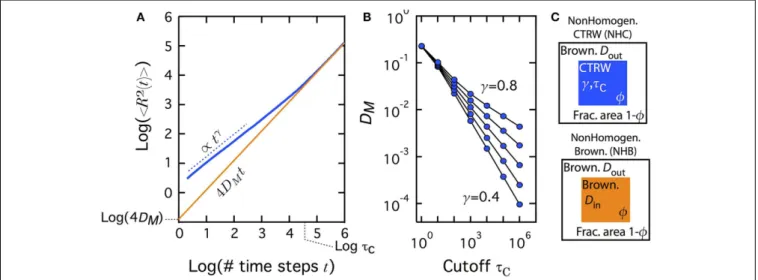
time, see Materials and Methods). In such a transient CTRW, !R2" indeed first scales as tγ at short times, then crosses over
to a Brownian motion (with γ = 1) for t # τC. This
asymp-totic Brownian regime can be considered a macroscopic view of the underlying microscopic subdiffusion, with a “macroscopic” diffusion coefficient (Figures 1A,B):
DM=
(%x)2
4#τC
%tτ η(τ )dτ
(1)
where η(τ ) is the distribution of the residence time, %t the time step of the Monte-Carlo simulation and#τC
%tτ η(τ )dτ is the
mean residence time of the random walk. To introduce non-homogeneous diffusion, we considered a “patchy” two dimen-sional space domain (Figure 1C). In the center of the domain, we locate a square patch, of area fraction φ, in which diffusion
FIGURE 1 | Transient subdiffusion (CTRW) turns Brownian at times longer than the cutoff τC. (A) The mean square displacement!R2" in transient CTRW (blue curve) first scales as tγ(where γ is the anomalous exponent), but at time scales larger than the cutoff τC, transient CTRW converges to a Brownian motion with DMas (macroscopic) diffusion coefficient, i.e.,!R2" = 4D
Mt(brown curve). The dashed line shows a scaling with exponent γ ,!R2"
∝tγ. (B) The microscopic diffusion coefficient D M decreases rapidly with increasing cutoff times τCand decreasing anomalous exponents. γ = 0.8, 0.7, 0.6, 0.5, and 0.4, from top to bottom. (C) In the
following, we study the spatially non-homogeneous case were the diffusion conditions inside a central patch, of fraction area φ differ from the diffusion conditions outside the patch. In the non-homogeneous CTRW (NHC) case, diffusion is Brownian with diffusion coefficient Doutoutside the patch and a CTRW with parameters (γ , τC) inside. In the non-homogeneous Brownian (NHB) case (used for comparison), diffusion is Brownian both outside the patch (diffusion coefficient Dout) and inside the patch (with diffusion coefficient Dinset so as to match the macroscopic diffusion coefficient DM obtained in transient CTRW with the same parameters γ and τC).
is due to a transient CTRW. Outside the patch, diffusion is Brownian. This setup therefore defines a non-homogeneous transient CTRW (NHC) process.
Our Monte-Carlo simulations show that the spatial distribu-tion at equilibrium of proteins subject to such a transient NHC process is itself non-homogeneous: with increasingly strong sub-diffusion (i.e., when γ decreases or τC increases), the proteins
progressively accumulate in the central patch. We show that this accumulation is totally controlled by the long-time (Brownian) regime of the transient CTRW and not the initial anomalous tran-sient. However, we also show that the dominance of the long-time Brownian regime in transient subdiffusion cannot be extended to other scenarios. Indeed, non-homogeneous transient subdif-fusion due to hindrance by randomly-located immobile obstacles also exhibit transient subdiffusion followed by a slowed-down Brownian regime. However, we show that this situation does not lead to such a strong local accumulation, but to depletion of the central patch or weak accumulation, depending on how concen-trations are computed. Therefore, even in the simplest case of pure lateral mobility (i.e., no reaction), the knowledge of the time-dependence of the mean square displacement is not suffi-cient to predict the distribution of the proteins at equilibrium. This simulation work strongly suggests that the different scenarios proposed to account for transient subdiffusion in the cell could lead to different protein distribution in space, even at equilibrium and in the absence of any reaction (binding, post-translational modifications, internalization. . . ).
2. MATERIALS AND METHODS
All simulations take place in a w × w 2D square lattice with reflective boundaries. At initialization, we position NT proteins
uniformly at random without excluded volume i.e., several pro-teins can occupy the same site. When a protein arrives at lattice site (i, j) at time tarrival, its residence time τ is sampled from a
distribution ηi,j. The next jump time of the protein therefore is
set as tarrival+ τ. ηi,j depends on the nature of the arrival site
(i, j). If (i, j) belongs to an area of Brownian motion, ηi,j is an
exponential distribution of parameter τB%t (where %t is the
sim-ulation time step): ηi,j(τ ) = 1/ (τB%t) exp ( − τ/ (τB%t) ). τB%t
is the average residence time and sets the diffusion coefficient at site (i, j): D(i, j) = %x2/ (4τB%t) where %x is the lattice spacing
(see Equation 1). If the site (i, j) belongs to an area of CTRW, the residence time is sampled from the power-law distribution ηi,j(τ ) = γ τ−(1+γ )/ $ %t−γ −τ−γ c % , for which#τc %tη(τ )dτ = 1.
Hence %t, the simulation time step is the smallest residence time possible and τc, the cut-off time, sets its maximal value. At each
simulation time step t = n%t, the algorithm finds all the proteins that have their jump time in [n − 1, n]%t. Each of those proteins independently jump to a destination site that is chosen uniformly at random from its 4 nearest neighbors (i ± 1, j ± 1).
Note that in the literature, the cutoff of the residence time distribution is frequently introduced using a soft cut-off, instead of the hard cutoff used in this study. Such “tem-pered” (soft) cutoff is commonly obtained by adding an exponential cutoff to the distribution of residence times i.e., η(τ ) = γ %tγ τ−(1+γ )exp ( − τ/τ
C). In a subset of the
simula-tions shown below, we have replaced our hard cutoff with a
tempered one and found that the results were identical to those obtained with our hard cutoff. We conclude that the exact imple-mentation of the cutoff does not have significant impact on the results reported below.
For simulation of spatially non-homogeneous Brownian dif-fusion (NHB), we position the boundary of the slowed-down patch in the middle of neighbor lattice sites. Each lattice side (i, j) therefore belongs either to the slowed-down patch [we thus set its diffusion constant to D(i, j) = D1] or to the outer region
(and we set D(i, j) = D0>D1). In the case of spatially
non-homogeneous CTRW (NHC), we also position the boundary between the CTRW patch and the Brownian exterior in the mid-dle of neighbor lattice sites. Therefore each lattice side (i, j) either belongs either to the CTRW patch or to the outer Brownian region.
To compare NHB and NHC, we simply computed the average residence time for the CTRW distribution according to the cut-off (τc) and γ parameters:
#τc
%tτ η(τ )dτ and use this value as the
mean residence time for Brownian motion (see Equation 1). Subdiffusion due to obstacle hinderance was simulated by positioning obstacles at random locations (with uniform distri-bution) within the inner region at the beginning of the sim-ulation. In this instance, obstacles behave a separate type of molecules that are kept unreactive and immobile. Moreover, they exclude the lattice site they occupy: whenever the chosen destina-tion site of a moving protein contains an obstacle, the protein is reflected back to its origin site (the destination site becomes the origin position).
Standard parameter values were used throughout the article, unless otherwise specified: lattice size w = 800, %t = 1, %x = 1 and diffusion coefficient Dout=1/4. Every simulation was
ini-tiated with NT=104 proteins and was run until the density of
proteins reaches equilibrium. Depending on simulation condi-tions, equilibrium was typically reached after at most 105 (obsta-cles) to 5 × 10⁵ (slowed down Brownian diffusion or CTRW)
time steps. The number of proteins present in the patch at equi-librium, Nin, was therefore computed as a time-average for t ∈
[9.5, 10.0] × 105. Each simulation was repeated 20 times with different realizations of the pseudo-random numbers. The data presented below are averaged over those 20 runs.
3. RESULTS
Figure 2 shows the average fraction of molecules present, at
equi-librium, in patches of fraction area φ = 0.25 or 0.01. The case of non-homogeneous CTRW (NHC), where diffusion is Brownian outside the patch and a transient CTRW inside, is plotted with blue plus (+) signs. Each data point corresponds to a value of the CTRW parameter pair (γ , τC). To facilitate visual presentation,
we determined the macroscopic diffusion coefficient defined by each parameter pair (according to Equation 1) and plot the ratio of molecules inside the patch (at equilibrium) Nin/NTagainst the
corresponding value of DMinside the patch (Din).
For large values of Din, when diffusion is only weakly
slowed down by the CTRW (τC small and/or γ large), Nin/NT
tends to φ (horizontal dashed lines), the fraction area of the patch. This is exactly the value expected when the densities of molecule inside and outside the patch are identical, Nin/φ =
Berry and Soula Accumulation in transient subdiffusion
FIGURE 2 | Non-homogeneous CTRW and non-homogeneous Brownian yield identical accumulation inside the patch. The fraction of
molecules inside the central patch Nin/NTat equilibrium increases with the slowdown of diffusion inside the patch (where Ninand NTare the number of molecules inside the central patch and the total number of molecules, respectively). NHC conditions are represented with blue plus signs whereas the NHB results are shown with brown empty circles. The full curves are the predictions from the theoretical expression for NHB, Equation (2) The dashed horizontal lines locate Nin/NT=0.25 and
Nin/NT=0.01. The fraction area occupied by the central patch is φ = 0.25 (top curve) or 0.010 (bottom curve). In the NHC case, Dinis here the macroscopic diffusion coefficient of the transient CTRW inside the patch.
Nout/ (1 − φ). Therefore, when the CTRW inside the patch
has a short or weakly anomalous transient, the spatial distri-bution remains uniform and homogeneous. When the tran-sient anomalous regime becomes more marked (Dindecreases),
Nin/NTincreases and becomes larger than φ. This reveals that
with increasingly marked anomalous regimes (longer lasting or more anomalous), the equilibrium spatial distribution becomes non-homogeneous: molecules progressively accumulate inside the patch [Nin/φ >Nout/ (1 − φ)]. For the smaller Din
val-ues, the fraction of molecules inside the patch even tends to unity. In other words, when the cutoff time τC tends to very
large values, accumulation reaches extreme levels since roughly all the diffusing molecules are found inside the slowed down patch.
Therefore, when the duration of the anomalous transient regime is large and/or the anomalous exponent small, non-homogeneous CTRW (NHC) leads to accumulation at equi-librium. To investigate the origin of this accumulation, we compared the results obtained with NHC to those with non-homogeneous Brownian motion (NHB), in which the motion remains Brownian inside the patch, but with a smaller diffu-sion coefficient Din. In terms of mean-squared displacement
!R2", NHB thus preserves the long-time behavior of NHC, but
does not feature the initial anomalous transient. In a previous work (Soula et al., 2013), we showed that decreasing the ratio of diffusion coefficients Din/Doutin NHB, leads to accumulation at
equilibrium inside the patch. We obtained a very good theoretical approximation of this accumulation with a simple expression:
Nin/NT=
φ φ +(1 − φ) Din
Dout
(2)
Note in particular that in this expression, Nin/NT→φ when
Din→Dout (homogeneous distribution) while Nin/NT→1
when Din→0 (total accumulation in the patch).
The brown open circles in Figure 2 show the accumulation obtained with NHB, for various values of Din(and constant Dout).
The accumulation values obtained in simulations of NHB match almost exactly those obtained with NHC. To confirm this result, we also plot in Figure 2 the theoretical predictions of Equation (2) (full black lines). The agreement between this theoretical pre-diction and the simulation results, either for NHB or NHC, is almost everywhere very good, confirming match between NHB and NHC values. A discrepancy between the theoretical predic-tion and the simulapredic-tion results (both for NHB or NHC) appears for very small patch fraction area (φ = 0.01) and strong slow-down (Din<10−3). This discrepancy might be due to the fact
that, with such extreme slowdown in the patch, our maximal sim-ulation time may be too short to reach equilibrium. In any case, this discrepancy does not invalidate the very good match for most of the values.
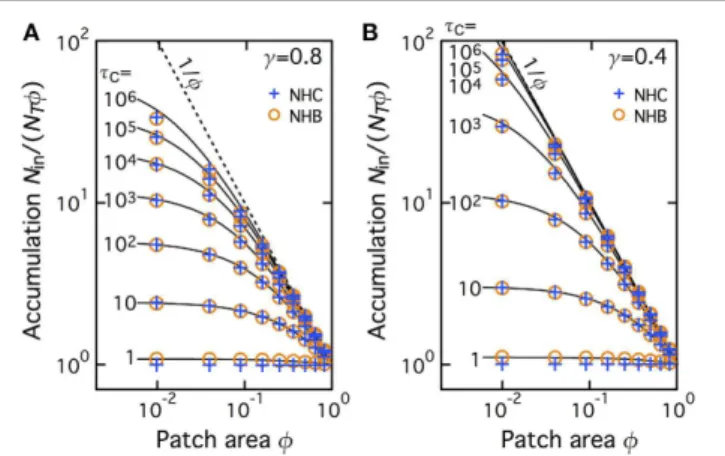
We then extended this comparison to a larger set of values of the fraction area of the patch. To quantify the accumula-tion more directly, we plot on Figure 3 the values of Nin/ (NTφ)
for various values of the CTRW parameters in the patch: cut-off τC and anomalous exponent (γ = 0.8 in A and 0.4 in B).
Using the same symbols as Figure 2 above, Figure 3 shows the results obtained with NHC and compare them to simulation and theoretical accumulation in a NHB with comparable Din. In
absence of accumulation (i.e., with homogeneous spatial distri-bution of the molecules), one expects Nin/ (NTφ) ∼1 whereas
Nin/ (NTφ)should be close 1/φ (dashed line) when
accumula-tion is close to complete in the patch. For both exponent values, the spatial distribution is found homogeneous (or close to homo-geneous) for small cutoff times τCand progressively converges to
1/φ when τC→ ∞. The limit of almost-complete accumulation
(1/φ) is reached for smaller τC when γ is small (thus
diffu-sion heavy anomalous) than when γ is large. This confirms that NHC progressively leads to complete accumulation when the cut-off time increases. Here again the match with the simulated and theoretical values of NHB is very good.
We next investigated whether this accumulation was specific to the geometry used in Figures 1–3. To this end we compared two geometries: (i) Patch geometry: CTRW takes place in a single patch of surface area φw2(where w2 is the total domain surface area), located in the center of the domain. This is the geometry used in Figures 1–3 above; (ii) Distributed geometry: The patch is split into Npsquares of individual area S (we used unit area, S = 1); the total patch area is preserved (i.e., NpS = φw2 ); the Np patches are distributed uniformly at random in the domain
(without overlapping). Figure 4 plots the values of Nin/ (NTφ)
for several CTRW parameter pairs (γ , τC) obtained from
FIGURE 3 | Accumulation depends on patch area and the amplitude of the slowdown in the patch. The extent of accumulation Nin/&NTφ' ranges from 1.0 (no accumulation, Nin/NT= φ) for τC=1.0 (i.e., Din=Dout) to 1/φ (all the molecules are inside the patch), when τC→ ∞(i.e., Din→0). The symbols are identical to those in Figure 2. The dashed line locates the curve Nin/&NTφ' = 1/φ. The anomalous exponent γ = 0.8 (A) or 0.4 (B).
FIGURE 4 | The accumulation phenomenon with NHC is not specific of the central patch geometry. Accumulation values are shown for
simulations of NHC with a single central CTRW patch (i.e., the geometry used in Figure 3, blue plus signs, “patch” configuration) and when the patch is split into many smaller subparts, that are spread uniformly in the space domain (“distributed” configuration, black crosses). See the main text for details. All the other parameters and symbols are identical to
Figure 3, in particular the anomalous exponent γ was 0.8 (A) or 0.4 (B).
of accumulation observed for the two geometries, patch (blue “+” signs) or distributed (black “×” signs), are identical, for all the total patch areas and all the CTRW parameters we tested. Therefore, accumulation is also observed when the central patch is split into subpatches uniformly distributed in the domain. This indicates that the observed accumulation is a generic property of NHC that is not specific to the precise geometry configuration.
Those results therefore reveal that NHC leads to progressive accumulation of the molecules inside the central patch, what-ever its area fraction. Since the amplitude of the accumulation due to NHC is almost identical to the amplitude of the accu-mulation due to NHB, one may conclude from those results
that, at least regarding the spatial distribution of the molecules at equilibrium, the transient anomalous regime has no signifi-cant impact. Accumulation would therefore be entirely controlled by the “macroscopic” Brownian regime that is exhibited at long times by transient CTRW.
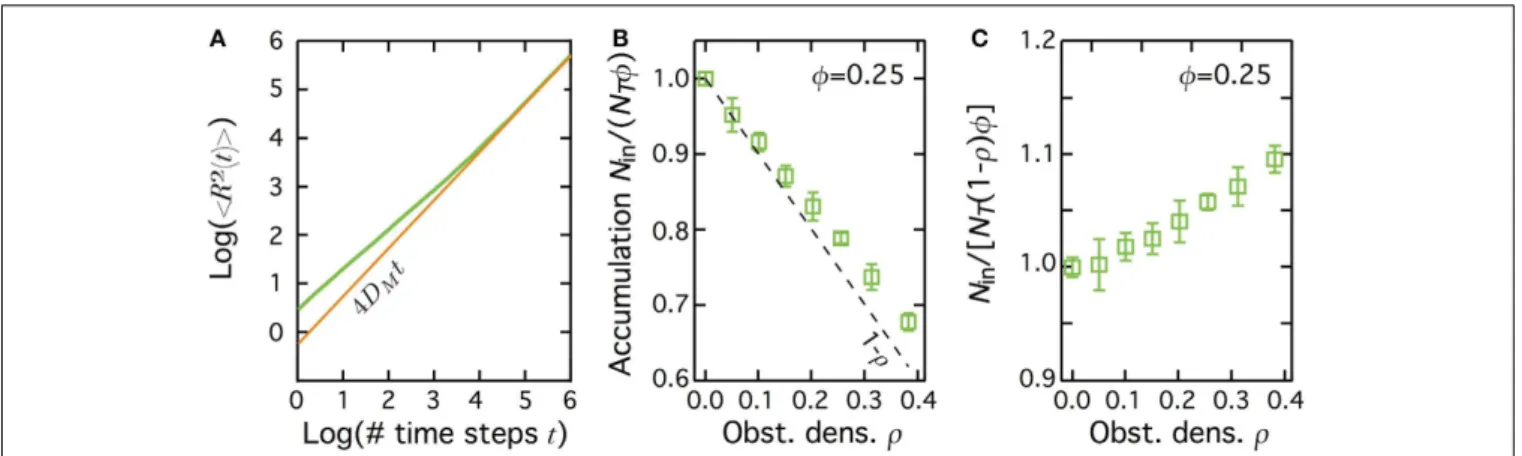
A convenient way to test this hypothesis is to compare the results obtained with transient subdiffusion due to obstacle hindering. In this case, diffusion is still Brownian-like inside the patch, except for the presence of randomly-distributed immobile obstacles that hinder diffusion (see Materials and Methods) (Saxton, 1994; Berry, 2002; Höfling and Franosch, 2013). In this case (green curve in Figure 5A), the mean-squared displacement!R2" is transiently anomalous with γ = 0.659 in 2D
(in continuum space) (Bouchaud and Georges, 1990; Kammerer et al., 2008). Just like in transient CTRW, !R2" then converges
to slowed-down Brownian motion with a “macroscopic” diffu-sion coefficient DM (brown line in Figure 5A). When obstacle
density ρ inside the patch increases, the crossover time from tran-sient to Brownian regimes increases while DM decays. Therefore,
from the perspective of the mean-squared displacement, transient subdiffusion due to hindering by obstacles is very similar to tran-sient CTRW. In particular, both exhibit a slowed-down Brownian behavior at long times.
Figure 5B shows the changes of Nin/ (NTφ)when the obstacle
density is changed, for a central patch with fraction area φ = 0.25. Note that when immobile obstacles are added in the patch, some of the unobstructed sites of the patch find themselves isolated from the rest of the patch inside a cage made of obstacles. We found that in our simulations, those encaged sites were never present in a very significant amount (less than 9 % of the unob-structed patch sites, even at large obstacle densities). However, since they are not accessible for proteins located outside the cage, we included the fraction of such encaged isolated sites in the cal-culation of the obstacle density ρ. Without obstacles (ρ = 0), one recovers the expected spatially homogeneous distribution of the molecules at equilibrium [Nin/ (NTφ) =1]. In a striking
con-trast with NHC or NHB, though, increasing the obstacle density in the patch (thus increasing τC and decreasing Din) leads to a
quick decay of the accumulated fraction below 1. This reveals that increasing the motion slowdown in the patch by obstacle hinder-ing leads to a non-homogeneous equilibrium distribution of the molecules. But in opposition to the NHB or NHC case, this leads to a depletion of the molecule in the patch: the molecule density inside the patch becomes smaller than outside.
However, examination of Figure 5B shows that the values of
Nin/ (NTφ)decrease slightly slower than the available area
frac-tion inside the patch (1 − ρ, dashed line in the figure). This means that if one uses the accessible area in the patch [(1 − ρ)φ] to compute concentration (and not the total patch area φ), hindering by immobile obstacles in fact leads to a slight accumu-lation. To quantify this further, we show on Figure 5C the results obtained when we compute accumulation using the effectively accessible volume (1 − ρ)φ, i.e., we now compute accumulation as Nin/(NT(1 − ρ)φ). In agreement with the above comment, this
figure shows a slight accumulation, especially for large obstacle densities. Note however that this accumulation effect is small as it never get larger than 10%.
Berry and Soula Accumulation in transient subdiffusion
FIGURE 5 | Diffusion hindering by obstacles leads to depletion of the molecules in the patch at equilibrium. (A) The mean square
displacement !R2"
in transient subdiffusion due to hinderance by randomly-located immobile obstacles (green curve) first scales as tγ (with γ < 1), before converging to a Brownian motion with DM a (macroscopic) diffusion coefficient, i.e., !R2" = 4D
Mt (brown curve). Obstacle density ρ = 0.35, patch area fraction φ = 1. (B) When the
obstacles are restricted to a central patch, the number of molecules inside the patch at equilibrium decreases below 1.0, Nin/&NTφ'≤
1.0 (depletion). The dashed line shows Nin/&NTφ' = 1 − ρ. (C) When accumulation is computed using the effectively accessible area in the patch (1 − ρ)φ, and not the total patch area φ, one gets instead a weak accumulation in the patch. In (B,C), bars indicate ±1 s.d., and the fraction area of the patch φ = 0.25.
Therefore, although they show very similar behaviors in terms of mean-square displacement, the impact on the equilibrium protein distribution in space of non-homogeneous transient sub-diffusion due to obstacle hinderance or to CTRW are very dif-ferent: while the latter leads to strong and robust accumulation in the patch, the former yields depletion or weak accumulation (depending on how concentrations are calculated).
4. DISCUSSION
The lateral diffusion of proteins in membranes, and more gen-erally, in the intracellular spaces is a complex process. First, many experimental reports evidence that their mobility does not agree with the classical Brownian motion but exhibit subdiffu-sion (Schwille et al., 1999; Smith et al., 1999; Fujiwara et al., 2002;
Weigel et al., 2011; Höfling and Franosch, 2013). Moreover, the
properties of their diffusion process can themselves vary from one location to another in the cell (or membrane) because of e.g., the non-homogeneous distribution of macromolecular crowd-ing in space (Wachsmuth et al., 2000; Kühn et al., 2011; Parry
et al., 2014) or the presence of nanodomains in the membranes
that locally alter diffusion (Kenworthy et al., 2004; Goodwin et al., 2005; Fujita et al., 2007; Jacobson et al., 2007; Day and
Kenworthy, 2009; Kusumi et al., 2011; Cambi and Lidke, 2012).
Understanding protein mobility subject to such a complex pro-cess is still challenging. Here, we used Monte-Carlo simulations to study the spatial distribution (at equilibrium) of a protein that moves on a non-homogeneous two-dimensional domain with Brownian diffusion outside a central subregion (“patch”) and with transient CTRW inside (Figure 1C).
Our first finding is that in these conditions, proteins tend to accumulate inside the central patch (Figures 2, 3). When the anomalous regime becomes increasingly marked (i.e., the longer it lasts and the smaller its anomalous exponent), the density of proteins located at equilibrium inside the central patch is increasingly larger than the density of proteins outside.
At the limit were the CTRW becomes permanent (i.e., when the cutoff time diverges), this accumulation is complete, i.e., close to all the mobile proteins are found inside the central patch. This result agrees with the one-dimensional case studied
byKorabel and Barkai (2010, 2011); Fedotov and Falconer (2012),
extending them to two-dimensional spaces and generalizing it to variable fraction areas for the CTRW patch and to transient CTRW.
Our second contribution is that in the case of non-homogeneous transient CTRW, this accumulation phenomenon is entirely driven by the Brownian regime that is reached after the transient anomalous regime. The anomalous expo-nent impacts the accumulation phenomenon because it sets the effective macroscopic diffusion coefficient in the Brownian regime, not because it causes the initial sublinear scaling of the mean square displacement with time. Accordingly, when we sup-pressed the initial transient anomalous regime keeping the same asymptotic Brownian one (i.e., simulating non-homogeneous Brownian motion), our simulations shows the same accumu-lation, quantitatively and qualitatively. However, we also show that this conclusion cannot be generalized to other mecha-nisms that cause transient subdiffusion. Indeed, the evolution with time of the mean square displacement when diffusion is hindered by randomly-located immobile obstacles exhibits the same changes with time as those of transient CTRW (compare
Figure 5A with Figure 1A). Yet, when such a process is used to
simulate non-homogenous transient subdiffusion, our simula-tions did not evidence strong local accumulation of the proteins. Therefore, two mechanisms for subdiffusion, CTRW and obstacle hindrance, can present exactly the same regimes for the changes of the mean-squared displacement (!R2") with time, but lead
to very different results regarding the protein distribution at equilibrium.
Our simulations do not account for excluded volume between diffusing proteins as several proteins can share the same lattice
site at a given time. Including a hard limit on the maximal num-ber of proteins that can share the same lattice site would lead to a significant decrease of the apparent diffusion coefficient (inside and outside the patch). This excluded volume interac-tion between proteins would arguably be more realistic but is also more demanding in terms of computation time. Moreover, we do not think it would change our main conclusions since excluded volume interaction between the proteins is not expected to mod-ify their diffusion regime. However, it could of course have the trivial effect of limiting the amplitude of the reported accumula-tions inside the patch, since the bound on the number of proteins per lattice site implies a strict limitation of the number of proteins in the patch.
Taken together, our results provide a clear indication that the changes of!R2(t)" with time are not enough to explain the
spa-tiotemporal dynamics of the proteins, even in the simple case, studied here, where the mobile protein to not interact via bio-chemical reactions or interactions. This realization has already started to emerge in the most recent experimental reports (see e.g., Parry et al., 2014). Other quantities that can be studied include quantifiers of the weak ergodicity breaking, specific to CTRWs (Burov et al., 2011; Weigel et al., 2011; Tabei et al., 2013) or quantifiers of how the distribution of the successive displace-ment deviates from a Gaussian distribution, that is expected for a Brownian motion (Parry et al., 2014). See e.g.,Metzler et al.
(2014)for a recent survey of those quantities. Moreover, CTRWs
can give rise to spontaneous population splitting into mobile and immobile fractions (Schulz et al., 2013, 2014). This specificity of CTRWs could also be exploited to define more informative quantities.
Albeit the present work only concerns protein mobility, i.e., without coupling to a reaction, our results also shed new lights on the outcome of biochemical reactions when they occur among proteins with such non-homogeneous transient subdiffusion. In a recent article, we have studied the spatiotemporal dynamics of the ligand-binding equilibrium (L + R −⇀↽− C) (Soula et al.,
2013) in a similar space-dependent setup. We compared the apparent affinity of the reaction when diffusion in the central patch is restricted by transient subdiffusion either due to obstacle hindrance or NHC or NHB. We found that, while CTRW system-atically decreases the apparent affinity of the reaction i.e., makes it less likely to occur, both non-homogeneous Brownian motion and local hinderance by obstacles increase it. The improvement of the affinity with non-homogeneous Brownian motion seems expected due to accumulation inside the patch. However, this explanation fails in the case of transient CTRW. It also fails in the case of transient subdiffusion due to obstacles. Indeed albeit obstacle hindrance yields depletion of the proteins inside the patch, it still gives rise to a slight improvement in appar-ent affinity of the ligand binding equilibrium. Therefore, our main conclusions is that both equilibrium concentrations or the asymptotic behavior of the mean square displacement are not the key control for the dynamics of the ligand-binding equilibrium. It seems that even at equilibrium the structure of the anoma-lous transient, and/or other quantifiers of the mobility have a deep impact. Future works will be needed to understand those impacts.
AUTHOR CONTRIBUTIONS
Hugues Berry and Hédi A. Soula conceived and designed the work; acquired, analyzed and interpreted the simulation data and wrote the paper.
REFERENCES
Barkai, E., Garini, Y., and Metzler, R. (2012). Strange kinetics of single molecules in living cells. Phys. Today 65, 29+. doi: 10.1063/PT.3.1677
Berry, H. (2002). Monte carlo simulations of enzyme reactions in two dimen-sions: fractal kinetics and spatial segregation. Biophys. J. 83, 1891–1901. doi: 10.1016/S0006-3495(02)73953-2
Bouchaud, J.-P., and Georges, A. (1990). Anomalous diffusion in disordered media: statistical mechanisms, models and physical applications. Phys. Rep. 195, 127–293. doi: 10.1016/0370-1573(90)90099-N
Bronstein, I., Israel, Y., Kepten, E., Mai, S., Shav-Tal, Y., Barkai, E., et al. (2009). Transient anomalous diffusion of telomeres in the nucleus of mammalian cells.
Phys. Rev. Lett. 103, 018102. doi: 10.1103/PhysRevLett.103.018102
Burov, S., Jeon, J.-H., Metzler, R., and Barkai, E. (2011). Single particle tracking in systems showing anomalous diffusion: the role of weak ergodicity breaking.
Phys. Chem. Chem. Phys. 13, 1800–1812. doi: 10.1039/c0cp01879a
Cambi, A., and Lidke, D. S. (2012). Nanoscale membrane organization: where biochemistry meets advanced microscopy. ACS Chem. Biol. 7, 139–149. doi: 10.1021/cb200326g
Cherstvy, A. G., Chechkin, A. V., and Metzler, R. (2013). Anomalous diffusion and ergodicity breaking in heterogeneous diffusion processes. New J. Phys. 15, 083039. doi: 10.1088/1367-2630/15/8/083039
Cherstvy, A. G., Chechkin, A. V., and Metzler, R. (2014). Particle invasion, survival, and non-ergodicity in 2d diffusion processes with space-dependent diffusivity.
Soft Matter 10, 1591–1601. doi: 10.1039/c3sm52846d
Day, C. A., and Kenworthy, A. K. (2009). Tracking microdomain dynam-ics in cell membranes. Biochim. Biophys. Acta 1788, 245–253. doi: 10.1016/j.bbamem.2008.10.024
Dix, J. A., and Verkman, A. S. (2008). Crowding effects on diffu-sion in solutions and cells. Annu. Rev. Biophys. 37, 247–263. doi: 10.1146/annurev.biophys.37.032807.125824
Fedotov, S., and Falconer, S. (2012). Subdiffusive master equation with space-dependent anomalous exponent and structural instability. Phys. Rev. E 85, 031132. doi: 10.1103/PhysRevE.85.031132
Fujita, A., Cheng, J., Hirakawa, M., Furukawa, K., Kusunoki, S., and Fujimoto, T. (2007). Gangliosides gm1 and gm3 in the living cell membrane form clusters susceptible to cholesterol depletion and chilling. Mol. Biol. Cell 18, 2112–2122. doi: 10.1091/mbc.E07-01-0071
Fujiwara, T., Ritchie, K., Murakoshi, H., Jacobson, K., and Kusumi, A. (2002). Phospholipids undergo hop diffusion in compartmentalized cell membrane. J.
Cell Biol. 157, 1071–1081. doi: 10.1083/jcb.200202050
Goodwin, J. S., Drake, K. R., Remmert, C. L., and Kenworthy, A. K. (2005). Ras diffusion is sensitive to plasma membrane viscosity. Biophys. J. 89, 1398–1410. doi: 10.1529/biophysj.104.055640
Höfling, F., and Franosch, T. (2013). Anomalous transport in the crowded world of biological cells. Rep. Prog. Phys. 76, 046602. doi: 10.1088/0034-4885/76/4/046602
Jacobson, K., Mouritsen, O. G., and Anderson, R. G. W. (2007). Lipid rafts: at a crossroad between cell biology and physics. Nat. Cell Biol. 9, 7–14. doi: 10.1038/ncb0107-7
Jeon, J.-H., Tejedor, V., Burov, S., Barkai, E., Selhuber-Unkel, C., Berg-Sørensen, K., et al. (2011). In vivo anomalous diffusion and weak ergodicity breaking of lipid granules. Phys. Rev. Lett. 106, 048103. doi: 10.1103/PhysRevLett.106.048103 Kammerer, A., Hfling, F., and Franosch, T. (2008). Cluster-resolved dynamic scaling
theory and universal corrections for transport on percolating systems. Europhys.
Lett. 84, 66002. doi: 10.1209/0295-5075/84/66002
Kenworthy, A. K., Nichols, B. J., Remmert, C. L., Hendrix, G. M., Kumar, M., Zimmerberg, J., et al. (2004). Dynamics of putative raft-associated proteins at the cell surface. J. Cell Biol. 165, 735–746. doi: 10.1083/jcb.200312170 Korabel, N., and Barkai, E. (2010). Paradoxes of subdiffusive
infil-tration in disordered systems. Phys. Rev. Lett. 104, 170603. doi: 10.1103/PhysRevLett.104.170603
Korabel, N., and Barkai, E. (2011). Anomalous infiltration. J. Stat. Mech. Theor.
Berry and Soula Accumulation in transient subdiffusion
Kühn, T., Ihalainen, T. O., Hyväluoma, J., Dross, N., Willman, S. F., Langowski, J., et al. (2011). Protein diffusion in mammalian cell cytoplasm. PLoS ONE 6:e22962. doi: 10.1371/journal.pone.0022962
Kusumi, A., Suzuki, K. G. N., Kasai, R. S., Ritchie, K., and Fujiwara, T. K. (2011). Hierarchical mesoscale domain organization of the plasma membrane. Trends Biochem. Sci. 36, 604–615. doi: 10.1016/j.tibs.2011. 08.001
Metzler, R., Jeon, J.-H., Cherstvy, A. G., and Barkai, E. (2014). Anomalous diffusion models and their properties: non-stationarity, non-ergodicity, and ageing at the centenary of single particle tracking. Phys. Chem. Chem. Phys. 16, 24128–24164. doi: 10.1039/C4CP03465A
Metzler, R., and Klafter, J. (2000). The random walk’s guide to anomalous diffusion: a fractional dynamics approach. Phys. Rep. 339, 1–77. doi: 10.1016/S0370-1573(00)00070-3
Murase, K., Fujiwara, T., Umemura, Y., Suzuki, K., Iino, R., Yamashita, H., et al. (2004). Ultrafine membrane compartments for molecular diffusion as revealed by single molecule techniques. Biophys. J. 86, 4075–4093. doi: 10.1529/bio-physj.103.035717
Parry, B. R., Surovtsev, I. V., Cabeen, M. T., O’Hern, C. S., Dufresne, E. R., and Jacobs-Wagner, C. (2014). The bacterial cytoplasm has glass-like properties and is fluidized by metabolic activity. Cell 156, 183–194. doi: 10.1016/j.cell.2013.11.028
Platani, M., Goldberg, I., Lamond, A. I., and Swedlow, J. R. (2002). Cajal body dynamics and association with chromatin are atp-dependent. Nat. Cell Biol. 4, 502–508. doi: 10.1038/ncb809
Saxton, M. (2007). A biological interpretation of transient anomalous subd-iffusion. i. qualitative model. Biophys. J. 92, 1178–1191. doi: 10.1529/bio-physj.106.092619
Saxton, M. J. (1994). Anomalous diffusion due to obstacles: a monte carlo study. Biophys. J. 66(Pt 1), 394–401. doi: 10.1016/S0006-3495(94) 80789-1
Schulz, J. H. P., Barkai, E., and Metzler, R. (2013). Aging effects and population splitting in single-particle trajectory averages. Phys. Rev. Lett. 110, 020602. doi: 10.1103/PhysRevLett.110.020602
Schulz, J. H. P., Barkai, E., and Metzler, R. (2014). Aging renewal the-ory and application to random walks. Phys. Rev. X 4, 011028. doi: 10.1103/PhysRevX.4.011028
Schwille, P., Korlach, J., and Webb, W. (1999). Fluorescence corre-lation spectroscopy with single-molecule sensitivity on cell and
model membranes. Cytometry 36, 176–182. doi: 10.1002/(SICI)1097-0320(19990701)36:3<176::AID-CYTO5>3.0.CO;2-F
Smith, P. R., Morrison, I. E., Wilson, K. M., Fernndez, N., and Cherry, R. J. (1999). Anomalous diffusion of major histocompatibility complex class i molecules on hela cells determined by single particle tracking. Biophys. J. 76, 3331–3344. doi: 10.1016/S0006-3495(99)77486-2
Soula, H., Caré, B., Beslon, G., and Berry, H. (2013). Anomalous versus slowed-down brownian diffusion in the ligand-binding equilibrium. Biophys. J. 105, 2064–2073. doi: 10.1016/j.bpj.2013.07.023
Tabei, S. M. A., Burov, S., Kim, H. Y., Kuznetsov, A., Huynh, T., Jureller, J., et al. (2013). Intracellular transport of insulin granules is a subor-dinated random walk. Proc. Natl. Acad. Sci. U.S.A. 110, 4911–4916. doi: 10.1073/pnas.1221962110
Wachsmuth, M., Waldeck, W., and Langowski, J. (2000). Anomalous diffu-sion of fluorescent probes inseide living cell nuclei investigated by spatially-resolved fluorescence correlation spectroscopy. J. Mol. Biol. 298, 677–689. doi: 10.1006/jmbi.2000.3692
Weigel, A. V., Simon, B., Tamkun, M. M., and Krapf, D. (2011). Ergodic and nonergodic processes coexist in the plasma membrane as observed by single-molecule tracking. Proc. Natl. Acad. Sci. U.S.A. 108, 6438–6443. doi: 10.1073/pnas.1016325108
Conflict of Interest Statement: The authors declare that the research was
con-ducted in the absence of any commercial or financial relationships that could be construed as a potential conflict of interest.
Received: 25 September 2014; accepted: 27 October 2014; published online: 12 November 2014.
Citation: Berry H and Soula HA (2014) Spatial distributions at equilibrium under heterogeneous transient subdiffusion. Front. Physiol. 5:437. doi: 10.3389/fphys. 2014.00437
This article was submitted to Systems Biology, a section of the journal Frontiers in Physiology.
Copyright © 2014 Berry and Soula. This is an open-access article distributed under the terms of the Creative Commons Attribution License (CC BY). The use, distribu-tion or reproducdistribu-tion in other forums is permitted, provided the original author(s) or licensor are credited and that the original publication in this journal is cited, in accordance with accepted academic practice. No use, distribution or reproduction is permitted which does not comply with these terms.