Publisher’s version / Version de l'éditeur:
Vous avez des questions? Nous pouvons vous aider. Pour communiquer directement avec un auteur, consultez la
première page de la revue dans laquelle son article a été publié afin de trouver ses coordonnées. Si vous n’arrivez pas à les repérer, communiquez avec nous à [email protected].
Questions? Contact the NRC Publications Archive team at
[email protected]. If you wish to email the authors directly, please see the first page of the publication for their contact information.
https://publications-cnrc.canada.ca/fra/droits
L’accès à ce site Web et l’utilisation de son contenu sont assujettis aux conditions présentées dans le site LISEZ CES CONDITIONS ATTENTIVEMENT AVANT D’UTILISER CE SITE WEB.
Technical Memorandum (National Research Council of Canada. Division of Building Research), 1950-06-01
READ THESE TERMS AND CONDITIONS CAREFULLY BEFORE USING THIS WEBSITE. https://nrc-publications.canada.ca/eng/copyright
NRC Publications Archive Record / Notice des Archives des publications du CNRC :
https://nrc-publications.canada.ca/eng/view/object/?id=edc45934-51f7-40df-af0a-f3885389fbec https://publications-cnrc.canada.ca/fra/voir/objet/?id=edc45934-51f7-40df-af0a-f3885389fbec
NRC Publications Archive
Archives des publications du CNRC
This publication could be one of several versions: author’s original, accepted manuscript or the publisher’s version. / La version de cette publication peut être l’une des suivantes : la version prépublication de l’auteur, la version acceptée du manuscrit ou la version de l’éditeur.
Access and use of this website and the material on it are subject to the Terms and Conditions set forth at Progress report on organic terrain studies
r
II
I
I;
NATIONAL RESEARCH COillJCIL OF CANADA
ASSOCIATE COMMITTEE ON SOIL AND SNOW MECHANICS
TECHNICAL MEMORANDUM NOg
16
PROGRESS REPORT ON ORGANIC TERRAIN STUDIES
by
No Wg Radforth
Ottawa
PROGRESS REPORT ON ORGANIC TERRAIN STUDIES by
N. W. Radforth
During the summers of 1947, 1948, and 1949, extensive investigations were carried out near Churchill on muskeg or "organic terrain" as it may more appropria-tely be called.
The work has been divided into two parts, aerial
and ground investigations. The former deals with problems
of interpretation from the air and has been carried out
with the assistance of the Defence Research Boardo This
part of the work has been reformulated and now goes beyond the single topic of ecological method into the actual
interpretation of organic terrain. As the results of this
fundamental investigation are unfolding, their value is being assessed in connection with applied problems.
Ground investigations, representing the other
phase of the work, have even broader delimitations. They
are basic to the aerial program, but,in addition, they either embrace or are related to all aspects of exploita-tion, utilizaexploita-tion, and manipulation of the organic terrain. The creation of systems of classification of terrain pro-perties and phenomena is in itself quite complex. The ground investigations must be recognized as comprising not merely a single problem, but a wide new field of study.
The work has been divided into the following aspects, all of which require attention if anyone of the topics is to be completely validated.
1. Utilization of micro and macro fossils in organic
terrain characterization.
2. The classification of palaeophysiographical phenomena
relative to variation in consistency of organic terrain.
3. The relation between fossil components and physiographic
conditions in evaluating organic terrain for traffic-abili ty.
4. Organic layer structure variation in relation to
= 2 =
50 Changes in the constitution of the organic layer in
terms of a vertical axis in six experimental areaso
60 Permafrost surface contour apparent in relation to
constitution of the organic over=burdeno
70 Influence of organic over=burden on physical
charac-teristics of the active and persistent iceo
80 The degree to which ice is permanently incorporated
into the organic layer0
90 Seasonal change in bearing value of the organic
terrain as tabulated according to the conditions controlling the various classes of peato
100 The effect of continued traffic on the constitution
and quality of organic terraino
110 The relationship of the constitution of organic over=
burden to polygon formation o
120 Utilization of physical values for typing organic
terrain that have been classified according to a palaeobotanical systemo
130 Terrain unevenness in relation to composition of the
sub=surface organic medium0
140 Comparisons of peaty material collected from widely
separated zones across the northo
150 Structure variation in surface vegetation relative
to sub=surface conditionso
In 。、、ゥエゥッョセ supplementary and confirmatory data
required for the proposed paper to be entitLed i"The Inter=
pretation of Organic Terrain" were sought at Fort Churchill and elsewhereo
Location and duties of assi stant s
Because of the growing ョ・」・ウウゥセ of having two
operational centres, Fort Churchill and Hamilton (the base
for all the winter キッイォセ and some of the summer
investiga-エゥッョウIセ the need for liaison has increasedo a」」ッイ、ゥョァャケセ
it was planned to have several assistants interchange at
3
-imposed a hardship on the enforcement of this plan, but serious interference was avoided o
The relationship between the ground and aerial
studies has been explained elsewhereo I must acknowledge
again here, however, the assistance of the Arctic Research
Sectioni Defence Research Boardo Integration between the
two major fields of work has facilitated greater efficiency
in management 0 Field procedure, procurement and joint
utilization of information has been enhancedo Either
Dro Do Wo MacClementi Eo J o Johnson (who hasi through his
continued association with the investigation, become a key man), or myself have directed activities at both operational
centres o Studies elsewhere in northern New Brunswick and
in the Chicoutimi region of Quebec also have been pursued to augment chiefly the geographic component of the worko
It seems appropriate to interject here that for
a significant portion of the summer Professor Jo walton, of Glasgow University, travelled and worked with me at Fort
Churchill and elsewhereo His services as a consultant
should, I feel, be fittingly acknowledgedo
The assistants セ one a laboratory technician, the
other a field assistant = Mro Po Ro Pase and Mro Glenn Rouse,
respectively, have also contributed greatly in the procure-ment of the information utilized belowo
10 Utilization of micro and macro fossils in organic
terrain characterization
(a) Perhaps the most significant contribution to
this diV-Bion is derived from data and observations outlined by Eo Jo Johnson in a thesis entitled uPollen Analysis of
Peat Underlying a Treeless Heath Area in the fッイ・ウエセtオョ、イ。
Transition, near Fort Churchilli Manitobatlo Mro Johnson's
account provides basic material for this segment of our worki
and therefore it has been appended to this report as Appendix Ao
The application of the results is broad in nature. For example, the data contained the first palaeoecological information relative to tree-line advance and recession to
come from northern regions between Great Slave Lake and
Hudson Bayo Thisi like the work of pollen analysts in the
south, makes its contribution to our understanding of tree
= 4 =
which will assist in interpreting past climatic changes0
Indirect information relative to ground ice conditions and
drainage is also significant in the 」ッョエイゥ「オエゥッョセ but
per-tains chiefly to other sub-topics of our investigationo Primary evidence expressed in these result$ focuses on our immediate objectiveso
Because of the exceptional nature of the present,
and possibly past, environment in the Churchill 。イ・。セ our
first summeris work largely dealt w.1th the problem of dis-covering whether microfossils were in plentifUl enough supply
to have significance for analysiso The results were
encou-ragingo
Subsequent work has indicated that their types and frequency can be utilized to reflect a kind of
orderli-ness (organization) in the organic terraino Where there is
organization there is a basis for classificationo These
principles, with the associated data, have been employed to establish the first label for one of the most significant regions in the vicinity of Churchillo
It need not concern non-botanists that the compo-nents of the label are expressed in terms of pollen grains;
they might have been referred to as, say, organic soil index
units9 in which case they might have carried a non=botanical
name or even numbero Mro Johnson's results expressed in the
histogram charts combine tree-type microfossils with
non-tree-typeso The former furnished that component of the
label which relates (chiefly, though not entirely) to the
designation of the area as a wholeo The latter
(non-tree-types) provide the component which relates to localized designationo
The dual nature of the label is expressed in both charts 9 thus the empirical formula or label for the area is superimposed upon the detailed label for the precise
loca-tion within the areao In the local picture Cyperaceae and
Sphagnum microfossils contribute markedlyo Any procedure
devised for comparison of locations may allow for
incor-poration directly of the statistical configurations for these
two indices and the other ョッョ]エイ・・]エケー・ウセ chiefly because of
the in situ origin of the indiceso The configurations for
the tree-type indices9 however, can not be utilized directly.
These components might not have had an in situ ッイゥァゥョセ and
other configurations show セイ・ャ。エゥカ・ measure:ments9 not
seepage qualities cohesiveness
degree of disintegration expansion
ability to resist mechanical injury
fertility potential rate of growth
= 5 =
It remains to be seen to what extent these data compare or contrast with data from other significant areas
under investigationo SecondlY9 the degree of variation for
local stations must be explored furthero Keeping in mind
the surface vegetation and general terrain conditions for
the two locations which Johnson ウ・ャ・」エ・、セ it would seem that
neither time nor any other factor has barred the possibility of relating sub=surface materials with the surface characte=
ristics. iョ、・・、セ the evidence so far is encouraging to this
・ョ、セ particularly when it is emphasized that pollens and
spores are the only fossils so far utilized in characteriza-tiono
Als09 now that terrain labelling is more than a
mere possibility, it becomes pressing not only to expand this method, but to correlate the resulting characterization with
such properties in the peat as: degree of lignification structural homogenei ty insulation value imbibition value saturation capacity drying rate consolidation porosi ty range
In working out these correlations it would seem that the relationship between fossil frequency and lamination
in the peat matrix would be important; (see Table I セョ
Appen-dix A) for record of lamination effect in vertical samples)o
(b) Exploration of technical methods in determin=
ing microfossil constituents in peats has been intensifiedo In the course of all our analyses we have been aware that some of the fragments of peat under investigation are more
difficult to break down than otherso The deflocculation
pro-cesses of the peats must be successful if all of the micro=
fossil types are to be made available for studyo This is
particularly important when it is considered that in the far
north the number of pollen types is relatively limitedo Also,
if the most is to be made of local comparisons within areas, it is very important that those microfossil types which are scarce should be revealed in every caseo
In accordance with these two objectives care has been taken to utilize the best possible method for defloccu=
= 6 セ
is referred to as the standard alkali method in which 10 per cent potassium hydroxide solution hydrolizes and breaks down the resinous and humic acid content of the peat to release the pollen which is embedded in it; the other is the
chlori-nation-acetolysis methodp which is used frequently in Europe,
particularly Swedeng but seldom on this continent0 It has
been discovered that the latter method has superior
defloc-cUlating propertiesg and when it is applied in regular
analyses it is found that the numbers of microfossils released
from the matrix is markedly increasedo Howeverg if one
com-pares relative frequencies of microfossils obtained by this method with the relative frequencies of those obtained by the
standard alkali methodg the figures are proportionately the
same ° It would appear that localized investigation between
types of ー・。エセ eogo, laminations in a given vertical 。クゥウセ
might better be explored with the acetolysis methodo
{c) The survey of fossil and living pollen types
in the Fort Churchill area is providing useful reference materialo
Accurate designation of microfossil characters is obviously important if statistical accounts are to be valido In many cases it is technically difficult to differentiate
between various kinds of pollen or spore typeso It has been
found helpful to assemble for reference purposes a collection of the types of pollens and spores Which occur in the Churchill
areao It has been found useful to record the structure of
these types by means of outline drawingso Included in this
report in Appendix B is an atlas showing the record of types as far as it has been completed to dateo
Description of types recorded:
NOTE: Classification is by plant familY9 magnification is
to the scale of 05 inches equals 1704 micronso
MONOCOTYLEDONEAE
CYPERACEAE: Carex and Scirpus types are frequento Their
shape is roughly triangular9 and their size
35 x 30 micronso
Eriophorum = Pollen measures in average 27 microns
= 7
-GRAMINEAE: All types were thin walled, frequently exhibiting
a single pore with no granulation evidento
Phleum セ measures 18 to 30 microns in diametero
Poa - also has diameter of about 18 microns, and contrasting with Phleum shows one line of folding in the form of an arc rather than several lines
of folding0
DICOTYLEDONEAE
BETULACEAE: Betula = average diameter, 27 micronso In fossil
mounts the grains appear to be non=granular, and
in polar view are equilateralo The pore is present
at the angles of the triangle0 Usually easily
distinguished, lip-shaped border of ' the wall sur-rounding the pore can also be seen o
Alnus = average diameter» 24 micronso Pores usually
five instead of three» and shape of grain almost sphericalo
CHENOPODIACEAE: These grains are rarely discovered as
micro-fossilso However, members of the family are
fre-quently found in the modern flora in Churchillo Average diameter, 26 micronso
COMPOSITAE: The pronounced spines are characteristic of many
of the pollen examples in this familyo This is
not true, however» of the genus Petasiteso Average
diameter, 35 micronso Note: Petasites grains can
be distinguished from Carex grains by reason of their thick wallso
CRUCIFERAE: Examples are roughly ウーィセイゥ」。ャッ Average diameter
about 25 mlcronso They are characteristically
lobed and have marked granulationo The wall is
thick and possesses cross=striationo
POLYGONACEAE: Length along long axis, 60 micronso Examples
possess thick exine and two conspicuous pores o Plants of this family are widely distributed» but no examples of grains are found in the microfossil stateo
ERICACEAE: The structure of the grains is said to be tetrad
in nature, though this is not always obvious, eogo ,
= 8 =
RANUNCULACEAE: Examples of Caltha palustris may occur as
microfossilso Average 、ゥ。ュ・エ・イセ 22 micronso
Note canals through the exine for Anemone o
ROSACEAE: Average length of long axis, 35 micronso
Occasionally found in peato
SAXIFRAGACEAE: Some examples of this family resemble those
of SALICACEAE, but are lacking in spines o
SCROPHULARIACEAE: Examples chiefly ウーィ・イゥ」。ャセ sometimes
showing tetrad structure and striationo
SALICACEAE: Note presence of ウーゥョ・ウセ the length of Which
may varyo See slides Sl, Tセ 5, 6 of collectiono
GYMNOSPERMAE
ABIES: Bladders not as spherical as those of Picea and
Pf.nus ,
Examples frequently irregular and largeo Average
、ゥ。ュ・エ・イセ 100 micronso
Note bladders tend to sweep together (Po Ro Pase)o Examples have bladders attached remote from one
another (Po Ro Pase)o
PTERIDOPHYTA, bryophytaセ EQUISETACEAE: Occasionally found in
peato LARIX:
PICEA: PINUS:
LYCOPODIACEAE: Average diameterj 30 micronso
OSMUNDACEAE: An important example for comparison with fern
types found in the northo
POLYPODIACEAE: Note extremely thick wall and convoluted
patterno Occasionally has outer coat which has
been released to expose a thin inner wall which may be confused with other examples o
SPHAGNACEAE: Note trilete ュ。セォゥョァウッ
POLYTRICHUM: Extremely ウュ。ャャセ average 、ゥ。ュ・エ・イセ 10 micronso
= 9 =
(d) A contribution to this section of the in=
vestigation is derived through aerial distribution studies
of pollens in the Canadian Northo It must be admitted that
the tree-type pollens discovered as components in peat may have travelled great distances before they came to resto
Professor No pッャオョゥョセ a member of theSub=Committee on Muskeg,
has provided us with the first piece of information concerning records of pollens gathered at high altitudes in the northo Professor Polunin asked me to examine the material collected
in his flights in northern Canada in QYTWセ knowing that the
information his slides might reveal would be of interest in
the northern peat investigationso I was glad to assist9 and
have submitted for his consideration the following report: Aerobiological Data comprising Pollen and Spore Studies
from Material obtained by Professor No Polunini from
flights in Northern Canada in 1947
Observations included in this report relate to
photomicrographs and copies of camera lucida drawings ウオ「セ
mitted to Dro Polunin in JuneJ 19490 These records were
accompanied by a table (herein referred to as Table I) which carries a list of the entire slide collection examined and shows in the case of each slide whether lint or other dust
particles are presento Also in Table I is a list of examples
of spores or pollen types recorded by figure number and
represented photographically or by drawingso Spore and grain
types are listed by name in Table II in this reporto Summary of Results and Observations
10 Qualitative designations expressing frequency are
given in Table iiセ last columno
20 Because of the low number of spores or grains9
ana-lysis based on numerical results from each slide has.
limited significance0
30 Analysis of the collection as a whole gives numerical
frequency (Table III) as related to the example s
photographedi and this is slightly more significant0
(As far as is known all types were photographed) 0
NOTE: Good photographs (the frequent basis of
refer-ence for identification9 and necessary here as a
medium for intercommunication with Dr o Polunin) were difficult to obtain because of poor optical conditions.
The mountsi petroleum jelly as the ュ・、ゥオュセ and no thin
cover glass addedi were not interfered with in the
= 10 =
40 Information offered during our recent meeting which had not come to hand previously (See Dro Polunings
statistical chart and printed ー。ー・イセ Naturej vッャッQVRセ
po 3799 1948) when considered with the data presented
here suggests:
(a) Air-borne coniferous pollen (Picea9 Pinus) occurs
in the Arctic as late as the last week in Augusto (b) Coniferous pollen occurred after midsummer at
two places = South of Cape Bathurst9 and again about
200 miles north of Edmonton at about 5,000 fto in each case o
(c) Observations in Ca) and (b) above apply also (approximately) to Betulaceae pollenso
(d) Cruciferous pollen occurred at all regions investigated (note time and altitude) 0
(e) Cruciferous pollen occurred farther north than any other polleno (Geographical implications should be notied , )
(f) Pollen and spore counts were greatest in the test made over Alberta where the number of types recorded was also greatesto
(g) Pollen and spore counts were greater NoWo of Great Bear Lake and in Alberta than in the other regionso
(h) Could the comparatively high reading for Slide llA be due to relatively low altitude (lsOOO fto
instead of UセPPP fto)?
TABLE I
*
Slide
#
CONTENT1 B Lint9 dust particles numerous)
septate myceliumo
2 B lゥョエセ greenish septate
myce-ャゥオュセ dust particles numerouso
POLLEN AND SPORES
See drawings9 5 like
photo N15s 1 like
photo #60
No pollen seen
...
Drawings referred to here are in the collection available in the records of the author 0
セ 11 =
TABLE I {contgd)
SLIDE
#
CONTENT3 B Septate mycelium, branched;
lint, dust particle s numerous, clumps of fibres, horse=tail-like bodyo
4 B Dust ー。イエゥ」ャ・ウセ bast fibres,
phloem tissue, ャゥョエセ tangled
masses of fibreso
5 B Dust particles , lint, fibres
6 B Dus t particle s
7 B Lint, dust particle s
8 A Lint, dust particles
9 A Lint, dust particles
10 A Lint, dust particles
11 A Lint, dust particle s
13 A Dust particles, twisted
fibres
14 A Dust particles, twisted
fibres
15 A Lint, dust particles, septate
mycelium
16 A Lint, dust particles
POLLEN AND SPORES See drawings
2 like photo #4
See drawings 1 like photo #15 See drawings, 1 like
photo #29
See drawings, 1 Picea-like grain, 1 Betula-like grain
See drawings9 clump
of spores, 1 like photo #26
See draw1ngs9 1 like
photo CQUセ 1 like
photo #6
See drawings, 1 like photo #31
No pollen seen
See drawings, 1 like photo #8, 1 like photo #13, 1 like photo #4,
1 like photo #15i
1 Betula type
See drawingsv 1 like
photo #33, 1 like
photo #29
See drawings, 1 like
photo #26
No pollen seen No pollen seen
= 12
-TABLE I (contQd)
SLIDE
#
CONTENT POLLEN AND SPORES17 A Lint, dust particles, horse- No pollen seen
tail-like body
18 A Lint!I dust particle s No pollen seen
19 A Lint!I dust particles No pollen seen
20 A Lint, dust particle s No pollen seen
21 A Lintg dust particles, horse- See drawingsg 1 like
tail-like cluster photo
#4
g 1 like photo#29
22 A Lintg dust particles numerous; No pollen seen
horse=tail-like body
23 A Lint!l dust particle s No pollen seen
24 A Lint)) dust particles See drawingsg 1 like
photo #29
25 A Lint, dust particles, numerous No pollen seen
horse-tail-like bodies
26 A Lint!I dust particles No pollen seen
27 A Lintg dust particles See drawings, 1 like
photo #13
28 A Lint, dust particle s numerous No pollen seen
29 A Lintg dus t particles See drawings, 1 like
photo 1/15
30 A Lint, dust particle s No pollen seen
31 A Lint, dust particles No pollen seen
32 A Dust particles a fewg lint!I No pollen seen
fibres
33 A Dust particles a fewg phloem No pollen seen
ti ssues long twisted fibres!l
short yellow fibres
= 13
-TABLE I (cont9d)
SLIDE
#
CONTENT35 A Lintjl dust particle s
36 A Dust particles
37 A Dust particles
38 A Dust particles
39 A Dust particle s , yellowish
fibres
40 A Dust particle s, lint
POLLEN AND SPORES
See 、イ。キゥョァウセ 1 like photo
CXセ 1 like photo #31
No pollen seen No pollen seen No pollen seen No pollen seen
See drawings, 3 like photo
#
26, 3 like photo #21 8 like photo #15 2 like photo #26 1 like photo #26 1 like photo #11 2 like photo #29 3 like photo #4 3 like photo #8 4 like photo #16 1 like photo #24 41 A 42 A 43 A 44 A 45 A 46 ALint, dust particles
Dust particles, lint
Dust particles numerous, lint Dust particles, lint
Numerous dust particles Dust particles} lint
See drawings» 2 like photo #26, 15 like photo #16 1 like photo #21
2 like photo #8 2 like photo #15 1 like photo #20
See drawings, 3 like photo #6, 2 like photo #16, 1 like photo #33 2 like photo #21 1 like photo #15 1 like photo #8 No pollen seen No pollen seen No pollen seen
See drawings, 1 like photo #26, 1 like photo #21
2 like photo
14
= 14 =
TABLE I (cont 'd )
SLIDE
#
CONTENT47 A Dust particles, lint
48 A Dust particles, lint, fibres
49 A Dust particles, lint and
fibres
50 A Dust particles, lint
51 A Dust particles, lint
52 A Dust particles, lint
53 A Dust particles, lint
POLLEN AND SPORES
See drawings, 2 like photo
#8, 4 like photo #4,
5 like photo #15
See drawings, 3 like photo #8, 4 like photo #4,
5 like photo #15
See drawings, 1 like photo
#12, 3 like photo #15,
1 like photo #31 1 like photo #13 3 like photo #6
1 like photo
12
See draWings, 3 like photo
#21, 3 like photo #13,
1 like photo #16 5 like photo #15
See drawings, 1 like photo
#13, 1 like photo #4,
3 like photo #21 1 like photo #6
See drawings, 3 like photo
#4, 2 like photo
H8,
1 like photo #26 2 like photo #16 1 like photo #13 1 like photo #15
See drawings, 1 like photo
#31, 2 like photo #15,
15 -TABLE II
Classification of Air Borne Pollen
Type Photo Drawings Drawings Remarks on
(Condition (Sometimes Frequency
Typical) atypical) Picea 31(2,3) 152 44, 116, 119 Occasional Pinus 15 23 Occasional Betula 16 25, 30, 92 Occasional Cruciferae 29 54 Rare rッセ。」・。・ 1 Rare Polypodiaceae, 6(8,26) (62 ) Abundant monolete Lycopodiaceae 16 85 56, 73, 77 Frequent 89, 113" 140 Sphagnum 21(23) 84 64, 74" 91" 91b" Frequent 60 g 98,9 1209 130
Unknown,cofo Poly- 15 58 8, 51, 53, 96g Abundant
trichum,open side 106" 108" 112" 125
Bryophyta, 109 9, 199 21" 28.1) 90b D Frequent
small" trilete 93, 110, 117
Bryophyta, small 55 100, I I I Occasional
triangular scar
Bryophyta? triangle 4 132 11, 36, 76, 101, Frequent
16
-TABLE III
PHOTO
#
NO. OF SIMILAR ONES SEEN1 1 2 1 3 1 4 15 6 10 8 12 12 1 13 8 15 35 16 24 20 1 21 16 24 1 26 11 31 (Coni:ferae) 3 29 5 33 2
= 17
-Reverting now to the list at the beginning of this report, it can only be said that data is still being accumulated and analysis is being pressed when possible
with regard to Items 2 to 12, and also 140
A special note may be added concerning Item 13 "Terrain unevenness in relation to composition of the
sub-surface organic medi um"0 Thi s past summer a new pie ce of
apparatus was constructed at McMaster University for measur-ing vertical amplitudes in terrain contour irregularityo The equipment, While patterned fundamentally on the appara-tus provided by the Directorate of Vehicle Development,
is constructed of aluminum alloy エオ「ゥョァセ and has a few
improvements appropriate to our special needso This not
only facilitated operation in the field wnere travel on foot is slow and difficult, and over-muskeg vehicles are
。「ウ・ョエセ but also reduced the shipping weight from 200 pounds
to 25 pounds.
Item 15, involving a study of structure variation
in surface カ・ァ・エ。エゥッョセ has been vigorously pursuedo The
plant s under consideration have been classified and example s
mounted for winter referenceo The names of the last group
of plants to be collected have not yet been added, but the preliminary list is attached (Appendix C)o
g・ッァイ。ーィゥ」。ャャケセ the investigations have extended
to Lake Ennadai in the north, and in anticipation of the
study of structural comparisons in peats9 gross samplea
for laboratory tests have been procured to specification from north central Quebec as well as New Brunswicko
The collection of photographs, providing much of the evidence and record of study for many of the phenomena
on which the work is based9 now numbers over 1,000 in colour
APPENDIX A
POLLEN ANALYSIS OF PEAT UNDERLYING A TREELESS HEATH AREA IN THE FOREST セ TUNDRA TRANSITION
NEAR churchillセ MANITOBA
by
Edward James Johnson, BoAo
A The sis
Submitted to the Faculty of Arts and Sciences in Partial Fulfilment of the Requirements
for the Degree Master of Arts
McMaster University October, 1949
TABLE OF CONTENT S o A=l o A=3 o u A=6 o (.l 0 0 Q 0 ' j 0 0 Ar,:g 7 " Q • 0 Q 0 :J 0 Q A= 10 " 0 0 Co A=ll o 0 o 0 0 A=15 o A=18 o • o A=19 • • • • • c II !OJ a • D 0 aセ 19 • 0 • c • 0 " 0 A=22 • . . " • A=23 • 0 c A=24 o 0 0 0 0 0 e 0 0 A<=25 REFERENCES • • EXPLANATION OF PLATE I PLATE I • . Q 0 c 0 0 EXPLANATION OF PLATE II PLATE II 0 0 0 0 • 0 • • 0 INTRODUCTION . . . . .
DESCRIPTION OF HEATH SITE METHODS AND OBSERVATIONS
I Sampling . . • . .
II Description of Peat 0
III Analytical Techniques
IV Results of Analyses •
DISCUSSION 0 0 0 • • • • •
suセセセry . . . • 0 •
ackn。nledgeセents • . • • • • . . .
A=l
INTRODUCTION
The preservation in peat of identifiable pollen from various plants has been used by pollen analysts to indicate the vegetation growing in the locality when the
peat was depositedQ By studying successively older depths
of the deposit9 the past history of the vegetation may often
be revealed and hence related climatic or physiographic
changes in the region and their chronology0
Pollen analysis was undertaken of peat in the Churchill region as an aid to general knowledge of the peat
and its relation to the northern terraino This knowledge
is especially important since approximately the northern
エキッセエィゥイ、ウ of Canada is covered not by soils9 Leo soils as
derived in part from rock matrixg but by peat deposits
(organic) of many sarts and complexitieso
These complexities have long been recognized but not understood by specialists in various fields who have worked with the northern organic terrain as civilian and
military engineers9 foresters and scientists in generalo
Organizations which have supported the investigations of which this is a part are the National Research Council of Canada ani the Defence Research Boa r-d,
It is possible there has been some misconception by those who have considered the environs of the town and military campsite at Churchill as typical of the regiono The coastal strip of terrain at Churchill itself does not appear typical of the tundra nor of the one hundred and fifty miles of transitional forest to the sout.h..
For significant terrain phenomena the assemblage of problems is better to be sought and studied to the south of what has frequently been regarded as the Churchill areao The first station selected to the south was a heath located
in a typical "barrensll
g ioeo treeless areao
The scope of northern terrain or "muskeg" research
lies far beyond the aims of this thesiso At the station
suggested, for instanceg the complete investigation will
involve such primary work as physiographicj ecological and
other related studies which are involved in applied palaeo=
botany0 The present investigation has to do almost entirely
with interpretation from pollen analysis which has been suggested as fundamental to the many aspects of the work
A=2
being investigated under Professor No W. Radforth at
McMaster uョゥカ・イウゥエケセ and the Royal Botanical Gardens,
Hamilton.
The scope of this thesis has 「・・ョセ ヲゥイウエセ to
develop a method of analysis for the peat deposits ウ・ャ・」エ・、セ
in order to facilitate characterization of the peat for
カセイゥッオウ depths. This may be used in the comparison of ッイセ
ganic deposits in that region. Also it is hoped that such
an analysis may throw light on the origin and development of this particular local class of treeless heath terrain. Finally» it is hoped that the analysis the writer is pro-posing will provide a basis for considering the physical
qualities of the terrain ゥエウ・ャヲセ and suggest the possible
reasons for variations noted in neighbouring tracts of ground.
The lack of any guide or basis for nothern pollen studies in North America is shown by a review of the
litera-ture. In the subarctic, there has been only one study in
Alaska, a small analysis in the Mackenzie 、ゥウエイゥ」エセ a study
in Greenland in connection with archaeological work, and an
investigation on the Labrador Coast. In the arctic regions
there have been none at all.
Pollen analysis itself is a young science. Erdtman, (1943) in his review of early literature notes that, although
in 1885 the Swiss geologist, J. Fruh, observed numerous
types of pollen preserved in ー・。エセ it was not until early in
the present century that G. Lagerheim, a Swedish micro=
palaeontologist, began to study fossil pollen quantitatively, and he has been termed by Erdtman Uthe father of modern
pollen analysi sIt. It was L. Von Post, however, who really
developed fossil pollen study» whereby the vegetational history so revealed might be applied to historical
climato-logy and geoclimato-logy. He also was the first to use pollen
dia-grams showing graphically the pollen frequencies at depths in a peat boring.
Pollen studies then went ahead rapidly in Europe. Northern Europe especially led the way and has remained the most important centre, where pollen studies have become
numerous enough to be the basis for advanced work (Von pッウエセ
1930) o
In North Arrerica the first pollen analyses were those made in south-eastern Canada in 1926 by V. Auer (1930). Investigations began in the United States in 1927 (Fuller» 1927) and became frequent enough that several general papers
A-3
have appeared covering pollen analytical problems in the
United Stateso Hs・。イウセ QYSUセ 1938, Cain, 1939, sュゥエィセ
1940) 0
In southern c。ョ。、。セ investigations following Auer
have been made by Bowman (1931) in qオ・「・」セ by Wilson and
Webster (1943) to the west of Lake Superior9 and by Radforth
(1945) in the Shipshaw 。イ・。セ QuebecD In western c。ョ。、。セ
Erdtman (1931) made studies of peat bogs in central Alberta.
In the ョッイエィセ pollen analyses have been made of
some Alaskan bogs by Bowman (1934) and of archaeological
sites in Greenland by Iversen (1934). In Canada9 peat from
earth mounds in the Mackenzie district has also been studied
by Iversen Hpッイウゥャ、セ 1938)0 Extensive investigations have
recently been made along the Labrador coast by Wenner (1947)0 DESCRIPTION OF HEATH SITE
Location and Physiography
The site studied is located 33 miles south of
Churchill on the Hudson Bay Railway, (see FigD 1)0 The
exact site of the sampling is two-tenths of a mile south of the railway section-point of Lamprey and 100 yards east of
the railroad. The existence of Lamprey is indicated by a
ュ。イォ・イセ Itmi l e 477ft on the railway, which is marked every
mile from its starting-point at Le Pas, Manitoba, to its
terminus at Churchil19 mile 5100
Although the locality is Latitude 580 17 u No,
(Longitude 940 9i wdIセ it is comparable in its tree-limit
proximitYg and in some aspects of its 」ャQュ。エ・セ to the Arctic
coast at the Mackenzie River 、・ャエ。セ and in northern Alaska
which is inside the Arctic CircleD
Its physiographic region is tha t of the Hudson Bay
Lowlands D This is the rather narrow belt of flat-lying
palaeozoic limestones covered with thick glacial till» which circles the lower portion of Hudson Bay within the Precambrian
shieldo The land is a very low, level ーャ。ゥョセ sloping gently
into Hudson Bay. tィオウセ Lamprey, although the sea is 33 miles
to the north and 40 miles to the ・。ウエセ is shown by the
topo-graphical maps to have an altitude of only 140 feet9 a slope
A=4
On the lセセーイ・ケ barrens itselfp the topography is
so even that the horizon presents in all directions a
per-fectly straight ャゥヲャ・セ only slightly broken by a few spruce
patches (see Plate 1)0 The level heath is only a foot or
two higher than the water level of marshy ground and pondso
Two gravel イゥ、ァ・ウセ only twenty to thirty feet ィゥァィセ between
Lamprey and Churchil1 9 present the only relief seen in a
large area. These ridges were also the only places where
there were visible patches of mineral matter9 although these
were small. Otherwise9 the entire countryp including the
shallow ponds9 has a complete cover of organic deposits.
Johnston {19l7) points out that since the glacial drift completely covers the flat bedrock of limestone (Upper Ordiviciap, at Lamprey) to a depth of probably one hundred feet 9 Uthe even surface is largely due to the deposition of a thick sheet of boulder claY9 the somewhat irregular surface of which has been planed off by marine erosion and the
de-pressions filled by deposition of marine sediments"o At
Lamprey9 the sediments encountered were fine 9 light=coloured
sands.
Marine shells and beaches occurring farther south down to the Nelson River indicate that the land was covered by sea after the Pleistocene glacial ice recession from the locality which had been depressed below sea=level by the
ァャ。」ゥ・イセウ weight. The action of the sea, in addition to
making the ャ・カ・ャセ reworked deposits mentioned above9 iS 9 at
least in part9 responsible for the mosaic of shallow
depres-sions containing ponds and small lakes9 which the writer
estimates cover 30 per cent of the area at Lamprey.
An important feature of the terrain is the frost
and its action. The heath peats which is three to four feet
in depth9 is permanently frozen below the 14=18 inches which
thaw out by the end of the summer0 Although the ponds thaw
out to a depth of at least four feet9 the inhibitory effect
can be seen on the drainage of the ponds if the surrounding heath is permanently frozen to a level higher than the water-table.
Another important feature of the terrain associated with frost action and presenting as many problems for related
investigation9 is the polygon formation of the surface of
heath areas. These are trench-like depressions which traverse
the heath and9 in joining 9 cut off polygonal=shaped areas.
Polygons in various forms are widespread in the arctic and in the subarctic region south of Churchill» although essentially absent in the vicinity of Churchill itself.
A=5 Vegetation
The effect presented by treeless northern country
is shown by the established use of the term "bar-r-eria'",
This is in spite of the fact that the ground is not barren
of カ・ァ・エ。エゥッョセ 「オエセ on the contrary, consists of a completely
"closed" mat of vegetationo
The extent of the barrens south of Churchill may be seen when travelling southward on the Hudson Bay Railway
from Churchillo After leaving the coastal five miles of
partly barren countrY9 one passes through fair=slzed spruce
ヲッイ・ウエセ alternating with willow=birch ウ」イオ「セ unti19
twenty-five miles south of cィオイ」ィゥャャセ the predominately barren
country is ・ョエ・イ・、セ which extends south at least seventy
mileso Since the barrens stretch forty miles east to the
coast and at least thirty miles to the westD their area in
this region 。ャッョ・セ of the ウオ「。イ」エゥ」セ is a minimum of
five-thousand square mileso
This region south of Churchill is classified by Halliday (1937) under the Northern Transition Section of the
Boreal Foresta Hustich (1949) has pointed out that in
Labrador9 Hallidaygs Northern Transition should be divided
into a Taiga and a more northerly Forest=Tundra sectiono
Hustich says, "In the ヲッイ・ウエ]エオョ、イ。セ the forest occurs only
in patches and the whole area is dominated by barren ground
with characteristic plant and animal lifello Thus the Lamprey
region would be termed flforest tundraU
o
The nearest patch of forest to the Lamprey site is
a spruce woods a mile=and-one-half to the northo This patch
is approximately a mile wide, as is a similar patch seen seven
miles south of Lamprey0
A single ウーイオ」・セ six feet high was growing on the
siteo This specimen was a black spruce (Picea mariana) while
another9 three=hundred feet 。キ。ケセ was a white spruce (Picea
glauca)0 The ャ。エエ・イセ although only six feet high, had at
least sixty annual rings9 of which the last twenty rings
showed greater growth, perhaps due to the improved drainage when the railway was builto
The 10w9 level habit of the vegetation9 matching
the topography can be seen in the photographs (Plate 1)0
Shrubs of Betula glandulosum, and to a lesser degres9 Salix
セッ grow to a height of only one to three feet9 and since
they usually occur in the 、・ーイ・ウウゥッョウセ add little vertical
A=6
The heath セ。エ is dense and ャ・カ・ャセ although small
tussocks of organic matter and clumps of Ledum palustre
may give it a bumpy appearanceo The mat itself is ーイ・、ッュゥセ
nately reindeer lichen (Cladonia セPIY which appears to be
succeeding its 。ウウッ」ゥ。エ・ウセ members of the heath family =
Vaccinium カゥエゥウ]ゥ、。・。セ Empetrum nigrumD with ッ」」。ウゥッョ。ャセケ
Andromeda polifolia and Vaccinium 0xycoccuso Also in the
mat there occurred occasionally slight bits of ウ・、ァ・セ while
Rubus chamaemorus9 the only forb seen in the ュ。エセ was
parti-cularly common at the site shown in Plate iセ figure 20
Depressed areas bordering ponds, as セ・ョ in Plate I,
figure ャセ showed a succession from open marsh of either or
both of Eriophorum セッ or Carex セPY through a closed mat
association of the same plants 9 in which dwarf birch then
took holdo At the edge or in slight depressions of the ュ。エセ
as in the trenches of polygons9 Sphagnum セッ were growlng 9
although dying and overgrown with licheno
Certain features concerning the vegetation show relationships to accompanying physiographY9 which are being explored by other workers in related studieso
METHODS AND OBSERVATIONS
I Sampling
The usual methods of peat sampling were qui te use=
less at this siteo In spite of the ground thawing all summer,
there were only fourteen inches of unfrozen material which
could be drilled with the Davis peat borer9 usually employed
on peat deposits} and two other methods of sampling had to be
u sed ,
The first complete bore9 ioeu, series of samples at
successi ve depths from the surface to the bottom of the pe at ,
was made by the following method.9 and will be referred to as
Bore (A)o The unfrozen peat was removed from an area six feet
ウアオ。イ・セ exposing the frozen peat surface.9 which was chopped
to excavate a pito Due to the peculiar and remarkably tough
structure of the frozen peat9 an axe was found to be more
effective than a picko From one side of the pit so formed 9 a
series of samples9 each five or six inches long and about two
inches in diameter9 were taken from the surface to the bottom
of the pito The outer surface of each channel sample was cut
off in case there had been contamination from pollen in the
airo Then the samples were placed quickly in covered sample=
A=7
A second method of sampling was used to obtain
Bore (B)o The sharpened end of a heavy pipe of two=inch
diameter was driven several inchea into the frozen peat by numerous blows of a sledge=hammer, the pipe was then with=
drawnj and the core pushed outo The pipe was replaced in
the hole and the process repeatedo This drill had been
constructed by Mro Jo Croaly of Defence Research Boardv for
frozen soil studieso
Care was taken in replacing the drill in the hole to avoid knocking surface peat into the hole; but to be safe,
a portion was cut off the top of each sectiono Partly due
to a shortage of containersy the sections comprising the
upper eighteen inches were separately wrapped in paper towel=
ling9 while the lower ウ・」エゥッョウセ which released considerable
water on thawingl , were peeled to fit into vials of three=
quarter-inch diametero
To preserve the peat against microbiological action9
alcohol was added to bring the mel'-water content of the
containeps to seventy per cento Those samples in paper
towelling were soaked in seventy per cent alcoho19 and alLowed
to dry out completelyo This latter method of wrapping and
drying the peat was found most satisfactorY9 since the core
kept its shape and ウエイオ」エオイ・セ whereas the frozen peat put in
containers melted and mixedo
The location of Bore (A) was on a small heath area
having b・エオャ。セeイゥッーィッイオュ marsh within eight feet to the east
and twelve feet to the westo Plate 19 figure ャセ shows the
position of Bore (A) and the thirty feet of marsh to the east separating it from the large heath area on which Bore (B) was locatedo
II Description of Peat
The peat types encountered and their depths are
shown in Table 10 In Bore (A)y the mineral substrate was not
reached at the bottom at forty=two ゥョ」ィ・ウセ but in Bore (B)9
fine9 light=coloured sand was reached at forty=three Incheso
More detailed observations of the peat layers were
made on Bore (B) than on Bore (A)o These revealed that the
three groups of Sphagnum peat in Bore (A)9 alternating with
A-8
Comparisons of the descriptions indicated in the
table reveal other structural variations in the peatso To
account for these is not within the scope of this thesis. They are, however, significant and helpful in those
inves-tigations which parallel this one o Some of the variation
assists in the ・クーャ。ョセエャッョ of statistical phenomena revealed
in the pollen analyses as shown latero
The term, "undecomposed", has been frequently used in the table in connection with the term USphagnum peat"o It should be noted that in most of this peat so little de-composition has occurred that complete plants of sphagnum could be picked outo
The wood indicated in the table consisted of
several pieces, each of which was encased in one=quarter to
one-half inch of pure iceo Small lenses of pure ice also
occurred independently in the peato The largest piece of
wood measured three inches by one-half inch, and although quite soft, could be sectioned well enough to identify it as
larch (Larix セッIッ
Although studied only brierly in connection with this work, a few rough pH measurements were made of this
peato Fresh セァョオュ peat near the surface was very acid,
pH 3. Measurements made of similar peat, dried for some
time, compared closely, thus making determinations appear
possible after storage of peato A thin layer of black,
de-composed type of peat near the surface had a similar pHj
but from the bottom of the peat deposit, black peat was only
A=9
TABLE I
Type of peat at depths of two borings BORE ( A)
DEPTH
mCRE S PEAT TYPE
PセR bャ。」ォセ decomposed 2=10 Sphagnum (brown) undecomposed QPセQS bャ。」ォセ ヲゥョ・セ decomposed BffiE (B) DEPTH
INCHES PEAT TYPE
0=2 Dark 「イッキョセ fibrous RセQU sーィ。ァョオュセ undecomposed 14 (Frost surface) 13 13=22 22=26 29=32 32=34 34=42 42
(Frost surface) QUセQV Dark brownp fibrous»
decomposed wood
sーィ。ァョオュセ undecompo 16-17 Sphagnumg undecomposed
Black, slo decompo 17=18 Black, fine9 decomposed
Sedge leaves?
bQ。」ォセ undecomposed 18=19 Sphagnum9 undecomposed
Sedge? Wood
Sphagnum, slo decompo 19-20 bャ。」ォセ decomposed
and fibrouso Wood
sーィ。ァョオュセ slo decompo 20=21 Sphagnum, undecomposed
Black9 decomposed 21-25 Black£ fibrous, gritty
Sedge?
(Bottom still peat) 25=27 Sphagnum, slo decomposed
RWセRX Black, gritty
28=33 Sphagnum, slo decomposed
33=41 Black, ヲゥョ・セ decomposedp
Some ericaceous leaves
A-lO
III Analytical Techniques
pollen counts are:The chief steps in the preparation of peat for
(1) Deflocculation of peato (2) Concentration of polleno (3) Mounting the polleno (4) Counting and tabulating.
Deflocculation of the peat was by the 。ャォ。ャゥセ
potas-sium-hydroxide method. fゥイウエセ the sample for each depth
(eog o 0-6 or 6-11 inches) was thoroughly mixedo Approximately
one cCo of the peat was boiled with fifteen cCq of ten per
cent potassium hydroxide solution for twenty minuteao
The deflocculated peat was diluted with water and the
pollen concentrated by centrifugingo The washing and
centri-fuging were then repeatedo
A small amount of the pollen-bearing sediment was
mounted in a media of three-quarter-strength corn ウケイオーセ
with-out a cover glasso The surface of the mount was found to
harden sufficiently within a few minutes to prevent any
con-tamination from pollen settling from the airo As in all
stages of the ーイ・ー。イ。エゥッョセ precautions were エ。ォ・ョセ such as
continual covering of the material, to prevent contaminationo A cover glass was not used, as it has been observed that currents under the cover glass affected certain pollens but not others; thus altering their relative frequencies in
the countso
The corn-syrup medium used by Radforth (1945) was
found to be simple and effective for temporary mountso At
any time, a drop of water applied to the surface softened the media sUfficiently to allow manipulation of the grains to
study identifying featureso It was ヲッオョ、セ howeverp that the
medium was not too reliable for permanent mountsv since some
optical qualities are lost after a few monthso
Pollen counts were made at a magnification of l50Xp
but all measurements and the examination of not=easily=
identified grains was made at 43OXo The slides were
control-led by a mechanical stageo Counts were made of usually 200
microfossils, but as many as 400 were counted when one type was of high frequency and pollen were numerous o
A=ll
Identification of the pollen types was ュ。、・セ using
reference slides of modern pollen species = especially those
of the present Churchill f Lora , Aid was also recei ved from
certain papers containing notes on identification and photo=
micrographs (Wilson and w・「ウエ・イセ 1942) or drawings Heイ、エュ。ョセ
1943, Lewis and cッ」ォ・セ 1929, s・。イウセ 1930, Wilson9 1934,
Wodehousei 1935)0
Photomicrographs were taken with a Leica camera
and Ibso photomicrographic 。エエ。」ィュ・ョエセ using Dupont Microcopy
film and Dll developero A Bausch and Lomb monocular micro=
scope was used with a TSxセ 0065 NoAo achromatic objective9 a
lOX Leitz Periplan ッ」オャ。イセ and a 1025 NoAo Abbe condensOro
IV Results of Analyses
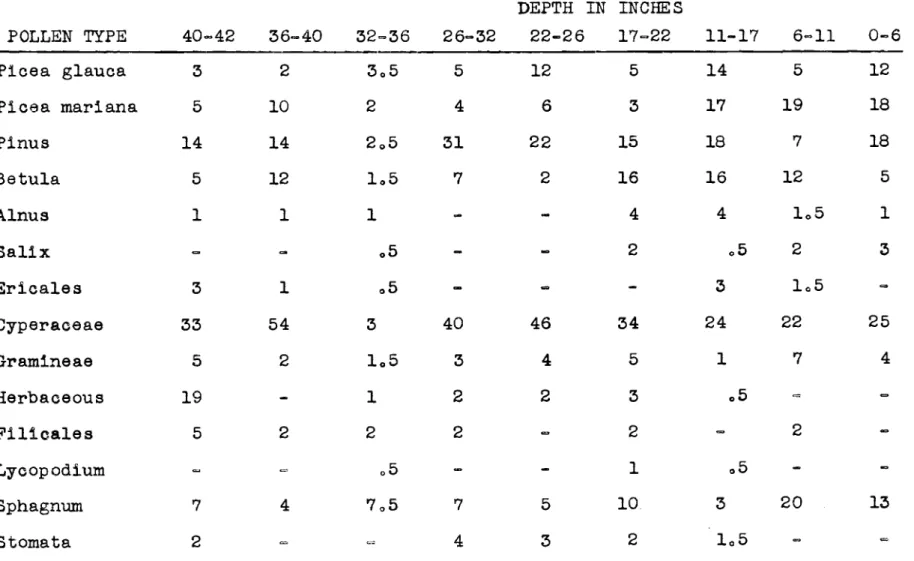
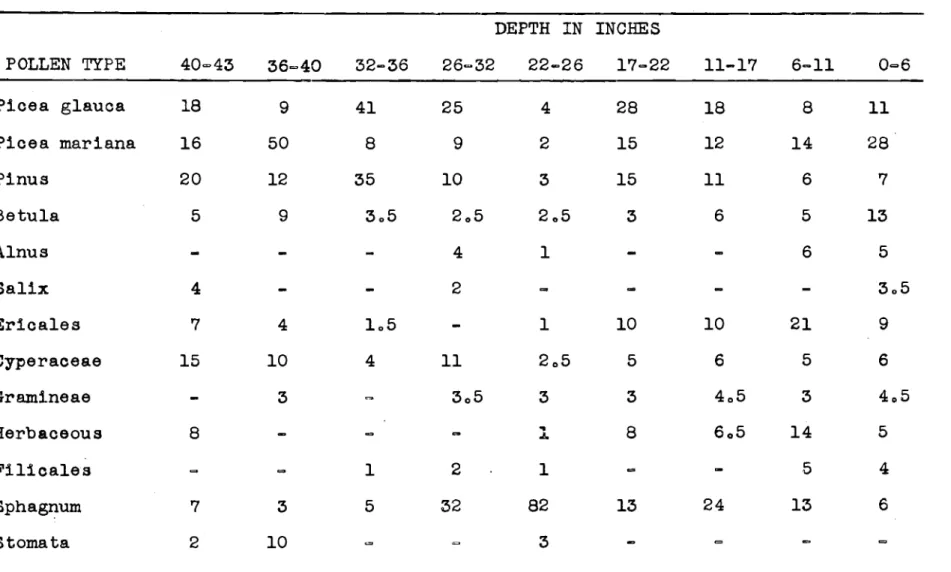
Relative percentages of the fossil pollen preserved at successive depths of peat Bore (A) are presented in Table
1I9 and those for Bore (B) in Table IIIo As in most pollen
analysesp the spores of Pteridophytes and Bryophytes have
been イ・」ッイ、・、セ but it has not been felt necessary to continu=
ally qualify the term "pollen" when thus used in connection
with pollen analysiso The presence of fossil stomatal cells
was observed at certain depths and has been イセ」ッイ、・、 in the
table s0
For each 、・ーエィセ the percentages expressed in the
tables are based on the total number of pollen and sporeso
The percentages are presented diagrammatically in figures 2
and 30
The fossil stomatal cells (Plate iiセ figure 17)
were compared with stomata from modern conifers9 and were
identified as those of Pinus. The percentages of stomata
may be considered as minima, since their observation was
incidental to the counting of ーッャャ・ョセ and their presence in
macroscopic material on the slides could have been easily missedo
The fossil pollen preserved in peat are in general
confined to anemophilous plantsp as seen from the list in
the tableso They are listed by genus) where identifiable to
that degree and where the genus is considered to be of ー。イセ
ticular paleoecological significanceo Other pollen are
tabulated as families or plant groupso
With Piaea ーッャャ・ョセ the species Po glauca (Plate iiセ
A=·12
mariana (PIa te II9 figure 1) 0 Some grains of 'the fermer·
were at ヲゥイウセ considered to be the similar=sized a「ゥ・セ as
Wilson (1942) believes many workers have done o hッキ・カ・イセ
the hemispherical shape of the bladders, as seen in distal
view, definitely distinguish P0 glauca from the a「ゥセ^ which
shows spherical bladderso No fossil Abies pollen was
obser-vedo The grains of Pinus (Plate II, figure 3) were
refer-able to Po banksiana, no larger grains of the more southerly Eo resinosa' being observedc
The pollen listed as Herbaceous was almost entirely Compositae and Rosaceae (Rubus chamaemorus was predominant
for the groupセ and pre sent onlyセ in the two .top depths of
Bore (B))o Similarlyセ Plantago was the pr-edomfnant herbaceous
pollen in the base sample of Bore (A) and otherwise was present only slightly at the base of Bore (B)o
An unidentified mf cr-of'o a ai L, termed grain IILII.
(Plate II. figure 16) was relatively common at thirty=two to
エィゥイエケセウゥク inches in Bore (A). and present only again in the
surface sample of Bore (B) 0
This sporadic appearance of Rubus. pャ。ョエ。ァッセ and
the grain Gセliャ II as well as the e xtr-emeLy high frequency of
Sphagnum at one depth in each of Bore (A) and Bore (B) 0
suggests the preservation in the peat of pollen in masses
such as anthers" 'I'hLa is to be expe cted, p er-hap s , con s
L-dering the very poor decomposition of the plant remains"
especially sphagnum9 as mentioned in the descrlption of this
TABLE II
Microfossil percentages of peat Bore (A) DEPTH IN INCHE S POLLEN TYPE 40-42 SVセTP 32=36 26=32 22-26 QWセRR 11-17 6-11 0-6 Picea glauca 3 2 3 05 5 12 5 14 5 12 Picsa mariana 5 10 2 4 6 3 17 19 18 Pinus 14 14 20 5 31 22 15 18 7 18 Betula 5 12 105 7 2 16 16 12 5 Alnus 1 1 1
-
-
4 4 1 05 1 Salix = = 05-
-
2 05 2 3 :t:-D Ericales 3 1 05-
=-
3 105 = セVl Cyperaceae 33 54 3 40 46 34 24 22 25 Gramineae 5 2 10 5 3 4 5 1 7 4 Herbaceous 19-
1 2 2 3 05 Fil1cales 5 2 2 2 セ 2 = 2 Lycopodium = セL 05-
-
1 05 Sphagnum 7 4 70 5 7 5 10 3 20 13 Stomata 2 = セセ 4 3 2 1 05TABLE III
Microfossil percentages of peat Bore (B) DEPTH IN INCHES POLLEN TYPE 40=43 36=40 SRセSV 26=32 RRセRV QWセRR 11-17 6-11 0=6 Picea glauca 18 9 41 25 4 28 18 8 11 Picea mariana 16 50 8 9 2 15 12 14 28 Pinus 20 12 35 10 3 15 11 6 7 Betula 5 9 305 2 05 205 3 6 5 13 Alnus
-
-
-
4 1-
-
6 5 Salix 4-
-
2 セ-
-
-
305 ):-D Er1ca1es 7 4 105-
1 10 10 21 9 ...セ Cyperaceae 15 10 4 11 2 05 5 6 5 6 Gramineae-
3 = 30 5 3 3 405 3 4 05 Herbaceous 8 セ = セ..
A 8 605 14 5 Fi11ca1es = = 1 2 1 =-
5 4 Sphagnum 7 3 5 32 82 13 24 13 6 Stomata 2 10 = = 3A=15 DISCUSSION
In spite of the rather indefinite trends shown by
some of the pollen diagramsr there are some features which
are definite and others which are not so apparento
Sphagnum in Bore (B) shows a definite maximum and
a gradual declineo Pinus and Cyperaceae show gradual declines
from the beginning of the deposito Picea glauca shows a
general maximum in the middle of the peat ーイッヲゥャ・セ while Po
ュ。イゥ。ョ。セ predominating ・。イャゥ・イセ reverts to a strong maximum
in the upper layers of the peato Revertence is also shown
by Betula and eイゥ」。ャ・ウセ with Alnus and Salix showing that
posSIb-rIrtyo The Gramineae are ウエ。「ャ・セ of low frequenoy and
relatively オョゥューッイエ。ョエセ as are the Filicaleso Herbaceous
frequencies are substantial at the very bottomv but are 」ッョセ
tradictory in the upper halves of the two Boreso
The extent to which the pollen of the surface samples show discrepancies with the present vegetation on the barrens
should be noticedo The conifers in both Bores represent just
under 50 per cent of the total pollen9 yet the nearest woods
are I! miles awayo The frequency of Pinus in Bore (A) is 18
per 」・ョエセ although the nearest known pine stands are at least
175 miles distanto Alnus is present as five per centr although
the writer has never seen any in the Churchill regiano It ュ。ケセ
howeverp grow on the banks of near=hy イゥカ・イウセ the closest of
which is two miles o
The fossil pollen of plants may represent to a
varying degree the importance of the plants in the vegetation at the time of the peat depositiono
Thus Pinus is often much ッカ・イ]イ・ーイ・ウ・ョエ・、セ due to
the prolific production and far=travelling ability of its
polleno Another reason for the non=representation of the 3ur=
face samples is that they consist of the top six inches which
includes underlying sphagnum peato Since the cover today is
ャャ」ィ・ョセ・イゥ」。」・ッオウセ the top sample includes the deposition of
a previous and different vegetation and its polleno
The indefinite trends and depth=to=depth fluctua= tions of some pollens such as Picea glauca and Sphagnum in Bore CA) may not necessarily reflect similar floral changeso They may be due to the preservation of pollen masses as men= tioned previouslY9 or due to the layers of different peat
types having varying degrees of decompositionr which could
A=16
Cain (1939) 0 Wenner {1947} says of Labr ador-, iセ The fluc
t.ua-tions of the ー・イ」・ョエ。ァ・Xセ especially in short diagrams of
the barren イ・ァゥッョセ are often difficult to interpretUo
Differences may be seen between pollen frequencies
for the two 「ッイ・ウセ such as the muoh higher frequencies of
Cyperaceae in Bore (A)o This is due to the peat at the site
of Bore HaIセ キィゥ」ィセ being only eight feet from sedge ュ。イウィセ
would receive more sedge pollen than Bore (B) which was at
least fifty feet from a depression of sedgeo Other diffe=
rences between the Bores would be expectedj> since a certain peat facies in one Bore could be more compressed than in the second Bore, and an equivalent depth in each Bore would not
contain the same peat stratao This difference in layers of
the two Bores is seen in Table 10
These qualifying factors suggest that further borings should be analysed to study the relationships of
local variations vdth vegetation on the one hand and peat
stratification on the othere Until this is done» accurate
conclusions cannot be drawn from the pollen diagrams regard=
ing past vegetational ィゥウエッイセ and its significanceo
In sections of the United sエ。エ・ウセ numerou3 analyses
have been made by many キッイォ・イウセ and study of エィセゥイ ウゥュゥャ。イゥセ
ties and differences has established the significance of
certain pollen type s and their trend s in pollen diagrams0
From エィ・ウ・セ deductions have been made regarding past climatic
and other phenomena, but with much resulting controversyo
Cain (1939) ウ。ケウセ !LAs a matter of fact,!juntil the
relations between the modern distribution of trees and climate
is better understood9 interpretations of the past will be
somewhat uncertain at the beste The evidence of pollen sta=
tistics should be bolstered by modern floristic geography and
by stratigraphicalj> geological and archaeological facts キィ・ョセ
ever possi bleエセ a
A few tentative suggestions regarding the past
vegetation 。イゥウ・セ howeverj> from the observations on the peat
and on the pollen diagramse The peatj> at leastj> suggests a
non-isphagnum vegetation in the immediate vicinity at the
beginning of the peat depositiono The presence of larch wood
at a depth of RVセSV inches then indicates succession to at
least some wooded covere
Sphagnum then invaded the area and has been イ・ウーッョウセ
A=17
absence of trees from the region today confirms the
extinc-tion of forest by the acid sphagnum=bog condiextinc-tions o The
slight surface peat and the vegetation エッ、。ケセ show that a
recent change of conditions has allowed the replacement of
sphagnum by lichen=ericaceous ィ・。エィセ and the immigration of
the two small spruce mentioned in the description of
vegeta-tiono This sphagnum retrogression is similar to that re=
corded in Alberta "muskegsU by Lewis and Dowding (1926)9 who
present evidence for drier climate as the cause o
The fairly high percentages of pine pollen do not necessarily indicate that pine has grown at Lamprey in the
pasto Although today's probable pine limit is at least 175
miles either to the south or west of Lamprey (Halliday, 1937;
Raup, QYSVIセ pine pollen is common in surface samples even at
Churchill to the northo Pinus, as ュ・ョエゥッョ・、セ can be much
ッカ・イセイ・ーイ・ウ・ョエ・、 by its abundant pollen even at long distances o
Thus Erdtman (1931) says that bogs in Central Alberta showed
a predominance of pine ーッャャ・ョセ although pine was not growing
near-byo If pine had grown near the Lamprey site, much higher
percentages of pine pollen might have been expectedo The
diagrams suggest that the somewhat higher frequencies are only relative and are due to comparatively low depositions of
spruce and other grainso
It is difficult to ・クーャ。ゥョセ however, the presence
of pine macrofossils, the stomatal cellso In a similar case9
Faegri (1945) suggested tha t they might have come from pine needles blown on the snow, but was surprised at their presence
nine miles from the rearest pine foresto It is much more
surprising at Lamprey to find them at least 175 miles from the present pine limito
The pollen frequencies at the base of the deposit,
suggest a berbaceous=ericaceous heath vegetation together with sedge, which throughout 9 probably" dominated the wet habitatso Shrub succession, or at least, rise, is indicated by a Betula
maximum0
The high frequencies ョ・クエセ in Bore (B) of first
Picea mariana and then Po glauca, suggest the succession of spruce, while the unchanged frequencie s in Bore (A) may indi=
cate9 together with the preserved larch キッッ、セ the dominance
at Bore (A) of that treeo The advent of sphagnum is then
indicated, especially in Bore HbIセ with extinction to some
degree of the spruce suggested between the depths of 22=32
incheso The high frequency of Picea mariana then suggests
the revival of the ーイ・ウ・ョエセ、。ケ spruce woods in their scattered
A=18
High frequencies of the ウィイオ「ウセ b・エオャ。セ Alnus and
Salix occur in the top levelsc The セ「オョ、。ョ」・ of Ericales
pollen, beginning as much as four depths from the tOPj point the way to the invasion of sphagnum by the heath group;
Dullninating in the complete lichen=heath replacement of todayo
SUMlVIARY
10 Peat from a treeless heath "bar-r-ens" of the forest-tundra
transition, south of Churchill, Manitoba; has been studied pollen-analyticallyo
2. Two borings of the peat underlying areas of lichen=
・イゥセ。」・ッオウ heath, have been analysed to obtain the
frequen-cies of certain pollen at nine successive depths.\) and the results presented diagrammaticallyo
30 The peat deposits were shown, to be エィセM。ョ、MッョセMィ。ャヲ feet
deep, permanently ヲイッコ・ョセ except for the upper thirteen
inches, and consisted largely of very undecomposed sphag-num peat, containing larch wood at a lower deptho
40 Apparent fluctuations and indefinite trends of certain
pollens have been suggested as not representative of
similar floristic actionp but as due to local conditions,
in particular, the peato
50 Certain differences between the analyses of the two bores
emphasize that numerous analyses and the study of related conditions must be made before reliable interpretation of
past vegetation and conditions can be madeo
60 The high frequency of Pinus.\) gradually declining, is not
necessarily believed to represent the presence of pine in the immediate vicinity at· any time.\) although the presence here of pine stomata at least 175 miles from the present pine limit is surprisingo
70 For reasons presentedp only a very tentative
interpreta-tion of the past history of the area can be proposedo
8. It is suggested that the past vegetational history
fol-lowed this pattern: (sedge dominating the wet areas through-out) - herbaceous-ericaceous heath, birch shrub; spruce
forest j probably black spruce followed by white spruce and
larch, sphagnum9 causing the extinction of the woods,
revival of black spruce in the scattered patches of todaY9 followed shortly by shrub immigration in other areas,
A=19
rise of ericaceous plants in the sphagnum» ending in its
extinction9 and growth of the present lichen=ericaceous
heatho
ACKNOWLEDGEMENTS
The writer wishes to express his deepest grati=
tude to Professor N. wッr。、ヲッイエィセ for making possible this
investigation9 and for his kind advice and continued
encouragemen to
Grateful acknowledgement is made to the National
Research Council of Canada and to the Defence Research
Board for their interest in this work
Sincere thanks are due to all who aided in secur-ing the material, and to those who contributed suggestions and time during the investigation, as well as during the preparation of the thesis.
REFERENCES
AUER, Vo 1930 0 Peat bogs in southeastern Canada o Geolo
Survo c。ョッセ Memo 1620
BOWMAN, PoWo 19310 Study of a peat bog near the Natamek
River, Quebec, Canada, by the method of pollen
analysiso Ecology, 12g694=708.
19340 Pollen analysis of Kodiak bogs o
Ecology, QUァYWセQPPP
ERDTMAN, Go 19310 Study of peat bogs of Central Albertao
Abho Nato Vero Bremen, 28811=170
19430 An introduction to pollen analysiso
Waltham, Masso Chronica Botanicao
FAEGRI, Ko 19450 A pollen diagram from the sub=alpine
region of central south Norwayo
Norsk geologisk Tidsskrift RUZYYセQRVP
FULLER, GoDo 19270 Pollen analysis and post glacial