Transposition of Tn125 Encoding the NDM-1 Carbapenemase in
Acinetobacter baumannii
Séverine Bontron,a,bPatrice Nordmann,a,b,cLaurent Poirela,b
Emerging Antibiotic Resistance Unit, Medical and Molecular Microbiology, Department of Medicine, Faculty of Science, University of Fribourg, Fribourg, Switzerlanda; INSERM European Unit (LEA Paris, France), University of Fribourg, Fribourg, Switzerlandb; University of Lausanne and University Hospital Center, Lausanne, Switzerlandc
The bla
NDM-1gene encodes a carbapenemase that confers resistance to almost all
-lactams, including last-resort carbapenems.
This is increasingly reported worldwide in nosocomial and community-acquired Gram-negative bacteria. Acinetobacter
bau-mannii is an important opportunistic pathogen that is considered an intermediate reservoir for the bla
NDM-1gene. In this
spe-cies, the bla
NDM-1gene is located within the Tn125 composite transposon. The mechanism driving the mobility of Tn125 has not
yet been elucidated. Here we experimentally demonstrated the transposition of Tn125 in A. baumannii. Systematic 3-bp
dupli-cation of the target site, being the signature of transposition, was evidenced. The target site consensus sequence for Tn125
trans-position was found to be GC enriched at the duplicated 3 bp and AT rich in the vicinity. Transtrans-position frequency was not
influ-enced by temperature changes or by exposure to subinhibitory concentrations of various antibiotics. This work is the first direct
evidence of the functionality of a composite transposon in A. baumannii. It provides a mechanistic clue for the dissemination of
the bla
NDM-1gene in Acinetobacter spp. and subsequently among Enterobacteriaceae.
C
arbapenemases are enzymes hydrolyzing most
-lactams,
in-cluding penicillins, cephalosporins, and carbapenems.
Dur-ing the last decade, they have been increasDur-ingly reported
world-wide in Acinetobacter baumannii, Pseudomonas aeruginosa, and
Enterobacteriaceae. The spread of carbapenemases is of utmost
importance for medicine, since carbapenems are last-resort
anti-biotics for treating the most severe and hospital-acquired
infec-tions. The class B New Delhi metallo-
-lactamase (NDM-1) is
a broad-spectrum
-lactamase, hydrolyzing penicillins,
ceph-alosporins, and carbapenems (
1
). NDM-1 was first identified in
a Klebsiella pneumoniae isolate from a patient previously
hospi-talized in India in 2008 (
2
). Since then, it has been found mostly
in Enterobacteriaceae and A. baumannii and to a lesser extend in
P. aeruginosa (
1
,
3
). The origin of the bla
NDM-1resistance gene
and the mechanism(s) driving its mobility remains unknown.
However, a current hypothesis suggests that the bla
NDM-1gene
originates from an environmental bacterial progenitor species and
that A. baumannii is an intermediate reservoir for the bla
NDM-1gene (
4
).
A. baumannii is an opportunistic human pathogen and a
com-mon cause of sepsis, pneucom-monia, urinary tract infection, and
pri-mary bacteremia. Multidrug-resistant A. baumannii isolates are of
great concern (
5
,
6
). In Acinetobacter spp., the bla
NDM-1gene is
embedded in transposon Tn125 (
4
,
7
,
8
). Tn125 is a 10,099-bp
composite transposon bracketed by two copies of the insertion
sequence (IS) ISAba125 orientated in the same direction (
Fig. 1A
)
(
4
,
7
,
8
). The 1,087-bp ISAba125 element belongs to the IS30
fam-ily and encodes a 322-amino-acid-long DDE-type transposase
surrounded by imperfect terminal inverted repeat sequences (IRR
[inverted repeat right] and IRL [inverted repeat left], sharing
20/26 nucleotide identity) (
9
,
10
). The ble
MBLgene, which encodes
a 121-amino-acid-long protein conferring resistance to
bleomy-cin, a glycopeptide antibiotic used as an antitumor agent, is
lo-cated downstream of the bla
NDM-1gene (
11
). In addition, Tn125
comprises six genes encoding putative proteins (iso, tat, dct, groES,
groEL, and
⌬pac [a truncated phospholipid acetyltransferase
gene]), the ISCR21 element, and the putative oriIS sequence that
defines the origin of replication of ISCR21 (
7
,
8
). ISCR elements
are peculiar ISs belonging to the IS91 family, likely mobilizing
genes located at their left-hand extremity by a rolling-circle
trans-position process (
12
,
13
).
Current observations suggest that the bla
NDM-1gene originates
from an unknown environmental bacterial progenitor species
and is integrated into the chromosome of Acinetobacter spp. The
bla
NDM-1-bearing Tn125 transposon was likely subsequently built
from such Acinetobacter spp. and then transferred onto
broad-host-range plasmids, followed by horizontal transfer to
Enterobac-teriaceae and P. aeruginosa. This hypothesis is supported by a
se-ries of genetic features (
4
,
5
), as follows. (i) The bla
NDM-1gene
displays a higher GC percentage (62%) than that of the genome of
Acinetobacter spp. (38% to 42%), arguing in favor of a
phyloge-netic distance between the progenitor species and Acinetobacter
spp. (ii) ISCR21 may have mobilized a fragment encompassing the
bla
NDM-1gene that displays a similar GC percentage from an
un-known bacterial progenitor. (iii) ISAba125 has also been identified
in Acinetobacter species isolates without physical association with
the bla
NDM-1gene and shows a low GC content of 37%, consistent
with a possible Acinetobacter species origin (
4
,
5
).
A critical step in the dissemination process of the bla
NDM-1gene is the mobility of the Tn125 transposon in Acinetobacter spp.
According to its genetic structure, it was presumed that Tn125 can
move through transposition. Transposition is a catalytic process,
driven by an element-specific transposase. During this process,
Citation Bontron S, Nordmann P, Poirel L. 2016. Transposition of Tn125 encoding the NDM-1 carbapenemase inAcinetobacter baumannii. Antimicrob Agents Chemother 60:7245–7251.doi:10.1128/AAC.01755-16.
Address correspondence to Laurent Poirel, [email protected].
http://doc.rero.ch
Published in "Antimicrobial Agents and Chemotherapy 60(12): 7245–7251, 2016"
which should be cited to refer to this work.
the transposase generates a short direct repeat flanking the
trans-poson in the target DNA, corresponding to a signature of the
transposition event (
10
). Alternative mechanisms for Tn125
transfer might involve nonhomologous recombination or
cointe-gration. Here, we show that the Tn125 transposon can efficiently
transpose in A. baumannii and that the transposition frequency is
not influenced by temperature changes or antibiotic pressure.
MATERIALS AND METHODS
Strains. Transposition experiments were performed in A. baumannii
CIP70.10 and Ab17978 (recA::Km) (14) reference strains. Plasmids were constructed in Escherichia coli TOP10 (Invitrogen).
Plasmid construction. For pTOPO-Tn125, the Tn125 transposon was
amplified from A. baumannii strain JH (8) together with 98 bp and 99 bp of the flanking genomic sequences present in upstream and downstream Tn125, respectively, with primers JHorfTn125-HindIII-F (5=-gatgat aagcttTCAGCAATAAATTTGTCACCAGC-3=) and JHorfTn125-XbaI-R (5=-gatgattctagaCAAGCTGCTCAAGTTAAAGATCG-3=) (the HindIII and XbaI restriction sites are underlined, and the uppercase letters correspond to the open reading frame [ORF] identified in strain JH). This amplicon was subcloned into the HindIII and XbaI restriction sites of the pCR-BluntII-TOPO plasmid (Invitrogen). The integrity of both ISAba125 elements and of blaNDM-1was confirmed by
sequenc-ing. pTOPO-zeodel-Tn125 was derived from pTOPO-Tn125, in which a frameshift in the zeocin resistance gene was generated by digestion at the unique FseI site, blunting, and self-ligation. The resulting zeocin resis-tance protein lacks the 32 C-terminal amino acids. For the pTOPO-shut-tle-Tn125 plasmid, the A. baumannii-specific origin of replication was amplified from pWH1266 (a kind gift from P. Higgins) and subcloned into pTOPO-Tn125 between the BsrGI and HindIII restriction sites. Plas-mid pTOPO-shuttle-Tn125 replicates in E. coli, from which it can be selected with 50g/ml zeocin, 100 g/ml ampicillin, 25 g/ml kanamy-cin, or 0.5g/ml imipenem (IPM), in A. baumannii CIP70.10, from which it can be selected with 25g/ml kanamycin, 200 g/ml zeocin, or 1 g/ml IPM, and finally in A. baumannii Ab17978 recA::Km, from which it
can be selected with 10g/ml zeocin or 1 g/ml IPM. Full sequences of the Tn125 plasmids are available upon request.
Transposition assays. One-hundred-nanogram amounts of
pTOPO-Tn125 or pTOPO-zeodel-pTOPO-Tn125 suicide plasmids were electroporated into 25l of electrocompetent A. baumannii cells with a MicroPulser (Bio-Rad). The bacteria were resuspended in 2 ml LB and incubated for 1 h 30 min at 37°C with agitation. A total of 100l was plated onto LB agar plates supplemented with 1g/ml IPM to select the transposition events. The transformation efficiency was determined with the highly similar pTOPO-shuttle-Tn125 plasmid (replicating in A. baumannii), which was electroporated and processed in parallel to the suicide plasmids. The transposition frequencies were calculated by dividing the number of transposition events by the number of transformed cells. Experiments were done in triplicate. The same procedure was used to address the effect antibiotics has on transposition, but cells were incubated for 3 h at 37°C after electroporation with the following antibiotics: the glycopeptide bleo-mycin (1g/ml and 5 g/ml) (Molekula) or zeocin (4 g/ml and 8 g/ ml), the fluoroquinolone ciprofloxacin (0.05g/ml and 1 g/ml) (Sigma-Aldrich), the aminoglycoside kanamycin (1.5g/ml and 3 g/ml) (Roth; ThermoFisher Scientific), and the carbapenem imipenem (0.125g/ml and 0.25g/ml) (Mylan). The MIC of bleomycin for Tn125-containing CIP70.10 was 10g/ml, while it was ⬍1 g/ml for the parental CIP70.10 strain.
Molecular characterization of transposition events. The presence of
the full-length Tn125 was confirmed by the amplification in 5= of a 925-bp fragment spanning from ISAba125 to blaNDM-1with primers 125-F
(5=-ACACCATTAGAGAAATTTGC-3=) and NDM-R (5=-CGGAATGGC TCATCACGATC-3=) and in 3= of a 1,326-bp fragment spanning from ⌬pac to ISAba125 with primers dpac-F (5=-CAACTGTGAGTCCTTTAC TGAC-3=) and 125-R (5=-GCAAATTTCTCTAATGGTGT-3=). The inte-gration sites of the transposition events were characterized by shotgun cloning. Total genomic DNA was digested with EcoRV and ligated into the EcoRV-digested and dephosphorylated pBSKS-kanR vector. The li-braries were electroporated into E. coli TOP10 and plated onto LB agar containing 1 mg/liter IPM to select for blaNDM-1-positive clones, which
were sequenced with the primer IS125tpase_NORF-R (5=-CTCACGATA
FIG 1 Transposition of Tn125. (A) Schematic representation of transposon Tn125. The total size is 10,099 bp. The ORFs are represented by arrows, and the
lengths are to scale. The two ISAba125 elements bracketing Tn125 are indicated in green, each with the transposase (tnp) gene and the IRL and IRR inverted repeats. The blaNDM-1gene is in red, the bleMBLgene is in blue, and the 7 other ORFs are in dark gray; the ISCR21 and the oriIS (circle) are in light gray. The GC
content (%) for each of the following fragments is indicated: 37% for each ISAba125 (nucleotides 1 to 1087 and 9013 to 10099), 65% for the sequence encompassing blaNDM-1to oriIS, and 32% for⌬pac. (B) Characterization of four Tn125 transposition events in A. baumannii CIP70.10 and Ab17978 (recA
mutant) strains. The duplicated 3-bp target sites are underlined. The surrounding 50 nucleotides, upstream and downstream of each transposon insertion, are shown. In A. baumannii CIP70.10, transposon Tn125 transposed between ORFs designated No1 (encoding proteins deposited under accession no.CRL92855.1
andCRL92856.1) or an ORF designated No2 (encoding an outer membrane protein A precursor [accession no.CRL95910.1); in A. baumannii Ab17978 (recA mutant), transposon Tn125 transposed in the ORF designated No1 (encoding a hypothetical protein [accession no.AKQ26110.1]) or in the ORF designated No2 (encoding a CinA-like protein [accession no.KNZ37258.1]).
GATCGTACTAGG-3=) to identify the genomic sequence upstream of Tn125. For each transposition event, a primer was designed to amplify a fragment spanning from the 3= end of Tn125 to the genomic sequence downstream of Tn125. These PCR amplicons were sequenced with primer IS125tpase-CORF-F (5=-CATGTCACTGAATACTCGTCC-3=).
Determination of the AT and GC contents and pictogram of the target site consensus. For the 27 transposition events characterized, the
relative frequencies of each A and T, and G and C, for the region extending from 50 nucleotides upstream to 50 nucleotides downstream from the duplicated 3-bp target site were calculated and plotted onto a graph. The pictures of the relative frequencies of the bases at each position were generated with the Pictogram program (http://genes.mit.edu/pictogram .html).
Detection of ISAba125 in Acinetobacter species strains. Strains were
screened by PCR with primers Tn125-F (5=-TGTATATTTCTGTGAC CCAC-3=) and Tn125-R (5=-GAAGGCGAATTCAAACATGAGGTGC-3=). A 255-bp product was amplified in the presence of ISAba125.
RESULTS
Transposition of Tn125 in A. baumannii. To address the
trans-position of Tn125 in A. baumannii, the suicide plasmid
pTOPO-Tn125 was transformed as the donor for the transposon in two A.
baumannii recipient strains, CIP70.10 (recA wild type) and
Ab17978 (recA mutant) (
14
). The pTOPO-Tn125 plasmid
con-tains the entire Tn125 transposon, together with the flanking
chromosomal sequences present in the Tn125-positive A.
bau-mannii isolate JH (98 and 99 bp upstream and downstream of the
transposon, respectively) (
8
). Four imipenem-resistant clones,
two in A. baumannii CIP70.10 and two in A. baumannii Ab17978,
were stepwise characterized as follows. First, they were tested for
the loss of kanamycin and zeocin resistance markers, confirming
that the donor plasmid did not integrate into the genome. Second,
the presence of the full-length transposon Tn125 and the absence
of the flanking sequences present in the donor plasmid were
con-firmed by PCR. Third, the genomic sequences flanking Tn125
were characterized in order to map the transposition sites and
analyze the target site duplication. As shown in
Fig. 1B
, for each of
the four studied clones, the entire Tn125 transposed into distinct
loci of the A. baumannii chromosome. A 3-bp target site
duplica-tion was present in each case. Transposiduplica-tion of Tn125 conferred
resistance to cephalosporins and carbapenems, with MIC values
of ceftazidime, imipenem, and meropenem being
⬎256, ⬎32, and
⬎32 g/ml, respectively.
Transposition frequencies. The transposition frequencies
measured with pTOPO-Tn125 and pTOPO-zeodel-Tn125 as
do-nors were 4.5
⫻ 10
⫺4(
⫾0.5 ⫻ 10
⫺4) and 5.7
⫻ 10
⫺4(
⫾0.9 ⫻
10
⫺4) per transformed cell, respectively (
Table 1
, experiment 1).
The frequencies with both donor plasmids were in the same range,
excluding the potential influence of the zeocin marker gene, which
confers resistance to the same class of molecules (bleomycin) as
the ble
MBLgene. Since the source of dissemination of the bla
NDM-1gene is likely the environment, in particularly in Asia (
15
,
16
),
where a variety of antibiotics has been widely identified (
17
,
18
)
and where temperature changes might influence the transposition
frequency (
19
,
20
), corresponding experiments were conducted.
Incubation for 3 h with 1 or 5
g/ml bleomycin, a glycopeptide
antibiotic used as an antitumor agent, did not influence the
trans-position rate of Tn125 (
Table 1
, experiment 2). Similarly, the
transposition rate was not influenced by incubation for 3 h at
different temperatures (25°C, 30°C, 37°C, or 44°C) or by the
pres-ence of subinhibitory concentrations of structurally nonrelated
antibiotics, such as fluoroquinolone (ciprofloxacin),
aminoglyco-side (kanamycin), glycopeptide (zeocin), and carbapenem
(imi-penem) (data not shown).
Target site specificity. In order to determine a consensus
tar-get site for Tn125 transposition, 25 additional independent
trans-position events, in 25 independent isolates, were characterized in
A. baumannii CIP70.10. Among the transposition events, 19
oc-curred within open reading frames (ORFs), 8 in direct orientation
and 11 in reverse orientation compared to the disrupted ORF, and
8 outside of ORFs. For each transposition event, a systematic 3-bp
duplication of the target site was evidenced (
Fig. 2A
). To further
characterize the features of the target site, the surrounding
genomic sequences of the 27 transposition events were aligned,
from 50 bp upstream up to 50 bp downstream of Tn125. The mean
AT content for the regions distal to the duplicated target site, from
⫺50 to ⫺4 bp and from ⫹4 to ⫹50 bp relative to it, was 72% on
both sides (
Fig. 2B
, upper graph). Around the duplicated target
site, the AT content increased, with 100% at positions
⫺3 and ⫹3
and 83% to 90% at positions
⫺2, ⫺1, ⫹1, and ⫹2 (
Fig. 2B
, lower
graph). By analysis of the nucleotide composition, the
⫺3 position
was found to be predominantly an A (69%), and the
⫹3 position
was found to be predominantly a T (72%) (
Fig. 2C
). At the
dupli-cated target site positions, named here c1, c2, and c3, the AT
con-tent was lower (38% to 62%) (
Fig. 2B
, lower graph). At c1, A, T, C,
and G were equally represented (24% to 28%), while G was
un-derrepresented at c2 (10% versus 38%, 24%, and 28% for A, T,
and C, respectively) and predominant at c3 (48% versus 21%,
17%, and 14% for A, T, and C, respectively) (
Fig. 2C
). Further
analysis of sequences flanking 74 ISAba125 elements retrieved
from GenBank confirmed the consensus derived from the analysis
of Tn125 transposition events (
Fig. 2D
). In conclusion, the target
site specificity of Tn125 was driven mainly both by the 3 bp
sur-rounding the duplicated target site, being AT rich and reaching
TABLE 1 Transposition frequencies of Tn125 in A. baumannii CIP70.10
Expta Incubation drug (concn)
Transposition frequency (10⫺4)b pTOPO-Tn125 pTOPO-zeodel-Tn125 1 None 4.5 (⫾0.5) 5.7 (⫾0.9) 2 None 11.8 (⫾3.0) 9.6 (⫾5.1) Bleomycin (1 mg/liter) 11.4 (⫾2.2) 9.0 (⫾3.4) Bleomycin (5 mg/liter) 7.6 (⫾3.9) 4.6 (⫾1.8)
aIn experiment 1, the bacteria were incubated for 1 h 30 min at 37°C after electroporation and then plated on 1-mg/liter imipenem-containing plates. In experiment 2, the bacteria
were incubated for 3 h at 37°C with the indicated concentration of bleomycin.
bpTOPO-Tn125 or pTOPO-zeodel-Tn125 was transformed as the donor of Tn125. The transposition frequencies are expressed as the number of transposition events relative to the
number of cells transformed. Experiments were performed in triplicate. Values in parentheses are standard deviations.
96% to 99% A or T at positions
⫺3 and ⫹3, and by the duplicated
3-bp target site itself, which was GC enriched, with a strong bias
for nucleotide G at the position c3.
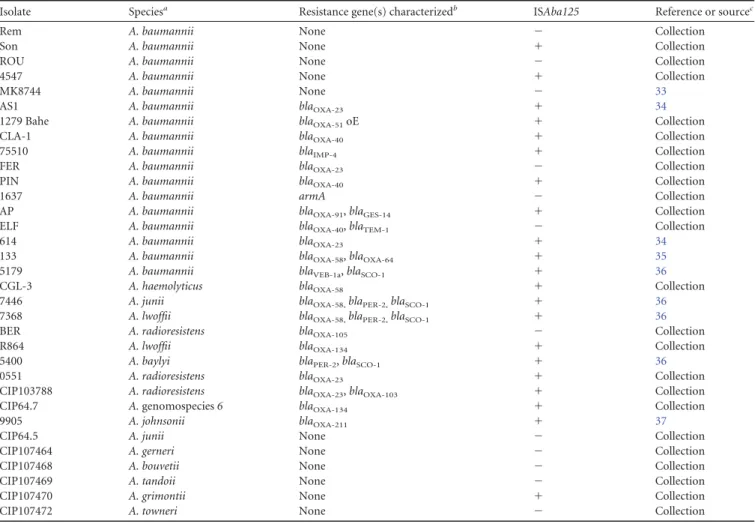
Distribution of ISAba125 in Acinetobacter spp. In order to
evaluate the distribution of ISAba125, its occurrence was
evalu-ated among 17 A. baumannii and 16 Acinetobacter species clinical
isolates. These strains were negative for the bla
NDM-1gene, and
some of them carried previously characterized resistance genes to
FIG 2 Target site preferences of Tn125. (A) Molecular characterization of 27 transposition events of Tn125 in A. baumannii CIP70.10 (two of them are the same
as inFig. 1B). For each of them, the duplicated 3-bp target site is underlined. The surrounding 50 nucleotides upstream and downstream of the target sites are shown. (B) The 27 transposition sites ofFig. 2Awere aligned, and the percentages of AT and GC at each position, from 50 nucleotides upstream to 50 nucleotides downstream of the target site, are shown on the graph. The 3 bp of the duplicated target site, named here c1, c2, and c3, are highlighted by a black bar. The AT percentages of regions spanning positions⫺50 to ⫺4 and positions ⫹4 to ⫹ 50 and those of the region spanning positions ⫺3 to ⫹ 3 are indicated in the upper and lower graphs, respectively. (C) Pictogram showing the relative frequencies of each A, T, C, and G at the target site, deduced from the 27 experimental transposition events shown in panel A. (D) Pictogram showing the relative frequencies of each A, T, C, and G at the target site, deduced from 74 ISAba125 elements retrieved from GenBank (seeTable 3for references).
broad-spectrum
-lactams. ISAba125 was detected in 21 out of 33
strains (
Table 2
). In addition, the locations of 74 ISAba125
ele-ments found in genomic sequences of 8 A. baumannii strains
de-posited in GenBank were mapped with respect to their target sites.
Half of the ISAba125 elements were located within ORFs. For 6 of
them, the IRR of ISAba125, which provides a
⫺35 box promoter
element orientated toward the flanking DNA, was found in
prox-imity (less than 100 bp) of the ATG start codon of the adjacent
TABLE 2 Distribution of ISAba125 in Acinetobacter species isolates, detected by PCR
Isolate Speciesa Resistance gene(s) characterizedb ISAba125 Reference or sourcec
Rem A. baumannii None ⫺ Collection
Son A. baumannii None ⫹ Collection
ROU A. baumannii None ⫺ Collection
4547 A. baumannii None ⫹ Collection
MK8744 A. baumannii None ⫺ 33
AS1 A. baumannii blaOXA-23 ⫹ 34
1279 Bahe A. baumannii blaOXA-51oE ⫹ Collection
CLA-1 A. baumannii blaOXA-40 ⫹ Collection
75510 A. baumannii blaIMP-4 ⫹ Collection
FER A. baumannii blaOXA-23 ⫺ Collection
PIN A. baumannii blaOXA-40 ⫹ Collection
1637 A. baumannii armA ⫺ Collection
AP A. baumannii blaOXA-91, blaGES-14 ⫹ Collection
ELF A. baumannii blaOXA-40, blaTEM-1 ⫺ Collection
614 A. baumannii blaOXA-23 ⫹ 34
133 A. baumannii blaOXA-58, blaOXA-64 ⫹ 35
5179 A. baumannii blaVEB-1a, blaSCO-1 ⫹ 36
CGL-3 A. haemolyticus blaOXA-58 ⫹ Collection
7446 A. junii blaOXA-58,blaPER-2,blaSCO-1 ⫹ 36
7368 A. lwoffii blaOXA-58,blaPER-2,blaSCO-1 ⫹ 36
BER A. radioresistens blaOXA-105 ⫺ Collection
R864 A. lwoffii blaOXA-134 ⫹ Collection
5400 A. baylyi blaPER-2, blaSCO-1 ⫹ 36
0551 A. radioresistens blaOXA-23 ⫹ Collection
CIP103788 A. radioresistens blaOXA-23, blaOXA-103 ⫹ Collection
CIP64.7 A. genomospecies 6 blaOXA-134 ⫹ Collection
9905 A. johnsonii blaOXA-211 ⫹ 37
CIP64.5 A. junii None ⫺ Collection
CIP107464 A. gerneri None ⫺ Collection
CIP107468 A. bouvetii None ⫺ Collection
CIP107469 A. tandoii None ⫺ Collection
CIP107470 A. grimontii None ⫹ Collection
CIP107472 A. towneri None ⫺ Collection
a
A. baumannii is the clinically most important species.
bblaOXAgenes encode carbapenem-hydrolyzing class D oxacillinases, bla
TEM-1and blaSCO-1encode penicillinases, blaVEB-1aand blaPER-2encode extended-spectrum
beta-lactamases (ESBLs), blaIMP-4and blaGES-14encode carbapenemases, and armA encodes a 16S rRNA methylase. oE, overexpression. cCollection, personal laboratory collection.
TABLE 3 Position of 74 ISAba125 elements with respect to genomic ORFsa
Strain Accession no.
No. of ISAba125 copies
Totalb Within ORF Between ORFs Promoter providerc Reference
NCGM 237 AP013357 26 14 12 2 38 LAC-4 CP007712 14 9 5 1 39 AbH12O-A2 CP009534 3 2 1 0 40 AB04-mff CP012006 12d 5 6 0 41 ACICU CP000863 7 2 5 2 29 BJAB0715 CP003847 8 3 5 0 30 TTHO-4 CP012608 4 2 2 0 Unpublished TCDC-AB0715 CP002522 1 0 1 1 42 a
Sequences were retrieved from 8 A. baumannii complete genome sequences deposited in GenBank.
bNumber of ISAba125 copies found in each strain. c
Among ISAba125 intergenic copies, those copies where the distance between the end of the IRR (which provides a⫺35 box promoter element) and the ATG of the following ORF was less than 100 bp.
d
Ten single ISAba125 elements and 1 composite transposon made of 2 ISAba125 copies.
ORFs (
Table 3
). In conclusion, ISAba125 was detected in more
than half of the Acinetobacter species clinical isolates tested and
potentially contributed to the genetic plasticity of those strains,
either by disrupting ORFs or by potentially bringing promoter
sequences to chromosomal genes.
DISCUSSION
This study actually corresponds to the first experimental
demon-stration of the functionality of the bla
NDM-1-carrying Tn125
trans-poson. The ability of Tn125 to transpose in A. baumannii sustains
the following model: A. baumannii is an intermediate reservoir
for the bla
NDM-1gene and may contribute to further dissemination
of the bla
NDM-1gene among species. Indeed, environmental A.
baumannii is originally likely in close contact with a still unknown
progenitor of the bla
NDM-1gene or with disseminated bla
NDM-1-positive bacteria (
15
). It could then transfer resistance genes to
Enterobacteriaceae in the environment or in humans.
The transposase directly influences the choice of the target site,
with a preference for GC- or AT-rich DNA domains, local DNA
structure, degree of supercoiling, replication or transcription
level, and chromosome or plasmid location (
10
). The target site of
Tn125 was AT rich when the 3 bp surrounding the duplicated
target site was considered, reaching 99% A and 96% T at positions
⫺3 and ⫹3, respectively, and was enriched in GC within the 3-bp
target site, which is duplicated upon transposition, with a strong
preference for G at c3 (
Fig. 2
). In A. baumannii clinical isolates, the
same features are present in the chromosomal regions flanking the
Tn125 and TnaphA6 composite transposons, the most recently
identified being composed of the aphA6 aminoglycoside
resis-tance gene surrounded by two ISAba125 elements (
8
,
21
). The
preference for AT-rich regions, previously observed for ISAba1
(
22
), is consistent with the Acinetobacter species origin of
ISAba125, whose genome is AT rich (58 to 62%). The frequencies
of transposition of Tn125 observed here were several orders of
magnitude higher than, for example, those of the Tn2006
compos-ite transposon and the ISAba1 and IS1999 elements (
22
,
23
);
un-fortunately, these values are difficult to compare due to different
experimental setups.
Two ISs were previously shown to be functional for
transposi-tion in A. baumannii, namely, ISAba825 (IS982 family) (
24
) and
ISAba1 (IS4 family) (
22
,
25
). Here, we experimentally
demon-strated the functionality of ISAba125 (IS30 family). Consistent
with its ability to transpose, ISAba125 was described in association
with increased resistance levels to
-lactams in Acinetobacter
spp., for example, through duplication of the bla
OXA-58carbapen-emase gene (
26
), disruption of the carO gene encoding an outer
membrane protein acting in synergy with other resistance
mech-anisms (
27
), or insertion upstream of the bla
ADCcephalosporinase
gene (
28
). In the sequenced genomes of strains listed in
Table 3
,
ISAba125 was found upstream of the ampC gene in strain ACICU
(
29
) or flanking the aphA6 gene conferring resistance to amikacin
in strain BJAB0715 (
30
).
ISAba125 was present in more than half of the clinical isolates
tested (
Table 2
). In a parallel study, analysis of 131 Acinetobacter
spp. revealed that 5 strains had 1 copy, 34 strains had few (2 to
9) copies, 12 strains exhibited numerous (
ⱖ10) copies, and 80
strains contained no copy of ISAba125 (
31
). This high frequency
and high copy number of ISAba125 in Acinetobacter spp. are
in-dicative of frequent transposition events, lateral gene transfer
within Acinetobacter spp., a replicative mechanism of
transposi-tion (as shown for the IS30 family), and the capacity of ISAba125
to expand within genomes, a general feature of ISs (
9
). Taken
together, these characteristics are suggestive of an evolutionary
role of ISAba125 customized for Acinetobacter spp., as proposed
for ISAba1 in A. baumannii (
32
,
33
).
This work demonstrates the ability of the bla
NDM-1-carrying
Tn125 transposon to transpose in A. baumannii. It underlines the
importance of A. baumannii, which has been considered for years
as playing a minor role in medical microbiology. A. baumannii is
likely in close contact in the environment with the (still unknown)
natural progenitor of the bla
NDM-1gene and may play a key role in
the spread of the bla
NDM-1gene to clinically relevant bacterial
spe-cies, in particular members of the Enterobacteriaceae.
ACKNOWLEDGMENTS
This work was supported by the Swiss National Science Foundation (proj-ect FNS-31003A_163432) and by the University of Fribourg.
FUNDING INFORMATION
This work was funded by University of Fribourg. This work was funded by Swiss National Science Foundation (FNS-31003A_163432).
REFERENCES
1. Nordmann P, Poirel L, Walsh TR, Livermore DM. 2011. The emerging NDM carbapenemases. Trends Microbiol 19:588 –595.http://dx.doi.org /10.1016/j.tim.2011.09.005.
2. Yong D, Toleman MA, Giske CG, Cho HS, Sundman K, Lee K,
Walsh TR. 2009. Characterization of a new metallo--lactamase gene,
blaNDM-1, and a novel erythromycin esterase gene carried on a unique
genetic structure in Klebsiella pneumoniae sequence type 14 from India. Antimicrob Agents Chemother 53:5046 –5054.http://dx.doi.org/10.1128 /AAC.00774-09.
3. Dortet L, Poirel L, Nordmann P. 2014. Worldwide dissemination of the NDM-type carbapenemases in Gram-negative bacteria. Biomed Res Int
2014:249856.http://dx.doi.org/10.1155/2014/249856.
4. Bonnin RA, Poirel L, Nordmann P. 2014. New Delhi metallo- -lactamase-producing Acinetobacter baumannii: a novel paradigm for spreading antibiotic resistance genes. Future Microbiol 9:33– 41.http://dx .doi.org/10.2217/fmb.13.69.
5. Nordmann P, Dortet L, Poirel L. 2012. Carbapenem resistance in Entero-bacteriaceae: here is the storm! Trends Mol Med 18:263–272.http://dx.doi .org/10.1016/j.molmed.2012.03.003.
6. Potron A, Poirel L, Nordmann P. 2015. Emerging broad-spectrum re-sistance in Pseudomonas aeruginosa and Acinetobacter baumannii: mech-anisms and epidemiology. Int J Antimicrob Agents 45:568 –585.http://dx .doi.org/10.1016/j.ijantimicag.2015.03.001.
7. Pfeifer Y, Wilharm G, Zander E, Wichelhaus TA, Gottig S, Hunfeld KP,
Seifert H, Witte W, Higgins PG. 2011. Molecular characterization of
blaNDM-1in an Acinetobacter baumannii strain isolated in Germany in
2007. J Antimicrob Chemother 66:1998 –2001.http://dx.doi.org/10.1093 /jac/dkr256.
8. Poirel L, Bonnin RA, Boulanger A, Schrenzel J, Kaase M, Nordmann P. 2012. Tn125-related acquisition of blaNDM-like genes in Acinetobacter
baumannii. Antimicrob Agents Chemother 56:1087–1089.http://dx.doi .org/10.1128/AAC.05620-11.
9. Siguier P, Gourbeyre E, Varani A, Ton-Hoang B, Chandler M. 2015. Everyman’s guide to bacterial insertion sequences. Microbiol Spectr
3:MDNA3-0030-2014. http://dx.doi.org/10.1128/microbiolspec.MDNA3 -0030-2014.
10. Mahillon J, Chandler M. 1998. Insertion sequences. Microbiol Mol Biol Rev 62:725–774.
11. Dortet L, Nordmann P, Poirel L. 2012. Association of the emerging carbapenemase NDM-1 with a bleomycin resistance protein in
Enterobac-teriaceae and Acinetobacter baumannii. Antimicrob Agents Chemother 56:
1693–1697.http://dx.doi.org/10.1128/AAC.05583-11.
12. Toleman MA, Bennett PM, Walsh TR. 2006. ISCR elements: novel gene-capturing systems of the 21st century? Microbiol Mol Biol Rev 70: 296 –316.http://dx.doi.org/10.1128/MMBR.00048-05.
13. Bennett PM. 2008. Plasmid encoded antibiotic resistance: acquisition and
transfer of antibiotic resistance genes in bacteria. Br J Pharmacol
153(Suppl 1):S347–S357.http://dx.doi.org/10.1038/sj.bjp.0707607. 14. Aranda J, Bardina C, Beceiro A, Rumbo S, Cabral MP, Barbe J, Bou G.
2011. Acinetobacter baumannii RecA protein in repair of DNA damage, antimicrobial resistance, general stress response, and virulence. J Bacteriol
193:3740 –3747.http://dx.doi.org/10.1128/JB.00389-11.
15. Walsh TR, Weeks J, Livermore DM, Toleman MA. 2011. Dissemination of NDM-1 positive bacteria in the New Delhi environment and its impli-cations for human health: an environmental point prevalence study. Lancet Infect Dis 11:355–362.http://dx.doi.org/10.1016/S1473-3099(11) 70059-7.
16. Chen Y, Zhou Z, Jiang Y, Yu Y. 2011. Emergence of NDM-1-producing
Acinetobacter baumannii in China. J Antimicrob Chemother 66:1255–
1259.http://dx.doi.org/10.1093/jac/dkr082.
17. Diwan V, Tamhankar AJ, Khandal RK, Sen S, Aggarwal M, Marothi Y,
Iyer RV, Sundblad-Tonderski K, Stalsby-Lundborg C. 2010. Antibiotics
and antibiotic-resistant bacteria in waters associated with a hospital in Ujjain, India. BMC Public Health 10:414.http://dx.doi.org/10.1186/1471 -2458-10-414.
18. Fick J, Soderstrom H, Lindberg RH, Phan C, Tysklind M, Larsson DG. 2009. Contamination of surface, ground, and drinking water from phar-maceutical production. Environ Toxicol Chem 28:2522–2527.http://dx .doi.org/10.1897/09-073.1.
19. Nagel M, Reuter T, Jansen A, Szekat C, Bierbaum G. 2011. Influence of ciprofloxacin and vancomycin on mutation rate and transposition of IS256 in Staphylococcus aureus. Int J Med Microbiol 301:229 –236.http: //dx.doi.org/10.1016/j.ijmm.2010.08.021.
20. Ohtsubo Y, Genka H, Komatsu H, Nagata Y, Tsuda M. 2005. High-temperature-induced transposition of insertion elements in Burkholderia
multivorans ATCC 17616. Appl Environ Microbiol 71:1822–1828.http: //dx.doi.org/10.1128/AEM.71.4.1822-1828.2005.
21. Hamidian M, Holt KE, Pickard D, Dougan G, Hall RM. 2014. A GC1
Acinetobacter baumannii isolate carrying AbaR3 and the aminoglycoside
resistance transposon TnaphA6 in a conjugative plasmid. J Antimicrob Chemother 69:955–958.http://dx.doi.org/10.1093/jac/dkt454.
22. Mugnier PD, Poirel L, Nordmann P. 2009. Functional analysis of insertion sequence ISAba1, responsible for genomic plasticity of
Acin-etobacter baumannii. J Bacteriol 191:2414 –2418.http://dx.doi.org/10 .1128/JB.01258-08.
23. Aubert D, Naas T, Heritier C, Poirel L, Nordmann P. 2006. Functional characterization of IS1999, an IS4 family element involved in mobilization and expression of-lactam resistance genes. J Bacteriol 188:6506–6514.
http://dx.doi.org/10.1128/JB.00375-06.
24. Ravasi P, Limansky AS, Rodriguez RE, Viale AM, Mussi MA. 2011. ISAba825, a functional insertion sequence modulating genomic plasticity and blaOXA-58expression in Acinetobacter baumannii. Antimicrob Agents
Chemother 55:917–920.http://dx.doi.org/10.1128/AAC.00491-10. 25. Kuo HY, Chang KC, Liu CC, Tang CY, Peng JH, Lu CW, Tu CC, Liou
ML. 2014. Insertion sequence transposition determines imipenem
resis-tance in Acinetobacter baumannii. Microb Drug Resist 20:410 – 415.http: //dx.doi.org/10.1089/mdr.2014.0004.
26. Evans BA, Hamouda A, Towner KJ, Amyes SG. 2010. Novel genetic context of multiple blaOXA-58genes in Acinetobacter genospecies 3. J Antimicrob
Che-mother 65:1586 –1588.http://dx.doi.org/10.1093/jac/dkq180.
27. Mussi MA, Limansky AS, Viale AM. 2005. Acquisition of resistance to carbapenems in multidrug-resistant clinical strains of Acinetobacter
baumannii: natural insertional inactivation of a gene encoding a
mem-ber of a novel family of-barrel outer membrane proteins. Antimicrob Agents Chemother 49:1432–1440.http://dx.doi.org/10.1128/AAC.49 .4.1432-1440.2005.
28. Lopes BS, Amyes SG. 2012. Role of ISAba1 and ISAba125 in governing the expression of blaADCin clinically relevant Acinetobacter baumannii strains
resistant to cephalosporins. J Med Microbiol 61:1103–1108.http://dx.doi .org/10.1099/jmm.0.044156-0.
29. Iacono M, Villa L, Fortini D, Bordoni R, Imperi F, Bonnal RJ,
Sicheritz-Ponten T, De Bellis G, Visca P, Cassone A, Carattoli A.
2008. Whole-genome pyrosequencing of an epidemic multidrug-resistant Acinetobacter baumannii strain belonging to the European clone II group. Antimicrob Agents Chemother 52:2616 –2625.http://dx.doi.org /10.1128/AAC.01643-07.
30. Zhu L, Yan Z, Zhang Z, Zhou Q, Zhou J, Wakeland EK, Fang X, Xuan
Z, Shen D, Li QZ. 2013. Complete genome analysis of three Acinetobacter
baumannii clinical isolates in China for insight into the diversification of
drug resistance elements. PLoS One 8:e66584.http://dx.doi.org/10.1371 /journal.pone.0066584.
31. Yoon EJ, Goussard S, Touchon M, Krizova L, Cerqueira G, Murphy C,
Lambert T, Grillot-Courvalin C, Nemec A, Courvalin P. 2014. Origin in
Acinetobacter guillouiae and dissemination of the
aminoglycoside-modifying enzyme Aph(3=)-VI. mBio 5:e01972-14.http://dx.doi.org/10 .1128/mBio.01972-14.
32. Segal H, Garny S, Elisha BG. 2005. Is IS(ABA-1) customized for
Acin-etobacter? FEMS Microbiol Lett 243:425– 429.http://dx.doi.org/10.1016/j .femsle.2005.01.005.
33. Heritier C, Poirel L, Nordmann P. 2006. Cephalosporinase over-expression resulting from insertion of ISAba1 in Acinetobacter baumannii. Clin Microbiol Infect 12:123–130.http://dx.doi.org/10.1111/j.1469-0691 .2005.01320.x.
34. Mugnier PD, Poirel L, Naas T, Nordmann P. 2010. Worldwide dissem-ination of the blaOXA-23carbapenemase gene of Acinetobacter baumannii.
Emerg Infect Dis 16:35– 40.http://dx.doi.org/10.3201/eid1601.090852. 35. Figueiredo S, Poirel L, Papa A, Koulourida V, Nordmann P. 2009.
Overexpression of the naturally occurring blaOXA-51gene in
Acineto-bacter baumannii mediated by novel insertion sequence ISAba9.
Anti-microb Agents Chemother 53:4045– 4047.http://dx.doi.org/10.1128 /AAC.00292-09.
36. Poirel L, Corvec S, Rapoport M, Mugnier P, Petroni A, Pasteran F,
Faccone D, Galas M, Drugeon H, Cattoir V, Nordmann P. 2007.
Identification of the novel narrow-spectrum-lactamase SCO-1 in
Acin-etobacter spp. from Argentina. Antimicrob Agents Chemother 51:2179 –
2184.http://dx.doi.org/10.1128/AAC.01600-06.
37. Figueiredo S, Bonnin RA, Poirel L, Duranteau J, Nordmann P. 2012. Identification of the naturally occurring genes encoding carbapenem-hydrolysing oxacillinases from Acinetobacter haemolyticus, Acinetobacter
johnsonii, and Acinetobacter calcoaceticus. Clin Microbiol Infect 18:907–
913.http://dx.doi.org/10.1111/j.1469-0691.2011.03708.x.
38. Tada T, Miyoshi-Akiyama T, Shimada K, Shimojima M, Kirikae T. 2014. Dissemination of 16S rRNA methylase ArmA-producing
Acineto-bacter baumannii and emergence of OXA-72 carbapenemase coproducers
in Japan. Antimicrob Agents Chemother 58:2916 –2920.http://dx.doi.org /10.1128/AAC.01212-13.
39. Ou HY, Kuang SN, He X, Molgora BM, Ewing PJ, Deng Z, Osby M,
Chen W, Xu HH. 2015. Complete genome sequence of hypervirulent and
outbreak-associated Acinetobacter baumannii strain LAC-4: epidemiol-ogy, resistance genetic determinants and potential virulence factors. Sci Rep 5:8643.http://dx.doi.org/10.1038/srep08643.
40. Merino M, Poza M, Roca I, Barba MJ, Sousa MD, Vila J, Bou G. 2014. Nosocomial outbreak of a multiresistant Acinetobacter baumannii ex-pressing OXA-23 carbapenemase in Spain. Microb Drug Resist 20:259 – 263.http://dx.doi.org/10.1089/mdr.2013.0127.
41. Weber BS, Ly PM, Irwin JN, Pukatzki S, Feldman MF. 2015. A multi-drug resistance plasmid contains the molecular switch for type VI secre-tion in Acinetobacter baumannii. Proc Natl Acad Sci U S A 112:9442–9447.
http://dx.doi.org/10.1073/pnas.1502966112.
42. Chen CC, Lin YC, Sheng WH, Chen YC, Chang SC, Hsia KC, Liao MH,
Li SY. 2011. Genome sequence of a dominant, multidrug-resistant
Acin-etobacter baumannii strain, TCDC-AB0715. J Bacteriol 193:2361–2362. http://dx.doi.org/10.1128/JB.00244-11.