• Aucun résultat trouvé

Anticipation via canards in excitable systems

N/A
N/A
Protected

Academic year: 2021

Partager "Anticipation via canards in excitable systems"

Copied!
19
0
0

Texte intégral

(1)

HAL Id: hal-01960691

https://hal.inria.fr/hal-01960691

Submitted on 19 Dec 2018

HAL is a multi-disciplinary open access

archive for the deposit and dissemination of

sci-entific research documents, whether they are

pub-lished or not. The documents may come from

teaching and research institutions in France or

abroad, or from public or private research centers.

L’archive ouverte pluridisciplinaire HAL, est

destinée au dépôt et à la diffusion de documents

scientifiques de niveau recherche, publiés ou non,

émanant des établissements d’enseignement et de

recherche français ou étrangers, des laboratoires

publics ou privés.

Elif Köksal Ersöz, Mathieu Desroches, Claudio Mirasso, Serafim Rodrigues

To cite this version:

Elif Köksal Ersöz, Mathieu Desroches, Claudio Mirasso, Serafim Rodrigues. Anticipation via canards

in excitable systems. Chaos: An Interdisciplinary Journal of Nonlinear Science, American Institute of

Physics, 2019, 29 (1), pp.013111. �10.1063/1.5050018�. �hal-01960691�

(2)

Elif K¨

oksal Ers¨

oz,

1,

a)

Mathieu Desroches,

1

Claudio R. Mirasso,

2

and Serafim Rodrigues

3, 4,

b)

1)

MathNeuro team, Inria Sophia Antipolis M´

editerran´

ee, 06902 Sophia Antipolis,

France

2)

Instituto de F´ısica Interdisciplinar y Sistemas Complejos IFISC (CSIC-UIB),

Universitat de les Illes Baleares, Campus UIB, E-07122 Palma de Mallorca,

Spain

3)

IKERBASQUE: The Basque Foundation for Science, 48013 Bilbao, Basque Country,

Spain

4)

MCEN team, Basque Centre for Applied Mathematics (BCAM), 48009 Bilbao, Basque Country,

Spain

(Dated: 19 December 2018)

Neurons can anticipate incoming signals by exploiting a physiological mechanism not well understood. This

ar-ticle offers a novel explanation on how a receiver neuron can predict the sender’s dynamics in a

unidirectionally-coupled configuration, in which both sender-receiver follow the evolution of a multi-scale excitable system.

We present a novel theoretical view point based on a mathematical object, called canard, to explain

anticipa-tion in excitable systems. We provide a numerical approach, which allows to determine the transient effects

of canards. To demonstrate the general validity of canard-mediated anticipation in the context of excitable

systems, we illustrate our framework in two examples, a multi-scale radio-wave circuit (the van der Pol model)

that inspired a caricature neuronal model (the FitzHugh-Nagumo model) and a biophysical neuronal model

(a 2-dimentional reduction of the Hodgkin-Huxley model), where canards act as messengers to the senders’

prediction. We also propose an experimental paradigm that would enable experimental neuroscientists to

validate our predictions. We conclude with an outlook to possible fascinating research avenues to further

unfold the mechanisms underpinning anticipation. We envisage that our approach can be employed to a

wider class of excitable systems with appropriate theoretical extensions.

Anticipation appears as a counter-intuitive

ob-servation in a wide range of dynamical systems

ranging from biology to engineering applications.

It can occur in unidirectionally coupled systems

when the receiver is subject to a self-delayed

feedback in addition to a signal coming from

the sender. This particular interaction permits

the receiver to predict the future trajectory of

the sender. Anticipation can occur transiently,

thus straightforwardly denoted anticipation, or in

long-term dynamics, in which case it is referred to

as anticipated synchronization. In this study, we

focus on both aspects of anticipatory dynamics in

the context of excitable systems and explain it via

a counter-intuitive phenomenon, namely canards.

Canard trajectories structure the excitability and

synchronization properties of multiple timescale

systems exhibiting excitable dynamics. By

devel-oping a theoretical framework enhanced by

nu-merical continuation, we show that the

under-lying canard structure in excitable systems is

responsible for delaying sub-threshold solutions,

but anticipating the spiking ones. We also

pro-pose an experimental set up that would enable

experimentalists to observe anticipated behavior

in neural systems, in particular in type-II

neu-rons.

a)

Electronic mail: [email protected].

b)

Electronic mail: [email protected].

I.

INTRODUCTION AND MOTIVATION

Anticipated synchronization (AS), or more generally

anticipation, is a counter-intuitive dynamical behavior

that can occur between two unidirectionally coupled

sys-tems. Unexpectedly, under certain conditions, the state

of a receiver system anticipates that of the sender. This

phenomenon was first discovered by Voss in

unidirection-ally coupled chaotic oscillators

1

. Voss proposed two

al-tenative schemes ruled by the following equations:

˙x =

−αx(t) + F(x(t − τ))

˙y =

−αy(t) + F(x(t))

(1)

or

˙x = F(x(t))

˙y = F(y(t)) + K (x(t)

− y(t − τ))

(2)

where the vector x corresponds to the variables of the

master system, y corresponds to those of the slave

sys-tem, F is a vector function. The first scheme is called

complete replacement

and the second one delay coupling.

In (2) K is the coupling matrix between the sender x

and the receiver y, and τ is the delay time. Note that

y(t) = x(t+τ ) is a solution of both (1) and (2). Moreover,

Voss showed that these solutions can be stable for certain

parameter values. For the case of complete replacement,

the anticipation time can be arbitrarily large; for the

de-lay coupling, some constraints on the anticipation time

(3)

and coupling K are required for the synchronization

so-lution to be stable. If an external forcing I(t), which is

neither constant nor periodic with period τ , is added to

the set of equations (2), y(t) = x(t + τ ) is no longer an

exact solution of the problem. However, it has been

nu-merically shown that the system tends to operate in the

AS regime (see, e.g. Refs. 2 and 3). Furthermore, it can

occur transiently in the excitable regime

4

.

The theoretical framework as proposed by Voss, in

par-ticular for the delay coupling scheme, has led to an

in-tense subject of research (theoretically and

experimen-tally) over the past 15 years due to an apparent

viola-tion of causality, thus contradicting a central postulate

that underpins Science and Engineering. In particular

within Neuroscience, a number of studies have shown

that anticipation occurs in electrically coupled excitable

neuron models

2,4

, and in synaptically coupled neuron

models

3,5–7

. The anticipation phenomena appear to be

robust and a particular example was shown by Pyragien˙e

and Pyragas

8

for chaotic neuronal models, where the

re-ceiver anticipates the chaotic neuronal spikes (i.e.

elec-trical activations of neurons) of the sender neuron. Voss’

scheme of (2) was used to explain the estimations of a

positive Granger Causality, with well-defined directional

influence, accompanied by either a positive or negative

phase lag in the recordings of the motor cortex

activ-ity of monkeys while performing a visual task

6

. AS has

also been applied to control and parameter estimation

problems in dynamical systems both numerically

9–12

and

experimentally

6,13–18

.

A number of theoretical and numerical methods have

been developed to unveil the mechanism of anticipation.

Starting with the work by Voss in systems of the form

(1) and (2). A particular implementation of the

replace-ment scheme, denoted subsystem decomposition, which

considers the decomposition dynamics of the sender

sys-tem was originally developed by Refs. 19 and 20 and

later explored by various researchers. Other methods

in-clude phase-lag compensating coupling

21

, phase response

curves (PRC) and improvements by considering maps

based on PRC

22

. Although the understanding of

antici-pation has advanced considerably, a complete knowledge

of the underlying mechanism is still lacking. To shed light

into the basic mechanisms, the present paper focuses on

multi-timescale systems exhibiting excitable dynamics,

which is ubiquitous in complex systems (e.g. neurons)

and further extend the understanding of AS by

provid-ing a novel theoretical explanation.

The starting point of our theoretical study derives

through the culmination of three key developments and

observations: (1) The theoretical work by Ciszak et al.

4

linked anticipation in excitable systems to a reduction

of excitability threshold. (2) Previous studies of some of

the authors of the present manuscript have demonstrated

that the excitability threshold is associated to a special

kind of trajectories that are sensitive to perturbations,

the so-called canard solutions

23

(details will be clarified

in subsequent paragraphs).

This suggests canards as

the key mechanism mediating anticipation in excitable

systems, and provides a theoretical extension of the

re-sults by Ciszak et al.

4

. Our recent work extended the

infinitesimal Phase Response Curve

(iPRCs), a method

that was originally developed for analyzing small

pertur-bation of a limit cycle trajectory, to the canard regime

24

.

Based on these results, we demonstrate that in excitable

systems, the mystery lies in the delayed coupling

be-tween the sender and receiver, which endows the receiver

with an extra timescale separation therefore triggering

faster canard trajectories that predict the senders

trajec-tories. This enables the receiver to ‘pre-synchronize’ to

the sender, thus, giving an illusion of anticipation. Our

result shows that there is no violation of causality, thus

rescuing the well defined (and expected) Scientific and

Engineering views. Despite the fact that there is no

vio-lation of causality, it is fascinating to gauge that nature

(i.e. neurons) exploit this mechanism for possibly

effi-ciency reasons and as a consequence, paradoxically

per-forming at speeds higher than expected. In addition,

we believe that the unfolding of this mechanism will

en-able computational models to exploit anticipation across

brain scales, thus establishing the link between neuronal

node activations and that of large-scale neuronal circuits

(associated to cognition).

To outline our results we conveniently organize the

paper as follows: In the Methods section, we revisit

the canard phenomenon and overview its importance in

complex systems. We highlight the main mathematical

framework employed in this paper, which includes a brief

discussion on the period function along the canard

ex-plosion, its relation to the adjoint solution (or

equiva-lently, the iPRCs) and discuss mathematical reduction

techniques of an one-dimensional delayed signal. In the

Results section, we show how to combine the

aforemen-tioned frameworks with our previous results in order to

explain, by means of arc-length numerical continuation

25

,

the causal link between canard and anticipation. We

showcase the results in two systems. On the one hand,

we consider the van der Pol (VDP) system (a radio-wave

circuit) for a pedagogical reason because it is a

canoni-cal (parsimonious) model that allows the reader to

eas-ily grasp the concept of canard-mediated anticipation,

and also because it is a variant of the FitzHugh-Nagumo

phenomenological neuron model. The second example

is a minimal biophysical neuronal model, namely a

2-dimensional (2D) reduction of the Hodgkin-Huxley (HH)

system. This leads us to propose a potential experimental

setup that would enable the observation of anticipation

in neuronal circuits and would also confirm our

theoret-ical predictions. To close up, we discuss our results on

anticipation in light of supposed violation of causality.

And finally, we summarize our findings and draw future

perspectives in the Conclusion section.

(4)

II.

METHODS

A.

Canard phenomena in multi-timescale excitable

systems

Multiple timescale dynamical systems (alternatively,

denoted slow-fast systems) are ubiquitous in science and

engineering since they have the power to synthetically

ex-plain empirical data exhibiting complex dynamics. These

complex dynamics occur due to strong interaction of

sys-tem variables across various timescales that can be

math-ematically explained by the so-called canard solutions.

This fundamental mathematical object was first

discov-ered by a group of french mathematicians while analysing

a radio-wave circuit, the VDP system, under a constant

forcing

26

. The key finding was that multi-timescale

sys-tems of this type possess an underlying locally-invariant

repulsive manifold, which unexpectedly causes solution

trajectories (e.g. oscillations in the case of VDP) to dwell

along the manifold for a time period without being

re-pelled. To best expose these canard trajectories and show

that they also underpin anticipated synchronization we

guide the reader through them in the VDP model, whose

equations are as follows:

ε ˙x = y

x

3

3

+ x =:f (x, y)

˙y = c

− x =:g(x, y)

(3)

where x is the fast variable, y is the slow variable, 0 <

ε

1 is the timescale parameter and c is the bifurcation

parameter. For ε = 0, system (3) has a S-shaped fast

nullcline or critical manifold S0

=

{f(x, y) = 0} = {y =

x

3

/3

− x}, with two fold points (x

f

, y

f

) and (x

+

f

, y

+

f

)

where fx(x

±

f

, y

±

f

) = (∂f /∂x)(x

±

f

, y

f

±

) = 0. At these fold

points, the critical manifold changes its behavior, i.e., it

is attracting for x

∈ (−∞, x

f

)

∩ (x

+

f

,

∞) and repelling

for x

∈ (x

f

, x

+

f

).

System (3) exhibits a Hopf bifurcation when the slow

nullcline

{x = c} crosses any of the fold points, that is

at c = cH

=

±1, which creates limit cycle solutions. At

an O(ε)-distance from cH, the family of limit cycles

un-dergoes a canard explosion

27

, that is, there exists a

pa-rameter value cc

called canard value and the

correspond-ing cycles grow to an O(1) amplitude within a variation

of this value that is exponentially small with respect to

the timescale separation parameter (O(e

−k/ε

), with k a

positive real constant). Cycles along this explosive part

of the family are termed canards (γε,c). A key feature

of these canard trajectories is that they pass from the

vicinity of one of the attracting branches of S0

flowing

along a so-called attracting slow manifold, to the

vicin-ity of its repelling branch flowing along a repelling slow

manifold. In this process, they come close to one of the

fold points (x

±

f

, y

±

f

). The counterintuitive repelling slow

movement of canard cycles can be seen as an inertia of

the system. To give an intuitive view, one can

imag-ine a point moving on a canard trajectory as a football

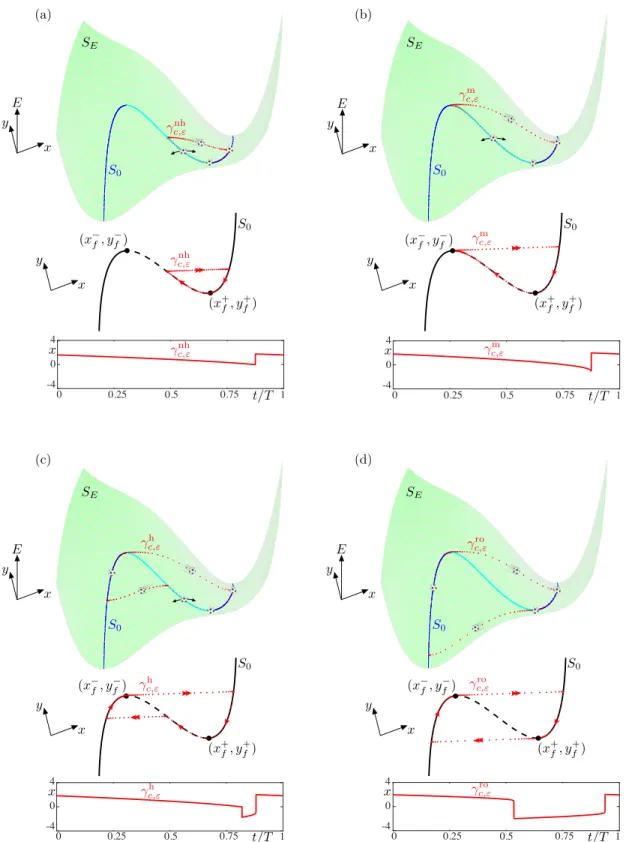
(see Fig. 1) rolling along the upper crest of a curved

field for a dwelling time period before ending up in the

lower crest of the field. This energy-like viewpoint is

presented in Fig. 1 where every panel is associated with

a specific cycle of VDP’s periodic regime: (a) canard

without head, (b) maximal canard, (c) canard with head

and (d) relaxation oscillation. Each panel contains three

plots: at the bottom, the time series of the corresponding

cycle of interest; in the middle, a phase-plane

represen-tation

28

of the cycle together with the critical manifold

S0; at the top, the energy-like surface SE

in (x, y,

E)-space, defined by the equation E =

R f(x, y)dx, onto

which the critical manifold is projected together with the

corresponding cycle. This particular representation

il-lustrates very well the specificity of canards as cycles,

stable along the canard explosion of VDP, which “surf”

for a long time on top of an unstable crest of the

en-ergy surface. More specifically, in the VDP system, and

generically in 2D slow fast systems with a similar

geom-etry of nullclines, the canard phenomenon explains the

transition from Hopf cycles with O(ε)-amplitude to

re-laxation cycles

γ

ro

ε,c

with O(1)-amplitude in a very brutal

yet continuous process. Within an exponentially-small

parameter variation this continuous transition involves

two canard families, denoted respectively canards without

head

nh

ε,c

) and canards with head (γ

ε,c

h

), the boundary

between these two families corresponding to the

maxi-mal canard

m

ε,c

). Canards without head subsequently

follow an attracting slow manifold and then a repelling

slow manifold until they escape from it towards the same

attracting slow manifold that they initially followed. In

contrast, canards with head terminate their repelling

seg-ment by escaping towards another attracting slow

man-ifold, near the opposite branch of S0. The boundary

behavior is that of the maximal canard, that is, the

ca-nard without head with the longest repelling segment: it

stays close to the repelling branch of S0

in between its

two fold points (x

±

f

, y

±

f

). The maximal canard exists at a

unique parameter value for which an expansion in ε can

be computed, namely cc

= cH

−(1/8)ε−(3/32)ε

2

+O(ε

3

).

Since it possesses the longest repelling segment, it also

has the longest period among the canard cycles. Note

that, in type-II neuron models with multiple timescales,

the repelling segment of the maximal canard offers the

best approximation to the excitability threshold. Past

the canard with head regime, relaxation cycles (γ

ro

ε,c

) are

observed. These are cycles that follow attracting slow

manifolds near the outer branches of S0

without

follow-ing any repellfollow-ing slow manifold, that is, they jump when

passing near each fold point of S0.

As explained above, along the canard explosion the

amplitude (or L2-norm) of the cycles increases sharply;

this sharp increase is considered as a signature of the

ca-nard explosion in VDP-type systems. Yet another

char-acteristic of the canard explosion is the behavior of the

period function

(see below) associated with this branch

of cycles, which for the readers convenience we explain in

the subsequent section since we employ it in this work.

(5)

S0

S

E

(c)

S

0

(x

+

f

, y

+

f

)

(x

f

, y

f

)

h

c,"

h

c,"

h

c,"

E

x

y

x

y

-4

0

4

x

0

0.25

0.5

0.75

t/T

1

S0

S

E

(a)

nh

c,"

S

0

(x

+

f

, y

f

+

)

(x

f

, y

f

)

nh

c,"

x

y

E

x

y

nh

c,"

-4

0

4

x

0

0.25

0.5

0.75

t/T

1

S0

S

E

(b)

m

c,"

m

c,"

E

x

y

S

0

(x

+

f

, y

+

f

)

(x

f

, y

f

)

x

y

m

c,"

-4

0

4

x

0

0.25

0.5

0.75

t/T

1

(d)

ro

c,"

ro

c,"

ro

c,"

S0

S

E

E

x

y

-4

0

4

x

0

0.25

0.5

0.75

t/T

1

S

0

(x

+

f

, y

f

+

)

(x

f

, y

f

)

x

y

FIG. 1. Canard explosion from the energy viewpoint: Canard explosion ((a)–(c)) leading to relaxation oscillations ((d)) in the

VDP system. On top of time series (lower part) and phase-plane projections (middle part), we show in the top part of each

panel the energy-like surface S

E

(green), the critical manifold S

0

(blue-cyan on S

E

, black on the phase-plane projections) as

well as a limit cycle γ

c,ε

h

(red). Blue and solid black parts of S

0

are the attracting, cyan and dashed black parts of S

0

are the

repelling branches of S

0

. One-headed arrows indicate the slow motion, and two-headed arrows indicate the fast motion along

the limit cycle.

B.

Period function of the canard explosion

The period function Tε

: Cp([0, 1]; R

n

)

×(−1, 1) → R

≥0

associates to any limit cycle γε,c

corresponding to a

(6)

period Tε(γε,c); here Cp([0, 1]; R

n

) denotes the space of

periodic functions defined on the unit interval.

Impor-tantly, it is known that in the canard regime, the period

function is non-monotonic since, as explained above, the

maximal canard has maximal period. This is exemplified

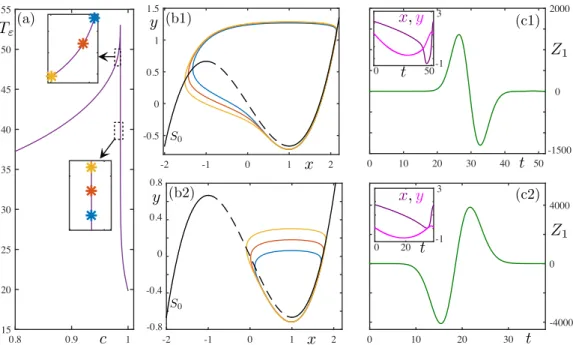
in Fig 2, which depicts a branch of canard cycles in the

VDP system for ε = 0.1 as c decreases from the Hopf

bi-furcation point at cH

= 1. Between cH

and the maximal

canard at cmax

≈ 0.9863158, the period of the headless

canard cycles increases as c decreases; see the bottom

inset in panel (a) and the corresponding cycle in panel

(b1). For c < cmax

the system enters into the

canard-with-head regime where the period decreases as the

cy-cles grow; see the top inset in panel (a) and corresponding

cycles in panel (a1). The non-monotonic behavior of the

period function can be considered as a key aspect of the

canard explosion. The maximum of the period function

can be used to detect numerically the maximal canard

trajectory, as a limit point on the branch obtained when

the period is the main continuation parameter

29

.

C.

Infinitesimal PRCs and relation to the period function

The response of canard cycles to perturbations can be

exploited by using the non-monotonic behavior of the

period function Tε

along the canard explosion. A

com-plementary key tool is the iPRC, which is a periodic

function that quantifies the response in phase variations

of a limit cycle solution γ in the limit of infinitesimal

perturbations

24,30

. The iPRC is determined by

estimat-ing the response variations (∆θ) of the phase θ : γ

[0, T ] defined along the cycle, with dθ(γ(t))/dt = 1/T

where T is the period of γ and θ at t = 0 is chosen

arbi-trarily, under ε-perturbations in the unit vector direction

η. That is

lim

ε→0

∆θ

ε

= Dθ(γ)

· η,

(4)

where the gradient of the phase function, Z(t) := Dθ(γ),

defines the iPRC. Additionally, the iPRC is the solution

of the following adjoint variational equation

Z(t)

dt

+ A(t)

T

Z(t) = 0,

(5)

where A(t) = DF (γ(t)) is the linearisation of the vector

field F = (f, g) under consideration along the limit cycle

γ; see details in Refs. 24 and 30. In particular, we are

interested in using the iPRC with perturbation in the

form of inputs from neighboring oscillators (in our case a

single sender system) under a weak-coupling assumption.

In Fig 2 we exemplify the use of the iPRC and the

period function. We underline two key points: (1) Slow

manifolds, some defining the excitability threshold, and

the maximal canard determine the response to

infinites-imal perturbations. (2) The non-monotonic behavior of

the period function along the canard explosion

deter-mines the response of a canard cycle to the perturbation

received in the fold neighborhood. Panels (c1, c2) of Fig

2 illustrate that the x-component of the adjoint solutions

gives access to the iPRC of the red canard cycles in (b1,

b2), respectively. When an infinitesimal perturbation in

the positive x-direction to the right of the fold is received

by a canard-with-head cycle (b1), it is driven towards a

larger cycle (like the yellow one in (b1)) with a shorter

period. Consequently, the perturbed trajectory’s phase

is advanced as confirmed by the positive part of Z1(t) in

panel (c1). Z1(t) becomes negative when the trajectory

(x(t), y(t)) crosses the lower fold (x = 1) while the

tra-jectory moves away from the fold region. Thus, a small

perturbation on the trajectory in this repelling region

de-lays the phase transiently to a smaller but slower cycle,

as exemplified by the blue curve in (b1). The delaying

effect of the slow manifolds associated with canard

tra-jectories extends the discussion by Ciszak et al.

4

where

the anticipation in excitable systems is interpreted as a

lowering of the excitability threshold.

Similar phase-plane analysis applies to a small red

ca-nard cycle (b2). When perturbed in the attracting slow

manifold near the fold region, it is driven transiently to

a cycle with longer period, like the yellow one in (b2).

Consequently the perturbed trajectory’s phase is delayed

compared to the unperturbed one, which corresponds to

the negative part of the adjoint solution Z1(t) in Panel

(c2). The sign on Z1(t) changes at the fold x = 1 and

becomes positive as the trajectory (x(t), y(t)) continues

along the repelling branch. The trajectory’s phase is

ad-vanced when the perturbation is received on the repelling

slow manifold as indicated by this positive segment of

Z1(t). In such a case, a perturbed trajectory transiently

follows a smaller cycle, like the blue one in (b2), with

a shorter period. In later sections we will show that a

strong enough perturbation received either by a small

canard cycle or when the system is at an equilibrium

(possibly in excitable regime) can lead to a relaxation

oscillation. This extreme regime is beyond the validity

of the weak-coupling theory in the canard regime.

D.

Relevance of canards in general

Within the field of mathematics, canards are

recog-nised as a fundamental mathematical object and

theoret-ical advances are being made to fully understand complex

patterns mediated by canards in high-dimensional

multi-scale systems. Some of these theoretical techniques

in-clude, e.g. nonstandard analysis

26,31

, matched

asymp-totic expansions

32

and blow-up methods

33,34

.

While being interesting mathematical objects, canards

have direct applicability in engineering and applied

sci-ences, and most interestingly in Neuroscience. For

exam-ple, in lab experiments involving neurons, experimental

data observations (via acquisition devices) show complex

patterns and counter-intuitive rapid transitions via

mod-ulation of a control input, e.g. through electrical current

injection. Furthermore, these observations show

Figure

FIG. 1. Canard explosion from the energy viewpoint: Canard explosion ((a)–(c)) leading to relaxation oscillations ((d)) in the VDP system
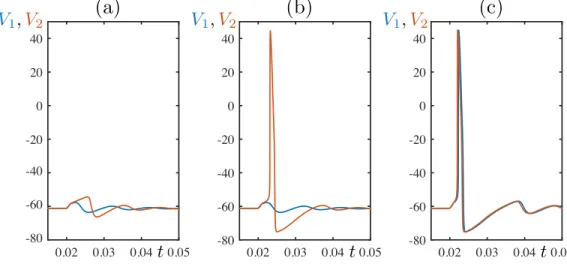
FIG. 2. Canard cycles and adjoint solutions: (a) Period of limit cycles along the canard explosion in the VDP system for ε = 0.1; the parameter that varies is c
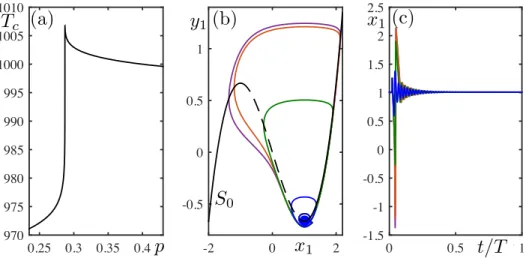
FIG. 3. Response of the sender to pulse perturbation in (8): (a) Integration time T c vs pulse amplitude p for ε = 0.09.
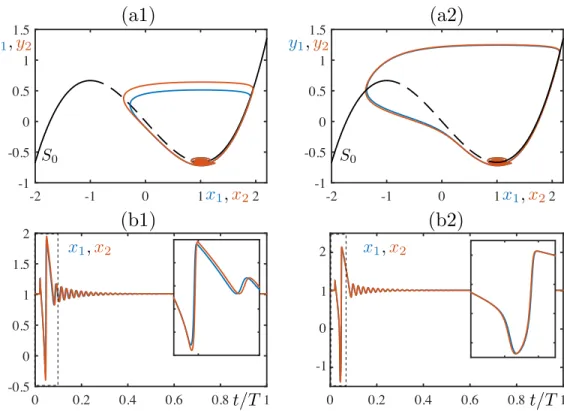
FIG. 4. Example solutions of system (8) under pulse perturbation: Lower panels are the time series of some solutions represented in the upper panels
+7

Références

Documents relatifs

This process consists in submitting load injection to the black box (see Figure 3). The workload is increased through several steps, until reaching the maximal estimated load C max

Anticipation play a very important role in the human- human as well as human-machine spoken interaction, because it influences the speed of response in conversation

Each sentence was thoroughly assessed by the four in- terpreters who recorded the number of rhythmic groups, the order number of the rhythmic group with the antici- patory nucleus,

The eclectic and powerful representation and calculation capabilities of the DSMs can be combined into a Multi Domain Matrix, MDM, by the DMMs Domain Mapping Matrices in order

Abstract. Systems biology of plants offers myriad opportunities and many challenges in modeling. A number of technical challenges stem from paucity of computational

Thus, working with model systems provide the possibility of reproducing specific crack patterns as a function of the mechanical properties of the system, and key parameters such as

To further these findings, we conducted a new coordinate-based meta-analysis of functional Magnetic Resonance Imaging (fMRI) studies comparing appetitive

2) Global case: In order to understand the accuracy of the Bayesian network, we depict in Figure 5.a estimated session durations versus the actual ones over a ten days period.