HAL Id: hal-01557180
https://hal.archives-ouvertes.fr/hal-01557180
Submitted on 5 Jul 2017HAL is a multi-disciplinary open access archive for the deposit and dissemination of sci-entific research documents, whether they are pub-lished or not. The documents may come from teaching and research institutions in France or abroad, or from public or private research centers.
L’archive ouverte pluridisciplinaire HAL, est destinée au dépôt et à la diffusion de documents scientifiques de niveau recherche, publiés ou non, émanant des établissements d’enseignement et de recherche français ou étrangers, des laboratoires publics ou privés.
Distributed under a Creative Commons Attribution| 4.0 International License
Zero-contours in low-energy K-π scattering
Alain Arnéodo
To cite this version:
Alain Arnéodo. Zero-contours in low-energy K-π scattering. Il Nuovo Cimento A, 1975, 25 (3), pp.511-533. �10.1007/bf02820862�. �hal-01557180�
Zero-Contours in Low-Energy
K-7t
Scattering.
A. ARNEODO
Physique Th!Jorique, Universite, de Nice · Nice (0 ) ("*)
Summary. - The paths oi' zeros of the low-energy K·7t seattering ampli-tudes AI,~i and AI,-1 are examined in a simple K* and p dominanee model, where it is found that the roles of PCAC zero, K* and p Legendre zero. and double-pole-killing zero are played by the same zero-eontour in the (s, t, u)-plane, an ellipse for the first amplitude, an ellipse plus the line s = u for the seeond one. The behaviour of these zero-eontours in the u-ehannel physieal region is studied in eomparison with th6 experi-mental zeros determined from the K+7t--+ K+7t- and K+1t0-+ K01t+
seat-tering resultR, and it is found that up to the K* mass region the elliptic. contour of AI,~i is essentially unaffected by unitarity. whilst the elliptic contour of A1,~1 is slightly more sensitive to sueh constraints. A
com-parison with the behaviour of the zeros of the corresponding 7t-7t ampli-tudes A~;2 and A:t;l is also performed.
1. - Introduction.
A few years ago ODORICO has provided a possible explanation of
meson-meson scattering data in termt~ of a hypothesis of a global structure for the
straight-line propagation of nearby zeros of the scattering amplitude, whereby
lineR passing through the inter~;ectionH of resonances in different channels also
pass through the Legendre zeros of resonances in the physical regions of the
(s, t, u)-plane (1-3 ).
(*) Equipe de Reeherche Associce au C.N.R.S.
(**) Postal address: Physique Tlu3oriquc, I.M.S.P. Pare Valrose, 06034 Nice Cedex.
( 1 ) R. 0DORICO: Nucl. Phys., 37 B, 509 (1971).
(2) R. OnoRICO: Phys. Lett., 38 B, 37 (1972). ( 3 ) R. ODORICO: Phys. Lett., 38 B. 411 (1972).
Since then numerous studies of zero-contours of the 7t-7t scattering amplitude
have been performed using the experimental phase shifts {4-7). Several of them
disagree with certain predictions made by ODORICO, such as for example the
analyses of PENNINGTON and PROTOPOPESCU {4) and of EGUCHI et al. (5) which
contest the suggestion that the anomalous behaviour of the experimental
moment (Y~) at 0.98 GeV may be seen as a consequence of the entry in the
physical region of a zero at fixed s
=
4f12- 2m~. Nevertheless on the whole these studies find this straight-line zero hypothesis as a reasonable approxi-mation to reality when viewing the Mandelstam plane from afar. However in any local region zero-contours are far from straight, and this is especially evident
in the low-energy region as is discussed by PENNINGTON and SCHMID in ref. (8).
The theoretical analysis of ARNEODO, GUERIN and DoNOHUE (9
) is also very
significant of this feature since it emphasizes that, in a simple nonunitary p
dominance model, the nearby zero-contours of low-energy 7t-7t scattering
am-plitudes A= (s, t, u) and A~;;2
(s, t, u) form a closed curve: a circle in the (s, t,
u)-plane. This circle plays the respective roles of POAO zero, p Legendre zero
and double-pole-killing zero, and is in large part rather stable when unitarity is enforced.
Such experimental and theoretical studies have not been performed in
K-7t scattering. Thus we propose in this article to examine the behaviour of
the zero-contours of the low-energy K-7t amplitudes; first in a pure K* and p
dominance model, which is a model for the whole amplitude and consequently permits us to define the zero-contours in the unphysical as well as the physical regions; then as determined from the experimental phase shift analyses of the
reactions K+n-~ K+7t- and K+1t0 ~ K01t+ (10-13 ), i.e. only in particular physical
(4) M. R. PENNINGTON and S. D. PROTOPOPESCU: Phys. Lett., 40 B, 105 (1972). ( 5 ) T. EGUCHI, M. FUKUGITA and T. SHIMADA: Phys. Lett., 48 B, 56 (1973). ( 6 ) P. EASTABROOKS, A. D. MARTIN, G. GRAYER, B. HYAMS,
c.
JONES, P. WEILHAM-MER, W. BLUM, H. DIETL, W. KocR, E. LORENZ, G. LtiTJENS, W. MANNER, J. Mmss-BURGER and U. STIERLIN: Conference on 7t-7t Scattering, 1973, Tallahassee Conference(A.I.P. Conference Proceedings, No. 13).
n
B. HYAMS,c.
JONES, P. WEILHAMMER,w.
BLUM, H. DIETL, G. GRAYER,w.
KocH, E. LORENZ, G. LtiTJENS, W. MANNER, J. MEISSBURGER, W. Ocns, U. STIERLIN and F. WAGNER: Nucl. Phys., 64 B, 134 (1973).( 8 ) M. R. PENNINGTON and C. ScHMID: Phys. Rev. D, 7, 2213 (1973).
( 9 ) A. ARNEODO, F. GuERIN and J. T. DoNOHUE: Nuovo Cimento, 17 A, 329 (1973). (1°) R. MERCER, P. ANTICH, A. CALLAHAN, C. Y. CHIEN, B. Cox, R. CARSON, D. DE-NEGRI, L. ETTLINGER, D. FEIOCK, G. GOODMANN, J. HAYNES, A. PEVSNER, R. SEKULIN, V. SREEDHAR and R. ZDANIS: Nucl. Phys., 32 B, 381 (1971).
(11) H. H. BINGHAM,
w.
M. DUNWOODIE, D. DRIJARD, D. LINGLIN, Y. GOLDSCHMIDT-CLERMONT, F. MuLLER, T. TRIPPE, F. GRARD, P. HERQUET, J. NAISSE, R. WINDMOLDERS, E. CoLTON, P. E. ScHLEIN and W. E. SLATER: Nucl. Phys., 41 B, 1 (1972).( 12 ) A. FIRESTONE, G. GOLDRABER, D. LrssAUER and G. H. TRILLING: Phys. Rev. D,
5, 2188 (1972).
region:-;. For our technical way of dc~eribing zero-contour~ we explieitly refer to the theoretical analyRif; of ref. (9
).
The main re~ult of our investigation i:-; that, in the narrow-wiclth K* and p
dominance approximaJ.ion, t.he zero-eontours of the K-rr amplitude:-; AI,~! an<l AI,~t are re,;peetively an ellip1-1e and an ellipse plm the line s
=
u in the (s,t, u)-plane. Tlwse contour;; are related to the different zero:-; arising at low energy: the Adler-Weinberg zero, the Legendre zero of K* and p mesons and the double-pole-killing zeros. Moreover the behaviour of the experimental complex zeros imggeHts that in the low-energy u-ehannel physieal region (u ~
~ mi:.) the elliptic zero-contour of the amplitu<Le AI,~! i:-; e;;sentially unmodified by the unitarity com;traintK, while the elliptic zero-contour of the amplitude
A I,~t iH more sensitive to unitarization and is drawn into a somewhat straight shape lying at t ,__,-0.:! (GeV)2. This ,;imple K* and p dominance model is found to be unreliable for energies above 0.95 GeV, since it predicts nearby zero-contours for the both K-rr seattering amplitudes while experimentally the zeros appear to be far away in the complex (s, u)-space, and consequently the term zero-contour is ambiguom; at wch energies.
We organize the paper as follow~>. In Sect. 2 we examine the zero-contours of the simple K* and p dominance model. In Sect. 3 we discuss how they are influenced in the K* mass region by the unitarity comtraint~. In Seet. 4 we compare them with the zero-contours ealculated from the experimental phase shifts. In Seet. 5 we perform a compariRon of zero-contours in rr-rr and K-rr scattering. Kinematie~ and amplitudes in K-rr scattering are defined in the Appendix.
2. - Zero-contours in the simple Breit· Wigner model.
The contribution of both p and K* resonances to the K-rr scattering am-plitudes A(s, t, u) and B(s, t, u), which respeetively represent in the s-channel physical region the reactions K+rr+--+ K+n+ and K+rr---+ K"n", may be written in the Breit-Wigner approximation ail
(~.1)
D. B. MILLEH. J. E. ALLEl\, P. \'. MARCII, S. H. MORRIS, K. 0 BRIEN and C. E. PEACH:
A stufly of K +7t-elastic scattering in the reaction K +n-+ K +7t-p bet'Ween 2.0 and 3.0 Ge V /c.
submitted to tlll' II Aix en Provence International Oonferenf'e on Elementary Particles
and (2.2) with (2.3) 1 = -(m~-4ti)l; 2 1 =
2
(4,u2- t ) l 'and where it is explicitly assumed that the p couples in the same way to the
1t1t and KK channels. The respective kaon and pion mass are m and ,u, and
the details of the K-7t kinematics are defined in the Appendix.
This simple model for the low-energy region has the analytic structure needed to incorporate the cuts due to elastic unitarity, but it has no cuts cor-responding to inelastic unitarity. One can justify this absence of double-spectral function in so far as the inelastic effects are unimportant, i.e. up to 1 GeV (").
Moreover this model gives the correct threshold behaviour for the real parts of all K-7t partial-wave amplitudes, and whilst one cannot determine the scat-tering amplitudes everywhere, this nonunitary approximation may be considered as reasonable in the low-energy region. (Some problems arising from the in-correct behaviour of the imaginary part of the K-7t partial-wave amplitudes will be discussed later.)
In the limit of narrow-width resonances:
rK.
andrp
small, both amplitudesA(s, t, u) and B(s, t, u) are real except at t =m~, u
=
mi• and s=
mi• (onlyfor B(s, t, u)), and the respective zero-surfaces intersect the real (s,
t,
u)-plane along the curves defined by(2.4)
for A(s, t, u) and
(2.5) (s-tt) ·
for B(s, t, u). For phy~ieal ma~s and width of the meson resonances (mp
=
=
0.765 GeV, 1~=
0.135 GeV and mK.=
0.890 GeV, FK.=
0.050 GeV) there-Fig. 1. - Morlulus contours of the K-rr amplitude A(s. t. u) in the (s
+
iO, t -iO, u+
iO) limit (see the Appendix for the definition of the limit). The continuous line is \AI
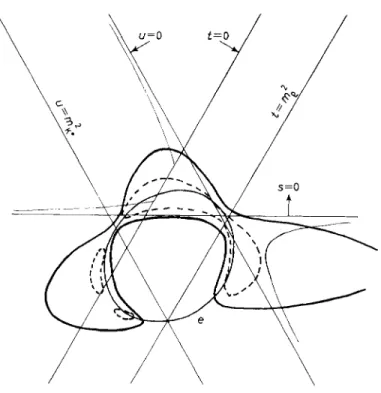
=1, the dashed line \A 1 = 0.5. The ellipse e is the zero-contour of the narrow-width approxi-mation of the K* and p dominance modPI.lation (2.4) is the equation of an ellipse passing through the p Legendre zero
in the t-channel, the K* Legendre zero in the u-channel physical region and
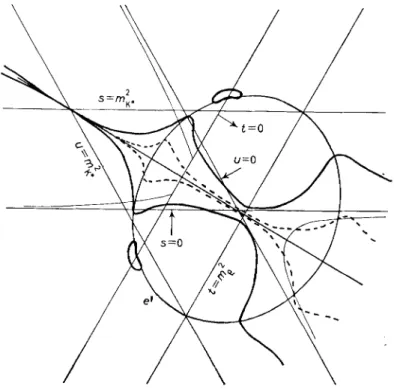
through the K*-p intersection (Fig. 1). From (2.5) the zero-contour of B(s, t, u)
consists of the line s
=
u (which attests to the antisymmetry of this amplitudeof the K* in the s- and u-channel physical regions and through the K*-p inter-sections (Fig. 2) (").
When
rx•
and FP are not very small, one expect these curves of nearestzeros to have moved to complex values of sand u, except in the region {t.;:;:4,u\
s.;;;; (m+ ,u)2
, u.;;;; (m+ ,u)2} where the amplitudes A(s, t, u) and B(s, t, u) are real.
Fig. 2. -Modulus contours of the K-1t amplitude B(s, t, u) in the (s+ iO,
t+
iO, u+iO) limit. The continuous line isJB\
= l, the dashed lineJB\
= 0.2. The zero-contour predictions of the narrow-width K* and p dominance model consist of the lines= u, plus the ellipse e'.Before developing this study of complex zeros we must resolve a problem inherent in this simple Breit-Wigner model which consists in an incorrect
be-haviour of the imaginary part of the I=! K-n S-wave amplitude. If, on the
one hand, the expressions (2.1) and (2.2) do not give a correct threshold behaviour for the imaginary parts of the partial-wave amplitudes, on the other hand they
(") In the model based on Lagrangian theory of D. IAGOLNITZER et al. (14 ), where
SU3 symmetry is broken by mass terms, the values of mass and width of the resonances p
and K* obey the relation gp= 2gx•· In this case the zero-contours of .A(s, t, u) and
B(s, t, u) defined by (2.4) and (2.5) are circles passing through the same points previously defined for the ellipses.
imply more dramatieally that the imaginary part of the I=·~ 8-wave is ne-gative, though quite small (< ().06), up to the K* mass. In order to eliminate this difficulty we added linear terms in q" q1 and q,. to the simple Breit-\Vigner
approximation to the K-7t amplitudes
(2.6) A(g, t, u)
=
ABw(8, t, u) +(ex-(J) q,+ (ex+ (J) qu+
yq1and
(2.7) B(8, t, u)
=
BBW(8, t, u)+
v2
{3(qu- q,)where ABw(s, t, u) and BBw(8, t, u) are given by the expressiom (2.1) and (2.2),
and ex, (J, y are parameters. vVe fixed these parameters by imposing the un-itarity contraints at threshold in the 8-and t-channels. In the 8-channel we have
(2.8) lim
[Imf~(8)]
=(m+p)(a~)2'
s-+(m+p)1 Q ( 8}
where g(s) are the 8-wave amplitudes (I=·~ or
il
defined from (2.6) and (2.7)(see the Appendix), and a~ the corresponding seattering lengths. In the t-channel we have
(2.9) l . Im [Im -·Q---T~(t)]
=
Ilo o •0 Re T0(4w),
1-+4p2 (t)
where ~(t) is defined in the Appendix and IIg is the I= 0 8-wave scattering length of the 7t-7t amplitude. In the following we Hhall consider IIg to be equal to 0.17p-1
, and we shall diHcuss the importance of thiH choice at the eml of this Section. We then find that ex=-0.575 (GeV}-1
, (J = 0.078 (GeV)-',
y = 0.875 (GeV)-1, wherea:-; the K11: S-wave ~>cattering lengths turn out to be
a!=
O.llp-1 and a~=- O.l5v-'· These values are close to those predicted by current algebra and lie within the band found by ADER et al. using crossing, unitarity and the existenee of the K* ('5•16). Moreover the I=t
S-wave has a positive imaginary part but iH not unitary, except at the threshold from (2.8).Similarly eq. (2.8) makes the I=
l
S-wave unitary only at threshold. The other partial waves are not unitary even at threshold.Now, having resolved the important problem of the positivity of the im-aginary part of the I=
t
S-wave (but not the general problem of unitarity), we are allowed to define the complex zeroR of the K-11: scattering amplitudes.(15) J. P. ADER, C. MEYERS awl B. BONNIER: Nucl. Phys., 45 B. 554 (1972).
(16) J. P. ADER, C. MEYERS
2'1. Complex zeros of A(s, t, u). - From (2.6) the zeros of the amplitude
A(s, t, u) are given by
(2.10) YK* (t-s)+ - -
l
(m2-p2)2]
2- - Dp(t)-.,f(s-u)DK.(u)+ gmK... ...
+
[(oc-p)q,+
(oc+
Plqu+
yqt]Dp(t)DK•(U) = 0,which defines a two-dimensional surface in the complex (s, u)-space. The
fol-lowing points lie on this surface:
i) 8= u' t -_ mp 2
(
1 -r
8q~2)
P - ~mp rp .[ (
1 - mP 8q~r
P)2]'
. 'ii)
These points may be associated, in this order, with the zero of the Legendre
polynomial at the p mass in the t-channel and at the K* mass in the u-channel
physical region, and the double-pole-killing zero at the intersection of the
p and the K*. The projections of these points on the real (s, t, u)-plane are
eSSentially independent Of rp and FKo l provided that
rp «
mp and FKo«
mKo,Their respective distances from this plane are characterized by Im t of order mPFP and Im u of order mK.rK., hence one expects the zeros of A(s, t, u) to be nearby zeros. But this generalization is not evident in view of the presence of linear terms in q,, qt and qu in the expression of A(s, t, u). So we traced in
Fig. 1 the modulus contours of this amplitude in the real (s, t, u)-plane. It is
clear from this Figure that there exists a curve along which A(s, t, u) shows a pronounced sharp minimum, and it is reasonable to associate this with a
nearby zero-contour as is discussed in ref. (9). Moreover this curve of minimal
JA J is not very different from the elliptic zero-contour of the narrow-width
meson resonance approximation. The unitarization procedure at the threshold, defined by (2.8) and (2.9), tends somewhat to draw the original ellipse of zeros
into a triangular shape with the horizontal base passing through the K*-p
intersection, but this effect is indeed not very pronounced. As we have pre-viously remarked, this quasi-elliptic contour of nearby zeros plays the roles
addition it also playR the roh~ of the Adler-Weinberg zero, since it passes through the real (s, t, u)-plane region: {t.;;;4,u2
, s and u,;;; (m+ ,u)2} not very far from the line s = m2
+
,u2, which correspondH to a smooth extrapolation of the <·.urrent. algebra z1;ro to the on-maHH-Hhell amplitude.
2·2. Complex zeros of R(s, t, u). - From (:J.7) the zeroH of the amplitude
B(s, t, u) are given by
(2.11) YK*Dp(t) ·
[(
(m2 _ .U2)2) ( (m2 _ ,uz)z) ]
. (t-s)
+--m;;;.--
DK•(S)- (t-u)+ mi• DK.(u) --lgp(s-u)+
2p(q.-qu)Dp(t)]DK.(s)DK•(U)=
0, which defineH a t.wo-climensional wrface in the eomplex (s, u)-spaee. The fol-lowing points lie on thiH ~mrfaee:i) U=t+ (m2 _ .U")2 --mi• ' ii) iii) 8 ~ u ' iv) v)
These pointH emTeHpond respeetively to the K* Legendre zero in the s- and u-channel physical regimu;, the p J,egendre zero in the t-ehannel and to the double-pole-killing zero at the K*-p and K*-K* interHectiom. They exhibit the ~mme features as tlw previously des<•ribed points of the zero-surfaee of am.
plitude A(s, t, u). In the same way the modulus contours of the amplitude
B(s, t, u) attest to the existence of a nearby zero-contour, which is characterized by a curve (plus a line) of minimal \B\lying very close to the ellipse (the line
s
=
u) of the original narrow-width meson resonance model (Fig. 2).Conse-quently the unitarization procedure at the threshold defined by (2.8) and (2.9)
does not greatly disturb the behaviour of the zero-contour of B(s, t, u). This
result is easily explained by the small value taken by the {J-parameter
{ = 0.078 (GeV)-1).
To conclude this description we want to discuss the sensitivity of the paths of zeros of the amplitudes A(s, t, u) and B(s, t, u) to the value of the I = 0
1t1t S-wave scattering length
IIg
injected in the unitarity constraint at thethreshold in the t-channel (2.9). Previously this scattering length took the
value given by the current algebra theory and the zero-contours lay very close to the elliptic forms given by the narrow-width resonance approximation.
Now if
IIg
takes values in a domain which is compatible with the currental-gebra predictions (for example 0.07 p-1
<
ng
<
0.27 p-1) ' the behaviour of the zero-contours is essentially independent of the value chosen. In particular the paths of zeros associated with the value of II~ found in the model of ref. (17•18)(IIg
c:::: 0.095W1 ) are in perfect agreement with the ellipses of zeros defined byeqs. (2.4) and (2.5). Now if
IIg
takes values which are significantly differentfrom the current algebra value, e.g. the value
IIg=
0.6p-1 predicted by theexperimental results on the low-energy n°-7t0 (19.2°) and K.
4 (
21•22), the
zero-contours are strongly affected by such a choice (the lX,
fJ
and y parametersbe-come important). Thus the original elliptic shape of the zero-contours is
dis-torted, in particular for the amplitude A(s, t, u). Moreover the zero-surfaces go
away from the real (s, t, u)-plane in certain regions such as the u-channel physical
region of the two amplitudes A(s, t, u) and B(s, t, u), where they respectively
represent the experimentally well-known reactions K +7t----* K +7t- and K +no---*
---* K07t+, and the definition of the zero-contours becomes ambiguous. Therefore
it appears clear that in a low-energy Breit-Wigner picture of the K-7t
am-( 17 ) F. ARBAB and J. T. DoNOHUE: Phys. Rev. D, 1, 217 (1970).
(18) A. ARNEODO and J. T. DONOHUE: Nuovo Cimento, 15 A, 107 (1973).
(19) J. R. BENSINGER, A. R. ERWIN, M. A. THOMPSON and W. D. WALKER: Phys. Lett. 36 B, 134 (1971).
( 20) P. SONDEREGGER and P. BoNAMY: Proceedings of the Fifth International Conference
on Elementary Particles, Lund, 1969 (Paper No. 732, unpublished).
(21) A. ZYLBERSZTEJN, P. BASILE, M. BouRQUIN, J. P. BoYMOND, A. DIAMANT·BERGER, P. ExTERMANN, P. KuNZ, R. MERMOD, H. SuTER and R. TuRLAY: Phys. Lett., 38 B, 457 (1972).
(22) G. VILLET, M. DAvm, R. AYED, P. BAREYRE, P. BoRGEAUD, J. ERNWEIN, J.
FEL-TESSE, Y. LEMOIGNE, P. MARTY and A. V. STIRLING: Conference on THt Scattering, 1973, Tallahassee Conference (A.I.P. Conference Proceedings, No. 13).
plitudes the zero-contours are stable features against the unitarization procedure
at the threshold (in the three channels) only so long the I= 0 'TC-'TC S-wave
scat-tering length is compatible with the current algebra predictions.
3. - Zero-contours in the K
*
region and unitarity constraints.In order to investigate the consequences of unitarity for the nearby
zero-contours, we transpose the analysis which PENNINGTON and ScHMID have
performed for 'TC-'TC scattering (8) to the case of K-'TC scattering.
In the u-ehannel physical region of the K-'TC amplitude A(s, t, u), only the
S and P waves are important near the K* resonance. Hence the equation of zeros
may be written as
(3.1) (f!(u)
+
2ft(u)) cos O*(u)+-!
(f!(u)+
2ft(u))=
0.Moreover in the K* region we can reasonably neglect the I=
!
P-wave andrepresent the I=-! P-wave by a unitary Breit-Wigner form. Using a phase
shift representation for the S-waves, we obtain for the projection of the nearby
complex zeros onto the real (s, t, u)-plane
(3.2) Re (cosO*(u)) =
On the line
u
=
mi:.
the zero occurs forwhich is proportional to the value taken at the K* mass by the imaginary part of t,he S-wave amplitude in the u-channel physical region. This expression implies that the unitarity constraints cannot shift the intercept beyond the following limits:
(3.4)
-!<Re
(cos O*(u =mi:.))
<0.
Furthermore, if the exotic I= ~· S-wave is small, the effective lower limit
for the intercept iH ,...., - -~. If one believes in the current algebra zero-contour
in the region below threshold in all channels, then the true nearby zero-contour cannot deviate much from that given by the Breit-Wigner model, since it must
intersect the line u = m~. between -
i
and zero. (The Breit-Wigner model predicts an intercept at cos O(u) = 0.)If we repeat this analysis for the K-7t amplitude B(s, t, u), we obtain for the
projection of the nearby complex zeros onto the real plane in the u-channel physical region
(3.5) Re (cos O*(u)) =
A.t u = m~. the zero occurs at
This expression implies that the intercept remains within the unitarity limits
(3.7) -!<Re (cos O*(u =m~.)}<!.
4. - Zero-contours and low-energy K-7t scattering data.
There exist two different methods of describing zero-contours of an
am-plitude A(s, t, u): the contours of minimal modulus and the intersection of the
hyperplane Im u = 0 with the surface A(s, t, u) = 0. One method, which we
employed in our definition of the theoretical paths of zeros of the K-7t
am-plitudes in Sect. 2, corresponds experimentally to finding the minimum of the
differential cross-sections. The other consists in determining the zero-contours for A(s, t, u) in the u-channel using the phase shifts of the dominant waves, which are experimentally accessible; one solves for the complex values of cos O*(u) such that A(u, cos O*(u)) = 0, and then projects onto the real (s, t, u)-plane. The respective properties of these two methods are discussed in detail in ref. (9
•23). The main result of these analyses is that both methods lead to the
same definition of zero-contours if the amplitude possesses nearby zeros, which are illustrated by the existence of a curve (or curves) along which the am-plitude shows a pronounced sharp minimum. On the other hand, if the zeros acquire a nonnegligible imaginary part, the modulus contours no longer pre-sent such strongly marked features and the definition of zero-contours be-comes so ambiguous that the two methods lead to different conclusions. Con-sequently if one uses the second method of describing the experimental paths
(23) M. R. PENNINGTON: Conference on 7t-7t Scattering, 1973, Tallahassee Conference
of zeros, as we propose to do in this Section, we must take into account not
only the projection of the complex zeros onto the real (s, t, u)-plane but also
their distance from this plane, i.e. the imaginary part of these zeros. Moreover, as it is always interesting to look at what happens in the differential cross-section, we shall do so and compare the eventual minima with the real parts of the complex zeros.
We determine the experimental zeros by using the three following phase ~>hift analyses:
i) The analysis of the S and P K-n scattering wave phase shifts from
threshold to mKrc = 1.2 Ge V made by MERCER et al. (1°).
ii) The same analysis made by BrNGHAM et al. with a different method
and better statistics (11).
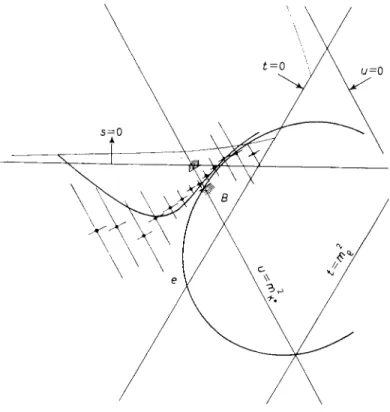
Fig. 3. - The real part of the complex zeros of the K-1t amplitude A(s, t, u) in the u-channel physical region, where it represents the K +7t- elastic scattering, as deter-mined from the data of ref. (1°·11 ). The black points are obtained by comidering the exact values (with independent errors) of the experimental wave phase shifts of
MERCER; the continuous line by considering fits of the wave phase shifts of BINGHAM. The ellipse e is the zero-contour of the narrow-width approximation of the K* and p dominance motlel. The bounds B at u= mi• are the unitarity bounds
iii) The analysis of S-, P- and D-wave phase shifts in K+7t-elastic
scat-tering has been performed by FIRESTONE et al. (12 ) up to mJVI: = 1. 7 Ge V, and
by BAKER et al. (13) up to 1.3 GeV. Since the latter find results not very
differ-ent to those of the former, we shall employ only the FIRESTONE et al. results in
our search for nearby zeros.
At this point let us remark that the analyses ii) and iii) yield two solutions
for the I =
i
S-wave phase shift. In what follows we use only the <<down))solution. The <<up )) solution resembles the << down )) solution except that it
\
Q q, Q (l q, q_ Q q_ q, (l q\
Fig. 4. - The real part of the complex zeros of the K-1t amplitude .A(s, t, u) in the u-channel physical region as determined from the data of FIRESTONE (ref. (12
) ). The
error bars are deduced from experimental errors in the determination of the I=
!
S-wave phase shift.
has a narrow ( .;;;; 30 Me V) resonance near mK. . The zero-contour structures
are quite similar for the two solutions except in a very narrow interval near
u=mi-.
We show in Fig. 3 and 4 the real part of the complex zeros of the K-7t
scat-tering amplitude .A(s, t, u) in the u-channel (where it represents in the physical
region the reaction K+7t- _,... K+7t-), obtained from the previously quoted
Figures it is clear that the zero-contour suggested by the Breit-Wigner model
is in reasonable agreement with the experimental results for
u ;;;;; mi•.
The<< first >> zero which enters the physical region does this through the backward
direction with an imaginary part of cos O*(u) ~ (-0.3, - 0.4), and moves
2.0~---, 1.0
.
(]) E ~ 0 --1.0 I6
I 1 I I~t
I
,o 0,
I
i I a I I Q I 0 0- - - - ---- - - ---- -- --- - -- -- -s- - -- - - -
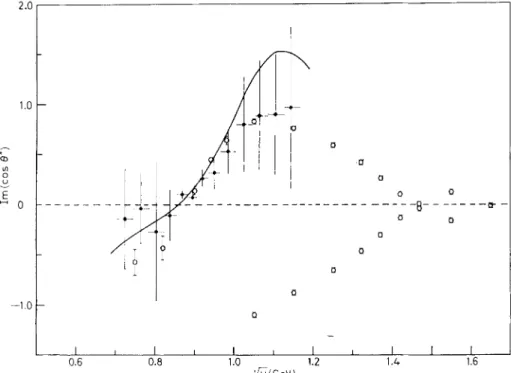
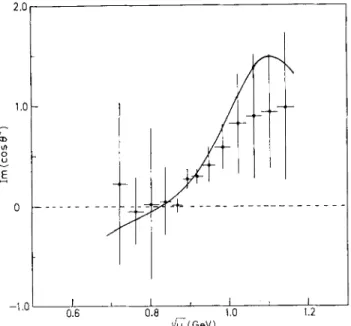
o -0 0 0 0 0 0 QFig. 5. - The imaginary part of the complex zeros of the K-7t amplitude .A(s, t, u) in the u-channel physical region as defined by Im cos O*(u) using the data of MERCER (black points), BINGHAM (continuous line) and FIRESTONE (circles).
smoothly towards the centre of the physical region, lying very close to the el-lipse defined by the eq. (2.4). This zero, which is a nearby zero having
[Im cos O*(u)[;;;;; 0.3 for u;;;;; 0.85 (GeV)2, passes in the vicinity of the K*
Le-gendre zero and is associated with a pronounced dip in the differential
cross-section. Beyond the K* region the imaginary part of cos O*(u) increases rapidly
and the projection of this complex zero onto the real (s, t, u)-plane no longer
corresponds to a minimum in the differential cross-section which, indeed,
pre-sents a very flat, featureless behaviour at such energies. Near u,...., 1 (GeV)2
the D-wave starts to contribute and a <<second>> zero begins to approach the physical region. Thus, in this region of higher energies we have to refer to the only D-wave phase shift analysis, i.e. to the Firestone et al. experiment (Fig. 4 and 5). As is well known, we cannot determine the zero-contours far outside the physical region since a finite number of partial waves provides a poor
rep-resentation of the amplitude there. Nevertheless we see that this <{second)} zero enters the physical region through the forward direction at approximately the place predicted by the simple Breit-Wigner model of Sect. 2, and with
Jlm cos O*(u)J ~ 0.9. It is not a nearby zero and its entrance in the u-channel
physical region causes the real part of the <{first )} zero to recoil somewhat towards the backward direction. Then the real part of the <{first )} zero lines up, ready to become one of the Legendre zeros of the K**(1420)-resonance, while the real part of the <{ second )} zero moves, ready to become the other K** Legendre zero. .At the same time that they approach the K** region, these complex
zeros approach the real (s, t, u)-plane and they produce a more and more marked
double-dip structure in the differential cross-section. Hence at
u
~mi-•
bothzeros are respectively characterized by
*
n*Re cos ()1 (u) ~-Re cos u2 (u) ~-0.5
Fig. 6. - The real part of the complex zeros of the K-rc amplitude B(s, t, u) in the u-channel physical region, where it represents the reaction K+rc0-+ K0rc+, as determined
from the data of MERCER (black points) and BINGHAM (continuous line). The ellipse e'
(plus the line s= u) is the zero-contour given by the narrow-width approximation of the K*- and p-dominance model. The bounds B' at u = mi:• are the unitarity bounds: -
i
<Re cos O*(u) <+!.
and
Jrm cos e~(u) 1 ,..._, Jim cos e:(u)J "(; 0.1.
We show in Fig. 6 and 7 the respective real and imaginary parts of the
complex zeros of the K-1t scattering amplitude B(s, t, u) in the u-channel (where
2 . 0 . - - - " l 1.0 * en <ll 0 ~
.s
0 Vu (GeV)Fig. 7. - The imaginary part of the complex zeros of the K-n- amplitude B(s, t, u) in the u-channel physical region as defined by Im cos O*(u) using the data of MERCER
(black points) and BlNGHAM (circles).
it represents in the physical region the reaction K+7t0 ~ K07t+) obtained from
the analyses i) and ii) (*). One can see from these Figures that the deviation
from the elliptic contour of the narrow-width K* and p dominance model seems
to be more important for this amplitude than for the amplitude A(s, t, u).
Indeed the zero enters the physical region through the backward direction
before the elliptic contour and with a small imaginary part, e.g. Jim cos{}*( u)
I "'
c:::: 0.1. It moves smoothly towards the centre of the physical region where it
crosses the line u = mi• very close to cos O(u) = 0. This zero is a nearby zero
having Jim cos O*(u)J "(; 0.3 for u "(; 0.85 (GeV)2, and it produces a marked dip
in the differential cross-section. As for the amplitude A(s, t, u), the zero rapidly
goes away in the complex (s, u)-space beyond this energy and is no longer
as-sociated with such a dip structure in the differential cross-section. For u ~
~ 1 (GeV)2 the zero described in both Fig. 6 and 7 becomes meaningless since
the B-and P-waves do not yield a good approximation to the amplitude B(s,t,u) at such energies. Moreover this lack of D-wave analysis does not allow us to study the entrance and the behaviour of the double-pole-killing zero in the u-channel physical region. We remark in addition that the experimental
re-sults suggest a possible contour of nearby zeros at t ~-0.2 (GeV)2 for
.Az•=1(s, t, u).
Finally for completeness we have tried to define the paths of zeros of the
K-7t scattering amplitude .A(s, t, u) in the t-channel from the experimental
7t-7t scattering results. This hope was illusory for the following reasons:
Above the 1t1t __,.. KK threshold unitarity quite fixes the both modulus
and phase of the 1t1t __,.. KK B-wave provided that the KK __,.. KK B-wave phase
shift is available, which is not the case.
Below the 1t1t __,.. KK threshold unitarity fixes the phase of the 1t1t __,.. KK
B-wave but does not yield any information about its modulus. Thus the exact determination of the 7t-7t amplitude does not constrain in any way the modulus
of the 1t1t __,.. KK B-wave. Consequently in the region defined by !cos O*(t)
I<
1,where a finite number of partial waves provides a good representation of the
amplitude, only the phase of the complex zeros is determined, i.e.
Im cos O*(t)jRe cos O*(t) and not the separate real and imaginary parts of cos O*(t). For example, considering that this phase is nothing but the difference
of the phases of I = 0 B-wave and P-wave of the 7t-7t scattering amplitude,
we know that the complex zero of .A(s, t, u) passes through the real (s, t,
u)-plane for t ~ 0.5 (GeV)2, but we are unable to say where it does this on the
straight line t = 0.5 (GeV)2 •
5. - Comparison of zero-contours in 7t-7t and K-7t scattering.
It is interesting to compare the zero-contours predicted by the simple
Breit-Wigner model for 7t-7t and K-7t scattering. In both cases the nearby zero-contours are found to be simple closed curves which act as Adler-Weinberg zeros, zeros of P-wave resonance Legendre polynomials and double-pole-killing
zeros. For the 7t-7t amplitudes .A:t;2
and .A~;;1
the curves are circles (9
), whereas
for the corresponding K-7t amplitudes .A(s, t, u) and B(s, t, u) the curves are
ellipses
n.
These zero-contour predictions, in spite of the very simple model from which they are drawn, appear to be in good agreement with the experimentally
ob-tained contours of nearby zeros, at least for energies up to ~ 0.95 GeV.
How-ever, the prediction that the double-pole-killing zero and the upper branch
(*) The l't"-l't" amplitude Af[;;1 and the K-1t amplitude B(s, t, u) are antisymmetric under
of the contours form a single smooth curve fails for both n-n and K-n scattering,
but for different reasons. In n-n scattering, due in part to the presence of the
S*-resonance situated between the p and f, the experimental contours of zeros
remain well defined, with Jim cos O*(u) J ~ 0.2, and it is clear that the <<first >~
0 . 4 , - - - ,
a)
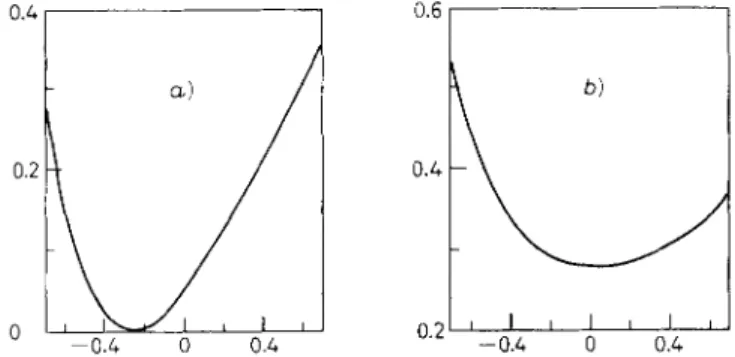
Fig. 8 - The differential cross-section (normalized to 1 for cos 0= - I ) vs. cos 0 for
a) rr+rr-- rr+rr- at I GeV from the data of ref. (24 ), b) K+rr--c>- K+rr- at 1.15 GeV
from the data of ref. (12).
and << second >> zero branches do not form a simple closed curve. On the other
hand, in K-n scattering there are experimentally no nearby zeros in the energy
range (0.95--;-1.30) GeV, hence the concept of zero-contour is not well defined.
However it is again clear that the model prediction of a closed curve of nearby
zeros is not verified. In order to illustrate this difference we show in Fig. 8
the experimental differential cross-sections for n+n- (a)) and K+n-
(b))
elasticscattering for energies approximately half-way between the p and f(a)), and
between the K*(890) and K**(1420). In case a) a pronounced minimum is
visible, whereas the K-n cross-section has only a broad relatively poorly
de-fined minimum.
6. - Summary.
We have shown that in the narrow-width K* and p dominance model the zero-contour of the K-n amplitude .A(s, t, u) = .A1.-i(s, t, u) is a closed curve,
an ellipse in the real (s, t, u)-plane. This curve fills three distinct roles:
Adler-(24)
s.
D. PROTOPOPESCU, M. ALSTON-GARNJOST, A. BARBARO-GALTIERI,s.
M. FLATTE,J. H. FRIEDMAN, T. A. LASINSKI, G. R. LYNCH, M_ S. RABIN and F_ T. SoLMITz:
Conference on Meson Spectroscopy, Philadelphia, April 1972 (A.I.P. Conference Proceedings).
Weinberg zero inside the region below threshold in all channels, p and K*
Le-gendre zeros respectively in the t-channel near the p mass and in the u-channel
physical region near the K* mass, and double-pole-killing zero at the
inter-section of the lines t = m~ and u = m~.. The experimental zeros determined
from the data of ref. (10
"13) show clearly that the zero-contour is essentially that predicted by this simple model in the low-energy u-channel physical region
(u >(m~.). This result lends support to the analysis of .ARNEODO, GUERIN
.and DoNOHUE {9
), which emphasizes how, in the low-energy region (u ~m~),
unitarization gives rise to a very small distortion of the circular zero-contour
given by the narrow-width p dominance approximation of the corresponding
n-n scattering amplitude A:t;2(8, t, u).
For the antisymmetric (under the exchange 8~u) K-n amplitude B(8,
.t, u) = -Az'""1(8, t, u)jv'2 the narrow-width K* and p dominance model
pre-dicts the zero-contour to consist of the line 8
=
u, plus an ellipse passing throughthe Legendre zero of the K* in the 8-and u-channel physical regions and through
both K*-p double poles. But this elliptic zero-contour is slightly more sensitive
to unitarization at low energy (u ~m~.) than the elliptic zero-contour of the
previous K-n amplitude A(8, t, u), and the experimental results show evidence
for a possible contour of nearby zeros at t c::::-0.2 (GeV)2•
This model fails for u
>
m~., since it predicts a closed contour of nearbyzeros for the two K-n amplitudes A(8, t, u) and B(8, t, u), while experimentally
the zeros have a nonnegligible imaginary part and that consequently the notion ·of zero-contour is not well defined at such energies. We must remark that the
€xperimental zeros of the corresponding n-n amplitudes (respectively A~2
and - A;o;;1
/v2)
also disagree with the predictions of the narrow-width p
1iominance model, but not for the same reason, since they are well defined nearby zeros up to the f mass which do not propagate along the predicted cir-·cular curves for
u
>
m!.
It remains a puzzle why the simple Breit-Wigner model, which strongly
violates unitarity, still predicts zero-contours in good agreement with
ex-Jleriment at low energy. The success of the analysis for n-n scattering of
PEN-NINGTON and ScHMm (8), which is based on the idea of zero-contours being
relatively stable against unitarization, suggests that this idea may be of some phenomenological importance.
Finally we discussed how it was illusory to hope for the experimental
de-finition of the paths of zeros of the K-n scattering amplitude A(8, t, u) in the
inelastic nn _,.. KK channel, from the knowledge only of the exact features of
the n-n scattering amplitude.
***
I would like to thank J. T. DONOHUE for reading the manuscript and
APPENDIX
Kinematics and amplitudes in K -TC scattering.
The conventional invariant variables of the elastic K-1t scattering
are defined by
where P1 (p2 } and p~ (p;) are the respective momenta of the incident (outgoing)
pion and kaon. These variables obey the on-mass-shell relation
(A.2)
with Pi=p:=tl and p~2=p~2=m2•
In the 8-channel c. m. system the outgoing momentum Q(8) and the scattering
angle 6(8) are given by
Q(8)
(A.3)
In the u-channel c.m. system the outgoing momentum Q(u) and the
scattering angle O(u) are deduced from (A.3) by the exchange of the
varia-bles u and 8.
In the t-channel the incoming momentum Q(t) and the scattering angle 6(t)
are given by
Q(t) = !v't-4f-t2,
(A.4) 8 - U
cos6(t) = -- - .
v't-4f-t 2Vt-4m2
We use explicitly in this paper the convenient variables
In our definition of zero-contours in Sect. 2, the limit one takes to approach
the real (8, t, u)-plane corresponds to a particular prescription for these
q,=
-ilq.l
for 8 real>(m+
ft)2, the (8-iO) limit to q,=ilq.l.
In the same way the (t+
iO) limit corresponds to qt=-ilqtl
for t real>
4ft2, the (t-iO)
limit to qt=
ilqtl·
The K-1t isospin amplitudes (I,=
l
and j) can be expressed in terms oftwo invariant amplitudes A ±(8, t, u) which exhibit definite crossing properties
under 8 ~ u exchange
(A.6)
_A±(8, t, u) =
±
_A:I:(u, t, 8),_Az.-!(8, t, u) = A.+(8, t, u)
+
2A.-(8, t, u), A.1.=!(8, t, u) = A.+(8, t, u)-A.-(8, t, u).The physical partial waves /:(8) in the 8-channel are defined by +1
(A.7) ft(8) =
!JA
1(8, t, u)P1(cos0(8)) d(cos0(8))-1
with I= I,. They are related to the elastic phase shifts (){(8) through
(A.8) 1{(8) =
~
exp [i/){(8)] sin/){(8).The scattering lengths are defined by
(A.9) a -1 1. rm ( (}{(8) ]
' - •-+<m+p>' Q(8)21+l '
which leads to the following S-wave scattering lengths
(A.lO)
In the t-channel the inelastic process 7t7t_,..Ki{ is described by the amplitudes
(A.ll) {
_AI,-o(t, 8, u) = -yi6A.+(8, t, u), A.Io-1(t, 8, u) = 2A.-(8, t, u).
The physical partial waves Tf(t) are defined by
+1
T{(t)
=
l
J
A1(t, 8, u)P,( cosO(t)) d( cosO(t))