HAL Id: halshs-00189339
https://halshs.archives-ouvertes.fr/halshs-00189339v4
Submitted on 24 Aug 2009
HAL is a multi-disciplinary open access
archive for the deposit and dissemination of
sci-entific research documents, whether they are
pub-lished or not. The documents may come from
teaching and research institutions in France or
abroad, or from public or private research centers.
L’archive ouverte pluridisciplinaire HAL, est
destinée au dépôt et à la diffusion de documents
scientifiques de niveau recherche, publiés ou non,
émanant des établissements d’enseignement et de
recherche français ou étrangers, des laboratoires
publics ou privés.
Distributed under a Creative Commons Attribution - NonCommercial - ShareAlike| 4.0
International License
On Sanskrit commentaries dealing with mathematics
(Vth-XIIth century)
Agathe Keller
To cite this version:
Agathe Keller. On Sanskrit commentaries dealing with mathematics (Vth-XIIth century).
Bretelle-Establet, Florence. Looking at it from Asia: the Processes that Shaped the Sources of History of
Science, Boston Studies in the Philosophy of Science, pp.211-244, 2010. �halshs-00189339v4�
On Sanskrit commentaries dealing with mathematics
(fifth-twelfth century)
∗
Agathe Keller
Introduction
A renewed interest for contextualization in indological studies1, is but slowly affecting publications on
Indian mathematics. The isolation of history of mathematics within the general field of indology derives partly from a lively historiographical trend of technical and patriotic history of mathematics which remains oblivious to social science. Preservation plays a role as well: precious little information exists on the context in which mathematics and astronomy were practiced in India in the past2. To overcome
this problem some historians of science have turned to periods (XVIth-XIXth century) and places where institutions, libraries and many texts help us contextualize their mathematical and astronomical ideas3. A focus on the kind of texts produced by astronomers and mathematicians of the Indian subconti-nent and the history of how they were transmitted to us aids the contextualization of the knowledge they contain. An explanation of the diversity of textual forms that were produced, examination of the functions these forms filled, consideration of their self-proclaimed purpose, and an elucidation of their own conceptions of mathematical practices and ideas can provide information about who produced math-ematical texts, why they were produced and how they were used4. This contextualized approach may
prove as fruitful for the history of mathematical practices and conceptions in India as it has elsewhere5.
These questions of author, audience and use pertain even to texts of early periods for which very little background information is known.
∗I would like to thank K. Chemla, F. Bretelle, C. Proust and M. Ross for their comments, suggestions, improvements and encouragement offered on several drafts of this article.
1For the fundamental project headed by Sheldon Pollock, “Sanskrit Knowledge Systems at the Eve of Colonialism” (SKEC), see http://www.columbia.edu/itc/mealac/pollock/sks, (Pollock, 2002). For the results of this approach in litera-ture (Pollock, 2006).
2(Plofker, 2009) struggles to link a technical history to social questions, but both fields remain estranged from one another today.
3Among the publications on history of science, produced within Pollock’s SKEC, see the works of Christopher Minkowski and Dominik Wujastyk, listed at http://www.columbia.edu/itc/mealac/pollock/sks/papers/index.html. We may add to this the recently defended thesis of Toke Lindegaard Knudsen, (Knudsen, 2008).
4A list of various categories of astronomical/astrological texts is given in(Pingree, 1981), and reformulated in (Plofker, 2009). Different kinds of texts, categorized by the subjects or styles they are likely to adopt, have long been identified by Indologists. Kim Plofker (p. 105-108) briefly contrasts the kind of trigonometrical astronomy stated in karan. as with the astronomy given in siddh¯antas. Mathematical difference and textual variations are noted, but not closely investigated. Plofker remarks that both kind of texts received commentaries.
5K. Chemla has published extensively on this question. Her latest synthesis is (Chemla, 2004).
Such a focus on the context of these texts requires clarification about which manuscripts can be found in libraries today, because they are the sources of editions and studies. Here, many questions arise6: Who
copied the texts now at our disposal? Who had them copied? How were these texts used and read? How where these texts collected into libraries? Why? C. Minkowski and D. Raina address these questions more directly in their contributions to this volume.
In this contribution, however, the spotlight falls on the specific case of Sanskrit commentaries on mathematical subjects written between the fifth and the twelfth century A. D.,7with the broader purpose
of understanding the social function of commentaries on mathematics. Therefore, this study will focus on how commentaries related to the texts which they were explicating. The answer to this question depends on an understanding of the points of view of three different sets of actors: those who wrote commentaries, those who had them copied, and those who analyzed them as historians of mathematics. The question of whether these actors were distinct must be addressed. Were commentaries on mathematics considered an adjunct but independent text? Were they thought of as reusable but ultimately disposable explanations to be summoned when useful to understanding an algorithm or an idea? In order to answer these questions, an attempt must be made to comprehend the scope of readings generated in India over time from an unchanging commentary.
Before these considerations, though, an introduction to what is known today about commentaries on the mathematics of the fifth to twelfth century. This introduction must situate these commentaries in the larger context of the literature on astral science (jyotis.a)8. Then, a description of the manuscripts at our disposal provides information about who copied these commentaries as well as how such texts were copied. A survey of selected histories of mathematics in India begins with the XIXth century and continues to the present. This survey gives special attention to the story of the rediscovery and edition of the works of ¯Aryabhat.a (ca. 499), Brahmagupta (ca. 628) and ´Sr¯ıdhara (ca. 950) and will illustrate how commentaries on mathematics have been read in more recent times. Finally, a close look at algorithms for the extraction of square roots will serve as an illustration of an analysis of a mathematical text and focus on how commentaries relate to the text they explain, thereby providing insights on the ways mathematicians writing in sanskrit conceived of and used the decimal place value notation.
1
Commentaries on mathematics from the fifth to the twelfth
century
Today, Indologists intent on making new editions may easily be overwhelmed by the number of manuscripts at their disposal. The case of Sanskrit astronomy and mathematics is quite exceptional in this respect,
6A similar set of questions about another kind of text, the colonial archives, can be found in (Stoler, 2002).
7Stated more precisely, these commentaries were written between the seventh and twelfth century about texts which had been composed between the fifth and eighth century.
8Jyotis.a (lit. “the hsky’si luminaries”), which is commonly translated as “astronomy,” more exactly means “astral science” because the field includes horoscopy and mathematics together with observational and computational astronomy. See (Pingree, 1981, Introduction and Table of contents).
since a census has been undertaken which enables us to evaluate the number of manuscripts and pub-lished editions for the specific field of jyotis.a. Indeed, David Pingree’s Census of the Exact Sciences in Sanskrit (CESS)9 lists most of the manuscripts on astronomy and mathematics in Sanskrit existing
today.
The near exhaustivity of the CESS enables quantitative reflection on the collected and preserved manuscripts for astronomical, astrological or mathematical texts. Since the census not only gives manuscript references but tracks published editions, it can help us evaluate how many of these texts buried in manuscripts have been edited and studied in the last two hundred years. A close look at the census10shows that mathematical texts in Sanskrit have been significantly better-studied than texts on jyotis.a. Indeed, texts on mathematics are comparatively rare in comparison to the other texts included in the census11, but those in Sanskrit have been much more actively edited, studied and translated than the texts concerned solely with astronomy or astrology12.
In this context, commentaries on mathematical texts have been closely studied, even though they do not represent much of the transmitted textual tradition13. However, as we will see, studies have
often treated the commentaries in bits and pieces, or considered at them independently from the texts they explicate. Furthermore, even when commentaries have been edited, they have often not always been completely translated. When compared with the sea of all astral texts known in Sanskrit, this specialized treatment of commentaries dealing with mathematics can be considered within the sub-set of known texts on mathematics for the period ranging from the fifth to twelfth century of our common era.
9(Pingree, 1970-1995). In 1955, D. Pingree started (see CESS I, preface.) a survey of manuscripts on jyotis.a that was remained unfinished when he died fifty years later in November, 2005. The CESS spans 5 volumes, and Pingree’s death interrupted the completion of volume 6. For authors who have not yet been treated in the published volumes of CESS, one can refer to (Sen, Bag, & Sarma, 1966) and to individual library catalogs. Despite its name, the CESS lists texts in many languages of the Indian subcontinent. Pingree cast a large net when undertaking his census and included texts that may refer to some part of jyotis.a only in passing. While some manuscripts doubtless exist in private collections, other have escaped classification by libraries, and still others have been misclassified, most known manuscripts are probably included in his census.
10Because no electronic version of the text was available, the entries were counted manually: the evaluation may be subject to human error. Nonetheless, the investigation give a general idea of the proportions involved. Since this investigation, the CESS has been partly digitalized (volumes 1, 2 and 4) on http://books.google.com/. I have counted only manuscripts and have thus excluded references to authors for which there is no remaining text, as well as XXth century publications by modern authors for which no manuscript remains.
11Indeed, of the 3,686 texts I have recorded in the first five volumes of the CESS, only 102 (2.7 %) are clearly devoted at least partly to mathematics (gan. ita).
12This list does not include texts which were edited and translated. However, among the 102 texts listed, a significant number are in vernacular languages (particularly, oriya and tamil) and have seldom been edited or even translated. A majority of the parts of the Sanskrit texts concerning gan. ita have been edited and translated.
13Of the 3,686 texts and 2,972 authors devoted to jyotis.a, 816 (22%) are commentaries and 646 authors (21.7 %) are commentators. Before starting this article, I believed that commentaries on mathematics had been largely neglected in the historiography of Indian science, and that they were an important part of the past tradition. Indeed, I mentioned this in the introduction to my book, (Keller, 2006). This error was noted and rightly criticized by S. R. Sharma. (S. R. Sarma, 2006, p. 144).
1.1
A limited number of known texts on mathematics.
All the presently identified texts on mathematics of the fifth to seventh century for which we have manuscripts are enumerated in Table 1.1. Some mathematical commentaries from this period are now lost to us, such as Prabh¯akara’s commentary on the ¯Aryabhat.¯ıya (ca.sixth century) (CESS 4 227 a), and Balabadhadra’s (fl. eighth century) commentary to the Brahmasphut.asiddh¯anta (CESS 4 255 a). These texts are not taken into account here.
Table 1: A list of known texts on mathematics, in Sanskrit, fifth-twelfth century.
Dates (A.D.) Author Title Abbreviation
499 Aryabhat.a¯ Aryabhat.¯ıya (Chapter 2)¯ Ab
628 Brahmagupta Brahmasput.asiddh¯anta (Chapter XII) BSS
629 Bh¯askara Aryabhat.¯ıyabh¯as.ya (Chapter 2)¯ BAB
VIIth-Xth century
unknown Bhaksh¯al¯ı manuscript BM
ca 864 Pr.thudak´svamin V¯asan¯abh¯as.ya on the BSS (verses of Chapter XII) PBSS
850-950 Sr¯ıdhara´ P¯at.¯ıgan.ita PG
idem idem Tri´satikaa T
tenth cen-tury
Mah¯av¯ıra Gan. itas¯arasam. graha GSS
c. 1039 A.D. Sr¯ıpati´ Gan. itatilaka GT
ca. 1040 Some´svara on the ¯Aryabhat.¯ıya (chapter 2) SAB
ca. 1150 Bh¯askara II L¯ıl¯avat¯ı L
idem idem Bijagan. ita BG
[
IXth-twelfth century
¯
Aryabhat.a II Mah¯asiddh¯anta (Chapters XV and XVIII) MS ]b
ca. 1200 S¯uryadeva Yajvan on the ¯Aryabhat.¯ıya (Chapter 2) SYAB
[Unknownc Unknown commentary on the P¯
at.¯ıgan.ita APG ]
aAs [Hayashi 1995] notes, we do not have any extant manuscript of his Gan
. itapa˜ncavim. ´si.
bAccording to Andr´e Billard ((Billard, 1971, 161)), the Mah¯asiddh¯anta contains observational data
that was made in the first half of the sixteenth century. Generally, however, ¯Aryabhat.a II is consid-ered to have lived between ´Sr¯ıdhara and Bh¯askara II (CESS I-II53). Thus, the text is provisionally added to this list.
c Shukla, who edited the text, considers that the commentary shares features with texts in the time
span we have delineated, such as the Bhaksh¯al¯ı Manuscript and the BSS. (K. S. Shukla, 1959, xxviii-xxxiv).
The seventh to twelfth century is the beginning of an expanding mathematical and astronomical tradition. This tradition will permeate not only the Indian subcontinent, but extend in the East to
China and in the West to the Arabic peninsula. We have chosen the time before the works of Bh¯askara II (ca.1114-1183 ) started to have an impact as an upper boundary. This decision enables us to include S¯uryadeva Y¯ajvan’s commentary, which dates from some time after Bh¯askara II (but is ignorant of his work) and after the Vedic period, which had its own specific mathematical tradition or style. The period we are considering thus ranges thus from 499 AD to 1200 precisely.
Although the number of mathematical texts transmitted is limited, their diversity is striking. This variety may be due in part to the limited autonomy of mathematics (gan. ita, “computation”) with respect to astronomy. Indeed, a number of preserved texts on mathematics belong to astronomical treatises. To some extent, particularly for certain authors, Mathematics seems to have been a sub-discipline of astronomy. A commonly accepted use of gan. ita in this context is “computational astronomy.” However, other Sanskrit authors of astronomical texts insisted that mathematics had an existence outside of astronomy14. This dubious division explains why a certain number of procedures with no application in
astronomy were stated in astronomical chapters. Additionally, from the Vedic time onwards, independent texts on mathematics have been preserved. Accordingly, mathematical texts in an astronomical context differed from autonomous mathematical texts. In the first and second part of this study, these disparate texts will be collected together in order to focus on the fact that they concentrate on a same subject matter, which has a specific name, gan. ita. In the third part of this study, the difference will emerge again.
Table 1.1 lists 15 texts. It includes two sets of texts. “Primary texts” contain treatises and all other texts that stand alone; “secondary texts” refer to those texts that depend on another composition. Thus, “secondary texts” may be termed commentaries. All the texts on mathematics known for this period are summarized graphically in Figure 1, which delineates between primary and secondary texts.
Texts so far identified as commentaries on the subject of gan. ita, written during our chosen period15
and for which we have extant manuscripts are thus, in a chronological order:
• Bh¯askara’s commentary on the second chapter of the ¯Aryabhat.¯ıya (629 A. D.; hereafter the treatise is abbreviated as Ab and the commentary as BAB, with implicit reference to chapter 2 when cited this way),
• Pr.thudak´svamin’s mathematical commentary on the twelfth chapter of the Brahmasphut.asiddh¯anta of Brahmagupta (the treatise dates to 628 A. D. and the commentary dates to ca. 864 A. D. ; hereafter the treatise is abbreviated as BSS and the commentary as PBSS, with implicit reference to chapter XII when cited this way),
• Some´svara’s commentary on the second chapter of the ¯Aryabhat.¯ıya (ca. 1040, hereafter abbreviated as SAB, with implicit reference to chapter 2),
• S¯uryadeva Yajvan’s mathematical commentary on the ¯Aryabhat.¯ıya (S¯uryadeva Yajvan is believed
14See for instance (Keller, 2007), and (Plofker, 2009).
15Commentaries on the treatises enumerated here have been written after our period but these commentaries are not listed here. We will return to this situation below.
Figure 1: Texts on mathematics in Sanskrit, from the seventh to twelfth century
to have been born in 1191 A. D., his commentary is hereafter abbreviated as SYAB, with implicit reference to chapter 2).
To these we might also add:
• the anonymous and undated commentary on the P¯at.¯ıgan.ita of ´Sr¯ıdhara (fl. 850-950 A.D , date unknown for the commentary16; hereafter the treatise is abbreviated as PG and the commentary
as APG).
The following discussion concentrates especially on the edited commentaries of this list: BAB, SYAB and APG. First, let us return to the texts which these commentaries gloss. The ¯Aryabhat.¯ıya has received extensive commentary. K. S. Shukla and K. V. Sarma count 19 commentators on the ¯Aryabhat.¯ıya17, 12
of which are in Sanskrit. Half of these are from after the Fifth century. In the case of Brahmagupta’s BSS, on the other hand, only two commentators are known. Furthermore, only seven manuscripts of the original composition have been preserved. BSS, however, considers only one commentary: PBSS. Only two manuscripts of PBSS contain commentaries of Chapter XII. Four manuscripts of the 34 remaining manuscripts of the BSS, however, also provide an anonymous commentary on BSS18. Finally, as far as I know, PG is known through a single manuscript which contains a similarly unique anonymous commentary on the text. Briefly stated, early treatises dealing with mathematics have not always come down to us with a great number of commentaries.
16K. S. Shukla, who edited the text, believes that the commentary shares features with texts from the chosen time span. He especially draws similarities with the Bhaksh¯al¯ı Manuscript and the BSS. (K. S. Shukla, 1959, pp. xxviii-xxxiv).
17See (K. V. Shukla & Sharma, 1976, p. xxv-lviii). We have included Prabh¯akara in this account, although no extant commentary is known. Nonetheless, he is quoted by Bh¯askara.
18CESS IV 255 b; V 239 b.
Figure 2: Edited and translated texts on mathematics from the fifth to the twelfth century
All of the primary texts enumerated here have been entirely edited and translated into English. The texts of Ab, BSS, BM, GSS, PG, L and BG have also been edited and translated into English19. All
other texts have only been edited20. The BSS is, for this period, the only non-extensively edited treatise
containing a mathematical part. Thus, BSS is an exception: only bits and pieces have been translated in English. This special situation probably derives from the fact that no extant ancient commentaries in surviving manuscripts are known for this text, part of which thus remains hard to understand.
Concerning commentaries, two (PBSS and BAB) have been partially translated into English21, but
only one (the BAB) was translated for its mathematical part. A portion of SAB was edited together with BAB.22. The situation concerning the editions and translations of these texts is given in Table 1.1 and Figure 2. Setting aside the special cases of BSS and PBSS, note that the commentaries have been generally edited, but usually not translated: a striking artefact of modern scholarship.
19See (K. V. Shukla & Sharma, 1976), (M. S. Dvivedin, 1902), (Hayashi, 1995), (K. S. Shukla, 1959), and (Rangacarya, 1912). There have been numerous printed editions of L and BG, two texts which are noted in CESS 4 308 a and 311 b. See the translation given in (Brahmagupta; Bh¯askar¯ac¯arya; Colebrooke, 1817).
20The text of T was edited in (S. E. Dvivedin, 1899). The text of GT was edited with a modern commentary (K¯apad¯ı¯a, 1937). The text of MS was edited by Sudh¯akara Dvivedin in 1910 (S. Dvivedin, 1910), and partially translated into English by S. R. Sarma, (S. R. Sarma, 1966).
21Part of PBSS’s astronomical commentary has been studied, edited and translated by Setsuro Ikeyama (Ikeyama, 2003). Pr.thudaks.vamin’s commentary on the twelfth chapter of the BSS, is found in a manuscript at the Indian Office and in what appears as a copy of this manuscript used by S. Dvivedi in Benares (CESS A. IV. 221 b), (Ikeyama, 2003, S5-S7). This last commentary has not been edited entirely, probably because the only recension is at times quite difficult to understand.
22(K. S. Shukla, 1976).
Table 2: Editorial situation of texts on Sanskrit mathematics from the fifth to twelfth century Abbreviation Treatise, Commentary, Others Edited Translated
Ab Versified treatise Yes Yes
BSS Versified treatise Partly Partly
BAB Prose commentary Yes Partly
BM Fragmentary text (versified rules
and examples; prose resolutions)
Yes Yes
PBSS commentary Partly Partly
PG Versified treatise Yes Yes
T Treatise Yes No
GSS Treatise Yes Yes
GT Treatise Yes Partly (not the mathematical parts)
L Treatise Yes Yes
BG Treatise Yes Yes
MS Treatise Yes Partly
SYAB Commentary Yes No
APG Commentary Yes No
This editorial situation can be taken as a symptom of the special treatment of commentaries as independent texts. The situation raises many questions: Were commentaries less frequently translated because historians of science were not interested in them? Or was their neglect a consequence of the state of manuscripts? These questions lead us to consider the way ancient collectors of texts, and maybe even authors of commentaries themselves, regarded the texts they were composing.
1.2
Reading and collecting commentaries on mathematical subjects
Who collected manuscripts? Who had them made? Who copied them? As C. Minkowski and D. Raina’s articles in this volume emphasize, to date we have only sporadic information, which enables only partial answers, varying from library to library, region to region, collection to collection. Because we have restricted ourselves to a specific corpus, information is especially sparse. Usually, we do not even know the dates of manuscripts or their accession histories, but it is reasonable to believe that they are mostly products of the copying frenzy during the late modern period described by C. Minkowski in his article of this volume.
In certain cases, a great number of ancient hand made copies of a given text have been preserved. Thus, for Ab23, the CESS counts 149 manuscripts of which 47 (more or less 1/3rd) include commentaries.
These manuscripts can be found in 28 different libraries. These texts are mostly of unknown origin and are written on either paper or palm leaf.
23CESS 1 51a-52b; 2 15b; 3 16a; 4 27b.
The extant manuscripts of commentaries are comparatively less important. Bh¯askara’s commentary is known through six manuscripts, five of which are in the same library in Kerala. All are incomplete24.
Similarly, S¯uryadeva’s commentary has been transmitted to us through eight south Indian recension s and copies25, while SAB is known through only one copy26. The BSS is known through thirty-four
manuscripts27and PBSS is known in seven manuscripts, two of which are fairly recent copies of two others,
none of which are extant28. Only two of these seven manuscripts contain the commentary on chapter
XII which is explicitly devoted to gan. ita29. Finally, the edited PG is known through one manuscript –
the same one containing APG30. These details are summarized in Table 3.
Table 3: Number of manuscripts for commentaries and treatises on mathematics from the fifth to twelfth century
Text Treatise Commentary Number of remaining manuscripts
Ab x 47 BAB x 6 SAB x 1 BSS x 24 PBSS x 7 PG x 1 APG x 1
Therefore, in these collections, commentaries were much less numerous than the treatises and even then the commentaries were not always complete. Is this scarcity due to the hazards of preservation, or does it reflect a set of assumptions about the commentaries in common currency when the texts were copied or collected during the eighteenth and nineteenth centuries? Did the authors of commentaries themselves consider their commentaries fragmentary texts? Do these assumptions explain the way com-mentaries were subsequently treated by historians? To answer these questions precisely, we must inquire more deeply into the complexities of each text and how it has been transmitted to us. However, before looking at how these commentaries were transmitted, let us specify what kind of texts are subject to this analysis.
1.3
A preliminary characterization of commentaries on mathematics
As is clear from this article, much work stills needs to be done in organizing and categorizing the corpus of Sanskrit manuscripts. Consequently, there is something tricky in any attempt to isolate and
24(K. S. Shukla, 1976), CESS IV 297b. 25(K. V. Sarma, 1976, p. xvii to xxv). 26(Sen et al., 1966, p. 202), CESS I-II 51a. 27CESS IV 254 b-255b, CESS V 239 b- 240 a. 28CESS IV 221 a, CESS V 224 a .
29(Ikeyama, 2003, p. S7). 30
(K. S. Shukla, 1959). As noted previously, (Sen et al., 1966, p. 204) notes a second manuscript of the PG t.¯ık¯a, incomplete at fifty-four folios, in the Descriptive Catalogue of the Oriental Mss in the Mackenzie Collection, compiled by H. H. Wilson in Madras in 1882.
identify mathematical commentaries among the other Sanskrit texts on mathematics and related subjects. Nonetheless, some useful but tentative conclusions may be derived.
The titles of texts and expressions used in them indicate that the Sanskrit scholarly tradition dis-tinguished between treatises (´s¯astra , tantra, siddh¯anta) and commentaries (vyakhy¯a, bh¯as.ya, t.¯ık¯a)31. A
similar distinction separated the fields of jyotis.a and gan.ita32. Many other kinds of texts occupied these
fields, such as handbooks for making calendars (karan. a), almanacs (pa˜nc¯a ˙nga), compendiums (nibandha), etc.33. With this wealth of titles in mind, we can ponder whether certain kinds of text had been
pre-ferred over others in times past. Did such preferences vary over time, in different places, or according to certain sub-fields? Do these trends tell us something about the conceptions which different actors had of what an astronomical or mathematical text ought to be? What do these trends indicate about how such disciplines were practiced? Did the historians of science who identified these texts focus on one kind of text over another?
Concerning texts composed between the fifth and twelfth centuries, the Ab is referred to as a tantra by Bh¯askara34 but is described as a ´s¯astra by S¯uryadeva Yajvan. Finally, APG refers to the text for
which it provides commentary as a ´s¯astra35. Similarly, the Sanskrit authors rely on a paucity of names
to title to their commentaries. Thus, Bh¯akcara calls his commentary a vy¯akhy¯a36. As the title given to
his commentary reflects, Bh¯akcara invokes a similarity with the tradition of bh¯as.ya. S¯uryadeva Yajvan occasionally refers to his own text as a vy¯akhy¯a, but more generally, he calls it a prak¯a´sa, “light”37.
31For an attempt to characterize “scholastic Sanskrit” of commentaries (in the case of grammatical, philosophical and logical texts), see (Tubb, 2007).
32In the case of commentaries, many different technical names are recorded either in the titles or by D. Pingree in the CESS. Keeping in mind that these numbers and percentages should be used cautiously, the initial results may be reported. First, t.¯ık¯as compose 549 titles, (67.2% of all commentaries), but other technical names and titles appear. Vy¯akhy¯as represent 85 titles (or 10.4%); vivr. ttis number 50 (or, 6.1%); and bh¯as.yas number 34 (or, 4.1%). Smaller numbers of avac¯urn. is, v¯artikkas, tippan. an. is, and viv¯aran. as also occur. This diversity raises the general question of how the texts were titled. Unlike the compositions examined by C. Minkowski, the names of patrons seldom appear here. Moreover, were the titles composed by authors or by later scholars? Is it possible that the titles were modified by those who copied texts? These questions can be extended to all texts in the census. I count only 205 texts (or, 5.5%) with siddh¯anta in the title. Likewise, only 18 are described as ´s¯astras and tantras. In 141 cases (or, 3.8 %), the titles (sa ˙ngraha, j˜nana) express the fact that the compositions bestow knowledge; in 118 cases (or, 3.2%), the titles (phala, s¯ara) convey the idea of providing an essence of something. Sometimes the titles indicate both of these concerns: (s¯arasa ˙ngraha is quite a common title compound). The metaphor of light (d¯ıpika, prak¯a´sa) occurs 289 times (or, 7.8%) and somewhat less frequently in the titles of 28 commentaries (or, 3.4%).
33(Pingree, 1981). I have counted in the CESS 130 texts (or, 3.5%) bearing the name karan
. a or some associated title and 66 almanacs (or, 1.7%) bearing the name(pa˜c¯a ˙ngas) or texts explaining how to make almanacs. The CESS further notes a number of non-standard texts, such as the Apar¯ajitapr. cch¯a of Bhuvanadeva (fl. twelfth century), a text on architecture written as a dialogue (CESS V 264 a.).
34To be more specific, the three last chapters of the ¯Aryabhat.¯ıya are discussed in this way in the conclusions of the commentaries to each of these chapters. (K. V. Sarma, 1976, p. xxv), (K. S. Shukla, 1976, p. 171; p. 239; p. 288).
35(K. S. Shukla, 1959, p.1). 36See the ma ˙ngal¯acaran
. am of BAB.2 : vy¯akhy¯anam. gurup¯adalabdham adhun¯a ki˜ncin may¯a likhyate, (K. S. Shukla, 1976, p. 43).
37Thus, at the end of the introduction which begins his commentary, Yajvan writes evam upodgh¯atam
. pradar´sya ´sastram. vy¯akhy¯ayate. (K. V. Sarma, 1976, p. 7) However, at the end of that chapter’s commentary, he refers to his own text as a prak¯a´sa. (K. V. Sarma, 1976, p. 32, p. 79 (note 11); p. 117, p. 185). Again, at the end of SYAB.2, Yajvan relies on the verbal root vy¯akh-.
Finally, the APG simply calls itself a t.¯ık¯a38. We do not know then if these titles and names are simply synonyms or if they were intended to impart something about the kind of commentary which the authors and readers had in mind when they named them. We do not know then if these names are just synonyms or if they tell us something of the kind of commentary, authors and readers had in mind, when they read or gave them such names.
A commentary, by definition, is a secondary text, a deuteronomic text, a text that needs another text to make any sense39. However, is this definition sufficient to characterize a text? Sanskrit have a
multiplicity of forms. This diversity is reflected somewhat in the Sanskrit field of mathematics. Some commentaries respect the original order of the text, while others do not40. In particular, BAB, SAB, SYAB and APG41 respect the structure of the original text, whereas PBSS does not42. Alternately, SYAB develops a long introduction (upodghata) before the first gloss of the text, but this is not the case in the other commentaries considered here. Even though all commentaries have in common the use of a base text, the way they provide commentary varies widely. Thus, the relation between the commentary and the treatise which it elucidates must be specified.
All commentaries considered here quote the text which they purport to explain in its entirety43.
Despite the obvious embedding of the original text, finding stylistic criteria which separate the com-mentaries from the treatises proves to be a difficult task. Almost as soon as a principle of separation is proposed, a counter-example can be identified. Manuscripts, did not always graphically distinguish treatises from their commentaries. For instance, consider the illustration in Figure 3. Here, the treatise appear to be an undifferentiated part of the commentary.
In other cases, such as in Figure 4, the part of the original text which received commentary was colored differently or graphically separated from the commentary, but this was not a systematical rule44.
Thus, even though the titles suggest a difference, the material culture does not always preserve such a standard. Does this indicate that copied texts were not intended to be read? A historical study of traditions of reading and copying in the Indian subcontinent could shed much needed light on the practice
38(K. S. Shukla, 1959, p.1).
39On the question of “secondary texts” in the history of mathematics, see (Netz, 1998), (Chemla, 1999), (Bernard, 2003) and also Chemla in this volume.
40See (Bronkhorst, 1990).
41One should recall however that PG, given in Shukla’s edition, is known only from this single recension (K. S. Shukla, 1959).
42According to CESS IV 221b, the text of PBSS corresponds to I.1–3, XXI.1–XXII.3, I.4–II.68, XV.1–9, III.1–XIV.55, XV.1`a–XX.19, and XXII.4–XXIV.13, respectively, with chapters denoted by roman numerals and sections within chapter indicated by arabic numerals. It remains to be clarified what logic directed the composition of PBSS in this order.
43However, they also all quote also other texts, albeit not completely. Thus, SYAB often quotes PG, and APG cites BSS. SYAB frequently paraphrases BAB. Therefore, commentaries may be described as composite texts, assembled from parts of previously composed texts which are sometimes rewritten or paraphrased, and intertwined with passages original to the commentary. The commentaries also frequently share versified examples and these can be considered a form of quotation as well.
44Perhaps this standard arose in modern (eighteenth-nineteenth century) scribal traditions, and may very well have its ultimate origin in practices introduced by European texts, or as suggested in (Plofker, 2009, A.3, 305) by Islamic ones.
Figure 3: Palm leaf manuscript of BAB in a copy of the Kerala University Oriental Manuscripts Library
Figure 4: Paper manuscript with colored highlights of MS in a copy of the Mumbai University Library
of composing commentaries45.
The distinction between treatises and commentaries has often been described as a written reflection of the oral tradition, wherein some portion of the text was known by heart (the treatise) and some portion contained the explanations that were given subsequently (the commentary). Whereas the treatise was essentially an oral composition, the commentary was largely a written text46. This distinction
derives from the words of the commentators themselves. Thus, Bh¯askara insists on a distinction between ¯
Aryabhat.a who produced the treatise orally (¯ah-), and Bh¯askara’s own commentary which he committed to writing (likh-). Conversely, though, Hayashi has shown that the word likh- (to write) may occur as a synonym for vac- (to speak) in the BM47. In this case, there appears to be no difference between a written text and an oral one.
Not even the distinction between verse and prose passes unchallenged. Indeed, the treatises here are all versified. Thus, chapter 2 of the AB, chapter XII of the BSS, and the PG are composed as ¯arya verses. The commentaries all include prose sections, which can present great variation : for instance, they can introduce dialogs or grammatical analysis, but they all include versified parts. Thus, BAB even contains versified tables. Likewise, all commentaries contain versified examples48.
The presence of worked examples, together with the fact that they contain non-discursive parts such as numerical tables and drawings, may be a defining characteristic of mathematical commentaries in Sanskrit. Only further systematic study of the features of Sanskrit commentaries–especially of Sanskrit commentaries in the field of jyotis.a–will provide additional elements. Despite these possible defining features, the characteristics of treatises and commentaries remains a complex and difficult question, both in Sanskrit literature generally as well as in the limited case of mathematical commentaries49.
Internal evidence may yet reveal something about how texts were understood in relation to one another. Questioning why and how texts were copied may also yield some as yet unconsidered kinds of evidence and provide clues to the historical evolution of the social conceptualization of such texts. The history of text copying, collection and reading additionally gives us contextual information on who had texts collected and copied, as we will now see.
1.4
An example: manuscripts of SYAB
K. V. Sarma has described the codex in which the SYAB was found in Kerala50. In an Indological
context, “codex”’ refers to the bundle of texts which may sometimes comprise several texts. These bundles are an indication that the texts were either copied together or had been collected at the time they were integrated in the library. The first codex under consideration contains a set of manuscripts
45Note also that a strong stylistic criteria which separates commentaries from treatises would help philologists who edit manuscripts to determine what portion belongs to the original text and what portion belongs the commentary.
46See, for instance, (K. S. Shukla, 1976, Introduction). 47(Hayashi, 1995, p. 85).
48In his edition of PG and APG, Shukla seems hesitant: are the examples part of the treatise, or part of the commentary? All editions of L consider examples part of the treatise.
49In several parts of her book, (Plofker, 2009) offers several rough characteristics of mathematical commentaries:their uses of proofs and language games essentially.
50(K. V. Sarma, 1976, Introduction, xvii-xx).
which represent part of a collection made by scholarly astronomers.
Some historical details are known about Codex C. 224-A, the codex containing Manuscript A. This codex was made for the royal family of Ed.apal.l.¯ı of Kerala, in 1753. Aside from Manuscript A, the codex also contained six other texts. The codex also preserved two early works by Bh¯askara I (seventh century): the Laghubh¯askar¯ıya and Mah¯abh¯askar¯ıya. Also in the codex are two tenth-century works, the S¯uryasiddh¯anta and the Siddh¯anta´sekhara of ´Sr¯ıpati (fl. 1050). Obviously, the codex included the twelfth-century Bhat.aprak¯a´sik¯a of S¯uryadeva Yajvan (SYAB). Finally, two fourteenth twelfth-century compositions, the Golad¯ıpik¯a of Parame´svara and the Tantrasan. graha of N¯ılakan.t.ha Somay¯ajin (fl. 1450) round out the codex. Although they represent nearly eight hundred years of intellectual tradition, all these texts share a common subject matter: astronomy. In a similar way, manuscript D, also originated from a codex, (C. 22475-A). This codex belonged to the same royal family of Kerala and contains both SYAB and the solitary first chapter of Ab.
Again, Manuscript E of the same edition belonged to a codex (C.2121 C and D) which originally came from the “library of a family of astronomical scholars, the Ma ˙ngalappal.l.¯ı Illam, at ¯Aranmul.a, in southern Kerala”51.Aside from the SYAB, this codex contained nine compositions. The earliest text contained by
the codex are the last three chapters of Ab. Next, chronologically came the Mah¯abh¯askar¯ıya of Bh¯askara I and its anonymous commentary, the Mah¯abh¯askar¯ıyavyakhy¯a. Likewise, the codex also contains the Laghum¯anasakaran. a of Mu˜nj¯ala (fl. 932) and its anonymous commentary. The codex includes T, and while only the commentary to chapter II and parts of chapter III of the S¯uryasiddh¯anta appear, the codex preserves the whole of the S¯uryasiddh¯anta. Finally, the codex contains an anonymous prose R¯am¯ayan. a. Setting aside the prose version of the famous Indian Epic, this codex also concentrates on astronomical and mathematical lore. Here, only part of a commentary on the S¯uryasiddh¯anta is copied but the treatise itself is extensively copied. Ab is known to have been transmitted in two separate parts: the first chapter was copied separately (as in the codex for Manuscript A) from the 3 other parts (as in the codex of Manuscript E).
Evidently, commentaries were not exclusively copied together with other commentaries. Rather, a codex could contain a treatise by itself, and a couple chapters of commentary by a given author. Unlike the Chinese tradition, texts of important treatises could be copied and collected without any commentaries. Different commentaries to the same text were usually copied separately, unlike the tradition of the Chinese Nine Chapters.
Another codex, C. 2320-A, sheds light on texts copied for another kind of social context: the namp¯utiri, the brahmin cast of Kerala whose priests follow Vedic rituals, (´srauta). Of course, this codex contains SYAB, but it also contains also a text describing the horse sacrifice and detailed accounts of expenses for a ceremony carried out in 1535. The codex itself seems to be a copy of a manuscript dating from 1536. This textual justification finds some historical precedent. S¯uryadeva, himself a per-former of Vedic rituals, understood ¯Aryabhat.a’s text in relation to the ´srauta52. Save for the siddh¯antic
text, this small codex corresponds to the kind of ´srauta collection which C. Minkowski describes for the
51(K. V. Sarma, 1976, Introduction, xix)
52Oddly, SYAB states this clearly in its general introduction to Ab (K. V. Sarma, 1976, xxv-xxvi, 2-4). Indeed, ¯Aryabhat.a can scarcely be considered a ritualist, given the fame he garnered for taking puranic cosmology lightly.
Toro family. Might the surprising inclusion of the siddh¯antic text indicate that the use of siddh¯antic astronomy was a common phenomenon among ritualist families?
Manuscript B of Sarma’s edition was preserved by a scholarly family from vat.t.apal.l.i mat.ham (a re-ligious complex) near kany¯akum¯ar¯ı (the southernmost tip of the Indian sub-continent), in Tamil Nadu. Along with the Bhat.aprak¯a´sik¯a (SYAB), the codex contains an ¯As.t.¯adhy¯ay¯ı-s¯utr¯anukraman.i, an alpha-betical index of P¯an.ini’s s¯utras. In this way, the codex sets grammatical lore alongside mathematical learning.53. In this case, the motive for the inclusion of SYAB with literary elements seems to have been
the result of an endeavor to collect general Sanskrit scholarship.
The provenance of these manuscripts, then, underscores the already well-known legacy of ¯Aryabhat.a in Kerala. The SYAB seems to have been used in three different, although probably not separate, social contexts. The SYAB appears among scholarly astronomers, among priests who perform Vedic rituals and among the general scholarly atmosphere of south Indians monasteries.
Nonetheless, little information about how these texts were integrated into the Kerala University Oriental Manuscript Library where they are now can be found. Originally created by the Government of Travencore, an autonomous state within the British Raj, since 1908 the library has taken as its mission the the preservation of local heritage54. The history of this library calls for further investigation, but
for now, let it suffice that the structure of the collection in which different codices containing SYAB are found recalls those C. Minkowski has described.
The manuscripts of other mathematical texts do not always provide as rich information as the manuscripts of SYAB. For example, the BAB manuscripts preserved at the KUOML are not preserved within a codex. Similarly, the extant manuscripts of the PBSS tell us more about their recent accessions than about the tradition which transmitted them. To wit, the two manuscripts which contain chapter XII of the PBSS: one served as the text for the Colebrooke translation and the other served as the source for the edition which S. Dvivedin made in Benares55.
As might be expected, treatises on mathematics have attracted more attention, study and attempts at translation than have commentaries on mathematical treatises. This fact notwithstanding, mathematics as a discipline has attracted far more scholarship in the last two centuries than other elements of jyotis.a lore. Criteria to differentiate commentaries from treatises and tools to understand how the two types of texts relate to each other have been difficult to find. This relationship is complicated by the fact that each individual text seems to have a unique story of preservation and transmission. In the early modern period in South India, royal families with an interest in astronomy, ritualist families and religious groups had texts on mathematics copied. Those who copied the commentaries to those mathematical texts could copy them only partially. They seem not to have considered commentaries as independent extant texts. However, the question has not been addressed whether the authors of the commentaries considered their
53(K. V. Sarma, 1976, xviii).
54The “Index of Manuscripts” of the library notes that “In 1940 it possessed 3000 manuscripts, 142 publications in Sanskrit, 63 in Malayalam. Travancore University (which became the University of Kerala) organized after its establishment (1938) a manuscript preservation and collection department. Both were amalgamated in 1940. In 1958 there was (sic) 28 000 Codices in Sanskrit; 5 000 in Malayalam.”
55See (Pingree, 1970-1995, op.cit), (Ikeyama, 2003, op.cit) and (M. S. Dvivedin, 1902).
compositions independent texts? Were treatises even considered in this light? Furthermore, it is not certain how much the attitude of early modern copiers informed (or reciprocally was informed by) the practices and interpretations of the Europeans who read these texts at the end of the eighteenth century and the beginning of the nineteenth century.
2
The rediscovery of Ab, BSS, PG and their commentaries in
the historiography of Indian mathematics
Now that an understanding of the textual traditions of Sanskrit mathematical texts, their commentaries, and the problems related to these categories has been established, the textual aspects which informed the writing of the mathematical history of India may be reconsidered. Many of the questions depend on the assumptions and conceptions of past historians: How have historians of mathematics looked at the Ab, the BSS and the PG and their commentaries written between the seventh and twelfth centuries? There is no simple trend or common understanding which unifies how different historians dealt with commentaries. However, a key difference in perspective may lie in whether the historians were mathematicians or philologists. The more strongly the historian identified as a mathematician, the less sensitivity he or she generally exhibited toward textual problems; conversely, the more strongly he or she followed in the tradition of philologists, the greater weight he or she tended to ascribe to the commentary. Because of individual variation, however, this does not mean that commentaries were always treated as secondary texts by mathematicians but deemed important sources by philologists. As the twentieth century came to a close, the general historiographical trend has been to pay more and more attention to the mathematical contents of commentaries. We cannot afford here to look closely at the shifting attitudes of all historians, but we will try to draw out some of the characteristic attitudes which Colebrooke, Datta & Sing, and K. S. Shukla exhibited toward commentaries.
As D. Raina’s article in this volume explains56, by the early seventeenth century, a number of Eu-ropeans knew of the existence of Sanskrit astronomical treatises through the testimonies of travelers, academic envoys, and Jesuit missionaries. Some time passed before curious Europeans were able to ob-tain these texts and study them. By the early nineteenth century, the first translations of Sanskrit texts on mathematics into European languages (especially English) had been made. Thus, in 1812, in London, Stratchey produced the first translation of the BG into English. Next, in 1816, Taylor translated the BG in Mumbai. Finally, Colebrooke translated L and BG together with the mathematical chapters of Brahmagupta’s BSS and published the results in London in 181757.
2.1
Colebrooke and commentaries
Colebrooke’s publication proved to be a landmark. A former director of the Asiatic Society of Bengal and a recognized specialist of Hindu Law, Vedic ritual and Indian languages, Colebrooke had solid credentials. His publication marked the first interest of a well-established, Indologist in mathematical
56See also (Raina, 2003), (Raina, 1999).
57(Brahmagupta; Bh¯askar¯ac¯arya; Colebrooke, 1817).
texts from the Indian subcontinent. Colebrooke prefaced his translations of mathematical texts with a general “dissertation”, followed by “notes and illustrations”, which intended to establish these texts against the general history of mathematics. In this way, he endeavored to establish India among the ranks of mathematical cultures, a status which until then it had lacked58. In his introduction, Colebrook takes
a strong position on the antiquity of the Indian tradition of mathematics, especially algebra. In so doing, Colebrooke raised the stakes in an ongoing controversy about the age of Indian mathematics59. Through
the high quality of his translations, generally made in close collaboration with pandits, Colebrooke established his publication as an enduring reference.
Colebrooke included portions of commentaries in the footnotes to his translations. Thus, Colebrook included parts of the commentaries of Ga ˙ngadh¯ara (fl. 1420), S¯uryadasa (1541), Gan.es.a (fl.1520/1554), and Ramakr.s.n.a’s (1687?60) in his translation of L61’s translation; when Colebrook translated BG, he incorporated passages from the commentaries of Kr.s.n.a (ca.1615), Rangun¯at.ha (?), and Ramakr.s.n.a. Finally, when Colebrooke prepared a translation of the BSS, he used (and quoted) the PBSS, which he cited as “CA”, an abbreviation of Caturdeva, part of the name of the author of the commentary. Furthermore, although neither he nor his readers had recourse to the original text, Colebrooke refers to and discusses ¯Aryabhat.a’s works in his introduction62. In so doing, Colebrooke passed along
second-hand references: ¯Aryabhat.a was indeed criticized by Brahmagupta and a diverse group of commentators quoted and discussed ¯Aryabhat.a’s verses. Colebrooke also referred to a work by ´Sr¯ıdhara, though not however our PG63. Thus, Colebrooke introduced his readers to ¯Aryabhat.a, Brahmagupta and ´Sr¯ıdhara. Colebrooke hoped to describe the mathematical tradition of India. This aspiration limited his interest to only the mathematical part of Brahmagupta’s treatise, the BSS, and, consequently, only a portion of PBSS. The possibility that Colebrooke may have adopted his limited interest from the known tradition of copying (and thus showing a specialized interest in) only the mathematical chapters of astronomical treatises of the Sanskrit tradition prompts speculation. Just as Colebrooke may have continued past traditions, he may have founded others. The collation of BSS’s chapters into a printed edition may also mark the beginning of an enduring historiographical trend noted in the introduction: among the old jyotis.a texts, mathematical subjects have been the subject of more study than astronomy or astrology.
In his introduction, Colebrook presents the writing of the commentators as proofs of the authenticity and antiquity of the texts he is translating and discussing. As Colebrook writes64:
“The genuineness of the text is established with no less certainty [than its date] by numerous com-mentaries in Sanskrit, besides a Persian version of it. Those comcom-mentaries comprise a perpetual gloss, in which every passage of the original is noticed and interpreted : and every word of it is repeated and explained, a comparison of them authenticates the text where they agree; and would
58Op.cit.; p. xvi.
59(Kejariwal, 1988, 111-112). 60CESS V 453 a.
61Op.cit. Note A p. xxv and p.xxvii
62Op.cit. Introduction, sections G to I pp. xxxvii-xiv.
63Op.cit. p.v Colebrooke writes that he has a copy of “Sr`ıdhara’s compendium of arithmetic”, which is probably the Tri´satika.
64(Brahmagupta; Bh¯askar¯ac¯arya; Colebrooke, 1817, iii)
serve, where they did not, to detect any alterations of it that might have taken place, or variations, if any had crept in, subsequent to the composition of the earliest of them. A careful collation of several commentaries, and of three copies of the original work, has been made, and it will be seen in the notes to the translation how unimportant are the discrepancies. ”
For Colebrooke, commentaries are thus useful and necessary in order to edit a text: they are philo-logical tools. However, the way the commentaries are integrated in his translations reveals that he considered them far more than mere tools. Commentaries were key to understanding the treatises. They were stimulating mathematically with their examples and proofs. However, the commentary was not treated as a text in and of itself. It was given in bits and pieces. Selected.
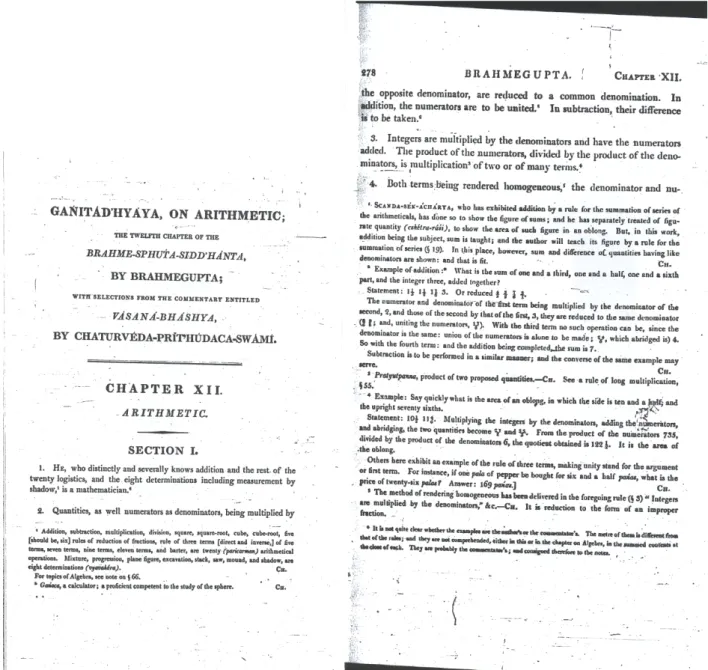
Consider the translation, as seen in Figure 5. Typographically, the commentary is a secondary text, written in a smaller font. The commentary is fragmentary, relegated to and divided among different footnotes. Despite its status as a secondary text, Colebrook makes the importance he ascribes to the commentary visually explicit. In Colebrooke’s edition, the commentary literally spills over and invades the space which is meant for the treatise.
If we recall that the codices sometimes include only portions of the commentaries, we may wonder how much of Colebrooke’s attitude toward giving commentaries in bits and pieces reflects the training he received from pandits. Perhaps the pandits themselves worked in this way and helped Colebrooke understand the text through collating references in different commentaries. Here, a history of how commentaries were conceptualized and read in the Indian subcontinent would be helpful. Likewise, a precise description of how Colebrooke (and other European scholars) worked with pandits in relation to texts would be useful as well65.
2.2
Indian Scholarship with Commentaries: Datta & Singh and K. S. Shukla
During the nineteenth century, the academic history of mathematics in India slowly opened to Indian scholars, who expounded a scholarship as much directed toward an inner audience as toward answering European interlocutors and engaging them in discussion66. The arrival of Indian scholars may first beperceived from articles discussing authorship of texts and was later placed in evidence by series of editions and translations of texts on mathematics. The names Datta, Sengupta and Dvivedin first appear during a period when European scholars had confused the fifth century ¯Aryabhat.a with his eleventh century namesake, and mistaken the seventh century Bh¯askara I with his twelfth century namesake.
By the end of the nineteenth century, the movement of edition, translation and analysis of texts on mathematics in Sanskrit, which had begun at the turn of the previous century, came to a peak. In 187467, Kern edited the Ab for the first time68. Kern printed his edition with the commentary of Parame´svara
(fourteenth century). Kern’s introduction cites SYAB, which is quoted by Parame´svara, but no reference
65The latter has been partially studied in (Kejariwal, 1988), (Aklujkar, 2001), (Bayly, 1996) among others, but little seems to have survived on precisely how European scholars and the pandits worked texts out.
66(Keller, 2006b). 67(Kern, 1874).
68The tradition of copying manuscripts can, of course, also be understood as the editorial tradition of classical India, but printed books are referred to here.
Figure 5: The BSS and PBSS in Colebrooke’s translation
is made to BAB. In 1879, Leon Rodet translated chapter 2 of the Ab into French and conducted an analysis of the text69. In 1896, Dikshit edited the BSS together with his own commentary70. These
two editions were followed by a number of translations in English, which in turn prompted the first studies in this language. Thus, in 1907 and 1908, G. R. Kaye published his controversial work, Notes on Indian Mathematics, part two of which is devoted to ¯Aryabhat.a71. Sengupta published the first English
translation of the Ab72, followed by Clark in 193073. In 1937, B. Datta and S. N. Singh published
the enduring classic “Hindu Mathematics”74. They aimed to provide a general description of all the
variations by which Hindu mathematicians practiced elementary and sometimes higher mathematics, each Sanskrit author contributing elements of his own expertise. Datta & Singh also wanted to refute G. R. Kaye’s claims for an Arabic or European origin of Indian mathematics generally and his attribution of the mathematics in Ab to a foreign source specifically. In order to accomplish these ends, they dedicated part of their effort to the comparison of the history of mathematics in Europe with what had been discovered about the history of mathematics on the Indian subcontinent. To a certain extent, Datta & Singh also wrote a history of mathematics in India in praise of its great mathematicians and the important discoveries recorded in their treatises. As trained mathematicians, Datta and Singh largely focused on the mathematical contents of the texts75. Throughout their publications, B. Datta and A. N.
Singh essentially consider mathematical commentaries to be mathematical texts. In this context, they occasionally referred to Bh¯askara I, whose text was known but was not published, as an astronomer who dealt with mathematics76. Datta & Singh sometimes quoted Bh¯askara I’s commentary to explain or interpret the verses in Ab77. Occasionally, they seem to share Colebrooke’s model and relegate these citations to footnotes on the text78. Datta & Singh often collated these citation with other commentaries on Ab, such as that of N¯ılakan.t.ha (fourteenth century), even though these commentaries were not yet widely available as edited texts. Most frequently, however, they cite BAB for its mathematical contents, with little attention paid to its relationship with Ab79. At times, Datta & Singh mingle the substance
of BAB with the contents of Bh¯askara’s other astronomical texts80.
With political independence and the creation of institutions for the study of the history of science in
69(Rodet, 1879) 70(Dikshit, 1896). 71(Kaye, March 1908). 72(Sengupta, 1927). 73(Clark, 1930). 74(Datta, 1935).
75Despite this tendency, they also embraced the dying tradition of mastering Sanskrit texts on jyotis.a. Within an Indian context, there results were successful and, at the end of his life, B. Datta was addressed as pandit. The enduring quality of their translations reflect their mastery of the Indian intellectual tradition. Indeed, “Hindu Mathematics” effectively blends two traditions, the lore of jyotis.a and the modern history of mathematics. A detailed scrutiny of Datta & Singh’s works could probably yield much useful information about the tradition of jyotis.a.
76(Datta, 1935, Volume I, 125 ).
77(Datta, 1935, Volume I, 66-67; 196; 211. Volume II, 93-95).
78(Datta, 1935, Volume I, 170). See also, SYAB as in op. cit.[Volume II, 91, footnote 4]. 79(Datta, 1935, Volume I, 80, 82, 87, 130, 204, 239; Volume II, 87, 238).
80Thus, the whole portion of Volume 2 devoted to the kut.t.aka quotes all the different texts which appear in Bh¯askara I, even though these passages sometimes present Bh¯askara’s own algorithms, and at other times only explain algorithms in Ab.
India, a new wave of editions appeared. K. S. Shukla took center stage in this movement. In 1959, he published an edition of PG together with APG and an English translation of PG at the University of Lucknow81. He then turned to Bh¯askara’s work, first editing and translating his treatises, which can be
interpreted as elaborations of ¯Aryabhat.a’s astronomy, the Laghubh¯askar¯ıya and the Mah¯abh¯askar¯ıya82.
In 1976, K. S. Shukla and S. R. Sharma jointly published an edition and translation of the AB and editions of BAB and SYAB under the aegis of the Indian National Science Academy83.
By the 1980s, a new generation had taken up the study of commentaries on mathematical subjects. On the one hand, publications on the M¯adhava school of mathematics called the attention of historians of mathematics to the scholiasts of ¯Aryabhat.a; on the other hand, the Japanese students of D. Pingree, particularly T. Hayashi, published articles on the mathematical contents in different commentaries on Ab, BG and L. To this can be added the publications of F. Patte’s Ph.D. and my own, which exemplify the growing interest in mathematical commentaries in Sanskrit at the end of the twentieth century84.
In his editions, Shukla uses commentaries in three separate ways: First, following Colebrooke’s model, commentaries provide a philological assessment of the original text to be edited. Secondly, the commen-taries are also used to explain the text. Thus, although Shukla did not translate APG, he refers to it in the written comments that accompany his translation of PG. At times, Shukla seems to believe that the commentators give a peculiar interpretation of the treatise but at other times he seems to suppose that the commentators serve to explain the contents. In his joint edition and translation of the Ab, commentators are consulted to add mathematical depth to the algorithms. At times, Shukla combed the commentaries in order to quote their conflicting interpretations. Finally, in some instances, especially in the case of BAB, Shukla esteems the commentaries as mathematical texts in their own right85. The
tendency to accept commentaries not only as philological aids but also as independent mathematical texts has been growing. This inclination no doubt coordinates with a general trend within the history of mathematics at large, because such approaches seem characteristic of modern approaches to the Chinese corpus as well.
In summary, commentaries have been used, read and analyzed but were seldom translated by modern historians of mathematics. This decision made sense when commentaries where thought of as philological tools, useful in the editing and understanding of the texts they treated, as was often the case. However, the lack of translations becomes surprising when commentaries are considered as independent texts on mathematics in their own right. Furthermore, if commentaries and treatises are seen as ballroom dancing
81(K. S. Shukla, 1959).
82(K. S. Shukla, 1963), (K. S. Shukla, 1960)
83(K. V. Shukla & Sharma, 1976), (K. S. Shukla, 1976), (K. V. Sarma, 1976).
84How closely can these attitudes toward commentaries be linked to developments in the field of Indology generally? Indeed, Indology has developed a special emphasis on the study of treatises and the contents of important commentaries but has somewhat neglected any reflection on the commentary as a specific kind of text. In the last five-to-ten years, however, a renewed interest in this kind of text has surfaced, as illustrated by the recent conference titled “Forms and Uses of the Commentary in the Indian world”, held at Pondicherry in February 2005. See http://www.ifpindia.org/Forms-and-Uses-of-the-Commentary-in-the-Indian-World.html., or the previously cited publication (Tubb, 2007).
85Before publishing his edition of BAB, Shukla published a number of analyses, which pinpointed the mathematical relevance of the text. (K. S. Shukla, 1972)
couples, sometimes the focus had been essentially on the treatise without its partner, sometimes on the commentary without its partner, and sometimes on details of how their steps follow each other. However, the global picture of how they danse together has not been drawn, or even aimed at.
3
Relating commentaries to their treatises:
the example of
square root extractions
In studies on the history of mathematics in India, the relationship of the commentaries to the text they explicated has generally been left unresolved. Reflections on the relation of one text to another one have usually been restricted a simplistic “right or wrong” interpretation of the treatise by the commentary. Scholarship on the mathematical contents of commentaries has focused on the mathematical ideas they contained, essentially their proofs86. The role of the commentary, then, is implicitly limited to providing
mathematical justifications of the treatise. Through the following examples of square root extractions, the relationship between the commentary and the treatise may be shown to be more complex
In the following, rules to extract square roots, which are found in Ab and PG will be examined. BSS provides only a rule to extract cube roots, and will thus remain outside the scope of the present study.
3.1
Extracting square roots along different lines
The procedures for extracting square roots considered here rely on the decimal place-value notation. Moreover, unlike the interpolations commonly described in astronomical parts of treatises, these algo-rithms are not “useful” procedures to extract square roots. Rather, these procedures all presume that the root is to be extracted from a perfect square87.
The basic idea underlying the procedure is to recognize the hidden development of a square expan-sion in a number written in the decimal place-value notation. In other words, the procedure relies on recognizing a square of the kind (bn× 10n+ . . . + bi× 10i+ . . . + c)2 (i < n) in a number written as
a2n× 102n+ a2n−1× 10²n−1+ . . . + a1× 102+ a0× 10 + c2. Crucial to this algorithm, then, is the ability
to distinguish between powers of ten that are squares (the even powers), and those that are not (the odd powers).88
Let us note that the algorithm in Ab returns the square root directly, while the algorithm in PG first extracts the double of square root and then says that the result should be halved. Thus, although they are founded on the same idea, the two procedures differ in their intermediary steps. Here is not
86(Srinivas, 1990), (Patte, 2004), (Plofker, 2009). Strangely enough, few reflections on comments connected to the definition of the field of gan. ita have been published. Such reflections might help explain why chapters on gan. ita contain algorithms with little astronomical application, although they are included in treatises on astronomy. See (Pingree, 1981), (Keller, 2007), (Plofker, 2009).
87Why, then, were such procedures given? In the Sanskrit mathematical tradition, the validity of an algorithm is sometimes verified by inverting the algorithm and finding the initial input. Perhaps a procedure which inverts the squaring procedure may have seemed useful for such verifications. In commentaries to these rules, all the worked examples undo the squares illustrated in the squaring procedure.
88For a general explanation of the different methods, see (Datta, 1935, Volume I, 170-171), (Bag, 1979, 78-79).
the place to expose their respective algorithms, but rather to concentrate on what treatises reveal that commentaries omit, and vice-versa.
This is the rule for the extraction of square roots as given by Ab89:
Ab.2.4. One should divide, constantly, the non-square hplacei by twice the square root|
When the square has been subtracted from the square hplacei, the quotient is the root in a different placek
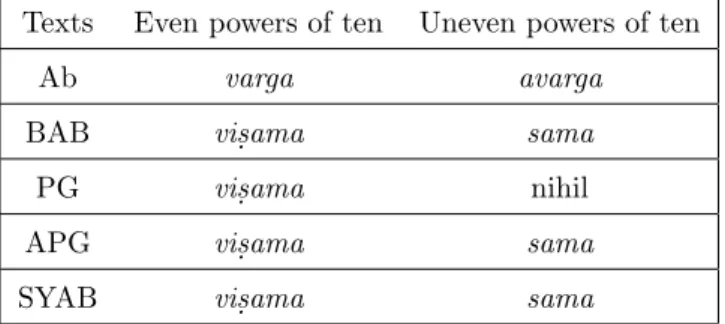
Without any commentary, the algorithm is hard to understand. Part of the difficulty springs from the fact that the verse begins in the the algorithm’s middle and thus emphasizes its iterative aspect. Another part of the difficulty arises from ¯Aryabhat.a’s pun: the same name (varga) is given to squared digits and also to the specific positions where digits are found, “square positions”. This pun highlights the mathematical idea behind the root extraction precisely: the “square places” of the decimal place value notation are positions give hints about the squaring of which digits produced the number at hand. The two commentaries BAB and SYAB introduce a grid to smooth the difficulty caused by the pun. Instead of considering square and non-square places, even and odd places are used. In both cases, this clarification is achieved quite simply by the commentary: one word is merely substituted for another. Thus, BAB states90:
In this computation (gan. ita), the square (varga) is the odd (vis.ama) place. Likewise, SYAB states:91:
In places where numbers are set-down (viny¯asa), the odd places have the technical name (samj˜n¯a) “square”.
We will return to the different grids for positions in the decimal place value notation below. For now, let us consider the act of substituting a noun given in the treatise by another noun, often called a “gloss”. These substitutions are common in the commentaries. In this case, the substitution serves two functions: first, it explains the literal meaning of the verse; second, it points out the mathematical meaning of the pun. Furthermore, this substitution of words indicates the standard by which the commentators believed the s¯utra had been composed: a mathematical pun had been used to pin down the mathematical idea
89
bh¯agam. hared avarg¯an nityam. dvigun. ena vargam¯ulena| varg¯ad varge ´suddhe labdham. sth¯an¯antare m¯ulamk
For an explanation of the algorithm, see (K. S. Shukla, 1976, 36-37). 90(K. S. Shukla, 1976, 52)
atra gan. ite vis.amam sth¯anam vargah. 91(K. V. Sarma, 1976, p. 36, line 15).
sam. khy¯a viny¯asasth¯anes.u vis.amasth¯an¯ani vargasam. j˜n¯ani