arXiv:1112.4092v2 [hep-ex] 9 Feb 2012
Search for universal extra dimensions in p ¯
p collisions
V.M. Abazov,34 B. Abbott,72 B.S. Acharya,28M. Adams,48 T. Adams,46 G.D. Alexeev,34 G. Alkhazov,38 A. Altona,60 G. Alverson,59M. Aoki,47 A. Askew,46 B. ˚Asman,40 S. Atkins,57O. Atramentov,64K. Augsten,9
C. Avila,7 J. BackusMayes,79F. Badaud,12 L. Bagby,47 B. Baldin,47 D.V. Bandurin,46 S. Banerjee,28 E. Barberis,59P. Baringer,55 J. Barreto,3 J.F. Bartlett,47 U. Bassler,17 V. Bazterra,48 A. Bean,55 M. Begalli,3 C. Belanger-Champagne,40L. Bellantoni,47S.B. Beri,26G. Bernardi,16R. Bernhard,21 I. Bertram,41M. Besan¸con,17 R. Beuselinck,42V.A. Bezzubov,37P.C. Bhat,47S. Bhatia,62 V. Bhatnagar,26G. Blazey,49S. Blessing,46K. Bloom,63
A. Boehnlein,47 D. Boline,69 E.E. Boos,36G. Borissov,41T. Bose,58A. Brandt,75O. Brandt,22 R. Brock,61 G. Brooijmans,67A. Bross,47 D. Brown,16 J. Brown,16X.B. Bu,47M. Buehler,47 V. Buescher,23 V. Bunichev,36
S. Burdinb,41 T.H. Burnett,79 C.P. Buszello,40 B. Calpas,14 E. Camacho-P´erez,31M.A. Carrasco-Lizarraga,55 B.C.K. Casey,47 H. Castilla-Valdez,31 S. Chakrabarti,69 D. Chakraborty,49K.M. Chan,53 A. Chandra,77 E. Chapon,17 G. Chen,55 S. Chevalier-Th´ery,17D.K. Cho,74S.W. Cho,30S. Choi,30B. Choudhary,27 S. Cihangir,47
D. Claes,63 J. Clutter,55 M. Cooke,47 W.E. Cooper,47 M. Corcoran,77F. Couderc,17M.-C. Cousinou,14 A. Croc,17 D. Cutts,74 A. Das,44 G. Davies,42S.J. de Jong,33E. De La Cruz-Burelo,31F. D´eliot,17R. Demina,68 D. Denisov,47
S.P. Denisov,37 S. Desai,47 C. Deterre,17 K. DeVaughan,63 H.T. Diehl,47 M. Diesburg,47 P.F. Ding,43 A. Dominguez,63T. Dorland,79A. Dubey,27L.V. Dudko,36 D. Duggan,64 A. Duperrin,14S. Dutt,26 A. Dyshkant,49 M. Eads,63D. Edmunds,61 J. Ellison,45 V.D. Elvira,47Y. Enari,16H. Evans,51A. Evdokimov,70 V.N. Evdokimov,37 G. Facini,59T. Ferbel,68 F. Fiedler,23F. Filthaut,33 W. Fisher,61 H.E. Fisk,47 M. Fortner,49H. Fox,41S. Fuess,47 A. Garcia-Bellido,68G.A. Garc´ıa-Guerrac,31 V. Gavrilov,35P. Gay,12W. Geng,14, 61 D. Gerbaudo,65C.E. Gerber,48
Y. Gershtein,64G. Ginther,47, 68 G. Golovanov,34V.N. Goryachev,37 A. Goussiou,79P.D. Grannis,69 S. Greder,18 H. Greenlee,47 Z.D. Greenwood,57E.M. Gregores,4G. Grenier,19Ph. Gris,12 J.-F. Grivaz,15 A. Grohsjeani,17 S. Gr¨unendahl,47 M.W. Gr¨unewald,29T. Guillemin,15 G. Gutierrez,47 P. Gutierrez,72 A. Haasd,67 S. Hagopian,46 J. Haley,59 L. Han,6K. Harder,43A. Harel,68 J.M. Hauptman,54 J. Hays,42T. Head,43 T. Hebbeker,20D. Hedin,49
H. Hegab,73 A.P. Heinson,45 U. Heintz,74 C. Hensel,22 I. Heredia-De La Cruz,31K. Herner,60 G. Heskethe,43 M.D. Hildreth,53 R. Hirosky,78T. Hoang,46 J.D. Hobbs,69 B. Hoeneisen,11 M. Hohlfeld,23 Z. Hubacek,9, 17
V. Hynek,9 I. Iashvili,66Y. Ilchenko,76R. Illingworth,47 A.S. Ito,47 S. Jabeen,74 M. Jaffr´e,15 D. Jamin,14 A. Jayasinghe,72 R. Jesik,42K. Johns,44 M. Johnson,47 A. Jonckheere,47P. Jonsson,42J. Joshi,26 A.W. Jung,47 A. Juste,39 K. Kaadze,56 E. Kajfasz,14 D. Karmanov,36 P.A. Kasper,47I. Katsanos,63 R. Kehoe,76 S. Kermiche,14
N. Khalatyan,47A. Khanov,73 A. Kharchilava,66 Y.N. Kharzheev,34 J.M. Kohli,26 A.V. Kozelov,37 J. Kraus,61 S. Kulikov,37A. Kumar,66 A. Kupco,10 T. Kurˇca,19V.A. Kuzmin,36 S. Lammers,51 G. Landsberg,74P. Lebrun,19
H.S. Lee,30 S.W. Lee,54 W.M. Lee,47 J. Lellouch,16 H. Li,13 L. Li,45 Q.Z. Li,47 S.M. Lietti,5 J.K. Lim,30 D. Lincoln,47 J. Linnemann,61 V.V. Lipaev,37 R. Lipton,47 Y. Liu,6 A. Lobodenko,38 M. Lokajicek,10 R. Lopes de Sa,69H.J. Lubatti,79 R. Luna-Garciaf,31 A.L. Lyon,47A.K.A. Maciel,2 D. Mackin,77R. Madar,17
R. Maga˜na-Villalba,31S. Malik,63 V.L. Malyshev,34 J. Mansour,22 Y. Maravin,56 J. Mart´ınez-Ortega,31 R. McCarthy,69 C.L. McGivern,55M.M. Meijer,33 A. Melnitchouk,62 D. Menezes,49P.G. Mercadante,4M. Merkin,36
A. Meyer,20 J. Meyer,22 F. Miconi,18 N.K. Mondal,28G.S. Muanza,14M. Mulhearn,78 E. Nagy,14 M. Naimuddin,27 M. Narain,74 R. Nayyar,27H.A. Neal,60 J.P. Negret,7 P. Neustroev,38 S.F. Novaes,5 T. Nunnemann,24G. Obrant‡,38
J. Orduna,77N. Osman,14J. Osta,53 G.J. Otero y Garz´on,1 M. Padilla,45A. Pal,75 N. Parashar,52V. Parihar,74 S.K. Park,30R. Partridged,74 N. Parua,51A. Patwa,70B. Penning,47 M. Perfilov,36 Y. Peters,43 K. Petridis,43 G. Petrillo,68 P. P´etroff,15R. Piegaia,1 M.-A. Pleier,70P.L.M. Podesta-Lermag,31 V.M. Podstavkov,47P. Polozov,35
A.V. Popov,37 M. Prewitt,77 D. Price,51 N. Prokopenko,37J. Qian,60 A. Quadt,22 B. Quinn,62 M.S. Rangel,2 K. Ranjan,27 P.N. Ratoff,41 I. Razumov,37 P. Renkel,76M. Rijssenbeek,69I. Ripp-Baudot,18 F. Rizatdinova,73 M. Rominsky,47 A. Ross,41C. Royon,17 P. Rubinov,47 R. Ruchti,53G. Safronov,35 G. Sajot,13 P. Salcido,49 A. S´anchez-Hern´andez,31M.P. Sanders,24 B. Sanghi,47 A.S. Santos,5 G. Savage,47L. Sawyer,57T. Scanlon,42 R.D. Schamberger,69 Y. Scheglov,38 H. Schellman,50 T. Schliephake,25S. Schlobohm,79C. Schwanenberger,43 R. Schwienhorst,61 J. Sekaric,55 H. Severini,72 E. Shabalina,22 V. Shary,17 A.A. Shchukin,37 R.K. Shivpuri,27 V. Simak,9 V. Sirotenko,47P. Skubic,72 P. Slattery,68 D. Smirnov,53 K.J. Smith,66 G.R. Snow,63J. Snow,71 S. Snyder,70S. S¨oldner-Rembold,43 L. Sonnenschein,20K. Soustruznik,8 J. Stark,13 V. Stolin,35D.A. Stoyanova,37
M. Strauss,72 D. Strom,48 L. Stutte,47 L. Suter,43 P. Svoisky,72 M. Takahashi,43 A. Tanasijczuk,1 M. Titov,17 V.V. Tokmenin,34 Y.-T. Tsai,68K. Tschann-Grimm,69D. Tsybychev,69B. Tuchming,17 C. Tully,65 L. Uvarov,38 S. Uvarov,38 S. Uzunyan,49R. Van Kooten,51W.M. van Leeuwen,32N. Varelas,48 E.W. Varnes,44 I.A. Vasilyev,37
P. Verdier,19 L.S. Vertogradov,34 M. Verzocchi,47 M. Vesterinen,43 D. Vilanova,17 P. Vokac,9 H.D. Wahl,46 M.H.L.S. Wang,47J. Warchol,53 G. Watts,79 M. Wayne,53 M. Weberh,47 J. Weichert,23 L. Welty-Rieger,50 A. White,75 D. Wicke,25 M.R.J. Williams,41 G.W. Wilson,55 M. Wobisch,57 D.R. Wood,59 T.R. Wyatt,43
Y. Xie,47 R. Yamada,47 W.-C. Yang,43 T. Yasuda,47 Y.A. Yatsunenko,34 W. Ye,69 Z. Ye,47 H. Yin,47 K. Yip,70 S.W. Youn,47 T. Zhao,79 B. Zhou,60J. Zhu,60 M. Zielinski,68 D. Zieminska,51 and L. Zivkovic74
(The D0 Collaboration∗)
1Universidad de Buenos Aires, Buenos Aires, Argentina 2LAFEX, Centro Brasileiro de Pesquisas F´ısicas, Rio de Janeiro, Brazil
3Universidade do Estado do Rio de Janeiro, Rio de Janeiro, Brazil 4Universidade Federal do ABC, Santo Andr´e, Brazil
5Instituto de F´ısica Te´orica, Universidade Estadual Paulista, S˜ao Paulo, Brazil 6University of Science and Technology of China, Hefei, People’s Republic of China
7Universidad de los Andes, Bogot´a, Colombia 8Charles University, Faculty of Mathematics and Physics,
Center for Particle Physics, Prague, Czech Republic
9Czech Technical University in Prague, Prague, Czech Republic 10Center for Particle Physics, Institute of Physics,
Academy of Sciences of the Czech Republic, Prague, Czech Republic
11Universidad San Francisco de Quito, Quito, Ecuador 12LPC, Universit´e Blaise Pascal, CNRS/IN2P3, Clermont, France
13LPSC, Universit´e Joseph Fourier Grenoble 1, CNRS/IN2P3,
Institut National Polytechnique de Grenoble, Grenoble, France
14CPPM, Aix-Marseille Universit´e, CNRS/IN2P3, Marseille, France 15LAL, Universit´e Paris-Sud, CNRS/IN2P3, Orsay, France 16LPNHE, Universit´es Paris VI and VII, CNRS/IN2P3, Paris, France
17CEA, Irfu, SPP, Saclay, France
18IPHC, Universit´e de Strasbourg, CNRS/IN2P3, Strasbourg, France
19IPNL, Universit´e Lyon 1, CNRS/IN2P3, Villeurbanne, France and Universit´e de Lyon, Lyon, France 20III. Physikalisches Institut A, RWTH Aachen University, Aachen, Germany
21Physikalisches Institut, Universit¨at Freiburg, Freiburg, Germany
22II. Physikalisches Institut, Georg-August-Universit¨at G¨ottingen, G¨ottingen, Germany 23Institut f¨ur Physik, Universit¨at Mainz, Mainz, Germany
24Ludwig-Maximilians-Universit¨at M¨unchen, M¨unchen, Germany 25Fachbereich Physik, Bergische Universit¨at Wuppertal, Wuppertal, Germany
26Panjab University, Chandigarh, India 27Delhi University, Delhi, India
28Tata Institute of Fundamental Research, Mumbai, India 29University College Dublin, Dublin, Ireland
30Korea Detector Laboratory, Korea University, Seoul, Korea 31CINVESTAV, Mexico City, Mexico
32Nikhef, Science Park, Amsterdam, the Netherlands
33Radboud University Nijmegen, Nijmegen, the Netherlands and Nikhef, Science Park, Amsterdam, the Netherlands 34Joint Institute for Nuclear Research, Dubna, Russia
35Institute for Theoretical and Experimental Physics, Moscow, Russia 36Moscow State University, Moscow, Russia
37Institute for High Energy Physics, Protvino, Russia 38Petersburg Nuclear Physics Institute, St. Petersburg, Russia
39Instituci´o Catalana de Recerca i Estudis Avan¸cats (ICREA) and Institut de F´ısica d’Altes Energies (IFAE), Barcelona, Spain 40Stockholm University, Stockholm and Uppsala University, Uppsala, Sweden
41Lancaster University, Lancaster LA1 4YB, United Kingdom 42Imperial College London, London SW7 2AZ, United Kingdom 43The University of Manchester, Manchester M13 9PL, United Kingdom
44University of Arizona, Tucson, Arizona 85721, USA 45University of California Riverside, Riverside, California 92521, USA
46Florida State University, Tallahassee, Florida 32306, USA 47Fermi National Accelerator Laboratory, Batavia, Illinois 60510, USA
48University of Illinois at Chicago, Chicago, Illinois 60607, USA 49Northern Illinois University, DeKalb, Illinois 60115, USA
50Northwestern University, Evanston, Illinois 60208, USA 51Indiana University, Bloomington, Indiana 47405, USA 52Purdue University Calumet, Hammond, Indiana 46323, USA 53University of Notre Dame, Notre Dame, Indiana 46556, USA
54Iowa State University, Ames, Iowa 50011, USA 55University of Kansas, Lawrence, Kansas 66045, USA 56Kansas State University, Manhattan, Kansas 66506, USA 57Louisiana Tech University, Ruston, Louisiana 71272, USA 58Boston University, Boston, Massachusetts 02215, USA 59Northeastern University, Boston, Massachusetts 02115, USA
60University of Michigan, Ann Arbor, Michigan 48109, USA 61Michigan State University, East Lansing, Michigan 48824, USA
62University of Mississippi, University, Mississippi 38677, USA 63University of Nebraska, Lincoln, Nebraska 68588, USA 64Rutgers University, Piscataway, New Jersey 08855, USA 65Princeton University, Princeton, New Jersey 08544, USA 66State University of New York, Buffalo, New York 14260, USA
67Columbia University, New York, New York 10027, USA 68University of Rochester, Rochester, New York 14627, USA 69State University of New York, Stony Brook, New York 11794, USA
70Brookhaven National Laboratory, Upton, New York 11973, USA 71Langston University, Langston, Oklahoma 73050, USA 72University of Oklahoma, Norman, Oklahoma 73019, USA 73Oklahoma State University, Stillwater, Oklahoma 74078, USA
74Brown University, Providence, Rhode Island 02912, USA 75University of Texas, Arlington, Texas 76019, USA 76Southern Methodist University, Dallas, Texas 75275, USA
77Rice University, Houston, Texas 77005, USA 78University of Virginia, Charlottesville, Virginia 22901, USA
79University of Washington, Seattle, Washington 98195, USA
(Dated: February 3, 2012)
We present a search for Kaluza-Klein (KK) particles predicted by models with universal extra dimensions (UED) using a data set corresponding to an integrated luminosity of 7.3 fb−1, collected by the D0 detector at a p¯p center of mass energy of 1.96 TeV. The decay chain of KK particles can lead to a final state with two muons of the same charge. This signature is used to set a lower limit on the compactification scale of R−1> 260 GeV in a minimal UED model.
PACS numbers: 04.50.-h, 14.80.Rt, 13.85.Rm
The existence of extra dimensions in addition to the 3 + 1 dimensions of space-time has been postulated as a possible solution to the problem of the large hierarchy of scales in the standard model (SM). In models with universal extra dimensions (UED) all particles propagate in the extra dimensions [1]. In this Letter, we study a minimal UED (mUED) model, which has only one extra dimension [2].
Each SM particle in the mUED model is associated with a set of excited Kaluza-Klein (KK) states when viewed in 3 + 1 dimensions. Since compactification of the extra dimensions leads to periodic boundary conditions,
∗with visitors from aAugustana College, Sioux Falls, SD, USA, bThe University of Liverpool, Liverpool, UK,cUPIITA-IPN, Mex-ico City, MexMex-ico, dSLAC, Menlo Park, CA, USA, eUniversity College London, London, UK, fCentro de Investigacion en Com-putacion - IPN, Mexico City, Mexico, gECFM, Universidad Au-tonoma de Sinaloa, Culiac´an, Mexico, andhUniversit¨at Bern, Bern, Switzerland,iDESY, Hamburg, Germany. ‡Deceased.
the KK states have discrete masses of the order of R−1, where R is the radius of the compact dimension. If one-loop corrections are applied, the mass spectrum of the KK modes also depends on a cutoff scale for boundary terms, which is chosen to be 10 TeV [2]. Gluon KK modes (g1) are the heaviest particles, followed by quarks (SU(2) doublet Q1 or singlet q1), gauge bosons (Z1/W1), lep-tons (SU(2) doublet L1or singlet ℓ1) and the KK photon (γ1), which is the lightest KK particle (LKP) and does not decay. The LKP is also a dark matter candidate [3]. Previous searches for KK particles predicted by a mod-ified UED model have been conducted by the D0 [4] Col-laboration at the Fermilab Tevatron Collider and by the ATLAS [5] Collaboration at the CERN Large Hadron Collider (LHC) in diphoton final states. In this model, gravity mediation allows decays of the LKP into a pho-ton plus a light KK gravipho-ton. A search for events with two leptons of the same charge, which can be interpreted in a mUED model, has been performed by ATLAS [6], but no dedicated study of the mUED model has so far
been performed at a collider. Constraints from preci-sion electroweak data [1], from the measurements of the muon anomalous magnetic moment and of the b → sγ branching ratio [7], indicate that the scale R−1 can be as low as ≈ 300 GeV, making KK particles accessible at the Tevatron. In this Letter, the first search for mUED in the final state with two leptons of the same charge is presented using data corresponding to 7.3 fb−1 of in-tegrated luminosity collected by the D0 detector [8] at √s = 1.96 TeV.
At the Tevatron, KK gluons or quarks are mainly pro-duced in pairs, as shown in Fig. 1. In the subsequent cascade decay, up to four charged leptons are produced. Since the masses of the extra particles predicted by the mUED models are nearly degenerate, the leptons are emitted with low transverse momentum and might es-cape detection. In this analysis, we select events with two muons of the same charge.
FIG. 1: (a) Production of a pair of KK quarks (Q1Q¯1). (b)
Decay of a KK quark into a jet, two oppositely charged lep-tons, and the LKP. Double lines indicate KK excitations. A similar cascade decay occurs for the second KK quark leading to several leptons of the same charge in the final state.
The D0 detector [8] consists of tracking systems and calorimeters. The innermost part is a tracking system where charged particles are detected by the silicon mi-crostrip (SMT) and central fiber (CFT) tracking detec-tors, located within a 2 T solenoid. The tracking sys-tem is surrounded by a liquid-argon/uranium calorime-ter. Particle energies are measured in the electromagnetic and hadronic calorimeters within a pseudorapidity range of |η| < 4.2 [9]. Jets are reconstructed with a cone algo-rithm using a radius of R = 0.5 [10] in the calorimeter. The central and forward muon detectors are composed of a layer of wire chambers and scintillators in front of a 1.8 T toroid magnet and two layers outside the toroid. Missing transverse energy is measured from the vector sum of the calorimeter cell energies in the xy plane [11]. A correction for the energy response of muons, electrons and jets is applied.
The backgrounds from Z+jets, W +jets, and t¯t pro-duction are modeled by the alpgen [12] Monte Carlo (MC) event generator, interfaced with pythia [13] for showering and hadronization. Diboson production (WW, WZ and ZZ) is simulated by pythia. The CTEQ6L1 parametrization of the parton distribution functions (PDF) are used [14]. Higher order cross sections for diboson and W/Z+jets production are calculated by mcfm [15] and the cross section of t¯t pair production
is taken from [16]. The dominant source of background is pairs of muons with the same charge from heavy fla-vor jets. This background contribution is estimated from data and is described in detail in the following.
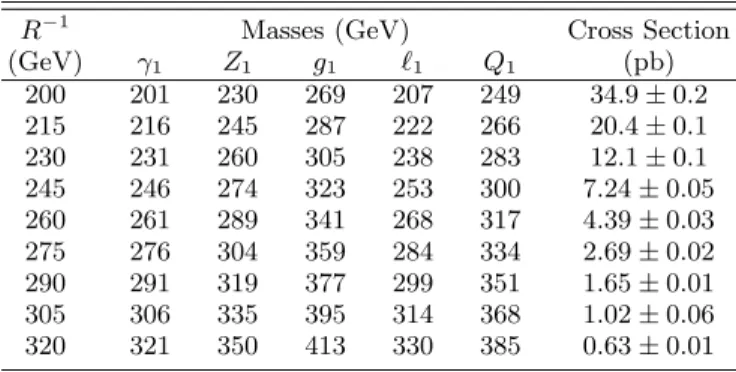
Signal MC events are generated for 9 different val-ues of R−1, covering the range from 200 to 320 GeV in steps of 15 GeV, using pythia with the CTEQ5L PDF parametrization [17]. The production cross sections and masses of KK particles are taken from pythia. They are given in Table I for each R−1 and with all KK gluon and quark production modes included. All decay mechanisms leading to like-charge dimuon final states are taken into account. The decay branching fractions for all KK par-ticles are given by the mUED model. After simulating all cascade decays, approximately 1% of events have two like-charged muons.
TABLE I: Masses of KK particles for each R−1value used in
the MC generation with corresponding total production cross section.
R−1 Masses (GeV) Cross Section
(GeV) γ1 Z1 g1 ℓ1 Q1 (pb) 200 201 230 269 207 249 34.9 ± 0.2 215 216 245 287 222 266 20.4 ± 0.1 230 231 260 305 238 283 12.1 ± 0.1 245 246 274 323 253 300 7.24 ± 0.05 260 261 289 341 268 317 4.39 ± 0.03 275 276 304 359 284 334 2.69 ± 0.02 290 291 319 377 299 351 1.65 ± 0.01 305 306 335 395 314 368 1.02 ± 0.06 320 321 350 413 330 385 0.63 ± 0.01
All signal and background MC events pass through the full geant-based simulation of the detector [18] and are reconstructed using the same algorithms as used for data. To simulate detector noise and multiple p¯p interactions, MC events are overlaid with data events from random beam crossings.
Events are selected by requiring that they pass at least one single muon trigger condition. We require that each event must contain at least two muons of the same charge. The track in the muon system must be matched to a track in the central tracking system with detector |η| < 1.5. We reject cosmic rays by requiring the associated scintillator hits in the muon system to be consistent with originating from a p¯p collision, the distance of closest approach (dca) of the muon tracks to the p¯p interaction vertex to be less than 0.05 cm, and the differences between the z coor-dinates of the dca of each muon and the p¯p interaction vertex to be < 1 cm. We require ∆φµµ < 2.9 rad for the azimuthal angle between the two muons in order to reject multijet background in which there are back-to-back jets which can contain muons from semileptonic meson decay, and ∆φµµ > 0.25 rad to reject muons originating from the same jet. The transverse momenta of the leading and next-to-leading muons have to be 15 < pT1 < 200 GeV
and pT2 > 10 GeV, respectively. The invariant mass of the muon pair must be in the range Mµµ < 250 GeV. The upper limits on the muon pT and dimuon invariant mass reduce the number of events with one of the muon charges mis-reconstructed. In addition, we reject events with 6ET < 25 GeV, since multijet background dominates at low 6ET.
To discriminate between isolated muons from signal and muons contained in jets, we define the isolation in the calorimeter, Ical, as the sum of the energy deposited in the calorimeter within an annulus of 0.1 < R < 0.4, divided by the muon pT, and the isolation in the track-ing detector, Itrk, as the sum of the p
T of all charged particles within a cone of R = 0.5 around the muon, ex-cluding the muon itself, divided by pµT. At least one of the two muons is required to be isolated with Ical< 0.4 and Itrk< 0.12.
We estimate the multijet background by defining a sig-nal and a background enriched sample. The sigsig-nal en-riched sample comprises events where the requirement on the isolation of the second muon in the tracking detec-tor is relaxed to Itrk < 0.25. To define a background enriched sample, we require that the second muon fails the isolation requirement. A normalization factor is cal-culated for each jet multiplicity, given by the ratio of the number of events in the signal and background enriched samples in a multijet dominated region where the pT of the most isolated muon is 5 < pT < 10 GeV. The multijet background is determined by multiplying the background enriched sample with this normalisation factor in the re-gion where the pT of the most isolated muon is > 10 GeV. In the high pT region, there is a significant contribution to the background enriched sample from SM processes other than multijet, particularly from W +jets produc-tion, with an isolated muon from the W boson decay and a non-isolated muon embedded in the jet. This SM background is modeled by applying the selection used to define the background enriched sample to MC events. The resulting SM background distributions, corrected with the same normalization factors as used for data, are subtracted from the corrected distribution of the back-ground enriched data sample to obtain an estimate of the multijet background.
Events from Z → µµ decays enter our sample mainly through mis-reconstruction of one of the muon charges. This background is estimated from simulation. We use data to determine the corresponding systematic uncer-tainty by comparing the two independent charge mea-surements in the central tracking detector and the muon detector [19]. We determine the rate of muons with an incorrectly measured charge by counting the number of events where the two measurements disagree. The num-ber of charge-flip events in data is in good agreement with the number of like-charged Z → µµ events predicted by the simulation.
To improve the discrimination between signal and
[GeV] T E 20 40 60 80 100 120 140 Events 1 10 2 10 Data Multijet Z + jets W + jets Diboson A t t Signal [GeV] T E 20 40 60 80 100 120 140 Events 1 10 2 10 (a) DØ, 7.3 fb-1 -1 = 260 GeV -1 R [GeV] T E 20 40 60 80 100 120 140 Events 1 10 2 10 [GeV] T Leading muon p 20 40 60 80 100 120 140 Events 1 10 2 10 Data Multijet Z + jets W + jets Diboson A t t Signal [GeV] T Leading muon p 20 40 60 80 100 120 140 Events 1 10 2 10 (b) DØ, 7.3 fb-1 -1 = 260 GeV -1 R [GeV] T Leading muon p 20 40 60 80 100 120 140 Events 1 10 2 10
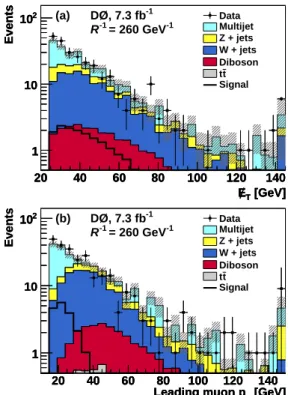
FIG. 2: Distribution of (a) 6ET and (b) pT1 for data and
background, compared to a signal with R−1= 260 GeV. The
shaded band shows the statistical uncertainty on the back-ground estimation. All entries exceeding the range of the histogram are added to the last bin.
background a boosted decision tree (BDT) [20] is trained using pT1, pT2, Mµµ, ∆φµµ, and the num-ber of jets as input variables. Further input vari-ables are the χ2 of the fit of the muon tracks to re-ject badly reconstructed muons, the transverse masses MT =
q
26ETpT(1 − cos ∆φ(6~ET, µ)) calculated sepa-rately for each muon, and the scalar product of 6ET and pT2. This rejects multijet background events with small 6ET or pT2.
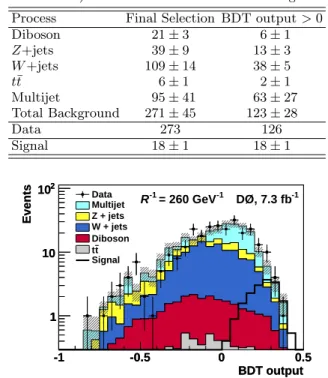
The distributions of 6ET and pT1 for data and back-ground are shown Fig. 2, together with signal for R−1 = 260 GeV. The BDT is trained separately for each signal point with different R−1. The BDT output distribution is shown in Fig. 3 and the event yields in data are com-pared to the expected number of background and signal events in Table II. Signal is concentrated in the region where the BDT output is > 0.
Systematic uncertainties on the normalisation of both background and signal, including their correlations, are taken into account. These include theoretical uncer-tainties on SM background cross sections (7% − 15%) and the uncertainties on the rate of multijet background (40%), signal efficiency from choice of PDF parametriza-tion (4%), integrated luminosity (6.1%), jet energy scale (4%), rate of Z/γ∗production with an incorrectly recon-structed muon charge (21%), trigger efficiency (6%) and
TABLE II: Expected number of events for backgrounds, event yields in data and expected number of events for a signal with R−1= 260 GeV after the final selection and requiring a BDT output > 0 (for illustrative purpose, this cut is not used for limit estimation). The total uncertainties are also given.
Process Final Selection BDT output > 0
Diboson 21 ± 3 6 ± 1 Z+jets 39 ± 9 13 ± 3 W +jets 109 ± 14 38 ± 5 t¯t 6 ± 1 2 ± 1 Multijet 95 ± 41 63 ± 27 Total Background 271 ± 45 123 ± 28 Data 273 126 Signal 18 ± 1 18 ± 1 BDT output -1 -0.5 0 0.5 Events 1 10 2 10 Data Multijet Z + jets W + jets Diboson A t t Signal BDT output -1 -0.5 0 0.5 Events 1 10 2 10 -1 = 260 GeV -1 R DØ, 7.3 fb-1
FIG. 3: Distribution of the BDT output for data and back-ground, compared to a signal with R−1 = 260 GeV. The shaded band shows the statistical uncertainty on the back-ground estimation.
muon reconstruction and isolation (2%).
The entire differential distribution of the BDT output is used to set limits on the product of the cross section and the branching ratio with the CLs method [21] and a profiling technique to reduce the impact of systematic uncertainties [22]. Observed and median expected upper limits at 95% CL on the product of the cross section σ and the branching fraction B into like-charged muon pairs are shown in Fig. 4 as a function of R−1. The theoretical cross section of the mUED model intersects the expected limit at R−1= 275 GeV and the observed at R−1= 260 GeV, which corresponds to a mass of 317 GeV of the lightest KK quark in the mUED model.
In summary, we present a search for extra dimensions in the mUED model using 7.3 fb−1of integrated luminos-ity collected by the D0 experiment. The first direct lower limit on the compactification scale of the extra dimension in the mUED model is set as R−1= 260 GeV.
We thank the staffs at Fermilab and collaborating institutions, and acknowledge support from the DOE and NSF (USA); CEA and CNRS/IN2P3 (France); FASI, Rosatom and RFBR (Russia); CNPq, FAPERJ, FAPESP and FUNDUNESP (Brazil); DAE and DST
[GeV] -1 R 200 220 240 260 280 300 ) [pb] ±µ ±µ B ( × σ 0 0.05 0.1 0.15 0.2 0.25 0.3 Observed Limit Expected Limit 1 SD Expected ± 2 SD Expected ± Theoretical -1 DØ Run II, L = 7.3 fb
FIG. 4: Observed and median expected 95% CL limits on σB(µ±µ±) as a function of R−1 compared to σB(µ±µ±)
cal-culated with the mUED model. The bands represent ±1 and ±2 standard deviations around the median expected limits.
dia); Colciencias (Colombia); CONACyT (Mexico); NRF (Korea); CONICET and UBACyT (Argentina); FOM (The Netherlands); STFC and the Royal Society (United Kingdom); MSMT and GACR (Czech Republic); BMBF and DFG (Germany); SFI (Ireland); The Swedish Re-search Council (Sweden); and CAS and CNSF (China).
[1] T. Appelquist, H.-C. Cheng and B. A. Dobrescu, Phys. Rev. D 64, 035002 (2001).
[2] H.-C. Cheng, K. T. Matchev and M. Schmaltz, Phys. Rev. D 66, 056006 (2002).
[3] H.-C. Cheng, J. L. Feng and K. T. Matchev, Phys. Rev. Lett. 89, 211301 (2002).
[4] V. M. Abazov et al., (D0 Collaboration), Phys. Rev. Lett. 105, 221802 (2010).
[5] G. Aad et al. (ATLAS Collaboration), Eur. Phys. J. C 71, 1744 (2011).
[6] G. Aad et al. (ATLAS Collaboration), J. High Energy Phys. 10, 107 (2011).
[7] K. Agashe, N. G. Deshpande and G. H. Wu, Phys. Lett. B 514, 309 (2001); T. Appelquist and B. A. Dobrescu, Phys. Lett. B 516, 85 (2001).
[8] V. M. Abazov et al. (D0 Collaboration), Nucl. Instrum. Methods Phys. Res., Sect. A 565, 463 (2006).
[9] The D0 detector coordinate system is right-handed with the z axis pointing in the proton beam direction. The y axis points upward and the azimuthal angle φ is mea-sured from the x axis. Pseudorapidity is defined as η = − ln[tan(θ/2)], where θ is the polar angle.
[10] G. C. Blazey et al., arXiv:hep-ex/0005012 (2000). [11] Missing transverse energy is defined as 6 ~ET =
−X i (Ei T ,x, ET ,yi ), where ET ,xi = E isin θicos φi, Ei T ,y =
Eisin θisin φi. Here Ei is the energy deposited in ith
calorimeter cell and the angles θiand φidefine the
direc-tion from the origin of the coordinate system to the ith
calorimeter cell. We also define 6ET≡ |6 ~ET|.
[12] M. L. Mangano et al., J. High Energy Phys. 07, 001 (2003). We use version 2.05.
[13] T. Sj¨ostrand, S. Mrenna and P. Skands, J. High Energy Phys. 05, 026 (2006). We use version 6.421 for generating the signal MC events.
[14] J. Pumplin et al., J. High Energy Phys. 07, 012 (2002); D. Stump et al., J. High Energy Phys. 10, 046 (2003). [15] J. Campbell and R. K. Ellis, Phys. Rev. D 65, 113007
(2002); J. Campbell, R. K. Ellis and D. Rainwater, Phys. Rev. D 68, 094021 (2003).
[16] S. Moch and P. Uwer, Phys. Rev. D 78, 034003 (2008). [17] H. L. Lai et al. (CTEQ Collaboration), Eur. Phys. J. C
12, 375 (2000).
[18] R. Brun, F. Carminati and S. Giani, CERN-W5013 (1993).
[19] V. M. Abazov et al. (D0 Collaboration), Phys. Rev. D 84, 092002 (2011).
[20] A. Hoecker et al., PoS ACAT, 040 (2007).
[21] T. Junk, Nucl. Instrum. Methods in Phys. Res. A 434, 435 (1999); A. Read, J. Phys. G 28, 2693 (2002). [22] W. Fisher, FERMILAB-TM-2386-E (2006).