Preoperative evaluation of patients with, or at risk of, coronary
artery disease undergoing non-cardiac surgery
P.-G. Chassot
1, A. Delabays
2and D. R. Spahn
3*
1
Department of Anaesthesiology,
2Division of Cardiology and
3Department of Anaesthesiology,
University Hospital Lausanne (CHUV), CH-1011 Lausanne, Switzerland.
*Corresponding authorThe increasing number of patients with coronary artery disease undergoing major non-cardiac surgery justi®es guidelines concerning preoperative evaluation, stress testing, coronary angio-graphy, and revascularization. A review of the recent literature shows that stress testing should be limited to patients with suspicion of a myocardium at risk of ischaemia, and coronary angio-graphy to situations where revascularization can improve long-term survival. Recent data have shown that any event in the coronary circulation, be it new ischaemia, infarction, or revascular-ization, induces a high-risk period of 6 weeks, and an intermediate-risk period of 3 months. A 3-month minimum delay is therefore indicated before performing non-cardiac surgery after myocardial infarction or revascularization. However, this delay may be too long if an urgent surgical procedure is requested, as for instance with rapidly spreading tumours, impending aneurysm rupture, infections requiring drainage, or bone fractures. It is then appropriate to use perioperative beta-block, which reduces the cardiac complication rate in patients with, or at risk of, coronary artery disease. The objective of this review is to offer a comprehensive algorithm to help clinicians in the preoperative assessment of patients undergoing non-cardiac surgery.
Br J Anaesth 2002; 89: 747±59
Keywords: heart, coronary artery disease; surgery, non-cardiac; surgery, preoperative assessment
Accepted for publication: April 8, 2002
Contemporary medicine shows a trend towards more aggressive surgery in sicker patients, among whom the prevalence of ischaemic heart disease is increasing. This tendency creates a requirement for guidance in the preoperative evaluation of patients known to have, or at risk of, coronary artery disease. There is an abundance of studies on this subject, but the way to evaluate these patients is still the object of considerable debate. Much of the controversy is because of the obvious dif®culties of conducting large randomized controlled clinical trials on this topic, and to the relatively low incidence of periopera-tive cardiac events (<10%). The rate of postoperaperiopera-tive myocardial infarction is 0.7% after general surgery in a male population over 50 yr old, but increases to 3.1% after vascular surgery where the prevalence of asymptomatic coronary artery disease is particularly high.3 53 61Because of
this prevalence, most of the studies have focused on
vascular patients, who represent less than 10% of the adult surgical population. This fact may introduce a bias when the results are extrapolated to other surgical cohorts.
The purpose of preoperative evaluation is to lower perioperative morbidity and mortality with minimal expense from preoperative testing, and to concentrate economic investment on high-risk patients where special-ized tests might modify perioperative management and improve long-term bene®t. Testing a low-risk population not only increases costs unnecessarily, but may increase morbidity and causes harm by delaying a non-cardiac operation. The main question to be answered is: does the patient need cardiological testing? When coronary artery disease is present, three other questions arise: may the patient bene®t from coronary revascularization? Is non-cardiac surgery so imperative that it should be carried out rapidly despite the risk? Is it possible to decrease this risk?
As the workload resulting from perioperative ischaemic cardiac evaluation is signi®cant, clinicians need practical guidelines for their daily practice. This review aims to offer them an update on the literature on preoperative assessment of patients known to have, or at risk of, coronary artery disease undergoing non-cardiac surgery. It also presents an evaluation algorithm used in our institution. The level of evidence in the studies cited in the text is mentioned in the references.
Clinical predictors
Despite sophisticated technologies, history and physical examination of the patient remain the key elements of preoperative risk assessment. Risk strati®cation of patients with known, or at risk of, coronary artery disease is usually based on three elements:115 (i) the patient risk factors;
(ii) functional capacity of the patient; and (iii) the risk factors of surgery.20 The vast majority of the studies has
been performed in North America and among Veterans Administration Hospitals, the population of which consists mainly of elderly white male patients. However, the prevalence of coronary artery disease and its morbidity varies considerably in different countries. For example, the incidence of infarction among patients with abdominal aortic aneurysm is 16% in France, but 50% in Sweden.4 55
Similarly, there are ethnic differences in the response to treatment between white and non-white populations.24 124
Thus, it may be inaccurate to transpose the results of one population to another. On the other hand, the risk of surgery is highly dependent on surgical skills, anaesthetic care, and nursing quality. Each institution should therefore establish its own audit in order to take appropriate decisions when choices have to be made between different treatment modalities.
Risk factors of the patients
Risk factors of the patients are usually subdivided into three categories: major, intermediate, and minor (Table 1). Major predictors are markers of unstable coronary disease and include: recent myocardial infarction (<6 weeks), unstable or severe angina (class III±IV), ongoing ischaemia after myocardial infarction, ischaemia and congestive heart failure, or malignant arrhythmias. New or changing symp-toms suggest atheromatous plaque rupture and should be presumed to be infarction unless proven otherwise. A 6-week period is necessary for the myocardium to heal after an infarction and for the thrombosis to resolve.116Patients
with coronary revascularization done within the preceding 40 days should also be classi®ed as high-risk patients.79
Because of sympathetic stimulation and hypercoagulability during and after surgery, patients with major predictors have a ®ve times greater perioperative risk.20 84 Only vital or
emergency surgical procedures should therefore be con-sidered for these patients. All elective operations should be
postponed and the patients properly investigated and treated.
Intermediate-risk factors, such as previous myocardial infarction (>6 weeks and <3 months) without sequelae or threatened myocardium, stable angina (class I±II) with optimal medical treatment, or documented previous peri-operative ischaemic events, are independent predictors for perioperative cardiac complications; they are proof of well established but controlled coronary artery disease. Diabetes mellitus is included in this category because it is frequently associated with silent ischaemia, and represents an inde-pendent risk factor for perioperative mortality, as do low ejection fraction (EF <0.35) and compensated heart failure.20 65 The relevance of advanced age (>70 yr),
hypertension and left ventricular hypertrophy (LVH) to the intermediate or minor risk category is still controversial. American guidelines tend to consider age as a minor factor but, if it is estimated by physiological age and not chronological age, it should belong to the intermediate category.20 22 50 65 93 101 The presence of hypertension
among intermediate or minor risk categories depends probably on the population studied, as it is an easily controllable factor in the perioperative period.57LVH has
been considered as an independent marker of ischaemic disease and cardiac complications, but recent recommen-dations tend to consider it a minor factor.17 33 37 65 76 Risk
Table 1 Classi®cation of cardiac risk factors linked to patient status modi®ed from references.20 22 64 69 83 92 114CABG=coronary artery bypass
graft
Major factors (markers of unstable coronary artery disease) Myocardial infarction <6 weeks
Angina class III±IV
Residual ischaemia after myocardial infarction Clinical ischaemia and congestive heart failure Clinical ischaemia and malignant arrhythmias CABG or PTCA <6 weeks
Intermediate factors (markers of stable coronary disease) Prior myocardial infarction >6 weeks and <3 months (>3 months if complicated) by clinical history or ECG abnormalities
Angina class I±II
Asymptomatic patient post infarction with maximal therapy Documented previous perioperative ischaemia
Silent ischaemia (Holter monitoring)
Post CABG or PTCA >6 weeks and <3 months, or >6 yr, or with anti-anginal therapy
Ventricular arrhythmia Diabetes mellitus Age (physiological) >70 yr
Compensated or prior heart failure, ejection fraction <0.35 Minor factors (increased probability of coronary artery disease) Familial history of coronary artery disease
Polyvascular status
Uncontrolled systemic hypertension Hypercholesterolaemia
Smoking
ECG abnormalities (arrhythmia, LVH, bundle branch block) Post infarction (>3 months), asymptomatic without treatment
Post CABG or PTCA >3 months and <6 yr, and no symptoms of angina nor anti-anginal therapy
factors are additive: complication rates increase with their number, as does the necessity to investigate the patients.65 76
Minor risk factors are markers of an increased probabil-ity of coronary artery disease, but not of an increased perioperative risk; they are mentioned in Table 1.2 In
patients asymptomatic within 6 yr after coronary artery bypass grafting (CABG) or percutaneous transluminal coronary angioplasty (PTCA), evidence suggests that the risk of subsequent cardiac surgery is the same as in non-coronary patients, as long as the delay of 3 months is respected after revascularization, and the stress tests are negative within the previous 2 yr.21 22 26 37 85 111
Functional capacity
Exercise tolerance is a major determinant of perioperative risk.20 22 42 81It is usually evaluated by the estimated energy
requirement for various activities, and graded in metabolic equivalents (MET) on a scale de®ned by the Duke Activity Status Index (Table 2).54One MET represents the oxygen
consumption of a resting adult (3.5 ml kg±1 min±1).
Ergometric measurements on a treadmill inducing ischae-mia at low-level exercise (<5 MET or heart rate <100 min±1)
identi®es a high-risk group, whereas the achievement of more than 7 MET (or heart rate >130 min±1) without
ischaemia identi®es a low-risk group.122Vascular patients
who are able to exercise to 85% of their maximal heart rate have a low risk of a perioperative cardiac event.78 More
simply, the inability to climb two ¯ights of stairs is associated with a positive predictive value of 89% for cardiopulmonary complications.42 In the absence of valve
pathology, the ejection fraction of the left ventricle can be considered as an adequate measurement of the myocardial functional reserve.100Patients with good functional capacity
and no symptoms can be considered free of any severe coronary artery disease.86Despite its predictive value in the
perioperative setting, the Duke Activity Status Index has never been speci®cally tested for ischaemic patients.84
Risk factors associated with surgery
Surgical procedures can be strati®ed into three categories, according to their level of perioperative physiological stress (Table 3).20 22When estimating the risk of an operation, one
must also take into consideration the risk of not operating on the patient. This evaluation is particularly important for oncological or limb salvaging procedures. It is unethical to reject a patient when their survival is threatened by the diseaseÐas with rapidly spreading tumours, impending aneurysm rupture, infections requiring surgery, or disabling bone fractures. In order to balance the risks, it might be necessary to limit the extent of the planned procedure, or to plan repeated operations. Risk reduction strategies must also be applied, such as maintaining normothermia, avoiding extreme anaemia, controlling postoperative pain, and pre-scribing perioperative beta-block.76 107 127The performance
of the individual institution must be taken into account, as it is a determinant factor in the success of particular procedures.
Previous ischaemia
During the 1980s, the rule prevailed to wait 6 months after a myocardial infarction before embarking on non-cardiac surgery.97 109 114Since then, the cardiological management
and the functional assessment of patients have evolved signi®cantly. It appears now that the risk after a previous infarction is related less to the age of the infarction than to the functional status of the ventricles and to the amount of myocardium at risk from further ischaemia, as evaluated during convalescence.22 104 105 A small infarction without
residual angina in the context of a good functional status allows essential non-cardiac surgery as soon as 6 weeks after the ischaemic episode.115On the contrary, a patient
with a large infarct, residual symptoms and ejection fraction below 0.35 has a high probability of a further cardiac event, even 6 months after the infarction. Usual practice guidelines consider the period within 6 weeks of infarction as a time of high risk for a perioperative cardiac event, because it is the
Table 2 MET in increasing order (Duke Activity Status Index) (adapted from Hlatky, 198954)
1±4 MET Standard light home activities Walk around the house
Walk 1±2 blocks on level ground at 3±5 km h±1
5±9 MET Climb a ¯ight of stairs, walk up a hill Walk on level ground at >6 km h±1
Run a short distance
Moderate activities (golf, dancing, mountain walk) >10 MET Strenuous sports (swimming, tennis, bicycle)
Heavy professional work
Table 3 Cardiac risk classi®cation of non-cardiac surgical procedures adapted from ACA/AHA guidelines for perioperative cardiovascular evaluation for non-cardiac surgery20 22
Minor procedures (cardiac complication rate <1%) Endoscopic procedures
Ambulatory surgery
Breast and super®cial procedures Eye surgery
Plastic and reconstructive surgery
Intermediate procedures (cardiac complication rate 1±5%) Minor vascular surgery, including carotid endarterectomy Abdominal and thoracic procedures
Neurosurgery ENT procedures Orthopaedic surgery Prostatectomy
Major procedures (cardiac complication rate >5%) Emergency intermediate and major procedures Aortic and major vascular surgery
Prolonged surgical procedures, large ¯uid shifts or blood loss Unstable haemodynamic situations
mean healing time of the infarct-related lesion.22 80 116The
period from 6 weeks to 3 months is of intermediate risk; this period is extended beyond 3 months in cases with complications such as arrhythmias, ventricular dysfunction, or continued medical therapy.1In uncomplicated cases, no
bene®t can be demonstrated for delaying surgery more than 3 months after an ischaemic accident.115
Previous coronary revascularization
Patients who do well after CABG have an attenuated risk of cardiac events during subsequent non-cardiac surgery. Retrospective studies have disclosed a signi®cant improve-ment in survival of revascularized patients, particularly those with triple-vessel coronary artery disease and depressed ventricular function, when they undergo subse-quent non-cardiac vascular surgery.85 98 110In the Coronary
Artery Surgery Study (CASS) experience, these patients have a mortality of 0.9%, instead of 2.4% for those who have not been revascularized;37recent data show the same
trend.51 However, when the complication and mortality
rates of CABG are taken into account, the combined mortality of cardiac and non-cardiac procedures is not different from the mortality of non-cardiac surgery when ischaemic heart disease has been managed by medical treatment only.37 A patient might therefore bene®t from
preoperative coronary revascularization if the CABG pro-cedure presents a low risk and will improve long-term survival, and if the planned non-cardiac procedure is high risk but can wait for at least 3 months.
The short-term effect of prophylactic CABG among vascular patients has been addressed in two decisional analyses; both showed it was safer to proceed directly with a non-cardiac operation and close monitoring before coronary revascularization.31 75 The bene®t of coronary
revascular-ization might be even lower among patients undergoing non-vascular surgery, as they have already a lower probability of perioperative cardiac events.3 84 Obviously,
there is no indication to advise prophylactic revasculariza-tion in order to protect the ischaemic myocardium from the effects of a subsequent non-cardiac operation. The indica-tions for coronary revascularization are aimed at reducing long-term mortality and prolonging survival.33 36 75 They
are the same in patients being evaluated for a non-cardiac operation as for non-surgical population and include: unstable angina, left main coronary artery disease, three-vessel disease, proximal left anterior descending artery disease, and decreased ventricular function.
Asymptomatic, functionally active patients with previous successful coronary revascularization within the last 6 yr are in a low-risk category and should not be investigated further for a non-cardiac operation; this cut-off point is based on a slight but non-signi®cant increase in postoperative infarc-tion rate among patients 6 yr after CABG surgery.21Patients
having a negative stress test or satisfactory angiography in the last 2 yr can be cleared for non-cardiac surgery without
further testing, if the symptomatology and treatment have not changed since the examination.20 22
In the 1990s, it seemed that PTCA had a signi®cant protective effect on the ischaemic complications of subse-quent non-cardiac surgery. In two studies from the Mayo Clinic, major vascular surgery was performed on average 11 days after PTCA;27 58 overall mortality of surgery was
halved and infarction rate ®ve times less in the groups having previous PTCA compared with non-revascularized patients. Such results with dilatative angioplasty have been repeated, showing improvement in vascular surgery out-come for patients having undergone PTCA 11 days to 18 months earlier.45 However, with the advent of stenting
during PTCA, recent studies have heralded fundamentally different results. In one study, there were eight deaths and seven myocardial infarctions among 40 patients who underwent coronary stent placement less than 2 weeks before non-cardiac surgery.60 In addition, patients
under-going non-cardiac surgery within 40 days of PTCA are nearly three times more likely to have an adverse cardiac event than normal controls, and are no less likely to have a poor cardiac outcome than non-revascularized patients until 90 days after PTCA.92 Any surgery performed within 6
weeks of PTCA presents an excessive risk of stent thrombosis and infarction if the antiplatelet medication is stopped, or of major bleeding if the treatment is maintained throughout the operation.22 79 119This is a period of major
risk: most of the re-stenoses requiring repeat PTCA occur during the ®rst months after stenting, and documented stent thrombosis is associated with a mortality rate of 7%.15 17
The optimal timing for surgery is therefore a delay of 3 months after PTCA and stenting. Compared with PTCA, CABG with internal mammary grafting has a better long-term protective effect, particularly in diabetic patients;38the
rate of late cardiac events (>3 yr) is halved in surgically revascularized patients.27 35
Preoperative testing
Preoperative testing is aimed at answering precise questions raised by clinical history and examination. No cardio-vascular test should be performed if the results will not change perioperative management. The therapeutic impact may differ according to the situation: medical treatment may be optimized, surgical procedure modi®ed, anaesthetic management adjusted, or the risk/bene®t ratio of a surgical procedure evaluated differently. These complex decisions can be taken more objectively when the actual risk can be quanti®ed by appropriate screening tests.70 However, no
magic test will ever exist to fully stratify all risks, because perioperative cardiac events are multifactorial.84
The indication for preoperative tests is based on Bayes' theorem, which speci®es that the predictive value of testing is optimized when it is applied to an intermediate-risk population (Table 1), as the incidence of false negatives and false positives is inversely proportional to disease
prevalence. The probability of a complication is a function of the probability of the disease in the category to which the patient belongs. In such a Bayesian model using clinical predictors and results of dipyridamole-thallium scintigraphy (DTS), it appears that modi®cations are introduced by the test only in the intermediate-risk patient category.66Without
symptoms of angina, previous infarction or heart failure, the probability of suffering from coronary artery disease is 6%; if diabetes is also excluded, the probability falls to 4%;86
further testing of such a patient has an extremely low impact on complication rate. Similarly, the outcome of a patient with a clear history of active coronary artery disease will not be modi®ed by screening tests.
Stress tests (exercise ECG, DTS, or dobutamine echocardiography) are dynamic investigations, which demonstrate the ischaemic threshold, the maximal tolerated heart rate, the localization, and the amount of threatened myocardium. An interruption of the test before reaching the maximal theoretical heart rate identi®es an increased risk of perioperative ischaemic events.70 The positive predictive
value of all stress tests is modest (20±30%), whereas their negative predictive value is excellent (95±100%); this should not be surprising, as the incidence of perioperative cardiac complications is low (<10%) and more than 90% of patients have a straightforward perioperative course.10In a
meta-analysis of the predictive value of four preoperative tests (DTS, ejection fraction estimated by radionuclide ventriculography, ambulatory electrocardiography, and dobutamine stress echocardiography (DSE)), DSE appears more discriminating, but the data do not allow selection of an optimal test because of overlapping con®dence intervals (Table 4).73DSE seems particularly informative because it
investigates the segmental coronary blood supply and allows simultaneous quanti®cation of ventricular function.
The pertinence of tests is increased for multi-vessel disease, but diminished in cases of isolated single-vessel stenosis.41 Beside the speci®cities of each test, it is the
expertise of its medical interpretation and the characteristics of the population in which it is applied which alters its impact. Such differences may introduce signi®cant bias when comparing the ef®ciency of these tests in predicting outcomes. The comparison of various studies is further confounded because some are based on consecutive case recruitment, whereas others analyse selective testing of classes of patients.33
Electrocardiography (24 h Holter monitoring)
Preoperative ambulatory ECG (Holter monitoring) is rela-tively inexpensive but may be dif®cult to analyse because of electrocardiographic abnormalities precluding adequate interpretation in up to 50% of patients.95 One highlypowered study demonstrated that the detection of silent preoperative ischaemia has a positive predictive value of 38% for postoperative cardiac events, whereas its absence precludes perioperative problems in non-vascular surgery in 99% of patients and in vascular surgery in 86%.30 When
electrocardiographic criteria of LVH were added to ST segment depression, the preoperative Holter ECG became signi®cantly predictive of postoperative events.62However,
other studies show less clear-cut data, and results are not unanimous in non-cardiac surgery, probably because post-operative ischaemia is primarily a result of ischaemic events occurring during surgery.67 69 95 Perioperative stress and
techniques of patient management are probably more determinant features than the presence of preoperative electrocardiographic signs of ischaemia.
Exercise ECG
The exercise ECG is a widely available and inexpensive method of screening for coronary artery disease but depends on the exercising ability of the patient and the legibility of the ECG. Often, vascular patients do not reach the target heart rates because of limb claudication, and therefore have an inadequate examination. In patients who can perform the test, studies conducted in vascular and non-vascular patients are not conclusive for its ability to predict perioperative cardiac complications.32 41 59 113 However, a recent
pro-spective study on intermediate-risk patients con®rmed that a ST-segment depression of 0.1 mV or more during exercise is an independent predictor of perioperative ischaemic events.39 Because of its availability and low cost, the
exercise ECG should be considered as the ®rst screening step in stress testing for non-vascular patients with a normal ECG and good mobility.20
Dipyridamole-thallium scintigraphy
When myocardial perfusion is increased by vasodilation with dipyridamole, infarcted areas appear as ®xed defects, whereas ischaemic myocardium appears as defects, which
Table 4 Comparison of three preoperative stress tests. *Relative risk is the probability of a cardiac event when a test result is positive divided by the probability of that event when the test result is negative (modi®ed from Mantha73). **Cost at the University Hospital of Lausanne (CHUV), Switzerland
Test Median relative
risk* Sensitivity(%) Speci®city(%) Positive predictivevalue (%) Cost**(=C)
Ambulatory ECG (Holter) 2.7 68 66 25 190
Exercise ECG 69 73 20 220
Dipyridamole-thallium 4.6 85 80 23 410
are reversible when reperfused on later images. There is an incremental increase in the probability of postoperative cardiac events with increasing size and number of these defects.12 14Reversible defects are ef®cient markers of the
myocardium at risk, and are clearly associated with an adverse cardiac event.19 Quanti®cation of their delayed
redistribution at 4±24 h is more predictive of cardiac death or myocardial infarction than simple dichotomous inter-pretation in positive/negative results.32 108 118 There is
strong evidence that DTS has a good predictive value for determining a low or high operative risk when applied to a selected population of clinical intermediate-risk, vascular patients.66 118However, it has no real screening value, when
applied to a large unselected vascular or non-vascular population, or among patients already classi®ed clinically as low- or high-risk candidates for surgery.4 68
Left ventricular ejection fraction
There is strong evidence that simple assessment of the resting ejection fraction by transthoracic echocardiography alone does not improve prediction of ischaemic complica-tions in cardiac patients, although it is useful for evaluating outcome in current or poorly controlled heart failure.22 49 77
A depressed ejection fraction predicts only postoperative left ventricular dysfunction and correlates better with late than early postoperative cardiac events.83 102
Technetium-99 radionuclide angiography offers a more precise and more reproducible measurement, but is not a better predictor of ischaemic events.117
Dobutamine stress echocardiography
An increase in oxygen demand following dobutamine perfusion (40 mg kg±1 min±1) is more discriminative, as it
can induce wall motion abnormalities pathognomonic of ischaemic myocardium. According to most meta-analyses, it offers the best prediction for perioperative events, with a negative predictive value close to 100% and a positive predictive value up to 38% among intermediate- or high-risk patients (Table 4), even if it does not add discriminative power in patients with no clinical markers of coronary artery disease.11 23 74 84 88 108 Patients demonstrating extensive
ischaemia under dobutamine stimulation (>5/16 left ven-tricular segments involved), experience 10 times more cardiac events than patients with limited stress-induced ischaemia (<4 segments involved).11 Based on a Dutch
study of 1351 consecutive patients undergoing major vascular surgery, DSE can be considered as an effective test for identifying the small group (2%) of patients at high ischaemic risk who should undergo coronary angiogram and possible revascularization. In contrast, patients with moderate risk (<4 segments involved) could undergo surgery directly under beta-block protection.11
Coronary angiography
Coronary angiography is an invasive procedure, which carries mortality of 0.01±0.05%, and a morbidity of 0.03±0.25%.75 It is indicated only in cases of unstable
coronary syndromes, of uncertain stress tests in high-risk patients undergoing major surgery, or when there is a possible indication for coronary revascularization.22 When
the coronary artery disease is diffuse in small vessels, as in subendocardial ischaemia without wall motion abnorm-alities, or when the patient is not a candidate for revascularization because of comorbid states, coronary angiography has little impact, as the probability of the results leading to PTCA or CABG is very low.104Coronary
angiography should therefore be performed before a non-cardiac operation only in high-risk patients who warrant coronary revascularization for medical reasons, irrespective of the preoperative context.
Test limitations
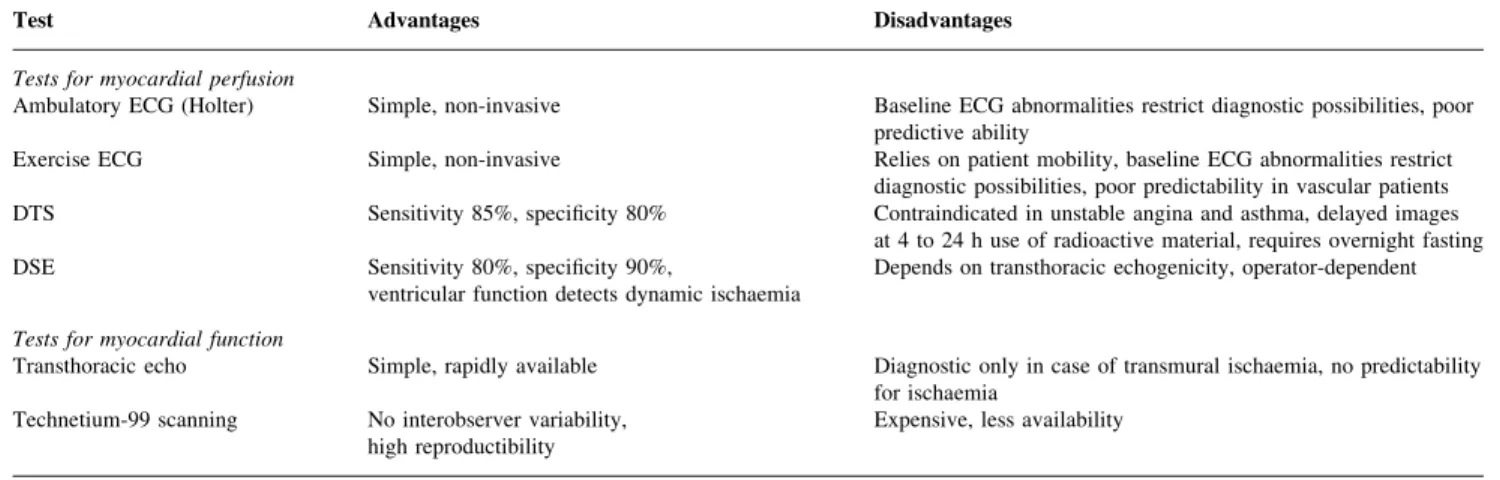
Predictions are only probabilities of events: a negative preoperative test in a particular patient, although reassuring for the anaesthetist, does not mean that cardiac complica-tions are excluded. Independent of its prognostic capacity, each test has its own advantages and contraindications (Table 5). More importantly, the primary factor for deciding the most ef®cient test is institution-speci®c: the best prediction will be provided by the most quali®ed depart-ment, whether it is cardiology, nuclear medicine, or the echo laboratory.
The concept that postoperative ischaemia and infarction are related to perioperative excess oxygen demand is supported by the fact that ischaemic events peak at the second and third postoperative day, whereas tachycardia is maximum during days 1 and 2.69 Patients with higher
maximum heart rates after surgery have more ischaemic episodes and a longer cumulative duration of ischaemia.96
There is a strong correlation between immediate post-operative ischaemia (ST-segment depression) and cardiac events supervening after surgery.67 Nowadays, stress
echocardiography is the closest replication of an equivalent increase in myocardial oxygen consumption. Nevertheless, there is no test that adequately mimics the physiological stress response to surgery, with prolonged sympathetic stimulation and tachycardia, increased coronary vasomotor tone, hypercoagulability, potential atheromatous plaque rupture leading to thrombus formation, hypothermia, and blood loss.28 33 107 Moreover, the culprit lesion causing
myocardial infarction often occurs in a insigni®cantly stenosed coronary vessel.26 43 Although DTS and DSE
have good predictive accuracy in patients undergoing vascular surgery,87 88they seem not as ef®cient in patients
undergoing non-vascular operations.63 125 Without
possible to de®ne the real impact of stress tests on outcome in general surgery.
Patients receiving effective chronic beta-block are dif®-cult to evaluate with stress tests because they have a limited increase in heart rate and cardiac output on exercise. The sensitivity of stress tests for diagnosing a coronary lesion is signi®cantly lowered under these circumstances.29 123
However, as a preoperative prognostic tool, these tests retain their full value, as they demonstrate which level of stress these patients can endure before showing myocardial ischaemia under the protection of beta-adrenergic antagon-ism. The decreased incidence of ischaemic modi®cations with beta-block is a diagnostic drawback, but is nevertheless a demonstration of the level of protection reached with this medication.
Testing takes time and money. Only intermediate-risk (Table 1), and low-functional status (Table 2) patients, undergoing major or vascular surgery (Table 3) bene®t from stress testing. High-risk patients should undergo coronary angiography. In a theoretical model of decision analysis, using as an end-point mortality rates for abdominal aortic aneurysm resection and CABG, Glance44 suggests that
preoperative screening, in which high-risk patients proceed directly to angiography and possible CABG, intermediate-risk patients are ®rst screened with DTS, and low-intermediate-risk patients undergo no testing before vascular surgery, may improve 5-yr survival from 77 to 86%. In this model, routine testing of all patients is of no bene®t compared with selective testing of the intermediate-risk category, and is more expensive. Some patients have an obvious indication for urgent surgery and yet have a clinical coronary status, which would require investigation because of the possible need for revascularization. Testing and treating them would impose an unacceptable delay in the surgical treatment of the life-threatening primary disease. In such a case, it is not indicated to thoroughly investigate the patient, as the decision to operate with the shortest delay is made whatever
the results. Based on recent data on risk strati®cation, it can be asserted that these emergency operations can be performed as soon as possible, but should be accompanied by perioperative treatment with beta-blockers.11 90 127
Diabetes mellitus
In diabetic patients, the risk of coronary artery disease is two to four times higher than in the corresponding general population.2 Moreover, diabetes is frequently associated
with silent ischaemia; if detected by Holter monitoring, it has a positive predictive value of 35% for postoperative cardiac events.30 Asymptomatic diabetic patients have an
incidence of ischaemic events similar to patients with stable coronary artery disease.48 Clinicians should have a low
threshold for cardiac testing in diabetics, as the following factors must be added to the usual minor clinical predictors (Table 1): obesity, physical inactivity, albuminuria, dys-lipidaemia, and age more than 55 yr.103 Chronically
elevated glucose (>11 mmol litre±1) and glycosylated
haemoglobin levels greater than 7% are better predictors of cardiac events than the simple presence of dia-betes.16 47 103Diabetics with proven coronary artery disease
(intermediate-risk predictors) have a much poorer long-term outcome after vascular surgery, with an increased prob-ability of cardiac death or myocardial infarction compared with non-diabetics with equivalent coronary artery disease.12 14
Asymptomatic diabetic patients with two or more risk factors should be investigated by stress testing if they have a low-functional capacity (Table 2), or if they are to undergo major or vascular surgery. Only individuals with good functional capacity undergoing minor or intermediate surgery (Table 3) can proceed directly to surgery. This is a more aggressive attitude than for the general population. The modi®cation of hypoglycaemic symptoms with
beta-Table 5 Advantages and disadvantages of preoperative tests
Test Advantages Disadvantages
Tests for myocardial perfusion
Ambulatory ECG (Holter) Simple, non-invasive Baseline ECG abnormalities restrict diagnostic possibilities, poor predictive ability
Exercise ECG Simple, non-invasive Relies on patient mobility, baseline ECG abnormalities restrict
diagnostic possibilities, poor predictability in vascular patients
DTS Sensitivity 85%, speci®city 80% Contraindicated in unstable angina and asthma, delayed images
at 4 to 24 h use of radioactive material, requires overnight fasting
DSE Sensitivity 80%, speci®city 90%,
ventricular function detects dynamic ischaemia Depends on transthoracic echogenicity, operator-dependent Tests for myocardial function
Transthoracic echo Simple, rapidly available Diagnostic only in case of transmural ischaemia, no predictability for ischaemia
Technetium-99 scanning No interobserver variability,
blockers does not preclude their use in diabetics, as they offer a perioperative protection against ischaemia.47 127
Vascular surgery
Preoperative evaluation for coronary ischaemia most fre-quently involves vascular surgical patients, even if they are asymptomatic because of limitations in physical activity: 37% of surgical vascular patients without symptoms of myocardial ischaemia have signi®cant coronary disease at angiography, and 15% have disease that warrants interven-tion.1 52 53 The perioperative infarction rate in vascular
surgery is three times higher than in non-vascular surgery.61
The mortality rate for non-cardiac vascular surgery in patients with coronary artery disease is 5±9%, whereas it is only 1±2% in patients free of coronary disease, or in patients who have had previous CABG.37 40 53 The incidence of
perioperative non-fatal myocardial infarction in vascular surgery is 8.5% when the patients have proven coronary artery disease, but only 1.6% in patients with no risk factors, and 1.9% if the patient has had a CABG;21 118 the latter
results are obtained in patients who survived at least 6 months after their cardiac operation.
The data might seem to support prophylactic CABG. However, the mortality/morbidity of coronary revascular-ization, of a non-cardiac procedure and of postponement of vascular surgery must be added.28 31 The mortality of
vascular patients in cardiac surgery (6.5%) is much higher than the mortality of patients without vascular disease (0.5±2%).8 31 50 82 98 99 Prior CABG offers no short-term
bene®t to these patients. In a decision analysis study comparing the strategy of prior coronary revascularization vs proceeding directly to vascular surgery, Mason and colleagues found poorer overall short-term outcomes with the combined procedures for the four end points of non-fatal myocardial infarction, stroke, cost, and mortality.75 The
indication for revascularization is the potential long-term bene®t of an increased survival, independent of non-cardiac operative events. Routine coronary angiography in vascular patients does not provide short-term perioperative bene®t.44
In a retrospective study on 6895 US Medicare patients, it appears that coronary revascularization has a protective effect on cases undergoing abdominal aortic surgery (fall in mortality from 4.1 to 2.8%), but not on those who underwent infra-inguinal vascular surgery.35 In older
patients (>70 yr), the bene®t of previous coronary revascularization is probably non-existent, as mortality correlated to CABG or PTCA increases with age and the potential life-prolonging effect decreases. Finally, the bene®t from CABG or PTCA may vary considerably between different institutions or different surgeons: when the perioperative mortality of abdominal aortic surgery is low (<3%), preoperative testing for coronary artery disease becomes insigni®cant in modifying the clinical outcome, and previous revascularization is no longer necessary in all but highly symptomatic patients.106
Pharmacological pretreatment
Is any pharmacological perioperative treatment protective against ischaemia? In the past, controlled studies with nitrates, calcium-channel blockers, clonidine, or digoxin have all produced negative answers.7 13 18 25 94More recent
prospective randomized studies have focused on the use of beta-blockers with favourable results.127 In both vascular
and general surgery, the cardiac perioperative mortality is reduced by 8% and the ischaemic complication rate by 15% in patients treated with atenolol.71Among vascular patients
with abnormal DSE, cardiac mortality, and morbidity are lowered from 34% in a control group to 3.4% in a group treated with bisoprolol.90 Perioperative beta-block reduces
the mortality of vascular patients in all risk categories except in patients with unstable coronary syndromes needing revascularization, as indicated by extensive ischae-mia induced at DSE.11The treatment is started a few days
before surgery, and continued during the ®rst postoperative week. The dose is titrated to achieve a resting heart rate between 50 and 60 beats min±1.22 Older age is not a
contraindication.126 If preoperative administration is not
possible, i.v. beta-block at the start of anaesthesia, followed by continuous postoperative treatment, is also ef®cient.120
During a 3-yr follow-up, continuous administration of bisoprolol also protects from late ischaemic cardiac events after vascular surgery.89 91As sympathetic stimulation and
tachycardia are among the most important factors in the development of perioperative myocardial ischaemia, and as ischaemia might appear in an insigni®cantly stenosed coronary artery, it is not surprising that sympathetic block is an effective method of preventing cardiac morbidity and mortality in non-cardiac surgery, as it is in non-surgical patients after myocardial infarction.26 43 46 69 There might
be non-responders, as recent investigations have disclosed less effect of beta-block in American black individuals than in the white population.24 124
As a consequence, in patients with known, or at risk of coronary artery disease, beta1-selective antagonists should
be considered in the perioperative period when these patients are to undergo major or vascular surgery. Despite the concern of many anaesthetists, the bene®ts of fewer cardiac complications in patients with coronary artery disease outweigh the risks of adverse effects in stage IV peripheral arterial disease, diabetes, and obstructive lung disease.11 34 112 121 127In most cases, the risk of non-cardiac
surgery alone with prophylactic beta1-block is lower than
the cumulative risk of coronary angiography, a revascular-ization procedure and a non-cardiac vascular operation.10 64
Nevertheless, the recent trend towards beta1-antagonism
is essentially based on six publications summing up a total of 502 patients receiving perioperative beta-block.11 71 90 91 120 126 Only three of them are randomized
(total, 201 beta-block patients),71 90 126 and only two are
outcome studies (158 beta-block patients vs 154 controls, short- and long-term follow-up).71 90 91 120Obviously, more
studies are needed before this therapy can be presented as state-of-the-art management.
Algorithm
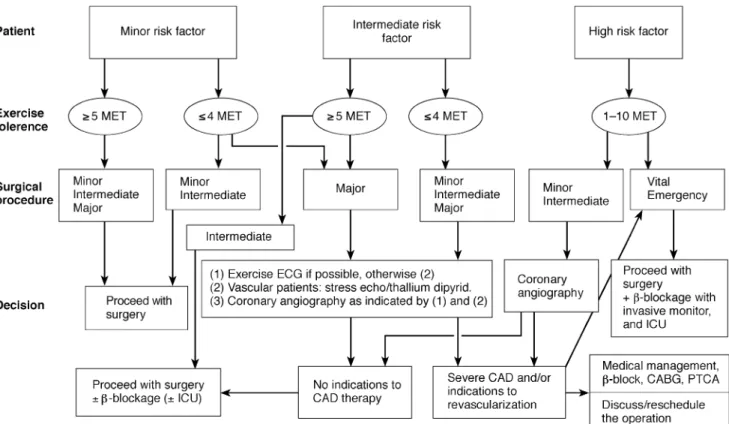
The American College of Cardiology/American Heart Association Guidelines for Perioperative Cardiovascular Evaluation for Noncardiac Surgery have promoted recom-mendations based on evidence and expert opinions, and summarized them in a decisional algorithm which has proven ef®cient and cost-effective when tested on clinical patients for vascular surgery.5 20 22The American College
of Physicians has adopted a position based on a meta-analysis of studies considered of strong, fair, or weak quality, and proposed an algorithm based on a modi®ed cardiac risk index;1 84vascular and non-vascular surgery are
separated. Other workers have published their own views on preoperative cardiac assessment, and have suggested useful paradigms.36 56 72 74 115
In our proposition (Fig. 1), the algorithm starts with a strati®cation of patients in three categories on the basis of clinical predictors (Table 1): low-risk (increased probability of coronary artery disease), intermediate-risk (stable coronary artery disease), and high-risk (unstable coronary syndrome). It proceeds through two evaluation steps: the exercise tolerance of the patient (cut-off point between 4 and 5 MET, Table 2) and the importance of the surgical procedure (minor, intermediate, or major, Table 3). Stress
tests are performed only in the intermediate-risk category. Coronary angiography is considered in patients with unstable coronary syndromes or with stress tests revealing large areas of myocardium at risk. High-risk patients should undergo only mandatory or emergency procedures; anaes-thesia should then be provided by an experienced anaesthetist using invasive monitoring and aggressive treatment of haemodynamic or ischaemic abnormalities. The choice of anaesthesia technique, like use of epidural analgesia, might be of signi®cance in cardiac morbidity and mortality, but this is outside the scope of this review.6 9
Conclusions
Several studies have addressed the problem of preoperative evaluation of patients known to have, or at risk of, coronary artery disease. Nevertheless, in the absence of large, randomized, multicentre studies with clear-cut results, we have to rely on evidence-based medicine and Bayesian analysis for choosing preoperative strategies. The proposed framework suggests a rather conservative approach, limit-ing stress testlimit-ing to intermediate-risk patients with suspicion of a myocardium at risk of ischaemia, and coronary angiography to situations where revascularization can improve long-term survival. A specialized and costly test is indicated only when the additional information provided has a positive impact on patient outcome.
Recent publications tend to show an increased risk of proceeding with non-cardiac surgery less than 3 months after coronary revascularization, which has been demon-strated to have no place in preventing the ischaemic complications of non-cardiac operations. Moreover, it is frequently impossible to wait to treat myocardial ischaemia when the patient requires a life-saving operation. In these situations, recent studies, although scarce, have demon-strated a marked bene®t of operating under the protection of beta1-adrenergic antagonism. As postoperative infarction
has a better correlation with peri- and postoperative ischaemic events than with preoperative ischaemia, it seems logical to be aggressive in the prevention and treatment of perioperative events. Finally, it appears that the best strategy is very institution-speci®c. Every institu-tion should construct its own guidelines, based on local performances and results.
To help clarifying the comparison between different publications with dissimilar methodologies, the references are annotated into levels of evidence according to the guidelines of evidence-based medicine. Level I of evidence contains large studies with prospective, randomized selec-tion of patients, blinding, and clear-cut results. Level II contains small, randomized trials with uncertain results. Level III comprises non-randomized studies with contem-poraneous controls. Level IV corresponds to non-random-ized studies with historical controls. Level V includes uncontrolled case series and expert opinions. Theoretical models, meta-analyses, and guidelines are not coded.
References
1 ACPÐAmerican College of Physicians. Guidelines for assessing and managing the perioperative risk from coronary artery disease associated with major noncardiac surgery. Ann Intern Med 1997; 127: 309±12
2 ADAÐAmerican Diabetes Association. Consensus development conference on the diagnosis of coronary heart disease in people with diabetes. Diabetes Care 1998; 21: 1551±9
3 Ashton CM, Petersen NJ, Wray NP, et al. The incidence of perioperative myocardial infarction in men undergoing noncardiac surgery. Ann Intern Med 1993; 118: 504±10 (Level III) 4 Baron JF, Mundler O, Bertrand M, et al. Dipyridamole-thallium scintigraphy and gated radionuclide angiography to assess cardiac risk before abdominal aortic surgery. N Engl J Med 1994; 330: 663±9 (Level III)
5 Bartels C, Bechtel M, Hossmann V, Horsch S. Cardiac risk strati®cation for high-risk vascular surgery. Circulation 1997; 95: 2473±5 (Level II)
6 Beattie Ws, Badner NH, Choi P. Epidural analgesia reduces postoperative myocardial infarction: a meta-analysis. Anesth Analg 2001; 93: 853±8
7 Bille-Brahe E, Engell HC, Bredgaard-Sorensen M. Acute postoperative digitalization of patients with arteriosclerotic heart disease after major surgery: randomized hemodynamic study and proposal for therapy. Acta Anaesthesiol Scand 1980; 24: 501±6 (Level II)
8 Birkmeyer JD, O'Connor FT, Quinton HB, et al. The effect of
peripheral vascular disease on in-hospital mortality rates with coronary bypass surgery. J Vasc Surg 1995; 21: 445±52 (Level III) 9 Bode RH, Lewis KP, Zarich SW, et al. Cardiac outcome after peripheral vascular surgery. Comparison of general and regional anesthesia. Anesthesiology 1996; 84: 3±13 (Level II)
10 Bodenmeier MM. Noncardiac surgery in the cardiac patient: what is the question? Ann Intern Med 1996; 124: 763±6 (Level V) 11 Boersma E, Poldermans D, Bax JJ, et al. Predictors of cardiac events after major vascular surgery. Role of clinical characteristics, dobutamine echocardiography, and b-blocker therapy. JAMA 2001; 285: 1865±73 (Level II)
12 Brown KA, Rowen M. Extent of jeopardized viable myocardium determined by myocardial perfusion imaging best predicts perioperative cardiac events in patients undergoing noncardiac surgery. J Am Coll Cardiol 1993; 21: 325±30 (Level III)
13 Chung F, Houston PL, Cheng DC, et al. Calcium channel blockade does not offer adequate protection from perioperative myocardial ischemia. Anesthesiology 1988; 69: 343±7 (Level II) 14 Cohen MC, Curran PJ, L'Italien GJ, Mittelman MA, Zarich SW.
Long-term prognostic value of preoperative dipyridamole-thallium imaging and clinical indexes in patients with diabetes mellitus undergoing peripheral vascular surgery. Am J Cardiol 1999; 83: 1038±42 (Level III)
15 Cutlip DE, Baim DS, Ho KKL, et al. Stent thrombosis in the modern era. A pooled analysis of multicenter coronary stent clinical trial. Circulation 2001; 103: 1967±71 (Level III)
16 Desprez RD, Friesinger GC, Red GW, et al. A simple accurate model for predicting myocardial infarction after general surgery (abstract). Circulation 1995; 92: S744(Level III)
17 Detre K, Yeh W, Kesley S, et al. Has improvement in PTCA intervention affected long-term prognosis? The NHLBI PTCA Registry experience. Circulation 1995; 91: 2868±75 (Level III) 18 Dodds TM, Stone JG, Coromillas J, Weinberger M, Levy DG.
Prophylactic nitroglycerine infusion during noncardiac surgery does not reduce perioperative ischemia. Anesth Analg 1993; 76: 705±13 (Level II)
19 Eagle KA, Coley CM, Newell JB, et al. Combining clinical and thallium data optimizes preoperative assessment of cardiac risk before vascular surgery. Ann Intern Med 1989; 110: 859±66 (Level III)
20 Eagle KA, Brundage BH, Chaitman BR, et al. Guidelines for perioperative cardiovascular evaluation for non-cardiac surgery. Report of the American College of Cardiology/American Heart Association Task Force on Practice Guidelines. Circulation 1996; 93: 1278±317
21 Eagle KA, Rihal CS, Mickel MC, Holmes DR, Foster ED, Gersh BJ. Cardiac risk of non-cardiac surgery: in¯uence of coronary disease and type of surgery in 3,368 operations. Circulation 1997; 96: 1882±7 (Level III)
22 Eagle KA, Berger PB, Calkins H, et al. ACC/AHA guideline update for perioperative cardiovascular evaluation for noncardiac surgeryÐexecutive summary. A report of the American College of Cardiology/American Heart Association Task Force on practice guidelines (Committee to update 1996 guidelines on perioperative cardiovascular evaluation for noncardiac surgery). Circulation 2002; 105: 1257±67
23 Eichelberger JP, Schwarz KQ, Black ER, Green RM, Ouriel K. Predictive value of dobutamine echocardiography just before noncardiac vascular surgery. Am J Cardiol 1993; 72: 602±7 (Level III)
24 Eichhorn E, Domanski M, Krause-Steinrauf H, et al. The Beta-blocker Evaluation of Survival Trial (BEST). A trial of the beta-blocker bucindolol in patients with advanced chronic heart failure. N Engl J Med 2001; 344: 1659±67 (Level I)
25 Ellis JE, Pedlow S, Laff SP, et al. Premedication with oral and transdermal clonidine provides safe and ef®cacious postoperative sympatholysis. Anesth Analg 1994; 79: 1133±40 (Level III)
26 Ellis SG, Hertzer NR, Young JR, Brener S. Angiographic correlates of cardiac death and myocardial infarction complicating major non-thoracic vascular surgery. Am J Cardiol 1996; 77: 1126±8 (Level III)
27 Elmore JR, Hallett JW, Gibbons RJ, et al. Myocardial revascularization before abdominal aortic aneurysmorrhaphy: effect of coronary angioplasty. Mayo Clin Proc 1993; 68: 637±41 (Level III)
28 Fehr DM, Chambers CE, Thiele B, Mangano D, Kingsley CP. Case 4±1995. Perioperative myocardial infarction in a patient undergoing abdominal aortic aneuvrysm resection: perioperative risk assessment. J Cardiothorac Vasc Anesth 1995; 9: 452±9 (Level V)
29 Ferrara N, Longobardi G, Nicolino A, et al. Effect of beta-adrenoreceptor blockade on dipyridamole-induced myocardial asynergies in coronary artery disease. Am J Cardiol 1992; 70: 724±7 (Level I)
30 Fleisher LA, Rosenbaum SH, Nelson AH, Barash PG. The predictive value of preoperative silent ischemia for postoperative ischemic cardiac events in vascular and nonvascular surgery patients. Am Heart J 1991; 122: 980±6 (Level II)
31 Fleisher LA, Skolnick ED, Holroyd KJ, Lehman HP. Coronary artery revascularization before abdominal aortic aneurysm surgery: a decision analytic approach. Anesth Analg 1994; 79: 661±9
32 Fleisher LA, Rosenbaum SH, Nelson AH, Jain D, Wackers FJ, Zaret BL. Preoperative dipyridamole-thallium imaging and ambulatory electrocardiographic monitoring as a predictor of perioperative cardiac events and long-term outcome. Anesthesiology 1995; 83: 906±17 (Level III)
33 Fleisher LA, Eagle KA. Screening for cardiac disease in patients having noncardiac surgery. Ann Intern Med 1996; 124: 762±72 (Level V)
34 Fleisher LA. Con: b-blockers should not be used in all patients undergoing vascular surgery. J Cardiothorac Vasc Anesth 1999; 13: 496±7 (Level V)
35 Fleisher LA, Eagle KA, Schaffer T, Anderson GF. Perioperative and long-term mortality rates after major vascular surgery: The relationship to preoperative testing in the Medicare population. Anesth Analg 1999; 89: 849±55 (Level III)
36 Fleisher LA, Eagle KA. Lowering cardiac risk in noncardiac surgery. N Engl J Med 2001; 345: 1677±82 (Level V)
37 Foster ED, Davis KB, Carpentier JA, Abele S, Fray D. Risk of noncardiac operation in patients with de®ned coronary disease: The Coronary Artery Surgery Study (CASS) registry experience. Ann Thorac Surg 1986; 41: 42±50 (Level III)
38 Frye RL, Alderman E, Bourassa M, Brouks MM, Califf R, Chaitman B. In¯uence of diabetes on 5-year mortality and morbidity in a randomized trial comparing CABG and PTCA in patients with multivessel disease: the Bypass Angioplasty Revascularization Investigation (BARI). Circulation 1997; 96: 1761±9 (Level I)
39 Gauss A, RoÈhm HJ, SchaÈuffelen A, et al. Electro-cardiographic exercise stress testing for cardiac risk assessment in patients undergoing noncardiac surgery. Anesthesiology 2001; 94: 38±46 (Level II)
40 Gersh BJ, Rihal CS, Rooke TW, Ballard DJ. Evaluation and management of patients with peripheral vascular and coronary disease. J Am Coll Cardiol 1991; 18: 203±14 (Level V)
41 Gianrossi R, Detrano R, Mulvihill D, et al. Exercise-induced
ST-depression in the diagnosis of coronary artery disease. A meta-analysis. Circulation 1989; 80: 87±98
42 Girish M, Trayner E, Dammann O, Pinto-Plata V, Celli B. Symptom-limited stair climbing as a predictor of postoperative cardiopulmonary complications after high-risk surgery. Chest 2001; 120: 1147±51 (Level III)
43 Giroud D, Li JM, Urban P, Meier B, Rutishauser W. Relation of the site of acute myocardial infarction to the most severe coronary arterial stenosis at prior angiography. Am J Cardiol 1992; 69: 729±32 (Level III)
44 Glance LG. Selective preoperative cardiac screening improves ®ve-year survival in patients undergoing major vascular surgery: a cost-effectiveness analysis. J Cardiothor Vasc Anesth 1999; 13: 265±71
45 Gottlieb A, Banoub M, Sprung J, Levy PV, Beven M, Masha EJ. Perioperative cardiovascular morbidity in patients with coronary artery disease undergoing vascular surgery after percutaneous transluminal coronary angioplasty. J Cardiothor Vasc Anesth 1998; 12: 501±6 (Level III)
46 Gottlieb SS, McCarter RJ, Vogel RA. Effect of beta-blockade on mortality among high-risk and low-risk patients after myocardial infarction. N Engl J Med 1998; 339: 489±97 (Level III)
47 Grundy SM, Benjamin IJ, Burke GL, et al. Diabetes and cardiovascular disease. A statement for healthcare professionals from the American Heart Association. Circulation 1999; 100: 1134±46 (Level V)
48 Haffner SM, Lehto S, ReÈnnemaa T, PyoÈraÈlaÈ, Laakso M. Mortality from coronary heart disease in subjects with type 2 diabetes and in nondiabetic subjects with and without prior myocardial infarction. N Engl J Med 1998; 339: 229±34 (Level III)
49 Halm EA, Browner WS, Tubau JF, Tateo IM, Mangano DT. Echocardiogaphy for assessing cardiac risk in patients having noncardiac surgery. Ann Intern Med 1996; 125: 433±41 (Level III) 50 Hartz AJ, Kuhn EM, Pryor DB, Krakauer H, Young M, Heudebert G, Rimm AA. Mortality after coronary angioplasty and coronary artery bypass surgery (the National Medicare experience). Am J Cardiol 1992; 70: 179±85 (Level III)
51 Hassan SA, Hlatky MA, Boothroyd DB, et al. Outcomes of noncardiac surgery after coronary bypass surgery or coronary angioplasty in the Bypass Angioplasty Revascularization Investigation (BARI). Am J Med 2001; 110: 260±6 (Level I) 52 Hertzer NR, Beven EG, Young JR, et al. Coronary artery disease
in peripheral vascular patients: a classi®cation of 1000 coronary angiograms and results of surgical management. Ann Surg 1984; 199: 223±33 (Level IV)
53 Hertzer NR. Basic data concerning coronary disease in peripheral vascular patients. Ann Vasc Surg 1987; 1: 616±20 (Level IV)
54 Hlatky P, Boineau RE, Higginbotham MB, et al. A brief self-administered questionnaire to determine functional capacity (the Duke Activity Status Index). Am J Cardiol 1989; 64: 651±4 (Level V)
55 Hohner P, Nancarrow C, Backman C, et al. Anesthesia for abdominal vascular surgery in patients with coronary artery disease. Part I: iso¯urane produces dose-dependent coronary vasodilatation. Acta Anaesthesiol Scand 1994; 38: 780±92 (Level II) 56 Hollenberg SM. Preoperative cardiac risk assessment. Chest
1999; 115: 51S±7S
57 Howell SJ, Sear YM, Yeates D, Goldacre M, Sear JW, FoeÈx P. Risk factors for cardiovascular death after elective surgery under general anaesthesia. Br J Anaesth 1998; 80: 14±9 (Level IV) 58 Huber KC, Evans MA, Bresnahan JF, Gibbons RJ, Holmes DR.
coronary artery disease successfully treated preoperatively with coronary angioplasty. Mayo Clin Proc 1992; 67: 15±21 (Level III) 59 Kaaja R, Sell H, Erkola O, Harjula A. Predictive value of manual ECG-monitored exercise test before abdominal aortic or peripheral vascular surgery. Angiology 1993; 44: 11±5 (Level II) 60 Kaluza GL, Joseph J, Lee RJ, Raizner ME, Raizner AE.
Catastrophic outcomes of noncardiac surgery soon after coronary stenting. J Am Coll Cardiol 2000; 35: 1288±94 (Level IV) 61 Khuri SF, Daley J, Henderson W, et al. The National Veterans Administration Surgical Risk Study: risk adjustment for the comparative assessment of the quality of surgical care. J Am Coll Surg 1995; 180: 519±31 (Level III)
62 Landesberg G, Einav S, Christopherson R, et al. Perioperative ischemia and cardiac complications in major vascular surgery: importance of the preoperative twelve-lead electrocardiogram. J Vasc Surg 1997; 26: 570±8 (Level III)
63 Lane RT, Sawada SG, Segar DS, et al. Dobutamine stress echocardiography for assessment of cardiac risk before noncardiac surgery. Am J Cardiol 1991; 68: 976±7 (Level IV) 64 Lee TH. Reducing cardiac risk in noncadiac surgery. N Engl J Med
1999; 341: 1838±40 (Level V)
65 Lee TH, Marcantonio ER, Mangione CM, et al. Derivation and prospective validation of a simple index for prediction of cardiac risk of major noncardiac surgery. Circulation 1999; 100: 1043±9 (Level I)
66 L'Italien GJ, Paul SD, Hendel RC, et al. Development and validation of a Bayesian model for perioperative cardiac risk assessment in a cohort of 1,081 vascular surgical candidates. J Am Coll Cardiol 1996; 27: 779±86 (Level III)
67 Mangano DT, Browner WS, Hollenberg M, London MJ, Tubau JF, Tateo IM. Association of perioperative myocardial ischemia with cardiac morbidity and mortality in men undergoing noncardiac surgery. The Study of Perioperative Ischemia Research Group. N Engl J Med 1990; 323: 1781±8 (Level III)
68 Mangano DT, London MJ, Tubau JF, et al. Dipyridamole-thallium-201 scintigraphy as a preoperative screening test. A reexamination of its predictive potential. Circulation 1991; 84: 493±502 (Level III)
69 Mangano DT, Wong MG, London MJ, Tubau JF, Rapp JA. Perioperative myocardial ischemia in patients undergoing noncardiac surgeryÐII: incidence and severity during the 1st week after surgery. The Study of Perioperative Ischemia Research Group. J Am Coll Cardiol 1991; 17: 851±7 (Level III) 70 Mangano DT, Goldman L. Preoperative assessment of patients
with known or suspected coronary disease. N Engl J Med 1995; 333: 1750±6 (Level V)
71 Mangano DT, Layug EL, Wallace A, Tateo IM. Effects of atenolol on mortality and cardiovascular morbidity after noncardiac surgery. The multicenter study of Perioperative Ischemia Research Group. N Engl J Med 1996; 335: 1713±20 (Level II) 72 Mangano DT. Assessment of the patient with cardiac disease. An
anesthesiologist's paradigm. Anesthesiology 1999; 91: 1521±6 (Level V)
73 Mantha S, Roizen MF, Barnard J, Thisted RA, Ellis JE, Foss J. Relative effectiveness of four preoperative tests for predictive adverse cardiac outcome after vascular surgery. Anesth Analg 1994; 79: 422±33
74 Mantha S. Rational cardiac risk strati®cation before peripheral vascular surgery: application of evidence-based medicine and Bayesian analysis. Semin Cardiothorac Vasc Anesth 2000; 4: 198±212 (Level V)
75 Mason JJ, Owens DK, Harris RA, Cooke JP, Hlatky MA. The role of coronary angiography and coronary revascularization before noncardiac surgery. JAMA 1995; 273: 1919±25
76 Mathes DD. The preoperative evaluation of the patient with cardiac risk factors for noncardiac surgery: which patients need further cardiac risk strati®cation tests? Semin Cardiothorac Vasc Anesth 2001; 5: 154±65 (Level V)
77 McCann RL. Wolfe WG. Resection of abdominal aortic aneuvrysm in patients with low ejection fraction. J Vasc Surg 1989; 10: 240±4 (Level V)
78 McPhail N, Calvin JE, Shariatmadar A, Barber GG, Scobie TK. The use of preoperative exercise testing to predict cardiac complications after arterial reconstruction. J Vasc Surg 1988; 7: 60±8 (Level III)
79 Metzler H. Preoperative interventional cardiology in noncardiac surgery: bene®t or risk? Curr Opin Anaesthesiol 2001; 14: 1±2 (Level V)
80 Mizuno K, Miyamoto A, Satomura K, et al. Angioscopic coronary macromorphology in patients with acute coronary disorders. Lancet 1991; 337: 809±12 (Level III)
81 Morris CK, Ueshima K, Kawaguchi T, Hideg A, Froelicher VF. The prognostic value of exercise capacity: a review of the literature. Am Heart J 1991; 122: 1423±31
82 Olsen PS, Schroeder T, Agerskov K, et al. Surgery for abdominal aortic aneuvrysms. A survey of 656 patients. J Cardiovasc Surg 1991; 32: 636±42 (Level IV)
83 Ouriel K, Green RM, Deweese JA, Varon ME. Outpatient echocardiography as a predictor of perioperative cardiac morbidity after peripheral vascular surgical procedures. J Vasc Surg 1995; 22: 671±9 (Level IV)
84 Palda VA, Detsky AS. Perioperative assessment and management of risk from coronary artery disease. Ann Intern Med 1997; 127: 313±28
85 Paul SD, L'Italien GJ, Hendel RC, Leppo JA, Eagle KA. In¯uence of prior heart disease on morbidity and mortality after vascular surgery: role of coronary artery bypass grafting (abstract). J Am Coll Cardiol 1994; 24: 952±133, 380A (Level III)
86 Paul SD, Eagle KA, Kuntz KM, Young JR, Hertzer NR. Concordance of preoperative clinical risk with angiographic severity of coronary artery disease in patients undergoing vascular surgery. Circulation 1996; 94: 1561±6 (Level III) 87 Poldermans D, Fioretti PM, Forster T, et al. Dobutamine stress
echocardiography for assessment of perioperative cardiac risk in patients undergoing major vascular surgery. Circulation 1993; 87: 1506±12 (Level III)
88 Poldermans D, Arnese M, Fioretti P, et al. Improved cardiac risk strati®cation in major vascular surgery with dobutamine-atropine stress echocardiography. J Am Coll Cardiol 1995; 26: 648±53 (Level III)
89 Poldermans D, Arnese M, Fioretti PM, et al. Sustained prognostic value of dobutamine stress echocardiography for late cardiac events after major noncardiac vascular surgery. Circulation 1997; 95: 53±8 (Level III)
90 Poldermans D, Boersma E, Bax JJ, et al. The effect of bisoprolol on perioperative mortality and myocardial infarction in high-risk patients undergoing vascular surgery. N Engl J Med 1999; 341: 1789±94 (Level II)
91 Poldermans D, Boersma E, Bax JJ, et al. Bisoprolol reduces cardiac death and myocardial infarction in high-risk patients as long as 2 years after successful major vascular surgery. Eur Heart J 2001; 22: 1353±8 (Level II)
92 Posner KL, van Norman GA, Chan V. Adverse cardiac outcome after noncardiac surgery in patients with prior percutaneous transluminal coronary angioplasty. Anesth Analg 1999; 89: 553±60 (Level IV)
93 Priebe HJ. The aged cardiovascular risk patient. Br J Anaesth 2000; 85: 763±78 (Level V)
94 Quentin L, Bouilloc X, Butin E, et al. Clonidine for major vascular surgery in hypertensive patients: a double-blind, controlled, randomized trial. Anesth Analg 1996; 83: 687±95 (Level I) 95 Raby KE, Goldman L, Creager MA, et al. Correlation between
preoperative ischemia and major cardiac events after peripheral vascular surgery. N Engl J Med 1989; 321: 1296±300 (Level III) 96 Raby KE, Barry J, Creager MA, Cook EF, Weisberg MC,
Goldman L. Detection and signi®cance of intraoperative and postoperative myocardial ischemia in peripheral vascular surgery. JAMA 1992; 268: 222±7 (Level III)
97 Rao TL, Jacobs KH, El-Etr AA. Reinfarction following anesthesia in patients with myocardial infarction. Anesthesiology 1983; 59: 499±505 (Level IV)
98 Rihal CS, Eagle KA, Mickel MC, Foster ED, Sopko G, Gersh BJ. Surgical therapy for coronary artery disease among patients with combined coronary artery and peripheral vascular disease. Circulation 1995; 91: 46±53 (Level IV)
99 Rihal CS, Sutton-Tyrell K, Schaff HV, et al. Increased incidence of complications among patients with peripheral vascular disease following coronary bypass grafting and angioplasty. Circulation 1997; 96: 467±8 (Level III)
100 Robotham JL, Takata M, Berman M. Ejection fraction revisited. Anesthesiology 1991; 74: 172±83
101 Roizen MF. Are you as young as you could be? Anesth Analg 2000; 70: 58±64 (Suppl) (Level V)
102 Rossi E, Citterio F, Vescio MF, et al. Risk strati®cation of patients undergoing peripheral vascular revascularization by combined resting and dipyridamole echocardiography. Am J Cardiol 1998; 82: 306±10 (Level III)
103 Ruiz J, Keller U, Buillard C. PreÂvention et deÂpistage de la maladie coronarienne chez le patient diabeÂtique. Bull MeÂd Suisses 2000; 81: 2596±600
104 Ryan TJ, Bauman WB, Kennedy JW, et al. ACC/AHA Task Force report: guidelines for percutaneous transluminal coronary angioplasty. A report of the ACC/AHA Task Force on assessment of diagnostic and therapeutic cardiovascular procedures. J Am Coll Cardiol 1993; 22: 2033±54
105 Ryan TJ, Antman EM, Brooks NH. 1999 update: ACC/AHA guidelines for the management of patients with acute myocardial infarction: executive summary and recommendations. Circulation 1999; 100: 1016±30
106 Seeger JM, Rosenthal GR, Self SB, Flynn TC, Limacher MC, Harward TRS. Does routine stress-thallium cardiac scanning reduce postoperative cardiac complications? Ann Surg 1994; 219: 654±63 (Level III)
107 Sessler DI. Complications and treatment of mild hypothermia. Anesthesiology 2001; 95: 531±43 (Level V)
108 Shaw LJ, Eagle KA, Gersh BJ, Miller DD. Meta-analysis of intravenous dipyridamole-thallium-201 imaging (1985±1994) and dobutamine stress echocardiography (1991±1994) for risk strati®cation before vascular surgery. J Am Coll Cardiol 1996; 27: 787±98
109 Steen PA, Tinker JH, Tarhan S. Myocardial reinfarction after anaesthesia and surgery. JAMA 1978; 239: 2566±70 (Level IV) 110 Steinberg JB, Kresowik TF, Behrendt DM. Prophylactic
myocardial revascularization based on dipyridamole-thallium scanning before vascular surgery. Cardiovasc Surg 1993; 1: 552±7 (Level IV)
111 Suggs WD, Smith RB, Weintraub WS, Dodson TF, Salam AA. Selective screening for coronary artery disease in patients
undergoing elective repair of abdominal aortic aneuvrysm. J Vasc Surg 1993; 18: 349±57 (Level III)
112 Sutton T, Rock P. Pro: b-blockers should be used in all patients undergoing vascular surgery. J Cardiothorac Vasc Anesth 1999; 13: 490±5 (Level V)
113 Takase B, Younis LT, Byers SL, et al. Comparative prognostic value of clinical risk indexes, resting two-dimensional echocardiography, and dipyridamole stress thallium-201 myocardial imaging for perioperative cardiac events in major nonvascular surgery patients. Am Heart J 1993; 126: 1099±106 (Level III)
114 Tarhan S, Mof®tt SA, Taylor WF. Myocardial infarction after general anesthesia. JAMA 1972; 220: 1451±4 (Level IV) 115 Tuman KJ. Perioperative cardiovascular risk: assessment and
management. Anesth Analg 2001; 92: S106±12 (Level V) 116 VanBelle E, Lablanche JM, Bauters C. Coronary angioscopic
®ndings in the infarcted-related vessel within 1 month of acute myocardial infarction. Natural history and the effect of thrombolysis. Circulation 1998; 97: 26±33 (Level IV)
117 VanRoyen N, Jaffe CC, Krumholz HM, et al. Comparison and reproductibility of visual echocardiographic and quantitative radionuclide left ventricular ejection fractions. Am J Cardiol 1996; 77: 843±50 (Level II)
118 Vanzetto G, Machecourt J, Blendea D, et al. Additive value of thallium single-photon emission computed tomography myocardial imaging for prediction of perioperative events in clinically selected high cardiac risk patients having abdominal aortic surgery. Am J Cardiol 1996; 77: 143±8 (Level III) 119 Vicenzi MN, Ribitsch E, Luha O, Klein W, Metzler H. Coronary
artery stenting before noncardiac surgery: more threat than safety? Anesthesiology 2001; 94: 367±8 (Level V)
120 Wallace A, Layug B, Tateo I, et al. Prophylactic atenolol reduces postoperative myocardial ischemia. Anesthesiology 1998; 88: 7±17 (Level II)
121 Warltier DC. b-Adrenergic blocking drugs. Incredibly useful, incredibly underutilized. Anesthesiology 1998; 88: 2±5 (Level V) 122 Weiner D, Ryan TJ, McCabe CH, Chaitman BR, Shef®eld LT,
Fisher LD. Prognostic importance of a clinical pro®le and exercise test in medically treated patients with coronary artery disease. J Am Coll Cardiol 1984; 3: 772±9 (Level III)
123 Weissman NJ, Levangie MW, Guerrero JL, Weyman AE, Picard MH. Effect of b-blockade on dobutamine stress echocardiography. Am Heart J 1996; 131: 698±703 (Level II) 124 Yancy CW, Fowler MB, Colucci WS, et al. Race and the
response to adrenergic blockade with carvedilol in patients with chronic heart failure. N Engl J Med 2001; 344: 1358±65 (Level II) 125 Younis L, Stratmann H, Takase B, Byers S, Chaitman BR, Miller DD. Perioperative clinical assessment and dipyridamole thallium-201 scintigraphy for prediction and prevention of cardiac events in patients having noncardiovascular surgery and known or suspected coronary artery disease. Am J Cardiol 1994; 74: 311±7 (Level III)
126 Zaugg M, Tagliente T, Luchinetti E, et al. Bene®cial effects of b-adrenergic blockade in elderly patients undergoing noncardiac surgery. Anesthesiology 1999; 91: 1674±86 (Level II)
127 Zaugg M, Schaub MC, Pasch T, Spahn DR. Modulation of b-adrenergic receptor subtype activities in perioperative medecine: Mechanisms and sites of action. Br J Anaesth 2002; 88: 101±23