HAL Id: hal-01927447
https://hal.laas.fr/hal-01927447
Submitted on 29 Nov 2018
HAL is a multi-disciplinary open access
archive for the deposit and dissemination of
sci-entific research documents, whether they are
pub-lished or not. The documents may come from
teaching and research institutions in France or
abroad, or from public or private research centers.
L’archive ouverte pluridisciplinaire HAL, est
destinée au dépôt et à la diffusion de documents
scientifiques de niveau recherche, publiés ou non,
émanant des établissements d’enseignement et de
recherche français ou étrangers, des laboratoires
publics ou privés.
Umbrella : a deployable SDN-enabled IXP Switching
Fabric
Marc Bruyère, Eder Fernandes, Ignacio Castro, Steve Uhlig, Rémy Lapeyrade,
Philippe Owezarski, Andrew Moore, Gianni Antichi
To cite this version:
Marc Bruyère, Eder Fernandes, Ignacio Castro, Steve Uhlig, Rémy Lapeyrade, et al.. Umbrella :
a deployable SDN-enabled IXP Switching Fabric. ACM symposium on SDN Research, Mar 2018,
Los-Angeles, United States. 2p. �hal-01927447�
Umbrella : a deployable SDN-enabled IXP Switching Fabric
Marc Bruyere
The University of Tokyo
Remy Lapeyrade
Philippe Owezarski
LAAS CNRSEder L. Fernandes
Ignacio Castro
Steve Uhlig
Queen Mary University of London
Andrew W. Moore
Gianni Antichi
University of Cambridge
ABSTRACT
Software Defined internet eXchange Points (SDXs) are a promising solution to the long-standing limitations and problems of interdo-main routing. While proposed SDX architectures have improved the scalability of the control plane, these solutions have ignored the underlying fabric upon which they should be deployed. This work makes the case for a new fabric architecture that proposes stronger control and data plane separation.
KEYWORDS
Software Defined Networking, OpenFlow, Internet eXchange Point
1
INTRODUCTION
Internet eXchange Points (IXPs) are a central element of the Inter-net ecosystem: IXPs can carry huge traffic volumes and intercon-nect a multitude of networks of different types [1]. The fundamen-tal service provided by IXPs is a Layer 2 neutral facility where het-erogeneous networks exchange IP traffic. While IXPs are the ideal vehicle to extend the benefits promised by Software Defined Net-working (SDN) to the interdomain level [4], reliability and scalabil-ity are essential aspects of an IXP that cannot be compromised by the introduction of SDN. In particular, the impact of control chan-nel disruptions or outages can cause severe disturbances, poten-tially affecting hundreds of networks and huge traffic volumes [2]. Control plane failures in large scale deployed SDN networks out-weigh largely data or management combined together [3].
In this paper we make the case for a stronger control and data plane separation and propose a novel approach, namely Umbrella, to IXP fabric management that can be deployed in any IXP topol-ogy to reduce the risks of a fabric excessively dependent on the control plane. Umbrella leverages SDN programmability to tackle part of the control traffic, removing the actual mac learning mech-anism in legacy IXPs networks. For this, the broadcasted Address Resolution Protocol (ARP) traffic is directly programmed within the data plane. Secondly, we use a Layer 2 encode path to mini-mize the resources, management cost and extend scalability. This approach greatly simplifies the management of the fabric: the only role of the controller is supervising the network, leveraging its global knowledge.
The main contributions of this paper are:
• We make the case for a stronger control and data plane sep-aration in SDN IXPs.
• We introduce the Umbrella architecture and show how it leverages SDN programmability within the data plane.
2
THE CASE FOR STRONGER CONTROL AND
DATA PLANE SEPARATION
Previous works have shown how OpenFlow (OF) [6] could be de-ployed at the exchange [4] using an IXP fabric with a central con-troller for all the peering routers at the IXP. In such architecture, the SDN controller would be co-located with the route server (RS) to ensure that the SDN and BGP control planes can talk to each other with a minimal delay. Despite advantages such as richer poli-cies, one challenge remains: data plane issues may affect control plane messages, leading to a slow or unresponsive control plane, further aggravating the effect on the data plane. The critical prob-lem resides in the centralized ARP-proxy: delays in the control channel might lead to all the connection oriented mechanisms (i.e., BGP, TCP) failing. For example, if the ARP messages of the peer-ing router A get delayed inside the IXP fabric to reach the SDN controller: all the BGP sessions between the router A and its peers would suffer, forcing (in the worst case scenario) establishing new connections. 0 100 200 300 400 500 600 700 800 900 25 50 75 100 150 200
Average Service interruption (ms)
Added Control Path Delay (ms) BGP
Data plane
Figure 1: The dependency between control and data plane.
We show in Fig. 1 the disruption caused by ARP delays on the data plane or BGP sessions. We emulated the above SDN scenario of a central controller co-located with the RS on Mininext, a Mininet extension to build complex networks. We instantiated virtual con-tainers acting as peering routers: one for the RS and two more working as client hosts directly connected to one peering router each. We represented the IXP as a single open vSwitch coupled with a Ryu controller acting also as an ARP-proxy, as in [4]. Fig. 1 shows that, even a small delay of a few tens of milliseconds for ARP messages may trigger much larger disruptions on the data plane or BGP. Given the large volumes of traffic IXPs’ critical role, such disruptions are not acceptable [7].
3
A NEW SDN FABRIC FOR IXPS
IXPs apply strict rules [5] to limit the side effects of a layer-2 shared broadcast domain, e.g., the MAC address of the router with which the member connects to the peering fabric must be known in ad-vance. Only then the IXP will allocate an ethernet port on the edge switch and configure a MAC filtering Access Control List (ACL) with that MAC address. The location of all the member’s routers is thus known to the IXP. For this reason, Umbrella elimi-nates the need of location discovery mechanisms based on broad-cast packets, i.e., ARP request, IPv6 neighbor discovery, making unnecessary the active ARP-proxy daemon proposed in previous SDN-enabled IXP solutions. Umbrella makes on-the-fly translation of broadcast packets into unicast by exploiting the OF ability to rewrite the destination MAC address of a frame matching a rule.
We propose a label-oriented forwarding mechanism to reduce the number of rules inside the core of the IXP fabric. Umbrella edge switches explicitly write the per-hop port destinations into the destination MAC field of the packet. The first byte of the MAC address represents the output port to be used by the core switch.
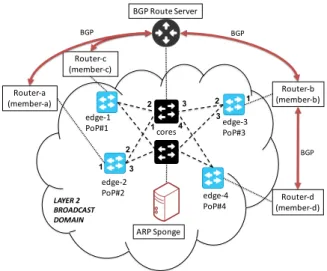
edge-4 PoP#4 edge-3 PoP#3 cores Router-d (member-d) Router-b (member-b) Router-c (member-c) edge-1 PoP#1 edge-2 PoP#2 ARP Sponge BGP Route Server BGP Router-a (member-a) BGP BGP LAYER 2 BROADCAST DOMAIN 1 2 3 1 2 3 4 2 3 1
Figure 2: Typical topology of a medium to large IXP.
We now explain how Umbrella using the IXP topology in Fig. 2. The path to connect router-a to router-b through core-a goes through port numbers 2, 3 and 3. When the router-a send an ARP request (i.e., broadcast message), the switch edge-2 receives the frame, rewrites the destination MAC address with the correspond-ing ports path, 03:01:00:00:00:00, and forwards it to the core switch. Once the frame reaches the core, it is redirected to output port 3, and then to switch edge-3 (i.e., the forwarding in the core is based on the most significant byte). Finally, edge-3, before for-warding the frame through the output port indicated in the second byte of the MAC address, rewrites that field with the real MAC ad-dress of router-b.
When the source and destination are directly connected to the same edge switch, no encoding is needed, and the the edge switch directly replaces the broadcast destination address with the target MAC destination address. In an IPv6 scenario, the OF match pat-tern indicated in the edge switch needs to be on the IPv6 ND target
field of the incoming ICMPv6 Neighbor Solicitation packet. The matching table on the edge switch should maintain an association between IPv6 addresses and their location, as in the IPv4 case.
3.1
A label switching approach
Umbrella’s forwarding mechanism allows reusing legacy switches in the core, limiting the burden (and costs) of upgrading the hard-ware. A core switch only needs to forward packets based on simple access filtering rules, whereas the edge switches need OF-like capa-bilities to rewrite the layer-2 destination field. While this approach is directly applicable to single-core IXP fabrics, it is not applica-ble to multiple-hops fabrics. With a single hop, the core switch would expect the output port to be encoded in the most significant byte of the destination MAC address. In the multi-hop case, since a packet can traverse multiple core switches, a new encoding scheme is needed to distinguish the output ports at different core switches. This is a fairly common case in hypercube-like topologies, such as the ones adopted by LINX or MSK-IX.
Umbrella leverages source routing to allow a correct packet for-warding in such topologies. An ordered list of output ports is en-coded by the fabric input edge in the destination MAC address as a stack of labels. Each core node then processes the frame according to the value on the top of the stack and pops it before forwarding the frame. With this configuration each switch only needs to look at the most significant byte of the address, regardless of where is it located in the path toward the destination. Popping out from the MAC destination address, the last used label requires header rewriting capabilities, making this solution feasible only for OF-enabled core switches. In particular, every core switch must have 2 action tables: forwarding and copy-field.
4
CONCLUSION
Umbrella is a solution that enhances IXP reliability, manageability
and scalability. By handling the control traffic directly within the data plane, our approach reduces failures or disruptions and illus-trates the advantage of a sharper separation between control and data plane for IXP management. We see Umbrella as a first step to-wards SDN architectures less dependent on the control plane, sup-porting the controller in its role of an intelligent supervisor, rather than as an active and dangerously critical decision point.
REFERENCES
[1] Bernhard Ager, Nikolaos Chatzis, Anja Feldmann, Nadi Sarrar, Steve Uhlig, and Walter Willinger. 2012. Anatomy of a Large European IXP. In SIGCOMM. ACM. [2] Vasileios Giotsas, Christoph Dietzel, Georgios Smaragdakis, Anja Feldmann,
Arthur Berger, and Emile Aben. 2017. Detecting Peering Infrastructure Outages in the Wild. In Proceedings of the Conference of the ACM Special Interest Group on Data Communication. ACM, 446–459.
[3] Ramesh Govindan, Ina Minei, Mahesh Kallahalla, Bikash Koley, and Amin Vahdat. 2016. Evolve or Die: High-Availability Design Principles Drawn from Googles Network Infrastructure. In SIGCOMM. ACM.
[4] A. Gupta, L. Vanbever, M. Hahbaz, S.P. Donovan, B. Schlinker, N. Feamster, J. Rex-ford, S. Shenker, R. Clark, and E. Katz-Bassett. 2014. SDX: A Software Defined Internet Exchange. In SIGCOMM. ACM.
[5] M. Hughes, M. Pels, and H. Michl. 2015. Internet Exchange Point Wishlist. https: //www.euro-ix.net/ixps/ixp-wishlist/. (2015). [Online; accessed Feb. 2018]. [6] Nick McKeown, Tom Anderson, Hari Balakrishnan, Guru Parulkar, Larry
Peter-son, Jennifer Rexford, Scott Shenker, and Jonathan Turner. 2008. OpenFlow: En-abling Innovation in Campus Networks. CCR 38, 2 (2008).
[7] Hung D. Vu and Jason But. 2015. How RTT Between the Control and Data Plane on a SDN Network Impacts on the Perceived Performance. In ITNAC. IEEE. 2