HAL Id: hal-00160807
https://hal.archives-ouvertes.fr/hal-00160807
Submitted on 8 Jul 2007
HAL is a multi-disciplinary open access
archive for the deposit and dissemination of
sci-entific research documents, whether they are
pub-lished or not. The documents may come from
teaching and research institutions in France or
abroad, or from public or private research centers.
L’archive ouverte pluridisciplinaire HAL, est
destinée au dépôt et à la diffusion de documents
scientifiques de niveau recherche, publiés ou non,
émanant des établissements d’enseignement et de
recherche français ou étrangers, des laboratoires
publics ou privés.
Towards a Formal Verification of Process Model’s
Properties - SimplePDL and TOCL Case Study
Benoit Combemale, Pierre-Loïc Garoche, Xavier Crégut, Xavier Thirioux,
François Vernadat
To cite this version:
Benoit Combemale, Pierre-Loïc Garoche, Xavier Crégut, Xavier Thirioux, François Vernadat.
To-wards a Formal Verification of Process Model’s Properties - SimplePDL and TOCL Case Study. 9th
International Conference on Enterprise Information Systems, Jun 2007, Funchal, Madeira, Portugal.
pp.80-89. �hal-00160807�
Towards a Formal Verification of Process Model’s Properties
SimplePDL and TOCL Case Study
Benoˆıt Combemale, Pierre-Lo¨ıc Garoche, Xavier Cr´egut, Xavier Thirioux
Institut de Recherche en Informatique de Toulouse (CNRS UMR 5505), Toulouse, France { first name . last name @ enseeiht.fr }
Francois Vernadat
Laboratoire d’Analyse et d’Architecture des Systemes (CNRS), Toulouse, France { last name @ laas.fr }
Keywords: Metamodelling, Properties Validation, Verification, Temporal OCL, Process Model, Petri Nets, LTL, Models Semantics, Model Transformation
Abstract: More and more, models, through Domain Specific Languages (DSL), tend to be the solution to define complex systems. Expressing properties specific to these metamodels and checking them appear as an urgent need. Until now, the only complete industrial solutions that are available consider structural properties such as the ones that could be expressed in OCL. There are although some attempts on behavioural properties for DSL. This paper addresses a method to specify and then check temporal properties over models. The case study is
SIMPLEPDL, a process metamodel. We propose a way to use a temporal extension of OCL, TOCL, to express
properties. We specify a models transformation to Petri Nets and LTL formulae for both the process model and its associated temporal properties. We check these properties using a model checker and enrich the model with the analysis results. This work is a first step towards a generic framework to specify and effectively check temporal properties over arbitrary models.
1
Introduction
Domain specific approaches tend to be the next approach for specifying complex systems, giving the appropriate abstraction. They can be easily built by domain experts and can then be integrated in generic toolkits and frameworks. Nowadays, there exists a bunch of environments allowing to define DSL (EMF1, GME2...) mainly focusing on abstract and concrete syntaxes.
Once a metamodel specific to a particular domain has been defined, one wants to express properties that have to be verified for models of this DSL. Such ex-tensions are usually expressed in OCL and describe structural properties of the model. Initially OCL con-straints were applied to UML models. Therefore many works and tools have been designed in order to verify these constraints. Tools developed for UML have been adapted to DSL.
However, for behavioural properties, there is a
1http://www.eclipse.org/emf/
2http://www.isis.vanderbilt.edu/projects/
gme/
lack of effective works that define all the steps from the property specification to its effective verification. Numerous current projects, such as Topcased3, con-sider these problematics as a main topic.
The paper introduces a property-driven approach for specifying and checking temporal properties. The case study is process engineering. Our approach can be described as simple steps. We first characterise the properties. Then process states must be identi-fied. The DSL metamodel is then extended to repre-sent these states. We adapt an OCL temporal exten-sion, formalized using a LTL semantics (Chaki et al., 2004), to represent our temporal properties. The prop-erties are then checked in another formalism: Petri nets. A model transformation to Petri nets is given and allows to apply model checking on an observa-tional abstraction of the trace semantics of the given model with respect to the properties. Finally the re-sult of the analysis is used to enrich the model with properties information.
3Toolkit In OPen source for Critical Applications and
This paper gives the following contributions: • we propose a property-driven approach to identify
dynamic states of process models;
• we introduce a temporal extension of OCL based on process states;
• we translate temporal constraints into LTL con-straints on the Petri nets;
• we propose an observational trace semantics for
SIMPLEPDL;
• we define SIMPLEPDL denotational semantics though a mapping to Petri nets;
• we define a front end for the Tina model checker. This paper is organised as follows: the second section introduces our DSL, a process metamodel, as well as the natural expression of the user needs for models validation. The third section develops our proposition on our case study. The fourth section con-siders related works then the last section concludes.
2
Case Study: Process Model
Validation
Our contribution is introduced through a mod-elling language example on which we would like to express a set of properties that have to be verified on all possible models. Our DSL is a simple process de-scription language: SIMPLEPDL.
We first introduce the domain concepts of SIM
-PLEPDL and then the kind of properties we want to check on models. The properties we are interested in are properties specific to our DSL that must be satis-fied for every model of our metamodel. In fact, our approach of verification is driven by those properties. Properties allows to caracterise SIMPLEPDL models states and then refine the metamodel to capture them.
2.1
S
IMPLEPDL
SIMPLEPDL is an experimental language for speci-fying processes. The SPEM standard (Software Pro-cess Engineering Metamodel) (omg, 2005) proposed by the OMG inspires our work4, but we also take
ideas from the UMA metamodel (Unified Method Ar-chitecture) used in the EPF Eclipse plug-in5(Eclipse Process Framework), dedicated to process modelling. It is simplified to keep the presentation simple.
4We propose an analysis of the SPEM 1.1 standard
in (Combemale et al., 2006a)
5http://www.eclipse.org/epf/
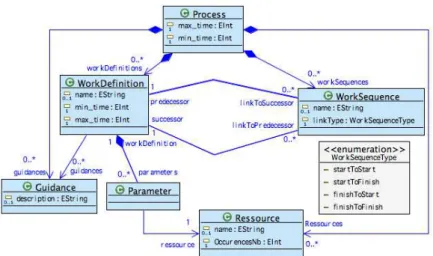
The SIMPLEPDL metamodel is given in Figure 1. It defines the process concept (Process) composed of a set of work definitions (WorkDefinition) represent-ing the activities to be performed durrepresent-ing the devel-opment. One workdefinition may depend upon an-other (WorkSequence). In such a case, an ordering constraint (linkType) on the second workdefinition is specified, using the enumeration WorkSequenceType. For example, two workdefinitions WD1 and WD2 linked by a precedence relation of kind finishToStart specify thatWD2 will be able to start only whenWD1 is finished (and respectively for startToStart, start-ToFinishand finishToFinish). SIMPLEPDL does also allow to explicitly represent resources (Resource) that are needed in order to perform one workdefinition (designer, computer, server, . . . ) and also time con-straints (min time and max time on WorkDefinition and Process) to specify the minimum (resp. maxi-mum) time allowed to perform the workdefinition or the whole process.
One can remark that, for the sake of brevity, some concepts are not presented here such as products (WorkProduct) that workdefinitions handle, or roles (Role) that can be assimilated to resources.
2.2
Properties
We now present the different kinds of properties spe-cific to the proposed metamodel: structural ones, tem-poral ones and quantitative ones. We will particularly develop the second kind as a core concept for the rest of the paper.
Structural properties: The expressivity of meta-modelling languages (i.e. meta-metamodels) does not allow to formally capture the whole set of the lan-guage properties, i.e. the axiomatic semantics. They mainly capture the cardinalities constraints
In programming languages, the axiomatic seman-tics is usually based on mathematical logics and ex-presses a proof method for some construction prop-erties of a language (Cousot, 1990). It can be very general, such as Hoare triples or restricted to ensure construction consistency (e.g. typing).
In a modelling language, this second kind of use is expressed using well formedness rules at the meta-model level. Such rules have to be realised by all models that are conform to this metamodel. One can check these rules by static analysis on models.
In order to express the rules, the OMG advocates the use of OCL (omg, 2003; Warmer and Kleppe, 2003). Applied at the metamodel level, OCL can add properties, mostly structural, that could not have been captured by the metamodel definition. It is a mean to
Figure 1: SIMPLEPDL metamodel
precise the metamodel semantics by limiting possible conforming models.
There is an example of such a constraint: One Worksequence could not have the same Workdefinition as source and target.
That can be formalised as context WorkSequence inv :
self.predecessor <> self.successor
In order to check that a particular model satis-fies these constraints, one can use an OCL checker such as USE (Richters and Gogolla, 2000), OSLO6, or EMFT7.
Temporal properties: Many properties have to be satisfied in every model execution. The expert of the domain will formalise them when defining the meta-model. In our process metamodel, any workdefinition can be started and then be finished. One can then ask, and therefore check, whether a given process model effectively terminates, i.e. that every workdefinition in it finishes. Taking into account time and resources, some new properties appear that are independent of any model. For a given set of resources, described in the model, does the process terminate ? Is it possible to satisfy every real time constraints expressed on the workdefinition (attributes min time and max time) ? We could also express temporal properties depending on the capability for a workdefinition to suspend its work and free its resources to share them temporarily with other workdefinitions.
6Open Source Library for OCL, http:
//oslo-project.berlios.de.
7The Eclipse Modeling Framework Technology project,
http://www.eclipse.org/emft/
Quantitative properties: The aim of such proper-ties is to describe or compute critical paths of exe-cutions in terms of minimal or maximal resource con-sumption. WCET8or schedulability are typical exam-ples of quantitative properties. For instance, time and memory are standard resources the usage of which one would wish to measure. In this respect, a con-sumption (and production) model has first to be set. In simple situations, a discrete and finite model may fit the needs, as it is the case when we focus on a single kind of resource, with a fixed and finite num-ber of instances. Memory requirements alone usually fall in this simple class and could be checked with off-the-shelf model-checking techniques for discrete models, nevertheless with possible minor adaptations. Yet, for more involved models and resources, in order to precisely represent what is happening, we may find it mandatory to write down quite general arithmetical constraints or to handle continuous quantities (as in real-time systems specifications for instance). As dis-cussions about relevance of such models and their ver-ification issues are quite complex and out of the scope of this present work, we choose for the time being to simply rule out quantitative properties and postpone their introduction for future works. Thus, we stick to the presentation of the overall methodology without delving upon details.
2.3
Dynamic Informations &
Property-Driven Approach
Expressing temporal properties that have to be checked on each model execution implies the exis-tence of an operational semantics that is not expressed
within a metamodelling language such as the MOF. In our case, the execution of a process model con-sists in performing the different work definitions of the process. When executing a model, every work definition must be started and the overall process must finally reach a state where all of them are in the state finished.
The real semantics can be arbitrary complex, and sometimes non computer-representable in case of complex continuous systems.
Our previous works have investigated the use of operational semantics (Combemale et al., 2006b) and translational semantics (Combemale et al., 2007). In this paper we present a generic approach to define the abstract dynamic semantics, a semantics of observ-able events, built upon the properties expressed at the metamodel level.
The temporal properties expressed for every model conform to the metamodel are built over a notion of states. The formal semantics associated to the system can be seen as the set of maximal fi-nite traces which elements are model states. If the metamodel has a well defined operational semantics, it can be easily expressed as a modification of in-stances’ attributes or a modification of the topology (dynamically creating or killing instances). On the contrary, if the associated semantics is not formally defined, the states characterised by properties allow to define an observable operational semantics. Follow-ing this idea, if state properties rely on notions that cannot be directly expressed in the model (classical OCL queries), then the metamodel must be enriched to express these notions. The dynamic operational se-mantics, i.e. the Kripke structure that allows to build trace semantics, must then be approximated by defin-ing transition between characterised states. It is the work of the domain expert to describe them.
This approach has mainly three advantages: • it gives a method to define a formal semantics for
metamodel that could not always initially describe it;
• this approach is incremental: the domain expert can specify a property, that characterises new states. Then he will extend the metamodel to rep-resent this new dynamic information. The expert can then introduce another property and extend again the metamodel.
• it allows to easily define an “observable” approxi-mation of the trace semantics. One such approach allows to check the properties defined, because the semantics were defined depending on the needs expressed by these properties. It can also help in defining a minimal abstract semantics that gives
access to formal tools allowing to check proper-ties on a reasonably-sized state space.
3
An Approach to Validation
through Petri Nets and LTL
In this section, we will follow all the steps that allow us to express temporal constraints on our SIM -PLEPDL metamodel.
3.1
Characterising Properties
This first step must be realised by the expert. As expert of processes, we say that every SIMPLEPDL model must verify the following properties. We sep-arate them in two classes: universal properties that have to be satisfied by every execution and existential properties that must be true in at least one execution.
Our universal properties are: • every workdefinition must start, • all started workdefinitions must finish,
• once a workdefinition is finished, it has to stay in this state,
• a workdefinition is able to start depending on worksequences constraints. All workdefinitions that are linked to it using a startToStart workse-quence are started. Reciprocally all workdefini-tions that are linked to it using a finishedToStart worksequence are finished.
The same kind of properties apply for finishing each workdefinition.
Our existential properties are:
• every workdefinition must take more than min timeand less than max time to be performed, • the overall process is able to finish, i.e. when all workdefinitions are finished in a good state (i.e. between min time and max time).
3.2
Characterising States
The second step consists in characterising different states for the metamodel elements from the proper-ties. From the aforementioned temporal properties, we can identify two orthogonal ideas for the workdef-inition element. First, a workdefworkdef-inition can be not started, started and finally finished. Secondly, there is a notion of time and clock associated to each workdef-inition; but this time is only relevant for transition enabling conditions (in our case transitions that start and finish a workdefinition) and is not explicit in state
properties. Thus it can be represented into the finite set of states{ tooEarly, ok , tooLate }. This second orthogonal idea is only relevant when the progress is finished. Therefore we add a fourth state: notFin-ished.
3.3
Extending the Metamodel to
Represent Dynamic Information
We now have to express these states by extending the WorkDefinition elements in order to introduce at-tributes that reflect dynamic information, i.e. the state of the current workdefinition. We choose to add three variables: state∈ {notStarted, started, f inished}, time state∈ {notFinished, tooEarly, ok, tooLate} and clock∈ R+.
An observational abstraction of the operational se-mantics of our processes with respect to our proper-ties can now be defined.
The expert has again to formalise the initial states and the transition relation. In our case, it is quite natural: the initial states are the singleton {w 7→ (notStarted, notFinished)| w ∈
W D
}. We define the transition relation for one workdefinition inW D
in Figure 2.3.4
Expressing Temporal Properties :
Temporal OCL
A few temporal extensions of OCL have already been proposed in a UML context (see related works sec-tion). We have chosen the proposal of (Ziemann and Gogolla, 2002) for two main reasons:
1. The semantics of the temporal expressions is for-mally defined on a trace semantics. Such traces are finite sequences of system states, describing a snapshot of the running system. Even if this work was initially defined on UML models, the trace se-mantics can be easily generalised to arbitrary state sequences while keeping the original semantics of temporal operators.
2. The syntax of this OCL extension is quite natural. It introduces usual future-oriented temporal oper-ators such as next, existsNext, always, sometimes as well as their past-oriented duals. We will only use the future-oriented ones because we intend to effectively check properties using the Tina model checker (Berthomieu et al., 2004), which does not support past-oriented operators.
Let us go back to our process example to intro-duce our generalisation. A snapshot of our process has to describe precisely the state of each workdefini-tion. We take as given a finite set
S
of such states. LetW D
be the set of workdefinitions of the model. Let Σbe the set of the process state: Σ=W D
7→S
.A trace ˆσof the process is a maximal finite se-quence of process states hσ0, . . . , σni, σi∈ Σ, where
σ0 denotes the initial process state. Semantically, we have two kinds of transitions. First, continuous time-passing transitions that are here unobservable and consist in incrementing all workdefinition clocks by a quantity dt simultaneously. Second, event-based transitions that change the states of workdefinitions as defined by the expert above. Two consecutive events in a sequence are related through a combination of the time-passing transition followed by an event-based transition.
In order to ease the definition of our properties we introduce the new operator precedes. Such an opera-tor can be described using the previous ones:
e1precedes e2= always!(e2) until e1
Expressions of our TOCL extension are now OCL expressions over the model elements using these tem-poral operators. We also allow these expressions to be built over state names defined in the aforementioned set
S
. The universal temporal properties can now beexpressed as:
always(notStarted =⇒ sometime started) always(started =⇒ sometime finished) finished =⇒ always finished
always((predss.state= started &&
predf.state= finished &&
notStarted) =⇒ sometime started) The existential ones have to be rewritten in order to be checked: we will verify the negation of each for-mula. If the analysis gives a correct answer, there is no trace satisfying the property. On the contrary, if the analysis gives a negative answer with a counter-example, the existential property is verified and the counter-example is one of the traces satisfying the temporal property. We only give here the first exis-tential property.
always(not wd.time state = ok) ≡ always (wd.time state = tooEarly
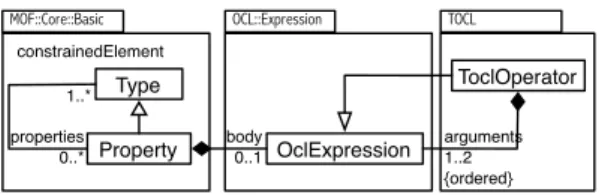
||wd.time state = tooLate) We have given the textual concrete syntax and the as-sociated semantics of our extension of TOCL. In or-der to integrate it into a metamodelling approach (i.e. defining properties at the metamodel level), it is nec-essary to define, at the MOF level, the OCL abstract syntax and its temporal extension. To give the abil-ity for any DSL to use TOCL, we start from the OCL metamodel defined in (Richters and Gogolla, 1999) and promote it at the MOF level (omg, 2006) (fig.
Let w be the considered Work Definition.
∀ws = w.predecessor, (ws.linkType = startToStart&&ws.linkToPredecessor.state = started) ||(ws.linkType = f inishedToStart&&ws.linkToPredecessor.state = f inished) notStarted, notFinished, clock → started, notFinished,0
∀ws = w.predecessor, (ws.linkType = startToFinished&&ws.linkToPredecessor.state = started) ||(ws.linkType = f inishedToFinished&&ws.linkToPredecessor.state = f inished) started, notFinished, clock < min time → f inished,tooEarly, clock
started, notFinished, clock∈ [min time, max time] → f inished, ok, clock started, notFinished, clock > max time → f inished,tooLate, clock
Figure 2: Event-based Transition Relation for WorkDefinitions
MOF::Core::Basic Type Property constrainedElement 1..* properties 0..* OCL::Expression OclExpression body 0..1 TOCL ToclOperator arguments 1..2 {ordered} Figure 3: Temporal OCL integration to MOF
3). We also add the set of temporal operators defined in (Ziemann and Gogolla, 2002) and in the aforemen-tioned extension (fig. 3).
We have now introduced the concrete and abstract syntax and semantics of our temporal OCL extension. With these temporal constraints we are now able to express complex properties on the behaviour of the model to be checked. One immediate application of these constraints is the transformation of every invari-ant as defined in OCL as the first kind of properties. We now consider executing models and each invariant has to be checked in every process state of all possible traces. Therefore, we rename invariant expressions e to always e.
The next part introduces how these model states can be built using OCL over model attributes.
3.5
Denotational Semantics to Petri Net
and LTL
In this study, we choose to use the technical space of Petri nets as the target representation for formally expressing our process models. We also choose to ex-press our temporal formulae as LTL formaluae (Lin-ear Temporal Logic) over the Petri net associated to a process model. Then we manipulate Petri nets and LTL formulae within the Tina9toolkit.
TINA (TIme Petri Net Analyser) is a software en-vironment to edit and analyse Petri nets and timed
9http://www.laas.fr/tina/
nets (Berthomieu et al., 2004). The different tools constituting the environment can be used alone or to-gether. Some of these tools will be used in this study: • nd (NetDraw) : nd is an editing tool for automatas and timed networks, under a textual or graphi-cal form. It integrates a “step by step” simulator (graphical or textual) for the timed networks and allows to call other tools without leaving the edi-tor.
• Tina : this tool builds the state space of a Petri net, timed or not. Tina can perform classical con-structs (marking graphs, covering trees) and also allows abstract state space construction, based on partial order techniques. Tina proposes, for timed networks, all quotient graph constructions dis-cussed in (Berthomieu and Vernadat, 2006). • selt: usually, it is necessary to check more specific
properties than the ones dedicated to general ac-cessibility alone, such as boundedness, deadlocks, pseudo liveness and liveness already checked by tina. The selt tool is a model-checker for for-mulae of an extension of temporal logic seltl (State/Event LT L) of (Chaki et al., 2004). In case of non satisfiability, selt is able to build a read-able counter-example sequence or in a more com-pressed form usable by the TINA simulator, in or-der to execute it step by step.
3.5.1 Denotational Semantics of SIMPLEPDL PetriNet In this case study, we use timed Petri nets as a paradigm to express the semantics of our pro-cesses, models of SIMPLEPDL. The semantics is now a denotational one defined as a mapping from SIM
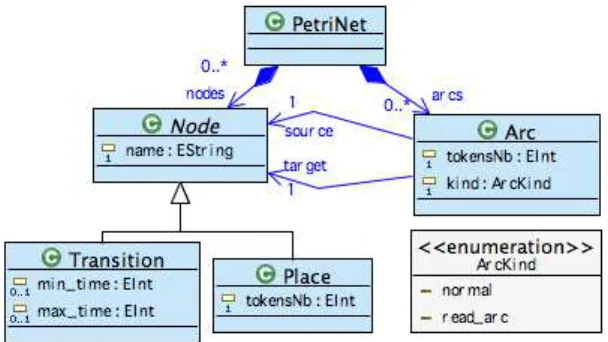
-PLEPDL to Petri nets. The Petri nets metamodel is given in Figure 4. A Petri net (PetriNet) is com-posed of nodes (Node) that denote places (Place) or transitions (Transition). Nodes are linked together by arcs (Arc). Arcs can be normal ones or read-arcs (Ar-cKind). The attribute tokensNb specifies the number of tokens consumed in the source place or produced
Figure 4: Petri Nets Metamodel
in the target one (in case of a read-arc, it is only used to check whether the source place contains at least the specified number of tokens). Petri nets markings are defined by the tokensNb attributes of places. Finally, a time interval can be expressed on transitions.
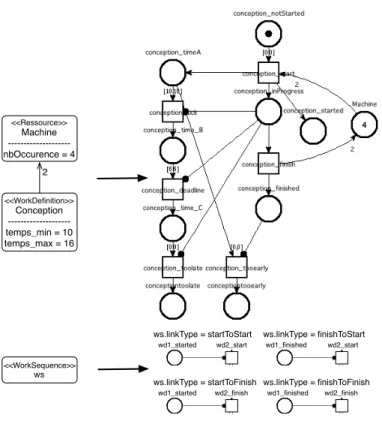
Mapping The translation schema that trans-forms a process model into a Petri nets model (SIMPLEPDL2PETRINET) is given in Figure 5. Each workdefinition is translated into four places charac-terising its state (NotStarted, Started, InProgress or Finished). A WorkSequence becomes a read-arc from one place of the source workdefinition to a transition of the target workdefinition. The state Started records that the workdefinition has been started.
We also add five places that will define a local clock. The clock will be in state TooEarly when the workdefinition ends before min time and in the state TooLatewhen the workdefinition ends after max time. Our transformation has been written in ATL, AT-LAS Transformation Language (Jouault and Kurtev, 2005). A first rule expresses one workdefinition in terms of places and transitions. A second one trans-lates a work sequence into a rearc between the ad-equate place of the source workdefinition and the ap-propriate transition of the target workdefinition. Fi-nally a third rule considers the whole process and builds the associated Petri net.
In order to manipulate the obtained Petri net in-side a dedicated tool such as Tina, we have com-posed the preceding transformation with a transfor-mation PETRINET2TINA that translates a PetriNet model into the textual syntax of the Tina tool.
Traceability The set of translation choices (i.e. the mapping) defined in the SIMPLEPDL2PETRINET
transformation is captured in the ATL source code. The benefit of this language is that it is itself defined as a metamodel. It allows to obtain a model (conform
to the ATL metamodel) corresponding to the trans-formation. This transformation model can be reused as an entry model for another transformation (Higher Order Transformation). We can remark that it is pos-sible to enrich traceability information as proposed by (Jouault, 2005).
3.5.2 Denotational Semantics of TOCL
The transformation model defined during the trans-lation to Petri nets is used to instantiate a generic transformation that defines LTL properties from the initial metamodel properties, instantiated relatively to the initial process model.
Our experiments show a lack in current MDE technology that does not allow to parameterise a model transformation. The use of a programming lan-guage such as Java, as well as a specific library such as EMF, is necessary to handle such a transformation.
3.6
Models Validation and Feedback
Model checking results have to be interpreted at the SIMPLEPDL model level in order to provide a com-plete front-end to the end-user. Properties verified in the Petri net correspond to a double instantiation of the properties expressed at the metamodel level. The interpretation of the results must be the conjunction of the results obtained for the different instantiations of a metamodel property.
The feedback of properties results (catching in a first time the truth value of the property) in the model, can be automatically computed using the transfor-mation model defined during the translation SIM
-PLEPDL2PETRINET. This translation captures the set of choices that have been done during the transfor-mation (i.e. the mapping table). This technique uses a Higher Order Transformation that takes a transforma-tion model and allows to trace back the model checker interpretation into the DSL model.
In a first time, we only handle the boolean value returned by the Tina analyser. When the LTL proper-ties associated to one SIMPLEPDL properties are sat-isfied, the property is satisfied. In the other case, the transformation model allows to identify in the model the faulty element and to update its dynamic informa-tion in order to visualise the state in which the prop-erty failed. We have to take care of the kind (universal or existential) of temporal properties expressed. In case of an existential one, the negation of the result has to be returned.
The next step consists in handling counter-examples. Such counter-examples generated by the model checker could be expressed on the model and be then injected in the model animator (in our case,
<<WorkDefinition>> Conception ---temps_min = 10 temps_max = 16 <<Ressource>> Machine ---nbOccurence = 4 2 <<WorkSequence>> ws wd1_started wd2_start ws.linkType = startToStart wd1_finished wd2_start ws.linkType = finishToStart wd1_started wd2_finish ws.linkType = startToFinish wd1_finished wd2_finish ws.linkType = finishToFinish
Figure 5: Translation schema from SIMPLEPDL to PetriNet
the one defined on SIMPLEPDL) defined in the Top-cased project.
4
Related Works
4.1
Models Semantics
The formal semantics definition of modelling lan-guages is an active research field in the MDE commu-nity. Beside our previous works presented in (Combe-male et al., 2006b) and (Combe(Combe-male et al., 2007), we have identified other projects that consider this impor-tant subject.
The ISIS laboratory of the Vanderbilt University focuses on MDE for many years. They proposed the MIC approach (Model-Integrated Computing), in which models are at the heart of the integrated soft-ware development. Recently, they propose, in (Chen et al., 2005), a semantics anchored to a model of for-mal semantics built upon ASM (Abstract State Ma-chine) (Gurevich, 2001), using the transformation language GReAT (Graph Rewriting And Transforma-tion language) (Agrawal et al., 2005).
Xactium10 is a company created in 2003. Its ob-jectives are to provide practical solutions for the de-velopment of systems based on MDE principles. It developed the XMF-Mosaic tool (Clark et al., 2004) that allows to define a DSL, to simulate and to vali-date models using a extension of the OCL language named xOCL (eXecutable OCL). XMF-Mosaic also provides means to transform models and to define translations to other technical spaces.
These works are very near to the objectives of the TOPCASED environment, i.e. to propose a modular modelling environment based on a modular genera-tive approach (like GME, XMF), as well as a formal semantics that provides simulation and model valida-tion tools. Our works based on Kermeta follow an ap-proach similar to the ones of xOCL inside the XMF-Mosaic tool.
The semantics anchoring proposed by the ISIS laboratory is similar to the denotational semantics such as the mapping to Petri nets we propose. The main difference is that we want to give more flexibil-ity in the choice of the semantics model and to allow easier feedbacks from simulations or verifications in-side a particular model. However, they do not propose
the use of models rewriting rules to define the opera-tional semantics.
4.2
Models verification
Verification of UML models In order to specify structural properties on UML models, OCL was in-troduced. It is therefore accepted as the standard lan-guage to express structural properties on UML mod-els. There also exists a bunch of tools to check OCL properties for any model.
As for temporal properties, some recent works in-tend to exin-tend the usual OCL syntax and semantics to give the capability to express temporal constraints. All these works address OCL extensions in an UML context. They do not address how the transition sys-tem is derived from the model.
The aforementioned work of (Ziemann and Gogolla, 2002) proposed to extend OCL with usual temporal operators and defined their semantics on the trace semantics of the UML model. This work is a first step towards the simulation of temporal proper-ties over traces using the USE tool.
Some works, such as (Flake, 2003) and (Flake and Mueller, 2003), are focused on the expression of real time constraints while keeping the original OCL syntax. They relied on StateChart states to express the dynamic constraints of the system. Then, they mapped their constraints into Clocked-CTL.
(Cengarle and Knapp, 2002) proposed to express real time constraints using two new classes Time and Events. A new OCL template is introduced and the usual ones (pre-post, inv and action) are translated in it. The semantics is also defined as a trace semantics. In (Distefano et al., 2000), the authors expressed non temporal OCL constraints into their object-oriented version of CTL. They defined formally what is a state of the UML model. They are able to check whether a property expressed in OCL can be checked in every reachable state.
The work of (Bradfield et al., 2002) intro-duced new OCL templates. They mapped them into
O
µ(OCL)-calculus, an observational µ-calculus,which expressions are OCL expressions. The seman-tics of their
O
µ(OCL)-calculus is defined over the states of (Distefano et al., 2000). Using model check-ing tools, the author intends to check the property on a CCS term modelling their UML system.All the previous works only specify the way OCL must be extended to deal with temporal formulae in order to verify or simulate them later but do not reach this last step, at least not in an automatic manner. For instance, the point of generating the transition system from the initial UML is not solved.
Verification of DSL models OCL was initially de-fined on UML but was quickly dede-fined for every meta-model. It is the main tool to express structural prop-erties in DSL. Existing OCL checkers are also model independent.
5
Conclusion & Future Works
The context of this article was to integrate formal methods for refining DSL semantics. DSL semantics is usually restricted to structural properties and dy-namic aspects are often only informally described or are even implicit. As our aim is to express and vali-date behavioural and operational properties within a metamodelling framework, the first step was to in-troduce and handle an operational semantics, instan-tiated in this article to our process metamodel SIM
-PLEPDL. This semantics is introduced with respect to properties of interest, given by an expert of the do-main. First, a notion of state is introduced, followed by the definition of transitions and executions. Tem-poral operators, forming temTem-poral properties, are also introduced. In order to check these properties, first a denotational semantics is provided as a mapping from SIMPLEPDL processes to Petri nets, second a front
end to the Tina model-checker is defined.
Few things still remain to be done. In particular, the current presentation is focused on SIMPLEPDL, it still needs to be abstracted away to get a more gen-eral approach. The formal connection between the observational operational semantics and the denota-tional semantics induced by the ATL transformation have to be validated.
Currently, we are implementing a prototype al-lowing us to define metaproperties through an Ecore modelling language extension given by the Eclipse EMF plugin. The expression of temporal properties uses an extension of OCL metamodel provided by the EMFT plugin on which we add the set of temporal operators described above, in the article. An interface associated to the TOCL textual concrete syntax will be integrated using generators such as Sintaks (Muller et al., 2006) or TCS (Jouault et al., 2006). Our pro-totype must also integrate the set of ATL transforma-tions and provide a front end to Petri nets using the Tina toolkit, through the SIMPLEPDL language. We still have, in case of a negative answer from the model checker, for a given property, to retrieve the gener-ated counter-example. It can then be injected within both the model animator currently developed with the TOPCASED project and the SIMPLEPDL model graphical editor defined with TOPCASED.
REFERENCES
(2003). UML Object Constraint Language (OCL) 2.0 Spec-ification. Object Management Group, Inc. Final Adopted Specification.
(2005). Software Process Engineering Metamodel (SPEM) 1.1 Specification. Object Management Group, Inc. formal/05-01-06.
(2006). Meta Object Facility (MOF) 2.0 Core Specifica-tion. Object Management Group, Inc. Final Adopted Specification.
Agrawal, A., Karsai, G., Kalmar, Z., Neema, S., Shi, F., and Vizhanyo, A. (2005). The design of a language for model transformations. Technical report, Institute for Software Integrated Systems, Vanderbilt Univer-sity, Nashville, TN 37235, USA.
Berthomieu, B., Ribet, P.-O., and Vernadat, F. (2004). The tool TINA – construction of abstract state spaces for Petri nets and time Petri nets. International Journal of Production Research, 42(14):2741–2756.
Berthomieu, B. and Vernadat, F. (2006). R´eseaux de Petri temporels : m´ethodes d’analyse et v´erification avec TINA. Trait´e IC2.
Bradfield, J. C., Filipe, J. K., and Stevens, P. (2002). En-riching OCL using observational mu-calculus. In Fun-damental Approaches to Software Engineering, pages 203–217.
Cengarle, M. V. and Knapp, A. (2002). Towards OCL/RT. In International Symposium of Formal Methods Eu-rope on Formal Methods (FME) - Getting IT Right, pages 390–409, London, UK. Springer-Verlag. Chaki, S., E, M., Clarke, Ouaknine, J., Sharygina, N., and
Sinha, N. (2004). State/event-based software model checking. In 4th International Conference on Inte-grated Formal Methods (IFM), volume 2999 of LNCS, pages 128–147.
Chen, K., Sztipanovits, J., Abdelwalhed, S., and Jackson, E. (2005). Semantic anchoring with model transforma-tions. In Model Driven Architecture - Foundations and Applications, First European Conference (ECMDA-FA), volume 3748 of LNCS, pages 115–129.
Clark, T., Evans, A., Sammut, P., and Willans, J. (2004). Applied metamodelling - a foundation for language driven development. version 0.1.
Combemale, B., Cr´egut, X., Berthomieu, B., and Verna-dat, F. (2007). SimplePDL2Tina : Mise en oeuvre d’une Validation de Mod`eles de Processus. In 3ieme journ´ees sur l’Ing´enierie Dirig´ee par les Mod`eles (IDM), Toulouse, France.
Combemale, B., Cr´egut, X., Ober, I., and Percebois, C. (2006a). Evaluation du standard SPEM de repr´esentation des processus. G´enie Logiciel, Mod`eles et Processus de d´eveloppement, 77:25–30.
Combemale, B., Rougemaille, S., Cr´egut, X., Migeon, F., Pantel, M., Maurel, C., and Coulette, B. (2006b). To-wards a rigorous metamodeling. In 2nd International Workshop on Model-Driven Enterprise Information Systems (MDEIS), Paphos, Cyprus. INSTICC.
Cousot, P. (1990). Methods and logics for proving pro-grams. In Handbook of Theoretical Computer Sci-ence, Volume B: Formal Models and Sematics (B), pages 841–994.
Distefano, D., Katoen, J.-P., and Rensink, A. (2000). To-wards model checking OCL. In ECOOP Workshop on Dening a Precise Semantics for UML.
Flake, S. (2003). Temporal OCL extensions for specifica-tion of real-time constraints. In Workshop Specifica-tion and ValidaSpecifica-tion of UML models for Real Time and Embedded Systems (SVERTS) at UML’03, San Fran-cisco, CA, USA.
Flake, S. and Mueller, W. (2003). Formal semantics of static and temporal state-oriented OCL constraints. Journal on Software and System Modeling (SoSyM), 2(3). Gurevich, Y. (2001). The abstract state machine paradigm:
What is in and what is out. In Ershov Memorial Con-ference.
Jouault, F. (2005). Loosely Coupled Traceability for ATL. In Proceedings of the European Conference on Model Driven Architecture (ECMDA) workshop on trace-ability, Nuremberg, Germany.
Jouault, F., B´ezivin, J., and Kurtev, I. (2006). TCS: a DSL for the Specification of Textual Concrete Syntaxes in Model Engineering. In Proceedings of the fifth inter-national conference on Generative programming and Component Engineering (GPCE), Portland, Oregon. Jouault, F. and Kurtev, I. (2005). Transforming models with
ATL. In Proceedings of the Model Transformations in Practice Workshop at MoDELS, Montego Bay, Ja-maica.
Muller, P.-A., Fleurey, F., Fondement, F., michel Hassen-forder, Schneckenburger, R., G´erard, S., and J´ez´equel, J.-M. (2006). Model-driven analysis and synthesis of concrete syntax. In 9th International Conference on Model Driven Engineering Languages and Systems (MoDELS), volume 4199 of LNCS, Genova, Italy. Richters, M. and Gogolla, M. (1999). A metamodel for
OCL. In France, R. and Rumpe, B., editors, UML’99 - The Unified Modeling Language. Beyond the Stan-dard. Second International Conference, Fort Collins., volume 1723 of LNCS, pages 156–171, USA. Richters, M. and Gogolla, M. (2000). Validating UML
models and OCL constraints. In UML 2000 - The Unified Modeling Language. Advancing the Stan-dard. Third International Conference, volume 1939 of LNCS, pages 265–277, York, UK.
Warmer, J. and Kleppe, A. (2003). The Object Constraint Language: Getting Your Models Ready for MDA. Addison-Wesley Longman Publishing Co., Inc. Ziemann, P. and Gogolla, M. (2002). An extension of OCL
with temporal logic. In Critical Systems Development with UML – Proceedings of the UML’02 workshop, volume TUM-I0208, pages 53–62.