HAL Id: hal-02437512
https://hal.archives-ouvertes.fr/hal-02437512
Submitted on 13 Jan 2020HAL is a multi-disciplinary open access archive for the deposit and dissemination of sci-entific research documents, whether they are pub-lished or not. The documents may come from teaching and research institutions in France or abroad, or from public or private research centers.
L’archive ouverte pluridisciplinaire HAL, est destinée au dépôt et à la diffusion de documents scientifiques de niveau recherche, publiés ou non, émanant des établissements d’enseignement et de recherche français ou étrangers, des laboratoires publics ou privés.
Complex deformation at shallow depth during the 30
October 2016 Mw6.5 Norcia earthquake: interference
between tectonic and gravity processes?
Arthur Delorme, Raphael Grandin, Yann Klinger, Marc Pierrot-Deseilligny,
Nathalie Feuillet, Eric Jacques, E. Rupnik, Yu Morishita
To cite this version:
Arthur Delorme, Raphael Grandin, Yann Klinger, Marc Pierrot-Deseilligny, Nathalie Feuillet, et al.. Complex deformation at shallow depth during the 30 October 2016 Mw6.5 Norcia earthquake: in-terference between tectonic and gravity processes?. Tectonics, American Geophysical Union (AGU), 2020, �10.1029/2019TC005596�. �hal-02437512�
HAL Id: hal-02437512
https://hal.archives-ouvertes.fr/hal-02437512
Submitted on 13 Jan 2020HAL is a multi-disciplinary open access archive for the deposit and dissemination of sci-entific research documents, whether they are pub-lished or not. The documents may come from teaching and research institutions in France or abroad, or from public or private research centers.
L’archive ouverte pluridisciplinaire HAL, est destinée au dépôt et à la diffusion de documents scientifiques de niveau recherche, publiés ou non, émanant des établissements d’enseignement et de recherche français ou étrangers, des laboratoires publics ou privés.
Complex deformation at shallow depth during the 30
October 2016 Mw6.5 Norcia earthquake: interference
between tectonic and gravity processes?
Arthur Delorme, Raphael Grandin, Yann Klinger, Marc Pierrot-Deseilligny,
Nathalie Feuillet, Eric Jacques, E. Rupnik, Yu Morishita
To cite this version:
Arthur Delorme, Raphael Grandin, Yann Klinger, Marc Pierrot-Deseilligny, Nathalie Feuillet, et al.. Complex deformation at shallow depth during the 30 October 2016 Mw6.5 Norcia earthquake: in-terference between tectonic and gravity processes?. Tectonics, American Geophysical Union (AGU), 2020, �10.1029/2019TC005596�. �hal-02437512�
This article has been accepted for publication and undergone full peer review but has not been through the copyediting, typesetting, pagination and proofreading process which may lead to differences between this version and the Version of Record. Please cite this article as doi: 10.1029/2019TC005596
Complex deformation at shallow depth during the 30 October 2016 M
w6.5 Norcia
earthquake: interference between tectonic and gravity processes?
A. Delorme1, R. Grandin1, Y. Klinger1, M. Pierrot-Deseilligny2, N. Feuillet1, E. Jacques1, E. Rupnik2, Y. Morishita3
1Université de Paris, Institut de physique du globe de Paris, CNRS, F-75005 Paris, France, 2LaSTIG, IGN, ENSG, Univ. Paris-Est F-94160, Saint-Mandé, France, 3Geospatial
Information Authority of Japan, Kitasato-1, Tsukuba, Ibaraki 305-0811, Japan Corresponding author: Arthur Delorme ([email protected])
Key Points:
Correlation of optical images covering the Norcia earthquake allows inference of the slip distribution at depth and at the surface
Decrease of slip toward the surface inferred from elastic modeling of interferograms contradicts high slip values measured at the surface
Gravity processes, which interfere with dominant tectonic processes, could be locally involved and explain slip excess at the surface
Abstract
The relation between slip at the near surface and at depth during earthquakes is still not fully resolved at the moment. This deficiency leads to large uncertainties in the evaluation of the magnitude of past earthquakes based on surface observations, which is the only accessible evidence for such events. A better knowledge of the way slip distributes over distinct rupture strands within the first few kilometers from the surface would contribute greatly to reduce these uncertainties. The 30 October 2016 Mw6.5 Norcia earthquake has been captured by a
variety of geodetic techniques, which provide access to the slip distribution both at depth and at the ground surface, with an unprecedented level of detail for a normal-faulting earthquake. We first present coseismic surface offset measurements from correlation of optical satellite images of sub-metric resolution, which are compared to field observations made shortly after the earthquake. Based on a joint inversion of optical data together with InSAR and GPS data, we then propose a rupture model that explains the observations both at far-field and near-field scales. Finally we explore different rupture geometries at shallow depth, in an attempt to better explain the near-field deformation (i.e. within the first hundreds of meters around the fault) observed at the surface. Despite the fact that the solution is not unique, several lines of evidence suggest that gravity processes could be locally involved, which interfere with the dominant tectonic processes.
1 Introduction
Between August 2016 and January 2017, the Central Apennines region in Italy was struck by an earthquake sequence (Figure 1), which included three moderate to large events (Chiaraluce et al., 2017). This sequence caused 299 fatalities and severely damaged buildings and infrastructures in a region of 20 km by 40 km around the epicenter (Galli et al., 2017).
On 24 August 2016, the sequence started with a Mw6.0 earthquake that occurred close
to the towns of Accumoli and Amatrice. Two months later, on 26 October 2016, a second earthquake, with magnitude Mw5.9, hit ~25 km NNW from the first earthquake, near the
town of Visso. On 30 October 2016, the third and largest event, with a magnitude of Mw6.5,
occurred close to the town of Norcia. This third earthquake is the largest Italian earthquake since the 1980 Mw6.9 Irpinia earthquake. Finally, on 18 January 2017, a series of four smaller
events, with magnitude culminating at 5.5 (Chiaraluce et al., 2017), occurred 10 km S of Amatrice.
Overall, the 2016-2017 sequence ruptured NW-SE oriented, mainly SW-dipping, normal fault systems over a length of 60 km (Chiaraluce et al., 2017).
The sequence is located in-between the two previous largest normal-faulting
sequences that occurred along the Apennines (Figure 1; Chiaraluce et al., 2017 and references therein): to the NW, the 1997 Mw6.0 Umbria-Marche sequence ruptured a 40-km-long
SW-dipping fault system; to the SE, the 2009 Mw6.1 L’Aquila sequence ruptured a 50-km-long
SW-dipping fault system.
Currently in the Apennines, extension in a NE direction is occurring at a rate of ~1.6 to 3 mm/yr, which is accommodated through such moderate- to large-magnitude (M6.0-7.0) earthquakes (D’Agostino, 2014). Evidence for historical earthquake sequences sharing similar features with the 1997, 2009 and 2016-2017 sequences has long been reported in the literature (e.g. Boschi et al., 2000; Guidoboni et al., 2007 and references therein). These sequences are generally interpreted as representing the individual events, that together build the spectacular Holocene fault scarps observed in the field, such as the Magnola fault or the Norcia fault (e.g. Blumetti et al., 1993; Piccardi et al., 1999; Galadini & Galli, 2000). Surface offsets associated with the largest of these past earthquakes are recognized in paleoseismic
.
trenches and by cosmogenic dating of incremental exhumation of limestone bedrock along fault scarps, thereby providing a foundation for assessing earthquake recurrence intervals (e.g. Pantosti et al., 1996; Palumbo et al., 2004; Galli et al., 2005; Schlagenhauf et al., 2011).
However, it remains difficult to derive earthquake magnitude from fault offsets measured at paleoseismic sites, even in cases of complete and useful stratigraphy. Indeed, along-strike variability of slip distribution (Rockwell et al., 2002) is often not known for past earthquakes due to sparseness of measurements and, even at one individual site, relations between coseismic slip at depth and in the near-surface are not yet fully understood. This lack of understanding partly stems from the difficulty to properly measure the slip distribution and fault geometry at depth during large surface-rupturing earthquakes, as this information is actually contained in the off-fault elastic deformation field, which is inaccessible in the absence of pre-earthquake observations. Actually, the full amount of coseismic offsets at the surface is often difficult to recognize and to measure accurately in the field, especially when deformation occurs on many individual faults forming a broad, distributed fault zone
(Vallage et al., 2015; Klinger et al., 2018), as it is often the case for normal-faulting
earthquakes (e.g. Caskey et al., 1996; Meyer et al., 1996; EMERGEO, 2010; Jacques et al., 2011). On the other hand, far-field deformation, which is best captured by space geodetic techniques such as synthetic aperture radar (InSAR), allows for retrieving reasonably well the slip distribution at depth through solving an inverse problem (Saint Fleur et al., 2015).
Conversely, retrieving near-fault deformation at the surface from InSAR is often hampered by a combination of factors including (1) the loss of coherence in the near-field due to surface changes or extreme strain, (2) the limited spatial resolution of the images and (3)
discontinuities of surface ruptures and existence of local ruptures not directly related to primary faulting (e.g. Meyer et al., 1996; Guerrieri et al., 2010). For these reasons, scaling laws relating surface slip to earthquake magnitude (e.g. Wells & Coppersmith, 1994) rely on limited data and overly simplistic assumptions, leading to substantial epistemic uncertainty when it comes to estimating rupture parameters for past earthquakes.
Here, we first derive the three-dimensional coseismic surface deformation for the 30 October 2016 Mw6.5 Norcia event from the correlation of optical satellite images of
sub-metric resolution (hereafter VHR, for very high-resolution). Then, from surface deformation maps, for every fault strand we can identify (i.e. when the deformation signal exceeds the detection threshold), we extract a slip distribution for both the horizontal and the vertical components of the slip vector at the surface. These slip measurements are compared and validated against field measurements compiled by the Open EMERGEO Working Group (Civico et al., 2018; Villani, Civico et al., 2018). Eventually, we perform a joint inversion of InSAR, GPS and optical data to propose a rupture model that explains both the far-field and near-field observations. Our modeling indicates that some degree of horizontal, slope-parallel deformation, possibly of gravitational origin, is needed, in addition to dominant tectonic deformation, to explain at best the different datasets, although at this stage the detail of model geometry remains non-unique.
2 Optical satellite data
Image correlation techniques allow for analyzing differences between images acquired respectively before and after an earthquake to measure horizontal coseismic displacements at the ground surface (Michel et al., 1999a, 1999b; Van Puymbroeck et al., 2000; Leprince et al., 2007). The smallest detectable displacement is directly related to the image resolution and is about 0.05 pixels at best (Leprince et al., 2007). This accuracy can only be achieved under specific conditions: (1) a precise knowledge of the geometry of acquisition and (2) the use of an accurate digital surface model (DSM) to correct for
non-tectonic sources of distortions within the images (e.g. the geometry of the sensor, the topography, the relative position between images, i.e. the stereoscopic effect). Furthermore, limited temporal changes between images acquired at different dates are required to avoid decorrelation. This technique has been used to describe coseismic earthquake ruptures (i.e. Binet & Bollinger, 2005; Vallage et al., 2015, 2016; Klinger et al., 2018; Socquet et al., 2019), rifting events (i.e. Grandin et al., 2009; Hollingsworth et al., 2013), glacial flow (Berthier et al., 2005; Heid & Kääb, 2012) and landslides (Booth et al., 2013; Stumpf et al., 2014).
2.1 Data processing
The technique described here has been commonly used during the last two decades to process images with decametric resolution (Dominguez et al., 2003; Klinger et al., 2006; Grandin et al., 2009). However, the recent advent of VHR satellite images introduced some new complexities in the processing that calls for a detailed description.
The Pleiades 1A and 1B satellites provide images with a ground sampling distance (GSD) of 50 cm for the panchromatic band. Under optimal conditions, such data should thus allow for measuring horizontal surface displacements at centimeter scale. This threshold is appropriate to capture the horizontal surface displacement that is expected for a normal-faulting earthquake of magnitude 6 or larger. To be able to measure accurately the coseismic displacement, all other distortions must be accounted for. Hence, first, images are
orthorectified to a cartographic projection to remove the effects of the sensor geometry and topography. To limit as much as possible the impact of stereoscopy, images are selected with the closest possible angles of incidence and also as close as possible to nadir. The larger the stereoscopic effect, the more residual topographic artifacts should be expected. However, with modern VHR satellites (such as Pleiades), which operate in agile modes, obtaining two images acquired at different dates that comply with such angular constraints is difficult. To address this problem, for each date, a stereo acquisition can be processed to derive a high-resolution DSM, later used in the orthorectification process, thus improving the accuracy of the generated orthoimages.
In this work, we obtained two Pleiades tri-stereo acquisitions (i.e. two sets of three images), with the first acquisition on 29 October 2016, before the 30 October 2016 event, and the second acquisition after the event, on 1 December 2016 (Table 1). It is worth noting that: (1) the 26 October 2016 earthquake is not captured by this dataset; (2) about one month of postseismic signal also contributes toward the coseismic signal. The data are processed with MicMac, a free open-source software for photogrammetry (Pierrot-Deseilligny & Paparoditis, 2006; Rosu et al., 2015; Rupnik et al., 2017). To deal with computational limitations,
processing is divided into two geographical zones, N and S. Each image is cropped
accordingly and new RPCs (Rational Polynomial Coefficients, which describe the geometry of acquisition of the image) are computed from the initial RPCs, to fit the smaller area. To better constrain the geometry, for each zone, RPC-based bundle block adjustment (BBA) – i.e. the geometries of all the acquisitions are refined during a single process, based on a least squares method – is performed (Rupnik et al., 2016), using all six images as input. This way the geometry of a given image, besides being better constrained, is consistent within the whole dataset, which allows producing co-registered DSMs and orthoimages. Re-projection residuals of the tie points between the images, before and after the process, are shown in Table S1. For each zone, the refined geometry enables a localization precision in the range of 0.4 pixels, corresponding to 20 cm on the ground.
During BBA, all tie points between images acquired at different dates are considered as relating to the same coordinates on the ground. However, for zones affected by the
earthquake deformation, this assumption is not valid, because target pixels moved as a result of coseismic displacement. Nevertheless, such violation in our assumptions is not critical as changes in geometry introduced by these erroneous tie points are characterized by long wavelength, whereas the tectonic signal has a short wavelength. Hence, the tectonic signal is not significantly affected, as shown by comparison of deformation maps derived from ALOS-2 and Pleiades (see Section 3.1).
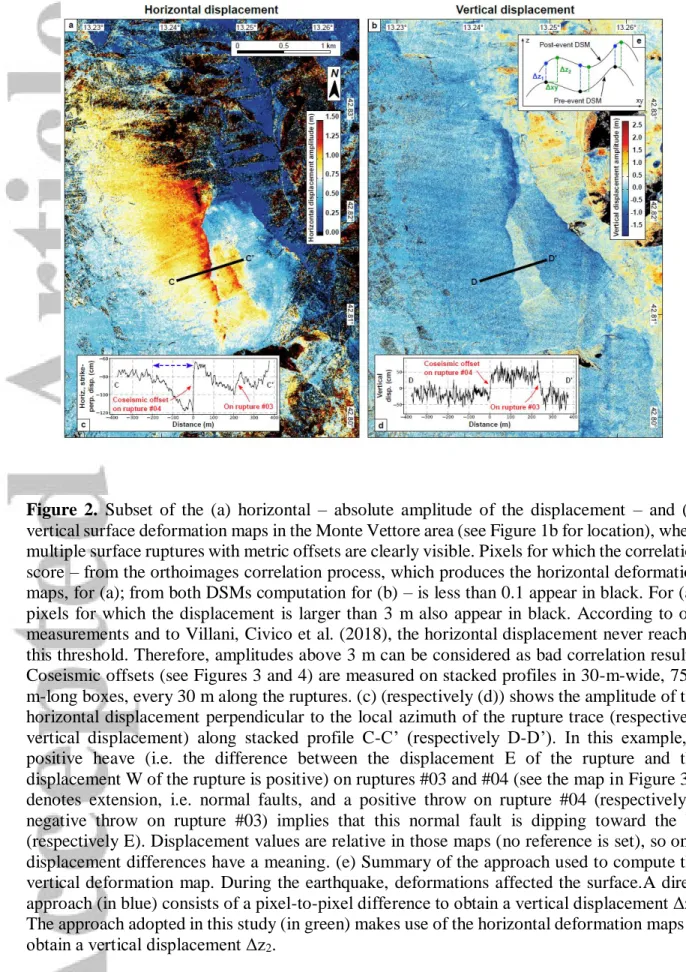
From this point on, the pre-event and post-event images are processed separately to produce, in each case, a DSM and three orthoimages at GSD equal to 0.5 m. Then, sub-pixel correlation is performed on each pair of pre- and post-event orthoimages. Thanks to MicMac capability to handle a small correlation window (in our case 9 by 9 pixels) with a low level of noise (Rosu et al., 2015), two 0.5 m resolution horizontal surface deformation maps are obtained, one for the E-W deformation and one for the N-S deformation (Figures 2a and S1). This enables us to fully benefit from the high-resolution of modern optical satellites, in order to investigate details of geometric complexities along the earthquake ruptures.
Besides being used for active fault mapping and orthorectification of the images, the pre- and post-event DSMs can also be used to assess the vertical component of the
deformation. A vertical deformation map is computed (Figure 2b and S1), taking into account the horizontal deformation field obtained during the previous step (Figure 2e); the DSMs and horizontal deformation maps being co-registered, for each pixel of the pre-event DSM, the corresponding horizontal displacement value is used to locate the same pixel in the post-event DSM. By subtracting the altitudes at the respective positions in the two DSMs, we are able to estimate the change in elevation for each pixel. This approach eliminates the effect of
spurious elevation changes that would appear with a direct DSMs subtraction, in case of a combination of horizontal motion and pre-existing topographic slope (Mackenzie & Elliott, 2017).
To mitigate noise and especially spatial aliasing in the horizontal deformation maps, we take advantage of the redundancy in our results. Weighted average of the nine maps that were previously calculated (one for each pair of orthoimages) is computed, using the correlation score generated during the correlation steps as the weight, to obtain, for each direction, a map of average deformation. Although we performed no quantitative assessment of the noise level evolution, the result shows a noticeable visual decrease of the noise, while the signal is well preserved (Figure S2).
Several additional sources of noise are also identified, which can be at least partly addressed. Inaccuracies in the estimation of the satellite attitude lead to residual signals in the correlation maps. The dominant residual signal, in the satellite across-track direction, relates to pitch variations. The wavelength of this signal is long in comparison with the tectonic deformation. In addition, in our case, this residual signal is almost perpendicular to the
ruptures. Thus, the impact of this residual signal on our analyses should be limited. To reduce the impact of this signal further, we extract stacked profiles from a region with no significant tectonic signal to fit a long wavelength spline function, which is next subtracted from the deformation map. A second residual signal, in the satellite along-track direction, relates to charge-coupled device (CCD) misalignments and jitter artifacts (Ayoub et al., 2008). In our case, the direction of this signal is almost parallel to the ruptures direction. As there is no wide-enough area free from tectonic signal where its spectral pattern could be estimated, it is impossible to correct this artifact following similar methodology as previously for the across-track artifact, without jeopardizing the tectonic signal. Despite the use of high-resolution DSMs in the orthorectification process, some residual topographic artifacts are still visible in the deformation maps (Figure S2), which cannot be fully corrected. Finally, temporal changes
(snow and shadows in particular) between the two tri-stereo acquisitions, which are 33 days apart, lead to poor correlation scores in certain areas, where horizontal surface offset
measurements are therefore more difficult to perform, if not impossible.
As for the horizontal surface deformation maps, some noise is also present in the vertical map. Similarly to what was done for the horizontal deformation results, a long wavelength, across-track pattern is estimated and removed. The impact of temporal changes between the two tri-stereo acquisitions, however, remains limited on the vertical map, as each DSM is computed with images acquired in a single pass, which limits potential for
decorrelation.
2.2 Coseismic offsets measurements
In the following, we use the terms defined in Mackenzie & Elliott (2017) for the different components of the slip vector: lateral slip (horizontal, along-strike), heave
(horizontal, strike-perpendicular), throw (vertical) and dip-slip (the vector sum of heave and throw).
Detailed mapping of the coseismic surface ruptures from aerial images and field observations is available in Civico et al. (2018). We also map coseismic surface ruptures in detail (Figure 1b), using the computed horizontal and vertical surface deformation maps, DSMs, and orthoimages (Figure S3). In a second step, the mapping is slightly simplified: (1) the sinuosity is reduced manually. This way the measurements performed are less sensitive to very local, potentially large changes in the rupture azimuth; (2) small, discontinuous surface ruptures are grouped in a single line. Stacked profiles are generated along each rupture every 30 m in 30-m-wide, 750-m-long boxes (Figure 2), using the dedicated tool available in the COSI-Corr software (Leprince et al., 2007), to measure surface offsets in both horizontal and vertical directions (Tables S2 and S3). In places where deformation is distributed across multiple sub-parallel fault strands, we pay attention to constrain our offset measurement using only data located in direct vicinity of the rupture. This is in order to ensure that comparison with field data is meaningful (see Section 2.3). Furthermore, measurements impacted by short wavelength topographic artifacts – e.g. a drainage channel cutting through the rupture – are discarded.
On the western flank of Monte Vettore, a complex 3.6-km-long, N155°E trending network of ruptures, both synthetic and antithetic to the principal dip direction – toward the SW – (Chiaraluce et al., 2017; Villani, Civico et al., 2018; Brozzetti et al., 2019) was
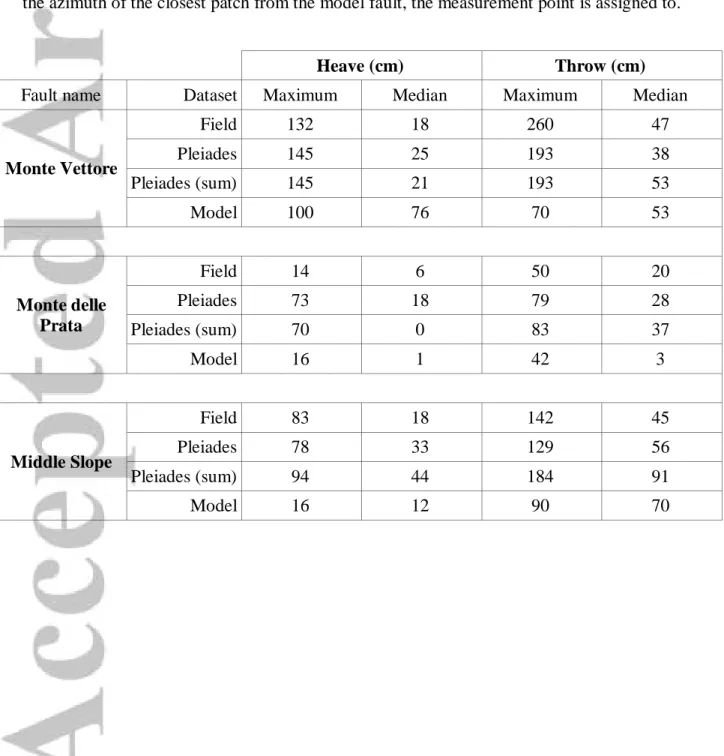
activated. In this area, measurements made in our deformation maps show a median of 25 cm for the heave and of 37 cm for the throw (ruptures in green, white and red colors in the small dashed rectangle on Figure 1b). Located on multiple sub-parallel fault strands, 15% of the heave measurements exceed 50 cm (with a maximum of 145 cm) and 9% of the throw
measurements exceed 1 m (with a maximum of 193 cm). Monte Rotondo, 6 km NE of Monte Vettore, is cut by a 1-km-long NE-dipping antithetic N40°W-striking rupture (red line on Figure 1b), on which the median values for heave and throw are equal to 36 cm and 37 cm respectively. Facing Monte Rotondo, 6 km N of Monte Vettore, Monte Porche is cut by a 1.6-km-long, N170°E-striking synthetic rupture (green line on Figure 1b), on which the median values for heave and throw are equal to 24 cm and 43 cm respectively. SW of Piano Grande, on Monte Castello, a 1.3-km-long, N140°E-striking rupture (black line on Figure 1b) was also activated, with no significant heave nor throw – the median values are equal to 1 cm and 0 cm respectively – but right-lateral strike-slip with a median value equal to 21 cm (Figure S4).
2.3 Measurements from deformation maps and comparison with field data
Systematic offset measurements are performed every 30 m along the surface ruptures mapped from optical results. These offset measurements are compared with field
observations collected between the 31 October 2016 and the 16 July 2017 (90% were collected before the 22 December 2016), consisting of 7323 records of coseismic surface rupture data (Villani, Civico et al., 2018; see Text S1 for more information about field data integration). Figures 3 and 4 show respectively the measurements of throw and heave at the surface. For each heave measurement from optical results, the strike-perpendicular direction considered is relative to the rupture local azimuth.
Three main normal fault systems are described hereafter. They are used as an input in the inversion detailed further in Section 3, where their geometry is described in more details, but they are briefly introduced here for the sole purpose of helping to describe the
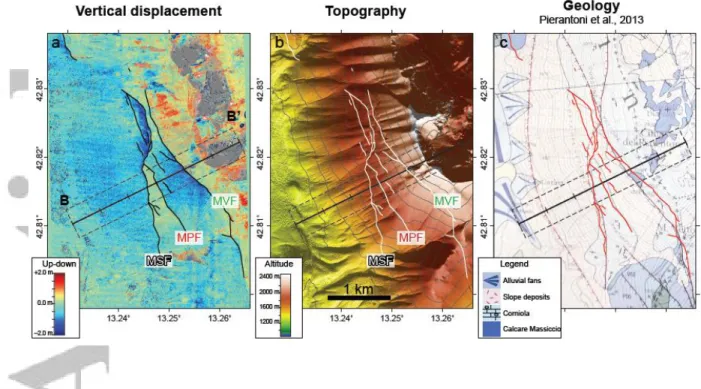
measurements. Their trace at the surface is deduced from the mapping of surface ruptures from optical results. Each mapped surface rupture is assigned to a fault system, according to the rupture dip direction (derived from the throw measurements performed on the rupture, see Figure 3) and location. The major “Monte Vettore” fault (MVF) is a west-dipping fault that reaches the surface over a length of ~12 km. It accounts for most of the seismic moment release (e.g. Cheloni et al., 2017; Scognamiglio et al., 2018). A second fault named “Monte delle Prata” fault (MPF), antithetic to the MVF, nearly intersects the MVF at the latitude of Monte Vettore, then moves westward, away from the MVF, when one goes north. The two antithetic fault systems of MVF and MPF together form an asymmetric graben-like structure at large scale (Figure 1b). A third smaller, synthetic fault, named “Middle Slope” fault (MSF), is located in the hanging wall of the MVF. The MSF intersects the MPF (see between km 12 and 13 in Figure 3a) and locally introduces further complexity in the surface
deformation signal.
The locations of the measurements made from optical results are most probably different from that of the field measurements. Thus, isolated measurements cannot be compared rigorously. We compare instead the maximum values and the median values on selected areas, to get a first order estimation of the degree of agreement between the two datasets. On the southern flank of both Monte Bicco and Monte Bove Sud, numerous
measurements of coseismic displacement were reported in the field (see between km 0 and 2 along Section A in Figure 3b), with up to 23 cm of heave (the median is equal to 0 cm) and 80 cm of throw (the median is equal to 32 cm). However, in the deformation maps, only very few offsets can be detected, around km 0.5, with four heave measurements with a median of 25 cm and one throw measurement of 4 cm. Wedmore et al. (2019) detected coseismic surface deformation due to the Norcia earthquake, on a section of the Monte Bove fault that ruptured during the 26 October 2016 Visso earthquake. The measured displacements are <10 cm and are not detectable in our horizontal and vertical deformation maps, possibly because the signal stays under the detection threshold. Moreover, the correlation score in the
horizontal deformation maps is low in the area considered in this study. This area is located ~900 m from the location of the measurements from the deformation maps reported in
Section A and ~500 m outside of the buffer zone around the mapped surface ruptures, used in our study to select the field measurements from Villani, Civico et al. (2018). Those field measurements were all collected after the 30 October Norcia event. Therefore, there is no certainty whether the ground displacements measured in the field inside our buffer zone could be related to the 30 October event. Instead, they could be related to the 26 October event, and those structures would not have been remobilized significantly during the subsequent events, as they do not appear in the deformation maps, despite field
with an ALOS-2 interferogram between 5 February and 28 October 2016
(http://www.gsi.go.jp/cais/topic161108-index-e.html; Figure S5), clearly show that the 26 October 2016 event ruptured the surface in this area. Between km 2 and 3.6 (Section B in Figure 3b), no evidence of slip on a coseismic rupture is observed at the surface, neither in the field nor in our deformation maps. However, evident surface deformation caused by shallow landslides, already documented by Villani, Civico et al. (2018), are detected. These deformations are ignored in the subsequent analysis. On the MPF, from km 3.6 to 10 (Section C in Figure 3b), slip evidence is reported in the field, which can only be partly observed in the deformation maps, where decorrelation due to temporal changes between the acquisitions and forested areas prohibit measurement in some areas. Heave reaches up to 64 cm (the median is equal to 13 cm) for field measurements and 60 cm (the median is equal to 29 cm) in the deformation maps. Throw reaches up to 140 cm (the median is equal to 40 cm) for field measurements and 118 cm (the median is equal to 36 cm) in the deformation maps. Along the MPF, for most of the measurements, the dip direction is antithetic to the dip direction of the MVF (Figure 3c). Also in Section C, facing the MPF, the MVF experienced noticeable synthetic slip. Field observations report up to 46 cm of heave (the median is equal to 8 cm), where the deformation maps show 50 cm (the median is equal to 27 cm). Throw reaches up to 100 cm for field data (the median is equal to 21 cm) and 86 cm (the median is equal to 40 cm) in the deformation maps. No measurements can be achieved in the horizontal
deformation maps for rupture #09, due to temporal decorrelation in this area. On the other hand, impact of temporal decorrelation is more limited in the vertical deformation map (see Section 2.1), thus allowing us to successfully measure throw offsets on this rupture. Around km 10, the signal seems to weaken and almost disappear along the MVF and MPF faults, with very few coseismic slip observations in the field and no signal in the deformation maps. On the MSF however, consistent series of measurements are made both in the deformation maps and in the field. From km 10 to 17 (Section D in Figure 3b), the rupture zone narrows to concentrate on the Monte Vettore western flank, as described before. Table 2 summarizes the measurements made. Figure S6 shows the throw measurements in a close-up view of the western slope of Monte Vettore. Between km 11 and 12.25, temporal decorrelation
complicates or even prohibits measurements in the horizontal deformation maps. Hence, there is no horizontal measurement on the MSF for rupture #06, on the MPF for rupture #07 and on the MVF for rupture #21. On rupture #02 of the MVF, a few horizontal measurements are considered reliable enough to be kept.
The comparison between offset measurements made from our deformation maps and field observations shows that while the two datasets are consistent for many sites, they also diverge significantly at a few locations. Along the MVF, which hosts the largest coseismic slip, field measurements tend to be consistent or larger than measurements derived from deformation maps. Along the MPF and MSF, where deformation is generally smaller, hidden in grassy mat and loose rocky soil, and cumulative scarps are more subdued, if they exist at all, offset measurements derived from deformation maps tend to be either consistent or larger than field measurements. In that configuration, field measurements might lead to
underestimation of actual fault displacement.
Hence, in the context of a complex faulting geometry, where many of the ruptures are actually small and partly masked by vegetation and loose soils, deformation measurements through image correlation, provided there is no major temporal decorrelation, might
constitute a critical dataset to better constrain the 2016 Norcia rupture process by providing a homogeneous dataset of surface-rupture measurements.
3 Joint inversion of InSAR, GPS and optical data
The 2016-2017 Italian earthquake sequence has been investigated in detail and an exceptional wealth of data has been accumulated. On one hand several studies have focused on resolving various aspects of the kinematics and dynamics of the earthquake seismic source, using seismological and/or geodetic data (e.g. Cheloni et al., 2017; Chiaraluce et al., 2017; Pizzi et al., 2017; Huang et al., 2017; Xu et al., 2017; Scognamiglio et al., 2018; Walters et al., 2018). On the other hand many groups have put their effort in common to document surface ruptures (Pucci et al., 2017; Smeraglia et al., 2017; Civico et al., 2018; Villani, Pucci et al., 2018; Perouse et al., 2018; Brozzetti et al., 2019). Combining the two approaches, however, in order to produce an earthquake source model that would satisfy both low-resolution regional-scale data and high-resolution local-scale data, remains difficult. In the next part, as we have demonstrated in the previous sections that offset measurements derived from optical image correlation compare well with field data, we will combine our high-resolution local-scale data with lower-resolution regional-scale geodetic data to propose a set of models accommodating these different datasets.
3.1 Data
In order to estimate the distribution of coseismic slip at depth, we perform a static slip inversion of the 30 October 2016 earthquake, using a combination of surface deformation maps derived from radar and optical imagery, along with displacement vectors estimated from GPS measurements. The relatively large magnitude of the 30 October earthquake, combined with a shallow depth, is adequate to achieve precise measurements of the surface deformation field using InSAR. However, due to the occurrence of two Mw~6 shocks at short
time interval (26 and 30 October), it is difficult to isolate the contribution of each single event in the InSAR signal. Furthermore, the deformation gradient close to the surface ruptures of the Mw6.5 30 October event leads to steep fringe patterns that cannot be easily unwrapped in
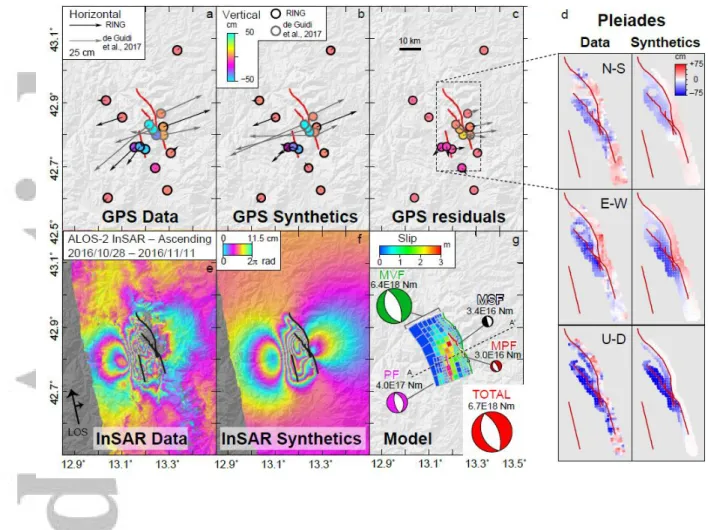
X- and C-bands (e.g. Cheloni et al., 2017). Hence, we combine two ascending ALOS-2 L-band acquisitions from 28 October and 11 November 2016 to map the line-of-sight surface deformation field associated with the 30 October 2016 (Figure 5e; Table 1). The
interferogram shows intense surface strain on the western flank of Monte Vettore, consistent with observations of surface ruptures there.
Unfortunately, no complementary descending interferogram allows for the separation of the Mw6.0 26 October and Mw6.5 30 October events. Therefore, we also incorporate the descending ALOS-2 interferogram (2016/08/31-2016/11/09) and apply a mask in the area of the Mw6.0 26 October event to ensure consistency with the rest of the dataset. Finally, in order to compare with Pleiades 3D displacement maps, we also include the quasi-east-west (E-W) and up-down (U-D) decomposition derived from two ascending and descending interferograms (e.g. Fujiwara et al., 2000) that captured both the 26 and 30 October events but not the 24 August event (2016/08/24-2016/11/02 and 2016/08/31-2016/11/09,
respectively). The area affected by the 26 October earthquake is masked in the datasets that include the contribution of this event, based on prior knowledge of the extent of the area deformed by this event (Cheloni et al., 2017; Walters et al., 2018) to ensure consistency with the rest of the dataset. This decomposition indicates that significant displacement (> 10 cm) is recorded up to distances of 7-10 km from the MVF (Figure S7), except on the vertical
component for pixels located on the footwall of the MVF, which everywhere show very little uplift (< 10 cm). Relative displacement across the fault reaches slightly more than 100 cm horizontally and approximately 80 cm vertically. Comparison with horizontal and vertical displacements from Pleiades shows an excellent agreement between the two datasets in the
distance range of 1 to 7 km away from the fault trace (Figure S7). Unfortunately, this comparison cannot be carried out near the fault trace due to decorrelation of InSAR.
GPS data covering the 30 October 2016 earthquake have been collected, processed and harmonized by the Rete Integrata Nazionale GPS (RING) group, and made available at ftp://gpsfree.gm.ingv.it/amatrice2016/static/Cosismico_30Oct2016_GPS_GdL_V1.dat (Avallone et al., 2010; Devoti, 2012). This dataset consists of a few continuous GPS stations, complemented by campaign GPS measurements at benchmarks that had been already
installed and surveyed prior to the 2016 sequence. The benchmarks were re-occupied after the 24 August 2016 earthquake and recorded the 26 and 30 October 2016 shocks. The contribution of the 30 October earthquake was isolated from continuous GPS measurements using daily solutions. This dataset covers both the footwall and the hanging wall of the main fault (Figure 5). A clear E-W extension is visible across the fault, whereas contraction is observed away from the fault. Sites located on the hanging wall exhibit a clear subsidence reaching -45 cm, whereas sites on the footwall, in spite of a very close distance from the fault trace (~2 km for site VETT) show small uplift, consistent with ALOS-2 and Pleiades results (Figure S7).
We also include the dataset published by De Guidi et al. (2017), which consists of five additional campaign sites located within 1 to 4 km away from the trace of the MVF. These benchmarks were first surveyed in early October 2016, and then re-surveyed in November 2016, so that this dataset includes the contribution of both the 26 and 30 October 2016 earthquakes. Nevertheless, the location of the De Guidi et al. (2017) network is mainly centered on the area where the most prominent surface ruptures of the Mw6.5 30 October
2016 were observed, whereas the Mw5.9 26 October 2016 event appears to be located further
to the north (Figure S5). Therefore, in first approximation, we may consider that this dataset mainly captures coseismic deformation due to the 30 October earthquake. Similar to the RING dataset, horizontal extension is recorded close to the fault, with a maximum of 86 cm relative horizontal displacement between sites VTW1 and VTW5. Up to -77 cm of
subsidence are measured on the hanging wall, whereas less than 10 cm of uplift are measured on the footwall. In spite of its potential limitations (contribution of the 26 October earthquake and potential post-seismic signal), thanks to its exceptionally close location with respect to the surface ruptures, the GPS data from De Guidi et al. (2017) allow for validating the deformation field derived by ALOS-2 and Pleiades in the very near field (Figure S7).
Overall, the ALOS-2 dataset allows for accurately measuring displacement in the mid- and far-field of the earthquake (i.e. > 1 km from the fault), thereby illuminating the slip distribution at depth, whereas the Pleiades dataset covers the mid- and near-field (i.e. < 5 km from the fault), providing information about slip at shallow depth and at the surface. On the other hand, GPS data bring a strong reference frame to the dataset, effectively constraining the maximum extension of slip at depth, as well as the main features of the seismic moment tensor of the earthquake.
3.2 Methods
The inversion is carried out using the Classic Slip Inversion (CSI) package (Jolivet et al., personal communication) using a standard approach whereby surface displacement is modeled by superimposing elementary displacement field due to rectangular dislocations embedded in a linear elastic homogeneous isotropic halfspace, using Okada (1985)'s
equations. We first decimate the ALOS-2 and Pleiades deformation maps using a quad-tree algorithm (e.g. Grandin et al., 2009) (Figure S8). ALOS-2 InSAR data are resampled to a homogeneous 1 km posting in the area within 15 km of the epicenter and to 8 km posting beyond. ALOS-2 quasi-E-W and U-D decompositions are resampled to 2 km posting close to
the fault, and 8 km further away. Both datasets are masked within 1 km of the surface trace of the MVF, MSF and MPF, in order to avoid incorporating unwrapping errors. Pleiades data (E-W, N-S and U-D) are downsampled to 0.5 km posting, keeping only measurements made within 1 km of the trace of the coseismic surface rupture, in order to fill the measurement gap in the ALOS-2 dataset. The total number of data points after decimation is 1327 points for the ALOS-2 interferograms, 316 points for the ALOS-2 quasi-E-W and U-D decompositions, and 1055 points for the Pleiades data. ALOS-2 quasi-E-W and U-D decompositions, which may be subject to larger uncertainties due to assumptions in the decomposition (e.g. N-S displacement is assumed to be negligible), are therefore underweighted in the overall dataset in order to avoid a propagation of errors in the inversion. For both ALOS-2 and Pleiades data, we estimate a variance-covariance matrix by computing the empirical semi-variogram fitted with an exponential model, excluding the area of significant deformation (e.g. Lohman & Simons, 2005).
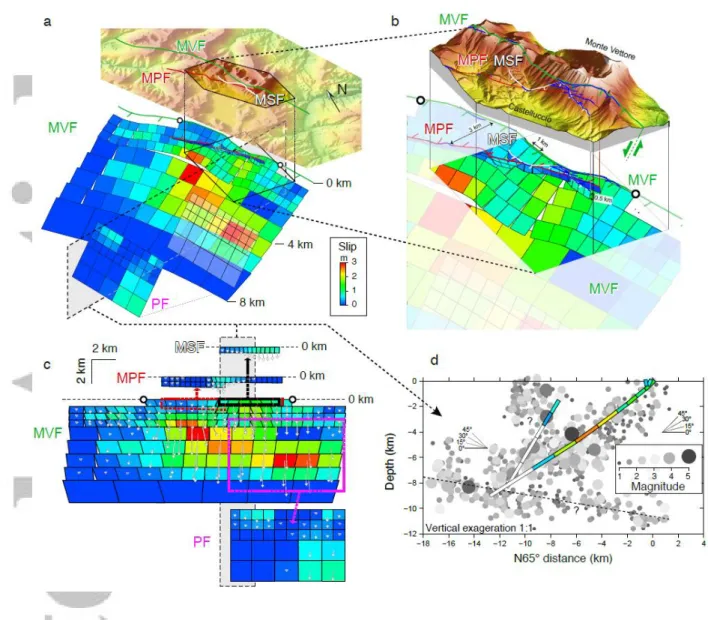
In the inversion, fault geometry is fixed, and has to be determined beforehand. We find that at least four faults (Figures 5 and 6) are necessary to explain the observations:
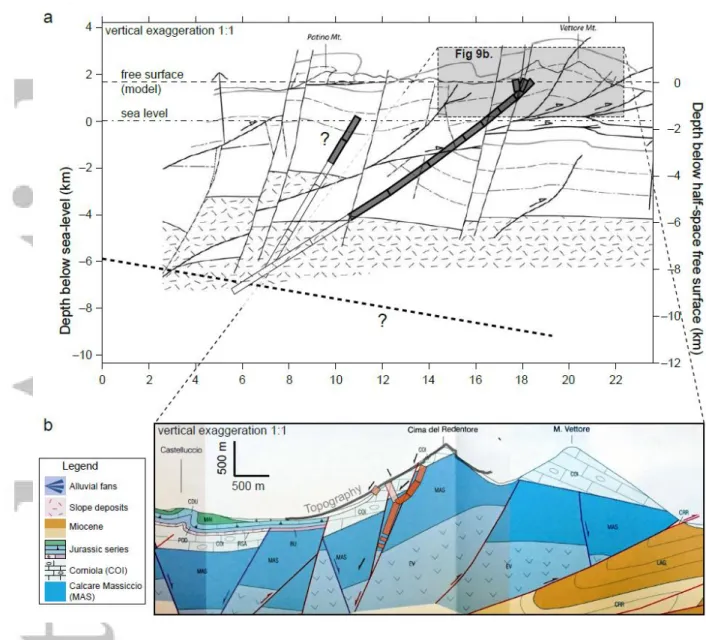
1. The main west-dipping “Monte Vettore” fault (MVF), which concentrates most of the slip. The “Monte Vettore” normal fault is ~20-km-long with a mean strike of N150°E. Its ruptured part at the surface is ~12-km-long. On the Monte Vettore western flank, this fault is characterized by (1) a conspicuous topographic slope break, (2) a nearly vertical free face, locally designated as “Cordone del Vettore”, and (3) an
unconformity between Corniola (Jurassic) limestone uphill and slope deposits downhill (Pierantoni et al., 2013). To better fit the mapped rupture at the surface while keeping a simple geometry at depth, the fault is divided into two sub-faults: (1) a shallow part from 0.05 to 2.5-km-depth – the fault does not reach surface in the model to avoid unrealistic elastic overshoot within ~100 m of the fault trace –, dipping toward the W at 40°, divided in 1 by 1 km patches and that follows the wavy trace of the rupture, and (2) a deep part from 2.5 to 8-km-depth, with a simpler along-strike curvature, dipping toward the W at 35°, divided in 2 by 2 km patches in its upper part and in 4 by 4 km patches along its bottommost row. The dip angle of our fault is consistent with the dip of ~38° toward the SW calculated by averaging moment tensor solutions of the 30 October earthquake from a collection of publicly available sources (Figure S9). In cross section, this fault follows the west-dipping plane highlighted by the aftershock distribution and terminates near its intersection with the east-dipping decollement level inferred at 8-10 km (Chiaraluce et al., 2017) (Figures 6d and S10). We find that a dip angle steeper than 35-40° fails to explain the horizontal:vertical displacement ratio on the hanging wall, while producing excessive uplift on the footwall. For a better stability of the inversion, slip at the surface is prevented in areas where no surface ruptures were detected in the field or in the Pleiades data. This constraint is implemented by removing the uppermost row of patches beyond the along-strike interval where surface ruptures are present (black filled circles in Figures 5g and 6).
2. A conjugate east-dipping fault, named “Monte delle Prata” fault (MPF), corresponds to a secondary fault that produced discontinuous surface rupture to the W of the main surface rupture. Field observations and imagery concur to a dip toward the E for this fault. This conjugate fault, of mean strike N60°W, outcrops at a distance as short as 500 m away from the main fault in its southern part, and progressively gets further toward the N, up to 2 km at its termination. Horizontal:vertical ratio along the rupture suggests a variable dip along-strike, from steep to the S to shallow to the N. Due to its proximity to the main fault, the MPF is extended from the surface down to 0.5 km
with a dip of 85° in its southern part, and down to 1 km with a dip of 40° in its northern part. The fault is divided into 0.5 by 0.5 km patches.
3. A west-dipping fault, hereafter called “Middle Slope” fault (MSF), located in the hanging wall of the MVF, is inferred from detailed analysis of surface ruptures and deformation visible in Pleiades data on the western flank of Monte Vettore (Figures 1 and 2). This fault has a complex, discontinuous trace, and even intersects the east-dipping MPF, producing a horst-and-graben feature depending on whether the two faults are dipping away from or toward each other. In spite of an apparently steep dip near the surface, the vertical component of displacement across the fault seems to decay sharply at very short range (< 200 m if we look at the portion of the rupture between N42.82° and N42.83°; see Figure 2), whereas the horizontal component of relative displacement across the fault dominates further away. As discussed later in Section 4, this fault is interpreted as a very shallow structure (< 500 m in extent at depth) that cannot be fully accounted for by the present joint inversion. Nevertheless, in order to simulate the offset visible in the Pleiades imagery along the trace of the MSF, the fault is described by a single row of 0.5 by 0.5 km patches. The fault is given a steep dip (80°) in consistency with direct measurements made in the field (Section 2.3). However, after testing several geometries for the MSF, we notice that slip distribution on the MSF recovered by the inversion is not very sensitive to the dip angle. This suggests that details of the deformation in the vicinity of this fault are not fully restituted by our downsampling procedure. This specific point will be further discussed in Section 4.
4. Finally, the “Patino” fault (PF), dipping toward the W, is necessary to explain the fringe pattern visible in ALOS-2 data between the Castelluccio and Norcia plains (Figures 5e and S5b). Previous studies have disagreed on the actual dip direction of the fault. In their static inversion, Walters et al. (2018) choose an E-dipping fault, as suggested by an alignment of aftershocks, and include an additional N220°-trending fault bounding the southern part of the Castelluccio basin (also named “Piano Grande”). Scognamiglio et al. (2018) include a N210°-trending fault in their
kinematic inversion. Cheloni et al. (2017) showed that available geodetic data do not allow to constrain the detailed geometry of this blind fault. In particular, a conjugate plane dipping toward the E would achieve a similar success in explaining InSAR and GPS observations. We here choose to fix the dip of the PF to 60° toward the W (i.e. synthetic to the MVF), so that the along-dip projection of the fault plane at the surface corresponds to the diffuse ruptures mapped along the western side of the Castelluccio plain (Villani, Civico et al., 2018). This fault geometry is broadly consistent with a secondary concentration of seismicity in the hanging wall of the main MVF (Figures 6d and S10). We set the lower edge of this fault to 8 km, i.e. near the intersection with the MVF. The fault is divided into 0.5 by 0.5 km patches in its upper part, and 1 by 1 km patches near the bottom.
This geometry is simplified compared to the mapping of surface ruptures (i.e.
discontinuous ruptures are considered continuous; rupture traces are smoothened; some minor ruptures are ignored). The continuity of a fault in the model does not imply that the faults are continuous in reality: the aim of the chosen geometry is to intersect all surface ruptures mapped at the surface, while retaining a reasonable complexity of the model. Nevertheless, its coarser resolution is consistent with the size of the defined patches.
The inverse problem is solved by means of a non-negative least-squares algorithm (Lawson & Hanson, 1995). For all fault planes, both dip-slip and strike-slip are inverted.
However, in order to avoid unrealistic rake values, the slip direction in map view is forced to remain within ± 15° from a mean azimuth of N70°E for all faults. Due to the variable strike angle along the fault trace, the rake angle is adjusted accordingly, so as to satisfy the
prescribed range of azimuth for the horizontal component of slip. We checked that allowing for a broader range of possible slip directions (e.g. ± 45°) only marginally impacts the final, estimated slip distribution. Slip roughness is controlled by a model covariance matrix filled with an exponential function, and scaled by a meta-parameter that allows for tuning the smoothness of the slip distribution (e.g. Radiguet et al., 2011). Smoothing only applies to patches belonging to the same fault. The value of the meta-parameter is fixed by an L-curve criterion (Figure S11). In addition to slip, a 2D ramp is adjusted on each dataset to account for unmodeled large-scale signal (e.g. orbital errors or atmospheric artifacts for the InSAR dataset, inaccuracies in the compensation of the platform attitude for the Pleiades dataset).
3.3 Inversion results
3.3.1 Slip distribution at depth
One of our concerns is to obtain a model that can reconcile at best data of different resolutions, at both far-field and near-field scales, and especially the high-resolution
measurements made from Pleiades close to the ruptures. Figure 5 shows the slip distribution obtained after running the inversion procedure, as well as the fit to the ALOS-2 InSAR, Pleiades and GPS data (Figure S8 shows misfits to all imagery datasets). The best model yields a good fit to ALOS-2 and GPS data (> 85% variance reduction). Residual GPS
displacements are generally less than 5 cm, except for GPS measurements located close to the trace of the MVF where a systematic ~15 cm residual eastward motion is observed on both sides of the fault (Figure 5c). Residuals to the Pleiades dataset also yield similar values, with a standard deviation of 14 cm and 19 cm for the E-W and N-S components, respectively (Figure S8). The standard deviation of residuals for the Pleiades vertical component is higher (24 cm), which is consistent with the higher level of noise visible in cross-sections (e.g. Figure 2).
Residual displacements at close distance from the fault are likely due to the relatively low degree of detail of the model resulting from the combination of data downsampling, finite patch size (0.5 km), and smooth slip. On the other hand, surface displacement modeled with the synthetic slip distribution achieves a reasonable fit to the InSAR and GPS data at distances > 1.0 km from the trace of the MVF, as shown in Figure S7. We however note that the misfit on the ascending ALOS-2 InSAR data (standard deviation of 4 cm) is better than on the descending ALOS-2 InSAR data (standard deviation of 6 cm), which contains maximum residual misfits reaching up to 15 cm. This difference likely stems from the fact that the ascending geometry has a line-of-sight vector nearly perpendicular to the MVF fault plane, hence is less sensitive to coseismic deformation. For both line-of-sight directions, the InSAR misfits are concentrated on intermediate-wavelength features of the deformation field (~15 km), in particular around the S and W sides of the Piano Grande / Castelluccio basin. Residual misfits likely reveal second-order discrepancies between the idealized setup chosen in our inversion and the actual fault geometry at depth. These shortcomings suggest that the geometry of secondary faults not reaching the surface in the hanging wall of the main MVF, especially those located between the Castelluccio and Norcia basins, such as the PF, is poorly constrained. In fact, these secondary structures are modeled with a broad range of
configurations in previous studies relying on InSAR and/or GPS data (see Cheloni et al., 2017; Scognamiglio et al., 2018; Walters et al., 2018), which reflects a persistent ambiguity in the determination of the geometry and kinematics of these blind faults. Nevertheless, residuals on the InSAR data are mostly restricted to > 2 km from the main W-dipping MVF
fault trace, hence do not massively affect our conclusions on the fault geometry and
distribution of slip at shallow depth on the main MVF. We conclude that, although the model does not capture the full complexity of the rupture at depth, the fault geometry and slip distribution are appropriately described at first-order.
In our preferred model, most of the seismic moment is released on the MVF (6.4×10¹⁸ Nm), with slip reaching a maximum of 3 m at depth (Figures 6d and S10). Small amounts of slip (< 1 m) are also recovered on the Patino, Middle Slope and Monte delle Prata faults, where the seismic moment released accounts for ~6%, ~0.5% and ~0.5%, respectively, of the moment released on the MVF. The total scalar seismic moment is 6.7×10¹⁸ Nm, equivalent to a moment magnitude of Mw6.5.
Slip on the MVF is mainly concentrated in the depth range between 2 and 6 km under the free surface of the model. Slip on the MVF reaches up to 3 m and decreases toward the surface to ~1.5 m, as illustrated in Figures 6 and S10. This result is consistent with other analyses available in the literature (e.g. Cheloni et al., 2017; Walters et al., 2018).
This behavior is constrained by the observation of a “concavity” in the vertical
deformation field, with the maximum subsidence of the surface of the hanging wall occurring ~3 km away from the surface trace of the MVF (Figure S7b). Such a feature would not be observed if slip were distributed uniformly on the fault plane from a depth of ~10 km up to the surface, as demonstrated by forward tests conducted using simplified slip distributions (Figure S12). We checked that a uniform-slip distribution would result in a varying subsidence of the hanging wall, which would monotonously increase from the far-field toward the surface trace of the fault, reaching a maximum at the fault trace that is inconsistent with observations. On the other hand, the “concavity” observed in the vertical component of deformation ~3 km away from the fault trace can be reproduced if slip decreases from the bottom of the fault toward the surface.
This decrease of slip toward the surface is also consistent with ALOS-2 observations (Figure 5e), which shows a maximum line-of-sight change (corresponding to motion away from the satellite) occurring W of the surface trace of the modeled PF. Although ALOS-2 InSAR measurement also includes the influence of the E-W deformation, forward
reprojection of the modeled deformation field indicates that this contribution cannot explain this “concavity”, which instead mainly originates from the vertical component (Figure S12).
We note that a similar “concavity” in the hanging wall, occurring 1-2 km from the fault trace, was also observed in the case of the 24th August 2016 M6.0 Amatrice earthquake using ascending and descending InSAR data. It has been the subject of a specific analysis by Tung & Masterlark (2018), who used finite-element modeling to test whether this
“concavity” could be explained by (1) a decrease of coseismic slip toward the surface, (2) variations of elastic properties of rock as a function of depth, or (3) a curvature of the fault plane. The authors concluded that accounting for realistic properties of rock and variable dip at depth cannot explain this feature, which, in turn, reveals the existence of a tapering of slip toward the free surface, akin to the shallow slip deficit effect documented for several
instances of continental strike-slip ruptures (e.g. Fialko et al., 2005; Xu et al., 2016). This tapering effect is commonly observed for most shallow normal-faulting earthquakes, as for the 1997 M6.0 Colfiorito earthquake (Lundgren & Stramondo, 2002), the 2009 M6.1 L'Aquila earthquake (Walters et al., 2009), the 2006 M7.0 Mozambique earthquake (Raucoules et al., 2010; Copley et al., 2012) or the sequence of five earthquakes with
magnitudes ranging from M5.9 to M7.1 that occurred in 2008 on the Tibetan plateau (Elliott et al., 2010).
We conclude that the imagery and GPS data for the 30 October 2016 earthquake are consistent with coseismic slip reaching a maximum of 3 m near ~4 km depth and decreasing to only ~1.5 m at the surface (Figures 6d and S10). We also suggest that this shallow slip deficit effect is common to many normal-faulting earthquakes with magnitudes M<7.1, as revealed by high-quality InSAR data.
3.3.2 Comparison of the model prediction with surface offsets from Pleiades and from field measurements
Figure S13 compares the Pleiades heave measurements at the surface with the slip provided by the model at the surface, each Pleiades measurement being projected according to the azimuth of the corresponding model patch. In the same way, the lateral slip (i.e. strike-slip) at the surface is shown in Figure S14 and the throw at the surface is represented in Figure S15. As mentioned previously, for a better stability of the model, the modeled MVF only reaches the surface between distance along the baseline from km 3.6 and km 16. Considering the coarser resolution of the slip patches and the constraint to generate a model consistent at multiple scales, slip observed in the deformation maps from Pleiades and in field data is successfully reproduced at first order (Figure S7).
In Section C (initially defined in Figure 3b), on the MVF, heave deduced from the model and observed in the Pleiades data and in the field (the median values are equal to 20 cm, 27 cm and 8 cm respectively; the maximum values are equal to 51 cm, 50 cm and 46 cm respectively) are in relatively good agreement (see Figures 4 and S13). The median of the throw measurements from Pleiades, with 40 cm, is about twice the ones deduced from the model (14 cm) and observed in the field (21 cm) (see Figures 3 and S15). The maximum throw values measured in Pleiades and in the field (86 cm and 100 cm respectively) are in good agreement, while, in the model, throw culminates at 36 cm only, in this section. On the “Monte delle Prata” antithetic fault, heave deduced from the model, with a median equal to 4 cm, is in relatively good agreement with the field data (13 cm) whereas the Pleiades data show 29 cm. The maximum heave values measured in Pleiades and in the field (60 cm and 64 cm respectively) are very similar, while the model reaches 28 cm at most. A slip deficit is observed in the model for throw – the median is equal to 6 cm for 36 cm and 40 cm for the Pleiades and field data, respectively. Around km 10, the model shows no slip waning on the MVF.
For Section D, to make the Pleiades measurements comparable with the model, cumulative slip along the baseline shown in Figure 3a is computed (Figures S13, S14 and S15). Again, the measurements are divided into three geographical zones corresponding to the MVF, MSF and MPF. For each zone, measurements made on the deformation maps are added up whenever they are distributed on multiple ruptures (see Figure S16 for a description of the method used). The results appear on Figure S13 for the heave, Figure S14 for the lateral slip and Figure S15 for the throw. Maximum and median amplitudes are reported in Table 2. For the “Monte Vettore” west-dipping fault, the median of the heave deduced from the model, with 76 cm, is 3.6 times the cumulative heave from Pleiades. The Pleiades and field measurements (21 cm and 18 cm respectively) are in good agreement. The medians of the throw measurements are similar between the model (53 cm), Pleiades (53 cm) and the field (47 cm). On the “Monte delle Prata” antithetic fault, the three datasets show little slip in the horizontal, strike-perpendicular direction. In the vertical direction, the model shows very little slip, whereas slip observed in Pleiades has a median of 37 cm. Concerning the “Middle Slope” synthetic fault, heave deduced from the model, with a median of 12 cm, is less than 30% of the Pleiades cumulative heave (44 cm). The median of the throw measurements from
Pleiades (91 cm) is in relatively good agreement with the one deduced from the model (70 cm).
4 Significance of deformation at close distance from the surface ruptures
The Mts. Sibbilini area is affected by a complex network of surface ruptures
associated with the 2016 Norcia earthquake, which locally recorded a large amount of slip at the surface (maximum ~2 m). The slip inversion described in the previous section does not aim at reproducing this small-scale variability. As discussed in Section 3, throw at the surface however appears to vary smoothly along-strike at the kilometric scale (Figure S15). This feature is correctly captured by the inversion, which suggests that broad-scale along-strike variations of slip at depth are well resolved by the inversion.
On the other hand, significant off-fault deformation is also observed across-strike, within a few hundred meters of fault ground ruptures. Figure 2c shows that up to 40 cm of horizontal shortening occurs 200 m to the W of the MSF, i.e. in the hanging wall of the main west-dipping MVF (blue dashed line in Figure 2c). Similarly, Figure 2b (see also Figure 7) shows that the subsidence of the hanging wall increases dramatically near the surface rupture of the MVF, reaching 80 cm over a distance of 500 meters.
This off-fault deformation, visible at short distance from surface ruptures, has important implications: if interpreted within the framework of linear elasticity, this small-scale deformation points to a complexity of the fault geometry and/or to a variability of coseismic slip at shallow depth (< 500 m). This is in keeping with the dip of the faults measured at the surface (50°-80°) and the short distance between the sub-parallel fault traces of the main faults (100-500 m): based on these values, a downward prolongation of the fault planes leads to an intersection of the fault strands at depths no greater than 500 m (see e.g. the cross-sections of Figure 4 in Brozzetti et al., 2019). Therefore, it is tempting to interpret these off-fault deformation signals as resulting from geometric complexities associated with fault connection in the shallow sub-surface. These complexities cannot be accounted for by the large-scale slip inversion developed in Section 3 and they require a specific modeling strategy.
In the following, we concentrate on a 3-km-long profile crossing the western slope of Monte Vettore. This profile is located where surface ruptures are best documented and where the Pleiades dataset shows the clearest off-fault deformation signal (Figure 7). In addition, unlike farther N, the profile intersect the fault strands in an area where individual faults are separated by a distance large enough (several hundred meters) to make the off-fault
deformation interpretation easier. This cross-section roughly corresponds to the cross-section D-D’ in Figure 4 of Brozzetti et al. (2019). Slip on the MSF and MPF leads to the formation of a ~150 m-wide horst within the hanging wall of the main MVF, which intersects the surface 500 m to the E. The outcropping of the Corniola formation between the MSF and the MPF (Figure 7c) is exempt from the scree covering the slope elsewhere. This observation and the fact that this horst-like feature is already visible in the pre-earthquake DSM (Figure S17) both indicate that similar deformation patterns already happened in the past. Thus, the rupture complexity across the western slope of Monte Vettore mostly reflects long-lasting fault complexity at shallow depth.
In order to decipher these small-scale deformation signals, we adopt a forward
modeling strategy, with the aim of determining the best fault geometry and slip distribution at shallow depth that would reproduce our observations. Obviously, this approach is subject to non uniqueness and should be interpreted with caution. Individual models are not necessarily representative of the full range of models providing a good fit to the data, but rather reflect
particular model configurations that satisfy the observations, hence indicating possible scenarios.
We test a range of scenarios using Okada's equations, assuming that deformation occurs in 2D within a vertical plane (i.e. no motion occurs horizontally along-strike, which is equivalent to an assumption of plane strain). At the surface, we include three dislocations representing, from E to W, the MVF, MPF and MSF, respectively. To facilitate the parameters space exploration, we fix the intersection of these three faults with the surface based on the locations of the steps measured in the displacement profile (Figure 8). For each step, we measure the horizontal and vertical relative displacement across the fault and we compute the corresponding dip angle and slip magnitude, making the assumption that relative displacement is due to pure dip-slip. These geometric parameters are listed in Table S4. Since the MVF and MPF form a ~500 m-wide graben, they can be inferred to intersect at shallow depth (< 1 km). Assuming that the two faults connect at depth into a third fault extending downward, the dip angle and slip magnitude on this third fault can be calculated based on the assumption that slip vectors form a closed triangle, akin to kinematic reconstructions on triple junctions (Caskey, 1995). This assumption allows for interpreting residual deformation in terms of departure from a rigid behavior. Taking into account the dip of these two faults (69° and 67°, respectively), as well as the magnitude of the two slip vectors (121 cm and 48 cm, respectively), we find a dip of 47° and a slip magnitude of 93 cm for the third fault, hereafter named “dislocation D” (see inset in Figure 8, scenario 1). This dislocation is then assumed to connect to a deeper dislocation that accounts for the large-scale deformation induced by slip on the deeper parts of the MVF. This deep dislocation, hereafter named “dislocation E”, is modeled as a 35°-dipping fault, with a dip-slip of 1.5 m and an along-dip width of 5 km. These values are taken from the average features of the slip model derived from the inversion in coincidence of the fault section profile. We checked that short-spatial-wavelength
deformation patterns along the profile are largely insensitive to the parameters of this dislocation. By trial and error, we fix the along-dip width of the dislocation D (connecting updip with Monte Vettore and Monte delle Prata dislocations, and downdip with dislocation E) to 0.5 km. On the other hand, the MSF, with a dip of 53° toward the W according to surface measurements from our Pleiades deformation maps, is difficult to root into any clearly identified deeper structure based on our observations only. Finally, for the Middle Slope dislocation, we are left to explore only one parameter, namely its along-dip width.
As our objective is to accurately model surface deformation within a zone of ± 1 km around the surface ruptures, it is necessary to take into account the local topography in the calculations (e.g. Tinti & Armigliato., 2002). Indeed, the western flank of Monte Vettore is characterized by a pronounced slope toward the W, reaching 25° on average and up to 45° toward the summit. Due to this steep topography, the faults cut the free surface at different altitudes, and they intersect each other at a significantly different depth and location compared to a situation where the surface would be assumed as horizontal. This eventually affects the pattern of deformation at surface and violates the boundary conditions of a horizontal free surface in Okada's equations. Although a more advanced modeling strategy would be required to accurately account for topography, it is possible to account in first approximation for the effect of a uniformly sloping free surface by rotating Okada’s
equations. In practice, we rotate all fault dips 25° clockwise so that the relative angle between the free surface and the fault plane is simulated, instead of the dip angle, which represents the angle with respect to a horizontal reference surface (Figure S18a). In the simulation, east-dipping faults (respectively west-east-dipping faults) are therefore modeled with a steeper (respectively shallower) dip angle relative to the model free surface. In a final step, after the forward simulation has been computed, we rotate the coordinate system back by 25°
clockwise in order to convert surface-parallel and surface-perpendicular displacements into horizontal and vertical displacements (Figure S18b).
Finally, we present two extreme scenarios for the down-dip width of the MSF (Figure 8). The first scenario (1) assumes a width of 0.7 km. In this scenario, the first-order long-spatial-wavelength features of the deformation field appear to be correctly reproduced, as well as the “steps” induced by the three faults intersecting the surface. This similarity is explained by the fact that the model takes into account the slip vectors of the three faults that can be directly measured from the 3D Pleiades measurements. Due to the slip vector triangle closure assumption, the modeled deformation field is, in first approximation, consistent with rigid block motion, except in the vicinity of the surface projection of the down-dip edge of the MSF. As a result, residual deformation (i.e. observed minus modeled) highlight
departures from the rigid behavior.
We however notice that substantial near-fault short-scale deformation patterns remain unexplained by this first-order model. In particular, both in the footwall and the hanging wall of the MSF, a sharp E-W deformation gradient is not reproduced (yellow ellipse in Figure 8, scenario 1). This gradient may be explained by a source of strain (i.e. the bottom of the MSF dislocation) situated at shallower depth than in the model of scenario 1. In a second scenario (2), the width of the MSF is therefore shortened to 0.15 km only, which successfully
reproduces the location and magnitude of this residual deformation pattern. A sharp
subsidence signal is also produced in the hanging wall of the MSF, within 150 m of the fault trace, which is consistent with the observations from Pleiades (see also Figure 2). This finding indicates that the MSF roots at very shallow depth (< 200 m), in spite of the
prominent offset measured across its trace at the surface (~1 m dip-slip, see Figure S15). This is in keeping with the difficulty to infer a potential connection between this west-dipping fault and the two other faults mapped in the area.
It is worth mentioning that, along the MSF, dip values deduced from the field measurements (~70-90°; Figure S19a) are significantly steeper than the ones deduced from Pleiades (53° at the location of the profile considered here; Figure S19b). A satisfying fit to the data, though not as good as in scenarios 3 and 4, is obtained by modeling dislocation C with a dip of ~80°. In this case, the horizontal signal observed in the data requires the addition of an opening component on dislocation C, which generates ~45 cm of opening and ~80 cm of dip-slip. In any case, to produce the localized subsidence (< 200 m) and
contraction (< 500 m) in the hanging wall, dislocation C has to remain very short and shallow.
In spite of the improvement brought by scenario 2, a significant residual pattern still remains on the vertical component. Residual uplift occurs near the trace of the MPF, whereas residual subsidence occurs near the trace of the MVF, due to an unmodeled gradient of vertical deformation within 400 m to the W of the trace of the MVF (orange ellipse in Figure 8, scenario 2). This residual cannot be explained by a dislocation intersecting the surface, since no break is observed in the signal, which appears to be smooth and continuous. Neither would a steeply-dipping normal fault (whether dipping toward the E or the W) explains the signal, because it would only produce one “concavity”, but would not explain the uplift signal. After conducting several tests, we came to the conclusion that this residual pattern can only be explained by dip-slip occurring on a dislocation dipping approximately parallel to the free-surface. In a third scenario (3), keeping the same parameters as in scenario 2, we
introduce an additional dislocation, hereafter named “F”, dipping 20° toward the E, i.e. at 5° from the average local topography, and slipping by 1 m. The depth of this fault is not well constrained, but has to be less than 250 m to reproduce the observed gradient of the residual