NodeSketch: Highly-Efficient Graph Embeddings
via Recursive Sketching
Dingqi Yang
1, Paolo Rosso
1, Bin Li
2and Philippe Cudre-Mauroux
11
University of Fribourg, Switzerland, {firstname.lastname}@unifr.ch;2Fudan University, China, [email protected]
ABSTRACT
Embeddings have become a key paradigm to learn graph represen-tations and facilitate downstream graph analysis tasks. Existing graph embedding techniques either sample a large number of node pairs from a graph to learn node embeddings via stochastic op-timization, or factorize a high-order proximity/adjacency matrix of the graph via expensive matrix factorization. However, these techniques usually require significant computational resources for the learning process, which hinders their applications on large-scale graphs. Moreover, the cosine similarity preserved by these techniques shows suboptimal efficiency in downstream graph anal-ysis tasks, compared to Hamming similarity, for example. To ad-dress these issues, we propose NodeSketch, a highly-efficient graph embedding technique preserving high-order node proximity via recursive sketching. Specifically, built on top of an efficient data-independent hashing/sketching technique, NodeSketch generates node embeddings in Hamming space. For an input graph, it starts by sketching the self-loop-augmented adjacency matrix of the graph to output low-order node embeddings, and then recursively gener-atesk-order node embeddings based on the self-loop-augmented adjacency matrix and (k-1)-order node embeddings. Our extensive evaluation compares NodeSketch against a sizable collection of state-of-the-art techniques using five real-world graphs on two graph analysis tasks. The results show that NodeSketch achieves state-of-the-art performance compared to these techniques, while showing significant speedup of 9x-372x in the embedding learning process and 1.19x-1.68x speedup when performing downstream graph analysis tasks.
CCS CONCEPTS
•Information systems → Data mining; Web applications;
KEYWORDS
Graph embedding, Recursive sketching, Data independent hashing
ACM Reference Format:
Dingqi Yang, Paolo Rosso, Bin Li and Philippe Cudre-Mauroux. 2019. NodeSketch: Highly-Efficient Graph Embeddings via Recursive Sketching. In The 25th ACM SIGKDD Conference on Knowledge Discovery and Data Mining (KDD ’19), August 4–8, 2019, Anchorage, AK, USA. ACM, New York, NY, USA, 11 pages. https://doi.org/10.1145/3292500.3330951
Permission to make digital or hard copies of all or part of this work for personal or classroom use is granted without fee provided that copies are not made or distributed for profit or commercial advantage and that copies bear this notice and the full citation on the first page. Copyrights for components of this work owned by others than ACM must be honored. Abstracting with credit is permitted. To copy otherwise, or republish, to post on servers or to redistribute to lists, requires prior specific permission and/or a fee. Request permissions from [email protected].
KDD ’19, August 4–8, 2019, Anchorage, AK, USA © 2019 Association for Computing Machinery. ACM ISBN 978-1-4503-6201-6/19/08....$15.00. https://doi.org/10.1145/3292500.3330951
1
INTRODUCTION
With the increasing prominence of graph (network) data in real-world scenarios such as online social networks, biological networks and communication networks, graph embeddings (a.k.a. network embeddings) have become a key paradigm to learn node represen-tations from a graph [3]. Specifically, these techniques represent each node in a graph as a feature vector, while still preserving key structural properties of the graph (mostly topological proximity of the nodes). Based on such node embeddings, downstream graph analysis tasks, such as node classification and link prediction, can be easily performed.
However, existing graph embedding techniques usually face computational challenges in the embedding learning process, and become inefficient when tackling large graphs. In the current lit-erature, existing techniques can be roughly classified into two cat-egories, i.e., graph-sampling based techniques and factorization-based techniques. First, graph-sampling factorization-based techniques such as DeepWalk [23], Node2Vec [9], LINE [26], SDNE [30] or VERSE [29] sample node pairs (directly or using random walks) from an input graph and design specific models to learn node embeddings from those samples via stochastic optimization. To ensure the quality of the learnt node embeddings, these methods usually sample a large number of node pairs, and thus require significant computational resources (CP U time in particular). Second, factorization-based techniques such as GraRep [4], HOPE [22] and NetMF [24] learn node embeddings directly from the high-order proximity/adjacency matrix of an input graph using matrix factorization. These methods usually require significant computational resources also (both CP U time and RAM) due to expensive matrix factorization operations. These computational challenges indeed hinder the application of many of those techniques on large-scale graphs (see Section 4.2 for more details).
Moreover, the learnt node embeddings from the above techniques also face computational challenges when being used in downstream tasks, in particular for tasks heavily involving similarity computa-tion between node embeddings. A typical example is link prediccomputa-tion, which tries to predict potential links between pairs of nodes in a graph. For a given graph, it requires to compute the similarity be-tween all pairs of disconnected nodes in the embedding vector space, and then to rank the node pairs according to their similarity. In the current literature, most of the existing graph embedding techniques measure node proximity using cosine distance (or dot product after normalization). However, cosine distance is known to be slow compared to other techniques. A recent work [18], for instance, applied learning-to-hash techniques [31] to graph em-bedding problems to learn node emem-beddings in Hamming space, and showed that using Hamming distance is able to speedup the KNN search (which heavily involves similarity computations) by
4x-10x compared to cosine distance. Despite this clear computa-tional advantage of Hamming distance in downstream tasks, the graph embedding technique proposed by [18] still undergoes ex-pensive matrix factorization operations, resulting in an inefficient embedding learning process (see Section 4.4 for more details).
Against this background and to address the above computational challenges, we explore data-independent hashing (i.e., sketching1) techniques [6] to efficiently and effectively solve the graph embed-ding problem. Specifically, sketching techniques use randomized hashing functions to create compact and fixed-size sketches for the original high-dimensional data for fast similarity approximation in Hamming space. Different from learning-to-hash techniques [31], which are data-dependent and learn dataset-specific hash functions, data-independent sketching techniques use randomized hashing functions without involving a learning process on a dataset, which is often much more efficient. However, it is not straightforward to directly apply existing sketching techniques such as minhash [2] or consistent weighted sampling [20], to the graph embedding problem due to the requirement of considering high-order prox-imity in graph embedding problems. More precisely, it has been widely shown that considering high-order proximity is of particular importance in learning high-quality node embeddings from a graph [4, 18, 22, 24]. While directly applying sketching techniques to the adjacency matrix of a graph captures low-order node proximity only, a straightforward extension to capture high-order proximity is to sketch the high-order adjacency/proximity matrix of the graph, measured by Katz index [22] or a high-order transition matrix (used for random walks in a graph) [4] for example. However, involv-ing such high-order adjacency matrices dramatically increases the complexity of the process, since 1) the computation of high-order transition matrices usually involves expensive matrix multiplica-tion/inversion operations, and 2) storing them creates significant overhead in RAM as these high-order adjacency matrices are often much denser compared to the original adjacency matrix of the graph. For example, on our Blog dataset (see Section 4.1.1), we observe that the density of its original adjacency matrix is only 0.63%, while the density of its 2nd- and 3rd-order adjacency matrices quickly raises up to 61.66% and 99.48%, respectively.
In this paper, to efficiently exploit sketching techniques for graph embeddings, we propose NodeSketch, a highly-efficient graph em-bedding technique preserving high-order node proximity via re-cursive sketching. Specifically, NodeSketch is designed on top of consistent weighted sampling [10, 13, 16, 20, 36], which is a popular data-independent sketching technique for sketching nonnegative real-valued, high-dimensional data. Our recursive skeching process works in the following way. For each node in a given graph, our technique starts by sketching its Self-Loop-Augmented (SLA) ad-jacency vector [1] to create its low-order (i.e., 1st- and 2nd-order proximity-preserving) embedding vector. Afterwards, to output the k-order embedding of the node, our technique sketches an approxi-matek-order SLA adjacency vector, which is generated by merging the node’s SLA adjacency vector with the (k-1)-order embedding vectors of all the node’s direct neighbors in a weighted manner. Such a recursive sketching process actually captures up-to-k-order 1
We use the term “sketching” in this paper to exclusively refer to data-independent hashing, in order to avoid any potential confusion with learning-to-hash.
node proximity (with an exponential decay weight when increas-ingk) in the resulting node embeddings. Our design ensures that NodeSketch is highly-efficient, as it involves fast vector sketch-ing and mergsketch-ing operations only, without computsketch-ing and storsketch-ing any high-order adjacency matrix. We conduct a thorough empiri-cal evaluation using five real-world graphs on two graph analysis tasks, including node classification and link prediction tasks. We compare NodeSketch against a sizable collection of state-of-the-art techniques from three categories, i.e., classical graph embedding techniques, learning-to-hash techniques, and sketching techniques. The results show that our NodeSketch achieves state-of-the-art performance with a remarkable speedup in the embedding learning process. In summary, our contributions are three-fold:
• We investigate data-independent sketching techniques to solve graph embedding problems, aiming to overcome the computa-tional challenges in both the node embedding learning process and the application of node embeddings to downstream graph analysis tasks;
• We propose NodeSketch, a highly-efficient graph embedding techniques preserving high-order node proximity via recursive sketching. NodeSketch not only generates high-quality and efficient-to-use node embeddings in Hamming space by considering high-order node proximity, but is also highly-efficient in the embed-ding learning process due to our recursive sketching process; • Our extensive evaluation shows that NodeSketch significantly
outperforms learning-to-hash and other sketching techniques, and achieves state-of-the-art performance compared to classical graph embedding techniques. More importantly, NodeSketch is highly-efficient in the embedding learning process, showing 12x-372x speedup over classical graph embedding baselines, 9x-163x speedup over learning-to-hash baselines, and a 10x speedup over other sketching baselines. The resulting node embeddings pre-serving Hamming distance also lead to an improved efficiency in downstream graph analysis tasks, showing 1.19x-1.68x speedup over cosine distance.
2
RELATED WORK
2.1
Graph Embeddings
In the current literature, most of the existing graph embedding tech-niques focus on projecting nodes onto real-valued vector spaces, where the similarity between nodes is measured using cosine simi-larity (dot-product of normalized embedding vectors). These tech-niques can be classified into two categories. First, graph-sampling based techniques design specific models to learn node embeddings from pairs of nodes sampled from an input graph. DeepWalk [23] and Node2vec [9], JUST [12] and LBSN2Vec [37] firstly sample pairs of nodes from an input graph using random walks, and then feed them into a SkipGram-alike model [21] to output node embeddings. LINE [26] directly samples node pairs from an input graph consid-ering specifically the 1st- and 2nd-order node proximity. VERSE [29] was recently proposed as a generalized graph-sampling based embedding learning framework that preserves a pre-selected node similarity measure. SDNE [30] and DVNE [39] use deep neural net-works to learn node embeddings by sampling nodes from an input graph. As the embedding learning process of the techniques from this category usually relies on Stochastic Gradient Descent (SGD),
a large number of node pairs are often sampled and learnt to ensure the quality of the learnt node embeddings (convergence of the SGD algorithms), which requires significant computational resources (CP U time in particular). Second, factorization-based techniques apply matrix factorization on a high-order proximity/adjacency matrix of an input graph to output node embeddings. GraRep [4] preserves the toporder node proximity by factorizing the top k-order transition matrices; HOPE [22] investigates several different node proximity measures and uses a generalized SVD to factor-ize the corresponding high-order node proximity matrices; NetMF [24] was recently proposed as a generalized matrix factorization framework unifying DeepWalk, Node2vec and LINE. Due to ex-pensive matrix factorization operations, the techniques from this category suffer from computational challenges (RAM bottleneck in particular). In this paper, we explore sketching techniques to efficiently generate node embeddings from a graph and overcome these computational challenges.
In addition, it has been shown that cosine similarity (used by above techniques) is not efficient enough in downstream graph analysis tasks, in particular those involving intensive similarity computation, such as link prediction. To overcome this issue, INH-MF [18] was recently proposed to generate node embeddings in Hamming space using learning-to-hash techniques [31], resulting in a significant speedup in the downstream KNN search task compared to cosine similarity. However, similar to factorization-based graph embedding techniques, INH-MF still has severe computational is-sues in its embedding learning process, which utilizes expensive matrix factorization operations. To overcome this limitation, data-independent hashing (sketching) has been recently explored in solvingattributed graph embedding problems. NetHash [33] has been proposed forattributed graph embedding, where each node in a graph is assumed to have a set of attributes describing the prop-erties of the node. It adopts locality sensitive hashing [7] to sketch nodeattributes in a recursive manner. However, as node attributes are not always available in real-world graphs, this paper focuses on using sketching techniques to solve general graph embeddings prob-lems without assuming the availability of node attributes, which therefore differs from the problem setting of NetHash.
2.2
Similarity-Preserving Hashing
Similarity-preserving hashing [6, 31] has been extensively studied to efficiently approximate the similarity of high dimensional data, such as documents or images [7]. Its key idea is to create compact sketches (in Hamming space) of the original high dimensional data while still preserving their similarities. According to the hashing process, the existing techniques can be classified into two categories: data-dependent hashing and data-independent hashing/sketching [6] (also called by [31] as learning-to-hash and locality sensitive hashing, respectively). First, data-dependent hashing (learning-to-hash) techniques, such as spectral hashing [32], iterative quantiza-tion [8], discrete graph hashing [19], supervised discrete hashing [25] and scalable graph hashing [14], learn dataset-specific hashing functions to closely fit the underlying data distribution in the fea-ture space. Second, data-independent sketching techniques, such as minhash [2] and consistent weighted sampling [20], use random-ized hashing functions without involving any learning process from
a dataset, which is usually more efficient. In this paper, we exploit data-independent sketching techniques to build a highly-efficient solution for graph embedding problems, while considering high-order node proximity. To this end, we resort to a recursive sketching scheme. Recursive sketching has been explored mainly for data with complex structures in order to capture the internal structural in-formation of each data instance, such as textual structures of a document [5], or subtrees in a graph [15]. These approaches create a sketch vector for each complex data instance (e.g., a graph), in order to fast approximate the similarity between two data instances (e.g., two graphs). In contrast, our objective is to create a sketch for each node in a graph, while preserving their high-order node proximity, which is different from [5, 15].
3
NODESKETCH
In this section, we first briefly introduce consistent weighted sam-pling techniques, and then present our proposed technique NodeS-ketch, followed by a theoretical analysis.
3.1
Preliminary:Consistent Weighted Sampling
Consistent weight sampling techniques were originally proposed to approximate min-max similarity for high-dimensional data [10, 13, 16, 20, 34–36]. Formally, given two nonnegative data vectors VaandVbof sizeD, their min-max similarity is defined as follows:
SimM M(Va,Vb)= ÍD i=1min(Via,Vib) ÍD i=1max(Via,Vib) (1)
It is also called weighted Jaccard similarity [16], as it can be sim-plified to Jaccard similarity under the conditionVa,Vb∈ {0, 1}D. When applying the sum-to-one normalizationÍD
i=1Via= ÍDi=1Vib=
1, Eq. 1 becomes the normalized min-max similarity, denoted by SimN M M. It has been shown in [16] that (normalized) min-max kernel is an effective similarity measure for nonnegative data; it can achieve state-of-the-art performance compared to other kernels such as linear kernel and intersection kernel on different classifica-tion tasks over a sizable collecclassifica-tion of public datasets.
The key idea of consistent weight sampling techniques is to generate data samples such that the probability of drawing identical samples for a pair of vectors is equal to their min-max similarity. A set of such samples is then regarded as the sketch of the input vector. The first consistent weighted sampling method [20] was designed to handle integer vectors. Specifically, given a data vector V ∈ ND, it first uses a random hash functionhjto generate indepen-dent and uniform distributed random hash valueshj(i, f ) for each (i, f ), where i ∈ {1, 2, ..., D} and f ∈ {1, 2, ...,Vi}, and then returns (i∗j, fj∗) = argmini ∈{1,2, ...,D },f ∈{1,2, ...,V
i}hj(i, f ) as one sample (i.e., one sketch elementSj). The random hash functionhjdepends only on(i, f ), and maps (i, f ) uniquely to hj(i, f ). By applying L (L ≪ D) independent random hash functions (j = 1, 2, ..., L), we generate sketchS (of size L) from V . Subsequently, the collision probability between two sketch elements(ia∗
j , fja∗) and (ib∗j , fjb∗),
which are generated fromVaandVb, respectively, is proven to be exactly the min-max similarity of the two vectors [10, 20]:
Therefore, the min-max similarity betweenVaandVb of large sizeD can be efficiently approximated by the Hamming similarity between the sketchesSaandSbof compact sizeL.
To improve the efficiency of the above method and extend it to nonnegative real vectors (V ∈ RD
≥0), Ioffe [13] later proposed to
directly generate one hash value for eachi (with its corresponding f ∈ N, f ≤ Vi) by takingVias the input of the random hash value generation process, rather than generatingVidifferent random hash values. In such a case,Vi can also be any nonnegative real number. Based on this method, Li [16] further proposed 0-bit consistent sampling to simplify the sketch by only keepingi∗j rather than (i∗j, fj∗), and empirically provedPr[ia∗j = ib∗j ] ≈Pr[(ia∗j , fja∗) = (ib∗
j , fjb∗)]. Recently, Yang et al. [36] further improved the efficiency
of 0-bit consistent sampling using a much more efficient hash value generation process, where the resulting sketches have been proven to be equivalent to those generated by 0-bit consistent sampling. A succinct description of the method proposed in [36] is as follows. To generate one sketch elementSj(samplei∗j), the method uses a random hash functionhjwith an inputi (seed for a random number generator) to generate a random hash valuehj(i) ∼ U ni f orm(0, 1), and then returns the sketch element as:
Sj = argmin i ∈{1,2, ...,D }
− loghj(i) Vi
(3)
With a sketch length ofL, the resulting sketches actually preserves normalized min-max similarity [35]:
Pr[Saj = Sbj]= SimN M M(Va,Vb), j = 1, 2, ..., L. (4) Please refer to [13, 16, 36] for more details. In this paper, we take advantage of the high efficiency of the above consistent weighted sampling technique to design NodeSketch, a highly-efficient graph embedding technique via recursive sketching.
3.2
Node Emebeddings via Recursive Sketching
Built on top of the above consistent weighted sampling technique, our proposed NodeSketch first generates low-order (1st- and 2nd-order) node embeddings from the Self-Loop-Augmented (SLA) ad-jacency matrix of an input graph [1], and then generatek-order node embeddings2based on this SLA adjacency matrix and the (k-1)-order node embeddings in a recursive manner.
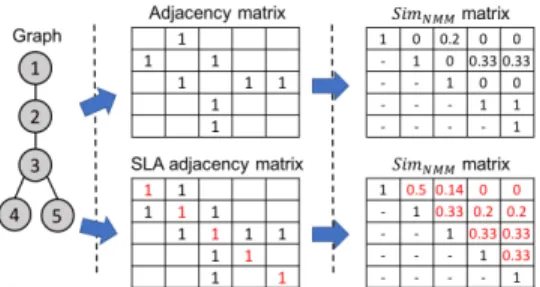
3.2.1 Low-Order Node Embeddings. The adjacency matrix A of a graph encodes the 1st-order node proximity of the graph. It is of-ten used by classical graph embedding techniques, such as GraRep [4] and LINE [26], to learn 1st-order node embeddings. However, directly sketching an adjacency vectorV (one row of the adjacency matrixA) actually overlooks the 1st-order node proximity and only preserves 2nd-order node proximity. To explain this, we investi-gate the min-max similarity between the nodes’ adjacency vectors (preserved by the sketches). As the adjacency vector of a node con-tains only its direct neighbors, the min-max similarity between two nodes indeed characterizes the similarity between their sets of neighbors only. Figure 1 shows an toy example in its top part.
2
Note that thek-order embeddings here actually refers to up-to-k-order embeddings in this section; we keep usingk-order embeddings for the sake of clarity.
Figure 1: A toy example illustrating the adjacency and SLA adjacency matrices of a graph and their corresponding nor-malized min-max similarity matricesSimN M M (computed using Eq. 1 between each pair of normalized adjacency vec-tors). In the top part of the figure, we see thatSimN M M be-tween the original adjacency vectors ignores the 1st-order node proximity, but preserves only the 2nd-order proximity. More precisely, we haveSimN M M(node1, node2) = 0 as nodes1 andnodes2 do not share any common neighbor (even though they are directly connected), whileSimN M M(node1, node3) = 0.2 as nodes1 and nodes3 have a common neighbor node2 (but they are not directly connected). In contrast, as shown in the bottom part of the figure,SimN M M between the SLA adjacency vectors preserves both 1st- and 2nd-order node proximity. After adding an identity matrix (changes high-lighted in red), we haveSimN M M(node1, node2) = 0.5 and SimN M M(node1, node3) = 0.14, which implies thatnode1 is now “closer” (in terms ofSimN M M) tonode2 than to node3.
Figure 2: Low-order node embeddings by sketching the SLA adjacency vector of each node, where the sketch length (em-beddings size) is set to 3. We highlight the SLA adjacency vector and the corresponding embeddings ofnode1 as an ex-ample. Based on the node embeddings, theSimN M Mmatrix can be efficiently approximated by computing the hamming similarity between node embeddings.
To address this issue, we resort to theSelf-Loop-Augmented (SLA) adjacency matrix of a graph [1]. Specifically, it is obtained by adding an identity matrix to the original adjacency matrix of the graph:
e
A= I + A (5)
Subsequently, the min-max similarity between the resulted SLA adjacency vectors eV (row vectors ofeA) is able to preserve both 1st-and 2nd-order node proximity. More precisely, when two nodes are directly connected, their SLA adjacency vectors have two more com-mon entries than the original adjacency vectors, and thus further captures 1st-order node proximity beyond the 2nd-order proximity captured by the original adjacency vectors. Figure 1 shows the SLA adjacency matrix of the previous toy example in its bottom part.
In summary, we sketch the SLA adjacency vector of each node using Eq. 3 to generate its low-order (1st- and 2nd-order proximity preserving) sketch/embedding3. Figure 2 shows the low-order node embeddings generated for the graph in Figure 1.
3.2.2 High-Order Node Embeddings. NodeSketch learns high-order node embeddings in a recursive manner. Specifically, to output thek-order embedding of a node, it sketches an approximate k-order SLA adjacency vector of the node, which is generated by merging the node’s SLA adjacency vector with the (k-1)-order embeddings of all the neighbors of the node in a weighted manner.
One key property of the consistent weighted sampling technique (in Eq. 3) isthe uniformity of the generated samples, which states that the probability of selectingi is proportional to Vi, i.e.,Pr(Sj =
i) = Vi
Í
iVi. As its proof is omitted in the original paper [36], we provide a brief proof in the supplemental materials. This uniformity property serves as the foundation of our recursive sketching process. It implies that the proportion of elementi in the resulting sketch S is an unbiased estimator of Vi, where we applied sum-to-one normalizationÍiVi = 1, and thus the empirical distribution of sketch elements is an unbiased approximation of input vectorV .
Based on this uniformity property, our recursive sketching pro-cess works in the following way. First, for each noder, we compute an approximatek-order SLA adjacency vectorVer(k) by merging the node’s SLA adjacency vector eVr with the distribution of the sketch elements in the (k-1)-order embeddings of all the neighbors of the node in a weighted manner:
e Vir(k) =Veir + Õ n ∈Γ(r ) α L L Õ j=1 1[Sn j(k−1)=i] (6)
whereΓ(r) is the set of neighbors of node r, Sn(k − 1) is the (k-1)-order sketch vector of noden, and 1[cond]is an indicator function which is equal to 1 whencond is true and 0 otherwise. More pre-cisely, the sketch element distribution for one neighborn, (i.e.,
1
LÍLj=11[Sn j(k−1)=i]
wherei = 1, ..., D) actually approximates the (k-1)-order SLA adjacency vector of the neighbor, which preserves the (k-1)-order node proximity. Subsequently, by merging the sketch element distribution for all the node’s neighbors with the node’s SLA adjacency vector, we indeed expand the order of proximity by one, and therefore obtain an approximatek-order SLA adja-cency vector of the node. Moreover, during the summing process, we assign an (exponential decay) weightα to the sketch element distribution, in order to give less importance to higher-order node proximity. Such a weighting scheme in the recursive sketching process actually implements exponential decay weighting when considering high-order proximity, where the weights for the kth-order proximity decays exponentially withk; it is a widely used weighting scheme in measuring high-order node proximity [22, 33]. Subsequently, we generate thek-order node embeddings S(k) by sketching the approximatek-order SLA adjacency vectorVer(k) using Eq. 3. Figure 3 shows the high-order node embeddings gener-ated via recursive sketching for the graph of Figure 1.
In summary, Algorithm 1 shows the overall process of generating k-order node embeddings from three inputs: the SLA adjacency 3
As the sketch vector of a node is regarded as its embedding vector, we do not distin-guish these two terms in this paper.
Algorithm 1 NodeSketch (eA,k, α)
1: ifk > 2 then
2: Get (k-1)-order sketch: S(k − 1) = NodeSketch (eA,k − 1, α ) 3: for each row (node)r ineAdo
4: Getk-order SLA adjacency vectorVer(k) using Eq. 6 5: Generate sketchSr(k) fromVer(k) using Eq. 3 6: end for
7: else ifk = 2 then
8: for each row (node)r ineAdo
9: Generate low-order sketchSr(2) fromVerusing Eq. 3 10: end for
11: end if
12: returnk-order sketch S(k)
matrix eA, the orderk and decay weight α. When k > 2, we first generate (k-1)-order node embeddings S(k − 1) using Algorithm 1 again (Line 2), and then generatek-order node embeddings by sketching each node’s approximatek-order SLA adjacency vector e
Vr(k) which is obtained from
e
Vr andS(k − 1) using Eq. 6 (Line 3-6). Whenk = 2, we simply generate low-order node embeddings by directly sketching each SLA adjacency vector eV (Line 8-10). The implementation of NodeSketch is available here4.
3.3
Theoretical Analysis
3.3.1 Similarity and error bound. According to Eq. 4, the ham-ming similarityH(·, ·) between the k-order embeddings of two nodesa and b actually approximates the normalized min-max simi-larity between thek-order SLA adjacency vectors of the two nodes: E(H(Sa(k), Sb(k))) = Pr[Saj(k) = Sbj(k)] = SimN M M(eVa(k),Veb(k)) The corresponding approximation error bound is:
Pr[|H − SimN M M| ≥ϵ] ≤ 2 exp(−2Lϵ2
) (7)
The error is bigger thanϵ with probability at most 2 exp(−2Lϵ2). Please refer to the supplemental materials for the proof.
3.3.2 Complexity. For time complexity, we separately discuss the cases of and high-order node embeddings. First, for low-order node embeddings where we directly apply Eq. 3 on the SLA adjacency vector of each node, the time complexity isO(D · L · d), where D and L are the number of nodes and embedding size (sketch length), respectively, andd is the average node degree in the SLA adjacency matrix. Second, for high-order node embeddings (k > 2) where the recursive sketching process is involved, the time complexity isO(D · L · (d + (k − 2) · min{d · L,d
2
})). In practice, we often haved ≪ D due to the sparsity of real-world graphs, and also L, k ≪ D. Therefore, the time complexity is linear w.r.t. the number of nodesD. Moreover, only involving fast hashing and merging operations makes NodeSketch highly-efficient as we show below. For space complexity, NodeSketch is memory-efficient as it only stores the SLA adjacency matrix and the node embeddings, resulting in a space complexity ofO(D · (d + L)). Compared to the case of storing a high-order proximity matrix (such as GraRep [4] and NetMF [24]) where the space complexity isO(D2), NodeSketch is much more memory-efficient asd, L ≪ D.
4
Figure 3: High-order node embeddings via recursive sketching. Here we highlight the detailed recursive sketching process for node1 based on the SLA adjacency matrix and (k-1)-order node embeddings (where k=3 in this example). First, we compute the approximatek-order SLA adjacency vectorVer(k) by summing the SLA adjacency vector of node1 and the sketch element distri-bution in the (k-1)-order embeddings of all node1’s neighbors (node1 has only one neighbor node2 in the graph) in a weighted manner. The exponential decay weight is set toα = 0.2 here. Then, we generate the k-order node embeddings by sketching the approximatek-order SLA adjacency vectorVer(k) using Eq. 3.
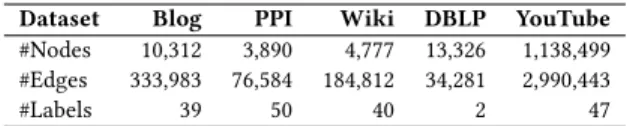
Table 1: Characteristics of the experimental graphs
Dataset Blog PPI Wiki DBLP YouTube #Nodes 10,312 3,890 4,777 13,326 1,138,499 #Edges 333,983 76,584 184,812 34,281 2,990,443
#Labels 39 50 40 2 47
4
EXPERIMENTS
4.1
Experimental Setting
4.1.1 Dataset. We conduct experiments on the following five real-world graphs which are commonly used by existing works on graph embeddings.BlogCatalog (Blog) [27] is a social network of bloggers. The labels of a node represent the topic categories that the corresponding user is interested in.Protein-Protein Interactions (PPI) [9] is a graph of the PPI network for Homo Sapiens. The labels of a node refer to its gene sets and represent biological states.Wikipedia (Wiki) [9] is a co-occurrence network of words appearing in a sampled set of the Wikipedia dump. The labels represent the part-of-speech tags.DBLP [38] is a collaboration network capturing the co-authorship of authors. The labels of a node refer to the publication venues of the corresponding author.YouTube [28] is a social network of users on YouTube. The labels of a node refer to the groups (e.g., anime) that the corresponding user is interested in. Table 1 summarizes the main statistics of those graphs.
4.1.2 Baselines. We compare NodeSketch against a sizable col-lection of state-of-the-art techniques from three categories: 1) clas-sical graph embedding techniques (preserving cosine similarity), includingDeepWalk [23], Node2Vec [9], LINE [26], VERSE [29], GraRep [4], HOPE [22] and NetMF [24]; 2) learning-to-hash tech-niques which are among the best-performing techtech-niques in [18], in-cluding Spectral Hashing (SH) [32], Iterative quantization (ITQ) [8], Scalable Graph Hashing (SGH) [14] and INH-MF [18]; 3) sketching techniques, includingNetHash [33], KatzSketch (which directly sketches the high-order node proximity matrix using Katz index) , NodeSketch(NoSLA) (a variant of our proposed NodeSketch by using the original adjacency matrix rather than the SLA adjacency matrix).Please refer to the supplemental materials for detailed descrip-tion on configuradescrip-tion and parameter tuning for individual methods. In all the experiments, we tune the parameters of each method on each task to let it achieve its highest performance. The dimension of the node embeddingsL is set to 128 for all methods.
4.2
Multi-label Node Classification Task
Node classification predicts the most probable label(s) for some nodes based on other labeled nodes. In this experiment, we ran-domly pick a set of nodes as labeled nodes for training, and use the rest for testing. To fairly compare node embeddings with different similarity measures, we train a one-vs-rest kernel SVM classifier with a pre-computed kernel (cosine or Hamming kernel according to the embedding techniques) to return the most probable labels for each node. We report the average Macro-F1 and Micro-F1 scores from 10 repeated trials, with 90% training ratio on Blogcatalog, PPI, Wiki and DBLP, and 9% training ratio on YouTube. We note that similar results are observed with different training ratios (not shown due to the space limitation).
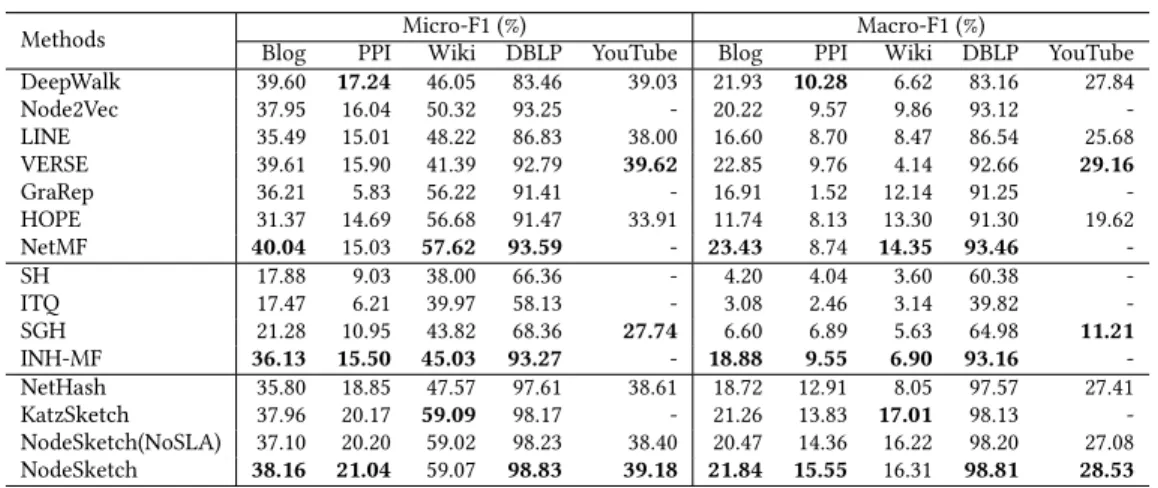
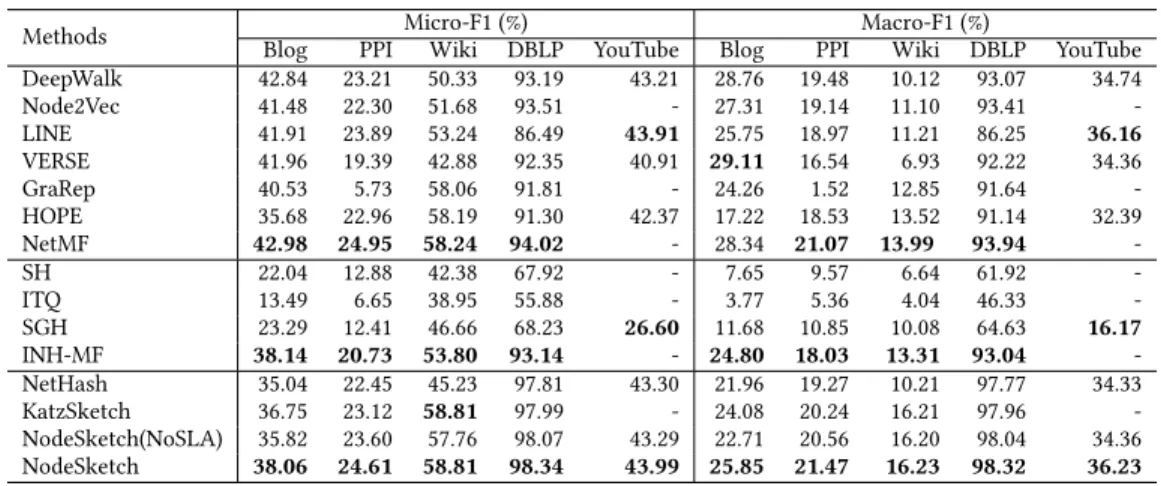
Table 2 shows the results. Note that on our YouTube dataset (>1M nodes), many baselines run out of memory, marked as “-” (also on other evaluation tasks). More precisely, Node2Vec requires to compute and store a large and non-sparse 2nd-order transition probability matrix for parameterized random walk; GraRep, NetMF, SH, ITQ, INH-MF and KatzSketch involve expensive matrix factor-ization/inversion/multiplication operations. We also highlight the best-performing technique from each of the three categories.
First, we observe that NodeSketch outperforms all sketching baselines in general. The only exception is on the Wiki dataset, where our proposed baseline KatzSketch is slightly better than NodeSketch. However, as KatzSketch involves expensive matrix multiplication/inversion operations to compute Katz index, NodeS-ketch is much more efficient than it, showing a 10x speedup on average (see Section 4.4 below). Second, among all the learning-to-hash methods, we find that INH-MF is the best-performing method on small and mid-size datasets (Blog, PPI, Wiki and DBLP), while SGH is the only technique that can handle the large YouTube dataset. However, they still show inferior performance compared to NodeS-ketch. Finally, among classical graph embedding methods, NetMF achieves the best performance on Blog, Wiki and DBLP, while DeepWalk and VERSE are the best ones on POI and YouTube, re-spectively. NodeSketch shows comparable performance to these best-performing baselines; it has better results on PPI, Wiki and DBLP, and slightly worse results on Blog and YouTube. However, our NodeSketch isfar more efficient than these baselines, i.e., 22x, 239x and 59x faster than NetMF, DeepWalk and VERSE, respectively (see Section 4.4 below).
Table 2: Node classification performance using kernel SVM
Methods
Micro-F1 (%) Macro-F1 (%)
Blog PPI Wiki DBLP YouTube Blog PPI Wiki DBLP YouTube DeepWalk 39.60 17.24 46.05 83.46 39.03 21.93 10.28 6.62 83.16 27.84 Node2Vec 37.95 16.04 50.32 93.25 - 20.22 9.57 9.86 93.12 -LINE 35.49 15.01 48.22 86.83 38.00 16.60 8.70 8.47 86.54 25.68 VERSE 39.61 15.90 41.39 92.79 39.62 22.85 9.76 4.14 92.66 29.16 GraRep 36.21 5.83 56.22 91.41 - 16.91 1.52 12.14 91.25 -HOPE 31.37 14.69 56.68 91.47 33.91 11.74 8.13 13.30 91.30 19.62 NetMF 40.04 15.03 57.62 93.59 - 23.43 8.74 14.35 93.46 -SH 17.88 9.03 38.00 66.36 - 4.20 4.04 3.60 60.38 -ITQ 17.47 6.21 39.97 58.13 - 3.08 2.46 3.14 39.82 -SGH 21.28 10.95 43.82 68.36 27.74 6.60 6.89 5.63 64.98 11.21 INH-MF 36.13 15.50 45.03 93.27 - 18.88 9.55 6.90 93.16 -NetHash 35.80 18.85 47.57 97.61 38.61 18.72 12.91 8.05 97.57 27.41 KatzSketch 37.96 20.17 59.09 98.17 - 21.26 13.83 17.01 98.13 -NodeSketch(NoSLA) 37.10 20.20 59.02 98.23 38.40 20.47 14.36 16.22 98.20 27.08 NodeSketch 38.16 21.04 59.07 98.83 39.18 21.84 15.55 16.31 98.81 28.53
4.3
Link Prediction Task
Link prediction predicts potential links between nodes in a graph. In this task, we use the same setting as in [22]. Specifically, we randomly sample 20% of the edges from each graph as test data, and use the rest of the graph for training. After learning the node embeddings based on the training graph, we predict the missing edges by generating a ranked list of potential edges. For each pair of nodes, we use the cosine or Hamming similarity (according to the embedding techniques) of their embeddings to generate the ranked list. We randomly sample 0.1% pairs of nodes for evaluation (0.01% on YouTube). We report the average precision@100 and recall@100 on Blog, PPI, Wiki and DBLP, and precision@1000 and recall@1000 on YouTube (due to its large size) from 10 repeated trials.
Table 3 shows the results. First, we observe that NodeSketch consistently outperforms all sketching and learning-to-hash base-lines. Moreover, compared to the best performing classical graph embedding baselines (Node2Vec on Blog and Wiki datasets, VERSE on DBLP and YouTube datasets, and NetMF on PPI dataset), NodeS-ketch shows comparable results (better on PPI and DBLP, and worse on other datasets). However, it significantly outperforms these base-lines in terms of runtime efficiency, which we present below.
4.4
Runtime Performance
We investigate the efficiency of both node embedding learning and the application of learnt node embeddings on different evaluation tasks. All the experiments are conducted on a commodity PC (Intel Core [email protected], 16GB RAM, Mac OS X). To discount the impact of explicit/implicit multi-threading implementation of individual methods, we use one thread (when applicable) and also report the CP U time for each method. For NodeSketch, as its com-plexity mainly depends on the order of proximityk (see Section 4.5 below), we setk=5 which is the largest of all the best-performing k values in different evaluation tasks and datasets.
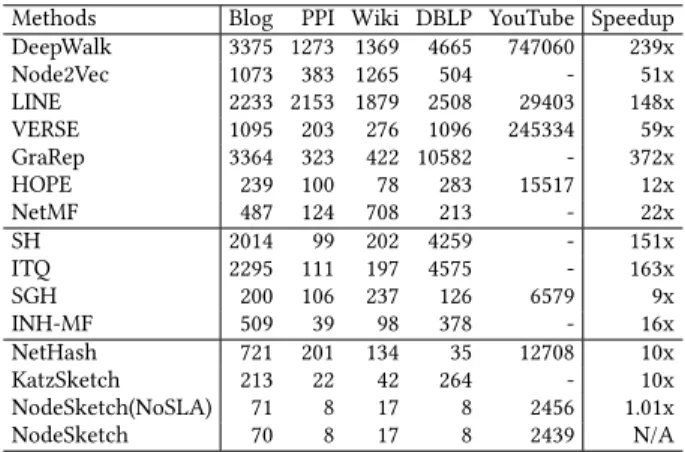
First, Table 4 shows the node embedding learning time. We ob-serve that NodeSketch is highly-efficient, and significantly out-performs all classical graph embedding baselines with 12x-372x speedup, all learning-to-hash baselines with 9x-163x speedup, and other sketching baselines with a 10x speedup. Moreover, compared
to its variant NodeSketch(NoSLA), NodeSketch using the SLA adja-cency matrix creates negligible computational overhead, but shows significantly improved performance on individual evaluation tasks. We also note that as the runtime complexity of LINE depends mostly on the number of sampled node pairs for learning, we observe a sublinear learning time for LINE as we set the number of samples to 1 billion for Blog, PPI, Wiki and DBLP datasets and 10 billion for YouTube (please refer to supplemental materials for details).
Second, Table 5 shows the end-to-end execution time of node classification (including classifier training and evaluation) and link prediction (including similarity computation, ranking and evalua-tion). We group the results by their distance measures, i.e., cosine distance for all classical graph embedding techniques, and Ham-ming distance for all learning-to-hash and sketching techniques. We see that Hamming distance is consistently more efficient than cosine distance, showing 1.19x and 1.68x speedup on average on the node classification and link prediction tasks, respectively. In partic-ular, the link prediction task shows higher speedup, as it heavily involves similarity computations between node embeddings.
4.5
Parameter Sensitivity of NodeSketch
We study the impact of decay weightα and order of proximity k on both graph analysis performance and runtime performance. First, Figure 4 shows the results on the node classification and link prediction tasks using the Blog dataset. We observe a clear convex surface for each metric. Furthermore, we see that the optimal setting varies across different tasks (α = 0.001 and k = 5 for node classification, andα = 0.2 and k = 4 for link prediction), which suggests that node embeddings are often task-specific and should be appropriately generated by tuning parameters for individual graph analysis tasks. Second, Figure 4(e) shows the impact on embedding learning time. We see that our embedding learning time linearly increases withk due to our recursive sketching process, and α has little impact on the embedding learning time.
5
DISCUSSION
NodeSketch preserves the normalized min-max similarity between the high-order SLA adjacency vectors of nodes. Due to the nonlin-earity of the min-max kernel [17], the resulting node embeddings
Table 3: Link prediction performance
Methods
Precision@100 Precision@1000 Recall@100 Recall@1000 Blog PPI Wiki DBLP YouTube Blog PPI Wiki DBLP YouTube DeepWalk 0.0200 0.0159 0.0090 0.0423 0.0001 0.0301 0.2227 0.0493 0.6749 0.0022 Node2Vec 0.0927 0.0137 0.0267 0.0321 - 0.1378 0.1958 0.1514 0.5174 -LINE 0.0070 0.0073 0.0031 0.0392 0.0004 0.0103 0.0923 0.0167 0.6186 0.0513 VERSE 0.0404 0.0206 0.0212 0.0436 0.0007 0.0602 0.2723 0.1118 0.6906 0.0783 GraRep 0.0014 0.0011 0.0054 0.0001 - 0.0020 0.0118 0.0286 0.0011 -HOPE 0.0023 0.0073 0.0027 0.0248 0.0001 0.0035 0.0960 0.0149 0.4034 0.0062 NetMF 0.0175 0.0174 0.0084 0.0218 - 0.0266 0.2287 0.0474 0.3126 SH 0.0001 0.0001 0.0003 0.0001 - 0.0001 0.0001 0.0017 0.0018 -ITQ 0.0014 0.0007 0.0010 0.0002 - 0.0020 0.0099 0.0057 0.0041 -SGH 0.0148 0.0019 0.0033 0.0002 0.0001 0.0222 0.0274 0.0186 0.0022 0.0278 INH-MF 0.0158 0.0158 0.0084 0.0252 - 0.0227 0.2209 0.0454 0.4052 -NetHash 0.0015 0.0134 0.0020 0.0387 0.0001 0.0022 0.1899 0.0101 0.5958 0.0105 KatzSketch 0.0052 0.0124 0.0025 0.0422 - 0.0078 0.1659 0.0134 0.6705 -NodeSketch(NoSLA) 0.0376 0.0167 0.0034 0.0433 0.0003 0.0564 0.2255 0.0183 0.7558 0.0447 NodeSketch 0.0729 0.0250 0.0176 0.0462 0.0005 0.1080 0.3331 0.0942 0.7595 0.0769 (a) (b) (c) (d) (e)
Figure 4: Impact ofk and α on a) Micro-F1 in Node classification, b) Macro-F1 in Node classification, c) Precision@100 in Link prediction, d) Recall@100 in Link prediction, and e) Embedding learning time in seconds.
Table 4: Node embedding learning time (in seconds) and the average speedup of NodeSketch over each baseline.
Methods Blog PPI Wiki DBLP YouTube Speedup DeepWalk 3375 1273 1369 4665 747060 239x Node2Vec 1073 383 1265 504 - 51x LINE 2233 2153 1879 2508 29403 148x VERSE 1095 203 276 1096 245334 59x GraRep 3364 323 422 10582 - 372x HOPE 239 100 78 283 15517 12x NetMF 487 124 708 213 - 22x SH 2014 99 202 4259 - 151x ITQ 2295 111 197 4575 - 163x SGH 200 106 237 126 6579 9x INH-MF 509 39 98 378 - 16x NetHash 721 201 134 35 12708 10x KatzSketch 213 22 42 264 - 10x NodeSketch(NoSLA) 71 8 17 8 2456 1.01x NodeSketch 70 8 17 8 2439 N/A
Table 5: Execution time (in seconds) of the evaluation tasks.
Tasks
Distance Measures
Blog PPI Wiki DBLP YouTube Node Classification Cosine 255.05 55.57 54.16 229.06 170.57 Hamming 226.96 42.78 45.27 204.45 139.25 Link Prediction Cosine 5.57 0.75 1.31 8.35 47.70 Hamming 3.51 0.42 0.65 5.46 32.17
cannot be directly used by linear algorithms such as logistic regres-sion, which is widely used in classical graph embedding papers [4, 9, 23, 24, 26, 29] for performing node classification. However, as proposed in [17], the min-max kernel can be easily linearized
via a simple transformation scheme, which suggests to store only the lowestb bits of each value in a sketch vector; it has also been shown thatb = 8 is often sufficient in practice. Using such a trans-formation scheme, we report the performance of node classification using a one-vs-rest logistic regression classifier in Table 6. We make the same observation as above; NodeSketch outperforms sketching and learning-to-hash baselines in general, and shows a level of performance comparable to classical graph embedding baselines (NodeSketch has better results on Wiki, DBLP and YouTube, and worse results on Blog and PPI).
6
CONCLUSION
This paper introduced NodeSketch, a highly-efficient graph embed-ding technique preserving high-order node proximity via recursive sketching. Built on top of an efficient consistent weighted sampling technique, NodeSketch generates node embeddings in Hamming space. It starts by sketching the SLA adjacency vector of each node to output low-order node embeddings, and then recursively gener-atesk-order node embeddings based on the SLA adjacency matrix and the (k-1)-order node embeddings. We conducted a thorough empirical evaluation of our technique using five real-world graphs on two graph analysis tasks, and compared NodeSketch against a sizable collection of state-of-the-art techniques. The results show that NodeSketch significantly outperforms learning-to-hash and other sketching techniques, and achieves state-of-the-art perfor-mance compared to classical graph embedding techniques. More importantly, NodeSketch ishighly-efficient in the embedding learn-ing process and significantly outperforms all baselines with 9x-372x speedup. In addition, its node embeddings preserving Hamming
Table 6: Node classification performance using logistic regression
Methods
Micro-F1 (%) Macro-F1 (%)
Blog PPI Wiki DBLP YouTube Blog PPI Wiki DBLP YouTube DeepWalk 42.84 23.21 50.33 93.19 43.21 28.76 19.48 10.12 93.07 34.74 Node2Vec 41.48 22.30 51.68 93.51 - 27.31 19.14 11.10 93.41 -LINE 41.91 23.89 53.24 86.49 43.91 25.75 18.97 11.21 86.25 36.16 VERSE 41.96 19.39 42.88 92.35 40.91 29.11 16.54 6.93 92.22 34.36 GraRep 40.53 5.73 58.06 91.81 - 24.26 1.52 12.85 91.64 -HOPE 35.68 22.96 58.19 91.30 42.37 17.22 18.53 13.52 91.14 32.39 NetMF 42.98 24.95 58.24 94.02 - 28.34 21.07 13.99 93.94 -SH 22.04 12.88 42.38 67.92 - 7.65 9.57 6.64 61.92 -ITQ 13.49 6.65 38.95 55.88 - 3.77 5.36 4.04 46.33 -SGH 23.29 12.41 46.66 68.23 26.60 11.68 10.85 10.08 64.63 16.17 INH-MF 38.14 20.73 53.80 93.14 - 24.80 18.03 13.31 93.04 -NetHash 35.04 22.45 45.23 97.81 43.30 21.96 19.27 10.21 97.77 34.33 KatzSketch 36.75 23.12 58.81 97.99 - 24.08 20.24 16.21 97.96 -NodeSketch(NoSLA) 35.82 23.60 57.76 98.07 43.29 22.71 20.56 16.20 98.04 34.36 NodeSketch 38.06 24.61 58.81 98.34 43.99 25.85 21.47 16.23 98.32 36.23
distance also lead to improved efficiency on downstream graph analysis tasks, with 1.19x-1.68x speedup over cosine distance.
In the future, we plan to extend NodeSketch on dynamic graphs which evolve over time.
ACKNOWLEDGMENTS
This project has received funding from the European Research Council (ERC) under the European Union’s Horizon 2020 research and innovation programme (grant agreement 683253/GraphInt), the Swiss National Science Foundation (grant #407540 167320 Tighten-it-All), the STCSM Project (16JC1420400, 18511103104) and the Program for Professor of Special Appointment (Eastern Scholar) at Shanghai Institutions of Higher Learning.
REFERENCES
[1] Alex Arenas, Alberto Fernandez, and Sergio Gomez. 2008. Analysis of the struc-ture of complex networks at different resolution levels.New Journal of Physics 10, 5 (2008), 053039.
[2] Andrei Z Broder. 1997. On the resemblance and containment of documents. In Proceedings of Compression and complexity of sequences 1997. IEEE, 21–29. [3] Hongyun Cai, Vincent W Zheng, and Kevin Chang. 2018. A comprehensive survey
of graph embedding: problems, techniques and applications.TKDE (2018). [4] Shaosheng Cao, Wei Lu, and Qiongkai Xu. 2015. Grarep: Learning graph
repre-sentations with global structural information. InCIKM’15. ACM, 891–900. [5] Lianhua Chi, Bin Li, and Xingquan Zhu. 2014. Context-preserving hashing for
fast text classification. InSDM’14. SIAM, 100–108.
[6] Lianhua Chi and Xingquan Zhu. 2017. Hashing techniques: A survey and taxon-omy.ACM Computing Surveys (CSUR) 50, 1 (2017), 11.
[7] Aristides Gionis, Piotr Indyk, Rajeev Motwani, et al. 1999. Similarity search in high dimensions via hashing. InVLDB’99, Vol. 99. 518–529.
[8] Yunchao Gong and Svetlana Lazebnik. 2011. Iterative quantization: A procrustean approach to learning binary codes. InCVPR’11. IEEE, 817–824.
[9] Aditya Grover and Jure Leskovec. 2016. node2vec: Scalable feature learning for networks. InKDD’16. ACM, 855–864.
[10] Bernhard Haeupler, Mark Manasse, and Kunal Talwar. 2014. Consistent weighted sampling made fast, small, and easy.arXiv preprint arXiv:1410.4266 (2014). [11] Wassily Hoeffding. 1963. Probability inequalities for sums of bounded random
variables.Journal of the American statistical association 58, 301 (1963), 13–30. [12] Rana Hussein, Dingqi Yang, and Philippe Cudré-Mauroux. 2018. Are Meta-Paths
Necessary?: Revisiting Heterogeneous Graph Embeddings. InCIKM’18. ACM, 437–446.
[13] Sergey Ioffe. 2010. Improved consistent sampling, weighted minhash and l1 sketching. InICDM’10. IEEE, 246–255.
[14] Qing-Yuan Jiang and Wu-Jun Li. 2015.Scalable Graph Hashing with Feature Transformation.. InIJCAI’15. 2248–2254.
[15] Bin Li, Xingquan Zhu, Lianhua Chi, and Chengqi Zhang. 2012. Nested subtree hash kernels for large-scale graph classification over streams. InICDM’12. IEEE, 399–408.
[16] Ping Li. 2015. 0-bit consistent weighted sampling. InKDD’15. ACM, 665–674. [17] Ping Li. 2015. Min-max kernels.arXiv preprint arXiv:1503.01737 (2015). [18] Defu Lian, Kai Zheng, Vincent W Zheng, Yong Ge, Longbing Cao, Ivor W Tsang,
and Xing Xie. 2018. High-order Proximity Preserving Information Network Hashing. InKDD’18. ACM, 1744–1753.
[19] Wei Liu, Cun Mu, Sanjiv Kumar, and Shih-Fu Chang. 2014. Discrete graph hashing. InNIPS’14. 3419–3427.
[20] Mark Manasse, Frank McSherry, and Kunal Talwar. 2010. Consistent weighted sampling.Technical Report MSR-TR-2010-73 (2010).
[21] Tomas Mikolov, Ilya Sutskever, Kai Chen, Greg S Corrado, and Jeff Dean. 2013. Distributed representations of words and phrases and their compositionality. In NIPS. 3111–3119.
[22] Mingdong Ou, Peng Cui, Jian Pei, Ziwei Zhang, and Wenwu Zhu. 2016. Asym-metric transitivity preserving graph embedding. InKDD’16. ACM, 1105–1114. [23] Bryan Perozzi, Rami Al-Rfou, and Steven Skiena. 2014. Deepwalk: Online learning
of social representations. InKDD’14. ACM, 701–710.
[24] Jiezhong Qiu, Yuxiao Dong, Hao Ma, Jian Li, Kuansan Wang, and Jie Tang. 2018. Network embedding as matrix factorization: Unifying deepwalk, line, pte, and node2vec. InWSDM’18. ACM, 459–467.
[25] Fumin Shen, Chunhua Shen, Wei Liu, and Heng Tao Shen. 2015. Supervised discrete hashing. InCVPR’15. 37–45.
[26] Jian Tang, Meng Qu, Mingzhe Wang, Ming Zhang, Jun Yan, and Qiaozhu Mei. 2015. Line: Large-scale information network embedding. InWWW’15. 1067–1077. [27] Lei Tang and Huan Liu. 2009. Relational learning via latent social dimensions. In
KDD’09. ACM, 817–826.
[28] Lei Tang and Huan Liu. 2009. Scalable learning of collective behavior based on sparse social dimensions. InCIKM’09. ACM, 1107–1116.
[29] Anton Tsitsulin, Davide Mottin, Panagiotis Karras, and Emmanuel Müller. 2018. VERSE: Versatile Graph Embeddings from Similarity Measures. InWWW’18. 539–548.
[30] Daixin Wang, Peng Cui, and Wenwu Zhu. 2016. Structural deep network embed-ding. InKDD‘16. ACM, 1225–1234.
[31] Jingdong Wang, Ting Zhang, Song Jingkuan, Nicu Sebe, and Heng Tao Shen. 2018. A survey on learning to hash.TPAMI 40, 4 (2018), 769–790.
[32] Yair Weiss, Antonio Torralba, and Rob Fergus. 2009. Spectral hashing. InNIPS’09. 1753–1760.
[33] Wei Wu, Bin Li, Ling Chen, and Chengqi Zhang. 2018. Efficient Attributed Network Embedding via Recursive Randomized Hashing.. InIJCAI’18. 2861– 2867.
[34] Dingqi Yang, Bin Li, and Philippe Cudré-Mauroux. 2016. POIsketch: Semantic Place Labeling over User Activity Streams. InIJCAI’16. 2697–2703.
[35] Dingqi Yang, Bin Li, Laura Rettig, and Philippe Cudré-Mauroux. 2017. His-toSketch: Fast Similarity-Preserving Sketching of Streaming Histograms with Concept Drift. InICDM’17. IEEE, 545–554.
[36] Dingqi Yang, Bin Li, Laura Rettig, and Philippe Cudré-Mauroux. 2018. D2HistoSketch: Discriminative and Dynamic Similarity-Preserving Sketching of Streaming Histograms.TKDE 1 (2018), 1–14.
[37] Dingqi Yang, Bingqing Qu, Jie Yang, and Philippe Cudre-Mauroux. 2019. Revisit-ing User Mobility and Social Relationships in LBSNs: A Hypergraph EmbeddRevisit-ing Approach. InWWW’19. ACM, 2147–2157.
[38] Jaewon Yang and Jure Leskovec. 2015. Defining and evaluating network commu-nities based on ground-truth.KIS 42, 1 (2015), 181–213.
[39] Dingyuan Zhu, Peng Cui, Daixin Wang, and Wenwu Zhu. 2018. Deep variational network embedding in wasserstein space. InKDD‘18. ACM, 2827–2836.
SUPPLEMENTAL MATERIALS
Proof of the Uniformity Property
We present a brief proof of the uniformity of the generated samples (using Eq. 3), which states that the probability of selectingi is pro-portional toVi. First, ashj(i) ∼ U ni f orm(0, 1) in Eq. 3, by applying the change of variable technique we have− loghV j(i)
i ∼Exp(Vi). We hereafter useXi = − loghj(i)
Vi ∼Exp(Vi) for the sake of notation simplicity. We now investigate the probability distribution of the minimum of{Xq|q , i}: Pr(minq,iXq> x) = Pr(Ù q,i {Xq> x}) =Ö q,i e−Vqx = e−(λ−Vi)x (8) whereλ = ÍqVq. AsXiare independent of{Xq|q , i}, the condi-tional probability of samplingi given Xiis:
Pr(minq,iXq> Xi|Xi)= e−(λ−Vi)Xis (9) By integrating over the distribution ofXi ∼Exp(Vi), we obtain the probability of samplingi as:
Pr(argmin q Xq= i) = ∫ ∞ 0 Vie−Vixe−(λ−Vi)xdx =Vi λ = Vi Í qVq (10) which means that the probability of selectingi is proportional to Vi. This completes the proof.
Proof of the Approximation Error Bound
We present a brief proof of the approximation error bound (Eq. 7). First, letYj = 1
Sa j=Sbj
, where1condis an indicator function which is equal to 1 whencond is true and to 0 otherwise. Subsequently, the Hamming similarity between the embeddings of two nodesa and b can be formulated as the empirical mean of variablesYj ∈ [0, 1]:
H(Sa, Sb)= 1 L L Õ j=1 Yj (11)
Based on Hoeffding inequality [11], we then have: Pr[|H − E(H)| ≥ ϵ] ≤ 2 exp(−2Lϵ2
) (12)
AsE(H) = SimN M M, we obtain the approximation error bound: Pr[|H − SimN M M| ≥ϵ] ≤ 2 exp(−2Lϵ2
) (13)
This completes the proof.
Detailed Settings and Parameter Tuning for
Baselines
We compare NodeSketch against a sizable collection of state-of-the-art techniques from three categories, i.e., classical graph em-bedding techniques (preserving cosine similarity), learning-to-hash techniques and data-independent sketching techniques (preserving Hamming similarity).
First, we consider the following graph embedding techniques: •DeepWalk5
[23] is a graph-sampling (via random-walk) based graph embedding technique. It first generates node sequences using random walks, and then feeds them to the SkipGram model 5
https://github.com/phanein/deepwalk
to output node embeddings. Following the suggestion of the authors, we set the walk length to 40, the number of walks per node to 80, and the context window size to 10.
• Node2Vec6
[9] extends DeepWalk by introducing a parameter-ized random walk method to balance the breadth-first search (return parameterp) and depth-first search (in-out parameter q) strategies to capture richer graph structures. Following the suggestions from the original paper, we tunep and q with a grid search overp, q ∈ {0.25, 0.05, 1, 2, 4}. We keep the other parameters same as for DeepWalk.
• LINE7
[26] directly samples node pairs from a graph to learn graph embeddings; it first learns two sets ofd/2-dimension node embeddings based on 1st and 2nd-order node proximity, respec-tively, and then concatenates them together. We set the total number of samples to 1 billion for Blog, PPI, Wiki and DBLP datasets and 10 billion for YouTube.
• VERSE8
[29] directly samples node pairs to learn graph embed-dings to preserve the node proximity measured by personalized PageRank. We tune the damping factorα of personalized PageR-ank using the method suggested by the authors, and leave all other parameters as default.
• GraRep9
[4] factorizes thek-order transition matrix to gener-ate node embeddings. It first separgener-ately learnsk sets of d/k-dimension node embeddings capturing 1st tokth-order node proximity, respectively, and then concatenate them together. We tunek by searching over {1, 2, 3, 4, 5, 6}. When d/k is not an inte-ger, we learn the firstk − 1 sets of ⌈d/k⌉-dimension embeddings, and the last set of embeddings of dimensiond − (k − 1)⌈d/k⌉. • HOPE10
[22] factorizes the up-to-k-order node proximity matrix measured by Katz index using a generalized SVD method to learn node embeddings. The proposed generalized SVD method can scale up to large matrices. We search the optimal decay parameter β from 0.1 to 0.9 with a step of 0.1 (further multiplied by the spectral radius of the adjacency matrix of the graph).
• NetMF11
[24] derives the closed form of DeepWalk’s implicit matrix, and factorizes this matrix to output node embeddings. Fol-lowing the suggestion made by the authors, we tune the implicit window sizeT within {1, 10}.
Second, we consider the following learning-to-hash techniques, which are among the best-performing techniques in [18]. • Spectral Hashing (SH)12
[32] learns the hash code of the input data by minimizing the product of the similarity between each pair of the input data samples and the Hamming distance between the corresponding pairs of hash code.
• Iterative quantization (ITQ)13
[8] first processes the input data by reducing the dimension using PCA, and then performs quan-tization to learn the hash code of the input data via alternative optimization. 6 https://github.com/snap-stanford/snap/tree/master/examples/node2vec 7 https://github.com/tangjianpku/LINE 8 https://github.com/xgfs/verse 9 https://github.com/ShelsonCao/GraRep 10http://git.thumedia.org/embedding/HOPE 11 https://github.com/xptree/NetMF 12 //www.cs.huji.ac.il/ yweiss/SpectralHashing/ 13 https://github.com/jfeng10/ITQ-image-retrieval
•Scalable Graph Hashing (SGH)14
[14] learns the hash code of the input data by minimizing the difference between the sim-ilarity of input data and the Hamming simsim-ilarity of the corre-sponding pairs of hash code. It uses the feature transformation to approximate the similarity matrix without explicitly comput-ing the similarity matrix, in order to make it scalable to large datasets.
•INH-MF15
[18] is the first learning-to-hash technique proposed for the graph embedding problem. It learns the hash code of nodes in a graph via matrix factorization while preserving the high-order node proximity in the graph. It also incorporates a hamming subspace learning process to improve the efficiency of the learning process. We set the ratio for subspace learning to 100%, to let it achieve its optimal performance w.r.t. the quality of the learnt node embeddings.
Finally, we consider the following sketching techniques: •NetHash16
[33] is the first work applying sketching techniques onattributed graph embedding problems. It first builds a parent-pointer-tree for each node in a graph, and then recursively applies minhash on theattributes of nodes in the tree from bottom to top. However, it cannot be directly applied to our graphs, as it requires a set of attributes for each node in the graph. To remedy this issue, we use a node’s direct neighbors as its attributes, which represents the node’s context in the graph. As suggested by the authors, we search the optimal tree depth in{1, 2, 3}.
•KatzSketch is one of our proposed baselines. It first computes the high-order node proximity matrix using Katz index, which is the best performing high-order proximity measure for graph embedding problem as suggested by [22]. Then, it directly gen-erates sketches based on the high-order node proximity vectors of nodes (rows of the obtained proximity matrix). We search the optimal decay parameterβ used by Katz index in the same way as for HOPE.
•NodeSketch(NoSLA) is a variant of our proposed NodeSketch by using the original adjacency matrix rather than the SLA adja-cency matrix. We search the optimal parametersk and α using the same strategy as for our method NodeSketch (see below). •NodeSketch17
is our proposed technique. We search the optimal order of proximityk up to 6 and the optimal decay parameter α from 0.0001 to 1 on a log scale.
14 https://github.com/jiangqy/SGH-IJCAI2015 15 https://github.com/DefuLian/network 16 https://github.com/williamweiwu/williamweiwu.github.io/tree/master/Graph_Network%20Embedding/NetHash 17 https://github.com/eXascaleInfolab/NodeSketch