Publisher’s version / Version de l'éditeur:
Chemistry of Materials, 20, 7, pp. 2544-2550, 2008-03-13
READ THESE TERMS AND CONDITIONS CAREFULLY BEFORE USING THIS WEBSITE. https://nrc-publications.canada.ca/eng/copyright
Vous avez des questions? Nous pouvons vous aider. Pour communiquer directement avec un auteur, consultez la première page de la revue dans laquelle son article a été publié afin de trouver ses coordonnées. Si vous n’arrivez pas à les repérer, communiquez avec nous à [email protected].
Questions? Contact the NRC Publications Archive team at
[email protected]. If you wish to email the authors directly, please see the first page of the publication for their contact information.
NRC Publications Archive
Archives des publications du CNRC
This publication could be one of several versions: author’s original, accepted manuscript or the publisher’s version. / La version de cette publication peut être l’une des suivantes : la version prépublication de l’auteur, la version acceptée du manuscrit ou la version de l’éditeur.
For the publisher’s version, please access the DOI link below./ Pour consulter la version de l’éditeur, utilisez le lien DOI ci-dessous.
https://doi.org/10.1021/cm703208w
Access and use of this website and the material on it are subject to the Terms and Conditions set forth at
Separable catalysts in one-pot syntheses for greener chemistry
Abu-Reziq, Raed; Wang, Dashan; Post, Michael; Alper, Howard
https://publications-cnrc.canada.ca/fra/droits
L’accès à ce site Web et l’utilisation de son contenu sont assujettis aux conditions présentées dans le site LISEZ CES CONDITIONS ATTENTIVEMENT AVANT D’UTILISER CE SITE WEB.
NRC Publications Record / Notice d'Archives des publications de CNRC:
https://nrc-publications.canada.ca/eng/view/object/?id=17fa0072-94cd-4a67-a099-35c3b67c7f9e https://publications-cnrc.canada.ca/fra/voir/objet/?id=17fa0072-94cd-4a67-a099-35c3b67c7f9e
Separable Catalysts in One-Pot Syntheses for Greener Chemistry
Raed Abu-Reziq,† Dashan Wang,‡ Michael Post,‡ and Howard Alper*,†
Centre for Catalysis Research and InnoVation, UniVersity of Ottawa, 10 Marie Curie, Ottawa, Ontario, Canada K1N 6N5, and Institute for Chemical Process and EnVironmental Technology, National Council of
Canada, 1200 Montreal Road, Ottawa, Ontario, Canada K1A OR6 ReceiVed NoVember 10, 2007. ReVised Manuscript ReceiVed December 29, 2007
A method that enables the separation between two different catalytic solids used in one-pot reactions is described. Such separation between the two catalytic solids can facilitate their reuse in other catalytic applications and make the synthesis cheap and greener. The method is based on doping one of the catalysts with magnetic nanoparticles, which can make it magnetically separable while the other solid can be separated by filtration. The magnetically separable catalytic solid is designed by a sol–gel process in which a palladium catalyst is encapsulated in a silica sol–gel-modified polyethylenimine composite in the presence of magnetic nanoparticles modified with ionic liquid groups. The other catalytic solid utilized in this study is a solid acid based on cross-linked polystyrene sulfonic acid and can be separated by simple filtration. The two catalytic solids are utilized in one-pot reactions of dehydration/hydrogenation of benzyl alcohols. After reaction, the palladium-based catalyst is separated by applying an external magnetic field and the solid acid is separated by filtration. The magnetically separable palladium-based catalyst is reused after utilization in a one-pot reaction to catalyze three different types of reactions: carbonylation of iodoarenes, Suzuki, and Heck coupling.
1. Introduction
In the past decade, many investigations have been con-ducted to try to develop greener chemical processes and synthetic methods, due to environmental considerations.1 Several new methods and novel-designed materials have been developed to make the chemical reactions cleaner and more benign. For example, performing safer and environmentally friendly synthetic processes is now possible by using ionic liquids, supercritical carbon dioxide, water, or perfluorinated solvents as media for reactions instead of the traditional hazard organic solvents.2In addition, some catalytic reactions have become less costly and green due to the utilization of recyclable heterogenized catalysts in these reactions that were developed by a variety of heterogenization methods.3
One-pot multistep reactions are very attractive since they significantly lower the cost of the synthetic routes, by reducing the number of purification and separation steps, as
well as reducing the amount of waste and solvents.4 However, the application of this type of synthesis is limited since the catalysts utilized in these reactions have to be compatible with each other.
The pioneer work of Patchornik in 1981 showed that it is possible to overcome the limitation of compatibility of catalysts by immobilizing them on solid supports.5Recently, Gelman, Blum, and Avnir described an impressive method to overcome the limitation of using incompatible catalysts in one-pot reactions which is based on the concept of “site isolation”.6–10According to this method, mutually destructive reactants were entrapped separately in sol–gel matrices and then used to catalyze one-pot sequences of reactions in a
* Corresponding author. Fax: (613) 562-5871. E-mail: howard.alper@ uottawa.ca.
†University of Ottawa. ‡National Council of Canada.
(1) (a) Trost, B. M. Science 1991, 254, 1471–1477. (b) Anastas, P. T.; Warner, J. C. Green Chemistry: Theory and Practice; Oxford Press: Oxford, U.K., 1998. (c) Clark, J. H. Green Chem. 1999, 1, 1–8. (2) (a) Sheldon, R. A. Green Chem. 2005, 7, 267–278. (b) Green
Chemistry Using Liquid and Supercritical Carbon Dioxide; DeSimone, J. M., Tumas, W., Eds.; Oxford Press: Oxford, U.K., 2003. (c) Ionic
Liquids in Synthesis; Wasserscheid, P., Welton, T., Eds.; Wiley-VCH, Weinheim, Germany, 2002. (d) Green Industrial Applications of Ionic
Liquids; Roger, R. D., Seddon, K. R., Volkov, S., Eds.; Kluwer Academic Publishers: Dordrecht, The Netherlands, 2003. (e) Organic
Synthesis in Water; Grieco, P. A., Eds.; Blackie: London, 1998. (f)
Organic Reactions in Water; Lindström, U. M., Ed.; Blackwell Publishing: Oxford, U.K., 2007. (g) Li, C.-J.; Chen, L. Chem. Soc.
ReV. 2006, 35, 68–82. (h) Pirrung, M. C. Chem.sEur. J. 2006, 12, 1312–1317. (i) Handbook of Fluorous Chemistry; Gladysz, J. A., Curran, D. P., Horvath, I. T., Eds.; Wiley-VCH, Weinheim, Germany, 2004.
(3) (a) Bhanage, B. M.; Hrai, M. Catal. ReV. Sci. Eng. 2001, 43, 315–344. (b) Biffis, A.; Zecca, M.; Basato, M. J. Mol. Catal. A: Chem. 2001, 173, 249–274. (c) Choplin, A.; Quignard, F. Coord. Chem. ReV. 1998, 178–
180, 1679–1702. (d) Blum, J.; Avnir, D.; Schumann, H. CHEMTECH
1999, 29, 32–38. (e) Chen, J.; Alper, H. J. Am. Chem. Soc. 1997, 119, 893–895. (f) Nait Ajjou, A.; Alper, H. J. Am. Chem. Soc. 1998, 120, 1466–1468. (g) Leadbeater, N. E.; Marco, M. Chem. ReV. 2002, 102, 3217–3274. (h) McNamara, C. A.; Dixon, M. J.; Bradley, M. Chem. ReV.
2002, 102, 3275–3300. (i) Song, C. E.; Lee, S. G. Chem. ReV. 2002,
102, 3495–3524.
(4) (a) Broadwater, S. J.; Roth, S. L.; Price, K. E.; Kobašlija, M.; McQuade, D. T. Org. Biomol. Chem. 2005, 3, 2899–2906. (b) Wasilke, J. C.; Obrey, S. J.; Baker, R. T.; Bazan, G. C. Chem. ReV. 2005, 105, 1001–1020. (c) Enders, D.; Hüttl, M. R. M.; Grondal, C.; Raabe, G.
Nature 2006, 441, 861–863.
(5) Cohen, B. J.; Kraus, M. J.; Patchornik, A. J. Am. Chem. Soc. 1982,
103(25), 7620–7629.
(6) Gelman, F.; Blum, J.; Avnir, D. J. Am. Chem. Soc. 2000, 129, 11999– 12000.
(7) Gelman, F.; Blum, J.; Avnir, D. Angew. Chem., Int. Ed. 2001, 40, 3647–3649.
(8) Gelman, F.; Blum, J.; Avnir, D. J. Am. Chem. Soc. 2002, 124, 14460– 14463.
(9) Gelman, F.; Blum, J.; Avnir, D. New J. Chem. 2003, 27, 205–207. (10) Gelman, F.; Blum, J.; Schumann, H.; Avnir, D. J. Sol-Gel Sci.
Technol. 2003, 26, 43–46. 10.1021/cm703208w CCC: $40.75 2008 American Chemical Society
single vessel. Different pairs of opposing reagents or catalysts like acid/base, oxidant/reducing catalyst, and enzyme/metal complex catalyst proved to be effective for the one-pot synthesis. Two other methods that enable the use of acids and bases in one-pot reactions in a single vessel have been reported. Thus, Fréchet and Hawker et al. developed star polymers containing acid and base groups confined in their core for catalyzing homogeneous one-pot reactions.11 In contrast, Kaneda et al. utilized two types of layered clays as inorganic acid and base catalysts for performing heteroge-neous one-pot catalysis.12 Furthermore, McQuade et al. described a method to use incompatible catalysts in a one-pot multistep reaction that is based on encapsulation of catalysts via interfacial polymerization of an oil-in-water emulsion.13
Magnetic nanoparticles (MNP) have received a great deal of attention because of their potential biomedical applications in fields such as drug delivery,14 magnetic resonance imaging,15 biomolecular sensors,16 bioseparation,17 and magneto-thermal therapy.18Additionally, recent studies show that magnetic nanoparticles are excellent supports for cata-lysts.19 The supported catalysts proved to be effective and easily separated from the reaction media by applying an external magnetic field. Moreover, quaternary ammonium and phosphonium salts were supported on magnetic nano-particles and utilized as phase transfer catalysts with good activities.20 We recently described the highly selective hydroformylation reaction using catalysts supported on dendronized magnetic nanoparticles.21In addition, we have developed a new catalytic system for the chemoselective hydrogenation of R, β-unsaturated aldehydes and alkynes, and based on platinum nanoparticles supported on nano-magnetite, Fe3O4, modified with ionic liquid groups.22
Herein, we report a novel method for separation between two solid catalysts after catalyzing one-pot reactions in a
single vessel, and then to reuse them for other applications. The method is based on doping of one catalytic solid with a magnetic nanoparticle that enables its separation by applying external magnetic field, while the other catalytic solid can be separated by filtration techniques. The magnetically separable solid catalyst was designed by sol–gel process in which magnetic nanoparticles and palladium catalyst were encapsulated together within silica sol–gel-modified poly-ethylenimine composite. The second solid catalyst that was chosen for the current study is based on the commercial cross-linked polystyrene sulfonic acid.
2. Experimental Section
2.1. Materials. Cross-linked polystyrene sulfonic acid
(PS-SO3H) (2.2 mmol/g of sulfonic acid groups), polyethylenimine
(PEI) (Mw)28000 g/mol), tetraethoxysilane (TEOS) were pur-chased from Sigma-Aldrich. Magnetite nanoparticles of 8–12 nm were prepared according to Massart’s method.23 The benzyl alcohols were prepared by reducing the appropriate aromatic ketone with excess of NaBH4in methanol.
2.2. Preparation of Acylated Polyethylenimine (PEI-C12).
Polyethylenimine (25 g) was mixed with lauric acid (36 g, 180 mmol) and heated at 160°C for 36 h while the formed water was distilled off. A bright yellow, very viscous liquid (58 g) was obtained.1H NMR (300 MHz, CDCl
3) δ 0.83 [PEI-CH2
-NHCO-CH2-CH2-(CH2)8-CH3], 1.23 [PEI-CH2-NHCO-CH2-CH2-(CH2)8
-CH3], 1.59 [PEI-CH2-NHCO-CH2-CH2-(CH2)8-CH3],2.15
[PEI-CH2-NHCO-CH2-CH2-(CH2)8-CH3], 2.39–2.83 [PEI-CH2
-NHCO-CH2-CH2-(CH2)8-CH3], 3.12–3.45 [PEI-CH2-NHCO-CH2-CH2
-(CH2)8-CH3], 3.57–3.71 [PEI-CH2-NHCO-CH2-CH2-(CH2)8-CH3];
13C NMR (300 MHz, CDCl
3) δ 14.5 [PEI-CH2-NHCO-CH2-CH2
-(CH2)7-CH2-CH3], 23.1 [PEI-CH2-NHCO-CH2-CH2-(CH2)7-CH2
-CH3], 26.4 [PEI-CH2-NHCO-CH2-CH2-(CH2)7-CH2-CH3], 29.8 and
30 [PEI-CH2-NHCO-CH2-CH2-(CH2)7-CH2-CH3], 32.3 [PEI-CH2
-NHCO-CH2-CH2-(CH2)7-CH2-CH3], 37.1 [PEI-CH2-NHCO-CH2
-CH2-(CH2)7-CH2-CH3], 47.1–48.8, 49.2–50.6 and 51.8–55.9
[PEI-CH2-NHCO-CH2-CH2-(CH2)7-CH2-CH3], 173.6 [PEI-CH2
-NHCO-CH2-CH2-(CH2)7-CH2-CH3]. IR (cm
-1): 3294.6, 2920, 2850, 1648, 1536, 1477. Elemental Anal.: C, 67.47; H, 11.33; N, 13.80.
2.3. Addition ofDL-Glycidol to Acylated Polyethylenimine To Form PEI-C12-GLY.DL-Glycidol (2.8 mL, 42.2 mmol) was added
to a solution of alkylated polyethylenimine (PEI-C12) (11.9 g) in
dry methanol (250 mL). The solution was stirred for 14 h at room temperature and then refluxed for 6 h. Colorless, very viscous, gel-like product (14.2 g) was obtained.1H NMR (300 MHz, CDCl
3) δ
0.88 [HOCH2-CH(OH)CH2-PEI-CH2-NHCO-CH2-CH2-(CH2)8
-CH3], 1.26 [HOCH2-CH(OH)CH2-PEI-CH2-NHCO-CH2-CH2
-(CH2)8-CH3], 1.59 [HOCH2-CH(OH)CH2-PEI-CH2-NHCO-CH2
-CH2-(CH2)8-CH3], 2.1 [HOCH2-CH(OH)CH2-PEI-CH2
-NHCO-CH2-CH2-(CH2)8-CH3], 2.4–2.87 [HOCH2-CH(OH)CH2-PEI-CH2
-NHCO-CH2-CH2-(CH2)8-CH3], 3.2–3.7 [HOCH2-CH(OH)CH2
-PEI-CH2-NHCO-CH2-CH2-(CH2)8-CH3], 3.47 [HOCH2-CH(OH)CH2
-PEI-CH2-NHCO-CH2-CH2-(CH2)8-CH3], 3.87 [HOCH2-CH(OH)CH2
-PEI-CH2-NHCO-CH2-CH2-(CH2)8-CH3]; 13C NMR (300 MHz,
CDCl3) δ 14.6 [HOCH2-CH(OH)CH2-PEI-CH2-NHCO-CH2-CH2
-(CH2)7-CH2-CH3], 23.1 [HOCH2-CH(OH)CH2-PEI-CH2
-NHCO-CH2-CH2-(CH2)7-CH2-CH3], 26.3 [HOCH2-CH(OH)CH2-PEI-CH2
-NHCO-CH2-CH2-(CH2)7-CH2-CH3], 29.7 and 30 [HOCH2
-CH-(OH)CH2-PEI-CH2-NHCO-CH2-CH2-(CH2)7-CH2-CH3],32.3[HOCH2
-CH(OH)CH2-PEI-CH2-NHCO-CH2-CH2-(CH2)7-CH2-CH3],36.9[HOCH2
-CH(OH)CH2-PEI-CH2-NHCO-CH2-CH2-(CH2)7-CH2-CH3], 47–60
(11) Helms, B.; Guillaudeu, S. J.; Xie, Y.; McMurdo, M.; Hawker, C. J.; Fréchet, J. M. J. Angew. Chem., Int. Ed. 2005, 44, 6384–6387. (12) Motokura, K.; Fujita, N.; Mori, K.; Mizugaki, T.; Ebitani, K.; Kaneda,
K. J. Am. Chem. Soc. 2005, 127, 9674–9675.
(13) Poe, S. L.; Kobašlija, M.; McQuade, D. T. J. Am. Chem. Soc. 2006,
128, 15586–15587.
(14) (a) Gupta, A. K.; Curtis, A. S. G. J. Mater. Sci. Mater. Med. 2004,
15, 493–496. (b) Neuberger, T.; Schoepf, B.; Hofmann, H.; Hofmann, M.; von Rechenberg, B. J. Magn. Magn. Mater. 2005, 293, 483–496. (15) Pankhurst, Q. A.; Connolly, J.; Jones, S. K.; Dobson, J. J. Phys. D:
Appl. Phys. 2003, 36, R167–R181.
(16) (a) Perez, J. M.; Simeone, F. J.; Saeki, Y.; Josephson, L.; Weissleder, R. J. Am. Chem. Soc. 2003, 125, 10192–10193. (b) Graham, D. L.; Ferreira, H. A.; Freitas, P. P. Trends Biotechnol. 2004, 22, 455–462. (17) (a) Wang, D.; He, J.; Rosenzweig, N.; Rosenzweig, Z. Nano Lett.
2004, 4, 409–413. (b) Xu, C.; Xu, K.; Gu, H.; Zheng, R.; Liu, H.; Zhang, X.; Guo, Z.; Xu, B. J. Am. Chem. Soc. 2004, 126, 9938–9939. (18) (a) Hiergeist, R.; Andra, W.; Buske, N.; Hergt, R.; Hilger, I.; Richter, U.; Kaiser, W. J. Magn. Magn. Mater. 1999, 201, 420–422. (b) Jordan, A.; Scholz, R.; Wust, P.; Fahling, H.; Felix, R. J. Magn. Magn. Mater.
1999, 201, 413–419.
(19) (a) Yoon, T. J.; Lee, W.; Oh, Y. S.; Lee, J. K. New J. Chem. 2003,
27, 227–229. (b) Stevens, P. D.; Fan, J.; Gardimalla, H. M. R.; Yen, M.; Gao, Y. Org. Lett. 2005, 7, 2085–2088. (c) Stevens, P. D.; Li, G.; Fan, J.; Yen, M.; Gao, Y. Chem. Commun. 2005, 4435–4437. (d) Hu, A.; Yee, G. T.; Lin, W. J. Am. Chem. Soc. 2005, 127, 12486– 12487.
(20) Kawamura, M.; Sato, K. Chem. Commun. 2006, 4718–4719. (21) Abu-Reziq, R.; Alper, H.; Wang, D.; Post, M. L. J. Am. Chem. Soc.
2006, 128, 5279–5282.
(22) Abu-Reziq, R.; Wang, D.; Post, M. L.; Alper, H. AdV. Synth. Catal.
2007, 349, 2145–2150. (23) Massart, R. IEEE Trans. Magn. 1981, 17, 1247–1248.
2545
Chem. Mater., Vol. 20, No. 7, 2008 Separable Catalysts for Greener Chemistry Syntheses
[HOCH2-CH(OH)CH2-PEI-CH2-NHCO-CH2-CH2-(CH2)7-CH2
-CH3], 64.4 [HOCH2-CH(OH)CH2-PEI-CH2-NHCO-CH2-CH2
-(CH2)7-CH2-CH3], 69.9 and 70.8 [HOCH2-CH(OH)CH2-PEI-CH2
-NHCO-CH2-CH2-(CH2)7-CH2-CH3], 174.5 [HOCH2-CH(OH)CH2
-PEI-CH2-NHCO-CH2-CH2-(CH2)7-CH2-CH3]. IR (cm
-1): 3294, 2920, 2850, 1639, 1545, 1459, 1272, 1050. Elemental Anal.: C, 63.83; H, 11.07; N, 10.84.
2.4. Synthesis of 1-Butyl-3-(3-trimethoxysilylpropyl)-1H-imid-azol-3-ium Chloride (IL-C4).(3-Chloropropyl)trimethoxysilane (35
mL, 192 mmol) and 1-butylimidazole (25.2 mL, 192 mmol) were heated under N2 at 120 °C. The progress of the reaction was
monitored by1H NMR, and it was completed after 8 h. The mixture was cooled to room temperature and honey-like, viscous liquid (60.4 g) was obtained (97% yield). 1H NMR (300 MHz, CDCl
3) δ 0.616–0.672 (m, 2H), 0.967 (t, J ) 7.5 Hz, 3H), 1.352 (dt, J ) 8.1 Hz, 2H), 1.872–2.075 (m, 4H), 3.571 (s, 9H), 4.334 (dt, J ) 4.2 Hz, 4H), 7.45 (t, J ) 1.2 Hz, 1H), 7.568 (t, J )1.8 Hz, 1H), 10.796 (s, 1H).13C NMR (300 MHz, CDCl 3) δ 5.94, 13.48, 19.51, 24.21, 32.21, 49.79, 50.75, 51.7, 121.91, 122.07, 137.84. IR (cm-1) 3128, 3044, 2943, 2843, 1560. Elemental anal. Calcd for C13H27ClN2O3Si:
C, 48.35; H, 8.43; N, 8.68. Found: C, 48.78; H, 8.78; N, 9.05.
2.5. Modification of Magnetic Nanoparticles with IL-C4To Obtain MNP- IL-C4.Freshly prepared magnetite nanoparticles23
(5.3 g) were suspended in ethanol (95%, 500 mL), and sonicated for 60 min. The resulted suspension was mechanically stirred, followed by addition of a solution of ethanol (95%, 100 mL) containing IL-C4(10.25 g, 30 mmol) and concentrated ammonia
(28%, 2 mL). Stirring under N2 was continued for 36 h. The
modified magnetite nanoparticles were magnetically separated and washed three times with ethanol (95%, 100 mL) and then dissolved in methanol (400 mL) and stirred mechanically for 30 min. Ether (100 mL) was added and the modified nanoparticles were magneti-cally separated, washed with ether (100 mL) and dried under a vacuum of 0.2 mmHg for 24 h. Typically, 6–6.5 g of brownish-black powder could be obtained.
2.6. Preparation of Magnetically Separable Palladium-Based Sol–Gel Catalyst (SG-MNP-PEI-Pd). Water (4 mL) and HCl solution (0.1 N, 0.1 mL) were added to TEOS (7.6 mL, 34 mmol)
and the resulting solution was stirred until a homogeneous solution was obtained (4.5 h). Also, Pd(OAc)2(0.23 g, 1mmol) and
PEI-C12-GLY (0.65 g) in methanol (7 mL) were stirred for 30 min,
then sonicated for 10 min and MNP-IL-C4(0.2 g) was added to
the solution while sonication continued for additional 5 min. This solution was added to the hydrolyzed TEOS and gelation occurred after stirring for 10 min. The obtained gel was aged for 24 h and
Scheme 1. Modification Processes on the Hyberbranched Polyethylenimine
Scheme 2. Modification of the Magnetic Nanoparticles with
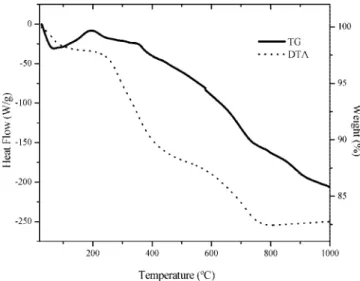
Ionic Liquid Groups Figure 1.ionic liquid IL-CDTA-TG curves of the magnetic nanoparticles modified with
4.
Figure 2.XRD patterns of (a) magnetic nanoparticles modified with
IL-C4, (b) palladium catalyst and magnetic nanoparticles encapsulated within
silica sol–gel-modified polyethylenimine composite (SG-MNP-PEI-Pd).
Figure 3. DTA-TG curves of the palladium catalyst and magnetic nanoparticles encapsulated within silica sol–gel-modified polyethylenimine composite (SG-MNP-PEI-Pd).
then dried under a vacuum of 0.2 mmHg at 40°C for 24 h. The black xerogel (3.1 g) was milled to give fine powder and the loading of the palladium catalyst was 0.323 mmol/g.
2.7. General Procedure for One-Pot Reaction in a Single Vessel.Cross-linked polystyrene sulfonic acid (100 mg) and SG-MNP-PEI-Pd (50 mg) were added to toluene (5 mL) containing the appropriate substrate (1.5 mmol) and placed in a 45 mL glass-lined autoclave. After sealing, the autoclave was purged three times with hydrogen and pressurized with 200 psi of hydrogen. The autoclave was placed in an oil bath and heated at 90°C. After 2.5 h, the autoclave was cooled to room temperature and the hydrogen was released. After separation of the catalysts, the solution was concentrated and the products were analyzed by spectral methods.
2.8. General Procedure for the Separation between the Two Catalytic Solids.At the end of the one-pot reaction, the magneti-cally separable catalyst, SG-MNP-PEI-Pd, was collected aside to the vessel wall using external magnetic field and the solid acid catalyst, PS-SO3H, was decanted with the products solution to
another vessel and then collected by filtration. The palladium-based
catalyst was washed twice with dichloromethane (10 mL) and then sonicated for 10 min in the presence of CH2Cl2(10 mL). After
magnetic separation, the catalyst was dried under a vacuum of 0.2 mmHg for 12 h and reused for catalyzing other reactions as described in sections 2.9, 2.10, and 2.11.
2.9. General Procedure for the Carbonylation Reaction of Iodoarenes.To a solution of the appropriate iodoarene (1.5 mmol) and triethylamine (0.45 mL, 3.2 mmol) in methanol (5 mL) was added the dried catalyst that was magnetically separated from the one-pot reaction. The mixture was placed in a 45 mL glass-lined autoclave, the autoclave was sealed, purged three times with carbon monoxide, and pressurized with 200 psi of carbon monoxide. The autoclave was placed in oil bath and heated at 110°C. After 8 h, the autoclave was cooled to room temperature and the carbon monoxide was released carefully. The catalyst was magnetically separated and the solution was decanted and concentrated by evaporation of the solvent. Ether (60 mL) was added to the residue and the ethereal solution was washed with aqueous hydrochloric acid (1N) (2 × 15 mL), saturated sodium hydrogen carbonate (10 mL), and distilled water (3 × 20 mL). The ethereal solution was dried over magnesium sulfate and then concentrated under reduced pressure. The products were analyzed by GC and 1H NMR.
2.10. General Procedure for the Suzuki Reaction.To a solution of the appropriate iodoarene (1.5 mmol), Cs2CO3(0.73 g, 2.2 mmol)
and phenylboronic acid (0.238 g, 1.95 mmol) in 1,4-dioxane (5 mL) was added the dried catalyst that was magnetically separated from the one-pot reaction. The mixture was placed in a tube, which was sealed under N2using a rubber septum, and heated at 90°C for 16 h. After
separation of the catalyst by an external magnetic field, the solution was decanted, filtrated, and concentrated by evaporation of the solvent. Ether (80 mL) was added to the residue and the ethereal solution was washed with aqueous hydrochloric acid (1N) (2 × 20 mL), saturated sodium hydrogen carbonate (10 mL), and distilled water (3 × 20 mL). The ethereal solution was dried over magnesium sulfate and then concentrated under reduced pressure. The products were analyzed by GC and1H NMR.
2.11 Procedure for the Heck Reaction.To a solution of a 4′ -iodoacetophenone (0.369 g, 1.5 mmol), triethylamine (0.45 mL, 3.2 mmol) and n-butyl acrylate (0.28 mL, 1.95 mmol) in toluene (5 mL) was added the dried catalyst that was magnetically separated from the one-pot reaction. The mixture was placed in a tube, which was sealed under N2using a rubber septum, and heated at 90°C
for 16 h. After separation of the catalyst by an external magnetic field, the solution was decanted and concentrated by evaporation of the solvent. Ether (60 mL) was added to the residue and the ethereal solution was washed with aqueous hydrochloric acid (1N) (2 × 15 mL), saturated sodium hydrogen carbonate (10 mL), and distilled water (3 × 20 mL). The ethereal solution was dried over magnesium sulfate and then concentrated under reduced pressure. The products were analyzed by GC and1H NMR.
Figure 4.Illustration of the separation method between two different catalytic solids mixed together in the same vessel and applied in a one-pot reaction.
Scheme 3. One-Pot Dehydration and Hydrogenation Reactions of Benzyl Alcohols
Table 1. One-Pot Dehydration/Hydrogenation of Benzyl Alcohols Catalyzed by Solid Acid Catalyst and Magnetically Separable
Palladium-Based Catalysta
a100 mg of PS-SO
3H, 50 mg of SG-MNP-PEI-Pd, 1.5 mmol of
substrate, 5 mL of solvent, 200 psi H2, 90°C, 4 h.bDetermined by GC
and 1H-NMR, missing percentage belongs to coupling products.
cMissing percentage belongs to starting reactant.
2547
Chem. Mater., Vol. 20, No. 7, 2008 Separable Catalysts for Greener Chemistry Syntheses
3. Results and Discussion
3.1. Modification of Polyethylenimine (PEI). Hyper-branched polyethylenimine was modified via reactions with its secondary and primary amine groups. First the primary amine
groups were reacted with lauric acid without organic solvent at 160°C for 36 h. During the reaction, water was formed and distilled off. After this amidation reaction the resulted polymer containing hydrophobic alkyl chains in the periphery is soluble in organic solvents but not soluble or dispersible in water. The second modification was obtained by reaction between the remaining secondary amine groups in the alkylated PEI and
DL-glycidol. By this modification the percentage of the tertiary
amine groups in the polymer is increased, and the core of the polymer becomes more hydrophilic because of the increase in the hydroxyl groups. The whole process for the modifications of PEI is illustrated in Scheme 1.
3.2. Preparation of Magnetic Nanoparticles Modified with Ionic Liquid Groups. Magnetic nanoparticles were readily prepared via coprecipitation of Fe(II) and Fe(III) ions in basic solution at 85°C according to Massart’s method.23 Typically, 8–12 nm of magnetite nanoparticles could be formed using this route, as confirmed by TEM analysis. However, the bare magnetite nanoparticles could not be soluble in any medium, including water, and they rapidly aggregate. To overcome this limitation, it was necessary to modify the surface of the magnetic nanoparticles with organic groups that can enhance their solubility in organic solvents. The modification occurred via grafting 1-butyl-3-(3-tri-methoxysilylpropyl)-1H-imidazol-3-ium chloride (IL-C4) on
the surface of the magnetite nanoparticles. The IL-C4was
prepared simply by reaction of (3-chloropropyl)trimethox-ysilane with 1-butylimidazole without solvent, and by heating at 120°C. The grafting process is carried out by reaction of the hydroxyl groups existing on the surface of the magnetic nanoparticles with the trimethoxysilane group of IL-C4
(Scheme 2). The loading of the ionic liquid groups in the modified magnetic nanoparticles (MNP- IL-C4) was 0.6
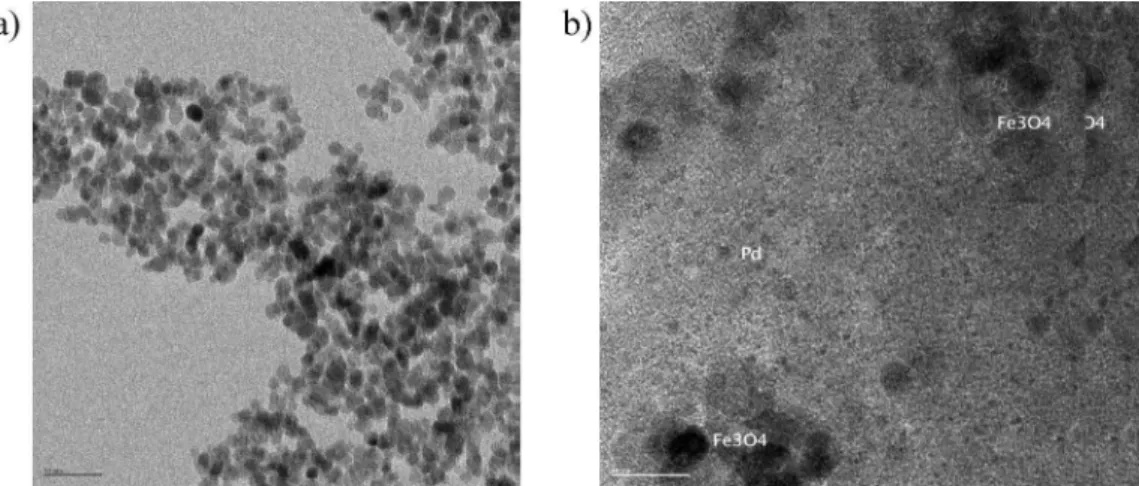
Figure 5.(a) TEM micrograph of magnetic nanoparticles modified with ionic liquid–liquid groups (MNP- IL-C4), scale bar is 50 nm. (b) TEM micrographs
of the magnetically separable palladium-based catalyst (SG-MNP-PEI-Pd) after one-pot reaction, scale bar is 20 nm.
Table 2. Carbonylation of Iodoarenes Catalyzed by Magnetically Separable Palladium-Based Catalyst That Was Separated from the
Reaction Mixture for the One-Pot Dehydration/Hydrogenation of
r-Tetralola
aSG-MNP-PEI-Pd (50 mg), 1.5 mmol of substrate, 0.45 mL of
triethylamine, 5 mL of dry methanol, 200 psi carbon monoxide, 110°C, 8 h.bDetermined by GC.cDetermined by GC and1H-NMR.
Table 3. Suzuki Coupling of Iodoarenes and Phenylboronic Acid Catalyzed by Magnetically Separable Palladium-Based Catalyst That Was Separated from the Reaction Mixture for the One-Pot
Dehydration/Hydrogenation of r-Tetralola
aSG-MNP-PEI-Pd (50 mg), 1.5 mmol of iodoarene, 2.2 mmol of
Cs2CO3, 1.95 mmol of phenylboronic acid, 5 mL of 1,4-dioxane, 90°C,
16 h.bDetermined by GC.cDetermined by GC and1H-NMR.
Scheme 4. Heck Reaction Catalyzed by Magnetically Separable Palladium-Based Catalyst
mmol/g as determined by TGA analysis (Figure 1). The resulted ionic liquid-modified magnetic nanoparticles were highly soluble in polar organic solvents like methanol and water.
3.3. Preparation of Magnetically Separable Palladium-Based Silica Sol–Gel/PEI-C12-GLY Composite.The sol–
gel process is used widely for the heterogenization of catalysts under mild conditions via encapsulation of homo-geneous catalysts.3dImportantly, the encapsulated catalysts could be recycled after filtration from the reaction mixture. In this study we utilized the sol–gel process to design a heterogeneous catalyst that can be separated by an easier and cheaper method based on applying an external magnetic field. The design is based on coencapsulation of palladium catalyst and ionic liquid-modified magnetic nanoparticles in the presence of the modified PEI within silica sol–gel matrix. The role of the modified PEI in this design is to coordinate with the palladium catalyst via its numerous coordinating sites, and to increase the loading of the catalyst in the final material as well to prevent possible leaching of the catalyst during the reactions. In addition, the modified PEI can increase the hydrophobicity of the silica sol–gel matrix and increase the stability of the magnetic nanoparticles in acidic solutions. Using unmodified PEI caused a rapid and uncon-trollable polycondensation of tetraethoxysilane, and partial gelation occurred as a result of this fast condensation.
The preparation of the magnetically separable palladium catalyst was performed as follows: Pd(OAc)2was mixed with
PEI-C12-GLY in methanol and after sonication a clear
yellow-reddish solution was obtained. The resulted solution was mixed with MNP-IL-C4 and then added to a TEOS
solution, which was hydrolyzed under acidic conditions. After gelation and aging steps, the solvents were removed under vacuum at 40°C and a black xerogel
(SG-MNP-PEI-Pd) was obtained. The SG-MNP-PEI-Pd catalyst was analyzed by Powder XRD (Figure 2), which confirms the presence of the magnetic nanoparticles in the silica sol–gel matrix. Thus, the XRD pattern of SG-MNP-PEI-Pd contains the characteristic peaks of the magnetite nanoparticles as well a broad peak between 2θ ) 10°and 2θ ) 33°, which belongs to amorphous silica produced by the sol–gel process. In addition, TGA analysis of the SG-MNP-PEI-Pd catalyst (Figure) shows that the organic content in the composite catalyst is 20% and it belongs mainly to the PEI-C12-GLY.
3.4. One-Pot Dehydration/Hydrogenation Reactions Catalyzed by Heterogeneous Acid Catalyst and the Magnetically Separable Palladium-Based Catalyst (SG-MNP-PEI-Pd). The basic idea behind this study is to develop a method to facilitate the separation between two solids functionalized with different catalysts and used in a one-pot reaction. The separation between such catalytic solids enables their reuse in other synthetic applications. The separation method for different catalytic solids, which we developed in the current study, is based on magnetic separation of one of the catalytic solids while the other one can be separated by filtration methods. Such a separation process is illustrated in Figure 4 in which two catalytic solids
are mixed in the same vessel (Figure 4 a) and after one-pot reaction, the magnetically separable catalytic solid is ac-cumulated to one side of the vessel wall after applying external magnetic field (Figure 4 b), and then the other catalytic solid is decanted with the reaction mixture to another vessel which can be then separated from the mixture by filtration (Figure 4 c).
The two catalytic solids utilized in this study are the designed SG-MNP-PEI-Pd as the hydrogenation catalyst and the cross-linked polystyrene sulfonic acid (PS-SO3H)
as the solid acid catalyst. These catalytic solids were applied in sequence reactions for the dehydration of benzyl alcohols and then the hydrogenation of the formed olefin intermediates (Scheme 3). The PS-SO3H was used to catalyze the
dehydration process of benzylic alcohols and the
SG-MNP-PEI-Pd was utilized to catalyze the hydrogenation of the double bonds formed after the dehydration reaction, giving alkylated arenes as the final products. At the end of the reactions the catalysts were separated from each other by first applying an external magnetic field to separate the
SG-MNP-PEI-Pd, and then decantation of the solid acid catalyst (PS-SO3H) to a second vessel, which was removed from
the reaction mixtures by simple filtration.
Various benzylic alcohols were tested in this sequence of reactions of dehydration/hydrogenation catalyzed by the magnetically separable palladium-based catalyst and the solid acid catalyst (Table 1). Thus, 1,2,3,4-tetrahydronaphthalene was produced exclusively when R-tetralol was mixed with
PS-SO3H and SG-MNP-PEI-Pd catalysts in toluene and
heated for 4 h at 90 °C and at a pressure of 200 psi of hydrogen (Table 1, entry 1). On the other hand, the presence of the catalysts together was necessary for a successful reaction; thus, no reaction was obtained when R-tetralol was mixed under the same conditions with SG-MNP-PEI-Pd, and only 1,2-dihydronaphthalene was obtained using the catalyst PS-SO3H. Moreover, when 1-phenyl-propan-1-ol
was used as the substrate, 97% of propylbenzene was obtained (Table 1, entry 2). When the substrates used in this reaction sequence have the possibility to stabilize the carbocation intermediate that is formed during the dehydra-tion reacdehydra-tion, coupling products were also formed. Thus, 1-naphalen-2-yl-ethanol gave 93% of 2-ethylnaphthalene and 7% of coupling products formed by reaction of toluene with the carbocation produced in the first step for the dehydration of 2-ethylnaphthalene (Table 1, entry 3). The attempts to reduce the amount of the PS-SO3Hor to increase it failed
to give better results. These coupling products were increased when 1-m-tolyl ethanol or 1-p-tolyl ethanol were used as sustrates. In the case of 1-m-tolylethanol, 70% of 1-ethyl-3-methylbenzene was produced and 30% of the coupling products (Table 1,entry 4), and only 14% of the desired product was formed when 1-p-tolyl ethanol was used as sustrate (Table 1, entry 5). However, it was possible to reduce the amount of the undesired coupling products by changing the solvents to those that can destabilize the intermediate carbocation or can not react with it. Thus, when 1-p-tolyl ethanol was reacted in n-heptane the percentage of the desired product increased to 86% (Table 1, entry 6) and when it was reacted in cyclohexane, 97% of the desired product was
2549
Chem. Mater., Vol. 20, No. 7, 2008 Separable Catalysts for Greener Chemistry Syntheses
obtained (Table 1, entry 7). After the one-pot reactions, the
SG-MNP-PEI-Pdcatalyst was analyzed by TEM and it was observed that palladium nanoparticles of 2 nm were formed as illustrated in Figure 5.
3.5. Reuse of the Palladium-Based Catalyst (SG-MNP-PEI-Pd) in Other Reactions after Magnetic Separation from One-Pot Dehydration/Hydrogenation Reactions.The palladium-based catalyst that was used for the one-pot reactions discussed above was magnetically separated and reused to catalyze successfully three types of reaction: carbonylation of iodoarenes, Suzuki, and Heck coupling reactions. Several iodoarenes were easily carbonylated and converted to aromatic carboxylate esters using the
SG-MNP-PEI-Pdcatalyst that was separated from the reaction mixture for the dehydration/hydrogenation of R-tetralol. Excellent results for this catalytic reaction are presented in Table 2. For example, iodobenzene was converted to methyl benzoate (Table 2, entry 1) when it was heated to 110 °C for 8 h under 200 psi of carbon monoxide and in the presence of the palladium-based catalyst. There is no electronic effect on this reaction. For example, 1-(iodo-phenyl)-ethanone or 1-chloro-4-iodo benzene, which containing electron with-drawing groups, gave quantitative yields of the corresponding aromatic ester (Table 2, entries 3 and 5 respectively). Quantitative yields were also obtained when substrates with electron donating groups like 1-iodo-4-methoxybenzene and 1-iodo-4-methylbenzene were subjected to carbonylation (Table 2, entries 2 and 4 respectively). Also, the position of the electron-donating group did not affect the carbonylation reaction (Table 1, compare entries 4 and 6).
Another reuse of the magnetically separated palladium catalyst was demonstrated by the Suzuki reaction. Thus, three different iodoarenes were coupled with phenyl boronic acid using SG-MNP-PEI-Pd that was separated from the reaction mixture of dehydration/hydrogenation of R-tetralol. The results for these coupling reactions are summarized in Table 3. While iodoarenes with electron donating or electron withdrawing group gave quantitative yields of the coupling
products (Table 3, entries 2 and 3 respectively), the non-substituted iodobenzene afforded biphenyl in a somewhat lower yield.
The third reuse of the separated palladium-based catalyst was demonstrated for the Heck coupling reaction. Thus, when 4′-iodo acetophenone was reacted with n-butyl acrylate, catalyzed by SG-MNP-PEI-Pd that was magnetically sepa-rated from the reaction mixture of dehydration/hydrogenation of R-tetralol, 3-(4-acetyl-phenyl)-acrylic acid butyl ester (Scheme 4) was obtained in 95% yield.
4. Conclusions
A palladium catalyst was encapsulated in silica sol–gel-modified polyethylenimine composite in the presence of ionic-liquid-modified magnetic nanoparticles. The resulting solid catalyst was easily attracted to an external magnetic field. This new catalyst was applied to one-pot dehydration/ hydrogenation reactions of benzylic alcohols. In these reactions, the palladium-based catalyst was mixed together with cross-linked polystyrene sulfonic acid in order to first catalyze the dehydration of the benzyl alcohols and then to hydrogenate the double bonds formed during the first reaction. At the end of these one-pot reactions, the palladium-based catalyst was separated magnetically from the reaction mixture and reused for other applications including the carbonylation of iodoarenes to aromatic esters, as well as the Suzuki and Heck coupling reactions.
We believe that the current findings can be useful for industrial applications where one catalyst can be cheaply and easily separated and used for several other applications. Moreover, the current method of separation between two solids that was developed in this study can be utilized in many other domains.
Acknowledgment.We are grateful to Sasol Technology and to the Natural Sciences and Engineering Research Council of Canada for support this research.