HAL Id: tel-01781786
https://tel.archives-ouvertes.fr/tel-01781786
Submitted on 30 Apr 2018
HAL is a multi-disciplinary open access archive for the deposit and dissemination of sci-entific research documents, whether they are pub-lished or not. The documents may come from teaching and research institutions in France or abroad, or from public or private research centers.
L’archive ouverte pluridisciplinaire HAL, est destinée au dépôt et à la diffusion de documents scientifiques de niveau recherche, publiés ou non, émanant des établissements d’enseignement et de recherche français ou étrangers, des laboratoires publics ou privés.
Analyse et algorithmes de résolution de systèmes ATO
(Assemble-To-Order) : Applications aux systèmes du
type W
Jianxin Fang
To cite this version:
Jianxin Fang. Analyse et algorithmes de résolution de systèmes ATO (Assemble-To-Order) : Applica-tions aux systèmes du type W. Other. Ecole Centrale de Lille, 2017. English. �NNT : 2017ECLI0012�. �tel-01781786�
N° d’ordre : 326 CENTRALE LILLE THÈSE Présentée en vue D’obtenir le grade de DOCTEUR En
Spécialité: Automatique, Génie Informatique, Traitement du Signal et des Images Par
Jianxin FANG
DOCTORAT DÉLIVRÉ PAR CENTRALE LILLE Titre de la thèse:
Analysis and Computational Algorithms for Assemble-To-Order systems:
Application to W-configuration systems
Analyse et algorithmes de résolution de systèmes ATO (Assemble-To-Order) : Applications aux systèmes du type W
Soutenue le 2 octobre devant le jury d’examen : Président Rapporteur Rapporteur Membre Membre Directeur de thèse Codirecteurs de thèse
BATTAIA Olga, Professeur, ISAE-SUPAERO DOLGUI Alexandre, Professeur, IMT Atlantique
QUADRI Dominique, Maître de Conférences (HDR), Université Paris Sud SAHIN Evren, Maître de Conférences (HDR), Centrale Supélec
BATTAIA Olga, Professeur, ISAE-SUPAERO HAMMADI Slim, Professeur, Ecole Centrale de Lille
ELHAFSI Mohsen, Professeur, University of California, Riverside CAMUS Hervé, Maître de Conférences, Ecole Centrale de Lille
Thèse préparée dans le Centre de Recherche en Informatique, Signal, et Automatique de Lille (CRIStAL), CNRS UMR 9189
To my parents,
To my family,
To my girlfriend,
To my friends,
To my professors.
Acknowledgements
This research project has been realized within the team of “Optimisation des Systèmes
Logistiques (OSL)” at the laboratory of “Centre de Recherche en Informatique, Signal et Automatique de Lille (CRIStAL)” in Centrale Lille, which is supported by the Chinese Scholarship Council (CSC) and the “Groupe de Ecole Centrale (GEC)” from October 2014 to October 2017.
First and foremost, I would like to give my gratitude to my professors: Pr. Slim Hammadi
and Mr. Hervé Camus from Centrale Lille and Pr. Mohsen EL Hafsi from University of
California, Riverside. Thanks to Pr. Slim Hammadi and Mr. Hervé Camus for giving me this
invaluable opportunity to study in Centrale Lille and for taking care of all my administration
issues. Thanks to Pr. Mohsen EL Hafsi for all his guidance, encouragement and help during my
research and for offering me a wonderful three months to work closely with him in USA. This
project would not be finished on time without their help.
Besides, I would like to thank all members of the jury of my thesis. Thanks to Pr.
AlexandreDolgui and Pr. Dominique Quadri for accepting to be reviewers of my thesis and for
giving their constructive opinions. Thanks to Pr. Evren Sahin and Pr. Olga Battaia for
accepting to be examiners of my thesis. Thanks to them for presenting in my defense and for
providing all the insightful suggestions and helpful questions to my thesis.
I am also grateful to the staffs of Centrale Lille. Thanks to Mrs. Vanessa Fleury, Mrs.
Brigitte Foncez and Mrs. Christine Yvoz for helping me in administrations. Thanks to Mrs.
Christine Vion, Mrs. Martine Mouvaux for their support in my lodgment. Thanks to Mr.
Patrick Gallais for his help in engineering issues of the laboratory. Thanks to Sara Tolba,
Veronique Attagnant for helping me in French and for letting me know better of the French
Life is much motivated being surrounded by a crowd of aspiring, executive and
interesting people. Thanks to all my colleagues and friends, Lijuan Zhang, Ben Li, Yuchen Xie,
Paul Cazenave, Ji Li, Xing Chu, Yaqian Wei, Siyang Deng, Jian Zhang, Yue Wang, etc., who
helped me a lot during my stay in the France.
Thanks to my parents, Tubiao Fang and Ronghua Ye, for all their confidence and support
during my life. Especial thanks to my girlfriend, Mingyue Wang, for all her comprehension,
patience and accompany.
Bat. E104, Residence Leonard de Vinci
26 October, 2017
Table of Contents
Acknowledgements ... 3
Lists of Figures ... 7
List of Tables ... 8
Abstract ... 9
Résumé étendue en Francais ... 13
Chapter 1. Introduction ... 17
1.1 The ATO system and its applications ... 17
1.1.1 What is an ATO system? ... 17
1.1.2 Applications of ATO systems ... 19
1.2 Outline of the thesis ... 20
1.3 Conclusion ... 22
Chapter 2. Literature Review ... 23
2.1 Inventory periodic review models ... 23
2.1.1. One-period models ... 23
2.1.2. Multi-period models ... 26
2.2 Inventory continuous review models ... 29
2.2.1 Optimal policies under several ATO configurations ... 30
2.2.2 Heuristic policies and performance metrics ... 33
2.2.3 Approximation methods ... 35
2.3 Conclusion ... 36
Chapter 3. Problem formulation and numerical example of continuous-time W-configuration ATO systems ... 37
3.1 Introduction ... 37
3.2 Lost sale case ... 38
3.2.1 Model formulation of expected total discounted cost criterion ... 38
3.2.3 Numerical example ... 43
3.3 Conclusion ... 47
Chapter 4. Structure of optimal policy in W-configuration ATO systems with lost sales and its extensions ... 49
4.1 Structure of optimal policy ... 49
4.1.1 Structure of optimal policy under average cost rate criterion ... 70
4.2 Extension to batch production and non-unitary compound Poisson demand process ... 71
4.3 Extension to K-Erlang production process ... 93
4.4 Conclusion ... 96
Chapter 5. Heuristic methods ... 97
5.1 Introduction ... 97
5.2 Decomposition method ... 98
5.3 (S, R) method and Exhaustive search method ... 100
5.3.1 (S, R) method (Heuristic I) ... 100
5.3.2 Exhaustive search method (Heuristic II)... 102
5.4 Numerical experiments ... 102
5.5 Decomposition method for larger systems ... 110
5.5.1 Decomposition method for system 1 ... 111
5.5.2 Decomposition method for system 2 ... 115
5.5.3 Decomposition method for system 3 ... 118
5.6 Conclusion ... 122
Chapter 6. Conclusion and Future research perspectives ... 123
Lists of Figures
Figure 1.1: Production process of ETO, MTO, ATO and MTS ... 18
Figure 1.2: Configuration of a basic ATO system ... 19
Figure 2.1: Configurations of simple ATO systems ... 31
Figure 3.1: A W-configuration ATO system ... 38
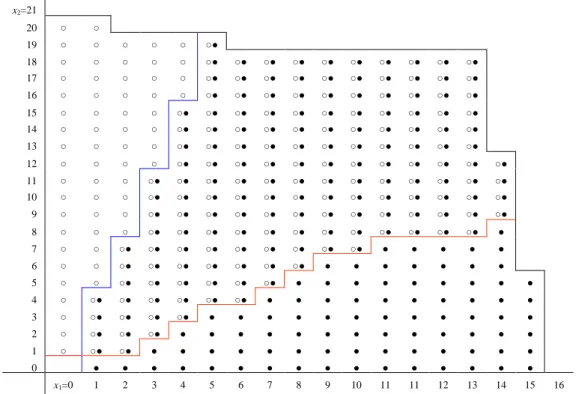
Figure 3.2: The optimal inventory allocation policy for x01, (1.23,3.20,1.83), (1.16,1.79), h(0.14,0.06,0.13) and L (35.56,32.60) ... 46
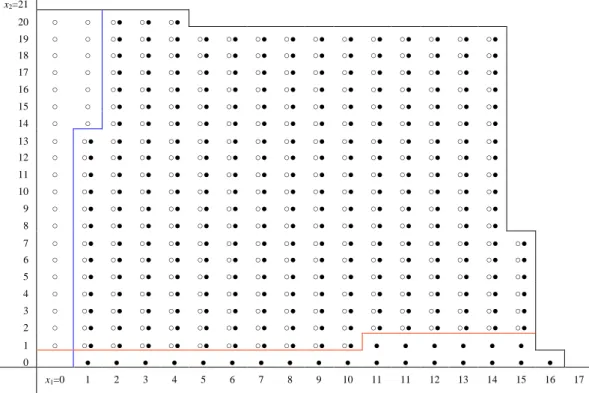
Figure 3.3: The optimal inventory allocation policy for x02, (1.23,3.20,1.83), (1.16,1.79), h (0.14,0.06,0.13) and L (35.56,32.60) ... 47
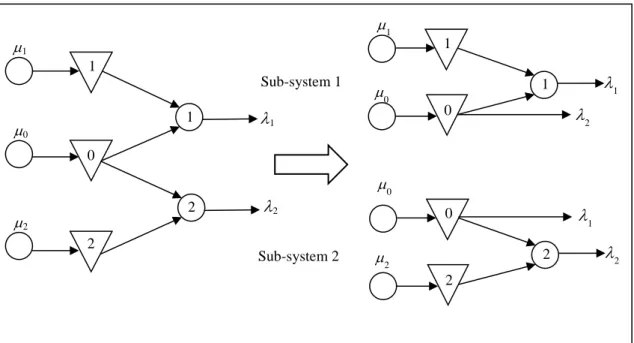
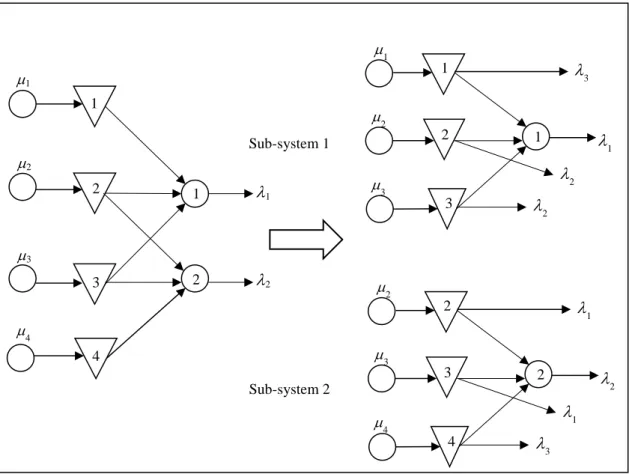
Figure 5.1: Decomposing the W-configuration ATO system into two N-configuration systems ... 99
Figure 5.2: Decomposing map of 4 components, 2 end products systems... 111
Figure 5.3: Decomposing map of 4 components, 3 end products systems... 115
List of Tables
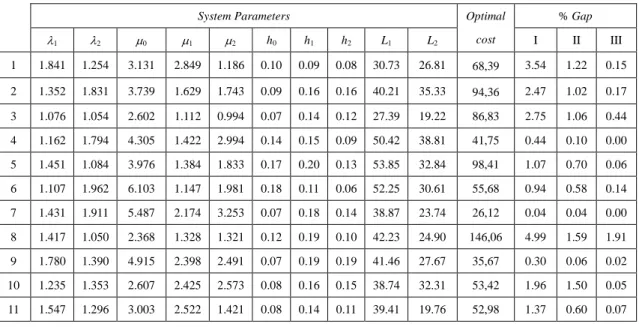
Table 5.1: Performance of Heuristic methods ... 105
Table 5.2: CPU Time Performance of Value and Policy Iteration Methods ... 108
Table 5.3: Parameter settings and decomposition results for System 1 ... 114
Table 5.4: Parameter settings and decomposition results for System 2 ... 117
Abstract
This thesis analyzes a W-configuration Assemble-To-Order (ATO) system with random lead
times, random arrival of demands, and lost sales, in continuous time. Our work contributes to
the research stream of ATO systems by characterizing the optimal control policy of a
W-configuration ATO system, which is a building block for more general systems. While the
vast majority of the literature dealing with integrated production and inventory control tries to
characterize the structure of the optimal policy over the entire state space, we used a novel
approach that characterizes the structure of the optimal policy within a sub space which we
identified as the recurrent region within which the state remains, in the long run. The
advantage of such approach is that it allows us to identify a set of structural properties that are
satisfied by the cost function (otherwise may not be satisfied outside this region). This
approach greatly simplifies the analysis and can be applied to several similar integrated
production and inventory control problems. In particular, within this region, the operator
associated with the production decision, in the optimality equation, automatically satisfies the
set of identified structural properties. This, in addition to greatly simplifying the proof of the
structure of the optimal policy, avoids the challenge of having the cost function not satisfying
certain properties in the region other than the recurrent. Furthermore, in addition to integrated
production and inventory control systems, our approach can be applied to problems where the
optimal policy yields both a recurrent and a transient region. Below, we elaborate on the
contents of each chapter.
In the first chapter, we give a basic introduction of ATO systems, which includes its
configurations and its advantages in various industries applications. We describe the challenges
in implementing ATO systems in practice and give the outline of our thesis.
In the second chapter, we review the current literatures dealing with ATO systems.
Specifically, we divide the literature based on the inventory review models and number of end
multiple-period models. For the continuous review models, we divide the literature into
exogenous load-independent models and endogenous load-dependent models. We also discuss
the optimal policy structures and computational methods in diverse problem settings.
In Chapter 3, we formulate the problem as an infinite-horizon Markov decision process.
We deviate from the standard approach by first characterizing a region (which we refer to it as
“the recurrent region”) of the state space where all properties of the cost function hold. We apply a linear programming technique to solve the problem, which shows that all states in the
recurrent region have a strictly positive limiting probability. Our analysis reveals that the
optimal allocation policy is counter-intuitive. For instance, even when one product dominates
the other, in terms of lost sale cost and lost sale cost rate (i.e., demand rate times the lost sale
cost), its demand may not have absolute priority (in being satisfied) over the other product’s
demand. Such a feature has not been observed in many integrated production/inventory
settings where inventory allocation follows a fixed priority in satisfying demands.
In Chapter 4, we characterize the optimal policy within the recurrent region. In particular,
we show that within the interior of the recurrent region, components are always produced. The
optimal component allocation within the recurrent region is characterized by two
state-dependent thresholds corresponding to the components used by the product. We also
show that the structure of the optimal policy remains for systems with batch production,
non-unitary product demand and K-Erlang distributed production times.
In Chapter 5, we propose a heuristic method that is based on system decomposition. We
compare this heuristic and two other state-independent heuristic methods to the optimal policy.
Extensive numerical experiments show that these three heuristics are efficient with compared
to the optimal policy. In particular, the decomposition method works best both with respect to
relative percentage error and computational time. Taking advantage of this fact, we use this
heuristic policy as a startup policy to the dynamic programming algorithms used to obtain the
optimal policy. We show that doing so reduces the CPU time required to obtain the optimal
decomposition method, we apply it to three other larger systems. In each of these three systems,
numerical results show it still performs very well.
In last chapter, we conclude our thesis and propose several branches of future research
perspectives.
Key words: Assemble-to-order, Markov decision process, Dynamic programming, Linear Programming, Production and inventory control, Inventory rationing, Demand management
Résumé étendue en Francais
Les systèmes Assemble-To-Order (ATO) qui comprennent un système d'assemblage et un
système de distribution sont difficiles à analyser par nature. Dans cette thèse, nous analysons
un type W (3 composants, 2 produits finales) de système ATO avec des délais de livraison
aléatoires, l'arrivée aléatoire de la demande et des ventes perdues, en temps continu. Notre
travail contribue au flux de recherche des systèmes ATO en caractérisant la politique de
contrôle optimale du système ATO avec la configuration W, qui est un bloc de construction
pour des systèmes plus généraux. Alors que la grande majorité de la littérature sur la
production intégrée et le contrôle des inventaires tente de caractériser la structure de la
politique optimale sur l'ensemble de l'espace étatique, nous avons utilisé une approche
originale qui caractérise la structure de la politique optimale à la région récurrente dans
laquelle l'état reste, à la longue. L'avantage d'une telle approche est qu'elle nous permet
d'identifier un ensemble de propriétés structurelles qui sont satisfaites par la fonction de coût
(autrement, elles pourraient ne pas être satisfaites en dehors de cette région). Cette approche
simplifie grandement l'analyse et peut être appliquée à plusieurs problèmes similaires de
production intégrée et de contrôle d'inventaire. En particulier, dans cette région, l'opérateur
associé à la décision de production, dans l'équation d'optimalité, satisfait automatiquement
l'ensemble des propriétés structurelles identifiées. Ceci, en plus de simplifier grandement la
preuve de la structure de la politique optimale, évite le défi d'avoir la fonction de coût ne
satisfaisant pas certaines propriétés dans la région autre que le récurrent. En outre, en plus des
systèmes intégrés de contrôle de la production et des stocks, notre approche peut être appliquée
aux problèmes où la politique optimale produit à la fois une région récurrente et une région
transitoire. Ci-dessous, nous développons le contenu de chaque chapitre.
Dans le premier chapitre, nous donnons une introduction basique des systèmes ATO, qui
inclut ses configurations, ses avantages et ses applications dans diverses industrielles. Nous
décrivons les défis dans la mise en œuvre des systèmes ATO dans la pratique et donnons les grandes lignes de notre thèse.
Dans le deuxième chapitre, nous passons en revue les littératures actuelles traitant des
systèmes ATO. Plus précisément, nous divisons la littérature en fonction des modèles de revue
d'inventaire et du nombre de produits finaux. Pour les modèles d'examen périodique, nous
divisons la littérature en modèles à une période et en modèles à périodes multiples. Pour les
modèles de revue continue, nous divisons la littérature en modèles exogènes et indépendants
de la charge et en modèles endogènes et dépendants de la charge. Nous discutons également
des structures politiques optimales et des méthodes de calcul dans divers contextes de
problèmes.
Dans le chapitre 3, nous formulons le problème comme un processus de décision de
Markov à l'horizon infini. Nous nous écartons de l'approche standard en caractérisant d'abord
une région (que nous appelons «la région récurrente») de l'espace d'état où toutes les propriétés
de la fonction de coût sont maintenues. Nous appliquons une technique de programmation
linéaire pour résoudre le problème, qui montre que tous les états de la région récurrente ont une
probabilité de limitation strictement positive. Notre analyse révèle que la politique d'allocation
optimale est contre-intuitive. Par exemple, même lorsqu'un produit domine l'autre, en termes
de coût de vente perdu et de perte de prix de vente (c'est-à-dire le taux de demande multiplié
par le coût de vente perdu), sa demande peut ne pas être prioritaire. Une telle caractéristique
n'a pas été observée dans de nombreux contextes intégrés de production / d'inventaire où la
répartition des stocks suit une priorité fixe dans la satisfaction des demandes.
Au chapitre 4, nous caractérisons la politique optimale dans la région récurrente. En
particulier, nous montrons qu'à l'intérieur de la région récurrente, les composants sont toujours
produits. L'allocation optimale des composants dans la région récurrente est caractérisée par
deux seuils dépendants de l'état correspondant aux composants utilisés par le produit. Nous
montrons également que la structure de la politique optimale reste pour les systèmes avec
production par lots, demande de produits non-unitaires et temps de production distribués
Au chapitre 5, nous proposons une méthode heuristique basée sur la décomposition du
système. Nous comparons cette heuristique et deux autres méthodes heuristiques
indépendantes de l'état à la politique optimale. Des expériences numériques approfondies
montrent que ces trois heuristiques sont efficaces par rapport à la politique optimale. En
particulier, la méthode de décomposition fonctionne le mieux en ce qui concerne le
pourcentage relatif d'erreur et le temps de calcul. Profitant de ce fait, nous utilisons cette
politique heuristique comme une politique de démarrage pour les algorithmes de
programmation dynamique utilisés pour obtenir la politique optimale. Nous montrons que cela
réduit le temps CPU nécessaire pour obtenir la politique optimale, de plusieurs ordres de
grandeur. De plus, afin de vérifier l'efficacité de la méthode de décomposition, nous
l'appliquons à trois autres systèmes plus importants. Dans chacun de ces trois systèmes, les
résultats numériques montrent qu'il fonctionne encore très bien.
Dans le dernier chapitre, nous terminons notre thèse et proposons plusieurs branches de
perspectives de recherche futures.
Mots-clefs: Assemble-To-Order, Processus de décision Markov, Programmation dynamique, Contrôle
Chapter 1. Introduction
Assemble-To-Order (ATO) systems have the advantages of decreasing operational costs,
increasing variety of end products and reducing response time by pooling inventory of
components and delaying the assembly stage until demand materialization. It has attracted
great deal of attention in industry for a long time. In the first chapter, we will try to understand
what an ATO system is, its advantages, disadvantages and its application fields. Then, we will
describe the optimal control of ATO systems and lay out the plan of the thesis.
1.1 The ATO system and its applications
1.1.1 What is an ATO system?
An appropriate production strategy is the keystone for a company (especially for a
manufacturing company) to integrate effectively its manpower, material resources and capital,
so as to provide market competitiveness. Typically, based on the customer order decoupling
point (M. Rudberg and J. Wikner, 2004), there are four frequently used production strategies:
Engineering-To-Order (ETO), Make-To-Order (MTO), Make-To-Stock (MTS) and
Assemble-To-Order (ATO) (cf. Figure 1.1). In General, the earlier the customer order
decoupling point, the higher degree of customization. Depending on the category of products,
the complexity of production and the specification of demand, different companies may apply
different production strategies. For instance, for bulky and complex products (Airplane,
High-speed train etc.) or non-standard products (Customized furniture, Tailored dress etc.), customers’ opinions are involved at the design phase of products. In this case, an ETO/MTO is a suitable production strategy. However, extra efforts and resources will be needed to meet customers’ specifications which increases the cost of the final product. Sometimes, customers could only choose from what is available in the marketplace (such as Agricultural products,
Apartments, etc.). In this case, Research and Development (R&D) is done through market
investigation and the MTS strategy is chosen for mass production to reduce costs. For example,
the Ford model T has always been regarded as the most successful initiative of changing from
Williams et al. 1992). The information in the MTS production system transfers to a bottom-up
model, which may induce a discrepancy between company’s supplies and customers’ needs
and which may result in a potential loss (H. L. Lee et al. 1997).
Because of customer desire for low cost as well as for customization, companies try to
strike a balance between low cost production and product customization. To this end, Mass
Customization has been proposed to serve each customer with customized product at a
reasonable price (B. J. Pine II, 1993). To obtaining the benefits of Mass Customization,
companies need to find an appropriate production stage to take customers’ needs into account.
Zinn (1990) found that the postponement of the assembly stage is an effective way to reduce
operational costs, to avoid unnecessary inventory and to offer a broader assortment of products.
In particular, postponement of the assembly stage represents a major strategic alternative to
sales forecast-based distribution when errors in demand forecasting are high. As such, the use
of the ATO strategy to organize production becomes an attractive alternative, which provides a
way to gain competitive advantage.
In general, an ATO system comprises several components or sub-assemblies that are
assembled into end products according to a bill of materials (BOM). Components are
purchased from suppliers or produced by the company itself. Products are assembled only
when customers’ demands materialize. The time of assembly can always be neglected, as the
time to acquire components is always substantially longer (Song and Zipkin, 2003). This
strategy is particularly attractive to firms with long component production/supply lead-times
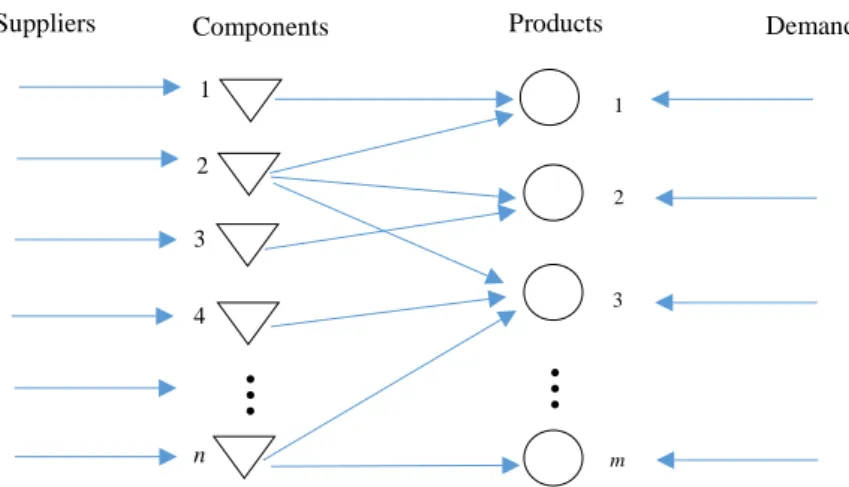
and relatively short assembly time. A basic configuration of an ATO system with n components
Figure 1.1: Production process of ETO, MTO, ATO and MTS MTS
ETO MTO ATO
Supplier Production of
and m products is shown in Figure 1.2, where certain components with certain units are
assembled to an end product and some of them are shared among different end products. The
system manager must decide when to produce/purchase components and when to satisfy
demands. If demands cannot be satisfied, they are backlogged or lost, which results in an
additional cost.
1.1.2 Applications of ATO systems
The ATO strategy has frequently been used in today’s marketplace due to its advantages. The
applications of ATO production not only allow companies to offer a large number of products
with different appearances and performances, but also let them reduce their operational costs.
We describe the following three fields where ATO systems are widely applied.
1) Traditional manufacturing
ATO is an appealing strategy for firms in such industries as high-tech, automotive and
white goods manufacturing. One well-known ATO system (also refer to as Configure-To-Order
(CTO)) is the operation of Dell Computer. Known for its direct sale, Dell lets its customers
configure their computers from sets of processors, memories, monitors, hard drives etc., and
build a customized personal computer (R. Kapuscinski, 2004). This strategy has become so
successful that other personal computer producers are adopting similar strategies, such as
Figure 1.2: Configuration of a basic ATO system
Components
…
1 2 3 4 n Suppliers Products 2…
1 2 3 m DemandsApple and H&P. In the automotive industry, the ATO system is also referred to as
Build-To-Order (BTO) system. For example, BMW allows customers to make changes to their
vehicle within 6 days of final assembly. This allows the company to build up to 550,000
permutations of the Z3 vehicle in applying such a BTO system (A. Gunasekaran, 2004).
2) Spare part management
Likewise, the ATO system can be used in the spare part control operation. Due to the
uncertain arrival of maintenance jobs that require different spare parts with different units, any
shortage of these leads to delayed maintenance jobs. In order to provide short repair turnaround
time, the maintenance department needs to keep a high stock level of spare parts. Hence, the
manager needs to balance the system cost and service level. In this setting, the spare parts refer
to components, while the end product is the maintenance component. There are many practical
applications of ATO systems in spare part management. For example, van Jaarsveld (2015)
analyzed the maintenance system of Fokker Service, which is a Netherlands-based aircraft
repair shop. He provided managerial insights that aim at balancing the operational cost and
service quality. Other examples can be found in ASML (Vilegen, I.M.H 2009), Airbus (A.
Regattieri et al. 2015) etc.
3) E-commerce
The structure of the ATO strategy also applies to other settings such as mail order catalogs,
e-retailers and distributors of multiple finished products. In such settings, customers may order
different and possibly overlapping sets of items. In this case, customer service is based on the
delivery of the entire order. The assembly of a product refers to pick the items in customers’
order and packaging them. For instance, Xu (2006) analyzed the relevant order assignment
problem so as to minimize the procurement and transportation costs of Amazon Inc.
1.2 Outline of the thesis
ATO systems however, are difficult to analyze in spite of their popularity due to the inability of
identifying the associated optimal operating policies in general. Much of this difficulty can be
attributed to several factors: Demand of a component depends on the demand of other
fulfillment of demand dependents on the availability of several components. In
multiple-products, multiple-customer classes ATO systems, this difficulty is further
compounded since the system manager not only must decide when to produce/procure
components but also must decide how to allocate component inventory among competing
demands with different priorities (Benjaafar and Elhafsi, 2006). Furthermore, an ATO system
can be thought of as a combination of an assembly system and a distribution system (Song and
Zipkin, 2003). The main challenge in an assembly system is component coordination and the
main challenge in a distribution system is component allocation among multiple products.
Thus, the difficulty of concurrently dealing with coordination and allocation issues in an ATO
system.
In this thesis, we study a continuous time integrated production and inventory control
W-configuration system with several features common in the literature. Such a system
constitutes a building block for the general multiple-component, multiple-product ATO system.
To our knowledge, there is no extant characterization of the optimal component
production/procurement and inventory allocation policies for even the basic W-configuration
system. We believe that studying and characterizing the optimal policy of the W-system allows
us to gain insight and enhance our understating of the general multiple-component,
multiple-product ATO system. Furthermore, knowing the structure of the optimal policy for the
W-configuration system allows us to extrapolate and develop efficient algorithms and
heuristics to manage the general configuration ATO systems.
The plan of our thesis is organized as follows: In chapter 2, we provide a review of the
current literature of ATO systems with different perspectives. In chapter 3, we formulate the
W-configuration ATO system and use a linear programming model to solve the system. In
chapter 4, we characterize the structure of optimal policy of W-configuration ATO system with
lost sales and extensions. In chapter 5, we propose three heuristic methods that can be used
efficiently for larger systems. In chapter 6, we conclude the thesis and provide some
1.3 Conclusion
In this chapter, we introduced the concept and advantages of an ATO system. We also
presented the applications of ATO systems. However, in spite of their popularity, ATO systems
are difficult to analyze due to their inherent characteristics. Specifically, the difficulty is due to
concurrently dealing with coordination and allocation issues in an ATO system, which leads to
Chapter 2. Literature Review
In recent years, academicians and practitioners alike have become increasingly interested in
analyzing ATO systems, with most of the papers being published in top journals of this filed.
The first review of literature relating to ATO systems was provided by Song and Zipkin (2003)
and the most recent review was provided by Atan et al. (2017). In this chapter, we follow their
leads to provide a comprehensive review of the current literature in ATO systems. Depending
on the inventory review approach, we divide the literature into periodic review models and
continuous review models.
2.1 Inventory periodic review models
In this section, we study ATO systems in the inventory periodic review setting. Based on the
number of periods, we divide this stream of literature into one-period models and multi-period
models.
2.1.1. One-period models
One-period models are studied because of their simplicity. On one hand, they can serve as a
myopic heuristic or an approximation method to more general models. On the other hand, the
one-period model can be practical under certain circumstances. For instance, the traditional
news-vendor model is a basic one-period model, where certain quantity of newspapers is
purchased according to the distribution of sales forecast ahead of the day and the leftover at the
end of the day will be discarded. Furthermore, the rapid changes in technology and engineering
can force companies to treat each demand separately, which lead to one-period models.
In a one-period setting, the sequence of events within the period is as follows: (1)
Components produced or purchased based on anticipated demand for the end products. (2) The
realization of customers’ demand. (3) Products are assembled from components and delivered
to customers. Because lead times vary among components, the main objective in the
Depending on the number of end products, we further divide the literature of one-period
models into single end product and multiple end products.
(1) One-period models with single end product
The literature of one-period models with single end product is limited. Most papers
attempt to get the optimal order policy under particular assumptions. Fu et al. (2006) consider
an inventory and production planning problem in a single product ATO system with uncertain
demand quantity. With assumptions of long components procurement lead times and limited
assembly capacity, they use a profit-maximization model to find the optimal inventory and
production decisions. In addition, the option of outsourcing is considered as an alternative way
to satisfy customers’ demands. Xiao et al. (2010b) consider a similar system, whereas
assuming uncertain assembly capacity and emergency component orders. They establish the
structural properties of the optimal solution and find assemble-in-advance strategy should be
adopted in certain conditions. Yao et al. (2013) study a single period ATO system for a single
product assembled from multiple components and assume the stock-out components can be
obtained through additional two sourcing channels that have different prices and lead-times.
They use a branch and bound algorithm to solve the system and explore the structure of the
optimal solutions.
The other branch of literature in one-period single end product deals with the lead-time
dependent pricing problem. Hsu et al. (2006) study the optimal stocking quantities problem
under the assumption of uncertain demand, while the price of the final product and the cost of
components depend on their delivery lead times. The authors provide an efficient solution
procedure that allows multiple shipments of full order quantity and extend it to the option of
not delivering the full quantity but instead taking the penalty for a delivery shortage. Hsu et al.
(2007) extend this result to consider the situation where the full order quantity must be shipped
together. They show that the full-shipment model is more appropriate for industries where the
economies of scale in transportation are critical for cost control. Fang et al. (2008) introduce the ‘Vendor Managed Consignment Inventory (VMCI)’ concept to manage the underlying risk and suppliers’ decision on production quantities under demand uncertainty. They formulate the problem using game theory to find suppliers’ Pareto-optimal equilibrium and derive the
non-increasing in delivery lead time and the supply of components can be expedited at higher
prices. They propose a cost-minimization model and develop an efficient polynomial time
algorithm to solve the problem.
In conclusion, most researchers studied the optimal ordering problem of one-period single
end product model with distinct assumptions on the sourcing mode (multiple sourcing channels,
expedited delivery etc.), the delivery mode (full quantity delivery, partial shipment, lost sale
etc.) and the assembly capacity (limited, unlimited, outsourcing etc.). In addition, some
researchers studied the lead-time dependent pricing problem, where the relation between the
price of end product and delivery lead-time need to be fully taken into consideration.
(2) One-period models with multiple end products
Unlike one-period models with single end product, one-period models with multiple end
products introduce more complication since components could be demanded by distinct end
products. To handle such systems, one needs not only to find the optimal order quantity for
each component, but also needs to determine how to allocate the component to products that
require it. Component commonality is a special issue in such system.
One branch of the literature in such systems is to determine the value of component
commonality. Inman and Schmeling (2003) investigate the value of decoupled assembly that
allows the automotive plant to change customer orders associated with a particular physical
vehicle in traditional assembly initiation. Using a simulation method, they show that the
decoupled assembly can simultaneously reduce material usage unevenness and worst case
lead-times. In particular, they claim that the benefit of decoupled orders increases with product
variety. Fong et al. (2004) provide analytical results for a commonality problem under a
general cost structure when demands follow an Erlang distribution. They show that the effect
of component commonality is significant when the budget level is high even if the common
component is much more expensive, whereas the effect is small or negative when the budget
level is low relative to the demand requirements for the end products. Chod et al. (2010) study
component procurement, assembly and product pricing under an MTO system. Specifically,
they show that the benefits of flexibility increase in demand correlation if the corresponding
products have a relatively low degree of commonality. Other results can be found in Van
The other stream of the literature deals with comparing different allocation rules and
finding their effect on system performance. Xiao et al. (2010a) analyze an ATO system that
produces two end products with a common component. They apply a profit-maximization
model to establish the structural properties for the optimal stocking solutions and investigate
with scenarios of how to fulfill low priority customer’s order. Bernstein et al. (2011) consider
an ATO system in which multiple products are assembled from a common component and a set
of product-specific components. In comparing a collection of allocation mechanisms involving
varying degrees of demand aggregation, they show that the benefit from increased demand
aggregation is closely linked to the degree of capacity imbalance. Tsai et al. (2013) propose a
two stages cost-based module mining method for an ATO system, where the first stage
determines the set of components to be formed as modules and the second stage determines
how to allocate modules among end products.
Bernstein et al. (2007) study the pricing problem in a decentralized multiproduct assembly
system and show that there exists a unique Pareto-optimal equilibrium in the supplier’s
capacity game for any set of wholesale prices.
Correspondingly, in one-period models with multiple end products, most of the research
focused on determining the value of component commonality and comparing the effect of
different allocation rules on system performance. Zipkin (2016) studied the relative integer
linear programming formulation of one-period models with multiple end products. Assuming
increasing acquisition cost, he proved that the problem holds a cover-L -convexity property #
and the feasible set has a polymatroid form.
2.1.2. Multi-period models
In multi-period models, the decisions and sequence of events within a single period are the
same as in one-period models. However, complications arise by linking subsequent periods
together. In general, there are two sources of complications. One is that the state at the end of
the current period will be the beginning state at next period. Besides, if the unsatisfied product
is backlogged, the backlogged demand need to be satisfied in subsequent periods and the rule
to clear the backlog is crucial. The other complication is due to the lead-times for components
are different, the replenishment decision in one period will affect inventory levels in other
periods in the future. Depending on the number of end products, we divide the literature on
multi-period models into single end product and multiple end products.
(1) Multi-period models with single end product
In this setting, the major problem is to find the optimal or near optimal component
replenishment policy. Rosling (1989) shows that simple reorder policies are optimal under a
mild condition of components’ initial stock levels. Karaaslan et al. (2013) study an ATO system
with one final product that is composed of one long lead-time component with short review
period and one short lead-time component with long review period. They compare the
balanced base-stock policy with pure base-stock policy and show that the balanced base stock
policy performs better under low service levels, low holding cost ratios and high demand
uncertainty.
Some researchers study the effect of different base-stock policies on system performance.
Glasserman and Wang (1998) find there is a linear trade-off between inventory levels and the
delivery lead time that is subject to a service level target. Song and Yao (2002) show that the
performance analysis for any base-stock policy reduces to the evaluation of a set of M/G/∞
queues with a common arrival stream in a single-product assembly system. In addition, they
show that it is more desirable to keep higher base-stock levels for components with longer
mean lead times and lower unit costs. Xu and Li (2007) investigate the strategic level and
operational level technology-inventory coordination for short life cycle products, in which they
show the strategic-level technology-inventory coordination is generally sufficient, but the
operational level coordination becomes necessary when demand variability is high and salvage
loss is heavy. To extend the corresponding joint price-inventory control problem to
multi-period models with single end product, Pang et al. (2012) partially characterize the
structure of optimal joint ordering and pricing policies.
As a result, in multi-period models with single end product, researchers mainly focus on
optimal replenishment policies and the effect of distinct base-stock policies on system
performance. However, the optimal replenishment policy is still an open problem for stochastic
demand process.
In this setting, the complications are further exacerbated by taking the allocation policy
into account as in one-period models with multiple end products. Since components may be
shared among different products, the value of component commonality is one of the research
topics. Mohebbi and Choobineh (2005) study the impact of component commonality in an
ATO system under supply and demand uncertainty. They apply a simulation method and show
that the introduction of common components significantly increases the average percentage of
products’ on-time delivery, while effects on the reduction of average total inventory of components and average total backorder of products are not significant.
To fully take the risk pooling advantages of component commonality, one must consider
the replenishment and allocation decisions jointly. However, Akcay and Xu (2004) show that
the component allocation problem is a general multidimensional knapsack problem and is
NP-hard, which means that the effort to find the optimal allocation policy in general ATO
systems is enormous. Some researchers tried to bypass this difficulty by finding a near optimal
or an asymptotically optimal allocation policy under certain assumptions. Plambeck and Ward
(2006) study an ATO system with a high volume of demand arriving. Taking product prices,
component production capacities and assembly sequences into consideration, they prove that a
myopic discrete-review sequencing policy is asymptotically optimal. Plambeck and Ward
(2008) extend their previous model by accepting expedite and salvage and derive the relative
asymptotical policy. Huang and de Kok (2015) consider a periodic review ATO system under
linear holding and backlogging costs and show that the First-Come-First-Service (FCFS)
allocation policy decouples the optimal component allocation problem over time into
deterministic period-by-period optimal component allocation problems, which results in a
multi-matching problem.
The benefits of ATO systems are undermined by the difficulty of finding the optimal
control policy. Some researchers examine the efficiency of combining an ATO system with
other strategies. Eynan and Rosenblatt (2007) show it is beneficial to employ the
Assemble-In-Advance (AIA) and ATO simultaneously. Furthermore, they state that the use of
component commonality reduces the number of units to be AIA and increase the number of
units to be ATO. Tsai and Wang (2009) develop a three-stage multi-site Available-To-Promise
results show this system could make good use of scarce capacity and provide customers with
high service level. Chen and Dong (2014) consider an ATP model with the consideration of
customers’ priority and show it is better than the ATP model that does not consider customers’
priority. For components’ ordering policy, Huang et al. (2014) consider a mixed replenishment
policy that adopts JIT and (Q, r) replenishment mode simultaneously. They use a hybrid
genetic simulated annealing algorithm to solve the system and show the good quality of
optimal mixed replenishment policy.
Most papers assume the instantaneous assembly in ATO systems. However, Guhlich and
Fleischmann (2015) explicitly model the intermediate materials and assembly capacity in an
ATO system. By taking scheduling and due date quoting decisions into account, they show
that the result is close to that of the ex-post solution, which contains full knowledge of all
incoming demand.
For the joint control of pricing and production decisions, Oh et al. (2014) show that a
state-dependent base-stock list-price is optimal, in which the optimal state-dependent
base-stock levels and list prices may increase or decrease as demand backlogs increase,
whereas demand backlogs always improve the optimal expected profit by providing additional
flexibilities in component allocation.
Since it’s difficult to find the optimal base-stock and allocation policies in the multi-period model with multiple end products, most papers in this section focus on testing and
improving the performance of heuristic policies. One way to conquer this problem is to find
effective heuristic production and allocation policies. The other way is to combine ATO with
other strategies, such as AIA, ATP and JIT etc.
2.2 Inventory continuous review models
In this section, we study ATO systems in continuous review setting. Unlike periodic-review,
continuous review lets manufacturers continuously monitor their system and make decisions
immediately. The development of Enterprise Resource Planning (ERP) software allows this to
characterisation of optimal policies, the use of heuristics policies, performance metrics, and
approximation methods.
2.2.1 Optimal policies under several ATO configurations
In general, it maybe hopeless to find the optimal policy for multiple-product
multiple-component ATO systems due to the high dimensionality of the system in one hand
and the lack of special properties of the cost function on the other hand. However, under some
assumptions on the demand and the supply processes and for special configurations of ATO
systems, one can characterize, fully or partially, the structure of an optimal policy. In the ATO
literature, such special configurations have been classified based on the number of components,
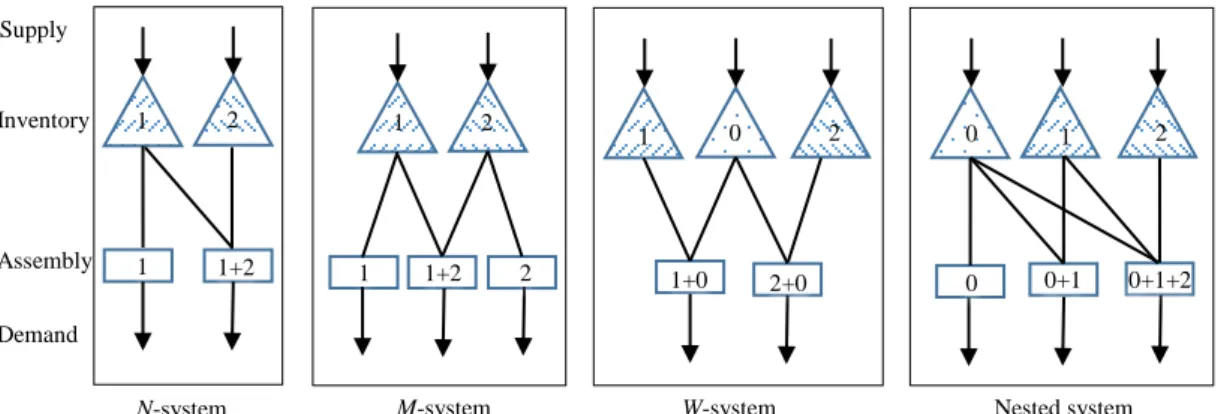
number of products, and the degree of commonality of the components. Lu et al. (2010)
identify four special configurations: (1) The N-configuration is a 2-component, 2-product
system where one product is made only from one of the components and the other product is
assembled using both components. (2) The M-configuration is a 2-component, 3-product
system where one product is assembled using both components while the other two products
use different components. (3) The W-configuration is a 3-component, 2-product system where
each product is assembled using a common component and a product-specific component. (4)
The Nested-configuration is a multiple-component, multiple product system where the “smallest” product uses one component only, the “largest” product uses all components, and the other products use one component less than the next “larger” product. These systems are
named after the shape of each configuration, which is shown in Figure 2.1. Depending on
components’ supply mode, we divide the literature on continuous review setting into endogenous and load-dependent systems and exogenous and load-independent systems.
(1) Endogenous and load-dependent continuous review systems
In such systems, replenishment lead-times are endogenous and depend on the load of the
system. This includes the work of Ha (1997a, 1997b, 2000), Carr and Duenyas (2000), de
Véricourt et al. (2002), Teunter and Klein Haneveld (2008), Zhao et al. (2009), Benjaafar et al.
(2010), Benjaafar and Elhafsi (2012) and Pang (2015). In such literature, typically, the system
produces a single product and faces Poisson demands which can be for a single unit or multiple
units and consist of several classes. Demand is either lost or backordered if not fulfilled
immediately. Items are produced either one at a time or in batches with exponentially
distributed production times. In this case, the problem is formulated as a continuous time
Markov Decision Process (MDP). The aim is to determine the optimal production and
inventory rationing policy.
As far as ATO systems are concerned, Benjaafar and ElHafsi (2006) were the first to
consider an MDP formulation of an ATO system. They studied a single-product
multiple-demand class ATO system under the assumption of exponential component
production times and Poisson demand arrivals. They showed that the optimal component
production and the optimal inventory rationing policies are both threshold type policies where
the thresholds depend on the inventory level of all components. Feng et al. (2008) study the
optimal pricing of a 2-component, single-product ATO system and showed that the optimal
component production and product pricing policies are both threshold type as in Benjaafar and
ElHafsi (2006). Elhafsi (2009) extended the results of Benjaafar and ElHafsi (2006) to the case
of compound Poisson demands and showed that using the optimal rationing policy results in
substantial savings compared to the First Come First Serve (FCFS) policy. Cheng et al. (2011)
Nested system W-system N-system Inventory Assembly Demand Supply 1 2 1 1+2 M-system 1 2 1 1+2 2 2 1 1+0 0 2+0 2 0 0+1 1 0+1+2 0
study the same system as Benjaafar and Elhafsi (2006), however they assume that the
production facilities are failure prone. They show that the production and inventory allocation
policy with respect to a component is not only influenced by the state of the other components
but also by the state of the production facilities as well. Keblis and Feng (2012) studied the
same system as Feng et al. (2008) with a general stock-out cost function and proved that the
pricing policy in Feng et al. (2008) continues to be optimal.
Elhafsi et al. (2009) study the optimal control of a nested multiple products ATO system,
which shows that components’ optimal production policy is of the base-stock type with the
base-stock level for each component non-decreasing in the inventory level of other components and components’ optimal inventory allocation is a multi-level rationing policy with the rationing level for each component depending on the inventory level of all other components.
Elhafsi et al. (2015) characterize the optimal policy structure for an M-configuration ATO
system with lost sales, which exhibits the state-dependent base-stock policy and
state-dependent rationing policy. Nadar et al. (2014) study a lost sales general M-configuration
ATO system. Assuming a certain production batch size, the authors show that the optimal
component production and inventory allocation policies are both lattice-dependent. ElHafsi
and Hamouda (2015) study a general M-configuration ATO system where in addition to the
final product, components are also available for sale. Assuming that demand is backordered if
it cannot be fulfilled immediately, they showed that the optimal rationing policy is not a strict
priority rule, as is usually the case for integrated production and inventory control problems,
but rather depends on the inventory levels of components.
(2) Exogenous and load-independent continuous review systems
In such systems, components lead-times are assumed to be exogenous and the system is
modeled as a set of queues with infinite servers and correlated arrivals. This includes the work
of Song et al. (1999, 2000, 2002 etc.), Song and Yao (2002), Gallien and Wein (2001), Dayanik
et al. (2003), Zhao (2009), Lu et al. (2010) and the references therein.
Lu et al. (2010) studied an N-configuration ATO system with general component lead
times and fixed base-stock replenishment policy. They show that a no-holdback allocation
policy (a no-holdback allocation policy does not reserve components for future product
Dogru et al. (2010) study a W-configuration ATO system where demand is backlogged if
not fulfilled immediately and component replenishment times are identical and deterministic.
Using a stochastic programming framework, they prove that a base stock component
replenishment policy combined with a priority based allocation rule is optimal under some
symmetry assumptions. Namely, balanced capacities and identical holding costs allow the
optimality of this intuitive policy. Lu et al. (2015) considered both an N-configuration and a
W-configuration system assuming a symmetric cost structure and general component
procurement lead times. Using a fixed base stock component replenishment policy, they
obtained similar results to Dogru et al. (2010).
In summary, the optimal control policy has been identified for N-, M- and nested
configurations of ATO systems. In such cases, the optimal policy is characterized by
state-dependent base-stock and state-dependent rationing thresholds. If components are
produced in batches and the end products require non-unit size of components, the optimal
policy is characterized by a lattice-dependent type for M-configuration ATO systems. If the
replenishment lead-times are identical and costs satisfy the symmetry condition in
W-configuration, the optimal replenishment policy is characterized by the coordinated
base-stock rule and the optimal allocation policy is characterized by the no-hold back
allocation rule. However, because of the curse of dimensionality in the MDP formulation, the
optimal control policy has not been determined for the general W-configuration ATO system.
2.2.2 Heuristic policies and performance metrics
Though the optimal control policies have been identified for simple ATO systems, it is difficult
to characterize it in general cases. In addition, the optimal policy is strenuous to be applied in
practice. Therefore, finding effective and easy to implement heuristic policies is an important
alternative. Another stream of the literature that is also related to our problem studies ATO
systems assuming component production/procurement is managed through base-stock levels
that are independent of the inventory level of other components and inventory allocation is
managed through specific rules. The aim is to study the performance of the system under such
rules. In this vein, Gao et al (2010) study a multi-product ATO system where product demand
fixed base stock levels. They derive the joint distribution of component inventories which
allows obtaining performance metrics such as order and item based fill rates. Fu et al. (2011)
propose approximate methods for obtaining bounds on similar performance metrics. Feng et al.
(2012) identify a necessary and sufficient condition to evaluate the order-based backorder level.
Zhou and Chao (2012) study the same system as Gao et al. (2010) and Fu et al. (2011) and
develop approximation methods to calculate the order-based fill rate of the system.
In general, most companies use independent base-stock level as components
replenishment rule. However, Benjaafar and Elhafsi (2006) show that the fixed base-stock
policy may not be able to work well in certain cases and that the coordinated base-stock rule is
more suitable. Coincidentally, Lu and Song (2015) show the coordinated base-stock policy is
optimal for W-configuration under cost symmetry condition. Van Jaarsveld et al. (2015) utilize
a (s, S) replenishment rule and show the policy works well in a practical example. For
components allocation rule, Huang and de Kok (2015) show it is of general importance.
Though FCFS rule is frequently applied, it is not optimal and sometimes it may incur great loss
potential. Elhafsi and Hamouda (2015) use a priority based allocation rule, which works well
when the demands have large differences. When the unsatisfied demands are backlogged, Lu et
al. (2010) show that the non-holdback rule is proved to be optimal in some circumstances and
outperforms all other component allocation rules.
The other branch of literature is to analyze the heuristic policies under certain
performance metrics. Lu et al. (2005) use the weighted average of backorders over product
types as the performance metric and derive easy-to-compute bounds for it. Similar to Lu et al.
(2005), Zhao (2009) study a multi-product multi-component ATO system where the external
demand follows compound Poisson processes and component inventories are controlled by
continuous time batch ordering policies. The author derives the exact expression for the
expected delivery lead-times and the order-based fill-rates metrics and estimates it under an
efficient sampling method. Iravani et al. (2004) consider an ATO system with consideration of
key and non-key items, in which they evaluate different levels of customer satisfactions using a
quasi-birth-and-death process. Lu (2008) evaluate the average inventory and immediate order
fill rate metrics and obtain qualitative results that reveal the impacts of changes in demand
The exact evaluation of any performance metric for complex ATO system faces a huge
numerical difficult. To overcome this problem, many researchers tried to obtain performance
bounds. Dayanik et al. (2003) present the order fill rate metric involving evaluation of
multivariate probability distributions, which is computationally demanding. In alternative to
the exact evaluation of the performance metric, the authors use tailored approximation ideas to
derive performance bounds. Busic et al. (2013) present a new bounding method for Markov
chains and apply it to analyze the out-of-stock situation in an ATO system.
In conclusion, many easy-to-implement heuristic policies have been developed for ATO
systems. One way to determine the efficiency of heuristic policies is to compare it with the
optimal policy. However, it is difficult to obtain optimal policies for complex ATO systems. In
order to bypass this difficulty, performance metrics have been developed to ease the evaluation
of heuristic policies, such as delivery lead time, expected backorders, order-based immediate
fill rate, order-based fill rate within a time window and a response-time based order fill rate. In
addition to exact evaluation, approximation methods have also been proposed for determining
performance bounds.
2.2.3 Approximation methods
The exact solution algorithms always face the curse of dimensionality problem, which means
that these methods cannot be used for large-scale problems. More recent literature focuses on
the development of efficient computational and solution methodologies for general ATO
systems. In this section, we review the studies on approximation methods to analyze
large-scale ATO systems.
Ceryan et al. (2012) propose to decompose an n-component, n+1-product ATO system
into N+1 independent problems. By solving each sub-problem, they can determine the
base-stock level of each component. Horng and Yang (2012) study a lost sale ATO system with
Normally-distributed component lead times and fixed base stock levels. They use
combinatorial optimization to formulate the problem. Using a genetic search algorithm, they
analyze the computational efficiency and solution quality of the algorithm for a 10-component,
6-product ATO system. Huang et al (2014) study an ATO system with setup costs and
search and simulated annealing algorithm, for a 20-component, 2-product system, they show
that such algorithm is very efficient in finding the global optimal solution. van Jaarsveld and
Scheller-Wolf (2015) use a stochastic programing formulation to determine the
state-independent base-stock levels of a large-scale ATO system. They assume product
demands are fulfilled in FCFS fashion and when demand cannot be fulfilled immediately it is
backordered. By using the column generation method in the integer programming formulation,
they show their method can be applied in an industrial scale problem. Nadar et al. (2016)
propose a mixed-integer linear programming method to evaluate the performance of
lattice-dependent policy, state-dependent policy and fixed policy, in which they show that
lattice-dependent policies outperform state-dependent and fixed ones with respect to both
objective value and computation time. Reiman et al. (2015) applied a two-stage stochastic
programming to set a lower bound on the average inventory cost for general ATO systems with
identical component lead times and develop the relevant inventory control policies, which
proved to be asymptotically optimal on the diffusion scale.
In conclusion, because of the curse of dimensionality afflicting exact algorithms,
researchers propose approximation methods for large-scale ATO problems, which can be
solved in polynomial time. These approximation methods depend greatly on the researcher’s
ingenuity and do not have the same format.
2.3 Conclusion
In this chapter, we compared and analyzed the ATO literature in a systematic way. This helped
us to gain insight into the current research progress and challenges facing ATO systems.
Specifically, we divided the literature into inventory periodic review ATO models and
inventory continuous review ATO models. In periodic review ATO models, we split this stream
into one-period ATO models and multi-period ATO models, with single end product or multiple
end products, respectively. For continuous review ATO models, we analyzed the literature from
optimal policy, heuristic policy and performance metrics, and approximation methods
Chapter 3. Problem formulation and numerical example of
continuous-time W-configuration ATO systems
The W-configuration ATO system combines both an assembly system and a distribution system,
which constitutes a building block for the general multiple-component, multiple-product ATO
system. In this chapter, we will analyze such W-configuration ATO systems under the condition
that unsatisfied demand is lost. Assuming the production processes follow exponential
distributions and demand processes follow Poisson distributions, we will formulate the
problem as a MDP and will adopt the Linear Programming (LP) method to solve it. In addition,
we will provide a numerical example and will show the form of the optimal policy.
3.1 Introduction
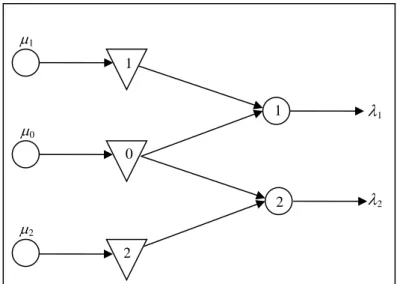
We consider a continuous-time W-configuration ATO system (cf. Figure 3.1). The system
consists of three production facilities, each producing a different component. Component 0 is
common to both products. Thus, Product j, j{1, 2}, is assembled from Components j and 0. Component i, i{0,1,2}, is produced ahead of demand in a make-to-stock fashion. Component i’s production times are independent of the state of the system, are independent of
the production status of other components, and are exponentially distributed with mean i1. Therefore, each production facility can be viewed as a single server queue with finite service
rate
i. Demand for Product j takes place continuously over time according to an independent Poisson process with rate j. Thus, the inter-arrival times between consecutive demands foreach product are exponentially distributed with mean j1. The assumption that demand inter-arrival times and production times are exponentially distributed, is common in the
integrated production/inventory systems literature (for example, Buzacott and Shanthikumar
(1993), Ha (1997a, 1997b), Zipkin (2000), and de Véricourt et al. (2002)); and is partly made
for mathematical tractability since it allows us to formulate the problem as a Markov Decision