arXiv:1907.06906v2 [nucl-ex] 24 Oct 2019
CERN-EP-2019-148 10 July 2019
c
2019 CERN for the benefit of the ALICE Collaboration.
Reproduction of this article or parts of it is allowed as specified in the CC-BY-4.0 license. 3
Λ
H and
3ΛH lifetime measurement in Pb–Pb collisions at
√
s
NN= 5.02 TeV via two-body decay
ALICE Collaboration∗
Abstract
An improved value for the lifetime of the (anti-)hypertriton has been obtained using the data sample
of Pb–Pb collisions at √sNN= 5.02 TeV collected by the ALICE experiment at the LHC. The
(anti-)hypertriton has been reconstructed via its charged two-body mesonic decay channel and the lifetime has been determined from an exponential fit to the dN/d(ct) spectrum. The measured value,
τ = 242+34
−38(stat.) ± 17 (syst.) ps, is compatible with representative theoretical predictions, thus contributing to the solution of the longstanding hypertriton lifetime puzzle.
1 Introduction
Hypernuclei are bound states of nucleons and hyperons and they are mainly produced by means of (K−,π−), (π+,K+) and (e,e′K+) reactions on stable nuclear targets [1, 2]. Hypernuclei are particularly
interesting because they can be used as experimental probes for the study of the hyperon-nucleon (Y– N) interaction. The knowledge of this interaction has become more relevant in recent years due to its connection to the modelling of astrophysical objects like neutron stars [3, 4]. In the inner core of neutron stars, the creation of hyperons is energetically favoured compared to a purely nucleonic matter composition [5]. The presence of hyperons as additional degrees of freedom leads to a considerable softening of the matter equation of state (EOS). The resulting EOS inhibits the formation of large mass neutron stars. This is incompatible with the observation of neutron stars as heavy as two solar masses [3], constituting what is referred to as the “hyperon puzzle”. Many attempts were made to solve this puzzle, e.g. by introducing three-body forces leading to an additional repulsion that can counterbalance the large gravitational pressure and allow for larger star masses. To constrain the parameter space of such models, a detailed knowledge of the Y–N interaction and of the three-body Y–N–N interaction is mandatory, including Λ, Σ and Ξ states. The lifetime of a hypernucleus depends on the strength of the Y– N interaction, and therefore a precise determination of the lifetime of hypernuclei provides information on the Y–N interaction strength [6, 7].
The recent observation of hypernuclei and the determination of their lifetimes in experiments with rela-tivistic heavy ion collisions has triggered a particular interest. All the results published so far are related to the lightest hypernucleus, the hypertriton3
ΛH, which is a bound state formed by a proton, a neutron and
a Λ, and its charge conjugate the anti-hypertriton 3
ΛH. The results have been obtained at the Relativistic
Heavy Ion Collider (STAR experiment) [8], at the SIS18 (HypHI Collaboration) [9] and at the Large Hadron Collider (ALICE Collaboration) [10].
The separation energy of the Λ in this hypernucleus is only about 130 keV [11], which results in an RMS radius (average distance of the Λ to the deuteron) of 10.6 fm [12, 13]. A very low binding energy implies a small change of the wave function of the Λ in a nucleus and hence one can expect the lifetime of the hypertriton to be very close to that of the free Λ hyperon (τΛ= (263.2 ± 2.0) ps [14]).
Early hypertriton lifetime measurements were done with imaging techniques (i.e. emulsions, bubble chambers) and the results are lower than or consistent with the value of the free Λ lifetime [15–20]. However, most of the measurements performed with these techniques are based on very small samples of events, thus resulting in a large statistical uncertainty. The recent measurements of the lifetime of (anti-)3
ΛH produced in ultra-relativistic heavy-ion collisions or in relativistic ion fragmentation [21], even
though affected by statistical and systematic uncertainties bigger than 10%, are in agreement among each other and are lower than the free Λ lifetime [9, 10, 22].
However, the few existing theoretical calculations predict that the lifetime of the3
ΛH should be very close
to the lifetime of free Λ. The most comprehensive3
ΛH lifetime calculation is from Rayet and Dalitz [23];
they obtained an estimate in the range from 239.3–255.5 ps. More recent calculations from Congleton [24] and Kamada et al. [7] yield a value of 232 ps and 256 ps, respectively. This scenario stimulated, in the last years, a new interest from both experimentalists and theoreticians for more precise measurements of the3ΛH lifetime.
In this letter, the lifetime of the (anti-)3
ΛH measured in Pb–Pb collisions at √sNN = 5.02 TeV by the
ALICE experiment is presented. In Section 2, the ALICE detector is briefly described. The details of the data sample, analysis technique and systematic uncertainties are presented in Section 3,where also a new analysis approach to crosscheck the results is introduced in the subsection 3.1. Finally the result is compared with previous measurements and with theoretical predictions in Section 4.
2 The ALICE apparatus
A detailed description of the ALICE apparatus and data acquisition framework can be found in [25, 26]. The main detectors used in this analysis are the V0 detector, the Inner Tracking System (ITS) and the Time Projection Chamber (TPC), which are located inside a solenoid creating a magnetic field of 0.5 T. The V0 detector [27] consists of two arrays of scintillator counters (V0A and V0C), placed around the beam-pipe on both sides of the interaction region. They cover the pseudorapidity ranges 2.8 < η < 5.1 and −3.7 < η < −1.7, respectively. The V0 detector is used to define the Minimum Bias (MB) trigger, which is characterized by a coincidence signal in the V0A and in the V0C, and to determine the centrality of the collisions [28]. The ITS [29] is the closest detector to the interaction point within ALICE. It is composed of six layers of silicon detectors, with radii between 3.9 and 43 cm from the interaction point. The six layers use three different technologies: silicon pixel detector (SPD), silicon drift detector (SDD) and silicon strip detector (SSD). The ITS has full azimuthal coverage 0 ≤ ϕ ≤ 2π and covers the pseudorapidity range |η| < 0.9. The TPC [30] is a gaseous detector, mainly used for tracking and for particle identification (PID) via the specific energy loss (dE/dx), with a total sensitive volume of 90 m3filled with a mixture of 88% Ar and 12% CO
2. The reconstructed clusters in TPC and
ITS are the starting point of the track finder algorithm, which adopts the Kalman filter technique [31]. These tracks are used to determine the primary collision vertex with a precision better than 50 µm in the plane transverse to the colliding beams [26].
3 Data sample and analysis technique
In this letter, the lifetime of the (anti-)hypertriton is determined by exploiting the 2-body mesonic decay channel with charged pions, namely3
ΛH →3He + π−and3ΛH →3He + π+. Both3ΛH and3ΛH candidates
are used for this measurement.
The analysis is performed using the data sample of Pb–Pb collisions at √sNN = 5.02 TeV collected by
the ALICE experiment at the end of 2015. To ensure a uniform acceptance and reconstruction efficiency in the pseudorapidity region |η| < 0.9, only those events are selected whose reconstructed primary vertex was within ±10 cm from the nominal position of the interaction point along the beam axis. The analysed sample contains approximately 90 million events in the centrality interval 0-90%.
The3
ΛH and3ΛH identification is based on the topology of their weak decays and on the reconstruction of
the tracks of their decay products, referred to as daughter particles. The weakly decaying hypernuclei are reconstructed using the algorithm which was previously used for the K0
Sand Λ production analyses [32]
and which is typically adopted for a 2-body weak decay topology. At first, the algorithm uses the TPC and ITS clusters to reconstruct the daughter tracks and then combines them in order to obtain a V-shaped decay vertex. More details on this algorithm can be found in [26, 33].
The daughter tracks are selected in the pseudorapidity region |η| < 0.9 and are required to have at least 70 clusters out of 159 in the TPC, in order to guarantee a resolution σ better than 5% on track momentum and of about 6% for the dE/dx [26]. Moreover, the χ2per TPC cluster is required to be less than 5 and
tracks with kink topologies are rejected. The particle identification (PID) of the daughters (3He,3He,
π±) is performed following the method described in [33], which is used in many analyses of the ALICE Collaboration. It is based on the difference between the measured and the expected dE/dx for a selected particle species normalized to the energy loss resolution in the detector, σ for short, and is referred to as the nσ method in this letter. In particular, an |nσ| ≤ 3 is required, in a track-by-track approach, with respect to the expected π and 3He specific energy loss in the TPC. The pions can be identified up to
a momentum of about 1.2 GeV/c, beyond which there is considerable contamination from kaons and protons. The3He, having a charge of z = 2e, can be identified cleanly up to 7 GeV/c. The 3He is also
produced in the detector material due to spallation. These are produced at low transverse momenta, as reported by the ALICE experiment [34]. As a consequence the 3He candidate is required to have a
transverse momentum (pT) greater than 1.8 GeV/c, where the spallation processes are negligible.
The3
ΛH and3ΛH candidates are selected by applying topological and kinematic selection criteria on the
decay products. The distance of closest approach (DCA) between the two daughter tracks and the DCA of π± tracks from the primary vertex are required to be lower than 0.7 cm and larger than 0.1 cm
re-spectively. The candidates are selected whose cosine of the angle between the total momentum of the daughter tracks at the secondary vertex and the vector connecting the primary and secondary vertex (pointing angle) is larger than 0.995. Two additional selections on the 3
ΛH and3ΛH rapidity (|y| < 0.8)
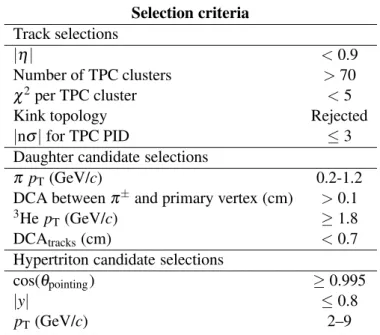
and transverse momentum (2 < pT < 9 GeV/c) are applied. All the selection criteria previously de-scribed have been studied with a dedicated Monte Carlo production, in order to improve the background rejection, and are summarized in Table 1.
Table 1:Selection criteria applied for the identification of the daughter candidate tracks and for the reconstruction of the hypertriton candidate.
Selection criteria Track selections
|η| <0.9
Number of TPC clusters >70
χ2per TPC cluster <5
Kink topology Rejected
|nσ| for TPC PID ≤ 3
Daughter candidate selections
π pT(GeV/c) 0.2-1.2
DCA between π±and primary vertex (cm) >0.1
3He p
T (GeV/c) ≥ 1.8
DCAtracks(cm) <0.7
Hypertriton candidate selections
cos(θpointing) ≥ 0.995
|y| ≤ 0.8
pT(GeV/c) 2–9
The sample of3
ΛH and3ΛH candidates is divided in four ct = MLc/p intervals for the lifetime
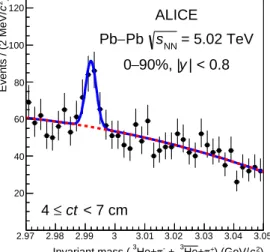
determina-tion, where c is the speed of light, t is the proper time of the candidate, M is the mass of the candidate, L is the decay distance and p is the reconstructed momentum. The mass M of the hypertriton is obtained from the measured values of mass of p, n and Λ [14] and of the binding energy [11], and has been fixed at M = 2.99116 ± 0.00005 GeV/c2. The four ct intervals are 4 ≤ ct < 7 cm, 7 ≤ ct < 10 cm, 10 ≤ ct
<15 cm and 15 ≤ ct < 28 cm. The corresponding invariant mass distributions are shown in Fig. 1 and are fitted, in each ct interval, with a function which is the sum of a Gaussian, used to interpolate the signal, and a second order polynomial, used to describe the background. The fit is performed using the maximum-likelihood estimate and the fit function is represented as a solid blue line.
From the fit, the mean values µ and the widths σ of each distribution are extracted. In particular, the signal width is in the range 1.7–2.1 MeV/c2, depending on the ct interval, and is driven by the detector
resolution. The raw yield of the signal is defined as the integral of the Gaussian function in a ± 3σ region around the mean value above the background. The significance of the signal in the four ct intervals varies in the range 3.1–4.9.
The yield is corrected in each ct bin for the detector acceptance, the reconstruction efficiency and the absorption of the 3
ΛH (3ΛH) in the detector material. The efficiency×acceptance is determined with a
dedicated Monte Carlo simulation, where the 3
ΛH and 3ΛH are injected on top of a HIJING event [35]
2.97 2.98 2.99 3 3.01 3.02 3.03 3.04 3.05 ) 2 c ) (GeV/ + π + He 3 + -π He+ 3 Invariant mass ( 20 40 60 80 100 120 ) 2 c Events / (2 MeV/ ALICE = 5.02 TeV NN s Pb − Pb | < 0.8 y 90%, | − 0 < 7 cm ct ≤ 4 2.97 2.98 2.99 3 3.01 3.02 3.03 3.04 3.05 ) 2 c ) (GeV/ + π + He 3 + -π He+ 3 Invariant mass ( 10 20 30 40 50 60 70 80 90 ) 2 c Events / (2 MeV/ Data Signal + background Background < 10 cm ct ≤ 7 2.97 2.98 2.99 3 3.01 3.02 3.03 3.04 3.05 ) 2 c ) (GeV/ + π + He 3 + -π He+ 3 Invariant mass ( 10 20 30 40 50 60 70 80 90 ) 2 c Events / (2 MeV/ < 15 cm ct ≤ 10 2.97 2.98 2.99 3 3.01 3.02 3.03 3.04 3.05 ) 2 c ) (GeV/ + π + He 3 + -π He+ 3 Invariant mass ( 20 40 60 80 100 ) 2 c Events / (2 MeV/ < 28 cm ct ≤ 15
Figure 1: Invariant mass distribution of (3He,π−) and (3He,π+) for the four ct intervals used to determine the 3
ΛH and3ΛH lifetime. The solid blue curve represents the function used to perform the fit and the red dashed curve represents the background component.
propagated through the ALICE detectors using the GEANT3 transport code [36] and then reconstructed following the same procedure as adopted for the data.
The aforementioned transport code does not properly describe the interactions of the (anti-)(hyper-)nuclei with the material of the apparatus. Thus, a correction factor for the absorption of3
ΛH (3ΛH) and
3He (3He)
is estimated, based on the p (p) absorption probability measured in the ALICE detector [37]. The usage of this experimental measurement offers the advantage of taking automatically into account the cross section and the effective material of the detector crossed by a charged particle. The same absorption probability for protons and neutrons has been assumed and the3He (3He) has been considered as a state
of three independent p (p) as verified in [10]. The absorption probability, computed as the third power of that of one proton, goes from 11% at low pTto 6% at high pTfor3He while it is constant at 6% for3He.
The evaluation of the3
ΛH (3ΛH) absorption probability is done following the same approach. However,
to take into account the small Λ separation energy (BΛ = 0.13 ± 0.05 MeV [11]), the 3ΛH absorption
cross-section is increased by 50% with respect to the one of the3He [38, 39], as described in the ALICE
measurement in Pb–Pb collisions at √sNN = 2.76 TeV [10]. This leads to an absorption probability
between 16% and 9% for3
ΛH as a function of pTwhile it is constant at 9% for 3
to be applied is:
k= kabs,3
ΛH+ (1 − kabs,3ΛH)kabs,3He (1)
where kabs,3
ΛH is the probability that the
3
ΛH is absorbed between the primary and the secondary vertex
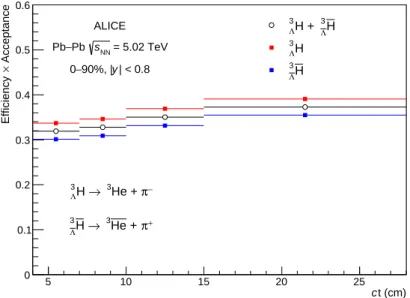
while kabs,3Heis the probability that the daughter3He is absorbed between the secondary vertex and the TPC inner wall. For each ct interval, the efficiency x acceptance has been calculated using the absorption corrected numbers of reconstructed3
ΛH and3ΛH. Fig. 2 shows the efficiency×acceptance (black marker)
which is used for the lifetime determination and is obtained by combining3
ΛH and3ΛH after the absorption
correction is applied. This distribution is also shown separately for3
ΛH and3ΛH and the difference is due
to the absorption correction which is bigger for the anti-matter.
5 10 15 20 25 t (cm) c 0 0.1 0.2 0.3 0.4 0.5 0.6 Acceptance × Efficiency H Λ 3 H + Λ 3 H Λ 3 H Λ 3 ALICE = 5.02 TeV NN s Pb − Pb | < 0.8 y 90%, | − 0 − π He + 3 → H Λ 3 + π + He 3 → H Λ 3
Figure 2: Efficiency×acceptance as a function of ct for3ΛH (red square), 3
ΛH (blue square) and
3
ΛH +3ΛH (black open circle) in the same ct intervals selected for the raw yields extraction.
The main sources of systematic uncertainties on each ct bin used for the lifetime evaluation are the absorption correction, the single track efficiency and the uncertainty on the detector material budget. The systematic uncertainty on the absorption correction is mainly due to the assumption used for the
3
ΛH (3ΛH) cross-section. This uncertainty is evaluated by varying this assumption between a lower and
an upper limit. The first one is obtained by setting the 3
ΛH (3ΛH) cross-section equal to the
3He (3He)
absorption cross-section and the second one as twice the3He (3He) absorption cross-section. This leads
to an uncertainty of 5.2% for each ct interval, as reported in Table 2.
The second source of systematic uncertainty is related to the material budget description in the simula-tion. An uncertainty on the knowledge of the ALICE detector material budget of 4.5% was determined in a previous study [26]. The systematic uncertainty is estimated using two dedicated Monte Carlo pro-ductions, varying the material budget accordingly, and amounts to 1% for the yields in all ct intervals. The systematic uncertainty due to the single-track efficiency and the different choices of the track quality selections has been investigated [40] and amounts to 4%. For the analysis of the two-body decay of
3
ΛH an uncertainty of 8% is assumed in all ct intervals. The summary of the systematic uncertainties is
reported in Table 2, where the total uncertainty is obtained as sum in quadrature of each contribution of the individual sources.
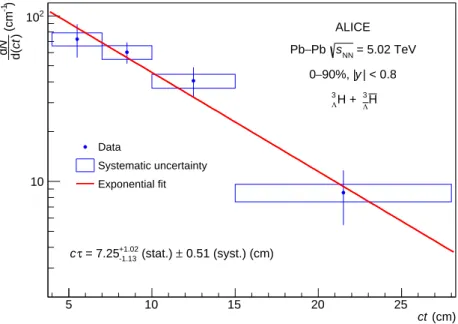
The corrected dN/d(ct) spectrum is shown in Fig. 3 where the blue markers are the corrected yield with their statistical uncertainty, while the boxes represents the systematic uncertainty.
Table 2:Summary of the systematic uncertainties used in the lifetime analysis. The total uncertainty assigned in each ct interval is the sum in quadrature of the single sources.
Systematic uncertainties
Source Value
Absorption 5.2%
Material budget 1%
Single track efficiency 8%
Total 9.5%
The lifetime is determined with an exponential fit (red line) and the slope results in a proper decay length of cτ = 7.25+1.02
−1.13 (stat.) ± 0.51 (syst.) cm, corresponding to a lifetime τ = 242+34−38 (stat.) ± 17 (syst.) ps.
The systematic uncertainty for the lifetime value is determined by assuming the systematic uncertainties in each ct interval as uncorrelated.
5 10 15 20 25 (cm) ct 10 2 10 ) -1 (cm ) ct d( N d 0.51 (syst.) (cm) ± (stat.) -1.13 +1.02 = 7.25 τ c ALICE = 5.02 TeV NN s Pb − Pb | < 0.8 y 90%, | − 0 H Λ 3 H + Λ 3 Data Systematic uncertainty Exponential fit
Figure 3:Corrected dN/d(ct) spectrum fitted with an exponential function (red line) used to extract the (3ΛH +3 ΛH) lifetime. The bars and boxes represent the statistical and systematic uncertainties, respectively.
3.1 Unbinned fit method for lifetime extraction
In order to enforce the result described in Sec. 3, an additional analysis on the same data sample has been carried out that relies on a two-dimensional (invariant mass vs. ct) unbinned fit approach. The method can be summarized in three steps: i) fit to the ct-integrated invariant mass distribution; ii) tune the function used to describe the combinatorial background; iii) fit to the ct distribution with a function which is the sum of three exponentials, one to describe the signal and two to describe the background. The first step is performed with a function that is the sum of a Gaussian, for the signal, and a second order polynomial, for the background. The mean value µ and the σ are 2.9913±0.0004 GeV/c2 and
0.0020±0.0005 GeV/c2 respectively and are used to define the boundaries of the signal region and the
sidebands, which correspond to the intervals µ ± 3σ and ± 3σ to ± 9σ with respect to the mean value, respectively.
The second step consists in fitting the ct distribution of the background in the sidebands using a function that is the sum of two exponentials. The fit is performed simultaneously in the two sideband regions with
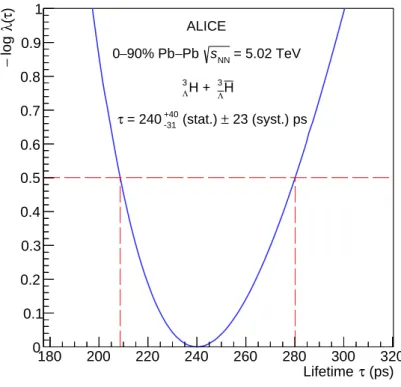
180 200 220 240 260 280 300 320 (ps) τ Lifetime 0 0.1 0.2 0.3 0.4 0.5 0.6 0.7 0.8 0.9 1 ) τ ( λ log − 0−90% Pb−Pb sNN = 5.02 TeV H Λ 3 H + Λ 3 ALICE 23 (syst.) ps ± (stat.) -31 +40 = 240 τ
Figure 4:Lifetime valueτdetermined from the minimization of the log-likelihood ratio –log(λ(τ)). The statistical uncertainty is evaluated at a confidence level of 68% (red dashed lines) with the log-likelihood ratio (blue line).
the ROOFITpackage [41]. The result is then used as background parameterization for the fit in the signal region.
The (3
ΛH +3ΛH) lifetime measurement is obtained by performing the unbinned fit to the ct distribution
in the signal region. The total probability density function used for the fit is the sum of the two expo-nentials (background) and the exponential adopted to reproduce the signal. Since the ct distribution is unbinned, the efficiency×acceptance correction, evaluated as described in Sec. 3, is parametrized with a polynomial plus an exponential and it is used to scale the signal function. The observed signal distri-bution is described as the product of the function used for the signal and the efficiency parametrization. Thus, the lifetime is obtained with the unbinned maximum-likelihood estimate (MLE) fit to the ct dis-tribution, performed in the signal region, leading to a value of τ = 240+40
−31 (stat.) ± 18 (syst.) ps, as
reported in Fig. 4. The statistical uncertainty of the measurement is assessed by providing the interval of the estimated τ [42], at a confidence level of 68%, which is represented by the red dashed lines, based on the log-likelihood ratio (logλ (τ)), shown as a blue line. The result corresponds to a proper decay length cτ = 7.20+1.20
−0.93 (stat.) ± 0.54 (syst.) cm. The sources of systematic uncertainties are the same as
described in Sec. 3 (Table 2) and contribute to a total systematic uncertainty of 9.5% on the estimated lifetime.
The value obtained with this approach is in good agreement within 1σ with the lifetime estimation obtained with the method described in Sec. 3, which we consider as the final value for the3
ΛH lifetime.
4 Discussion and conclusions
Thanks to the large data sample of heavy-ion collisions at √sNN = 5.02 TeV provided by the LHC
and to the excellent tracking and particle identification performance of the ALICE apparatus we have determined a precise value for the3
ΛH lifetime. The measured τ = 242+34−38(stat.) ± 17 (syst.) ps is shown
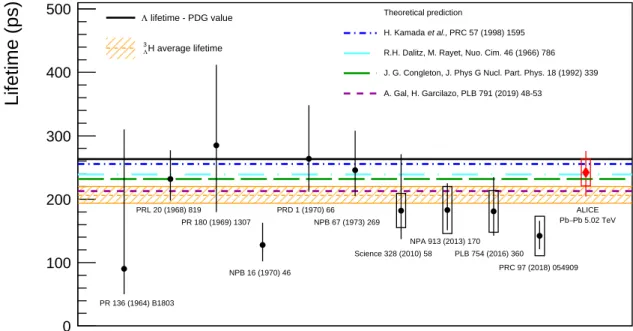
as a full red diamond in Fig. 5 together with other experimental results and theoretical estimates.
0 100 200 300 400 500
Lifetime (ps)
PR 136 (1964) B1803 PRL 20 (1968) 819 PR 180 (1969) 1307 NPB 16 (1970) 46 PRD 1 (1970) 66 NPB 67 (1973) 269 Science 328 (2010) 58 NPA 913 (2013) 170 PLB 754 (2016) 360 PRC 97 (2018) 054909 ALICE Pb 5.02 TeV − Pb lifetime - PDG value Λ H average lifetime Λ 3 Theoretical prediction , PRC 57 (1998) 1595 et al. H. KamadaR.H. Dalitz, M. Rayet, Nuo. Cim. 46 (1966) 786 J. G. Congleton, J. Phys G Nucl. Part. Phys. 18 (1992) 339 A. Gal, H. Garcilazo, PLB 791 (2019) 48-53
Figure 5: Collection of the 3ΛH lifetime measurements obtained with different experimental techniques. The
vertical lines and boxes are the statistical and systematic uncertainties respectively. The orange band represents the average of the lifetime values and the lines at the edge correspond to 1σ uncertainty. The dashed-dotted lines are four theoretical predictions.
Early experiments [15–20] were performed with visualizing techniques, namely photographic emul-sion and3He filled bubble chambers, where the tracks formed due to passage of charged particles were
recorded visually. Most of the results obtained using these techniques had large uncertainties due to the limited size of the data sample at disposal. Furthermore, these measurements prevented a definite conclusion on the agreement with the theoretical predictions, which foresee a lifetime close to the value of the free Λ hyperon. It is worthwhile to note that the small binding energy of the hypertriton makes the Λ spend most of the time far from the deuteron core thereby not affecting the lifetime due to Y-N interaction.
The recent determination of the lifetime τ of (anti-)3
ΛH of 182+89−45(stat.) ± 27 (syst.) ps, measured for the
first time in Au–Au collisions via two-body decay by the STAR experiment at RHIC [8], revived the in-terest for a more precise determination of the lifetime. The HypHI Collaboration at GSI reported a value of τ = 183+42
−32(stat.) ± 37 (syst.) ps [9], which was obtained by studying the projectile fragmentation of 6Li at 2 AGeV on a carbon target. Very recently, the ALICE experiment at the LHC measured a lifetime
value τ = 181+54
−38 (stat.) ± 33 (syst.) ps [10] using the data from Pb–Pb collisions at√sNN= 2.76 TeV
and the invariant mass analysis of the two-body decay channel. The average value of all results available up to 2016 was τ = 215+18
−16 ps [10], much lower than the theoretical estimates, motivating the need for
a measurement with improved precision. The STAR Collaboration performed a new analysis [22] com-bining the two-body and the three-body decay channels using the data sample of the RHIC beam energy
scan, resulting in an even lower value of τ = 142+24
−21 (stat.) ± 29 (syst.) ps. The ALICE Collaboration
exploited the data collected in Pb–Pb collisions at √sNN= 5.02 TeV to carry out a new analysis of the
two-body decay channel, reported in this letter. These two most recent values are reported in Fig. 5. The new measurement by STAR yields a very low value as compared to the lifetime of the free Λ, while the result presented in this paper is in agreement with the theoretical predictions and it is characterized by an improved precision with respect to previous experiments. This value is also in agreement with a previous ALICE result [10] obtained by analyzing the data sample of Pb–Pb collisions at √sNN= 2.76 TeV.
Besides the experimental results, the theoretical predictions for the 3
ΛH lifetime are reported in Fig. 5
for comparison with the data. The calculation performed by Dalitz and Rayet [23], represented with a dot-long dashed cyan line, took into account the phase space factors and the Pauli principle, including also corrections to account for final state pion scattering and the non-mesonic weak decay channel. More recently, a prediction for the3
ΛH lifetime quite close to the one of the free Λ hyperon was published by
Congleton [24] (dashed green line in Fig. 5), obtained using updated values for N–N and Y–N potentials. The prediction by Kamada et al. [7] (dotted-dashed blue line) was performed with a rigorous determina-tion of the hypernucleus wave funcdetermina-tion and of the three nucleons scattering states, thus finding a value of 256 ps, which is the closest to the free Λ lifetime value. Recently, Garcilazo and Gal performed a calculation [44] using the wave function generated by solving three-body Faddeev equations and adding the final-state interactions of the pions. Their prediction of 213 ps is shown as a dotted purple line. A statistical combination of all the experimental results, including the most recent values determined by the STAR and the ALICE experiment, leads to a world average of τ = 206+15
−13 ps for the3ΛH lifetime
and is represented with an orange band in Fig. 5. The method used for this evaluation is the same as described in [10]. Furthermore world averages were calculated grouping the measurements on the basis of the experimental techniques, obtaining τvisual = 224+23−20ps and τHI= 189+22−20ps for the visualizing
techniques and the heavy-ion experiments, respectively. These values are consistent and in agreement, also with the world average, and this suggests that the results are not affected by the technique used for the measurement.
Despite the addition of two recent high precision measurements of the3
ΛH lifetime, one well below and
the other closer to the theoretical predictions, the situation has hardly changed with the current world av-erage, now more than 3 σ below the lifetime of the free Λ hyperon. In the future a very large data sample will be collected with heavy-ion collisions during LHC Run 3 (2021-2023) and Run 4 (2027-2029) [45]. At the end of Run 4, ALICE expects to reduce the statistical uncertainty on the lifetime down to 1% and significantly improve the systematic uncertainty, which at present is 9.5%. Furthermore, it would be beneficial in view of a more solid comparison with the theoretical predictions, to have new measure-ments performed at lower energies at RHIC and SIS and by using different experimental techniques at the J-PARC and MAMI facilities. A measurement of the lifetime to a precision of a few percent will guide and constrain the theoretical input leading to a more precise determination of the Y-N interaction, eventually contributing to solving the hyperon puzzle.
Acknowledgements
The ALICE Collaboration would like to thank all its engineers and technicians for their invaluable con-tributions to the construction of the experiment and the CERN accelerator teams for the outstanding performance of the LHC complex. The ALICE Collaboration gratefully acknowledges the resources and support provided by all Grid centres and the Worldwide LHC Computing Grid (WLCG) collaboration. The ALICE Collaboration acknowledges the following funding agencies for their support in building and running the ALICE detector: A. I. Alikhanyan National Science Laboratory (Yerevan Physics In-stitute) Foundation (ANSL), State Committee of Science and World Federation of Scientists (WFS), Armenia; Austrian Academy of Sciences, Austrian Science Fund (FWF): [M 2467-N36] and
National-stiftung für Forschung, Technologie und Entwicklung, Austria; Ministry of Communications and High Technologies, National Nuclear Research Center, Azerbaijan; Conselho Nacional de Desenvolvimento Científico e Tecnológico (CNPq), Universidade Federal do Rio Grande do Sul (UFRGS), Financiadora de Estudos e Projetos (Finep) and Fundação de Amparo à Pesquisa do Estado de São Paulo (FAPESP), Brazil; Ministry of Science & Technology of China (MSTC), National Natural Science Foundation of China (NSFC) and Ministry of Education of China (MOEC) , China; Croatian Science Foundation and Ministry of Science and Education, Croatia; Centro de Aplicaciones Tecnológicas y Desarrollo Nuclear (CEADEN), Cubaenergía, Cuba; Ministry of Education, Youth and Sports of the Czech Republic, Czech Republic; The Danish Council for Independent Research | Natural Sciences, the Carlsberg Foundation and Danish National Research Foundation (DNRF), Denmark; Helsinki Institute of Physics (HIP), Fin-land; Commissariat à l’Energie Atomique (CEA), Institut National de Physique Nucléaire et de Physique des Particules (IN2P3) and Centre National de la Recherche Scientifique (CNRS) and Région des Pays de la Loire, France; Bundesministerium für Bildung und Forschung (BMBF) and GSI Helmholtzzentrum für Schwerionenforschung GmbH, Germany; General Secretariat for Research and Technology, Ministry of Education, Research and Religions, Greece; National Research, Development and Innovation Office, Hungary; Department of Atomic Energy Government of India (DAE), Department of Science and Tech-nology, Government of India (DST), University Grants Commission, Government of India (UGC) and Council of Scientific and Industrial Research (CSIR), India; Indonesian Institute of Science, Indonesia; Centro Fermi - Museo Storico della Fisica e Centro Studi e Ricerche Enrico Fermi and Istituto Nazionale di Fisica Nucleare (INFN), Italy; Institute for Innovative Science and Technology , Nagasaki Institute of Applied Science (IIST), Japan Society for the Promotion of Science (JSPS) KAKENHI and Japanese Ministry of Education, Culture, Sports, Science and Technology (MEXT), Japan; Consejo Nacional de Ciencia (CONACYT) y Tecnología, through Fondo de Cooperación Internacional en Ciencia y Tec-nología (FONCICYT) and Dirección General de Asuntos del Personal Academico (DGAPA), Mexico; Nederlandse Organisatie voor Wetenschappelijk Onderzoek (NWO), Netherlands; The Research Coun-cil of Norway, Norway; Commission on Science and Technology for Sustainable Development in the South (COMSATS), Pakistan; Pontificia Universidad Católica del Perú, Peru; Ministry of Science and Higher Education and National Science Centre, Poland; Korea Institute of Science and Technology In-formation and National Research Foundation of Korea (NRF), Republic of Korea; Ministry of Education and Scientific Research, Institute of Atomic Physics and Ministry of Research and Innovation and In-stitute of Atomic Physics, Romania; Joint InIn-stitute for Nuclear Research (JINR), Ministry of Education and Science of the Russian Federation, National Research Centre Kurchatov Institute, Russian Science Foundation and Russian Foundation for Basic Research, Russia; Ministry of Education, Science, Re-search and Sport of the Slovak Republic, Slovakia; National ReRe-search Foundation of South Africa, South Africa; Swedish Research Council (VR) and Knut & Alice Wallenberg Foundation (KAW), Sweden; Eu-ropean Organization for Nuclear Research, Switzerland; National Science and Technology Development Agency (NSDTA), Suranaree University of Technology (SUT) and Office of the Higher Education Com-mission under NRU project of Thailand, Thailand; Turkish Atomic Energy Agency (TAEK), Turkey; National Academy of Sciences of Ukraine, Ukraine; Science and Technology Facilities Council (STFC), United Kingdom; National Science Foundation of the United States of America (NSF) and United States Department of Energy, Office of Nuclear Physics (DOE NP), United States of America.
References
[1] E. Botta, T. Bressani, and G. Garbarino, “Strangeness nuclear physics: a critical review on selected topics”, Eur. Phys. J. A48 (2012) 41, arXiv:1203.5707 [nucl-ex].
[2] A. Gal, E. V. Hungerford, and D. J. Millener, “Strangeness in nuclear physics”, Rev. Mod. Phys. 88(2016) 035004, arXiv:1605.00557 [nucl-th].
[3] J. M. Lattimer and M. Prakash, “The Physics of Neutron Stars”, Science 304 (2004) 536–542, arXiv:astro-ph/0405262 [astro-ph].
[4] J. Schaffner-Bielich, “Hypernuclear Physics for Neutron Stars”, Nucl. Phys. A804(2008) 309–321, arXiv:0801.3791 [astro-ph].
[5] L. Tolos, M. Centelles, and A. Ramos, “The Equation of State for the Nucleonic and Hyperonic Core of Neutron Stars”, Publications of the Astronomical Society of Australia 34 (2017) e065, arXiv:1708.08681 [astro-ph].
[6] R. H. Dalitz and G. Rajasekharan, “The spins and lifetimes of the light hypernuclei”, Phys. Lett. 1(1962) 58–60.
[7] H. Kamada, J. Golak, K. Miyagawa, H. Witala, and W. Gloeckle, “π-mesonic decay of the hypertriton”, Phys. Rev. C57 (1998) 1595–1603, arXiv:nucl-th/9709035 [nucl-th]. [8] STAR Collaboration, B. I. Abelev et al., “Observation of an Antimatter Hypernucleus”,
Science 328(2010) 58–62, arXiv:1003.2030 [nucl-ex].
[9] C. Rappold et al., “Hypernuclear spectroscopy of products from 6Li projectiles on a carbon target at 2 AGeV”, Nucl. Phys. A913 (2013) 170–184, arXiv:1305.4871 [nucl-ex].
[10] ALICE Collaboration, J. Adam et al., “3
ΛH and3ΛH production in Pb–Pb collisions at √sNN= 2.76
TeV”, Phys. Lett. B754 (2016) 360–372, arXiv:1506.08453 [nucl-ex]. [11] D. H. Davis, “50 years of hypernuclear physics: I. The early experiments”,
Nucl. Phys. A754(2005) 3–13.
[12] P. Braun-Munzinger and B. Dönigus, “Loosely-bound objects produced in nuclear collisions at the LHC”, Nucl. Phys. A987 (2019) 144–201, arXiv:1809.04681 [nucl-ex].
[13] F. Hildenbrand and H. W. Hammer, “Three-Body Hypernuclei in Pionless Effective Field Theory”, arXiv:1904.05818 [nucl-th].
[14] Particle Data Group Collaboration, M. Tanabashi et al., “Review of Particle Physics”, Phys. Rev. D98(2018) 030001.
[15] R. J. Prem and P. H. Steinberg, “Lifetimes of Hypernuclei,3
ΛH,4ΛH,5ΛH”,
Phys. Rev. 136(1964) B1803–B1806.
[16] G. Keyes, M. Derrick, T. Fields, L. G. Hyman, J. G. Fetkovich, J. McKenzie, B. Riley, and I. T. Wang, “New Measurement of the3
ΛH Lifetime”, Phys. Rev. Lett. 20 (1968) 819–821.
[17] R. E. Phillips and J. Schneps, “Lifetimes of Light Hyperfragments. II”, Phys. Rev. 180(1969) 1307–1318.
[18] G. Bohm et al., “On the lifetime of the3
ΛH hypernucleus”, Nucl. Phys. B16 (1970) 46–52.
[Erratum ibid 16 (1970) 523].
[19] G. Keyes, M. Derrick, T. Fields, L. G. Hyman, J. G. Fetkovich, J. Mckenzie, B. Riley, and I.-T. Wang, “Properties of3
ΛH”, Phys. Rev. D1 (1970) 66–77.
[20] G. Keyes, J. Sacton, J. H. Wickens, and M. M. Block, “A measurement of the lifetime of the3
ΛH
hypernucleus”, Nucl. Phys. B67 (1973) 269–283.
[21] J. Chen, D. Keane, Y.-G. Ma, A. Tang, and Z. Xu, “Antinuclei in Heavy-Ion Collisions”, Phys. Rept. 760(2018) 1–39, arXiv:1808.09619 [nucl-ex].
[22] STAR Collaboration, L. Adamczyk et al., “Measurement of the3
ΛH lifetime in Au+Au collisions
at the BNL Relativistic Heavy Ion Collider”, Phys. Rev. C97 (2018) 054909, arXiv:1710.00436 [nucl-ex].
[23] R. Dalitz and M. Rayet, “Lifetime of3
ΛH”, Il Nuovo Cim. A 46 (1966) 786–794.
[24] J. G. Congleton, “A simple model of the hypertriton”, J. Phys. G18 (1992) 339–357. [25] ALICE Collaboration, K. Aamodt et al., “The ALICE experiment at the CERN LHC”,
JINST 3(2008) S08002.
[26] ALICE Collaboration, B. B. Abelev et al., “Performance of the ALICE experiment at the CERN LHC”, Int. J. Mod. Phys. A29 (2014) 1430044, arXiv:1402.4476 [nucl-ex].
[27] ALICE Collaboration, E. Abbas et al., “Performance of the ALICE VZERO system”, JINST 8(2013) P10016, arXiv:1306.3130 [nucl-ex].
[28] ALICE Collaboration, J. Adam et al., “Centrality dependence of the charged-particle multiplicity density at midrapidity in Pb–Pb collisions at √sNN= 5.02 TeV”,
Phys. Rev. Lett. 116(2016) 222302, arXiv:1512.06104 [nucl-ex]. https://cds.cern.ch/record/2118084.
[29] ALICE Collaboration, K. Aamodt et al., “Alignment of the ALICE Inner Tracking System with cosmic-ray tracks”, JINST 5 (2010) P03003, arXiv:1001.0502 [physics.ins-det].
[30] J. Alme et al., “The ALICE TPC, a large 3-dimensional tracking device with fast readout for ultra-high multiplicity events”, Nucl. Instrum. Methods A 622 (2010) 316–367,
arXiv:1001.1950 [physics.ins-det].
[31] R. Frühwirth, “Application of Kalman filtering to track and vertex fitting”, Nucl. Instum. Meth. A262(1987) 444–450.
[32] ALICE Collaboration, B. B. Abelev et al., “K0
Sand Λ production in Pb-Pb collisions at √sNN=
2.76 TeV”, Phys. Rev. Lett. 111 (2013) 222301, arXiv:1307.5530 [nucl-ex].
[33] ALICE Collaboration, K. Aamodt et al., “Strange particle production in proton-proton collisions at √s = 0.9 TeV with ALICE at the LHC”, Eur. Phys. J. C71 (2011) 1594,
arXiv:1012.3257 [hep-ex].
[34] ALICE Collaboration, J. Adam et al., “Production of light nuclei and anti-nuclei in pp and Pb-Pb collisions at energies available at the CERN Large Hadron Collider”,
Phys. Rev. C93(2016) 024917, arXiv:1506.08951 [nucl-ex].
[35] X.-N. Wang and M. Gyulassy, “HIJING: A Monte Carlo model for multiple jet production in pp, p–A and A–A collisions”, Phys. Rev. D44 (1991) 3501.
[36] R. Brun, F. Bruyant, F. Carminati, S. Giani, M. Maire, A. McPherson, G. Patrick, and L. Urban, GEANT: Detector Description and Simulation Tool. CERN Program Library. 1994. Long Write-up W5013.
[37] ALICE Collaboration, E. Abbas et al., “Mid-rapidity anti-baryon to baryon ratios in pp collisions at √s = 0.9, 2.76 and 7 TeV measured by ALICE”, Eur. Phys. J. C73 (2013) 2496,
arXiv:1305.1562 [nucl-ex].
[38] M. Evlanov, A. Sokolov, V. Tartakovsky, S. Khorozov, and J. Lukstins, “Interaction of hypertritons with nuclei at high energies”, Nucl. Phys. A632 (1998) 624 – 632.
[39] S. Kox, A. Gamp, C. Perrin, J. Arvieux, R. Bertholet, J. Bruandet, M. Buenerd, Y. E. Masri, N. Longequeue, and F. Merchez, “Transparency effects in heavy-ion collisions over the energy range 100-300 MeV/nucleon”, Phys. Lett. B159 (1985) 15 – 18.
[40] ALICE Collaboration, S. Acharya et al., “Transverse momentum spectra and nuclear modification factors of charged particles in pp, p-Pb and Pb-Pb collisions at the LHC”, JHEP 11 (2018) 013, arXiv:1802.09145 [nucl-ex].
[41] V. Verkerke and D. Kirkby, “RooFit User Manual, v2.91”, 2008.
[42] S. S. Wilks, “The large-sample distribution of the likelihood ratio for testing composite hypotheses”, Ann. Math. Statist. 9 (1938) 60–62.
[43] ALICE Collaboration, “Supplemental figures:3
ΛH and3ΛH lifetime measurement in Pb-Pb
collisions at √sNN= 5.02 TeV via two-body decay”, ALICE-PUBLIC-2019-003 (2019) ,
https://cds.cern.ch/record/2682029. [44] A. Gal and H. Garcilazo, “Towards resolving the3
ΛH lifetime puzzle”,
Phys. Lett. B 791(2019) 48–53, arXiv:1811.03842 [nucl-th].
[45] Z. Citron et al., “Future physics opportunities for high-density QCD at the LHC with heavy-ion and proton beams”, in HL/HE-LHC Workshop: Workshop on the Physics of HL-LHC, and Perspectives at HE-LHC Geneva, Switzerland, June 18-20, 2018. 2018.
A The ALICE Collaboration
S. Acharya141, D. Adamová93, S.P. Adhya141, A. Adler73, J. Adolfsson79, M.M. Aggarwal98, G. Aglieri Rinella34, M. Agnello31, N. Agrawal10 ,48 ,53, Z. Ahammed141, S. Ahmad17, S.U. Ahn75, A. Akindinov90, M. Al-Turany105, S.N. Alam141, D.S.D. Albuquerque122, D. Aleksandrov86, B. Alessandro58, H.M. Alfanda6, R. Alfaro Molina71, B. Ali17, Y. Ali15, A. Alici10 ,27 ,53, A. Alkin2, J. Alme22, T. Alt68, L. Altenkamper22, I. Altsybeev112, M.N. Anaam6, C. Andrei47, D. Andreou34, H.A. Andrews109, A. Andronic144, M. Angeletti34, V. Anguelov102, C. Anson16, T. Antiˇci´c106, F. Antinori56, P. Antonioli53, R. Anwar125, N. Apadula78,
L. Aphecetche114, H. Appelshäuser68, S. Arcelli27, R. Arnaldi58, M. Arratia78, I.C. Arsene21,
M. Arslandok102, A. Augustinus34, R. Averbeck105, S. Aziz61, M.D. Azmi17, A. Badalà55, Y.W. Baek40, S. Bagnasco58, X. Bai105, R. Bailhache68, R. Bala99, A. Baldisseri137, M. Ball42, S. Balouza103, R.C. Baral84, R. Barbera28, L. Barioglio26, G.G. Barnaföldi145, L.S. Barnby92, V. Barret134, P. Bartalini6, K. Barth34, E. Bartsch68, F. Baruffaldi29, N. Bastid134, S. Basu143, G. Batigne114, B. Batyunya74, P.C. Batzing21, D. Bauri48, J.L. Bazo Alba110, I.G. Bearden87, C. Bedda63, N.K. Behera60, I. Belikov136, F. Bellini34, R. Bellwied125, V. Belyaev91, G. Bencedi145, S. Beole26, A. Bercuci47, Y. Berdnikov96, D. Berenyi145, R.A. Bertens130, D. Berzano58, M.G. Besoiu67, L. Betev34, A. Bhasin99, I.R. Bhat99, M.A. Bhat3, H. Bhatt48, B. Bhattacharjee41, A. Bianchi26, L. Bianchi26, N. Bianchi51, J. Bielˇcík37, J. Bielˇcíková93, A. Bilandzic103 ,117, G. Biro145, R. Biswas3, S. Biswas3, J.T. Blair119, D. Blau86, C. Blume68, G. Boca139, F. Bock34 ,94,
A. Bogdanov91, L. Boldizsár145, A. Bolozdynya91, M. Bombara38, G. Bonomi140, H. Borel137,
A. Borissov91 ,144, M. Borri127, H. Bossi146, E. Botta26, L. Bratrud68, P. Braun-Munzinger105, M. Bregant121, T.A. Broker68, M. Broz37, E.J. Brucken43, E. Bruna58, G.E. Bruno33 ,104, M.D. Buckland127, D. Budnikov107, H. Buesching68, S. Bufalino31, O. Bugnon114, P. Buhler113, P. Buncic34, Z. Buthelezi72, J.B. Butt15,
J.T. Buxton95, S.A. Bysiak118, D. Caffarri88, A. Caliva105, E. Calvo Villar110, R.S. Camacho44, P. Camerini25, A.A. Capon113, F. Carnesecchi10, J. Castillo Castellanos137, A.J. Castro130, E.A.R. Casula54, F. Catalano31, C. Ceballos Sanchez52, P. Chakraborty48, S. Chandra141, B. Chang126, W. Chang6, S. Chapeland34, M. Chartier127, S. Chattopadhyay141, S. Chattopadhyay108, A. Chauvin24, C. Cheshkov135, B. Cheynis135, V. Chibante Barroso34, D.D. Chinellato122, S. Cho60, P. Chochula34, T. Chowdhury134, P. Christakoglou88, C.H. Christensen87, P. Christiansen79, T. Chujo133, C. Cicalo54, L. Cifarelli10 ,27, F. Cindolo53, J. Cleymans124, F. Colamaria52, D. Colella52, A. Collu78, M. Colocci27, M. Concas58 ,ii, G. Conesa Balbastre77, Z. Conesa del Valle61, G. Contin59 ,127, J.G. Contreras37, T.M. Cormier94, Y. Corrales Morales26 ,58, P. Cortese32,
M.R. Cosentino123, F. Costa34, S. Costanza139, J. Crkovská61, P. Crochet134, E. Cuautle69, P. Cui6, L. Cunqueiro94, D. Dabrowski142, T. Dahms103 ,117, A. Dainese56, F.P.A. Damas114 ,137, S. Dani65, M.C. Danisch102, A. Danu67, D. Das108, I. Das108, P. Das3, S. Das3, A. Dash84, S. Dash48, A. Dashi103, S. De49 ,84, A. De Caro30, G. de Cataldo52, C. de Conti121, J. de Cuveland39, A. De Falco24, D. De Gruttola10, N. De Marco58, S. De Pasquale30, R.D. De Souza122, S. Deb49, H.F. Degenhardt121, K.R. Deja142, A. Deloff83, S. Delsanto26 ,131, D. Devetak105, P. Dhankher48, D. Di Bari33, A. Di Mauro34, R.A. Diaz8, T. Dietel124, P. Dillenseger68, Y. Ding6, R. Divià34, Ø. Djuvsland22, U. Dmitrieva62, A. Dobrin34 ,67, B. Dönigus68, O. Dordic21, A.K. Dubey141, A. Dubla105, S. Dudi98, M. Dukhishyam84, P. Dupieux134, R.J. Ehlers146, D. Elia52, H. Engel73, E. Epple146, B. Erazmus114, F. Erhardt97, A. Erokhin112, M.R. Ersdal22, B. Espagnon61, G. Eulisse34, J. Eum18, D. Evans109, S. Evdokimov89, L. Fabbietti103 ,117, M. Faggin29, J. Faivre77, F. Fan6, A. Fantoni51, M. Fasel94, P. Fecchio31, A. Feliciello58, G. Feofilov112, A. Fernández Téllez44, A. Ferrero137, A. Ferretti26, A. Festanti34, V.J.G. Feuillard102, J. Figiel118, S. Filchagin107, D. Finogeev62, F.M. Fionda22, G. Fiorenza52, F. Flor125, S. Foertsch72, P. Foka105, S. Fokin86, E. Fragiacomo59, U. Frankenfeld105, G.G. Fronze26, U. Fuchs34, C. Furget77, A. Furs62, M. Fusco Girard30, J.J. Gaardhøje87, M. Gagliardi26, A.M. Gago110, A. Gal136, C.D. Galvan120, P. Ganoti82, C. Garabatos105, E. Garcia-Solis11, K. Garg28, C. Gargiulo34, A. Garibli85, K. Garner144, P. Gasik103 ,117, E.F. Gauger119, M.B. Gay Ducati70,
M. Germain114, J. Ghosh108, P. Ghosh141, S.K. Ghosh3, P. Gianotti51, P. Giubellino58 ,105, P. Giubilato29, P. Glässel102, D.M. Goméz Coral71, A. Gomez Ramirez73, V. Gonzalez105, P. González-Zamora44, S. Gorbunov39, L. Görlich118, S. Gotovac35, V. Grabski71, L.K. Graczykowski142, K.L. Graham109, L. Greiner78, A. Grelli63, C. Grigoras34, V. Grigoriev91, A. Grigoryan1, S. Grigoryan74, O.S. Groettvik22, J.M. Gronefeld105, F. Grosa31, J.F. Grosse-Oetringhaus34, R. Grosso105, R. Guernane77, B. Guerzoni27, M. Guittiere114, K. Gulbrandsen87, T. Gunji132, A. Gupta99, R. Gupta99, I.B. Guzman44, R. Haake146, M.K. Habib105, C. Hadjidakis61, H. Hamagaki80, G. Hamar145, M. Hamid6, R. Hannigan119, M.R. Haque63, A. Harlenderova105, J.W. Harris146, A. Harton11, J.A. Hasenbichler34, H. Hassan77, D. Hatzifotiadou10 ,53, P. Hauer42, S. Hayashi132, A.D.L.B. Hechavarria144, S.T. Heckel68, E. Hellbär68, H. Helstrup36,
A. Herghelegiu47, E.G. Hernandez44, G. Herrera Corral9, F. Herrmann144, K.F. Hetland36, T.E. Hilden43, H. Hillemanns34, C. Hills127, B. Hippolyte136, B. Hohlweger103, D. Horak37, S. Hornung105,
R. Hosokawa16 ,133, P. Hristov34, C. Huang61, C. Hughes130, P. Huhn68, T.J. Humanic95, H. Hushnud108, L.A. Husova144, N. Hussain41, S.A. Hussain15, T. Hussain17, D. Hutter39, D.S. Hwang19, J.P. Iddon34 ,127, R. Ilkaev107, M. Inaba133, M. Ippolitov86, M.S. Islam108, M. Ivanov105, V. Ivanov96, V. Izucheev89, B. Jacak78, N. Jacazio27, P.M. Jacobs78, M.B. Jadhav48, S. Jadlovska116, J. Jadlovsky116, S. Jaelani63, C. Jahnke121, M.J. Jakubowska142, M.A. Janik142, M. Jercic97, O. Jevons109, R.T. Jimenez Bustamante105, M. Jin125, F. Jonas94 ,144, P.G. Jones109, A. Jusko109, P. Kalinak64, A. Kalweit34, J.H. Kang147, V. Kaplin91, S. Kar6, A. Karasu Uysal76, O. Karavichev62, T. Karavicheva62, P. Karczmarczyk34, E. Karpechev62,
U. Kebschull73, R. Keidel46, M. Keil34, B. Ketzer42, Z. Khabanova88, A.M. Khan6, S. Khan17, S.A. Khan141, A. Khanzadeev96, Y. Kharlov89, A. Khatun17, A. Khuntia49 ,118, B. Kileng36, B. Kim60, B. Kim133,
D. Kim147, D.J. Kim126, E.J. Kim13, H. Kim147, J. Kim147, J.S. Kim40, J. Kim102, J. Kim147, J. Kim13, M. Kim102, S. Kim19, T. Kim147, T. Kim147, S. Kirsch39, I. Kisel39, S. Kiselev90, A. Kisiel142, J.L. Klay5, C. Klein68, J. Klein58, S. Klein78, C. Klein-Bösing144, S. Klewin102, A. Kluge34, M.L. Knichel34,
A.G. Knospe125, C. Kobdaj115, M.K. Köhler102, T. Kollegger105, A. Kondratyev74, N. Kondratyeva91,
E. Kondratyuk89, P.J. Konopka34, L. Koska116, O. Kovalenko83, V. Kovalenko112, M. Kowalski118, I. Králik64, A. Kravˇcáková38, L. Kreis105, M. Krivda64 ,109, F. Krizek93, K. Krizkova Gajdosova37, M. Krüger68,
E. Kryshen96, M. Krzewicki39, A.M. Kubera95, V. Kuˇcera60, C. Kuhn136, P.G. Kuijer88, L. Kumar98, S. Kumar48, S. Kundu84, P. Kurashvili83, A. Kurepin62, A.B. Kurepin62, A. Kuryakin107, S. Kushpil93, J. Kvapil109, M.J. Kweon60, J.Y. Kwon60, Y. Kwon147, S.L. La Pointe39, P. La Rocca28, Y.S. Lai78, R. Langoy129, K. Lapidus34 ,146, A. Lardeux21, P. Larionov51, E. Laudi34, R. Lavicka37, T. Lazareva112, R. Lea25, L. Leardini102, S. Lee147, F. Lehas88, S. Lehner113, J. Lehrbach39, R.C. Lemmon92, I. León Monzón120, E.D. Lesser20, M. Lettrich34, P. Lévai145, X. Li12, X.L. Li6, J. Lien129, R. Lietava109, B. Lim18, S. Lindal21, V. Lindenstruth39, S.W. Lindsay127, C. Lippmann105, M.A. Lisa95, V. Litichevskyi43, A. Liu78, S. Liu95, W.J. Llope143, I.M. Lofnes22, V. Loginov91, C. Loizides94, P. Loncar35, X. Lopez134, E. López Torres8, P. Luettig68, J.R. Luhder144, M. Lunardon29, G. Luparello59, M. Lupi73, A. Maevskaya62, M. Mager34, S.M. Mahmood21, T. Mahmoud42, A. Maire136, R.D. Majka146, M. Malaev96, Q.W. Malik21, L. Malinina74 ,iii, D. Mal’Kevich90, P. Malzacher105, A. Mamonov107, G. Mandaglio55, V. Manko86, F. Manso134, V. Manzari52, Y. Mao6, M. Marchisone135, J. Mareš66, G.V. Margagliotti25, A. Margotti53, J. Margutti63, A. Marín105, C. Markert119, M. Marquard68, N.A. Martin102, P. Martinengo34, J.L. Martinez125, M.I. Martínez44, G. Martínez García114, M. Martinez Pedreira34, S. Masciocchi105, M. Masera26, A. Masoni54, L. Massacrier61, E. Masson114, A. Mastroserio138, A.M. Mathis103 ,117, O. Matonoha79, P.F.T. Matuoka121, A. Matyja118, C. Mayer118, M. Mazzilli33, M.A. Mazzoni57, A.F. Mechler68, F. Meddi23, Y. Melikyan91, A. Menchaca-Rocha71, C. Mengke6, E. Meninno30, M. Meres14, S. Mhlanga124, Y. Miake133, L. Micheletti26, M.M. Mieskolainen43, D.L. Mihaylov103, K. Mikhaylov74 ,90, A. Mischke63 ,i, A.N. Mishra69,
D. Mi´skowiec105, C.M. Mitu67, A. Modak3, N. Mohammadi34, A.P. Mohanty63, B. Mohanty84, M. Mohisin
Khan17 ,iv, M. Mondal141, M.M. Mondal65, C. Mordasini103, D.A. Moreira De Godoy144, L.A.P. Moreno44, S. Moretto29, A. Morreale114, A. Morsch34, T. Mrnjavac34, V. Muccifora51, E. Mudnic35, D. Mühlheim144, S. Muhuri141, J.D. Mulligan78, M.G. Munhoz121, K. Münning42, R.H. Munzer68, H. Murakami132,
S. Murray72, L. Musa34, J. Musinsky64, C.J. Myers125, J.W. Myrcha142, B. Naik48, R. Nair83, B.K. Nandi48, R. Nania10 ,53, E. Nappi52, M.U. Naru15, A.F. Nassirpour79, H. Natal da Luz121, C. Nattrass130, R. Nayak48, T.K. Nayak84 ,141, S. Nazarenko107, A. Neagu21, R.A. Negrao De Oliveira68, L. Nellen69, S.V. Nesbo36, G. Neskovic39, D. Nesterov112, B.S. Nielsen87, S. Nikolaev86, S. Nikulin86, V. Nikulin96, F. Noferini10 ,53, P. Nomokonov74, G. Nooren63, J. Norman77, N. Novitzky133, P. Nowakowski142, A. Nyanin86, J. Nystrand22, M. Ogino80, A. Ohlson102, J. Oleniacz142, A.C. Oliveira Da Silva121, M.H. Oliver146, C. Oppedisano58, R. Orava43, A. Ortiz Velasquez69, A. Oskarsson79, J. Otwinowski118, K. Oyama80, Y. Pachmayer102, V. Pacik87, D. Pagano140, G. Pai´c69, P. Palni6, J. Pan143, A.K. Pandey48, S. Panebianco137, V. Papikyan1, P. Pareek49, J. Park60, J.E. Parkkila126, S. Parmar98, A. Passfeld144, S.P. Pathak125, R.N. Patra141, B. Paul24 ,58, H. Pei6, T. Peitzmann63, X. Peng6, L.G. Pereira70, H. Pereira Da Costa137, D. Peresunko86, G.M. Perez8, E. Perez Lezama68, V. Peskov68, Y. Pestov4, V. Petráˇcek37, M. Petrovici47, R.P. Pezzi70, S. Piano59, M. Pikna14, P. Pillot114, L.O.D.L. Pimentel87, O. Pinazza34 ,53, L. Pinsky125, C. Pinto28, S. Pisano51, D. Pistone55, D.B. Piyarathna125, M. Płosko´n78, M. Planinic97, F. Pliquett68, J. Pluta142, S. Pochybova145, M.G. Poghosyan94, B. Polichtchouk89, N. Poljak97, W. Poonsawat115, A. Pop47, H. Poppenborg144, S. Porteboeuf-Houssais134, V. Pozdniakov74, S.K. Prasad3, R. Preghenella53, F. Prino58, C.A. Pruneau143, I. Pshenichnov62, M. Puccio26 ,34, V. Punin107, K. Puranapanda141, J. Putschke143, R.E. Quishpe125, S. Ragoni109, S. Raha3, S. Rajput99, J. Rak126, A. Rakotozafindrabe137, L. Ramello32, F. Rami136, R. Raniwala100, S. Raniwala100, S.S. Räsänen43, B.T. Rascanu68, R. Rath49, V. Ratza42, I. Ravasenga31, K.F. Read94 ,130, K. Redlich83 ,v, A. Rehman22, P. Reichelt68, F. Reidt34, X. Ren6, R. Renfordt68,
A. Reshetin62, J.-P. Revol10, K. Reygers102, V. Riabov96, T. Richert79 ,87, M. Richter21, P. Riedler34, W. Riegler34, F. Riggi28, C. Ristea67, S.P. Rode49, M. Rodríguez Cahuantzi44, K. Røed21, R. Rogalev89, E. Rogochaya74, D. Rohr34, D. Röhrich22, P.S. Rokita142, F. Ronchetti51, E.D. Rosas69, K. Roslon142, P. Rosnet134, A. Rossi29, A. Rotondi139, F. Roukoutakis82, A. Roy49, P. Roy108, O.V. Rueda79, R. Rui25, B. Rumyantsev74, A. Rustamov85, E. Ryabinkin86, Y. Ryabov96, A. Rybicki118, H. Rytkonen126, S. Sadhu141, S. Sadovsky89, K. Šafaˇrík34 ,37, S.K. Saha141, B. Sahoo48, P. Sahoo48 ,49, R. Sahoo49, S. Sahoo65, P.K. Sahu65, J. Saini141, S. Sakai133, S. Sambyal99, V. Samsonov91 ,96, F.R. Sanchez44, A. Sandoval71, A. Sarkar72,
D. Sarkar143, N. Sarkar141, P. Sarma41, V.M. Sarti103, M.H.P. Sas63, E. Scapparone53, B. Schaefer94,
J. Schambach119, H.S. Scheid68, C. Schiaua47, R. Schicker102, A. Schmah102, C. Schmidt105, H.R. Schmidt101, M.O. Schmidt102, M. Schmidt101, N.V. Schmidt68 ,94, A.R. Schmier130, J. Schukraft34 ,87, Y. Schutz34 ,136, K. Schwarz105, K. Schweda105, G. Scioli27, E. Scomparin58, M. Šefˇcík38, J.E. Seger16, Y. Sekiguchi132, D. Sekihata45 ,132, I. Selyuzhenkov91 ,105, S. Senyukov136, D. Serebryakov62, E. Serradilla71, P. Sett48, A. Sevcenco67, A. Shabanov62, A. Shabetai114, R. Shahoyan34, W. Shaikh108, A. Shangaraev89, A. Sharma98, A. Sharma99, H. Sharma118, M. Sharma99, N. Sharma98, A.I. Sheikh141, K. Shigaki45, M. Shimomura81, S. Shirinkin90, Q. Shou111, Y. Sibiriak86, S. Siddhanta54, T. Siemiarczuk83, D. Silvermyr79, C. Silvestre77, G. Simatovic88, G. Simonetti34 ,103, R. Singh84, R. Singh99, V.K. Singh141, V. Singhal141, T. Sinha108, B. Sitar14, M. Sitta32, T.B. Skaali21, M. Slupecki126, N. Smirnov146, R.J.M. Snellings63, T.W. Snellman126, J. Sochan116, C. Soncco110, J. Song60 ,125, A. Songmoolnak115, F. Soramel29, S. Sorensen130, I. Sputowska118, J. Stachel102, I. Stan67, P. Stankus94, P.J. Steffanic130, E. Stenlund79, D. Stocco114, M.M. Storetvedt36, P. Strmen14, A.A.P. Suaide121, T. Sugitate45, C. Suire61, M. Suleymanov15, M. Suljic34, R. Sultanov90, M. Šumbera93, S. Sumowidagdo50, K. Suzuki113, S. Swain65, A. Szabo14, I. Szarka14, U. Tabassam15, G. Taillepied134, J. Takahashi122, G.J. Tambave22, S. Tang6 ,134, M. Tarhini114, M.G. Tarzila47, A. Tauro34, G. Tejeda Muñoz44, A. Telesca34, C. Terrevoli29 ,125, D. Thakur49, S. Thakur141, D. Thomas119, F. Thoresen87, R. Tieulent135, A. Tikhonov62, A.R. Timmins125, A. Toia68, N. Topilskaya62, M. Toppi51, F. Torales-Acosta20, S.R. Torres120, A. Trifiro55, S. Tripathy49, T. Tripathy48, S. Trogolo26 ,29, G. Trombetta33, L. Tropp38, V. Trubnikov2, W.H. Trzaska126, T.P. Trzcinski142, B.A. Trzeciak63, T. Tsuji132, A. Tumkin107, R. Turrisi56, T.S. Tveter21, K. Ullaland22, E.N. Umaka125, A. Uras135, G.L. Usai24, A. Utrobicic97, M. Vala38 ,116, N. Valle139, S. Vallero58, N. van der Kolk63, L.V.R. van Doremalen63, M. van Leeuwen63, P. Vande Vyvre34, D. Varga145, Z. Varga145, M. Varga-Kofarago145, A. Vargas44, M. Vargyas126, R. Varma48, M. Vasileiou82, A. Vasiliev86, O. Vázquez Doce103 ,117, V. Vechernin112, A.M. Veen63, E. Vercellin26, S. Vergara Limón44, L. Vermunt63, R. Vernet7, R. Vértesi145, M.G.D.L.C. Vicencio9, L. Vickovic35, J. Viinikainen126,
Z. Vilakazi131, O. Villalobos Baillie109, A. Villatoro Tello44, G. Vino52, A. Vinogradov86, T. Virgili30, V. Vislavicius87, A. Vodopyanov74, B. Volkel34, M.A. Völkl101, K. Voloshin90, S.A. Voloshin143, G. Volpe33, B. von Haller34, I. Vorobyev103, D. Voscek116, J. Vrláková38, B. Wagner22, M. Weber113, S.G. Weber105 ,144, A. Wegrzynek34, D.F. Weiser102, S.C. Wenzel34, J.P. Wessels144, E. Widmann113, J. Wiechula68, J. Wikne21, G. Wilk83, J. Wilkinson53, G.A. Willems34, E. Willsher109, B. Windelband102, W.E. Witt130, Y. Wu128, R. Xu6, S. Yalcin76, K. Yamakawa45, S. Yang22, S. Yano137, Z. Yin6, H. Yokoyama63 ,133, I.-K. Yoo18, J.H. Yoon60, S. Yuan22, A. Yuncu102, V. Yurchenko2, V. Zaccolo25 ,58, A. Zaman15, C. Zampolli34, H.J.C. Zanoli63 ,121, N. Zardoshti34, A. Zarochentsev112, P. Závada66, N. Zaviyalov107, H. Zbroszczyk142, M. Zhalov96, X. Zhang6, Z. Zhang6, C. Zhao21, V. Zherebchevskii112, N. Zhigareva90, D. Zhou6, Y. Zhou87, Z. Zhou22, J. Zhu6, Y. Zhu6, A. Zichichi10 ,27, M.B. Zimmermann34, G. Zinovjev2, N. Zurlo140,
Affiliation notes
iDeceased
iiDipartimento DET del Politecnico di Torino, Turin, Italy
iiiM.V. Lomonosov Moscow State University, D.V. Skobeltsyn Institute of Nuclear, Physics, Moscow, Russia
ivDepartment of Applied Physics, Aligarh Muslim University, Aligarh, India
vInstitute of Theoretical Physics, University of Wroclaw, Poland
Collaboration Institutes
1 A.I. Alikhanyan National Science Laboratory (Yerevan Physics Institute) Foundation, Yerevan, Armenia
2 Bogolyubov Institute for Theoretical Physics, National Academy of Sciences of Ukraine, Kiev, Ukraine
3 Bose Institute, Department of Physics and Centre for Astroparticle Physics and Space Science (CAPSS),
Kolkata, India