Publisher’s version / Version de l'éditeur:
Proceedings of the International Conference on Port and Ocean Engineering Under Arctic Conditions, 2013
READ THESE TERMS AND CONDITIONS CAREFULLY BEFORE USING THIS WEBSITE.
https://nrc-publications.canada.ca/eng/copyright
Vous avez des questions? Nous pouvons vous aider. Pour communiquer directement avec un auteur, consultez la première page de la revue dans laquelle son article a été publié afin de trouver ses coordonnées. Si vous n’arrivez pas à les repérer, communiquez avec nous à [email protected].
Questions? Contact the NRC Publications Archive team at
[email protected]. If you wish to email the authors directly, please see the first page of the publication for their contact information.
NRC Publications Archive
Archives des publications du CNRC
This publication could be one of several versions: author’s original, accepted manuscript or the publisher’s version. / La version de cette publication peut être l’une des suivantes : la version prépublication de l’auteur, la version acceptée du manuscrit ou la version de l’éditeur.
Access and use of this website and the material on it are subject to the Terms and Conditions set forth at
Knowledge gaps in sea ice ridge properties
Sudom, Denise; Timco, Garry
https://publications-cnrc.canada.ca/fra/droits
L’accès à ce site Web et l’utilisation de son contenu sont assujettis aux conditions présentées dans le site LISEZ CES CONDITIONS ATTENTIVEMENT AVANT D’UTILISER CE SITE WEB.
NRC Publications Record / Notice d'Archives des publications de CNRC: https://nrc-publications.canada.ca/eng/view/object/?id=6cb8c25c-0ade-4715-af62-2f31e41efa24 https://publications-cnrc.canada.ca/fra/voir/objet/?id=6cb8c25c-0ade-4715-af62-2f31e41efa24
KNOWLEDGE GAPS IN SEA ICE RIDGE PROPERTIES
Denise Sudom and Garry Timco
National Research Council, Ottawa, CANADA
ABSTRACT
From the 1970s to the present time, a great deal of field work and analysis has been done on the physical and mechanical properties of sea ice ridges. Despite numerous measurements made on hundreds of ridges, knowledge gaps still remain. Ridge properties have been summarized in terms of their relevance to shipping and offshore structures. An emphasis is placed on the degree of consolidation within the ridge, which is a key factor in the determination of the exerted ice load. The amount of data published on each ridge parameter is discussed, along with the variability in measurements for various parameters, and the measurement techniques used. Geographic location is also considered; ridge properties vary with location, and some regions have few published data.
INTRODUCTION AND BACKGROUND
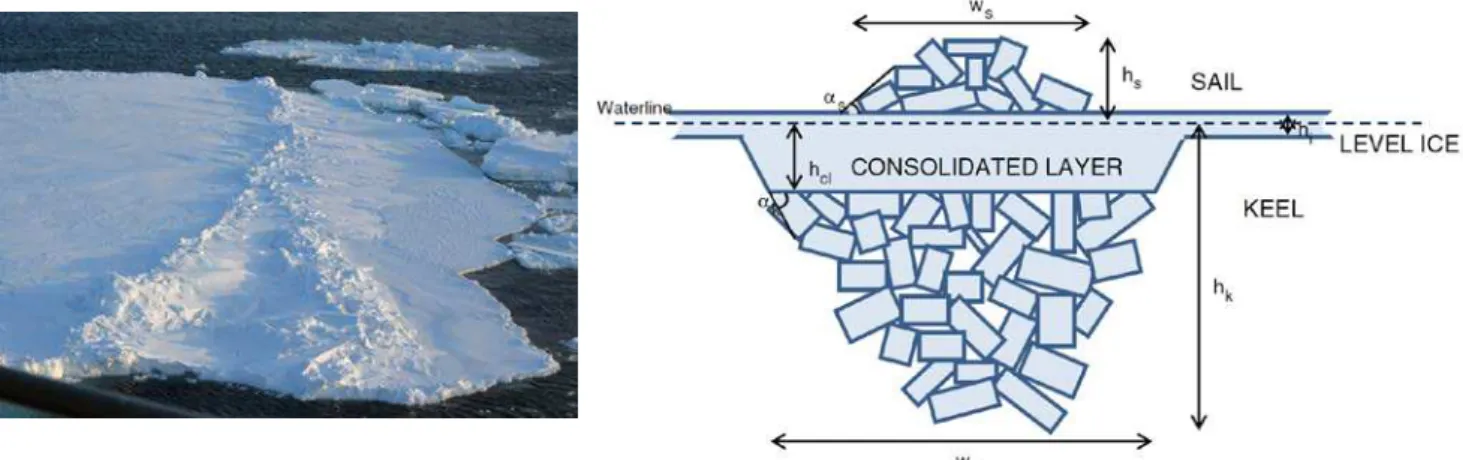
An ice ridge is a curvilinear or straight deformed ice feature that forms when ice floes collide under pressure or shear forces. An example of first-year ridging is shown in Figure 1 (left). Newly formed first-year ridges consist of randomly oriented rubble blocks both above and below the waterline as shown in Figure 1 (right). Once the ridge has formed, the water and slush between the rubble blocks of the keel will generally begin to freeze, forming a consolidated layer. Multi-year ridges will generally consist of mostly consolidated ice.
Many ridge studies have been carried out during numerous field expeditions. When assessing the geometry of a ridge, researchers generally attempt to make a transect or profile through the ridge cross-section, i.e. drill a number of holes across the ridge to obtain values of the sail and keel thicknesses. The ridges discussed in this paper were measured directly, generally using surface survey for the sails and drilling or sonar for keel profiles. The typical measurements that may be made on a ridge are shown in Figure 1 (right): sail height (hs),
width (ws), and angle (αs); keel depth (hk), width (wk), and angle (αk); as well as consolidated
layer thickness (hcl) and thickness of the surrounding level ice (hi). In addition, sail block size
(hb) may be assessed.
The sail and keel thicknesses are almost always measured during a field expedition (or at least the overall thickness of the ridge). More complete characterization of the sail may be done, due to the relative ease of survey above water. The widths and angles of the sail and keel are not always reported directly, but can be assessed if a cross-section of the ridge is made. Sail and keel geometry is variable along the length of the ridge, but due to time constraints in field studies, this is generally not assessed. The consolidated layer thickness and variation within the ridge is very important but not always measured. The surrounding level ice thickness for first-year ridges may be reported along with other ridge information. However, this may be a slightly less important parameter than the rubble block thickness, which gives a better
POAC’13
Espoo, Finland
Proceedings of the 22nd International Conference on
Port and Ocean Engineering under Arctic Conditions June 9-13, 2013 Espoo, Finland
indication of the ice thickness at the time of ridge formation since the level ice will grow throughout the season.
Figure 1. First year ridging on a floe in Fram Strait, March 2012 (left); cross-section illustrating the components of a typical first-year ice ridge, reproduced from Strub-Klein and Sudom, 2012 (right)
Hundreds of profiles have been made during field expeditions to study first-year ridges; the recent publication of first-year ridge studies made by Strub-Klein and Sudom (2012) included over 375 cross-sections. Figure 2 shows the number of first-year ridge cross-sections reported in various geographic regions. This plot is based on the compilation by Strub-Klein and Sudom (2012), and may not be complete but presents a picture of the first-year ridge studies that are readily available in the literature. Many studies are proprietary and so are not included. As an ongoing part of the ColdTech project, ice ridge data is being compiled as it becomes available or is discovered.
Figure 2. Number of first-year ridge profiles by geographic region, based on a compilation of 375 ridge cross-sections measured during field studies.
Fewer studies have been made on second- and multi-year ridges ice ridges, but at least 130 old ice ridge cross-section profiles have been reported. Data is available on old ice ridges in the Beaufort Sea, Canadian Arctic Archipelago, high Arctic, Labrador Coast and Fram Strait. Sudom et al. (2011) reported on the statistics for sail and keel geometry from numerous
Beaufort Sea, 100 Bering and Chukchi Seas, 91 Russian Arctic Ocean, 3 Barents Sea, 22 Offshore Svalbard, 22
Baltic Sea and Gulf of Bothnia,
70 Offshore
Sakhalin, 23
Sea of Azov, 2 East Coast Canada, 42
sources and regions, as an update to the work of Timco and Burden (1997). For multi-year ice in the Arctic, Johnston et al. (2009) have compiled over 5000 individual thickness measurements made by drilling or sonar, including both level ice and ridges.
IMPORTANCE OF RIDGE KNOWLEDGE TO SHIPPING AND OFFSHORE INDUSTRIES
Information on ridges is useful for many offshore applications including the design and operation of offshore structures, ships, and pipelines and other subsea facilities.
Offshore structures:
ISO 19906 (2010) mentions that several physical parameters are often used to describe a ridge: keel draft and geometry, thickness and lateral extent of the consolidated layer (for first-year ridges, since multi-first-year ridges are generally assumed to be consolidated), ridge length, and surrounding level ice thickness. The Standard also lists parameters external to the ridge itself: ridge spacing, ice drift speed, and ice drift direction (i.e., the ridge or floe orientation with respect to the structure). However, guidance is not given on how to apply each of these parameters. It is also noted that the presence of ridges affects the ice failure mode (p. 166). ISO 19906 (2010) gives Eqn. (1) for the global ice crushing action FG as a function of global
ice pressure (pG), ice thickness (h) and width of the contact area (w). This equation represents
an upper bound for crushing. Other failure modes may predominate especially on a sloped structure, and a ridge often fails by another mode before it even reaches the structure. The ice pressure pG is dependent on an ice strength coefficient which is used to account for the
variance in ice strength for temperate and Arctic regions.
FG = pG*h*w (1)
For a multi-year ice ridge, the entire ridge thickness including sail and keel should be accounted for in the ice thickness, h, in Eqn. (1). For a first-year ridge, the global load should include crushing force for the consolidated layer, as well as the effect of the keel. The crushing force can be calculated using Eqn. (1) with h equal to the consolidated layer thickness. An upper bound estimate of the horizontal action FR caused by a first year ridge is
the sum of the force components of the keel, FK, and consolidated layer, FC (ISO 19906,
2010). The sail rubble is generally relatively small in volume and can be ignored.
FR = FC + FK (2)
The keel force FK is based on passive failure models. The calculation includes the internal
friction angle (ranging from 10 to 80 degrees but generally accepted as 20 to 40), keel porosity (which ranges from 10 to 50% and varies with depth) and cohesion of the keel rubble blocks (from 0 to 100kPa, but some data suggests the average value is 5 to 7 kPa). In general these parameters will not be known for a specific ridge and estimates must be used.
ISO 19906 points out that special considerations should be made for multi-legged structures in areas with first-year ridges, as ice jamming is more likely due to the loose rubble in an unconsolidated ridge keel. If ice jams between the legs of a structure, the global ice loading will increase due to a greater structure width exposed to ice. To determine the likelihood of ice jamming, the keel depth, degree of consolidation and strength is important.
Ridge widths are not used in any calculations of loading in ISO; one would have to know the orientation of the ridge with respect to the structure to account for the importance of this parameter. This data could also be useful in numerical modelling of ice-structure interaction. Ridges generally increase the loading on a structure, but may also be useful for protecting a structure from oncoming ice. Grounded rubble fields (large areas of ice rubble pinned to the seafloor) are used to protect offshore structures from large global ice loads. For emergency evacuation and rescue operation planning, or for creation of an ice road from a structure to the shore, grounded ridges are also useful for stabilizing ice cover. Ridge grounding begins the stabilization process in the formation of a rubble field. The keel depth and amount of consolidation and cohesion is important. If information on ridge keels is not available, the sail height can be used in a typical keel to sail ratio to determine the likelihood of ridge grounding in a particular water depth.
Important ridge properties in ice load calculation for offshore structures include:
• total ridge thickness and ridge strength for multi-year ridges; consolidated layer thickness, keel properties (friction angle, porosity, cohesion) and possibly ridge width and orientation for a first-year ridge
Shipping:
The design global load for a ship is somewhat different from the above ice action guidance from ISO 19906 (2010) for offshore structures, as a ship can selectively avoid extremely thick or old ridges. In the design of an icebreaker to be used in an area with frequent ridging, the ridge thickness (consolidated layer thickness for a first-year ridge) may be used in estimates of ice loading.
Ridges are important for ship trafficability. Ridge size and frequency in an area can be used to determine vessel speed and fuel consumption along shipping routes. Shipping routes may be adjusted to avoid known areas of heavy ridging. For ship transit in an area with first-year ridges, the age of the ridge is important. If a ridge has only just recently formed, it will be weak and unconsolidated. A ship could then travel along the “spine” of the ridge more easily than breaking through surrounding floes as long as the ice is no longer in a convergence mode against the ridge.
Important ridge properties for the shipping industry include:
• For force on the hull: ridge or floe mass and consolidated layer thickness
• For transit time estimation and fuel consumption: ridge size and frequency; age of ridge field
Pipelines and related facilities:
Ice ridges are important for pipeline design and installation in seabeds that could be scoured or gouged by ridge keels. Ridge properties can determine the risk and extent of seabed gouging for the design and operation of pipelines and other subsea facilities. ISO 19906 (2010) states that pipelines in these areas should generally be trenched to avoid ice actions, but does not give specific criteria for burial depth. The determination of safe burial depth of a pipeline will consider the existing ice scour depth distribution obtained by field surveys of the seabed bathymetry. The gouge frequency and depth has also been assessed by mathematical models which include ridge sizes and shapes. Seabed gouging will be limited by the kinetic energy of the floe containing the ridge, and by failure of the ridge keel. Therefore the keel properties of depth, geometry and degree of consolidation and cohesion can be used to
determine likelihood and extent of seabed gouging. The mass of the floe containing the ridge(s), and potential for rotation of the floe and ridge or hummock field is also important as these factors can limit the force on a seabed.
Important ridge properties for subsea installations include:
• ridge frequency; keel properties (depth, geometry, and cohesion); the mass of the floe containing the ridge(s); and potential for rotation of the ice feature.
EXAMPLES OF RIDGE LOADS ON STRUCTURES
Here, we examine two studies of ridge loading on a narrow structure and one study of ridge loading on a wide caisson structure.
Lemee and Brown (2005) have found that first-year ridge keel depth does not influence the measured ice load on a pier of the Confederation Bridge in the temperate Northumberland Strait. The piers were designed as ice-breaking cones which induce flexural failure of level ice sheets, and protrude below the waterline which that the conical portion contacts a ridge keel before the keel reaches the pier shaft. It was found that for 71 relatively high load interactions between first-year ridges and the pier, the ice load was not higher for deeper keels. The maximum keel depth was approximately 17 m (keels were measured by sonar). Other parameters were examined for a possible effect on ice load: consolidated layer thickness (assessed from video), keel width, interaction speed, and tide height (i.e. waterline diameter of structure). Only consolidated layer thickness was found to correlate with ice load, which indicates that a large portion of the load is derived from the consolidated layer. The data show a great deal of scatter but the authors found the ridge load (in MN) on the pier to be FR =
2.1hCL + 0.58.
Bjerkas and Bonnemaire (2004) examined loads from 33 relatively small first-year ice ridge interactions with the Norströmsgrund lighthouse in the brackish Gulf of Bothnia. The sail height was measured by laser profilometer, and the keel by an electromagnetic or EM device (which was noted to possibly under-predict keep depth). The ridge load on the structure seemed to increase with sail height, although large amount of scatter is seen. The ridge load was compared to the loading from the surrounding level ice sheet, and it was found that the ridge load was 0.5 to 6 times higher. Ridge failure by crushing seemed to lead to the highest loads. Loads from these small individual ridges were found to be lower than those caused by consolidated ridge fields, and in the same range as loads measured from level ice crushing events.
Wright and Timco (2001) assessed video footage of ice interaction with the Molikpaq, a wide structure operating in the Beaufort Sea in the 1980s. The failure mode was assessed for 350 ridge interactions, and 23 interactions for which ice load data was available were selected. The ice load was compared to sail height, which was the only part of the ridge for which information was available. For the 23 ridge interactions, it was found that higher loads were experienced for ridges with a higher sail height. Although the data are scattered, the authors relate the ridge line load (PLL, in MN/m) for the Molikpaq was related to the sail height by PLL
= 0.36hs + 0.25, for sails up to 2.5 m. Ridge failure mode did not seem to influence the load.
The ridge load was also compared to the load from the level ice sheet immediately before ridge interaction, and the presence of a ridge was found to increase the load level by a factor of 1.5 to 3.5. However, the first-year ridge loads examined were no higher than loads caused by thick level first-year ice crushing against the platform. Keel loads were estimated to be up to 40 MN for ridges with keel depths of 8 m.
From these limited empirical data sets, it seems that a ridge will produce higher loads on a structure than the surrounding level ice sheet, but not necessarily higher than loads from other level ice crushing events. This could be due to the tendency of more ridging in thinner ice sheets. Failure mode likely plays a role in ridge loading, but few data are available. Ridge load on a structure seems to increase with sail height. The contribution of the keel to the total ridge load needs further examination.
IMPORTANT RIDGE PARAMETERS AND THEIR MEASUREMENT
This section discusses the ridge properties that have the most relevant applications, how these parameters are measured or estimated, and the variability of measurements.
Consolidated layer
When a ridge forms, the thickness of the consolidation layer is zero. As the ridge sits in an environment with temperatures below zero, the consolidated layer begins to form as the water between the ice blocks at the surface freezes. As freezing progresses, the thickness of the consolidated layer increases. The rate of freezing or thickening is up to twice as fast that of a level ice sheet (Leppäranta and Hakala, 1992) since only the water between the blocks has to freeze to form a solid ice layer. Therefore the thickness of the consolidated layer is a direct function of the time and temperature since the ridge formed. The consolidated layer thickness could be estimated using freezing degree days, but this is difficult to assess since the date of ridge formation is seldom known.
In an assessment of field data on 680 ridge cross-sections for this paper, the consolidated layer thickness was only assessed 35% of the time. This is partly due to the difficulty in measuring this property. The typical method of assessment of consolidation in a first-year ridge is drilling to feel for voids or see slush coming up through the auger hole. Another method that can be used to provide detailed information on ridges in landfast ice is to freeze thermistor strings in situ, and analyse the temperature evolution with depth (see, e.g., Hoyland 2002). In the absence of more detailed information, the consolidated layer of a first-year ridge may be assumed to be 1.5 to 2 times the surrounding level ice thickness (ISO 19906, 2010). But this is only a guideline and consolidation may be lower in dynamic ice conditions or warmer areas. Measurements of level ice thickness have been made for 32% of the 680 ridge cross-sections available for the present study, and not always simultaneously with the consolidated layer thickness. For 109 available measurements of both consolidated layer and level ice thickness for first-year ridges, the statistics are given in Table 1. The high standard deviation in this table indicates that there is no strong relationship between the thickness of the level ice and the consolidated layer. More data on the rate of consolidation of this layer would be useful especially if the initial block size and ambient conditions were recorded. Sail rubble block size is often better correlated to consolidated layer thickness as it gives a better indication of the ice thickness at time of ridge formation.
Table 1. Consolidated layer to level ice thickness ratio for 109 first-year ice ridges
Median 2.15
Mean 3.21
Standard Deviation 2.83
Ridges that survive a melt season will be more consolidated; Strub-Klein et al (2009) studied five second-year ridges with keel depths up to 8.2 m, and found that two ridges were almost
completely consolidated, while more voids or soft ice were found in the other three ridges. Fewer measurements have been made of the consolidation or porosity of a multi-year ridge, which can be mostly or fully consolidated. As an example, Voelker et al. (1981) measured an average of 86% consolidation of the total keel depth for seven multi-year ridges with keels up to 15.4 m.
Strub-Klein and Sudom (2012) found that the consolidated layer thickness for a first-year ridge may have relatively low spatial variation across the ridge, so may grow fairly evenly throughout the ridge. For 12 ridges with comprehensive consolidated layer thickness measurements in various geographic regions, the maximum coefficient of variation (ratio of the standard deviation to the mean) was 59%. Timco and Burden (1997) analyzed data from 25 different ridges and found the coefficient of variation of the consolidated layer thickness was 39% for the minimum to average thickness, and 22% for the maximum to average thickness.
Little information is available on the strength of the consolidated layer of a first-year ridge. Høyland et al. (2004) have done some compression tests near Svalbard and in the Barents Sea and found the consolidated layer to be slightly weaker than the nearby level ice.
Sail properties
The sail is often the easiest part of the ridge for which to collect information, and may be assessed by visual observation, survey, or laser profilometer. The sail height and width is quite variable along the length of a ridge. The sail volume is useful as an indicator of the size of the keel below. For first-year ridges, the sail rubble is generally unconsolidated, but older ice ridges have a more consolidated sail which must be accounted for. Sail block size has been measured for many ridges and gives an indication of the ice thickness at the time of ridge formation.
It should be pointed out that often in field measurement programs, the choice of where to profile a ridge is often based on choosing a section with a “classic” ridge shape. Barker et al. (2008) describe a first-year ridge with considerable differences in morphology along its length. In some cases there was a classic ridge shape whereas in other areas, the ridge was relatively flat. Thus a systematic program of profiling ridge sails (and keels) along a pre-determined spacing would provide information on the variability within ridges. A study by Bowen and Topham (1990) illustrated this variation.
Keel properties
Keel shapes are generally assessed by drilling and/or sonar devices. Few data are available on the variation of the keel depth and depth within one ridge. Due to time constraints, researchers usually collect detailed data on only one cross-section profile of a ridge. Strub-Klein and Sudom (2012) examined two ridges from the Barents Sea, each with data on four cross-sections. The variation in keel depth was 15% for a ridge studied in 2007, and 10% for one studied in 2008. The ridges had keel depths less than 12 m; variation in keel depth may be greater for larger ridges. Rubble porosity is sometimes measured. For first year ridges, the average keel rubble macroporosity is 20%, based on 44 values (Strub-Klein and Sudom, 2012).
The strength of the keel is a very important property but it is difficult to measure. Laboratory studies of the strength of ice rubble cannot be reliably extrapolated to field properties. Some very important full-scale measurements of ridge keep properties have been performed in
Canada, Russia and the Baltic. The results of the in-situ punch and direct shear tests have been summarized by Croasdale et al. (2001). The large scale in-situ tests give only about 40 data points (Croasdale et al., 2005). The keel strength ranged from 4 to 23 kPa. They also noted that there is strong evidence of a significant cohesive strength component. The maximum shear strength of the ridge keels was estimated to be 30 kPa. This data is extremely useful and more data of this type would aid in the understanding of keel properties. Unfortunately these types of field tests are quite costly. New numerical models may add further insight into keel properties by a re-examination of these test data (see, e.g., Polojärvi and Tuhkuri, 2009).
Keel to sail ratio
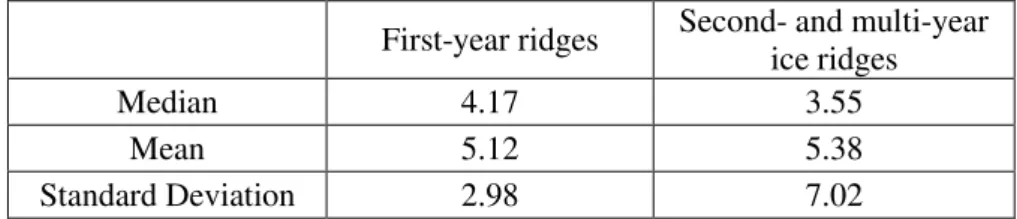
The keel to sail ratio is a typical parameter calculated for ridges. ISO 19906 (2010) indicates that this ratio is usually between 4 and 5 for first-year ridges and around 3 to 3.5 for second-year and multi-second-year ridges. Many field studies have been compiled which include this data and the present study includes data from Strub-Klein and Sudom (2012), Sudom et al. (2011), and other data from field studies that recently became available. The statistics in Table 2 have been calculated for 313 first-year and 111 old ice ridge cross-sections. It can be seen that the ISO ranges are reasonable; however standard deviation from the mean value is high especially for old ice ridges. This is partly due to ridges having a low or almost non-existent sail despite having a very deep keel. Also, the keel is not always directly under the highest point in the sail. A recent paper by Kharitonov (2012) illustrated this non-symmetry. The sail volume, or area of a cross-section, will give a better indication of the keel size. Timco and Burden (1997) reported that the keel cross-section area is about 8 times that of the sail area.
Table 2. Keel depth to sail height ratio statistics
First-year ridges Second- and multi-year ice ridges
Median 4.17 3.55
Mean 5.12 5.38
Standard Deviation 2.98 7.02
Ridge frequency and orientation
The present paper does not examine this parameter in detail, but ridge frequency is very important for shipping. Ridge frequency may be observed from a ship or by aerial reconnaissance, with the help of a laser profilometer. Remote observations can be made of keel draft using upward-looking sonar (ULS). Electromagnetic (EM) instrumentation can be used to obtain total ice thicknesses, which will be averaged over a certain footprint.
Little information on the orientation of ridges has been complied. This is understandable since each geographic region may have different predominate ice movement directions and these control the ridge orientation. Although this property is often overlooked in predicting ridge loads, a parametric study using a probabilistic ice load model (Timco and Irani, 1994) indicated that edge loading of a ridge gave the highest ice loads. Thus this factor should be considered in any detailed probabilistic load design calculation based on ridge orientation data for the region of interest.
STATE OF KNOWLEDGE ON FY AND MY RIDGES
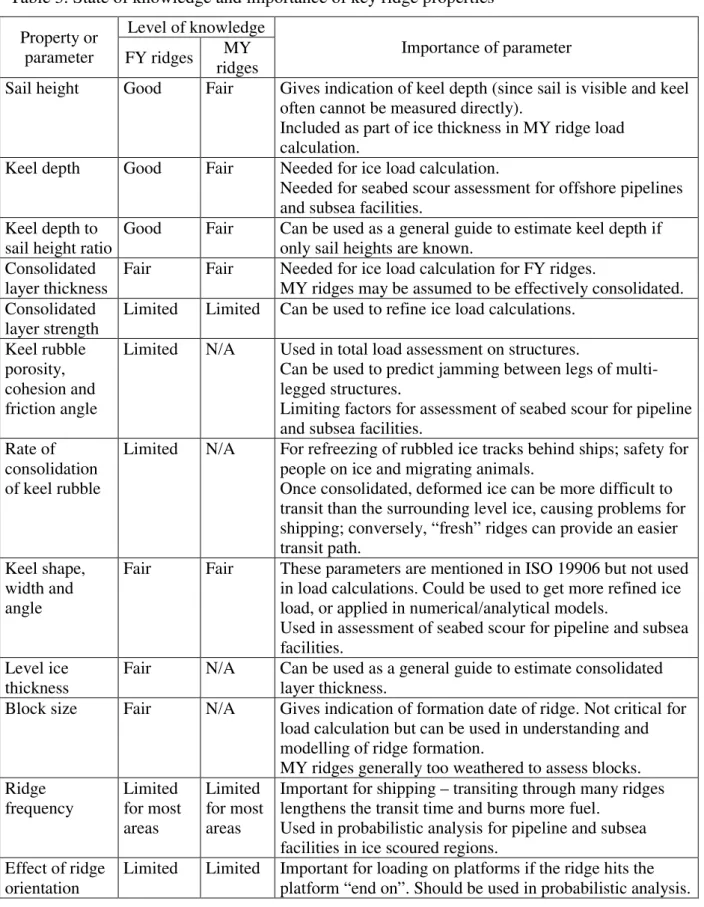
The level of knowledge and importance of various properties for first-year and multi-year ridges is given in Table 3.
Table 3. State of knowledge and importance of key ridge properties
Property or parameter Level of knowledge Importance of parameter FY ridges MY ridges
Sail height Good Fair Gives indication of keel depth (since sail is visible and keel often cannot be measured directly).
Included as part of ice thickness in MY ridge load calculation.
Keel depth Good Fair Needed for ice load calculation.
Needed for seabed scour assessment for offshore pipelines and subsea facilities.
Keel depth to sail height ratio
Good Fair Can be used as a general guide to estimate keel depth if only sail heights are known.
Consolidated layer thickness
Fair Fair Needed for ice load calculation for FY ridges.
MY ridges may be assumed to be effectively consolidated. Consolidated
layer strength
Limited Limited Can be used to refine ice load calculations. Keel rubble
porosity, cohesion and friction angle
Limited N/A Used in total load assessment on structures.
Can be used to predict jamming between legs of multi-legged structures.
Limiting factors for assessment of seabed scour for pipeline and subsea facilities.
Rate of consolidation of keel rubble
Limited N/A For refreezing of rubbled ice tracks behind ships; safety for people on ice and migrating animals.
Once consolidated, deformed ice can be more difficult to transit than the surrounding level ice, causing problems for shipping; conversely, “fresh” ridges can provide an easier transit path.
Keel shape, width and angle
Fair Fair These parameters are mentioned in ISO 19906 but not used in load calculations. Could be used to get more refined ice load, or applied in numerical/analytical models.
Used in assessment of seabed scour for pipeline and subsea facilities.
Level ice thickness
Fair N/A Can be used as a general guide to estimate consolidated layer thickness.
Block size Fair N/A Gives indication of formation date of ridge. Not critical for load calculation but can be used in understanding and modelling of ridge formation.
MY ridges generally too weathered to assess blocks. Ridge frequency Limited for most areas Limited for most areas
Important for shipping – transiting through many ridges lengthens the transit time and burns more fuel.
Used in probabilistic analysis for pipeline and subsea facilities in ice scoured regions.
Effect of ridge orientation
Limited Limited Important for loading on platforms if the ridge hits the platform “end on”. Should be used in probabilistic analysis.
CRITICAL KNOWLEDGE GAPS
As seen in Figure 1, most ridge studies have been done in three main geographic regions: the Baltic Sea and Gulf of Bothnia, the Beaufort Sea, and the Bering and Chukchi Seas. This is partly due to industry interest in obtaining data in these areas, and partly due to the relative ease of working in certain areas. In addition, some data collected are proprietary. Few data are available from Russian Arctic regions or the Caspian Sea, at least in the public domain. Few measurements have been made in more remote areas such as the high Arctic.
Many direct measurements of ridge keels and sails have been made, especially for first-year ridges. The typical keel to sail ratios have been established but there is great variation possible. The sail volume or cross-section area provides a better indication of the keel size below.
The consolidated layer of a first-year ridge generates a significant portion of the load on a structure. The thickness of this layer is not always measured – it is only available for about one third of reported ridges. There is little knowledge on the consolidated layer strength compared to the level ice strength for first-year ridges.
The contribution of the keel to the total ridge load is not well established. The keel contains the greatest ice volume of the ridge, but the cohesion and other properties are variable and affect the overall strength of the keel. The rate of consolidation and bonding of keel rubble is important; the consolidated layer is not always well-defined and ridges may have partially-consolidated zones.
The shape of the structure with which the ridge keel interacts is also important. It influences the ridge failure mode, which is another key parameter for determining force on a structure for which little data is available.
ACKNOWLEDGEMENTS
This work was supported by the ColdTech project (http://www.arctic-technology.com/); Norwegian Research Council project number 195153.
REFERENCES
Barker, A., Timco, G.W. and B. Wright. 2008. Surveying a Four-Week Old First-Year Ridge. Proceedings 19th IAHR Symposium on Ice, Vol. 2, pp 1263-1272, Vancouver, B.C. Canada. Bjerkås, M. and Bonnemaire, B., 2004. Ice ridge-structure interaction Part II: Loads from first-year ice ridges and their surrounding ice sheets. IAHR Ice Symposium, June 2004, St. Petersburg, Russian Federation.
Bowen R.G. and D.R. Topham. 1996. A study of the morphology of a discontinuous section of a first year arctic pressure ridge. Cold Regions Science and Technology 24 (1), pp 83-100. Croasdale K.R., S. Bruneau, D. Christian, G. Crocker, J. English, M. Metge and R. Ritch. 2001. In-situ Measurements of the Strength of First-year Ice Ridge Keels. Proceedings of POAC’01 Conference, Vol. 3, pp 1445-1454, Ottawa, ON, Canada.
Croasdale, K. R., Comfort, G. and Been, K. 2005. Investigation of ice limits to ice gouging. Proceedings of POAC’05 Conference, Vol 1, pp 23-32, Potsdam, NY, USA.
Høyland, K.V., 2002. Consolidation of first-year sea ice ridges. Journal of Geophysical Research 107 (C6), 15_1-15_7.
Høyland, K.V., et al., 2004. Mechanical properties of ice ridges and level ice, in-situ and laboratory testing 2003. Proceedings IAHR 17th International Symposium on Ice, Saint Petersburg, Russia, 21 - 25 June 2004.
ISO 19906 TC 67, 2010. Petroleum and natural gas industries— Arctic offshore structures. International Organization for Standardization.
Johnston, M., et al., 2009. Multi-year ice thickness: knowns and unknowns. Proceedings of the 20th International Conference on Port and Ocean Engineering under Arctic Conditions, June 9–12, 2009, Luleå, Sweden, Paper POAC09-120.
Kharitonov, V.V. 2012. Internal structure and porosity of ice ridges investigated at «North Pole‐38» drifting station. Cold Regions Science and Technology 82, pp 144-152.
Lemee, E. and Brown, T, 2004. Review of ridge failure against the confederation bridge. Cold Regions Science and Technology, Vol. 42, Issue 1, pp 1-15.
Leppäranta and Hakala, 1992. The structure and strength of first-year ice ridges in the Baltic Sea. Cold Regions Science and Technology, Vol. 20, pp. 295-311.
Polojärvi, A. and J. Tuhkuri. 2009. 3D discrete numerical modelling of ridge keel punch through tests. Cold Regions Science and Technology 56 (1), pp 18-29.
Strub-Klein, L., and Sudom, D., 2012. A comprehensive analysis of the morphology of first-year sea ice ridges. Cold Regions Science and Technology 82 (2012) 94–109
Strub-Klein, L., et al., 2009. Physical properties and comparison of first- and second-year sea ice ridges. Proceedings of the 20th International Conference on Port and Ocean Engineering under Arctic Conditions, June 9-12, 2009, Luleå, Sweden.
Sudom, D., et al., 2011. Analysis of first-year and old ice ridge characteristics. Proceedings of the 21st International Conference on Port and Ocean Engineering under Arctic Conditions (POAC). Montreal, Canada. 2011. Paper No. POAC11-164.
Timco, G.W., Burden, R.P., 1997. An analysis of the shape of sea ice ridges. Cold Regions Science and Technology 25, 65–77.
Timco, G.W. and Irani, M.B. 1994. Parametric Sensitivity in Ice Force Calculation Models. Proceedings of the 12th IAHR Ice Symposium, IAHR'94, Vol. 1, pp 382-392, Trondheim, Norway.
Voelker, R.P., et al., 1981. Assessment of ice conditions in the south Bering Sea based on April 1980 USCG Polar Class trafficability test data, Vol. 1 & 2. U.S. Maritime Administration Artec Inc., Springfield, VA, U.S.A.
Wright, B. and Timco, G.W., 2001. First-year ridge interaction with the Molikpaq in the Beaufort Sea, Cold Regions Science and Technology, 32, pp. 27 -44.