The Cryptographic Impact of Groups with Infeasible
Inversion
by
Susan Rae Hohenberger
Submitted to the Department of Electrical Engineering and Computer
Science
in partial fulfillment of the requirements for the degree of
Master of Science in Computer Science and Engineering
at the
MASSACHUSETTS INSTITUTE OF TECHNOLOGY
May 2003
©
Massachusetts Institute of Technology 2003. All rights reserved.
Author ...
... .---- ---... ...*
Department of Electrical Engineering and Computer Science
May 16, 2003
C ertified by ...
Ronald L. Rivest
Viterbi Professor of Electrical Engineering and Computer Science
Thesis Supervisor
Accepted by ...
. . .. .S . . i. tArthur C. Smith
Chairman,
DepartmentCommittee
onGraduate Students
MASSACHUSETTS IN OF TECHNOLO
SWO
JUL 0 7 2
STITUTE GY003
The Cryptographic Impact of Groups with Infeasible Inversion
by
Susan Rae Hohenberger
Submitted to the Department of Electrical Engineering and Computer Science on May 16, 2003, in partial fulfillment of the
requirements for the degree of
Master of Science in Computer Science and Engineering
Abstract
Algebraic group structure is an important-and often overlooked-tool for constructing and comparing cryptographic applications. Our driving example is the open problem of finding provably secure transitive signature schemes for directed graphs, proposed by Micali and Rivest
[41].
A directed transitive signature scheme (DTS) allows Alice to sign a subset ofedges on a directed graph in such a way that anyone can compose Alice's signatures on edges a and bc to obtain her signature on edge -a. We formalize the necessary mathemat-ical criteria for a secure DTS scheme when the signatures can be composed in any order, showing that the edge signatures in such a scheme form a special (and powerful) mathemat-ical group not known to exist: an Abelian trapdoor group with infeasible inversion (ATGII). Furthermore, we show that such a DTS scheme is more complex-in a black-box sense-than standard signatures, public key encryption and oblivious transfer. To our knowledge, this is the first separation between standard signature schemes and any of the many variant signature schemes proposed.
We formalize several group homomorphisms that can be used to construct undirected transitive signature schemes (UTS) (as generalizations of the UTS schemes of Micali and Rivest [41] and Bellare and Neven [7]), and explain why group isomorphisms, such as RSA, appear to require proofs in the one-more-inversion model. We also provide the first definition, to our knowledge, of a pseudo-free group. Informally, a pseudo-free group is computationally indistinguishable from a free group to any polynomially-bounded adversary given only black-box access to the group. We show that a pseudo-free ATGII group is sufficient for a secure
DTS construction. We conclude by relating the black-box complexity of our group-based primitives to the standard cryptographic primitives.
Thesis Supervisor: Ronald L. Rivest
Acknowledgments
I am extremely grateful to Ron Rivest for being my advisor. Ron introduced me to the
problem of transitive signatures and his insights and guidance were critical throughout all stages of this research. Ron was very patient and encouraging; ready to explain or to listen. Ron was a great advisor! I also want to thank my excellent research partner David Molnar. David's grasp of the material and enthusiasm for the project made the hours and hours and hours we spent working together very enjoyable.
I am very grateful to Alantha Newman for her advice, ideas, humor and support during
the countless hours of research and thesis writing. Thanks to my friends and fellow cryp-tographers at MIT, especially Jon Herzog, Matt Lepinski, Moses Liskov, Chris Peikert and Steve Weis, with whom I have enjoyed discussing these ideas. Salil Vadhan also provided comments that improved this thesis; most notably he pointed out an error in earlier proofs of Theorems 5.4.1 and 5.4.2.
Thanks to Erik Demaine and David Liben-Nowell for showing me the ropes of graduate level research. David's drive for perfection, elegant writing, and skill with latex are (humbly) emulated in this work. On that note, a special thank you to my proofreader Nicole Immorlica. Thanks to Bruce Weide and Paolo Bucci at The Ohio State University. Their teaching and encouragement inspired me to go to graduate school in computer science.
I appreciate the constant support of my family and friends, especially my sisters Megan
and Barbara, and my brothers-in-law Todd and Andy. This thesis is dedicated to my parents Raymond and Beth Hohenberger, and in memory to Nick Bosaw.
This research was conducted with the support of a National Defense Science and Engi-neering Graduate Fellowship.
Contents
1 Introduction 11
1.1 R elated W ork. . . . . 16
1.2 Contributions of This Thesis and Statement on Joint Work . . . . 20
2 Preliminaries 23 3 Transitive Signatures 29 3.1 Definitions with Commutativity . . . . 30
3.2 Undirected Transitive Signatures . . . . 36
3.2.1 Discrete Log-Based UTS Scheme of Micali-Rivest . . . . 36
3.2.2 RSA-Based UTS Scheme of Micali-Rivest, Bellare-Neven . . . . 38
3.3 Directed Transitive Signatures . . . . 40
4 Groups with Special Properties 43 4.1 Groups with Infeasible Inversion . . . . 45
4.2 Reverse Cryptography . . . . 46
4.3 Weakly Collision-Resistant Non-Injective Group Hom om orphism s . . . . 48
4.3.1 WCRNIGH -+ UTS . . . . 51
4.4 One-Way Group Isomorphisms . . . . 53
4.4.1 One-More-Inversion Security . . . . 54
4.4.2 OW GI - p UTS . . . . 56
4.5.1 Discussion of Pseudo-free Definition 4.6 Adding Group Structure to Primitives . .
5 Black-Box Reductions between
5.1 Black-Box Reductions . . . .
5.2 PFATGlI -k DTS . . . . 5.3 TGII -- + TDP, Gil . . . .
5.4 Gil -+ KA, SAOWF . . . . .
5.5 DTS - TG, UTS . . . . 5.6 UTS -+ SDS, OWF . . . . .
5.7 BL - KA . . . . 5.8 SAOWF --* OWF, GI* . . . .
5.9 OWF-+ SAOWF . . . . 6 Conclusion 6.1 Future D irections . . . . A Index of Acronyms Primitives . . . . . . . . 60 61 65 66 67 70 71 72 74 75 75 77 79 79 83
List of Figures
3-1 An experiment to define the correctness of a dynamic directed transitive sig-nature scheme DTS=(KG, NCert, ESign, Vf, Comp). . . . . 34
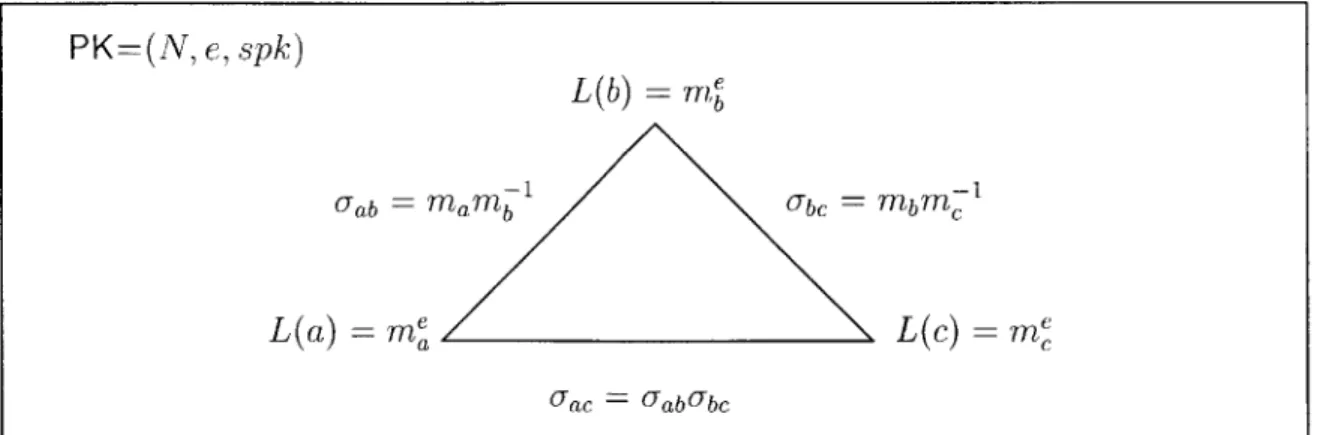
3-2 Illustration of DL-Based UTS, where L(a), L(b), L(c) are public node labels,
gab and abc are edge signatures from the master signer, and aac is a composed
signature. . . . . 38 3-3 Illustration of RSA-Based UTS, where L(a), L(b), L(c) are public node labels,
gab and 6
bc are edge signatures from the master signer, and 7ac is a composed signature. All values are taken modulo N. . . . . 39
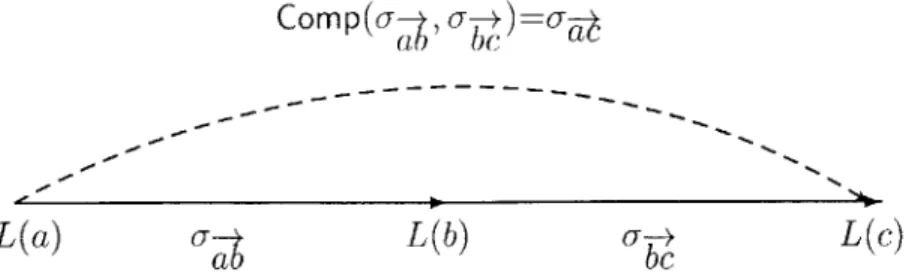
3-4 Illustration of a DTS scheme, where L(a), L(b), L(c) are public node labels and a , o-* are directed edge signatures from the master signer. . . . . 40 4-1 Left: An illustration of Claim 4.3.2 for NIGHs. Right: Relation of one-way
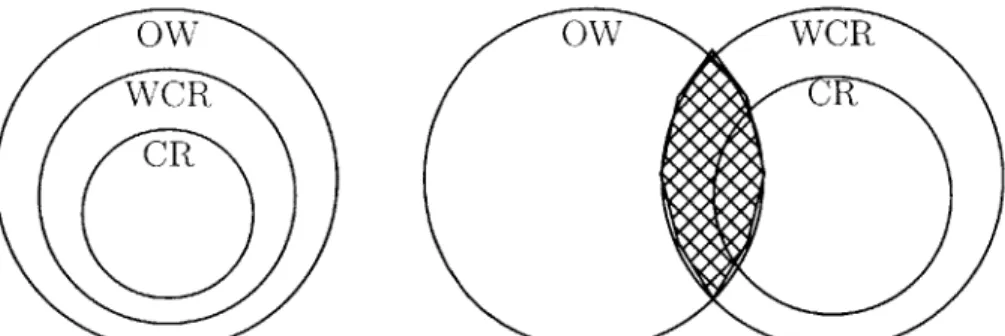
(OW), weakly collision-resistant (WCR), and collision-resistant (CR) functions on non-structured domains. . . . . 50
4-2 Example of the complexity disparity between SAOWF and SAOWF on a group. 62
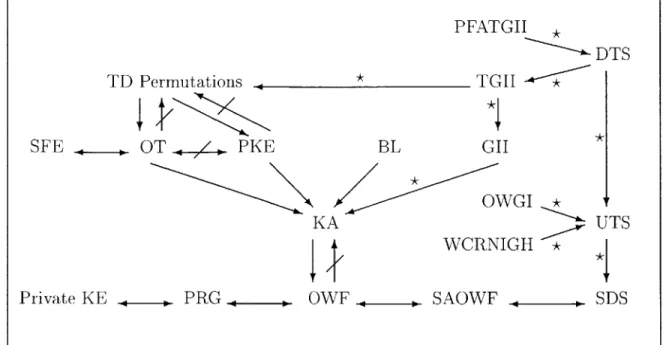
5-1 Black-Box Relationships between Cryptographic Primitives. The contribu-tions of this thesis are indicated by a *. . . . . 66 5-2 Illustration of DTS scheme using an Abelian PFTGII group, where A, B, C are
public node labels and A-1, B-1, C- are the secret keys. One can verify that
Chapter 1
Introduction
Invented in 1976 by Diffie and Hellman, digital signatures are one of the most practical contributions of cryptography to date [21]. In a standard digital signature scheme, Alice creates a signature 9Ao(M) on a message M using a secret key that only she knows. This is
analogous to the real-life situation of Alice signing her name to a document with her unique hand-writing style, although happily less prone to forgery. In a digital signature scheme, anyone can verify that Alice signed message M given her signature O-A(M), while no one should be able to forge her signature on any new message. The United States Congress legalized the use of digital signatures on contracts five years ago [20].
The best known digital signature scheme, RSA, is due to Rivest, Shamir, and Adle-man [50]. In their scheme, Alice signs a message m by computing md mod n, where n is the product of two large primes. The exponent d is kept secret by Alice, but she publishes n and a public exponent e such that (md)e = m mod n and thus provides a method for verifying her signatures. As far as anyone knows, it is difficult to create md given only n and e and therefore difficult to forge Alice's signatures from scratch.
However, one weakness in RSA can be observed. Two valid signatures from Alice can be combined into one she never signed: mfm = (mim2)d mod n. For some applications, this is
clearly dangerous. Suppose Alice makes two bids for an antique lamp at an auction. First, she signs a document saying she'll pay $10 for the lamp. Someone bids higher, so Alice signs a document saying she'll pay $15 and wins the auction. When Alice goes to claim her lamp, the auctioneer combines her two signatures and claims she agreed to pay $150 for the lamp.
Clearly, Alice is not pleased with this special property of RSA. However, one might ask are there situations in which this algebraic property can have positive uses instead?
Rivest pointed out in a series of talks that the answer is yes. Signatures schemes with algebraic properties can enable new applications [49]. Suppose Alice's friend Bob just joined the United States Navy. As a young ensign, Bob reports to his superior officer, a lieutenant, who reports to a commander, who reports to a captain, who reports to an admiral, who eventually reports to the Commander-in-Chief of the United States Armed Forces, the Pres-ident of the United States. Now, we can think of the Navy as a graph, with nodes as people and edges representing relationships between people. For example, a directed edge from Bob's lieutenant to Bob indicates that Bob reports to his lieutenant in the Navy's chain of command. The Secretary of the Navy is very busy and thus has only published certificates, bearing the Navy's official digital seal, on the relationships between each person and their immediate supervisor. In other words, the Secretary signed the edge between each person and their immediate supervisor.
Suppose Bob wishes to send a letter to Alice proving that he works for the President of the United States. Instead of paying for postage for the signatures on each of the edges (and revealing everyone on the path between Bob and the President), it would be better if Bob could send just one signature on an edge between himself and the President that he could
compute himself. To do this, the Navy must use a "transitive signature scheme" that allows
Bob (or anyone else) to create any signature in the transitive closure of those provided by the Secretary.
Transitive signature schemes were introduced by Micali and Rivest [41]. In such a scheme, a master signer signs the nodes and edges of a graph G = (V, E). Anyone, given signatures on the edges (u, v) and (v, w) in E, can compose these signatures to obtain a valid signature for edge (u, w). In other words, given the signatures on a set of edges, anyone can obtain the signature on any edge in their transitive closure. Furthermore, anyone, given a proposed signature on an edge and the signature of its endpoints, can verify that the edge is indeed
in the transitive closure of G. It remains difficult to forge any signatures outside of the transitive closure. Micali and Rivest [41] gave the first construction of a transitive signature scheme on an undirected graph, using a variant on commitment schemes. Later, Bellare and
Neven contributed new constructions and improved definitions for transitive signatures on undirected graphs, assuming the hardness of factoring and RSA
[7].
All transitive signaturesup to this time used a random oracle in the proof of their security, most commonly because they assumed a standard digital signature scheme, secure against adaptive chosen message attack, and used it to certify the public node labels. Zhu, Feng, and Deng
[60]
expanded the discrete log-based scheme of Micali and Rivest to cover both the node certification and the edge signing algorithm. This way, they did not need to assume anything but the hardness of taking discrete logarithms. Thus, Zhu, Feng, and Deng were able to provide the first undirected transitive signature scheme provably secure against adaptive chosen-messageattack in the standard model (i.e., without random oracles).
These undirected transitive signature schemes (UTS) can be very useful. Zhu, Feng, and Deng point out an application proving trusted relationships between servers in a distributed network [59]. In this distributed network, servers are either trusted or not, and those that are trusted are linked by signatures within the transitive closure of a master signer. Funda-mentally, signatures in undirected transitive signature schemes are symmetric in semantics, certifying an equality or peer relation between two nodes. Sometimes it is important that these relationships be asymmetric (i.e., the edges between nodes are directed). In our earlier example, Bob reports to his Admiral and not the other way around.
One of the main objectives of this thesis work was to propose the first directed transitive signature scheme (DTS). After numerous failed attempts to construct a directed transitive signature scheme out of the toolbox of standard cryptographic primitives (i.e., one-way functions, trapdoor permutations) and algebraic structures (i.e., RSA, Diffie-Helman), we started to wonder if it was even possible. We decided to take the following approach, asking ourselves two questions:
QUESTION 1: What algebraic properties, whether they are known to exist or
not, are sufficient for this cryptographic application?
The idea behind the first question is fairly straightforward. We wanted a DTS scheme and we did not know anything that made it possible. Thus, we invented an algebraic structure, formally defined it, and proved that it can be used to create a secure DTS scheme. (We will
also discuss in a moment the surprising result that a variant of this structure is also necessary
for any DTS scheme.) Roughly, this structure is a trapdoor group with infeasible inversion
(TGII)
G where given a random element in G it is hard to find its inverse unless one holds a secret piece of information. There is also a technical requirement called pseudo-freeness meaning that it is hard to find any non-trivial identities in G. These topics are discussed in detail in Chapters 4 and 5.Having formalized the necessary and sufficient properties of a directed transitive signature
(DTS) scheme, we were interested in doing the same for undirected transitive signature (UTS)
schemes. All previous UTS proposals are based on specific algebraic assumptions (i.e., RSA, Diffie-Hellman). We wanted to find the minimal abstraction that implies UTS (i.e., one-way permutations, trapdoor permutations)? Bellare and Neven [7] showed how to build a UTS scheme using the hardness of taking square roots modulo a composite without knowing the factorization. Thus, it seemed intuitively as though a black-box reduction from one-way permutations to undirected transitive signature schemes might be possible, especially given Rompel's result
[511
that standard digital signatures can be built out of one-way functions. However, many distinguished researchers looked at this problem and no such proof emerged. So we asked: what additional properties do RSA, taking square roots, and other specific complexity assumptions have that enable UTS and yet are not captured in the abstract notion of one-way permutations? Indeed, Bellare, Namprempre, Pointcheval, and Semanko were asking themselves the same question last year[6]
(italics ours):We suggest that practical RSA-based schemes that have resisted attack might be
manifestations of strengths of the RSA function that have not so far been properly abstracted or formalized. We suggest that one should build on the intuition of
designers and formulate explicit computational problems that capture the above-mentioned strengths and suffice to prove the security of the scheme.
It is our belief that the special property, that often prevents lifting security proofs for applications from specific assumptions to abstract primitives, is that of group structure. Group structure sometimes adds power that does not exist when considering a function as simply mapping bit strings to bit strings with no algebraic structure (which is exactly what
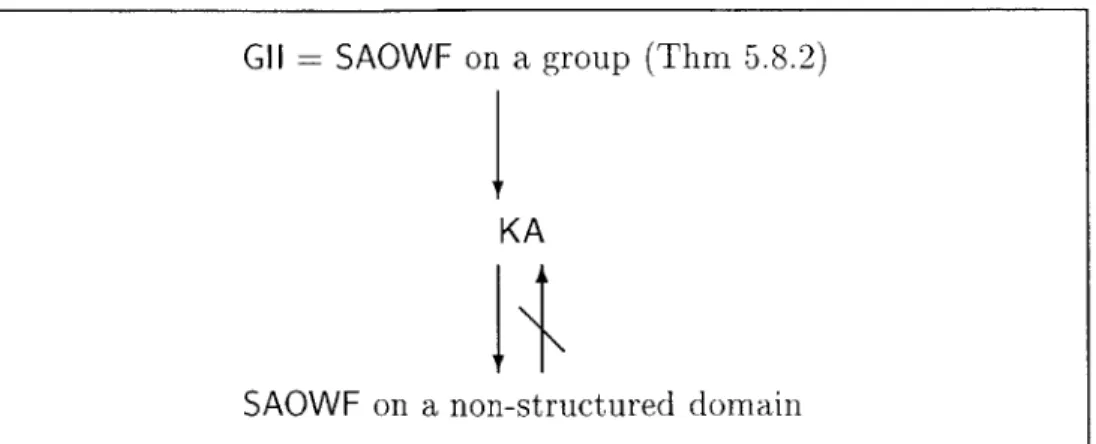
all of our standard cryptographic primitives do). In Chapter 5, we present a vivid example of this disparity. A certain type of one-way function proposed by Rabi and Sherman [45] is provably too weak to implement key agreement (KA) when considered as mapping bit strings with no algebraic structure, and yet, we show that when such a function becomes a group operator, it easily implies key agreement. Indeed, all known UTS constructions are made from groups and we conjecture in Chapter 4 that a certain type of group homomorphism is necessary for any UTS scheme. This leads us to our second question.
QUESTION 2: What algebraic properties are implied by a cryptographic
applica-tion? In other words, what are its necessary conditions?
The idea behind our second question has roots in "Reverse Mathematics", where instead of asking what axioms are needed in order to prove a theorem, one instead asks which set existence axioms are implied by the truth of a theorem [55]. In the case of "Reverse Cryptography", we ask what algebraic structures are implied by an application. We are able to show that all of the algebraic properties of TG1I are implied by a DTS scheme. Thus, we narrow the hunt for valid DTS schemes, a fairly complicated application, to that of first finding a group with this special property. Hopefully, TGI I groups do exist and our results can motivate research in locating them. In the meantime, this result offers the best explanation to date as to why no secure DTS schemes have been proposed.
In addition, recognizing that DTS schemes imply TGII groups allows us to more easily prove a black box complexity separation between directed transitive signatures and standard digital signatures. In Chapter 5, we show that DTS schemes can not be constructed out of standard digital signatures, public key encryption, or oblivious transfer. To our knowledge, this is the first black-box separation between a regular signature scheme and any of the many signature variants. Molnar points out that union-only signatures (a scheme where computing a signature on the union of a set of messages is easy given signatures on subsets of the messages, but computing the signature of the difference of two sets is hard) forms a GIl group, and thus we also separate union-only signatures from standard digital signatures [43]. It is not known if UTS schemes are strictly more complex than regular ones or not, but we make progress on this question in Chapter 4.
The main contributions of this work are highlighted in Section 1.2. Chapter 2 serves as a reference for the reader on terminology used throughout this thesis. Chapter 3 provides detailed definitions of transitive signatures, altered and extended from those of Bellare and Neven [7]. Chapter 4 is dedicated to formalizing a few groups structures of particular interest and proposing a technique for proving security in applications that use them. Chapter 5 gives the black-box relationships that exist between our new primitives and the standard cryptographic primitives in as complete a form as is known. Finally, we will conclude with several exciting open problems in Chapter 6. Appendix A contains a reference for the numerous acronyms appearing in this work.
1.1
Related Work.
An abundance of creativity and insight appearing in previous publications inspired this work. We highlight those works of particular interest below.
Transitive Signatures. Transitive signature schemes were introduced by Rivest and
Mi-cali [41]. They gave the first construction of an undirected transitive signature scheme based on the hardness of taking discrete logs and left finding a directed transitive signature scheme as an open problem. Shortly afterwards, Bellare and Neven gave alternate constructions for undirected schemes, based on the hardness of factoring and RSA [7]. These alternate constructions include the interesting property that public node labels can be derived from the hash of node indices, meaning that the signatures are secure even when an adversary is allowed to "name" the nodes. Recently, Zhu, Feng, and Deng were able to modify the discrete log based scheme of Micali and Rivest to form an undirected transitive signature scheme provably secure against adaptive chosen-message attack without random oracles [60]. We take a closer look at transitive signatures in Chapter 3.
Related Signature Work. The model for our standard digital signatures is that of
Gold-wasser, Micali, and Rivest [26]. We are also interested in homomorphic signatures as pro-posed by Johnson, Molnar, Song, and Wagner [35]. They provide definitions for homo-morphic signatures and the first constructions of additive and set homohomo-morphic signature
schemes. Chari, Rabin, and Rivest contributed a signature scheme for route aggregation, where in a binary tree anyone can produce the signature on a parent node by multiplying the signatures of its children [181. In transitive signatures, we wish to combine two signatures to produce a new message under the same signer. Going in the opposite direction, the proxy signatures of Blaze and Strauss provide a protocol (with a trusted proxy) keeping the mes-sage the same while changing the signer [12]; this idea was expanded by Dodis and Ivan [22]. Very similar to this is the notion of delegateable signatures. First proposed by Rivest, these signatures would allow Alice to sign a message delegating ability to Bob to efficiently sign a subset of messages on her behalf. Although, ideal delegateable signatures remain an open problem, Barak made progress using techniques from zero-knowledge proofs [3].
Reverse Mathematics. Reverse mathematics is a notion introduced into set theory by
Harvey Friedman, where instead of deducing a theorem from some axioms (i.e., "forward mathematics"), one instead asks which axioms are implied by the truth of a theorem [55]. In the case of reverse mathematics, the focus is generally on set existence axioms. We are interested in a "reverse cryptography" of sorts, where instead of building an application from some primitives, we instead ask which primitives are implied by the existence of an application.
Multilinear Forms. Multilinear forms provide a special mapping from one group to another
and thus are a good example of looking at applications over groups as opposed to a set of elements without structure. Since multilinear forms were introduced into cryptography [36], they have been useful in their binary form to construct secure identity-based encryption schemes [15] and secure aggregate signature schemes [16]. Happily there exist bilinear forms, with a reasonable assumed security, that can be found using elliptic curves [33]. Boneh and Silverberg recently motivated the search for realizable multilinear forms by a laundry list of cryptographic problems that they can solve [14]. Further interesting information on multilinear forms can be found online at the Pairing Based Crypto Lounge [4], including their relation to the classic Diffie-Hellman problem [19]. In our initial search for directed transitive signature schemes, multilinear forms appeared very promising; although we were never able to realize a full DTS scheme using them, we were able to use them to construct
a weakened DTS scheme where only original edges can be composed.
Associative One-Way Functions. Our research was successful in finding a link between
strongly associative one-way functions, introduced by Rabi and Sherman [45], and one of
our new primitives: groups with infeasible inversion. In a series of papers [31, 28, 46], these functions were shown to exist if and only if one-way functions exist. Thus, they are generally believed to exist, although no concrete possible implementations are known.
Black-Box Constructions and Oracle Separations. A sizable portion of our contri-bution comes from organizing and discovering the black-box relationship among our new group-based primitives, transitive signature schemes, and the standard cryptographic primi-tives. There is a large amount of literature for us to bring together. In Chapter 5, we present a diagram illustrating the known black-box relationships among cryptography primitives. The best up-to-date summary that we found for black-box relationships was by Gertner, Kannan, Malkin, Reingold, and Viswanathan, in which their main result is that public key encryption and oblivious transfer are incomparable in a black-box setting [23]. Gertner, Malkin, and Reingold were also able to show that trapdoor functions can not be constructed from trap-door predicates (i.e., public key encryption) [24]. We also used Selman's survey of one-way functions [51], as well as several references on the relation between one-way functions and one-way permutations [10, 52], including a very interesting paper by Hemaspaandra, Pasa-nen, and Rothe that proves the seemingly contradictory statement that strongly associative one-way functions are not always one-way functions [29]. Finally, we spent a large amount of time trying to construct a proof that one-way permutations are insufficient for undirected transitive signature schemes. We based our ideas off of the pioneering work of Impagliazzo and Rudich, who were first able to prove that one-way permutations are insufficient for key agreement by showing that in a world where P=NP there is an oracle relative to which one-way permutations exist and key agreement does not [32, 53]. Bellare and Rogaway's work on highlighting the difference between random oracles in proof and practice was also useful [9].
Braid Groups. In our quest to resolve the open problem of directed transitive signatures,
out, but offered several interesting ideas, is that of braid groups. A large listing of relevant braid group papers are available at the Braid Group Cryptography website [39]. We took particular interest in a recently proposed signature scheme using braids by Ko, Choi, Cho, and Lee that took advantage of a gap where the conjugacy search problem is hard and the conjugacy decision problem is easy [37].
One-More-Inversion Security. The proof that one-way group isomorphisms (OWGI) are sufficient for undirected transitive signature schemes in Section 4.4 is in the more-inversion security model. Bellare, Namprepre, Pointcheval, and Semanko introduced one-more-RSA-inversion security and used it to provide the first security proof, in any model, of Chaum's Blind Signature Scheme [6]. Bellare and Neven prove their RSA-based transitive signature scheme one-more-RSA-inversion model [7]. Recently, Bellare and Palacio also use it to show security from impersonation of the GQ and Schnorr Identification Schemes [8]. Section 4.4.1 contains a definition and discussion of one-more-inversion security.
Groups with Infeasible Inversion (Gil). We are not aware of the existence of any groups
with infeasible inversion, or of any unproven constructions that appear to satisfy its proper-ties. One area we have explored are groups where the computational Diffie-Helman problem was easy, but computational inversion in the exponent remained hard. However, we discov-ered that such a group would only be possible when the order of the group remains secret [54]. We also looked at the possibility of building a Gil group out of a suitable subgroup using
Straubing's work as a reference [56]. One (unrealized) proposal for a Gil group was intro-duced by Johnson et al. [35], although the notion of Gil was not formalized at that time. During joint work with this thesis in formalizing Gil, Molnar first brought the two notions together. Informally, it is a homomorphic set signature scheme in which the union operation is easy, while taking set difference is difficult. For further details, we refer the reader to his thesis [43].
1.2
Contributions of This Thesis and Statement on
Joint Work
All contributions included in this thesis represent joint work with Ron Rivest and David
Molnar. Rivest contributed to all parts of this thesis, especially identifying and formalizing the pseudo-free groups in Section 4.5, and he generously allowed me to use his proofs estab-lishing the relationships between weakly collision-resistant and one-way non-injective group homomorphisms in Claims 4.3.1, 4.3.2, and 4.3.3. Molnar was also active in this research and parts of this work also appear in his thesis [43].
1. SIGNATURE SEPARATIONS - To our knowledge, we provide the first separation of a
ho-mnonorphic signature scheme (DTS) from a standard digital signature scheme (SDS). In fact, we show that the directed transitive signatures proposed by Micali and Rivest [41] can not be constructed in a fully black-box fashion using either public key encryption
(PKE) or oblivious transfer (OT).
2. TRANSITIVE SIGNATURES - We do not answer the open problem proposed by Micali
and Rivest as to whether or not directed transitive signatures exist [41]. However, we do provide the necessary (Abelian TGII) and sufficient (pseudo-free Abelian TGII)
algebraic structures required for a DTS scheme. These structures are not known to exist, but are provably more complex, in a fully black-box sense, than either public key encryption (PKE) or oblivious transfer (OT), and at least as complex as trapdoor permutations (TDP) - the most complex primitive usually considered in cryptography. For undirected transitive signatures, we provide the first formalization of the sufficient conditions for a UTS scheme. We also offer explanation as to why discrete logarithm and square root based UTS schemes have standard security proofs, while RSA-based schemes elude them. In Chapter 4, we discuss the surprising result that for homomor-phic signature schemes non-injective trapdoor functions may be more powerful than trapdoor permutations (acting on a group).
3. REVERSE CRYPTOGRAPHY - Typically, cryptographers focus on building (or breaking)
We introduce an idea from set theory into cryptography, called Reverse Cryptography,
by asking what primitives or algebraic structures are implied by the existence of an
application. We provide an example of reverse cryptography in Section 5.5 by showing that the edge signatures in a DTS scheme form a special (and powerful) mathematical
group.
4. GROUP-BASED PRIMITIVES - We also focus on what provable complexity gains one
can find when considering a standard cryptographic primitive (i.e., one-way function) as operating on a group. Homomorphic schemes often imply group structure, while our standard primitives do not consider it. In 1993, Rabi and Sherman proposed a key agreement protocol based on strongly associative one-way functions (SAOWF), but were unable to prove its security outside of Yao's [57, 58] model of computational information theory [45]. We provide the first standard proof of security for their key agreement protocol based on the assumption of a group, where the operator is a SAOWF.
We formalize several new group-based primitives including: groups with infeasible
in-version (Gi\), one-way group isomorphisms (OWGI) and weakly collision-resistant one-way non-injective group homomorphisms (WCRNIGH). We relate their black-box
com-plexity to transitive signatures and some of the standard cryptographic primitives. Their relation to homomorphic encryption schemes remains an exciting open problem.
5. PSEUDO-FREE GROUPS - We introduce the notion of pseudo-free groups in Section 4.5, and show that a pseudo-free Abelian TG1I group is sufficient for a black-box DTS construction. Informally, a pseudo-free group G is computationally indistinguishable from a free group to any polynomially-bounded adversary, given black-box access to
G. We discuss possible examples of pseudo-free groups in Section 4.5.
6. BLACK-BOx RELATIONSHIPS - We contribute, in a humble way, to organizing the
black-box relaion between primitives. We build on a summary in the work of Gertner, Kannan, Malkin, Reingold, and Viswanathan [23] for a (hopefully) clean illustration of the known relationships in Figure 5-1. Understanding these entangling relationships may save other researchers from attempting constructions with insufficient primitives. For example, we tried many black-box constructions of DTS schemes from SAOWF
until we realized that Hemaspaandra and Rothe proved that SAOWF were equivalent in complexity to regular OWFs [28], and thus were unlikely to help us.
Chapter 2
Preliminaries
In this chapter, we formally define a number of standard notions that will be used throughout this work. It is primarily meant as a reference for commonly used terms. Readers familiar with the cryptographic literature may wish to skip to Chapter 3 and refer back to this chapter as needed. Let N be the set of positive integers and let denote concatenation (i.e.,
11b = 1b).
Graphs. In this thesis, G = (V, E) is a directed graph with vertex set V = {1, 2, .. ., n} and
edge set E, where each (i,
j)
E E is a directed edge from i toj,
denoted ij . The transitiveclosure of G is the graph C = (V,
E)
where ij E k if and only if there is a directed pathfrom i to
j
in G.Probabilistic Polynomial Time (PPT). Given k E N, we say that an algorithm runs in probabilistic polynomial time with respect to k if it is able to flip coins and its expected running time is polynomially-bounded in k.
Negligible. We say that an event ce has a negligible chance of occuring with respect to a
parameter k, if the probability that a occurs decreases faster than any polynomial in k (i.e.,
< 1/poly(k)) as the value k increases.
Collision-Resistant (CR). Let h : {0, 1}' -+
{0,
1}' be a polynomially-computable functionwhere I > n. We say that h is collision-resistant if it is hard for any PPT adversary to find
by the pigeonhole principle; yet for every PPT algorithm A, every positive polynomial p(-),
and all sufficiently large 's,
R1
Pr [X {0, 1}1, x' <- A (h (x), V2) : h (x) = h (x')] < p1 .
Weak collision-resistance (WCR) is also known as second pre-image resistance. Given
an input x, it is hard for any PPT adversary to find an x' / x such that h(x) = h(x'). Here
the adversary must find a collision for a particular input rather than on any input. If h is collision-resistant, then h is also weakly collision-resistant.
One-Way Function (OWF). We give the same definition as Goldreich [25]. A function
f : {0, 1}* - {0, 1}* is called one-way if: (1) [Easy to compute] there exists a deterministic
polynomial-time algorithm A such that on input x algorithm A outputs f(x), and (2) [Hard
to invert] for every PPT algorithm A, every positive polynomial p(-), and all sufficiently large
k's,
Pr[x
4-
{OI}kx' <- A(f (x), Ik) : f(X) - f(')] <p(k)'
For S C {0, 1}k, function p : S -± S is called a one-way permutation (OWP) if it has
properties (1) and (2), as well as (3) [One-to-One] for every y C S, there exists a unique
pre-image x C S such that p(x) = y.
The function f (or p) is said to be trapdoor if all the function's previous properties hold, except that it becomes polynomial-time computable to invert f (or p) when a secret trapdoor t C {0, 1}ply(k) is known to A'. Property (2) holds otherwise. In later sections, we will discuss
trapdoor permutations (TDP).
Standard Digital Signature (SDS). In several transitive signature constructions, we will
use an underlying standard digital signature scheme SDS=(SKG, SSign, SVf), described as
usual via its polynomial time key generation (SKG), signing (SSign), and verification (SVf)
algorithms. We use the security definition of Goldwasser, Micali, and Rivest [26], where the forger is given adaptive oracle access to the signing algorithm, meaning the forger can choose the next query based on the oracle's answer to the previous one. The scheme SDS is
successfully forging a signature on a message not asked of the oracle is negligible for every forger B with running time polynomial in the security parameter.
Pseudorandom Generator (PRG). We give the definition of Johan Hastad, Russell
Im-pagliazzo, Leonid A. Levin and Michael Luby, who proved that a pseudorandom generator can be constructed from any one-way function [271. Let g : {0, 1}n -+ {0, 1}' be a
polynomially-computable function where l, > t. Let U denote a truly random distribution on bit strings of length k. Then, g is a pseudorandom generator if the probability ensembles g(Ut.) and
Uir, are computationally indistinguishable.
Key Agreement (KA). We give (nearly) the same definition as Impagliazzo and Rudich [32].
A key agreement protocol is a pair of probabilistic polynomial time algorithms called Alice
and Bob. A run of the protocol is as follows: Alice and Bob both start with input 1. They
may send a polynomial number of messages to one another over a public channel; the set of their messages is called a conversation. At the end, they must both compute and agree
on a secret key K with probability 1. A probabilistic polynomial-time algorithm Eve breaks
the key agreement protocol if Eve, given only the conversation and I as input, can guess K with probability better than 1/p(k), for some polynomial p. A protocol is called secure if no
such Eve exists.
Public Key Encryption (PKE). Generally speaking, a public key encryption system is
a way in which Alice and Bob can securely send messages to each other over an insecure channel. Each user obtains a unique public and private key using a key generation algorithm. When Alice wishes to send a message to Bob, she encrypts the message using Bob's public
key. On receiving the encryption, Bob decrypts the message using his private key. PKE is
also referred to as asymmetric encryption.
Oblivious Transfer (OT). Oblivious transfer is an amazing protocol involving two
proba-bilistic polynomial time algorithms: a Sender and a Receiver. At the start of the protocol, the Sender knows m secrets and the Receiver wishes to know n _< m of them. They may send a polynomial number of messages to one another over a public channel. At the end, the Receiver learns all n secrets he requested, yet does not gain any knowledge about the
Sender's additional secrets. At the same time, the Sender gains no knowledge about which secrets the Receiver learned. The concept was first introduced in 1981 by Michael Rabin, who demonstrated that oblivious transfer can be used to obtain key agreement
[47].
Secure Function Evaluation (SFE). Intuitively, a protocol P securely evaluates function
f,
given input from n parties, if there does not exist an adversary against P who can learnmore than an adversary in a setting where a trusted party computes
f
given input privately from the same n parties. Oblivious transfer is an example of secure function evaluation. The first definition for secure computation was given by Micali and Rogaway in 1991 [42].Multilinear Forms (ML). Boneh and Silverberg introduced the concept of multilinear
forms on groups for cryptography and gave motivating applications[14]. We say a map
e : Gn -- G2 is an n-multilinear map if it satisfies the following properties: (1) G1 and G2 are groups of the same prime order.
(2) If "1,. .. , an E Z and x1,..., Xn c G1, then e(X , ., n) = e(X,.,Xn) .".
(3) The map e is non-degenerate in the following sense: if g E G1 is a generator of G1,
then e(g, ... , g) is a generator of G2.
(4) Computing discrete logarithms in G1 is hard.
For n = 2, we say e is a bilinear map (BL). Currently multilinear forms are only known to exist for n < 2 [4].
Semi Black-Box Reduction. We give the definition of Gertner et al.[23]. A semi
black-box reduction of a primitive P to a primitive
Q
is a construction of P out ofQ
that ignores the internal structure ofQ
(both in the construction itself and in its proof of correctness.) More formally, this is a construction of a polynomial time oracle machine M such that MC implements the primitive P whenever C implements the primitive Q. Namely,Q
is given in the construction as a black-box rather than, say, as the description of an algorithm that implements it. In addition, the proof of correctness is also limited to black-box access toQ.
This means that for any polynomial-time oracle machine Ap, there exists a polynomial-time oracle machine AQ such that, if Ap with access to C breaks Mc (as an implementation of
P), then AQ with access to C breaks C itself (as an implementation of Q). Note that AQ
Fully Black-Box Reduction. We give the definition of Gertner et al.[23]. A fully black-box
reduction between P and
Q
is a semi black-box reduction, where in addition the proof is black-box in a stronger sense: There is a polynomial-time adversary AQ which, given oracleaccess to any adversary Ap that breaks Mc (as an implementation of P), manages to break
C (as an implementation of Q).
Oracle Separation. We give the definition of Gertner et al.
[23],
originated by Impagliazzo and Rudich[32]. Let P,Q
be two cryptographic primitives. To separate P andQ with respect
to black-box reductions, it is enough to construct an oracle 0 such that relative to 0 the primitiveQ exists whereas P does not.
Chapter 3
Transitive Signatures
Transitive signature schemes were introduced by Rivest and Micali [41]. In such a scheme, a master signer signs the nodes and edges of a graph G = (V, E). Anyone, given signatures on the edges (u, v) and (v, w) in E, can compose these signatures to obtain a valid signature for edge (u, w) that can be verified by public information and is indistinguishable from a signature that the master signer would produce for edge (u, w). In other words, given the signatures on a set of edges, anyone can obtain and verify the signature on any edge in their transitive closure.
If we consider a master signer's time as an expensive resource, then a transitive signature scheme offers two main benefits to its users over a standard signature scheme: space and privacy. Recall our example from Chapter 1, where Bob recently joined with US Navy as a young ensign and wants to prove to his friend Alice that he works for the President of the United States. The Secretary of the Navy signs a certificate validating a reporting relationship between each Naval member and his (or her) immediate superior officer, but the Secretary does not have time to sign anything else. Why should the Navy use a transitive signature scheme?
First, a transitive signature scheme saves space, by allowing Bob to compute a short sig-nature containing the Secretary of the Navy's certification that Bob reports to the President.
If the Navy uses a standard signature scheme instead, then Bob's only option is to pay the
postage to ship all signatures on the path between himself and the President to Alice. If Bob (and other ensigns) wish to prove to many friends that they work for the President of
the United States, then this becomes an expensive operation.
Secondly, a transitive signature scheme maintains privacy. There is no need for Alice to know who Bob's captain's superior officer is. In fact, the Navy may wish to keep this information confidential. Transitive signatures allow Bob to produce a signature between himself and any of his superior officers without exposing the intermediate officers in the chain-of-command.
3.1
Definitions with Commutativity
In the first paper on transitive signatures, Micali and Rivest gave the intuition for both directed and undirected transitive signatures [411. Shortly afterwards, Bellare and Neven gave the first formal definition for undirected transitive signatures [7]. In this section, we extend the UTS definition of Bellare and Neven and provide the first formal definition of directed transitive signatures (DTS).1 All current UTS proposals remain valid under our
extended definition. (We will demonstrate this in Sections 3.2.1 and 3.2.2).
Our primary extension is the requirement that edge signatures can be composed in any
order. Formally, edge signatures must commute. Suppose Bob carries a smart card with
him, so full of nautical charts, that he only has room to store one signature. Every edge in the path from Bob to the President is signed by the Secretary of the Navy, except the link between his lieutenant and his commander. It would be great if Bob could combine all of the available signatures into a short signature to store on his smart card today and later compose with the missing link (once it becomes available) to form a signature from Bob to the President. Since edge signatures do commute in all known UTS schemes and we've identified this as a useful property, we feel our commutative definition captures a fuller intuition of what an ideal directed transitive signature scheme should be. Moreover, it enables us to prove the first strong assertion about the relative complexity of these signature schemes. We discuss possible relaxations of this definition in Section 6.1.
Undirected Transitive Signatures (UTS). Exactly like the DTS definition below with
'An earlier version of the directed transitive signature definition appears in Molnar's thesis [43], and was joint work with Molnar and Rivest.
an undirected edge represented by directed edges in both directions.
Directed Transitive Signatures (DTS). Let N be the set of positive integers. Our
def-inition of transitive signature schemes extends that of Bellare and Neven [7] in four ways. First, we have directed edges, which affect the edge signing, verification, and composition algorithms. Second, our definition introduces an explicit function NCert for the creation of per-node public and secret information; this information is implicitly encoded into the choice of graph index, an inherently public label, in the Bellare-Neven definition. (Con-currently with our work, Zhu, Feng, and Deng introduced an altered undirected transitive signature definition with an explicit NCert algorithm [60]; a good sign that we are capturing the correct intuition.) The algorithm NCert allows us to talk more easily about a transi-tive signature scheme to handle both "dynamic" and "static" transitransi-tive signature schemes, where a scheme may or may not have to sign nodes added after the master keys have been generated. Third, extending the intuition of "static" schemes, we define "transitive signa-ture schemes with pre-processing" where key generation may depend on the graph G (in the original definition key generation was always independent of the graph). This notion may be of independent interest for efficiency and simplicity issues in settings where changes are scarce. Finally, we broaden the notion of composed signatures to allow for the composition of signatures in an arbitrary order (commutativity of composition). Suppose signatures for edges a, bc, de are available. Bob wishes to create the signature ra. It is desirable that he can compose o 0 o =, T and at a later time, when edge signature or-a becomes
available, compute T O o = Uo . All previously suggested UTS constructions [41, 7, 60]
re-main valid under this natural, expanded definition. Whether or not a UTS (or DTS) scheme can be created with all properties, except commutativity of composition, is an open problem.
A (commutative) directed transitive signature scheme DTS=(KG, NCert, ESign, Vf, Comp)
is specified by five polynomial-time algorithms as follows:
o KG: The randomized key generation algorithm KG can take as input either 1k, where k E N is the security parameter, or take 1 and a graph G bounded in size by a
polynomial in k, and return a pair (PK,SK) consisting of a master public key and matching secret key. In the first case, we say the DTS scheme is dynamic, since new
nodes can be added at any time (because the master keys do not depend on the graph being signed). In the latter case, we say the DTS scheme is static, since the master keys are dependent on the graph (if the graph changes, KG may have to be run anew). For the static case, we say that a DTS requires E(k) -heavy per-key pre-processing if the running time of KG on input 1k and graph G is bounded by E(k). In the case that E(k)
is polynomial, we say that the DTS requires efficient per-key preprocessing. Unless otherwise stated, we refer to dynamic DTS schemes.
* NCert: The node certification algorithm NCert, which is stateful and could be random-ized, takes as input the master secret key SK and a node i C N, and returns a unique
pair (L(i), {(i)) consisting of a public value and a secret value for node i. It records the public and secret information for node i in state variables L and f, respectively, and updates any other state variables upon each invocation.
" ESign: The edge signing algorithm ESign, which could be stateful or randomized (or
both), has read only access to the public and secret node information (i.e., L, f) main-tained by NCert. It takes as input the master secret key SK and two node indices
i,
j,
and returns a value called an original signature of edge iy relative to the secret information of the master and nodes i, j, or I for failure. If stateful, it updates its state upon each invocation.* Vf: The deterministic verification algorithm Vf, given PK, two multisets of node public values Pc, Pdest
C
L, and a candidate signature o, returns either 1 or 0. It returns1 if and only if o is a valid signature of a set of directed edges E, = {ei, e2,. . ., em}
such that P, is the multiset of public values for source nodes in E, and Pdest is the analogous multiset for destination nodes. Thus, |Ps.cI = lPdest L. The validity of an edge is taken relative to the public information PK, P,, and Pdet. For example, on input (PK,{L(i)}, {L(j)}, a), Vf returns 1 if and only if a is a valid signature on edge i7J. By
this representation, sources are not paired with destinations; thus the edge set signed might be ambiguous, unless IPscl = IPdestl = 1. This unusual property allows for the
verification of all signatures produced by the master signer or the Comp algorithm.
" Comp: The deterministic composition algorithm Comp takes as input PK, two pairs of
A = PlsrcUP2src and T = PldestUP 2dest. Then Comp returns either a value (3, called a
composed signature on edge sets corresponding to (A- (AnT), T - (TnA)), or the
sym-bol _L to indicate failure. For example, on input (PK,({L(i)}, {L(j)}), ({L(j)}, {L(k)}), ou--, al), Comp returns %k, a composed edge signature for ({L(i)}, {L(k)}) (i.e.the signature for edge ir). A signature with Psrcl > 1 is also called a waiting signature, since it will need additional compositions before it can authenticate a single, explicit
edge.
For a directed transitive signature scheme DTS to be useful for the applications mentioned in Section 1, it must also be correct and secure.
CORRECTNESS OF DTS SCHEMES. It is a natural requirement that an original signature
o--+ is also a valid signature with respect to PK, {L(i)}, and {L(j)}. Similarly, the output
of the Comp algorithm must always be a valid signature, when given "correct" inputs: two
original or composed signatures and their corresponding public node values.
We agree with Bellare-Neven [7] that it does not always follow that simply because two
signatures are valid (i.e., they pass the Vf algorithm), they should be composable. Consider the case where the public value L(j) for node j is a square A and its secret value £(j) is a specific square root of A (modulo the product of two large primes). Now, it might be possible
that an edge using another square root of A might appear valid and yet not compose well with other original signatures. We overcome this problem by using a definition below that
requires all signatures passed to Comp be either original or composed themselves.
Furthermore, we require that a composed signature on edge I be computationally
in-distinguishable from an original signature on edge Yl. This requirement offers two benefits. First, we see that the length of a string of directed edge signatures (i.e., oi, or - ), once
a& bc' cd
composed, is no greater than the single signature u- . Secondly, the privacy of all interme-diate nodes are maintained. The composed edge signature ou- above gives no information
about its intermediate nodes b, c, since the signature is indistinguishable from that of the ESign algorithm on edge ad, which received neither L(b) nor L(c) as input.
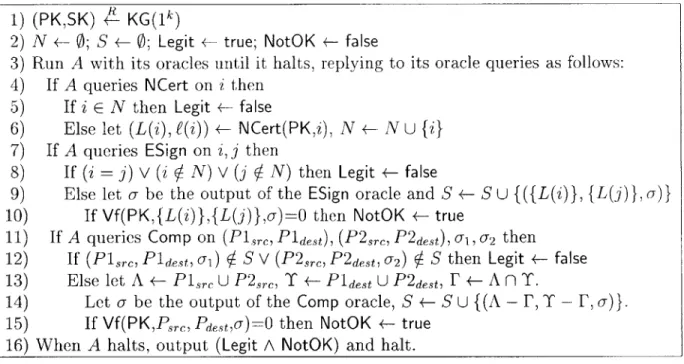
In Figure 3-1, we give an experiment for any (deterministic, halting, computationally
1) (PK,SK) +" KG(1k)
2) N +- 0; S <- 0; Legit - true; NotOK +- false
3) Run A with its oracles until it halts, replying to its oracle queries as follows:
4) If A queries NCert on i then 5) If i C N then Legit +- false
6) Else let (L(i), e(i)) - NCert(PK,i), N +- N U {i}
7) If A queries ESign on i, j then
8) If (i = j) v (i V N) V (j V N) then Legit <- false
9) Else let o be the output of the ESign oracle and S +- S U {({L(i)}, {L(j)}, O)}
10) If Vf(PK,{L(i)},{L(j)},o)=0 then NotOK +- true
11) If A queries Comp on (Plsrc, Pldest), (P2src, P2dest), o1, 02 then
12) If (Plsrc, Pldest, Ji) V S V (P2sc,, P2dest, U2) V S then Legit +- false
13) Else let A +- P1src U P2src, T +- Pldest U P2dest, F <- A n T.
14) Let o be the output of the Comp oracle, S <- S U {(A - F, T - F, o)}.
15) If Vf(PK,Psrc, Pdest,7)=0 then NotOK +- true 16) When A halts, output (Legit A NotOK) and halt.
Figure 3-1: An experiment to define the correctness of a dynamic directed transitive signature scheme DTS=(KG, NCert, ESign, Vf, Comp).
NCert(SK,-), ESign(SK,-,-) and Comp(PK,-,-,-,-),
where PKSK are the result of running KG on input 1k*. In this experiment, the NCert
and ESign oracles maintain state, and update their states each time they are invoked. If randomized, new coins are tossed at each invocation.
Definition 3.1.1 We say that the dynamic directed transitive signature scheme DTS is
cor-rect if for every (deterministic, halting, computationally unbounded) algorithm A and every
k E N, the output of the experiment of Figure 3-1 is true with probability zero.
We call this case dynamic, because A may add new nodes to the graph, via the NCert oracle, both before and after calls to ESign and Comp. As A queries, the boolean variable Legit is set to false if an illegitimate query is ever made, while the variable NotOK is set to true if an invalid signature is ever produced by either the ESign or Comp oracles on good inputs. To win, A must stay legitimate (Legit=true), but violate correctness (NotOK=false). The definition requires that this happen with probability zero.
For the static case, we simply require that all calls to the oracle NCert be completed before the master keys are generated (and therefore, before any calls to ESign or Comp). In
this case, we run a new experiment with A and k, changing Figure 3-1 to move lines 2, 4, 5 and 6 to appear sequentially above the current line 1, which itself is replaced by "(PK,SK) N KG(1 , G)", where G is the complete graph of nodes created during calls to NCert. The rest of the experiment is consistent with the dynamic case.
Definition 3.1.2 We say that the static directed transitive signature scheme DTS is
cor-rect if for every (deterministic, halting, computationally unbounded) algorithm A and every
k e N, the output of the experiment for Figure 3-1, with static modifications, is true with probability zero.
SECURITY OF DTS SCHEMES. Forgeries are valid signatures on a single edge not within
the transitive closure of G. Fundamentally, DTS schemes provide authentication of single edges (the relationship between two parties). The ability to "forge" waiting signatures only gives the adversary power when she is able to use them to compute an edge signature outside of the transitive closure of G, since those are the only signatures that directly (and falsely) authenticate a directed edge between two nodes.
Formally, we define an experiment for directed transitive signature scheme DTS=(KG, NCert, ESign, Vf, Comp), adversary F and security parameter k E N, denoted
Expu- a (k),
that returns 1 if and only if F is successful in its attack on the scheme. The experiment begins by running KG on input 1k (and also G for static schemes) to get the master keys
(PK,SK). It then runs F with input PK and oracle access to the function ESign(SK,-, .). The adversary for dynamic schemes can also make oracle calls to NCert to create nodes, while in static schemes she can not. (For this reason, dynamic security is strictly stronger than static security.) Eventually, F will output i',j' E N and a value -'. Let E be the set of all edges
Z) such that F made ESign query i,j. Let V be the set of all nodes certified by the master
-4
signer. We say that F wins if o-' is a valid signature of i'j relative to PK, L(i'), and L(j'), and yet edge i'j' is not in the transitive closure of G = (V E). The experiment returns 1 if