Demonstration of robust quantum gate
tomography via randomized benchmarking
The MIT Faculty has made this article openly available.
Please share
how this access benefits you. Your story matters.
Citation
Johnson, Blake R, Marcus P da Silva, Colm A Ryan, Shelby Kimmel,
Jerry M Chow, and Thomas A Ohki. “Demonstration of Robust
Quantum Gate Tomography via Randomized Benchmarking.” New J.
Phys. 17, no. 11 (November 6, 2015): 113019. © 2015 IOP Publishing
Ltd and Deutsche Physikalische Gesellschaft
As Published
http://dx.doi.org/10.1088/1367-2630/17/11/113019
Publisher
IOP Publishing
Version
Final published version
Citable link
http://hdl.handle.net/1721.1/101671
Terms of Use
Creative Commons Attribution
This content has been downloaded from IOPscience. Please scroll down to see the full text.
Download details: IP Address: 18.51.1.3
This content was downloaded on 26/02/2016 at 00:32
Please note that terms and conditions apply.
Demonstration of robust quantum gate tomography via randomized benchmarking
View the table of contents for this issue, or go to the journal homepage for more 2015 New J. Phys. 17 113019
New J. Phys. 17(2015) 113019 doi:10.1088/1367-2630/17/11/113019
PAPER
Demonstration of robust quantum gate tomography via randomized
benchmarking
Blake R Johnson1,5 , Marcus P da Silva1 , Colm A Ryan1 , Shelby Kimmel1,2,4 , Jerry M Chow3 and Thomas A Ohki11 Raytheon BBN Technologies, Cambridge, MA 02138, USA 2 Center for Theoretical Physics, MIT, Cambridge, MA 02139, USA 3 IBM TJ Watson Research Center, Yorktown Heights, NY 10598, USA
4 Current address: Joint Center for Quantum Information and Computer Science(QuICS), University of Maryland, College Park, MD
20742, USA.
5 Author to whom any correspondence should be addressed.
E-mail:[email protected]
Keywords: tomography, quantum information processing, superconducting qubits, randomized benchmarking, quantum computing, quantum control
Abstract
Typical quantum gate tomography protocols struggle with a self-consistency problem: the gate
operation cannot be reconstructed without knowledge of the initial state and
final measurement, but
such knowledge cannot be obtained without well-characterized gates. A recently proposed technique,
known as randomized benchmarking tomography
(RBT), sidesteps this self-consistency problem by
designing experiments to be insensitive to preparation and measurement imperfections. We
implement this proposal in a superconducting qubit system, using a number of experimental
improvements including implementing each of the elements of the Clifford group in single
‘atomic’
pulses and custom control hardware to enable large overhead protocols. We show a robust
reconstruction of several single-qubit quantum gates, including a unitary outside the Clifford group.
We demonstrate that RBT yields physical gate reconstructions that are consistent with
fidelities
obtained by RB.
1. Introduction
All approaches to quantum tomography are forced to make trade-offs given the exponentially increasing resources necessary as the size of the system grows. There has been an aggressive effort from the community to explore alternative approaches that return coarse-grained information in exchange for shorter run times[1–16]. All these techniques rely on some assumptions about the system being characterized. While quantum process tomography(QPT) has been shown to suffer from systematic errors due to incorrect or unverified assumptions about preparation and measurement[17], randomized benchmarking (RB) is insensitive to this ignorance and robust against imperfections in the other operations used in the protocol[8,9]. The trade-off is that RB only provides information about how far away an experiment is from an ideal Clifford group operation, i.e., the averagefidelity. In applications where a more complete reconstruction of the operation is necessary, e.g., for debugging purposes, RB fails to provide enough information, while the systematic errors in QPT preclude accurate results.
RB tomography(RBT) [18] is a recent proposal for near-complete process tomography that inherits the robustness of standard RB and its insensitivity to state preparation and measurement ignorance. Most notably, this technique also allows for the estimation of the averagefidelity of any applied gate relative to any unitary operation—in some cases, this estimation can even be done with a polynomial number of experiments, but in general, it has the same scaling as QPT.
In this letter, we apply RBT to reconstruct single-qubit operations in a transmon superconducting qubit, and compare these reconstructions to results obtained via QPT. In particular, we take advantage of the RBT protocol
OPEN ACCESS RECEIVED 4 September 2015 REVISED 6 October 2015 ACCEPTED FOR PUBLICATION 8 October 2015 PUBLISHED 5 November 2015
Content from this work may be used under the terms of theCreative Commons Attribution 3.0 licence.
Any further distribution of this work must maintain attribution to the author(s) and the title of the work, journal citation and DOI.
to robustly reconstruct a p 6 rotation that lies outside the Clifford group. We show that while QPT yields strong non-physical features due to systematic errors, RBT reconstructions remain physical. Moreover, thefidelities estimated by RBT are compatible withfidelities estimated by standard RB.
Unsurprisingly, extracting more information requires more experiments. Like standard QPT and other recent methods for improving upon it[17,19,20], RBT comes with an exponential overhead in the total number of experiments. The additional run time may lead to drift in parameters of the operation or in state-preparation and measurement errors. This would break a fundamental assumption of most tomography protocols that the parameters arefixed for all rounds of the experiment. Consequently, we describe some strategies for dealing with large experiment-count protocols, including the use of a custom arbitrary waveform generator that operates with very concise sequence descriptions, and readout approaches that improve system stability.
The problem of physically valid reconstructions in tomography is more significant in certain settings. In particular, reconstruction of nearly perfect unitary operations is more sensitive to this issue because such operations are extremal in the set of physically valid operations. Small errors, statistical or otherwise, can easily push estimates outside the physical bounds[21]. To ensure we are near this challenging limit, we endeavor to implement single-qubit unitaries from the Clifford group with coherence-limited control, i.e. withfidelities determined solely by instrinsic decoherence. A new method we use to achieve this effectively re-introduces frequency control tofixed-frequency qubits, creating single-pulse, or atomic, Clifford operations that minimize the average gate time by avoiding multi-pulse decompositions.
2. RBT protocol
We start with a brief description of the RBT protocol. Throughout this discussion, we denote unitary operators in the Clifford group byC ,ˆj and the corresponding quantum operation(superoperator) by .j Other operations
are denoted by calligraphic fonts as well, e.g., . The sequential composition of two operations andis denoted by , meaning actsfirst, followed by . This hints at the fact that operations can be represented as matrices and operators as vectors. This representation is known as the Liouville(or Hilbert–Schmidt)
representation, and throughout this discussion we will use the Liouville representation in the Pauli basis6. Pauli group unitaries are denoted by X Y Z, , , while the identity operator is denoted .
An operation is called unital iff ( )=. If is not unital, one can still refer to its unital part, ¢, by ignoring the traceless components of ( )7. This unital part of trace-preserving operations can be decomposed into a linear combination of Clifford group operations[18,22,23]. In other words,¢can be reconstructed from estimates of overlaps
= † ( )
aj tr j , 1
where jis a Clifford operation, as long as a sufficiently large linearly independent set of Clifford operations is
chosen. For a single-qubit, instead of the full Clifford group we consider = = = = = = = = = = = = p p p p p p p p p p p -- -- + + - + + - - + - - + - + - - + -- - + + - - + + ˆ ˆ ˆ ˆ ˆ ˆ ˆ ˆ ˆ ˆ ˆ ˆ ( ) C C C C C C C C C C C C e e e e e e e e e e e . 2 X Y Z X Y Z X Y Z X Y Z X Y Z X Y Z X Y Z X Y Z X Y Z 1 2 i2 3 i2 4 i2 5 i 3 3 6 i 2 3 3 7 i 3 3 8 i 2 3 3 9 i 3 3 10 i 2 3 3 11 i 3 3 12 i 23 3
which is a unitary two-design embedded in the Clifford group[3,24,25]. We call this groupA4,as it is isomorphic to the alternating group of degree four, i.e., the group of even permutations of four distinct labels. The linear span of the operations inA4is ten-dimensional(as is the linear span of the entire Clifford group for single qubits), so in the experiments described here, we take the first 10 of these operations as our linearly independent set. Given an estimate of the overlap vectora ={a1,¼,ak},standard unconstrained least-squares inversion yields an estimate of¢(see appendix).
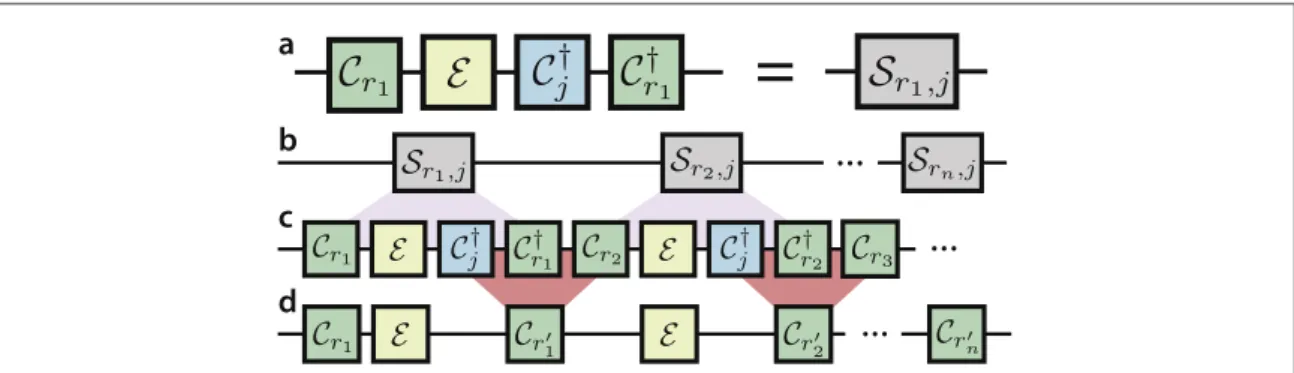
We estimate the overlaps ajthrough interleaved RB sequences(IRB) [11,12], as shown in figure1. That is, we
iteratively apply the sequence = † † ,
r j, r j r where ris randomly chosen fromA4.We will refer to a 6
This combination of choices is referred to as the Pauli–Liouville representation [18], while other works refer to the resulting matrices as
Pauli transfer matrices[49].
7
More precisely, if^is the projector that takes an operator into its traceless components and is a trace preserving operation, then
sequence =
i n
r ji, as a sequence of length n, where the riare chosen independently. In practice, it is convenient to reduce the total sequence length by compiling the compositions of the randomly chosen rʼs and
the overlap target†,
j and applying the corresponding Clifford group operation instead. Choosing the overlap
set to be a group ensures that the composed Clifford operations are still in the same set. Consequently, the applied sequences will take the form of alternating random Clifford operations and the target (see figure1(d)). As will be discussed later, we exhaustively sample from the set of all sequences of the form of for a given length, so it is advantageous to sample from a subgroup likeA4instead of the full Clifford group, in order to limit the total number of experiments.
The expectation of thefidelity between the input and the output of this sequence, averaged over the random choices of Clifford group operations, is[8,9,26]
= + ( ) Fj n, Apjn B, 3 where ⎡ ⎣⎢ ⎤⎦⎥ Î -p d 1 1, 1
j 2 is a decay rate, d is the dimension of the system(here d = 2), and A and B are factors
related to preparation and measurement errors. The decay rate pjis related to the overlap ajby
= -- ( ) p a d 1 1, 4 j j 2
so that estimates of the decay rates can be used to reconstruct . Equivalently, the ajcan be related to the average
fidelity between and j[27,28]. For small overlaps ( <aj 1), the decay rates are negative, leading to oscillatory
decays in the length n.
Imperfections in the randomizing, or twirling[24,25], operations can be accounted for by characterizing the (ideally) null operation ,0 a zero-length pulse[11,18]. If only the fidelity of 0to the identity is estimated, the imperfections can only be partially acounted for, leading to very loose bounds on the performance of . However, if the unital part of 0is fully reconstructed, a much more accurate estimate can be made by inversion [18]. For any operation that is reconstructed via RBT, the errors can be accounted for by computing the right and left corrected operations ¢ = ¢ ¢R ( 0)-1and ¢ = ¢( )-¢,
L 0 1 respectively. The placement of the error operation on the left or right side of is arbitrary(usually chosen by convention), so either estimate is valid.
A difficulty in experimentally obtaining pjarises from the fact that for most aj, the resulting decayApjnwill
rapidly vanish even for small n. In fact, if is close to an ideal Clifford operation, then the pjʼs in the overlap
experiments will be close to 1
3or 0, except whenj» . For example, when n= 4 one needs better than 1% precision in the measured averagefidelity to distinguish
( )
13 4
from the mean value of B reliably. One mitigation is to exhaustively sample all random sequences up to a given length. This removes configuration sampling uncertainty from the estimators ofFj n, above, though we are still affected by imperfections in the randomizing operations. As already discussed, these imperfections can be accounted for so long as they fall within the assumptions of the RB protocol. The cost of additional experiments from exhaustive sampling may be partially offset by using control hardware with minimal overhead for uploading gate sequences.
3. Experimental implementation
We test the RBT protocol on a single qubit of a three-transmon,five-resonator device, described in [29]. The probed qubit’s coherence times areT1»5.7 sm andT2echo»8.4 s,m with anharmonicity a 2p = -221 MHz.
Figure 1. Sequence reduction of an RBT overlap experiment.(a) The ‘unit cell’, ,r j, which is applied iteratively in an RB protocol,(b).
when written out(c), one can identify sections with up to three Clifford operations, e.g. † † ,
j r1 r2which can be compiled into a single gate, r1¢,also from the Clifford group. The resulting sequence,(d), has the same form as a standard IRB experiment, except that we allow » ,j in which case the action of the complete sequence may not be close to .
3
The qubit’s readout resonator is coupled to a lumped Josephson parametric amplifier [30] and pumped 17 MHz detuned from the measurement signal to operate it in a phase-preserving mode. The readout assignmentfidelity of »95% is sufficiently high that it is advantageous to convert the measurement outcomes into binary values by thresholding before averaging[31]. These two choices serve to improve the system stability by reducing sensitivity to the relative phases of the pump and measurement signals, as well as to small voltagefluctuations in the receiver chain.
Qubit control is realized by single sideband modulation of a microwave carrier detuned∼150 MHz from the qubit transition frequency. The shaped modulation signals are generated by a custom arbitrary waveform generator described in section3.2. With the exception of Z rotations which are done with a simple frame-update, we use afixed-duration pulse of 33.3 ns for all single-qubit gates, and vary the control amplitudes to implement different rotations.
3.1. Atomic Clifford group operations
Quantum control in superconducting qubits is usually relaxation limited and so to minimize gate errors it is desirable to keep the gates as short as possible. Typical implementations consider only control about axes in the XY plane or treat Z rotations separately and are forced to decompose rotations about an arbitrary axis into a sequence of rotations—the so-called Euler angle decomposition [32]. A relevant example of gates that require off-axis rotations are single-qubit Clifford group operations. These can be described as rotations about symmetry axes of the cube in the Bloch sphere, and the cube has symmetries forπ rotations about the (1, 0, 1) axis and p2 3 rotations about the (1, 1, 1)axis. When implemented with only XY control these can take up to three times longer to implement. Here we show that arbitrary single-qubit gates are possible with a single pulse using conventional control schemes under mild assumptions about the linearity of the control. We term these atomic operations.
In the reference frame rotating at the microwave control frequency, the control Hamiltonian rotates the qubit about afixed axis in the XY-plane. If the qubit is detuned from the microwave drive, then the total Hamiltonian picks up an additional Z component and the effective rotation axis is the vector sum of the drive and detuning terms, giving an arbitrary effective rotation axis. This off-resonance component can be induced by changing the frequency of the qubit or of the microwave drive. Variable frequency qubits struggle to obtain fine-frequency control and introduce non-Markovian effects from theflux bias line. On the other hand, rapidly changing the frequency of a microwave source in a phase coherent manner is a technical challenge. However, experiments already typically provide arbitrary amplitude and phase microwave control with an IQ mixer. This allows us to implement a discrete-time version of a frequency change by linearly ramping the phase of the shaped microwave drive[33].
The effect of phase ramping on detuning is straightforward to derive from a Suzuki–Trotter expansion [34] of a tilted rotation angle gate. Consider a Hadamard rotation(π rotation about the X+ Z, or (1, 0, 1)axis). The unitary is given by = -p + ( ) ( ) UHad e i2 X Z. 5 1 2
We can then consider a Suzuki–Trotter expansion of the anti-commuting X and Z terms with q= -i p 2 2 ⎡⎣ ⎤⎦ = ¥ q q ( ) U lim e e 6 n Z X n Had n n ⎡⎣ ⎤⎦ ⎡⎣ ⎤⎦⎡⎣ ⎤⎦ ⎡⎣ ⎤⎦
= = = = = q -- -- -¥ = -q q q q q q q q q q q q q q q q q q q q q q q q q q q q q q q q q q(
)
(
)
( ) ... e e e e e e , ... e e e e e e e e , ... e e e e e e e e e , ... e e e e e e e e , lim e e e e , 7 Z X Z X Z X Z X Z Z Z X Z X Z Z Z X Z Z X Z X Z Z X Z Z X Z X n Z k n Z X Z 0 1 n n n n n n n n n n n n n n n n n n n n n n n n n n n n n n n k n n kn 2 2 2 3 2 2where we have injected, in round parenthesis, identity Z rotation blocks. The same approach carries through for shaped pulses with time varying amplitudes. The phase steps dynamically vary with the pulse amplitude to maintain the same effective rotation axis.
Truncating the product in equation(7) at finite n, corresponding to the number of samples in the control pulse, gives a discrete-time implementation of a frequency shift in terms of XY control(the X components) and per-sample frame updates(the Z components). This is, however, only an approximation (top of figure2). The introduced error is drastically reduced by using a symmetric second-order Suzuki–Trotter expansion
⎡ ⎣ ⎤⎦
= q ¥ = - - q q - q ( ) ( ) ( ) U lim e e e e . 8 n Z k n Z X Z Had 1 k n n k n 2 1 2 2 1 2This is equivalent to defining the phase of each step at the mid-point of the time bin, rather than at the start of the ramp. This second-order version reduces the error to a level which is insignificant compared to other error sources in current implementations.
In implementing a detuned pulse we move to a new virtual frame where we acquire phase at a different rate than the qubit’s frame. Thus, when we move back to the qubit frame we must account for the accumulated phase difference. This is represented by thefinal Z rotation outside the product in equation (7). Since we are already working in a rotating frame, this Z rotation may be implemented for free by updating the phase of all subsequent pulses.
When controlling the anharmonic oscillators common to superconducting qubit implementations, additional pulse shaping is necessary to avoid exciting higher energy levels[35]. The first-order Z-only
correction follows through naturally to these phase ramped pulses and their ability to demonstrate highfidelity in a Duffing oscillator model of a transmon is shown in the bottom panel of figure2.
Figure 2. Simulated average gatefidelity [28] for the implementation of a Hadamard gate with a Gaussian pulse shape extending to
s
2 and varying time steps(colors). (Top) Example baseband quadrature control signals for a 30 ns duration Hadamard sampled at 1 GS s−1. Blue and green show the I and Q quadratures, respectively. The pulse carries forward a frame change of»-2.335rad. (Middle) Simulates a qubit model, where the only source of error is discretization error from implementing the frequency shift using phase-ramps. Dashed(solid) lines indicate 1st order 2nd order Suzuki–Trotter approximation. (Bottom) Simulates a five-level Duffing oscillator model of a transmon with 200 MHz anharmonicity. Dashed lines indicate no DRAG correction whereas solid have Z-only DRAG correction. Interplay between the DRAG correction, phase ramping and discretization effects gives non-smooth behavior.
5
3.2. Custom control hardware
Exhaustive sampling of even fairly short RBT overlap experiments(in our case, up to three twirling gates) requires implementing thousands of sequences of gates. This poses a practical difficulty for conventional arbitrary waveform generators(AWGs) which require waveforms that are the full duration of each sequence. These AWGs do not take advantage of the relatively small number of primitives that compose RB sequences, i.e., the pulses corresponding to each Clifford operation. Consequently, simply uploading waveform data to a traditional AWG may consume more wall clock time than running the experiment many thousands of times to collect statistics.
To overcome this hurdle, we use a custom arbitrary waveform generator called the arbitrary pulse sequencer (APS). This hardware is programmed using a natural representation for quantum information processing experiments: it uses lists of waveform primitives(pulses as short as eight samples) and outputs the composite waveform produced by concatenating these primitives without pauses or gaps between successive waveforms This allows the user to upload only a small set of waveforms, such as a generating set of the Clifford group(e.g., X, Y, Z, i ,X i ,Y iZ), or the ‘atomic’ pulses described above, and re-use these same pulses regardless of the
sequence length. This design also has the advantage of dramatically reducing the waveform memory requirements for the APS. In addition, our hardware has the capability to receive new sequence data while simultaneously outputting waveforms We use dual-port RAM configured as a circular buffer to fill new sequence data behind the sequence read pointer. Consequently, data acquisition can begin with only a small subset of the total sequence loaded onto the APS.
Fast and robust data taking is particularly important to tomography in order to avoid unaccounted for drifts in control or sample parameters, such asfluctuations in the qubit relaxation time. The two improvements described above combine to significantly reduce the overhead of experiments with large numbers of sequences and to reduce sensitivity to drift. For example, using the APS allowed collecting an RBT data set in∼6 h. We estimate that with a conventional AWG, the same experiment would take more than twice as long.
4. Results
4.1. Parameter estimation methods
The linear span of single-qubit Clifford group operations is ten-dimensional, and includes all trace-preserving, unital operations. Consequently, an RBT reconstruction requires at least ten distinct decay experiments, where each observed decay rate pjis related to the trace overlap ajby equation(4)8. Analytical formulas relating the
observedfidelities of each sequence length to the decay rate exist [18], but for the size of the statistical ensemble available to us and the experiment signal-to-noise ratio, this procedure results in large error bars. We remedied this by observing that thefit parameters are not independent across all experiments. In particular, the scaling A and offset B for the decay curves(see equation (3)) should be the same across different experiments as long as the characteristics of the state preparation and measurement are stable.
The overlaps with‘instantaneous decay’ (pj= 0) suffer from fitting degeneracy between pj= 0 and poor
preparation and measurement(A = 0). To break the degeneracy, we simultaneously fit a reference slow decay rate( »pj 1) with each overlap and require the A and B values to be consistent. An appropriate reference comes from a standard RB experiment that estimates thefidelity of the null operation ,0 which usually has highfidelity to the identity and therefore leads to a slow decay.
Thus, each decay rate pjis found using a four parameterfit of bothFj n, and another reference decay, where the parameters are: the reference decay rate(unused in the reconstruction), the decay rate pj, a shared scale
parameter A, and a shared offset parameter B, as in equation(3). Moreover, because fast decays only lead to a small number of reliable observations, while slow decays lead to many, thefigure of merit used in the joint fits is the sum of the mean squared errors of each of the two decays.
The sequence lengths used to estimate each overlap were 1, 2, 3 and¥,where the averagefidelities of infinite length sequences were approximated by averaging the single-pulse sequences consisting of the 12 elements ofA4
for the samefixed initial state, which effectively implements a twirl of the initial state9. This results in a total of
+ + + =
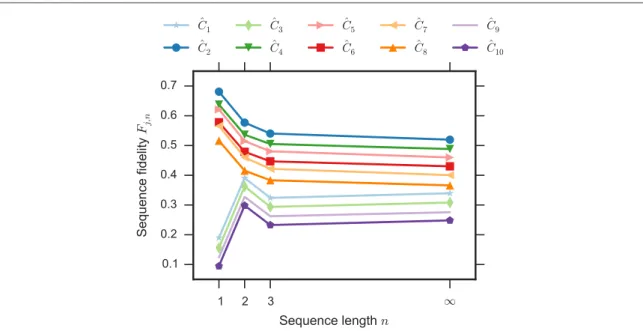
12 122 123 12 1, 896different sequences(length 1 and¥sequences were repeated 12 times for a total of 2, 160 experiments). The resulting decay curves for our implementation of the Hadamard are given in figure3. Since Hadamard is not inA4,everypj <1,and there is no slow decay. In fact, the decay ratespj » .
1 3 8
In principle we could reduce this to nine distinct decays, since unital trace-preserving single-qubit operations have only nine free parameters, but we choose not to enforce this additional constraint here.
9Twirling a gate over a two-design yields a depolarizing channel
(up to gate imperfections), so an infinite sequence of such depolarized channels would map all inputs to the maximally mixed state. We replace the infinite sequence by a short state twirling sequence that does the same thing. We are still able to capture the measurement imperfections because the state and gate twirling operations are the same.
The curves withpj <0are particularly unusual compared to standard RB experiments due to the oscillatory behavior of the sequencefidelity with length n, which occurs for vanishing overlaps »aj 0.
For each RB, IRB, or RBT sequence we collect 10 000 repetitions, binned into groups of 100. This binning reveals the underlying distribution of the experimental noise, and allows one to resample the data to create bootstrapped confidence intervals. The choice of 100 shots per bin is a trade-off between information about the distribution versus data storage requirements and experiment runtime.
In the analysis here, thefits to the exponential decays were performed by a nonlinear least-squares (NLLS) minimization, using Broyden–Fletcher–Goldfarb-Shanno (BFGS) minimization of the joint figure of merit with a starting point obtained from a simple Prony estimate of slow decays[36,37]. Confidence intervals were estimated by non-parametric bootstrap percentiles[38], using 2000 replications obtained from 100 samples of each of the exhaustive experimental configurations.
4.2. Reconstruction andfidelities
In order to test the protocol, we apply RBT to an implementation of the identity(a zero-length null operation), a Hadamard gate, and the W gate(ap
6rotation about the (1, 1, 1)axis, which is a unitary operation outside the Clifford group). For each tested gate, the fits of the overlap experiments are combined into an overlap vector
= ¼
{ }
a a1, ,ak .As described in appendix, the reconstructed operations¢are obtained from least squares inversion. The operations, along with their ideal, noiseless counterparts are depicted in the Pauli–Liouville representation infigure4. In this purely real representation the unital part excludes most elements of thefirst row and column. Strictly speaking it also requires the top-left element to be equal to one for a trace preserving map, although we have not enforced this constraint in our reconstruction.
We compare RBT reconstructions to standard RB, IRB and QPT. The averagefidelities from these
approaches for each of the three operations considered are depicted infigure5. The QPT results are adjusted to account for the imperfections in the measurement, under the assumption that these imperfections are independent of the measurement basis(i.e., the data are re-scaled so that the Z measurement spans the range
-[ 1, 1]). We also compared the RBT reconstruction to a separate IRB estimate of the fidelity of the Hadamard gate, and to a direct estimate of thefidelity of the W gate based on a subset of the decays. Although W is outside the Clifford group, it can be decomposed into a linear combination of Clifford operations. Namely
= 1+ 3 + + - ( ) 3 1 3 1 3 3 . 9 1 5 6
Consequently, one can estimate thefidelity toWˆ from overlap experiments with just ˆC C1, ˆ5,andCˆ6[18]. However, the resulting estimate has the same bounds as the standard IRB protocol, which leads to significantly greater uncertainty in the estimate compared to QPT or RBT. For reference, with our gate durations and sample coherence times, we estimate that coherence-limited control should lead to an average gatefidelity of 0.9974.
Figure 3. Experimental decay curves from RBT overlap experiments of a Hadamard gate, vertically offset by 0.03 for clarity.‘Infinite’ length sequences were approximated by averaging outcomes from applying single pulses from A4.The curves decay rapidly with a
rate∣ ∣p ~ 1 3,
j and thus thefitting procedure requires more care than standard RB fitting procedures, since only a few points are
statistically significant.
7
Figure 4. Hinton diagrams[39] for the Liouville representations of the ideal operation (left) and reconstructed unital part of the
operation¢(right) for the identity operation, Hadamard operation, andWˆ =e-p + + .
X Y Z
i
12 3 The area of each square corresponds to the magnitude of the corresponding matrix element, with the sign represented by white(positive) or black (negative). The hatched areas correspond to parameters not accessible via the RBT protocol.
Figure 5. Fidelity estimates for the various reconstructions of the identity, Hadamard, and W gates. The gray bar shows the average fidelity estimate from standard RB for the full single-qubit Clifford group. Error bars indicate 95% confidence intervals for each estimate, except for the IRB points where we show the bounds of the IRB inversion procedure. These bounds are dramatically larger than the uncertainties in the other protocols, extending past the bottom of thefigure to roughly 0.985. After removing randomizing error, the RBTfidelity estimate for the Hadamard gate is consistent with standard RB. The lower fidelity of W is potentially due to the gate not being directly calibrated. Coherence-limited control is estimated to produce gatefidelities of 0.9974.
Clearly the IRB bounds(black bars) are much looser than the fidelity estimates using the full reconstruction, although allfidelity estimates lie within the IRB bounds, so they are at least consistent. The error bars for the fidelities of the QPT and RBT reconstructions are comparable, and their estimates lie within each other’s error bars(diamond and circle). Importantly, these QPT estimates are non-physical, while the RBT estimates do not suffer from the same problem. However, neither of these estimates are comparable to thefidelity estimate for the identity obtained by RB(gray bar), indicating that the additional error is due to the residual imperfections in the randomizing operations, and not just the error in the gate in question.
To fully take advantage of RBT, we use the inverse of the reconstructed null operation ¢0to remove the error of the randomizing operations from the other reconstructions. As noted earlier in section2, there is freedom to remove this error channel by composing the inverse null operation on the left or right side of the characterized operation, and both may be valid. Consequently, we show both possibilities in thefidelity and negativity
estimates. With this error removed, the RBTfidelity estimates (red and green triangles) are much closer to the RB fidelity estimate for the identity. In other words, RBT is able to account for the errors in the randomizing operations without the imprecision that the IRB bounds yield.
4.3. Systematic errors
Imprecise knowledge about measurement and preparation imperfections is a significant problem in QPT, because it leads to strong systematic errors in the reconstructions of the quantum process[17]. While some new techniques aim at performing full reconstruction of all experimental components in a self-consistent manner [17,19,20,40], techniques such as RB, RBT, and others aim at getting around this problem by designing experiments that are insensitive to this ignorance[8,9,11,18,41].
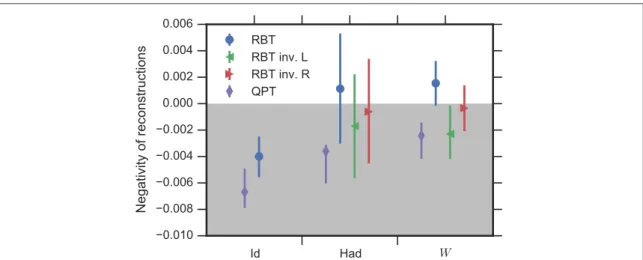
In order to demonstrate the reduced systematic errors in RBT compared to QPT, we tested the reconstructed process for characteristics such as negative eigenvalues—which, loosely speaking, correspond to negative probabilities, and are therefore non-physical. This technique has been used elsewhere to test for systematic errors in the analysis of tomographic data for quantum states[42], but it applies equally well in the quantum process setting, thanks to the Choi–Jamiolkoski isomorphism [43,44]. This isomorphism makes a one-to-one correspondence between a linear quantum process and the statesJ( ) resulting from applying to half of a fixed maximally entangled state. is considered to be physical if and only if it maps physical states to physical states even when acting on only part of a state—a condition known as complete positivity (CP) [43,44]. This condition is equivalent to requiring thatJ( ) be positive(i.e., that it has only positive eigenvalues). While RBT is only able to reconstruct the unital part of,positivity of a single qubit operation is equivalent to positivity of the unital part of that same operation[18], and so these tests can be applied to the reconstructed unital operation¢. Following[42], we test¢for non-physicality by adaptively estimating the most-negative component of the process and cross-validating it. For each configuration of both RBT and QPT experiments, we divide the measurements into two halves. Thefirst half is used to reconstruct the unital part of the operation, which we denote¢.1We compute the eigenvector ofJ( )¢1 corresponding to its most negative eigenvalue—this is what we call the negativity witness. The second half is used to obtain an independent estimate of the operation, which we call ¢ ,2 to estimate the expectation value of the negativity witness underJ(¢2).Since the parameters of¢iare
estimated by NLLS instead of projective measurements onJ( )¢i ,we cannot easily use the Hoeffding bounds in [42]. Instead, we compute confidence regions using non-parametric bootstrap percentiles, re-sampling only the second half of the samples while holding the negativity witnessfixed.
Asfigure6illustrates, the QPT reconstructions have strongly negative eigenvalues even when statistical fluctuations are taken into account—the 95% confidence intervals are well below zero. With the exception of the identity, all RBT reconstructions are consistent with CP operations—even when the non-physical estimates of the identity are used to separate the error of the randomizing operations from the errors in the gate itself.
The likely culprit for the observed negativity of the RBT estimates is bias in the NLLS estimation of the decay constants. In order to test this, we ran numerical experiments with depolarizing noise leading tofidelities of similar magnitude to what we observed in the experiment, as well as single-shot measurements with probability of error comparable to our experiments. Running our estimation procedure on this artificial data, we also found negativity for the identity reconstruction, with similar negativity to the experiment.
It is possible to obtain physical QPT estimates from unconstrained linear inversion by not compensating for measurement imperfections. This leads to reconstructions without any measurable negativity, at the cost of fidelity estimates that are in the neighborhood of 95%. However, this is completely inconsistent with fidelity estimates from RB, so they remain implausible. In other words, QPT estimates that are consistent with RB have statistically significant unphysical properties. By the same token, QPT estimates that are physical are
inconsistent withfidelities obtained from RB. RBT estimates, on the other hand, are consistent with physical evolution as well as our best estimates offidelity for the same gates.
9
5. Summary
We have empirically demonstrated the feasibility of RBT reconstructions of arbitrary single-qubit unitaries. These reconstructions show significant advantages over standard tomographic reconstruction of quantum operations. Namely,fidelity estimates of the RBT reconstruction are consistent with fidelity estimates obtained through robust methods, while the reconstructed operation is statistically consistent with a physical operation even though such a constraint was not imposed in our reconstruction. We also demonstrated that standard tomographical reconstructions do not satisfy these requirements simultaneously without significant modifications (e.g., using gate-set tomography). However, RBT imposes large costs in terms of experimental runtime and additional analysis complexity. Extending this work to two-qubit process tomography would require either daunting experiment counts for exhaustive sampling, accepting sampling variance in the decay curves, or a modified protocol that yields slow decays that are more ammenable to fitting procedures.
Ultimately, however, it remains unclear how to use information obtained from any of the known tomographical protocols forfine-grained debugging of quantum devices. Continued work is necessary to find other robust protocols that answer targeted questions about quantum operations, such as the recent work on robust phase estimation for pulse calibration[41].
Acknowledgments
The data analysis was performed using code written in Julia[45], including the NLopt library [46], and the figures were made with Seaborn [47] and matplotlib [48]. The authors would like to thank George A Keefe and Mary B Rothwell for device fabrication, and Diego Risté for comments on the manuscript. This research was funded by the Office of the Director of National Intelligence (ODNI), Intelligence Advanced Research Projects Activity(IARPA), through the Army Research Office contract No. W911NF-10-1-0324. All statements of fact, opinion or conclusions contained herein are those of the authors and should not be construed as representing the official views or policies of IARPA, the ODNI, or the US Government.
Appendix. Least-squares reconstruction of the unital part
¢
For any given trace preserving quantum operation,the unital part¢is linearly related toa , as described in the main body of the paper, by the equation
= † ( )
aj tr j . A1
Since the Clifford group operations jare unital and trace preserving, without loss of generality, this expression
can be replaced by
= † ¢ ( )
aj tr j . A2
Figure 6. Expectation value of the negativity witness for reconstructed operations using RBT and QPT. The error bars correspond to 95% bootstrapped confidence intervals using 2000 replications of the 50 samples for each experimental configuration used in estimating the expectation value of the negativity witness.
The explicit reconstruction of¢fromacan be obtained by noting that(A2) implies = ¢ · ( ) ( ) a P vec A3
wherevec( )¢ is the vectorization of¢and P is the predictor matrix defined as ⎡ ⎣ ⎢ ⎢ ⎢ ⎢ ⎢ ⎤ ⎦ ⎥ ⎥ ⎥ ⎥ ⎥ * * = Ä Ä
(
)
(
)
ˆ ˆ ˆ ˆ ( ) † † P C C C C vec vec . A4 1 1 2 2With these definitions, we have ¢ =P a ,I where PIis the Moore–Penrose pseudo-inverse of P (strict inversion
is not possible as P is rank deficient, thanks to Clifford operations spanning only a ten-dimensions space, instead of the 12-dimension space of general trace preserving operations, or the 16-dimensional space of general operations). In the presence of homoscedastic statistical fluctuations, the use of PI
corresponds to a least-squares estimate with minimum Euclidean norm, although solving(A3) through other equivalent means is preferable to pseudo-inversion, for reasons of numerical stability(the backslash operator in MATLAB and Julia [45], as well as specialized functions in other software packages, provide this functionality).
References
[1] Terhal B M 2000 Phys. Lett. A271 319
[2] Emerson J, Silva M, Moussa O, Ryan C, Laforest M, Baugh J, Cory D G and Laflamme R 2007 Science317 1893
[3] Dankert C, Cleve R, Emerson J and Livine E 2009 Phys. Rev. A80 012304
[4] Gühne O and Tóth G 2009 Phys. Rep.474 1
[5] Bendersky A, Pastawski F and Paz J P 2009 Phys. Rev. A80 032116
[6] Cramer M, Plenio M B, Flammia S T, Somma R, Gross D, Bartlett S D, Landon-Cardinal O, Poulin D and Liu Y-K 2010 Nat. Commun.
1 149
[7] da Silva M P, Landon-Cardinal O and Poulin D 2011 Phys. Rev. Lett.107 210404
[8] Magesan E, Gambetta J M and Emerson J 2011 Phys. Rev. Lett.106 180504
[9] Magesan E, Gambetta J M and Emerson J 2012 Phys. Rev. A85 042311
[10] Moussa O, da Silva M P, Ryan C A and Laflamme R 2012 Phys. Rev. Lett.109 070504
[11] Magesan E et al 2012 Phys. Rev. Lett.109 080505
[12] Gaebler J P et al 2012 Phys. Rev. Lett.108 260503
[13] Flammia S T, Gross D, Liu Y-K and Eisert J 2012 New J. Phys.14 095022
[14] Wallman J J and Flammia S T 2014 New J. Phys.16 103032
[15] Wallman J, Granade C, Harper R and Flammia S T 2015 Estimating the coherence of noise (arXiv:1503.07865)
[16] Granade C, Ferrie C and Cory D G 2015 New J. Phys.17 1
[17] Merkel S T, Gambetta J M, Smolin J A, Poletto S, Córcoles A D, Johnson B R, Ryan C A and Steffen M 2013 Phys. Rev. A87 062119
[18] Kimmel S, da Silva M P, Ryan C A, Johnson B R and Ohki T 2014 Phys. Rev. X4 011050
[19] Blume-Kohout R, Gamble J K, Nielsen E, Mizrahi J, Sterk J D and Maunz P 2013 Robust, self-consistent, closed-form tomography of quantum logic gates on a trapped ion qubit(arXiv:1310.4492)
[20] Stark C 2014 Phys. Rev. A89 052109
[21] Blume-Kohout R 2010 New J. Phys.12 043034
[22] Scott A J 2008 J. Phys. A41 055308
[23] van Dam W and Howard M 2011 Phys. Rev. A84 012117
[24] Bennett C H, DiVincenzo D P, Smolin J A and Wootters W K 1996 Phys. Rev. A54 3824
[25] DiVincenzo D P, Leung D and Terhal B 2002 IEEE Trans. Inf. Theory48 580
[26] Knill E, Leibfried D, Reichle R, Britton J, Blakestad R B, Jost J D, Langer C, Ozeri R, Seidelin S and Wineland D J 2008 Phys. Rev. A77 012307
[27] Horodecki M, Horodecki P and Horodecki R 1999 Phys. Rev. A60 1888
[28] Nielsen M A 2002 Phys. Lett. A303 249
[29] Chow J M et al 2012 Phys. Rev. Lett.109 060501
[30] Hatridge M, Vijay R, Slichter D H, Clarke J and Siddiqi I 2011 Phys. Rev. B83 134501
[31] Ryan C A, Johnson B R, Gambetta J M, Chow J M, da Silva M P, Dial O E and Ohki T A 2015 Phys. Rev. A91 022118
[32] Nielsen M A and Chuang I L 2011 Quantum Computation and Quantum Information: 10th Anniversary 10th edn (New York: Cambridge University Press)
[33] Patt S L 1992 J. Magn. Reson. 96 92 [34] Suzuki M 1993 Phys. Lett. A180 232
[35] Gambetta J M, Motzoi F, Merkel S T and Wilhelm F K 2011 Phys. Rev. A83 012308
[36] de Prony G C F M R 1795 J. l’École Polytech. 1 24 [37] Peter T and Plonka G 2013 Inverse Problems29 025001
[38] Efron B and Tibshirani R 1994 An Introduction to the Bootstrap (Chapman and Hall/CRC Monographs on Statistics and Applied Probability) (London: Taylor and Francis)
[39] Hinton G E 1986 Proc. 8th Annual Conf. of the Cognitive Science Society (Amherst, MA) ed R Morris (Oxford: Oxford University Press) [40] Dobrovitski V V, de Lange G, Ristè D and Hanson R 2010 Phys. Rev. Lett.105 077601
[41] Kimmel S, Low G H and Yoder T J 2015 Robust single-qubit process calibration via robust phase estimation (arXiv:1502.02677)
[42] Moroder T, Kleinmann M, Schindler P, Monz T, Gühne O and Blatt R 2013 Phys. Rev. Lett.110 180401
[43] Jamiołkowski A 1972 Rep. Math. Phys.3 275
[44] Choi M-D 1975 Linear Algebr. Appl.10 285
11
[45] Bezanson J, Edelman A, Karpinski S and Shah V B 2014 Julia: A Fresh Approach to Numerical Computing (arXiv:1411.1607)
[46] Johnson S G 2015 The NLopt nonlinear-optimization package (http://ab-initio.mit.edu/nlopt)
[47] Waskom M et al 2014 seaborn: v0.5.0 (November 2014) (doi:10.5281/zenodo.12710)
[48] Hunter J D 2007 Comput. Sci. Eng.9 90
![Figure 2. Simulated average gate fi delity [ 28 ] for the implementation of a Hadamard gate with a Gaussian pulse shape extending to s](https://thumb-eu.123doks.com/thumbv2/123doknet/14675121.557778/7.892.183.822.86.757/figure-simulated-average-delity-implementation-hadamard-gaussian-extending.webp)
![Figure 4. Hinton diagrams [ 39 ] for the Liouville representations of the ideal operation ( left ) and reconstructed unital part of the operation ¢ ( right ) for the identity operation, Hadamard operation, and Wˆ = e - p + + .](https://thumb-eu.123doks.com/thumbv2/123doknet/14675121.557778/10.892.184.825.86.656/liouville-representations-operation-reconstructed-operation-operation-hadamard-operation.webp)