
HAL Id: hal-02997297
https://hal.archives-ouvertes.fr/hal-02997297
Submitted on 10 Nov 2020HAL is a multi-disciplinary open access archive for the deposit and dissemination of sci-entific research documents, whether they are pub-lished or not. The documents may come from teaching and research institutions in France or abroad, or from public or private research centers.
L’archive ouverte pluridisciplinaire HAL, est destinée au dépôt et à la diffusion de documents scientifiques de niveau recherche, publiés ou non, émanant des établissements d’enseignement et de recherche français ou étrangers, des laboratoires publics ou privés.
Moira Dillon, Veronique Izard, Elizabeth Spelke
To cite this version:
Moira Dillon, Veronique Izard, Elizabeth Spelke. Infants’ sensitivity to shape changes in 2D visual forms. Infancy, Wiley, 2020, 25 (5), pp.618-639. �10.1111/infa.12343�. �hal-02997297�
Citation Dillon, M. R., Izard, V., & Spelke, E. (2020). Infants’ sensitivity to shape changes in 2D visual forms. Infancy. doi.org/10.1111/infa.12343
Title Infants’ sensitivity to shape changes in 2D visual forms
Authors Moira R. Dillona,b,c1, VéroniqueIzardd, Elizabeth S. Spelkea,b
Affiliations aDepartment of Psychology, Harvard University, Cambridge, MA, USA
bCenter for Brains, Minds, and Machines, McGovern Institute for Brain Research, Massachusetts
Institute of Technology, Cambridge, USA
cDepartment of Psychology, New York University, New York, NY, USA
dIntegrative Neuroscience and Cognition Center, CNRS, Université de Paris, Paris, France
1To whom correspondence should be addressed:
Moira R. Dillon
Department of Psychology, New York University 6 Washington Place
New York, NY 10003 USA Phone: 212-998-3693
Email: [email protected]
Abstract
Research in developmental cognitive science reveals that human infants perceive shape changes in 2D visual forms that are repeatedly presented over long durations. Nevertheless, infants’ sensitivity to shape under the brief conditions of natural viewing has been little studied. Three experiments tested for this sensitivity by presenting 128 seven-month-old infants with shapes for the briefer durations under which they might see them in dynamic scenes. The experiments probed infants’ sensitivity to two fundamental geometric properties of scale- and orientation-invariant shape: relative length and angle. Infants detected shape changes in closed figures, which presented changes in both geometric properties. Infants also detected shape changes in open figures differing in angle when figures were presented at limited orientations. In contrast, when open figures were presented at unlimited orientations, infants detected changes in relative length but not in angle. The present research therefore suggests that, as infants look around at the cluttered and changing visual world, relative length is the primary geometric property by which they perceive scale- and orientation-invariant shape.
Sensitivity to shape information arises early in human development and is critical to recognizing and categorizing objects (e.g., Quinn & Eimas, 1997; Quinn, Slater, Brown, & Hayes, 2001; Smith, 2009). Nevertheless, the specific geometric properties that human infants detect are not clear because distinct properties are correlated in connected figures (Figure 1). In triangles, for example, sides of given relative lengths dictate specific corner angles (Figure
1A-B). In polygons, changes in angle co-occur with changes in the orientations of sides (compare the
red and yellow lines in Figure 1A), unless the figure itself is rotated (Figure 1C). As angle size changes in figures presenting two constant side lengths, the subtended area of the figures varies concomitantly (Figure 1D). Thus, infants might discriminate between two forms by detecting a number of different geometric properties.
Figure 1. A. The smaller triangle with red, blue, and black sides sits inside the larger triangle
with yellow, blue, and black sides. B. When the black side of the smaller triangle is extended to make the larger triangle, then the opposite angle size gets larger as well. C. Only when figures are presented at different orientations are individual line orientations dissociated from angle sizes. D. The area of a triangle changes as one angle varies if the adjacent side lengths are held constant.
Rich bodies of prior research have shown that human infants are sensitive to variations in the shapes of objects and visual forms, in particular for shapes that vary in angle. Early studies showed that after several habituation trials in which a static figure appeared at a single
and open 2D figures, but infants below six weeks dishabituated only to changes in the figures’ orientations (Cohen & Younger, 1984; Schwartz & Day, 1979, Slater, Mattock, Brown, & Bremner, 1991). Using the same looking time paradigm but varying the orientations of the figures presented during habituation, Slater et al. (1991) found, in contrast, that newborn infants could dishabituate to changes in shape. Thus, from birth on infants are sensitive to some
invariant shape properties of visual forms when static forms are presented over extended periods. What invariant shape properties do infants detect? As illustrated above, the geometric properties of static figures are deeply intertwined. Most of the studies cited above, as well others (e.g., Lourenco & Huttenlocher, 2008; Lindskog, Rogell, Kenward, & Gredebäck, 2019)
presented infants with figures at a constant size, where variations in angle were confounded with many other geometric properties. In an attempt to address this confound, Slater et al. (1991) tested newborns in a second experiment that controlled for the spatial extent of open figures. In this experiment, however, the implied overall area of the angles (i.e., the area resulting from connecting the two open endpoints) differed by a ratio of almost 3.5:1, a difference well above the detection threshold for young infants’ discrimination of figures differing in size (Brannon, Lutz, & Cordes, 2006; de Hevia, Izard, Coubart, Spelke, & Streri, 2014). Thus, when infants discriminate between open figures, their discrimination could depend on angle, on the spatial extent of the figures, on their implied area, or on all of these properties.
Prior studies of infant shape discrimination have also used long presentation times, displaying each shape for durations ranging from about 4 s (Lourenco & Huttenlocher, 2008) to 25 s (Slater et al., 1991). Such presentation times far exceed the time that infants require to perceive changes in object color (Ross-Sheehy, Oakes, & Luck, 2003), number (Libertus & Brannon, 2010), or sense (Laurer, Udelson, Jeon, & Lourenco, 2015). They also exceed infants’
fixation times under natural viewing conditions, as revealed by studies using head-mounted eye-trackers. For example, 11-to-13-month-old infants engaged in natural play with a caregiver and with multiple objects spent on average about 2 s fixating on a single object. Moreover, most of their individual fixations were even shorter, with a mode fixation duration of about 0.25 s (Yu & Smith, 2016). Studies investigating the development of sustained attention from 1 to 5 years of age suggest that bouts of focused attention to a single object, defined as visual fixations to it lasting longer than 3 s, occur only about 13% of the time in 12-month-old infants observed within a 2-minute window (Ruff & Lawson, 1990).
Importantly, infants, like older children and adults, display different discrimination abilities when presentation time varies. For example, five-month-old infants discriminate two dot arrays that differ in number by a ratio of 2 when habituated to 2 s presentations of such arrays, but they react only to a ratio difference of 4 when given 1.5 s presentations (Wood & Spelke, 2005). For shape discrimination in particular, some geometric properties detectable over long presentation times may fail to be detected over short presentation times. Indeed, if two geometric properties normally occur together, one may be detected faster than the other. In that case, perception of the property that is detected faster may dominate shape perception in a variety of contexts. Studies using short presentation times, i.e., those presenting 2D forms for 2-3 s or less, may thus better probe abilities that arise during infants’ natural exploration than do extended presentation times with only a single, unchanging 2D form.
In the present study, we investigate infants’ sensitivity to two key geometric properties of scale- and orientation-invariant shape perception: relative length and angle. Because angle and relative length are inextricably correlated in any single geometric form, the findings on infant shape discrimination reviewed above raise the possibility that infants perceive shapes by
analyzing one of these properties to the exclusion of the other. To investigate that possibility, we present seven-month-old infants with a dynamic succession of figures, open or closed, that change in relative length and angle together (Experiment 1), relative length only (Experiment 2), and angle only (Experiment 3). We also vary the degree of orientation change, sense variation, and area variation. By measuring infants’ looking preferences to two streams of simultaneously presented figures, one of which changes in shape, while both of which change in size, sense, and orientation, we test infants’ sensitivity to two fundamental invariant properties of Euclidean plane geometry. Moreover, we compare the detection of relative length changes and angle changes to evaluate whether one of these types of information is detected more readily in briefly presented displays. Thus, we ask whether early shape detection, tested under conditions requiring rapid processing of scale-, orientation-, and sense-invariant shape, depends on sensitivity to relative length, angle, or both.
General Methods
Although the experiments were conducted before the laboratory began to preregister experiments on a public website, their methods, procedures, sample sizes, exclusion criteria, and analyses all were fixed before the onset of data collection, except where noted. The experiments follow the change-detection paradigm of Ross-Sheehy et al. (2003; see also Lauer et al., 2015; Libertus & Brannon, 2010). We presented two simultaneous streams of figures each within a bounding rectangle on the two sides of a large video projection screen (1.07m x 1.37m). In all experiments, one stream presented a 2D context figure, which alternated with a figure differing in shape and area. The other stream presented that same context figure, but here that figure alternated with another 2D figure of the same shape, differing from the context figure in area alone. Area changed between the alternating figures in both streams by a factor of 2 or more
(within the detection threshold of infants at this age, Brannon et al., 2006). Thus, the only difference between the streams was that this area change occurred as a result of a shape change in one stream, but it occurred as a result of a shape-preserving scale change in the other stream.
Figures alternated continuously and concurrently in four 60 s trials. The shape-change stream appeared twice on each side of the screen, switching its location between trials. Its starting location was counterbalanced across infants. Each figure appeared for 0.5 s, followed by a 0.3 s blank screen. At each presentation, small variations in position and size were added to each figure. Specifically, the location of the figure varied randomly within a 20 px radius of the center of the bounding rectangle, and the figure was scaled randomly by +/- 0-15%. In addition, at each presentation, the figures varied randomly in their orientation between +/- 30° in some studies and 0°-359°, with additional random sense variation, in other studies. Infants’ attention was drawn to the center of the screen (equidistant from the two bounding rectangles) before each trial by a large pink dot accompanied by the noise of a rattle used for calibration and by the experimenter calling their name. Sample videos of the stimuli for each experiment are provided in the SM.
Infants were recruited by mail and by posted flyers near a university in the Northeast region of the United States; most participating families were Caucasian and middle to upper-middle class. Families received a small toy and a $5 travel reimbursement for their participation. For the study, infants sat on their parents’ laps on a chair 1.70 m away from the screen. Parents were instructed to keep their eyes closed during the image presentation so as not to influence the infants’ looking, but they could open their eyes during the short breaks between each trial while infants’ looking direction was recalibrated. Infants were excluded from the analyses if the experimenter presented the displays incorrectly, if the data were lost due to equipment failure, or
if parents opened their eyes during the stimulus presentation. Infants also were excluded if they did not complete the experiment, if they failed to look at the screen for at least 2 s during each trial of stimulus presentation, if they did not meet a minimum total looking time criterion of more than two standard deviations below the mean total looking time across experiments, or if they showed a preference of more than two standard deviations above or below the mean preference for that experiment1. These exclusion criteria are similar to those of other studies
using a change-detection paradigm (e.g., Libertus & Brannon, 2010). The present study was conducted according to guidelines laid down in the Declaration of Helsinki, with written informed consent obtained from a parent or guardian of each infant before any assessment or data collection. The use of human participants was approved by the Committee on the Use of Human Subjects at Harvard University.
Sample sizes for each condition of each experiment were set at 16 infants, based on Libertus & Brannon (2010) and on initial piloting prior to Experiment 1. We measured infants’ looking at the stream presenting changes in shape and area, compared to the stream presenting changes in area alone. Infants’ looking time to each side of the screen was coded offline in real time from digital video recordings by a researcher unaware of the side on which each change was presented. The total looking of four random infants in each study (25%) was recoded offline in real time from digital video recordings by a second researcher, also unaware of the side on which each image change was presented. Our planned analyses, after Lauer et al. (2015), evaluated, for each infant, the proportion of looking to the shape-and-area change stream relative to their total looking to both streams across all four trials. Proportions greater than 0.50 indicated a preference
1 This criterion helps to keep the distribution of preference scores close to normal, and it is well suited to the planned
parametric analyses. This criterion could, however, introduce biases in non-parametric analyses counting the number of infants displaying a preference for one or the other stream, depending on the value of the mean preference score. For this reason, we did not conduct non-parametric analyses.
for the shape-and-area change stream compared to the area-only change stream. Infants’ preference scores for the shape-and-area change stream were compared to 0.50 using a one-sample, two-tailed t-test. We compared preferences across studies and experiments using independent-samples, two-tailed t-tests.
In addition to these planned analyses, we included an unplanned Bayes Factor analysis in light of the null findings of Experiment 3. Here, the Bayesian framework offers further
information compared to traditional significance testing about whether infants’ preferences were indeed equivalent between the two streams of shapes. We also conducted exploratory analyses using Bayesian mixed-model regressions (Buerkner, 2017) on raw looking times, including type of change (shape-and-area change stream or area-only change stream), trial (1-4), size variation of the area-only change stream (whether the shape changing in area was larger or smaller than the context shape presented in both streams), and gender (male or female). While the planned parametric analyses in the null-hypothesis framework lacked the power to test the impact of all these variables, the analyses in the Bayesian framework allowed us to evaluate a model that included all of the variables in our experiment. These analyses thus have the potential to inform future studies focused on testing the effects of any of these variables specifically. Partial
reporting of the Bayesian analyses appears in the main text; full reporting is included in the SM. Finally, each of the three experiments consists of multiple conditions, but the conditions were conducted sequentially, with each condition following from the findings of its predecessor. For this reason, the primary analyses focus on performance in each experimental condition, and the different conditions of each experiment are described sequentially.
Experiments 1A and 1B aimed to establish whether infants detect shape changes in rapidly changing, briefly presented displays of closed 2D triangles. In Experiment 1A, triangles varied in position, area, and orientation by +/- 0-30°. Experiment 1B replicated and extended Experiment 1A by presenting the same triangles but with maximal variation in orientation (0°-359°) and sense.
Experiment 1A.
Methods.
Sixteen healthy full-term 7-month-old infants (8 females; mean age = 6 months, 28 days; range = 6 months, 19 days to 7 months, 11 days) participated in this experiment. No infants were excluded. In the shape-and-area-change stream, a context triangle alternated with another
triangle that had a different shape and size, with a 2-fold difference in its area. In the area-only change stream, the context triangle alternated with another triangle of the same shape, but at a different size, also with a 2-fold difference in area. Across infants, four triangles were used: two similar 45°-60°-75° triangles (a larger version, with an area of 0.37 and a smaller version, with an area of 0.18) and two similar 15°-45°-120° triangles (a larger version, with an area of 0.37 and a smaller version, with an area of 0.18; Figure 2; see SM for videos of the displays). Half of the infants saw the larger 45°-60°-75° triangle as the context, the smaller 15°-45°-120° as the shape-and-area change, and the smaller 45°-60°-75° triangle as the area-only change. The remaining infants saw the smaller 15°-45°-120° triangle as the context, the larger 45°-60°-75° triangle as the shape-and-area change, and the larger 15°-45°-120° triangle as the area-only change. The reliability of the two looking-time coders of was high (r = .99).
Figure 2. A. Context figures, shape-and-area change figures, and area-only change figures for
Experiments 1A and 1B. The figures bounded by red boxes are different shapes and different sizes, and they were presented in alternation on one side of the screen. On the other side of the screen, a size change but no shape change was presented. Half of the infants saw the left figure in the red box alternate with the larger version of itself depicted directly below it, and half of the infants saw the right figure in the red box alternate with the smaller version of itself, depicted directly below it. The length, angle, and area measurements are provided for each figure. B. Progression of displays in Experiment 1A. On one side of the screen, infants saw a triangle changing in shape and in area by a factor of 2, and on the other side of the screen infants saw a triangle changing in area only (also by a factor of 2). At each presentation, the figures varied randomly in position, size, and orientation (+/- 0°-30°). The type of change switched sides between trails, and the starting location of the shape-and-area change side was counterbalanced across infants.
Results.
Infants looked proportionally longer at the shape-and-area change stream over the area-change stream (t(15) = 2.86, p = .012, Cohen’s d = 0.71; Figure 3). They looked on average 13.34 s to the shape-change stream (SEM = 0.80 s) and 11.03 s to the area change stream (SEM = 0.70 s) per trial. The Bayesian analysis estimated a difference of 2.37 s between the conditions (CrI = -0.54 s – 5.18 s) and suggested that infants’ looking time decreased across trials (-1.94, CrI = -3.26 s – -0.64 s). The Bayesian analysis also suggested no looking time differences based on the direction of the size change in the area-change stream or on gender (see SM).
Figure 3. Proportion of looking to shape changes in Experiments 1A and 1B. Infants detected
shape changes in connected triangles over limited (Experiment 1A) and unlimited variations in orientation and sense (Experiment 1B). The gray line at 0.5 indicates equal looking. * p < .05, two-tailed.
Discussion.
Experiment 1A provided evidence that infants detected the changes in the stream presenting triangles of two distinct shapes, despite the use of brief simultaneous presentations. Because the triangles appeared at a restricted range of orientations and with no variation in sense, however, infants’ longer looking could reflect their sensitivity to the orientations of the triangles’ individual sides, or to their sense properties, rather than to their differing orientation-invariant shapes. Experiments using the present method provide evidence for infants’ sensitivity to sense relations (Lauer et al., 2015), so Experiment 1B therefore investigated whether infants would
detect shape changes if the same two triangles appeared in displays presenting the full range of possible orientations as well as left-right directional flips.
Experiment 1B.
Methods.
Sixteen different infants (8 females; mean age = 7 months, 0 days; range = 6 months, 15 days to 7 months, 15 days) participated in the experiment, and none were excluded. Infants were presented with the same displays, design, and procedure as Experiment 1A with two changes: The figures appeared with equal probability at any orientation from 0°-359°, and the figures could be mirror-reflected (both parameters were determined randomly for each presentation; see
SM for videos of the displays). Inter-coder reliability of looking time was high (r = .99).
Results.
As in Experiment 1A, infants in Experiment 1B looked longer at the image stream in which the triangles changed shape (t(15) = 2.63, p = .019, Cohen’s d = 0.66; Figure 3). They looked on average 13.04 s to the shape-change stream (SEM = 0.84 s) and 11.24 s to the area change stream (SEM = 1.05 s) per trial. The Bayesian analysis estimated a difference of 1.77 s between the conditions (CrI = -1.16 s – 4.80 s) and suggested that infants’ looking time decreased across trials (-1.28, CrI = -2.66 s – 0.09 s). The Bayesian analysis also suggested no looking time differences based on the direction of the size change in the area-change stream or on gender (see SM for full analyses). An independent-samples t-test (two-tailed) revealed no difference between infants’ shape preference across Experiments 1A and 1B (t(30) = -0.08, p = .939, Cohen’s d = 0.03).
Experiment 1 provides evidence that a change-detection paradigm based on preferential looking can reveal infants’ sensitivity to changes in the shape properties of 2D visual forms, just as it can reveal infants’ sensitivity to changes in color (Ross-Sheehy et al., 2003), number (Libertus & Brannon, 2010), and sense (Lauer et al., 2015). Infants detected the shape changes given presentations of each figure that were much shorter than in any prior shape detection study: 0.8 s from the onset of one figure presentation until the next. Moreover, infants looked longer at shape changes over both limited and unlimited changes to a figure’s orientation and position as well as detectable changes to its size (Brannon et al., 2006). Indeed, infants’
preference for shape changes was not affected by the additional variation in orientation and sense presented in Experiment 1B compared to Experiment 1A.
Nevertheless, the findings of Experiment 1 do not specify the basic shape properties that infants detect in these rapidly changing arrays. In planar polygons, such as the triangles in Experiment 1, relative side lengths and corner angle sizes are related, as expressed for example, by the Side-Side-Side theorem of congruent triangles2. Moreover, the two triangular shapes
differed in aspect ratio. Because the present investigation aims to evaluate the specific geometric properties underlying early shape detection, the next two experiments use 2-sided, open figures that instantiate either relative length or angle changes. If infants’ shape detection depends only on the relative length and angle information carried by the two visible sides of these figures, not on the implied relative length or angle information of the missing side, then these open figures should decouple the properties of relative length and angle. We therefore ask whether infants detect one or both of these geometric properties when they are tested with open displays, following the method of Experiment 1.
2 “If two triangles have two sides equal to two sides, respectively, and also have the base equal to the base, then they
Experiment 2
Experiments 2A and 2B were conducted sequentially and assessed infants’ sensitivity to relative length changes by measuring their preferential looking to open figures that rapidly changed in relative length and area compared to open figures that changed in area alone. Experiment 2A presented obtuse angles in which the relative lengths of the constituent parts of those angles varied by a factor of 2. Experiment 2B replicated and extended Experiment 2A by presenting acute angles and by controlling for the amount of total line length appearing in each stream of figures. The displays and methods were otherwise identical to those of Experiment 1B.
Experiment 2A.
Methods.
Sixteen infants (8 females; mean age = 7 months, 1 day; range = 6 months, 20 days to 7 months, 15 days) participated in the experiment. Four additional infants were presented with the displays but were excluded because of parental interference (1), failure to complete all four trials of the experiment (1), or failure to meet the minimum looking-time criterion (2).
Each figure in the two streams was composed of two lines joined at one end to form a 106.77° 2-sided open figure. On one side of the screen, an open figure with one side length of 1 unit and another side length of 1.5 units alternated with a figure with one side length of 1 unit and another side length of 3 units. This figure stream thus presented a 2-fold change in relative length. This figure stream also presented a 2-fold change in implied area, which was evaluated by connecting the two endpoints of the open figure and calculating the area of the resulting triangle. We chose to evaluate area in this way because it reflected how area changes were implemented for the closed figures of Experiment 1. This area manipulation therefore allowed us to test for sensitivity to relative length independently of the implied area of the figure, in case
infants perceptually completed the open figures prior to comparing them. On the other side of the screen, one of the figures (counterbalanced across infants) was presented with a 2-fold increase or decrease in area: For half of the infants, the 1 x 1.5 figure alternated with figure of the same proportions but at a larger size; for the remaining infants, the 1 x 3 figure alternated with a figure of the same proportions but at a smaller size. Thus, the 2-fold change in area was constant across the two figure streams (Figure 4A; see SM for videos of the displays). Inter-coder reliability of looking time was high (r = .97).
Figure 4. A. Context figures, relative length-and-area change figures, and area-only change
figures for Experiments 2A and B. 2B. The figures bounded by red boxes have different relative lengths and different areas, and they were presented in alternation on one side of the screen. On the other side of the screen, an area change but no relative length change was presented. Half of the infants saw the left figure in each red box alternate with the larger version of itself depicted directly below it, and half of the infants saw the right figure in each red box alternate with the smaller version of itself, depicted directly below it. The length, angle, and area measurements are provided for each figure and are normalized for each condition.
Infants looked longer at the relative length-change stream (t(15) = 2.74, p = .015, Cohen’s d = 0.68; Figure 5). They looked on average 11.22 s to the relative length-change stream (SEM = 0.85 s) and 8.70 s to the area-change stream (SEM = 0.67 s) per trial. The
Bayesian analysis estimated a difference of 2.51 s between the conditions (CrI = 0.28 s – 4.75 s) and suggested that infants’ looking time decreased across trials (-1.91, CrI = -2.87 s – -0.90 s). The Bayesian analysis also suggested no looking time differences based on the direction of the size change in the area-change stream or on gender (see SM for full analyses).
Figure 5. Proportion of looking to relative length changes in Experiments 2A and 2B. Infants
detected relative length changes in open obtuse (Experiment 2A) and acute (Experiment 2B) figures over unlimited variations in orientation and sense. The gray line at 0.5 indicates equal looking. * p < .05, ** p < .01, two-tailed.
In Experiment 2A, infants looked longer at the alternating stream in which the sides of the two open figures differed in relative length. In addition to differing in relative length,
however, these figures also differed in the total length of lines that formed them (i.e., the sum of the two line-lengths forming the figures), and the total length change was greater in the relative length-and-area-change stream compared to the area-change stream. This difference raised the possibility that infants responded to differences in the total length changes in the displays rather than to differences in relative length. Experiment 2B addressed this possibility by matching the total length change across the relative length-and-area-change stream and area-change stream. It also presented acute rather than obtuse angles, since prior studies have revealed sensitivity to shape changes using both types of figures (e.g., Cohen & Younger, 1984; Schwartz & Day, 1979; Slater et al., 1991).
Experiment 2B.
Methods.
Sixteen different infants (8 females; 8 females; mean age = 7 months, 0 days; range = 6 months, 17 days to 7 months, 14 days) participated in this experiment. Three additional infants were presented with the displays but were excluded because of failure to meet the minimum looking-time criterion (1), having a preference score of more than two standard deviations above or below the mean for this condition (1), or equipment failure (1). Infants were presented with relative length changes in acute angles while equating the total length changes across the two figure streams. Each figure was composed of two lines joined at one end to form 53.39° open figures (half the angle measure of Experiment 2A). On one side of the screen, an open figure with one side length of 1 unit and another side length of 1.5 units alternated with an open figure with one side length of 1 unit and another side length of 3 units. This figure stream thus
presented a 2-fold change in relative length and a 2-fold change in implied area. It also presented a total length change of 1.5 units. On the other side of the screen, one of these figures
(counterbalanced across infants) was presented with an increase or decrease in total but not relative length to match the total length change in the relative length-and-area change stream. Specifically, the 1 x 1.5 figure alternated with a larger version of itself with sides of lengths 1.60 x 2.40 units (resulting in a total length increase of 1.5 units across both lines) and the 1 x 3 figure alternated with a smaller version of itself with sides of lengths 0.63 x 1.88 (resulting in a total length decrease of 1.5 units across both lines). These area-only change streams thus both presented a total length change of 1.5 units, just like the shape-and-area change stream.
However, they presented an even larger change in implied area compared to the relative length-and-area change stream (2.57-fold in the case of the 1 x 1.5 figure and 2.50-fold in the case of the 1 x 3 figure; Figure 4B; see SM for videos of the displays). Inter-coder reliability of looking time was high (r = .96).
Results.
As in Experiment 2A, infants looked longer at the relative length-change stream (t(15) = 3.93, p = .001, Cohen’s d = 0.98; Figure 5). They looked on average 10.34 s to the relative length-change stream (SEM = 0.87 s) and 7.98 s to the area change stream (SEM = 0.74 s) per trial. The Bayesian analysis estimated a difference of 2.36 s between the conditions (CrI = 0.19 s – 4.61 s) and suggested that infants’ looking time decreased across trials (1.64, CrI = 2.58 s – -0.69 s). The Bayesian analysis also suggested no looking time differences based on the direction of the size change in the area-change stream or on gender (see SM for full analyses). An
relative length changes presented in Experiments 2A and 2B (t(30) = 0.10, p = .919, Cohen’s d = 0.04).
Discussion.
The studies of Experiment 2 suggest that infants are sensitive to relative length changes in 2D visual forms presented with rapid variation in the shapes’ size, position, orientation, and sense. Together, Experiments 2A and 2B provide evidence that this sensitivity is present when infants are shown open 2D figures of either obtuse or acute angles. Experiment 2B provides further evidence that this sensitivity is robust to changes in the total lengths of the figures that are instantiating the relative length changes, suggesting that total length changes do not drive
infants’ responses to alternating figures with different relative lengths. Because the area-change display presented a detectably larger change in area than the relative length-change display (Brannon et al., 2006), moreover, the experiment suggests that infants respond more to relative length changes than to area changes, consistent with past evidence for scale-invariant shape perception (Slater et al., 1991).
Based on this experiment alone, however, we cannot rule out the possibility that infants perceptually completed the implied triangle. If they did, then the completed triangle would have presented angle as well as relative length information that infants could have used to detect the shape changes. Experiment 3 addressed this possibility by probing infants’ sensitivity to angle changes in open figures like those of Experiment 2.
Experiment 3
In four sequentially tested conditions, Experiment 3 investigated infants’ sensitivity to angle changes in open figures like those of Experiment 2 but varying in angle rather than in relative length. In the first three conditions, we assessed infants’ sensitivity to angle changes by
measuring their preferential looking to open figures that rapidly changed by a factor of 2 (Experiment 3A) or more (Experiments 3B and 3C) in angle and a factor of two in implied area compared to open figures that changed by a factor of two in implied area alone. In Experiment 3D, we revisited the interaction between orientation and angle detection and tested whether infants detect any changes in the angle displays used in the present change-detection paradigm when the orientation changes are reduced to +/- 0°-30° and variation in sense is eliminated.
Experiment 3A.
Methods.
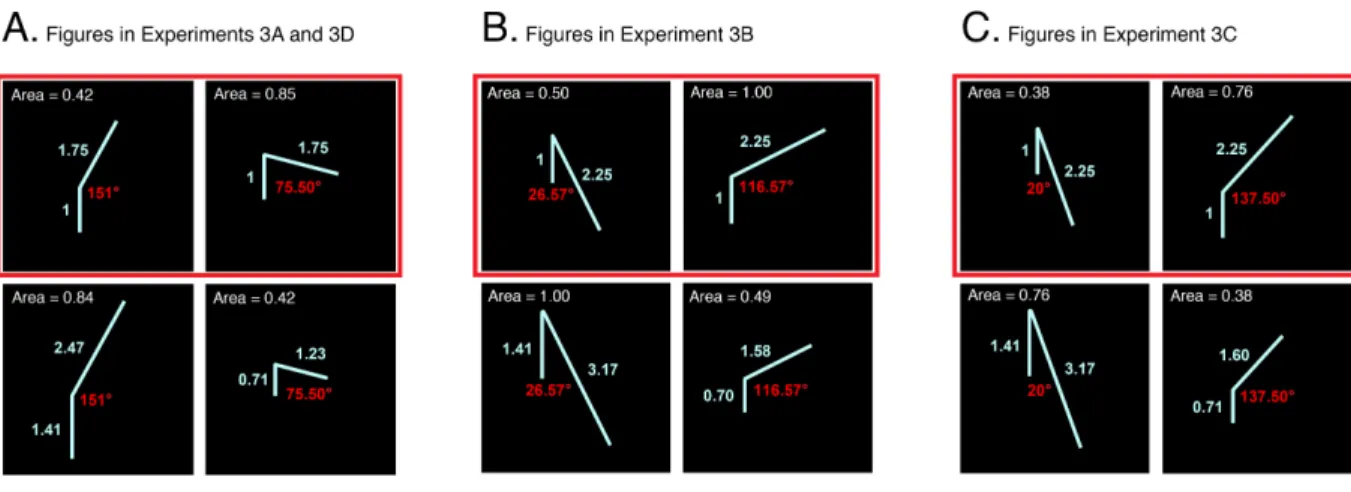
Sixteen infants (8 females; mean age = 7 months, 0 days; range = 6 months, 15 days to 7 months, 15 days) participated in this experiment. Two additional infants were presented with the displays but were excluded because of parental interference. Each figure was composed of one line of length 1 unit and one line of length 1.75 units, joined to form either a 75.50° angle or a 151° angle (these angle measures were equidistant from the angle measure used in Experiment 2A). On one side of the screen, these two angles alternated, presenting a 2-fold change in angle and a 2-fold change in implied area. On the other side of the screen, one of these angles
(counterbalanced across infants) was presented with a 2-fold increase in area (in the case of the 151° angle) or a 2-fold decrease in area (in the case of the 75.50° angle) such that the change in implied area across the two figure streams was equivalent (Figure 6A; see SM for videos of the displays). Inter-coder reliability of looking time was high (r = .95).
Figure 6. A. Context figures, angle-and-area change figures, and area-only change figures for
Experiments 3A and 3D, B. 3B, and C. 3C. The figures bounded by red boxes are different angles and different areas, and they were presented in alternation on one side of the screen. On the other side of the screen, an area change but no angle change was presented. Half of the infants saw the left figure in each red box alternate with the larger version of itself depicted directly below it, and half of the infants saw the right figure in each red box alternate with the smaller version of itself, depicted directly below it. The length, angle, and area measurements are provided for each figure and are normalized for each condition.
Results.
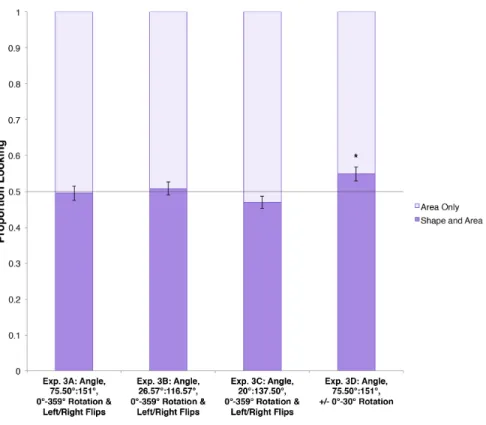
Infants showed no preference for the angle-change stream (t(15) = -0.28, p = .780,
Cohen’s d = 0.07; Figure 7). They looked on average 10.33 s to the angle-change stream (SEM = 0.1.10 s) and 10.31 s to the area-change stream (SEM = 0.88 s) per trial. The Bayesian analysis estimated a difference of 0.00 s between the conditions (CrI = -2.33 s – 2.42 s) and suggested that infants’ looking time decreased across trials (-1.78, CrI = -2.85 s – -0.72 s). The Bayesian analysis suggested that infants looked longer overall when presented with the version of the displays in which the area change in the area-change stream displayed the context shape
alternating with a larger shape, compared to when it alternated with a smaller shape (-4.27, CrI = -7.90 – -0.75). Nevertheless, the analysis did not suggest an interaction between the direction of the area change and longer looking to the area-change side (CrI = -5.94 – 3.54). The Bayesian analysis also suggested no looking time differences based on gender (see SM for full analyses).
Infants’ responses to the angle changes in Experiment 3A were significantly less than infants’ responses to the global shape changes in Experiment 1A (t(30) = -2.22, p = .034, Cohen’s d = 0.79, two-tailed) as well as to the 2-fold relative length changes in Experiment 2A (t(30) = -2.38, p = .024, Cohen’s d = 0.66, two-tailed).
Figure 7. Proportion of looking to angle changes in Experiments 3A-3D. Infants did not detect
angle changes in the figures varying by a 2-or-more-fold difference in angle when figures presented unlimited variations in orientation and sense (Experiments 3A-3C), but infants did detect changes in figures varying by a 2-fold difference in angle when figures presented limited variations in orientation and no changes in sense (Experiment 3D). The gray line at 0.5 indicates equal looking. * p < .05, two-tailed.
Discussion.
Experiment 3A provided no evidence that infants detected the change in angle when presented with angle changes at the same ratio difference as in the previous experiments. Although the relative length changes in the studies of Experiment 2 and the angle changes in
Experiment 3A varied by a factor of 2, it is not clear this magnitude of change is equivalent when instantiated by these different geometric properties. Other studies have found ratio
dependencies in relative length discrimination in infancy, as in numerical discrimination (e.g., de Hevia & Spelke, 2010), but no such determination has been made for angle discrimination in infancy. Indeed, the metric by which angles are discriminated is debated even in the adult literature. Some studies suggest at least some ratio-dependence for angle discrimination when angles are presented at restricted orientations (e.g., Chen & Levi, 1996), while other studies suggest an absolute threshold of discrimination, especially when figures are presented at varying orientations (e.g., Heeley & Buchanan-Smith, 1996). Furthermore, when both a figure’s
orientation and size vary, adults’ discrimination appears to depend on an angle’s proximity to 0° or 90° as well as whether the angle change crosses one of these angle-measure categories (e.g., discrimination is more fine-grained for 80° vs. 100° compared to 100° vs. 120°; Dillon, Duyck, Dehaene, Amalric, & Izard, 2019). Prior studies testing angle discrimination in infancy used angle measures that differed by relative differences of around 2-3-fold and absolute differences of around 45°-90° (e.g., Lourenco & Huttenlocher, 2008; Slater et al., 1991). In most cases, infants discriminated acute vs. obtuse angles. In Experiments 3B and 3C, we thus further tested infants’ sensitivity to angle by increasing both the relative and absolute angle differences in case the 2-fold relative difference and 75.50° absolute difference in Experiment 3A was too small for infants to discriminate (the angles being compared in all conditions of Experiment 3 crossed the 90° boundary).
Experiment 3B.
Sixteen different infants (9 females; mean age = 7 months, 0 days; range = 6 months, 20 days to 7 months, 12 days) participated in the experiment. Three additional infants were
presented with the displays but were excluded because they failed to complete all four test trials (1), failed to meet the minimum looking-time criterion (1), or showed a looking preference of more than two standard deviations above or below the mean for this condition (1). Infants were presented with displays with more extreme angle differences. Each figure was composed of one line of length 1 unit and one line of length 2.25 units, and the two lines joined to form either a 26.57° angle or a 116.57° angle. On one side of the screen, these two angles alternated, presenting a 4.39-fold change in angle (with an absolute angle change of 90°) and a 2-fold change in implied area. On the other side of the screen, half of the infants saw the 26.57° angle alternating with a bigger version of itself, and half saw the 116.57° angle alternating with a smaller version of itself, such that a 2-fold change in area distinguished the alternating figures in both image streams (Figure 6B; see SM for videos of the displays). Inter-coder reliability of looking time was high (r = .98).
Results and Discussion.
Infants showed no significant preference for the angle-change stream (t(15) = 0.41, p = .685, Cohen’s d = 0.10; Figure 7), despite the greater angle change. They looked on average 10.36 s to the angle-change stream (SEM = 0.92 s) and 9.98 s to the area change stream (SEM = 0.83 s) per trial. The Bayesian analysis estimated a difference of 0.42 s between the conditions (CrI = -2.40 s – 3.19 s) and suggested that infants’ looking time decreased across trials (-1.79, CrI = -3.02 s – -0.54 s). The Bayesian analysis also suggested no looking time differences based on the direction of the size change in the area-change stream or on gender (see SM for full
analyses). The next condition therefore tested infants’ discrimination of angles that differed by an even larger amount.
Experiment 3C.
Methods.
Sixteen different infants (8 females; mean age = 6 months, 29 days; range = 6 months, 20 days to 7 months, 10 days) participated in this experiment. Six additional infants were presented with the displays but were eliminated for failure to meet the minimum looking-time criterion (4), preference scores more than 2 standard deviations above or below the mean for this condition (1), or experimenter error (1). Infants were presented with figures composed of one line of length 1 unit and one line of length 2.25 units, joined to form either a 20° angle or a 137.50° angle. On one side of the screen, these two angles alternated, presenting a 6.88-fold change in angle (with an absolute angle change of 117.50°) and a 2-fold change in implied area. On the other side of the screen, either the smaller of these angles alternated with a larger version of itself, exhibiting a 2-fold increase in implied area or the larger of these angles alternated with a smaller version of itself, displaying a 2-fold decrease in area. Thus, the area changes across image streams were equal and matched those presented in the previous experiments (Figure 6C; see SM for videos of the displays). Inter-coder reliability of looking time was high (r = .99).
Results.
Infants showed no significant preference for the angle-change stream (t(15) = -1.69, p = .112, Cohen’s d = 0.42; Figure 7), despite the even larger differences in the angle displays. They looked on average 10.93 s to the angle-change stream (SEM = 1.03 s) and 12.39 s to the area-change stream (SEM = 1.17 s) per trial. The Bayesian analysis estimated a difference of -1.45 s between the conditions (the negative signifies longer looking to the areachange stream; CrI =
4.05 s – 1.06 s) and suggested that infants’ looking time decreased across trials (2.23, CrI = -3.40 s – -1.08 s). The Bayesian analysis also suggested no looking time differences based on the direction of the size change in the area-change stream or on gender (see SM for full analyses).
Finally, in a post hoc analysis pooling the data from Experiments 3A-3C to increase power (99.4%, using the effect size of Experiment 1B, which presented global shape changes with the same variation in orientation and sense), we still found no significant detection of angle (t(47) = -0.85, p = .400, Cohen’s d = 0.12). Moreover, a Bayes Factor analysis provides strong evidence in support of the null hypothesis that infants looked equally between the stream presenting figures changing in area and angle and the stream presenting changes in area alone (BF10 = 0.09; Rouder, Speckman, Sun, Morey, & Iverson, 2009).
Discussion.
In three separate conditions, infants showed no sensitivity to angle changes over figures’ rapid variation in orientation and sense. Might infants have failed to detect the shape changes in the open figures differing in angle because of lesser interest in these figures? Experiment 3D addressed this possibility by presenting the displays of Experiment 3A with restricted variation in orientation. If infants simply are not interested in the type of changes presented in Experiment 3A-3C, then the negative findings from Experiments 3A-3C should extend to Experiment 3D. In contrast, if they are interested in these displays but fail to detect changes in angle in an
orientation-invariant manner, then they should look longer at the changing arrays in Experiment 3D, because the changing arrays now present detectable changes in line orientation as well as angle.
Experiment 3D.
Sixteen different infants (8 females; mean age = 7 months, 2 days; range = 6 months, 18 days to 7 months, 15 days) participated in this experiment. Four additional infants were
presented with the displays but were excluded because of not meeting the minimum looking-time criterion (3) or experimenter error (1). Infants were presented with the same figures (75.5° angles versus 151° angles) using the same procedure as Experiment 3A but with one critical change: Instead of figures appearing at any orientation between 0°-359° at each presentation, they were only presented at orientations varying between +/- 30°, and there were no sense changes, as in Experiment 1A. Inter-coder reliability of looking time of this study was high (r = .97).
Results.
Infants showed a significant preference for the angle-and-area change stream (t(15) = 2.49, p = .025, Cohen’s d = 0.62; Figure 7). They looked on average 9.32 s to the angle-change stream (SEM = 0.94 s) and 7.83 s to the area change stream (SEM = 0.90 s) per trial. The
Bayesian analysis estimated a difference of 1.51 s between the conditions (CrI = -0.89 s – 3.90 s) and suggested that infants’ looking time decreased across trials (-1.93, CrI = -2.96 s – -0.92 s). The Bayesian analysis also suggested no looking time differences based on the direction of the area change in the area-change stream or on gender (see SM for full analyses). There was a significant difference in infants’ preference scores across Experiments 3A and 3D (t(30) = -2.08, p = .047, Cohen’s d = 0.73), indicating that a reduction in the range of orientations presented enhanced infants’ detection of changes in these displays.
Discussion.
When given the same angles as in Experiment 3A, but under limited orientation changes and no sense changes, infants in Experiment 3D succeeded in detecting changes in the figures. These findings show that infants indeed were interested in the changing displays, and the
findings are open to two distinct interpretations. First, infants may perceive angle in the displays used in this experiment, but not in a manner that is invariant over large changes in orientation. Second, infants may be wholly insensitive to angle in briefly presented displays: They may have looked longer at the changing displays in Experiment 3D because they detected the changes in orientation of its individual lines.
Infants’ failure to detect angle changes in open figures over changes in size, position, orientation, and sense in Experiments 3A-3C contrasts with their success in detecting both shape changes in complete triangles (Experiments 1A and 1B) and relative length changes in open figures (Experiments 2A and 2B) over these transformations. Experiments 3A-3C used very large relative and absolute differences in angle and thus provide strong evidence against infants’ ability to detect angle over rapid changes in size, position, orientation, and sense.
Infants also showed significantly less sensitivity to angle changes than to either global shape changes in closed figures or to relative length changes in open figures. These findings underscore infants’ greater sensitivity to relative length than to angle. Moreover, the findings indicate that infants did not complete the open figures in any experiment to evaluate the global shape of an implied figure. If infants were capable of such completion, then they would have detected the shape changes in Experiments 3A-3C because such a completion process would have yielded two triangles with different global shapes, as in Experiment 1B.
General Discussion
Three experiments with multiple conditions reveal both successes and failures in seven-month-old infants’ detection of 2D shape changes over fundamental invariance-preserving geometric transformations. Infants detected shape changes in rapidly alternating closed figures (Experiments 1A and 1B) and relative length changes in rapidly alternating open figures
(Experiments 2A and 2B), even when figures were presented with variation in their size, position, orientation, and sense. Nevertheless, infants failed to detect angle changes under these conditions (Experiments 3A-3C), although they did respond when the same figures appeared at a restricted range of orientations (Experiment 3D).
Three conclusions follow from these findings. First, infants are highly sensitive to relative length when they view briefly presented closed or open shapes at different orientations and under conditions that fully control for the correlated variables of angle size, global size, and line orientation. Second, infants are surprisingly insensitive to angle under the same conditions of viewing and with the same controls. They either fail to detect angle in briefly presented displays altogether, responding instead to the orientations of individual lines, or they perceive angle in an orientation-dependent fashion. In either case, infants show better detection of changes in relative length than of changes in angle. Their sensitivity to relative length therefore likely underlies their perception of shape changes in closed figures, as tested in Experiment 1. Because most common objects can appear at diverse orientations in visual scenes, these findings suggest that perception of the invariant shapes of objects depends more on relative length than on angle.
Why are infants so insensitive to angle in the current studies? Because these studies presented forms changing in angle while varying continuously in size, it is possible that size changes interfered with infants’ angle detection. Size interacts both with children’s and with adults’ detection and judgments about angles. For example, children and adults judge that an angle formed by longer lines, covering more surface area, or with a greater distance between its endpoints is bigger (Clements & Battista, 1989; Gibson, Congdon, & Levine, 2015; Izard & Spelke, 2009; Lehrer, Jenkins, & Osana, 1998; Wenderoth & Johnson, 1984; Werkhoven &
Koenderink, 1993), although these errors can be attenuated in children by using linguistic labels to draw children’s attention away from such size properties (Gibson et al., 2015). Moreover, when children are asked to generate (with their hands or with a goniometer) the third angle of a fragmented triangle after being presented with its spatially separated bottom two angles, they fail systematically, adopting an absolute size strategy: Their estimations of the missing top angle depend on the total length of the implied base and sides of the triangle, rather than on the angles at which the sides meet (Dillon & Spelke, 2018; Izard, Pica, Spelke, & Dehaene, 2011). Indeed, even adults are influenced by global size information on a similar task when angle judgments are subtle and global size varies by a large extent (Hart, Dillon, Marantan, Cardenas, Spelke, & Mahadevan, 2018).
Other properties of figure size also may affect angle discrimination, especially in infants. For example, if figures present long lines, infants may be less likely to attend to the angle
information at the junction of those lines. Future studies comparing infants’ ability to discriminate angles made from shorter versus longer lines, or using eye-tracking methods to more precisely evaluate what parts of figures infants look at, may begin to shed light on these possibilities.
A second possibility is that infants detect angle changes through a process that operates too slowly to be effective under the conditions of brief presentation used in the present studies. For example, infants may calculate angles by evaluating the differences in the orientations of the lines that form the angles, and this calculation may still be in progress when one display is replaced by another. Indeed, adults may invoke this kind of difference calculation when presented with angle displays under some very noisy conditions (see Snippe & Koenderink, 1994). If either of these hypotheses is correct, then infants’ success in Experiment 3D would
depend on their ability to detect changes in the orientations of the individual lines that compose the figures, not on their orientation-specific perception of changes in angle. Future research using dynamic displays with slower presentation times could further explore the conditions under which infants detect angle.
A third possibility is that infants can detect angle as rapidly as relative length, but they detect angle in an orientation-specific manner. This possibility is consistent with a wealth of evidence, from studies of adults, that shape is perceived in an orientation-specific manner
whenever the aspect ratio of a shape approaches one, i.e., when relative lengths fail to distinguish the shape’s primary and secondary axes. For example, when a square is rotated 45°, its perceived shape shifts from square to diamond (with a diamond’s angles no longer spontaneously
appearing 90°), and when a familiar shape whose aspect ratio is near to 1 appears at an
unfamiliar orientation, it often is unrecognizable (Rock, 1974). Rock (1974) has proposed that we analyze the shapes of objects by assigning them a principal axis along their dimension of greatest elongation, and then recognize the object at less familiar orientations by mentally rotating its current frame of reference into the canonical vertical orientation. This proposal gains force from more recent findings that everyday shape detection depends on the recovery of a form’s principal axes, which serve as shape skeletons and support adults’ perception of diverse objects and forms (Feldman & Singh, 2006; Kovacs & Julesz, 1994; Firestone & Scholl, 2014; Gershman, Tenenbaum, & Jakel, 2016). Research on infants, presenting shapes for long
durations, provides evidence for successful perception of the invariant shapes of rectangles with a clear intrinsic axis, but not of squares with no unique axis, consistent with Rock’s hypothesis (Schwartz & Day, 1979). Thus, infants might fail to represent angle in the present displays
because the brief presentation times preclude both recovery of each form’s principal axis and analysis of the angle relations relative to that axis.
Why, however, are infants so much more sensitive to relative length than to angle under the present conditions of rapid presentation and variations in orientation and sense? Visual mechanisms of shape perception may have evolved, first and foremost, to process the shapes of living things: plants and animals. The joints of the principal axes of plants and animals vary in angle as, for example, plants sway in the wind or animals assume different postures, but the relative lengths of limb segments do not change over the time scales relevant to perception. Plants and animals, moreover, have a privileged vertical axis, due to the constraints of gravity (and, for plants, of the upward direction of their source of energy), and much evidence suggests that perception both of faces and of moving bodies is orientation-specific, both for adults (e.g., Yin, 1969; Johansson, 1973) and for infants (e.g., Fagan, 1972; Bertenthal, Proffitt, & Kramer, 1987). If object shapes are represented by their principal axes, therefore, an optimal analysis of the orientation-invariant properties of natural shapes might be more sensitive to orientation and to relative length than to angle. When orientation is constant, moreover, angle may be used to specify an object’s action or posture more than its shape. Future research presenting angle and relative length changes embedded in 3D objects with skeletal structures could further explore these suggestions.
The marked superiority of infants’ detection of relative length, compared to their detection of angle, may have implications for the later development of geometric reasoning. Schooling teaches and exercises a concept of angle that is essentially scale- and rotation-invariant, as described in the formal system of Euclidean geometry. Euclidean geometry is not taught until secondary school, however, where many students learn it incompletely (Goldin,
Pezzatti, Battro, & Sigman, 2011). It is possible that the properties of orientation, relative length, and size are particularly salient early in development, rendering detection of these properties more robust throughout life (Dehaene-Lambertz & Spelke, 2015), while impairing children’s learning about angle. Future studies of sensitivity to relative length and angle, performed on students learning formal geometry, could test this suggestion.
Conclusion
The present study revisits infants’ shape discrimination by testing infants’ sensitivity to specific geometric properties of visual forms over changes in size and orientation. The
experiments use fragmented figures to decouple the geometric properties of relative length and angle from one another and from other geometric properties such as size and orientation. We evaluate the generality of infants’ sensitivity to the shape properties of visual forms by
presenting brief displays that change in orientation, size, and sense. We find that infants fail to detect angle over changes in orientation and size, although they respond robustly to changes in relative length presented under the same conditions. By exploring infants’ sensitivity to
geometry in a variety of contexts, with controls for correlated geometric variables, we may better understand the perceptual capacities that underlie spatial learning in natural environments.
Acknowledgements
This work was supported by the Center for Brains, Minds and Machines
(CBMM), a National Science Foundation Technology Center (CCF-1231216), the National Science Foundation (DGE-1144152 to MRD; DRL-1348140 to ESS), and a Starting Grant from the European Research Council (MathConstruction 263179 to VI). We thank the Institute for Quantitative Social Sciences at Harvard University for assistance with programming the stimulus-presentation software and V. Chan, R. Guzman, N. Kalra, and E. Wheaton for assistance with data collection and coding. The authors declare no conflicts of interest.
References
Bertenthal, B. I., Proffitt, D. R., & Kramer, S. J. (1987). Perception of biomechanical motions by infants: implementation of various processing constraints. Journal of Experimental Psychology: Human Perception and Performance, 13(4), 577-585.
Brannon, E. M., Lutz, D., & Cordes, S. (2006). The development of area discrimination and its implications for number representation in infancy. Developmental Science, 9(6), F59-F64.
Buerkner, P. C. (2017). brms: An R Package for Bayesian Multilevel Models Using Stan. Journal of Statistical Software, 80(1), 1-28.
Chen, S., & Levi, D. M. (1996). Angle judgment: Is the whole the sum of its parts?. Vision Research, 36(12), 1721-1735.
Clements, D. H., & Battista, M. T. (1989). Learning of geometric concepts in a Logo environment. Journal for Research in Mathematics Education, 450-467.
Cohen, L. B., & Younger, B. A. (1984). Infant perception of angular relations. Infant Behavior and Development, 7(1), 37-47.
Cordes, S., & Brannon, E. M. (2009). The relative salience of discrete and continuous quantity in young infants. Developmental Science, 12(3), 453-463.
Dehaene-Lambertz, G., & Spelke, E. S. (2015). The infancy of the human brain. Neuron, 88(1), 93-109.
de Hevia, M. D., Izard, V., Coubart, A., Spelke, E. S., & Streri, A. (2014). Representations of space, time, and number in neonates. Proceedings of the National Academy of
de Hevia, M. D., & Spelke, E. S. (2010). Number-space mapping in human infants. Psychological Science, 21(5), 653-660.
Dillon, M. R., Duyck, M., Dehaene, S., Amalric, M., & Izard, V. (2019). Geometric categories in cognition. Journal of Experimental Psychology: Human Perception and Performance, 45(9), 1236-1247.
Dillon, M. R., & Spelke, E. S. (2018). From map reading to geometric intuitions. Developmental Psychology, 54(7), 1304-1316.
Euclid. (2007). Euclid’s elements of geometry (R. Fitzpatrick, Trans.). J.L. Heiberg (Ed.). Austin,TX: R. Fitzpatrick. (Original work published c. 300 BCE).
Fagan, J. F. (1972). Infants' recognition memory for faces. Journal of Experimental Child Psychology, 14(3), 453-476.
Feldman, J., & Singh, M. (2006). Bayesian estimation of the shape skeleton. Proceedings of the National Academy of Sciences, 103(47), 18014-18019.
Firestone, C., & Scholl, B. J. (2014). “Please tap the shape, anywhere you like”: Shape skeletons in human vision revealed by an exceedingly simple measure. Psychological Science, 25, 377-386.
Gershman, S. J., Tenenbaum, J. T., & Jakel, F. (2016). Discovering hierarchical motion structure. Vision Research, 126, 232-241.
Gibson, D. J., Congdon, E. L., & Levine, S. C. (2015). The Effects of Word-Learning Biases on Children’s Concept of Angle. Child Development, 86(1), 319-326.
Goldin, A. P., Pezzatti, L., Battro, A. M., & Sigman, M. (2011). From ancient Greece to modern education: Universality and lack of generalization of the Socratic dialogue. Mind, Brain, and Education, 5(4), 180-185.
Hart, Y., Dillon, M. R., Marantan, A., Cardenas, A., Spelke, E. S., & Mahadevan, L. (2018). The statistical shape of geometric reasoning. Scientific Reports, 8, 12906.
Heeley, D. W., & Buchanan-Smith, H. M. (1996). Mechanisms specialized for the perception of image geometry. Vision research, 36(22), 3607-3627.
Hyde, D. C., & Wood, J. N. (2011). Spatial attention determines the nature of nonverbal number representation. Journal of Cognitive Neuroscience, 23(9), 2336-2351.
Izard, V., Pica, P., Spelke, E. S., & Dehaene, S. (2011). Flexible intuitions of Euclidean geometry in an Amazonian indigene group. Proceedings of the National Academy of Sciences of the United States of America, 108(24), 9782-9787.
Izard, V., & Spelke, E. S. (2009). Development of sensitivity to geometry in visual forms. Human Evolution, 23(3), 213.
Johansson, G. (1973). Visual perception of biological motion and a model for its analysis. Perception & Psychophysics, 14(2), 201-211.
Kovacs, I., & Julesz, B. (1994). Perceptual sensitivity maps within globally defined visual shapes. Nature, 370(6491), 644.
Lauer, J. E., Udelson, H. B., Jeon, S. O., & Lourenco, S. F. (2015). An early sex difference in the relation between mental rotation and object preference. Frontiers in Psychology, 6, 558. Lehrer, R., Jenkins, M., & Osana, H. (1998). Longitudinal study of children’s reasoning about
space and geometry. Designing learning environments for developing understanding of geometry and space, 1, 137-167.
Libertus, M. E., & Brannon, E. M. (2010). Stable individual differences in number discrimination in infancy. Developmental Science, 13(6), 900-906.
Lindskog, M., Rogell, M., Kenward, B., & Gredebäck, G. (2019). Discrimination of Small Forms in a Deviant-Detection Paradigm by 10-month-old Infants. Frontiers in Psychology, 10, 1032.
Lourenco, S. F., & Huttenlocher, J. (2008). The representation of geometric cues in infancy. Infancy, 13(2), 103-127.
Quinn, P. C., & Eimas, P. D. (1997). A reexamination of the perceptual-to-conceptual shift in mental representations. Review of General Psychology, 1(3), 271.
Quinn, P. C., Slater, A. M., Brown, E., & Hayes, R. A. (2001). Developmental change in form categorization in early infancy. British Journal of Developmental Psychology, 19(2), 207-218.
Rock, I. (1974). The perception of disoriented figures. Scientific American, 230(1), 78-86. Ross-Sheehy, S., Oakes, L. M., & Luck, S. J. (2003). The development of visual short-term
memory capacity in infants. Child Development, 74(6), 1807-1822.
Rouder, J. N., Speckman, P. L., Sun, D., Morey, R. D., & Iverson, G. (2009). Bayesian t tests for accepting and rejecting the null hypothesis. Psychonomic Bulletin & Review, 16(2), 225-237.
Ruff, H. A., & Lawson, K. R. (1990). Development of sustained, focused attention in young children during free play. Developmental Psychology, 26(1), 85.
Scholl, B. J., & Pylyshyn, Z. W. (1999). Tracking multiple items through occlusion: Clues to visual objecthood. Cognitive Psychology, 38(2), 259-290.
Schwartz, M., & Day, R. H. (1979). Visual shape perception in early infancy. Monographs of the Society for Research in Child Development, 44(7), 1-63.
Slater, A., Mattock, A., Brown, E., & Bremner, J. G. (1991). Form perception at birth: Revisited. Journal of Experimental Child Psychology, 51(3), 395-406.
Smith, L. B. (2009). From fragments to geometric shape changes in visual object recognition between 18 and 24 months. Current Directions in Psychological Science, 18(5), 290-294. Snippe, H. P., & Koenderink, J. J. (1994). Discrimination of geometric angle in the
fronto-parallel plane. Spatial Vision, 8(3), 309-328.
Spelke, E. S. (2017). Core Knowledge, Language, and Number. Language Learning and Development, 13(2), 147-170.
Starr, A., Libertus, M. E., & Brannon, E. M. (2013). Infants show ratio-dependent number discrimination regardless of set size. Infancy, 18(6), 927-941.
Wenderoth, P., & Johnson, M. (1984). The effects of angle-arm length on judgments of angle magnitude and orientation contrast. Perception & Psychophysics, 36(6), 538-544. Werkhoven, P., & Koenderink, J. J. (1993). Visual size invariance does not apply to geometric
angle and speed of rotation. Perception, 22(2), 177-184.
Wood, J. N., & Spelke, E. S. (2005). Chronometric studies of numerical cognition in five-month-old infants. Cognition, 97(1), 23-39.
Xu, F. (2003). Numerosity discrimination in infants: Evidence for two systems of representations. Cognition, 89(1), B15-B25.
Yin, R. K. (1969). Looking at upside-down faces. Journal of Experimental Psychology, 81(1), 141.
Yu, C., & Smith, L. B. (2016). The social origins of sustained attention in one-year-old human infants. Current Biology, 26(9), 1235-1240.





![[PDF] Cours sur la sécurité d’une application Android méthodes et applications - Free PDF Download](data:image/gif;base64,R0lGODlhAQABAIAAAP///wAAACH5BAEAAAAALAAAAAABAAEAAAICRAEAOw==)