THE ALGEBRAIC REGULATOR PROBLEM FROM THE STATE-SPACE POINT OF VIEW
by
J.M. Schumacher*
ABSTRACT
We study the algebraic aspects of the regulator problem, using some new ideas in the state-space ('geometric') approach to feedback design problems for linear multivariable systems. Necessary and sufficient con-ditions are given for the solvability of a general version of this problem, requiring output stability, internal stability, and disturbance decoupling as well. An algorithm is given by which these conditions can be verified from the system parameters. A few remarks are added on the analytical and numerical aspects of the problem, and on the relative merits of the state-space and the transfer matrix approach.
*
Laboratory for Information and Decision Systems, MIT, Cambridge, MA 02139. This research was done while the author held a fellowship provided by the Dutch Organization for the Advancement of Pure Scientific Research (ZWO).
1. Introduction
The problem of making a given system follow a certain signal in the presence of disturbances is, of course, a basic one in controller design. Several versions have been under study since the very beginnings of control theory. In recent years, much attention has been paid to the underlying algebraic structure of the problem. The central issue here is to decide on solvability or non-solvability of theproblem for a given set of para-meters. Of course, in practice the parameters are not known precisely,
and the yes-or-no answer which comes from the algebraic analysis is related in a nontrivial way to the hard/easy scale that is much more familiar to the engineer. Still, we may expect that a good understanding of the cases in which the problem is not solvable will be of help in identifying the crucial features of those control problems that should be classified as
'intrinsically difficult'. Moreover, if the answer to the algebraic problem is constructive in the sense that it provides an algorithm to find a solu-tion if there exists one, then this algorithm may also be used as a starting point for the development of software that would be applicable under a
minimum of assumptions on the system to be controlled.
Among other factors, these considerations have played a role in the development of several different approaches to, what we shall call, the
algebraic regulator problem. State space methods were used in [1-7], resulting in a constructive solution for a fairly general version of the problem. It was felt, however, that a solution in terms of transfer
functions would provide a better starting point for investigations in-volving (small) parameters changes, and this was one of the incentives for a number of papers using techniques like coprime factorization of transfer
matrices ([8-16]). The solvability conditions obtained, however, are in part inattractive from the numerical point of view (cf. the conclusions of
[15]).
The purpose of the present paper is to re-state the case for the state space approach. We shall use some new ideas to obtain a constructive solution for a general version of the regulator problem, involving output stability, internal stability, and disturbance decoupling. The main feature of the approach adopted here is that it incorporates (dynamic) observation feedback in a natural way. (The intricacy of working with observation feedback in earlier state-space treatments has sometimes been mentioned as a reason to prefer transfer matrix techniques: see [10]). We shall give several equivalent formulations of the main result, among which there will be an explicit matrix version that could be a starting point for calculations. This paper improves on the results in [18]. The organization of the paper is as follows. After having introduced some notation and preliminaries in section 2, we motivate our formulation of the regulator problem in Section 3. Section 4 contains necessary conditions
for this problem to be solvable. These conditions are shown to be also sufficient in section 5, and hence we obtain our basic result. In section 6, we show that this result leads to a completely constructive solvability criterion. The 'internal model principle' is briefly discussed in Section 7, and conclusions follow in section 8. An appendix is added in which it is shown that the problem considered here is a strict generalization of the one considered in [1] (see also [2], Ch. 7).
We shall consider only linear, finite-dimensional systems over B]. In general, vector spaces will be indicated by script capitals, linear mappings by Roman capitals and vectors by lower case letters. Further conventions
in the use of letters are as follows. The generic description for a system
is
x'
(t) = Ax(t)
+Bu(t) + Eq(t)
x(t) e
X,
u(t)
e
U
(2.1)
y(t) = Cx(t)
y(t)
e
Y
(2.2)
z(t) = Dx(t) z(t) e Z . (2.3)
Here, x(t) is called the state of the system at time t, u(t) is the input, q(t) the disturbance, y(t) the observation, z(t) the output. Our con-trollers will be devices that produce a control function u(t) from an
ob-servation function y(t) in the following way:
w' (t) = Aw(t) + Gcy(t) w(t) e W (2.4)
u(t) = F w(t) + Ky(t) , (2.5)
This is called a compensator; w(t) is the compensator state and W is the compensator state space. We can combine the equations (2.1-3) and (2.4-5) to form the extended system:
d
x/A+BKC
BF\
x
E
dt
w)
G
C
A c)
()
+
q(t)
(2.6)
z(t) = (D 0)
)
(t) . (2.7)A c (2.8) G C A
e c Ac
and call this the extended system matrix. This mapping acts on the extended state space Xe: = X @ W. There are two natural mappings between Xe and X: the natural projection P: Xe -+ X, defined by
p(X) = x (2.9)
and the canonical imbedding Q: X
-
Xe, defined by
x
Qx = (0) . (2.10)
A typical form of a control problem is now: given the system (2.1-3), find a compensator of the form (2.4-5) such that the closed-loop system
(2.6-7) has certain properties. For the algebraic regulator problem, these properties can be specified in terms of invariant subspaces of the extended system matrix. We shall denote the ' bad subspace' of A by e (A), so
Xb(Ae) = ker(XI-A ) (2.11)
Re X>0 ne3/
This subspace of Xe contains the 'unstable modes' of A , i.e., the eigen-e
directions corresponding to non-decreasing solutions. We say that we have output stability in the closed-loop system if
Xb(A ) C ker(D 0) . (2.12)
This means that the output z(t) will converge to zero, if no external dis-turbance is present (q(t) = 0). Another property of interest is disturbance decoupling: we say that the closed-loop system had this property if there
-5-exists an A -invariant subspace M such that
im(
0)
C M
C
ker(D 0) .
(2.13)
This means that the behavior of z(t) is completely unaffected by that of
q(t).
If we have both output stability and disturbance decoupling, then
the output z(t) converges to zero regardless of the behavior of q(t).
Note that these properties can also be formulated in terms of subspaces
of X: (2.12) is equivalent to
PXeb(A
)C ker D
(2.14)
and (2.13) is the same as
im E C Q-
M c
PM
C
ker D
.
(2.15)
A third property will be discussed below.
For a while, let us concentrate on the pair (A,B) of system mapping and
in-put mapping (see (2.1)).
A subspace V of X is said to be (A,B)-invariant if there
exists a 'state feedback mapping' F: X->J such that V is (A+BF)-invariant.
If V is (A,B)-invariant, the set of all mappings F:X-NU such that (A+BF)VC
V
is denoted by F(V).
An alternative characterization of (A,B)-invariance
can be given as follows ([2], lemma 4.2):
Lemma 2.1 A subspace V of X is (A,B)-invariant if and only if
AVc
V +
im B.
(2.16)
From this, it is easily seen that the set of (A,B)-invariant subspaces
is closed under subspace addition.
Consequently, the set of
(A,B)-invariant subspaces that are contained in a given subspace
K
(which set is never empty, because the zero subspace is (A,B)-invariant)
has a unique largest element which is denoted by
V*(K).
An algorithm
to construct V*(K) for any given K can be found in [2], p.91.
Given an (A,B)-invariant subspace V, it will be important for us to
know how the eigenvalues of A+BF can be manipulated when F may be chosen
from the class F(V).
To describe the situation, it is convenient to
intro-duce the following notation. If L
1and L2 are invariant subspaces for
some linear mapping T, and
L
1c
L
2,
then T:
L2/L
1will denote the factor
mapping induced on the quotient space L
2/L
1by the restriction of T to
L
2.
In matrix terms, this simply means that if the matrix of T can be
written, with respect to a suitable basis, in the block form
T
=
lT22
23
(2.17)
t mt
o
T33T
then the matrix of T:L2/L1
is
T22.
If
L
1=
{o},
we shall write T:L
2in-stead of T:L2/{O}. We can now formulate the following result ([24]; see
also [2], Cor. 5.2 and Thm.
4.4):
Lemma 2.2: Let V be an (A,B)-invariant subspace. Then the smallest
(A+BF) -invariant subspace containing im B n V is the same for all F C F(V).
Denote this subspace by R, and let S be the smallest A-invariant subspace
containing both im B and V.
Then S is (A+BF)-invariant for all F, and we
have for all F
l, F
2e F(V):
A + BFl:X/S =A:X/S
(2.18)
-7-Moreover, for any real polynomials pl(X) and p
2(X) with deg(pl) = dim S - dim V
and deg(p
2) = dim R, there exists an F CF(V) such that the characteristic
polynomials of A+BF: S/V and A+BF: R are equal to pl(X) and P
2(X),
re-spectively.
The content of this lemma can conveniently be expressed in the form of a diagram, in which the words 'free' and 'fixed' refer to the eigenvalues of A+BF when F may be chosen from F(V):
S
free V (2.20) fixed freeR
{0}
A+BF (FeF (V))An (A,B)-invariant subspace V is called a controllability subspace if O(A+BF:V) is free ([2], p.102), and it is called strongly invariant if c(A+BF:X/V) is fixed. If there exists an F
e
F(V) such that O(A+BF:V)C {X e IRe X < 0}, V is called a stabilizability subspace.
For brevity of notation, let us write
cg
= {X e IRe X < 0} cb = C \ (2.21)(Other partitionings of the complex plane may be used, for instance to express stronger stability requirements. The effects on the theory will be none, provided that the partitioning is symmetric with respect to the real axis, and C Cn/R# 0.) We already introduced X (Ae ), and the notations
Xe(A
), X
(A), %X(A)
etc. will refer in an obvious way to the modal
sub-spaces corresponding to the part of
aC
indicated by the subscript. For any
subspace
L,
we use the following notation for the smallest A-invariant
subspace containing
L
and for the largest A-invariant subspace contained
in L:
<AlL>
:=
AkL
(2.22)
keZ
+<LfA>
=
AL
-k
.(2.23)
ke2
A strongly invariant subspace of particular interest is
X
X (A) + <Alim B>
(2.24)
stab
g
which is easily seen to be the largest stabilizability subspace in X.
More generally, one can prove ([19],
p.26;
[2], p.114) that the set of
all stabilizability subspaces contained in a given subspace
K
has a unique
largest element, which will be denoted by
V*(K).
Let
V
be an (A,B)-invariant
g
subspace. It is seen from Lemma
2.2
that there exists F
e
F(V) such that
C(A+BF:X/V)
C
Cif and only if S + X (A) = X, where
S
= <Alim B + V>.
In
this case, we shall say that V is outer-stabilizable .
It is easily proved
that <A
lim B + V> = <Afim B> + V, and so we obtain the following
characteri-zation of outer-stabilizability.
Lemma 2.3. An (A ,B)-invariant subspace V is outer-stabilizable if and only
if
V + X
= X
(2.25)
-9-Everything what has been said above about the pair (A,B) can be dualized to statements about the pair (C,A) of output mapping and state mapping. We shall quickly go through the most important notions. A subspace
T
of X is said to be (C,A)-invariant if there exists a mapping G:Y - X such that T is (A-GC)-invariant, or, equivalently, ifA(Tn ker C)
C
T
(2.26)
The set of all mappings G: Y + X such that (A-GC)T C
T
is denoted by G(T). A(C,A) -invariant subspace T is said to be a detectability subspace if there exists Ge
G(T) such that O(A-GC:X/T) C -g. To every subspace E, there is a smallest detectability subspace containing it, which will bedenoted by T*(E). We defineg
Xdet := T*({O}) = XD(A)
n
<ker CIA> .(2.27)We now return to the specification of properties for the closed-loop system (2.6-7). It is easily seen that the subspace QXdet is always A
-invariant, and that A:Xdet is similar to A :QX det The subspace P (Xdet +
Xstab) is also always A- irv ariant, and Ae: /P (X +X is similar to
e e det stab
A:X/Xd + X b). This leads immediately to the following result.
Lemma 2. 4 For any compensator of the form (2. 4. -5) applied to the system
(2. 1-3), the extended system matrix A
ee
given by (2. 8) will satisfy
dim Xb(A ) > dim X
b
e
det
+
codim (X
det
+X
stab
(2.28)
We shall say that the closed-loop system (2.6.7) is internally stable if equality holds in (2.28). This nomenclature will be explained in the next section.
Finally, we shall need a concept that is related to the triple A,B and C. A (C,A,B)- pair ([17]) is an (ordered) pair of subspaces (T,V) in which
T
is (C,A)- invariant, V is (A,B)-invariant, and T C V. The following result ([18], lemma 4.2) will be instrumental.Lemma 2.5: Let (T, V) be a (C,A,B)-pair. Then there exists a mapping
K:Y -+ U such that (A+BKC)Tc V.
This means that in situations where we are allowed to replace A by A+BKC (applying a preliminary static output feedback), it is no restriction of
generality to assume that AT C V. Note that the properties we discussed above for the pair (A,B) are all feedback invariant: they would have been the
same for any pair of the form (A+BF, B). Likewise, the properties relating to the pair (C,A) would have been the same for any pair of the form (C,A-GC). Consequently, the change from A to A+BKC changed neither the input-to-state nor the state-to-output structure, which makes it a transformation that is applicable under many circumstances. If we have to do with several (C,A,B)-pairs (T.,
Vi)
(i=l,...,k), there does not necessarily exist a K such that(A+BKC)Ti C
V.
for all i; we shall say that the pairs (T., Vi) are compatible3. Problem Statement
A common control set-up for a 'plant' to follow a reference signal in the face of disturbances is depicted in Fig. 3.1.
disturbance
generator
l . . l...
reference
it
t
p
a
th
Ielemets
toectlter
iscaw
p
tt
th
e
rror
rerence generatoer, the d
I 11rbanegeneator and the
I _______.plant
Then
dagram
L_
_
en era r er c feedback rl- - I---- r--- -l
Fig. 3.2 Control Scheme
reference generator, the disturbance generator and the plant. The diagram can be re-organized to display more clearly the interface between the given elements and the elements that are to be constructed, in the following way:
disturbanc generator l error reference generator plant : ~ lan control_
feedback 1
observation
compensator-i
c IcanpensatoThe scheme can be simplified and generalized at the same time, as follows:
(external)
disturbance system ' output
(=error)
control _ compensator input
Fig. 3.3 Simplified and Generalized Control Scheme
All the given elements have been taken together under the name 'system', and the control elements are represented by one feedback processor called the 'compensator'. Also, an additional external disturbance has been added for which no knowledge of dynamics is assumed. (This may be quite natural, for instance, when this disturbance is used to model a lack of information about certain system parameters.) The error has been re-named as simply
'output'; the longer term 'variables-to-be-controlled' is also sometimes used.
We are now in the situation described in the previous section. The system is described by the equations (2.1-3), the compensator equations are given by (2.4-5), and the closed-loop system as a whole is described by (2.6-7). The question is, of course, whether we are still able to properly define our control objectives in the present context, in which the distinction between plant, disturbance and reference has seemingly disappeared.
To answer this question, we break down the system mapping A using the chain of invariant subspaces {O} C Xde
det
t C Xdedet
t + Xstab
C X. Taking
-13-into account the facts that Xdt C ker C and that im B C Xde
t+ X
this
enables us to re-write the equations
x'
(t) = Ax(t)
+
Bu(t)
(3.1)
y(t) = Cx(t)
(3.2)
in the following way:
x (t)
A11
ll
(t)
+
A12x
2(t)
+ A
13x3t)
B
U(t)
(3.3)
x2(t)
=
A22X
2(t) + A23x
3(t)
+
B2U(t)
(3.4)
x;
(t)
A
333(
t)
(3.5)
y(t) = C2x2 (t) + C3x3(t) . (3.6)
Picturewise, we have:
$ ...2
X3
i
y(t)
FXg
4 i
Fig. 3.4. Decomposition of a General Linear System
This makes it natural to interpret x
2(t) (corresponding to A: Xdet) as
representing irrelevant plant variables. That is, we assume that we are
not in the fundamentally hopeless situation in which there are unobservable
unstable relevant plant modes. The vector x
3(t) is naturally interpreted
generators. Again, supposing that x3(t) partly represents plant variables
would bring us into a fundamentally wrong situation, this time because of the presence of unstable uncontrollable plant modes. It can be argued (see for instance [73) that it is reasonable to asssume that Xdet = {0}, but
we shall take the option of performing the mathematical analysis in full generality, to see if the outcome agrees with our interpretations.
With this background, it is now reasonable to formulate the following specifications for the closed-loop system. To ensure that the system output (which represents the difference between reference signal and actual plant behavior) will tend to zero in spite of the internal and external disturbances, we ask for output stability and disturbance decoupling ((2.12) and (2.13)). Moreover, we want the plant to be stabilized. Using the interpetation dis-cussed above, this requirement is expressed by the condition of internal stability:
dim X (A ) = dim X + codim X +X (3.7)
So the algebraic regulator problem that will be discussed in this paper is: Given a system of the form (2.1-3), find necessary and sufficient conditions for the existence of a compensator of the form (2.4-5) such that the
closed-loop system (2.6-7) has the properties of output stability, disturbance decoupling, and internal stability; and give an algorithm to construct
such a compensator, if there exists one. We use the qualifier 'algebraic' because this problem does not include issues like sensitivityto parameter
changes, response of the system to signals other than which it has been designed for, efficient and numerically stable computational algorithms, and so on. It will be shown in the Appendix that the algebraic regulator problem as it is formulated here is a strict generalization of the problem
4. Necessity
We start with the following simple but basic observation (cf. [17]).
Lemma 4. 1
Let A
ebe an extended system matrix of the form (2. 8), and
suppose that M
M...,
kare Ae-invariant subspaces. Then the pairs (Q- MI
PM ),...
(Q-lMk, PMk) are compatible (C,A,B)-pairs.
Proof Take i
e
{1,...,k}, and let x e Q-1M.
ker C. Then (x) e Mi. andconsequently
+BKC BF
(A+B9C BC)
()
= e M. (4.1)c
c
We see that Ax e M., showing that Q -1M. is (C,A)-invariant. Next, let
~1
~~1
x
ePM.
and take w
e
W
such that
w) eM..
Then
(ACGcC
)()= e M i . (4.2)G
GC
GC
Ao
C
GoCx + AcW
C
\
C+Aw
Hence, Ax + B(KCx + F w) e PMi which implies that Ax e PMi + im B and
c 1 1
that PM. is (A,B)-invariant. Finally, let x
e
Q
1M..
We have
1 1
{A+BKC BF x A+BKC)x
\?c3
Ci
C
e M.
(4.3)
which shows that (A+BKC)Q-1M.
C
PM..
Since K does not depend on i, this
1 1
completes the proof.
-17-the following standard result.
Lemma 4. 2
Let T:X
X be a linear mapping, and let L and L
2be invariant
subspaces for T, with L
1c L
2.
Then the following are equivalent:
c(T:L
2/Lc)
Cg
(4. 4)
(XI-A)
L
n
L2 = Ll
VX
b
(4. 5)
(XI-A)L
2+
LI = L
2V
X
e
Gb
.
(4.6)
Suppose that V
land V2 are (A
,B
)-invariant subspaces, and
V
C V2.
We shall
say that (A,B) is stabilizable between V and V2 if there exists an
F G F(V
1)
n
F(V
2) such that G(A+BF:V
2/
1 )C G
.
We have the following
characterization of this property.
Lemma 4. 3
Let V -and V2 be (A,B)-invariant subspaces, with V
CV
2Then
(A,B) is stabilizable between V
1and V
2if and only if
(XI-A)V
2+ V
1+ im B = V
2 +im B
VX
CIb
.
(4. 7)
Proof.
First, suppose there exists F
e
F(V
2)
(
F(V
1) such that A+BF: V2/V
1is stable.
According to Lemma 4.2, we then have
(XI-(A+BF))V
2+ V
1=
V
2vX
e
b
.(4.8)
Adding im B on both sides now leads immediately to (4.7), if one uses the
obvious equality
(AI -
(A+BF))V
2+ im B = (XI-A)V
2+ im B .
(4.9)
by first defining F
0on V
1such that (A+BF )V
1C V
1then extending F
0on
V
2in such a way that (A+BF
)
V 2C
V
2, and finally extending F
0in an
arbitrary way to a mapping defined on all of X. Consider the controllability
subspace
R2: = <A+BF
Jim B
nV
2> (4.10)Define A:
= A+BFO:R
, and let R:U+U be such that im BR = im B
2 nV
2.Write
B0: = BR. By definition, we have <Ao0 i m Bo> = R2, and so it follows from
lemma 2.3 that every (A
0, B
0)-invariant subspace of R
2is outer-stabilizable.
In particular, there exists an F :R
2 +U such that (A +BFF
1)
(R
2nV
1) C R2 V
1and Y(AO+BoFi:R2/R2
V
1
))C
G.
The mapping F
0+ RF1, which is defined only
on R2, can be extended to a mapping F: X+U
in such a way that F e F(V1) nF(V ). We claim that this mapping F satisfies (A+BF:V2/
V
)
C C
To prove this, first note that A+BF:(R2+V1)/V
1is similar to
A+BF: R2/(R2/ V1) = A +BF :1 R2/ (R2 CV1) which is stable by construction.
Furthermore, we have given that (4.7) holds and this implies (using (4.9)
again)
(XI-(A+BF))V2 + V1 + im B = V2 + im B X
e
(4.11)Taking intersections with V
2on both sides, we get
(XI-(A+BF))V2 + V1 + (im Bn
V )
= V2v
2 eb .
(4.12)Because im B ) V
22
R
2c V2
this implies
(XI-(A+BF))V2 + V1 + R2 = V2 v e
a
b (4.13)which by Lemma 4.2, means that Y(A+BF: V2/(V1+R2)) c a . The proof is done.
-19-We are going to apply this lemma in the following way.
Lemma 4. 4
Let A
ebe an extended system matrix of the form (2. 8). If M
land M 2 are both A e-invariant subspaces satisfying M
2
e
11
C M
22
and (A e:M
e
2/M ) C
g:, then the pair (A,B) is stabilizable between PM
1and PM
2 .Proof Take x
e PM
2,
and let w
e
W be such that
e
M
2.
Also, take
X
Cb.
By lemma 4.2, there exists vectors ()
e M
1and (2)
e
M
2such that
(
=(XI-A)
/X2 +xi1
.(4.14)
In particular, we get
x = (XI-A)x
2- B(KCx
2+
Fcw
2) + x
1.
(4.15)
This shows that
PM2 C (.I-A)PM2 + PM1 + im B
v
Xe
C.
(4.16)
By the (A,B)-invariance of PM2, this is the same as
PM2 + im B = (XI-A)PM
2+
PM1
+
im B
VX e
cb
.
(4.17)
An application of Lemma 4.3 now gives the desired result.
Everything that has been said above about the pair (A,B) can be dualized
into statements about the pair (C,A). If T
1and T
2are (C,A)-invariant
subspaces such that T
1C T2, we shall say that the pair (C,A) is detectable
between
T
1
and
T
if there exists a G e G(T
)
r
G(T
2)such that
2
1
=2
G(A-GC:T2/Tl) C C .
The following results correspond
to Lemma 4.3 and
Lemma 4.4, respectively:
Lemma 4.5 Let T
land T
2be (C,A)-invariant subspaces, with TC T 2.
Then
(C,A) is detectable between Tl and T
2if and only if
(XI-A)
1Tn
T t ker C = T O ker C
e
ad
(4.
8)
1
2
'b
(1
Lemma 4. 6 Let A
e
be an extended system matrix of the form (2. 8). If M
land M 2 are both Ae-invariant subspaces, satisfying M
lc M2 and a(Ae:M 2/M1) c
g',
then the pair (C,A) is detectable between Q -M and Q
M1
2.
It is useful to note the following result, which is a direct consequence
of Lemma 4.3.
Corollary 4. 7 Suppose that V ,
V2 and V
3are (A,B) - invariant subspaces,
with V
1c V2
.If the pair (A,B) is stabilizable between V
land V
2,
then (A,B)
is also stabilizable between V( + V
3and V
2+ V
3.After these preparations, it is easy to give an extensive list of necessary
conditions for the algebraic regulator problem to be solvable.
Proposition 4. 8 Suppose that the-compensator (2. 4-5) provides a solution to
the algebraic regulator problem for the system (2. l-3); so there exists an A
e-invariant subspace M such that (2.13) holds and such that a(Ae:Xe/M)c
Cg,
and moreover the dimensional equality (3. 7) holds. Write V: = PM, T:=Q
-M,
V o:=PX e (Ae), and T
= Q Xb(A ).
Then the following is true:
(i)
the pairs (To
0V
0) and (T, V) are compatible (C,A,B)-pairs.
(ii)
T
0c T,
and VOC V
-21-(iv)
(A,B) is stabilizable between V
0and V and between V and X
(v)
(C,A)
is detectable between T
oand T and between T and X
(vi)
VO(Xdt
+X tb)
=Xdt
Proof The conditions (i) to (v) follow immediately from, respectively,
Lemma 4.1, the fact that X (Ae) C M, the remark leading to (2.15), Lemma
4.4, and Lemma 4.6. To prove (vi), first note that
T
O is, by (v), a detectability subspace. Therefore, XdetcT
O CV0
and so we have(det 0
(det
Xstab) (4.19)From (iv), it follows that V0 is outer-stabilizable, so that V0 + Xstab = X
(Lemma 2.3). Consequently, the following dimensional relations hold:
dim(V0 I (Xdet + Xstab)) = (4.20)
= dim V + dim(Xdet + Xstab) - dim X =
= dim V0 - codim(Xdet + Xstab) <
< dim Xb(A ) - codim(X + Xstab
- e det stab
=dim Xdet
This shows that in fact equality holds in (4.19).
The list is not completely economical; for instance, it is easy to see that (ii) already implies that the (C,A,B)-pairs
(T
o,
V
) and (T,V)
are compatible. The extras have been obtained with little effort, however, and the form of the list is convenient for the next section where we are going to prove that the conditions given above are also sufficient.
5. Sufficiency, Main Result
There is a general method of compensator construction, in which it
is also possible to keep track of the relation between invariant subspaces
in the constructed closed-loop system and certain (C,A,B)-pairs in X.
Here, we shall only need the following relatively simple result; more
elaborate versions are given in [18], Thm. 4.1, and [19], pp. 63-64. The
proof is basically easy, consisting mainly of using natural isomorphisms
between subspaces of X and of Xe, and can be found in the cited references.
Lemma 5.1
Let the system (2.1-3) be given.
Suppose that we have a
(C,A,B)-pair (T
c, Vc), an F CF(V
c) such that ker FoTc,
and a GC G(Tc) such that
im Gc V .
Then a compensatorof the form (2. 4-5) can be defined as follows:
Let W be a real vector space of dimension dim V
c- dim T
c .Let R be a mapping
from V
conto W such that ker R = T
c, and let R
be any right inverse of R.
c
cc
Set K -
, Fe = FR
^Gc =RG, and Ac = R(A+BF-C)R .
The extended system
matrix, that is obtained as
/A
BFR
\
Ae
{ +A
ROGC
R(AB F-GC)R
(5.has the following eigenvalues:
o(A
) = o(A+BF: Vc) u o(A-GC:X/r)
.
(5. 2)
Moreover, if
(T, V) is a (C,A,B)-pair such that ATc V, T C T c V c V
c,
(A+BF)VC V and (A-GC)Tc T, then the subspace M of X defined
by
M: = {)
xC
{(Rx) x
CV}
(5. 3)
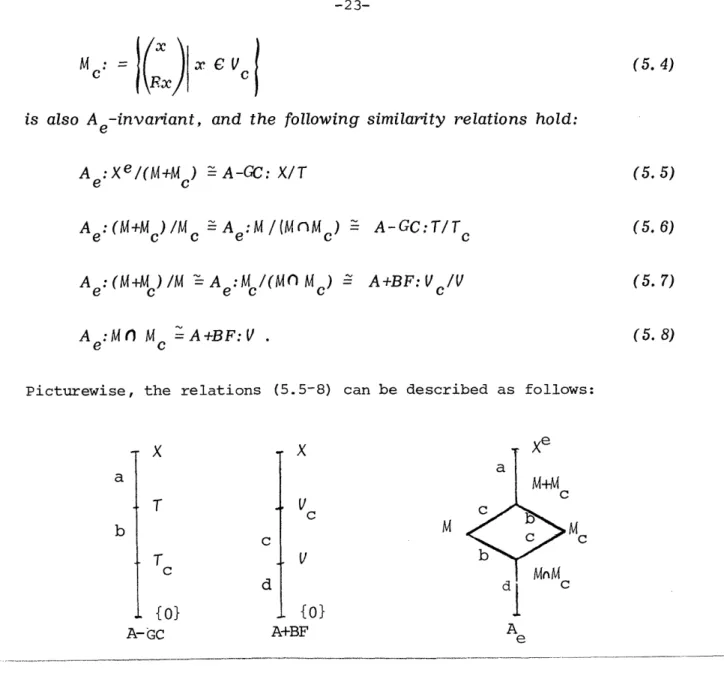
-23-Mc: = (
X
x
V
(5.
4)
is also Ae-invariant, and the following similarity relations hold:
Ae:Xe/(M+Mc)
A-GC: X/T
(5. 5)
Ae: (M+Mc) /Mc
Ae:M /(MnMc)
A-GC:T/T
(5. 6)
A
:(M+Mc)
/M
A :Mc/(M
Mc)
A+BF:Vc /V
(5. 7)
A :Mn M
=A+BF:V
.
(5. 8)
Picturewise, the relations (5.5-8) can be described as follows:
X
-
X
T Xe
a
a
M+M
v
b
M
M
c
c
C
T
IV
b
C
MnM
d
dMMC
{O}
{0}
A-GC
A+BF
Ae
Fig. 5.1 Regulator Construction
In order to translate data on a chain of (A,B)-invariant subspaces into
data on a feedback mapping, the following lemma is useful.
Lemma 5. 2
Suppose we have a chain of (A,B)-invariant subspaces
{O} = VC V C ..
C
..
V
CV
k= X.
Also, let mappings F. C-F( V.i)F(
V.
)
be given, for i = 1,... ,k.
Then there exists a mapping F CF(VI)n. .rF(Vk_1)
such that A-+BF:Vi/_
i i-l
l=V A+BF.i:Vi/
C i i-l
for all i C {...
,k.
i 1 2 2 k
Proof Select basis elements {xi ...1
,xn
l,Xl,...
, Xn2·..·x }____
x
x
.,x
,...,x ,.,xn
k1 1 2 nk
such that {x
1... ,x l,.
e,x
..
} forms a basis for V. for all
n'·
'".X'l, "
n. 1~1
. i .i
e
{1,...,k}. Define F by Fx. = F.x
1(i=l,...,k; j=l,...,n.).
Then F
j
1z 1satisfies the requirements.
To illustrate the proof, consider the block matrix representations for
the mappings A+BF. (i=l,...,k) and A+BF with respect to the selected basis:
* * · * * * · * * * * * \ ' .' * * * * ·
0 . .
~t·-
·
.... . 0· · O · · ·· · ' '
'
'
.
0.
.
0.
*
0
*
*
**0
*.
*
.
l
O
*
0I. ...
A+BF
A+BFk
A+BF
· ·
It is now not difficult to show that the necessary conditions derived in
the previous section are also sufficient.
Theorem 5. 3
The
algebraic regulator problem for the syostem (2.1-3) is
solvable if and only if there exist two compatible (C,A,B)-pairs (Tg VO)
and (T,V) such that
(i)
TOC T,
VOC V
(ii)
im EC TC 1VC ker D
(iii) (A.B) is stabilizable between V 0 and V and between V and X
-25-(v) V0 n (Xdet + Xstab) Xdet
Proof In view of Prop. 4.8, it remains to show the sufficiency of the conditions. Employing a preliminary static output feedback if necessary, we may assume that
AT
C V0 and ATC V (see Lemma 2.5 and the remarksfollowing it). It follows that there exists an F1 G F(V ) with ker F1
T
O. Using (iii) and lemma 5.2, we see that there exists anF e F(V0 )f F(V) such that ker F D
To
and G(A+BF:X/V 0 ) C g . Using(iv) and the dual of lemma 5.2, we find that there exists a G
e
G(TO)
G(T) such that C(A-,C:X/TO)
C C . Now we apply the compensatorcon-struction of lemma 5.1, using
T
0for
T
and X for V
.
The invariant
subspace
M
related to the pair (T,V) takes care of the disturbance
decoupling property, by condition (ii). From the relations (5.5-8),
we see that X(A )C M
nM =
{
(
x)x
e
VI. Consequently, PXe(A
s) C
D e
c
Rx
e
VC ker D and we have output stability.
In fact, we see from (5.8)
that dim
IX(Ae)
< dim VO . By condition (v), we have dim V0 <codim(X
+ Xs
)
+ dim
X
,and we conclude that the compensator
det stab det'
constructed above ieads to internal stability as well.
The proof is constructive once the pairs (ToV ) and (T,V) are
given. We shall now proceed to discuss how the existence of these pairs
can be verified by an algorithm that will also construct such pairs,
if they exist.
6. A Verification Algorithm
It may not seem easy to verify the conditions of Thm. 5.3 because
they are stated in terms of two (C,A,B)-pairs, which gives us four
variable subspaces. Without much effort, one can see that
T
Ocan always
be replaced by Xde
tand
T
by Tg(im E), but that still leaves us with two
variable subspaces.
It is possible to express the conditions in terms
of VO (as in [18] and [19]), but concentrating on V will lead to a
result that is more attractive from a numerical point of view. Before
we come to this, some preliminary work is needed.
Lemma 6.1
Let V be an (A,B)-invariant subspace, and let R be defined
by R
<A+BFIim B n V > (F
CF(Vl)).
(This defines R uniquely:
see Lemma 2. 2)
If V
7is an (A,B)-invariant subspace such that R
V
1C
V,
then V
7is (A+BF)-invariant for all F CF(V).
Proof
Take
F e
F(V), and F
0e
F(V1).
We have
(A+BF) V C (A+BF)V C
V,
but also
(A+BF)V1 C (A+BF
)V
1+ B(F-FO)V
1C
V
1+ im B.
Hence
(A+BF)V lC
V
(
(Vl+im B)
CV
1+RC
V
1.Lemma 6.2.
Let
V
0be an (A,B)-invariant subspace contained in a
subspace K.
The set of all (A,B)-invariant subspaces V contained in K
and containing
V0,
that are such that (A,B) is stabilizable between
V
0and
V,
contains a unique maximal element, which is given by
V
0+
V
*(K).Proof.
It follows immediately from Cor. 4.7 that (A,B) is stabilizable
between V
0subspace
with
and V
0+
V*(K).
C
K,
such that (AB)
Conversely, let V be an (A,B)-invariant
is stabilizable between
and
subspace with V
0C V c K, such that (A,B) is stabilizable between V and V.
-27-Then there exists an F e F(V ) () F(V) () F(V*(K)) such that a(A+BF:V/VO) C *. By lemma 6.1, we automatically have F e F(V*(K)) as well. Now,
g g
on the one hand,
O(A+BF:V/(V )(V (K) + V
)))
=g 0
=
c(A+BF: (V*
(K)
+
V)/(V*(K)
+
V
0))
c
C (A+BF: V* (K) /V (K)) C
b,
but on the other hand,
a
(A+BF:V/CV
(V*
(K)
+
V
)))C
(6.2)
C G(A+BF:V/V) C g . It follows thatc (A+BF:V/(V
(n
(V*
(K)
+
Vo)))
=
~
(6.3)
or,
VC
V*
(K)
+
V
0 .g
0
We can now re-formulate Thm. 5.3 as follows.
Thmin. 6.3 The algebraic regulator problem for the system (2.1-3) is solvable if and only if there exists an (A,B)-invariant subspace V such that
V C ker D (6.4)
V + X = X (6.5)
stab
V
)
(X
+X
b) = X
+ V*(ker D)
(6.6)
det stab det g
T*(im E) C V . (6.7)
Proof To prove the necessity, we assume that the conditions of Thm. 5.3 hold. So we have two compatible (C,A,B)-pairs (To,
V
) and(T,
V)
satisfying (i-v). We shall show that V0 + V* (ker D) satisfies0 g
the conditions (6.4-7). From (i) and (ii) we immediately have (6.4), (6.5) follows directly from (i) and (iii) with use of lemma 2.3, and (6.7) is obtained from (ii) and (iii) by an application of lemma 6.2. Finally, the obvious fact that V* (ker D) C X + X entails, by
g det stab condition (v), (V + V*(ker D)) n (Xd + X
)
= (6.8)g
(det
stab
=
V
f
(X
+X
+V*(ker D)
= 0 det stab g = X + V*(ker D) det gFor the sufficiency, we note that X C
T*
(im E) C V C ker D, and det gwe consider the chain of (A,B) - invariant subspaces {0} C XdetC Xdet + + V*(ker D) C V C X. Cor. 4.7 shows that (A,B) is stabilizable between
g
X and X + V*(ker D), and (6.5) shows that (A,B) is also stabilizable
det det g
between V and X. By lemma 5.2, there exists an F e F(X )F)F(X +V g(ker D)) det det 9g
_1 F(V) such that ker F XdeX t (A+BF:(X + V* (ker D))/Xdet ) C and
det'det g det g
C(A+BF:X/V) C C . Now, define V0 by
V
0 = Xb(A+BF) . (6.9)It is clear that Xde
tC V
C
,
and also that V
0(Xd + V*(ker D)) =
det 0 0 det g
Xde
t .Using (6.6) we see that condition (v)of Thm. 5.3 is satisfied.
We also see that (iii) holds. The other conditions are easily verified,
defining
T
O= X
0 detand T
=
T*im E).
g
-29-The following slight variation of this result will be useful.
Corollary 6. 4- The algebraic regulator problem for the system (2.1-3)
is solvable if and only if
V*(;er
D) + Xstab = X
(6.10)
and there exists an (A,B)-invariant subspace V such that
V c V,*(ker D)
(6.11)
V + (Xdet + (V*(ker D)
Xstab)) = V*(ker D)
(6.12)
V
(r
(Xdt
+
(V
*(ker D)
Xstab))
=X
de
+ V*(ker D)
(6.13)
T* (im E)C V
(6.14)
g
Proof. Necessity: (6.10) follows from (6.4) and (6.5), (6.12) is obtained
by intersecting both sides of the equality in (6.5) with
V*(ker D), and
(6.13) is obtained in the same way from (6.6).
Sufficiency:
for (6.5),
add
Xstab
on both sides of (6.12) and use (6.10).
Note that
Xde
tC V
by (6.13) (or (6.14)), and consequently
V
)(Xde
t+
(V*(ker D)
X
sta))
=
(6.15)
Xdet
+ (
Xstab
)=
=det
+ Xstab
Now use (6.13) again to obtain (6.6).
We see from Thm. 6.3 that the subspace
V
that we are looking for
must be in between X
+ V*(ker D) and V*(ker D), and the advantage of
the corollary is that the crucial conditions
(6.12-13) are formulated
in terms of these subspaces and of another subspace
that is in between the
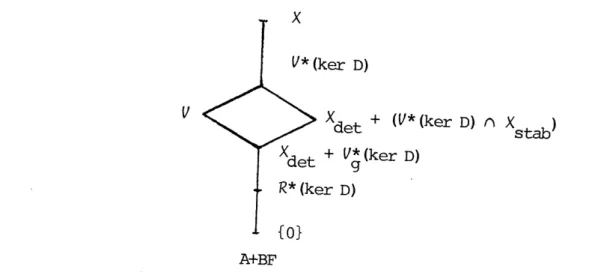
two, Xdet + (V*(ker D) / Xtab). Picturewise,
the situation we are trying
to establish looks as follows:
x
V*(ker D)
V
Xdet + (V*(ker D)
n
Xstab
Xdt
+ V*(ker D)
det
g
R*(ker D)
{}
A+BF
Fig. 6.1 The Split-Off Property
The important point to note here is that we are talking
about
(A,B)-invariant subspaces that all contain the subspace
R*(ker D): = <A+BFlim B
l
V*(ker D)> (F
e
F(V*(ker D)))
(6.16)
and which are therefore, by Lemma 6.1, all invariant
for each F
e
F(V*(ker D)).
This means that we can pick any F
e
F(V*(ker D))
and see if a subspace
V can be 'split off' as depicted in Fig. 6.1.
This comes down to requiring
that the subspace
(Xd
+ (V*(ker D) ) Xstab))/(X
+ V*(ker D))
(6.17)
must decompose the quotient space V*(ker D)/(Xdet
+ V*(ker D)) with respect
det
g
-31-to the mapping induced by A+BF on this space. This is well-known to be equivalent to a linear matrix equation (see for instance [2], p.21). The conclusion that we have now reached should be compared to Thms. 7.3 and 7.4 in [2]. In particular, the problem is trivial under the minimum phase condition V*(ker D) = V*(ker D) ( Xstab: in this case, the only
g
solution of (6.11-13) is V = V*(ker D). (This condition is often
assumed in classical control theory, be it not quite in this formulation.) To obtain a computational criterion, we may proceed as follows. Noting that it is necessary that Xdet C V*(ker D), we may set up a basis for X that is adapted to the chain of subspaces {O} C X + V*(ker D) C
det g
C Xdt + (V* (ker D) C' X tab) C V*(ker D) C X. Next, we form block matrix
det stab
representations for the relevant mappings and subspaces. We get
11 A12 A13 14 1T
A022
A23
A24
A O A22 A23 A24 \ BB= ,
T*
(im E) = sp4o
o
A33 A34 T341 A42 A43 A B T
(6.18) Here, the fact that A = 0 and A31 = 0 is explained by noting that
A(X + V*(ker D)) n V*(ker D) C det g
C (X + V*(ker D) + im B) () V* (ker D) C
C Xdet Ug~ker D) + (im g B (ker D)) (6.19) CX + V*(ker D) + (im B n V*(ker D)) =
det g
X + V*(ker D) det g
The same explanation goes for A32 = 0. We used the fact that im B / V*(ker D) C Xdet + V*(ker D), which also entails B2 = 0 and
B3 = 0.
A subspace V satisfies (6.11-13) if and only if it can be repre-sented, with respect to the selected basis, in the following way:
V = sp(
0
I
(6.20)0 /
where X may be any matrix of suitable size. Such a subspace is (A,B)-invariant, by Lemma 2.1, if and only if there exist matrices Q and R such that
0
A1
2X
+
A
2 3)
1 2)0
A
30
I
41
A4
2X + A
430
0/
\
4(6.21)
By elementary calculations, and using the fact that there exist, by the (A,B)-invariance of V*(ker D), matrices Fi such that A4i + B4Fi = 0 (i=l,...,3), we find that such matrices Q and R exist if and only if
A22X + A23 = XA33 (6.22)
(This is, of course, Sylvester's equation ([2], p.21).) Furthermore , the condition (6.14) holds if and only if there exists a matrix S such that
-33-T
1I
0
T
30
X
T 3
0I
1)
(6.23)
T
40
0
This is true if and only if T
4=
0 and
T2 = X T3 . (6.24)
Our conclusion is as follows.
Corollary 6. 5.
The algebraic regulator problem for the system (2.
1-3)
is solvable if and only if the following conditions hold.
V * (ker D) + Xstab = X
(6.25)
T* (i m E)C V * (ker D)
(6. 26)
g
and there exists a matrix X satisfying
XA 33 - A22
XA 23
(6. 27)
XT
3= T
2(6. 28)
where the A- and T-matrices are defined as in (6. 18).
For any
F e
F(V*(ker D)), A
3 3is the matrix of
A+BF:
V*(ker D)/(Xde
t+ (V* (ker D) /
X sta)
(6.29)
A+BF: (Xdt
+(V*(ker D)
X
))/(X
+
V*(ker D)).
(6.30)
det
stab
det
g
Under the conditions (6.25-26), the mapping in (6.29) is similar to
A:X/(Xde
t+ Xstab), and so we can say that A33 represents the signal
dynamics.
In view of the interpretations of section 3 and of [2],
Section 5.5, the eigenvalues of the mapping in (6.30) may be identified
as the relevant unstable plant zeros. In particular, since we know
that the equation (6.27) has a unique solution if and only if the matrices
A22 and A33 have no eigenvalues in common ([26], p.225), we can say that
a sufficient condition for (6.27) to be solvable is that the signal poles
and the relevant unstable plant zeros are distinct.
It should be emphasized that quite a bit of numerical techniques
are available to verify the conditions (6.25-28). The computation of
V*(ker D) and related subspaces and mappings is discussed from the
numerical point of view in [20-22].
The equation (6.27) can be
solved efficiently, at least in the case where the eigenvalues of A
2 2and A
33are distinct, by the method of [23].
Note that the size of
A22 is the number of unstable plant zeros whereas the size of A33 is
the number of signal poles, and both numbers will be moderate in very
many situations. Finally, if (6.27) has a unique solution, then (6.28)
is just a matter of checking .
All this gives hope that the solution
provided by Cor. 6.5 will be a good foundation for developing numerical
-35-7. The Internal Model
Francis [7] proved that, in the special case where the output is the same as the observation (C=D), any compensator that solves the algebraic regulator problem must contain a copy of the signal dynamics, the so-called "internal model". A similar result was derived by Bengtsson [8] in a frequency-domain
setting. Another form of the internal model principle, which involves a certain reduplication of signal dynamics, can be derived from strong robustness
requirements: see [2], Ch. 8. Below, we shall show how the internal model can be obtained from the set-up presented here. Our result is slightly more general than that of Francis.
Proposition 7. 1. Suppose that the compensator (2. 4-5) provides a solution
to the algebraic regulator problem for the system (2.1-3), in which ker DC ker C. Then there exists an A c-invariant subspace W0 of W such that A :WO is
similar to A:X/(Xdet + Xstab
Proof Write To Q A V = PX(Ae) We first show that TO = Xdet .
Being a (C,A)-invariant subspace in V0 C ker D C ker C,
T
O must in factbe A-invariant. So we have To C <ker CIA>. It is easily checked that
Q(<ker CIA>) is A -invariant and that Q intertwines A: <ker CIA> and A : Q(<ker CIA>). From this, it follows that To = Xdt
From Prop. 4.8, Lemma 2.3, and the formulation of internal stability in (3.7), we see that
dim
VC
= dim LV(A .. (7.1)Xb(Ae ) = {(LX)l
e
V
. (7.2)Because V0 C ker D C ker C, we have, for x
e
V0,
e A Lx
Al)
/(A+B
cFcL)x
eX(A
(7.3)Writing F: = F L, we find that (A+BF )V0 C VO and A cLx = L(A+BF )x for x
e
V
0 . This means that W0: = im L is A -invariant, and that A :Wsimilar to A+BF :V /(ker L). Because ker L = Q Xb(A)e = Xdet, it remains
to show that A+BF :Vo/Xdet is similar to A:X/(X det+X tab). By Prop. 4.8
and Lemma 2.3, we have
0 0 det(74)
A+BF
0:
VO/(VO -
(Xdet
+Xstab))
A+BF: (V +(X + X ))/(X + X =
0 0 (det stab (det stab
A:X/(Xdet + Xstab
This concludes the proof.
The internal model principle does not have to hold if there are observations available that are independent from the output (ker D ¢ ker C). Indeed, the disturbance decoupling problem may be solvable in non-trivial cases, and then any relation between the compensator dynamics and the disturbance dynamics is quite effectively precluded, since we did not make any assumption on the dynamics of the disturbance entering through E. The point is, of course, that the availability of observations independent from the output allows for a certain freedom of design, which may be used to advantage.
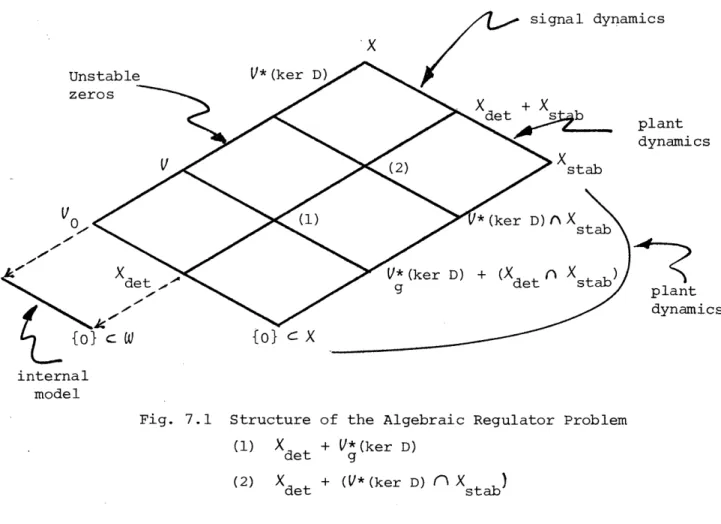
-37-The often-used assumption C=D is to be considered as a serious specializa-tion. Let us conclude by showing, picturewise, how the internal model fits into the structure discussed in previous sections:
~/ //~ signal dynamics Unstable V*(ker D) zeros / /~ / t + plantb dynamics V 0< < (ke r D)
X
sO
*(ker D) + (X np
sIaD/ plant dynamics{o} cW
{o)
c
X
internal modelFig. 7.1 Structure of the Algebraic Regulator Problem (1) X + V*(ker D)
det g
(2) Xdet + (V*(ker D) Xstab)
In this picture, only the presence of the internal model depends on the assumption ker D C ker C; all the rest holds in general.
8. Conclusions
We have been able to solve a general version of the algebraic regulator problem, requiring output stability, internal stability, and disturbance decoupling as well. The basic Thm. 5.3 has been derived in a quite straight-forward way, using material that is essentially elementary, as it is also likely to be useful for the analysis of other feedback design problems. Among this material, especially useful are lemma 4.1, which gives the connection between closed-loop invariant subspaces and (C,A,B)-pairs, and lemma 4.4, which adds the stability aspects to this connection. On the constructive side, the versatile compensator construction of Lemma 5.1 is important, and the 'paste-together' lemma 5.2 comes in handy. The main drawback of the results that we get from this type of analysis, like Thm. 5.3, is that the solvability condition involves the existence of a number of (C,A,B)-pairs having certain properties, so that it remains to be seen how this condition is going to be verified. For some problems, it is possible to have canonical choices for the (C,A,B)-pairs in terms of computable subspaces like Xet'
T*
(im E), etc. (Examples of this aredet' g
the disturbance decoupling problem with stability ([27], [28], [19]), which is obtained as a special case of the problem treated here by taking
X = X, or the regulator problem under the minimum phase condition..) stab
For the general problem under hand, this turned out to be not completely possible. It was possible, however, to select one pivot subspace in which the solvability condition could be expressed (Thm. 6.3), and to
derive a computational criterion for this subspace (Cor. 6.5) which also had a geometric interpretation as a decomposability condition. In this way, we obtained a fully effective solution.
-39-Life was also made somewhat easier by the use of the subspaces Xtab and Xdet rather than the subspaces <Alim B> and <ker CIA> which were
em-ployed in [1] and [2]. There is a clear parallel here with the recent trend in transfer matrix analysis to use factorizations in stable rationals instead of polynomials (see for instance [12] and [14]).
The ultimate goal in solving the regulator problem is to identify the essential properties that not only determine when the problem is
solvable for a given system, but that also lead to a concept of 'closeness' of systems. This concept should enable one to set bounds for the deteriora-tion of performance when the given system is replaced by another one that is 'close' to it, while the controller remains the same. Other concepts that will inevitably enter the discussion include a measure of performance, a notion of distance between controllers, system sensitivity, and controller robustness. Ideas like these are, of course, to be found in the classical control literature (gain margin, phase margin, steady-state error, minimum phase, etc.) and there is also important recent work on the subject (see
[29], for just one instance), but there are still quite a few issues to be cleared up. The context here is analytic rather than algebraic; never-theless, as emphasized in the introduction, studying the algebraic problem should give us a a lead.
This, in turn, may be used as an argument as to what algebraic approach should be preferred. We have used the state-space method here,
and we have built our most concrete results on explicit matrix representations. One might object that a large amount of arbitrariness and irrelevance is
introduced by the choice of basis, and, moreover, there seems to be no way to compare systems of different order. The transfer matrix approach seems to offer better perspectives. However, the objective is to cut out as much
Appendix
The purpose of this appendix is to prove that the algebraic regulator problem in our formulation is a strict generalization of the regulator problem with internal stability as studied in [1] (also [2], Ch. 7). In fact, RPIS
is obtained from the problem solved here by setting E=O in (2.1).
Proposition A. Consider the system (2.1-3) with E set equal to zero. The algebraic regulator: problem is solvable if and only if RPIS is solvable in the sense of [1], i. e., if there exists a feedback mapping F: X- U such that
ker F D <ker C JA > (A. I)
Xb(A+BF) 0 (<Alim B > + <ker CIA>) C <ker C IA> (A. 2)
Xb (A+BF) c ker D. (A. 3)
Proof. First assume that there exists an F such that (A.1-3) is true, and write V0 = Xb(A+BF). We shall show that V0 satisfies the conditions of
Thm. 6.1. Note that condition (ii) of this theorem becomes subsumed
under condition (iv) in the special case E=0. It is clear that conditions (i) and (iii) hold (Xb(A+BF) is outer-stabilizable, of course). Also, it follows from (A.l) that <ker CIA> is (A+BF)-invariant, and that
XdetC Xb(A+BF). So we get XdetC V0 f (Xdet + stab) To prove the
reverse inclusion, note that (A.2) is equivalent to
o(A+BF :(<AIim B> + <ker CIA >) /<ker C I A>) C Cg (A.4)
CY
o(A+BF:<AIim B>/(<AIim B>
n
<ker CIA>))C Cgt- Xb (A+BF) n <Ajim B> C <Alim B> n( <ker CIA>