HAL Id: hal-02753269
https://hal.inrae.fr/hal-02753269
Submitted on 3 Jun 2020HAL is a multi-disciplinary open access archive for the deposit and dissemination of sci-entific research documents, whether they are pub-lished or not. The documents may come from teaching and research institutions in France or abroad, or from public or private research centers.
L’archive ouverte pluridisciplinaire HAL, est destinée au dépôt et à la diffusion de documents scientifiques de niveau recherche, publiés ou non, émanant des établissements d’enseignement et de recherche français ou étrangers, des laboratoires publics ou privés.
Lucie Sirieix, Hervé Remaud
To cite this version:
Lucie Sirieix, Hervé Remaud. Exploring wine list design strategy in french restaurants. 5. Inter-national conference of the Academy of wine business research, Feb 2010, Auckland, New Zealand. �hal-02753269�
1
Exploring wine list design strategy in French restaurants Lucie Sirieix and Hervé Remaud Contact: [email protected] Abstract The aim of this study is to better understand restaurant owners’ strategies when selecting wines to be offered on a wine list. The study is based on a survey with 68 restaurant owners in France, using the Best‐Worst approach. Results show that restaurateurs have in mind a set of strategies underlying wine list design, including: ‘Preference for local wine product’, ‘Tastes good’, ‘Matching wine with food menu’, and ‘Competitive price fit for the price range of food’. More market‐driven strategies such as choosing ‘Popular wines’ or ‘Highly reputed brand’ are not considered to be as important. Further investigations reveal minor differences in the wine menu strategies for different types of restaurant. Keywords Wine list. Restaurants. Strategy. Wine Marketing. Best‐Worst. Topic aeras Wine marketing. Strategy.2
Introduction In most western‐style restaurants, wine sales contribute to a large part of the restaurant’s offering and profitability. While wine is an important component of the business, the question remains about which wines are best to be included in the wine list. To date, very little attention has been paid to explaining the key objectives of the restaurant owners when selecting wines to be offered on a wine list. To our knowledge, no study has ever been conducted in France on the strategies or reasons for the selection of wines a restaurant owner wants to offer on a wine list. Based on a survey of 68 restaurant owners / managers in France, this paper aims to provide a better understanding of these strategies using Best‐Worst methodology. The first section reviews the key studies conducted on this topic, followed by a description of the research design used to assess the most important objectives of the owners when selecting wines for their wine list. The results comparing wine list strategies are then presented and discussed.Literature Review
Factors affecting wine sales in restaurant
In a study investigating 52 up‐market Spanish restaurants located in Valencia, Gil, Ruiz and Berenguer (2008) and Berenguer, Gil and Ruiz (2009) pointed out that owners mainly considered the wine list as an instrument to improve customer satisfaction, increase restaurant value and provide prestige to the restaurant. Their exploratory study indicates that an excellent wine list should be: ‘easy to use’, ‘easy to change’, ‘varied’, ‘extensive’, ‘specialised’, ‘imaginative’ and ‘selective’. Moreover, a good wine list needs to be refreshed on a regular basis and the success of wine sales in a restaurant is partly based on the knowledge that both restaurant owners/managers and sommeliers possess about wine. In that vein, Gultek, Dodd, Guydosh (2006) found a small positive relationship between the attitude towards wine‐service training and the amount of wines sold (using a sample of 152 restaurants located in Texas). Dewald (2008) confirmed such an assumption, finding that restaurants using a sommelier tend to have their clients spend relatively more for wine. Dewald (2008) also found that more wines are ordered in smaller restaurants confirming Manske & Cordua’s (2005) findings.
Dodd (1997) and Wansink et al. (2006) found that wine sales can be increased if the restaurant recommends food‐wine pairing. Using a twelve‐week field experiment in a restaurant, Wansink et al. (2006) estimated that wine‐food pairing recommendations increased wine sales of the targeted wines by 44.5% while the promotion of five wines increased the sales of the promoted wines by 39%, and the opportunity to taste five wines before the meal increased sales of the targeted wines by 47%.
These few studies mainly identified the factors influencing wine sales, but very little is known about a restaurant owner’s strategy for the selection of the wines to be offered on the list.
3
Criteria used to design a wine listRestaurant owner’s preference
Gil, Ruiz and Berenguer (2008) suggested that the wine list is mainly a very personal instrument as a result of a combination of wine appreciation, innovation and risk, used by the restaurant owner for projecting the restaurant image. The wines on the list may be chosen because they are seen to reflect the restaurant’s style of food and personality (Corsey, 2006).
Food and wine pairing creates a synergistic relationship to heighten the gastronomic experience beyond what would be possible as separate offerings (Harrington, 2005; Hilton, 1998). Food and wine pairing recommendations can reduce the uncertainty / embarrassment that consumers may experience when selecting a wine (Wansink et al., 2006).
The ability to maximize profit is an important consideration for any restaurant owner (Alley, 2004). Wine usually has higher mark‐up than food in restaurants. As a result, wine is an important profit‐ centre for restaurant owners, who will pay great attention to the price range of their wine list (Walker, 1998) and choose the wines that have good ‘value‐for‐dollar’ (Alley, 2004).
Some restaurants decide to support their local wine industry by offering local products (Thorsen and Hail, 2001). Such a regional strategy and local networks can attract more visitors and benefit both the restaurant and wineries (Hall, 2003). A large selection of local wines might give a special, regional emphasis to a restaurant wine list. Tourists may enjoy sampling local wines or dishes, and residents are often eager to support their community by eating and drinking local food products (Gultek, Dodd and Guydosh, 2005).
Market‐driven choice
Another way to improve consumer satisfaction is to offer popular wines that restaurants can sell easily, or well‐known or highly reputed wine brands on the wine list. According to Hall, Lockshin, O’Mahony (2001), wine brand is considered to be very important to consumers across dining occasions.
The relationship with a wine supplier can be crucial to the success of a wine list. Gultek (2003) conducted a research on 152 restaurants in Texas and results showed that, wholesalers were the major suppliers of wine to restaurants. In fact, for the significant majority of the restaurants, wholesalers were the only wine suppliers used. Only 6.8% of restaurants purchased wine directly from wineries.
Research design
Wine List Design Strategy
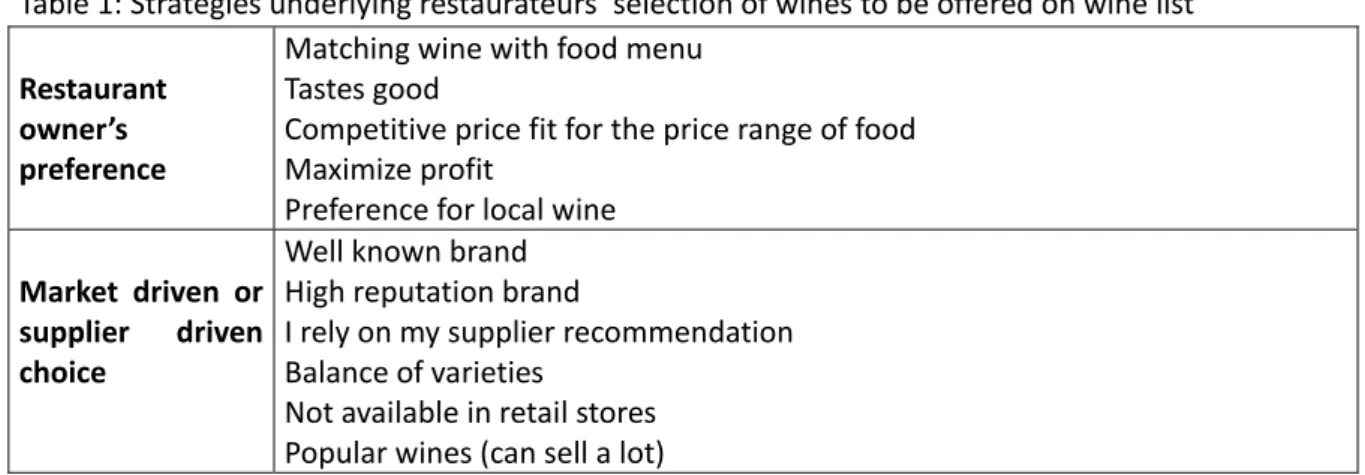
From the literature review, we identified several potential strategies underlying wine list design. These strategies have been classified as driven by the restaurant owner and/or market‐driven. Restaurateurs may use single or multiple strategies when making selections for their wine list. These
4
potential strategies are presented in the following table. Table 1: Strategies underlying restaurateurs’ selection of wines to be offered on wine list Restaurant owner’s preference Matching wine with food menu Tastes good Competitive price fit for the price range of food Maximize profit Preference for local wineMarket driven or supplier driven choice Well known brand High reputation brand I rely on my supplier recommendation Balance of varieties Not available in retail stores Popular wines (can sell a lot) Best‐Worst methodology
A face‐to‐face questionnaire was designed to assess the most vs. least important objectives of the restaurant owners when selecting wines for the wine list. Best‐Worst approach has been very successfully used in the wine marketing field (Cohen, 2009), especially within a restaurant context (Cohen, d’Hauteville and Sirieix, 2009). A Youden type of balanced incomplete block design was used, including 11 different strategies. The restaurant owners had to choose from each set (see Table 2), representing one of the 11 strategies, the options they considered most and least important in their choice of wine, respectively. Table 2: Example of a choice task
Least important Choice criteria Most important
1 Matching wine with food menu
× 2 Popular wines
3 I have read about the wine
4 Preference for local wine product ×
Each item appears the same number of times as every other item. Raw scores have been standardized into a 0‐100 scale with the highest best‐worst score of 100 used to standardize all other scores on the same scale.
Sample
We have elected to study the choice of wine by restaurant owners in France. Although this is an increasingly frequent consumption situation 1, restaurant consumption and more precisely wine consumption in restaurants is a subject that has been somewhat neglected by studies in France (Cohen et al., 2009). To our knowledge, no study has been conducted on the choice of wine by restaurant owners in France. Data from sixty‐eight restaurants located in various French towns including Montpellier, Toulouse, Paris and Lyon was collected in March‐April 2009.
1
5
Main results: Wine lists design strategiesImportance given to the different criteria by the best‐worst method
There are four particular strategies that are most important for restaurant owners when designing their wine list (scores obtained for these strategies are not significantly different): ‘preference for local wine product’ (using standardized scores affected this strategy a 100% probability to be chosen as most important), ‘tastes good’ (with a probability of 99.4%), ‘matching wine with food menu’ (with a probability of 85.4%), ‘competitive price fit for the price range of food’ (with a probability of 81.3%). All other potential strategies are clearly seen as least important (Table 3). Table 3: Most vs. Least important strategies used by restaurant owners to select wines Strategies Standardized score Mean Homogeneous Groups 4. Preference for local wine product 100.0 1.7647 X 9. Tastes good 99.4 1.6912 X 1. Matching wine with food menu 85.4 1.2794 X
7. Competitive price fit for the price range of food 81.3 1.2206 X 10. Balance of varieties 31.3 ‐ 0.4706 X 6. I rely on my supplier(s) recommendation 31.3 ‐ 0.4706 X 8. Maximize profit 27.0 ‐ 0.6471 X 2. Well known / popular brand 24.8 ‐ 0.7500 X 5. Popular wines 24 ‐ 0.8088 X X 11. Not available in retail stores 24 ‐ 0.8088 X X 3. Highly reputed brand 0.0 ‐2.000 X
BONFERRONI Comparison of means: 3 groups in which the means are not significantly different from one another. Critical T Value: 3.331; Rejection Level: 0.050. Critical Value for Comparison: 1.2394; Standard Error for Comparison: 0.3721
Discussion: understanding wine lists design strategies
Results show that restaurateurs have in mind a set of strategies underlying wine list design including: ‘Preference for local wine product’, ‘Tastes good’, ‘Matching wine with food menu’, and ‘Competitive price fit for the price range of food’. The most important strategies underlying wine list design are more driven by the restaurant owner’s choice than being market‐driven as such. Indeed, more market‐driven strategies such as choosing ‘Popular wines’ or ‘Highly reputed brand’ are not considered as so important. Within the restaurant owner’s strategies classification, ‘maximize profit’ is the only one to be considered as not important, compared to the set of important strategies. This surprising result may be driven by a desirability bias (Hermann et al., 1998).
6
Our findings are consistent with the results of the study by Cohen, d’Hauteville, and Sirieix (2009) conducted with Australian, UK, and French wine consumers in which respondents selected ‘match with food’ and ‘already tasted it’ as the most important criteria to select a wine on the list (and ‘waiters’ recommendations’ in France).Further investigations indicate minor differences in the strategies supporting wine list design for different restaurants. We found that the larger the restaurant, the higher the score for ‘Preference for local wine product’. Having a cellar to stock the wine might be the major contributor to higher score for the following strategies: ‘Matching wine with food menu’, ‘Preference for local wine product’, ‘Tastes good’. The restaurateur placing a higher emphasis on the extent to which the wine is important to the sales of the restaurant has a positive effect on the strategy ‘Tastes good’. On the other hand, the lower the importance of wine on the total sales of the restaurant, the higher the score for ‘Competitive price fit for the price range of food’. The style of the restaurant does not affect the ranking of these strategies. The key implications for any wineries would be to focus on its local food service market and develop a clear understanding of what is offered on the food menu.
These findings suggest that restaurant owners and managers prefer dealing with ‘proximity wines’ that can fit better with dishes reputed from a specific geographical region (so matching wine with food). Our findings mainly reinforce Thorsen and Hail (2001) results but it is unclear if such a strategy aims to support the local wine industry by offering local products or if the local wines fit much better with the food offerings of the restaurant.This could be particularly true in France where almost all regions are reputed for specific food products and dishes 2.
This exploratory study has a few limitations intrinsic in any exploratory study. The sample is quite small, not representative of the population and includes only independent restaurants. Further study with different types of restaurants is thus needed.
Conclusion
Deciding which wines will be offered on the wine list is a complex task. Our results indicate that restaurant owners’ wine list design strategies are more restaurants owner–driven than market‐ driven. Restaurateurs try to find a good balance between four strategies: a preference for local wine product, the fact that the wine tastes good, making sure that wines will match the food menu and also that the wine fits with the price range of the food. This reinforces the idea that a strong relationship between the winery and the restaurant is a key to success in the competitive wine food service market.
2
Another reason may be the logistics and suppliers flexibility, because a restaurant has no interest in stocking quantities. A qualitative survey is needed to better understand the reasons underlying the restaurant owners’ choices.