JON 2949
Marcel Arnold
Michael Halpern
Niklaus Meier
Urs Fischer
Tobias Haefeli
Liliane Kappeler
Caspar Brekenfeld
Heinrich P. Mattle
Krassen Nedeltchev
Age-dependent differences in
demographics, risk factors, co-morbidity,
etiology, management, and clinical
outcome of acute ischemic stroke
Introduction
Stroke in young adults is rare. The majority of strokes in
the younger age group are cerebral infarcts, and their
etiologies are manifold and often remain undetermined
[1–3].
Clinical functional outcome has been considered
more favorable and survival rates are higher in younger
than in older individuals, but severe and fatal strokes
may occur at any age and co-morbidities have not been
systematically analyzed in previous studies [1].
In recent years, new insights in stroke epidemiology,
aetiology and prognosis in young stroke patients have
been gained [4–7]. However, comparisons between
younger and older patients with ischemic stroke
includ-Received: 2 September 2007
Received in revised form: 26 February 2008 Accepted: 26 March 2008
Published online: 28 July 2008
M. Arnold, MD (쾷) · M. Halpern · N. Meier · U. Fischer · T. Haefeli · L. Kappeler · H. P. Mattle · K. Nedeltchev Dept. of Neurology University Hospital Inselspital Freiburgstrasse 3010 Berne, Switzerland Tel.: +41-31/632-3332 Fax: +41-31/632-9679 E-Mail: [email protected] C. Brekenfeld
Dept. of Diagnostic and Interventional Neuroradiology
Inselspital University of Bern Bern, Switzerland
■
Abstract
Background
Compari-sons between younger and older
stroke patients including
morbidities are limited.
Methods
Prospective data of consecutive
pa-tients with first ever acute ischemic
stroke were compared between
younger (≤ 45 years) and older
pa-tients (> 45 years).
Results Among
1004 patients, 137 (14 %) were ≤ 45
years. Younger patients were more
commonly female (57 % versus
34 %; p < 0.0001), had a lower
fre-quency of diabetes (1 % versus
15 %; p < 0.0001),
hypercholesterol-emia (26 % versus 56 %; p < 0.0001),
hypertension (19 % versus 65 %;
p < 0.0001), coronary heart disease
(14 % versus 40 %; p < 0.0001), and
a lower mean Charlson
co-morbid-ity index (CCI), (0.18 versus 0.84;
p < 0.0001). Tobacco use was more
prevalent in the young (39 % versus
26 %; P < 0.0001). Large artery
dis-ease (2 % versus 21 %; p < 0.0001),
small artery disease (3 % versus
12 %; p = 0.0019) and atrial
fibrilla-tion (1 % versus 17 %; p = 0.001)
were less common in young
pa-tients, while other etiologies (31 %
versus 9 %; p < 0.0001), patent
foramen ovale or atrial septal
de-fect (44 % versus 26 %; p < 0.0001),
and cervical artery dissection (26 %
versus 7 %; p < 0.0001) were more
frequent. A favorable outcome
(mRS 0 or 1) was more common
(57.4 % versus 46.9 %; p = 0.023),
and mortality (5.1 % versus 12 %;
p = 0.009) was lower in the young.
After regression analysis, there was
no independent association
between age and outcome
(p = 0.206) or mortality (p = 0.073).
Baseline NIHSS score (p < 0.0001),
diabetes (p = 0.041), and CCI
(p = 0.002) independently predicted
an unfavorable outcome.
Conclu-sions Younger patients were more
likely to be female, had different
risk factors and etiologies and
fewer co-morbidities. There was no
independent association between
age and clinical outcome or
mor-tality.
■
Key words stroke · outcome ·
ing risk factors, extensive diagnostic investigations to
determine etiology, management, co-morbidities, and
outcomes are still limited. Therefore we aimed to
com-pare younger and older patients with first-ever ischemic
strokes in a large cohort of consecutive patients.
Methods
The study sample included consecutive patients older than 16 years who suffered a first ever acute ischemic stroke and had been admitted to The Berne Stroke Unit from January 2000 to July 2006. Our Univer-sity Hospital-based Stroke Unit has a catchment population of about 1.5 million.
Data were collected prospectively and entered continuously in the hospital-based Bernese stroke database.
Stroke was defined according to the World Health Organization criteria as an acute focal neurological deficit with symptoms lasting longer than 24 hours [8]. Clinical data of some patients were reported previously [3].
All patients underwent a standard investigation protocol imme-diately upon admission, includingblood tests (determination of red cell, white cell and plateletcounts, prothrombin time, activated partial thromboplastin time, serum electrolytes, glucose, urea, creatinine, transaminases, and cholesterol levels),12-lead ECG, cranial computed tomography (CT) and/or conventional magneticresonance imaging (MRI) (1.5 Tesla system providing axial T1,T2, and proton density weighted images, and gadolinium- enhanced T1-weighted images. All patients were investigated by neurovascular ultrasound or magnetic resonance angiography (MRA) or digital subtraction angiography (DSA) of the brain supplying arteries upon admission or during their hospital stay. Thefollowing ancillary investigations were carried out at thediscretion of the treating stroke neurologist: a search for vascu-litis(including C reactive protein, erythrocyte sedimentation rate, antinuclear antibodies, and antiphospholipid antibodies), transtho-racicechocardiography, transesophageal echocardiography, 24-hour ECG monitoring,cervical MRI with fat suppression technique, diffu-sion-weighted and perfudiffu-sion-weighted MRI. We assessed etiologic stroke subtype according to the TOAST criteria (trial of ORG 10172) [9]. The frequency of atrial fibrillation, cervical artery dissection, fo-ramen ovale or atrial septal defect and atrial septal aneurysm (in pa-tients undergoing TEE), coagulopathy and vasculitis were analyzed separately.
In addition infarctions were categorized according to the Oxford-shire Community Stroke Project (OCSP) classification [10]. The fol-lowing risk factors were assessed: sex, hypertension(defined by pre-admission history and medical records), diabetesmellitus (fasting venous plasma glucose values ≥ 7.0 mmol/l on at least two separate occasions, and/or ≥ 11.1 mmol/l 2 hours after intake of 75 g of oral glucose and on one other occasion during the2 hour test, or pread-mission history of diabetes), current cigarette smoking, hypercholes-terolemia(total venous plasma cholesterol concentration >5 mmol/l), and coronary heart disease.
Pre-existing co-morbid conditions were assessed using the Charl-son Co-morbidity Index (CCI) [11]. The term “myocardial infarction” was replaced by “coronary heart disease” proved by coronary angiog-raphy or electrocardiogangiog-raphy [12]. The severity of the neurological deficit was assessed at admission by a neurologistusing the National Institutes of Health Stroke Scale (NIHSS) [13].
Antithrombotic therapy and secondary prevention was per-formed according to a standardized protocol similar to international guidelines [14, 15].
Clinical follow-up information of ischemic stroke patients was obtained by neurological examination (n = 307) or a structured tele-phone interview (n = 680) by different neurologists 3 months after stroke onset. The modified Rankin scale score (mRS) was recorded [16].
Seventeen patients (1.7 %) were lost to follow-up because they had moved or were living in foreign countries.
■ Statistical analysis
Statistical analysis was performed with SPSS 10 for Macintosh statis-tical software (2001; SPSS Inc). The following variables were analyzed and compared between younger (≤ 45 years) and older patients (> 45 years): gender; smoking; hypertension; diabetes mellitus; hypercho-lesterolemia; family history of stroke; NIHSS score on admission; Charlson Co-morbitidy Index; stroke etiology; intravenous and intra-arterial thrombolysis; antithrombotic treatment; overall frequency of transesophageal echocardiography (TEE), transthoracic echocar-diography (TTE), and 24-hour ECG; duration of hospital stay; dis-charge to home; 3 months functional clinical outcome; and mortal-ity.
For comparison of outcome we divided patients into two groups with favorable (mRS score 0 to 1) and non-favorable (mRS score 2 to 6) outcome. The χ2 test was performed for cross tabulation.
Mann-Whitney U test was used for non-categorical variables. Logistic re-gression analysis with a forward stepwise method was performed including the NIHSS score on admission and the variables that showed significant associations or trends (p < 0.20) with age when tested with univariate analyses, to determine an independent association be-tween age and functional outcome or mortality.
Results
Among 1004 patients with acute ischemic stroke, 137
(14 %) younger patients (≤ 45 years) and 867 (86 %) older
patients (> 45 years) were identified.
The mean age was 35.8 years (SD 7.3) in the younger
and 64.7 years (SD 9.9) in the older patients.
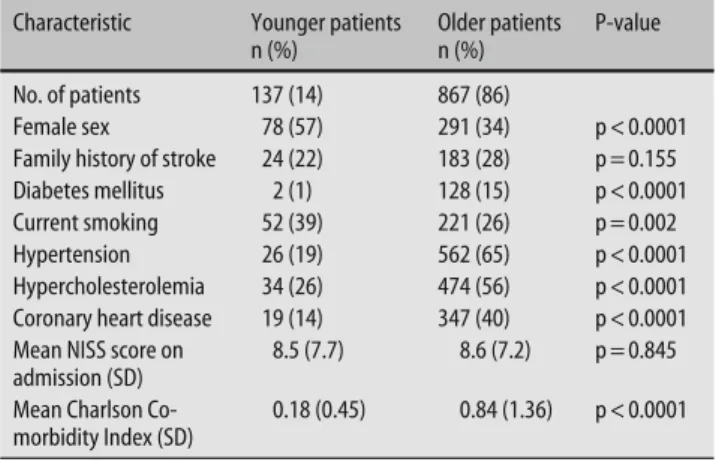
The percentage of women was higher in younger than
in older patients (57 % versus 34 %; p < 0.0001). Risk
fac-tors, stroke severity on admission and co-morbidities
are shown in Table 1: Younger patients had a lower
over-all frequency of diabetes mellitus (1 % versus 15 %;
p < 0.0001), hypercholesterolemia (26 % versus 56 %;
p < 0.0001), hypertension (19 % versus 65 %; p < 0.0001),
and coronary heart disease (14 % versus 40 %; p < 0.0001)
but were more often current smokers (39 % versus 26 %;
Table 1 Demographics, risk factors, stroke severity, and co-morbidity in younger (< 45 years) and older (> 45 years) patients
Characteristic Younger patients n (%) Older patients n (%) P-value No. of patients 137 (14) 867 (86) Female sex 78 (57) 291 (34) p < 0.0001 Family history of stroke 24 (22) 183 (28) p = 0.155 Diabetes mellitus 2 (1) 128 (15) p < 0.0001 Current smoking 52 (39) 221 (26) p = 0.002 Hypertension 26 (19) 562 (65) p < 0.0001 Hypercholesterolemia 34 (26) 474 (56) p < 0.0001 Coronary heart disease 19 (14) 347 (40) p < 0.0001 Mean NISS score on
admission (SD)
8.5 (7.7) 8.6 (7.2) p = 0.845 Mean Charlson
morbidity Index (SD)
P < 0.0001) than older patients. The NIHSS score on
ad-mission did not differ between younger and older
pa-tients (mean 8.5 (SD 7.7) versus 8.6 (SD 7.2; p = 0.845).
Mean CCI was lower in the younger age group (0.18
ver-sus 0.84; p < 0.0001).
Younger patients more often underwent TEE [(98
pa-tients (72 %) versus 442 (56 %); p < 0.0001)] and less
fre-quently TTE [15 (11 %) versus 174 (20 %) patients;
p = 0.011]. A 24-hour ECG was performed in 105 (77 %)
younger and in 704 (81 %) older patients (p = 0.21).
Strokes due to large artery disease (2 % versus 21 %;
p < 0.0001) and small artery disease (3 % versus 12 %;
p = 0.0019) were less frequent, and strokes due to other
etiologies (31 % versus 9 %; p < 0.0001) were more
com-mon in the younger age group. Patent foramen ovale or
atrial septal defect (44 % versus 26 %; p < 0.0001), and
cervical artery dissection were more common (26 %
ver-sus 7 %; p < 0.0001), and atrial fibrillation less frequent
(1 % versus 17 %; p = 0.001) among younger patients.
The stroke etiology remained undetermined in 27 % of
the younger and in 25 % of the older patients (Table 2).
There was no significant association between age and
OCSP categories (p = 0.120). However, a trend towards a
higher frequency of lacunar syndromes (16 % versus
12 %; 0.250) and total anterior circulation syndromes
(16 % versus 9 %; p = 0.062) and a lower frequency of
partial anterior circulation syndromes (45 % versus
53 %; p = 0.098) in the older patients was observed
(Ta-ble 2).
Twenty-eight patients (20 %) ≤ 45 years and 235
pa-tients (27 %) > 45 years were treated with local
intra-ar-terial thrombolysis (p = 0.099), and 6 (4 %) younger and
20 (2 %) older patients with intravenous thrombolysis
(p = 0.156).
Stroke treatment and prevention included aspirin in
84 younger (61
%) and 572 (66
%) older patients
(p = 0.29). Twenty-six older patients received
clopido-grel (3 %). Heparin in therapeutic dose and/or warfarin
was given to 53 (39 %) younger and 269 (31 %) older
pa-tients (p = 0.074).
Statins were given to 28 (20 %) younger and 395
(46 %) older patients (p < 0.0001).
The duration of hospital stay (10.3 (SD 7.5) days in
the young versus 9.9 (SD 6.5) days in the elderly;
p = 0.154) and the frequency of discharge at home (41 %
in the young versus 35 % in the elderly; p = 0.21) were
similar in both groups
At three months 107 (78 %) younger and 631 (73 %)
older patients were living at home (p = 0.19). At
univari-Table 3 Three-month clinical outcome in 136 younger (< 45 years) and 851 older (> 45 years) patients with ischemic stroke
Modified Rankin Scale Score Younger patients n (%) Elderly patients n (%) P-value univariate P-value Regression analyses 0 45 (33.1) 195 (22.9) 0.023 0.258 1 33 (24.3) 204 (24.0) 2 28 (20.6) 168 (19.7) 3 12 (8.8) 102 (12.0) 4 5 (3.7) 74 (8.7) 5 6 (4.4) 6 (0.7) 6 7 (5.1) 102 (12.0) 0.009 0.051
Characteristic Younger patients
n (%)
Older Patients n (%)
P-value
Atrial fibrillation 2 (1) 147 (17) < 0.0001
PFO or atrial septal defect 43 (44) 129 (26) < 0.0001
Atrial septal aneurysm 5 (5) 27 (6) 0.44
Cervical artery dissection 35 (26) 62 (7) < 0.0001
Coagulopathy 1 (1) 2 (0.2) 0.99
Vasculitis 2 (1.5) 4 (0.5) 0.16
TOAST criteria
Large artery disease 3 (2) 181 (21) < 0.0001
Cardioembolic 51 (37) 284 (33) 0.30
Small artery disease 4 (3) 101 (12) 0.0019
Other determined etiology 42 (31) 78 (9) < 0.0001
Undetermined, complete examination 37 (27) 214 (25) 0.56 Undetermined, incomplete examination 0 (0) 3 (0.3) 0.33
More than one cause 0 (0) 6 (0.7) 0.33
OCSP criteria
Total anterior circulation syndrome 13 (9) 135 (16) 0.062 Partial anterior circulation syndrome 72 (53) 390 (45) 0.098
Lacunar syndrome 17 (12) 141 (16) 0.250
Posterior circulation syndrome 35 (26) 201 (23) 0.544
PFO patent foramen ovale; p the difference between subgroups by χ2 test or Mann-Whitney-test; TOAST trial of
ORG 10172 in acute stroke treatment; OCSP Oxfordshire Community Stroke Project Table 2 Stroke etiology according to TOAST
clas-sification and Oxfordshire Community Stroke Project Subtype in younger (< 45 years) and older (> 45 years) patients
ate analysis, younger patients were more likely to have a
favorable outcome (modified Rankin scale Score ≤ 1)
af-ter 3 months (57 % versus 47 %; p = 0.023) and had a
lower mortality (5 % versus 12 %; p = 0.009).
After regression analysis, there was no independent
association between age and outcome (p = 0.206) or
mortality (p
=
0.073). Higher baseline NIHSS score
(p
<
0.0001), higher CCI (p
=
0.002) and diabetes
(p = 0.041) were the only independent predictors of an
unfavorable clinical functional outcome. Mortality was
independently associated with higher baseline NIHSS
score (p
<
0.0001), higher CCI (p
=
0.001), diabetes
(p = 0.008), cardioembolic etiology (p = 0.001) or stroke
due to other etiology (p = 0.015).
Discussion
In this hospital-based study the overall percentage of
younger patients ≤ 45 years of age was 14 %. The higher
percentage of younger patients compared with
popula-tion-based studies reporting less than 5 % young stroke
rates probably reflects a selection bias [1, 17]. In
Switzer-land, younger patients are more likely to be admitted to
a stroke unit.
The percentage of women was higher in younger than
in older patients (57 % versus 34 %).
These age-dependent gender differences are difficult
to explain and may be partly due to higher stroke
inci-dences in men in the sixth and seventh decade [18].
An-other reason may be that elderly women are less likely to
be admitted to a stroke unit than elderly men because of
a gender-based selection bias [19]. A sex-based selection
bias in the young is unlikely because in Switzerland
young adults with ischemic stroke are usually referred to
a stroke center independent of their sex.
Hypertension, diabetes, hypercholesterolemia, and
coronary heart disease were more common among older
patients. This reflects the higher prevalence of these risk
factors among older subjects in the general population.
Only smoking was more frequent among young stroke
patients. The fact that more than one third of the younger
group were current smokers indicates that smoking is a
particularly important modifiable risk factor in younger
subjects. This emphasizes the need to enforce preventive
strategies to target behavioral risk factors in this age
group.
One of the strengths of this study is a complete
evalu-ation including echocardiography and 24-hour ECG to
determine stroke etiology in almost all patients. Three
fourths of the younger and more than half of the older
patients underwent TEE. This explains the lower
fre-quency of stroke with undetermined etiology compared
with other series [20–22]. The etiology of stroke differed
greatly between younger and older
patients. Cardiac
em-bolism and other determined
etiologies such as cervical
internal carotid and vertebral artery dissections were
the most common causes in younger patients. These
re-sults are in agreement with previous studies [2, 23].
Atrial fibrillation was more frequent in older patients as
reported previously [24]. PFO or atrial septal defect were
detected by TEE in 44 % among younger and in only
26 % among older patients. These findings support the
current hypothesis that a right to left shunt may play a
more important role in the pathogenesis of stroke in the
young, whereas other etiologies such as atrial
fibrilla-tion, large and small vessel disease are the principal
causes of stroke in older patients.
Previous reports on clinical functional outcome in
ischemic
stroke in the young are contradictory. In a
French study, 86.8 % of young adults were independent
3 years after ischemic stroke [2]. In contrast, functional
outcome was worse in other studies reporting 37 % to
47 % moderate or severe disabilities in young ischemic
stroke patients [1, 25]. In our study, a favorable outcome
(mRS 0 or 1) was more common (57.4 % versus 46.9 %),
and case fatality (5.1 % versus 12 %) was lower in the
young compared with older patients. The low mortality
rates in our young adults is in agreement with previous
studies reporting case fatality rates ranging from 4.9 %
to 7.7 % in young stroke patients [1, 2]. However, after
regression analysis, there was no independent
associa-tion between age and clinical outcome or mortality in
our patients. Higher baseline NIHSS score, higher CCI
and diabetes were the only independent predictors of an
unfavorable outcome. These results emphasize the need
to analyze co-morbidities such as the CCI in stroke
stud-ies aiming to predict clinical outcome or mortality.
The main limitation of this hospital-based study is a
selection bias. Our cohort had a lower mean age than
patients in population-based studies. However, in
con-trast to most population-based studies the strength of
this study is a more extensive diagnostic investigation
including neurovascular ultrasound or MRA of the brain
supplying arteries, echocardiography and 24-hour ECG
in most patients.
In conclusion, in this hospital-based study with a
po-tential selection bias, young adult stroke patients were
more likely to be female than older patients and had
dif-ferent stroke etiologies and vascular risk factors. More
than one third of the young stroke patients were current
smokers. Co-morbidities were less common in the
young. After correction for other variables including
CCI, there was no independent association between age
and clinical outcome or mortality.
■ Acknowledgments We thank Pietro Ballinari, PhD, for statistical advice. We wish to thank Dr. Andros Tofield, MD and Mr. Fred Buerki for their proofreading and editing.
References
1. Rozenthul-Sorokin N, Ronen R, Tamir A, et al. (1996) Stroke in the young in Israel. Incidence and outcomes. Stroke 27:838–841
2. Leys D, Bandu L, Henon H, Lucas C, Mounier-Vehier F, Rondepierre P, Godefroy O (2002) Clinical outcome in 287 consecutive young adults (15 to 45 years) with ischemic stroke. Neurology 59:26–33
3. Nedeltchev K, Auf der Maur T, Geor-giadis D, Arnold M, Caso V, Mattle HP, Schroth G, Remonda L, Sturzenegger M, Fischer U, Baumgartner RW (2005) Ischemic stroke in young adults: pre-dictors of outcome and recurrence. J Neurol Neurosurg Psychiatry 76: 2191–2195
4. Neau JP, Ingrand P, Mouille-Brachet C, et al. (1998) Functional recovery and social outcome after cerebral infarc-tion in young adults. Cerebrovasc Dis 8:296–302
5. Marini C, Totaro R, Carolei A (1999) Long-term prognosis of cerebral ischemia in young adults. National research council study group on stroke in the young. Stroke 30:2320–2325 6. Naess H, Nyland HI, Thomassen L, et
al. (2002) Incidence and short-term outcome of cerebral infarction in young adults in western Norway. Stroke 33:2105–2108
7. Jacobs BS, Boden-Albala B, Lin IF, et al. (2002) Stroke in the young in the northern Manhattan stroke study. Stroke 33:2789–2793
8. Aho K, Harmsen P, Hatano S, et al. (1980) Cerebrovascular disease in the community: results of a WHO collab-orative study. Bull WHO 58:113–130 9. Adams HP Jr, Bendixen BH, Kappelle
LJ, Biller J, Love BB, Gordon DL, Marsh EE 3rd, and the TOAST investigators (1993) Classification of subtype of acute ischemic stroke: definitions for use in a multicenter clinical trial. TOAST. Trial of Org 10172 in Acute Stroke Treatment. Stroke 24:35–41
10. Bamford J, Sandercock P, Dennis M, Burn J, Warlow C (1991) Classification and natural history of clinically identi-fiable subtypes of cerebral infarction. Lancet 22(337):1521–1526
11. Charlson ME, Pompei P, Ales KL, MacKenzie CR (1987) A new method of classifying prognostic comorbidity in longitudinal studies: development and validation. J Chronic Dis 40: 373–383
12. Fischer U, Arnold M, Nedeltchev K, Schoenenberger RA, Kappeler L, Hollinger P, Schroth G, Ballinari P, Mattle HP (2006) Impact of comorbid-ity on ischemic stroke outcome. Acta Neurol Scand 113:108–113
13. Brott T, Adams HP Jr, Olinger CP, Marler JR, Barsan WG, Biller J, Spilker J, Holleran R, Eberle R, Hertzberg V, Roorick M, Moomaw CJ, Walker M (1989) Measurements of acute cerebral infarction: a clinical examination scale. Stroke 20:846–870
14. Toni D, Chamorro A, Kaste M, Lees K, Wahlgren NG, Hacke W, for the EUSI Executive Committee and the EUSI Writing Committee (2004) Acute Treatment of Ischaemic Stroke. Euro-pean Stroke Initiative. Cerebrovasc Dis 17(Suppl 2):30–46
15. Leys D, Kwiecinski H, Bogousslavsky J, Bath P, Brainin M, Diener HC, Kaste M, Sivenius J, Hennerici MG, Hacke W, for the EUSI Executive Committee and the EUSI Writing Committee (2204) Pre-vention. European Stroke Initiative. Cerebrovasc Dis 17(Suppl 2):15–29 16. Van Swieten JC, Koudstaal PJ, Visser
MC, Schouten HJ, von Gijn J (1988) Interobserver agreement for the assessment of handicap in stroke patients. Stroke 19:604–607
17. Nencini P, Inzitari D, Baruffi MC, et al. (1988) Incidence of stroke in young adults in Florence, Italy. Stroke 19: 977–981
18. Johansson B, Norrving B, Lindgren A (2000) Increased Stroke Incidence in Lund-Orup, Sweden, Between 1983 to 1985 and 1993 to 1995. Stroke 31: 481–486
19. Kapral MK, Fang J, Hill MD, Silver F, Richards J, Jaigobin C, Cheung AM (2005) Investigators of the Registry of the Canadian Stroke Network. Sex differences in stroke care and out-comes: Results from the registry of the Canadian Stroke Network. Stroke 36: 809–814
20. Adams HP Jr, Kapelle LJ, Biller J, Gordon DL, Love BB, Gomez F, Heffner RN (1995) Ischemic stroke in young adults: experience in 329 patients in the Iowa Registry of Stroke in Young Adults. Arch Neurol 52:491–495 21. Pohjasvaara T, Erkinjuntti T, Vataja R,
Kaste M (1997) Comparison of stroke features and disability in daily life in patients with ischemic stroke aged 55 to 70 and 71 to 85 years. Stroke 28: 729–735
22. Lipska K, Sylaja PN, Sarma SP, Kutty VR, Thankappan KR, Vasan RS, Radhakrishnan K (2007) Risk factors for acute ischaemic stroke in young adults in South India. J Neurol Neuro-surg Psychiatry 78:959–963
23. Kristensen B, Malm J, Carlberg B, et al. (1997) Epidemiology and Etiology of Ischemic Stroke in Young Adults Aged 18 to 44 Years in Northern Sweden. Stroke 28:1702–1709
24. Zeiler K, Siostrzonek P, Lang W, et al. (1992) Different risk factor profiles in young and elderly stroke patients with special reference to cardiac disorders. J Clin Epidemiol 45:1383–1389 25. Marini C, Totaro R, De Santis F,
Ciancarelli I, Baldassarre M, Carolei A (2001) Stroke in Young Adults in the Community-Based L’Aquila Registry. Incidence and Prognosis. Stroke 32: 52–56