V
o
HD28 .M414 no.
\U^-Dewey
WORKING
PAPER
ALFRED
P.SLOAN SCHOOL
OF
MANAGEMENT
A COMPOSITE ALGORITHM FOR THE CONCAVE-COST LTL CONSOLIDATION PROBLEM
by Anantaram Balakrishnan* Stephen C. Graves** WP #1669-85 June 1985
MASSACHUSETTS
INSTITUTEOF
TECHNOLOGY
50MEMORIAL
DRIVE CAMBRIDGE,MASSACHUSETTS
02139A COMPOSITE ALGORITHM FOR THE CONCAVE-COST LTL CONSOLIDATION PROBLEM
by
Anantaram Balakrishnan* Stephen C. Graves**
WP #1669-85 June 1985
* Krannert Graduate School of Management , Purdue University, West Lafayette, Indiana 47907.
** A. P. Sloan School of Management, Massacusetts Institute of Technology, Cambridge, MA 02139.
ABSTRACT
We consider the problem of routing LTL shipments from
distinct sources to destinations over a given network. Economies
of scale in transportation are possible from the consolidation of
several LTL shipments. We model these economies of scale by a
p
i
ecewise-1 inear , concave cost function for each arc. Thus, we
formulate the problem as a mu 1t
i
-commod i ty network flow problem
with concave, piecewi se-1 i
near arc costs. We develop a composite
algorithm for generating both good lower bounds and heuristic
solutions, and report on computational experiences for networks
Introduction
Tn many 'real-world' planning contexts, decision-makers must
contend with cost functions that exhibit strong economies of
scale. While modeling such problems, a locai linear approximation
might be acceptable in some instances, especially if the problem under considerat-on is operational, rather than tactical or
strategic, in nature. However, for medium and long-term planning
problems, it may be essential to account for the concavity of the
cost function in the problem formulation. In this paper, we
consider network problems in which the cost of flow along each arc
is a concave piecewise- 1 i
nea r function of the total flow along
that arc. Such problems arise in transportation planning, design
of computer networks, plant location and capacity expansion
planning, production p
1
ann i ng/i
n
ventory management, and water
resource management. This problem can be formulated as a
network-design problem over a suitably defined network; solving it to
optimality would necessitate the use of a branch-and-bound or
enumeration procedure. Our intent is to derive good lower and
upper bounds for the problem rather than to solve it optimally.
We develop and test a composite Lagrangean-based procedure that
exploits the special structure of this problem.
We first present a formal definition of the problem and
discuss a specific application, namely the LTL
{Less-than-Truckload) consolidation problem, that motivated our work in this
area, and briefly review the literature on related minimum
concave-cost models. We then use a I.agrangean relaxation of the
generate good lower bounds, as the basis for a heuristic
procedure, and for problem reduction. We describe each of these
segments in detail before reporting on our computational
experience with the algorithm on a series of randomly generated
problems .
The concave-cost network flow problem (abbreviated as CCNFP)
that we consider involves routing multiple commodities on a given
network. We define each commodity by its origin node and its
destination node, and by the flow amount required to be routed
from the origin to the destination. The commodities can be routed
via any number of intermediate transshipment nodes. The cost of
flow along each arc is a concave p ecewise- 1 near function.
Therefore, for each arc (i,j) of the network, the set of all
possible flows on that arc is partitioned into several
prespecified 'cost ranges'. The incremental cost per unit of flow
on the arc is constant within each of these ranges, and this per
unit cost is lower for higher ranges. Figure 1 shows a typical
total cost curve for flow along arc (i,j). (The notation in the
figure will be defined in the next section.) The objective of the
CCNFP is to find the flow pattern that satisfies the commodity
requirements at minimum total cost.
Transportation planning is a natural context in which this
problem is of interest. Consider, for instance, the problem
facing a firm that must ship relatively small quantities of
finished goods (or components) from several widely dispersed
warehouses (or vendor locations) to its numerous customers (or
assembly plants). One distribution strategy is to dispatch the
Figure 1 : Total cost of flow on arc (i,j)
Flow on arc (i,j) X
This strategy Is usually not cost effective, however, because it
does not exploit the economies of scale in transportation costs.
Typically, freight carriers offer discounts that increase with the
volume shipped. We assume here that we can model these economies
of scale with a concave, p ecewis e -1 near cost function. Thus,
the shipping firm may be able to reduce its distribution costs by
routing its small shipments on non-direct routes on which the
benefits of the scale economies are available. For instance,
several warehouses may route 1ess-than-1ruck 1oad (LTL) shipments
through a common warehouse (called a consolidation point) at which
the LTL shipments can be combined into truckloads. These
truckloads can then be dispatched to another common warehouse
(called a breakbulk point) at which the truckload is
'disassembled' into the LTL shipments. These LTL shipments may be
reconso1 idated with other LTL shipments for dispatch to another
intermediate point, or they may now go direct to the customer
destination. Provided that the intermediate points (e.g.
consolidation and breakbulk) are specified, then the problem is to
determine the best dispatching policy, i.e., the route along which
each shipment (or commodity) goes in order to exploit the
transportation economies of scale to the maximum possible extent.
This transportation planning problem (or variants of it) is
often referred to as the LTL consolidation problem. We have
described the problem from the point of view of the shipper who
contracts for the services of one or more freight operators.
However, carriers and freight operators who handle LTL shipments
(such as the package delivery services) also face a similar
the transportation cost function has a staircase structure that
reflects the fact that the carrier moves freight in discrete
truckjoads. It is not clear whether a concave, piecewise-linear
function would provide a good approximation to this cost function.
Branch-and-bound and dynamic programming are the two main
optimization approaches that have been discussed in the literature
for solving the general concave-cost network flow problem.
Zangwill [1968] exploits a characterization of extreme point
solutions for the single commodity problem to develop a dynamic
programming algorithm for the single source, multiple destination,
concave cost problem defined over an acyclic network. Erickson et
al. [1981] have proposed a dynamic programming procedure for the
general concave-cost network flow problem. Soland [1974]
describes a branch-and-bound algorithm for the concave-cost plant
location problem; this algorithm is derived as a special case of a
method for minimizing separable concave functions over a
polyhedral set. Taha [1973] has proposed a branch-and-bound
algorithm that employs a special cutting plane procedure for
finding the minimum of a concave function over a convex polyhedron
(that is not necessarily a network flow polyhedron). Gallo and
Sodini [1979] discuss a vertex-following algorithm for finding a
local optimum for the general concave-cost mu1t
i
commod ity flow
problem. They report computational results for problems with up
to 48 nodes, 174 arcs and 5 commodities. All these papers deal
with problems having general^ concave-cost objective functions;
and, with the exception of Soland [1974], all of them assume that
the networks are uncapaci tated. In addition to this literature,
application areas (Zadeh [1973], [1974] for communication
networks, Florian and Klein [1971], Love [1973], and Swoveland
[1975] for production planning, and Fong and Rao [1975], and Luss
[1979] for capacity expansion). Finally, Powell and Sheffi
[1983], Powell [1985], Lamar [1983], and Lamar et al. [1984] have
considered variants of the LTL consolidation problem that we just
described. These papers represent the problem as a fixed-charge
network design problem rather than as a concave cost minimization
problem. Powell and Sheffi [1983] and Powell [1985] propose a
heuristic approach that trades off the level of service against
the cost of the load plan. Lamar [1983], and Lamar et al. [1984],
on the other hand, solve the LTL problem as an uncapacitated
network design problem without any side constraints; their
algorithm iteratively strengthens the for""'.:luLjon by adding valid
Inequalities to generate successively tighter lower bounds at each
node of the branch-and- bound tree.
Formulation of CCNFP
We define the CCNFP on a given graph G = (N,A) where N is the
node set and A is the set of directed arcs defined on N. We have
a set of K commodities where 0(k) e N is the origin for commodity
k, D(k) e N is the destination for commodity k, and an amount dj^
is to be shipped on G from 0(k) to D(k) for each k=l. 2 ... K.
For each arc (i,j) e A we assume that the cost function is
piecewise- 1 inear in the flow on the arc; that is, for x being the
r r
F. . + C. . X
1 J 1 J
r- 1 r r
for X t (M. . , M. .1, where M. . is the upper bound on flow in the
1J 1
J
1
J
.th cost segment on arc (i.j), (M.. = 0), F.. is the "fixed
ij i J
charge" for the r^^ cost segment, and C.. is the cost per unit
flow in the r^h cost segment. We assume M. . = F db- , where R is
the number of cost segments for arc (i.j). Furthermore, we assume
the cost function is continuous, so that
r+1 r
,r
r+1. rF . . = F . . + C . . - C . . M . .
ij iJ iJ iJ IJ
for r > 1. Finally, we assume the cost function is concave and
r r+1
non-decreasing, i.e. C. . > C. . > for all r. See figure 1
ij ij
for an example of the cost function.
To formulate the CCNFP as a m
i
xed- integer program we need to
kr
define the decision variables x. . as the flow of commodity k in
i J
the r^h cost segment of arc (i.j), and y. . as a zero-one variable
that denotes whether the r^^ cost segment of arc (i,j) is used.
We can now formulate the CCNFP as
[CCNFP] * = min E E C^(i: x"^^) + Z I
FiiVM
(i.j) r '-^ k 'J (i.j) r '-^ 'J (1) s . t . J r ^ j r -^ + dk if i = 0(k) - dk if i = D(k) V k.i otherwise (2
kr f. . ij < d]^ y1J E Xkr i J „r-1 r 1 J 1 J < M . . y . . 1 J 1J E y 1 v^j e 10.
u,
x^; < 1 > V (1 . j ) . r,k V ( i . j ) ,r V ( i , j ) . r V (: , j) V ( j . j ,r,k (3) (4) (5) (6) (7)In this formulation, the objective (1) is to minimize the total
flow cost subject to flow conservation constraints (2) at each
node for each commodity, and subject to constraints (3) - (6) that
are necessary to define the concave, p ecewise- 1 near cost
function. Constraint set (3) are forcing constraints that ensure
that the fixed charge F. . is incurred if there is flow on the r^h
1 J
cost segment of arc {l,j). Constraint sets (4) and (5) define the
range for each cost segment on each arc. Due to our assumptions
that the cost function is concave and continuous, these constraint
sets are redundant; however, we retain them here since they are
not redundant in the Lagrangean relaxation that we will consider.
The constraint set (6) specifies that at most one cost range is
chosen for each arc.
The solution procedure that we report on here Is based on a
Lagrangean relaxation to [CCNFP]. We first use the Lagrangean
relaxation to generate lower bounds; we find a "good" choice for
the Lagrangean multipliers via a combination of a dual ascent
procedure and subgradient optimization. We also use the
11
Lagrangean-based heuristic procedure that transforms a Lagrangean
solution to a feasible solution to [CCNFP]. We can then apply a
local improvement procedure to this feasible solution to obtain a
locally-optimal solution. Finally, we use the Lagrangean
relaxation for problem reduction. Based on the Lagrangean lower
bound and the best-known upper bound, we try to reduce the problem
size by restricting the flow of certain commodities on certain
arcs through a "fathoming" test.
iiagrang§§n_B?l§2i§li2Il_2l_2CNFP
We form a Langrangean relaxation of [CCNFP] by dualizing the
flow conservation equations (2) using multipliers {v.}. This
gives us the Lagrangean subproblem [SP(v)] as follows (wlog we set
%(k)
='^
[SP(v)]: z(v) = min E E E (c'". + v^ - v*") x'"': (i.j) r k '-^ J iJ (J jj ^ IJ ij ^ k D(k) s.t. (3) - (7)To solve LSP(v)] we first note that it separates by arc; that is
we have a Lagrangean subproblem [SPjj(v)] for each arc (i,j) e A.
To solve [SPi-j(v)] we note that to satisfy (6), at most one y.
•^ 1
must be set to one. Consequently, we define [SP. .(v)] as the
[SP'.j(v)] s . t
z..(v)=minrc..
X..+F..
kr X.J < dk X . . > 1J 8) Vk Vk (9) (10) (11) ^kr ^r k kwhere C.. = C.. + v. - v. let r* be the range for which z. .(v)
js minimum for arc (i,j). If z. .(v) < O.then the solution to
[SP j j (V ) ] is given by r 1 J kr X . . = i J !1 if r = r* else, !0 Vk, Vr ?i r* r* optimal solution to [SP. ,(v)]. if r
and Zii(v) = z. .(v). If z. .(v) > 0, then all the x- and
y-variables for arc (i,j) are set to zero.
We can solve [SP..(v)] by a greedy algorithm that has
complexity O(KlogK) where K is the number of commodities; the
greedy algorithm requires that the commodities be first sorted in
kr
increasing order of C. . and then it sets the values of x
1 J sequentially as follows: k-1 x^": = mln { du, [M^ . - E x^'^J^ } ij ' k- L ij ^^^ ijJ . - „kr if C . . > 1J k-1 _ Ar L x . . } if c'^^ < = min { dw, M.. where [x]
13
kr
sorted In increasing order of C. ., then the complexity for
solving [SP^ . (v) ] is 0(K) .
We now show that the complexity for solving tSP|j{v)] is
0(KR + KlogK) where R is the maximum number of ranges on arc (i,j). To see this, we note that for a given arc (i,j) the
commodities have the same ordering on each cost range. That is,
if C. . < C. . for two commodities k,X, for some range r, then
ks is
C. . c C. . for any other range s ?^ r . This follows immediately
ij iJ
kr
from the definition of C. . , since
1J 1J 1 J
(K
K, , X X. v. - V.) - (v. - V. i J 1 Jis independent of the range for any range r = 1,2, ... R. As a
consequence of this observation, solving (SPj^j(v)] consists of
first sorting the commodities with complexity O(KlogK), and then
p
solving [SP..(v)j for r=l, 2, .... R, where each instance has
complexity 0(K). Thus, the complexity for [SPj[j(v)] is
0(KR + KlogK), and the complexity for [SP(v)] is 0(MKR + MKlogK)
where M is the number of arcs in G.
We note that [SP(v)] does not satisfy the integrali_ty
Property (Geoffrion, 1974), in that the LP relaxation of LSP(v)]
does not necessarily have an integer solution. Thus, the dual
problem suggested by [SP{v)] will give a lower bound to [CCNFP]
that is at least as good as solving the LP relaxation to [CCNFP]
In the next section, we discuss two methods for approximately solving this dual problem.
Generateon_of Lowe
rBound
St
o_C CNFTo obtain lower bounds on the optimal value of [CCNFP], we
consider its dual problem
[DP] zp = max z(v)
^
where z(v) is the solution value to the Lagrangean subproblem
[SP(v)]. In our algorithm we do not solve [DP] to optimality; rather, we attempt to find a near-optimal solution by using both
an ascent procedure, and a subgradient optimization procedure to
adjust the multipliers v to increase z(v). In this section we
describe the initialization of the multipliers, and the two
multiplier-adjustment procedures.
To initial ize_the_mul ti^ej^iers , we note that the multiplier
I,
v is analagous to the shortest path length from 0(k) to node i
using some function of the fixed and flow costs as arc lengths.
For our work, we set v. as the length of the shortest path from
R R R
0(k) to i on graph G with arc length C + (^jj/'^^jj)- "here R is p
the number of cost segments on arc (i.j) and M . = E dj^ . This
^ k
initial choice of multipliers results in a solution to [SP(v)] in
which the flow on all arcs is zero, i.e.
f . . =
ij Vi , ,k ,
where f'^ . = E x'^': . The optimal value for [SP(v)] for this
ij ^ iJ
35
where v . is the length of the shortest path from 0(k) to D(k)
D(k)
using the arc lengths given above.
To improve this initial choice of multipliers, we can use an
§§fI§Ql_Br2cedure , the intent of which is to change iteratively the
multipliers so that z(v) increases monoton ica1 1y . We can write
z (V ) as
z(v) E Z . .(V
'
I ^k^D(k) (i, J)
where Z|j(v) is the optimal value to [SPij(v)l To increase z(v)
we employ an iterative strategy where we adjust v so that z
jj ( v
)
remains unchanged for all (i,j) and d v , . increases for some k.
To keep z^j(v) unchanged, we note that [SPjj(v)] depends on
k k k
the difference v. - v., rather than the actual values of v. and
1 J i
v.. For a particular choice of k we will determine for each arc
J
k k
(i,j) how much we can change v. - v. without changing
ZjWv).
In1 J '
k k
particular, we consider decreasing v. - v. (effectively,
k k k
Increasing v.) so as to be able to increase v^,, ,. We define u. .
J D(k) ij
k k
as an acceptable amount by which we can decrease v. - v.. We
1 J
defer discussion on how to determine u. . to indicate first how to
1 J
use the u. . to adjust the multipliers.
For a given k suppose we have u. . for all arcs (i,j). Then
k k
we determine the adjustment to v., call it 6., such that
ZjWv)
remains unchanged and v is increased by the maximum amount; this is given from the solution to the following LP:
max D(k ,k -k k s.t.
&.-6.
<u..
J 1 1 V i , j *0(k) = 'But this is just the dual of a shortest path problem from 0(k) to
k k
D(k) on G with arc lengths u. .; 6. is the shortest distance from
0(k) to i where we set 6q(>^j to be zero. Having solved this
k k k k
shortest path problem, we then update v by v := ^^ ^
*i • "^^^
ascent procedure iterates in this fashion over the set of
commodities until no more improvement in z(v) is possible.
To determine u.. we first note tnat if f.. =
d.
then any1J 1J K
k k k
change to v. - v. will change Zi<{v); thus, for f = d , we set
1 J -" i J "^
k k k
u = 0. When f . . = 0, however, the determination of u is not
1j i J ^ J
as immediate
For f = 0, suppose that the optimal solution for [SP^Wv)]
1
-^
occurs in range r. Since f . . = 0, it is easy to conclude that
,kr k k
C. . = C. . + V - V > 0; else, we may set f . . = d and decrease
1J ij ij k
k kr
Zjj(v). As a consequence, an upper bound on
u.
is C^. ;k kr
unfortunately, though, setting
u_
to C ( equiva1 ently , settingV - V to -c'".) may reduce z,•
i ( v) since the optimal solution to
1 J ij -J
17
possibility, we determine a permissible value for u. . by the
following procedure:
k k r
a) Resolve [SPij{v)] with (v. - v.) set equal to -C . . .
Define Zjj as the optimal value
b) Set u . . = C . .
1 J 1J
kr _ Zjj (v) ^ij
k k k
We can show that if we decrease v. - v. by up to u. ., then the
1 3 1 J
solution value of [SPjj(v)] remains at Zij(v).
A second procedure for increasing the value of z(v) by
multiplier adjustment is subgradi
entogt
i_mi.zation . We define thesubgradient {w.} for the Lagrangean function by
k w. 1 E f*^ . - H f^. . if i = 0(k) if i it 0(k) , D(k) if i = D(k) k kr
where f . . = T x. . is a solution to [SP(v)]. Rather than use the
ij ^ ij
subgradient to update the multipliers, we use a weighted
'k
subgradient {w.), as given by Crowder (1976), which is a smoothed
average of previous observations of the subgradient. For the
current iteration we compute the weighted subgradient by
"k k 'k w . : = w . + a w .
1 i 1
where a is the prespecified "discount factor." Now, the weighted
k k "k V . : = V . + e w .
1 J 1
where e is the step size given by
E = \ z
- Z ( V)
1 Iwl 1^
z is an upper bound on the solution value to the dual problem zq,
|jw|| is the Euclidean norm for the weighted subgradient, and
X e (0,2) is the prespecified step-size multiplier. In our
Implementation, z will be the value of the best known solution to
[CCNFPJ; the specification of the discount factor a and of the
step-size multiplier \ will be given in the section on
computational tests. The subgradient procedure continues
Iteratively until a stopping criterion is triggered; this will
also be specified in the section on computational tests.
L§gI!§nS§3n2i3§§d_Heuristl^c_for_CCNFP
In conjunction with the generation of lower bounds to
[CCNFP], we will search for good feasible solutions. We do this
with a Lagrangean-based heuristic that can be applied for any
choice of multipliers v and its corresponding solution to [SP(v)];
for instance, we can apply the heuristic after the completion of
the ascent procedure or after any iteration of the subgradient
optimization procedure.
The structure of the heuristic algorithm Is as follows:
Steg_1^: Construct an initial feasible solution using the
Lagrangean solution corresponding to the current set of
multipliers v. i
19
St.e£_2 : For each commodity k e K:
Is there an alternate routing from 0(k) to D(k)
along which commodity k can be routed and the total
cost decreased?
If yes, find the best alternate routing, i.e. one
which decreases total cost most.
Next k;
Let k* be the commodity, which when rerouted results in
the maximum decrease in total cost.
Steg_3: If rerouting does not decrease total cost for any
commodity, STOP. Otherwise, reroute commodity k* and
return to Step 2.
Steps 2-3 represent a local improvement procedure that is
equivalent to the algorithm proposed by Gallo and Sodini (1979)
for networks with general concave costs. The determination of an
"alternate routing" for commodity k in step 2 requires the
solution of a shortest path problem from 0(k) to D(k) on G with
arc costs that reflect the routings of the other commodities.
In Step 1 we construct a feasible solution that coresponds to
the solution to [SP(v)] for the current value of v. In effect we
need to determine a path from 0(k) to D(k) for each commodity k.
To do this, we define Ak = { (i, j) e A : E x^'l > } , r -^ kr
where {x. .} is the current solution to [SP(v)]. Thus, A^ is the
set of arcs with positive flow for commodity k. If there is one
heuristic assigns one of them to k. If Aj^ defines no paths from 0(k) to D(k), then the path for k is selected as follows:
(a) When the heuristic algorithm is applied immediately after
an ascent procedure, commodity k is routed on a shortest
path from 0(k) to D(k). using u. . as arc lengths.
(b) When the heuristic algorithm is applied at an
intermediate stage of the subgradient procedure,
commodity k is routed on the same path that was used in
the previous application of the heuristic algorithm.
Note that in our implementation we will always generate a
heuristic solution before using the subgradient optimization
procedure. Hence, in step (b) there will always be a "previous
application."
Problem Reduction
The purpose of problem reduction is to deduce, based on the
current best upper bound and on the Lagrangean subproblem. whether
or not commodity k must flow on a particular arc (i,j) in an
optimal solution to [CCNFP]. When we can determine this, we
effectively reduce the size of the problem, and should see an
improvement in the value of the lower bound to [CCNFP]; the
problem reduction may also suggest an improvement to the upper
bound .
Our basic strategy for problem reduction is similar to that used to prune the enumeration tree in a branch -and -bound
21
(i,j), we solve the Lagrangean subproblem with the current
multipliers but with the additional constraint
E x'^': =
r ''
(or E X.J = dk)
(12a)
{12b)
If the new Lagrangean objective function, call it z* , is greater
than the value of the incumbent z, then commodity k must (or must
not) flow on arc (i,j). Thus, we can add the constraint
r- kr ,
Ex..
= di,( or E x"^"^ = )
(13a)
(13b)
to both [CCNFP] and its Lagrangean subproblem. The validity of
this reduction stems from the fact that z* is a lower bound on the
[CCNFP] with the additional constraint (12). If there is an
optimal solution to the [CCNFP] that does not violate constraint
(12), then we must have z* < z. But if z* > z, then all optimal
solutions violate constraint (12), and thus we can add (13) to
tighten the formulation.
We note that the Lagrangean subproblem with an additional
constraint such as (12) is easily solved using a minor variant to
the algorithm outlined earlier. Also, in this problem reduction
procedure we exploit the observation that there is an optimal
solution to [CCNFP] in which each commodity k flows on a single
path from 0( k) to D(k )
.
also know that k cannot flow at all on arcs (i.A) for A 7^ j or
on arcs (A.j) for I i^ i. Also if k must flow on arc (i.j), then
we know that k must flow via node i. Consequently, if node i has
only one arc (t,i) incident to it, then k must also flow on (l,i)
A second type of problem reduction attempts to determine
whether commodity k must flow through node 1 in an optimal
solution to [CCNFP]. To do this we solve the Lagrangean
subproblem with the additionaJ constraints
J r E T. x'r. = I r 1 J kr (14)
If the new Lagrangean objective function z* exceeds the value of
the incumbent z, then commodity k must flow via node i. This
finding is useful when, as a result of previous reductions, node i
has exactly one arc (i.j) incident from it and/or one arc (X.i)
incident to it; in this case, commodity k must flow on arc (i,j)
and/or on arc ( Jt , i ) .
Similarly, we can attempt to determine whether commodity k
must not flow through node i. Here we need to solve a Lagrangean
subproblem in which we force commodity k to flow through node i.
Again if z* > z, then we conclude that k must not flow through i
and thus we add constraints (14) to the formulation.
A third type of problem reduction is based on the network
topology rather than the solutions to the [CCNFP] and its
Lagrangean subproblem. Consider the reduced arc set on which
commodity k can or must flow; if for some node i there is no path
23
flow via node 1 in an optimal solution. Thus, we add constraints
(14) to the formulation of [CCNFP] and its Lagrangean subproblem.
The various problem reduction steps can be performed once we
have an upper bound z and for any choice of multipliers.
Furthermore, we can attempt the various reductions iteratively
until no additional improvement is possible.
Oy^H^i^ewof _Com20sj_te_Algorithm
In the previous sections we have presented a set of
procedures for generating both a lower bound and an upper bound to
[CCNFP], and for improving these bounds. We indicate next how we
piece these procedures together into a composite algorithm for
generating a good solution to [CCNFP], as well as an ex post
assessment of the closeness of this solution to the optimum. The
composite algorithm consists of seven steps, as given below.
SteE_l: INITIALIZATION
For each commodity k e K and every node i e N, set v. equal to the
length of the shortest path from 0(k) to node i using
c^. + ( f'^./m'^. )
as the arc length, where R is the number of cost segments on arc
(i. J).
SteE_2: INITIAL ASCENT
Apply the multiplier adjustment procedure until no more
improvement is possible.
Ste2_3: INITIAL HEURISTIC
Construct an initial feasible solution from the results of the
Initial Ascent. Find a locally optimal solution by iteratively
Stee_4: SUBGRADIENT OPTIMIZATION and INTERMEDIATE HEURISTIC Apply the subgradient method to update the multipliers.
Periodically apply the heuristic procedure using the current set
of multipliers to find a feasible solution, and then reroute the
commodities to get a locally optimal solution.
SteB_5: FINAL ASCENT
Starting with the best multipliers found in Step 4, apply the
multiplier adjustment method.
Ste2_6: FINAL HEURISTIC
Apply the heuristic procedure using the current set of multipliers
to find a feasible solution, and then reroute the commodities to
get a locally optimal solution.
Step?:
PROBLEM REDUCTIONUsing the best multipliers and Incumbent solution, apply the
problem reduction steps until no more reduction is possible.
Recalculate the optimal Lagrangean solution for the reduced
problem.
At the end of this algorithm, it may be possible to improve
further both the upper and lower bounds by repeating steps 4-7.
For instance, if there were a significant problem reduction from
Step 7, then it may be possible to get an improved set of
multipliers for the reduced problem by reapplying the subgradient
method. Indeed, we found in our computational tests that
25
Computat_ional^_Resuj^ts
We tested the composite algorithm for the [CCNFP] on two
types of problems:
(1) General networks that have arbitrary topologies and
demand patterns;
(2) Three-layer networks, in which origins and destinations
are distinct and do not serve as transshipment nodes,
and every origin-destination path passes through exactly
two intermediate nodes.
For both problem types, we randomly generated 5 problem instances
for each of 5 problem sizes. The number of variables in the IP
formulations of these problems varied from 168 binary and 1680
continuous variables to 1488 binary and 89,280 continuous
variables. We discuss the computational results for the general
networks first.
GENERAL NETWORKS
This type of problem has an arbitrary network configuration
and every node of the given network is a candidate origin and/or
destination. Transshipment is allowed at all nodes of the
network
.
To generate a test problem, we first specify the number of
nodes, number of commodities, and the arc density. We randomly
locate the nodes of the network on a 100x100 grid. We then
randomly select for each commodity a unique or igi
n-destinat
ion
pair. If the Euclidean distance between the origin and
50), a new origin-destination pair is chosen. If no such pair exists, we repeat the procedure after Jowering the threshold
distance. We specify such a threshold distance in order to
increase the likelihood that the optimal route for each commodity
contains more than one arc; consequently, several commodities are
likely to share arcs in the optimal routing, rendering the
problems more difficult to solve. To select the arcs of the
network, we use the specified arc density as the probability that
we select the arc connecting each node pair. To ensure that the
problem has a feasible solution, we add 'direct'
origin-destination arcs, for each commodity.
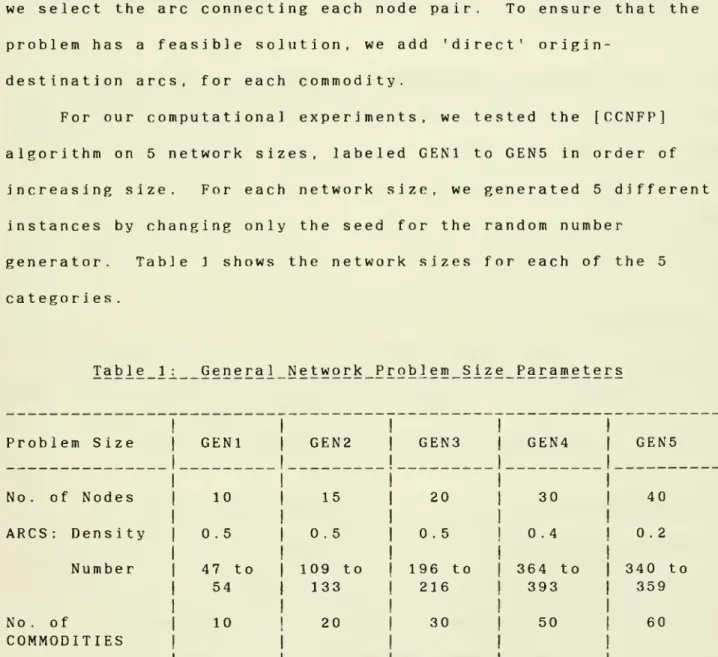
For our computational experiments, we tested the [CCNFP]
algorithm on 5 network sizes, labeled GENl to GENS in order of
increasing size. For each network size, we generated 5 different
instances by changing only the seed for the random number
generator. Table 1 shows the network sizes for each of the 5
categories .
27
For each test problem we set the demand for all commodities
to be the same, say, 1 demand unit. To specify the cost function
for each arc, we first set the number of cost ranges to be four
for all arcs. The widths of each of the 4 cost ranges were chosen so that the optimal solution contains, with high probability,
several arcs that operate in the 'higher' cost ranges in order to
exploit the economies of scale. Table 2 gives the range widths
(in demand units) for the 5 problem categories.
Tabie_22 Range_Widths_X2n_demand_unitsJ^_for_Generai_Networks
1 Range
We assume the fixed cost F. . for the first range in zero for ail
1 J
arcs.
A preprocessing routine executed at the end of the graph
generation procedure identifies, for each commodity k, all arcs
that do not lie on any path from 0(k) to n(k). This procedure
reduces the upper limit of flow (and the number of ranges, if
necessary) on all such arcs.
We coded the composite algorithm in FORTRAN on a PRIME 850
computer. We did not use any special data structures. Djikstra's
[1959] algorithm was used to find shortest paths in the granh. To
initiate the algorithm, we must specify several control
parameters, such as the maximum number of subgradient iterations
to be executed, the intial value of the step size multiplier, and
so on. We now describe these settings below.
(1) The maximum number of subgradient iterations for the
initial run was set at 100. (The subgradient procdure might terminate earlier if either the step size becomes
too small or the Lagrangean subproblem solution is primal feasible.) Subsequent continuation runs of 100
subgradient iterations each were initiated if the gap
between the best Lagrangean lower and the best upper
bound was relatively large and If no significant problem
reduction was achieved In the initial run.
(2) In the first run, the step size multiplier X was
initialized to 2.0. We do not adjust the step size
multiplier during the first 20 iterations or until the
first improvement in z(v) is realized, whichever occurs earlier; thereafter, the step size multiplier was halved
whenever the Lagrangean objective function value did not
improve for 10 consecutive subgradient iterations. In
subsequent runs, \ was initialized to half the initial
value of the previous run (i.e., to 1.0 in the second
run, 0.5 in the third run, and so on). Again, the step
size multiplier was not adjusted during the first 20
iterations or until an improvement in z(v); thereafter,
it was halved after 5 consecutive 'no improvement'
(3) The heuristic procedu
subgradlent iteration
solution obtained fro
is identica] to the i
previous execution of
loca] improvement alg recall that, for each
to D(k) using arcs wi
Lagrangean solution i
for commodity k. Our
procedure if no such
percent of the commod
commodities that cann
algorithm uses the pr
29 re was s . If m the c ni t i a] the he orithm commod th posi s se1ec a1gori path ex it ies ; ot be r evious
initiated once every 10
the initial heuristic
urrent Lagrangean solution
solution derived during the
uristic procedure, then the
is not applied. Also,
ity k, some path from 0(k)
tive flow in the current
ted as the initial routing
thm terminates the heuristic
ists for more than 10
otherwise, for all
outed in this manner, the
initial routing.
(4) After some initial experimentation, we set the
discounting factor for computing the weighted
subgradient equal to 0.2 for all the runs.
Table 3 shows the average, minimum and maximum values of
different performance measures for each of the five problem sizes.
We now interpret some of the key figures. We express all
indicators pertaining to the lower and upper bounding components
of the algorithm as a percentage of the best upper bound that was
obtained .
Qua]_it]^_of_the_fi_nal,_Lagrangean_l_ower_bounds
On average, over all the 25 problem instances, the final lower bound as a percentage of the best upper bound was 98,3 percent. In 4 out of the 25 instances, this gap was zero, while the largest gap was 5.4 percent. As might be expected, this gap seems to be
greater for the larger problems.
Ef£ectl^venes
sof
theLagrangean^basedheur
i_s1 1cIn all but 4 instances, the Lagrangean-based heuristic improved
upon the initial heuristic solution. On average, the Lagrangean-based heuristic improved the solution by 2.3 percent while the
maximum improvement was 9.0 percent.
Effect
iyenessof
_the_2n_i t i_a_l_izati_on_2r2cedureThe initial lower bound as a percentage of the best upper bound
was 46.8 percent on average, with a high and low of 58.3 percent
and 39.6 percent respectively. As the problem size increases, the
percentage gap between the initial lower bound and the best upper
31
EfffCtiyeness_of_the_iTiul^t2Bli§£_§^iy5jt!n§Ql-Procedure
The percentage improvement in the Lagrangean lower bound due to
the Idt_iaj^ascent phase was markedly higher than the improvement
brought about by subsequent multiplier adjustment phases. The
average, minimum and maximum improvements caused by the initial
ascent and subsequent ascent phases are
Initial Ascent Subsequent Ascent Average improvement 22.9 Minimum improvement 13.2 Maximum Improvement 27.7 . 1 0.0 0.3
In 7 out of the 25 problem instances, no improvement was achieved
in the subsequent ascent phases. The percentage improvement due
to Initial ascent does not seem to depend on the problem size.
E§l£2I!D§Q£§_2f_lb?_§ilkgIl§^i£nt_2rocedure
As the problem size increases, more subgradient iterations are
required before the procedure terminates (due to small step size).
As a percentage of the best upper bound, the average, minimum, and
maximum improvements in z(v) are 28.7 percent, 18,8 percent and
35,3 percent, respectively. The subgradient procedure
consistently increased the Lagrangean lower bound by more for the
largest problem size GENS; however, for the other four problem sizes, there is no discernible relationship between this
percentage improvement and the problem size.
lIf?ct2yeness_of_the_2roblem_reducti_on_2I2cedure
The extent to which problems are reduced depends on the absol^ute
Dl^SQitii^? of ^he gap between the Lagrangean lower bound and the
best upper bound, rather than on the percentage gap. On average,
3 P£§EE2cessing routine eliminated 10.6 percent of the original
kr flow' variables x
1J
To measure the effectiveness of the
Lagrangean-based problem reduction phase, we use the following
indicator :
PR = 1
-percent of free flow variables at end of algorithm
percent of free flow variables after Preprocessing
This index was 48.5 percent, on average, over all problem
Instances. This procedure fixed al_l the variables for 2 out of
the 25 problem instances, while it did not fix any variable for 1
instance .
Comgutati^onalregui^rements
The figures for CPU times in Table 3 show that the computational
requirements grow very rapidly as the problem size increases.
requir ret ros larger subgra iterat prob] three to tap two ru reduct if we subgra have b subgra Additi sortin at eac and an es m pect pro di en ion ms G time er o ns w ion had d1en een d ien ona1 g ro h St eff
ore time than the other components of the algorithm. In
, this time could have been reduced considerably, if for
blems we had specified a maximum limit of 200 or 300
t iterations in the initial run, rather than the ]00
limit that we used. For almost all the instances of
EN4 and GENS, we had to run the composite algorithm
s before the improvement in the Lagrangean value began
ff . In all these cases, the improvement in the first
as insufficient to lead to any significant problem
and thus, entailed substantial wasted effort. Instead,
allowed the first run to continue for say 200 or 300
t iterations, the total time for problem reduction could
reduced by approximately 2/3rds, and the total time for
t optimization would also have decreased significantly.
savings could have been achieved by employing efficient
utines (required for solving the Lagrangean subproblems
age), special data structures and updating procedures,
icient shortest path subroutine.
THREE-LAYER NETWORKS
This, problem type is a special case of the CCNFP in which (1) nodes of the network are classified into 4 types - Source
nodes. Consolidation points, Breakbulk points, and
Destination nodes,
(2) transshipment is permitted only at consolidation and
breakbulk points, and
(3) the network contains only three categories of arcs:
Source-Consolidation arcs, Conso1 idat ion-Breakbu Ik arcs, and Breakbulk-Destination arcs.
Thus, the origins and destinations are distinct and do not serve
as intermediate nodes. Every commodity must be transported across
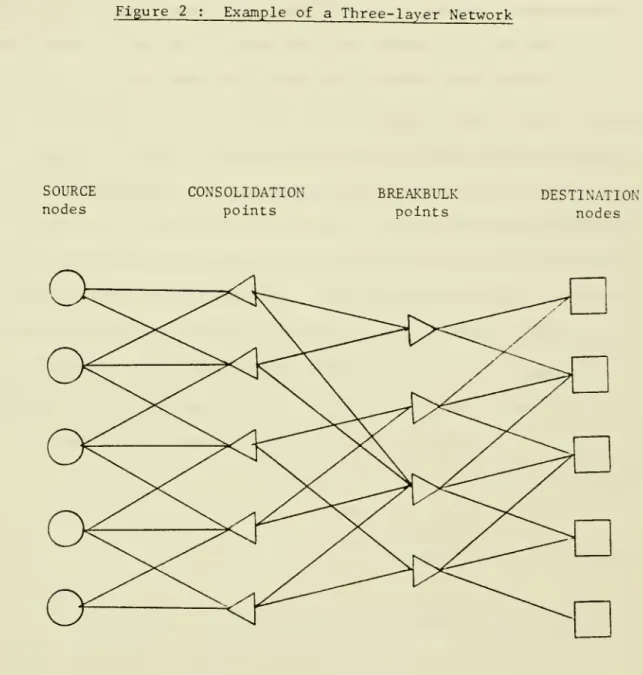
three 'layers' of the network. Figure 2 shows the configuration of a typical network of this type.
33
Figure 2 ; Example of a Three-layer Network
SOURCE nodes CONSOLIDATION points BREAKBULK points DESTINATION nodes
This type of network is of interest as a model for
consolidating and routing LTL shipments, as described at the
outset. Consolidation points are the nodes at which incoming LTL
shipments from the various sources are consolidated into
truckloads before being dispatched to the breakbulk points. At
the breakbulk nodes, incoming truckloads are 'broken', sorted
destination-wise, and forwarded {perhaps as LTL shipments) to
their respective destinations. We permit economies of scale
(i.e., p iecewise- inear concave cost functions) on all arcs of the
network. Note that, although only 3 types of arcs are permitted,
it is possible to model direct source-to-destination links, by
introducing dummy consolidation and breakbulk nodes. This type of
model is very useful when, for operational reasons, the load plan
requires that no shipment is transshipped at more than two
Intermediate points.
To generate the test problems, we specified
(a) the number of source, consolidation, breakbulk, and
destination nodes, denoted as ng, n^, ng, and n^
respectively. The specified number of commodities must
be between Max [ng, np] and ns*n[3 to ensure that each
source and destination node is utilized and that all
commodities have distinct origin-destination pairs; and
(b) the density of the source-conso 1 idat ion ,
consolidation-breakbulk, and breakbu 1k-destinati on arcs, denoted as
•^SC- df;p, and dgp, respectively.
Then, we generated a random network on a 100x100 grid for each
test problem by randomly locating
- source nodes in the [0,20] x [0,100] rectangle,
- consolidation and breakbulk points in the [20,50] x [0,100]
and [50,80] x [0,100] rectangles, respectively, and
35
The selection of the orJgJn-destination pair for each commodity
was random, except for modifications to ensure that all source and
destination nodes are used and that no origin-destination pair is
assigned to more than one commodity. To generate the arcs for the
network, we identified for each source node the (dg^nQ) closest
consolidation points and included the corresponding
source-consolidation arcs in the network. Similarly, each destination
node is connected to the (dp^nR) closest breakbulk points. This
choice reflects the characteristic of practical problems in which
each source and destination is typically connected to a few of the
closest transshipment (consolidation and/or breakbulk) points.
The consolidation-breakbulk arcs are chosen randomly with
probability
d^B-For each commodity, it is necessary to check if the current
graph has at least one path from the commodity's origin to its
destination, in order to ensure that the problem is feasible. If
some commodity k does not have any path from 0(k) to D(k) , an
appropriate consolidation-breakbulk arc is randomly added to
ensure feasibility.
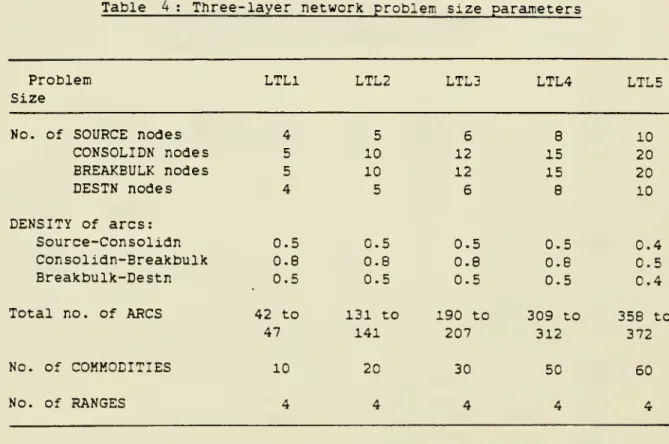
For our computational experiments, we generated problems in 5
different sizes, labeled LTLl to LTL5, for each of which we
generated 5 problem instances. Table 4 specifies the problem
sizes for each category.
All other problem parameters - for the demand, variable cost
structure, and range widths - were identical to those used for
generating the general CCNFP test problems.
modifications for exploiting the special LTL structure, to solve
the 25 test instances of the three-layer problem. All the
solution parameters in the CCNFP algorithm, e.g. the maximum
number of subgradient iterations per run, had the same values used
for solving general networks.
Table 5 presents the summary statistics for the five problem
sizes. As before, we consider the performance of each component
of the composite procedure in turn. All the improvements in the
upper and lower bounds are evaluated in terms of percentages of
the best final upper bound.
Qual^_ity_of_the_fi,na2_L§gI§DS?§Il_i2wer_bound
The average value of the final lower bound as a percentage of the
best upper bound was 99.6 percent while the largest gap was 2.5
percent. In 19 out of the 25 problem instances, there was no gap
between the final lower bound and the best upper bound, indicating
that the optimal solution had been found in all these cases.
l££§cti^yeness_of_the_Lagrangean-based_heuristj^c_procedure
In all but 3 instances, the Lagrangean-based heuristic improved upon the intlal heuristic solution. As a percentage of the best
upper bound, the Lagrangean-based heuristic improved the initial
solution by an average of 6.8 percent; the maximum improvement was
24.8 percent .
l£f§£liy§0§s
sof
_the__init i.a1.i^zati^on_procedureThe average, minimum, and maximum values of the initial lower
bound as a percentage of the best upper bound were 89.6 percent,
83.8 percent, and 95.4 percent respectively. For this class of
problems, therefore, the multiplier initialization method seems to
37
Table 4 ; Three-layer network problem size para^ieters
Problem Size
LTLl LTL2 LTL3 LTL4 LTL5
TABLE 5
Summary statistics for test runs on Three-layer Network problems
Problem class LTLl LTL2 LTL3 LTL4 LTL4 SITE
39
IIf§£liHeness_of_the_multi22ier_adjustment_method
As before, the initial ascent phase gives significantly better
improvements to the Lagrangean lower bound than the subsequent
multiplier adjustment phases. The average, minimum, and maximum
values of the improvement in the lower bound as a percentage of
the best upper bound are
Average increase Minimum increase Maximum increase Initial Ascent 4 . 45 1.11 7 . 73 Subsequent
COMPARISON OF RESULTS FOR GENERAL AND THREE-LAYER PROBLEMS
The three-layer problems that we tested were obviously easier
to solve using our algorithm than the general network problems.
The performance of every component of the algorithm was superior
for the three-layer problems. First, the preprocessing routine
was significantly more effective for these problems (75.7 percent
reduction compared to 10.6 percent for general networks). Because
of the significant reduction in problem size at the preprocessing
stage, the initial lower bound was on average 89.6 percent of the
best upper bound, as compared to only 46.8 percent for general problems. Since the percentage gap between the lower and upper
bound is relatively small from the beginning, the ascent and
subgradient phases did not improve the bounds as much for three
layer problems as for general network problems. Also, since the
gaps were smaller, more reduction was possible, and the
three-layer problems required fewer iterations (and hence less CPU
time). Finally, the Lagrangean-based heuristic procedure also
performed better for this class of problems (improving the initial
heuristic solution by 6.8 percent compared to 2.3 percent). Since
the final set of Lagrange multipliers were closer to the optimal values, the Lagrangean-based initial solutions might have been
better than for general network problems. Thus, the effectiveness
of each component of the composite algorithm contributes to
41
CONCLyDING_REMARKS
In this paper we developed a composite procedure for finding
good upper and lower bounds for a special case of a network design
problem that Is of considerable practical importance. By
combining a mu1ti p1 ier-adjustment procedure with a subgradient
procedure, a problem reduction phase, and a Lagrangean-based
heuristic algorithm, we were able to solve fairly large
concave-cost network flow problems. This composite algorithm exploits the
special structure of the CCNFP, and the computational results
confirm the usefulness of a strategy that combines lower and upper
bounding schemes, which are based on the partial optimization of
some related problems. Also, the performance of such algorithms
seems to improve substantially when the networks have certain
special structures. See Balakrishnan (1985) for more details on
the algorithm and on the computational experiments. Balakrishnan
(1985) also explores several possible extensions to the algorithm;
in particular, he considers the use of a more complex subproblem
in the Lagrangean, and the development of an ascent procedure that
permits Zjj(v) to change.
ACKNOWLEDGEMENT
This research was supported by a grant from the Center for
Transportation Studies, Massachusetts Institute of Technology,
Cambridge , MA .
BALAKRISHNAN , A. 1984. Va]_id_Inegua1 i ti es_and_AIgori thms_for_the
Network_Design_Prob2em_wi_th_an_Agglicati^on_to_LTL Conso^idatj^on . Doctoral dissertation, Sloan School of
Management, Massachusetts Institute of Technology, Cambridge,
MA . , December .
CROWDER, H. 1976. "Computational Improvements for Subgradient Optimization", S^mpos i_a_Mathemati^ca , Vol. 19, pp. 357-372.
DIJKSTRA, E. W. 1959. "A Note on Two Problems in Connexion with Graphs", Numer
scheMa
themat ik , Vol. 1, pp. 269-271.ERICKSON, R. E.. C. L. MONMA and A. P. VEINOTT. 1981. "Minimum
Concave-cost Network Flows", Working paper.
FLORIAN, M., and M. KLEIN. 1971. "Deterministic Production Planning With Concave Costs and Capacity Constraints", Management_Sclence, Vol. 18, pp. 12-20.
PONG, C. 0. and M. R. RAO. 1975. "Capacity Expansion with Two
Producing Regions and Concave Costs", Management_Sc ence , Vol.
22, No. 3, pp. 331-339, November.
GALLO, G., and C. SODINI. 1979. "Concave Cost Minimization on
Networks", Eurogean_Jou
rnalof
_Ogerat ona l_Research , Vol. 3,pp . 239-249
GEOFFRION, A. M. 1974. "Lagrangian Relaxation for Integer
Programming", MathematicaX_Programmi^ng_Stud^_2 , pp. 82-114.
LAMAR, B. 1983. "Les -Than-Truck oad Freight Consolidation and
Routing Strategies: A Mathematical Programming Procedure",
Project Report No. CTS/IU-83.2, Center for Transportation
Studi es , M. I . T
LAMAR, B., Y. SHEFFI and W. POWELL. 1984. "Bounding Procedures for
Fixed Charge, Multicommodity Network Design Problems", Working Paper , December .
LOVE, S. F. 1973. "Bound Production and Inventory Models with
Piecewise Linear Concave Costs", Management_Science , Vol. 20. pp . 313-318
LUSS, H. 1979. "A Capac1 ty-Expansion Model for Two Facility
Types",
NavalResearchLogi
s tcsQuar
terly, Vol. 26, pp.291-303.
POWELL, W. 1985. "A Local Improvement Heuristic for the Design of
Less-Than-Truckload Motor Carrier Networks", Princeton
43
POWELL. W. B.. and Y. SHEFFI. 1983. "The Load Planning Problem of
LTL Motor Carriers: Problem Description and a Proposed
Solution Approach", Transgortat_i
onRes
earch , Vol. 17A, pp. 471380.
SOLAND , R, M. 1974. "Optimal Facility Location with Concave
Costs", Operations_Research , Vol. 22, pp. 373-382.
SWOVELAND, C. 1975. "A Deterministic Multi-Period Production
Planning Model with Piecewise Concave Production and
Holding-Backorder Costs",
ManagementSc
ience , Vol. 21, pp. 1007-1013.TAHA , H. A. 1973. "Concave Minimization over a Convex Polyhedron"
Nava1 Legist
icsResearchQuar
terly , Vol. 20, pp. 533-548.ZADEH, N. 1973. "On Building Minimum Cost Communication Networks"
Networks, Vol. 3, No. 4, pp. 315-331.
ZADEH, N. 1974. "On Building Minimum Cost Communication Networks Over Time". Networks, Vol. 4, No. 1, pp. 19-34.
ZANGWILL, W. I. 1968. "Minimum Concave Cost Flows in Certain Networks", Management_Science , Vol. 14, No. 7. pp. 429-450.
MIT LIBRARIES
DatB