READ THESE TERMS AND CONDITIONS CAREFULLY BEFORE USING THIS WEBSITE. https://nrc-publications.canada.ca/eng/copyright
Vous avez des questions? Nous pouvons vous aider. Pour communiquer directement avec un auteur, consultez la première page de la revue dans laquelle son article a été publié afin de trouver ses coordonnées. Si vous n’arrivez pas à les repérer, communiquez avec nous à [email protected].
Questions? Contact the NRC Publications Archive team at
[email protected]. If you wish to email the authors directly, please see the first page of the publication for their contact information.
NRC Publications Archive
Archives des publications du CNRC
This publication could be one of several versions: author’s original, accepted manuscript or the publisher’s version. / La version de cette publication peut être l’une des suivantes : la version prépublication de l’auteur, la version acceptée du manuscrit ou la version de l’éditeur.
Access and use of this website and the material on it are subject to the Terms and Conditions set forth at
Influence of wind pressures on joint performance
Dalgliesh, W. A.; Garden, G. K.
https://publications-cnrc.canada.ca/fra/droits
L’accès à ce site Web et l’utilisation de son contenu sont assujettis aux conditions présentées dans le site LISEZ CES CONDITIONS ATTENTIVEMENT AVANT D’UTILISER CE SITE WEB.
NRC Publications Record / Notice d'Archives des publications de CNRC:
https://nrc-publications.canada.ca/eng/view/object/?id=0a29a9fc-f294-4d3b-96bb-327ce1d466fb
https://publications-cnrc.canada.ca/fra/voir/objet/?id=0a29a9fc-f294-4d3b-96bb-327ce1d466fb
3 d ,
s y M p o s t u M
o N I W E A T H E R T t c H T
J O T N T S
F O R
W A L L S O S L O
- N O R W A Y
- S E P T E M B E R
1 9 6 7
Ser
TIIl
Nztt2
no. 26\
e . 2
BI,DG
lnfluence of wind
pressures on ioint performance
B Y W . A . D A L G T I E S H i A N D G . K . G A R D E N N A T I O N A L R E S E A R C H C O U N C I L D t v r s t o N o F : B : u I L D r N G R E S E A R C H C A N A D A
A I . I
A L Y Z i ; }
Onn/NnC
Technical Paper No. 264
OTIAWA,
September 1968
BUILDING
RESEARCII
r
r LIBRARY
'
FEii
'I3 j!70
ilATIOnAL RE5EARC1+ eottlrclt
ai:,5€eF
NRC 9873
Price 10 cents
N o . 2 6 D
Influence of wind pressures on joint performance
BY W. A. DALGLIESH AND G. K. GARDEN NATroNAr. RESEARCH couNcrl oF CANADA ' DIVISION OI' BIIILDING RE SEARCH
Reprint from NBBI Report 51 C "Weathertight joints for walls"
face is approached. Over much of the boundary layer turbulent mixing is effective and the rate of decrease in velocity is comparatively small. Adjacent to the wall' however, there is an extremely thin laminar sublayer where the rate of velocity decrease is very great. Out-side this laminar sublayer there is still a significant porportion of velocity energ'y available that could be converted into a pressure difference across projections.
Studies of surface friction drag (1, 2) show that pro-jections on a flat surface experience pressure diffe-rentials unless they are submerged within the laminar sublayer. The net pressure difference across such Proiec-tions, expressed as a pressure coefficient (Co) based on the free stream velocity, is in the range 0.4 < CD < 0.8. The pressure difference is obtained as the protluct of C" multiplied by the free-stream velocity pressure'
-The
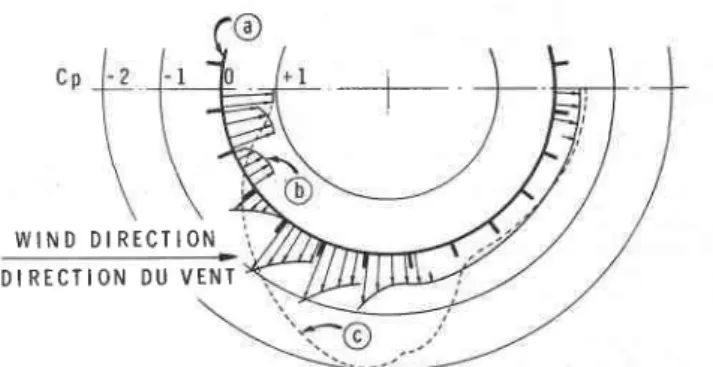
critical height for surface projections, beyond which pressure differences could occur, is evidently the depth of the laminar sublayer. The two most important factors on which this depth depends are the flow velocity and the length of the surface over which the flow has passed. Judging from criteria developed for surface friction calculations on streamlined bodies, the depth of the laminar sublayer on a building in moderate to high winds would be 10-a to 10-e times the distance along the wall. Mullions, for example, may project as much as 10-2 times the total length of the wall and would, therefore, be subject to pressure differentials. Measurell Presslhre Dillerences on Bluff Bod'ies The only information found in the literature to illustrate pressure differences across projections on bluff bodies was for sylindrical tanks with vertical fins (3, 4). The pressure pattern found in one case (Figure 1,) indicates a pressure difference across the fins up to 1.2 times the dynamic pressure of the free wind stream. The ratio of fin height to tank diameter was 1:150, and the ratio of tank height to diameter was 1.8:1. The separation points occur somewhat to the rear of the widest part, and as mentioned previously, ribs in the wake region have no effect on the pressure pattern. Similar results for two-dimensional circular cylinders with a ratio of rib height to cylinder diameter of 1:300 have also been reported (4). Such information, although relevant for many of the round buildings being designed today cannot be applied to angular buldings with plane walls.
---r-W I N D D I R E C T I O N D I R E C T I O N D U V E N T
Fig, 1. Winitr pressure on a, Large cgldnder wdth uertical fins. Ail,apted from Fluid-Dgnamics bg S. E. Hoerner. a. Wall ol cglinil,er wdth' ltns
b. Wi,nil pressure oardatdons d,ue to lins c. Wdnd, pressure lor srnooth cgliniler. Rain penetration is one of the major considerations in
the design of weathertight joints. There are several approaches to preventing rain penetration, but the one that has the greatest promise is based on controlling the four forces which act to cause it. These forces are the kinetic energy of the raindrop, capillary suction, gravity, and an inward air pressure drop through the wetted surface of a wall. Control methods for the first three forces have long been understood, but need and methods for controlling the fourth have only recently been recognized. The control of thts force can be achie-ved by the incorporation of a space in the wall or joint which is sufficiently open to outside, so that the air pressure in the space can equallze with that outside. The achievement of this pressure equalization is ob-viously influenced by the air pressure on the outside of a building, especially if there are variations of air pressure from one point to another.
Wind causes a wide variation of air pressures on the surfaces of a building. The over-all pressure distri-butions which are of importance in determining wind loads have been under study for many years. Infor-mation is available on these pressure variations for many building shapes and many wind directions. There are indications, however, that abrupt local pressure variations from side to side of projections and recesses on a wall surface also occur. These have seldom been determined and the authors have found very little infor-mation in the literature on detailed point-to-point pres-sure differences. A knowledge of both the over-all and local pressure variations is necessary for the full exploitation of the priciple of pressure equalization as a means of controlling rain penetration.
Wi,nd FIaw Oaer Building Surlaces
Wind flow around a building can be broadly divided into the two regions of attached flow and separated flow. The air flowing around a building maintains con-tact with the building surfaces (attached flow) until a sharp edge or other point of separation is reached. Here, the streamlines separate from the building cau-sing a wake region of moderate suction. This suction is uniform over walls located in the wake, flow velo-cities are small, and projections or recesses on the wall surfaces will have no significant influence on the pres-sure pattern.
Attached flow consists of,the boundary layer, where friction retards the flow down to zero velocity at the wall surface, and the main flow, where the effects of friction are negligible. Near the building the stream-lines are <<squeezed together>> and the flow speeds up so that the same amount of air can pass through a reduced <<channel>> area. In the main flow when the velocity increases, the pressure decreases, and the re-sulting pressure variations from point-to-point are trans-mitted across the boundary layer and act on the walls of the building.
Projections on WalL Surlaces
If projections on a wall are small enough to be entirely submerged in the boundary layer, they will not affect the over-all pressure distribution resulting from the deflection of the airflow around the building. Pressure differences across such projections will depend on the flow velocities in the boundary layer as the wall
sur-'Wind
tunnel tests are now underway in the United States to investigate the pressure differences at mullions on at least one tall, rectangular bulding but results are not yet available. Field investigation of the problem is also necessary for proper application of wind tunnel results to full-scale structures because of possible scale effects.
Preliminary field measurements were started in Feb-ruary 1967 by the Division of Building Research, National Research Council of Canada, to confirm that such pressure differentials occur and to determine their magnitudes. To the date of writing this paper, only one set of measurements has been recorded. On this occasion, the wind direction was, unfortunately, almost perpendicular to one waII with the result that the other three walls were essentially in the wake zone of sepa-rated flow.
Under these conditions, pressure variations between mullions were not expected except perhaps very near the corners on the windward face. Of the seven 4-ft (120 cm) mullion spaces investigated on two elevations, no significant pressure variations were recorded except at one location - at a mullion space on a wall parallel to the wind direction. Here a steady pressure differential of 1.5 to 2.0 psf (7 to 10 kg/m2) was measured when the wind speed was 30 to 40 ftlsec (9 to 12 m/sec). This indicates a pressure coefficient of Cp - 0.7 for the differential pressure. An air intake for the mecha-nical system of the building was located upstream in the adjacent mullion space. The probable explanation for the pressure differential recorded is that the inflow at the duct opening may have caused localized re-attachement of the flow.
Although this one case cannot be considered as evi-dence either for or against the general occurence of significant pressure differentials in mullion spaces on buildings, it is an indicaton that factors other than simply the speed and direction of the wind may require attention. Funnelling between adjacent buildings may also lead to attached flow along a wall even though the wind is essentially normal to one face of the buildings Ellects of Presswre Di,fferences
It is apparent from the available information that the air pressure on a building: varies from point to point and from wall to wall. There are also strong indications that abrupt, local pressure differences occur at pro-jections and recesses on waII surfaces. Pressure diffe-rences from point to point on a wall must be recog-nized since they influence the design of weathertight joints. Abrupt, local pressure variations should also be considered in the structural design of projecting elements and their connections.
Information on the patterns and magnitudes of pres-sure differences is required for the design of mullions, column covers, and other non-structural elements which could otherwise be considered not subject to wind loading. Until such detailed information becomes avai-Iable, however, projections must continue to be over-designed. A different situation is faced in the case of rain penetration. Having recognized that these pressure differences do occur, it is possible to take steps in the design of cladding and joints to ensure that their in-fluence will be reduced or eliminated.
Rain penetration can be most positively and most easily prevented by controlling the forces which cause it (5). The main force in most occurrences of rain pene-tration is an inward air pressure drop through the wet-ted plane of the wall or joint. A space in a wall or joint which is sufficiently open to the outside, so that the pressure in it can equalize with that outside, can prevent the development of the inward pressure drop at the wetted plane. The required pressure equalization will not be obtained however in a space which is open at two or more locations if the outside pressure differs from one opening to another. IJnder such conditions, inward air pressure may still drive water into the
construction, even at minute openings. Air flow through the space from one intentional opening to another may also transport water droplets or snow into the space.
Pressure equalization spaces should be drained and, therefore, small quantities of water in the cavity may be of little concern. The partial penetration of rain into the outer layer of the wall, however, may produce undesirable effects and should be minimized. If water in the space bridges gaps in the air barrier portion of the wall or joint, through-wall 'penetration of rain can also result. Although there is little likelihood of through-wall penetration when a well-designed cavity is employed, the occurrence of a pressure drop across the outer materials should nevertheless be prevented, if possible.
Control of Potential, Problems
In recognition of the general pressure variations that occur on a building, it has been recommended that the pressure equalization cavities in walls be closed at frequent intervals (5). By compartmentation of the cavity, the range of pressure differences acting on any cavity compartment can be greatly reduced. It is pro-posed that until further pertinent information becomes available vertical closures should be provided at each outside corner of a building and at A-tt (720 cm) inter-vals for about 20 ft (6 m) from corners (6). Horizon-tal closures should be used near the top of a wa[. ft is also considered advisable that both vertical and hori-zontal closures be positioned up to 30 ft (6 m) on centres over the total wall area. It should be noted that these cavity closures need not provide a complete air seal but must be sufficient to allow the appropriate pressure differences between cavity compartments to develop. It is possible to follow a similar approach to deal with the problem of achieving pressure equalization in spaces or cavities where abrupt pressure variations occur at projections and recesses.
Where there is an air pressure difference from side to side of projecting mullions, there will obviously be a pressure difference between the two jambs of each window located between them. Any spaces that are continuous between mullions and open at both ends are subject to the same problems that could occur in cavity walls. Here, again, division of the space into separate cavities, each open to one pressure area, should ease the problem.
The space between double windows cannot be com-partmented unless there are two more windows to allow water which may enter the space to flow along the sill and drain outward at the low pressure side of the window. In smaller concealed spaces, such ast those between the glass and sash or sash and frame, a plug can readily be incorporated. Because these spaces usually are continuous around four sides of the window, a cavity closure should be located in both the head and sill spaces. They should not, however, be located where they would interfere with the required drainage of the space.
Conclusi,on
It is generally well recognized that the wind pressure varies from point to point on building surfaces. Abrupt pressure differences across surface projections are a distinct possibility. Fortunately, there are some practical steps which can be taken to minimize the risk of rain penetration. There is great need, however, for research to provide much more detailed information on pressure magnitudes and the influence of height and spacing of projections and recesses.
This is a contribution from the Division of Building Research, National Research Council of Canada and is published with the approval of the Director of the Division.
EeJerences
(1) Schlichting, H. Boundary layer theory. McGraw-Hill, New York, 1955, p. 454.
(2) Hoerner, S. F. X'luid-dynamic drag; practical infor-mation on aerodynamic drag and hydrodynamic re-sistance. Midland Park, N. J. Published by the author, 1965, p. 5-6.
(3) Pris, R. Etudes a6rodynamiques, Ilf: R6servoirs et cheminEes; recherches pr6liminaires. Influence de Ia rugosit6 et de la nervuration sur la r6sistance a6rodynamique des eylindres. Annales de I'Institut Technique du Bdtiment et des Travaux Publics, No. 155, nov. 1960, p. L23L-1246. (S6rie: Essais et Mesures (49). (English summary).
Etudes a6rodynamiques, fV: R6servoirs et
chemi-n6es. Rdsistance de cylindre d base polygonale ir ar€tes vives ou munis de nervures; R6sistance de cylindres d base circulaire et d surface rugueuse. Annales de I'Institut Technique du Batiment et des Travaux Publics, Nos. 163-164, Juillet-aofrt 1961, p.735-755. (S6rie: Essais et Mesures (51). (Eng-lish summary).
(4) Garden, G. K. Rain penetration and its control. National Research Council of Canada. Division of Building Research, Canadian Building Digest No. 40, Ottawa, April 1963.
(5) Garden, G. K. Some experiences with joints. CIB Symposium on Weathertight Joints for Walls. Oslo, September 1967.
R6sum6
Influence de la pouss6e du vent sur l'effcacit6 des joints L'infiltration de la pluie d travers les joints d'un b6,ti-ment peut 6tre empechee pai le contrdle des forces qui en sont la cause. La principale force d'infiltration est une r6duction de pression dirig6e vers I'int6rieur. Le contr6le de cette force peut €tre atteint en mainte-nant I'espace d I'arridre du mur ext6rieur d6tremp6 d une pression 6gale d, celle de I'ambiance ext6rieure. La pression du vent, toutefois, varie consid6rablement d'un endroit d. un autre i la face d'un mur. De plus, I'exp6-rience semble indiquer qu'il existe des diff6rences Iocalis6es, mais s6vdres d I'endroit des projections ou de recoins dans les murs.
L'6quilibre des pressions ne peut €tre atteint dans
un espace, ouvert d plus d'un endroit, si les surcharges du vent varient d'un endroit d un autre. Si la cavitd est obtur6e Fr des endroits strat6giques, on pourra quand m6me rdaliser, ou dr peu prds, cet Equilibre des pressions. Malgr6 les lacunes dans nos connaissances sur les diff6rences de pression d, la face des bd.timents, il existe des moyens pratiques de r6duire les risques d'infiltration de la pluie. On doit ajouter, cependant, ques de s6rieuses recherches sont n6cessaires sur I'amplitude des sur-charges du vent et sur les influences qui d6coulent de la hauteur et de I'espacement de toute projection ou recoin dans les murs.