Reaction of Methyllithium with Group 6 Phosphine Dinitrogen
Complexes
Amal Bouammali,
[a]Christian Bijani,
[a]Laure Vendier,
[a]Michel Etienne,
[a]and Antoine Simonneau*
[a]Abstract: The reaction of MeLi with several group 6 phosphine
end-on dinitrogen complexes of the general formula [ML4(N2)2] (M = Mo or W) is reported. Unlike the isoelectronic complex [CpMn(CO)2(N2)] on which RLi reagents have been reported to add to the N2 ligand, we show herein that MeLi attacks the metal centre to afford rare anionic
trans methyl dinitrogen complexes.
Introduction
Dinitrogen has a very rich coordination chemistry that has been widely explored for more than 50 years.[1–4] The development of
this field is linked to the problems raised by nitrogen fixation into the biosphere : indeed, dinitrogen complexes have proven valuable models in order to understand the functioning of the nitrogenases.[5–7] Besides, the environmental and sustainability
concerns linked to anthropogenic N fixation via the Haber-Bosch process[8–11] have fueled a quest for bio-inspired molecular
alternatives.[12–15] Among all the dinitrogen complexes found in the
literature, a very common coordination mode is the terminal one. Hidai-Chatt group 6 complexes may be the most emblematic compounds of this type. Their reactivity has been extensively studied, and due to the polarization induced by coordination as well as back-donation from the metal, electrophilic attack at the terminal N (Nb) is generally observed.[16] This has served as
starting point for the development of synthetic methods affording nitrogen compounds such as ammonia,[12–15] silylamines[17] or
more complex organonitrogen products.[16] Contrastingly,
nucleophilic attack at Nα has been rarely encountered. As far as
we are aware, Sellmann’s complex [CpMn(CO)2(N2)] remains the
sole compound for which such reactivity has been reported, using organolithium reagents as nucleophiles to afford an akyldiazenido ligand (Scheme 1).[18] This is reminiscent of the reactivity of the
isoelectronic CO ligand that leads to Fischer carbenes for example.[19] In the present article, we explore the reactivity of
some Mo and W Hidai-Chatt-type complexes, isoelectronic to [CpMn(CO)2(N2)], with methyllithium, in order to verify whether the
same outcome than with Sellmann’s Mn complex is observed.
Scheme 1. Nucleophilic attack at an end-on N2 ligand in [CpMn(CO)2(N2)].
Results and Discussion
We chose to investigate the reactivity of the complexes trans-[M(N2)2(dppe)2] 1 [dppe = 1,2-bis(diphenylphosphino)ethane], trans-[M(N2)2(depe)2] 2 [depe = 1,2-bis(diethylphosphino)ethane]
and [M(N2)2(PMe2Ph)4] (M = Mo, 3Mo, 12:88 cis/trans mixture, or
W, 3W, only cis). The reaction of 1Mo with 1 equiv. of MeLi (1.6 M
in Et2O) at room temperature yields small amounts of a new
diamagnetic species 4Mo along with untouched 1Mo. More forcing
conditions (2 equiv. MeLi, 50 °C) allowed us to fully convert 1Mo
to 4Mo. In this new compound all phosphorus atoms remained
magnetically equivalent, while a shielded CH3 signal at –2.94 ppm
was observed in 1H NMR as a quintet (3J
HP = 6 Hz). A 13C NMR
experiment revealed the associated carbon signal at –4.1 ppm (quint, 2J
CP = 9 Hz). 4Mo could be isolated by precipitation from
pentane at –40 °C as a dark red powder (ca. 68% yield). It is highly sensitive to air or moisture, does not stand in solution upon exposure to vacuum and decomposes slowly in the solid state even when stored in the –40 °C freezer of the glove box. Therefore, its handling was challenging and its full characterization made difficult. The infrared spectrum (ATR) of isolated 4Mo shows a strong absorption band at 1780 cm–1 that
can be attributed to a nN2 stretching vibration, and nitrogen was detected in non-negligible amounts when we attempted its elemental analysis, suggesting 4Mo has likely retained one N2
ligand in its coordination sphere. From these pieces of data we propose that the organolithium reagent reacted with the metal center instead of the N2 ligand, affording an anionic trans-methyl
dinitrogen complex. Integration of the THF signals in 1H NMR
revealed exactly 3 equivalents remained in the isolated powder: thus, it is reasonable to propose that the Li atom is bound to 3 THF molecules and the terminal nitrogen of an end-on N2
ligand.[20]. As the outcome of an attempt to crystallize 4Mo, we
have serendipitously obtained good quality crystals of the ortho-metallated complex 5Mo (Fig. S27), but the inherent reactivity of
4Mo prevented the growth of single crystals suitable for X-ray
analysis. 5Mo presumably arise from ortho-C–H activation
concomitantly with methane evolution.[21] However, we were not
able to find conditions in which 5Mo could be formed in high yields,
which precluded further characterization. Likewise, the depe-supported complex 2Mo fully reacted in the presence of an excess
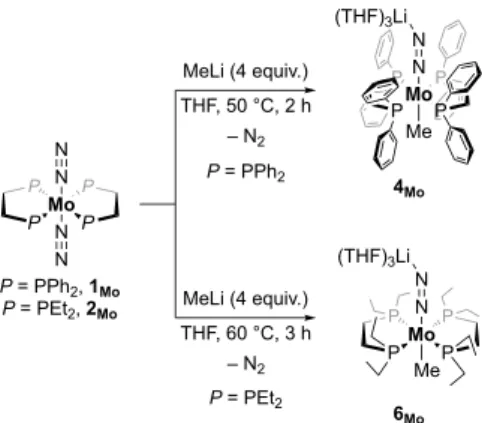
of MeLi (4 equiv.) in THF at 60 °C to afford the depe analog of 4Mo,
6Mo (Scheme 2). The latter did not exhibit improved stability
compared to 4Mo. Although clean reaction mixtures were obtained
under these conditions, its co-precipitation with excess MeLi hampered isolation of 6Mo in pure form.
Mn OC OC NN Li Mn OC OC N N Li
[a] A. Bouammali, Dr. C. Bijani, Dr. L. Vendier, Prof. Dr. M. Etienne, Dr. A. Simonneau
LCC-CNRS, Université de Toulouse, CNRS, UPS
205 route de Narbonne, BP44099, F-31077 Toulouse cedex 4, France.
E-mail: [email protected] Homepage: https://www.lcc-toulouse.fr/?lang=en
Supporting information for this article can be accessed free of charge at https://onlinelibrary.wiley.com.
Scheme 2. Reactions of 1Mo and 2Mo with MeLi affording anionic trans-methyl dinitrogen complexes.
Next, a mixture of cis- and trans-3Mo supported by the PMe2Ph
monophosphine was treated with MeLi. 3Mo reacted cleanly in the
presence of 1.1 equiv. of MeLi to afford the trans-methyl complex
7Mo as the major compound, which was characterized by a
highfield-shifted quintet in 1H NMR at d –1.38 ppm (3J
HP = 7 Hz).
Along 7Mo, another minor methyl complex (8Mo) formed (ca. 8:2
ratio according to 1H NMR). Its 31P{1H} NMR spectrum showed
two sets of inequivalent phosphorus atoms and integration was in agreement with the loss of one phosphine (see Fig. S20). A CH3
signal in 1H NMR with an observed quartet multiplicity (d –1.47
ppm, 3JHP = 7 Hz) was present in 1H NMR; selective irradiation on
each of the 31P resonances indeed showed this signal was
actually a dt (Fig. S17). A DOSY experiment resulted in close diffusion coefficients for 7Mo and 8Mo, while a EXSY experiment
did not show any exchange between them (Fig. S18). Because separation of the two species was not possible, further characterization of 8Mo could not be performed. Yet, on the basis
of NMR data, we propose 8Mo to be fac-[(PMe2Ph)3MoMe(N2)2]Li
(Scheme 3).
Scheme 3. Reactivity of complex 3Mo with MeLi.
Unlike their molybdenum analogues, 1W and 2W did not react
with MeLi under the conditions described above. In the presence of excess MeLi and at elevated temperature (80 °C), slow decomposition occurred instead, with no evidence of tungsten methyl complexes according to NMR data. Yet, treatment of 3W
with MeLi led to a mixture of compounds in which a major tungsten complex 9W was found, according to the 31P{1H} NMR
analysis of an aliquot. The latter was characterized by a ABX2
system (2JPP = 14 and 18 Hz). Important amounts of free PMe2Ph
were also found, suggesting facile phosphine dissociation. Precipitation of 9W in low amounts (8%) out of the reaction
medium in crystalline form allowed its characterization by X-ray diffraction.[22] One of the aromatic substituent of a phosphine
ligand is ortho-metallated in 9W, yielding a structure highly
distorted from an ideal octahedron (Figure 1), akin to 5Mo (Fig.
S27). 1H and 31P{1H} NMR monitoring of the reaction run in
[D8]THF (Fig. S23–24) indeed shows the presence of methyl
residues bound to a W(PMe2Ph)4 core in small amounts, the
major one being characterized by a quintet in 1H NMR (d –1.06
ppm, 3J
HP = 7 Hz) to which we associated a singlet in 31P{1H} NMR
(d –20.9 ppm): this compound may be 7W. Although formed early
on, 7W disappeared as 9W formed. Methane build-up was also
observed: thus, we speculate that 9W results from the
ortho-metallation of the phosphine ligand in a W–CH3 intermediate.
Other minor diamagnetic W species were also present in the reaction mixture but could not be identified. In addition, PMe3 was
also detected. It is probably formed by the reaction of free PMe2Ph
with excess MeLi.[23]
Figure 1. Molecular structure of compound 9W in the solid state. Hydrogen atoms omitted for clarity, ellipsoids drawn at the 50% probability level. Relevant bond lengths (Å) and angles (°): N2–LI1 1.935(6); N1–N2 1.175(4); W1–N1 1.913(3); W1–C10 2.230(3); W1–P1 2.397(1); W1–P2 2.424(1); W1–P3 2.405(1); W1–P4 2.519(1); N1–N2–LI1 161.4(3); W1–N1–N2 178.8(2); P4–W1– C10 64.32(8); W1–C10–C23 107.2(2); W1–P4–C23 85.1(1); P4–C23–C10 103.3(2); N1–W1–C10 107.3(1).
The lack of reactivity of 1W and 2W may stem from their inability
to thermally dissociate N2. Indeed, we suggest the formation of 4Mo, 6Mo and 7Mo occurs after dissociation of one N2 ligand,[24]
which liberates a vacant coordination sites, thus setting the stage for the carbanion to attack at the metal. The thermal activation coupled to the overall long reaction times reflects the reported low rate of N2 dissociation.[25] However, the tungsten complexes
readily photodissociate N2, and their treatment with excess MeLi
under irradiation allowed us to detect the methyl-dinitrogen complexes 4W, 6W and 7W as the major components of the
reaction mixtures. 4W and 6W were formed quantitatively
according to NMR, but akin to the molybdenum compounds, their isolation in pure form proved difficult owing to their sensivity to vacuum and limited stability in the solid state. 7W formed in a few
hours in mixture with free PMe2Ph as well as other minor
complexes as shown by NMR monitoring (Scheme 4 and Fig. S25–26). Attempts to isolate it have resulted in mixture where 7W
had partially degraded to another, unidentified methyl complex. MeLi (4 equiv.) THF, 50 °C, 2 h – N2 PMo P P P N N Me (THF)3Li 4Mo PMo P P P N N N N P = PPh2, 1Mo
P = PEt2, 2Mo MeLi (4 equiv.)
THF, 60 °C, 3 h – N2 P Mo P P P N Me N (THF)3Li 6Mo P = PPh2 P = PEt2 Mo PhMe2P PhMe2P PMe2Ph N N PhMe2P N N MeLi (1.1 equiv.) Mo PhMe2P PhMe2P PMe2Ph PMe2Ph N Me N (THF)3Li
3Mo (cis:trans = 8:2) 7Mo (major) tentative structure on8Mo (minor) the basis of NMR spectra THF, RT, 5 h – N2, – PMe2Ph + Mo PhMe2P PhMe2P N Me N PMe2Ph N (THF)3Li N W PMe2Ph PMe2Ph PhMe2P N P Li(THF)3 N 9W
Scheme 4. Reactions of 1W, 2W and 3W with MeLi under irradiation (460 nm) affording anionic trans-methyl dinitrogen complexes.
When the more sterically demanding organolithium reagents
n-BuLi or PhLi were employed, no evidence of RLi reaction with
the metal complex could be observed by monitoring these reactions by NMR spectroscopy. The alkylating agent Me2Mg did
not react with 3Mo even under forcing conditions (60°C, 6 h).
Conclusions
Despite the demonstration more than 40 years ago that polar organometallic reagents, and especially MeLi, can attack coordinated dinitrogen in [CpMn(CO)2(N2)] (Scheme 1),[18] the
corollary for the isoelectronic, zero-valent group 6 [M(N2)2L4]
complexes 1–3 is not true. Such discrepancy might stem from the difference in electron back-donation to the N2 ligand that can be
related to the nNN stretching frequencies: 2169 cm–1 for
[CpMn(CO)2N2], and between 2020 and 1891 cm–1 for 1–3: the N2
ligand is thus more likely to show “electrophilic” character in the former. Under thermal (Mo) or photochemical (W) activation, MeLi was found to attack at the metal by dissociative displacement of one of the N2 ligands, a behavior that can be paralleled to the one
of W(0)-nitrosyl-carbonyl complexes.[26] Rare, low valent and very
labile methyl-dinitrogen complexes[27–30] are thus obtained.
Experimental Section
General Information: All reactions were performed in flame- or oven-dried
glassware with rigorous exclusion of air and moisture, using a nitrogen filled Jacomex glove box (O2 < 0.5 ppm, H2O < 1 ppm). Photochemical reactions were performed by irradiating glass NMR tubes or Schlenk flasks in a cylinder covered with 20W blue LEDs strips (λmax = 460 nm) and topped with a ventilator.Solvent used were pre-dried (THF and n-pentane by passing through a Puresolv MD 7 solvent purification machine; n-hexane by distillation over CaH2), degassed by freeze-pump-thaw cycles, dried over molecular sieves and stored in the glove box. [D8]THF (purchased from Eurisotop) was degassed by freeze-pump-thaw cycles, dried over molecular sieves and stored in the glove box. trans-[M(dppe)2(N2)2] (1), trans-[M(depe)2(N2)2] (2) and cis/trans-[M(PMe2Ph)4(N2)2] (3) with M = Mo or W were prepared according to reported procedures.[31] Methylithium (1.6 M in Et
2O) was purchased from Sigma-Aldrich and was titrated before use.[32] 1H, 13C, and 31P NMR spectra were recorded in [D8]THF using NMR tubes equipped with J. Young valves on a Bruker Avance III 400 spectrometer or Avance NEO 600. Chemical shifts are in parts per million (ppm) downfield from tetramethylsilane and are referenced to the residual solvent resonance as the internal standard (C4HD7O: d reported = 3.58 and 1.72 ppm for 1H NMR; 67.2 and 25.3 for 13C NMR). 31P NMR spectra were calibrated according to the IUPAC recommendation.[33] Data are reported as follows: chemical shift, multiplicity (br = broad, s = singlet, d = doublet, t = triplet, q = quartet, quint = quintet, m = multiplet), coupling constant (Hz), and
integration. Infrared (IR) spectra were recorded in the glove box on an
Agilent Cary 630 FT-IR spectrophotometer equipped with ATR or
transmission modules and are reported in wavenumbers (cm-1) with (s) indicating strong absorption. We draw the attention of the reader that all compounds described herein are highly sensitive and do not tolerate vacuum (nor light for 7Mo), making their isolation in analytically pure form challenging; most of our attempts to obtain and analyze crystals were scuppered by the reactivity of the compounds. Consequently, none of the samples we submitted for elemental analysis (performed on samples sealed in tin capsules under Ar or N2 by the Analytical Service of the Laboratoire de Chimie de Coordination) gave satisfying results.
trans-[MeMo(dppe)2N2]Li(THF)3 (4Mo): To a stirred solution of 1Mo (0.127 g, 0.133 mmol) in THF (2.5 mL) in a screw-cap 10-mL Schlenk tube, an ether solution of MeLi (1.6 M, 0.33 mL, 0.532 mmol, 4 equiv.) was added dropwise and the obtained mixture was stirred at 50 °C for 2 h under a nitrogen atmosphere. After cooling the solution to room temperature, the reaction flask was brought to the glove box where pentane (15 mL) was added and the resulting mixture was kept at –40 °C for 1 h which caused the precipitation of 4Mo as a dark red powder. This product was recovered by filtering off the supernatant, washed with pentane (2 mL) and briefly under an N2 stream to partly remove remaining pentane as the compound is vacuum sensitive; this did not allow to get a pentane-free product. Approximate yield deduced from NMR was 68% (0.105 g, 0.091 mmol). 1H-NMR (400 MHz, [D8]THF) d = 7.70 (d, J = 5.8 Hz, 8Hmeta), 7.11 – 6.98 (m, 8Hortho + 4Hpara), 6.88 (t, J = 7.2 Hz, 4Hpara), 6.77 (t, J = 7.5 Hz, 8Hortho), 6.72 – 6.65 (m, 8Hmeta), 2.50 – 2.29 (m, 4H, CH2), 2.06 – 1.90 (m, 4H, CH2), –2.94 (quint, 3JHP = 6.3 Hz, 3H, MoCH3). 13C{1H}-NMR (100 MHz, [D8]THF) d = 145.6 (quint, JCP = 4.5 Hz, 4Cipso), 142.4 (quint, JCP = 5.4 Hz, 4Cipso), 135.2 (t, JCP = 3.0 Hz, 8Cmeta), 133.1 (8Cmeta), 127.2 (4Cpara), 127.1 (8Cortho), 126.9 (8Cortho), 126.2 (4Cpara), 30.9 (p, JCP = 9.2 Hz, 2CH2), –4.1 (quint, 2JCP = 8.5 Hz, MoCH3). 31P{1H}-NMR (162 MHz, [D8]THF) d = 73.7. IR (ATR) nNN = 1784 cm–1 (s). Elem. Anal. calcd for C65H72LiMoN2O3P4: C, 67.53; H, 6.28; N, 2.42. Found: C, 63.88; H, 6.26; N, 2.9.
trans-[MeW(dppe)2N2]Li(THF)3 (4W): To a solution of 1W (0.037 g, 0.036 mmol) in [D8]THF (0.7 mL) in a Young NMR tube, an ether solution of MeLi (1.6 M, 70 µL, 0.11 mmol, 3.0 equiv) was added dropwise and the obtained orange mixture was stirred under irradiation at 460 nm for 3 h under an argon atmosphere. Pentane (15 mL) was added and the resulting mixture was stored at –40 °C for 1 h which caused the precipitation of a red solid. This solid was washed with pentane (2 × 2 mL) and dried briefly under an N2 stream to partly remove remaining pentane as the compound is vacuum sensitive; this did not allow to get a pentane-free product. Approximate yield deduced from NMR was 91% (0.040 g, 0.032 mmol).1H-RMN (400 MHz, [D8]THF) d = 7.75–7.63 (m, 8H, Hmeta); 7.04 (m, 12H, Hpara+ortho), 6.86 (t, 4H,J = 7.2 Hz, Hpara), 6.77 (t,J = 7.4 Hz, 8Hortho), 6.68–6.59 (m, 8H, Hmeta), 2.49–2.29 (m, 4H, CH2), 2.09–1.84 (m, 4H, CH2), –2.81 (quint, 3JHP = 7.0 Hz, 3H, WCH3). 13C{1H}-NMR (100 MHz, [D8]THF) d = 145.8 (quint, JCP = 6.2 Hz, Cipso), 142.0 (quint, JCP = 6.8 Hz, Cipso), 135.8–135.7 (m, 8Cmeta), 133.4–133.3 (m, 8Cmeta),127.5–127.4 (m, 8Cortho), 127.2–127.1 (m, 8Cortho), 126.2 (s, 4Cpara), 32.9 (quint, JCP = 9.7 Hz, 4C, PCH2), –6.3 (quint, 2JCP = 6.0 Hz, WCH3). 31P{1H}-NMR (162 MHz, [D8]THF) d = 51.3 (JPW = 310 Hz). IR (ATR) nNN = 1763 cm–1 (s). Elem. Anal. calcd for C65H72LiWN2O3P4: C, 62.76; H, 5.83; N, 2.25. Found: C, 57.48; H, 6.08; N, 1.54.
trans-[MeMo(depe)2N2]Li(THF)3 (6Mo): To a stirred solution of 2Mo (0.080 g, 0.142 mmol) in THF (1.5 mL) in a screw-cap 10-mL Schlenk tube, an ether solution of MeLi (1.6 M, 0.35 mL, 0.57 mmol, 4.0 equiv.) was added dropwise and the obtained mixture was stirred at 60 °C for 3 h under a nitrogen atmosphere. After cooling the solution to room temperature, the reaction flask was brought to the glove box where pentane (15 mL) was added and the resulting mixture was kept at –40 °C overnight which caused co-precipitation of excess MeLi together with 6Mo as orange crystals.The solids were recovered by filtration, washed with pentane (2 × 2 mL) and ether (2 mL) and dried briefly under an N2 stream. 6Mo was obtained as an orange solid in mixture with MeLi. Approximate yield deduced from NMR was 60% (0.066 g, 0.085 mmol).1H-NMR (400 MHz, [D8]THF) d = 1.90 (q, J = 7.4 Hz, 8H), 1.67 (ddq, J = 21.7, 14.7, 7.1 Hz, 8H, CH2), 1.42 – 1.23 (m, 8H, CH2), 1.06 – 0.98 (m, 12H), –2.56 (quint, J = 6.5 Hz, 3H, MoCH3); one of the CH2CH3 signals overlap with the one of Et2O. W PhMe2P PhMe2P PMe2Ph N N PhMe2P N N MeLi (6 equiv), hν W PhMe2P PhMe2P PMe2Ph PMe2Ph N Me N (THF)3Li 3W 7W [D8]THF, RT, 3 h – N2 + free PMe2Ph + 9W (trace) + minor W species P W P P P N N N N P = PPh2, 1W P = PEt2, 2W MeLi (3–7.5 equiv), hν [D8]THF, RT, 3 h – N2 P W P P P N Me N (THF)3Li P = PPh2, 4W P = PEt2, 6W
1H{31P}-NMR (400 MHz, [D8]THF) d = 1.90 (qd, J = 7.6, 2.6 Hz), 1.67 (ddq, J = 21.7, 14.7, 7.5 Hz), 1.40 – 1.26 (m), 1.10 (t, J = 7.6 Hz), 1.02 (t, J = 7.6 Hz), –2.56 (s, 3H). 13C{1H}-NMR (100 MHz, [D8]THF) d = 24.7 (quint, JCP = 8.8 Hz, 4C, PCH2), 21.5 (dt, JCP = 18.2, 2.6 Hz, 4C, PCH2CH3), 9.8 (4C, CH3), 9.3 (4C, CH3), –16.5 (quint, 2JCP = 9.4 Hz, MoCH3). 31P{1H}-NMR (162 MHz, [D8]THF) d = 60.8. IR (ATR) nNN = 1755 cm–1 (s).
trans-[MeW(depe)2N2]Li(THF)3 (6W): To a solution of 2W (0.070 g, 0.107 mmol) in [D8]THF (0.7 mL) in a Young NMR tube, an ether solution of MeLi (4.6 M, 110 µL, 7.50 equiv) was added dropwise and the obtained orange mixture was stirred under irradiation at 460 nm for 3 h under a argon atmosphere. In a glove box, the solution was transferred to a 20-mL screw-cap tube (1 mL of THF was used to rinse the NMR tube) and pentane (15 mL) was added. The resulting mixture was stored at –40 °C overnight which caused the co-precipitation of excess MeLi together with 4W as orange crystals. The solids were recovered by filtration, washed with pentane (2 × 2 mL) and ether (2 mL) and dried briefly under an N2 stream. 4W was obtained as an orange solid in mixture with MeLi (approx. 6 equiv of MeLi per W complex). Approximate yield deduced from NMR was 47% (0.044 g, 0.050 mmol).1H-RMN (400 MHz, [D8]THF) d = 2.12–1.91 (quint,
J = 7.1 Hz, 8H, PCH2 ), 1.34–1.24 (m, 8H, CH2), 1.11–1.04 (m, 12H, CH3), 1.04–0.96 (m, 12H, CH3), –2.25 (quint, 3JHP = 7.2 Hz, 3H, WCH3). A signal for 8 CH2 protons overlaps with the signals for THF and [D8]THF. 13C{1 H}-NMR (100 MHz, [D8]THF) d = 26.8 (quint,JCP = 9.1 Hz, 4C, PCH2), 21.6 (dt,JCP = 22.1, 3.0 Hz, 4C, PCH2CH3), 10.3 (4C, CH3), 9.9 (4C, CH3), – 21.8 (quint, 2JCP = 6.9 Hz, WCH3). 31P{1H}-NMR (162 MHz, [D8]THF) d = 37.4 (JPW = 303 Hz). IR (ATR) nNN = 1733 cm–1 (s).
trans-[MeMo(PMe2Ph)4N2]Li(THF)3 (7Mo): To a stirred solution of 3Mo (0.062 g, 0.088 mmol) in THF (1.5 mL) in a screw-cap 10-mL Schlenk tube, an ether solution of MeLi (1.6 M, 60 µL, 0.10 mmol, 1.1 equiv) was added dropwise and the obtained green mixture was stirred in the dark at room temperature for 5 h under a nitrogen atmosphere. Pentane (15 mL) was added and the resulting mixture was stored at –40 °C for 1 h which caused the precipitation of a light-sensitive red solid. This solid was washed with pentane (2 × 2 mL) and then the solvent was removed under reduced pressure during 10 min. A 76:24 mixture of 7Mo/8Mo was obtained in 72 % yield (0.056 g, 0.063 mmol Mo).1H-RMN (600 MHz, [D8]THF) d = 7.64– 7.57 (m, 8H, Hmeta); 7.04–6.94 (m, 12H, Hortho + Hpara), 1.35 (s, 24H, CH3), –1.34 (quint, 3JHP = 6.6 Hz, 3H, MoCH3). 13C{1H}-NMR (100 MHz, [D8]THF) d = 151.6 – 151.4 (m, 4Cipso), 132.0 – 131.8 (m, 8Cmeta), 127.3 – 127.2 (m, 8Cortho), 126.6 (8Cpara) 20.6 – 20.3 (m, 8C, PCH3), – 8.0 (quint, 2JCP = 9.1 Hz, MoCH3). 31P{1H}-NMR (243 MHz, [D8]THF) d = 10.9. IR (ATR) nNN = 1740 cm–1 (s).
trans-[MeW(PMe2Ph)4N2]Li(THF)n (7W): To a solution of 3W (0.051 g, 0.064 mmol) in [D8]THF (0.7 mL) in a Young NMR tube, an ether solution of MeLi (4.6 M, 80 µL, 6.0 equiv) was added dropwise and the obtained orange mixture was stirred under irradiation at 460 nm for 3 h under an argon atmosphere. In a glove box, the solution was transferred to a 20-mL screw-cap tube (1 mL of THF was used to rinse the NMR tube) and pentane (15 mL) was added and the resulting mixture was stored at –40 °C for 1 h which caused the precipitation of a brown solid. This solid was washed with pentane (2 × 2 mL) and then the solvent was removed under reduced pressure during 10 min. NMR analysis of this solid revealed a mixture of several compounds in which 7W was the major component but partly degraded into an unidentified methyl complex.1H-RMN (400 MHz, [D8]THF) d = 7.60–7.56 (m, 8H, Hmeta); 7.02–6.97 (q, 12H, Hortho + Hpara) 1.46 (s, 24H, CH3),–1.34 (quint, 3JHP = 7.3 Hz, 3H, WCH3). 13C{1H}-NMR (100 MHz, [D8]THF) d = 151.5-151.7(m, CIV), 132.2 – 131.0 (m, 8Cmeta), 127.3 (s, 8Cortho), 126.8 (s, 4Cpara), 20.6 – 20.3 (m, PCH3), – 12.2 (quint, 2JCP = 9.1 Hz, WCH3). 31P{1H}-NMR (162 MHz, [D8]THF) d = – 20.9 (JPW = 307 Hz).
fac-[(PMe2Ph)3MoMe(N2)2]Li(THF)3 (8Mo): this compound was obtained as the minor component of a mixture with 7Mo and could only be partially characterized. Its structure is tentative. 1H-RMN (600 MHz, [D8]THF) d = 7.47 – 7.41 (m, 3HAr ), 7.32 – 7.28 (m, 1HAr, under a signal of free PMe2Ph), 7.15 (t,J = 7.4 Hz, 5HAr), 7.06 (t,J = 7.5 Hz, 3HAr), 1.46 (t, 2JHP = 2.3 Hz, 6H, P(CH3)2), 1.37 (t, 2JHP = 2.1 Hz, 6H, P(CH3)2), 1.06 (d, 2JHP = 4.8 Hz, 6H, P(CH3)2), –1.43 (dt, 3JHP = 6.7, 6.7 Hz, 3H, MoCH3). The signals for 3 aromatic protons probably overlap with those of 7Mo.13C{1H}-NMR (100
MHz, [D8]THF) d = 148.8 (d, 1JCP = 18.1 Hz, Cipso), 146.8 (t, 1JCP = 8.0 Hz, Cipso),130.9 (d, JCP = 2.1 Hz, CAr), 130.8 (d, JCP = 3.2 Hz, CAr), 127.6 (t, JCP = 3.3 Hz, CAr), 19.2 (dt, 2JCP = 14.6, 2.7 Hz, P(CH3)2), 15.4 (td, 2JCP = 7.1, 1.3 Hz, P(CH3)2), 14.7 (t, 2JCP = 6.5 Hz, P(CH3)2). 31P{1H}-NMR (243 MHz, [D8]THF) d = 12.0 (d, JPP = 20.2 Hz), 11.1 (dd, JPP = 21.1, 19.2 Hz). [k2-(PMe2C6H4)W(PMe2Ph)3N2]Li(THF)3 (9W): In glove box, a 10-mL Schlenk tube was charged with 3W (0.050 g, 0.063 mmol), which was then dissolved in [D8]THF (0.5 mL). The Schlenk tube was then capped with a septum and brought outside of the glove box.An ether solution of MeLi (1.6 M, 0.04 mL, 0.064 mmol, 1 equiv) was added dropwise and the orange solution was stirred at 60 °C for 24 h under N2. After cooling, the solution was transferred via canula to a Young NMR tube. NMR analysis revealed a mixture of free PMe2Ph and 9W as major component and free PMe3 and other minor unidentified diamagnetic W compounds as side products. Upon storing at –40 °C, one of our reaction mixture gave crystals of 9W in low yield (0.005 g, 0.005 mmol, 8%). Attempts to obtain higher amounts of
9W for further characterization failed. 31P{1H}-NMR (243 MHz, [D8]THF) d = –10.5 (d, 2JPP = 17.6 Hz, JPW = 325.5 Hz, 1P), –12.1 (d, 2JPP = 14.1 Hz, JPW = 307 Hz, 2P), –80.4 (dt, JPP = 8.1, 14.6 Hz, 1P).
Acknowledgments
A. B. and A. S. acknowledge the European Research Council (ERC) for funding (Grant Agreement 757501). All authors are indebted to the French National Center for Scientific Research (CNRS) for financial support. We thank Drs. O. Baslé and D. Valyaev at LCC for lending us a photochemical apparatus.
Keywords: dinitrogen • methyllithium • molybdenum • tungsten •
phosphines
[1] a) Y. Nishibayashi, Ed., Transition Metal-Dinitrogen Complexes: Preparation and Reactivity, Wiley-VCH Verlag GmbH & Co. KGaA,
Weinheim, Germany, 2019.
[2] R. J. Burford, M. D. Fryzuk, Nat. Rev. Chem. 2017, 1, 26.
[3] M. D. Walter, in Adv. Organomet. Chem. (Ed.: P.J. Pérez), Academic Press, 2016, pp. 261–377.
[4] N. Khoenkhoen, B. de Bruin, J. N. H. Reek, W. I. Dzik, Eur. J. Inorg.
Chem. 2015, 2015, 567–598.
[5] Y. Nishibayashi, Ed., Nitrogen Fixation, Springer International Publishing AG, Cham, Switzerland, 2017.
[6] I. Djurdjevic, O. Einsle, L. Decamps, Chem. Asian J. 2017, 12, 1447– 1455.
[7] B. M. Hoffman, D. Lukoyanov, Z.-Y. Yang, D. R. Dean, L. C. Seefeldt,
Chem. Rev. 2014, 114, 4041–4062.
[8] G. Ertl, Angew. Chem. Int. Ed. 2008, 47, 3524–3535; Angew. Chem. 2008, 120, 3578–3590.
[9] R. Schlögl, Angew. Chem. Int. Ed. 2003, 42, 2004–2008; Angew. Chem. 2003, 42, 2004.
[10] V. Smil, Enriching the Earth: Fritz Haber, Carl Bosch, and the
Transformation of World Food Production, Mit Press, 2001.
[11] J. R. Jennings, Catalytic Ammonia Synthesis: Fundamentals and
Practice, Springer, 1991.
[12] S. L. Foster, S. I. P. Bakovic, R. D. Duda, S. Maheshwari, R. D. Milton, S. D. Minteer, M. J. Janik, J. N. Renner, L. F. Greenlee, Nat. Catal. 2018,
1, 490–500.
[13] N. Stucke, B. M. Flöser, T. Weyrich, F. Tuczek, Eur. J. Inorg. Chem. 2018,
2018, 1337–1355.
[14] Y. Roux, C. Duboc, M. Gennari, ChemPhysChem 2017, 18, 2606–2617. [15] K. C. MacLeod, P. L. Holland, Nat. Chem. 2013, 5, 559–565.
[16] M. Hidai, Coord. Chem. Rev. 1999, 185–186, 99–108.
[17] Y. Tanabe, Y. Nishibayashi, Coord. Chem. Rev. 2019, 389, 73–93. [18] D. Sellmann, W. Weiss, Angew. Chem. 1977, 89, 918–919.
[19] E. O. Fischer, A. Maasböl, Angew. Chem. Int. Ed. Engl. 1964, 3, 580– 581.
[20] S. E. Creutz, J. C. Peters, J. Am. Chem. Soc. 2014, 136, 1105–1115. [21] F. Mohr, S. H. Privér, S. K. Bhargava, M. A. Bennett, Coord. Chem. Rev.
[22] CCDC 1973082–83 contain the supplementary crystallographic data for this paper. These data are provided free of charge by the Cambridge Crystallographic Data Centre.
[23] M. Stankevič, J. Pisklak, K. Włodarczyk, Tetrahedron 2016, 72, 810–824. [24] J. Chatt, R. A. Head, G. J. Leigh, C. J. Pickett, J. Chem. Soc. Dalt. Trans.
1978, 1638–1647.
[25] B. J. Carter, J. E. Bercaw, H. B. Gray, J. Organomet. Chem. 1979, 181, 105–116.
[26] P. Kundel, H. Berke, J. Organomet. Chem. 1988, 339, 297–307. [27] D. M. Tellers, R. G. Bergman, J. Am. Chem. Soc. 2000, 122, 954–955. [28] H. Ishino, S. Takemoto, K. Hirata, Y. Kanaizuka, M. Hidai, M. Nabika, Y.
Seki, T. Miyatake, N. Suzuki, Organometallics 2004, 23, 4544–4546. [29] L. D. Field, N. Hazari, H. L. Li, Inorg. Chem. 2015, 54, 4768–4776. [30] D. Benito-Garagorri, W. H. Bernskoetter, E. Lobkovsky, P. J. Chirik,
Organometallics 2009, 28, 4807–4813.
[31] For 1: a) J. R. Dilworth, R. L. Richards, Inorg. Synth. 1990, 28, 33–43; for 2Mo: b) T. A. George, M. E. Noble, Inorg. Chem. 1978, 17, 1678–1679; for 2W and 3W: c) A. Coffinet, D. Specklin, L. Vendier, M. Etienne, A. Simonneau, Chem. Eur. J. 2019, 25, 14300–14303; for 3Mo: d) T. A. George, R. K. Hayes, M. Y. Mohammed, C. J. Pickett, Inorg. Chem. 1989,
28, 3269–3270.
[32] J. Suffert, J. Org. Chem. 1989, 54, 509–510.
[33] R. K. Harris, E. D. Becker, S. M. Cabral de Menezes, R. Goodfellow, P. Granger, Pure Appl. Chem. 2001, 73, 1795–1818.