HAL Id: hal-00331775
https://hal.archives-ouvertes.fr/hal-00331775
Submitted on 17 Oct 2008
HAL is a multi-disciplinary open access
archive for the deposit and dissemination of
sci-entific research documents, whether they are
pub-lished or not. The documents may come from
teaching and research institutions in France or
abroad, or from public or private research centers.
L’archive ouverte pluridisciplinaire HAL, est
destinée au dépôt et à la diffusion de documents
scientifiques de niveau recherche, publiés ou non,
émanant des établissements d’enseignement et de
recherche français ou étrangers, des laboratoires
publics ou privés.
The timescale for giant planet formation : constraints
from the rotational evolution of exoplanet host stars.
Jerome Bouvier
To cite this version:
Jerome Bouvier. The timescale for giant planet formation : constraints from the rotational evolution
of exoplanet host stars.. SF2A 2008, Journees de l’Astrophysique Francaise, Jun 2008, Paris, France.
�hal-00331775�
THE TIMESCALE FOR GIANT PLANET FORMATION : CONSTRAINTS FROM THE
ROTATIONAL EVOLUTION OF EXOPLANET HOST STARS.
Bouvier, J.
1Abstract. The timescale over which planets may form in the circumstellar disks of young stars is one of the main issues of current planetary formation models. We present here new constraints on planet formation timescales derived from the rotational evolution of exoplanet host stars.
1 Introduction
The time it takes to form giant gaseous planets in the circumstellar disks of young stars is still a poorly constrained parameter. On the theoretical side, models predict planet formation timescales in the range from ∼1 Myr to 10 Myr, depending on the processes at work (e.g. Ida & Lin 2004; Alibert et al. 2005; Guillot & Hueso 2006; Lissauer & Stevenson 2007). On the observational side, protoplanetary disk lifetimes, as measured by the decay of either infrared excess (dust) or line emission (gas) in pre-main sequence stars, appear to vary from star to star, in the range from ≤1 Myr up to about 10 Myr (e.g. Lawson et al. 2004; Hillenbrand et al. 2005; Jayawardhana et al. 2006; Meyer et al. 2007). Why do some stars dissipate their disk on very short timescales while other retain their disk up to ∼10 Myr ? Is rapid disk dissipation the result of prompt planet formation in the disk ? Or, on the contrary, are long-lived disks required to allow for planet formation ?
Indirect clues may be gained by investigating the imprint the planet formation process may have left on the properties of exoplanet host stars. Israelian et al. (2004) reported that solar-type stars with massive planets are more lithium depleted than their siblings without detected massive planets, a result recently confirmed by Gonzalez (2008). We investigate here whether enhanced lithium depletion in exoplanet host stars may result from their specific rotational history, which in turn is tightly coupled to the evolution of their circumstellar disk during the pre-main sequence. In this way, we attempt to relate giant planet formation to lithium abundances, angular momentum evolution, and disk lifetimes.
2 The rotational evolution of solar-mass stars
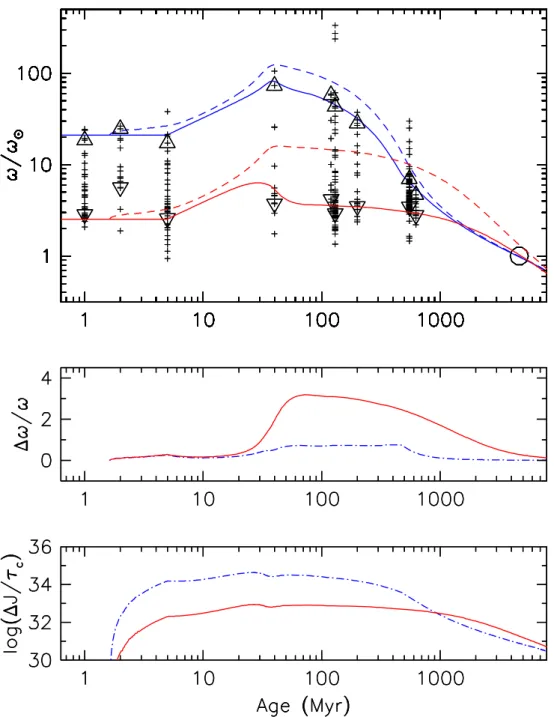
Figure 1 shows models we developped to investigate the rotational evolution of solar-type stars, from their birth up to the age of the Sun. The models dicussed here were originally developped by Bouvier et al. (1997) and Allain (1998). The rotational evolution of solar-mass stars is driven by a number of physical processes acting over the star’s lifetime. During the early pre-main sequence (PMS), the star is magnetically coupled to its accretion disk (cf. Bouvier et al. 2007). As long as this interaction lasts, the star is prevented from spinning up (in spite of contraction) and evolves at constant angular velocity (Matt & Pudritz 2005). The disk lifetime, a free parameter of the model, thus dictates the early rotational evolution of the star. When the disk eventually dissipates, the star begins to spin up as it contracts towards the zero-age main sequence (ZAMS). Depending on the initial velocity and disk lifetime, a wide range of rotation rates can be obtained on the ZAMS (Bouvier et al. 1997). The lowest initial velocities and longest disk lifetimes result in the slowest rotation rates on the ZAMS. On the opposite, high initial velocities and/or short disk lifetimes lead to fast rotation on the ZAMS. Finally, as the stellar structure stabilizes on the ZAMS, at an age of about 40 Myr for a solar-mass star, the braking by a magnetized wind becomes the dominant process and effectively spins the star down on the early
1Laboratoire d’Astrophysique, Observatoire de Grenoble, Universit´e J. Fourier, CNRS, BP 53, 38041 Grenoble, Cedex 9, France c
238 SF2A 2008
main sequence (MS). As the braking rate scales with surface velocity (Kawaler 1988), fast rotators are spun down more efficiently than slow ones, and this leads to a rapid convergence towards uniformly slow rotation by the age of the Sun. Indeed, after a few Gyr, the surface rotational velocity of solar-type stars has lost memory of the past rotational history.
Internal differential rotation is an important additional parameter of the model. We consider here a radiative core and a convective envelope that are each in rigid rotation, but whose rotation rate may differ (Allain 1998). We therefore introduce a coupling timescale between the inner radiative zone and the outer convective envelope, τc, which measures the rate of angular momentum transfer between the core and the envelope (MacGregor
& Brenner 1991). A short coupling timescale corresponds to an efficient core-envelope angular momentum transport and, as a consequence, little internal differential rotation. On the opposite, a long coupling timescale leads to the developement of a large rotational velocity gradient between the core and the envelope. This model parameter, τc, governs internal differential rotation, and is therefore expected to be of prime importance for
rotationally-induced mixing and associated lithium depletion during the evolution of solar-type stars.
The models are confronted to the observed rotation rates of solar-type stars at various ages (e.g. Irwin et al. 2008). We aim here at reproducing the lower and upper envelopes of the observed rotational distributions, in order to contrast the evolution of slow and fast rotators and relate it to lithium depletion. A model for fast rotators is compared to observations in Fig. 1. Starting from an initial period of 1.2 d, the star remains coupled to its disk for 5 Myr, then spins up to a velocity of order of 160 km s−1 on the ZAMS, and is eventually spun
down by a magnetized wind on the MS to the Sun’s velocity. The model reproduces reasonably well the PMS spin up and the rapid MS spin down observed for fast rotators between 5 and 500 Myr. In order to reach such an agreement, the core-envelope coupling timescale has to be short, τc ∼10 Myr, which implies little internal
differential rotation in fast rotators.
Fig. 1 also shows a model for slow rotators. The initial period is 10 d and the star-disk interaction lasts for 5 Myr in the early PMS. As the star approaches the ZAMS, both the outer convective envelope and the inner radiative core spin up. Once on the ZAMS, the outer envelope is quickly braked, while the core remains in rapid rotation. This behaviour results from an assumed weak coupling between the core and the envelope, with τc ∼100 Myr. On the early MS, the rapidly-rotating core transfers angular momentum back to the envelope,
which explains the nearly constant surface velocity over several 100 Myr in spite of magnetic braking. We thus find that a long core-envelope coupling timescale is required to account for the observed rotational evolution of slow rotators, which implies the developement of a large velocity gradient at the core-envelope boundary. 3 Lithium depletion, rotation, and the lifetime of protoplanetary disks
The modeling of the rotational evolution of solar-type stars seems to imply that internal differential rotation is much larger in slow rotators than in fast ones. This should have a strong impact on lithium abundances, as the efficiency of rotationally-induced lithium burning is expected to scale with differential rotation (Zahn 2007). This model prediction is supported indeed by measurements of lithium abundances in the Pleiades open cluster, at an age of 100 Myr. Soderblom et al. (1993) found that rapidly rotating solar-type stars in the Pleiades exhibit higher lithium abundances than slow rotators, which indicates that lithium depletion already takes place during the PMS/ZAMS, and is more pronounced in slow than in fast rotators.
Different rotational histories may thus be reflected in the lithium abundance pattern of mature solar-type stars, leading to a dispersion of lithium abundances at a given age and mass, long after the circumstellar disks have disappeared. The models above suggest that enhanced lithium depletion is associated to low surface rotation on the ZAMS. Then, the fact that mature solar-type stars with massive exoplanets are lithium-depleted compared to similar stars with no planet detection seems to indicate that massive exoplanet hosts had slow rotation rates on the ZAMS.
Why were massive exoplanet host stars slow rotators on the ZAMS ? Two main parameters dictate the rotation rate at the ZAMS : the initial velocity and, most importantly, the disk lifetime. For a given disk lifetime, the lower the initial velocity, the lower the velocity on the ZAMS. Conversely, for a given initial velocity, the longer the disk lifetime, the lower the velocity on the ZAMS. This is because the magnetic star-disk interaction during the PMS is far more efficient than solar-type winds in extracting angular momentum from the star (Bouvier 2007; Matt& Pudritz 2007). Disk lifetimes varying from star to star in the range 1-10 Myr are required to account for the distribution of rotational velocities on the ZAMS (Bouvier et al. 1997). Statistically, however, the slowest rotators on the ZAMS are expected to be the stars who had initially low rotation rates and
Fig. 1.Rotational models for slow and fast solar-mass rotators. Data : The 10th and 75th percentiles of the observed rotational period distributions of solar-type stars (0.8-1.1 M⊙) were converted to angular velocity and are plotted as
direct and inverted triangles as a function of time. Individual measurements of rotational periods converted to angular velocities are also shown in order to illustrate the statistical significance of the various samples. Models : Rotational evolution models are shown for slow and fast 1 M⊙ rotators. For each model in the upper panel, surface rotation is
shown as a solid line, and the rotation of the radiative core by a dashed line. With a core-envelope coupling timescale τcof only 10 Myr, little differential rotation develops in fast rotators. In contrast, the 100 Myr core-envelope coupling
timescale in slow rotators results in a large velocity gradient at the base of the convective zone. A disk lifetime of 5 Myr is assumed for both models. Lower panels : The velocity shear at the base of the convective zone (ωrad− ωconv)/ωconv,
and the angular momentum transport rate ∆J/τc (gcm2s−2) from the core to the envelope are shown for slow (solid
240 SF2A 2008
the longest-lived disks. An initially slowly-rotating star with a short-lived disk would strongly spin up during the PMS and reach the ZAMS as an intermediate or fast rotator.
Long-lived disks thus appear as a necessary condition for massive planet formation and/or migration on a timescale ≥5 Myr. Long lasting disks may indeed be the common origin for slow rotation on the ZAMS, lithium depletion and massive planet formation. Interestingly enough, the Sun hosts massive planets. Even though the solar system gaseous planets are located further away from the Sun than massive exoplanets are from their host stars, the Sun is strongly lithium deficient. According to the scenario outlined above, the Sun would thus have been a slow rotator on the ZAMS.
4 Conclusions
Based on what we currently know of the rotational properties of young stars, of the lithium depletion process in stellar interiors and of the angular momentum evolution of solar-type stars, it seems likely that the lithium-depleted content of massive exoplanet host stars is a sequel to their specific rotational history. This history is predominantly dictated by star-disk interaction during the pre-main sequence. Rotationally-driven lithium depletion in exoplanet host stars can be at least qualitatively accounted for by assuming protoplanetary disk lifetimes of order of 5-10 Myr. Such long-lived disks may be a necessary condition for planet formation and/or migration around young solar-type stars, at least for the class of giant exoplanets detected so far. A full account of this work is given in Bouvier (2008).
References
Alibert, Y., Mordasini, C., Benz, W., & Winisdoerffer, C. 2005, A&A, 434, 343 Allain, S. 1998, A&A, 333, 629
Bouvier, J. 2007, IAU Symposium, 243, 231 Bouvier, J. 2008, A&A, 489, L53
Bouvier, J., Forestini, M., & Allain, S. 1997, A&A, 326, 1023
Bouvier, J., Alencar, S. H. P., Harries, T. J., Johns-Krull, C. M., & Romanova, M. M. 2007, Protostars and Planets V, 479
Gonzalez, G. 2008, MNRAS, 386, 928
Guillot, T., & Hueso, R. 2006, MNRAS, 367, L47 Hillenbrand, L. A. 2005, arXiv:astro-ph/0511083 Ida, S., & Lin, D. N. C. 2004, ApJ, 616, 567
Irwin, J., Hodgkin, S., Aigrain, S., Bouvier, J., Hebb, L., Irwin, M., & Moraux, E. 2008, MNRAS, 384, 675 Israelian, G., Santos, N. C., Mayor, M., & Rebolo, R. 2004, A&A, 414, 601
Jayawardhana, R., Coffey, J., Scholz, A., Brandeker, A., & van Kerkwijk, M. H. 2006, ApJ, 648, 1206 Kawaler, S. D. 1988, ApJ, 333, 236
Lawson, W. A., Lyo, A.-R., & Muzerolle, J. 2004, MNRAS, 351, L39 Lissauer, J. J., & Stevenson, D. J. 2007, Protostars and Planets V, 591 MacGregor, K. B., & Brenner, M. 1991, ApJ, 376, 204
Matt, S., & Pudritz, R. E. 2005, ApJl, 632, L135
Matt, S., & Pudritz, R. E. 2007, IAU Symposium, 243, 299
Meyer, M. R., Backman, D. E., Weinberger, A. J., & Wyatt, M. C. 2007, Protostars and Planets V, 573
Soderblom, D. R., Jones, B. F., Balachandran, S., Stauffer, J. R., Duncan, D. K., Fedele, S. B., & Hudon, J. D. 1993, AJ, 106, 1059