HAL Id: hal-00725553
https://hal.archives-ouvertes.fr/hal-00725553
Submitted on 27 Aug 2012
HAL is a multi-disciplinary open access
archive for the deposit and dissemination of
sci-entific research documents, whether they are
pub-lished or not. The documents may come from
teaching and research institutions in France or
abroad, or from public or private research centers.
L’archive ouverte pluridisciplinaire HAL, est
destinée au dépôt et à la diffusion de documents
scientifiques de niveau recherche, publiés ou non,
émanant des établissements d’enseignement et de
recherche français ou étrangers, des laboratoires
publics ou privés.
Models of Tet-On System with Epigenetic Effects
Russ Harmer, Jean Krivine, Élise Laruelle, Cédric Lhoussaine, Guillaume
Madelaine, Mirabelle Nebut
To cite this version:
Russ Harmer, Jean Krivine, Élise Laruelle, Cédric Lhoussaine, Guillaume Madelaine, et al.. Models
of Tet-On System with Epigenetic Effects. Computational Methods in Systems Biology 2012 (CMSB
2012, Flashposter), Oct 2012, London, United Kingdom. pp.378. �hal-00725553�
Models of Tet-On System with Epigenetic Effects
Russ Harmer1, Jean Krivine1, ´Elise Laruelle1, C´edric Lhoussaine2, Guillaume
Madelaine2,3, Mirabelle Nebut2
1
PPS (Cnrs Umr 7126), University Paris Diderot, France
2
Lifl (Cnrs Umr 8022), University of Lille 1, France
3 ´
Ens Cachan, France
Abstract. We present the first results of ongoing work investigating two models of the artificial inducible promoter Tet-On that include epigenetic regulation. We consider chromatin states and 1D diffusion of transcrip-tion factors that reveal, respectively, stochastic noise and a memory ef-fect.
1
Introduction
In gene regulatory systems, transcription factors (TF) usually require activa-tion in order to perform their regulatory funcactiva-tion. This generally results from the action of complex signalling pathways, so an investigation of the dynam-ics of TF activation is important for understanding the underlying gene regu-lation. Recently, an efficient experimental technique to monitor this dynamics has been proposed, using fluorescent proteins expressed under the control of an inducible promoter by the TF of interest. However, observed fluorescence is not linearly correlated to the TF activation: a delay is induced by fluo-rescent protein expression and subsequent folding; and fluorescence may
per-sist even after TF deactivation. Huang et al [4] propose a method to
recon-struct TF dynamics from observed fluorescent protein dynamics by means of a very simple two-level model of the Tet-On system, an artificial inducible
pro-moter of Green Fluorescent Protein (GFP). The first level (rules (1) to (3)
below) models the signal transduction pathway leading to TF activation: this
involves the artificial TF rtTA, activated by binding with doxycycline Doxi.
Extracellular doxycycline Doxe is assumed constant and can degrade in the
cell. The second level (rules (4) to (9)) models protein synthesis and
activa-tion of fluorescence: this includes transcripactiva-tion, translaactiva-tion and GFP activaactiva-tion. Doxe Deff −−−→ Doxe+ Doxi (1) Doxi Deff −−−→ ∅ (2) rtTA + Doxi kf 2 −−* )−− kr2 rtTA · Dox (3) rtTA · Dox S 0 m
−−→ rtTA · Dox + mRNA (4)
mRNA−−→ ∅Dm (5) mRNA −−→ GFP + mRNASn (6) GFP −S−→ GFPf a (7) GFP −−→ ∅Dn (8) GFPa Dn −−→ ∅ (9)
0 5 10 15 20 0 10 20 30 40 50 60 Continuous stimulation Time (hour) Fluorescence Intensity Experimental data Deterministic Simulation 0 5 10 15 20 0 5 10 15 20 25 30 Pulse stimulation Time (hour) Fluorescence Intensity Experimental data Deterministic simulation
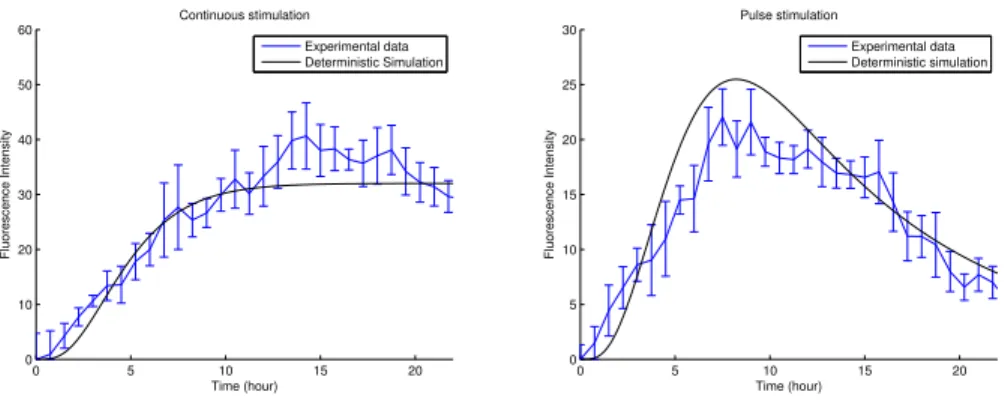
Fig. 1. Continuous (left) and pulse (right) stimulation with doxycycline.
Fig.1shows that the dynamics predicted by the deterministic model is in good
agreement with experimental data in the case of continuous and pulse4
stimula-tion with doxycycline. In [4], the authors demonstrate that the dynamics of TF
activation is accurately correlated with the dynamics offluorescence.
In this paper, we propose two simple extensions of the basic model proposed
in [4] to investigate effects that may result from epigenetic regulation. The first
extension deals with chromatin states, i.e. the (un)availability of the inducible promoter due to chromatin compaction. In the second, we model TF diffusion along DNA, i.e. the binding of a TF to non-specific binding sites, followed by its sliding to the operator site.
2
Chromatin states: a stochastic noise effect
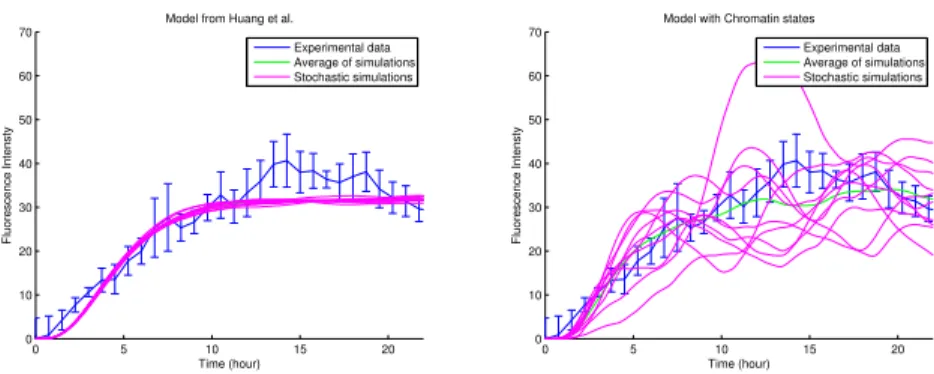
The experimental data of [4] appear to be quite noisy, contrary to what is
pre-dicted by the original model (Fig.2left). Although it is hard to assess
quantita-tively, we can assume that some of this noise results from intrinsic stochasticity. A recognized likely source of stochasticity in gene regulation is the dynamic alteration of chromatin structure that makes it more or less accessible to the transcriptional machinery. Most of the time, the chromatin is tightly packaged or, roughly speaking, in a closed state. This implies that the TF cannot find the promoter to activate transcription; to allow rtTA · Dox to bind with the promoter, the chromatin must be in an open state. Depending on the needs of the cell, the chromatin can rapidly switch between these states.
We refine the model given in the introduction by replacing reaction (4) with
reactions (10) to (13) below. In words, rtTA · Dox can bind its operator site (rule
(10)) when the chromatin is locally open; then, either rtTA · Dox can dissociate
from the operator (rule (10)), or transcription can begin (rule (13)). At any time,
the chromatin can switch to a closed state (rule (11)); if the TF is bound to the
operator when the chromatin closes, then it dissociates (rule (12)).
4
0 5 10 15 20 0 10 20 30 40 50 60 70
Model from Huang et al.
Time (hour) Fluorescence Intensty Experimental data Average of simulations Stochastic simulations 0 5 10 15 20 0 10 20 30 40 50 60 70
Model with Chromatin states
Time (hour)
Fluorescence Intensty
Experimental data Average of simulations Stochastic simulations
Fig. 2. Comparison of the stochastic noise between the basic model (left) and the model with chromatin states (right).
We take values for krop and kfop of the same order as those for TetR given in
[1]. The values of kclosedand kopenare actually dependent on the promoter used,
the position of the gene, the cell type, etc, but the values taken here are close
to those of promoters found in mammalian cells [6]. Finally, the rate constant of
transcription (rule (13)) has been chosen to fit the experimental data.
rtTA · Dox + Opopen −−*)−−kfop
krop
Opopen· rtTA · Dox (10)
Opclosed kopen −−−−* )−−−− kclosed Opopen (11)
Opopen· rtTA · Dox kclosed
−−−−→ Opclosed+ rtTA · Dox (12)
Opopen· rtTA · Dox −−−→ Opktrans
open· rtTA · Dox + mRNA (13)
The average of the stochastic simulations in Fig.2 is close to the deterministic
dynamics given by Huang et al. [4], as expected, but stochastic noise is far more
pronounced than in the basic model. The influence of chromatin states could thus provide an explanation for the noise observed in the experimental data.
3
1D diffusion of TF: a memory effect
Another interesting aspect of gene regulation is related to how the TF finds its promoter since it is known that three-dimensional (3D) diffusion is insufficient
to explain fast binding [5]. In [3], a diffusion-based model is proposed: once the
TF has (3D-) diffused within the nucleus and bound randomly to a non-specific DNA site, it rapidly slides along the DNA (1D diffusion) in a small region. If there is an operator in this region, it has an approximately 50-50 chance to bind it. In the case of binding, transcription can begin; otherwise, the TF either unbinds completely, returning to a search by 3D diffusion, or it jumps to another non-specific binding site in a neighbouring area.
We add this behaviour to the basic model with 14 new reactions (due to lack of space, we don’t report them here). The transcription rate has again
0 5 10 15 20 0 10 20 30 40 50 60 Continuous stimulation Time (hour) Fluorescence Intensity Experimental data
Deterministic simulation with Sliding Model Deterministic simulation with Huang Model
0 5 10 15 20 0 5 10 15 20 25 30 35 40 Pulse stimulation Time (hour) Fluorescence Intensity Experimental data
Deterministic simulation with Sliding Model Deterministic simulation with Huang Model
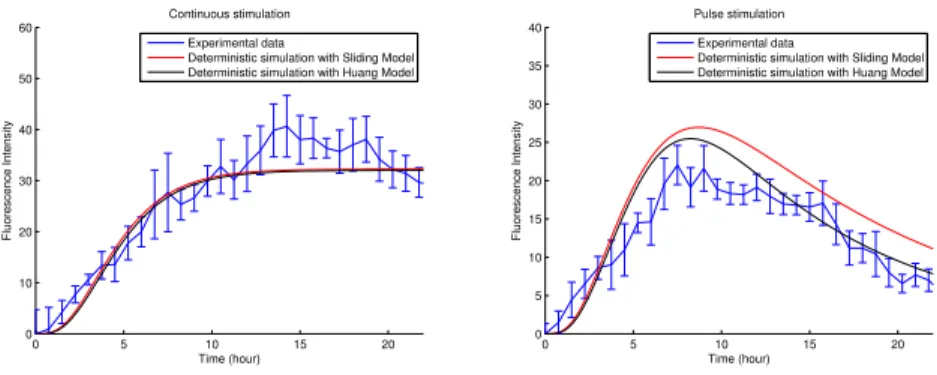
Fig. 3. Comparison between Huang model and Sliding model, with a continuous (left) or pulse (right) stimulation of doxycycline.
been chosen to fit the experimental data and the other parameters have been
taken from [3] and [2]. The results of the deterministic simulations in Fig.3are
interesting: there is no significant difference in the case of constant stimulation but, in the pulse case, fluorescence decays more slowly than in the basic model which can be interpreted as a sort of “memory effect”.
4
Conclusion
We have developed two extensions of the Tet-On model of [4]. The first, adding
chromatin states, increases stochastic noise but preserves the average behaviour in accordance with the experimental data. The second, adding a search for the operator by the TF via 1D diffusion, reveals a delayed decay in fluorescence after stimulation has ceased. We are currently investigating this effect in more detail, notably in the case where there are multiple operator sites in close proximity.
References
1. K. Biliouris, P. Daoutidis, and Y. N. Kaznessis. Stochastic simulations of the tetra-cycline operon. BMC systems biology, 5, 2011.
2. I. Bonnet. M´ecanismes de diffusion facilit´ee de l’enzyme de restriction EcoRV. 2007. 3. P. Hammar, P. Leroy, A. Mahmutovic, E. G. Marklund, O. G. Berg, and J. Elf. The lac repressor displays facilitated diffusion in living cells. Science, 336(6088):1595– 1598, June 2012.
4. Z. Huang, C. Moya, A. Jayaraman, and J. Hahn. Using the Tet-On system to de-velop a procedure for extracting transcription factor activation dynamics. Molecular bioSystems, 6(10):1883–1889, October 2010.
5. A. D. Riggs, S. Bourgeois, and M. Cohn. The lac repressor-operator interaction. 3. kinetic studies. Journal of molecular biology, 53(3):401–417, November 1970. 6. D. M. Suter, N. Molina, D. Gatfield, K. Schneider, U. Schibler, and F. Naef.
Mammalian genes are transcribed with widely different bursting kinetics. Science, 332(6028):472–474, April 2011.