Publisher’s version / Version de l'éditeur:
Solplan Review, July 93, pp. 18-19, 2000-07-01
READ THESE TERMS AND CONDITIONS CAREFULLY BEFORE USING THIS WEBSITE. https://nrc-publications.canada.ca/eng/copyright
Vous avez des questions? Nous pouvons vous aider. Pour communiquer directement avec un auteur, consultez la
première page de la revue dans laquelle son article a été publié afin de trouver ses coordonnées. Si vous n’arrivez pas à les repérer, communiquez avec nous à [email protected].
Questions? Contact the NRC Publications Archive team at
[email protected]. If you wish to email the authors directly, please see the first page of the publication for their contact information.
NRC Publications Archive
Archives des publications du CNRC
This publication could be one of several versions: author’s original, accepted manuscript or the publisher’s version. / La version de cette publication peut être l’une des suivantes : la version prépublication de l’auteur, la version acceptée du manuscrit ou la version de l’éditeur.
Access and use of this website and the material on it are subject to the Terms and Conditions set forth at
Controlling impact noise in residential buildings
Warnock, A. C. C.
https://publications-cnrc.canada.ca/fra/droits
L’accès à ce site Web et l’utilisation de son contenu sont assujettis aux conditions présentées dans le site LISEZ CES CONDITIONS ATTENTIVEMENT AVANT D’UTILISER CE SITE WEB.
NRC Publications Record / Notice d'Archives des publications de CNRC:
https://nrc-publications.canada.ca/eng/view/object/?id=2278cd23-9964-4c48-aa4e-4a3457745a01 https://publications-cnrc.canada.ca/fra/voir/objet/?id=2278cd23-9964-4c48-aa4e-4a3457745a01Controlling Impact Noise in Residential Buildings
By A.C.C. Warnock
Institute for Research in Construction, National Research Council Canada Originally published in Solplan Review, (93), July pp. 18-19, 2000
Abstract:
This article presents some results from an extensive study carried out to determine how best to control the transmission of impact noise through different types of floor systems. The study was carried out by NRC’s Institute for Research in Construction in collaboration with industry partners. Results reported here cover concrete-slab floors and wood-joist floors, as well as joist floors with heavy subfloors.
Résumé:
Cet article présente certains résultats d’une vaste étude visant à déterminer les meilleurs moyens de réduire la transmission des bruits d’impact par différents types de planchers. Cette étude a été menée par l’IRC et des partenaires de l’industrie. Les résultats décrits ici portent sur les planchers à dalle de béton ou à solives, ainsi que sur les planchers à solives comportant un support de revêtement de sol lourd.
Most people have experienced the sound of a thump, thud, tap or other impact on the floor above. Whether someone is moving furniture, dragging a vacuum cleaner, dropping a baseball, or walking in hard shoes, impact noise can be quite annoying, especially in multi-family dwellings.
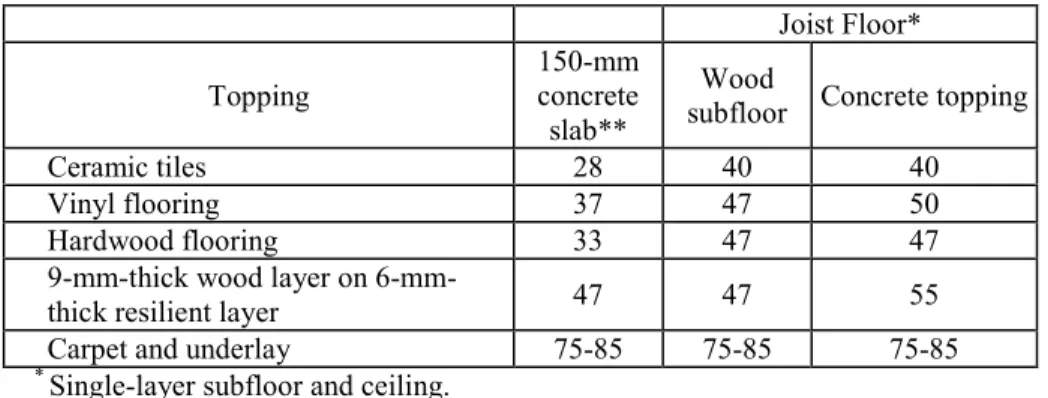
A common measure of a floor system’s ability to control impact noise is the Impact Insulation Class (IIC). This measure is derived from standard tests in which a tapping machine with five steel-faced hammers strikes a test floor and generates noise in the room below. The higher the IIC, the better the attenuation of noise, with 50 considered the minimum for multi-family dwellings. Table 1 gives some examples of IIC values for different floor types and toppings.
Concrete-Slab Floors
Soft floor finishing materials that provide a cushioning effect are needed for effective control of impact noise with concrete slabs, which themselves provide poor sound attenuation. Good thick carpet with underlay provides excellent cushioning and high IIC ratings; few occupants will be disturbed by impact noise in this situation. Soft, vinyl coverings, however, are too thin and lack the resiliency to provide effective noise control.
Ceramic or marble tiles attached directly to the slab make for attractive floors but they provide precious little improvement in sound attenuation. When a hardwood finish over concrete is desired, a cushioning resilient layer such as shredded or foamed rubber, foamed plastic or cork mats, must be used in between. Even better impact noise control is achieved by supporting the wood finish on strapping and a layer of fibrous material; this called a floating floor. The floating floor is also the most effective system when ceramic tiles or other hard finishes are to be used.
A concrete top layer (30-100 mm) placed over a layer of fibre board (glass or mineral fibre) gives an even better IIC rating than a layer of wood on strapping.
Wood-Joist Floors
Gypsum board attached directly to joists, or to wood or stiff metal furring, gives poor impact sound attenuation. A basic joist floor that follows good acoustical principles is one that has resilient metal channels supporting the gypsum board and sound-absorbing batts in the cavity. Common resilient metal channels are adequate for most cases. The key factor is the total mass of the subfloor and the ceiling layers: each doubling of the total mass increases the IIC by about seven points. Increasing the thickness of the sound-absorbing material increases the IIC but to a lesser degree.
NRCC-43388
2
Joist floors must still be provided with a finish layer, and an unwise choice can actually increase sound transmission. Hard finishes such as ceramic tiles adhered directly to the subfloor, for instance, reduce the IIC because of the increased generation and transmission of sharp, high-frequency sounds. Thin resilient coverings such as vinyl, while reducing the sharpness of noise, do not greatly increase the IIC of joist floors. (They are somewhat more effective on concrete floors.) Wood or laminate flooring on a thin resilient layer usually does not increase the IIC significantly. Any benefit comes mainly from the added weight of the wood.
High IIC values can be obtained with lightweight joist construction by using a carpet and pad. However, while the IIC rating will be high, such floors may still engender complaints about excessive low-frequency “booming” or “thumping” sounds produced by people walking. The IIC rating does not reflect the degree of annoyance caused by these sounds on this type of floor.
Joist Floors with Heavy Subfloors
A heavier floor vibrates less when walked on, and so it generates less low-frequency sound. Thus, a common approach to reducing the thumping noise associated with joist floors is to increase the mass of the floor by adding a layer of concrete, gypsum concrete or the like on top. But, while this reduces low-frequency thumping, it creates another problem: the sharp clicking heard on any hard surface. In fact, the effect of adding a layer of concrete on top of a basic joist floor is to reduce the IIC by several points. The solution to this problem is to “treat” the hard surface of the added concrete layer in the same way as described earlier for a solid concrete slab—with soft floor coverings or floating layers.
Alternatively, a resilient material can be placed between the wood subfloor and the concrete layer. Using this approach, a ceramic or hardwood finish may then be applied directly to the concrete without fear of reducing the IIC.
Table 1. Some approximate IIC ratings.
Joist Floor* Topping 150-mm concrete slab** Wood
subfloor Concrete topping
Ceramic tiles 28 40 40
Vinyl flooring 37 47 50
Hardwood flooring 33 47 47
9-mm-thick wood layer on
6-mm-thick resilient layer 47 47 55
Carpet and underlay 75-85 75-85 75-85
*
Single-layer subfloor and ceiling.
**
A 200-mm-thick concrete slab would increase all IIC ratings by about three points. For more information on this subject, particularly the differences inherent in dealing with
low- and high-frequency sound, readers should consult Construction Technology Update No. 35, Controlling the Transmission of Impact Sound Through Floors, available from IRC: www.nrc.ca/irc/catalogue/ctu.html
Dr. A.C.C. Warnock is a senior researcher in the Indoor Environment Program of the National Research Council’s Institute for Research in Construction.