HAL Id: halshs-00736551
https://halshs.archives-ouvertes.fr/halshs-00736551
Preprint submitted on 28 Sep 2012
HAL is a multi-disciplinary open access
archive for the deposit and dissemination of sci-entific research documents, whether they are pub-lished or not. The documents may come from teaching and research institutions in France or abroad, or from public or private research centers.
L’archive ouverte pluridisciplinaire HAL, est destinée au dépôt et à la diffusion de documents scientifiques de niveau recherche, publiés ou non, émanant des établissements d’enseignement et de recherche français ou étrangers, des laboratoires publics ou privés.
Signaling Corporate Social Responsibility: Third-Party
Certification vs. Brands
Fabrice Etilé, Sabrina Teyssier
To cite this version:
Fabrice Etilé, Sabrina Teyssier. Signaling Corporate Social Responsibility: Third-Party Certification vs. Brands. 2012. �halshs-00736551�
WORKING PAPER N° 2012 – 38
Signaling Corporate Social Responsibility: Third-Party
Certification vs. Brands
Fabrice Etilé Sabrina Teyssier
JEL Codes : C92, D82, L15, M14
Keywords: Corporate social responsibility ; Third-party certification ; Brand building ; Market experiment ; Halo effect
P
ARIS-
JOURDANS
CIENCESE
CONOMIQUES48, BD JOURDAN – E.N.S. – 75014 PARIS TÉL. : 33(0) 1 43 13 63 00 – FAX : 33 (0) 1 43 13 63 10
www.pse.ens.fr
CENTRE NATIONAL DE LA RECHERCHE SCIENTIFIQUE – ECOLE DES HAUTES ETUDES EN SCIENCES SOCIALES ÉCOLE DES PONTS PARISTECH – ECOLE NORMALE SUPÉRIEURE – INSTITUT NATIONAL DE LA RECHERCHE AGRONOMIQUE
1
Signaling Corporate Social Responsibility:
Third-Party Certification vs. Brands
Fabrice Etilé* and Sabrina Teyssier# September 25, 2012
Abstract
For most consumers, Corporate Social Responsibility is a credence attribute of products, which can be signaled either through a label certified by a third party, or via unsubstantiated claims used as part of a brand-building strategy. These claims may, in theory, be regulated by reputation mechanisms and the awareness of NGOs and activists. We use an experimental posted-offer market with sellers and buyers to compare the impact of these signaling strategies on market efficiency. Both third-party certification and the possibility of CSR-related brand building give rise to a separating equilibrium. However, only third-party certification clearly produces efficiency gains, by increasing CSR investments. In markets where reputation matters little, unsubstantiated claims can generate a ‘halo’ effect on consumers, whereby the latter are nudged into paying more for the same level of CSR investments by firms.
Keywords: corporate social responsibility, third-party certification, brand building, market experiment, halo effect.
JEL codes: C92, D82, L15, M14.
* INRA – ALISS, UR 1303, 65 Boulevard de Brandebourg, 94205 Ivry-sur-Seine cedex, France, and Paris
School of Economics, 48 Boulevard Jourdan, 75014 Paris, France. E-mail: [email protected].
# INRA – ALISS, UR 1303, 65 Boulevard de Brandebourg, 94205 Ivry-sur-Seine cedex, France. E-mail: [email protected]. Corresponding author.
Acknowledgments: We are grateful to Maxim Frolov for research assistance and Marie Font for administrative help. We warmly thank Andrew Clark, Patricia Crifo, Thomas Lyon, Stéphane Robin and seminar participants at the Ecole Polytechnique, the conference on “The Economics of Corporate Social Responsibility” (Paris), the 2nd
ASFEE conference (Fort-de-France), the 10th Journées Louis-André Gérard-Varet (Marseilles), INRA-GAEL,
the 29th Journées de Microéconomie appliquée (Brest) and the University of Lyon 2-GATE. We gratefully acknowledge funding from the ANR ALIMINFO grant. Sabrina Teyssier acknowledges the support of the chair FDIR (chair for Sustainable Finance and Responsible Investment).
2 1 Introduction
Corporate Social Responsibility (CSR) implies companies' use of social-, environmental- or health-friendly technologies, in ways "that go above and beyond what companies are legally required to do" (Vogel 2005).1 Firms' CSR commitments thus differentiate consumer goods by process attributes. As these are generally unrelated to end-use attributes, and consumers cannot verify CSR claims without paying considerable information costs, these products fall into the category of credence goods (Darby and Karni 1973, Nelson 1974, Roe and Sheldon 2007). Differentiation by CSR attributes may increase consumer welfare, but also creates an asymmetric-information problem. Labeling may be used to signal CSR to consumers and address this market failure. Most CSR labels are delivered to firms after a certification process carried out by an independent agency (a private or public third-party), guaranteeing that the good meets a certain quality threshold.2 However, many companies choose to undertake some CSR investments without being certified, and make CSR claims in advertising campaigns or on product packaging.3 This practice is often seen as one element of a more general brand-building strategy aiming to generate consumer awareness and loyalty (Anisimova 2007, Blumenthal and Bergstrom 2003, Guzman and Becker-Olsen 2010, Hoeffler and Lane Keller 2002, Kay 2006). These CSR claims may be totally or partially unsubstantiated, and refer to superficial or even non-existent CSR engagements: they are imperfect quality signals.4 It has been argued that their proliferation increases consumer skepticism toward CSR initiatives, especially when CSR efforts are perceived as not being driven by other-oriented values (Bronn and Vrioni 2001, Ellen et al. 2006, Jahdi and Acikdilli 2009). Economic theory suggests, however, that the combined effect of entrepreneurs' social preferences, media, NGO or State monitoring, and reputation may provide sufficient incentives for companies to self-regulate, i.e. to not mislead consumers regarding their CSR commitments (Baron 2001, Baron 2007, Feddersen and Gilligan 2001, Lyon and Maxwell
1 Policy makers view CSR as a means of promoting the production of public goods without altering private
profits, in a win-win scenario. See for instance the summary of the European Commission's position "What is Corporate Social Responsibility (CSR)?" at http://ec.europa.eu/social/main.jsp?catId=331&langId=en. CSR has also become one of the major priorities of managers in the retail and consumer goods sector (Hartmann 2011).
2 In the food sector, Max Haavelaar is one leading example of a third-party certification agency.
3 Cause-related marketing, i.e. the funding of non-profit organizations or social causes by firms, is an example of
a CSR practice that does not require certification. See Bronn and Vrioni (2001) for an overview.
4 This situation covers the case of 'greenwashing', i.e. the disclosure of selected positive information on firms'
activities. Lyon and Maxwell (2011) present a formal analysis of greenwashing, and Kim and Lyon (2011) provide empirical evidence of greenwash in a U.S. government program of gas reduction with the voluntary disclosure of effort by firms.
3
2011, McCluskey 2000).5 Brands then play the same signaling role as certified labels.6 Our research here presents experimental evidence on third-party certification and brands as potential remedies for information asymmetry when CSR differentiates goods, and asks whether third-party certification is better at increasing market efficiency than brands alone.
We propose an experimental posted-offer market, where subjects are randomly assigned to the role of buyers or sellers and trade virtual goods. Sellers have to choose a price and a level of CSR investment that can differentiate the quality of their offer. The quality – the actual level of CSR investment – remains private information, and we test the impact of four informational environments. In the baseline there is no signaling device other than the market price, and buyers remain unaware of the exact quality throughout the game (the No Signaling
treatment). In the research treatments, sellers can signal quality via a label. We compare the
case where labels guarantee a Minimum Quality Standard (MQS) certified by a third-party (the Third-Party treatment) to that in which labels are not regulated by a third-party.7 These labels correspond to unsubstantiated claims that may or may not correspond to CSR investments above the MQS. We examine two mechanisms whereby these CSR claims may be self-regulated. In the first treatment, there is a positive probability that fraudulent claims (investment under the MQS) be detected and reported to buyers. This simulates the pressure from activists, NGOs and the media on companies (the Claim treatment).8 The second treatment adds reputation effects to the Claim treatment, in order to account for the inclusion of CSR into brand-building strategies (the Brand treatment).9 We compare these four treatments in terms of market efficiency by considering the market shares, prices and qualities of labeled and unlabeled products. Our empirical measure of greater efficiency is the
5 See also the references in Dulleck and Kerschbamer (2006) and Roe and Sheldon (2007).
6 The Economist claimed in an answer to the ‘No-Logo’ movement that brands “make firms accountable to
consumers”, and “brands of the future […] will also have to signal something wholesome about the company behind the brand […] social responsibility”. See “The Case for Brands” (http://www.economist.com/node/771049/print) and “Who’s wearing the trousers?” (http://www.economist.com/node/770992/print), September 6th 2001, from the print edition.
7 The word “label” is used in the experiments' three research treatments, in order to avoid uncontrolled wording
effects. It is clear however that each research treatment corresponds to a specific type of signal, and is a way of representing the signaling content of certified labels, unsubstantiated claims and brands. In addition, the three types of signal often co-exist in real consumer markets. For clarity reasons, we do not investigate such mixed cases.
8 In the case of credence attributes, fraud and mislabeling can be uncovered by inspections carried out by
external organizations, public authorities, or competitors (Caswell et al. 1998, Emons 1997, Vetter and Karantininis 2002).
9 Ben & Jerry's, for ice cream, Altera for coffee, Body Shop for cosmetics and American Apparel for clothes are
4
emergence of a separating equilibrium, whereby labels signal significantly higher quality (Besley and Ghatak 2007, Conrad 2005, Rothschild and Stiglitz 1976, Spence 1973). We also look at distributional effects, from sellers' profits, buyers' payoffs and CSR investments.
Our experimental design introduces four key innovations relative to the existing literature (Cason and Gangadharan 2002, Rode et al. 2008). First, sellers not only choose prices and whether they want to be labeled, but also the quality level they offer. Second, product quality, i.e. CSR investments, is measured by real donations to charities: these donations are chosen by sellers and increase their production costs. Third, the virtual goods are pure credence goods, as exact offer quality is never revealed. Buyers infer offer quality only from prices, labels and, in the Claim and Brand treatments, detection reports and the game history. Last, we do not manipulate the payoff functions to induce individual preferences over product quality. Allowing individuals to express their actual preferences for social responsibility increases the external validity of the experimental results, and accounts for the potential role of social entrepreneurs in the sustainability of CSR (Baron 2007). We use donations in a dictator game where the receivers are charities to control for heterogeneity in social preferences across the treatment groups.
We find a separating equilibrium in the Third-Party and Brand treatments: labels signal higher-quality goods, which are also traded at higher prices. However, only the Third-Party treatment significantly increases donations to NGOs. The Brand treatment yields a separating equilibrium only because sellers lower the quality of unlabeled products. If NGO donations are assumed to represent investments in public goods, these distributional effects translate into efficiency gains.10 Third-party certification with perfect monitoring and a minimum quality standard then does much better than the inclusion of CSR in brand building in social-responsibility and market-efficiency terms. We also find that sellers make significantly higher profits in the Claim treatment, while donations are unchanged. However, all products are labeled here, implying that labels are uninformative. This suggests that sellers exploit ‘halo’ effects, whereby consumers are nudged by the mere presence of a label into paying more for labeled products. Straightforward conclusions can be drawn for the regulation of consumer information regarding CSR.
5
The remainder of the paper is organized as follows. The experimental design and procedures are presented in Section 2. Section 3 then discusses the previous experimental evidence on label regulations, and presents the main hypotheses to be tested. Sections 4 and 5 analyze and discuss the results, and Section 6 concludes.
2 Experimental design and procedures
The experimental design consists of two parts. In each session, participants first play a modified dictator game, in order to elicit their preferences for NGO donations, and then participate in a posted-offer market game.
2.1 Elicitation of donation preferences
A modified version of the Dictator game is used to measure preferences for donations. Each participant starts with an endowment of 50 Experimental Currency Units (ECUs: 8 ECUs = 1 Euro). They then have to decide how much to give to one receiver out of a list of four NGOs: ‘Emmaüs’, ‘the Red Cross’ and ‘Secours populaire’ are social NGOs which help the poor and homeless, and ‘Fonds ADIE’ is an NGO encouraging entrepreneurship via micro-credit.11 Participants can give between 0 and 50 ECUs, and keep the remaining sum. It is common knowledge that all decisions are anonymous, and that NGOs will really receive the donations. While making their decisions in the Dictator game, the participants do not know that they will subsequently participate in a market game.
2.2 A posted-offer market game
After having played the Dictator game, subjects participate in a market game that is repeated over 20 periods. The trading institution is a variation of the posted-offer market (Holt 2006, Plott and Smith 1978). In each market period, eight sellers and twelve buyers trade a virtual good. There are enough sellers to induce price competition in the absence of product
11 All of these NGOs are well known in France, except for the ‘Fonds ADIE’. We provided details about each
NGO's programmes at the beginning of each session. The diversity of the NGOs here ensures that we can elicit preferences for donations unconditionally on the identity of the receiver.
6
differentiation. The roles are randomly assigned at the beginning of the market game and are retained for the entire game. Participants trade using ECUs, which are converted into real payments at the end of the experiment at the rate of 8 ECUs = 1 Euro. This conversion rate is known at the beginning of the experiment.
Four treatments were designed. Each subject participates in only one treatment. Whatever the treatment, each period consists of four stages. First, sellers make their production decisions and propose their offers. Second, the offers are posted. Third, buyers make their decisions. Last, sellers and buyers receive information feedback. We now describe the baseline treatment. The following subsection will then present the main research treatments.
In the No Signaling treatment (NS treatment), each seller chooses a production cost, 𝑐, as well as a price, 𝑝. The production cost is a minimum of 20 ECUs per unit sold, and the price must be greater than or equal to the production cost. Sellers can choose production costs of over 20 ECUs. In this case, for every unit sold, the difference from the minimum cost 𝑐 − 20 is given to an NGO which sellers choose from the NGOs presented during the Dictator game. In this design, there are neither fixed costs of production nor limited production capacities: sellers produce the exact number of units sold.12 All of the prices are then posted simultaneously and revealed to buyers. It is public information that production costs over the minimum level generate a donation to one of the four NGOs, but buyers do not know the actual production costs, donations or the NGOs that were chosen by the sellers. The latter cannot be identified and tracked across periods, as the price offers appear on the screen in a random order in each period. Buyers have a fixed endowment, and must purchase at least four units of the virtual good;13 they can purchase all of these units from a single seller, or from a number of different sellers at different prices. At the end of the period, each buyer receives information about their own payoff (endowment minus expenditure) and profits, and the prices offered and quantities sold by each seller. A new period then starts. The payoff
12 We could hypothesise limited production capacities for sellers, as is often assumed in industrial organization
theory. However, this would raise methodological issues regarding the interpretation of the results. If consumers knew that production capacities were limited, they would be forced to make their choice more quickly. Some of them may then not have enough time to choose their preferred option carefully, which would generate noise. To obtain more reliable results, we therefore assume that sellers can always satisfy demand.
13 As we do not want to induce buyers' preferences formally via payoff functions, as is generally the case in
posted-offer market games, we force buyers to purchase a minimum number of units (this framework is also used in Rode et al. (2008). This corresponds, for instance, to food choices or any goods which individuals have to purchase on a regular basis.
7
functions of all agents (sellers, buyers and NGOs) are common knowledge. In each period, the profit 𝜋! of seller 𝑗 is:
𝜋! = 𝐸!+ 𝑝!− 𝑐! 𝑞!, ∀𝑗 ∈ 1,2, … ,8 (1) where 𝑞! is the number of units sold by seller 𝑗, and a fixed payment of 𝐸! = 50 ECUs is added to ensure a minimum profit for participants in the seller's role. The per-period payoff of buyer 𝑖 is:
𝑊! = E!− 𝑞!"𝑝! !
!!!
, ∀𝑖 ∈ 1,2, … ,12 (2) where 𝑞!" is the number of units that 𝑖 buys from seller 𝑗 (note also that !" 𝑞!"
!!! = 𝑞!), and 𝐸! = 250 ECUs is the fixed endowment received at the beginning of the period. At the end of the period, the donations made to NGO 𝑘 are:
𝐷! = 𝑐! − 20 𝑞!𝑑!" !
!!!
, ∀𝑘 ∈ 1,2,3,4 (3) where 𝑑!" is a dummy variable equal to 1 if seller 𝑗 chooses NGO 𝑘 as a beneficiary, and 0 otherwise.
In this experimental design, the donation associated with each unit sold is not observed by buyers: it is rather a credence attribute. From the buyer’s point of view, products are quality-differentiated according to the expected donation that each unit purchased generates. As emphasized in Section 2, we do not induce quality preferences via specific consumer payoff functions. Their valuation of quality is their utility from making donations, i.e. from purchasing goods whose production costs are expected to be over 20 ECUs. Buyers' expectations regarding sellers’ production costs and donations depend on the former's information set, which here includes only the prices posted by sellers. The other treatments will change the structure of this information set.
2.3 Main research treatments
The other three treatments are designed to compare the effects of third-party certification and market self-regulation. These two types of regulatory regimes differ in their labeling requirements. Third-party regulation corresponds to official certification such as ISO norms
8
or labels administered by independent certifying agencies with strict attribution criteria such as Max Havelaar. The Third-Party treatment (TP treatment) thus differs from the NS treatment in that sellers can choose to post a label along with the price after having set their production cost. However they can do so only if their production cost is greater than or equal to 25 ECUs (the minimum quality standard: MQS), meaning that at least 5 ECUs will be given to an NGO. The label thus tells buyers that a donation of at least 5 ECUs will be made with probability one if they purchase the good. This is common knowledge to all session participants. The information set of buyers at the time of the purchase decision now includes the two characteristics (price and label) of all posted offers. At the end of each period, they learn their own payoff, while sellers observe the characteristics of all offers and the quantities sold by each seller.
Market self-regulation is not, strictly speaking, a regulatory regime, as firms can here use labels to make unsubstantiated claims about their social investments. Media, activists, NGOs (e.g. consumer associations) and even State agencies can however check whether the company's claims are substantiated. One key difference with third-party certification is that monitoring yields a random probability that unsubstantiated claims be detected.14 In addition, the consequences of detection differ according to whether the firm's reputation is at stake or not.
In the Claim treatment (C treatment), sellers can also post their offers with a label, but a key difference with the TP treatment is that they can do so even if their production cost is under 25 ECUs, so that the label does not guarantee buyers a donation of at least 5 ECUs. Sellers who post a labeled offer but choose a production cost under 25 ECUs have a one in three chance of being detected as having a MQS of under 25 ECUs. In this case, the offer is posted with a warning message ‘Has the label but the production cost is lower than 25
ECUs’. This detection probability is independently and identically distributed across sellers.
Compared to the TP treatment, buyers' information at the time of purchase includes an additional characteristic for all posted offers: the presence or absence of the warning message. Last, the Brand treatment (B treatment) is identical to the C treatment, except that sellers
14 In general, activists choose to focus on some firms only. Lyon and Maxwell (2011) provide the example of
activists focusing on British Petroleum but not Exxon during the 2002 Earth Summit in Johannesburg. Certification agencies also use random monitoring procedures, but only when the company is certified for the first time. We here abstract from this consideration.
9
can be tracked across periods. Each seller is identified by a letter (from A to H) throughout the game. The information set of buyers is potentially richer here than in the C treatment, as the identification of sellers can be used to link their past and present offers.
2.4 Procedures
All sessions were conducted at the University of Paris 1-Sorbonne in Paris. The design was computerized using ‘Regate’ software (Zeiliger 2000), and recruitment was carried out using ‘ORSEE’ software (Greiner 2004). We organized 22 sessions, with 20 participants in each session: five sessions for the NS and B treatments, and six for the TP and C treatments.15
When participants entered the experimental room, they were randomly assigned a computer. They received instructions (see Appendix A) on how to play the modified Dictator game and details about the activities of the four NGOs: ‘Emmaus’, ‘Red Cross’, ‘Secours populaire’ and ‘Fonds ADIE’. The instructions were read out aloud and all participants then entered their donation decision without knowing that they would subsequently play a market game with donations in the second part of the experiment. After this first game, instructions for the posted-offer market game were distributed. These were read aloud and participants answered questions to check whether they had understood the game rules (payoff functions, choices to be made, etc.). The game only started once all participants had correctly answered these questions. Participants were randomly assigned as eight sellers and twelve buyers, and knew they would keep the same role until the end of the game. All treatments were framed in a neutral manner, and participants knew that the donations would be actually made.
At the end of the game, participants were free to provide remarks and comments. These did not reveal any particular misconceptions regarding the experimental procedure. Payments were made at the end of the session. One period out of the 20 in the market game was randomly drawn to determine participants’ earnings in this game. Participants' total earnings were their earnings in the modified Dictator game and the market game, plus a show-up fee of 4€. Payments were received in a separate room to preserve confidentiality. Each session lasted around 120 minutes and participants received on average 23.20€. After the sessions, donations to the NGOs were made online, with proofs of payment being sent to the participants.
10 3 Previous literature and research hypotheses
3.1 Experimental evidence on label regulations
When signaling credence attributes is not possible, buyers have no direct means of observing product quality. When buyers cannot distinguish low- from high-quality products, only low-quality products are traded: this is the usual ‘lemons’ or adverse-selection problem (Akerlof 1970). Introducing certified labels based on a certain quality standard can remedy this market failure, as quality and therefore labeling is costly (Auriol and Schilizzi 2003).
Some experimental work has looked at markets with adverse selection, wherein products are vertically differentiated and buyers' preferences for quality are homogenous. One robust empirical finding is that adverse selection is reduced when a truthful signal about goods' quality is introduced (Dejong et al. 1985, Forsythe et al. 1999, Holt and Sherman 1990, Miller and Plott 1985, Plott and Wilde 1982). Cason and Gangadharan (2002) consider the effect of various label regulations, as we do here. A posted-offer market game is used to compare the outcomes of three treatments: Third-Party certification, Claim without detection or reputation, and Claim without detection but with reputation. Two key differences from our experimental design are that product quality is revealed at the end of each market period in every treatment, and preferences for quality are induced via payoff functions. Participants hence trade experience goods, not credence goods, and sellers have no preference for quality while buyers have homogenous preferences. They focus on equilibrium selection (high- or low-quality) rather than on the emergence of a separating equilibrium. They find that third-party certification leads to greater efficiency gains while reputation alone does not suffice to produce efficient outcomes.
In most experiments, preference for quality is implemented via a single buyer payoff function. One exception is Rode et al. (2008), who conduct a laboratory market experiment where three sellers and six buyers exchange units of a virtual good. The sellers choose the prices but not the quality of the products. The latter takes the form of a fixed donation to an internationally-recognized NGO fighting child labor, and brings higher production costs. Two sellers are committed to offer low-quality goods (no donations are made), while the last offers high-quality products. The results show that high quality is offered at higher prices. When labeling or signaling is not possible, buyers purchase at the lowest price: this is the ‘lemons’
11
equilibrium. When labeling is possible, many buyers accept lower monetary gains and pay a premium for labeled products: there is a separating equilibrium.
We here combine and extend the above work. First, we endogenize the choice of production costs, product quality and labeling on the supply side. Second, product quality is measured by real donations to NGOs. Third, product quality is never revealed to buyers. Fourth, we allow for heterogeneous preferences over quality amongst both sellers and consumers. As higher production costs and greater product quality are associated with donations to NGOs, buyers have heterogeneous preferences over product quality as they differ in their preferences for donations, i.e. their social preferences. There is both vertical and horizontal differentiation: buyers' utility increases in quality, and for a given quality, utility is higher for individuals with strong social preferences. Introducing preference heterogeneity between sellers is equivalent to inducing heterogeneity in production costs: the greater is the preference for donations, the lower the perceived cost of production.16 As participant preferences are not constrained, the empirical results here will arguably exhibit greater external validity.
3.2 Research hypotheses
Although the proposition of a formal model regarding this experiment is beyond the scope of the current paper, we now discuss in a non-technical way some of our predictions for the effect of the treatments on market efficiency.
For clarity of exposition, consider that the population (sellers and buyers) is a mixture of two types of individuals. Some participants have weak or no social preferences (abbreviated as WSP), while other have strong social preferences (SSP). The latter have a stronger taste for donations. Whatever the treatment, sellers and buyers are drawn from the same pool of individuals, and thus have similar social preferences. SSP-type sellers are more likely to choose higher production costs, in order to generate donations, even if they cannot signal this with a label.
16 For sellers, strong social preferences is akin to facing falling production costs as quality (the donation)
increases from 0, up to some point where the unit cost of production will start to rise. For a given selling price, their subjective profit (utility) rises as the production cost increases from 20 ECUs, even if their monetary profits fall. Amacher et al. (2004) and Crampes et al. (1995) formally discuss the effect of heterogeneity in firm cost structure on labeling.
12
Buyers are aware of this, as the randomness of role assignment is common knowledge. They thus expect some sellers to be SSP-type, and to post high-quality offers at higher prices. Prices might be a signal of quality. However, in the No-Signaling treatment, WSP-type sellers have an incentive to offer higher prices too, as low- and high-quality offers are indistinguishable. SSP-type buyers know this, but there is still a strictly positive probability that a high price offer corresponds to a high-quality product, and should therefore be willing to pay more than the minimum available price.17 We will hence observe transaction prices over 20 ECUs. In this pooling equilibrium, WSP-type sellers are able to sell low-cost products at a high-price: they benefit from an informational rent.18
Adding the certified label (the Third-Party treatment) reduces information asymmetry, since labeled products are necessarily of higher quality. SSP-type buyers purchase labeled products at a high price, while WSP-type buyers purchase unlabeled products at a low price. SSP-type sellers are motivated to offer high-quality products, as they receive a subjective benefit from donations. WSP-type sellers may offer low- or high-quality products, depending on the relative market shares expected on the markets for unlabeled and labeled products.19 Overall, agents can trade products whose quality better matches their preferences. In this separating equilibrium, the price distribution will have two modes, one located between 20 and 25 ECUs for unlabeled products, and the other over 25 ECUs for labeled products. The emergence of a separating equilibrium hence implies that the market is more efficient, even though the efficiency gains cannot be directly measured (they depend on the distribution of social preferences). As there is less informational asymmetry, the informational rent and profits of sellers are reduced. These are transferred to WSP-type buyers and NGOs.
In the Claim and Brand treatments, sellers can post labeled offers even if their production cost is under 25. In this case, they face a one in three chance of being detected. Detection (and the label) is uninformative for all labeled offers with a price under 25 ECUs since the production cost is necessarily lower than the price. Sellers who want to offer a price under 25
17 Note that the expected gains of a rational seller are higher if she posts at a price of 21, since profits and
donations are always zero at a price of 20. In the TP treatment, it is more rational at least for WSP-type sellers to offer labeled products at a price of 26 than at a price of 25 if they choose the label. The situation is somewhat different in the B treatment, if we imagine that making zero profit in the current period is a way of signalling honesty to consumers for the future periods, with potential future rewards.
18 That imperfect information leads to informational rents for sellers is a standard result in IO theory (Laffont
and Martimort 2002, Williamson 1975).
19 Whence the idea that the development of ethical consumerism will drive change in businesses. See Doane
13
ECUs are indifferent between taking the label or not. Only those sellers who would like to choose a price over 25 ECUs and a production cost under 25 ECUs face a trade-off in their labeling decision. There is the prospect of making higher margins, but also the risk of being detected.
In the Claim treatment, detection implies at most the loss of current profits. This is a small cost, implying that almost all offers will be labeled. Apart from the share of labeled offers, market outcomes should be very similar to those obtained under the NS treatment. Neither the labels nor the detection mechanism reduce the information asymmetry as they do not imply significant costs (Matthews et al. 1991).
In the Brand treatment, the cost of detection is higher, as it may also imply the loss of future profits.20 As the cost of detection is higher, fewer sellers are likely to take the risk of posting a price higher over 25 ECUs while producing a quality under the MQS. We may thus obtain a separating equilibrium with products priced over 25 ECUs being of high quality. However, the label alone does not signal quality, as sellers can without risk post labeled offers at a price under 25 ECUs: in this treatment, high quality is signalled by the combination of the label and a high price. Conversely, the market segment of labeled products pools low- and high-quality products: the label does not reduce the information asymmetry as efficiently as in the TP treatment. The average quality of labeled products in the B treatment should be lower than that in the TP treatment, but higher than in the NS treatment. The same holds for the amount of donations, and the inverse for sellers' profits.
Following the above discussion, two hypotheses will be tested:
HYPOTHESIS 1:SEPARATING EQUILIBRIUM. Only the TP and B treatments yield a separating
equilibrium, whereby labeled goods are of higher quality and are traded at a higher price than unlabeled goods. The C and NS treatments do not produce different market equilibria, except that all goods are labeled in the C treatment.
HYPOTHESIS 2: DISTRIBUTIONAL EFFECTS. Donations in the TP treatment should be higher
20 Although there may be an end-of-the-game effect on the cost from detection (the closer to the end of the game,
14
than in the B treatment. Donations in the C and NS treatment should be the same, and lower than in the B and TP treatments. The inverse should hold for sellers' profits.
If donations to NGOs are assimilated to the production of public goods, then their rise is another marker of greater market efficiency. Then, if Hypotheses 1 and 2 hold, the efficiency gains from labeling are larger in the TP than in the B treatment, and higher in the TP and B treatments than in the C and NS treatments. Section 4 below tests these hypotheses by analyzing the market shares of labeled and unlabeled products, their average prices and qualities (donations), and sellers' profits. Section 5 then discusses these results.
4 Results
We here compare the way in which treatments affect the capacity of labels to increase market efficiency, i.e. whether they produce separating equilibria and increase NGO donations.
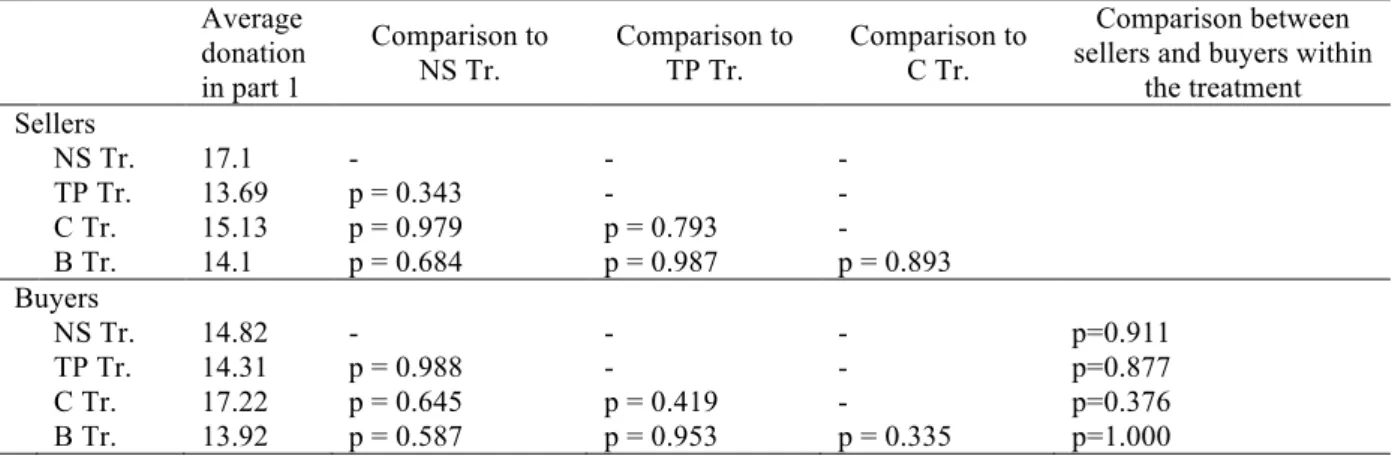
The empirical analysis focuses on periods 6 to 20 of the game, as the average market prices, calculated as the weighted averages of prices with the weights being the quantities purchased at each price, are stable after period 5 (see Appendix B). We compare the results from the different treatments using non-parametric tests. The social preferences of sellers and buyers (amongst other variables) drive their behavior and may differ between sessions, which would bias the tests. However, participants’ social preferences were measured in the dictator game21 played at the beginning of each experimental session (see Section 2), and Kolmogorov-Smirnov tests comparing the distributions of donations between treatments, and between sellers and buyers within each treatment, reveal no significant differences at the 10% level (see Appendix C, which also shows the distribution of subjects’ social preferences). In all of the regression analyses, we explicitly control for any differences in social preferences.
21 We also check that the Dictator game does not induce any ‘crowding out’ in the Market game. Donations in
the dictator game are indeed positively correlated with donation behavior in the market game, i.e. the production costs for sellers, and the purchases of labeled goods for buyers.
15
4.1 Separating equilibria
Labels encourage the appearance of separating equilibria, if both labeled and unlabeled products are traded on the market, and labeled products are of higher quality and are traded at higher prices than are unlabeled products.
Figure 1 depicts the market share of labeled goods in the TP treatment (the black line),22 and the C and B treatments (light and dark grey).
FIGURE 1-MARKET SHARES OF LABELED GOODS
Note: The market share of labeled goods is the sum of the labeled units of products purchased by buyers over the total number of units of the good purchased.
The market share of labeled goods is positive in all research treatments. On average, 28.4% of goods traded on the market after period 5 are labeled in the TP treatment. Almost all traded goods (92.6%, in periods 6 to 20) are labeled under the C treatment: this reflects almost all of the offers being labeled. When reputation is introduced, this figure falls to 64.7%. This drop is statistically significant: the Wilcoxon rank-sum test statistics on the difference between the market shares in the C and B treatments, using the average market share for all periods, is
22 Throughout the game, the share of labeled offers does not adjust to the market share of labeled goods. For
instance in the TP treatment, the share of labeled offers is 45.3% for periods 6 to 20, which is significantly higher than the market share of 28.4% for labeled goods observed in the TP treatment (Wilcoxon signed-rank test statistics: p-value = 0.046). This occurs as sellers have a non-strategic reason for posting labeled offers (making donations) and because there is no threat of bankruptcy when no sale is made.
0% 20% 40% 60% 80% 100% 1 2 3 4 5 6 7 8 9 10 11 12 13 14 15 16 17 18 19 20 Periods TP tr. C tr. B tr.
16
z=1.643, significant at the 10% level (p=0.100).
Figure 2 shows the distribution of transaction prices for labeled and unlabeled products in the TP, C and B treatments, and all products in the NS treatment, for periods 6 to 20. The Y-axis measures the market share for each price. Figures 2A-2D refer to the NS, TP, C and B
treatments, respectively.
FIGURE 2-MARKET SHARES OF UNLABELED AND LABELED GOODS BY PRICE
These price distributions reflect both treatment effects and the heterogeneity in participants' social preferences. However, as social preferences do not actually differ much between treatments, the differences in price distributions are determined only by the treatments. In the No Signaling treatment, consumers mainly choose the minimum or almost minimum price: 63.4% of goods are exchanged at price 21 and 18.4% at price 22. Absent
0% 20% 40% 60% 80% 100% 20 21 22 23 24 25 26 27 28 29 > 30 Price FIGURE 2A - NS TREATMENT 0% 20% 40% 60% 80% 100% 20 21 22 23 24 25 26 27 28 29 > 30 Price FIGURE 2B - TP TREATMENT 0% 20% 40% 60% 80% 100% 20 21 22 23 24 25 26 27 28 29 > 30 Price FIGURE 2C - C TREATMENT 0% 20% 40% 60% 80% 100% 20 21 22 23 24 25 26 27 28 29 > 30 Price FIGURE 2D - B TREATMENT
17
other signals, prices have some influence on buyers’ expectations of quality. This creates an informational rent for the sellers who choose the lowest production cost, i.e. not to donate. When Third-Party certification is implemented, there is clear market segmentation. Unlabeled goods are mainly traded at price 21 (84.5% of unlabeled goods) and labeled goods at price 26 (65.0% of labeled goods). Almost all goods, whether labeled or not, are sold at their minimum price in the TP treatment. This suggests that consumers do not rely greatly on prices to infer the quality of offers, but rather on labels.
In the C treatment, 46.0% of labeled goods are traded at price 21, 21.9% at price 22 and 30.3% at a price of 23 or more. When reputation is introduced (the B treatment), 86.6% of unlabeled goods are exchanged at price 20. The price distribution is skewed for labeled goods: 54.1% are bought at price 21, 13.2% at price 22 and 31.4% at a price of 23 or more. The price distributions in the B treatment are hence clearly different from those in the TP treatment. In particular, labeled goods are traded at a price much lower than 25 ECUs in the B treatment. The prices of unlabeled and labeled goods in the C treatment, and of labeled goods in the B treatment, are more dispersed than they are in the TP treatment. This suggests that buyers are more likely to use price as a signal of quality. However, there are fewer transactions at prices over 25 ECU in the B than in the TP treatment, so that price seems to be a less efficient signal of quality than certified labels.
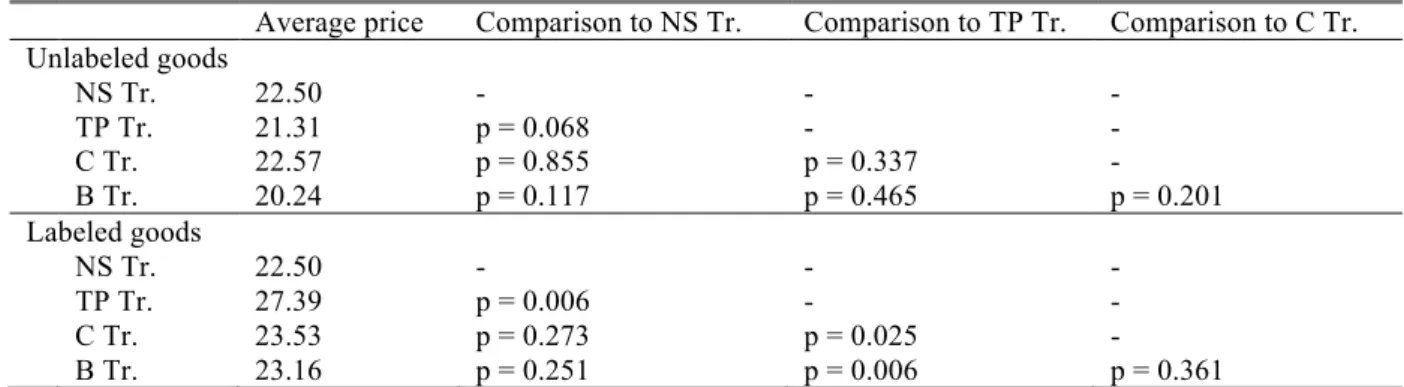
Table 1 present the statistical tests of these differences, comparing average price per transaction in all treatments for periods 6 to 20 separately for unlabeled and labeled goods. The first column shows the average price by treatment for labeled goods (upper panel) and unlabeled goods (lower panel). The following columns list the p-values from Wilcoxon rank-sum tests on the difference in average price between treatments (one observation per session). A p-value over 0.1 indicates that the difference is not significant at the 10% level.
18
TABLE 1–COMPARISON OF AVERAGE PRICES ACROSS TREATMENTS
Average price Comparison to NS Tr. Comparison to TP Tr. Comparison to C Tr. Unlabeled goods NS Tr. 22.50 - - - TP Tr. 21.31 p = 0.068 - - C Tr. 22.57 p = 0.855 p = 0.337 - B Tr. 20.24 p = 0.117 p = 0.465 p = 0.201 Labeled goods NS Tr. 22.50 - - - TP Tr. 27.39 p = 0.006 - - C Tr. 23.53 p = 0.273 p = 0.025 - B Tr. 23.16 p = 0.251 p = 0.006 p = 0.361
Notes: For the NS treatment, we show the same average price for labeled and unlabeled goods as there are no labels. The first column lists the average price observed in each treatment. The following columns (p=) show the p-values of the Wilcoxon rank-sum tests on the difference in average price between treatments (one observation per session).
The average price is 22.50 in the NS treatment, while labeled and unlabeled products are exchanged at respectively 21.31 and 27.39 ECUs in the TP treatment. The price difference between labeled and unlabeled products is significant, as shown by the Wilcoxon signed-rank test (with the average price in periods 6 to 20, the p-value is 0.028). The second line of Table 1 shows that the average price of unlabeled goods in the TP treatment is significantly lower (at the 10% level) than that in the NS treatment: the associated p-value of the Wilcoxon rank-sum test is 0.068. The analogous figure for labeled goods is positive and significant at the 1% level (the associated p-value in the sixth line of results in Table 1 is 0.006).
In the C treatment, the average price of unlabeled goods is not significantly different from that of labeled goods, with a p-value of 0.917 for the Wilcoxon signed-rank test using average price from period 6 to 20. The distribution of the prices of labeled goods in the C treatment is not significantly different from that in the NS treatment, with a p-value of 0.273 (see line seven in the second column of Table 1). In the B treatment, the prices of labeled goods are significantly higher than those of unlabeled goods, with a p-value of 0.043 for the Wilcoxon signed-rank test using average prices from periods 6 to 20. However, the price of labeled goods in the B treatment is no different from prices in the NS and the price of labeled goods in the C treatment, with p-values of 0.251 and 0.361 in the last line of Table 1; they are on the contrary significantly lower than the price of labeled goods in the TP treatment (with a p-value of 0.006).
Table D1 in Appendix D presents additional OLS regressions to test the robustness of these results. Average prices in each period for each treatment from period 6 to 20 are regressed
19
separately for labeled and unlabeled goods on treatment dummies, a period trend, and controls for sellers’ and buyers’ social preferences in each session (the average donations in the Dictator Game). These produce fairly similar results to Table 1, with few differences between the B, C and NS treatments.
Labeling will yield a separating equilibrium not only when labeled products are sold at higher prices, but also when they are of higher quality. While rational consumers should not be willing to pay higher prices if they do not believe in the associated higher quality, it is worth checking that this is actually the case. Donations measure product quality. Table 2 below shows average donations for both labeled and unlabeled goods per unit sold on the market. The p-value corresponding to the Wilcoxon rank-sum test comparing the average donations between treatments are listed. We consider as independent observations the average donation in each session from period 6 to 20.
TABLE 2–COMPARISON OF THE AVERAGE DONATIONS BETWEEN TREATMENTS Average
donation Comparison to NS Tr. Comparison to TP Tr. Comparison to C Tr. Unlabeled goods NS Tr. 0.39 - - - TP Tr. 0.05 p = 0.006 - - C Tr. 0.27 p = 0.062 p = 0.733 - B Tr. 0.01 p = 0.009 p = 0.709 p = 0.842 Labeled goods NS Tr. 0.39 - - - TP Tr. 5.18 p = 0.006 - - C Tr. 0.59 p = 0.715 p = 0.004 - B Tr. 0.66 p = 0.016 p = 0.006 p = 0.100
Notes: For the NS treatment, we show the same average donation for labeled and unlabeled goods as there are no labels. The first column lists the average donation observed in each treatment. The following columns (p=) show the p-values of the Wilcoxon rank-sum tests on the difference in average donations between the treatments (one observation per session).
Unsurprisingly, the highest quality pertains for labeled goods in the TP treatment, with an average donation of 5.18, which is close to the mandatory threshold of 5 (the MQS). The average donation of unlabeled products is significantly lower than that observed in the NS treatment (with a p-value of 0.006). In the TP treatment, labeled goods yield greater donations to NGOs than do unlabeled goods (5.18 ECUs by unit vs. 0.05 ECUs, with a p-value of 0.028). The TP treatment thus generates two market segments which clearly differ in quality and price.
20
The average quality of labeled goods in the C treatment is not significantly higher than that of all offers in the NS treatment (with a p-value of 0.715). In addition, the qualities of labeled and unlabeled goods are the same (p=0.345). Given the price results, the C treatment yields a pooling equilibrium like that in the NS treatment, except that almost all offers are labeled.
In the B treatment, the labeled products are of higher quality than the pooled offers in the NS treatment (p=0.016), but their average quality is much lower than in the TP treatment: 0.66 as against 5.18 ECUs. There is also no significant difference in quality from the C treatment. However, labeled products do induce significantly higher donations (0.66) than unlabeled products (0.01), at the 5% level (p=0.043). Hence, brands restore the separating equilibrium, as labeled and unlabeled goods are sold at different prices and the label effectively signals different qualities.
Table D2 in Appendix D shows that these results are reasonably robust to the introduction of controls for preference heterogeneity. There is only one minor change, as the quality of unlabeled products in the B treatment is here insignificantly different from that in the NS treatment. The experimental data therefore supports Hypothesis 1: only the Third-Party and Brand treatments yield separating equilibria; the impact of the C treatment is no different from the NS treatment, except that all products are now labeled.
4.2 Distributional effects
The above results have shown that the price and quality of labeled goods are significantly lower in the B than the TP treatment. The separating equilibrium is hence not the same in these treatments. The treatments have different distributional effects on payoffs. Table 3 below compares average donations per unit of the good traded across treatments, when labeled and unlabeled products are pooled together. This is to be read in the same way as Tables 1 and 2. Compared to the NS treatment, there is a significant increase in donations only in the TP treatment. The B treatment does not then generate higher donations than the NS treatment (0.43 ECUs per transaction as opposed to 0.39 ECUs).
21
TABLE 3–COMPARISON OF AVERAGE DONATIONS PER UNIT OF THE GOOD ACROSS TREATMENTS Average
donation Comparison to NS Tr. Comparison to TP Tr. Comparison to C Tr. All goods
NS Tr. 0.39 - - -
TP Tr. 1.50 p = 0.006 - -
C Tr. 0.57 p = 0.855 p = 0.025 -
B Tr. 0.43 p = 0.602 p = 0.011 p = 0.855
Notes: The first column shows the average donation in each treatment. The following columns (p=) list the p-values of the Wilcoxon rank-sum tests on the difference in average donations between treatments (one observation per session).
Even if the C and B treatments do not affect donations, they can have significant distributional effects. Table 4 summarizes the transfers of period-specific payoffs between the agents (sellers, buyers and NGOs) in each research treatment, in ECUs. The first column shows aggregate sellers’ profits, buyers’ payoffs, and NGO donations, averaged over periods 6 to 20, in the NS treatment. The individual averages are in parentheses. The number of goods traded on the market is also shown here: clearly almost all of the buyers purchase only four units. The following columns show the changes in aggregate payoffs by research treatment (the relative changes appear in parentheses.
TABLE 4–TRANSFERS OF PAYOFFS BETWEEN THE SELLERS, BUYERS AND NGOS NS Treatment
(Baseline)
TP Treatment C Treatment B Treatment Sellers’ profits 502.3 (62.8) -24.3 (-4.8%) +41.7 (+8.3%) -18.4 (-3.7%) Consumers’ payoffs 1893.2 (157.8) -65.1 (-3.4%) -60.5 (-3.2%) +17.8 (+0.9%) Donations to NGOs 22.5 (5.6) +53.8 (+239.0%) +5.7 (+25.3%) -1.4 (-6.3%) Number of sold goods 49.1 (4.1) +1.8 (+3.6%) +0.7 (+1.3%) +0.1 (+0.2%) Notes: All payoffs are in ECUs. The first column lists the average aggregate payoffs per period in the NS treatment, with the average individual payoffs in parentheses. The following columns present the absolute changes in aggregate payoffs in each research treatment relatively to the baseline treatment; the % changes are shown in parentheses.
There are three striking results in Table 4. First, as expected, NGO donations are much higher in the TP than the other research treatments: +53.84 ECUs per period on average (an increase of nearly 240%). Second, sellers’ profits are higher in the C treatment, by 41.73 ECUS (+8.3%), while we would expect them to be equal to or lower than the profits in the NS treatment. This result cannot reflect the informational rent from which sellers may benefit, as
22
information asymmetry is no stronger than in the NS treatment. Third, donations are similar in the B and NS treatments, and lower in the B treatment compared to the C treatment. Table D3 in Appendix D runs linear regressions to check these findings. The three dependent variables are the profit of each seller in each period, the payoffs of each buyer, and the donations made by each seller to the NGOs. These are regressed on dummies for the research treatments, controls for period trends, and individual and average social preferences. The results confirm that sellers make significantly higher profits in the C treatment. The TP treatment has the strongest distributional effects, with lower buyer payoffs and seller profits, and greater NGO donations. The fall in buyer payoffs measures their willingness-to-pay for giving to NGOs: this is indeed associated with higher welfare.23 Overall, the experimental data only partially validate Hypothesis 2, especially as the B and C treatments do not exhibit the expected effects on the distribution of payoffs.
Section 3.2 proposed two criteria for evaluating the efficiency gains generated by each treatment as compared to the baseline. First, the existence of a separating equilibrium ensures that the offer better matches consumer preferences. Second, assuming that NGOs produce a public good, efficiency rises in donations. Following these two criteria, Third-party certification clearly yields efficiency gains. Labeled goods are unambiguously associated with higher quality: buyers' choices can more closely reflect their social preferences. Second, donations to NGOs are significantly higher. The B treatment leads to some efficiency gains, as the equilibrium is separating, but donations are no higher: efficiency gains are lower. The C treatment produces no efficiency gains compared to the NS treatment. Worse, it increases the sellers' ability to make profits.
5 Discussion
The above results confirm that third-party certification clearly produces separating equilibria in markets for credence goods. These extend the validity of previous experiments (Cason and Gangadharan 2002, Rode et al. 2008), as the experimental design here is closer to
23 It may be argued that some buyers would like to be offered labeled "medium"-quality products at a price
between 20 and 25 ECUs. The TP treatment, with its discrete quality threshold, forces them to "over-donate" (equally for sellers). However, given that one period only is drawn at the end of the session to decide the payoffs, they can always play a mixed strategy: buying labeled products in some sessions, and unlabeled products in others. This is indeed what we observe in the individual data.
23
real-world situations: it does not induce agents' preferences over quality; the latter here correspond to actual donations; and choice by sellers is endogenized. In addition, our findings suggest that incorporating CSR in brand-building strategies is not an alternative to third-party certification, from a consumer policy point-of-view, or for a policy-maker who is interested in promoting CSR. Last, freely allowing firms that do not care for reputation to make CSR claims may lead to lower consumer welfare.24
The analysis of the effect of social preferences on choices reveals the superiority of Third-Party certification, insofar as it allows sellers and consumers to better express their social preferences. Table 5 examines the impact of social preferences on quality choices via OLS regressions, where social preferences are measured by the donation made in the Dictator game (on a 0-50 scale), prior to the market game. The upper panel reports the results for sellers' decisions, and the lower panel for buyers' decisions. Social preferences have about the same effect on sellers' decisions to produce over the MQS in the TP and C treatments. Giving 10 ECUs more in the Dictator game implies an increase of about 0.65 ECUs in the production cost (or quality or donation) chosen in the TP treatment, and 0.75 ECUs in the C treatment. The probability of posting a labeled offer with quality over the MQS increases by 11.49 percentage points in the TP treatment and 6.49 percentage points in the C treatment. Social preferences are unrelated to sellers' choices in the Brand treatment, and unrelated to the choice of posting a labeled offer with quality under the MQS in the C treatment. For buyers, the same increase of 10 ECUs in social preferences implies an increase of 14.59 percentage points in the market share of labeled products in the TP treatment, 4.70 points in the B treatment (significant at the 10% level only), and 1.83 points in the C treatment (not significant, but all products are labeled). Overall, the TP treatment is associated with greater efficiency gains as it allows social preferences to affect both sellers' and buyers' quality choices: both categories of economic agents can make choices that better mirror their social preferences.
24 This is the case if consumers do not remain ignorant of the absence of CSR investments by firms, i.e. are
24
TABLE 5–SOCIAL PREFERENCES AND QUALITY CHOICES
Effect of individual social preferences on the period… NS treatment
TP treatment C treatment B treatment Choice of quality (donation) by sellers (in ECUs) 0.018
(0.034) 0.065*** (0.014) 0.075** (0.036) 0.027 (0.022) Choice of posting a labeled offer with a quality
over the MQS (0 or 1: Linear Probability Model)
0.011*** (0.003) 0.006** (0.003) -0.004 (0.003) Choice of posting a labeled offer with a quality
under the MQS (0 or 1: Linear Probability Model)
0.004 (0.003)
-0.002 (0.005) Demand for labeled products by buyers _ 1.459*** 0.183 0.470* (% of labeled products in individual purchases) (0.275) (0.109) (0.257) Notes: OLS regression results with standard errors in parentheses clustered by individuals; *** significant at the 1% level, ** significant at the 5% level, * significant at the 10% level; sellers' and buyers' social preferences are measured by their donations in the Dictator Game played in the first part of the session; all regressions control for a period trend and the mean donations of sellers and buyers in the session.
The failure of the Brand treatment to yield significant efficiency gains by increasing donations is partly explained by the negligible influence of reputation mechanisms on buyer behavior. Table 6 illustrates this point by comparing the average market shares of offers according to whether the seller introduces the label and quality is detected as being under the MQS. The upper panel shows the impact of detection at t on market share at t in the C treatment, with the associated p-value from a Wilkoxon signed-rank test. The lower panel shows the same statistics for the B treatment, and for the impact of detection at t and detection at t-1 on market shares at t.
Detection at t has a significant impact on buyer behavior in the same period in both treatments. In the C treatment, the average market share falls from 13.65% to 8.81% (p=0.028), and from 10.25% to 6.45% in the B treatment (p=0.043). This impact is even significant for the market share of offers priced under 25 ECUs, for which labels are uninformative (see the second column of results). However, in the B treatment, detection at
t-1 does not significantly affect market share at t, so that adding reputation does not increase the
cost of detection, even for offers proposed at a price above 25 ECUs. Additional results (not reported here) reveal that the only effect of detection at t-1 is on sellers' behaviors at t: the probability of posting labeled offers falls by 4.47 percentage points (significant at the 5% level), and the price proposed by sellers with labeled products drops by 2.41 ECUs. Table 7
25
shows the related aggregated results, which confirm previous findings from economic experiments regarding goods or services of uncertain quality (Cason and Gangadharan 2002, Dulleck et al. 2011).
TABLE 6–MARKET SHARE OF OFFERS AND DETECTION
For all prices For prices < 25 For prices ≥ 25
C treatment – Market share at t if…
…detected at t 8.81% 17.49% 2.07%
…not detected at t 13.65% 28.56% 4.66%
Wilcoxon signed-rank test
H0: Market share detected = Market share not detected p=0.028 p=0.028 p=0.028
B treatment – Market share at t if…
…detected at t 6.45% 11.75% 0.82%
…not detected at t 10.25% 20.49% 3.77%
Wilcoxon signed-rank test
H0: Market share detected = Market share not detected p=0.043 p=0.043 p=0.043
…detected at t-1 10.82% 3.40% 18.51%
…not detected at t-1 8.84% 3.07% 17.87%
Wilcoxon signed-rank test
H0: Market share detected = Market share not detected p=0.500 p=0.686 p=0.893 Notes: This Table tests whether detection at t (for both treatments) or at t-1 (for the B treatment only) has a significant impact on the market share of offers at t. The upper panel shows the results for the C treatment and the lower panel for the B treatment.
TABLE 7–CHOICE OF LABEL, PRICES AND DETECTION
For all prices For prices < 25 For prices ≥ 25
B treatment – Share of sellers with the label at t if…
…detected at t-1 91.06% 91.67% 90.48%
…not detected at t-1 95.44% 91.30% 98.29% Wilcoxon signed-rank test
H0: Labeled sellers detected = Labeled sellers not detected p=0.080 p=0.345 p=0.080
B treatment – Price at t of sellers with the label if…
…detected at t-1 26.15 22.05 30.11
…not detected at t-1 28.56 22.20 32.62
Wilcoxon signed-rank test
H0: Price detected = Price not detected p=0.080 p=0.893 p=0.080 Notes: This Table tests for the B treatment whether detection at t-1 has a significant impact on the share of sellers choosing to label their product and on the price of sellers with the label at t.
The Brand treatment does indeed yield a separating equilibrium, but only because the average quality of unlabeled products is very low, as shown in Table 2: the average donation is only 0.01 ECUs for unlabeled products in this treatment. Table 8 below also shows how the research treatments affect the payoffs of sellers and NGOs, separately for the labeled and
26
unlabeled offers. While the TP treatment introduces an increase in the quality (donations) of labeled products, associated with lower payoffs for sellers proposing labeled offers, the B treatment only affects the quality of unlabeled products. The two treatments produce very different separating equilibria.
TABLE 8–SELLERS’ AND NGOS’ PAYOFFS CONDITIONAL ON TREATMENTS AND LABELING Dependent variable: Sellers’ payoffs NGOs' payoffsa
From unlabeled offers From labeled offers From unlabeled offers From labeled offers
NS treatment Ref Ref Ref Ref
TP Treatment -1.748 -3.649* -1.563*** 17.913*** (1.535) (1.953) (0.426) (2.287) C Treatment -0.095 4.319* -0.678 0.318 (3.240) (2.490) (1.213) (0.851) B Treatment -8.279*** -0.867 -1.804*** 0.905 (1.905) (1.591) (0.525) (0.766) Notes: Dependent variable = payoffs per period. aNGOs’ payoffs are the donations made by each seller in each
period. OLS regression results with standard errors in parentheses clustered by individuals; *** significant at the 1% level, ** significant at the 5% level, * significant at the 10% level; all regressions control for a period trend, individual social preferences, and the mean social preferences of sellers and buyers participating in the session
Table 8 also shows that sellers' profits are significantly higher in the C than the NS treatment, although almost all offers are labeled. This can be interpreted as a halo effect of labels. A halo effect is “a problem that arises in data collection when there is carry-over from
one judgment to another” (Thorndike 1920).25 In the current experiment, the halo effect is a perception error by buyers regarding quality that comes about because the label is used as a signal of quality even when it is uninformative. This signal tends to blur other quality signals (here the price) as it is easier to use in routine judgments. Although the halo effect of CSR claims has previously been demonstrated in the marketing literature in a variety of contexts (see for instance Klein and Dawar (2004)), our work here is to the best our knowledge the first to identify such an effect in a market experiment with monetary incentives. While this a
priori calls for consumer protection against unsubstantiated claims by firms, it is worth noting
that buyers may continue to believe that they are making significant donations by purchasing
25 Thorndike (1920) was the first empirical study supporting the halo effect. The application was the rating of
27
labeled products until they are informed of the true quality of the product. Hence, it is not clear that consumer welfare falls significantly.
6 Conclusion
The research here has proposed an innovative experimental design to compare the market effect of Third-Party certification and the free incorporation of CSR attributes into brand-building strategies through unsubstantiated claims. A key criterion of comparison is the efficiency gains produced by the two market environments. From this point of view, Third-party certification clearly increases efficiency compared to situations where signaling is not possible. Branding yields a separating equilibrium that is inferior to Third-Party certification, as CSR brands are of no higher quality than those when there is no signaling. Additionally, when firms’ reputation is not at stake, unsubstantiated CSR claims have a halo effect on buyer behavior.
For policy-makers interested in the level of CSR investments by firms, unsubstantiated claims should be prohibited in markets where reputation does not matter. Alternatively, liability claims (possibly collective actions by activist or consumer groups) should be made possible by classifying unsubstantiated claims as potentially deceptive advertising.26 Our results also suggest that the development of CSR will be difficult to achieve if companies use CSR claims without being certified. CSR must be incorporated into brand-building strategies through third-party certification.
The experimental design that has been proposed here has, of course, a number of limitations. On the one hand, we gave self-regulation a better chance as sellers and buyers have similar social preferences. On the other hand, selfish sellers may perhaps make market mechanisms (i.e. reputation and competition) work better. It would thus be of interest to have real company managers in the position of sellers. This is left for future research. The results of this study provide clear evidence on the separate roles of different types of signaling. With these as a reference, the current proliferation of labels or claims referring to firms' social responsibility is also worthy of analysis. An experiment which allowed sellers to choose
26 In the context of expertise regarding credence goods (doctors and mechanics), Dulleck et al. (2011) show that