HAL Id: lirmm-01222961
https://hal-lirmm.ccsd.cnrs.fr/lirmm-01222961
Submitted on 31 Oct 2015
HAL is a multi-disciplinary open access
archive for the deposit and dissemination of
sci-entific research documents, whether they are
pub-lished or not. The documents may come from
teaching and research institutions in France or
abroad, or from public or private research centers.
L’archive ouverte pluridisciplinaire HAL, est
destinée au dépôt et à la diffusion de documents
scientifiques de niveau recherche, publiés ou non,
émanant des établissements d’enseignement et de
recherche français ou étrangers, des laboratoires
publics ou privés.
Collaborative Content-Based Method for Estimating
User Reputation in Online Forums
Amine Abdaoui, Jérôme Azé, Sandra Bringay, Pascal Poncelet
To cite this version:
Amine Abdaoui, Jérôme Azé, Sandra Bringay, Pascal Poncelet. Collaborative Content-Based Method
for Estimating User Reputation in Online Forums. WISE: Web Information Systems Engineering,
Nov 2015, Miami, United States. pp.292-299, �10.1007/978-3-319-26187-4_26�. �lirmm-01222961�
© Springer
Collaborative Content-Based Method for Estimating User
Reputation in Online Forums
Amine Abdaoui1, Jérôme Azé1, Sandra Bringay1 and Pascal Poncelet1 1 LIRMM B5 UM CNRS, UMR 5506, 161 Rue Ada, 34095 Montpellier, France
{amin.abdaoui, jerome.aze, sandra.bringay, pascal.poncelet}@lirmm.fr
Abstract. Collaborative ratings of forum posts have been successfully applied
in order to infer the reputations of forum users. Famous websites such as
Slash-dot or Stack Exchange allow their users to score messages in order to evaluate
their content. These scores can be aggregated for each user in order to compute a reputation value in the forum. However, explicit rating functionalities are rarely used in many online communities such as health forums. At the same time, the textual content of the messages can reveal a lot of information regard-ing the trust that users have in the posted information. In this work, we propose to use these hidden expressions of trust in order to estimate user reputation in online forums.
Keywords: Trust, reputation, online forums, social networks.
1
Introduction
Online forums are areas of exchange generated by their own users. Therefore, the veracity and the quality of the posted information vary wildly according to their au-thor. With the massive and rapid growth of these conversational social spaces, it be-comes very difficult for human moderators to separate good posts from bad ones. Consequently, more and more forums are implementing automated trust and reputa-tion metrics to infer the trustworthiness of posts and the reputareputa-tion of their authors. These metrics vary from ranks based on a simple post count to more elaborated repu-tation systems based on collaborative ratings. If the first category of metrics tries simply to reward users according to the number of their posts, the second category uses collaborative intelligence to rate a user’s posts and then aggregate these ratings to give him a reputation value [1]. This idea has been successfully applied in many online forums such as news groups (Slashdot1), question-answering websites (Stack
Exchange2), etc. However, collaborative rating is not so popular in other communities
such as health forums, where users prefer to post a new message in order to thank each other rather than clicking the ‘like’ or ‘vote up’ button. The objective of this
1 http://www.slashdot.org/ 2 http://www.stackexchange.com/
work is to use this implicit collaborative intelligence hidden in the textual content of the replies in order to infer user reputations.
Many definitions of trust and computational trust exist in the literature [2], [3]. Here we define the trust that a user A has in another user B as: “the belief of A in the
veracity of the information posted by B”, and the reputation of a user A as “the aggre-gation of trust values given to user A”. To infer such trust from textual replies and
aggregate user reputations, we need to know both the recipient of each forum message and the trust expressed in it. However, the forum structure does not always provide explicit quoting or direct answering functionalities. Besides, when these functionali-ties are provided, many users prefer posting a message answering the whole thread rather than a one answering or quoting another specific message. In order to deal with this issue, we propose a rule based heuristic to extract an interaction network where the nodes are the users and the edges are the replying posts. Regarding the semantic evaluation of each post’s content, the features that we are looking for are agreement and valorization for trust, and disagreement and depreciation for distrust. The rest of posts are considered as neutral. Finally, we propose a metric to aggregate trust and distrust replies that a user receives and infer his reputation in the forum. The proposed reputation metric considers propagation aspects by giving more weight to the replies posted by trusted users and less to the replies posted by untrusted ones.
The rest of the paper is organized as follows: section 2 presents a summary of re-lated work that match our methods. Section 3 gives the theoretical framework, pre-sents the corpus of our study and describes the proposed approach. Section 4 prepre-sents and discusses the obtained results using manual annotations. Finally, section 5 gives our main perspectives.
2
Related work
Most of the methods found in the literature in order to extract interaction networks from online communities use the HTML structure of the web page [4]–[7]. They try to identify explicit message quoting. However, explicit quoting functionality is not always provided in online forums, and even when it exists many discussion partici-pants do not use it. Moreover, a message may have many recipients. Consequently, posting it as an answer to another specific one may be insufficient. Gruzd and Hay-thornthwaite [8] presented an automatic approach to discover and analysize social networks from threaded discussions in online courses. The authors proposed a Name Entity Recognition system to extract name mentions inside the textual content of posts. After a preprocessing step (removing quotations, stop words, etc.), their method used a dictionary of names combined with manually designed linguistic rules. Anoth-er textual based method has been proposed by ForestiAnoth-er et al. [9] to extract a network of user interactions. They suggested to infer three types of interactions: structural relations, name citations, and text quotations. While structural relations can be in-ferred directly from the structure of the forum, name citations and text quotations require analyzing the textual contents. First, name citation relations have been ex-tracted by searching pseudonyms of authors inside the posts. Then, text quotations are
extracted by comparing sequences of words inside a message and the messages that have been posted before in the same thread.
On the other hand, existing trust metrics dealing with online forums can be orga-nized in two main categories: structure-based trust metrics and content-based trust metrics. The first category focus on the structure of the website (including the number of postings, the distance between messages, quotes, citations, etc.) [10], while the second one use the textual content of messages to infer trust and reputation. For ex-ample Wanas et al. [11] automatically score posts based on their textual content. Their method is inspired from forums that use collaborative intelligence to rate posts. They tried to model how users would perceive a post as good or as bad. However, unlike Wanas, we believe that the textual content of the messages that reply to a user’s post may reveal a lot of information regarding the trust or the distrust that the other users have in this post and therefore in its author. Consequently, instead of inferring a us-er’s reputation from his own posts, we suggest to consider the messages replying to his posts. Moreover, we would like to give more importance to a reply made by a trusted user and less to a reply made by an untrusted user. A large effort has been done to include propagation aspects in order to rank webpages [12]. Similarly, we propose a reputation metric that include these propagation aspects.
3
Materials and methods
3.1 Corpus of studyCancerDuSein.org is a French health forum specialized in breast cancer. 1,050
threads have been collected which amounts 16,961 messages posted by 675 users. It represents all the data that have been posted between October 2011 and November 2013. This forum allows users to thank each other using a “like” button, but this func-tionally is rarely used. Less than 1.4% of messages received at least one “like”. On the other hand, CancerDuSein.org gives a rank to each user based on the number of posts since his registration. However, we believe that these ranks are not sufficient to infer reputations.
3.2 Theoretical framework
Let 𝐺 = (𝑉, 𝐸, 𝑡, 𝑟) be a multigraph where: 𝑉 is the set of users, 𝐸 is the multiset of ‘reply-to’ edges between these users, 𝑡 is a function that returns the transmitter of a reply, and 𝑟 is a function that returns the recipient of a reply:
𝑡 ∶ 𝐸 → 𝑉 𝑟 ∶ 𝐸 → 𝑉 𝑒 → 𝑡(𝑒) 𝑒 → 𝑟(𝑒)
Let 𝑣 ∈ 𝑉 be a user. Then 𝐸𝑣⊆ 𝐸 is the set of edges that reply to the user 𝑣:
𝐸𝑣= {𝑒 ∈ 𝐸 ∶ 𝑟(𝑒) = 𝑣}
Let 𝐸𝑣+, 𝐸𝑣− and 𝐸𝑣𝑛⊆ 𝐸𝑣 be the subsets of trust, distrust and neutral edges that reply
3.3 Extracting the interaction network
We suggest searching nine types of relations using manually designed heuristic rules, checked sequentially in the following order:
Explicit quoting: CancerDuSein.org allows users to explicitly quote another user’s
post. However, only 349 posts on the Website are explicit quoting. They have been detected automatically using the HTML tag <quote>.
Second posts: Messages posted at the second place in each thread have been
considered as replying to the first one.
Names and pseudonyms: If a message contains the pseudonym or the name of a user
who previously posted a message in the same thread, then this user is considered as the recipient of the message. The following preprocessing steps were been applied to detect names and pseudonyms: 1) Remove all non-alphabetic characters except spaces; 2) Replace all accented characters by the corresponding non-accented ones; 3) Lowercasing.
Grouped posts: If a message contains a group marker (“hello everyone”, “Hi girls”,
“Thank you all”, etc.) then all the users who previously posted in the same thread are considered as recipients for this post.
Second person pronouns: In French, singular second person pronouns and plural
second person pronouns are different. If a singular second person pronoun is used then the recipient is considered to be the author of the previous post.
Activator posts: If the activator3 posts a new message in the same thread, we
consider that his new message is adressed to all the users who posted after him.
Questions: If the message contains a question, then the message is addressed to all
the users who previously posted in the same thread.
Answers: If there is a question posted before in the thread, the recipient is the user
who posted this question.
Default: If none of the above rules before are satisfied, we consider that the recipient
of the message is the activator.
3.4 Predicting trust and distrust
Once the interaction network is constructed, we need to classify each post with one of the following three classes: (1) Positive: the post expresses trust to its recipient; (2) Negative: the post expresses distrust to its recipient; (3) Neutral: otherwise.
Building lists of trust and distrust expressions: We manually created two lists of
expressions that should indicate if a message expresses trust (or distrust) to its recipi-ent. These lists have been obtained by manual annotations of a set of threads using the brat tool4. The annotators were asked to choose trust, distrust or neutral for each
thread post and to indicate the expressions that justify their choice. These expressions have been manually validated, and then corrected, lowercased and lemmatized.
3 The user who opened the thread by posting the first message. 4 www.brat.nlplab.org
Handling negation: If a trust expression is under the scope of a negation term, it is
considered as a distrust expression and vice versa.
Computing the frequencies and classifying the posts: All posts have been
automat-ically lowercased, lemmatized, and corrected using the Aspell5 spell checker. Then,
each post is assigned to the majority category carried by its words.
3.5 Proposed metrics
For each user 𝑣, we define a reputation value R(𝑣) as follows:
𝑅𝑛+1(𝑣) = {
∑𝑒∈𝐸𝑣+𝑅𝑛(𝑡(𝑒))
∑𝑒∈𝐸𝑣+𝑅𝑛(𝑡(𝑒))+ ∑𝑒∈𝐸𝑣−𝑅𝑛(𝑡(𝑒))
, 𝑖𝑓 𝐸𝑣𝑛≠ 𝐸𝑣
0.5 , 𝑂𝑡ℎ𝑒𝑟𝑤𝑖𝑠𝑒
This equation is recursive and can be computed by starting with reputations equal to 1 and iterating until it converges. The proposed reputation equation depends on both the number of trust and distrust replies a user receives and the reputations of the users who posted these replies.
We also define two complementary metrics: the neutral rate of the user 𝑁𝑅(𝑣), and the reliability of the computed reputation value 𝑅𝑒𝑙(𝑅(𝑣)).
𝑁𝑅(𝑣) = { |𝐸𝑣𝑛| |𝐸𝑣|, 𝑖𝑓 |𝐸𝑣| ≠ ∅ 0 , 𝑂𝑡ℎ𝑒𝑟𝑤𝑖𝑠𝑒 , 𝑅𝑒𝑙(𝑅(𝑣)) = { |𝐸𝑣| 𝑚𝑎𝑥𝑅, 𝑖𝑓 |𝐸𝑣| < 𝑚𝑎𝑥𝑅 1 , 𝑂𝑡ℎ𝑒𝑟𝑤𝑖𝑠𝑒 Where 𝑚𝑎𝑥𝑅 is a constant that represents the maximum replies that a user should receive in order to have a reliability of one in his reputation.
4
Results
4.1 Evaluating the network extraction step
Two datasets were used to test our rule based heuristic. The rules have been designed according to a development set (10 threads) and tested on other 10 unseen threads.
Prior-assessment: 15 non-expert annotators, unaware of the designed rules,
annotated our two datasets. Each one annotated between 1 and 5 threads so that each thread had 3 different annotators. The goal was to find the recipient(s) of each post without knowing the results of our heuristic.
Post-assessment: Three expert annotators (the authors) annotated the links found by
the heuristic in the two datasets. The goal was to validate or not the links found
automatically with the possibility of adding a link which was not found by the heuristic.
Evaluation: Using these annotations, the quality of the developed heuristic was
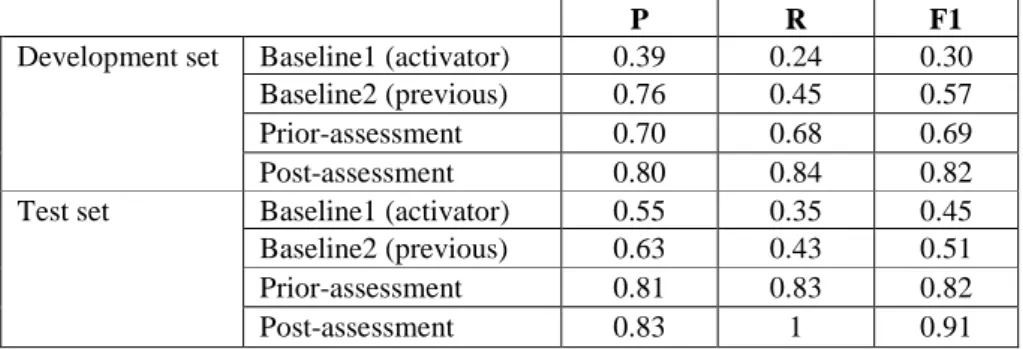
evaluated. The links obtained automatically were compared with those obtained from the annotations by considering only those that have been validated by two or more annotators (a majority vote). We compare the results of the prior-assesment and the post-assesment with two baselines. The first one considers the activator of the thread as the recipeint of all the messages posted in this thread (activator). The second baseline considers the author of the previous message as the recipient (previous).
Table 1. Precision (P), recall (R) and F1-score (F1) of baselines and our heuristic obtained on
both dataset using prior and post assessments
P R F1
Development set Baseline1 (activator) 0.39 0.24 0.30 Baseline2 (previous) 0.76 0.45 0.57 Prior-assessment 0.70 0.68 0.69 Post-assessment 0.80 0.84 0.82 Test set Baseline1 (activator) 0.55 0.35 0.45 Baseline2 (previous) 0.63 0.43 0.51 Prior-assessment 0.81 0.83 0.82 Post-assessment 0.83 1 0.91
Discussion: Our heuristic obtained higher F1-scores than both baselines. The results
obtained using a post-assessment are better than those obtained using prior-assessment. This observation can be explained by the nature of the prior-assessment itself which gives much more freedom in choosing the links. Surprisingly, the results obtained on the test set have been better than those obtained on the development set.
4.2 Evaluating the trust prediction step
Two new datasets have been used to evaluate the automatic trust inference. Unlike the first step where both datasets had assessment and post-assessment, here prior-assessment has been done only for the first dataset and post-prior-assessment has been done only for the second one.
Prior-assessment: Three annotators annotated the trust expressed in 97 messages
without knowing the results of the automatic system. The agreement between them was less than the recipient assessment but still acceptable.
Post-assessment: The same three annotators annotated the trust expressed in 102
other messages. The results of the automatic system have been displayed, and annota-tors can chose the same value of trust or another one.
Evaluation: The results obtained by comparing the classification made by the system
Table 2. Precision, recall and F1-score of the trust inference system using prior-assessment and
post-assessment
Discussion: The results obtained for the trust class are good but the recall is higher
than the precision using both assessments. Therefore, our list of trust expressions seems to be sufficient to find the majority of trust posts. Moreover, the results ob-tained on the neutral class are also good, but the precision is higher than the recall. Finally, the results obtained on the distrust class have been the worst but it is difficult to make conclusions regarding the small number of distrust posts.
4.3 Evaluating the proposed metric
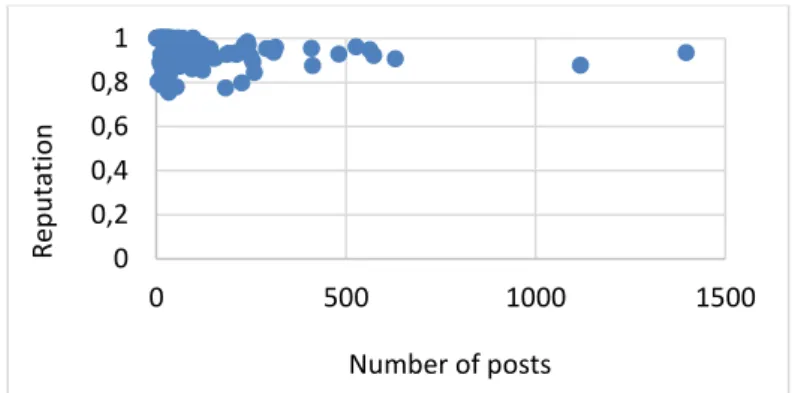
In our experiments, the constant 𝑚𝑎𝑥𝑅 has been fixed to the average number of re-plies received by each user. The reputations of 157 users had reliabilities greater than 0.5.
Fig. 1. User reputations that had more than 0.5 of reliability according to the number of posts
Discussion: Figure 1 shows that all considered reputations are greater than 0.7. This
observation can be explained by the fact that CancerDuSein.org is a forum where little distrust is expressed, since the users aim at first to exchange emotional support. Moreover, the user reputations seem to be independent from the number of posted messages, which reinforces our opinion that the number of postings do not represent a good estimation of user reputations or ranks.
0 0,2 0,4 0,6 0,8 1 0 500 1000 1500 Re p u ta tio n Number of posts Datasets Class P R F Prior-assessment Trust 0.67 0.93 0.78 Distrust 0.50 0.25 0.33 Neutral 0.96 0.83 0.89 Global 0.86 0.84 0.84 Post-assessment Trust 0.77 0.87 0.82 Distrust 0.23 0.60 0.33 Neutral 0.92 0.75 0.83 Global 0.84 0.78 0.80
5
Conclusion
Many perspectives can be considered in order to improve the work and to better ex-plore the idea. First, the user’s reputation can be computed for each thread topic in addition to the global reputation in the whole forum. In fact, the user’s expertise may change according to the discussed topic. Then, we are now scrolling other French forums in order to apply our method on a larger number of forums. Finally, we are planning to compare ourselves to PageRank or HITS based models built on the user interaction network.
6
Bibliography
[1] C. Lampe and P. Resnick, “Slash(Dot) and Burn: Distributed Moderation in a Large Online Conversation Space,” in Proceedings of the SIGCHI Conference on
Human Factors in Computing Systems, New York, NY, USA, 2004, pp. 543–550.
[2] P. Sztompka, Trust: A Sociological Theory. Cambridge University Press, 1999. [3] J. Golbeck, “Trust and Nuanced Profile Similarity in Online Social Networks,”
ACM Trans. Web, vol. 3, no. 4, pp. 12:1–12:33, Sep. 2009.
[4] L. A. Adamic, J. Zhang, E. Bakshy, and M. S. Ackerman, “Knowledge Sharing and Yahoo Answers: Everyone Knows Something,” in Proceedings of the 17th
In-ternational Conference on World Wide Web, New York, NY, USA, 2008, pp.
665–674.
[5] A. Stavrianou, J. Velcin, and J.-H. Chauchat, “Definition and Measures of an Opinion Model for Mining Forums,” in Social Network Analysis and Mining,
2009. ASONAM ’09. International Conference on Advances in, 2009, pp. 188–
193.
[6] H. Welser, E. Gleave, D. Fisher, and M. Smith, “Visualizing the Signatures of Social Roles in Online Discussion Groups,” The Journal of Social Structure, vol. 8, no. 2, pp. 1–32, 2007.
[7] J. Zhang, M. S. Ackerman, and L. Adamic, “Expertise Networks in Online Com-munities: Structure and Algorithms,” in Proceedings of the 16th International
Conference on World Wide Web, New York, NY, USA, 2007, pp. 221–230.
[8] A. Gruzd, “Automated Discovery and Analysis of Social Networks from Threaded Discussions. Paper presented at,” University of Illinois, Urbana-Champaign, 2009. [9] M. Forestier, J. Velcin, and D. Zighed, “Extracting Social Networks Enriched by
Using Text,” in Foundations of Intelligent Systems, Poland, 2011, pp. 140–145. [10] F. Skopik, H.-L. Truong, and S. Dustdar, “Trust and Reputation Mining in
Professional Virtual Communities,” in Proceedings of the 9th International
Con-ference on Web Engineering, Berlin, Heidelberg, 2009, pp. 76–90.
[11] N. Wanas, M. El-Saban, H. Ashour, and W. Ammar, “Automatic Scoring of Online Discussion Posts,” in Proceedings of the 2nd ACM Workshop on
Infor-mation Credibility on the Web, New York, NY, USA, 2008, pp. 19–26.
[12] L. Page, S. Brin, R. Motwani, and T. Winograd, “The PageRank Citation Ranking: Bringing Order to the Web,” Stanford InfoLab., 66, 1999.