HAL Id: hal-02124366
https://hal.archives-ouvertes.fr/hal-02124366
Submitted on 27 Oct 2020HAL is a multi-disciplinary open access archive for the deposit and dissemination of sci-entific research documents, whether they are pub-lished or not. The documents may come from teaching and research institutions in France or abroad, or from public or private research centers.
L’archive ouverte pluridisciplinaire HAL, est destinée au dépôt et à la diffusion de documents scientifiques de niveau recherche, publiés ou non, émanant des établissements d’enseignement et de recherche français ou étrangers, des laboratoires publics ou privés.
Tuning photosensitized singlet oxygen production from
microgels synthesized by polymerization in aqueous
dispersed media
Luca Petrizza, Mickaël Le Béchec, Emile Decompte, Hind El Hadri, Sylvie
Lacombe-Lhoste, Maud Save
To cite this version:
Luca Petrizza, Mickaël Le Béchec, Emile Decompte, Hind El Hadri, Sylvie Lacombe-Lhoste, et al.. Tuning photosensitized singlet oxygen production from microgels synthesized by polymerization in aqueous dispersed media. Polymer Chemistry, Royal Society of Chemistry - RSC, 2019, 2019 Pioneer-ing Investigators Issue, 10, pp.3170 - 3179. �10.1039/C9PY00157C�. �hal-02124366�
1
Tuning photosensitized singlet oxygen production from microgels synthesized by polymerization in aqueous dispersed media
Luca Petrizza, Mickael Le Bechec, Emile Decompte, Hind El Hadri, Sylvie Lacombe*, Maud Save*
CNRS/ Univ. Pau & Pays Adour/ E2S UPPA, IPREM, Institut des sciences analytiques et de Physicochimie pour l'environnement et les Matériaux, UMR5254, Hélioparc, 2 avenue
Président Angot, 64053, PAU cedex 9, France
[email protected] [email protected]
† Electronic supplementary information (ESI) available.
Table of content entry
Miniemulsion copolymerization of vinyl acetate, N-vinylcaprolactam, vinyl benzyl Rose
Bengal and divinyl adipate to synthesize switchable photosensitizer-grafted polymer colloids
for interfacial photooxygenation reactions. Latent colloids Irradiation LED= 515 nm Photoactive microgels Quantum yield of singlet oxygen (1O 2) production EtOH 0.36 Water 0.03 Swelling
2
Abstract
Novel sub-micronic photoactive polymer colloids grafted with Rose Bengal (RB)
photosensitizer were designed to promote singlet oxygen production from a supported organic
photosensitizer. Photooxygenation of fine chemicals under visible light irradiation is considered
as a green process. To enhance the overall process sustainability, stable colloidal particles were
synthesized by polymerization in aqueous dispersed media with the ability to be transferred into
ethanol, recycled by a centrifugation step and reused with no significant decrease of the
quantum yield of singlet oxygen production. The microgels were synthesized for the first time
by miniemulsion copolymerization of vinyl acetate (VAc), N-vinyl caprolactam (VCL),
polymerizable vinyl benzyl Rose Bengal (VBRB) monomers and divinyl adipate (DVA)
crosslinker. The microgels were characterized by UV-visible spectroscopy and compared with
the homologue non-crosslinked polymer in order to discriminate the effect of RB grafted onto
the linear polymer from its grafting inside crosslinked microgels. The quantum yields of singlet
oxygen production were almost null in water but interestingly in the range of 0.27-0.47 in
ethanol. The singlet oxygen quantum yield of these polymer materials is tuned by the
aggregation state of VBRB units, hence producing an ON/OFF photosensitizing colloidal
system. The absorption and emission spectra of the VBRB containing microgels in water were
characteristic of strongly aggregated VBRB, while no evidence of aggregation was observed
from the spectra in ethanol. The highest singlet oxygen quantum yield of the linear polymer
was correlated with a less aggregated state of RB units compared with the crosslinked
microgels. The present RB-based microgels were 20 % more resistant to photobleaching than
3
Introduction
Singlet oxygen production by photosensitization is a green chemistry process that takes
advantage of oxygen from air as reactant and of visible light to excite a photosensitizer (PS).
Singlet oxygen is a powerful selective oxidant, used for Photodynamic Therapy (PDT),1–3 for
the treatment/disinfection of environmental pollutants,4,5 or for fine chemical synthesis.6 The
covalent grafting of PS onto polymer substrates has been extensively investigated as a strategy
to transpose poorly soluble photosensitizers in solvent (or in water) while enhancing their
stability and recycling. A large part of the literature is devoted to the field of PDT with studies
describing multi-step syntheses of either star-like or block copolymers,7–13 and the design of
hydrogels.14–16 It should be mentioned that the block copolymer self-assembly into micelles as
nanoparticles dispersed in water required the systematic use of an organic co-solvent. On the
other hand, photosensitizing polymer beads, mainly based on polystyrene and/or poly(vinyl
benzyl chloride) polymers, with large diameters above 5 µm, have been extensively studied as
support for interfacial production of singlet oxygen to promote photooxygenation reactions. 17–
26 Polymer microbeads of 3–27 µm diameter were also prepared by thiol-ene
photopolymerization and capped with C60 photosensitizer.27 The singlet oxygen production
mainly occurs at the surface of such large beads which are prone to sedimentation.
In the growing area of continuous-flow photochemistry implemented in microreactors for fine
chemical oxidation,28–31 a potential barrier to the use of the large photosensitizer-grafted
polymer beads is their fast sedimentation rate and low specific surface area. It is thus important
to develop a straightforward synthesis of stable submicronic polymer particles covalently
grafted by an efficient organic photosensitizer.
Herein, we focus our attention on the covalent bonding of the Rose Bengal photosensitizer with
the polymer to limit any catalyst leaching and to design robust organic photocatalysts suitable
4 depending on its surrounding medium (16 µs and 3.3 µs in ethanol and water respectively), so
its diffusion length is highly dependent on the solvent.6,32 At solid/liquid interface, singlet
oxygen diffusion length is limited to several tens of nanometers.33,34 Consequently, the reagents
to be oxidized have to be in the vicinity of the photosensitizer to enhance the efficiency of the
photosensitized oxygenation. Moreover, due to solubility issues, relevant photo-oxygenation
reactions of fine chemicals such as -terpinene or furfural have to be performed in organic
solvents, among which alcoholic solvents are the less hazardous for any application.6,35 To
address these challenges, we describe here for the first time the synthesis of submicronic
photosensitizing crosslinked colloidal particles by one pot miniemulsion copolymerization.
These PS-grafted microgels are designed to exhibit swelling capacity in ethanol and should
present several advantages: enhancement of reactant diffusion during the photooxygenation
process, increase of the exchange surface due to their sub-micronic size, colloidal stability in
the absence of sedimentation. Polymerizations in aqueous dispersed media (emulsion,
miniemulsion, dispersion) are environmentally friendly processes of interest to synthesize
stable dispersions of submicronic polymer colloids in one step in the absence of solvents.36,37
Although polymer particles can be directly synthesized in alcoholic media by dispersion
polymerization, this implies the choice of polymers that precipitate in alcohol preventing their
swelling in ethanol. To the best of our knowledge, the development of polymer microgels with
covalent anchoring of organic photosensitizer is very scarce. In parallel with the synthesis of
crosslinked nanocapsules from sacrificial silica core embedding thionine photosensitizer,
Shiraishi et al. described the synthesis of poly(N-isopropylacrylamide-co-vinyl benzyl
chloride) microgels by precipitation polymerization, post-derivatized by thionine.38 Sensitized
oxygenation activity via the turnover number was estimated with the transformation of phenol
to p-benzoquinone.38 Lyon et al. synthesized Rose Bengal-grafted PNIPAM-based microgels
5 these colloids was not investigated at all.39 Polyacrylamide hydrogel nanoparticles of 50-60 nm
grafted with methylene blue were reported by Kopelman et al. for PDT purpose but the
synthesis was performed by inverse microemulsion with 300 wt-% of surfactant versus
monomers and hexane as organic continuous phase.40
In the present work, the commercially available Rose Bengal (RB) was selected as
photosensitizer due to both its high value of singlet oxygen quantum yield in water ( = 0.75)
and ethanol ( = 0.68-0.80)41 and its reactivity towards vinyl benzyl chloride (VBC) to produce
a polymerizable vinyl benzyl Rose Bengal (VBRB) monomer.42,43 Statistical copolymerization
of VBRB with N-vinylcaprolactam (VCL), vinyl acetate (VAc), and divinyl adipate (DVA)
crosslinker is implemented to covalently anchor RB to the crosslinked latex particles during
miniemulsion polymerization. The choice of P(VAc-co-VCL) copolymer to form the
sensitizing colloidal particles was driven by its solubility in ethanol, thus conferring a swelling
ability to the crosslinked particles compared with the more conventional polystyrene latex
particles that do not swell in such solvent. Several studies have reported self-quenching of the
photosensitizer induced by aggregation of the photosensitizer.19,20,25,44–49 This will be taken as
an advantage in the present work to design ON/OFF photosensitizing colloidal system by
simple switching from water to ethanol. Here, we aim to provide a detailed study on singlet
oxygen production via the measurement of the singlet oxygen quantum yield (∅∆). This allows
an accurate comparison of the singlet oxygen production between the different systems (free
rose Bengal, linear and crosslinked P(VAc-co-VCL-co-VBRB) polymer), independently from
the RB concentration.
Experimental section
6 4-vinylbenzyl chloride (VBC, 90 %), Rose Bengal (RB, 95 %), N,N-Dimethylformamide
(DMF, 99.8 %), acetone (99.9 %), chloroform (99 %), methanol (99.8 %), diethyl ether (99.8
%), vinyl acetate (VAc, 99 %), N-vinylcaprolactam (VCL, 98 %),
2,2-azobis(2-methylpropionitrile) (AIBN, 98 %), 1,3,5-trioxane (TR, 99 %), furfuryl alcohol (FFA, 99 %),
ethanol (for UV spectroscopy, 96 %), 1,3-diphenylisobenzofuran (DPBF, 97 %), 1,3,5-trioxane
and hexadecane (HD, 99 %) were purchased from Sigma-Aldrich Co. (St Louis, USA). Divinyl adipate (DVA, ≥99 %) was purchased from TCI Europe N.V. (Paris, France). Dimethyl sulfoxide-d6 (99.8 %) was purchased from Euriso-Top Sas (Saint-Aubin, France). Sodium
dodecyl sulfate (SDS, 99 %) was purchased from ABCR GmbH (Karlsruhe, Germany). Sodium
bicarbonate (SbC, NaHCO3, 99 %) was purchased from VWR International S.A.S. All the
purchased chemicals were used as received except furfuryl alcohol, freshly distilled (boiling
point 170°C) before use. ALUGRAM® aluminium sheets SIL G/UV254 for TLC were
purchased from MACHEREY-NAGEL GmbH & Co (Düren, Germany). Dialysis was
performed against water at room temperature under gentle stirring with Spectra/Por® Dialysis
membrane (Spectrum Laboratories, Inc., Rancho Dominquez, USA, mol wt cutoff >3.5 kDa,
average diameter 33 mm).
Characterization methods.
NMR spectra were recorded using a Brüker 400 MHz spectrometer at 25 °C. 1H measurements
were performed at 400 MHz and 13C measurements at 100 MHz.
The hydrodynamic diameter (Dh) of the microgels were measured by Dynamic Light Scattering
(DLS) using a Malvern Nano ZS instrument equipped with a He-Ne mW power laser operating
at a wavelength of 633 nm. Dialyzed samples were housed in disposable polystyrene cuvettes
of 1 cm optical path length, using double deionized water or ethanol as solvent, at 25° C and at
7 by the Cumulant analysis and reported as the Polydispersity Index (PDI). Dh values reported in
Table 1 were calculated from the intensity of light scattered by particles (10 measurements per
sample) from a multiple narrow mode (non-negative least squares (NNLS) analysis) to obtain
the particle size of each population.
The MG and VBRB@MG microgels were also analyzed by asymmetrical flow field-flow
fractionation (AF4) running with aqueous eluent. An Eclipse 3+ AF4 instrument (Wyatt
Technology, Dernbach, USA) equipped with a 1200 series high-performance liquid
chromatography pump (Agilent Technologies, Les Ulis, France) was used as a separation
system. All injections were performed with an Agilent Technologies 1260 ALS series
autosampler. The detection system was formed by a 1200 series UV-vis absorbance detector
(Agilent Technologies) and a multi-angle laser light scattering (MALLS) detector (DAWN
HELEOS, Wyatt Technology). The AF4 channel thickness was fixed by a 250-µm Mylar spacer
(with dimensions of 26.5 cm length and narrowing width from 2.1 to 0.6 cm). The accumulation
wall was defined by a 10-kDa polyethersulfone (PES) membrane purchased from Wyatt
Technology. The AF4 conditions used in this study were: an elution flow rate of 0.5 mL min-1,
an injection flow rate fixed at 0.2 mL min-1, a focus flow rate of 0.5 mL min-1 and a cross flow
rate (decreasing exponential) of 2e−0.27t mL min-1 (with t the time).50,51 The mobile phase was
prepared with sodium nitrate (NaNO3) diluted in deionized water (to reach a concentration of
0.5 mmol L-1) and filtered at 0.1 µm. The overlay of the UV-visible trace recorded at 559 nm,
characteristic absorption wavelength of Rose Bengal derivatives, with light scattering trace
confirms the presence of VBRB inside the microgels. The gyration radius (Rg) was measured
from the plot of scattered light intensity versus the wave vector (q = (4/) sin/2) using the
sphere model with ASTRA software (version 6, Wyatt technology). The polymer concentration
8 TEM images were recorded on a TEM JEOL JEM 1400 with a tungsten filament working at
120KeV, an objective diaphragm to improve the contrast and a Gatan Orius 1000 camera. The
samples dispersed in water were casted onto TEM grids.
Photophysical measurements.
UV-VIS absorption spectra were recorded at 5, 10 and 25 °C by means of Perkin-Elmer Lambda
850 spectrophotometer. Corrected steady-state emission and excitation spectra were recorded
with a photon counting Edinburgh FLS920 fluorescence spectrometer equipped with Xe lamp.
The concentrations of all compounds were adjusted to give an absorbance around 0.1 at the
absorption maximum. Quartz cuvettes (Hellma) with optical path length of 1 cm were used for
both absorbance and emission measurements. The detailed irradiation experiments and
equations used for singlet oxygen quantum yield determination, photobleaching and cycling
photooxygenation measurements are described in Electronic Supplementary Information.
General procedure for the synthesis of crosslinked particles and linear polymer by
miniemulsion polymerization. The synthesis of the VBRB monomer is described in Electronic
Supplementary Information (Fig. S1†) and the corresponding 1H,13CNMR and UV spectra are
displayed in Fig. S2†, Fig. S3† and Fig. S4†. The microgels were synthesized by miniemulsion
polymerization carried out at 10 wt% of initial solid content. The organic phase containing
VAc, VCL, TR, AIBN, HD, DVA and VBRB was stirred at 0°C for 15 min. The aqueous phase
consisted of SDS and SbC, dissolved in double deionized water (DW) and was stirred at room
temperature for 30 min and thus sonicated with an ultra-probe VIbraCell 72408, Bioblock
Scientific in a continuous mode (power 30 % for 6 min). The organic phase was added to the
aqueous phase and stirred at 0°C for 15 min. The reaction mixture was introduced in a 100 mL
9 nitrogen at 0°C for 30 min. The round bottom flask was placed into an oil-bath previously
heated to 65 °C and the reaction mixture was stirred for 3 h, then cooled to room temperature
and oxygen was introduced in the reaction mixture. The recipes for the microgel syntheses are
reported in Table S1. The final monomer conversion calculated by 1H NMR (See Fig. S5† and
S6†) ranged from 50 to 90 %. The final microgels were dialyzed in DW at room temperature
for 48 h. The codes MG-w correspond to the initial weight fraction (w) of DVA crosslinker used
in the synthesis of microgels (MG), calculated on the basis of the mass of crosslinker and
VAc/VCL monomers: w = mDVA/(mDVA + mVCL + mVAc). In order to assess the ability of the
photoactive microgels to be separated from the reaction medium while being still photoactive,
the VBRB@MG-14 microgels were centrifuged at 4°C, 10 000 g on a Beckman Coulter Aventi
J30I centrifuge.
Results and discussion
Synthesis and colloidal characterization of photosensitizing polymer colloids.
Due to the aromatic structure of RB, the derived VBRB vinyl monomer is poorly soluble in
water. Contrary to emulsion polymerization which requires monomer diffusion through the
aqueous continuous phase, miniemulsion is advantageous to disperse highly hydrophobic
species as the particle nucleation proceeds in the monomer droplets formed by shearing the
initial dispersed phase.36 The choice of the VCL and VAc monomers was driven by different
parameters that were not achievable by using more conventional styrene or alkyl (meth)acrylate
monomers, widely used in miniemulsion polymerization. First, the mixture of VAc and VCL
was able to solubilize VBRB, otherwise almost insoluble in n-butyl acrylate or methyl acrylate
for instance. The best organic solvent for RB derivatives is dimethyl formamide (DMF) and
VCL is an amide, liquid at temperature above 35-38°C, with good solubilisation capacity
10 41 g L-1, [VAc]
limit, water, 20°C = 23 g L-1)52,53 to promote the formation of monomer droplet at 10
wt-% (ie 100 g.L-1) of initial monomer content in water. Vinyl acetate enables the solubilisation
of the solid VCL to form the initial monomer droplets at room temperature while being
efficiently copolymerized with VCL,54–56 which avoids the use of an organic co-solvent that
should be removed at the end of polymerization as reported by Crespy et al..57 In the present
work, the P(VAc-co-VCL)-based particles were synthesized by miniemulsion polymerization
in the presence of hydrophobic hexadecane limiting the Ostwald Ripening, as depicted in
Scheme 1.36
Scheme 1 : Reaction scheme for the synthesis of photosensitizing microgels by miniemulsion
copolymerization.
A series of four microgels were synthesized (Figure 1): i) two model photosensitizer-free
microgels crosslinked with 8 or 14 mol % of the divinyl adipate (DVA) crosslinker (MG-8,
MG-14 in Table 1), and ii) two homologue microgels containing Rose Bengal photosensitizer
synthesized by miniemulsion copolymerization of 0.6 mol-% of VBRB (ie 5.6 wt %, initial
loading 50 µmol g-1) based on the total number of moles of VAc, VCL and DVA
(VBRB@MG-Water phase (surfactant = SDS) Liquid Miniemulsion (monomer droplets) Ultrasonic shear Miniemulsion Polymerization 6 h, 65 C
Rose-bengal grafted microgel particles
+
Divinyl adipate (DVA)
N-vinylcaprolactam
(VCL)
Oil phase
(AIBN initiator, Hexadecane) +
Vinyl acetate
Vinylbenzyl Rose Bengal (VBRB) O O Cl Cl Cl Cl O I O I I +Na-O I
11 8, VBRB@MG-14 in Table 1). In order to discriminate the effect of RB grafting onto
P(VAc-co-VCL) copolymer from the effect of the microgel environment on photoactivity, a linear
P(VAc-co-VCL-co-VBRB) was synthesized by miniemulsion copolymerization in the absence
of DVA crosslinker (VBRB@P in Table 1).
Figure 1. Pictures of the final polymer dispersions in water obtained by miniemulsion
copolymerization of VAc and VCL (Table 1): a) MG-8; b) VBRB@MG8.
Table 1. Characterization of the microgels: RB loading, hydrodynamic diameter Dh in water
and alcohol, gyration radius Rg, singlet oxygen quantum yields in water and alcohols.
Expt Dh, H20 (nm) a (PDI) Dh, EtOH (nm) a (PDI) SR b Rg,H20 c
(nm) MG-8 190 (0.05) 247 (0.06) 2.2 90 MG-14 171 (0.06) 205 (0.03) 1.7 80 VBRB@MG-8 262 (0.16) 285 (0.44) 1.3 100 VBRB@MG-14 241 (0.17) 260 (0.31) 1.3 100 a Hydrodynamic diameter (D
h) values and polydispersity index measured in water or ethanol
for [microgel] =0.05 g L-1 ; b Swelling ratio, SR = R
h3 EtOH / Rh3 H20, where Rh is the
hydrodynamic radius at 25° C; c Gyration radius measured by MALLS.
The P(VAc-co-VCL) microgels were synthesized by miniemulsion polymerization up to
complete monomer conversion within 3 hours. Stable microgels dispersed in the aqueous phase
b)
a)
12 exhibit a narrow particle size distribution (PDI < 0.1, see MG-8 and MG-14 in Table 1 and Fig.
S7†). Miniemulsion process requires the addition of a hydrophobic molecule (hexadecane in
the present work) in order to limit the monomer diffusion through the water phase which would
results in larger droplets at equilibrium.36,58 The higher Laplace pressure of small droplets
should be counterbalanced by the non-favorable increase of the osmotic pressure in case of
increasing hexadecane concentration through monomer exit. The RB-free microgel crosslinked
with 8 mol-% of DVA (MG-8) displays an average hydrodynamic diameter (Dh) of 190 nm,
slightly higher than the microgels crosslinked with 14 mol-% of DVA (Dh = 171 nm for
MG-14 in Table 1). A similar trend was observed for the RB-grafted microgels as 10 % of Dh
decrease was observed by increasing the initial crosslinker ratio from 8 mol-% to 14 mol-%
(see VBRB@MG-8, and VBRB@MG-14 in Table 1). It should be mentioned that all microgels
dispersed in water are stable over months in the absence of sedimentation. The
copolymerization of VBRB induced an increase of Dh measured in water (see MG-8 vs
VBRB@MG-8 and MG-14 vs VBRB@MG-14 in Table 1). The VBRB monomer introduces
ionic moieties inside the polymer network (see scheme 1). The ionic contribution to the total
osmotic pressure is known to enhance microgel swelling.59 The characterization of the
VBRB@MG-8 microgels by TEM revealed a different contrast in the VBRB@MG microgels
compared to the RB-free counterparts (Figure 2), which probably highlight the presence of the
heavy iodide atoms in RB moiety.
13 The dialyzed microgels were also analysed by Asymetrical Flow Field-Flow Fractionation
(AF4) equipped with UV-visible detector set at a wavelength of 559 nm, a characteristic
wavelength of RB moiety compared to the polymer, and a MALLS detector. As depicted in
Figure 3, the absorbance traces of VBRB@P and VBRB@MG-8 samples overlay with the light
scattering (LS) traces which supports the presence of VBRB within the colloids. It should be
noted that the colloidal dispersion scatters light which induces an extra-absorbance at 559 nm
due to the slight upper shift of the baseline of UV-visible spectra for all the microgels (see Fig.
S8†). However, at a concentration of 5 ppm, the ratio between the areas of the LS signal over
the UV-visible signal is 5 times higher for VBRB@MG-8 microgel than for the MG-8 microgel
(Table S2). This confirms that the UV-visible trace at 559 nm arises mainly from the VBRB
units.
Figure 3. A4F fractograms in NaNO3/H2O eluent of: a) VBRB@P and b) VBRB@MG-8.
Overlay of the light scattering (LS, orange) and UV-visible ( = 559 nm, blue) traces.
The microgels were dried to be further dispersed in ethanol, a solvent suitable for
photooxygenation reactions of organic molecules of interest such as -terpinene or furfural.6,35
Interestingly, both MG and VBRB@MG crosslinked microgels had the ability to swell in
ethanol as shown by the higher Dh value measured in ethanol than in water (Table 1). The lower
swelling ratio of the VBRB@MG compared to MG is due to the higher diameter in water as
0 0.1 0.2 0.3 0.4 0.5 0.6 0.7 0.8 0.9 1 15 25 35 45 Nor mali zed si gna ls Time (min) a) LS UV 0 0.1 0.2 0.3 0.4 0.5 0.6 0.7 0.8 0.9 1 15 25 35 45 Nor mali zed si gna ls Time (min) b) LS UV
14 discussed above. The swelling ability of microgels is of high interest to increase the diffusion
of oxygen in the vicinity of the grafted photosensitizer.
Characterization of the photophysical properties of the polymer colloids.
In order to correlate the swelling ability of the microgels to the yield of singlet oxygen
production, the singlet oxygen quantum yield ( was monitored in both water and ethanol. The singlet oxygen quantum yield, corresponding to the number of moles of singlet oxygen
produced per photon adsorbed by the photosensitizer, will be measured using two different
quenchers, either furfuryl alcohol (FFA) in water or diphenylisobenzofuran (DPBF) in ethanol
(Scheme 2). The oxidation of FFA to 6-hydroxy-(2H)-pyranone is monitored by HPLC, while
DPBF concentration is calculated from the decrease of its absorbance spectra at 410 nm. The
oxidation of FFA follows a pseudo first order kinetics (see Eq. 4 in Electronic Supplementary
Information), while the decrease of DPBF followed a more general kinetic scheme (see Eq.5 in
Electronic Supplementary Information).
Scheme 2. Singlet oxygen quenching by FA in water and by DPBF in ethanol
Prior to measurement of the quantum yield of singlet oxygen production, it is important to
carefully analyze the UV-visible absorbance and emission spectra of the different materials.
15 ethanol (see Fig. S4†). The maximum absorbance and emission wavelengths (abs= 559 nm,
em= 573 nm) as well as the shoulder peak at 514 nm were slightly red-shifted relative to free
RB (abs,max = 548 nm, em,max = 569 nm) as already reported for other aromatic derivatives of
RB.60 This confirms the successful nucleophilic substitution of Rose Bengal with vinyl benzyl
chloride to produce a pure styrenic monomer. The absorbance and emission spectra of both the
RB-grafted microgels (VBRB@MG) and the non-crosslinked copolymer (VBRB@P)
dispersed in water are displayed Figure 4. First, we can notice that the adsorption bands of the
VBRB@P linear polymer are broader than those of free RB with a red-shifted maximum at 565
nm, an intense shoulder at 535 nm and a weak band at 428 nm. It has been previously reported
that dimers of RB ethyl esters in water were characterized by two absorption bands at 526 and
572 nm.61 The absorbance spectrum of the linear polymer VBRB@P (Figure 4), with a
noticeable decrease of the I565/ I535 intensity ratio relative to the I548/ I514 ratio in Rose Bengal,
and the broadening of the absorption bands,62 both support the assumption of slight aggregation
of VBRB moiety in the VBRB@P polymer dispersed in water. This is in agreement with our
previous results showing that amphiphilic P(VAc-co-VCL) statistical copolymer chains with
50/50 composition in VAc/VCL slightly self-assembled via hydrophobic interactions, even
below the phase transition temperature (PTT 17-20 °C) of these copolymers in water.52,53 The
UV spectra of the linear VBRB@P polymer in water exhibit the characteristic traces of RB
aggregation even at low temperature (5 °C and 10 °C) (Fig. S9†). The same P(VAc-co-VCL)
copolymers crosslinked with the hydrophobic DVA are likely in a more collapsed state within
the colloidal particles as the microgels do not exhibit any swelling-to-collapse transition in
water over the all temperature range from 10 to 50 °C (Fig. S10†). This collapsed state induces
an intense distortion of the absorption spectra of the grafted RB moieties in the VBRB@MG
microgels (Figure 4). Figure 4 displays absorption spectra in which the drift of the baseline
16 S8†). A very broad band is observed for both VBRB@MG-8 and VBRB@MG-14 microgels,
with a maximum absorbance at 544 nm and prominent shoulders on the high energy side at 518
nm and 436 nm (this latter noticeably more intense than in VBRB@P) and on the low energy
side at 576 nm. The spectra of these microgels are more difficult to rationalize since their shapes
are indicative of optically thick samples strongly modified by diffusion effects. Higher
dimer/monomer ratio in the cross-linked microgel can however be assumed.
Figure 4: a) Normalized absorption spectra b) emission spectra (ex 530 nm) in H2O of the
soluble polymer VBRB@P (blue lines), microgels VBRB@MG-8 (continuous red lines), VBRB@MG-14 (dotted red lines), polymer concentration in H20 [13.0 mg L-1] together with
RB spectra in H2O [1.0 µM] (black lines).
The emission spectrum of VBRB@P (em = 569 nm) (Figure 4b) is similar to that of free RB
but exhibits a broader signal compared to the emission spectrum of free RB, as expected for
aggregated species. On the contrary, the emission spectra of 8 and
VBRB@MG-14 microgels in water show a bathochromic shift (em 595 nm) relative to free RB (em 569
nm) and a growing shoulder at longer wavelengths typical of inner filter effects,63 with
reabsorption of the 0-0 emission band, indicative of strong aggregation in this optically thick
sample. Additionally the fluorescence excitation spectra are expected to be different from the
absorption spectrum for a solution containing monomeric photosensitizer and its aggregates
absorbing in the same region.64 This is actually observed for the VBRB@P linear copolymer
0 0.2 0.4 0.6 0.8 1 300 400 500 600 700 800 Nor maliz ed Ab s. (a. u.) Wavelength (nm) RB VBRB@P VBRB@MG-8 VBRB@MG-14 a) 0 0.2 0.4 0.6 0.8 1 1.2 540 590 640 690 740 Normal iz ed Em. (a. u.) Wavelength (nm) b)
17 and VBRB@MG-8, VBRB@MG-14 microgels in water (Fig. S11†). To summarize these
spectral data, aggregation of RB units is observed for the different RB-grafted polymers
dispersed in water and this aggregation is much more significant in the crosslinked microgels
than in the corresponding linear soluble polymer.
It is worth noting that the aggregation of RB moieties in the linear or crosslinked
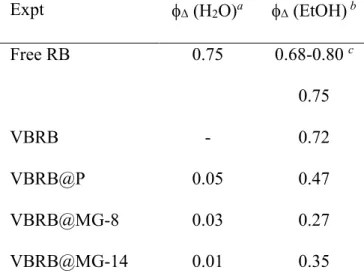
P(VAc-co-VCL-co-VBRB) dispersed in water is correlated to very low values of singlet oxygen quantum
yields (0.01 < < 0.05, Table 2). Thus, the synthesis of VBRB@MG microgels by
polymerization in aqueous dispersed media (miniemulsion polymerization) produces “latent”
microgels which are not photo-active in water under light irradiation at 515 nm due to the
aggregated state of RB moieties in the collapsed polymer. In relationship with their respective
solubility and swelling ability in ethanol, the photosensitized linear copolymer and microgels
were further dispersed in ethanol to monitor their propensity to produce singlet oxygen. Note
that VBRB, which is soluble in ethanol up to 0.05 mol L-1, is as efficient as free RB to produce
singlet oxygen in ethanol (see Table 2, = 0.72). In ethanol, the absorbance and emission
spectra of the RB-grafted copolymers are very close to that of the free VBRB monomer in the
same solvent (Figure 5) and strikingly different from their spectra in water (Figure 4a and b).
Figure 5. Normalized absorption (full lines) and emission (dotted lines, ex 530 nm) spectra in
ethanol of VBRB ([VBRB] = 0.98 × 10⁻⁶ M) and VBRB@P, VBRB@MG-8, VBRB@MG-14
at polymer concentrations ranging from 0.003 to 0.007 g L-1.
0 0.2 0.4 0.6 0.8 1 300 400 500 600 700 800 Normal iz ed Ab s/Emi (a. u.) Wavelength (nm) VBRB VBRB VBRB@P VBRB@P VBRB@MG-8 VBRB@MG-8 VBRB@MG-14
18 Moreover, the extent of crosslinking had no influence on the spectra, as the patterns of
VBRB@P, VBRB@MG-8 and VBRB@MG-14 perfectly overlaid. It can be also noticed that
the absorption and excitation spectra of RB-based soluble linear polymer and dispersed
microgels perfectly matched (Fig. S12†). All these spectral features tend to show that the RB
moieties do not aggregate inside the swollen microgels in ethanol, contrary to the strong
aggregation observed in the collapsed state of the microgels dispersed in water. The three types
of RB-grafted polymeric materials proved to be photoactive in ethanol producing singlet
oxygen under irradiation. Indeed, the singlet oxygen quantum yields () ranged between 0.47
and 0.32 for VBRB@P and VBRB@MG (Table 2), the highest value being obtained with the
soluble VBRB@P linear polymer. These values are rather high for supported Rose Bengal.62
The efficiency of the VBRB@MG in producing singlet oxygen in ethanol can thus be ascribed
to the absence of any aggregation of the covalently grafted RB in the swollen microgels. We
can conclude that the latent non-photoactive VBRB@MG polymer colloids dispersed in water
were turned ON into very active systems in ethanol. It is well known from the literature that the
singlet oxygen production is drastically reduced by the photosensitizer aggregation, which
enhances self-quenching of the excited state,44,25 as demonstrated for instance with lipophilic
phthalocyanines included in polymer hydrogels of various lipophilicity.65 Aggregation effects,
were also reported to be responsible for the decrease of singlet oxygen quantum yield of either
RB esters insoluble in non-polar solvents66 or RB-grafted to
poly(styrene-co-vinylbenzylchloride) beads.67
It should be noticed that VBRB@MG-14 microgels were centrifuged to assess the recovery of
the supported photosensitizer separately from the photo-oxidized molecules. This recycling step
is expected to minimize the tricky distillation steps usually applied to recover from the solvent
the oxidized product free of photosensitizer. Centrifuged VBRB@MG-14 microgels were
VBRB@MG-19 14 were still photoactive after the centrifugation cycle with a singlet oxygen quantum yield in
a similar range ( = 0.32).
Table 2. Singlet oxygen quantum yields of free RB, VBRB and dialyzed polymers.
Expt (H2O)a (EtOH) b Free RB 0.75 0.68-0.80 c 0.75 VBRB - 0.72 VBRB@P 0.05 0.47 VBRB@MG-8 0.03 0.27 VBRB@MG-14 0.01 0.35
a Singlet oxygen quantum yields measured in water with FFA quencher (LED at 515 nm,
irradiance of 3 mW cm-2); b Singlet oxygen quantum yields measured in ethanol with DPBF
quencher (Xe-Hg Lamp Monochromator 547 nm, irradiance of 0.2 mW cm-2); c Extracted from
reference 41.
The reusability of VBRB@MG14 microgels was investigated through a repeated use of the
photosensitized colloids in five photooxygenation cycles. The overlay of the DPBF conversion
versus time for each cycle reveals that the high efficiency is maintained over the different cycles
(Figure 6a) while no DPBF conversion could be detected in the dark. It is worth noting that
under the conditions used for singlet oxygen measurement in ethanol at low irradiance (0.2 mW
cm-2), neither RB nor VBRB@MG photobleached (constant absorbance at 569 nm). In order
to highlight the interest of RB grafting, free RB and VBRB@MG-14 were irradiated in ethanol
with a more powerful Xenon lamp (irradiance 55 mW cm-2) to allow the comparison of their
20 more photo-stable (36 % photobleaching) than free RB (53 % photobleaching) over 6 hours of
intense irradiation (Figure 6b). It should be noted that the photo-stability of VBRB@MG14
particles is maintained over more than 12 months with very close value of singlet oxygen
quantum yield (Table S3).
Figure 6 : a) Five photooxygenation cycles of DPBF from VBRB@MG-14 (Xe-Hg Lamp Monochromator 547 nm, irradiance of 0.2 mW cm-2); b) Comparison of the rate of
photobleaching of RB and VBRB@MG-14 in ethanol (300 W Xe Lamp, Irradiance 55 mW cm-2 between 400 and 800 nm). 0 0.1 0.2 0.3 0.4 0.5 0.6 0.7 0.8 0.9 1 0 50 100 150 200 250 300 D PBF Con ve rsio n Time (minutes)
Cycle 1 Cycle 2 Cycle 3 Cycle 4 Cycle 5
a) 0 10 20 30 40 50 60 0 1 2 3 4 5 6 % Pho tob lea chin g (norm . on λAb s, ma x ) Time (h) RB VBRB@MG-14 b)
21
Conclusions
In conclusion, novel photosensitizer-grafted polymer colloids of submicronic diameter were
designed as efficient tool to trigger the photoactivity of supported Rose Bengal. Interestingly,
the Rose-Bengal microgels were synthesized by a one-step miniemulsion copolymerization of
vinyl benzyl rose Bengal, vinyl acetate, N-vinyl caprolactam and divinyl adipate crosslinker
carried out in aqueous dispersed media. We designed a switchable system via the synthesis of
non-photoactive latent polymer colloids in water which can be triggered into photoactive
particles in ethanol with a good level of singlet oxygen quantum yield ( = 0.32-0.47) via Rose
Bengal disaggregation through simple swelling of these microgels. Their photo-activity is
maintained after 5 repeated use of the photosensitized microgels in photooxygenation cycles
but also after their centrifugation, which opens perspectives towards an efficient separation of
the supported sensitizer from the reaction medium. The reusability and recyclability of the
organic photocatalyst limiting any distillation step is will increase the sustainability of the
catalytic photooxygenation green process. The switchable photo-activity represents an
advantage as latent photoactivity in water during storage should enhance the photostability
while efficient photoactivity in ethanol is of particular interest to trigger photo-oxygenation
reactions. These original sub-micronic microgels open the route towards further
implementation of fine chemicals photooxygenation in flow photoreactors, in the absence of
substrate sedimentation.
Conflicts of interest
There are no conflicts to declare.
Acknowledgements
The authors would like to thank Agence Nationale de la Recherche (ANR) for funding
PICPOSS project (ANR-15-CE07-0008-03), CNRS and UPPA for financial support. The
22 support respectively in NMR, DLS and A4F techniques and Armel Descamps-Mandine Center
23
Notes and references
1 S. S. Lucky, K. C. Soo and Y. Zhang, Chem. Rev., 2015, 115, 1990–2042.
2 Z. Zhou, J. Song, L. Nie and X. Chen, Chem. Soc. Rev., 2016, 45, 6597–6626.
3 W. Fan, P. Huang and X. Chen, Chem. Soc. Rev., 2016, 45, 6488–6519.
4 E. Díez-Mato, F. C. Cortezón-Tamarit, S. Bogialli, D. García-Fresnadillo and M. D.
Marazuela, Appl. Catal. B Environ., 2014, 160–161, 445–455.
5 M. Magaraggia, F. Faccenda, A. Gandolfi and G. Jori, J. Environ. Monit., 2006, 8, 923.
6 A. A. Ghogare and A. Greer, Chem. Rev., 2016, 116, 9994–10034.
7 Y. Liu, T. Pauloehrl, S. I. Presolski, L. Albertazzi, A. R. A. Palmans and E. W. Meijer,
J. Am. Chem. Soc., 2015, 137, 13096–13105.
8 S. Pramual, K. Lirdprapamongkol, J. Svasti, M. Bergkvist, V. Jouan-Hureaux, P.
Arnoux, C. Frochot, M. Barberi-Heyob and N. Niamsiri, J. Photochem. Photobiol. B, 2017,
173, 12–22.
9 Q. Zhou, L. Xu, F. Liu and W. Zhang, Polymer, 2016, 97, 323–334.
10 X.-H. Dai, H. Jin, S.-S. Yuan, J.-M. Pan, X.-H. Wang, Y.-S. Yan, D.-M. Liu and L. Sun,
J. Polym. Res., , DOI:10.1007/s10965-014-0412-9.
11 Y. Sun, H. Hu, N. Zhao, T. Xia, B. Yu, C. Shen and F.-J. Xu., Biomaterials, 2017, 117,
77–91.
12 C. Li, F. Lin, W. Sun, F.-G. Wu, H. Yang, R. Lv, Y.-X. Zhu, H.-R. Jia, C. Wang, G.
Gao and Z. Chen, ACS Appl. Mater. Interfaces, 2018, 10, 16715–16722.
13 L. Wang, J. Li, W. Zhang, G. Chen, W. Zhang and X. Zhu, Polym. Chem., 2014, 5,
2872–2879.
14 S. Belali, A. R. Karimi and M. Hadizadeh, Polymer, 2017, 109, 93–105.
15 S. Belali, A. R. Karimi and M. Hadizadeh, Int. J. Biol. Macromol., 2018, 110, 437–448.
24 Boyle and M. O. Senge, Biomacromolecules, 2018, 19, 1592–1601.
17 E. C. Blossey, D. C. Neckers, A. L. Thayer and A. Paul. Schaap, J. Am. Chem. Soc.,
1973, 95, 5820–5822.
18 F. Prat and C. S. Foote, Photochem. Photobiol., 1998, 67, 626–627.
19 M. I. Burguete, F. Galindo, R. Gavara, S. V. Luis, M. Moreno, P. Thomas and D. A.
Russell, Photochem. Photobiol. Sci., 2009, 8, 37–44.
20 M. I. Burguete, R. Gavara, F. Galindo and S. V. Luis, Catal. Commun., 2010, 11, 1081–
1084.
21 V. Fabregat, M. I. Burguete, S. V. Luis and F. Galindo, RSC Adv, 2017, 7, 35154–35158.
22 M. Suzuki, Y. Ohta, H. Nagae, T. Ichinohe, M. Kimura, K. Hanabusa, H. Shirai and D.
Wohrle, Chem. Commun., 2000, 213–214.
23 S. M. Ribeiro, A. C. Serra and A. M. D. Rocha Gonsalves, J. Catal., 2008, 256, 331–
337.
24 S. Ribeiro, A. C. Serra and A. M. d’A. Rocha Gonsalves, ChemCatChem, 2013, 5, 134– 137.
25 J. L. Bourdelande, M. Karzazi, L. E. Dicelio, M. I. Litter, G. Marqués Tura, E. San
Román and V. Vinent, J. Photochem. Photobiol. Chem., 1997, 108, 273–282.
26 J. M. Tobin, T. J. D. McCabe, A. W. Prentice, S. Holzer, G. O. Lloyd, M. J. Paterson,
V. Arrighi, P. A. G. Cormack and F. Vilela, ACS Catal., 2017, 4602–4612.
27 E. M. Barker and J. P. Buchanan, Polymer, 2016, 92, 66–73.
28 D. Cambié, C. Bottecchia, N. J. W. Straathof, V. Hessel and T. Noël, Chem. Rev., 2016,
116, 10276–10341.
29 K. Mizuno, Y. Nishiyama, T. Ogaki, K. Terao, H. Ikeda and K. Kakiuchi, J. Photochem.
Photobiol. C Photochem. Rev., 2016, 29, 107–147.
25
Adv., 2015, 5, 4233–4237.
31 C. Mendoza, N. Emmanuel, C. A. Páez, L. Dreesen, J.-C. M. Monbaliu and B.
Heinrichs, ChemPhotoChem, 2018, 2, 890–897.
32 E. Boix-Garriga, B. Rodríguez-Amigo, O. Planas and S. Nonell, in Singlet Oxygen:
Applications in Biosciences and Nanosciences, Nonell, S.; Flors, C., Royal Society of
Chemistry, Cambridge, Royal Society of Chemistry., 2016, vol. 1, pp. 23–46.
33 P. R. Ogilby, Chem. Soc. Rev., 2010, 39, 3181.
34 C. Schweitzer and R. Schmidt, Chem. Rev., 2003, 103, 1685–1758.
35 R. C. R. Wootton, R. Fortt and A. J. de Mello, Org. Process Res. Dev., 2002, 6, 187–
189.
36 K. Landfester, Macromol. Rapid Commun., 2001, 22, 896–936.
37 C. S. Chern, Prog. Polym. Sci., 2006, 31, 443–486.
38 Y. Shiraishi, Y. Kimata, H. Koizumi and T. Hirai, Langmuir, 2008, 24, 9832–9836.
39 P. Kodlekere, A. L. Cartelle and L. A. Lyon, RSC Adv, 2016, 6, 31619–31631.
40 H. J. Hah, G. Kim, Y.-E. K. Lee, D. A. Orringer, O. Sagher, M. A. Philbert and R.
Kopelman, Macromol. Biosci., 2011, 11, 90–99.
41 F. Wilkinson, W. P. Helman and A. B. Ross, J Phys Chem Ref Data, 1993, 22, 113–
262.
42 M. Nowakowska, M. Kepczynski and K. Szczubialka, Pure Appl. Chem., 2001, 73,
491–495.
43 C. Boussiron, M. Le Bechec, L. Petrizza, J. Sabalot, S. Lacombe and M. Save,
Macromol. Rapid Commun., 2018, 1800329.
44 F. Amat-Guerri, J. M. Botija and R. Sastre, J. Polym. Sci. Part Polym. Chem., 1993, 31,
2609–2615.
26 10191–10200.
46 A. Aluigi, G. Sotgiu, A. Torreggiani, A. Guerrini, V. T. Orlandi, F. Corticelli and G.
Varchi, ACS Appl. Mater. Interfaces, 2015, 7, 17416–17424.
47 D. P. Ferreira, D. S. Conceição, R. C. Calhelha, T. Sousa, R. Socoteanu, I. C. F. R.
Ferreira and L. F. Vieira Ferreira, Carbohydr. Polym., 2016, 151, 160–171.
48 F. van Laar, F. Holsteyns, I. F. J. Vankelecom, S. Smeets, W. Dehaen and P. A. Jacobs,
J. Photochem. Photobiol. -Chem., 2001, 144, 141–151.
49 S. Tamagaki and R. Akatsuka, Bull. Chem. Soc. Jpn., 1982, 55, 3037–3038.
50 J. Gigault, H. El Hadri, S. Reynaud, E. Deniau and B. Grassl, Anal. Bioanal. Chem.,
2017, 409, 6761–6769.
51 J. Gigault, E. Mignard, H. E. Hadri and B. Grassl, Chromatographia, 2017, 80, 287–
294.
52 M. J. Barandiaran, J. C. de la Cal and J. M. Asua, in Polymer Reaction Engineering,
John Wiley & Sons, Ltd, 2008, pp. 233–272.
53 BASF, Safety Data Sheet Vinyl caprolactam Kerobit, 2018.
54 L. Etchenausia, A. Khoukh, E. D. Lejeune and M. Save, Polym. Chem., 2017, 8, 2244–
2256.
55 L. Etchenausia, A. M. Rodrigues, S. Harrisson, E. Deniau Lejeune and M. Save,
Macromolecules, 2016, 49, 6799–6809.
56 A. Kermagoret, C.-A. Fustin, M. Bourguignon, C. Detrembleur, C. Jérôme and A.
Debuigne, Polym. Chem., 2013, 4, 2575–2583.
57 D. Crespy, S. Zuber, A. Turshatov, K. Landfester and A.-M. Popa, J. Polym. Sci. Part
Polym. Chem., 2012, 50, 1043–1048.
58 J. M. Asua, Prog. Polym. Sci., 2014, 39, 1797–1826.
27 60 D. Neckers, J. Photochem. Photobiol. -Chem., 1989, 47, 1–29.
61 O. Valdes-Aguilera and D. C. Neckers, J. Phys. Chem., 1988, 92, 4286–4289.
62 M. Nowakowska, M. Kepczyński and M. Dabrowska, Macromol. Chem. Phys., 2001,
202, 1679–1688.
63 H. B. Rodríguez, E. S. Román, P. Duarte, I. F. Machado and L. F. Vieira Ferreira,
Photochem. Photobiol., 2012, 88, 831–839.
64 D. K. Luttrull, O. Valdes-Aguilera, S. M. Linden, J. Paczkowski and D. C. Neckers,
Photochem. Photobiol., 1988, 47, 551–557.
65 M. E. Rodriguez, V. E. Diz, J. Awruch and L. E. Dicelio, Photochem. Photobiol., 2010,
86, 513–519.
66 J. Paczkowski and D. C. Neckers, J. Photochem., 1986, 35, 283–287.



![Figure 4: a) Normalized absorption spectra b) emission spectra ( ex 530 nm) in H 2 O of the soluble polymer VBRB@P (blue lines), microgels VBRB@MG-8 (continuous red lines), VBRB@MG-14 (dotted red lines), polymer concentration in H 2 0 [13.0 mg L -1 ]](https://thumb-eu.123doks.com/thumbv2/123doknet/14360376.502514/17.892.113.787.399.617/figure-normalized-absorption-spectra-emission-microgels-continuous-concentration.webp)
![Figure 5. Normalized absorption (full lines) and emission (dotted lines, ex 530 nm) spectra in ethanol of VBRB ([VBRB] = 0.98 × 10 -6 M) and VBRB@P, VBRB@MG-8, VBRB@MG-14](https://thumb-eu.123doks.com/thumbv2/123doknet/14360376.502514/18.892.228.671.790.1062/figure-normalized-absorption-lines-emission-dotted-spectra-ethanol.webp)