Publisher’s version / Version de l'éditeur:
Journal of Materials Science Letters, 6, February 2, pp. 197-199, 1987-02-01
READ THESE TERMS AND CONDITIONS CAREFULLY BEFORE USING THIS WEBSITE. https://nrc-publications.canada.ca/eng/copyright
Vous avez des questions? Nous pouvons vous aider. Pour communiquer directement avec un auteur, consultez la première page de la revue dans laquelle son article a été publié afin de trouver ses coordonnées. Si vous n’arrivez pas à les repérer, communiquez avec nous à [email protected].
Questions? Contact the NRC Publications Archive team at
[email protected]. If you wish to email the authors directly, please see the first page of the publication for their contact information.
NRC Publications Archive
Archives des publications du CNRC
This publication could be one of several versions: author’s original, accepted manuscript or the publisher’s version. / La version de cette publication peut être l’une des suivantes : la version prépublication de l’auteur, la version acceptée du manuscrit ou la version de l’éditeur.
Access and use of this website and the material on it are subject to the Terms and Conditions set forth at
Subcritical crack growth in low-porosity cement systems
Beaudoin, J. J.
https://publications-cnrc.canada.ca/fra/droits
L’accès à ce site Web et l’utilisation de son contenu sont assujettis aux conditions présentées dans le site LISEZ CES CONDITIONS ATTENTIVEMENT AVANT D’UTILISER CE SITE WEB.
NRC Publications Record / Notice d'Archives des publications de CNRC:
https://nrc-publications.canada.ca/eng/view/object/?id=07dadf5a-55fa-46d3-9a7e-b3ebec39777c https://publications-cnrc.canada.ca/fra/voir/objet/?id=07dadf5a-55fa-46d3-9a7e-b3ebec39777cI N 2 1 d
Natlonai Research
Conseil national
no. 1
4
4 91
$
Council Canada
de recherches
Canada
c .
2B LDG
Institute for
lnstitut de
- -
Research in
recherche en
Construction
construction
k
Subcritical Crack Growth in
I
I
Low-Porosity Cement Systems
by J.J. Beaudoin
Reprinted from
Journal of Materials Science Letters
Vol. 6, 1987, p. 197- 199
(IRC Paper No. 1449)
Price $3.00
NRCC 27629
W R C-
ClSTlI R C
. i B R A R Y
UEC
3
:35:
BIBLIOTHEQUE
I
C N R CI R C
-
IP;%T1
ABSTRACT
Mechanisms of s u b c r i t i c a l c r a c k growth i n p o r t l a n d cement p a s t e a r e d i s c u s s e d and e v i d e n c e i s p r e s e n t e d o f c h e m i c a l m o d i f i c a t i o n of c r a c k t i p s i n cement p a s t e t e s t e d i n a l c o h o l media. Environmental e f f e c t s on c r a c k growth
are
d i f f e r e n t f o r low-porosity p a s t e s .L ' a u t e u r C t u d i e l e s m6canismes i n t e r v e n a n t dans l a c r o i s s a n c e s u b c r i t i q u e d e s f i s s u r e s dans l a p a t e d e ciment P o r t l a n d , e t il p r g s e n t e d e s donnCes dgmontrant l a m o d i f i c a t i o n chimique d e s extrSmitSs d e s f i s s u r e s dans l a p a t e de ciment t e s t & e n m i l i e u a l c o o l i s 6 . Les e f f e t s du m i l i e u ambiant s u r l a c r o i s s a n c e d e s f i s s u r e s s o n t d i f f g r e n t s dans l e c a s d e s p a t e s 3 f a i b l e porositC.
J O U R N A L O F M A T E R I A L S S C I E N C E L E T T E R S 6 ( 1 9 8 7 ) 1 9 7 - 1 9 9
Subcritical crack growth in low-porosity cement systems
J . J . B E A U D O I N
Institute for Research in Construction, National Research Council, Ottawa, Canada
Hydrated portland cement or portland cement paste is a microporous, moisture-sensitive material that forms the binder in conventional concrete. Numerous studies have demonstrated the dependence of engineering
I properties of concrete on microstructural character-
istics including crack formation and growth in cement paste [I]. The dependence of subcritical crack growth
I
in paste on humidity, temperature and test media has been reported at higher waterlcement (w/c) ratio pastes [2, 31. Evidence from crack growth studies in alcohol media suggests that stress corrosion processes are operative [4] at crack tips.
Low-porosity portland c h e n t paste (generally prepared at waterlcement ratios of 0.25 or less) has several characteristics that are different from those of pastes having higher porosity. These include large quantities of unhydrated cement grains, less Ca(OH),, lower surface area, and different pore structure. This letter reports the general effect of such differences on subcritical crack growth in water, methanol and decanol.
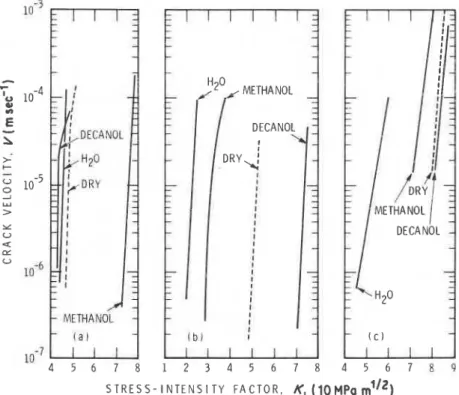
Log V-K, diagrams for low porosity (w/c = 0.25) and higher porosity (w/c = 0.35) cement paste, along with non-porous soda lime glass, are presented in Fig. 1 (where V is the crack velocity and K, the stress intensity factor). Apparatus and experimental tech- niques have been described elsewhere [2]. All paste samples are dried at 110°C for 3 h and vacuum saturated in the test fluid for a minimum of 48 h prior
S T R E S S -
to test. For the low-porosity paste (Fig. la) the curves for tests in water, decanol and the dry state are close to each other (0.42 < K, < 0.47MPamL12), crack growth occurring at the lowest stress values in decanol. In contrast, in high-porosity paste (Fig. lb) crack growth occurs at much higher stress levels in decanol. K, values for subcritical crack growth in the different media are in the following order: decanol > dry > methanol > water. The curves (Fig. lc) for soda lime glass [5] are of the same order with respect to test media as the curves in Fig. lb. The position of the curves (K, axis) for methanol (low-porosity paste) and decanol (high-porosity paste and glass) relative to those in the dry state appears to be anomalous.
These results may be expained as follows: methanol interacts with CH (cement chemistry notation is used; C = CaO; H = H 2 0 ; S = SiO,) and C-S-H [6-81. In reacting with methanol, the surface area increases from 13.5 to 60 x lo3 m2 k g L . Methanol treatment of synthetically prepared C-S-H can result in reduction of surface area by a factor of 4 [7]. Methanol interacts with C-S-H to a greater extent in paste with higher porosity; for example, the N2 surface area of methanol- treated paste, w/c = 0.25, is similar to the control, whereas at w/c = 0.50 the surface area is 30% less than that of the control. Thus, changes in surface area of the paste are controlled by. those of modified CH and C-S-H.
It has been suggested that water attacks Si-0-Si
I N T E N S I T Y F A C T O R . K, (1OMPo rn1I2)
Figure 1 Log V-K, diagrams for cement paste (w/c = (a) 0.25, (b) 0.35) and (c) soda lime glass. Data for glass after Wiederhorn et al. [S].
- - -
15 pore volume, and a reduced amount of C-S-H. It is
possible, therefore, that the difference in the position of the log V-K, curves (K,-axis) for methanol and
10 water media is greater at low porosity because there is
a reduced methanol-CH interaction. This argument would apply if the product that forms when methanol
5 interacts with C-S-H were to facilitate crack growth,
-
e.g. in higher porosity paste where a greater amount ofse.
-
the complex forms.5 In low-porosity paste, however, CH-rich interfaces
3 are formed at the boundaries of unhydrated cement
1 1 1 1 I 1 1 1
particles because of the closeness of the products.
-
z A small amount of reaction product from a CH-
0
a 25
-
-
methanol interaction deposited at the interface might Iactually inhibit crack growth.
2 0
-
-
Additional factors to consider are the total porosityb
15
-
of the system and the effect of microstructural changes,e.g. surface area changes in the cement paste. The total
1 0
-
porosity of methanol-treated paste samples is less for5
-
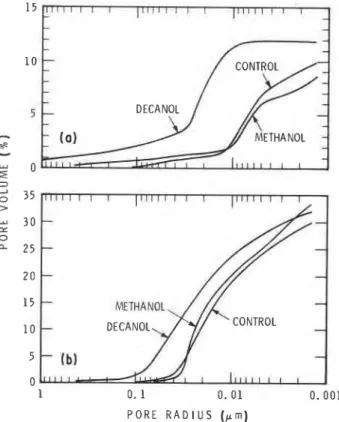
(bl the low-porosity system and more for the high-porositysystem than that of the control (see pore-size distri-
0- !
1 0. 1 0. 0 1 butions in Fig. 2). How microstructural changes
directly affect crack growth is not known.
P O R E R A D I U S ( p m ) Decanol interacts with C-S-H in paste to a much
Figure 2 Pore size distribution curves for cement paste (w/c = (a) greater extent than CH [6, 71. Scanning electron
0.25, (b) 0.50) specimens treated w~th methanol and decanol. micrographs (Fig. 3) reveal that fracture surfaces of
decanol-treated C-S-H compacts (porosity similar to
bonds in silicate structures [5]. The rate of interaction paste with w/c = 0.35) and porous glass have much
in paste is controlled primarily by the chemical poten- rougher topography than do the controls. Cracks
tial of the reactants (water and C-S-H) and the propagate through a more tortuous path and higher K
permeability of the material. values would be expected. This observation is in
In low-porosity pastes there is less CH owing to agreement with the higher K, values required for
lower degree of hydration, less methanol due to lower crack growth in decanol-treated paste and glass (Fig. l b
i
b
*
Agure 3 Scannlng electron micrographs: fracture surfaces of (a) C-S-H untreated, (b) C-S-H treated In decanol, (c) porous glass untreated, (d) porous glass treated In decanol.
Figure 4 Pore size distribution of porous glass: (-) untreated and (---) treated in decanol.
and c). The extent to which decanol treatment modifies the microstructure of cement paste is reflected in pore- size distributions (Fig. 2). At w/c = 0.25 the change is large; the population of coarse pores is significantly increased and that of fine pores decreased. Increase in the volume concentration of coarse pores shifts the log V-K, curves to lower values of K, [3]. This may be the predominant reason for the low values of KI necessary for crack growth in w/c = 0.25 paste (Fig. la).
At w/c = 0.50 the differences in the pore-size distri- bution of the decanol-treated sample and the control are less than those for the w/c = 0.25 sample. The increase in coarse pores is less and fine pores are not eliminated. The log V-K, curve for w/c = 0.50 shifts to higher K, values after decanol treatment. As the
k pore-size distribution is less affected at higher w/c I ratios, this shift may be due to other changes. Micro-
structural changes to the paste include, for example, small changes in surface area at w/c = 0.25 and large decreases in surface area for w/c = 0.35 and 0.50. Preparations of C-S-H treated with decanol also have large decreases in surface area.
A pore-size distribution for decanol-treated porous glass is given in Fig. 4. The histogram covers a very narrow pore-size range, 1.50 to 3.80 x 10⁻³pm. Major changes occur in the pore radius range, 2.25 to 2.70 x ~ O - ~ p m ; decanol treatment more than doubles the pore volume in the range 2.35 to 2.50 x 10⁻³pm, and in the finest pore range, 1.5 to 2.0 x 10⁻³pm, decanol treatment also increases pore volume. Chemi- cal modification of the glass itself (i.e. attack of Si-0-Si bonds at crack tips) has been cited as a reason why KI values for crack growth are higher in glass treated with decanol than in dry glass [5]. There is no direct evidence that pore structure change is related to this type of chemical modification. No SEM evidence of chemical modification of crack tip geometry (e.g. blunting) was obtained for pastes at any w/c ratio and porous glass. This toughening mechanism, if operative, is probably not a predominant factor.
It is concluded that chemical modification of crack tips can occur in cement paste tested in alcohol media and that media effects on crack growth are different for low-porosity pastes (w/c = 0.25).
References
1. V . S. R A M A C H A N D R A N , R. F. F E L D M A N and J. J. B E A U D O I N , "Concrete Science" (Heyden, 1981) p. 398. 2. J . J . B E A U D O I N , Cem. Concr. Res. 15 (1985) 871.
3. Idem, ibid. 15 (1985) 988.
4. Idem, Proceedings International Conference on Fracture Mechanics of Concrete, Lausanne, October, 1985 (Elsevier). 5. S. M . W I E D E R H O R N , D. W. F R I E M A N , E. R.
F U L L E R J r and C J . SIMONS, J . Muter. Sci. 17 (1982) 3460.
6. J . J B E A U D O I N , Materials and Struclures (1985), submitted.
7. Idem, I1 Cemenlo (1985), submitted. 8. R . L. D A Y , Cem. Conr. Res. 11 (1981) 341.
Received 16 July
T h i s p a p e r i s b e i n g d i s t r i b u t e d i n r e p r i n t f o r m by t h e I n s t i t u t e f o r R e s e a r c h i n C o n s t r u c t i o n . A l i s t of b u i l d i n g p r a c t i c e and r e s e a r c h p u b l i c a t i o n s a v a i l a b l e from t h e I n s t i t u t e may be o b t a i n e d by w r i t i n g t o t h e ~ u b l i c a t i - o n s S e c t i o n , I n s t i t u t e f o r R e s e a r c h i n C o n s t r u c t i o n , N a t i o n a l R e s e a r c h C o u n c i l o f C a n a d a , O t t a w a , O n t a r i o ,