The acquisition of inductive constraints
by
Charles Kemp
B.A., University of Melbourne, 2000
B.Sc. (Hons.), University of Melbourne, 2001
Submitted to the Department of Brain and Cognitive Sciences
in partial fulfillment of the requirements for the degree of
Doctor of Philosophy
at the
Massachusetts Institute of Technology
February 2008
c
° 2008 Charles Kemp. All rights reserved.
The author hereby grants to MIT permission to reproduce and to
distribute publicly paper and electronic copies of this thesis document
in whole or in part in any medium now known or hereafter created.
Author:
Department of Brain and Cognitive Sciences
September 27, 2007
Certified by:
Joshua Tenenbaum
Associate Professor of Cognitive Science
Thesis Supervisor
Accepted by:
Matthew Wilson
Professor of Neurobiology
Chairman, Committee for Graduate Students
The acquisition of inductive constraints
by
Charles Kemp
Submitted to the Department of Brain and Cognitive Sciences on September 27, 2007, in partial fulfillment of the
requirements for the degree of Doctor of Philosophy
Abstract
Human learners routinely make inductive inferences, or inferences that go beyond the data they have observed. Inferences like these must be supported by constraints, some of which are innate, although others are almost certainly learned. This thesis presents a hierarchical Bayesian framework that helps to explain the nature, use and acquisition of inductive constraints. Hierarchical Bayesian models include multiple levels of abstraction, and the representations at the upper levels place constraints on the representations at the lower levels. The probabilistic nature of these models allows them to make statistical inferences at multiple levels of abstraction. In par-ticular, they show how knowledge can be acquired at levels quite remote from the data of experience—levels where the representations learned are naturally described as inductive constraints.
Hierarchical Bayesian models can address inductive problems from many domains but this thesis focuses on models that address three aspects of high-level cogni-tion. The first model is sensitive to patterns of feature variability, and acquires constraints similar to the shape bias in word learning. The second model acquires causal schemata—systems of abstract causal knowledge that allow learners to discover causal relationships given very sparse data. The final model discovers the structural form of a domain—for instance, it discovers whether the relationships between a set of entities are best described by a tree, a chain, a ring, or some other kind of representation.
The hierarchical Bayesian approach captures several principles that go beyond traditional formulations of learning theory. It supports learning at multiple levels of abstraction, it handles structured representations, and it helps to explain how learning can succeed given sparse and noisy data. Principles like these are needed to explain how humans acquire rich systems of knowledge, and hierarchical Bayesian models point the way towards a modern learning theory that is better able to capture the sophistication of human learning.
Thesis Supervisor: Joshua Tenenbaum
Acknowledgements
Josh Tenenbaum has been my advisor since I first arrived at MIT, and most of the ideas in this thesis were developed in collaboration with him. Josh has the rare ability to draw on proposals from cognitive psychology, philosophy, and machine learning, and to put them together to address the most fundamental questions in cognitive science. Working with him has brought me a great deal of intellectual and personal satisfaction, and anyone who walks into his office will begin to understand why. The walls and sometimes the windows are covered with writing, and it is clear that Josh is overflowing with ideas and generous about sharing them with others. His research group inherits both qualities, and I feel very fortunate to have been part of this community for five years.
Whitman Richards has given me valuable advice about most of the projects I have worked on, including several which do not appear in this thesis. Whitman encouraged my interests in graph structures and in social systems, and the experiments in Chapter 6 were written up initially as a report for his class. Whitman’s teaching and writing draw on an incredibly broad range of sources, and he has introduced me to many provocative ideas that are well outside the mainstream psychological literature.
The remaining members of my thesis and advisory committees have encouraged me and pushed me to improve my work. Laura Schulz helped me improve the models and experiments in Chapter 5, and gave me valuable advice about academic talks. Frank Keil helped me to see how this thesis fits in to the broader literature on inductive constraints, and identified many weak spots in an earlier draft of this thesis. Molly Potter encouraged me to move beyond simple models and develop formal approaches that begin to capture the complexity of real-world knowledge. I haven’t yet managed to satisfy this request, but it has guided my thinking for several years.
Tom Griffiths and Tania Lombrozo helped me feel at home when I first arrived in Boston, and their playful approach to life and work sets a standard I might reach one day. Tom’s intellectual style has shaped the way I think and write about cog-nitive science, and his advice about academic jobs and many other topics has been
invaluable.
Three other long-term members of the computational cognitive science group have provided steady support both inside and outside of the lab. Amy Perfors is a regu-lar debating partner and a collaborator on the work described in Chapter 4. Amy introduced me to Taco Bell, rugby songs and the state of Vermont, and made fun of my accent only sometimes. Lauren Schmidt is a collaborator who helped me appre-ciate the art of experiment design, and who is the main reason I have come to value the Thanksgiving holiday. Liz Bonawitz is a collaborator who helped me to run my first experiment, and I’m grateful to her for arranging apple-picking outings and for bringing song and dance into the lab.
Two postdoctoral associates have been valued collaborators over several years. Patrick Shafto willingly shared his knowledge of cognitive psychology, and his pres-ence brightened up the morning shift in the lab. Noah Goodman has sharpened my thinking about many philosophical aspects of cognitive science, and is a collaborator on the work described in Chapter 5.
I’m grateful to several other friends and colleagues at MIT and beyond, including Chris Baker, Ben Balas, Sreekar Bhaviripudi, Keith Bonawitz, Mike Frank, Konrad K¨ording, Tevye Krynski, Vikash Mansinghka, Tim O’Donnell, Dan Roy, Virginia Savova, Sean Stromsten, Yves Victor, and Ed Vul. Some of them have been room-mates, others have been collaborators, and all of them have made MIT a fun place to study.
I have been fortunate to work with four outstanding undergraduates and high-school students: Allison Berke, Aaron Bernstein, Genya Frenkel, and Pooja Jotwani. Each one spent a summer in the lab and helped to transform abstract ideas into models and experiments. I’m grateful to all of the participants in our experiments, especially those who kept trying when faced with difficult tasks.
My research has been supported in part by a Praecis Presidential Fellowship and by the William Asbjornsen Albert memorial fellowship. I’m grateful to Denise Heintze, who immediately knew the right response to every administrative issue I faced, and to John Bearley, who makes the Teuber library a pleasure to visit.
I am especially grateful to my parents, Andrew and Sally; my sisters, Celia and Alice; my grandparents, Heather, Winston, Mary and Len; and to many other mem-bers of my extended family. More than anyone else, they have taught me the value of ideas and encouraged me at every stage of my education. Their phone calls, letters, postcards, and packages have kept me grounded, and my mental representation of the past few years is organized around the weeks I have managed to spend with them. I owe more than I can express to all of them, but this thesis is dedicated to two grandparents who passed away during my time at MIT: Winston Kent, who showed me the importance of thinking for myself, and Mary Kemp, who would have read every word in this document.
Contents
1 Inductive inference 13
2 Inductive constraints 23
A taxonomy of constraints . . . 23
Epistemic versus non-epistemic . . . 24
Domain-general versus domain-specific . . . 26
Innate versus learned . . . 27
Soft versus hard . . . 28
Enabling versus limiting . . . 28
Other distinctions . . . 29
Constraints and abstract knowledge . . . 30
Conceptual approaches to constraint learning . . . 34
Formal models of constraint learning . . . 36
Connectionist approaches . . . 39
AI approaches . . . 40
Machine learning approaches . . . 41
Statistical approaches . . . 42
My approach to constraint learning . . . 42
Why Bayes? . . . 43
Why hierarchical Bayes? . . . 45
3 Hierarchical Bayesian models 49
Inferences supported by hierarchical models . . . 51
Top-down inferences . . . 51
Bottom-up inferences . . . 52
Simultaneous inferences at multiple levels . . . 52
Choosing a hierarchy . . . 54
Other hierarchical approaches . . . 55
Hierarchical approaches in linguistics . . . 55
Multilevel neural networks . . . 57
Belief formation or belief fixation? . . . 58
Summary . . . 60
4 Learning about feature variability 61 Modeling inductive reasoning . . . 67
Learning the shape bias . . . 70
Learning constraints fast . . . 75
Discovering ontological kinds . . . 77
Related models . . . 83
Conclusion . . . 85
5 Learning causal schemata 89 Learning about a single object . . . 91
Learning about multiple objects . . . 94
Experiment 1: One-shot causal learning . . . 96
Experiment 2: Learning about new causal types . . . 105
Learning causal types given feature data . . . 112
Lien and Cheng data . . . 114
Experiment 3: Combining causal and feature data . . . 118
Discovering interactions between causal types . . . 122
Shanks and Darby data . . . 123
6 The discovery of structural form 127
A hypothesis space of structural forms . . . 130
Generating structures from structural forms . . . 135
Feature data . . . 136 Experiments . . . 137 Similarity data . . . 140 Experiments . . . 143 Relational data . . . 144 Experiments . . . 145 Related models . . . 148 Feature data . . . 149 Relational data . . . 150
Learning from sparse data . . . 151
Novel entities . . . 151
Novel systems of entities . . . 151
Form discovery in the laboratory . . . 152
Experiment 1: Transfer to novel systems . . . 152
Experiment 2: Predictions about novel entities . . . 157
Modeling cognitive development . . . 160
Conclusion . . . 163
7 Conclusion 167 Lesson 1: Inductive constraints can be learned . . . 168
Lesson 2: Inductive constraints can be learned fast . . . 169
Lesson 3: Bottom-up and top-down inferences are both important . . . 170
Lesson 4: A method for understanding induction . . . 171
Developmental implications . . . 174
Limitations . . . 176
Future directions . . . 179
Applications to other fields . . . 181
Theoretical challenges . . . 182
Towards a modern theory of learning . . . 184
Appendix: Form discovery model 187 Generating structures from structural forms . . . 187
Generating data from structures . . . 189
Feature data . . . 189 Similarity data . . . 192 Relational data . . . 192 Model implementation . . . 194 Feature data . . . 195 Relational data . . . 196 References 197
Chapter 1
Inductive inference
One of the most striking human achievements is routinely observed in homes around the world. Take a young child and expose her to light waves, sound waves, and other patterns of sensory stimulation. Somehow she will learn words, causal relation-ships and grammatical rules, and will develop abstract knowledge about numbers, objects, space, time, and the beliefs and desires of others. The acquisition of human knowledge raises many challenging questions, but many are elaborations of a single fundamental question: how do learners make inferences that go beyond the data they have observed? Psychologists and philosophers alike have struggled to understand the relationship between the “meager input” and the “torrential output” (Quine, 1969). Inferences that go beyond the available data are sometimes called ampliative or non-deductive inferences, but I will refer to them as inductive inferences. Some of the earliest inductive inferences may be inferences about visual scenes. At 4 months of age, for instance, infants make inductive predictions about the shapes of objects that are partially concealed by an occluder, and about the trajectories of moving objects that pass behind an occluder (E. S. Spelke, 1990). Inductive inferences, however, can be found in almost every domain of cognition. Consider a child who observes her mother point at a bird and utter the word “swan.” This observation is consistent with many hypotheses about the meaning of the word: perhaps it refers to the beak of the bird, or to any object that is white, or to any creature with a long neck. A single labeled example, however, is often enough for children to grasp the meaning of a
novel word. Other aspects of linguistic knowledge are also acquired given very sparse data. To mention one familiar example, children acquire grammatical constructions that are rarely found in the sentences that they hear (Chomsky, 1980).
A partial explanation of human inductive abilities has been available for many centuries. Since inductive inferences arrive at conclusions that go beyond the available data, additional elements are needed to bridge the gap between data and conclusions. These additional elements might be given different names, but I will refer to them as inductive constraints. There is room for debate about the nature of these constraints, but the need for constraints of some sort has been widely recognized by philosophers, psychologists, statisticians, and machine learning researchers (Keil, 1981; Chomsky, 1986; Holland, Holyoak, Nisbett, & Thagard, 1986).
Many ideas about inductive constraints can be traced back to the philosophical literature. Peirce points out that any set of observations can potentially be explained by a vast number of hypotheses, and asks how a learner might identify the hypotheses that turn out to be productive. His answer is that the mind has innate tendencies which lead it towards appropriate hypotheses: “if men had not come to [Nature] with special aptitudes for guessing right, it may well be doubted whether in the ten or twenty thousand years that they may have existed their greatest mind would have attained the amount of knowledge which is actually possessed by the lowest idiot” (Peirce, 1931–1935). Other philosophers have demonstrated the need for in-ductive constraints, and two of these demonstrations are particularly memorable. Goodman (1955) discusses constraints which help a learner identify lawlike hypothe-ses, or hypotheses that are supported by their positive instances. For instance, ob-serving a green emerald supports the hypothesis that “all emeralds are green,” but does not support the hypothesis that “all emeralds are green if examined before 2050, or blue if not so examined.” Quine (1960) focuses on the problem of language acqui-sition, and suggests that the evidence available to learners is insufficient to establish the meanings of the words in their native language. A common conclusion is that language learners must rely on constraints which limit the word meanings that they entertain (Markman, 1989).
Inspired in part by the philosophical literature, psychologists have argued that learning depends critically on inductive constraints and have proposed specific con-straints that may play a role in human learning (Table 1.1). Researchers including Markman (1989) have explored how children learn novel words, and have identified several constraints that can help children overcome the challenges identified by Quine. One of these constraints is the whole object bias: the expectation that novel labels tend to refer to entire objects (such as swans) instead of object parts (such as beaks), or object attributes such as size, color, or texture. Chomsky (1986) has suggested that children are exposed to linguistic data that are relatively sparse, and are able to learn the grammar of their native language only because they begin with constraints that limit the class of possible grammars. E. S. Spelke (1990) has studied inductive infer-ences about the shape and motion of physical objects, and has suggested that these in-ferences are constrained by abstract knowledge, including the knowledge that objects tend to follow smooth trajectories through space and time. Other psychologists have identified constraints that appear to support inferences about space (Landau, Gleit-man, & Spelke, 1981), number (R. Gelman & Gallistel, 1978), living kinds (Atran, 1998), and the goals and beliefs of others (Wellman, 1990).
Computer scientists and mathematicians have supported these philosophical and psychological arguments by providing formal demonstrations of the importance of inductive constraints (Watanabe, 1969; Schaffer, 1994). One well-known result is the No Free Lunch Theorem which states that there is no learning algorithm that can suc-ceed in all possible contexts—averaged across all conceivable contexts, no algorithm can perform better than random guessing (Wolpert, 1995). It follows that even the most powerful learning algorithm cannot avoid the need for inductive constraints, and will succeed only if the constraints it incorporates are well-matched to the problem at hand. The assumptions made by a learning algorithm are often referred to collec-tively as its inductive bias (Geman, Bienenstock, & Doursat, 1992; Mitchell, 1997), but these assumptions might equally well be described as inductive constraints.
Although few researchers deny the importance of inductive constraints, there are fierce debates about the nature and origin of these constraints. A strong empiricist
Domain Constraints Reference
Word learning Shape bias Landau, Smith, and Jones (1988)
Whole object bias Markman (1989)
Taxonomic bias Markman (1989)
Principle of contrast Clark (1987)
Predicability M-constraint Keil (1979)
Causal learning Causal schemata Kelley (1972)
Kinship Social schemata D. Jones (2003)
Folk biology Taxonomic principle Atran (1998)
Folk physics Spelke principles E. S. Spelke (1990)
Folk psychology Theory of Mind Wellman (1990)
Spatial reasoning Geometric principles Landau et al. (1981)
Number Counting principles R. Gelman and Gallistel (1978)
Syntax Universal grammar Chomsky (1965)
Phonology Faithfulness constraints Prince and Smolensky (1993) Markedness constraints Prince and Smolensky (1993)
Music Well-formedness rules Lerdahl and Jackendoff (1983)
Preference rules Lerdahl and Jackendoff (1983)
Table 1.1: Constraints that guide inferences about several domains.
view proposes that only a handful of constraints need to be innate. The constraints in this class include properties of sensory transducers that determine how sensory data are represented, and constraints that take the form of a domain-general learning algorithm. Given this learning algorithm, all remaining constraints are thought to be learned from sensory input. A strong nativist view challenges the notion of domain-general learning, and proposes that learning is guided by strong constraints that are specific to individual domains—for example, that the acquisition of linguistic knowledge is guided by innate constraints that are specifically linguistic (Chomsky, 1986). Both sides of this debate must face some challenging questions.
The empiricist side must confront the problem of explaining how constraints might be acquired. At least two issues arise. First, if inductive learning is impossible without constraints, then any method for learning constraints must rely on meta-constraints of some sort, and we are faced with the threat of an infinite regress. Second, even if we grant that constraints might be learned in principle, it is difficult to understand how they are learned fast enough to be useful. Studies suggest that
many inductive constraints are available relatively early in development (Mehler et al., 1988; E. S. Spelke, 1990; Wynn, 1992), and there is a good reason to expect this result: constraints must be in place relatively early in order to support subsequent learning. Explaining how constraints can be learned is a difficult enough challenge, but explaining how they are learned rapidly is even harder.
The difficulty of explaining how constraints might be learned may explain in part why most discussions of constraints adopt a nativist perspective. Some constraints are almost certainly innate, but others appear to be learned, and a strong nativist account must address two challenges. First, how can humans successfully learn about novel contexts, including contexts that emerged only recently on an evolutionary timescale? Human reasoning is remarkably flexible, and our ability to reason about fields like mathematics, chemistry, and molecular biology stands in need of some explanation. Inductive constraints appear to play a role: for instance, skilled mathematicians rely on constraints which help them identify which of the many possible approaches to a problem is most likely to succeed (Polya, 1990). Similarly, most chess positions can be developed in many different ways, but expert chess players rely on constraints which prune away all but the handful of possibilities that turn out to be most promising.
The second challenge for a strong nativist view is that some of the constraints that guide inferences about more fundamental cognitive domains also appear to be learned (Goldstone & Johansen, 2003). One such constraint is the shape bias—the expectation that all of the objects in a given category tend to have the same shape, even if they differ along other dimensions, such as color and texture. Smith, Jones, Landau, Gershkoff-Stowe, and Samuelson (2002) provide evidence that the shape bias is learned by showing that laboratory training allows children to demonstrate this bias at an age before it normally emerges. Other constraints that appear to be learned in-clude constraints on the rhythmic pattern of a child’s native language (Jusczyk, 2003), and constraints on the feature correlations that are worth tracking when learning about artifacts or other objects (Madole & Cohen, 1995).
This thesis develops an approach that draws on ideas from both nativist and empiricist approaches to development. Consistent with a nativist approach, I
ac-knowledge that induction is impossible without constraints, and argue that human inferences are often guided by domain-specific constraints. Consistent with an em-piricist approach, I focus on learning and argue that domain-specific constraints can be acquired by general-purpose learning mechanisms. Attempting to reconcile na-tivism and empiricism is not especially novel, and many psychologists presumably believe that their own theoretical orientation strikes the ideal balance between these philosophical traditions. This thesis suggests, however, that the dialogue between nativism and empiricism can be enriched by models that explain how constraints might be learned. Suppose, for instance, that we want to decide whether a certain kind of constraint is learned or innate. A good way to support an empiricist posi-tion is to provide a formal model that can acquire this constraint. A good way to support a nativist position is to develop the best possible strategy for acquiring the constraint, then to show that even this strategy must fail. Both approaches rely on formal models, and I attempt to show how these models can be developed.
The primary contribution of this thesis is a formal framework that helps to explain the nature, use and acquisition of inductive constraints. I explore models that include representations at multiple levels of abstraction, and where the representations at the upper levels place constraints on the representations at the lower levels. Each model is a hierarchical Bayesian model, and the probabilistic nature of these models allows them to make statistical inferences at multiple levels of abstraction. In particular, they show how knowledge can be acquired at levels quite remote from the data given by experience—levels where the learning problem can be described as the problem of learning inductive constraints.
Although I focus on the acquisition of inductive constraints, the larger goal of the work described here is to develop a comprehensive theory of human learning. Learn-ing can be broadly defined as the acquisition of knowledge (Simpson & Weiner, 1989), and learning so defined includes topics like the acquisition of language and mathe-matical knowledge, the development of folk biology, folk physics, and folk psychology, and the development of scientific theories. As these topics suggest, the study of learn-ing can help to explain the origin of human knowledge in all of its forms. Within
psychology, however, “learning” is sometimes given a technical meaning that is much narrower than its colloquial meaning. Kimble (1961) for instance, defines learning as a “relatively permanent change in a behavioral potentiality that occurs as a result of reinforced practice.” Contemporary psychologists may prefer definitions that are less explicitly behaviorist, but the link between learning and behaviorism remains strong. Introductory textbooks, for instance, often include a chapter on learning that discusses classical and operant conditioning and little else.
A casual glance at an introductory textbook might suggest otherwise, but most psychologists agree that knowledge acquisition involves much more than the tracking of simple associations. Developmental psychology has been a particularly rich source of alternative views. Piaget, for instance, has argued that children create rich and sys-tematic mental structures to explain their experience (Piaget & Inhelder, 1969), and other researchers have described learning mechanisms such as “bootstrapping” which go well beyond stimulus-response learning (Carey, 2004). The study of language has also led to alternative views of knowledge acquisition, and few contemporary researchers would argue that language acquisition can be explained by simple asso-ciative mechanisms. As these examples suggest, alternatives to associationism have been developed, but these alternatives have not led to the creation of a modern theory of learning. Traditional learning theory focused on the contributions of researchers like Thorndike, Pavlov, Hull, Tolman and Skinner (Hilgard & Bower, 1975). Although traditional learning theory has fallen out of favor, no modern equivalent has risen up to replace it.
Some psychologists will argue that there are good reasons to abandon the pursuit of a theory of learning. Traditional learning theory was based on the idea that a handful of general principles could explain how much of human knowledge was acquired. Perhaps, however, there can be no general theory of learning. If most forms of human learning are guided by domain-specific constraints, perhaps psychologists should aim for multiple theories of learning, one for each domain (Gallistel, 2000).
Even if different kinds of knowledge are acquired in very different ways, it will still be useful to identify general themes which apply across many different settings. The
(a) Traditional learning theory
1. Learning takes place at a single level of abstraction.
2. The representations learned are simple, and are often pairwise associations. 3. Animals are more prepared to learn some associations than others, but rich
systems of prior knowledge play little role.
4. Formal models focus on cases where many training examples are observed.
(b) Modern learning theory
1. Learning takes place at multiple levels of abstraction.
2. Representations with rich and systematic structure can be learned. 3. Learning is guided by sophisticated, domain-specific knowledge. 4. Learning can succeed given sparse and noisy data.
Table 1.2: For many psychologists, “learning theory” has come to refer to the study of simple associative learning. Modern approaches to learning can differ from traditional learning theory along the four dimensions shown here.
aim is not necessarily to develop a monolithic theory of learning, but to understand the general principles that support learning in all of its forms. Four principles that seem particularly important are collected in Table 1.2b. The first principle recognizes that human knowledge is organized into multiple levels of abstraction, and that learning can take place at all of these levels. There are different proposals about how knowledge might be represented, but structured representations are useful for capturing rich systems of knowledge, and the second principle suggests that these representations can be learned. Some discussions of learning focus on what can be achieved with a minimum of prior assumptions, but the third principle recognizes that learning often relies on systems of domain-specific knowledge, some of which are listed in Table 1.1. The third and fourth principles are closely related, since systems of prior knowledge help to explain how humans can learn so much from sparse and noisy data.
Each principle in Table 1.2b has been emphasized by previous researchers, includ-ing some of the most prominent opponents of traditional learninclud-ing theory. The third and fourth principles, for instance, are compatible with the approach of researchers like Chomsky who are usually regarded as nativists. The first and second principles are closely related to the constructivist approach of Piaget, who is much more of an empiricist than Chomsky, but is not usually regarded as a learning theorist (Hilgard & Bower, 1975). By developing a framework that incorporates all four principles, psychologists can lay the foundations of a modern theory of learning—a theory that incorporates the insights of researchers like Chomsky and Piaget, and that goes well beyond learning theory as it is traditionally conceived.
The hierarchical Bayesian framework I describe is consistent with all four princi-ples in Table 1.2b, but this thesis will focus on the first principle. My primary goal is to explain how inductive constraints might be acquired, and I begin in Chapter 2 by reviewing existing views of inductive constraints and describing the criteria that a constraint-learning framework should satisfy. Chapter 3 introduces the hierarchical Bayesian framework that I will adopt, and the following chapters apply this frame-work to three inductive problems. Chapter 4 explores how constraints related to feature-variability (e.g. the shape bias) are acquired and used to support categoriza-tion. Chapter 5 considers the problem of causal learning, and introduces a model that helps to explain how causal schemata are acquired and used. Causal schemata can be viewed as systems of causal knowledge that place strong constraints on causal reasoning. The final application of the hierarchical Bayesian framework considers how learners might discover which kind of representation is best for a domain. Chap-ter 6 presents a model that discovers the structural constraints that characChap-terize a given domain: for instance, the model discovers that anatomical features of biological species are best explained by a taxonomic tree, political views are best explained by a linear spectrum, and friendship relations are best captured by a set of discrete cliques. Although I describe models that acquire some of the constraints listed in Table 1.1, I do not claim that all or even most of these constraints are learned. There are formal arguments, however, which suggest that all of these constraints are learnable
in principle (Solomonoff, 1978; Chater & Vitanyi, 2007). Given enough data that are consistent with a certain constraint, learners should be able to realize that this constraint is the best explanation for the data they have encountered. The real question for psychologists is whether the constraints in Table 1.1 can be learned given the data typically available to human learners. This thesis provides a necessary first step towards answering this question. Once we have a clear idea how constraints can be learned in principle, we can explore how feasible it is for constraints to be learned in practice.
Chapter 2
Inductive constraints
Although most researchers agree that induction is impossible without constraints, there are competing claims about the nature of these constraints. This chapter presents a taxonomy of constraints, and argues that the constraints which can be learned correspond to forms of abstract knowledge. I review several existing propos-als about the acquisition of abstract knowledge, then argue for a hierarchical Bayesian approach to this problem.
A taxonomy of constraints
Different researchers work with different ideas about what can count as an inductive constraint. Nelson (1988) assumes that constraints are innate and domain-specific, and can be distinguished from soft preferences or biases. This thesis takes a more inclusive view, and suggests that there are many kinds of constraints. Unlike Nelson, I will suggest that some constraints are learned, some constraints are domain-general, and some constraints are soft. This section describes some of the dimensions along which constraints can vary, and identifies the kinds of constraints that can be learned by the framework I will introduce. Keil (1990), D. L. Medin et al. (1990) and R. Gelman and Williams (1998) have made previous attempts to chart the space of constraints, and the taxonomy I present draws on the perspectives of all of these authors.
Constraints Epistemic
Abstract
knowledge constraints
Inductive
Figure 2-1: Epistemic constraints correspond to an abstract kind of knowledge. The framework developed in this thesis helps to explain how these constraints can be learned.
Epistemic versus non-epistemic
There is a fundamental distinction between constraints that correspond to an ab-stract kind of knowledge and constraints that do not. I will refer to constraints of the first type as “epistemic constraints” (Figure 2-1). Each of the principles of object perception identified by E. Spelke (1994) is an epistemic constraint. For instance, the principle of continuity makes a defeasible claim about the world—it states that “a moving object traces exactly one connected path over space and time” (E. Spelke, 1994). The M-constraint (Sommers, 1963; Keil, 1979) is a second example of an epistemic constraint, and corresponds to a claim about the possible relationships be-tween sets of predicates and sets of arguments. As these examples suggest, epistemic constraints might alternatively be defined as constraints that can be represented as statements with truth values. Additional examples of epistemic constraints can be found in Table 1.1.
Non-epistemic constraints include mechanistic constraints of various kinds. Mem-ory limitations are familiar examples: Newport (1990), for instance, suggests that some aspects of language acquisition are easier for children than adults because chil-dren are less able to keep track of the many potentially confusing details that they hear. Several authors argue similarly that early visual limitations (including poor acuity) may make object recognition easier rather than harder for infants (Turkewitz & Kenny, 1982; French, Mermillod, Quinn, Chauvin, & Mareschal, 2002). Note that memory limitations and perceptual limitations will both shape inductive inferences,
and will be responsible in part for the beliefs that a learner ends up acquiring. A non-epistemic constraint will usually have epistemic consequences, but the constraint itself must not correspond to a form of knowledge about the world.
Although there is an important difference between constraints like the Spelke principles and constraints like working memory limitations, the distinction between epistemic and non-epistemic constraints is not always perfectly clear. Constraints on the architecture of neural networks (Elman et al., 1996) include some borderline cases. Some of these constraints appear to be non-epistemic—for instance, the fact that mammalian cortex has six layers rather than seven or eight does not appear to correspond to any kind of knowledge about the world. Other architectural constraints might capture knowledge about the world that has been internalized through evolu-tion. For instance, the particular recurrent structure of an auditory network might be viewed as implicit knowledge about the temporal properties of a certain kind of sig-nal. As cases like these suggest, deciding whether a constraint is epistemic or not may sometimes require elaborate scientific investigation, and tentative decisions about the status of any given constraint may be overturned by future scientific discoveries.
Even if the boundary between epistemic and non-epistemic constraints turns out to be fuzzy, there are important differences between these classes of constraints. Since epistemic constraints can be associated with degrees of belief, it is natural to explore how these constraints might be learned. After seeing data consistent with an epistemic constraint, for instance, a learner might become more confident that the constraint is generally applicable. The idea that non-epistemic constraints might be learned usually makes less sense—for instance, it is not particularly useful to ask how a memory limitation might be learned. A strong conjecture is that the class of epistemic constraints is coextensive with the class of constraints that can be learned. It may turn out, however, that the distinction between epistemic and non-epistemic constraints is close but not identical to the distinction between constraints that can and cannot be learned.
Since this thesis explores how constraints might be learned, I will focus almost exclusively on epistemic constraints. My goal is to characterize the computational
benefits that epistemic constraints can bring, and the computational principles that allow these constraints to be acquired. Although this section has suggested that epis-temic constraints can be represented as statements with truth values, I do not claim that these constraints are explicitly represented as propositions. Spelke’s principles of object perception, for instance, can be represented as a set of propositions, and these propositions may help to explain the visual abilities of an infant, but it does not follow that these propositions are located somewhere within the infant’s mind. Even-tually it will be important to consider how epistemic constraints are represented, and to study the psychological mechanisms that operate over these representations. This thesis, however, provides a computational investigation of the nature and acquisition of epistemic constraints.
Domain-general versus domain-specific
Inductive constraints range from general expectations about a broad class of settings to expectations about a relatively narrow context. Consider, for example, the expec-tation that stimuli are often composed of modular units, and that the units which appear in one configuration might appear again in the future. Knowledge this gen-eral might apply across many domains—for instance, it might lead a learner to break visual scenes into configurations of visual objects, and auditory scenes into config-urations of auditory objects (Kubovy & Van Valkenburg, 2001). Within any given domain, learners will often rely on more specific constraints. For instance, people have expectations about the characteristic motions of animals and vehicles, and rely on these expectations when interpreting the content of a visual scene.
This thesis describes a learning framework that will accommodate constraints at many points along the spectrum from general to specific. The key idea is that constraints can occupy different levels of abstraction: abstract constraints may apply across many domains, but less abstract constraints may hold only within a single domain. Even within a single domain, however, there may be general constraints (e.g. constraints on the properties of all human languages) and less general constraints (e.g. constraints on the morphology of a child’s native language). I will therefore focus
more on the distinction between abstract and specific constraints than the distinction between domain-general and domain-specific constraints.
Innate versus learned
As suggested in the previous chapter, inductive learning is impossible without con-straints. It follows that any method for learning constraints must rely on meta-constraints of some sort. It is natural to ask where these meta-meta-constraints come from, and we can develop models that explain how they are learned with the help of meta-meta-constraints. We can continue to push the learning question up to higher levels, but eventually we must assume that the constraints at some level of abstraction are fixed from the start. I will refer to these constraints as background assumptions to distinguish them from constraints that can be learned.
The ultimate goal of this approach is to develop models where each background assumption corresponds to a form of innate knowledge. Constraint-learning models will usually fail to reach this goal, but may be useful nonetheless. For instance, a model that relies on a certain set of background assumptions can become a platform for future efforts to explain how these assumptions are acquired given new background assumptions that are simpler, more general, or both. Each of the models I present should be viewed in this way, and I do not propose that the background assumptions required by these models are innately provided.
Although it is clear that some inductive constraints must be innate, the nature of these constraints is a matter for psychological investigation. One important question is whether these constraints are domain-general or domain-specific (Chomsky, 1980; Keil, 1981; Elman et al., 1996), and the framework I present does not commit to either position. It is natural to aim for models that rely on background assumptions which are as simple and as general as possible, but it may turn out, for instance, that any adequate model of language learning will need to include background assumptions that are language-specific.
Soft versus hard
Some constraints are soft probabilistic expectations that might alternatively be called biases or preferences, and others are hard constraints that categorically rule out cer-tain hypotheses. The framework I describe will have room for both kinds of con-straints. Since I take a probabilistic approach, it will be natural to specify constraints that make some hypotheses more likely than others. A probabilistic approach, how-ever, can also incorporate constraints that assign zero probability to some hypotheses. Even though the world is complicated, simple constraints may still be useful as long as they are soft. It is obviously not the case that all English words refer to entire objects, but the whole object bias (Markman, 1989) may still be useful as long as it can be overruled when necessary. Similarly, the M-constraint (Sommers, 1963; Keil, 1979) captures a principle which appears to be useful in general, even though there may be exceptions to this principle (Carey, 1985b). Soft versions of constraints like these help to explain how human learning can be both highly constrained and highly flexible. When few observations are available, a learner may make inferences that are guided almost entirely by soft constraints. Once many observations are available, these soft constraints can be overruled, and a learner can make inferences that are guided primarily by the data she has observed. Both patterns of inference are important: together, they produce a learner who can make strong inductive inferences when data are sparse, but can learn almost anything given sufficient data.
Enabling versus limiting
There are two very different reasons to take an interest in inductive constraints. For some researchers, the most pressing goal is to explain how human inferences are so successful—to explain, for instance, how humans make inferences that go well beyond the capacities of our best formal models. In many situations, the observations made by a learner are consistent with a vast number of hypotheses, and the overwhelming problem is to identify the hypotheses that are most likely to be correct. Inductive constraints provide a critical part of the solution, since they narrow down the space
of hypotheses. Researchers who adopt this perspective tend to take a positive view of constraints, and argue that constraints deserve much of the credit for successful learning (Keil, 1990; R. Gelman & Williams, 1998). Other researchers begin with the problem of explaining why human inferences fall short of optimality in some settings. These researchers adopt a more negative definition of constraints, and reserve this term for factors (e.g. memory limitations) that rule out useful hypotheses and prevent learners from reaching optimal decisions.
This thesis will focus on constraints that enable rather than impede learning. My primary goal is to describe computational theories (Marr, 1982) that help to explain how people solve challenging inductive problems. Enabling constraints play a critical role in these theories, since they guide learners towards accurate conclusions when the available data are sparse or noisy. Computational theories, however, will never provide a complete account of cognition, and eventually it will be important to specify the psychological mechanisms that might carry out the computations required by these theories. Limiting constraints will become important at this stage, since we will need to explain why people’s inferences sometimes fall short of the predictions made by computational theories (Anderson, 1991). Here, however, I attempt only to develop computational theories of human inference, and I leave detailed discussions of limiting constraints for future work.
Other distinctions
Although I have identified several dimensions which are relevant to psychological dis-cussions of constraints, constraints may vary along several other dimensions. Many authors distinguish between constraints on the structure of mental representations, and constraints on the processes that operate over these representations (D. L. Medin et al., 1990). A related distinction is made by computer scientists when discussing the inductive bias of a learning system. The representational bias of a system character-izes the hypothesis space that will be explored by the learner, and the procedural bias determines the order in which the hypotheses will be explored (desJardins & Gordon, 1995). Although the distinction between structural and processing constraints may
be far from clean, I will focus on constraints that are probably best described as structural constraints.
A comprehensive taxonomy of constraints is likely to include dimensions that I have not discussed, and should also attempt to capture the relationships between different dimensions. This section made some effort in this direction—for instance, I suggested that any constraint that is learned is probably an epistemic constraint—but other regularities are also apparent (Keil, 1990). If we consider the constraints that are discussed most often in the psychological literature, enabling constraints tend to be epistemic constraints, learned constraints are often domain-specific, and soft constraints are often enabling constraints.
Developing a taxonomy of constraints is useful in part because researchers who disagree about the value of constraints (Nelson, 1988; Keil, 1990; Behrend, 1990; De´ak, 2000) often seem to disagree about the meaning of this term. This thesis has adopted a very broad definition, and I will continue to use “constraint” to refer to any factor which bridges the inferential gap between a body of data and an inductive conclusion. I hope, however, that researchers who disagree with this usage (De´ak, 2000) will agree that the value of my theoretical claims does not rest on any particular label used to describe them.
Constraints and abstract knowledge
Any taxonomy of constraints will include many dimensions, but the dimension most useful for picking out the constraints I will discuss is the distinction between epistemic and non-epistemic constraints. The framework I describe can model the acquisition of many different constraints, but each of these constraints must correspond to a kind of abstract knowledge. An alternative title for this thesis might have been “the acquisition of abstract knowledge,” and my work is inspired in part by previous attempts to describe the nature, acquisition and use of abstract knowledge.
Many kinds of abstract knowledge have been discussed by philosophers, psy-chologists and computer scientists. Some of the most familiar examples are
over-hypotheses (Goodman, 1955), theories (Carey, 1985a; Wellman & Gelman, 1992; Kuhn, 1970), schemata (Kelley, 1972; D. E. Rumelhart, 1980), learning sets (Harlow, 1949), scripts (Schank & Abelson, 1977), and frames (Minsky, 1975). Each kind of knowledge can be viewed as an abstract representation that places constraints on representations at lower levels of abstraction. For instance, an overhypothesis sets up a more concrete space of hypotheses, a learning set captures expectations that a learner brings to a specific learning problem, and a theory captures general principles that make predictions about specific phenomena that fall under the theory. There are important differences between these varieties of abstract knowledge, but I will focus on the similarities rather than the differences. For instance, each kind of abstract knowledge suggests the need for inferential frameworks that include multiple levels of abstraction.
Figure 2-2 shows several cognitive domains where knowledge can be organized into several levels of abstraction. Language (Chomsky, 1957), vision (Han & Zhu, 2005) and action (Cooper & Shallice, 2000) provide the most familiar examples (Figure 2-2). We can hear a speech signal and recognize the phonemes and words that it contains. We may know how a given sentence should be parsed, and we may know a grammar which allows us to parse many different sentences. In the visual domain, we know which objects are likely to appear in a street scene or an office scene, we know about the parts of these objects, and we have some idea about the shapes and the relative orientations of the surfaces that compose these parts. Our abilities to form plans and carry them out can also be described at several levels—for instance, we know how to make coffee, and how to open a packet of sugar.
Figures 2-2c, 2-2e and 2-2f show hierarchies that address three aspects of high-level cognition. When grouping items into categories, we rely on knowledge about specific categories (balls tend to be round) as well as general knowledge about patterns of feature variability (all instances of a given object category tend to have the same shape). Causal inferences can draw on knowledge about specific entities (Lariam pills tend to cause headaches) as well as more abstract kinds of knowledge (medications may cause headaches). Learning structured representations may also require
infer-(d) (e) (f) description Structural phonemes String of signal Speech grammar Phrase structure Sentence+ categories Knowledge about Exemplars 00001111 0 0 0 1 1 1 Shape bias Categories BALL Goal elements Action Motor command Subgoal
Prepare instant coffee
Add sugar from packet
Grasp packet, tear, ...
Move hand to (x,y,z)
Context parts Object Objects Surfaces Pixels schema Causal Contingency data Causal models Lariam headache 0.9 Day 3: Day 2: Day 1: Lariam headache
Medications cause headaches formStructural
gorilla mouse squirrel chimp Features mouse squirrel chimp gorilla Structure Tree whiskers hands Action Language Causal reasoning
Vision Knowledge representation
Categorization (c) (a) (b) .. . ... × X X × X X X X × × × X X . . . . . . . . . . . . ×
Figure 2-2: Systems of knowledge are often organized into several levels of abstrac-tion. (a)(b)(d) Hierarchies are useful for understanding language, action and vision. (c)(e)(f) The later chapters of this thesis describe hierarchical approaches to catego-rization, causal reasoning and knowledge representation.
ences at several levels of abstraction. The most general problem is to decide whether the relationships between a set of entities are best captured by a tree, a ring, a set of clusters, or some other kind of representation. If the entities, say, are believed to belong to some latent tree structure, the next problem is to identify the specific tree that best accounts for the available data.
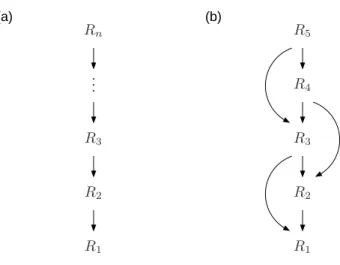
The hierarchies in Figure 2-2 all rely on multiple levels of abstraction, but the representations at adjacent levels are related to each other in many different ways. Let Ribe a representation at level i in a hierarchy, where R1 is a representation at the
lowest level. In some cases, Ri is a Ri+1—for instance, a bouncy round object may
be a ball. Ri may also be part of Ri+1—for instance, an object part is a constituent
of an object. Although is a relationships and part of relationships are often used to construct hierarchies, many other relationships are possible. For instance, a speech signal is a realization of a string of phonemes, and a structural description can be built from a grammar.
Since many kinds of relationships between levels are possible, the hierarchies I consider include examples (e.g. Figure 2-2a) that go beyond simple class-inclusion hierarchies (Collins & Quillian, 1969). A hierarchy can be defined as a system of latent variables that captures expectations about the data observed at the bottom of the hierarchy. In most cases, the levels in the hierarchy will not correspond to simple summaries of the observable data. Instead, the levels are best viewed as components of a system which explains the observable data. The role of these levels is therefore similar to the role of the concepts in a scientific theory. As philosophers have argued, scientific concepts are more than simple abstractions from experience. Scientific concepts are components of theories, and it is entire theories that make contact with experience (Hempel, 1972).
The notion of an abstraction hierarchy is the starting point for the formal frame-work described in the next chapter. I formalize this notion using nested hypothesis spaces: X is more abstract than Y if X sets up a hypothesis space that can be used when learning Y . The framework I describe supports hierarchies with multi-ple levels of abstraction, and the representations at the upper levels can be viewed
as epistemic constraints. Since I take a probabilistic approach, Bayesian inference can explain how the constraints at the upper levels are learned given observations at the bottom level of the hierarchy. Even though I will focus on relatively simple constraints, the hierarchical Bayesian approach can help to explain the acquisition of many kinds of abstract knowledge, including representations that might be best described as schemata or intuitive theories.
Conceptual approaches to constraint learning
The acquisition of abstract knowledge has been a central concern for epistemolo-gists and developmental psycholoepistemolo-gists alike. This section introduces three views of knowledge acquisition that have been popular in the psychological literature. One prominent approach grows out of the work of the British empiricists (Locke, 1998; Hume, 1748), who argued that even our most abstract ideas correspond to combi-nations of perceptual primitives. Abstract knowledge is thought to emerge when associative learning mechanisms combine these primitives to create new concepts. Some kinds of abstract knowledge may correspond to higher-level associations, or associations between associations (Colunga & Smith, 2003). As discussed in the next section, connectionist models can be viewed as modern attempts to formalize asso-ciative learning.
Piaget and his colleagues developed an alternative empiricist approach that em-phasizes the construction of increasingly abstract cognitive structures (Piaget, 1970; Piaget & Inhelder, 1969). This constructivist approach suggests that infants begin with relatively simple perceptual and motor abilities, and move through a series of in-creasingly complex stages. Each stage is characterized by the kinds of representations that are available and the operations that can be carried out over these representa-tions. These computational resources can be viewed as domain-general constraints: for example, the concrete and formal operations are abstract structures that help learners to address problems from many different domains. Two mechanisms are thought to explain how children move from one stage to another: assimilation, or the
integration of external elements into a structure, and accommodation, or the modi-fication of a structure by the elements it assimilates. The interaction between these mechanisms is believed to lead to the emergence of abstract knowledge.
A third view works with the idea that abstract knowledge is embedded in theories, or rich systems that specify concepts and relationships between these concepts. This theory-based approach is clearly relevant to the study of scientific knowledge, but psychologists have proposed that much of our everyday knowledge is organized into intuitive theories that are similar to scientific theories in important respects (Carey, 1985a; Murphy & Medin, 1985; Wellman & Gelman, 1992; Gopnik & Meltzoff, 1997). From this perspective, the problem of understanding how abstract knowledge is ac-quired turns into the problem of characterizing the process of theory formation. Un-like associationism and constructivism, the theory-based approach need not explain how theories are built from raw perceptual primitives: many supporters of this ap-proach suggest that infants begin with innate theories of several core domains, and that learning is a matter of moving from one theory to another (Gopnik, 1996; Well-man & GelWell-man, 1998). High-level descriptions of theory change are sometimes pro-vided (Popper, 1935/1980; Kuhn, 1970)—to mention one typical example, Gopnik (1996) suggests that theory formation is a matter of accumulating counterevidence to an existing theory, proposing an alternative theory, then searching for evidence for this new theory. Accounts like this are convincing as far as they go, but understanding theory change in detail remains a major challenge.
This section has described three influential approaches to the acquisition of ab-stract knowledge, and these approaches have inspired many of the ideas in this thesis. Although I draw on previous work from the philosophical and psychological litera-ture, I take on the challenge of developing computational theories that go beyond verbal descriptions of the emergence of abstract knowledge. The next section de-scribes some of the issues that arise when attempting to model the acquisition of abstract knowledge.
Conventional model
(a) (b) Constraint-learning model
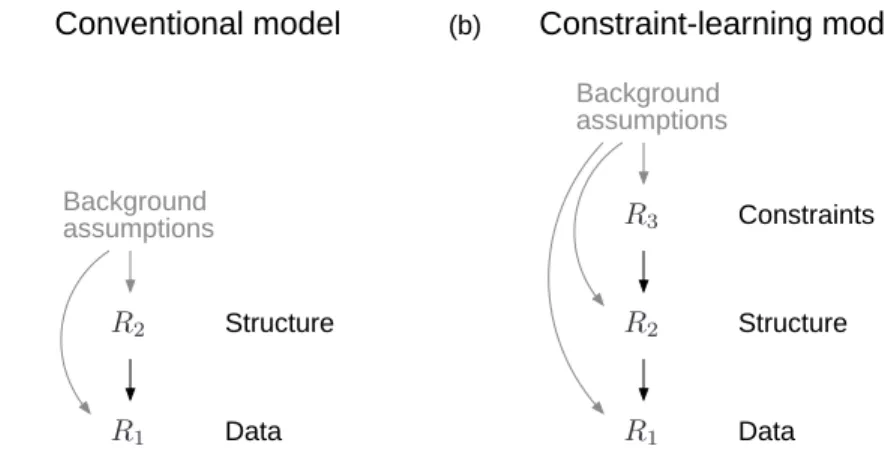
Data Structure Background assumptions Data Structure Constraints Background assumptions R1 R2 R1 R2 R3
Figure 2-3: (a) Cognitive models typically make inferences at two levels. Given data (e.g. contingency data or a set of features), these models learn a latent representation R2 (e.g. a causal model or a set of network weights) and use this representation to make inferences about any missing entries in the data (R1). These models always
rely on background assumptions which must be fixed in advance. (b) A constraint-learning model makes inferences at three or more levels. The model shown here relies on background assumptions which are fixed, but can learn inductive constraints (R3), discover a latent representation (R2), and fill in missing data (R1). The models
developed in Chapters 4, 5 and 6 are all instances of this schema.
Formal models of constraint learning
Many cognitive models can be seen as instances of the two-level schema shown in Figure 2-3a. The schema indicates that observable data R1 are consistent with some
underlying structure R2, and that the representations at both levels depend on a set
of background assumptions. These assumptions might equally well be described as inductive constraints, and include assumptions about the class of possible structures, the class of possible data sets, and the relationship between structure R2 and the data
observed at level 1. The background assumptions are fixed in advance and grayed out in Figure 2-3a, but the schema supports inferences at level 1 and level 2.
Some concrete examples may help to explain the schema in Figure 2-3a. Models of causal learning often work with contingency data (R1), and discover a causal network
(R2) that accounts well for the patterns in the data. All of these causal models rely
on background assumptions of some sort: for instance, Bayesian approaches use a prior distribution on causal networks, and make some assumptions about how data
are generated from these networks. All of these models support inferences at two levels: they learn a causal network R2, and can use this network to make inferences
about any missing entries in the data set R1.
To give a second example, connectionist models often take a collection of features as input (R1), and learn a set of weights (R2) that accounts well for the data. These
models rely on background assumptions which may include assumptions about the architecture of the network, the initial state of the network and the parameters that specify the learning rule (Elman et al., 1996). Since the learned network weights (R2)
support predictions about unobserved features (R1), again the model makes inferences
at two distinct levels.
To give a third and final example, models for multidimensional scaling (MDS) be-gin with a similarity matrix (R1), and discover a low-dimensional representation (R2)
that accounts well for the data. Again, these models rely on background assumptions which may or may not be explicitly stated: for instance, MDS models assume in advance that a spatial representation is appropriate for the data. In principle, MDS models make inferences at two levels: they discover a representation R2, and can use
this representation to make predictions about any pairwise similarity ratings that are missing from the data set R1.
From one perspective, any conventional model of learning (Figure 2-3a) acquires inductive constraints, since it learns a representation R2 which shapes inductive
in-ferences about the unobserved entries in data set R1. The conventional approach,
however, does not provide a general framework for explaining how constraints might be learned. Many constraints of interest correspond to assumptions about repre-sentation R2, and the background assumptions in Figure 2-3a will always include
constraints of this sort. To explore how these constraints might be learned, we need models with at least three levels of abstraction, and the simplest models that satisfy this criterion are instances of the schema in Figure 2-3b. This schema indicates that data are generated from some underlying structure, that this structure conforms to a set of constraints (R3), and that the representations at all levels are consistent with
and grayed out in Figure 2-3b, but the schema supports inferences at levels 1, 2 and 3.
Given any two-level model (Figure 2-3a), we can move to a three-level model by carving out some of the background assumptions about structure R2 and introducing
them as a level in their own right. Some additional assumptions will need to be added as we move from two to three levels—in particular, we will need to add background assumptions that capture expectations about the representation at level 3. The aim, however, is to achieve a net reduction in background assumptions whenever we add a level. There is no reason to stop at just three levels, and we can continue to add levels, again aiming to shrink the set of background assumptions at each stage.
The schema in Figure 2-3b does not explain how all of the constraints that guide inferences about R2 and R1 might be learned. As in Figure 2-3a, the background
assumptions might equally well be described as inductive constraints, but I have chosen a different label to distinguish the constraints that are learned (R3) from
the constraints that are not (the background assumptions). Any model of learning will rely on some set of background assumptions, and the schema in Figure 2-3b is no exception. This schema, however, can help to explain the acquisition of many constraints discussed by psychologists, including many of the constraints in Table 1.1. Whether a given model matches the schema in Figure 2-3b will depend on what it learns and what it takes as input. Consider, for example, two methods for learning probabilistic context-free grammars. The first is a supervised model and takes a set of parse trees as input. The second is an unsupervised model: it takes a set of sentences (R1) as input, and must discover parse trees for each sentence (R2) and a grammar
(R3) that accounts well for these (unobserved) parse trees. Even though the two
models may discover identical grammars, only the unsupervised model qualifies as a constraint-learning model. The unsupervised model deserves this description since the grammar it learns captures constraints which help to solve the inductive problem of parsing. As required by Figure 2-3b, it makes inferences at three levels: it learns a grammar and a set of parse trees, and if any of the sentences contain words that are garbled or unobserved, it can predict what those missing words might be. The
supervised model does not address the parsing problem, and makes inferences at only two levels of abstraction: it discovers a grammar, and can use this grammar to fill in parts of the parse trees that might have been unobserved.
Researchers from several disciplines have developed formal models that help to explain the acquisition of abstract knowledge. Some, but not all of these models match the three-level schema shown in Figure 2-3b. These models can be organized into four broad classes: connectionist approaches, AI approaches, machine learning approaches, and statistical approaches. Note, however, that these classes overlap, and that some models are valid representatives of two or more classes.
Connectionist approaches
Connectionist models represent a modern attempt to implement some of the ideas behind associationism, and some of these models appear to acquire knowledge at multiple levels of abstraction. A particularly clear example is provided by Colunga and Smith (2005), who show that a recurrent network can acquire a shape bias for object categories and a material bias for substance categories. In other words, the network learns about the features of specific categories (balls tend to be round) and about the features of categories in general (all instances of a given object category tend to have the same shape). Constraints on word-learning have also been explored: for example, Regier (2003) reviews work suggesting that something like the principle of mutual exclusivity can emerge from associative learning. Finally, I suggested earlier that the abstract knowledge which guides induction can sometimes be described as an intuitive theory, and Rogers and McClelland (2004) argue that connectionist models provide a mechanistic account of many inductive phenomena that are commonly thought to rely on intuitive theories.
There is at least one kind of connectionist model that matches the three-level schema in Figure 2-3b. Cascade-correlation models grow in complexity as more data are encountered: in other words, they learn both the architecture of a network (R3)
and the weights for this network (R2) (Fahlman & Lebiere, 1990; Mareschal & Shultz,
cogni-tive development, and psychological applications of these models are often inspired by Piaget’s constructivist approach to development (Shultz, 2003). Most connection-ist models, however, learn at only two levels—a level which includes the data and a level which specifies the weights of the network. These models match the schema in Figure 2-3a, and raise the question whether models that make inferences at three or more levels are necessary to account for the acquisition of abstract knowledge. I take up this question towards the end of this chapter.
AI approaches
Logic provides a powerful tool for representing inductive constraints, and the artifi-cial intelligence research community has long been interested in methods for learn-ing logical representations. Some of these methods can be viewed as techniques for learning the epistemic constraints that are the focus of this thesis. One class of methods (Davies & Russell, 1987) aims to identify determinations, or abstract logical statements that identify patterns of dependency between attributes. For example, the statement that “people in a given country usually speak the same language” is a constraint that supports confident generalizations from very sparse data. A visitor to Brazil, for example, can conclude that Brazilians speak Portugese after meeting a single Portugese-speaking local (Russell & Norvig, 2002).
Another approach is known as Explanation-Based Learning, or EBL (Mitchell, Keller, & Kedar-Cabelli, 1986; DeJong & Mooney, 1986). Given a single observation of a novel concept, EBL systems attempt to identify a schema (or a set of general rules) that include the individual observation as a special case. Suppose, for example, that an EBL system is given a single example of a kidnapping narrative—a story about Mary, who was kidnapped by Bill when she was out running one evening, and released only when Mary’s father gave three hundred thousand dollars to Bill (DeJong & Mooney, 1986). An EBL system will attempt to identify general rules that are true of all kidnapping narratives. For instance, a kidnapping narrative is one where a person x captures another person y, and x releases y only when associates of y pay x money. Note that this schema abstracts away from the idiosyncratic details