%NVUEDELOBTENTIONDU
%0$503"5%&
%0$503"5%&-6/*7&34*5² -6/*7&34*5²%&506-064& %&506-064&
$ÏLIVRÏPAR $ISCIPLINEOUSPÏCIALITÏ
0RÏSENTÏEETSOUTENUEPAR
4ITRE
*529
%COLEDOCTORALE 5NITÏDERECHERCHE
$IRECTEURS DE4HÒSE
2APPORTEURS LE
Institut National Polytechnique de Toulouse (INP Toulouse)
Mécanique, Energétique, Génie civil et Procédés (MEGeP)
Analysis and control of self-sustained instabilities in a cavity using reduced order modelling
Analyse et contrôle des instabilités dans une cavité par modélisation d’ordre réduit
lundi 8 février 2010
Kaushik Kumar NAGARAJAN
Dynamique des fluides
Jean-Pierre RAYMOND, Professeur, Université Paul Sabatier, IMT, Toulouse, Président Christophe AIRIAU, Professeur, Université Paul Sabatier, Toulouse, Directeur Laurent CORDIER, Chargé de recherche CNRS, LEA/CEAT, Poitiers, Examinateur
Angelo IOLLO, Professeur, Université Bordeaux, IMB, Bordeaux, Rapporteur Bernd. R NOACK, Directeur de Recherche CNRS, LEA/CEAT, Poitiers, Rapporteur
Christophe AIRIAU, Professeur, Université Paul Sabatier, Toulouse Azeddine KOURTA, Professeur, Polytech Orléans, PRISME, Orléans
Institut de Mécanique des Fluides de Toulouse (IMFT)
Acknowledgments
Thomas Alva Edison once said: ”100% Success = 99% perspiration + 1% inspiration” ! for me, the ratio of perspiration to inspiration didn’t trigger my thoughts as much as the truth that inspiration is more dense, deeper and carries equal weight! Without being ‘calculative’ in expressing myself, I would still have to admit my anxiety of making understatements:
I cannot thank enough my supervisors Christophe Airiau and Azeddine Kourta who have moti- vated me to stretch my forte and my competence beyond limits and thereby helped me discover my inner strength which I was not aware of. I owe the success of my efforts and the brightness of my future to them. Christophe brought to this work the insight and rigor in many parts especially con- cerning ‘Control’. I am very indebted to him for having instilled in me a sense of rigor in my research, as well as in presenting this work. His concern to make his students learn the state-of-art was very well ref ected in the many workshops I attended during the three years.
Words fail to express my gratitude to Laurent Cordier from LEA Poitiers, who has for the most part of the work served as a virtual supervisor. His knowledge in POD based Reduced Order Modelling was indispensible. His rigor and never-say-die attitude has rubbed off on me for life. He has held the guiding light for me to tread this path and has encouraged me all-through. His guidance and constructive criticism have been like stepping stones in the process. Thanks for his great patience in talking to me practically everyday and advising me. Apart from this, I enjoyed the moments of long discussions I had with him on almost every topic.
I sincerely thank Bernd Noack and Angelo Iollo for accepting to be a part of the jury. Their deep knowledge of the state-of-art was ref ected in the many questions they posed and has encouraged me to pursue this f eld further in my career. I would also like to thank Jean-Pierre Raymond for agreeing to preside over the defence presentation. I would also like to remember him for the good lunches I had at his home, his lively spirit and love for Mathematics. I would also like to acknowledge Professor Pierre Comte of LEA Poitiers for providing me with a copy of his DNS code and his help during the initial days of the work.
Thanks for the support I received from the Service Informatiques during the last three years.
Special thanks to Nicolas Renon of CICT for providing me various tips on large-scale computation.
Thanks to Marie Christiani secretory of the group for coordinating the various activities of the project.
Her enthusiasm to help foreign students in many day-to-day activities is noteworthy. I would also like to thank V´eronique Cassin, the new secretory, for her help during the last days of the work.
Special thanks to the various partners of the AeroTraNet project who gave a new direction on solving a problem by combining the various aspects of work like numerical, experimental. The bi- annual meetings gave me an unique opportunity to network with various researchers working on different aspects of the same problem. I would also like to thank peers in the f eld whom I met during many conferences and workshops. Thanks to Clancy Rowley, Dietmar Rempfer, Ravindran for providing many exciting perspectives of thought. A special acknowledgment goes to John Burkardt from Florida State University for maintaining the best collection of libraries of various programs which have been used in this work. I have copied his style of programming!
Thanks to Laia and Sivam, mes amies in this long sejour of three years, who have stood by me and encouraged all along. Laia has been a great support till the last days of my thesis. Her
uncanny ability to organise things leaves me awe-struck. Sivam by sharing his treasure of Tamil songs made my days lively. Thanks to my other friends Karim, Anais, Houssam, Remi, Wafa, Marguerite, Thibaud, Benjamin, Romain, Xavier, Rudy, Mariyana, Bernard, Dirk, Yannick, Marie, Omar, Luigi, Sheetal and Aalap for their support and encouragement. I would like to acknowledge Yogesh for suggesting many improvements in the write-up. Thanks to David for giving me various tips for my f nal presentation.
I owe my heart f lled thanks to my parents; especially my mother (Smt. Girija Nagarajan), brother and sister-in-law (Ishwar & Ramya), sisters - Rani, Preethi, Gowri (Chinni included) for their encour- agements, forbearance, support and prayers and having stood by me during ‘high and low tides’, for the unfaltering faith they had in me, which was an essential base to the victorious atmosphere I’m breathing in, right now.
Thanks to my friends the Badri-boys (Dilip, Guru, JP, Kiran, Parag, Sriram, Sreenidhi, Vivek), Di- vya and Swathi for their constant encouragement and prayers for my betterment. I would like to thank Raghoothamachar for cultivating in me a sense of unbiasedness while pursuing knowledge. Thanks to Dr. Ramesh (NAL) for encouraging me in my pursuits. I would also like to thank Dr Kirti Malhotra and Dr N. Balasubramanya my undergraduate professors. Thanks to Professor A.S.Vasudevamurthy of TIFR for his words of motivation to come abroad for a PhD.
There is no greater blessing than to have the guidance of an enlightened personality. All our knowledge, inspiration and wisdom are dormant within us as seeds. The proper watering through spiritual guidance nurtures these seeds to grow into deep-rooted, majestic trees. That kind of initiation is what I have received from Shrila Prabhupada. This seed was further cultivated and enriched by Shri Bannanje Govindacharya by showing me a new light, leading to the path of Shri Madhwacharya, who is immanent in every soul, the preceptor of all the worlds and the embodiment of all virtues.
Last but not the least, all these thanks-giving would have no real meaning if I fail to recognise the Supreme Lord Shri Krishna, immanent in all of them. I humbly dedicate this work unto His lotus feet with heart-felt prayers. I would like to admit that I too am a mere instrument in this progression.
This thesis has been supported by a Marie Curie Early Stage Research Training Fellowship of the European Community’s Sixth Framework Programme under contract number MEST CT 2005 020301.
Contents
General Introduction 1
1 Description and validation of the numerical tool 7
1.1 Introduction . . . 10
1.2 Non-dimensionalisation parameters . . . 10
1.3 Governing equations in cartesian coordinate system . . . 11
1.4 Time advancement . . . 12
1.5 Boundary conditions . . . 13
1.5.1 Wall boundary condition . . . 13
1.5.2 Non-ref ective boundary conditions . . . 13
1.5.3 Subsonic inf ow boundary condition . . . 15
1.5.4 Subsonic non-ref ecting outf ow boundary condition . . . 16
1.6 Modelling cavity f ows using NIGLO . . . 17
1.7 Introduction of control . . . 21
1.8 Conclusion . . . 23
2 Basic tools from control theory 25 2.1 Introduction . . . 28
2.2 Open loop control and constrained optimisation . . . 29
2.2.1 Functional gradients through sensitivities . . . 34
2.2.2 Functional gradients using adjoint equations. . . 34
2.2.3 Differentiation then Discretisation . . . 35
2.2.4 Discretisation-Differentiation . . . 35
2.2.5 Differentiation-Discretisation . . . 35
2.3 Feedback control . . . 37
2.4 H2 control theory . . . 38
2.4.1 Linear Quadratic Regulator LQR control . . . 38
2.4.2 Lyapunov equation and minimum of the functionalJLQR . . . 39
2.4.3 Estimation and the Kalman-Bucy Filter (KBF) . . . 40
2.4.4 Linear Quadratic Gaussian LQG control . . . 43
2.5 H∞control: robust control . . . 44
2.6 Conclusions . . . 46
3 Proper Orthogonal Decomposition (POD) based Reduced Order Modelling (ROM) 47
3.1 Introduction . . . 53
3.2 Reduced order modelling an overview . . . 53
3.2.1 Historical background of POD . . . 54
3.2.2 Application of POD in control and turbulence . . . 55
3.3 Proper Orthogonal Decomposition . . . 55
3.4 Properties of POD. . . 57
3.5 Finite dimensional case . . . 60
3.6 Singular Value Decomposition (SVD) . . . 62
3.6.1 Geometric interpretations of SVD . . . 62
3.6.2 Connection between the SVD and eigenvalue problems . . . 63
3.7 Direct and snapshot method. . . 64
3.7.1 On the application of the classical eigenvalue problem: . . . 64
3.7.2 Snapshot POD . . . 65
3.8 Choice of inner product . . . 66
3.8.1 L2 inner product . . . 67
3.8.2 H1 inner product . . . 67
3.8.3 Compressible inner product . . . 67
3.9 ROM in literature . . . 68
3.10 Galerkin projection, principles . . . 69
3.11 Incompressible case . . . 70
3.12 Compressible case . . . 72
3.13 Extension to actuated case . . . 73
3.13.1 Reduced order model for the actuated case . . . 75
3.13.2 A polynomial notation for the reduced-order model . . . 77
3.13.3 Extension to multiple modes . . . 78
3.14 Application to cavity f ows . . . 80
3.15 Conclusion . . . 82
4 Integration and calibration of ROM 89 4.1 Introduction . . . 92
4.2 Def nition of errors . . . 93
4.2.1 State calibration method with nonlinear constraints . . . 93
4.2.2 State calibration method . . . 94
4.2.3 Flow calibration method . . . 94
4.2.4 Aff ne function of error . . . 95
4.3 Calibration method of Couplet . . . 96
4.4 Application to cavity f ow. . . 97
4.4.1 Introduction . . . 97
4.4.2 Minimisation ofJα(2)andJα(3) . . . 98
4.5 Calibration by the method of Tikhonov regularization . . . 101
4.5.1 Filter factors and Picard’s criteria . . . 101
4.5.2 Tikhonov regularization . . . 102
4.5.3 A weighted approach to Tikhonov regularization . . . 105
4.5.4 Comparison of different types of Tikhonov regularization . . . 108
4.6 Comparison with other calibration methods . . . 111
4.7 Long time time integration of the POD ROM . . . 112
4.8 Conclusion . . . 113
5 Feedback control of cavity f ows 115 5.1 Introduction . . . 117
5.2 Tools used for the feedback design . . . 117
5.2.1 Linear Stochastic Estimation (LSE) . . . 118
5.2.2 Sensitivity analysis of the actuated terms . . . 119
5.2.3 Linearisation of the plant . . . 121
5.3 Feedback design. . . 124
5.3.1 Controller . . . 124
5.3.2 Observer . . . 125
5.3.3 Simulation of the full system . . . 125
5.3.4 Application to cavity . . . 126
5.4 Conclusion . . . 130
Conclusions and Perspectives 133
Annexes 141
A Controllability and observability of linear systems 141 B Galerkin projections for the full NS equations 143 C Specif c volume formulations of ROM 145 D Actuated POD by the method of stochastic estimation 147 E Theorem concerning actuated mode 149 F Generalized Singular Value Decomposition (GSVD) 153 G Open loop control 155 G.1 Open loop control of cavity f ows. . . 155G.2 Resolving the optimal system . . . 156
G.3 Open loop control of cavity . . . 158 H An open loop approach to handle the acoustic terms in ROM 161
References 163
General Introduction
Motivation
Les ´emissions acoustiques repr´esentent un des probl`emes majeures du transport a´erien qui concer- nent l’environnement. G´en´eralement on classe les bruits ´emis en fonction de leur origine m´ecanique, a´erodynamique et ceux li´esaux syst`emes secondaires. On s’int´eresse ici au bruit ´emis au voisi- nage des a´eroports, et il provient pour l’essentiel (voir figures 1 et 2) de l’´ecoulement autour du train d’atterrissage, de celui des jets de r´eacteurs et de diff´erentes cavit´es pr´esentes sur l’avion.
Nous allons dans la suite consid´er´e uniquement la g´eom´etrie de la cavit´e dont l’´ecoulement est sch´ematiquement donn´e sur la figure 3 et 4, en fonction du rapport d’aspect. Le travail pr´esent´e ici consiste `a analyser la physique de l’´ecoulement et de la propagation du bruit et surtout `a chercher
`a r´eduire les ´emissions acoustiques.
Diff´erents approches exp´erimentales par un contrˆole passif ou actif de l’´ecoulement ont pu d´ej`a ˆetre test´ees avec plus ou moins de succ`es, grˆace en particulier aux avanc´ees techniques dans les moyens de mesures et de de contrˆole, et dans le domaine des ressources informatiques. Actuellement, en utilisant les Simulations Num´eriques Directes (DNS) ou les Simulations `a Grandes Echelles (LES) nous sommes en mesure de mieux comprendre la physique de cet ´ecoulement. Par contre, compte tenu de l’´enorme dimension du probl`eme, les ´etudes num´eriques et th´eoriques du contrˆole acoustique doivent n´ecessairement passer par la r´eduction de mod`ele (ROM, voir figure5). Ici nous appliquerons la D´ecomposition en Valeurs Propres Orthogonales (POD), qui permettent finalement de r´eduire la complexicit´e des ´equations de Navier-Stokes `a la r´esolution et donc au contrˆole, d’un syst`emes d’´equations au d´eriv´ees ordinaires (ODE, voir figure 6), plus simple `a manipuler et r´esoudre. En se basant sur les travaux pr´ec´edents de Rowleyet al.(2003), Gloerfelt(2008), Kasnako˘glu(2007), Samimyet al.(2007) et deCordieret al.(2009), nous allons proposer un contrˆole du syst`eme r´eduit, une fois celui-ci calibr´e et l’appliquer ensuite sur le syst`eme complet issu des Simulations Num´eriques Directes.
Ce travail a ´et´e effectu´e dans le cadre d’un projet Marie-Curie appel´e AeroTraNet, men´e en collaboration avec3universit´es ´etrang`eres. Le LEA de Poitiers a largement contribu´e aux diff´erentes parties: L. Cordier pour ce qui concerne la r´eduction de mod`ele, P. Compte pour les DNS.
Organisation du document
La chapitre 1 introduit l’outil de simulation num´erique de base (DNS). Les ´el´ements de la th´eorie du contrˆole utilis´es plus tard sont pr´esent´es dans le chapitre 2. Le chapitre suivant est consacr´e `a la r´eduction de mod`ele et son application sur l’´ecoulement de cavit´e. Le syst`eme dynamique obtenu est fortement instable aussi le chapitre 5 est d´edi´e `a la calibration et la stabilisation du mod`ele r´eduit.
De multiples approches sont abord´ees. Le contrˆole du syst`eme dynamique forc´e et son effet sur l’´ecoulement complet, sur la base de la th´eorie du contrˆole lin´eaire quadratique gaussien sont finale- ment pr´esent´es dans le chapitre 5. Une conclusion suivi de quelques annexes ach`event le document.
Motivation
The recent rise in the air travel has given rise to a number of environmental concerns of which an important issue is the noise. Exposure to noise, particularly near the airports have been known to cause a number of health problems, like stress, hearing problems, hypertension, cardio-vascular problems, sleeping disorders. A constant exposure to noise levels beyond65−70dB is known to cause life term health effects.
Noise emitted from an aircraft can be broadly classif ed as mechanical noise, aerodynamic noise and aircraft system noise. Mechanical noise is usually caused due to propeller, jet engines. The main source of mechanical noise in an aircraft occurs during cruise conditions, due to the high velocity of jet from the engine. The aerodynamic noise arises due to the airf ow around the different geometric conf gurations such as fuselages, high lift devices devices, landing gears, head and tail rotors of a helicopter etc. Aircraft system noise is mainly due to the cabin pressurisation as well as due to the auxiliary power units used to start the main engines, to provide power during ground conditions.
Although during cruise conditions the mechanical noise dominates, the aerodynamic noise assumes an equal proportion during landing and takeoffs. Most of the aerodynamic noise during landing and take-offs can be associated to the landing gear, the geometry of which can be modelled as a cavity.
Figure 1 shows the various components of noise sources during the landing or takeoff of aircrafts.
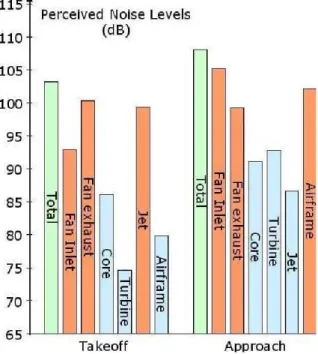
Typical values of perceived noise, due to various components, during take off and landing is shown in f gure2.
A similar phenomenon can also be seen in other conf gurations such as weapon bays, joints be- tween high speed train bogies, car body openings. This brings to interest the study of cavity f ows, particularly when in search of quieter aircrafts as envisaged in the report European aeronautics: a vision for 2020 byEC(2001) .
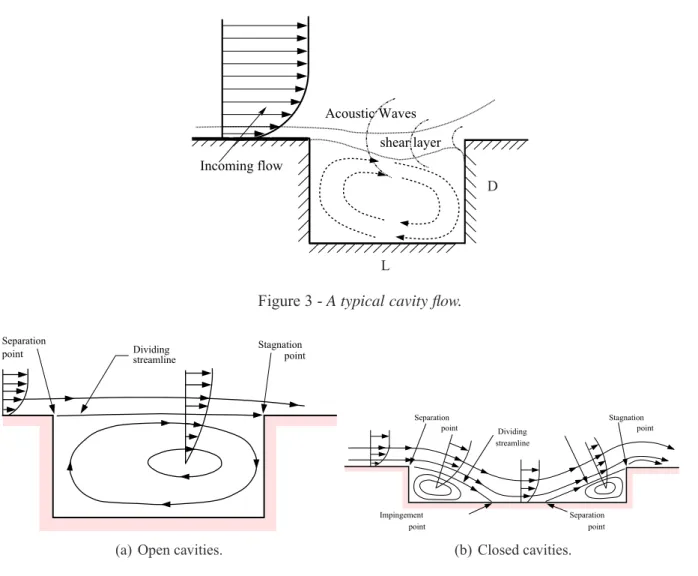
A typical cavity f ow conf guration is as shown in f gure3. The physics of the cavity can be ex- plained by the formation of the shear layer at the upstream cavity edge. As the shear layer propagates it breaks down due to the Kelvin-Helmholtz mechanism resulting in a membrane like oscillation. The shear layer impinges the downstream edge of the cavity and splits, resulting in the formation of vorti- cal structure close to the downstream edge, and is of the size of the depth of the cavity. This results in the formation of acoustic waves which propagates into the upstream, causing the far-f eld noise. The cavity can be classif ed based upon the f ow mechanism it generates, as an open cavity or a closed
Figure 1 -Typical airframe cavities. (Picture courtesy Ben Pritchard, airliners.com)
Figure 2 -Aircraft noise sources, during approach and takeoffOwens(1979).
cavity. Open cavities are characterised by the shear layer which attaches near the downstream corner, whereas closed cavities are characterised by the shear layer attachment at the bottom of the cavity and separation downstream. The basic difference can be summarised in f gure4. Open cavities are further divided into deep cavities and shallow cavities based on the aspect ratio DL. Deep cavities are charecterized by an aspect ratio DL < 1, and shallow cavities by aspect ratio DL > 1. Many of the airframe structures shown in f gure 1can be treated as a shallow open cavity. The main interest of this work is then to study these f ows and to reduce the noise due to the acoustics.
There has also been numerous attempt to reduce the noise emitted from a cavity, by many heuristic
shear layer Acoustic Waves Incoming flow
L
D
Figure 3 -A typical cavity flow.
Dividing streamline Separation
point Stagnationpoint
(a) Open cavities.
Stagnation
Impingement Separation
Separation point point
Dividing streamline
point point
(b) Closed cavities.
Figure 4 -Schematic representation of open and closed cavities.
means such as modifying the geometry by means of castellations, spoilers at the upstream edge of the cavity, so as to change the turbulent scales and hence reduce acoustic emissions. Use of synthetic jets delays the re-attachment of the shear layer and has been used in many experiments. With the advent of high performance computing as well as advanced experimental techniques such as the Particle Image Velocimetry (PIV), Laser Doppler Velocimetry (LDV) deep insights into the physics of cavity f ows can be explored, with an aim to reduce the noise.
The traditional approaches like Direct Numerical Simulation (DNS) involve fully resolving the equations governing the f ow dynamicsi.e.the Navier-Stokes’ equations down to the f nest scale. Al- though this approach seems attractive it has inherent diff culties like the computational resources. An approach to reduce the computational time is the utilisation of Large Eddy Simulation (LES) where the major structures governing the f ow (large eddies as they are called) are resolved and the f ner scales are modelled. This approach also poses diff culties, particularly when used as an iterative tool for f ow control, due to their high dimensional nature. The next proposition to reduce the dimen- sionality of the problem is by restricting our interest to the ”most essential structures” which governs
the dynamics. The basic observation of f uid f ow as a cascading phenomenon gives us the hint of this ”essential” structures in terms of the energy, to obtain a low dimensional space. The reduced order model is then constructed as a projection of the high dimensional dynamics onto this lower dimensional subspace as summarised in f gure5.
Navier-Stokes DNS/LES ROM
Figure 5 -Philosophy of reduced order modelling.
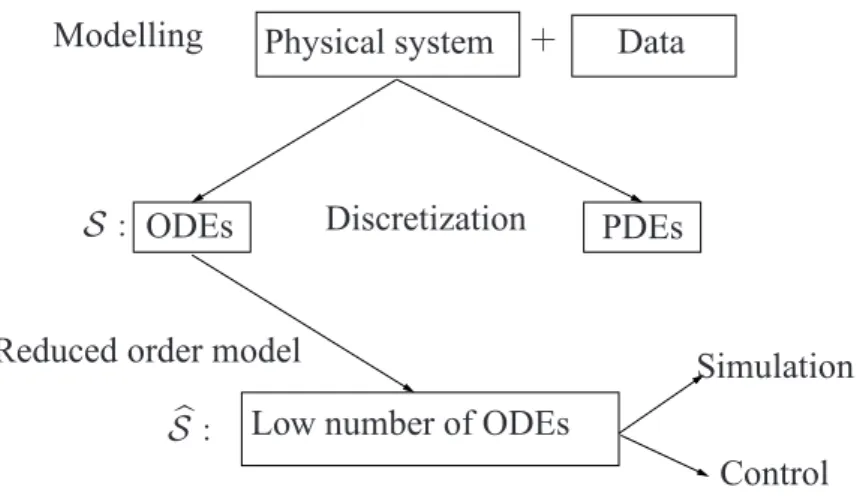
The aim of this thesis is to construct reduced order models for the cavity f ows. The basic idea is to retain the most essential features of the f ow called Proper Orthogonal Decomposition POD modes, which contain the maximum amount of information about the f ow dynamics. By performing a DNS of the compressible Navier-Stokes equations to compute the f ow of a large cavity, the POD modes are extracted. The Reduce Order Model (ROM) is then obtained by projecting the governing equation of f uid f ow i,e the Navier Stokes equations on the subspace spanned the POD modes. This results in one having to solve a system of Ordinary Differential Equations (ODE) rather than the complicated system of Partial Differential Equations (PDE) and hence the name reduced order modelling. The well developed control theory is applied on this system of ODE’s to obtain the noise reduction. Apart from being used in-lieu of the high f delity model for control studies, the reduced order model obtained can also be used as a predictive tool to save computational resources. The overall strategy of using a reduced order model (ROM) can be summarised as shown in the f gure6.
Physical system + Data
S : ODEs Discretization PDEs
Sb: Low number of ODEs
Simulation Control Modelling
Reduced order model
Figure 6 -A Schematic representation of Reduced Order Modelling.
Flow past an open cavity has been studied using ROM byRowleyet al.(2003) andGloerfelt(2008) but without any application to f ow control. More recently, ROM for controlled conf gurations has
been proposed by Kasnako˘glu(2007). In Samimyet al.(2007) the ROM for f ows issued from an experiment has been used to design a controller. The major hurdle in using the ROM for control applications is the accuracy of the model in predicting the dynamics of the system even for short periods. Also diff culty arises when the control parameters are changed as in a real time simulation.
Various numerical strategies termed as calibration techniques has been developed in the recent past to treat this problem as found inCordieret al.(2009). The major contribution of this thesis is then to complete the full development as applied to cavities, like building up the ROM, including the effect of control, calibrating the model and f nally performing control studies.
The outcome of the interest in reducing the cavity noise has resulted in the frame work of Aero- TraNet (Aerodynamic Training Network) projected which was a collaboration of4academic partners in Europe. The academic partners which included University of Leicester (U.K.), the Universit`a degli Studi Roma Tre (Rome, Italy), Politecnico di Torino (Turin, Italy) and Institut de M´ecanique des Fluides de Toulouse (Toulouse, France) were interested in various aspect of the cavity f ow, like, nu- merical, experimental and f ow control. This thesis was done in collaboration with LEA Poitiers, P.
Comte for the DNS and L. Cordier for reduced order modelling. The thesis can be summarized as follows.
Organisation of the thesis
In chapter1we give a brief description of the numerical tool, namely the DNS used in this study and present some validation results. In chapter2the basic tools from control theory are introduced.
Chapter3concerns the basic theory of the technique of POD based ROM. The various techniques to include the effect of actuation in the ROM are summarized, with an application to the cavity f ow.
In Chapter 4 the various def nitions of errors between the calibrated dynamics and the original temporal dynamics are introduced and the different methods of calibration summarized are applied to the cavity f ows. The methods are compared for accuracy. The calibration of the ROM is performed using a Tikhonov based regularization to obtain an accurate representation of the dynamics. We also present an improvement of the technique by introducing various type of weight matrix used in the def nition of error. In the f rst method, we use a sensitivity analysis of the ROM, to determine the weights of the relevant terms which needs to be calibrated. The second approach is to use the energy content of the POD representation in forming the weight matrix to represent the errors.
In Chapter 5a feedback control law based on the estimation of the observer dynamics has been presented. The observer matrix is constructed using a linear stochastic estimation. A sensititivity study of the actuated dynamics has been performed to determine the relevant terms in the linearisation of the model. Finally an Linear Quadratic Gaussian (LQG) controller is designed to obtain an optimal solution, which is introduced in the Direct Numerical Simulation to obtain a decrease in spectra of the cavity acoustic mode.
Chapter 1
Description and validation of the numerical tool
Description et validation de l’outil num´erique
Dans cette partie, les outils num´eriques utilis´es pour les ´etudes de mod`ele r´eduit et du contrˆole sont d´ecrits. Le jet synth´etique est introduit pour contrˆoler les instabilit´es de cavit´e. L’´ecoulement de cavit´e est largement ´etudi´ee dans la litt´erature. Il pr´esente des instabilit´es auto-entretenues qui sont difficiles `a pr´edire num´eriquement (sensibilit´e aux diff´erents param`etres num´eriques). La cavit´e est aussi le si`ege d’int´eractions a´eroacoustiques qui n´ecessitent un sch´ema num´erique d’ordre sup´erieur et peu dissipatif pour capter les ondes acoustiques. Le code NIGLO utilis´e est d´evelopp´e par Pierre Comte de l’Universit´e de Poitiers. Il est capable de r´esoudre les ´equations de Navier Stokes com- pressibles en instationnaire et en tridimensionnel. La discr´etisation diff´erences finies de quatri`eme ordre est faite sous forme conservative.
Param`etres de non-dimensionalisation
Le code r´esout les ´equations sous forme adimensionnelle. L’adimensionalisation d´epend fortement des ´echelles caract´eristiques pour rendre les variables adimensionnelles. La forme adimensionnelle des ´equations de Navier-Stokes incorpore trois nombres adimensionnel, les nombres de Reynolds, de Mach et de Prandtl.
Equations du mouvement en coordonn´ees cart´esiennes
Les ´equations de Navier Stokes compressibles sont ´ecrites sous forme conservatives. Il s’agit des
´equations de continuit´e, de conservation de la quantit´e de mouvement et de l’´energie. Le tenseur des contraintes de cisaillement est exprim´e sous l’hypoth`ese de Newton-Stokes et le flux thermique est donn´e `a l’aide de la loi de Fourier. La viscosit´e en fonction de la temp´erature est exprim´ee avec la loi de en puissance.
1. Description and validation of the numerical tool
Avancement en temps
Le sch´ema temporel utilis´e est un sch´ema explicite aux diff´erences finies utilisant la proc´edure pr´edicteur-correcteur. Une diff´erenciation d´ecentr´ee conservative est utilis´ee pour les deux pas temporels du sch´ema en alternant la direction de discr´etisation entre le pas pr´edicteur et correcteur.
Il en r´esulte globalement un sch´ema spatial centr´e de quatri`eme ordre pour les termes d’advection et de second ordre pour ceux de la diffusion. La discr´etisation temporelle est du second ordre.
Conditions aux limites
Pour les parois, la condition d’adh´erence est appliqu´ee. La forme simplifi´ee de l’´equation dynamique reliant la pression et le tenseur de cisaillement est aussi utilis´ee. Pour l’´etat thermodynamique on d´efinit soit une paroi adiabatique ou soit une paroi isotherme.
Conditions aux limites non-r´ef´echissantes
Pour ´eviter toute r´eflexion sur les limites du domaine de calcul, deux types de conditions peuvent ˆetre adopt´ees: des conditions physiques dict´ees par le probl`eme continu initial ou des conditions num´eriques n´ecessaires `a la m´ethode discr`ete pour compl´eter l’ensemble des conditions physiques.
Les conditions aux limites bas´ees sur les caract´eristiques (NSCBC) dePoinsot & Lele(1992) est une m´ethode pour sp´ecifier `a la fois les conditions physiques et num´eriques pour les ´equations d’Euler et pour celles de Navier Stokes. La m´ethode NSCBC est bas´ee sur une analyse monodimensionnelle locale en non-visqueux (LODI) des ondes traversant les limites du domaine. Les amplitudes des ondes caract´eristiques associ´ees `a chaque vitesse caract´eristique sont donn´ees (´equations1.19 `a1.21). On distingue les conditions aux limites non-r´ef´echissantespour une entr´ee subsonique (´equations1.22 `a 1.27) de celles pour une sortie subsonique (´equations1.28et1.29).
Validation du code num´erique pour le cas de la cavit´e
On pr´esente les r´esultats pour une cavit´e de rapport d’aspectL/D = 2. L’´ecoulement est initialis´e par une couche limite laminaire pour avoir une ´epaisseurδ/D = 0.28au coin amont de la cavit´e.
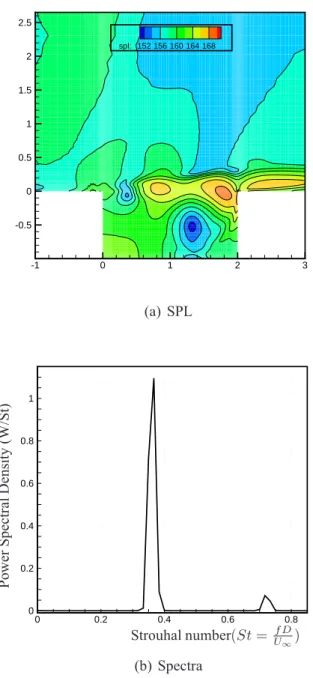
Le nombre de Reynolds bas´e sur la profondeur de la cavit´e est de 1500 et le nombre de Mach est de 0.6.Le domaine de calcul a une longueur de14Det une hauteur de 7D (figure1.1). Le tableau 1.1 donne la taille des diff´erents maillages utilis´es. Le maillage choisi est donn´e sur la figure1.2 et correspond au maillage M. La figure 1.4 montre les niveaux de pression sonore (SPL) pour le champ acoustique au-dessus de la cavit´e et le spectre de vitesse normal en un point de la couche cisaill´ee. Le niveau de pression sonore maximal est de 170 dB qui est inf´erieur `a celui obtenu par Rowleyet al.(2002) (180 db). Ceci peut s’expliquer par la diff´erence de pr´ecision des sch´emas (4eme ici et6emepour eux). Les niveaux SPL sont cependant en accord avec les r´esultats exp´erimentaux de Krishnamurthi(1956) (168 dB). Le spectre montre la valeur typique correspondant au second mode de Rossiter (avec deux tourbillons en moyenne entre les deux coins de la cavit´e). Les oscillations auto-entretenues sont quasi-p´eriodiques, avec un spectre pr´esentant une fr´equence dominante.
Introduction au contrˆole
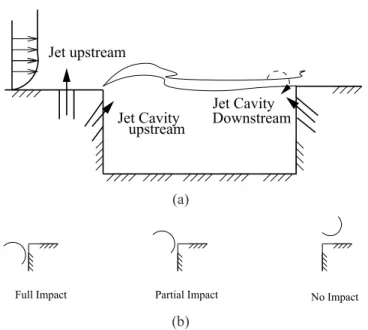
Le contrˆole de la cavit´e r´esonante est r´ealis´e `a l’aide d’un jet synth´etique en modifiant la condition au limite convenablement. Le contrˆole par jet synth´etique a ´et´e r´ealis´e auparavant num´eriquement et exp´erimentalement. L’objectif du contˆole est de d´evier la couche cisaill´ee pour qu’elle n’impacte pas sur le coin aval et ´eviter le ph´enom`ene du retour (feedback). Comme on peut le voir sur la figure 1.6, sous l’effet du jet, la couche cisaill´ee peut impacter totalement, partiellement ou pas du tout.
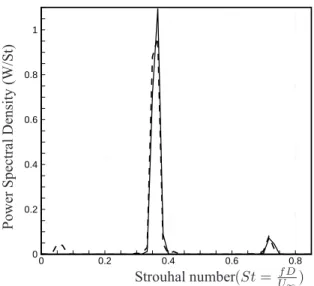
Plusieurs positions ont ´et´e test´ees avant le coin amont pour am´eliorer l’efficacit´e. Ceci peut ˆetre fait en mesurant la sensibilit´e de l’´ecoulement au coin amont. Il a ´et´e montr´ee que c’est le point le plus sensible aux perturbations externes. Le forc¸age est typiquement de la formeAsin(ωt)et l’actionneur est introduit juste avant le coin de cavit´e(x ∈ [−0.15;−0.05]et y = 0). Le spectre de vitesse pour un forc¸age de la formeAsin(wt)(figure1.7) conduistant `a la diminution du mode de Rossiter. Il y a une redistribution de l’´energie sur d’autres pics. L’actionnement est cependant non optimal. Un des objectifs de ce travail est de d´eterminer la fr´equence et l’amplitude optimales en utilisant le contrˆole dans le le mod`ele d’ordre r´eduit.
Conclusion
Dans ce chapitre nous utilis´ees introduit l’outil num´erique, les ´equations, la discr´etisation et les conditions aux limites utilis´e. Le code a ´et´e valid´e sur le cas de la cavit´e. L’introduction du contrˆole avec un jet synth´etique plac´e avant le coin amont est d´ecrite. On note la diminution du mode de Rossiter et la distribution de l’´energie sur d’autres pics. Les outils pour r´ealiser un contrˆole optimal seront d´ecrits dans la suite.
1. Description and validation of the numerical tool
1.1 Introduction
In this chapter the basic numerical tool used in this work is described. We perform a DNS resolving of a 2D cavity f ow. Regarding the introduction of actuation a synthetic jet is introduced at the upstream boundary to control the instabilities. There has been a large body of literature on physics of the cav- ity f ow as can be found inRowleyet al.(2002),Larchevˆequeet al.(2004),Bres & Colonius(2008), Rowley & Williams(2006). Flows with self sustained oscillations are diff cult to model as they are very sensitive to the disturbances, due to shear layer amplif cation. Even a small error in the numerical discretisation at the cavity leading edge can result in a large amplif cation of the errors downstream of the cavity. Problems can also arise due to the artif cial ref ections at the computational boundary, and may sometimes be indistinguishable from the physical disturbances, causing the appearance of non-physical frequencies. Also in the case of cavity f ows the feedback mechanism is acoustic and of many orders smaller than the hydrodynamic disturbances, which necessitates the utilisation of a high order, low-dissipative numerical method to resolve them. The code NIGLO used in this study is capable of solving three dimensional unsteady compressible Navier-Stokes equations on multi-block curvilinear grid. The discretisation is through a fourth order f nite difference scheme for the advective f uxes and second order scheme for the diffusive f uxes. The temporal discretisation is second order accurate. The code was initially developed by Professor Pierre Comte at the University of Poitiers.
1.2 Non-dimensionalisation parameters
Non-dimensionalising the f ow-f eld parameters removes the necessity of converting from one system to another within the code. The process of non-dimensionalisation depends on the choice of the parameter for the problem. In the code all the parameters of the simulation are non-dimensionalised by the reference values, which are the characteristics of the f ow namely the Reynolds number, Mach number & Prandtl number. The Reynolds number is used to quantify the convective effects to the viscous effects, whereas Mach number gives the ratio between the reference velocity and the speed of the sound, f nally the Prandtl number gives the ratio between the heat transfer by viscous diffusion and heat transfer by thermal conduction.
x∗=Lx0 y∗=Ly0 z∗=Lz0 u∗=Uu0 v∗=Uv0
w∗=Lw0 P∗=PP0 ρ∗=ρρ0 T∗=TT0 t∗=UL00t
Where all the quantities with (⋆) are the non-dimensionalised scales used in the code, and values with (0) are reference values of the f ow-f eld. In the following we use only non dimensional variables without∗
1.3. Governing equations in cartesian coordinate system
1.3 Governing equations in cartesian coordinate system
The fully compressible Navier-Stokes equation in a conservative form can be written for the non dimensionalised variables as
∂U
∂t −divF = 0 (1.1)
withF = (E, F, G)andU = (ρ, ρu, ρv, ρw, ρe).
In Cartesian coordinates we have,
∂U
∂t +∂E
∂x + ∂F
∂y +∂G
∂z = 0 (1.2)
where E, F, G are the non-dimensionalised f uxes def ned by:
E =
−ρu
−ρu2− 1
γM2p+ µ Reτxx
−ρuv+ µ Reτxy
−ρuw+ µ Reτxz
−u(ρe+p) +γM2 µ
Re(uτxx+vτxy+wτxz) + γ γ−1
µ ReP rqx
F =
−ρv
−ρuv− 1
γM2p+ µ Reτxy
−ρv2− 1
γM2p+ µ Reτyy
−ρuw+ µ Reτyz
−v(ρe+P) +γM2 µ
Re(uτxy +vτyy+wτyz) + γ γ−1
µ ReP rqy
G=
−ρw
−ρuw− 1
γM2p+ µ Reτxz
−ρvw+ µ Reτyy
−ρw2− 1
γM2p+ µ Reτzz
−w(ρe+p) +γM2 µ
Re(uτxz+vτyz+wτzz) + γ γ−1
µ ReP rqz
The Reynolds number is based on the characteristic lengthL0 of the cavity, and velocityU0, which represents the characteristics of the f ow can be def ned by:
Re= ρ0U0L0
µ0 (1.3)
1. Description and validation of the numerical tool
Withµ0 is the dynamic viscosity calculated at the same point of reference chosen for the velocityU0
and for the densityρ0. In the same manner, the Mach number based on a reference temperatureT0
M = U0
√RγT0 (1.4)
The Prandtl number which corresponds to the ratio of the kinematic viscosity and thermal diffusivi- ties:
P r= µ0Cp
λ0 (1.5)
The total energyEis given by the equation of state as:
ρE = 1
γ−1p+ γM2
2 ρ(u2+v2+w2) (1.6)
With the Stokes hypothesis the viscous stress tensor is proportional to the trace free part of the strain rate tensor.
τij = ∂ui
∂xj
+∂uj
∂xi − 2 3
∂ul
∂xl
δij
(1.7) With the above non-dimensionalisation, the Fourier law reads as
qi =−k∂T
∂xi (1.8)
For taking into account the variation of dynamic viscosity with temperature a power law has been used and is given by
µ(T) =
µ(T0) T
T0
0.7
(1.9)
1.4 Time advancement
The time advancement scheme employed in NIGLO is an explicit f nite difference scheme of predictor-corrector type as proposed by Gottlieb & Turkel(1975). Conservative decentered differ- encing is utilised for two steps of time advancement scheme which alters the discretisation between the predictor and corrector steps, resulting in a globally centered scheme which is4th order for the advection term and2nd order for the diffusion term in space respectively. The discretisation is given byPredictor step:
Uin+1/2 =Uin+
∆t
∆x[−7
6Ein+8
6Ei+1n − 1 6Ei+2n ]
∆t
∆y[−7
6Fin+8
6Fi+1n −1 6Fi+2n ]
∆t
∆z[−7
6Gni + 8
6Gni+1− 1 6Gni+2]
(1.10)
1.5. Boundary conditions
Corrector step:
Uin+1 = 1
2(Uin+1/2+Uin) +
∆t
∆x[ 7
12Ein+1/2+ 8
12Ei+1n+1/2− 1
12Ei+2n+1/2]
∆t
∆y[ 7
12Fin+1/2+ 8
12Fi+1n+1/2− 1
12Fi+2n+1/2]
∆t
∆z[−7
6Gn+1/2i + 8
12Gn+1/2i+1 − 1
12Gn+1/2i+2 ]
(1.11)
The predictor-corrector scheme described above is valid for uniform mesh. In our case when we use mesh ref nement to resolve the boundary layer, corners of cavity the mesh spacing is not constant.
In that case we use a transformation of the physical variables into a new coordinates of constant length and perform the discretisation. The derivatives are then transformed back onto the physical coordinates by the inverse transform.
1.5 Boundary conditions
1.5.1 Wall boundary condition
No slip condition at the wall is applied, so that all the velocity components at the wall are zeroi.e.
uwall = 0 vwall = 0
wwall = 0 (1.12)
The conservation of momentum equation is reduced to the following form
− 1 γM2
∂p
∂xn + ( µ Re)(∂τij
∂xj) = 0 (1.13)
It only remains to determine the thermodynamic state at the wall, which is chosen as isothermal for the case of the cavity f ow.
1.5.2 Non-ref ective boundary conditions
The accuracy of unsteady f ow calculations relies on accurate treatment of boundary conditions. Due to the limit of computational resource, usually only a limited computational domain is considered for an unsteady f ow calculations. This means that we have to ”cut off” the domain that is not of our primary interest. However, the cut boundaries may cause artif cial wave ref ections which may include both physical and numerical waves. Such waves may bounce back and forth within the computational domain and may seriously contaminate the solutions.
Two types of conditions have to be provided to solve numerically the fully compressible Euler or Navier-Stokes equations
1. Description and validation of the numerical tool
• Physical conditions which are the boundary conditions dictated by the original non-discretised problem.
• Soft conditions which are numerical conditions required by the discrete method to complete the set of physical conditions.
As described in Poinsot & Lele(1992), the Navier-Stokes characteristic boundary condition (NSCBC) specif es both the physical and soft boundary conditions for Euler and for Navier- Stokes equations. In this method physical conditions are specif ed according to the well-posedness of Navier-Stokes equation.
Viscous condition for Navier-Stokes are added to the inviscid Euler equations to obtain the right number of boundary conditions for Navier-Stokes. The viscous conditions are used only to compute the viscous terms in the conservation equations at the boundary and, therefore are not strictly enforced.
The method relaxes smoothly to the Euler boundary condition when the viscosity goes to zero.
Soft conditions are constructed without any extrapolation. The NSCBC method is based on a local one dimensional inviscid (termed LODI) analysis of the waves crossing the boundary. The amplitude variation of the waves entering the domain are estimated from an analysis of the local one dimensional inviscid equations. To explain further consider the quasi-linear form of the Euler equation
∂V
∂t +A∂V
∂x +B∂V
∂y +C∂V
∂z = 0 (1.14)
Which can also be written in the following compact form:
∂V
∂t + (A.~~ ∇)V = 0 (1.15)
WhereV = (u, v, w, T, p)tis the vector of primitive variables and the matrices A, B, C are def ned as:
A=
u ρ 0 0 0 0 u 0 0 1/ρ 0 0 u 0 0 0 0 0 u 0 0 γp 0 0 u
B =
v 0 ρ 0 0 0 v 0 0 0 0 0 v 0 1/ρ 0 0 0 v 0 0 0 γp 0 v
C =
w 0 0 ρ 0
0 w 0 0 0
0 0 w 0 0
0 0 0 w 1/ρ 0 0 0 γp w
In our case , we are interested in the propagation of the vectorV normal to the boundary. So we introduce the matrixEnsuch that
En=Anx+Bny+Cnz (1.16)
or
En=A.~n~ (1.17)
1.5. Boundary conditions
wheren = (nx, ny, nz)tis the unit normal. The matrix of the eigenvalues obtained by diagonalizing Enis
λn =LnEnL−1n =diag(λ1, λ2, λ3, λ4, λ5) =diag(u1−c, u1, u1, u1, u1+c) (1.18) Here c is the speed of sound. The amplitudes of the characteristics wavesL′is associated with each characteristic velocity are given by:
L1 = λ1( ∂p
∂x1 −ρc∂u1
∂x1) L2 = λ2(c2 ∂ρ
∂x1 − ∂p
∂x1
) L3 = λ3
∂u2
∂x1
L4 = λ4
∂u3
∂x1
L5 = λ5( ∂p
∂x1
+ρc∂u1
∂x1
) (1.19)
The LODI system can be cast in many different forms depending on the choice of variables. In terms of the primitive variable, this system can be written as
∂ρ
∂t + 1
c2[L2 +1
2(L5+L1)] = 0
∂p
∂t + 1
2(L5+L1) = 0
∂u1
∂t + 1
2ρc(L5−L1) = 0
∂u2
∂t +L3 = 0
∂u3
∂t +L4 = 0 (1.20)
The LODI relations are used to obtain the relations on theL′iswhich will be used later in the system of conservation equation. Using the LODI relation alone may also provide a simple but approximate method to derive boundary conditions. For example assuming non-ref ection at the outlet is equivalent to imposingL1 = 0.
∂p
∂t −ρc∂u1
∂t = 0 (1.21)
1.5.3 Subsonic inf ow boundary condition
For the case of inf ow we consider the case where all components of velocityu1, u2, andu3 as well as the temperature T are imposed. At the inletu1is imposed, the LODI relation suggest the following
1. Description and validation of the numerical tool
expression forL5:
L5 =L1−2ρc∂U
∂t (1.22)
L2 = 1
2(γ−1)(L5+L1) + ρc2 T
dT
dt (1.23)
Also we have
L3 =−∂V
∂t (1.24)
and
L4 =−∂W
∂t (1.25)
The density can now be obtained by using the equation
∂ρ
∂t +d1 = 0 (1.26)
Whered1 is given by
d1 = 1
c2[L2 +1
2(γ−1)(L5+L1] (1.27)
In this caseL1 is computed using the interior points from (1.19).
1.5.4 Subsonic non-ref ecting outf ow boundary condition
For subsonic f ow at exit, the eigenvalueλ1 = u−cis negative and the disturbance propagates into the domain from outside. L2 to L5 can be still calculated from the interior points. However, L1
corresponding to the eigenvalue of u−c must be treated differently. The conventional method to provide a well posed boundary condition is to imposep=p∞at the outf ow boundary.
This treatment however will create acoustic wave ref ections, which may be diffused and even- tually disappear at the steady state. In case of unsteady f ows, the wave ref ection may contaminate the f ow solutions. To avoid wave ref ections, the following soft boundary condition as suggested by Poinsot & Lele(1992) is used.
L1 =K(p−p∞) (1.28)
whereK is a constant and is determined by
K =σ(1−M2)c/L (1.29)
M is the maximum Mach number in the f ow, L is a characteristic size of the domain, and σ is a constant. The preffered range for constantσ is0.2−0.5. Whenσ = 0(1.29) imposes the amplitude of ref ected waves to 0as suggested byThompson(1987) and termed as ”perfectly non-ref ecting”.
In this study we choose the value ofσ= 0.25.
1.6. Modelling cavity f ows using NIGLO
1.6 Modelling cavity f ows using NIGLO
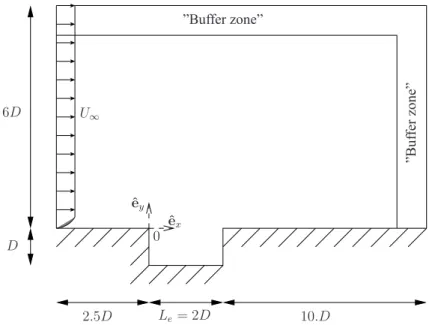
In this section we present the results of validation for the cavity of Le/D ratio of 2. The f ow is initialised by a laminar boundary layer so as to have a thickness ofδ/D = 0.28at the leading edge of the cavity. The Reynolds number of the f ow based on the cavity depth is1500and the f ow Mach number is0.6 as inRowleyet al.(2002). The representative f ow in our case is laminar due to the restriction of computational resources for a real time turbulent simulations. Also it is worthwhile to use scale down the problem to laminar regions to test the basic developments. The computational domain consists of14Din the stream-wise direction and7Din the vertical direction. The cavity f ow conf guration is as shown in f gure1.1. For the mesh a double hyperbolic tangent distribution is used in both the stream-wise and vertical directions, with a stretch ratio of 5%. The inf uence of mesh
ˆ ex ˆ ey
0
Le= 2D D
U∞
”Buffer zone”
”Bufferzone”
6D
2.5D 10.D
Figure 1.1 -Schematic diagram of cavity configuration and computational domain.
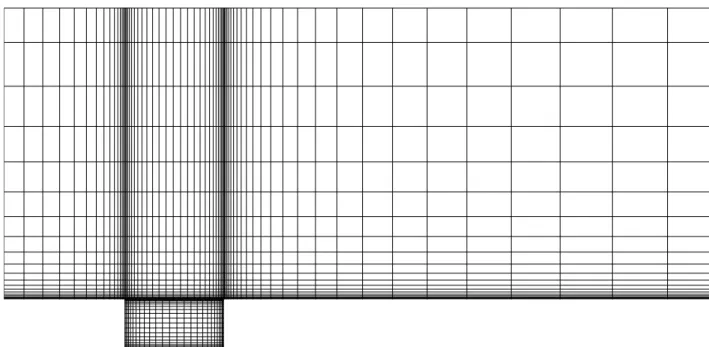
resolution on numerical results is measured by performing a mesh convergence studies to obtain grid independent results. The different mesh sizes used in the studies is given in table 1.1. The typical mesh used in this study is shown in f gure1.2and corresponds to mesh M.
Figure1.3 shows the instantaneous contours of vorticity, the size of the recirculation zone being the same order as the depth. Figure 1.4(a) shows the overall sound pressure level (SPL) for the acoustic f eld above the cavity. The maximum SPL is about 170dB at a point near the downstream edge.
This is lower than the value reported inRowleyet al.(2002) where a value of180dB is reported.
This may be due to the artifact of the numerical scheme used in computation which is 4th order accurate in the present study whereas it is6thorder accurate in the case ofRowleyet al.(2002). The SPL levels is however is in agreement with the experimental results ofKrishnamurthi(1956) where a typical value of around168dB is reported.
1. Description and validation of the numerical tool
Mesh Type Block 1 Block 2 (cavity) CFL
Coarse (C) 185×80 60×40 0.75
Medium (M) 260×80 102×80 0.6
Fine (F) 335×108 120×100 0.6
Table 1.1 -Mesh sizes used in computation.
The spectra corresponding to the normal component of velocity at a point in the shear layer is shown in Figure1.4(b) and shows a single frequency. The value of Strouhal number isSt2 = fU2∞L = 0.72in good agreement with the value of0.74determined by the Rossiter’s formulaDelprat(2006)
St= (n−0.25)
(M+ 1/0.57) for n= 2
Figure 1.2 -Typical mesh used in cavity corresponding to M in table1.1. One in every fourth cell is plotted.
1.6. Modelling cavity f ows using NIGLO
0 1 2 3
-1 -0.5 0 0.5 1 1.5 2
vort: -5 -1.665 1.67
(a)
0 1 2 3
-1 -0.5 0 0.5 1 1.5 2
vort: -5 -1.665 1.67
(b)
0 1 2 3
-1 -0.5 0 0.5 1 1.5 2
vort: -5 -1.665 1.67
(c)
0 1 2 3
-1 -0.5 0 0.5 1 1.5 2
vort: -5 -1.665 1.67
(d)
Figure 1.3 -Instantaneous snapshots of vorticity.15contours in the range ωDU ∈[−5,1.67]are plotted. Only a small portion of the computational domain near the cavity is shown.
1. Description and validation of the numerical tool
-1 0 1 2 3
-0.5 0 0.5 1 1.5 2 2.5
spl: 152 156 160 164 168
(a) SPL
0 0.2 0.4 0.6 0.8
0 0.2 0.4 0.6 0.8 1
PowerSpectralDensity(W/St)
Strouhal number(St= Uf D∞) (b) Spectra
Figure 1.4 -SPL and spectra of the normal component of velocity aty= 0andx= 1.8Din the shear layer.
1.7. Introduction of control
Jet upstream
Jet Cavity upstream
Jet Cavity Downstream
(a)
Full Impact Partial Impact No Impact
(b)
Figure 1.5 -Schematic representation of the action of jet and its effect on the impingement of the shear layer.
1.7 Introduction of control
The control of the cavity is achieved by means of a synthetic jet, which is achieved by modifying the boundary condition in a suitable way. The introduction of control by means of the synthetic jet has been previously performed byShutianet al.(2007) for the case of f ow separation around an airfoil, Kestens(1999) and Samimyet al.(2007) for the case of the cavity. for the experimental control of cavity.
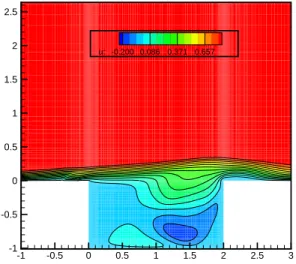
The basic physics behind the control of cavity resonance is to def ect the shear layer from imping- ing on the downstream edge of the cavity thereby arresting the feedback mechanism. As a result of the jet the shear layer can impinge on the downstream edge either fully, partially or can just pass over without any impingement as shown in f gure1.5. Different positions of the jet has been tried, and the position just before the upstream edge of the cavity proves to be more effective. This can be explained by measuring the sensitivity of the f ow, where the upstream edge is more sensitive to external f ow disturbances as shown inMoret-Gabarro(2009). The forcing is typically of the formAsin(ωt), and the actuation is introduced just before the leading edge of the cavity (x∈[−0.15;−0.05]andy= 0), the length of actuation is dependent on cost factors, such as the cost of the actuator in case of exper- iments or the computational cost in case of numerical simulation. The snapshots of the stream wise component of velocity is shown in f gure1.6, showing the case of no impact and partial impact of the shear layer on the trailing edge.
1. Description and validation of the numerical tool
-1 -0.5 0 0.5 1 1.5 2 2.5 3
-1 -0.5 0 0.5 1 1.5 2 2.5
u: -0.200 0.086 0.371 0.657
(a) No impact of shear layer on the downstream edge.
-1 -0.5 0 0.5 1 1.5 2 2.5 3
-1 -0.5 0 0.5 1 1.5 2 2.5
u: -0.200 0.086 0.371 0.657
(b) Partial impact of the shear layer on the downstream edge.
Figure 1.6 -Instantaneous snapshots of the stream wise component of velocity depicting the effect of actuation. The forcing is introduced atx∈[−0.15;−0.05]andy= 0and is of the form0.2 sin(0.4t).
1.8. Conclusion
The spectra for a typical forcing of the formAsin(ωt)is shown in the f gure 1.7, Here the peak
0 0.2 0.4 0.6 0.8
0 0.2 0.4 0.6 0.8 1
PowerSpectralDensity(W/St)
Strouhal number(St= Uf D
∞)
Figure 1.7 -Spectra aty= 0andx= 1.8Din the shear layer for the normal component of velocity for the actuated flow (dashed line). The forcing is of the form0.2 sin(0.4t). The spectra is compared for flow without
any actuation (solid line).
corresponding to the Rossiter mode is reduced. One of the objects of the current work is to determine the optimal forcing frequency and amplitude by utilising a reduced order model and check its effect by introducing it in the DNS code.
1.8 Conclusion
In this chapter we have introduced the basic numerical tool used in this study with respect to the governing equations, numerical discretisation and the various boundary conditions used. The code has been validated for the cavity f ow conf guration and will be used through in this study. Introduction of control by means of a synthetic jet at the upstream edge of the cavity, where the f ow is more sensitive to perturbations is performed. The associated spectra shows a decrease at the peak Rossiter mode followed by the appearance of new peaks suggesting the need for optimal criteria for injection.
Various tools to perform the optimal control using ROM will be developed in the subsequent chapters.
Chapter 2
Basic tools from control theory
Introduction
Ce chapitre pr´esente bri`evement les diff´erentes th´eories du contrˆole actifBewley & Agarwal(1996), Bewley & Liu(1998),Kim & Bewley(2007),Bagheriet al.(2009b) qui ont trouv´e des applications en m´ecanique des fluides lors de ces 15 derni`eres ann´ees, et qui sont utilis´ees en partie dans ce travail.
On qualifie en premier lieu le type de contrˆole en fonction de la loi de contrˆole et de son action.
On parle de contrˆole en boucle ouverte (open loop) lorsque la loi de contrˆole est d´etermin´ee opti- malement pour stabiliser un syst`eme initialement instable. La loi n’est pas modifiable au cours du processus de contrˆole. A l’oppos´e, dans le contrˆole en boucle ferm´ee (close-loop), une loi de re- tour (feedback) lie le contrˆole `a l’´etat r´eel et r´eactualis´e du syst`eme, assurant une stabilisation plus efficace.
Avant de chercher une loi de contrˆole, on doit aussi regarder les aspects de contrˆolabilit´e (ou com- mandabilit´e) et d’observabilit´e. La contrˆolabilit´e qualifie la capacit´e du syst`eme `a atteindre un ´etat souhait´e `a partir d’une certaine loi de contrˆole et d’une bonne condition initiale. La stabilisabilit´e, associ´ee `a la contrˆolabilit´e, assure qu’il existe une loi de retour capable de stabiliser le syst`eme.
Cela revient `a dire que les modes non commandables sont tous stables. Enfin l’observabilit´e, qui math´ematiquement est une notion duale `a la notion de contrˆolabilit´e, indique que l’observation des entr´ees et sorties du syst`eme, pendant un intervalle de temps fini, permet de retrouver l’´etat initial et donc l’´etat complet.
Contrˆole des ´ecoulements en boucle ouvert et optimisation sous contrainte
Un probl`eme de contrˆole est bien pos´e si on peut clairement d´efinir :
• la variable d’´etat du syst`emeφ.
• la variable de contrˆolec.
2. Basic tools from control theory
• une fonctionnelle coˆut `a minimiserJ(φ, c), associ´ee `a la recherche d’une r´eduction de traˆın´ee ou de bruit, par example.
• des contraintesF(φ, c) = 0, qui sont les ´equations d’´etat avec les conditions aux limites ou initiales ´eventuellement.
Pour minimiser la fonctionnelle coˆut, on introduit une fonctionnelle Lagrangienne qui, `a la fonc- tionnelle coˆut, ajoute les contraintes multipli´ees scalairement par des multiplicateurs de Lagrange ξ, qui sont en r´ealit´e des variables d’un probl`eme adjoint restant `a d´efinir. La minimisation de la fonctionnelle Lagrangienne se fait en calculant les d´eriv´ees de Fr´echet par rapport `a une variation de l’´etatφ, qu’on annule par la suite. Une fois les gradients de la fonctionnelle calcul´es, on utilise une m´ethode it´erative pour aboutir au contrˆole optimal, solution de notre probl`eme. Le calcul des gradients peut aussi ˆetre effectu´e en appliquant la m´ethode des sensibilit´es. Il s’agit alors de d´eriver les contraintes par rapport `a la variable de contrˆole pour aboutir `a la r´esolution directe d’un syst`eme o`u les d´eriv´ees sont les variables principales. Finalement, une discussion sur les int´erˆets et les in- conv´enients entre les deux approches conclut cette section :
• diff´erentiation puis discr´etisation : en diff´erentiant le syst`eme et ses contraintes, on obtient les gradients continus. Ensuite on discr´etise l’ensemble du probl`eme pour obtenir la solution num´erique.
• discr´etisation puis diff´erentiation : on discr´etise l’ensemble du probl`eme (contrainte, fonction- nelle), puis on cherche les gradients des grandeurs discr`etes par diff´erentiation des ´equations discr`etes.
Contrˆole en boucle ferm´ee
Dans cette partie est d´evelopp´ee l’approche classique du contrˆole optimal avec loi de retour. A partir de mesure des sorties du syst`eme, on estime l’´etat du syst`eme optimalement. C’est l’observation et l’estimation. Ensuite, on suppose que l’´etat estim´e est l’´etat r´eel, et on bˆatit la loi de contrˆole, c’est l’´etape de contrˆole.
Contrˆole lin´eaire quadratique r´egulier (LQR)
On consid`ere dans un premier temps un syst`eme dans le cadre d’information compl`ete, c’est-`a-dire, qu’on peut connaˆıtre `a tout instant l’´etat du syst`eme. Par l’approche adjointe on obtient facilement une loi de contrˆole de retour (r´etroaction) fonction lin´eairement de l’´etat, en minimisant une fonc- tionnelle bas´ee sur l’´etat et le coˆut du contrˆole. La solution est en fait obtenue en r´esolvant une
´equation de Riccati stationnaire, ce qui signifie qu’on cherche `a stabiliser le syst`eme sur un horizon infini (t → ∞).
Dans une second ´etape, sur la base des mesures en sortie, on cherche `a reconstruire l’´etat. Pour cela on applique la th´eorie du filtre de Kalman-Bucy qui suppose que statistiquement le syst`eme est soumis `a des bruits gaussiens qui engendrent une erreur dans les mesures. Cette erreur se traduit
![Figure 1.3 - Instantaneous snapshots of vorticity. 15 contours in the range ωD U ∈ [ − 5, 1.67] are plotted](https://thumb-eu.123doks.com/thumbv2/123doknet/3684568.109228/26.892.133.785.296.967/figure-instantaneous-snapshots-vorticity-contours-range-ωd-plotted.webp)