Holly Siegele Darzen B.A. Smith College, 1971
Submitted in Partial Fulfillment of the Requirements for the
Degree of
Master of Architecture
MASSACHUSETTS INSTITUTE OF TECHNOLOGY
February 1978
Signature of the Author
Certified by
Accepted by
Chefter Sprague, Associate Professor Thesis Supervisor
S
7Chester Sprague, ChairmanDepartmental Committee for Graduate Students
Holly Siegele Darzen 1978
ARCHIVES
MA1
ADAPTIVE REUSE: ANALYSIS OF BUILDING STOCK Holly Siegele Darzen
This project studies the process of building evaluation and design for reuse. The thesis presents a collection of tools and resources for that purpose, including a checklist for cataloguing physical conditions of existing stock
and their implications for design solutions. In order to develop and test
the process, two examples were used, a school and a hospital wing, as a context for analysis and design studies.
Thesis Supervisor:
Associat& Pkofessor
Department of Architecture
Acknowledgements
My thanks to Chet Sprague, Tony Platt, and Ed Allen for their help as
advisors on this project.
TABLE OF CONTENTS
page
I. Introduction 1.
II. Resources and Procedure 5.
III. Conclusions 33.
Appendix A: Building Analysis
Checklist 40.
Appendix B: Bibliography 60.
Appendix C: Program Information 64.
Appendix D: Case Studies 96.
Appendix E: Notes on Consultants 111.
I. INTRODUCTION
The implications of a decreasing energy supply coupled
with rising costs of materials and production due to inflation
are serious issues architects cannot ignore. These trends have
led many designers to question the assumption that new buildings
must always be constructed as society's needs change. New York
architect Richard G. Stein points out in a recent energy study
that the construction industry is responsible for 6.25% of all
the nation's consumption. "The energy used to make a building
is about sixteen times the energy it costs to operate it for a
year," he told the New York Times, "so if you hold onto an existing building instead of replacing it, you are sixteen years ahead to start."
There are other arguments for recycling buildings.
Reusing structures maintains a continuity in neighborhoods
often favored over demolition and new construction, especially when the building saved is unusually handsome or has
sentimen-tal value to surrounding residents. Often older buildings were
decorative detail than is financially possible today.
Further-more, the fact that rehab construction is often less costly
than new building, more space can be afforded for the same amount of money. Or, more money can be spent on the quality and character of the adapted space.
Location and the demand for potential uses play
sig-nificant roles in the feasibility of reuse. However,
adapta-bility also depends on the physical structure and configuration of the building itself, and a rational approach toward assess-ing this aspect of feasibility is the goal of this thesis
proj-ect. More specifically, I have been working toward a process
which helps one (1) to understand the design potential of an
existing building, and (2) to grasp the feasibility of various design possibilities, as a mechanism for working with the
devel-opment process. Feasibility here is measured not in terms of
dollar figures but in terms of the congruency or compatibility of an alternative with what is already there.
From the outset of this project the intention was to generate information about reuse of a building from many sources.
Sometimes the particular sequence of steps which examine the building are helpful, but in general this is a collection of resources, all important in context of each other. What emerged from the study as a most useful tool for analyzing existing building stock is a checklist of elements which is used to describe in a fairly exhaustive way, what is there to work with and the design implications of these existing
condi-tions. This device was developed from a preliminary outline,
presented at the beginning of Chapter II, to a more elaborated
list suggesting design approaches, which can be found at the
conclusion of Chapter II. Resources used either to contribute
to formulation of the checklist or as supplementary tools for investigation of the building stock include a survey of
liter-ature, study of various potential programs, relevant case
studies, discussion with consultants experienced in reuse, and
a design process. All of these will be described in more
de-tail and additional information is included in the Appendices. To provide a context for this multidirectional anal-ysis, I chose two structures which represented types of
build-ing stock increasbuild-ingly becombuild-ing vacant and thus ripe for
re-cycling. A school and one wing of a hospital selected with
their differences (in age, construction, etc.) in mind in order
to produce and test a procedure of investigation that has a
A. Preliminary Checklist
As a first pass at grasping what are the physical conditions to be dealt with in a recycling situation, the
pre-liminary checklist provides a general framework for a system-atic examination. Some impressions about possible schemes for
reuse may begin to emerge from this initial analysis. However,
it is most likely that all the design implications may not
im-mediately be clear. Therefore, the description organized around the checklist may also be useful for suggesting how to
utilize other resources, to get at additional information about
similar problems solved eleswhere which may be supplied by
consultants, case studies, or literature. This checklist, then,
provides the first layer of familiarity with the building, gen-erates some ideas about potential, and focuses on how to direct additional inquiry.
Preliminary Building Analysis Checklist Architecture
3. Configuration; depth and perimeter
4. Openings; frequency, height, width, sill height
5. Ceiling height
6. Bay size; location of columns
7. Location and construction of internal bearing walls
8. Location of circulation; stairs, corridors, elevators
9. Nature of roof construction; type, pitch
10. Materials
11. Availability of outdoor space
Structural
1. Nature of existing systems; location of members
2. Original loading of structural members, floors, foundations
Mechanical
1. Existing systems; degree of utility, nature of
distribution, controls, load capacity
2. Capacity and location of utility lines in the street
3. Potential space to locate new systems (equipment,
pipes, ductwork)
4. Thermal efficiency of building shell
Code Issues
1. Construction type
4. Fire protection systems
5. Window openings: area of operable and fixed portions
6. Provisions for the handicapped 7. Earthquake resistance
Appendix A presents the above checklist used in con-text to describe two buildings, the Hancock School in Lexington, Massachusetts, and a portion of Charles Choate Memorial Hospital
in Woburn, Massachusetts. The examples indicate the type of
information implied by the list. Problems in obtaining this data may result if drawings of the buildings are unavailable, incomplete or incorrect, and/or if the structure is still being used, as in the case of the hospital, and thorough on-site in-vestigation is impossible.
B. Literature Survey
Background reading can provide numerous examples of successfully recycled buildings which may have aspects which
relate to a specific situation at hand. Existing literature
also discusses the economics of reuse in terms of available programs of assistance and cost studies of completed projects.
Along other lines, the readings supply
information about
alternative uses for old buildings, which will be discussed
further in the next section of program study.
The bibliography in Appendix B lists relevant sources
which deal with adaptive reuse and information on potential new
programs. However, since the entire built environment, old
and new, can provide references pertinent to the specific
prob-lems or constraints of a reuse project, all architectural
liter-ature should be considered as possible resources.
C.
Program Study
The purpose of the program study was to gain a clear
understanding of the demands a new use is likely to make on
existing buildings designed for other purposes. I concentrated
on the needs of a selected range of programs:
housing, retail,
and office space, each of which has its own set of space,
struc-tural, mechanical, code and environmental requirements. In
order to get at these requirements I used the readings,
consult-ants and case studies. The product of studying the general
needs of these programs is a compilation of descriptive material
of varying specificity which can be found in Appendix C.
The significance'of this study was its indication that, in terms of the physical structure itself (regardless of other factors such as location), housing places the most numerous and often most exacting demands on the building to be reused. This conclusion resulted in part from the fact that literature on these programs supplied more detailed and specific informa-tion on the needs of housing, whereas useful discussions of programs for office and retail spaces were more difficult to
find and more general in nature. My conversations with
consultants supported the conclusion (see Appendix E: Rector,
Levinson) as did observations of case studies (see Appendix D).
The program study was useful in two ways. The first
entails the utilization of the building analysis checklist.
The program study contributed to development of the checklist,
and when these are used together they can be helpful in the determination of appropriateness of a building for a particular use; the checklist outlines what the structure provides and the program study summarizes what a particular use might require.
design process as a basis for generating and organizing an
environment for a new use. It furnished a set of
specifica-tions for the spaces required by new building funcspecifica-tions. The
programmatic complexity and availability of firm descriptive information led me to select housing as a prospective use in the design studies.
D. Case Studies
Case studies of projects - both rehab and new
con-struction - can be helpful in gathering knowledge about the
problems and potentials of recycling a particular building. I
found this resource useful in several ways. From looking at
relevant examples nearby I expanded the program study and
veri-fied what I had read about housing, retail and office space.
This required visiting projects which contained these varied
uses. Discussions with persons involved in the recycling
pro-cess of these projects (architects and users) served to elabo-rate on the building analysis checklist. The case studies in-volving housing were of further use in the design process
to common problems in rehab which could be inspected and
evaluated.
The projects I visited are discussed in Appendix B.
They all occupy reused space. However, like references in
literature, case studies should not be limited to recycled buildings. Any piece of building stock, regardless of use, which in some physical way resembles the project one is dealing
with, can be a relevant analogue. Similarly, any built
environ-ment which supports the particular use with which one is con-cerned, can supply helpful information on how to satisfy the needs of that program. Therefore, case studies should be
drawn from as wide a range of projects as possible to assist one
in more. fully understanding the potential alternatives in any
project.
E. Consultants
A number of people with various kinds of experience
in recycling assisted me with this project. Structural and
mechanical engineers related recurring problems they encountered in dealing with reuse of old buildings and spoke about various
solutions to these difficulties. Apropos of the checklist, they talked about what they looked for in evaluating a struc-ture for reuse, and what implications those aspects had for occupying the building in a new way. They were also helpful in the design phase of this project by discussing the constraints
and potentials of the systems in the two specific buildings- I
was dealing with. Finally, they contributed to the summary of the needs of various uses outlined in the program information
(see Appendix C).
Another group of consultants gave additional
assis-tance with the program study. These were mainly architects
whose experience included various projects, developing housing,
offices, and retail in older buildings. In some cases their
involvement in design and project management roles led their conversations with me to center on the process of building
con-version. Others dealt with planning and program development.
One consultant from the Boston Building Department had contact with recycled buildings through building code review.
A final group of consultants did not work in the field of design or planning or construction. They were the
users of some of the recycled buildings I visited as case
studies. They assisted my in evaluating these projects, and
notes on my discussions are included in Appendix D. All other information obtained from consultants is presented in Appendix
E. The utility of these conversations becomes apparent as their
advice shows up in other sections: the checklist, the program information, case studies, and the design schemes.
F. Design Studies
The work completed prior to this phase included (1) analysis of various programs for their essential (generalised) demands on a building, and (2) ongoing development of a check-list for analysis of a building to assess its adaptability to
new uses. Together with these procedures, the case studies,
consultants, and references in literature filled out the emer-ging process. The design studies were to test and develop
this process by clarifying program requirements and by providing knowledge for evaluating the flexibility of structures.
Moreover, the design work was initiated with the hope that
variety, sensitivity to user needs, and the character of the
spatial
exterience, would be dealt with.The scope of this work encompassed several housing programs, with the school and the hospital wing as contexts for the problem. The exploration delved in more depth into the needs of the housing program by outlining schemes for
different types of clients and different unit or building types. The task was to determine what characteristics make those
buildings suitable for housing, and what types of housing fit them best. The building analysis checklist, in its earlier
stages was used to determine what both buildings offered to
work with at the outset of the design 'studies.
In the Hancock School, units for the elderly, family
units, and small loft units were designed. Though most of the schemes have single loaded corridors because of the constraints, double loaded situations were attempted as well. Some units
are flats, others have partial mezzanines. Some of the Han-cock school schemes were generated without emphasis on preser-ving nonbearing partitions or plumbing locations in order to
maintain as free a design approach as possible and maximize possibilities inherant in the building. One scheme retains
most of the existing partitions and reuses plumbing connections. The design studies of Choate followed a slightly more complicated procedure. Again, multiple schemes were sketched
for varied users (elderly, families) and unit types (flats,
duplexes). Like the Hancock studies, the first set of plans
for Choate were designed considering only major architectural
elements for reuse. Structure, stairs, and windows were
util-ized, but nonbearing partitions, interior doorways, and
plum-bing were ignored. In a second pass these schemes were all
overlaid on drawings of the existing layout to determine
which corresponded most closely with the given building
organ-ization. The one which seemed most compatible was redesigned
to further minimize demolition and construction necessary to reuse the facility for housing.
It is necessary that design for reuse be judged by the same kinds of criteria with which new projects are tested.
it seemed important to assess the efficiency of planning and
the quality of the environment created by the schemes.
Effici-ency was measured in terms of unit sizes and ratios of net to gross area in the overall building. Presumably, there is some sacrifice in efficiency possible in a reuse project if con-struction costs are kept low from using what is there.
Quality was evaluated by means of another checklist which is presented below.
Quality Checklist
Image (suitability to projected use); materials, scale,
detail.
Workability of layout; circulation, ajacencies, privacy of zones; suitability to specific user needs.
Through ventilation; multiple views (from how many places? simultaneously or sequentially?)
Light to the interior of the building.
Variety of spatial experience; two storey space, overlooks, nonrectilinear volumes.
Private outdoor
space.-Common space and amenities. Variety of units.
This list begins to assess the livnbility of the
en-vironment in a reuse scheme. It can be applied to the building
as a whole or to the individual units. The recycled building
should also meet the code requirements for fire and safety, energy conservation, and provisions for the handicapped.
Plans and sections of the design schemes developed for both the Hancock and Choate are in Appendix F. Preceding the drawings for each building is a section of notes made during the design phase of this project to record discoveries which might contribute to the building analysis checklist. Also included there is an evaluation of two of the dwelling units using the quality checklist, and a summary of the effi-ciencies of the schemes.
'-a-S 9-. V
*
G. Elaborated ChecklistA final and fundamental piece of the process de-veloped in this thesis project is the building analysis
checklist. This was presented as a skeletal outline
ear-lier, and it was noted from time to time that various
re-sources contributed to its complexity and elaboration. This section will present the checklist again, filled out
to include some implications for design. In this way the
checklist becomes a more useful tool enabling the architect to "prethink" the problem of reusing a particular building. Architecture
1. Character, Image, Special Features
This can be a positive or negative aspect of the building, depending on the program for reuse. The institutional character of the hospital wing is more acceptable for offices than for housing, though it is even rather sterile for a workplace.
If a building's image needs change, and therefore
money spent, then perhaps as many of its functional or organizational elements should be reused as
possible to control total costs. Thus by utilizing
existing partitions or plumbing, money is saved which can be spent to improve the exterior face of
the building. If the character of the building is
wonderfully suited to its new use, like the Hancock School, then more energy can be devoted to making
the interior layout an
exciting environment
care-fully crafted to the needs of the users. A reuse scheme should maintain the original integrity of
a building, exploiting its positive aspects.
There-fore it is important to grasp the essential
charac-ter of a structure, which may be a subtle thing, and
turn what may seem to be a constraint into a
posi-tive design determinant.
2.
Historic Considerations
The implications of historic preservation relate
to character. If a building is to be preserved, its
image has been established as positive, and a use
suitable to that image should be the program for
reuse.
A major design implication related to historic
preservation involves openings in the building shell.
Since the facade must be maintained, intact,
not adequate to meet window requirements, the only alternative usually acceptable allows additional openings in areas of the roof not visible from the ground. Therefore, the roof type and structure takes on added significance. Facade preservation also has implications for the way windows are per-ceived from the interior. If sill heights are un-comfortably high, as in the Hancock, floors may have to be raised to adjust views from inside.
Another concern arising from historic preserva-tion of windows deals with energy conservapreserva-tion and the double glazing requirement. One solution has been to make up new thermal pane windows which
replicate original mullion patterns. Another
use-ful approach is to add new sash inside the original window. This additional glazing may have mullions which accommodate new intermediate floor levels.
A final consideration related to historic re-strictions involves mechanical systems. Air con-ditioning and ventilation equipment cannot be in-stalled where it is visible on the exterior of the building; thus many types of systems using roof window units may be prohibited.
3. Building Configuration
The shape of a building can provide a quick
indi-cation of how it might be organized. This is
es-pecially true for housing, where more specific space and exposure requirements make it possible to estimate the number of dwelling units
accommo-dated in a particular building configuration. In
deep buildings, over 50 feet wid-e, where a double loaded corridor is a likely potential organization, the perimeter is significant in that exposure is required for each habitable room. In a shallow building the depth is a more critical dimension; perimeter use becomes a function of depth. Thus the configuration signals potential organization and provides a measure of maximum usage for
evaluat-ing the efficiency of an actual scheme.
4. Openings
In general for housing, the more .window openings there are in an existing building, the better, since natural light and ventilation are required
in all habitable spaces. For other programs the
necessity diminishes; in offices windows are de-sirable but not required, in retail use they are sometimes unnecessary. Windows that extend high
up on the wall are useful in bringing light deeper into the building. For housing, lower sill heights
(three feet above the floor or less) are prefer-able.
Door openings are also significant, as it may be expensive to cut new ones and cover old ones acceptably. Moreover, in many old buildings the original doors are handsome and solid, increasing
acoustical separation. These are worth reusing
wherever possible.
5. Ceiling Height
The significance of this element lies in its indi-cation of the potential for intermediate levels
within one existing floor of the building. It may
mean lofts or mezzanines which add more square
footage to the usable area of the building. Or, if the height is insufficient for two use spaces but greater than 8 feet, variety and interest might be created by platforms raised a few feet above
the floor. Note that this may solve the problem
of high window sill heights. High ceilings also allow the possibility of varying the ceiling height, either to make mechanical spaces or to create a
6. Bay Size; Location of Columns
Since columns generally are not desirable in the middle of rooms their spacing may indicate where
potential walls should be located. Thus, if
dis-tances between columns correspond to reasonable room sizes or a multiple thereof, for whatever pro-gram will be introduced, the structural members will be easier to deal with in design for reuse. Once again, efficient residential planning makes more specific demands on these dimensions than offices or retail, though there is a range even in housing. This issue may be a low priority if plans with floating columns are acceptable or desirable.
7. Location and Construction of Internal Bearing Walls
Bearing walls have similar implications for design
as those discussed above for columns; however, they
are obviously more restrictive, and partitions in the new plan must coincide with existing structural
walls. Though some openings are possible in
bear-ing walls, it becomes expensive to substitute new structural elements extensively to carry the loads of the building, particularly in the lower floors of a building.
8.
Location of Circulation
The location of existing circulation is significant
in that most types of reuse will require some kind
of circulation, and sometimes these requirements
can be met by what is there. This is especially
true with fire stairs, of which the function (and
therefore size and location) does not change
sub-stantially with a change in program. Other vertical
and horizontal circulation may or may not be
suit-able for a new use, however, it is costly to make
new stair wells just as it is to fill in old ones
with use spaces, so the utility of these should be
examined. Often other elements of the building
such as mechanical and structural systems have been
organized around corridors and stairs, thus
rein-forcing the desirability of reusing existing
circu-lation, particularly in newer structures where most
systems can have utility for reuse. The hospital
is an example of this situation.
9.
Roof Type and Construction
The area on or under the roof of an old building
can provide additional usable space or "found
space."
Attics under pitched roofs are often
con-verted into interesting places with non-rectilinear
a
volumes, if enough windows can be provided. Sky-lights or dormers are often required. Cutting out larger pieces of a pitched roof can open up deck
spaces and bring more light inside. Flat roofs, if
strong enough construction, can also be useful in creating new private outdoor space, especially over lower extensions of the building (as in the hospi-tal) where the roof is on the same level as an upper floor, and thus directly accessible.
Basements can also be sources of usuable "found space."
10. Materials
Quality, durability, fire resistance, and character are all important aspects of the materials of a structure that affect its suitability for reuse. Housing requires high quality materials which will withstand constant exposure to people (in some cases
children). Residential use is not considered as
high a fire hazard as some kinds of storage or manufacturing, though two hour fire ratings are
required in some areas, and fire resistant materials
are desirable. The discussion on character above
(#1) emphasizes the importance of fitting the use with the image of a building, and materials play a major role in determining what that image is.
This is important both inside and outside a build-ing. Wainscoting, wood trim, and paneled doors
give an environment character, and ways to make them acceptable to code requirements are worth pursuing.
Materials are also significant in terms of their resistance to change. A concrete floor is more difficult to cut holes in than wood. The sound
transmission or absorption quality of various mate-rials is also important to consider, especially for housing or offices.
11. Outdoor Space
Outdoor space may be required for a number of
pro-grammatic uses. Housing is improved by such
amen-ities as garden and play areas as well as simple quiet sitting places. On-site parking is frequently a necessity for housing, offices or retail space. The outdoor space around Faneuil Hall Marketplace
in Boston takes on the qualities of a street and a park, absorbing overflow from the active retail
center. Sometimes space around a building is
use-ful as a buffer between the new use and the
surround-ing area, either protectsurround-ing the recycled buildsurround-ing
if it is housing from a less hospitable
environ-ment, or shielding the neighborhood from a commer-cial concern in the reused structure.
Structure
1.
Nature and Location of Existing Systems
As discussed above with reference to columns and
bear-ing walls, the location of structure has implications
for where space definition might occur or be added in
a reuse scheme. It also affects where subtractions to
the building might happen, in that they must avoid
structural members. Floor construction may be a
sig-nificant determinant of where and in what shape
open-ings between floors are created. This becomes quite
complicated with a concrete slab where the location of
reinforcing, which might be unknown, must be taken into
account.
2.
Original Loading
Understanding what load the building can take is basic
to deciding what uses are possible in terms of safety
codes, and also in determining where additional
load-ing from the construction of extra levels is possible.
In general, institutional buildings can carry heavier
loads than residential or office uses produce, so if
ceilings are high enough, they are good candidates for
mezzanines. Lower loads from new uses may mean that
new floors can be added on to the top of the building.
Often hospitals have been designed such that the
foun-dations are strong enough to accept additional stories
as a result of planning for the future. Sometimes these floors were never built, so the potential is there for new construction as well as rehabilitation. Mechanical Systems
1. Existing Systems
According to several consultants, most of the existing
systems in older buildings are not reusable. Electric
wiring and plumbing pipes do not meet code require-ments, and HVAC systems are often outdated and ineffi-cient. However, these should be examined, for new ones are expensive, and if old ones can be used, especially in more recent buildings like the hospital,
consider-able money can be saved. Reusing these systems,
es-pecially plumbing may be a major determinant in the
layout of new spaces. Housing requires the most
ex-tensive and complex systems, and thus is likely to
need new mechanical equipment. The nature of distribu-tion, control, and load capacity are all requirements which vary with the specific program planned for re-use, so these aspects of the existing systems should be checked as well as the condition of the equipment.
2. Capacity and Location of Utility Lines in the Street
de-mand on building services is expected to increase sig-nificantly with a change in the nature or intensity of the use of the building. This may be the result of additional area being added to the building or simply more people or processes requiring more water, elec-tricity, gas, or waste removal.
3. Potential Space to Locate New Systems
New equipment might well be installed in the same place old equipment was located, however, in the case of large boilers easy access through sizable openings is
impor-tant. If new mechanical space is needed, one would
look to an area least desirable for other uses, unless for aesthetic reasons the equipment acquired a
promi-nent place in the design. Existing risers and chase
areas should be used if possible to avoid cutting
addi-tional holes in the floor. Extra ceiling height might
be required for horizontal runs of pipes and ductwork. Mechanical equipment can be placed on the roof if there are no preservation restrictions, and this possibility might be examined carefully if solar energy could be utilized. Surrounding outdoor space is an alternative
if equipment cannot go on the roof.
4. Thermal Efficiency of the Building Shell
The thermal efficiency of the building shell becomes an increasingly important issue as energy conservation
is enforced by legislation. New code requirements will
necessitate that any changes in exterior walls in a reuse project include bringing the U factor into line with a set of tough standards. Windows will also have
to be tightened, requiring storm sash or double glazing.
Code Issues
1. Construction Type
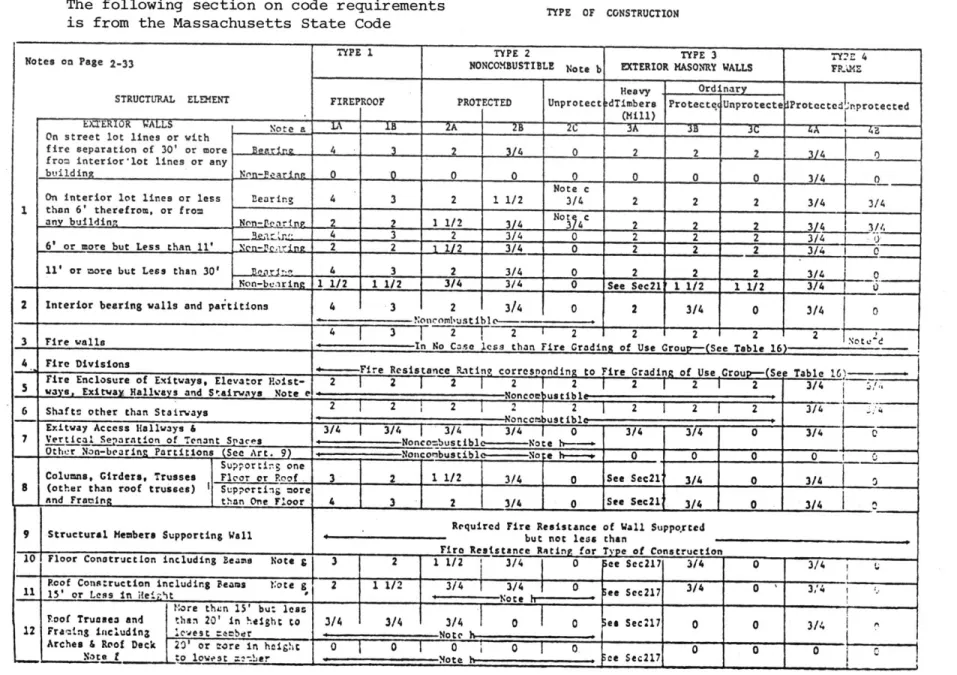
The type of construction is significant in that it limits the height and floor area allowable under the code (see Program Information, Appendix C, for figures). The more fireproof the construction is, the greater the height and area permitted, therefore concrete struc-tures can be larger than buildings of wood frame
con-struction, without additional fire supression devices being required.
2. Height and Floor Area
See #1 above, "Construction Type."
3. Egress
The location, size and materials of exitways are
impor-tant code issues in planning reuse of an existing
build-ing. Generally two means of egress are required from
each floor (all levels covering more than 30% of the
building area). As it was discussed under
should be reused if possible to avoid costs of new
construction. If these are reutilized, their location
will have some impact on the new organization of the building; for example, in housing, all units must be within 75' of an exitway.
4. Fire Protection Systems
The existence of fire protection systems may result in a broader allowance in height or floor area, or might make certain combustible materials important to the image of the building permissable. Fire supression systems are required if the new use for the building entails hazardous areas (such as certain kinds of
stor-age), so the location of such systems may locate these
parts of the new program in the building.
5. Window Openings
Required areas of operable and fixed portions of
win-dows is determined by the code. Habitable rooms
re-quire a window area equal to 10 percent of the floor area and one half of that must be operable. To
reiter-ate #4 in the "Architecture" part of this checklist, the more windows an existing building has, the better,
if the new use is housing. This sometimes becomes
problematic in attic and basement areas of the building. Any changes to existing windows must bring them in line
with the energy part of the code, usually satisfied by
storm sash or double glazing. Sometimes it is useful
to add storm sash to the inside of the existing window rather than the outside, to preserve the fenestration details on the facade, or to deal with additional levels on the interior of the building.
6. Provisions for the Handicapped
Entry to the building must be on grade or gently ramped (1 in 10 slope). Thus if the entry to a building is quite distant from the ground, a substantial amount of area is required for a ramp, or else entry at a differ-ent level closer to grade must be part of the new de-sign. An elevator must be provided if handicapped
people are to reach upper portions of the building, and in the case of housing, there should be some units
which are without changes in level. In public
build-ings toilet facilities must be sized and equipped for the accommodation of wheelchairs. Because they satisfy most of these code issues, hospitals require little money spent in this area.
7. Earthquake Resistance
The code requirements for earthquake resistance (Sec-tion 718.0) are almost never met by older buildings and a variance is needed.
III. CONCLUSIONS
An area of study which is fundamental to the question of reuse is the relation of a new use to the location of an existing building. The site was not dealt with in this thesis because it was necessary to limit the scope of the project to
a reasonable size. However, marketing and location studies
are most important to the success of a recycled building, and guidelines for planning in this area must precede evaluation
of the adaptability of the structure itself. Once a location
is judged appropriate to a set of development alternatives,
then the structure itself can be analysed as a further step in the assessment of feasibility.
An original intent of this thesis project was to gain
an understanding of the role of the architect in evaluating a building for reuse. The approach was to develop a process for cataloguing existing physical conditions and their impli-cations for design. The result of an open and multidirectional
and resources which can be used together, reinforcing and
supplementing each other, as an evaluation and design process. The study culminated in the generation of a building analysis checklist which can be used by the architect to
produce an organized and systematically arrivedK at design for reuse which responds to the existing architecture. The proce-dure consists of grasping the positive aspects of the building and capitalizing on them, as well as identifying the
con-straints which must be turned into positive elements of interest. The integration of data from a variety of sources gives the
overall process a flexible and expansive approach toward recognizing constraints in a building and finding acceptable
design solutions. This might be illustrated by two examples.
A problem which surfaces in the evaluation of the hos-pital wing involves the inappropriate image of that structure
for housing. The issue is identified at the outset in the building analysis checklist, and is emphasized again in the
for solutions which modify Choate's institutional character
can then be sought in the other resources.
Since the problem stems in part from the large flat
undifferentiated exterior of the buildimg, housing projects
with a similar aspect successfully treated can be examingd
for useful ideas. A project in the Boston area which can be
considered a relevant case study is Sert's Peabody Terrace.
Here the image of the large blocks is scaled down and
human-ized by a system of balconies and sunbreaks applied to the
surface of the buildings.
The literature also provides some helpful references.
For example, Ralph Erskine's Byker Wall housing in Newcastle,
England, published in Jencks' The Language of Post Modern
Architecture, shows another treatment of the same condition.
The flat expanse of wall here was broken up and given
residen-tial scale by changes in materials (brick to metal and asbestos)
and the addition of galleries and balconies of wood.
potential users can provide information useful in designing
the elements to be added to the slab. Details concerning
dimensions and materials can be chosen with regard to resi-dents' needs. Architects who have used such elements on their buildings might be helpful consultants, both in terms of design
and cost estimates.
A major aspect of the Hancock School to be dealt with in reuse design is the existing circulation. As noted in -2he checklist analysis, there is a wide single loaded corridor
along the back of the building which connects two large stairs. On one side of this hall is a bearing wall. The question is,
what sjhould the attitude of the designer be toward reusing these circulation elements?
The set of design studies eXamined double and single loaded schemes for organizing dwelling units inthe building,
i.e., maintaining the original location of the hall, and
moving it to the other side of the bearing wall. (see Appendix
because it was awkward to adapt them to apgrtments. One of
the consultants experienced in reuse of schools, pointed out
the financial advantage of reutilizing stairs, for it can be
expensive to replace them with dwelling units.
Detailed understanding of program and users supported by the literature supplies information about the design and use of corridors in such a project. Elderly tend to appreciate more common indoor space where ppportunities for socialization
can occur, so larger hallways can be an asset. Moreoverthe savings in construction expense from reusing existing
organi-zation can make up for a decrease in efficiency and thus allow
larger units and public space. This information is supported
by case studies, such as Central Grammar in Gloucester. The
architects retained the large hall in this building; residents use it, and the economics of the building compare very
favor-ably with new construction. Alternative options might use part of the large hall space for a kitchen and service core or
storage for the dwelling, or, it might be used to give the
The process of considering alternatives such as these in
reuse projects is a dialogue between the constraints and the
design goals. The already built environment contributes one
set of information to the problem, which must be integrated
with the user needs and form building issues. Consequently,
the designer must work back and forth---sometimes preserving
the existing architecture is a high priority and important constraint; other times the designer must look at the problem with a fresh viewpoint, relatively free of much of the already
built context. The dynamic of this process became. obvious
in the design exercises. At first I analysed the buildings to understand what was there, then sketched with little more than
the outline, windows and structure of the building as a base.
Subsequent overlays examined the preliminary schemes in relation
to more of the existing construction--partitions, doors, plumb-ing---and some changes were make to bring the new plans in line
with these details. A further pass checked the plan for
quality issues, and workability andsform decisions were weighed
The image and circulation issues discussed above point
to another set of information which would be a useful addition to the dialectic process. Cost data projecting expenses involved in solutions to common problems could be very instructive in
predicting feasibility of solutions for reuse. Such a
collec-tion,.of data would follow a study of the recurring issues, like
the image problem of the large slab, or the question of reusing
stairs. This study might be organized around the building
analysis checklist. Estimates could be collected on the basis of product information and existing projects where these
solu-tions have been employed. The cost information would then
become a further resource available in reuse design. It would
beused not as a tool for generating alternatives, but rather
as a measure of the relatvie feasibility of the solutions emphasizing various priorities which emerge in the dialogue.
Appendix A: Building Analysis Checklist
This appendix describes the two buildings studied in this thesis using the building analysis checklist. The analysis was a useful basis for the design
THE HANCOCK SCHOOL, LEXINGTON, MASSACHUSETTS
I chose this building to study for adaptive reuse for
several reasons. Appropriately, the school is presently
empty and being examined for potential development as housing. Constructed in the 1880s, it is typical of many schools be-coming vacant as a result of population shifts and new
con-struction in the 1960s. The building is handsome and
struc-turally sound. It contains a cafeteria in the basement and
a large open meeting room in the attic, as well as standard classrooms, thus providing a variety of spatial conditions. Architecture
1. Character, Image, Special Features
Though designed for an institution, the scale is suitable for residential or cellular offices, or could
house small stores. Its image could be thought of as
residential,with a pitched roof, gabled windows and porches. Arched windows of several sizes and handsome brickwork as well as interesting volumetric shapes (a semicircular stair) are special features of the building. Its frontality and general symmetry give it formality and dignity. Inside there is attractive woodwork, though
it is painted institutional colors. Flues between
class-rooms might make fireplaces feasible. Classrooms have
b
tin ceilings and some are equipped with built-in cabbuilt-inets. Wood trusses frame a large open space on the third floor.
2. Historic Considerations
The Hancock School is located in a
histor-ic distrhistor-ict (Lexington, Massachusetts) whhistor-ich
prevents much change to the exterior of the building.
3. Configuration
Building depth: 45' - 50' (to outside of
walls), suitable for double or single loaded corridor.
Perimeter: 440' excluding porches.
4. Openings
Large and frequent windows on the first and second floors extend to the ceilings and
let light deep into the building. Windows
in the basement are relatively small. The
third floor (attic) has less window area and
would require more for residential use. Most
though none have storm sash. All have quite high sills, 4' above the floors and sometimes higher, making them uncomfortably high for
residential use. Since the facade cannot be
changed, floors might be raised to adjust sill height.
5. Ceiling Height
Basement: 7 1/2' - 8 1/2'.
First and Second Floors: 13'-4".
Third Floor: up to 20'.
Upper three floors might accommodate inter-mediate levels.
6. Bay Size, Column Location
No columns. Classrooms are typically 31'
wide, a suitable dimension for a dwelling unit.
7. Internal Bearing Walls
The single internal bearing wall runs lon-gitudinally through the building about one-third
of the way across the depth. (See plan of
exist-ing buildexist-ing.) Its masonry construction in the
basement resists new openings - though some
already exist - more than the wood stud
8. Circulation
Two large, glass enclosed stairs are located at each end of a short hall which runs along the back of the building between the bearing wall and the exterior
wall, and is single loaded. (See plan.) The stairs
are suitably located for fire egress but might need
additional enclosure. The hall is quite large: 14'
wide. 9. Roof
The hip roof rises at a slope of 9 in 12 from the ends and 12 in 12 from the front and back. Large wood trusses support wood purlins and rafters; the roof is slate. Mezzanine could be built in the attic under the roof, though skylights would be needed.
10. Materials
The shell is brick faced with plaster inside. The
bearing wall is brick with arched openings in the base-ment, 6" wood stud walls above which are plastered or
finished with wood wainscotting below blackboards. Classrooms have tin ceilings which contribute to the character of the building. Floors in upper three
floors are wood construction using large joists. Sound
attenuation results from thick walls and floors.
11. Outdoor Space
Plenty of outdoor space is available for parking and green space.
Structure
1. Existing Systems
The system of joists does not change, always running from front to back. The
original structure in the basement carrying the flues has been removed and replaced by steel WF beams. On the third floor, large wooden trusses carry the roof. Floor joists are 4" x 15" at 16" o.c. Stud walls are 2" x 6" at o.c.
2. Original Loading
The original loading was nominally 100 psf but the structure can most likely
carry more than that. Additional wood frame structure can be carried on the floors if spread out or on the bearing and exterior walls if concentrated. Since the
trusses in the attic act like arches structurally, additional loading should be
symmetrical. Holes can be cut and framed, if necessary, almost anywhere except
where the bearing wall is. Mechanical
1. Existing Systems
The existing systems are obsolete (heating, ventilation, plumbing). There
are sprinklers on the top floor which could be maintained. There is no standpipe; however, there is an alarm system which is connected to the fire department.
A 4" water main supplies the building and a 6" pipe connects the system to
the basement with some supply and waste connections along the perimeter. The oil tank for the present heating system holds 5000 gallons; it is located on the west side of the building. The school was rewired in 1960, and power lines are avail-able in the street for additional electricity.
2. Mechanical Space
The boiler room in the basement (500 s.f.), equipped with a masonry chimney
flue and easy outside access, provides a good location for new mechanical system
equipment. If large exterior air conditioning equipment is necessary, an
instal-lation on the ground is preferable to on the roof for reasons of historical
pres-ervation. Ample space is available near the building. Chase area for pipes and
ductwork within the building is provided next to the flues and along the bearing wall.
3. Thermal Efficiency
U factor of walls, first and second floors = .21. Windows are single pane
glass without storm sash. Third floor (attic) has fiber insulation in between
rafters but it has settled and needs to be replaced. There is ample space for
new insulation.
Code Issues
1. Construction Type
Presently 3C; masonry exterior wall, interior unprotected wood frame walls.
(Plaster on interior walls may contain horsehair.) Interior walls need additional
2.
Building Height and Area
Height:
4 floors; 50'
Area:
6000 square feet per floor. With new plaster
on the walls, the area on each floor could be increased to twice its size.
3.
Egress
Multiple egress from each floor conforms to code requirements.
Stairs are
of sufficient size but may require additional fire enclosure protection.
4.
Fire Protection
Sprinklers have been installed in the basement and on the top floor (dry
system).
There are alarm connections to the fire department. Fire resistance of
some walls may be insufficient.
5.
Openings
At present, window openings are adequate for use in a school.
Residential
use may require additional openings on the third floor.
6.
Handicap Requirements
The school has no provisions for the hapdicapped; a ramp is needed for
entrance on grade and an elevator must be installed.
7.
Earthquake Resistance
Like all older buildings, Hancock does not meet the earthquake and mortar
requirements of the code. A variance is needed.
CHARLES CHOATE MEMORIAL HOSPITAL, WOBURN, MASSACHUSETTS
In order to further develop and test the process being formulated to analyze buildings for recycling, an additional
structure was chosen for study. I selected the hospital not
only because it was designed for a program different from
the Hancock School. The hospital is not designated for
historical preservation and thus has no restriction on changes to the exterior. It is composed of several build-ings or wbuild-ings constructed at different times and having
different configurations; I chose one piece to work on which was built in the 1960s and added to several years later, so
the construction is very different from the school. More-over, the section I am studying is a deeper building with
lower ceiling heights, which presents a new set of constraints later on in the design studies.
Architecture
1. Character, Image, Special Features
The character and image of this wing of Choate are completely institutional. The materials and construc-tion are sound and substantial, but the lack of orna-mentation and plain, minimal detailing give the
build-ing an unwelcombuild-ing aspect which might be problematic
if the hospital were to be converted to housing. Part
of the lower floor is covered with stucco and has few openings; its functions (laundry and receiving) have
resulted in a bland, unattractive exterior. Interior
finishes are hard institutional materials and colors. There are no special features to this part of Choate which invite emphasis or exploitation in rehab design. 2. Historic Considerations
There are no historic restrictions concerning pres-ervation of the building. Therefore, the plan unattrac-tive exterior could receive extensive change. Moreover, any alteration in wondow openings required by interior changes is possible.
3. Configuration
Building depth: basement: 68' first floor: 50'
These figures imply a double loaded corridor
organiza-tion. Perimeter: basement: 710' first floor: 590'
4. Openings
In most parts of the wing window openings are frequent; however, for conversion to housing the upper floor and parts of the basement would require additional
windows. Windows in the basement have rather high sills
which are at an uncomfortable height for residential
use. To correct this, sills would have to be lowered
50.
new and tight and thus suitable for reuse. Spacing of
openings is irregular.
5. Ceiling Height
Ceiling height varies somewhat (9'-7" - 12') but
all floors are too low for the addition of intermediate
levels. There is substantial room, however, for
run-ning mechanical ducts and piping horizontally above a suspended ceiling.
6. Columns
There are columns on either side of the corridor (which might suggest maintaining the present location of the hall), and on the basement floor there is also a line of columns on one side between the cortidor and the outside walls; in other places exterior walls are
continuous bearing walls. Column spacing varies, but
the irregularity, like that of the windows, is not a
problem for the varied spaces required in housing. The
system of columns is quite flexible in terms of alter-native space organization, being less restrictive than
bearing walls.
7. Internal Bearing Walls
In a few places on the basement floor there are sections of bearing wall rather than the columns found
above. These are along the corridor, and again suggest
8. Circulation
There are interior double loaded corridors on all floors of this wing of Choate, with an elevator located in the center where the building joins the rest of the hospital. Along the hall there are fire stairs which are suitably sized, enclosed and located for residential use.
9. Roof
The roofs are flat concrete slabs covered with
built up asphalt roofing. With suitable surfaces applied
they could be used as deck areas, especially the section over the basement floor which extends out past the upper part of the building. Skylights installed in this part of the roof could be useful in bringing light into the deep interior of the basement level.
10. Materials
Exterior walls are brick and, on the basement,
stucco. Floors are all concrete, and thus cutting
through them is somewhat expensive and complicated. Partitions are mainly stud walls covered in gypsum or
sometimes ceramic tile. Acoustic separation is
sub-stantial. Floors are covered in linoleum tile. Doors
are solid wood; some have small windows. They are
suitable for reuse. The materials strongly reinforce
might require softer materials to "minimize" the image.
11. Outdoor Space
There is considerable open space around the hospi-tal presently used for parking.
Structural
1. The existing structural system of concrete columns is irregular, but the average
span of the beams is 12' and the concrete slab spans 20', 16', and 8'. The
thick-ness of the slab is generally 6 1/2", and 12" in some places under the corridor. Reinforcing of the slab is in one direction.
2. The original loading of the system was at least 60 psf, and 80 psf in corridors.
When one storey of the wing was built in 1962, the foundations were designed and
built for additional floors. Three more floors were added along with an extension
in 1971, utilizing the extra strength in the foundations. This is a common
se-quence in hospital design; often foundations can hold more stories. New
parti-tions can be built anywhere on the floor, even if they are constructed of clay
tile or light block.
Holes cut in the concrete must avoid the beams and the edge of the cut slab should be supported since reinforcing is in only one direction. Stair construction is reasonable since the sides of the stair could have walls to support the slab. Large two-storey spaces are more difficult unless the slab is removed from the
whole span. Holes cut for chases or ductwork are not problematic but it is
Mechanical Systems
A study of Choate Hospital has been done by Block McGibony Associates, Inc., and
Payette Associates, Inc., for the basis of future planning of the facility. The study
was very complete, and portions of it dealing with the mechanical systems are included
here.
1.
Existing Systems
I.
PLUMBING SYSTEMS
A. Domestic Cold Water:
1. Present Condition: A 4" cold water supply enters
the basement of the 1960 building from Dows Lane
and a 4" enters the administration building from
Warren Avenue.
The two services are looped through the basement
with a 4" main so that the building can be fed
from two streets.
The water pressure varies from 50 p.s.i.g. in the
winter to approximately 38 p.s.i.g. in summer, and
is barely adequate to serve the top floors.
2. Adequacy and Future Considerations:
The system is
adequate for any foreseeable development. The city
mains are an 8" on Warren Avenue'and a 6" on Dows
Lane. Any new construction which has an occupied
floor higher than the existing top floor would
re-quire a booster water pump. The corrosion problem
with the water supply would have to be addressed.-,
B. Domestic Hot Water:
1. Present Condition: Three 800 gal. domesti-c hot
water storage heaters supply the Hospital.
One located in the boiler room supplies the laundry with 1800 water; one located in the boiler room
supplies all
but the 1960 building, and one' located
in the 1960 building supplies the 1960 building.
2. Adequacy and Future Considerations: System'is
adequate and would be capable of Handling moderate
expansion.
C. Sanitary Waste Systems:
1. Present Condition: There is a 6" sanitary waste to
Warren Avenue, 1-6" and 1-8" sanitary waste to Dows Lane.
2. Adequacy and Future Considerations: The aggregate
capacity of the 3 sanitary sewer lines is enough; however, the amount of expansion any one 6" waste
line can handle is slight.
D. Storm Drainage System:
1. Present Condition: 8" storm drain to Dows Lane.
6" storm drain to Dows Lane.
2. Adequacy and Future Considerations: Existing lines