Rémy Belmonte
University of Electro-Communications, Chofu, Tokyo, 182-8585, Japan [email protected]
Eun Jung Kim
Université Paris-Dauphine, PSL University, CNRS, LAMSADE, 75016, Paris, France [email protected]
Michael Lampis
Université Paris-Dauphine, PSL University, CNRS, LAMSADE, 75016, Paris, France [email protected]
Valia Mitsou
Université Paris-Diderot, IRIF, CNRS, 75205, Paris, France [email protected]
Yota Otachi
Kumamoto University, Kumamoto, 860-8555, Japan [email protected]
Florian Sikora
Université Paris-Dauphine, PSL University, CNRS, LAMSADE, 75016, Paris, France [email protected]
Abstract
We consider the complexity of the Independent Set Reconfiguration problem under the Token Sliding rule. In this problem we are given two independent sets of a graph and are asked if we can transform one to the other by repeatedly exchanging a vertex that is currently in the set with one of its neighbors, while maintaining the set independent. Our main result is to show that this problem is PSPACE-complete on split graphs (and hence also on chordal graphs), thus resolving an open problem in this area.
We then go on to consider the c-Colorable Reconfiguration problem under the same rule, where the constraint is now to maintain the set c-colorable at all times. As one may expect, a simple modification of our reduction shows that this more general problem is PSPACE-complete for all fixed c ≥ 1 on chordal graphs. Somewhat surprisingly, we show that the same cannot be said for split graphs: we give a polynomial time (nO(c)) algorithm for all fixed values of c, except c = 1, for which the problem is PSPACE-complete. We complement our algorithm with a lower bound showing that c-Colorable Reconfiguration is W[2]-hard on split graphs parameterized by c and the length of the solution, as well as a tight ETH-based lower bound for both parameters.
2012 ACM Subject Classification Mathematics of computing → Graph algorithms; Theory of computation → Parameterized complexity and exact algorithms
Keywords and phrases reconfiguration, independent set, split graph
Digital Object Identifier 10.4230/LIPIcs.STACS.2019.13
Funding Supported by JSPS and MAEDI under the Japan-France Integrated Action Program (SAKURA) Project GRAPA 38593YJ, by FMJH program PGMO and EDF via project 2016-1760H/C16/1507 “Stability versus Optimality in Dynamic Environment Algorithmics” and projects “ESIGMA” (ANR-17-CE23-0010) and “HOSIGRA” (ANR-17-CE40-0022), and by JSPS KAKENHI
Grant Numbers JP18K11157, JP18K11168, JP18K11169, JP18H04091. © Rémy Belmonte, Eun Jung Kim, Michael Lampis, Valia Mitsou, Yota Otachi, and Florian Sikora;
licensed under Creative Commons License CC-BY
1
Introduction
A reconfiguration problem is a problem of the following type: we are given an instance of a decision problem, two feasible solutions S, T , and a local modification rule. The question is whether S can be transformed to T by repeated applications of the modification rule in a way that maintains the solution feasible at all times. Due to their numerous applications, reconfiguration problems have attracted much interest in the literature, and reconfiguration versions of standard problems (such as Satisfiability, Dominating Set, and Independent Set) have been widely studied (see the surveys [10, 19] and the references therein).
Among reconfiguration problems on graphs, Independent Set Reconfiguration is certainly the most well-studied. The complexity of this problem depends heavily on the rule specifying the allowed reconfiguration moves. The main reconfiguration rules that have been studied for Independent Set Reconfiguration are Token Addition & Removal (TAR) [16, 18], Token Jumping (TJ) [2, 3, 12, 13, 14], and Token Sliding (TS) [1, 5, 6, 8, 11, 17]. In all rules, we are required to keep the current set independent at all times. TAR allows us to add or remove any vertex in the current set, as long as the set’s size is always higher than a predetermined threshold. TJ allows to exchange any vertex in the set with any vertex outside it (thus keeping the size of the set constant at all times). Finally, under TS, we are allowed to exchange a vertex in the current independent set with one of its neighbors, that is, we are allowed to perform a TJ move only if the two involved vertices are adjacent.
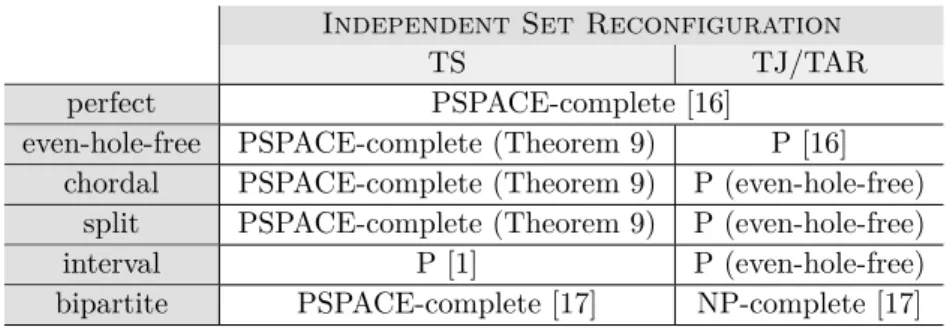
The Independent Set Reconfiguration problem has been intensively studied under all three rules. Because the problem is PSPACE-complete in general for all three rules [16], this has motivated the study of its complexity in restricted classes of graphs, with an emphasis on graphs where Independent Set is polynomial-time solvable, such as chordal graphs and bipartite graphs. By now, many results of this type have been discovered (see Table 1 for a summary).
Our first, and main, focus of this paper is to concentrate on a case of this problem which has so far remained elusive, namely, the complexity of Independent Set Reconfiguration on chordal graphs under the TS rule. This case is of particular interest because it is one of the few cases where the problem is known to be tractable under both TAR and TJ. Indeed, Kamiński, Medvedev, and Milanič [16] showed that under these two rules Independent Set Reconfiguration is polynomial-time solvable on even-hole-free graphs, a class that contains chordal graphs. In the same paper they explicitly asked as an open question if the same problem is tractable on even-hole-free graphs under TS ([16, Question 2]).
This question was then taken up by Bonamy and Bousquet [1] who made some progress by showing that Independent Set Reconfiguration under TS is polynomial-time solvable on interval graphs, an important subclass of chordal graphs. They also gave some first evidence that it may be hard to obtain a similarly positive result for chordal graphs by showing that a related problem, the problem of determining if all independent sets of the same size can be transformed to each other under TS, is coNP-hard on split graphs, another subclass of chordal graphs. Note, however, that this is a problem that is clearly distinct from the more common reconfiguration problem (which asks if two specific sets are reachable from each other), and that the coNP-hardness is not tight, since the best known upper bound for this problem is also PSPACE.
The complexity of Independent Set Reconfiguration under TS on split and chordal graphs has thus remained as an open problem. Our first, and main, contribution in this paper is to settle this problem by showing that the problem is PSPACE-complete already on split graphs (Theorem 9), and therefore also on chordal and even-hole-free graphs.
Table 1 Complexity of Independent Set Reconfiguration on some graph classes. Independent Set Reconfiguration
TS TJ/TAR
perfect PSPACE-complete [16]
even-hole-free PSPACE-complete (Theorem 9) P [16] chordal PSPACE-complete (Theorem 9) P (even-hole-free)
split PSPACE-complete (Theorem 9) P (even-hole-free)
interval P [1] P (even-hole-free)
bipartite PSPACE-complete [17] NP-complete [17]
c-Colorable Reconfiguration. A natural generalization of Independent Set
Reconfig-uration was recently introduced in [15]: in c-Colorable ReconfigReconfig-uration we are given a graph G = (V, E) and two sets S, T ⊆ V , both of which induce a c-colorable graph. The question is whether S can be transformed to T (under any of the previously mentioned rules) in a way that maintains a c-colorable graph at all times. Clearly, c = 1 is the case of Independent Set Reconfiguration. It was shown in [15] that this problem is already PSPACE-complete on split graphs under all three rules, when c is part of the input. It was thus posed as an open question what is the complexity of the same problem when c is fixed. Some first results in this direction were given in the form of an nO(c) (XP) algorithm that
works for split graphs under the TAR and TJ rules (but not TS). Motivated by this work, the second area of focus of this paper is to investigate how the hardness of 1-Colorable Reconfiguration for split graphs established in Theorem 9 extends to larger, but fixed c.
Our first contribution in this direction is to show that, for chordal graphs, c-Colorable Reconfiguration under TS is PSPACE-complete for any fixed c ≥ 1. This is, of course, not surprising, as the problem is PSPACE-complete for c = 1; indeed, the reduction we present in Theorem 10 is a tweak of the construction of Theorem 9 that increases c.
What is perhaps more surprising is that we show (under standard assumptions) that, even though Theorem 9 establishes hardness for c = 1 on split graphs, a similar tweak cannot establish hardness for higher c on the same class for TS. Indeed, we provide an algorithm which solves TS c-Colorable Reconfiguration in split graphs in time nO(c) for any
c except c = 1. Thus, Independent Set Reconfiguration turns out to be the only hard case of c-Colorable Reconfiguration for split graphs under TS. Since the nO(c) algorithm of [15] for TAR/TJ reconfiguration of split graphs works for all fixed c, it thus seems that this anomalous behavior is peculiar to the Token Sliding rule.
Finally, we address the natural question of whether one can improve this nO(c)algorithm, by showing that the problem is W[2]-hard parameterized by c and the length of the solution ` for all three rules. This is in a sense doubly tight, since in addition to our algorithm and the algorithm of [15] which run in nO(c), it also matches the trivial nO(`) algorithm which tries
out all solutions of length `. More strongly, under the ETH our reduction implies that the problem cannot be solved in no(c+`) meaning that these algorithms are in a sense “optimal”.
2
Definitions
We use standard graph-theoretic terminology. For a graph G = (V, E) and a set S ⊆ V we use G[S] to denote the graph induced by S. A graph is chordal if it does not contain a k-vertex cycle Ck as an induced subgraph for any k > 3. A graph is split if its vertex
independent set. It is a well-known fact that split graphs are chordal, and it is easy to see that both classes are closed under induced subgraphs. We use χ(G), ω(G) to denote the chromatic number and maximum clique size of a graph G respectively. It is known that, because chordal graphs are perfect, if G is chordal then χ(G) = ω(G) [21]. We also recall that a graph G is chordal if and only if every induced subgraph of G contains a simplicial vertex, where a vertex is simplicial if its neighborhood is a clique.
Let G = (V, E) be a graph and c ≥ 1 an integer. Given two sets S, T ⊆ V such that χ(G[S]), χ(G[T ]) ≤ c, we say that S can be c-transformed into T by one token sliding (TS) move if |T | = |S| and there exist u, v ∈ V with (u, v) ∈ E such that {u} = T \ S, {v} = S \ T . One easy way to think of TS moves is by picturing the elements of the current set S as tokens placed on the vertices of the graph, and a single move as “sliding” a token along an edge (hence the name Token Sliding).
We say that S is c-reachable from T , or that S can be c-transformed into T , by a sequence of TS moves if there exists a sequence of sets I0, I1, . . . , I`, with I0= S, I`= T and for each
i ∈ {0, . . . , ` − 1}, χ(G[Ii]) ≤ c and Ii can be c-transformed into Ii+1 by one TS move. We
will simply say that S can be transformed into T or that S is reachable from T , if S, T are independent sets and S can be 1-transformed into T . We focus on the following problems.
IDefinition 1. In c-Colorable Reconfiguration we are given a graph G = (V, E) and two sets S, T ⊆ V with |S| = |T | and χ(G[S]), χ(G[T ]) ≤ c. We are asked if S can be c-transformed into T . Independent Set Reconfiguration is the special case of
c-Colorable Reconfiguration where c = 1.
In addition to TS moves we will consider Token Jumping (TJ) and Token Addition & Removal (TAR) moves. A TJ move is the same as a TS move except that the two vertices u, v are not required to be adjacent. Two c-colorable sets S, T are reachable with one TAR move with threshold k if |S|, |T | ≥ k and |(S \ T ) ∪ (T \ S)| = 1. We note here that, because our main focus in this paper is the TS rule, whenever we refer to a transformation without explicitly specifying under which rule this transformation is performed the reader may assume that we are referring to the TS rule.
We assume that the reader is familiar with basic complexity notions such as the class PSPACE [20], as well as basic notions in parameterized complexity, such as the class W[2] (see e.g. [4]). In Theorem 9 we will perform a reduction from the PSPACE-complete NCL (non-deterministic constraint logic) reconfiguration problem introduced by Demaine and Hearn in [8] (see also [7, 9]). Let us recall this problem. In the NCL reconfiguration problem we are given as input a graph G = (V, E), whose edge set is partitioned into two sets, R (red) and B (blue). We consider blue edges as edges of weight 2 and red edges as edges of weight 1. A valid configuration of G is an orientation of all the edges with the property that all vertices have weighted in-degree at least 2. In the NCL configuration-to-configuration problem we are given two valid orientations of G, D and D0, and are asked if there is a sequence of valid orientations D0, D1, . . . , Dtsuch that D = D0, D0= Dtand for all i ∈ {0, . . . , t − 1} we have
that Di, Di+1 agree on all edges except one. We recall the following theorem:
I Theorem 2 (Corollary 6 of [8]). The NCL configuration-to-configuration problem is PSPACE-complete even if all vertices of G have degree exactly three and, moreover, even if all vertices belong in one of the following two types: OR vertices, which are vertices incident on exactly three blue edges and no red edges; and AND vertices which are vertices incident on two red edges and one blue edge.
3
Token Sliding on Split Graphs is PSPACE-complete
The main result of this section is that Independent Set Reconfiguration is PSPACE-complete under the TS rule when restricted to split graphs.
Overview of the proof
Our proof is a reduction from the NCL (non-deterministic constraint logic) reconfiguration problem of Theorem 2. The first step of our proof is a relatively straightforward reduction from the NCL reconfiguration problem to token sliding on split graphs. Its main idea is roughly as follows: for each edge e = (u, v) of the original graph we construct two selection vertices eu, ev in the independent set of our split graph. The idea is that at each point exactly
one of the two will contain a token (i.e. will belong in the current independent set), hence our independent set will in a natural way represent an orientation of the original graph. In order to allow a single reconfiguration step to take place we add for each pair of selection vertices eu, ev one or two “gate” vertices (depending on the color of e), which are common
neighbors of eu, ev and belong in the clique. The idea is that a single re-orientation step
would, for example, take a token from eu, slide it to a gate vertex connected to the pair
eu, ev, and then slide it to ev: this sequence would represent re-orienting e from u to v. In
order to simulate the in-degree constraint we add edges between each selection vertex eu
and gate vertices corresponding to edges incident on the other endpoint of e, since keeping a token on eu represents an orientation of e towards u, which makes it harder to re-orient the
edges incident on the other endpoint of e.
The above sketch captures the basic idea of our reduction, except for one significant obstacle. The correspondence between orientations and independent sets is only valid if we can guarantee that no intermediate independent set will “cheat” by, for example, placing tokens on both eu and ev. Since we have added edges from eu, ev to gate vertices that
correspond to other edges (in order to simulate the interaction between edges in the NCL instance), nothing prevents a reconfiguration solution from using these edges to slide a token from one selection pair to another. The main problem thus becomes enforcing consistency, or in other words forcing the solution sequence to only use the appropriate gate vertices to slide tokens as intended. This is handled in the second step of our reduction which, given the split graph construction sketched above, makes a large number of copies and connects them appropriately in a way that the only feasible token sliding solutions are indeed those that correspond to valid orientations of the original graph.
In the remainder of this section we use the following notation: G = (V, E), where E = R ∪ B, is the graph supplied with the initial NCL reconfiguration instance and D, D0 are the initial and target orientations; Gb= (Vb, Eb) is the “basic” split graph of our construction
in the first step and S, T the independent sets of Gbfor which we need to decide reachability;
and Gf = (Vf, Ef) is the split graph of our final token sliding instance with Sf, Tf being its
corresponding independent sets.
Before we proceed, let us first slightly edit our given NCL reconfiguration instance. We will now allow some vertices to have degree two and call these vertices COPY vertices. Using these we can force the OR vertices to become an independent set.
ILemma 3. NCL reconfiguration remains PSPACE-complete on graphs where (i) all vertices are either AND vertices (two incident red edges, one incident blue edge), OR vertices (three incident blue edges), or COPY vertices (two incident blue edges) (ii) every blue edge is incident on exactly one COPY vertex.
Proof. For every blue edge e = (u, v) ∈ B in the original graph we delete this edge from the graph, introduce a new COPY vertex w, and connect w to u, v with blue edges. It is not hard to see that this transformation does not change the type of any original vertex or the
answer to the reconfiguration problem. J
First Step of the Construction
We assume (Lemma 3) that in the given graph G we have three types of vertices (AND, OR, COPY) and that each blue edge is incident on one COPY vertex. Let us now describe the construction of Gb.
1. For each e = (u, v) ∈ R we construct two selector vertices eu, ev and one gate vertex ge.
2. For each e = (u, v) ∈ B we construct two selector vertices eu, ev and two gate vertices
ge,1, ge,2.
3. For each edge e = (u, v) ∈ R we connect geto both eu, ev. For each edge e = (u, v) ∈ B
we connect both ge,1, ge,2 to both eu, ev. We call the edges added in this step gate edges.
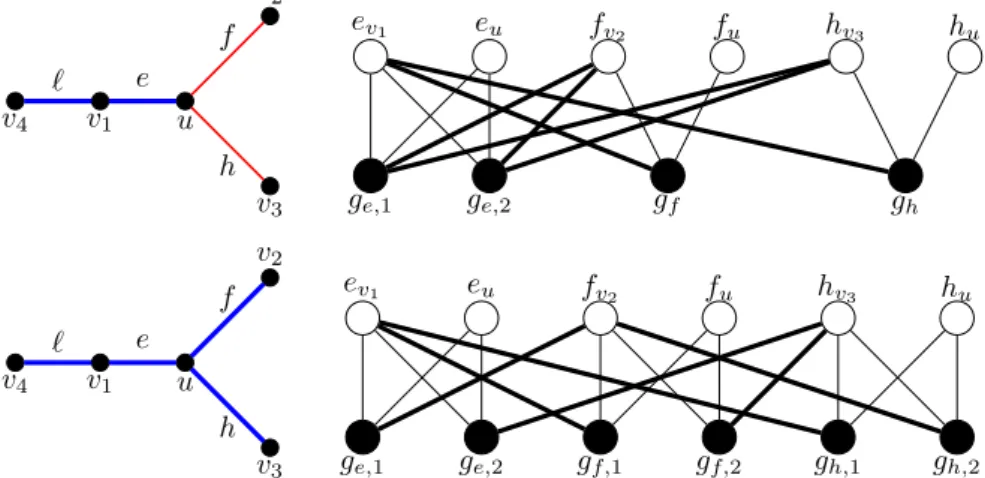
4. For each AND vertex u, such that e = (u, v1) ∈ B and f = (u, v2) ∈ R, h = (u, v3) ∈ R we add the following edges: (ev1, gf), (ev1, gh), (fv2, ge,1), (fv2, ge,2), (hv3, ge,1), (hv3, ge,2)
(see Figure 1). In other words, for each edge involved in this part we connect the selector which represents its other endpoint (not u) to the gate vertices of edges that should be unmovable if this edge is not oriented towards u.
5. For each OR vertex u such that e = (u, v1), f = (u, v2), h = (u, v3) ∈ B we add the following edges: (ev1, gf,1), (ev1, gh,1), (ev2, ge,1), (ev2, gh,2), (ev3, ge,2), (ev3, gf,2). In
other words, we connect the selector vertex for each vi to a distinct gate of the edges
(u, vj), (u, vk), for i, j, k distinct. Informally, this makes sure that if two of the edges are
oriented away from u the third edge is stuck, but if at most one is oriented away from u the other edges have a free gate.
6. For each COPY vertex u such that e = (u, v1), f = (u, v2) ∈ B we add the following edges: (ev1, gf,1), (ev1, gf,2), (fv2, ge,1), (fv2, ge2). In other words, we connect the selector
vertex for v1 in a way that blocks the movement of the token from fu, and similarly for
v2.
7. We connect all gate vertices into a clique to obtain a split graph. Note that the remaining vertices (that is, the selector vertices ev) form an independent set.
We now construct two independent sets S, T of Gbin the natural way: given an orientation
D, for each e = (u, v) we place eu in S if and only if D orients e towards u; we construct T
from D0 in the same way. This completes the basic construction.
Before proceeding, let us make some basic observations regarding the neighborhoods of gate vertices of the graph Gb. We have the following:
If e = (u, v) ∈ R, let u0, v0 be vertices of G such that f = (u, u0) ∈ B, h = (v, v0) ∈ B (that is, u0, v0 are the second endpoints of the blue edges incident on u, v). We have that
N (ge) = {eu, ev, fu0, hv0}.
If e = (u, v) ∈ B, u is a COPY vertex and v is an AND vertex, let f = (u, u0) ∈ B be the other edge incident on u, and h = (v, v0), ` = (v, v00) ∈ R be the other two edges incident on v. Then N (ge,1) = N (ge,2) = {eu, ev, fu0, hv0, `v00}.
If e = (u, v) ∈ B, u is a COPY vertex and v is an OR vertex, let f = (u, u0) ∈ B be the other edge incident on u, and h = (v, v0), ` = (v, v00) ∈ B be the other two edges incident on v. Then one of the vertices ge,1, ge,2 has neighbors {eu, ev, fu0, hv0} and the other has
e f h ` u v1 v2 v3 v4 gf fu fv2 gh hu hv3 ge,1 ge,2 eu ev1 e f h ` u v1 v2 v3 v4 gf,1 gf,2 fu fv2 gh,1 gh,2 hu hv3 ge,1 ge,2 eu ev1
Figure 1 Construction when u is an AND vertex (top) or an OR vertex (bottom). In both cases v1 is a COPY vertex. The part of the construction corresponding to ` is not drawn: `v4 would be a
common neighbor of ge,1, ge,2 and euwould be a common neighbor of `e,1, `e,2. Edges connecting
selector vertices to their corresponding gates are drawn thinner for readability. On the right, black (gate) vertices are connected in a clique.
We are now ready to show that if we only consider “consistent” configurations in Gb,
then the new instance simulates the original NCL reconfiguration problem.
ILemma 4. There is a valid reconfiguration of the NCL instance given by G, D, D0 if and only if there exists a valid reconfiguration under the TS rule from S to T in Gb such that no
independent set of the reconfiguration sequence contains both eu, ev for any e = (u, v) ∈ E.
Proof. Since Gb is a split graph, any independent set contains at most one vertex from
the clique made up of the gate vertices. We will call an independent set that contains no gate vertices a “main” configuration. Furthermore, for main configurations that also obey the restrictions of the lemma (i.e. do not contain both eu, ev for any e ∈ E), we observe
that there is a natural one-to-one correspondence with the set of orientations of G: an edge e = (u, v) is oriented towards u if and only if eu is in the independent set. (We implicitly use
the fact that the number of tokens is |E|, therefore for each pair eu, ev exactly one vertex
has a token in such a main configuration).
Suppose now that we have two consecutive valid orientations Di, Di+1 in the
reconfigura-tion sequence of G such that Di, Di+1 differ only on the edge e = (u, v), which Di orients
towards u. We want to show that the sets Ii, Ii+1 obtained using the correspondence above
from Di, Di+1 can be obtained from each other with a pair of sliding token moves. Indeed,
the sets Ii, Ii+1 are identical except that {eu} = Ii\ Ii+1 and {ev} = Ii+1\ Ii. We would
like to slide the token from euto ev using a gate vertex adjacent to both vertices.
First, assume that e ∈ R, so there exists a single gate vertex ge. Furthermore, u, v are
both AND vertices. Since both Di, Di+1 are valid configurations, in both configurations the
blue edges incident on u, v are oriented towards these two vertices. As a result ge has no
neighbor in Ii.
Second, suppose e = (u, v) ∈ B and one of u, v is a COPY vertex. If e is incident on an AND vertex, because both Di, Di+1 are valid and agree on all edges except e we have that
both red edges incident on the AND vertex are oriented towards it in both configurations. Similarly, the second blue edge incident on the COPY endpoint of e is oriented towards it in both configurations. We therefore observe that neither ge,1, nor ge,2 has a neighbor in Ii
Similarly, for the last case, suppose that e = (u, v) ∈ B and one of the endpoints of e is an OR vertex, while the other is a COPY vertex. Again, because Di, Di+1are both valid and
only disagree on e, at least one of the blue edges incident on the OR vertex (other than e) is oriented towards it in both configurations. As before, the second blue edge incident on the COPY vertex is oriented towards it in both configurations. Therefore, one of ge,1, ge,2 has
no neighbor in Ii except eu, so we can safely slide the token from eu to ev with two moves.
To complete the proof, we need to show that if we have a valid token sliding reconfiguration sequence, this gives a valid reorientation sequence for G. The main observation now is that in a shortest token sliding solution that obeys the properties of the lemma, a token that slides out of eu must necessarily in the next move slide into ev, where e = (u, v) ∈ E. To
see this, observe that because of the requirement that the set does not contain both selector vertices of any edge, the tokens found on other selector vertices dominate all gate vertices except those corresponding to e. Since we can neither repeat configurations, nor add a second token to the clique made up of gate vertices, the next move must slide the token to the other selector vertex.
To see that the orientation sequence obtained through the natural translation of main configurations is valid, consider two consecutive main configurations Ii, Ii+1 in the token
sliding solution, such that the corresponding orientations are Di, Di+1, and Diis valid. We
will show that Di+1 is also valid. Suppose that Di+1 differs from Di in the edge e = (u, v)
which is oriented towards u in Di (it is not hard to see that Di, Di+1 cannot differ in more
than one edge). Thus, Ii is transformable in two moves to Ii+1 by sliding eu to a gate
corresponding to e and then to ev. If e is a red edge, this means that in Di both blue edges
incident on u, v are directed towards u, v, so the reorientation is valid. If e is blue, we first assume that u is a COPY vertex. Since a gate corresponding to u is free, the other blue edge incident on u is oriented towards u in Di and we have a valid move. Finally, if e is blue and
u is an OR vertex, we conclude that, since at least one gate from ge,1, ge,2 is available in Ii,
at least one of the two other blue edges incident on u is directed towards u in Di and we
have a valid move. J
Second Step: Enforcing Consistency
We will now construct a graph Gf that will function in a way similar to the graph we have
already constructed but in a way that enforces consistency. Let Gb= (Vb, Eb) be the graph
constructed in the first step of our reduction, and let Eg⊆ Eb be the set of gate edges, that
is, the set of edges that connect the selector vertices for an edge e to the corresponding gate(s).
Let m := |E| and C := m + 4. We first take C disjoint copies of Gb= (Vb, Eb) and for a
vertex v ∈ Vbwe will use the notation vi, where 1 ≤ i ≤ C to denote the vertex corresponding
to v in the i-th copy. Then, for every edge (u, v) ∈ Eb\ Eg (every non-gate edge) and for all
i 6= j ∈ {1, . . . , C} we add the edge (ui, vj). This completes the construction of Gf and it is
not hard to see that the graph is split, as the C copies of the clique of Gb form a larger clique.
To complete our instance let us explain how to translate an independent set of Gb that
contains no vertices of the clique to an independent set of Gf: we do this in the natural way
by including in the new independent set all C copies of vertices of the original independent set. Since both the initial and final independent sets in our first construction use no vertices in the clique, we have in this way two independent sets of size mC in the new graph, and thus a valid Token Sliding instance. Let S, T be the two independent sets of Gb we are asked
We first show that if we have a solution for reconfiguration in Gb then we have a solution
for reconfiguring the sets in the new graph.
ILemma 5. Let I1, I2 be two independent sets of Gb of size m that use no vertices of the
clique, respect the conditions of Lemma 4, and can be transformed to one another by two sliding moves. Then the independent sets I10, I20 which are obtained in Gf by including all
copies of vertices of I1, I2 respectively can be transformed into one another by a sequence of 2C TS moves.
Proof. Each of I1, I2 uses exactly one of the vertices eu, ev, for each edge e = (u, v) ∈ E,
because of their size, the fact that they contain no vertex of the clique, and the fact that neither contains both eu, ev for any edge e = (u, v) ∈ E (this is the condition of Lemma 4).
If I1 can be transformed into I2 with two sliding moves, the first move takes a token from an independent set vertex, say eu and moves it to the clique and the second moves the same
token to ev. Since I1contains a token on each pair of selector vertices, the only vertex of the clique on which the token can be moved is a gate vertex corresponding to e, say ge (if e is
red) or ge,1 (if e is blue). We now observe that if ge(or similarly ge,1) is available in I1(that is, it has no neighbors in I1 besides eu), then the same is true for giefor all i ∈ {1, . . . , C}
in I10. To see this, note that the neighbors of gei are, eiu, eiv, and, for each v ∈ N (ge) all the
vertices vj for j ∈ {1, . . . , C}. Since none of the neighbors of g
eis in I1, gei is available. We
therefore slide, one by one, a token from eiu to gei and then to eiv, for all i ∈ {1, . . . , C}. J
Now, for the more involved direction of the reduction we first observe that it is impossible for a reconfiguration to arrive at a situation where the solution is highly irregular, in the sense that, for an edge e = (u, v) we have multiple tokens on copies of both eu and ev.
ILemma 6. Let Sf be the initial independent set constructed in our instance and S0 be an
independent set which for some e = (u, v) ∈ E and for some i, j ∈ {1, . . . , C} with i 6= j has eiu, eiv, eju, ejv∈ S0. Then S0 is not reachable with TS moves from Sf.
Proof. Let S0 be an independent set that satisfies the conditions of the lemma but is reachable from Sf with the minimum number of token sliding moves. Consider a sequence
that transforms Sf to S0, and let S00be the independent set immediately before S0 in this
sequence. S00 contains exactly three of the vertices ei
u, eiv, eju, ejv. Without loss of generality
say ej
v6∈ S00. Therefore, the move that transforms S00to S0 slides a token into ejv from one of
the neighbors of this vertex. We now observe that N (ej
v) contains C copies of each neighbor
of ev in Gb, plus the gate vertices corresponding to e in the j-th copy of Gb. However, the C
copies of the neighbors of ev are also neighbors of eiv, hence a token cannot slide through
these vertices. Furthermore, the gate vertices of e are also neighbors of ej
u. We therefore
have a contradiction. J
We now use Lemma 6 to show that for each original edge, the graph Gf contains some
non-trivial number of tokens on the selector vertices of that edge.
ILemma 7. Let Sf be the initial independent set constructed in our instance and S0 be an
independent set which for some e = (u, v) ∈ E has |S0∩ ({ei
u | 1 ≤ i ≤ C} ∪ {e i
v | 1 ≤ i ≤
C})| < 4. Then S0 is unreachable from Sf.
Proof. Suppose S0 is reachable. Then by Lemma 6, for each edge e = (u, v) ∈ E we have |S0∩ ({ei
u| 1 ≤ i ≤ C} ∪ {eiv | 1 ≤ i ≤ C})| ≤ C + 1, because otherwise there would exist (by
pigeonhole principle) ei
u, eiv, eju, ejv∈ S0. We now use a simple counting argument. The total
number of tokens is mC, while for any edge f ∈ E we haveP
e∈E\{f }|S0∩ ({e i
C}∪{eiv| 1 ≤ i ≤ C})| ≤ (m−1)(C +1). However, (m−1)(C +1) = mC +m−C −1 = mC −5,
where we use the fact that C = m + 4. As a result |S0∩ ({ei
u | 1 ≤ i ≤ C} ∪ {eiv | 1 ≤ i ≤
C})| ≥ 4 for any edge e ∈ E, as the independent set S0 uses at most one vertex from the
clique. J
We are now ready to establish the final lemma that gives a mapping from a sliding token reconfiguration in Gf to one in Gb.
ILemma 8. If there exists a reconfiguration from Sf to Tf in Gf under the TS rule then
there exists a reconfiguration from S to T in Gb under the TS rule which for each edge
e = (u, v) ∈ E contains at most one of the vertices eu, ev in every independent set in the
sequence.
Proof. Take a configuration I of Gf, that is an independent set in the supposed sequence from
Sfto Tf. We map this independent set to an independent set I0of Gbas follows: for each edge
e = (u, v) ∈ E, we set eu∈ I0 if and only if |I ∩ {eiu | 1 ≤ i ≤ C}| ≥ |I ∩ {eiv | 1 ≤ i ≤ C}|.
Informally, this means that we take the majority setting from Gf. We note that this
always gives an independent set I0 that contains exactly one vertex from {eu, ev} for each
e = (u, v) ∈ E.
Our main argument now is to show that if I1, I2 are two consecutive independent sets of the solution for Gf, then the sets I10, I20 which are obtained in the way described above in Gb are either identical or can be obtained from one another with two sliding moves. If
I10, I20 are not identical, they may differ in at most two vertices corresponding to an edge e = (u, v) ∈ E, say {eu} = I10 \ I20 and {ev} = I20 \ I10. This is not hard to see, since I2 is obtained from I1 with one sliding move, and this move can only affect the majority opinion for at most one edge.
Now we would like to argue that it is possible to slide eu to a gate vertex associated to e
and then to ev in Gb. Consider the transition from I1 to I2. This move either slides a token from some ei
uto the clique, or slides a token from the clique to some ejv (because the majority
opinion changed from eu to ev). Because of Lemma 7, both I1 and I2 contain at least four vertices in some copies of eu, ev. Hence, since at least half of these vertices are in copies of eu
in I1, there exists some eiu∈ I1∩ I2. Similarly, there exists some ejv∈ I1∩ I2. Consider now a gate vertex g in the clique of Gb such that g is not associated with e. If g has an edge to
{eu, ev} in Gb, then all copies of g in Gf have an edge to I1∩ I2, therefore cannot belong in either set. As a result, the clique vertex that is used in the transition from I1 to I2 is a copy of a gate vertex associated with e (either ge, or one of ge,1, ge,2, depending on the color of e).
This gate vertex copy therefore has no neighbor in I1∩ I2. From this we conclude that the same gate vertex in Gb also has no neighbor in I10∩ I20, as the majority opinion only changed for e. It is therefore legal to slide from eu to this gate vertex and then to ev. J
ITheorem 9. Sliding Token Reconfiguration is PSPACE-complete for split graphs. Proof. We begin with an instance of the PSPACE-complete NCL reconfiguration problem, as given in Lemma 3. We construct the instance Gf, Sf, Tf of Sliding Token Reconfiguration
on split graphs as described (it’s clear that this can be done in polynomial time). If the NCL reconfiguration instance is a YES instance, then by Lemma 4 there exists a sliding token reconfiguration of Gb, and by repeated applications of Lemma 5 to independent sets
that do not contain clique vertices in the reconfiguration of Gb there exists a sliding token
reconfiguration of Gf. If on the other hand there exists a sliding token reconfiguration on
Gf, then by Lemma 8 there exists a reconfiguration that satisfies the condition of Lemma 4
4
PSPACE-completeness for Chordal Graphs for c ≥ 2
In this section, we build upon the PSPACE-completeness result from Section 3 to show that c-Colorable Set Reconfiguration is PSPACE-complete, for every c ≥ 2, when the input graph is restricted to be chordal.
ITheorem 10. For every c ≥ 2, the c-Colorable Set Reconfiguration problem under the TS rule is PSPACE-complete, even when the input graph is restricted to be chordal. Proof. We provide a reduction from Independent Set Reconfiguration where the input graph G is restricted to be a split graph, which we proved to be PSPACE-complete in Theorem 9. Let G = (V, E) be an input split graph for Independent Set Reconfiguration. We construct a chordal graph G0 as follows, starting from a graph isomorphic to G and two non-empty independents set S, T of the same size. For every edge uv ∈ E(G), we add |V (G)| sets of c − 1 new vertices W1
uv, . . . , W
|V (G)|
uv , such that Wuvi induces a clique for every
1 ≤ i ≤ |V (G)|, and every vertex of Wi
uv is made adjacent to both u and v, for every
1 ≤ i ≤ |V (G)|. In addition, we create a new set S0 = S ∪S
uv∈E(G),1≤i≤|V (G)|W i uv and a set T0= T ∪S uv∈E(G),1≤i≤|V (G)|W i
uv. In other words, we append |V (G)| disjoint cliques of
size c − 1 to every edge of G, and add all those newly created vertices to S and to T . The chordality of G0 follows from the fact that the new vertices of the sets Wi
uv are all simplicial
in G0, hence G0 is chordal if and only if G is chordal as well (and G is split).
We now claim the following: given in independent set T of G, the instance (G, S, T ) of Independent Set Reconfiguration is a YES-instance if and only if the instance (G0, S0, T0
) of c-Colorable Set Reconfiguration is a YES-instance as well. Observe that, by the construction, S0 and T0 are c-colorable because the maximum clique in G0[S0] contains at most one vertex of S and at most the c − 1 vertices of a clique Wi
uv.
The forward direction of the previous claim follows easily: performing the same moves as those of a reconfiguration sequence from S to T in G0, starting from S0, yields a reconfiguration sequence where every step preserves c-colorability, and produces the desired set T0.
For the backwards direction, we claim that, for any c-colorable set R0 reachable from S0, it holds that the vertices of R0∩ V (G) are pairwise non-adjacent. In other words, the tokens placed on original vertices of G form an independent set. Indeed, observe that the number of vertices of G0 that do not belong to R0 satisfies |V (G0) \ R0| = |V (G) \ S| < |V (G)|. This immediately implies that for any set R0 and edge uv ∈ E(G), we have |R0∩S 1≤i≤|V (G)|W i uv| ≥ (c − 2)|V (G)| + 1, and therefore G[R0∩ S 1≤i≤|V (G)|W i uv] contains
a clique of size c − 1 as an induced subgraph, i.e., one of the sets Wi
uvis completely contained
in R0. This implies that, for every edge uv of G, we have |R0∩ {u, v}| ≤ 1, i.e., the vertices
of R0∩ V (G) are pairwise non-adjacent, as desired. J
5
XP-time Algorithm on Split Graphs for fixed c ≥ 2
In this section we present an nO(c)algorithm for c-Colorable Reconfiguration under the TS rule, on split graphs, for c > 1. Recall that a split graph G = (V, E) is a graph whose vertex set V is partitioned into a clique K and an independent set I. An input instance consists of a split graph G, and two c-colorable sets S, T ⊆ V .
Before proceeding, let us give some high-level ideas as well as some intuition why this problem, which is PSPACE-complete for c = 1 (Theorem 9), admits such an algorithm for larger c. Our algorithm consists of two parts: a rigid and a non-rigid reconfiguration part. In the rigid reconfiguration part the algorithm decides if two sets are reachable by using
moves that never slide tokens into or out of I. Because of this restriction and the fact that the sets are c-colorable, the total number of possible configurations is nO(c), so this part can
be solved with exhaustive search (this is similar to the algorithm of [15] for TJ/TAR). In the non-rigid part we assume we are given two sets S, T which, in addition to being c-colorable, have |S ∩ K|, |T ∩ K| ≤ c − 1. The main insight is now that any two such sets are reachable via TS moves (Lemma 11 below). Informally, the algorithm guesses a partition of the optimal reconfiguration into a rigid prefix, a rigid suffix, and a non-rigid middle, and uses the two parts to calculate each independently.
The intuitive reason that our algorithm cannot work for c = 1 is the non-rigid part. The crucial Lemma 11 on which this part is based fails for c = 1: for instance, if G is a star with three leaves and S, T are two distinct sets each containing two leaves, then S, T satisfy all the conditions for c = 1, but are not reachable from each other with TS moves. Such counterexamples do not, however, exist for higher c, because for sets that satisfy the conditions of Lemma 11 we know we can always freely move tokens around inside the clique (and without loss of generality, such tokens exist). Note also, that this difficulty is specific to the TS rule: the algorithm of [15] implicitly uses the fact that any two sets with c − 1 tokens in the clique are always reachable, as this is an almost trivial fact if one is allowed to use TJ moves. Thus, Lemma 11 is the main new ingredient that makes our algorithm work.
Let us now proceed with a detailed description of the algorithm. First, let us fix some notation. For a vertex set R ⊆ V , we write the subsets R ∩ K and R ∩ I as RK and RI
respectively.
Throughout this section, we assume that input graph G = (K ∪ I, E) is connected (and thus each vertex in I has a neighbor in K); otherwise we can consider instances induced by each component separately.
ILemma 11. Let G be a split graph, c ≥ 2, and S, T ⊆ V be two c-colorable sets such that |SK|, |TK| ≤ c − 1. Then T is c-reachable from S. Furthermore, a reconfiguration sequence
from S to T can be produced in polynomial time.
Proof. We first observe that if SI = TI, then there is an easy optimal c-transformation. By
making one TS move from u ∈ SK\ TK to v ∈ TK\ SK, one can c-transform S to T with
|S \ T | sliding moves (thus yielding an optimal reconfiguration sequence). It is clear that all the sets resulting from these TS moves are c-colorable because each of them has at most c − 1 vertices in K.
Therefore, it suffices to show that there is always a c-transformation of T which decrease |SI\ TI| as long as S 6= T . Note that we can assume that there exists v ∈ SI\ TI (otherwise
we exchange the roles of S and T ). In the case when TK = ∅, one can transform T to T0with
TS moves from a vertex of TI\ SI to v. Trivially this is a c-transformation, and it holds that
|T0
K| = ∅. (Note that this argument would not be valid if c = 1). If TK 6= ∅, then one can
make at most two TS moves from a vertex of TK to v. Because T has at most c − 1 vertices
and these TS moves maintain at most c − 1 vertices in K, c-colorability of T is preserved. Moreover, the new set has at most c − 1 vertices in K while its intersection with S in I is strictly larger. This completes the proof of the first statement. The proof is constructive and
easily translates to a polynomial-time algorithm. J
Let us now introduce a notion that will be useful in our algorithm. For two c-colorable sets S, T with SI = TI we say that S has a rigid c-transformation to T if there exists a
valid c-transformation from S to T with TS moves which also has the property that every c-colorable set R of the transformation has RI = SI.
I Lemma 12. Given a split graph G = (V, E), with V = K ∪ I, and two c-colorable sets S, T ⊆ V with SI = TI, there is an algorithm that decides if there exists a rigid
c-transformation of S to T in time nO(c).
Proof. The main observation is that since all intermediate sets must have RI = SI, we are
only allowed to slide tokens inside K. However, SK contains at most c vertices (as it is
c-colorable), therefore, there are at most nc potentially reachable sets: one for each collection
of |SK| vertices of the clique.
We now construct a secondary graph with a node for each subset of V that contains |SK|
vertices of K and the vertices of SI, and connect two such nodes if their corresponding sets
are reachable with a single TS move in G. In this graph we check if there is a path from the node that represents S to the one that represents T and if yes output the sets corresponding to the nodes of the path as our rigid reconfiguration sequence. J
ITheorem 13. There is an algorithm that decides c-Colorable Reconfiguration on split graphs under the TS rule in time nO(c), for c ≥ 2.
Proof. We distinguish the following cases: (i) |SK|, |TK| ≤ c−1, (ii) |SK| = c and |TK| = c−1,
(iii) |SK| = |TK| = c. This covers all cases since S, T are c-colorable and we can assume
without loss of generality that |SK| ≥ |TK|.
For case (i) we invoke Lemma 11. The answer is always Yes, and the algorithm of the lemma produces a feasible reconfiguration sequence.
For case (ii), suppose there exists a reconfiguration sequence from S to T , call it T0= S, T1, . . . , T`= T . Let i be the smallest index such that |Ti∩ K| ≤ c − 1. Clearly such an
index exists, since |TK| ≤ c − 1. We now guess the configuration Ti−1 and the configuration
Ti (that is, we branch into all possibilities). Observe that there are at most nc choices for
Ti−1as we have Ti−1∩ I = SI and |Ti−1∩ K| = c. Furthermore, once we have selected a
Ti−1, there are nO(1) possibilities for Ti, as Ti is reachable from Ti−1with one TS move.
We observe that if we guessed correctly, then there exists a rigid c-transformation from S to Ti−1 (by the minimality of i and the fact that |SK| = c); we use the algorithm of
Lemma 12 to check this. Furthermore, the configuration Ti is always transformable to T
by Lemma 11. Therefore, if the algorithm of Lemma 12 returns a solution, then we have a c-transformation from S to T . Conversely, if a c-transformation from S to T exists, since we tried all possibilities for Ti−1, one of the branches will find it.
Finally, for case (iii), if SI = TI we first use Lemma 12 to check if there is a rigid
c-transformation from S to T . If one is found, we are done. If not, or if SI 6= TI we observe
that, similarly to case (ii), in any feasible transformation T0= S, T1, . . . , T`= T , there exists
an i such that |Ti∩ K| ≤ c − 1 (otherwise the transformation would be rigid). Pick the
minimum such i. We now guess the configurations Ti−1, Ti (as before, there are nc+O(1)
possibilities) and use Lemma 12 to verify that Ti−1is reachable from S. If Ti−1is reachable
from S, we need to verify that T is reachable from Ti. However, we observe that this reduces
to case (ii), because |Ti∩ K| ≤ c − 1, so we proceed as above. If the algorithm returns a
valid sequence we accept, while we know that if a valid sequence exists, then there exists a
correct guess for Ti−1, Ti that we consider. J
6
W-hardness for Split Graphs
In this section we show that c-Colorable Reconfiguration on split graphs is W[2]-hard parameterized by c and the length ` of the reconfiguration sequence under all three reconfiguration rules (TAR, TJ, and TS). In this sense, this section complements Section 5 by
showing that the nO(c) algorithm that we presented for c-Colorable Reconfiguration on split graphs cannot be significantly improved under standard assumptions.
We will rely on known results on the hardness of Dominating Set Reconfiguration. We recall that in this problem we are given a graph G = (V, E), two dominating sets S, T ⊆ V of size at most k and are asked if we can transform S into T by a series of TAR operations while keeping the size of the current set at most k at all times. More formally, we are asked if there exists a sequence T0= S, T1, . . . , T`= T such that for each i ∈ {0, . . . , ` − 1}, |Ti| ≤ k,
Ti is a dominating set of G, and |(Ti\ Ti+1) ∪ (Ti+1\ Ti)| = 1.
ITheorem 14 ([18]). Dominating Set Reconfiguration is W[2]-hard parameterized by the maximum size of the allowed dominating sets k and the length ` of the reconfiguration sequence under the TAR rule.
Before proceeding, let us make two remarks on Theorem 14: first, because the reduction of [18] is linear in the parameters, it is not hard to see that it also implies a tight ETH-based lower bound based on known results for Dominating Set; second, using an argument similar to that of Theorem 1 of [16], the same hardness can be obtained for the TJ rule.
ICorollary 15. Dominating Set Reconfiguration is W[2]-hard parameterized by the maximum size of the allowed dominating sets k and the length ` of the reconfiguration sequence under the TAR, or TJ rule. Furthermore, the problem does not admit an algorithm running in no(c+`) under the ETH for any of the two rules.
Proof. To obtain hardness under the TJ rule we use an argument similar to that of Theorem 1 of [16]. Suppose we are given an instance of k-Dominating Set Reconfiguration G = (V, E) and S, T ⊆ V where k is the maximum size of any dominating set allowed and we use the TAR rule, that is, an instance produced by the reduction establishing Theorem 14. We recall that in the instances produced for this reduction we have k = Θ(`) and that S can be transformed into T with ` TAR moves if and only if S can be transformed into T with some number of TAR moves (in other words, if ` moves are not sufficient, then S and T are in fact unreachable). This observation will be useful because it means that in the reduction that follows we do not have to preserve ` exactly but only guarantee that it increases by at most a constant factor.
We can assume without loss of generality that |S| = |T | = k − 1: if |S| < k − 1 we can add to S arbitrary vertices to make its size k − 1, while if |S| = k then S cannot be a minimal dominating set (otherwise it would be impossible to transform it to any other set and we would have an obvious NO instance) so there is a vertex that we can remove from S without affecting the answer. In both cases we appropriately increase ` by the number of modifications we made to S, T to preserve reachability. We want to show that the instance is now equivalent under the TJ rule. In particular, there exists a TAR reconfiguration with 2` moves if there exists a TJ reconfiguration with ` moves.
First, if there exists a TJ reconfiguration from S to T then there exists a TAR reconfigu-ration from S to T : for each move that exchanges u ∈ S with v 6∈ S we first add v to S and then remove u.
For the converse direction, suppose that there is a TAR reconfiguration of S to T . If moves alternate in this reconfiguration, that is, if all intermediate sets have size between k − 2 and k, then it is not hard to see how to perform the same reconfiguration with TJ moves. Suppose then that the reconfiguration performs two consecutive vertex removal moves, so we have the dominating sets Ti, Ti+1, Ti+2 appearing consecutively in the reconfiguration
that |Tj| > |Tj−1| (i.e. j signifies the first time we added a vertex after the i-th move). Let
Ti\ Ti+1= {u} and Tj\ Tj−1= {v}. Then, if u = v we can add u to all sets Ti+1, . . . , Tj−1
and obtain a shorter reconfiguration sequence (since now Ti= Ti+1 and Tj= Tj−1). Similarly,
if u 6= v and v ∈ Ti+1 we add v to all sets Ti+2, . . . , Tj−1 to which it doesn’t appear and we
have a shorter reconfiguration sequence. Finally, if u 6= v and v 6∈ Ti+1, we insert after Ti+1
the set Ti+1∪ {v} and then add v to all sets Ti+2, . . . , Tj−1. We now have Tj−1= Tj, so we
have a valid TAR reconfiguration of the same length but with one less pair of consecutive vertex removals. Repeating this argument produces a TAR reconfiguration which can be performed with TJ moves.
For the ETH-based lower bound it suffices to recall that, under the ETH t-Dominating Set does not admit an no(t) algorithm [4], and that the reduction establishing Theorem 14 in [18] is a reduction from t-Dominating Set that sets k, ` = O(t). J ITheorem 16. The c-Colorable Reconfiguration problem is W[2]-hard parameterized by c and the reconfiguration length ` when restricted to split graphs under any of the three reconfiguration rules (TAR, TJ, TS). Furthermore, under the ETH, the same problem does not admit an no(c+`) algorithm.
Proof. We use a reduction from Dominating Set Reconfiguration similar to the one used in [15] to prove that our problem is PSPACE-complete if c is part of the input. Let G = (V, E) be an input graph for Dominating Set Reconfiguration. We construct a split graph G0 as follows: we take two copies of V , call them V1, V2; we turn V1into a clique; for each u ∈ V1 and v ∈ V2 we add the edge (u, v) if and only if u 6∈ N [v] in G. In other words, we connect each vertex from V1 with all the vertices of V2which it does not dominate in G.
We assume now that we have started with k-Dominating Set Reconfiguration instance under the TJ rule, which is W[2]-hard according to Corollary 15 parameterized by k + `. We will first show hardness of c-Colorable Reconfiguration for TJ and TS parameterized by c + `.
We construct a one-to-one correspondence between size k dominating sets of G and k-colorable sets of vertices of G0 of size n + k, where n = |V |: for each such set S ⊆ V we define its image φ(S) in G0 as {u ∈ V1| u ∈ S} ∪ V2. In other words, we select all the vertices of S from V1 and all of V2. It is not hard to see that φ(S) is indeed k-colorable: if not, there exists a clique of size k + 1 in G0[S0] (since split graphs are perfect), which must consist of the k vertices of S from V1, plus a vertex v from V2. But v must be dominated by a vertex u ∈ S in G, which means that v and the copy of u in V1 are not connected.
Let us also observe that for every k-colorable set S0 of size n + k in G0 we have that S0= φ(S) for some dominating set S of size k in G. To see this, observe that S0 must contain exactly k vertices of V1(since it is k-colorable, V1 is a clique, and |V2| = n). These vertices must be a dominating set of G as otherwise there would exist a vertex v that is not in any of their closed neighborhoods, and the copy of v in V2together with S0∩ V1 would form a clique of size k + 1, contradicting the k-colorability of S0.
Given the above correspondence it is not hard to complete the reduction: if we are given two dominating sets S, T ⊆ V with the initial instance we set φ(S), φ(T ) as the two k-colorable graphs of the new instance. We observe that any valid TJ move that transforms a dominating set Tito a dominating set Ti+1 in G, corresponds to a TJ move that transforms
φ(Ti) to φ(Ti+1) in G0. Crucially, such a move is also a TS move, as the symmetric difference
between TJ k-dominating set reconfigurations in G and TS k-colorable subgraph (of size n + k) reconfiguration in G0. We therefore set the length of the desired reconfiguration sequence in G0 to `.
Finally, to obtain hardness of the new instance under the TAR rule we set the lower bound on the size of any intermediate set to n + k − 1. Since |φ(S)| = |φ(T )| = n + k this means that any TJ c-colorable reconfiguration can also be performed with at most 2` TAR moves. For the converse direction we observe that in any TAR reconfiguration we never have a set of size n + k + 1 or more, since such a set would necessarily induce a graph that needs k + 1 colors. Hence, such a reconfiguration must consist of alternating vertex removal and addition moves, which can be performed with ` TJ moves.
The ETH-based lower bounds follow from Corollary 15 and the fact that the reduction
we performed is at most linear in all parameters. J
References
1 Marthe Bonamy and Nicolas Bousquet. Token Sliding on Chordal Graphs. In WG 2017, volume 10520 of Lecture Notes in Computer Science, pages 127–139, 2017. doi:10.1007/ 978-3-319-68705-6_10.
2 Paul S. Bonsma, Marcin Kaminski, and Marcin Wrochna. Reconfiguring Independent Sets in Claw-Free Graphs. In SWAT, volume 8503 of Lecture Notes in Computer Science, pages 86–97. Springer, 2014.
3 Nicolas Bousquet, Arnaud Mary, and Aline Parreau. Token Jumping in Minor-Closed Classes. In FCT, volume 10472 of Lecture Notes in Computer Science, pages 136–149. Springer, 2017.
4 Marek Cygan, Fedor V. Fomin, Lukasz Kowalik, Daniel Lokshtanov, Dániel Marx, Marcin Pilipczuk, Michal Pilipczuk, and Saket Saurabh. Parameterized Algorithms. Springer, 2015.
5 Erik D. Demaine, Martin L. Demaine, Eli Fox-Epstein, Duc A. Hoang, Takehiro Ito, Hirotaka Ono, Yota Otachi, Ryuhei Uehara, and Takeshi Yamada. Linear-time algorithm for sliding tokens on trees. Theor. Comput. Sci., 600:132–142, 2015. doi:10.1016/j.tcs.2015.07.037.
6 Eli Fox-Epstein, Duc A. Hoang, Yota Otachi, and Ryuhei Uehara. Sliding Token on Bipartite Permutation Graphs. In ISAAC, volume 9472 of Lecture Notes in Computer Science, pages 237–247. Springer, 2015.
7 Robert A. Hearn. Games, puzzles, and computation. PhD thesis, Massachusetts Institute of Technology, Cambridge, MA, USA, 2006. URL: http://hdl.handle.net/1721.1/37913.
8 Robert A. Hearn and Erik D. Demaine. PSPACE-completeness of sliding-block puzzles and other problems through the nondeterministic constraint logic model of computation. Theor. Comput. Sci., 343(1-2):72–96, 2005. doi:10.1016/j.tcs.2005.05.008.
9 Robert A. Hearn and Erik D. Demaine. Games, puzzles and computation. A K Peters, 2009.
10 Jan van den Heuvel. The complexity of change. In Simon R. Blackburn, Stefanie Gerke, and Mark Wildon, editors, Surveys in Combinatorics 2013, volume 409 of London Mathematical Society Lecture Note Series, pages 127–160. Cambridge University Press, 2013. doi:10.1017/ CBO9781139506748.005.
11 Duc A. Hoang and Ryuhei Uehara. Sliding Tokens on a Cactus. In ISAAC, volume 64 of LIPIcs, pages 37:1–37:26. Schloss Dagstuhl - Leibniz-Zentrum fuer Informatik, 2016. 12 Takehiro Ito, Erik D. Demaine, Nicholas J. A. Harvey, Christos H. Papadimitriou, Martha
Sideri, Ryuhei Uehara, and Yushi Uno. On the complexity of reconfiguration problems. Theor. Comput. Sci., 412(12–14):1054–1065, 2011. doi:10.1016/j.tcs.2010.12.005.
13 Takehiro Ito, Marcin Kaminski, Hirotaka Ono, Akira Suzuki, Ryuhei Uehara, and Katsuhisa Yamanaka. On the Parameterized Complexity for Token Jumping on Graphs. In TAMC, volume 8402 of Lecture Notes in Computer Science, pages 341–351. Springer, 2014.
14 Takehiro Ito, Marcin Jakub Kaminski, and Hirotaka Ono. Fixed-Parameter Tractability of Token Jumping on Planar Graphs. In ISAAC, volume 8889 of Lecture Notes in Computer Science, pages 208–219. Springer, 2014.
15 Takehiro Ito and Yota Otachi. Reconfiguration of Colorable Sets in Classes of Perfect Graphs. In SWAT, volume 101 of LIPIcs, pages 27:1–27:13. Schloss Dagstuhl - Leibniz-Zentrum fuer Informatik, 2018.
16 Marcin Kamiński, Paul Medvedev, and Martin Milanič. Complexity of independent set reconfigurability problems. Theor. Comput. Sci., 439:9–15, 2012. doi:10.1016/j.tcs.2012. 03.004.
17 Daniel Lokshtanov and Amer E. Mouawad. The complexity of independent set reconfiguration on bipartite graphs. In SODA 2018, pages 185–195, 2018. doi:10.1137/1.9781611975031.13.
18 Amer E. Mouawad, Naomi Nishimura, Venkatesh Raman, Narges Simjour, and Akira Suzuki. On the Parameterized Complexity of Reconfiguration Problems. Algorithmica, 78(1):274–297, 2017.
19 Naomi Nishimura. Introduction to Reconfiguration. Algorithms, 11(4):52, 2018. doi:10.3390/ a11040052.
20 Christos H. Papadimitriou. Computational complexity. Addison-Wesley, 1994.
21 Douglas B. West. Introduction to graph theory. Prentice Hall, Upper Saddle River, 2nd edition, 2001.